There is a particular Pinterest spiral that starts with one innocent photo of a candlelit Christmas table and ends forty minutes later with you zoomed in on a stranger’s napkin rings. No judgment — that is exactly how this guide was born. After filtering through hundreds of options across Etsy, Target, and Anthropologie, we narrowed it down to 35 ideas that actually deliver, from a $6 spool of velvet ribbon to a $480 dinnerware set.
Inside you will find cozy neutral evergreen tables, modern black-and-gold settings, rustic woodland centerpieces, and a few gloriously whimsical pastel palettes — with budget and luxury versions compared side by side wherever it matters.
What has shifted for 2026 is the palette. Red-and-green is no longer the default; olive, mauve, slate, and soft pink are showing up on holiday tables because hosts want something that does not have to be packed away on December 26.
And stay until the end — we break down the most common mistakes that can ruin these looks.
📌 Save this to Pinterest for later — you’ll want to revisit these ideas.
1. Neutral Christmas Table Wrapped in Evergreen Garland
If you are building a garland runner, do not lay it in one straight line — it reads like a hedge. Snake it in loose S-curves and pinch in a few branch tips at the ends so it looks like it grew there. Keep the center of the arrangement under about four inches tall or nobody across the table can see each other, and cluster your tapers in odd numbers, slightly off-center. Three candles at 8, 10, and 12 inches will always beat a perfectly matched pair.
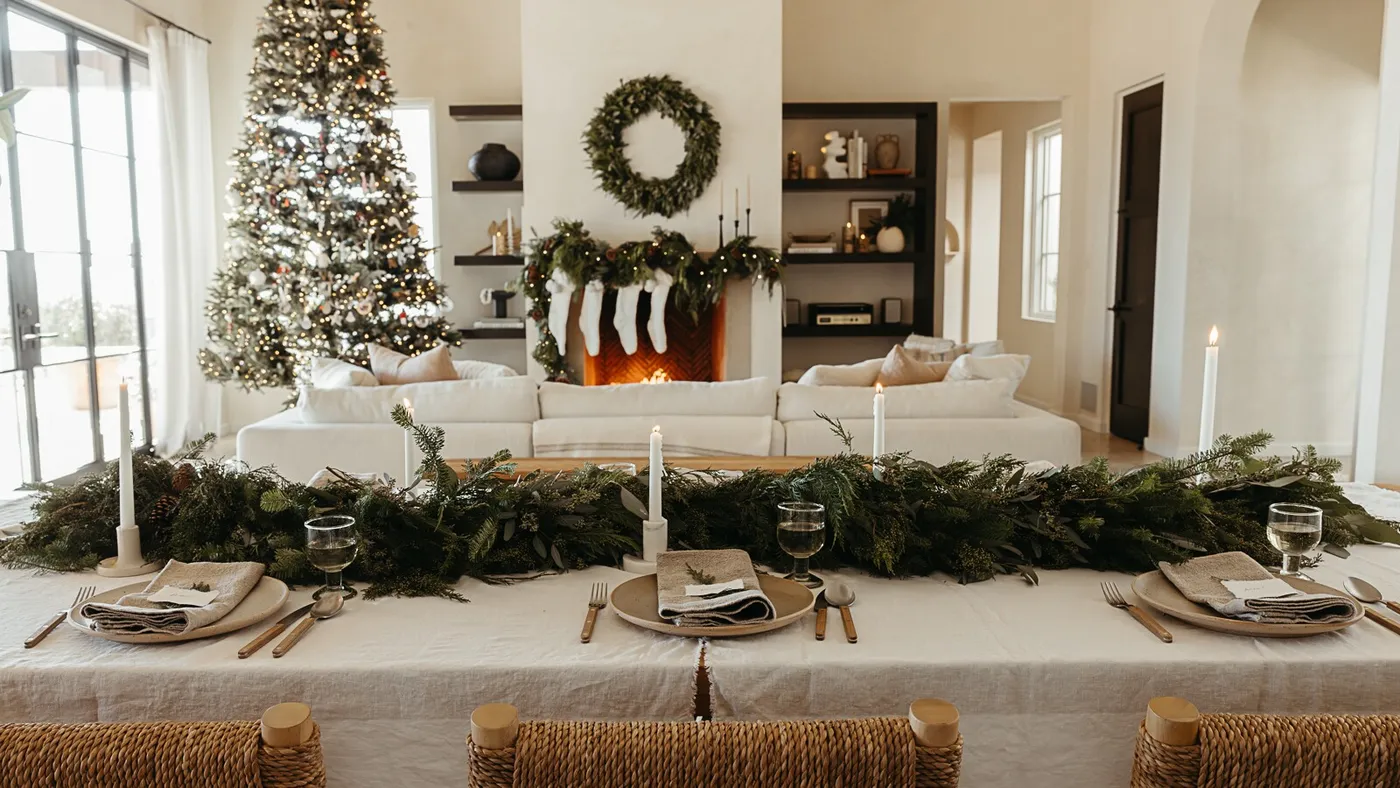
The restraint is doing the work. A white cloth, plain ceramic plates, and wooden-handled cutlery hand the evergreen and eucalyptus garland all the color authority, so a busy centerpiece is not fighting a busy table. Notice the only repeated gesture is a single sprig on each napkin — repetition at a scale small enough to read as polish rather than theme. Warm white tapers add one more layer of soft, flickering light against all that matte texture.
- Garland, fresh or good faux: $35–$120
- White linen tablecloth: $25–$90
- Neutral ceramic dinnerware, set of 6: $60–$180
- White taper candles and holders: $18–$60
- Linen napkins and wooden-handled flatware: $40–$130
Total: $178–$580. Budget alternative: wire two $12 faux cedar stems together with grocery-store eucalyptus instead of buying a full garland — roughly half the cost.
2. Grey-and-White Minimalist Table with Paper Stars
The trio of paper stars on the wall is the whole trick. A grey-and-white table against a white wall is beautifully calm and, honestly, a little flat — those stars pull the eye upward and give the composition a top, a middle, and a bottom. Take them away and you have a very tasteful table that photographs like a blank page. One black star among the white ones is what saves it from looking like a nursery mobile.
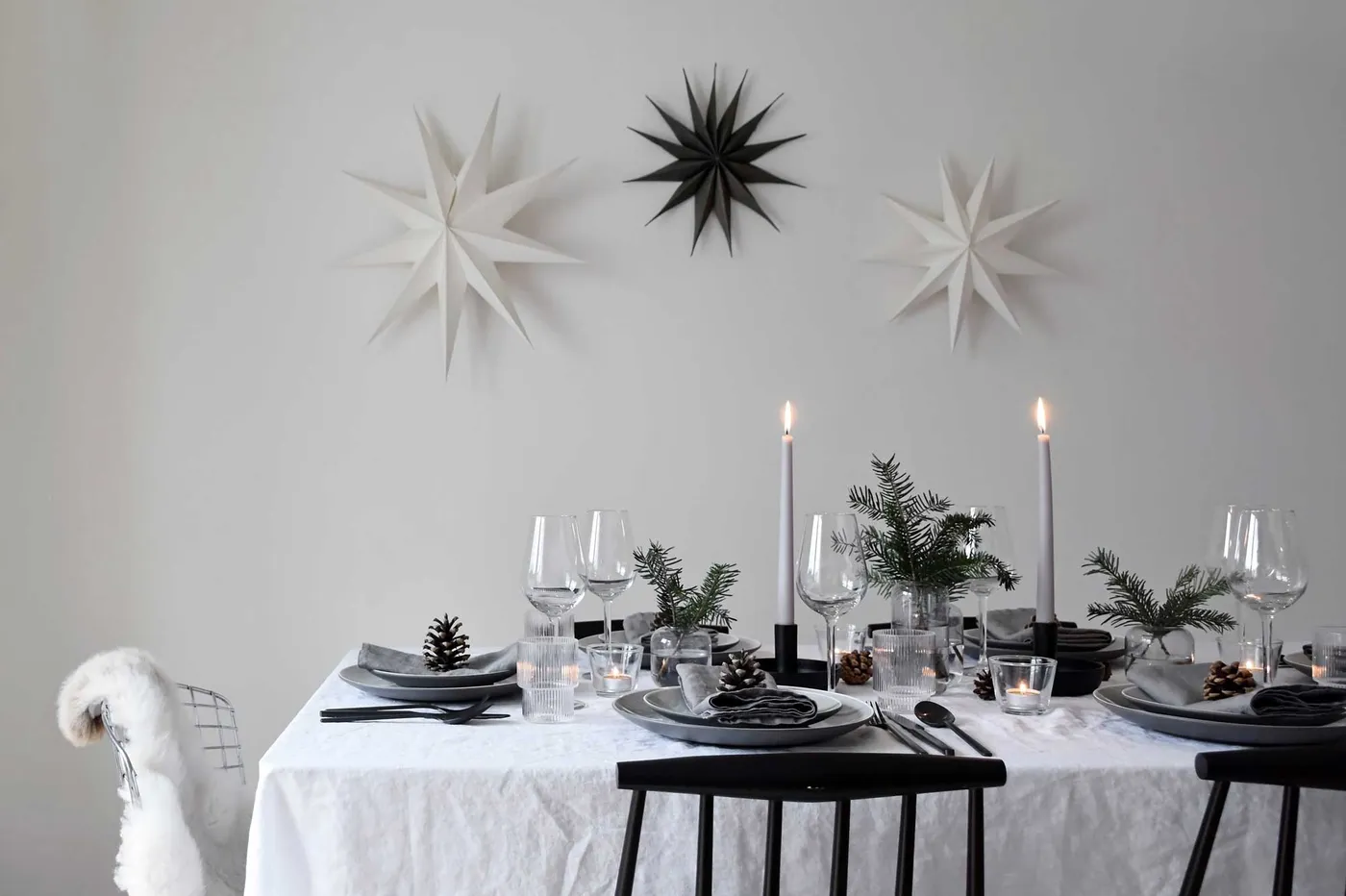
Two things will bite you here. Dark grey plates are unforgiving — every water spot, every fingerprint from a hot dish, every streak of dish soap shows up in candlelight, so dry them with a microfiber cloth right before guests arrive. And a white linen cloth is basically a gravy detector. Keep a spare folded in the closet or accept that this is a one-holiday tablecloth.
Roughly 70 percent white (cloth, wall, glass votives), 20 percent grey (plates, napkins, tapers), 10 percent black (holders, chairs, one star), with pine green as a whisper rather than a color. Swap the grey for warm taupe and the same math reads softer and more traditional; swap white for ivory and the black gets twice as dramatic.
3. Frosted Garland That Climbs From Table to Chandelier
Flocked garland is where holiday decor quietly gets expensive — a good nine-foot piece runs $90 to $200. Buy two plain faux cedar garlands for about $22 each, hit them with spray snow from eight inches back, and wire in a $6 bag of faux red berries. Total lands near $55, and nobody at the table is inspecting the needle-to-flock ratio. Spray in two light passes, maximum; a heavy hand reads like a dusting of dandruff.
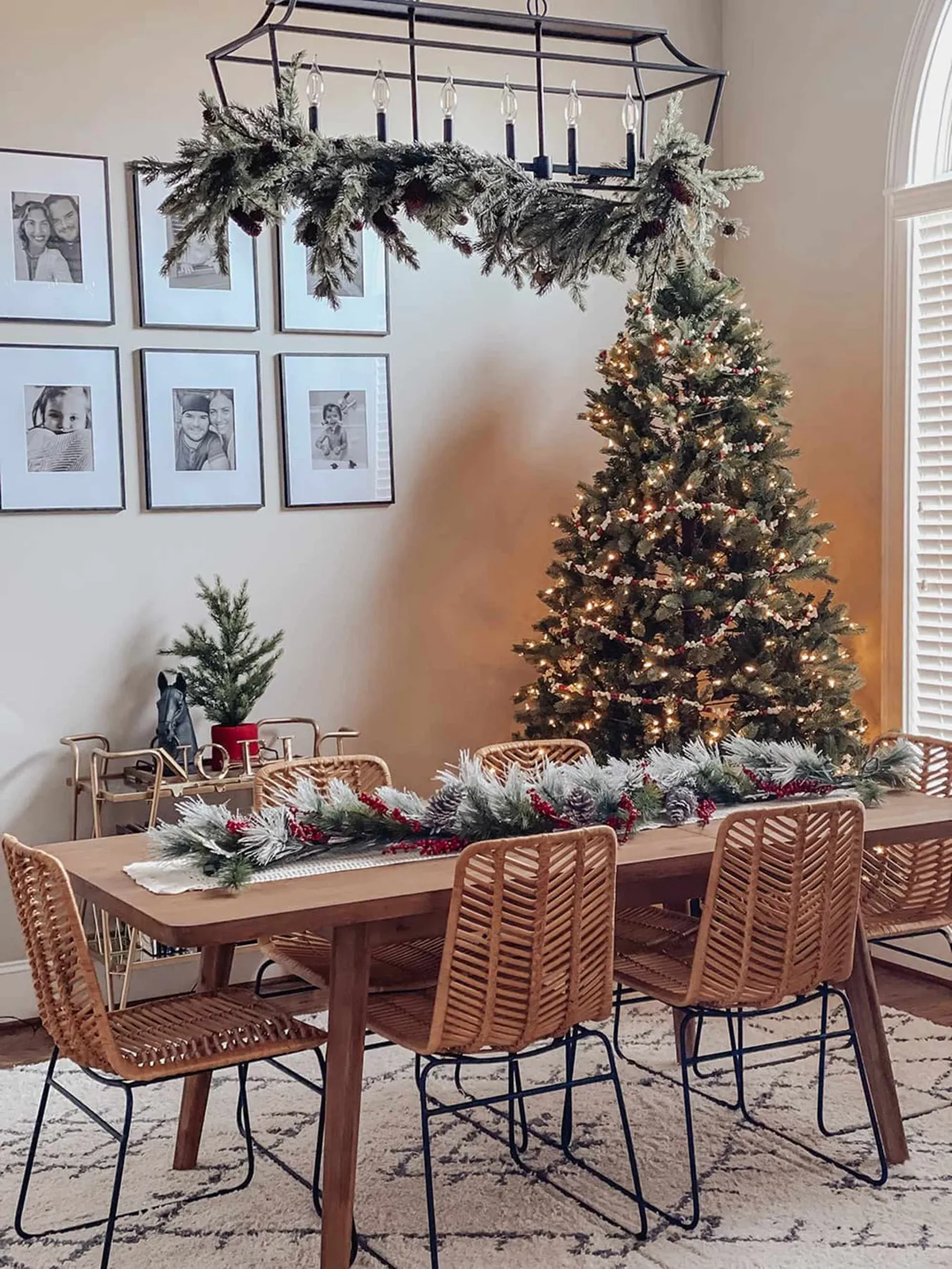
- Measure the chandelier’s widest span and add 12 inches on each side.
- Attach with clear zip ties at the frame — never tape, because heat and adhesive are enemies.
- Start at the center and work outward so the weight stays balanced.
- Weave in two strands of battery fairy lights, hiding the pack on top of the frame.
- Keep the lowest branch tips at least 18 inches above the tabletop so nobody ducks.
About 45 minutes and $25 to $40 if you are reusing last year’s garland.
This one asks for ceiling height. You want at least nine feet floor to ceiling for a chandelier garland to read as generous instead of looming — under eight and guests feel like they are eating inside a wreath. The table should be at least six feet long so there is something to be centered over. Low ceilings? Steal from Idea #1 instead and keep the greenery at table level.
4. Snow-Dusted Garland with Silver Mercury Glass
Two shape decisions carry this table. First, square and rectangular white plates stacked on round wooden chargers — that round-versus-square friction keeps a mostly white setting from going flat. Second, the silver mercury glass scattered through the garland. It is the only reflective surface on the table besides the cutlery, so every flame gets bounced twice and the whole thing glows without a single string light.
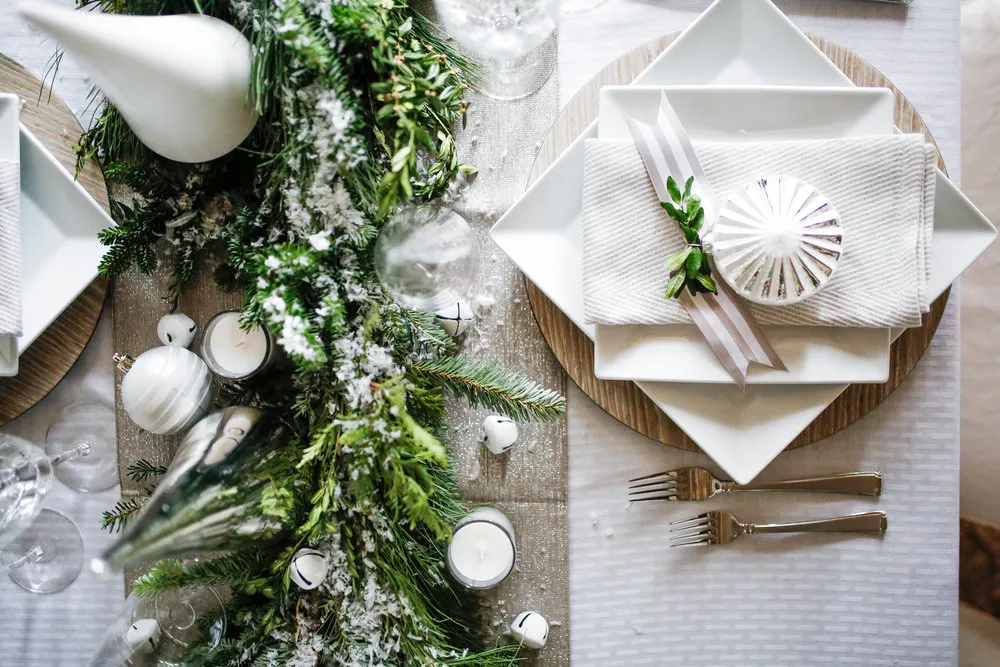
Flocked garland sheds. Not dramatically, but you will find white dust on the tablecloth by dessert and more on the floor by January. Shake it out outdoors before it comes inside, keep it away from anything warm, and store it loosely in a breathable bag rather than vacuum-sealing it flat. Mercury glass, meanwhile, hates the dishwasher — hand wash in lukewarm water or the silver finish clouds permanently.
Tie the napkin with a striped ribbon about 1.5 inches wide and cut the tails at a sharp diagonal. A straight cut looks like a mistake; an angled one looks deliberate. Knot once and let the ends fall about six inches down the plate. That single asymmetric gesture keeps a very symmetrical, very traditional setting from feeling like a catalog page.
5. Plaid Runner and a Wicker Santa Basket
Vintage Santa figures spent a decade in the ironic category and have fully crossed over into beloved. The grandmillennial wave turned nostalgia into a design decision rather than a default, and a wicker-and-ribbon Santa is exactly the object people are hunting at estate sales. It has staying power because it is personal — nobody’s grandmother had the same mass-produced centerpiece from a big-box store.
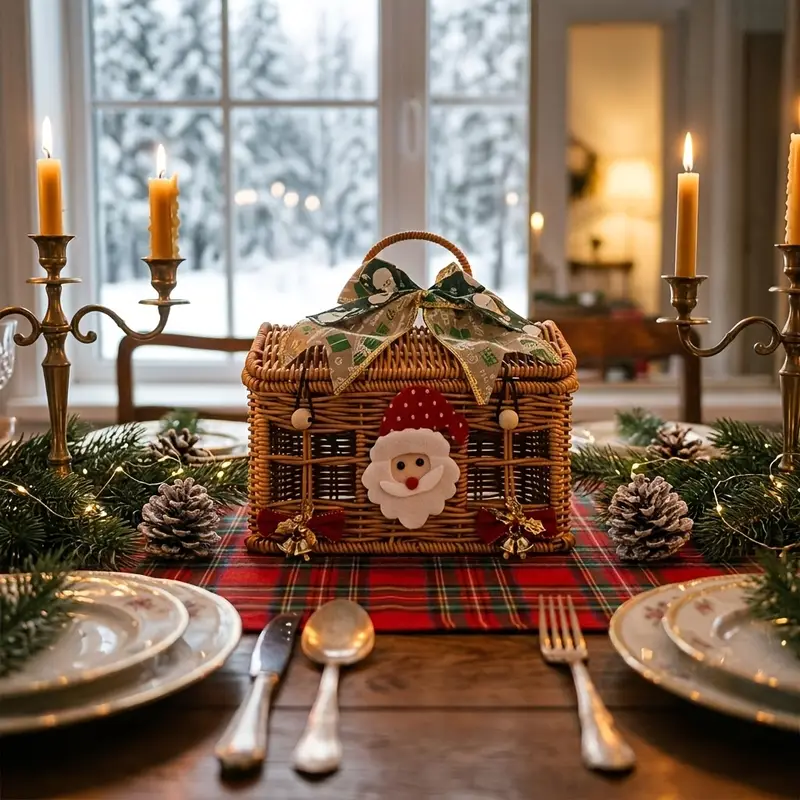
It is the wicker basket. Everything else — plaid runner, fir branches, brass candelabras, white plates — is a supporting player holding the center of the table down at a low, wide, generous height. Swap the basket for a tall floral arrangement and the setting instantly turns formal and slightly stiff. The Santa is charming, but the basket’s proportions are what actually make this work.
Three quick checks before you commit:
- Runner length: it should overhang six to eight inches on each end, not stop at the edge.
- Candle clearance: lit tapers need 12 inches of open air above them and nothing flammable within six.
- Basket height: keep the centerpiece under 12 inches so it does not wall off the table.
- Table width: under 36 inches wide, drop the candelabras and use votives instead.
6. Pumpkin-and-Velvet Table That Bridges Thanksgiving to Christmas
Yes, those are pumpkins. If you are hosting in December, someone will mention it — which is fine as long as you call it a harvest-to-holiday table on purpose. The trick is the palette: cream, pale green, and terracotta all read winter once the greens are evergreen and the candles are white. Swap the pumpkins for pomegranates and quince after Thanksgiving and the same table carries straight through to New Year’s.
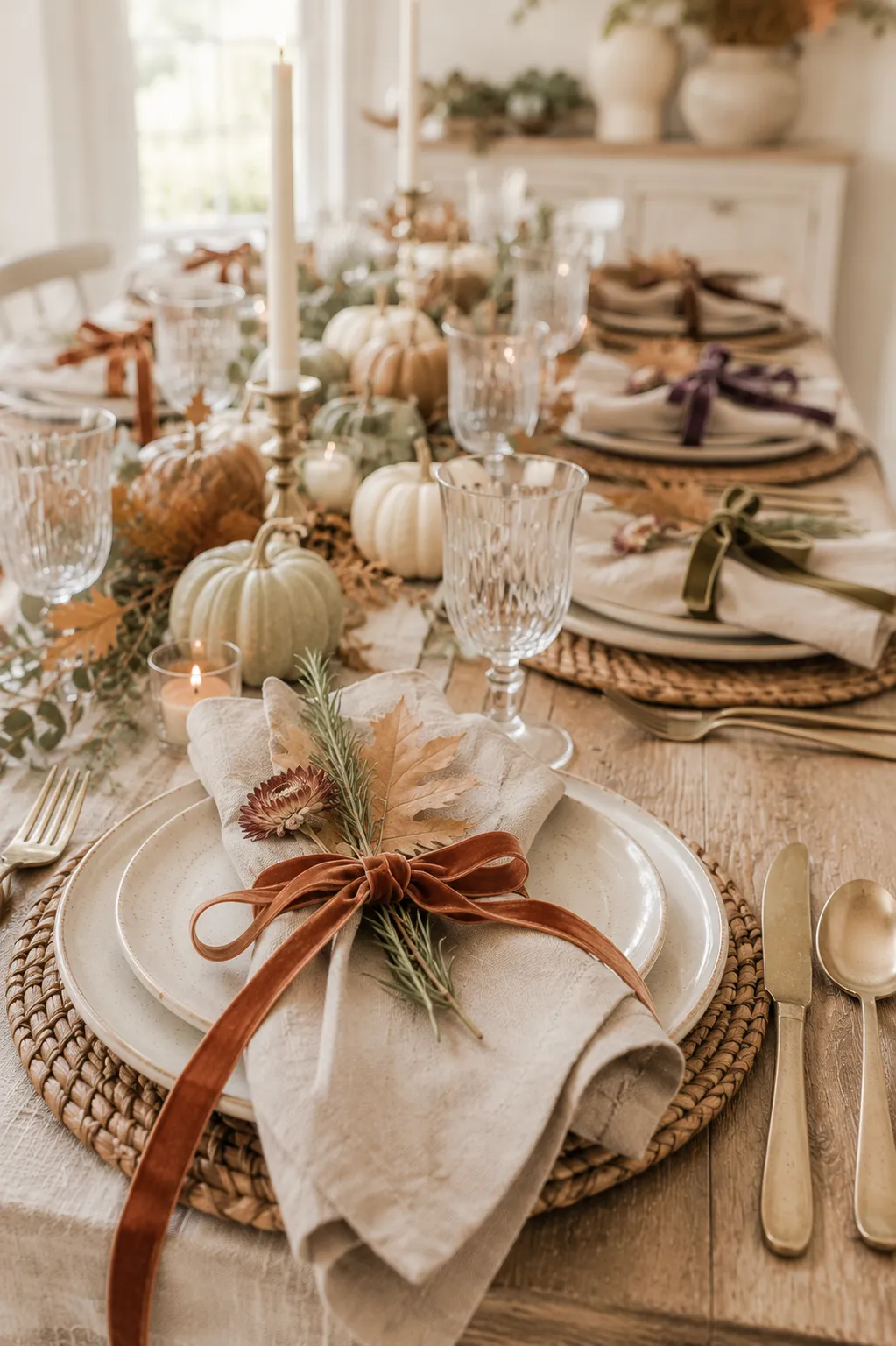
About 60 percent cream and linen (placemats, napkins, ceramic), 25 percent terracotta and pale green, 15 percent brass and gold. Those ratios are what make mismatched objects feel collected rather than cluttered. Want a cooler version? Keep the math and trade terracotta for dusty blue — same table, completely different mood.
- Woven round placemats, set of 6: $24–$60
- Speckled ceramic plates, set of 6: $48–$140
- Velvet ribbon, 3 rolls: $12–$30
- Brass taper holders, set of 4: $20–$70
- Pumpkins and dried florals: $25–$60
Total: $129–$360. Budget alternative: tear strips of thrifted linen instead of buying velvet ribbon — about $4 for a whole sheet at Goodwill.
7. Matte Black Cutlery on a Grey-and-White Table
Matte black flatware is gorgeous and slightly high maintenance: it shows every water spot. Rinse in vinegar water, dry immediately with a towel, never let it air dry. Here is the tip that saves real money — buy two four-piece sets at $35 each instead of one twelve-piece set at $180. You will serve eight, you will never need twelve, and replacing a lost fork costs a fraction of replacing a set.
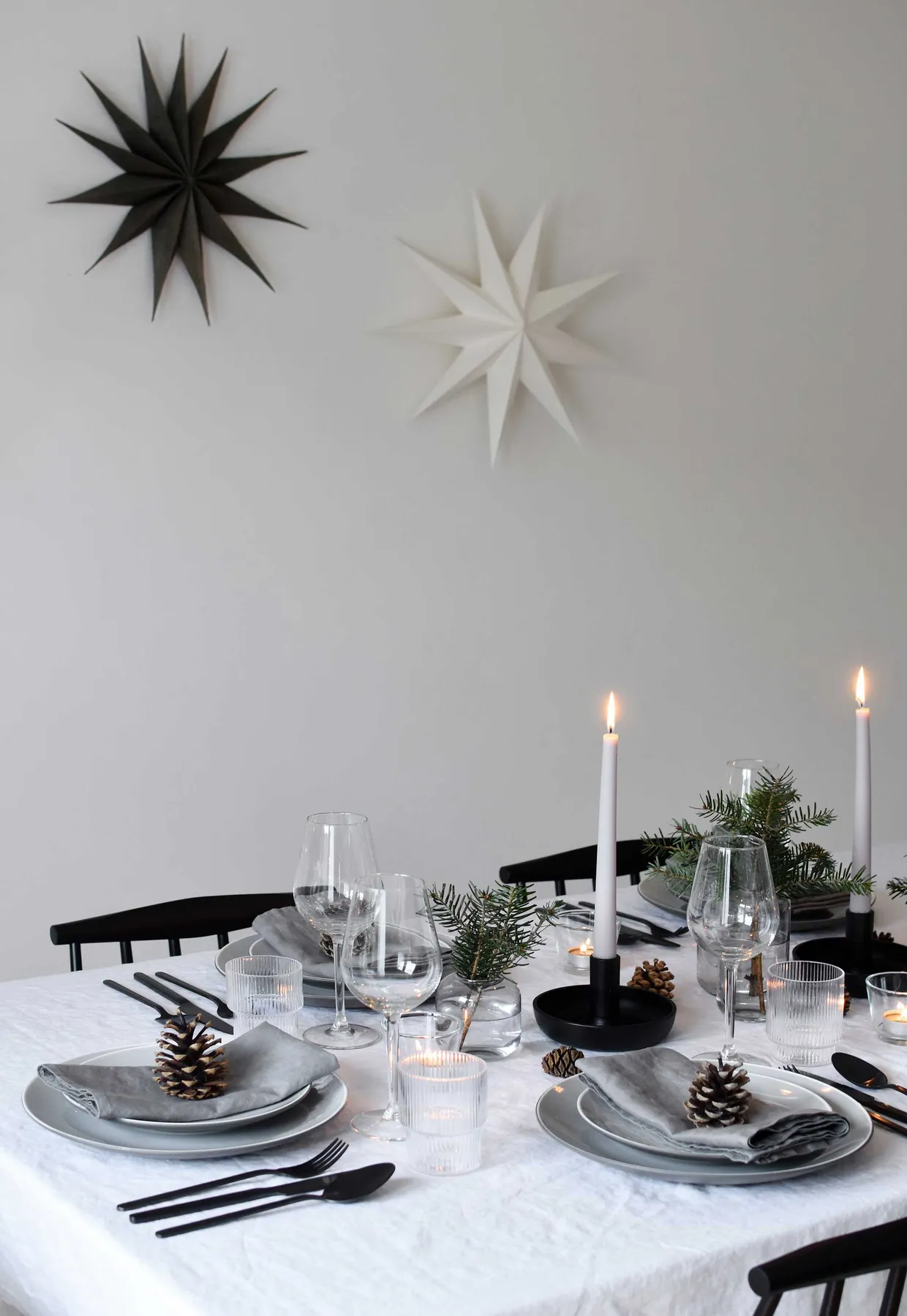
This setting likes a table between 36 and 40 inches wide. Narrower and tall white tapers plus glass vases start crowding the plates; wider and the center cluster floats. Ceiling height matters less, but in a small dining room keep the paper stars at seated eye level — around 48 inches off the floor — so they read as part of the table rather than wall decor you notice from the hallway.
The whole look is a bargain if you are willing to forage and fold. Matte black flatware runs about $35 for four at IKEA, plain white linen is $20 at Target, and pinecones are free if you walk a park in November. Paper stars are the real steal — cut them from cardstock and hang on fishing line for maybe $6 total. Save on decor, spend on dinner.
8. Miniature Village Hidden in a Garland Runner
- Roll brown kraft paper down the center of the table, overhanging the edge by two inches.
- Lay the garland in a loose wave, not a straight line, and fluff it outward.
- Weave warm string lights through the branches, hiding the wire underneath.
- Nestle the miniature houses at three heights — a small stack of books under the paper does it invisibly.
- Scatter pinecones and jingle bells, then set slate coasters where glasses will land.
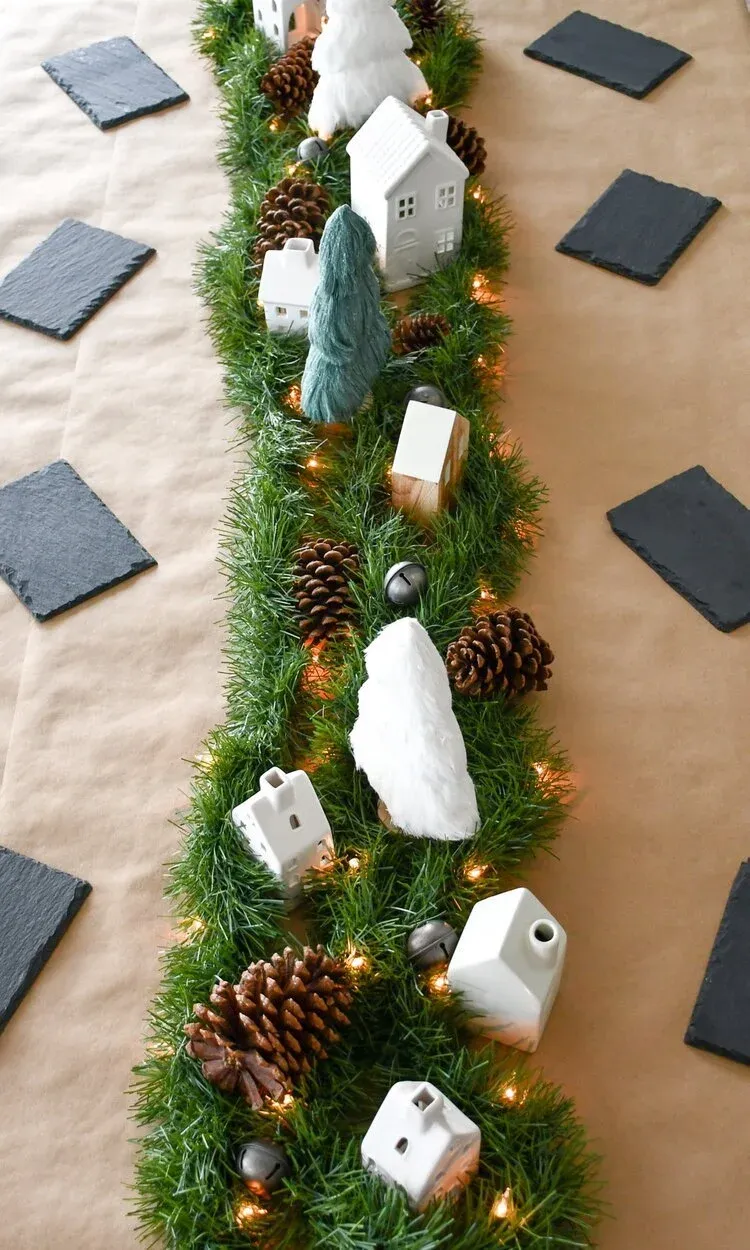
Roughly 30 minutes and $30 to $60, most of it the houses.
Scale is the whole story. Miniatures next to full-size dinner plates create a deliberate size mismatch that reads as charming rather than odd, and the brown paper keeps the white ceramics from disappearing into a white cloth. The wrapped string lights do all the sparkle work, which means you can skip candles entirely and still get that low, warm, room-glowing light people photograph at the end of the night.
The kraft paper. It costs about $5 a roll and it is the reason this table looks like a memory instead of a display. Put the same garland and houses on white linen and the houses vanish, the coasters look random, and the whole thing turns into a craft project. The paper gives everything a matte, warm, faintly vintage backdrop — and when dinner is over you roll it up, crumbs and all.
9. Black Linen and Matte Gold, No Red in Sight
Roughly 55 percent charcoal (runner, plates, napkins), 25 percent evergreen, 15 percent matte gold, 5 percent white. That ratio is why it reads modern instead of goth — the green and gold are generous enough to warm the black up. This is the cooler, moodier cousin of Idea #2: same restraint, opposite temperature. Swap matte gold for brushed brass and the table shifts five years more traditional.
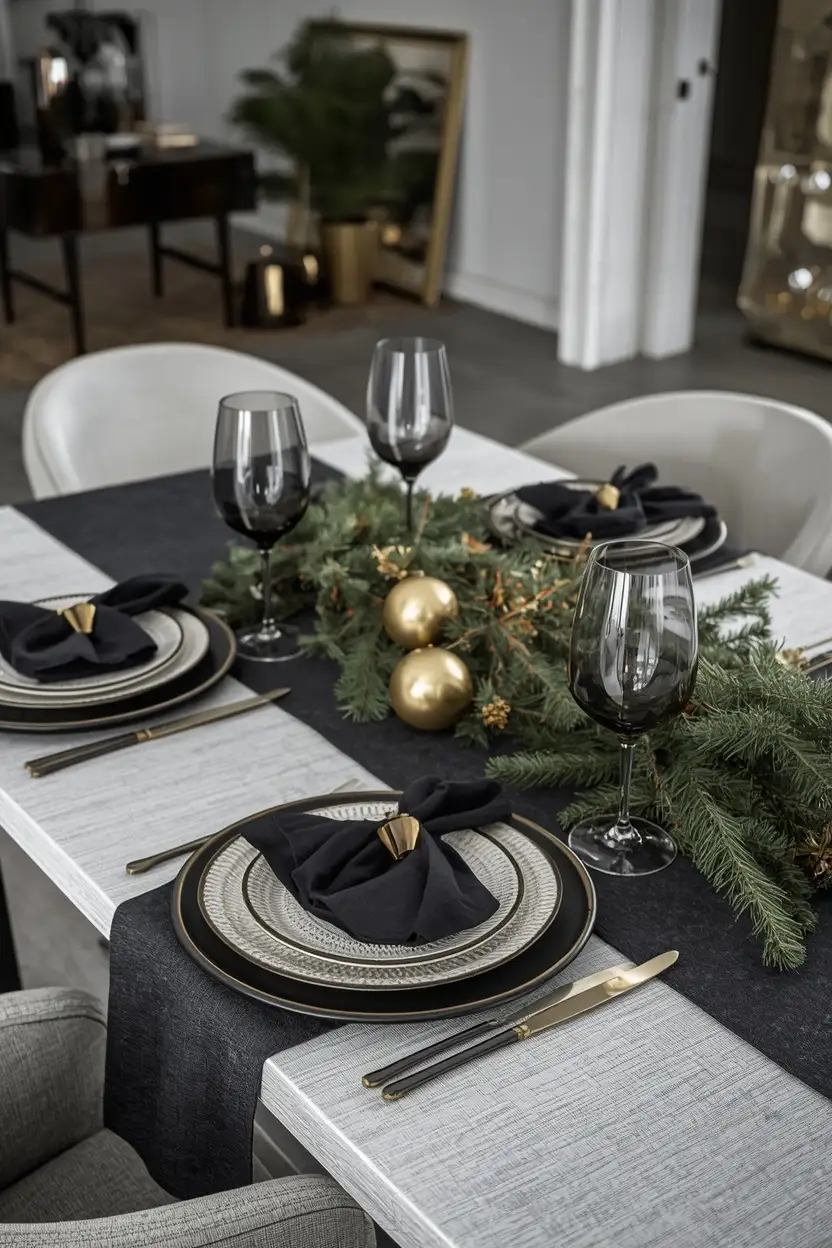
- Dark grey table runner, 10 ft: $18–$45
- Black linen napkins, set of 6: $22–$60
- Gold geometric napkin rings, set of 6: $14–$40
- Smoky grey wine glasses, set of 4: $30–$80
- Black and gold flatware, service for 6: $45–$120
- Evergreen garland plus matte gold ornaments: $40–$110
Total: $169–$455. Budget alternative: gold-spray thrifted napkin rings and use the glasses you already own — saves about $90.
Two honest notes. Smoky grey glassware makes it genuinely hard to see how much wine is left, especially by candlelight, so pour for your guests rather than letting the bottle circulate. And black linen napkins are lint magnets that show every fleck of wax — run a lint roller over them right before people sit down. Both fixable in thirty seconds, and worth it.
10. Tree-Shaped Candles Doing the Centerpiece Work
Three tree candles at roughly 6, 8, and 10 inches is the sweet spot for a table 30 to 48 inches wide. On a narrow bistro table, drop to two and let the garland do the rest; on a long table, repeat the trio at both ends rather than buying bigger candles. The eye reads height differences of two inches or more — anything closer looks like a matching set that got damaged.
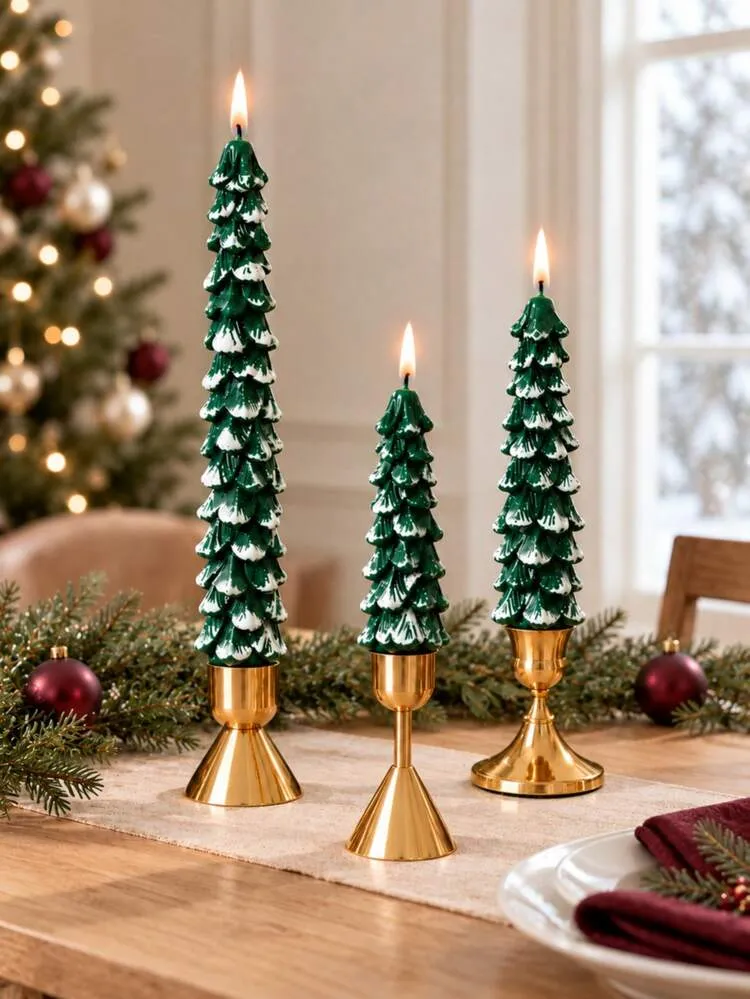
Figural candles burn unevenly because the shape is wider at the base than the wick can handle. Trim the wick to a quarter inch, set them on a heatproof tray, and put them out with a snuffer instead of blowing — you will get two full dinners out of a set rather than one melted afternoon. If you want them to last the season, light only the tallest and let the other two be sculpture.
Shaped and sculptural candles are the quiet breakout of recent holiday seasons, and tree silhouettes are the version that stuck. Part of it is economics: a $14 candle delivers the same visual hit as a $90 arrangement. Part of it is the drift away from more stuff — people would rather burn something beautiful than store it for eleven months.
11. Eucalyptus, Pears, and Plums Down the Middle
Fresh eucalyptus is one of the great cheap thrills of holiday hosting — a bunch runs $6 to $9 at most grocery stores, and three bunches will run the length of a six-foot table. Pears and plums come from the produce aisle and get eaten afterward, so the centerpiece doubles as dessert. This entire look can land under $60 if you already own plates and a white runner. Trader Joe’s in December is your friend.
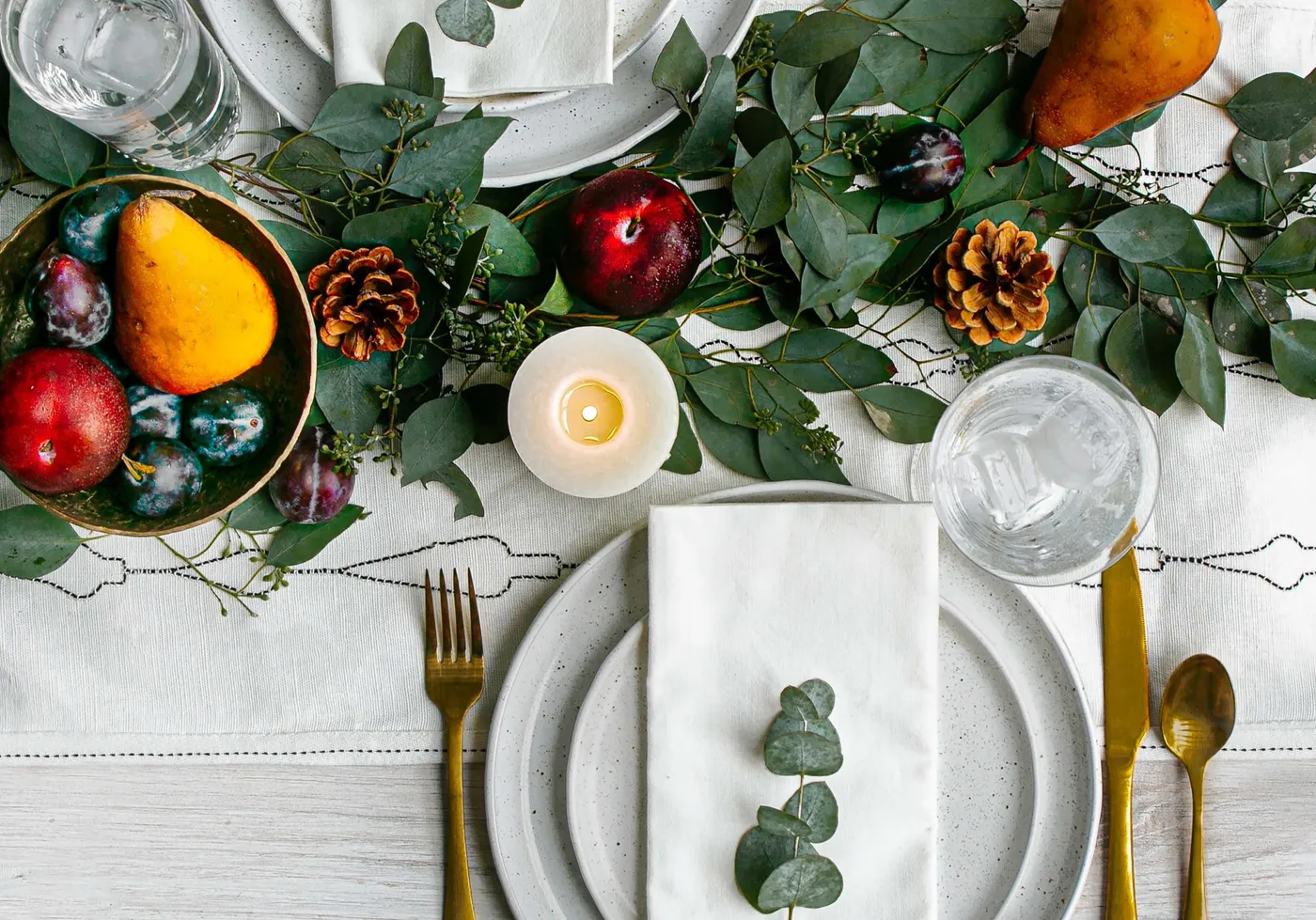
It is the fruit. Everything else — the embroidered runner, the eucalyptus, the pinecones, the speckled grey plates — is a neutral supporting one saturated moment. Pears and plums bring color, weight, and a little gloss no ornament can fake, and they are the thing guests always comment on. Take the fruit out and you have a pretty green garland. Put it back and the table has a pulse.
- Lay the embroidered runner first; it is the base everything sits on.
- Run the eucalyptus in a shallow S, letting sprigs fall over the runner’s edge.
- Nestle fruit in clusters of three — never single file, never evenly spaced.
- Tuck pinecones into the gaps so no bare table shows through.
- Set one lit white pillar candle on a small dish, a few inches off-center.
About 20 minutes to assemble, roughly $45 if you are starting from scratch.
12. A Printed Plaid Tablecloth Does the Heavy Lifting
A busy printed cloth is your best defense against gravy, red wine, and a four-year-old with a spoon — it hides everything. The trade-off is candle wax, which bonds to printed cotton and needs an iron-and-paper-towel lift rather than a scrape. Wash cold, skip the dryer, iron on the reverse. If the print is a seasonal splurge, layer a plain white cloth underneath so a spill never reaches the table itself.
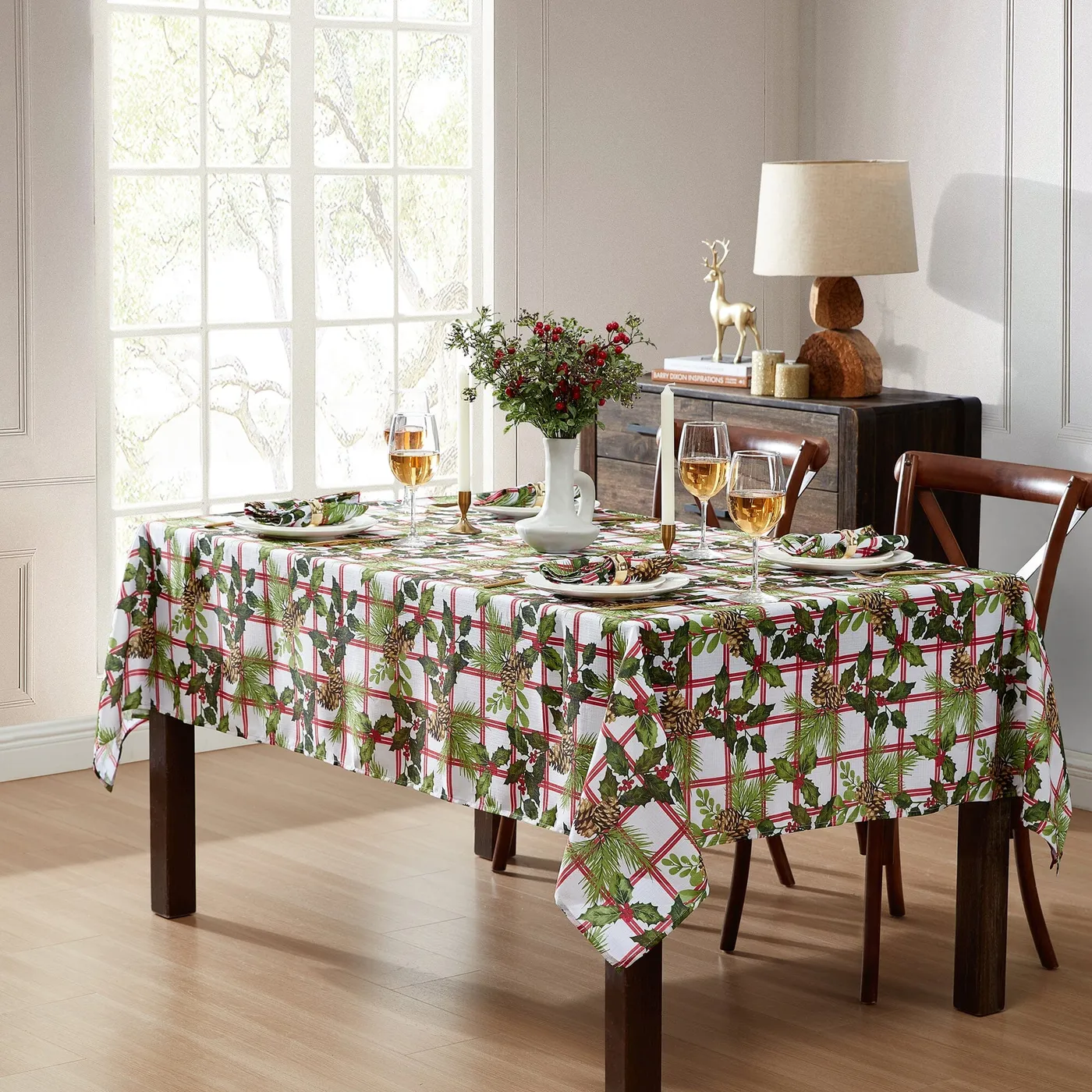
The pattern does the decorating so the tableware does not have to. Solid white plates on a busy plaid-and-botanical print is a classic grounding move — pattern up top, calm below. The gold flatware and napkin rings pick up the warm tones in the print instead of competing with them, and the red berries repeat the red lines at a completely different scale. That is why it reads intentional rather than matchy.
About 50 percent pattern (cloth, napkins), 30 percent white (plates, vase), 15 percent red and forest green, 5 percent gold. The rule: only one pattern at full strength. If your cloth is this busy, keep napkins solid and skip a printed runner entirely. Want it calmer? Use white linen and let botanical napkins carry the print.
13. Olive Green Linen with Polka-Dot Glassware
- Olive green tablecloth, 90 inch round or 8 ft: $30–$85
- Fluted glass candlesticks, set of 3: $36–$95
- Cream stoneware plates, set of 6: $55–$150
- Polka-dot or charm glassware, set of 6: $40–$110
- Dark green napkins and ribbon: $24–$60
- Silver gourd vase and pine branches: $20–$55
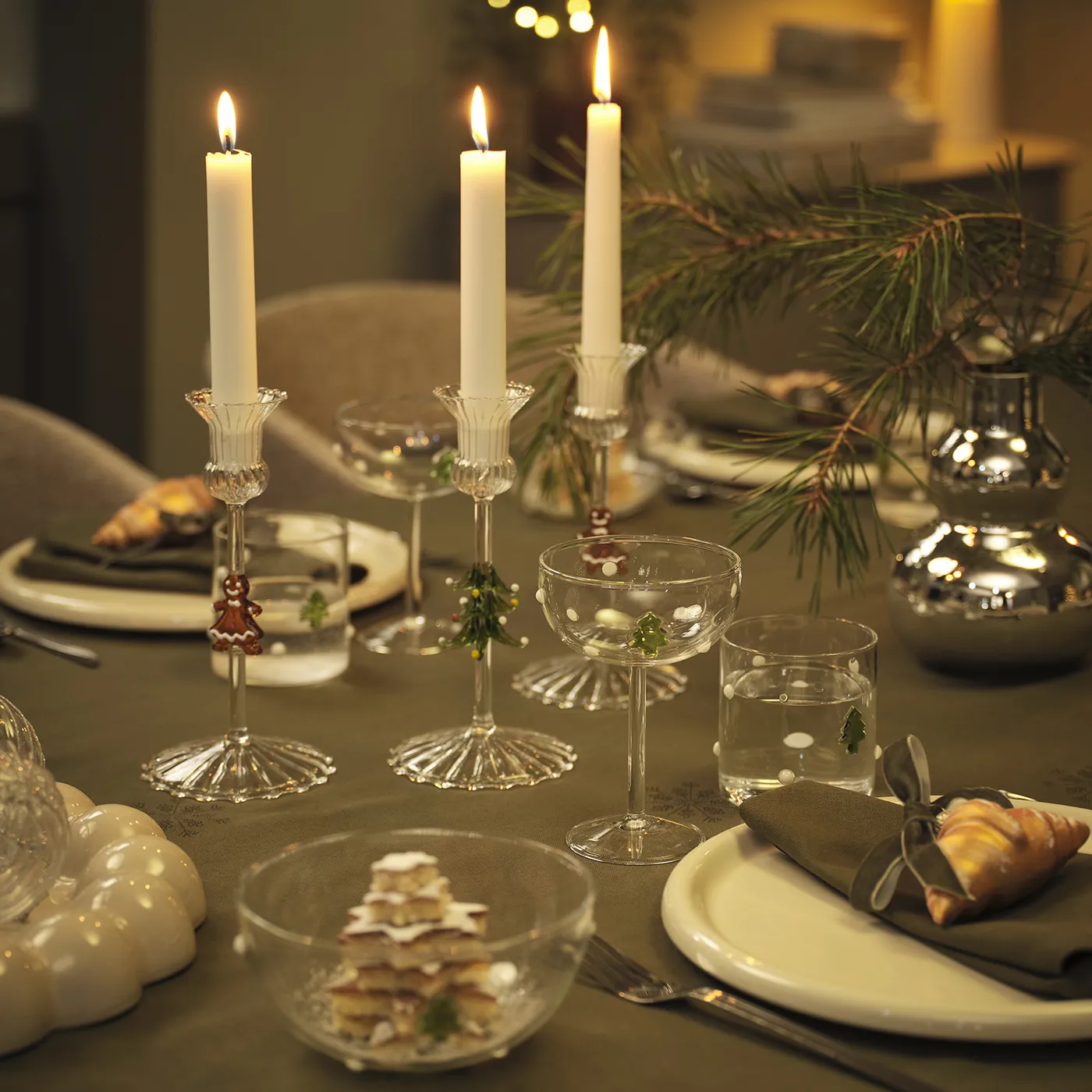
Total: $205–$555. Budget alternative: clear glass candlesticks from IKEA at $8 each and a $15 olive flat sheet as a cloth — saves around $110.
Olive green is the hardest holiday color to match under warm bulbs. Two olive linens from different stores will read as two different greens by candlelight. Buy the cloth and napkins from the same brand and dye lot, and check them under your actual dining room lighting before you cut tags. If they clash, break them apart with cream plates and clear glass so the mismatch looks like layering.
- Choose ribbon about 3/8 inch wide — wider overwhelms a folded napkin.
- Fold the napkin in thirds into a roughly four-inch band, not a triangle.
- Wrap the ribbon around the band and knot once, leaving two tails.
- Thread a small tree charm onto one tail and tie off.
- Trim both ends at a diagonal and let them fall toward the plate’s edge.
Roughly 20 minutes for eight settings, about $8 in ribbon and charms.
14. Moss, Mushrooms, and a Wooden Moose
The moss is what makes the mushrooms believable. Without a green, textured base, ceramic mushrooms and a wooden moose are just objects sitting on a table — with it, they read as a forest floor. It is also the cheapest element here. A bag of preserved moss runs under $15 and covers three feet of table. Everything else in this arrangement exists to justify the moss.
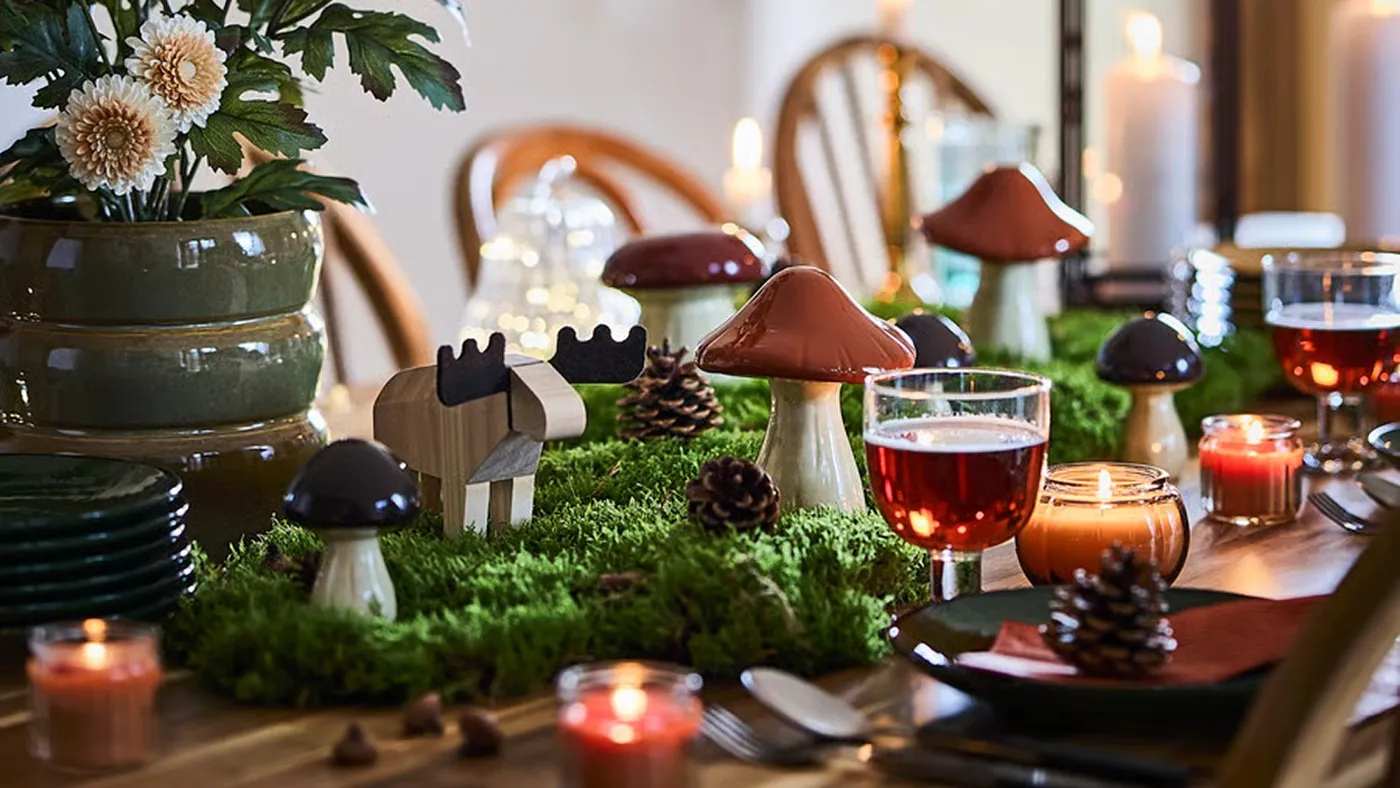
Two warnings, both practical. Preserved moss sheds and stains light linens, so keep it on a tray or a wide runner you do not love. And open flames next to dry moss is a genuinely bad combination — use LED jar candles for that amber glow and save real ones for a spot where nothing combustible is within a foot. The moose, at least, is harmless.
This woodland arrangement wants width. Plan on a table at least 40 inches across so the moss runner can sit in the middle with 14 inches of clear plate space on each side. On a narrow table, move the moss to a sideboard and keep the mushrooms and pinecones as small plate accents instead. Ceiling height is irrelevant here; chair clearance is what matters.
15. Blue-and-White Ceramic as the Centerpiece
Roughly 45 percent deep blue (cloth, ceramic figure), 30 percent white (roses, plates, wainscoting), 15 percent green foliage, 10 percent gold. Blue is the cool anchor that makes gold read warm rather than brassy, which is why this table feels rich without feeling loud. Swap the blue for forest green and you get a more traditional version of Idea #12; take the blue down to charcoal and it turns modern.
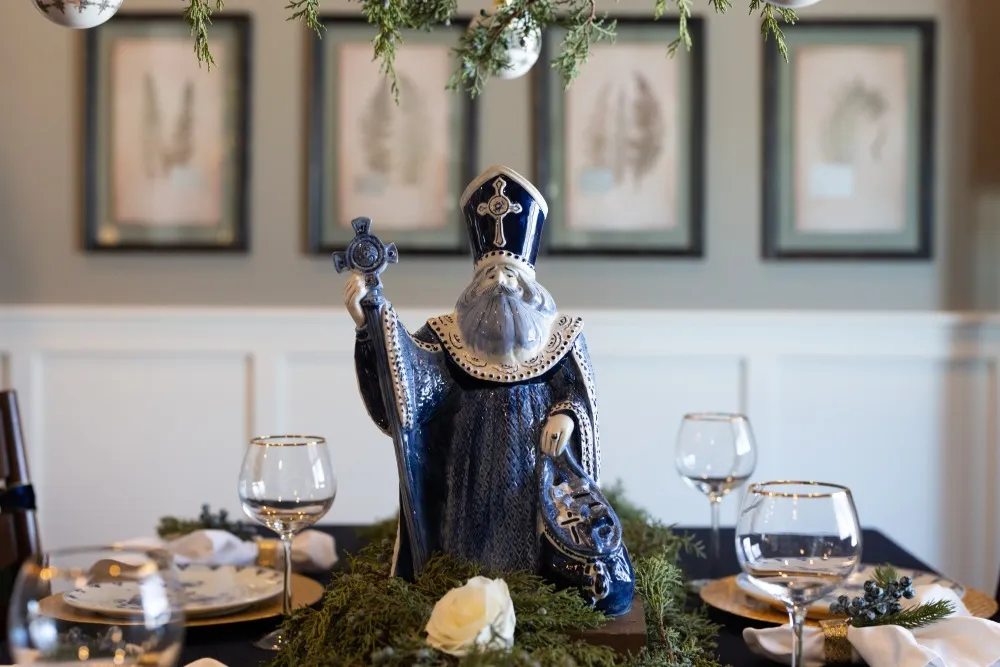
Blue-and-white ceramic is the most thriftable thing in this entire article. Ginger jars and figures turn up at Goodwill and estate sales for $12 to $25 regularly because people do not know what to do with them. Gold woven chargers run about $3 each at dollar stores, and a dark blue flat sheet makes a perfectly good tablecloth for $14. Build this table for under $90 secondhand.
Formality needs a softener. The ceramic figure, gold-rimmed glassware, and dark cloth would all read slightly stiff alone — it is the loose cedar and pine foliage and the white roses spilling around the base that keep it from feeling like a museum display. That contrast between hard ceramic and soft botanicals is the entire mechanism, and it is why the arrangement looks expensive.
16. Yellow Runner and Christmas Crackers, Zero Fuss
- Run the yellow runner down the center, overhanging eight inches on each end.
- Place a cracker at each setting, angled slightly toward the plate rather than squared up.
- Set the wrapped gift in the middle as the centerpiece — no florals needed.
- Put glasses at two o’clock and silverware where it belongs; resist adding more.
- Light the tree in the background and dim the overheads. That is the whole mood.
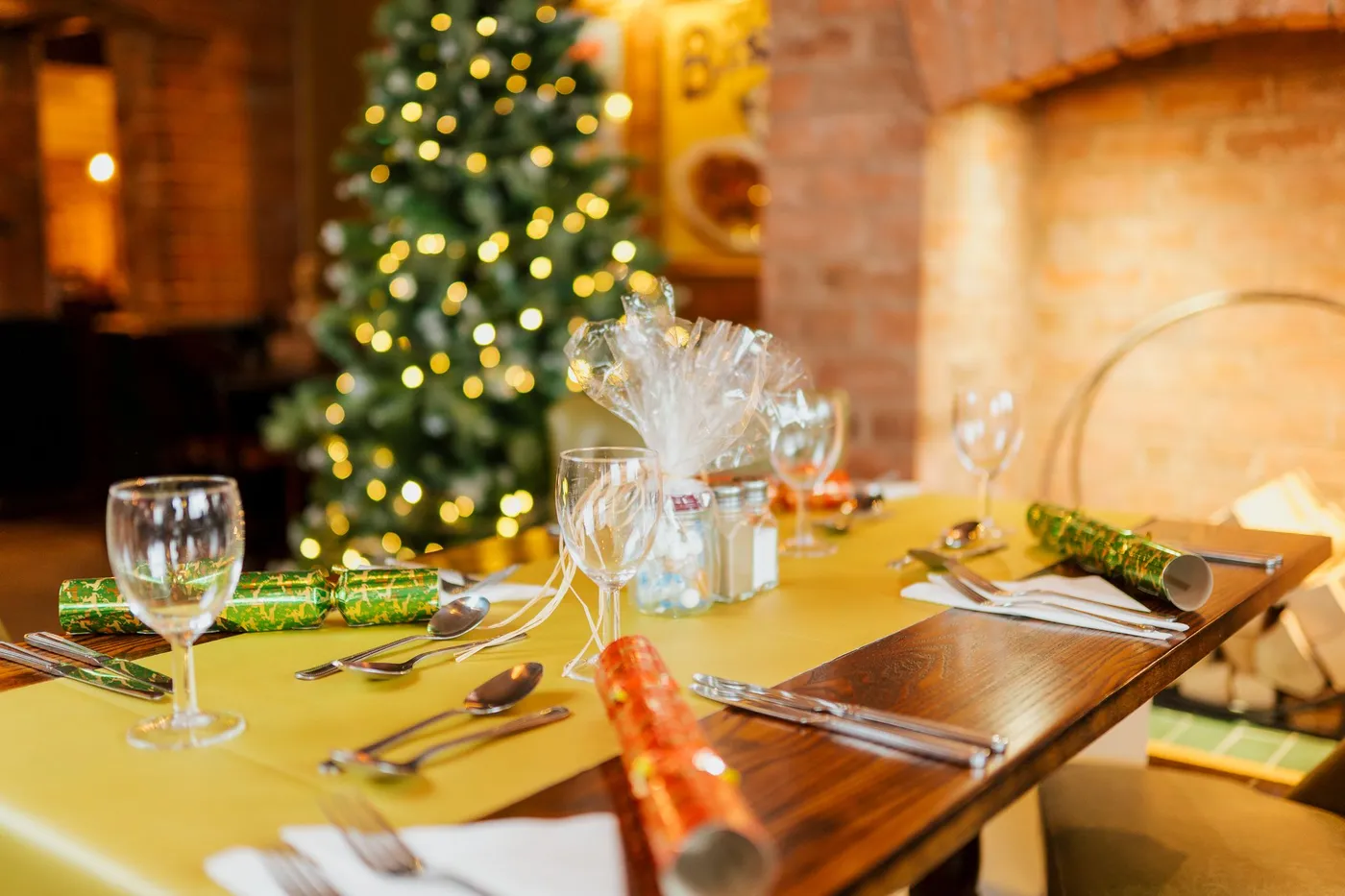
Fifteen minutes, and crackers run $12 to $30 for a box of eight.
The yellow. On a dark wood table with green and red crackers and a glowing tree behind it, that runner does something no red-and-green scheme could — it gives your eye somewhere bright to land. Yellow sits right next to green on the color wheel, so it reads festive without being literal. Take it away and this is a perfectly nice table nobody photographs.
Non-traditional holiday color has been building for several seasons and 2026 is the year it stops being the bold choice. Hosts who spent years assembling red-and-green are layering in mustard, plum, olive, and blush because those colors work the other eleven months too. Yellow specifically reads warm and unfussy rather than themed.
17. Figs, Smoked Glass, and Mauve Tapers
- Light beige embroidered tablecloth: $40–$120
- Smoked-glass tumblers, set of 6: $48–$130
- Plum ceramic bowls, set of 4: $28–$75
- Mauve taper candles, set of 6: $12–$30
- Mixed metal candleholders: $24–$70
- Fresh figs and velvet ribbon: $18–$40
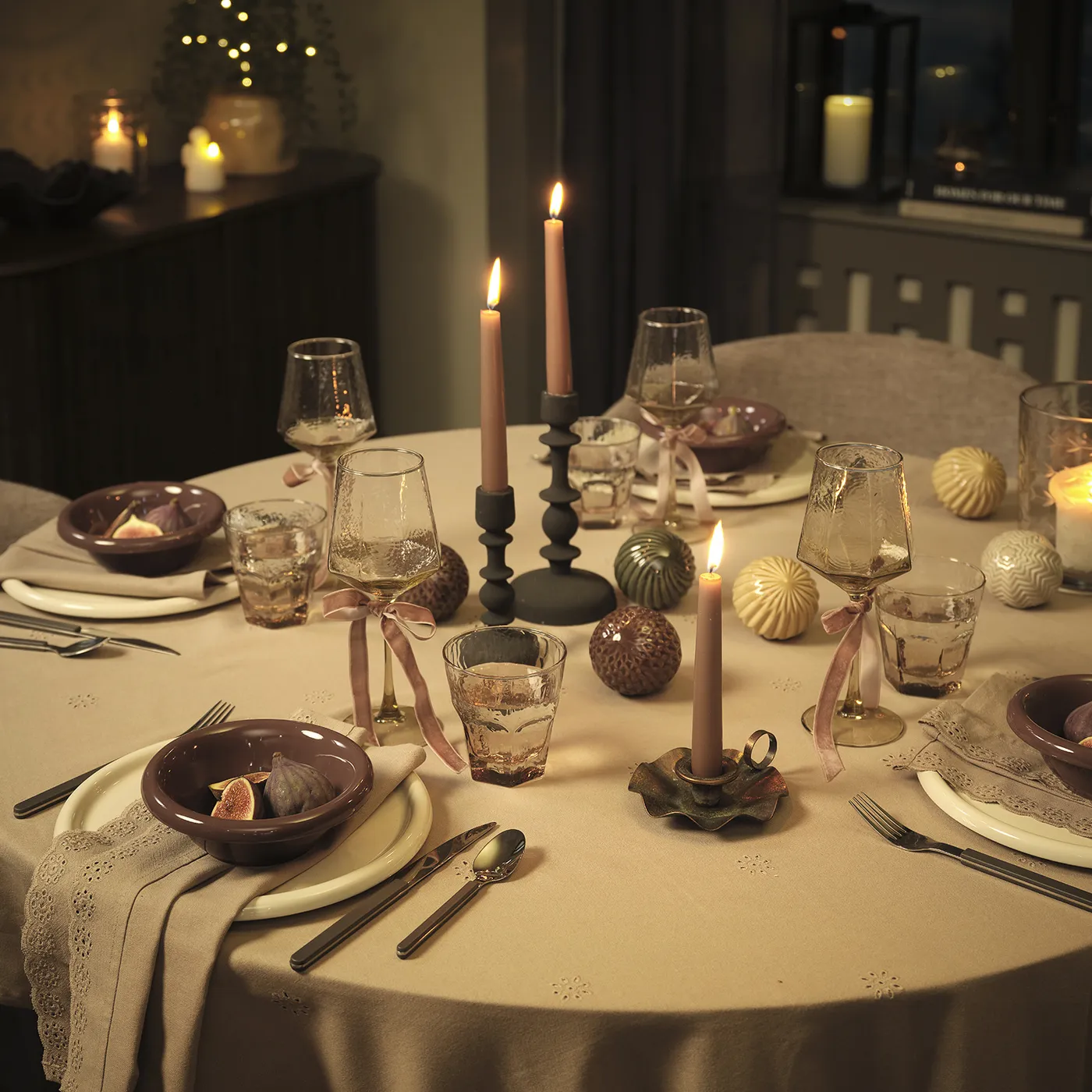
Total: $170–$465. Budget alternative: swap smoked glass for clear tumblers and tie the ribbon higher — saves about $70 with almost no visual loss.
Taper colors like mauve and plum are sold in one length, which is why so many tables look monotonous. Buy six of the same color, cut three down with a serrated knife to create 6, 8, and 10-inch heights, and sand the cut base flat so they stand straight. You now have a graduated, collected set for the price of one size.
Fresh figs are a September-to-November luxury and they bruise if you look at them wrong. Hosting in late December? Swap in red grapes, clementines, or small pomegranates and nobody feels deprived. Also worth knowing: mauve tapers read distinctly purple once the room goes candlelit, which is lovely or not depending on your cloth — test one lit candle before you commit to eight.
18. A Table for Two Under the Chandelier
A 36-inch round table is the ideal footprint for two — big enough for plates, glasses, and a centerpiece, small enough that you are actually sitting with each other. Hang the chandelier so its lowest point sits 30 to 34 inches above the tabletop. Working with a 30-inch bistro table? Skip the small tree and use a single low bowl of ornaments instead; there is no room for both a centerpiece and two full settings.
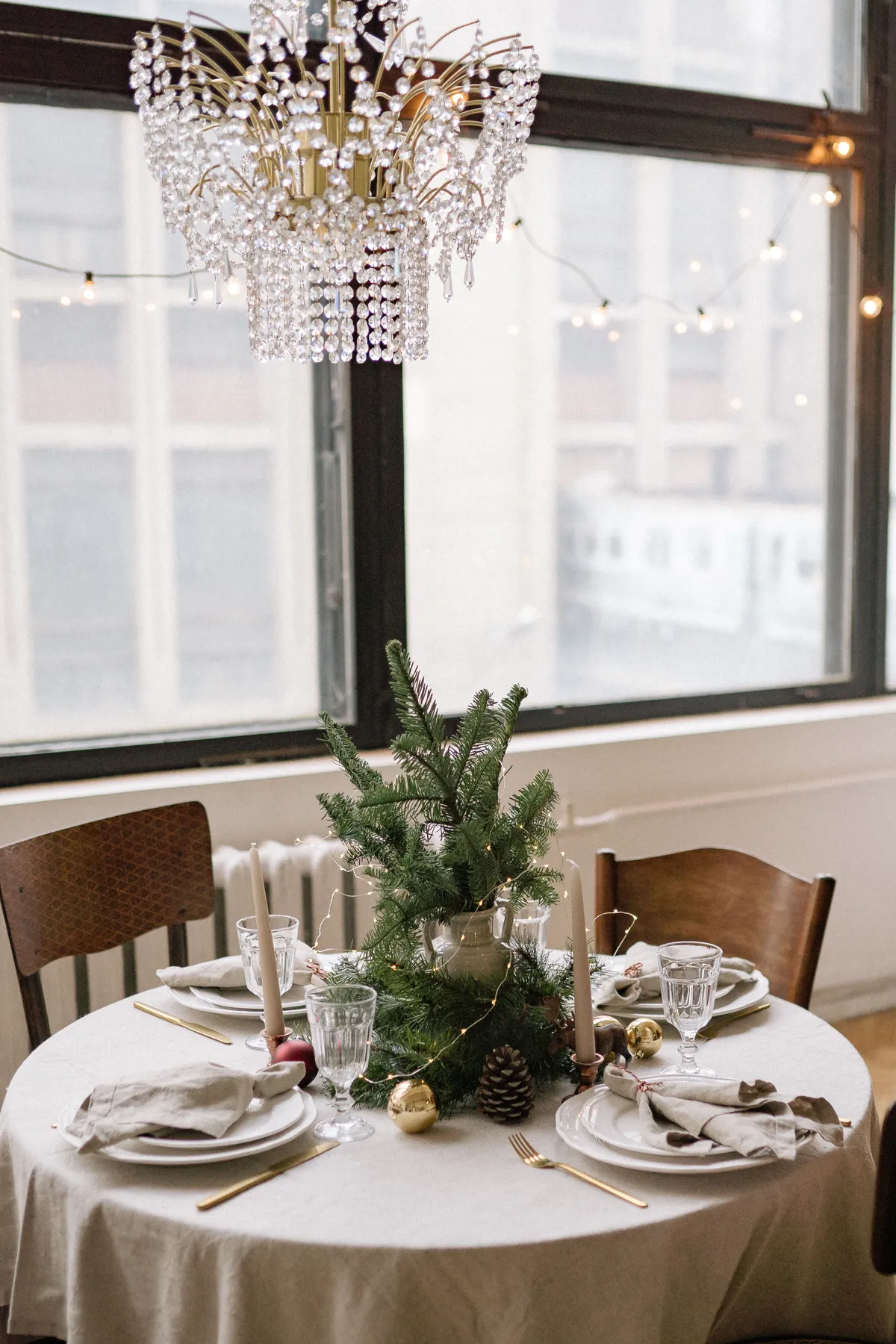
This is a vertical composition, not a horizontal one. The small tree, the candles, the chandelier, the string lights across the window — they all stack upward, which makes a genuinely small table feel grand. The horizontal layer stays deliberately plain: white cloth, white plates, gold cutlery. When one direction is busy, the other has to be quiet, or the whole thing turns into a Christmas aisle in a store.
Battery fairy lights are the hidden labor of a table like this. Cheap strands dim within two weeks and eat AAAs, so buy rechargeables and check them the morning of. The crystal chandelier needs a proper clean once a year or the sparkle turns to haze — a 50/50 water and vinegar spritz on a microfiber glove, one crystal at a time, is the least miserable method.
19. Magnolia-and-Pine Runner on a Distressed Table
It is the magnolia leaves. They are enormous, glossy on top and matte brown underneath, and at that scale they do something a pine garland cannot — they give a runner real presence without height. On a distressed white table, those big creamy leaves and dark needles are the only thing keeping the scene from washing out. Nobody expects magnolia in December, which is exactly why it works.
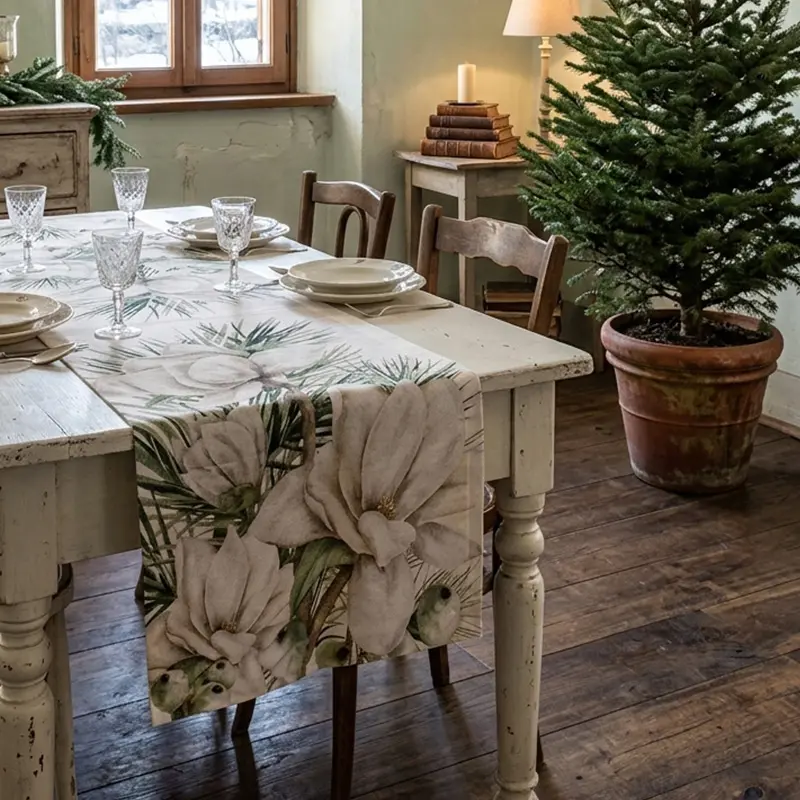
- Buy three or four faux magnolia stems — real ones brown at the edges within days indoors.
- Cut the stems into eight-inch sections with wire cutters.
- Lay them flat down the runner, alternating leaf faces so you get both gloss and matte brown.
- Thread pine sprigs underneath every third magnolia so green pokes through.
- Keep the whole runner under three inches tall so plates still have breathing room.
About 40 minutes and $35 to $70 depending on stem quality.
Roughly 55 percent white and distressed wood, 30 percent green, 10 percent creamy white florals, 5 percent terracotta. The low-contrast base is what lets the magnolia read as luxurious rather than busy. Want more drama? Keep the math and switch the terracotta pot for matte black — same proportions, sharper edge.
20. Red Tapers and a Ribbon Bow on a Side Table
This entire vignette costs under $40 if you shop the week after Thanksgiving. Evergreen clippings are often free at tree lots — just ask, they are usually throwing them out. Two red tapers run $6, a spool of red satin ribbon $5, a bag of faux berries $6. The black side table is the only real purchase, and Facebook Marketplace is full of them for $25.
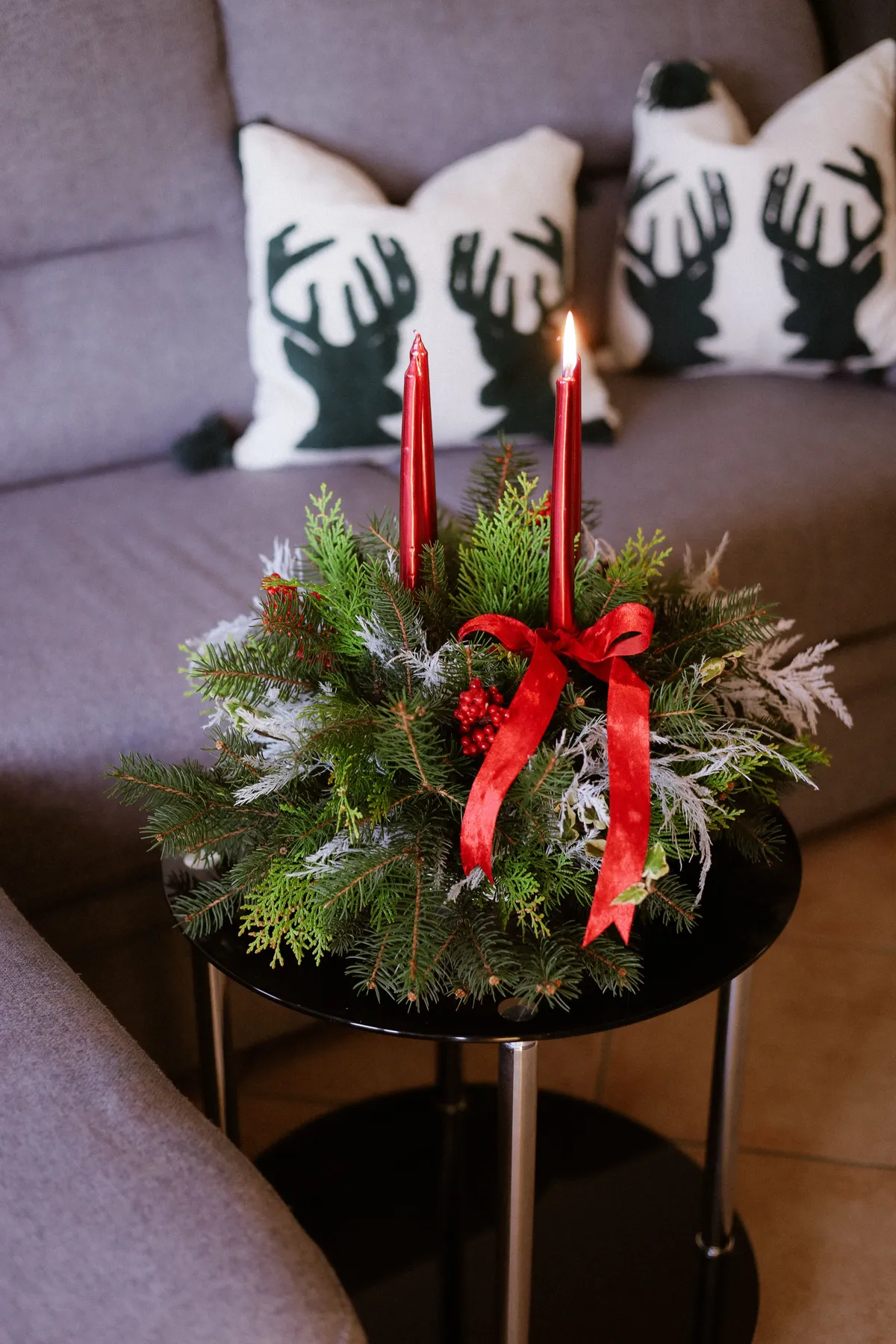
Remember what this is: a side table vignette, not a dining table. It sits where people set down drinks and phones, so keep the candles to the back half and never leave a lit taper unattended near a sofa. Satin ribbon is flammable — trim the tails so they do not drape over the flame, and blow the candles out before the room fills up.
The red ribbon bow is doing structural work. Evergreen clippings alone spread outward and look like debris; the bow gathers them into a single mass with a clear center, so the arrangement reads as one object instead of several. Two candles, not three, keeps the red graphic rather than decorative — and one lit, one unlit is the detail that makes it feel like a room someone actually uses.
21. Wreath-and-Candle Ring You Can Build in an Hour
Candles in a wreath look effortlessly rustic until one leans and drips onto the tablecloth. Set each pillar on a small metal disc or a dab of museum putty so it sits dead level, and keep every flame at least three inches from the nearest pine needle. Using real greenery? Line the wreath’s underside with foil — a step nobody sees and everybody is grateful for.
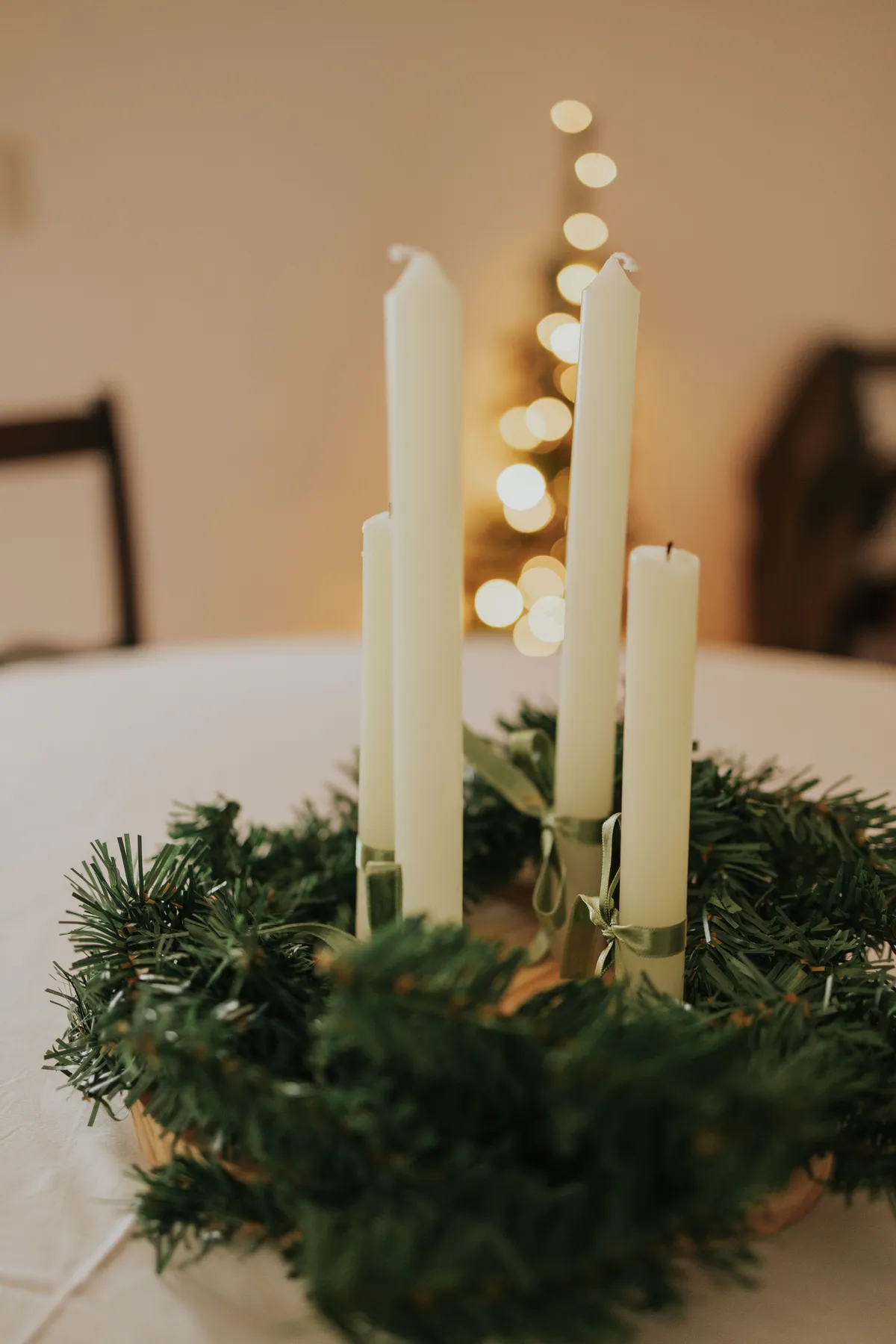
A 12 to 14-inch wreath is the right base for four pillars at roughly 4, 6, 8, and 10 inches tall. That arrangement holds a table center comfortably on anything 36 inches wide or more. On a longer table, do not scale the candles up — build a second identical ring for the far end. Matching pairs at both ends always look more considered than one enormous centerpiece.
Run through this before you build:
- Wreath diameter under 14 inches so place settings still have room.
- All four candles level, on heatproof bases, three inches clear of greenery.
- Pale green ribbon cut to 18-inch lengths — enough for a bow with tails.
- A light wooden board underneath to protect the cloth from wax.
22. Garland on the Beams, Not Just the Table
Repeating greenery at two heights — table level and ceiling level — makes a room read as one decorated idea instead of a table with some stuff on it. The rough beams give the garland something honest to sit against, and small ornaments on invisible thread create movement right at the edge of your vision. It is the difference between a tablescape and a room.
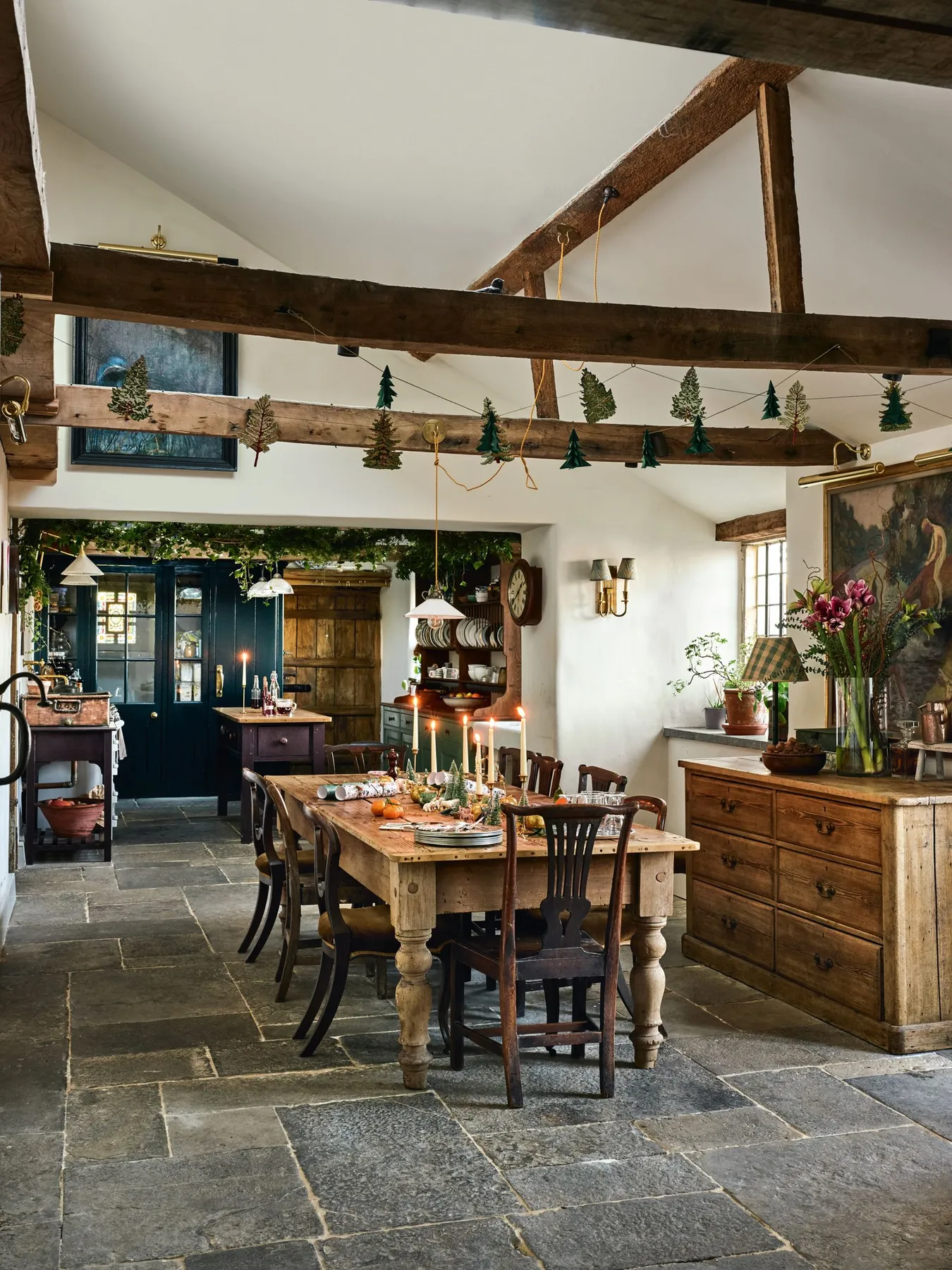
Whole-room holiday decorating is where the energy has gone. After years of tablescapes that only existed in photographs of the table’s surface, hosts are back to garlanding beams, doorframes, and stair rails — partly because it is cheaper per square foot of impact, partly because people are hosting again and want the room, not just the plate, to feel finished.
- Measure your beam run and buy garland at 1.5 times that length so it can loop.
- Screw small cup hooks into the beams — two per six feet, no drilling drama.
- Attach the garland at the hooks and let it sag naturally between them.
- Hang small ornaments on fishing line at 6, 10, and 14-inch drops.
- Weave in battery lights and hide the packs on top of the beam.
About 90 minutes for a 20-foot run, roughly $60 to $120.
23. Mirror-Work Runner with Brass Candelabras
Roughly 40 percent dark wood, 25 percent brass, 20 percent off-white, 15 percent multicolor embroidery. The brass is what holds the saturated textile in check — without warm metal, an embroidered runner this colorful can tip into souvenir-shop territory. Swap the brass for silver and the table goes cooler and more modern; swap terracotta plates for white and the embroidery becomes the only color story.
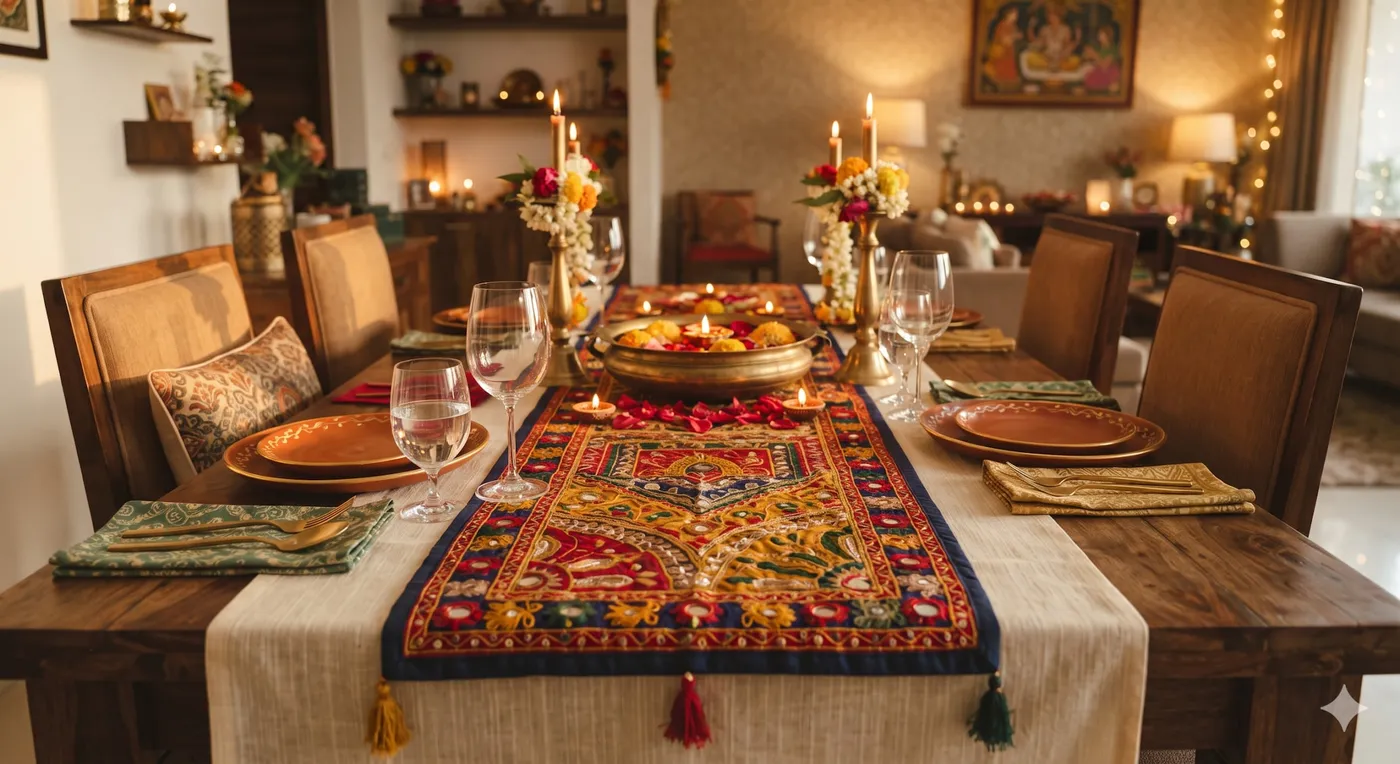
Vintage embroidered and mirror-work textiles show up constantly on Etsy and eBay for $30 to $70, often listed vaguely as embroidered runner by sellers who have no idea what they have. Brass candelabras are a thrift-store staple at $15 to $40 each — nobody wants them until November. Skip new brass bowls and float candles in a shallow ceramic dish instead.
The layering. A runner this ornate on bare dark wood would look like an accident — the beige base cloth underneath is the difference between collected and crooked. That under-layer gives the embroidered textile a neutral field to sit on, which is why the mirrors and tassels read as deliberate ornament rather than clutter. It costs almost nothing and it is the most important decision here.
24. Moss-Green Cloth with Wooden Chargers
Green on green on green is harder than it looks. When the cloth, napkins, and glassware all live in the same family, the table can turn into a solid mass with no place for the eye to rest. White plates and warm wood chargers are the antidote — three clean pauses. Also, a textured cloth will not survive a spill gracefully; blot, do not rub, and keep a spare nearby.
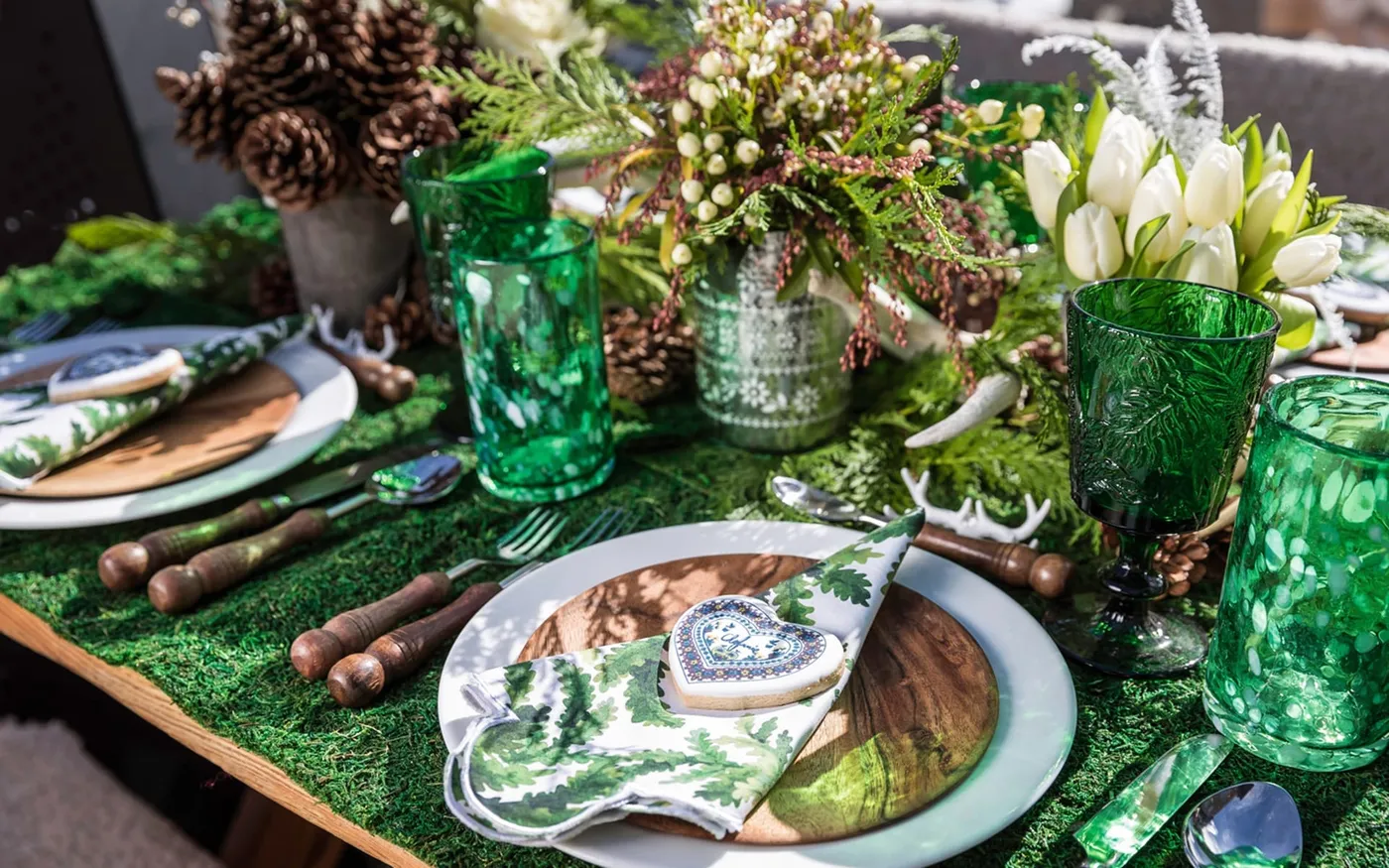
Limit yourself to two greens, maximum, and make sure they are clearly different values — one deep forest, one soft sage. Same-value greens from different dye lots read as a mistake. And when you use green glassware, put something opaque in it: water or white wine. Empty colored glass goes dark and murky under candlelight, which is not the look you are after.
This layered, textured setting works best on tables 40 inches wide or more, where plate, charger, and glassware all have room. On a 36-inch table, lose the wooden charger and stack straight onto the cloth. Round tables handle green-on-green better than rectangles — the eye curves rather than running in a straight line into a wall of color.
25. Kraft Paper and a Gingerbread Village
- Roll kraft paper over the whole table and tape it underneath so it does not slide.
- Lay a red-and-white striped runner down the center for the candy-cane stripe.
- Build the gingerbread house on a cake stand so it sits above the plates.
- Fill three glass jars with different candies and cluster them at one end, not both.
- Tie a candy cane to each chair back with a 12-inch ribbon — five minutes, done.
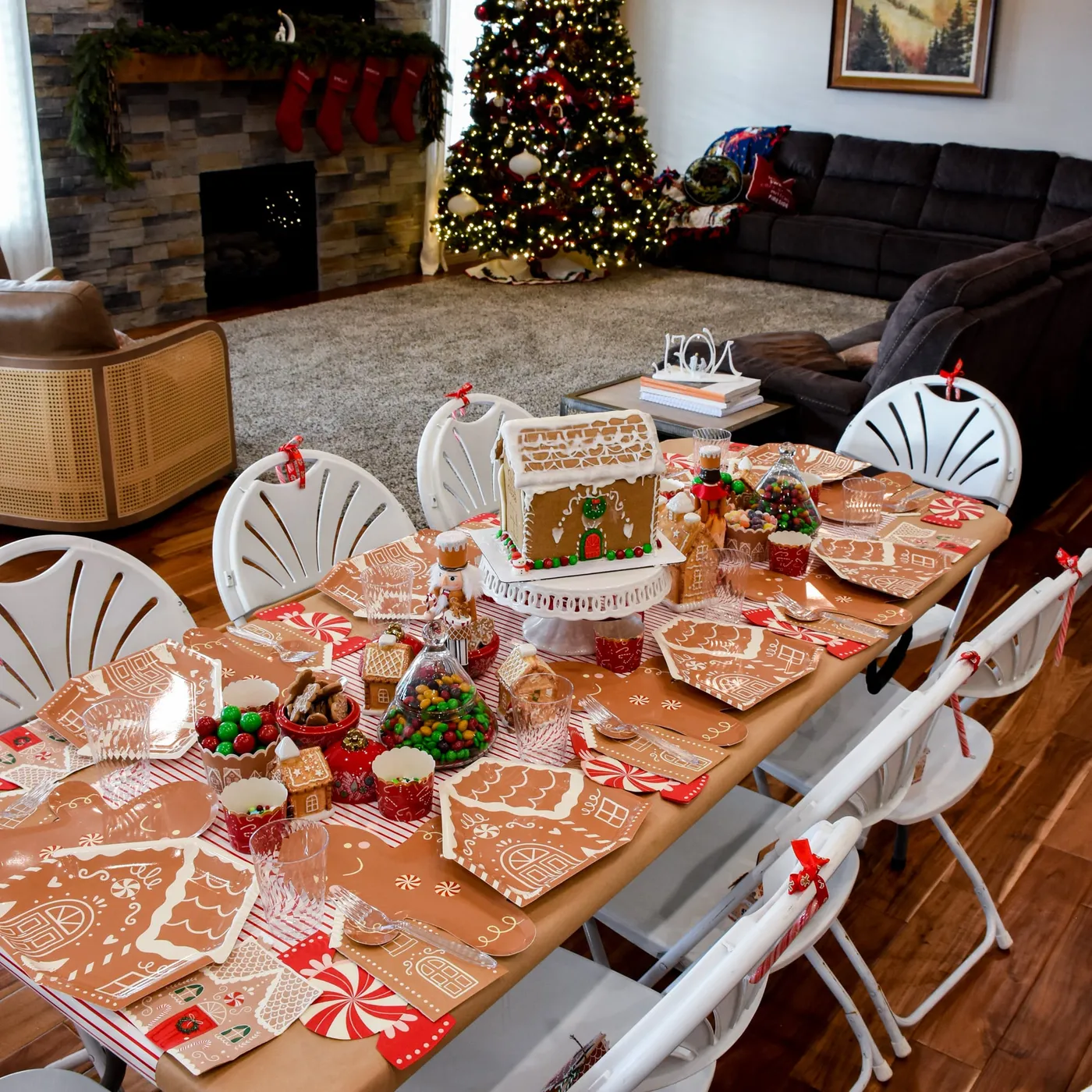
About 45 minutes total, and the paper means no tablecloth to launder.
- Kraft paper roll: $8–$15
- Striped runner: $12–$30
- Gingerbread house kit: $12–$25
- Gingerbread paper plates and napkins: $10–$22
- Candy-filled jars and ribbon: $15–$35
- Candy canes and nutcracker figures: $10–$25
Total: $67–$152. Budget alternative: skip the kit and build the house from graham crackers and a $3 tub of frosting — it looks more homemade, because it is.
This is the one table where paper plates are the right call, and that is the point. Kids’ tables fail when adults try to make them formal — the kraft paper, candy jars, and deliberately casual plates give everyone permission to make a mess. The gingerbread house gets height from a cake stand, so the centerpiece reads as a real centerpiece even though it is dessert.
26. Dark Green Plates Against Bare Light Wood
Bare wood is beautiful and completely unprotected. Hot plates leave white rings, red wine marks in minutes, and candle wax is a genuine project to remove. Put a runner or individual trivets down before anything warm lands, and wipe spills immediately with a dry cloth rather than a wet one. Re-oil the table once a year with a food-safe oil — twenty minutes buys you a decade.
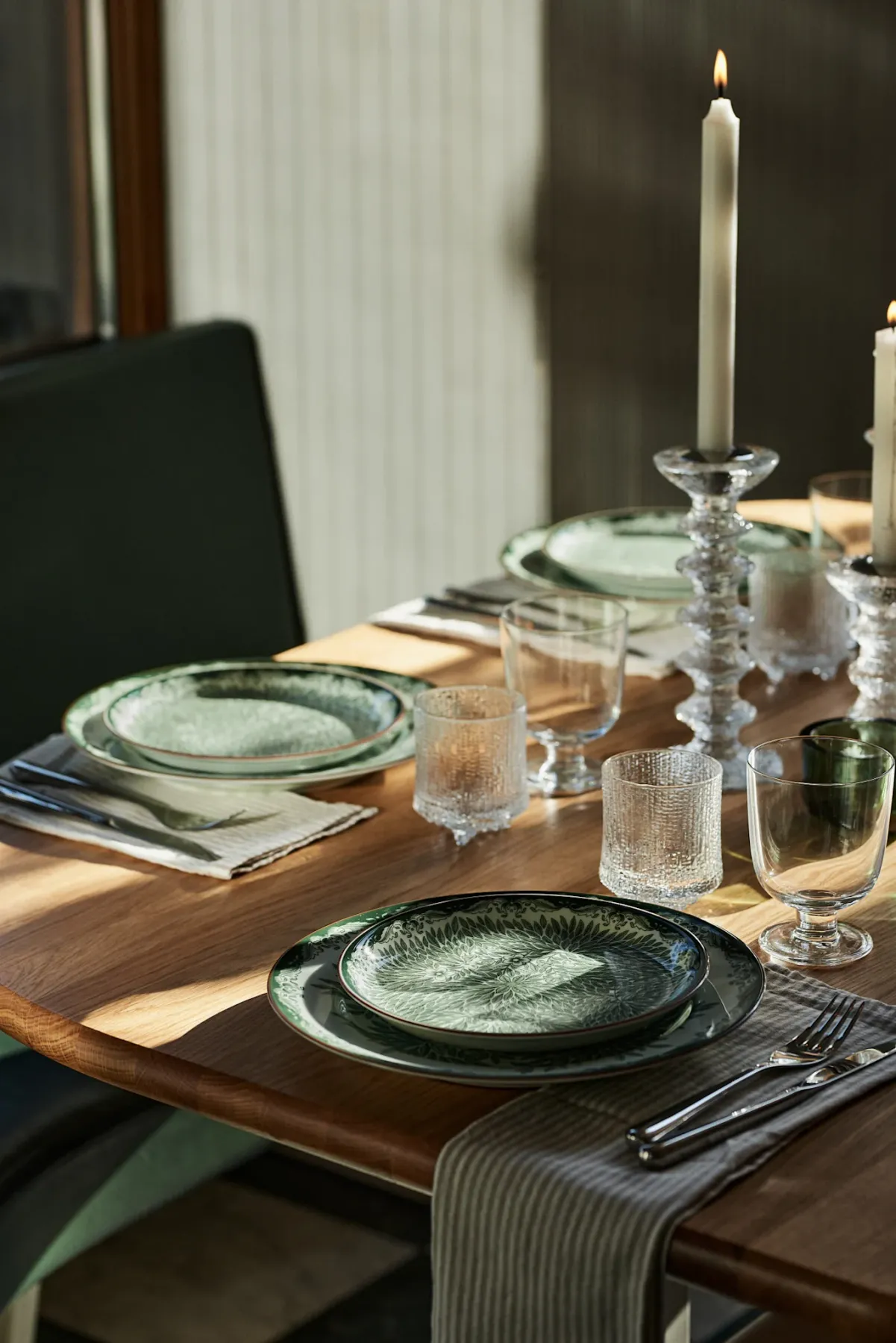
Roughly 50 percent light wood, 30 percent dark green, 15 percent grey and white, 5 percent silver. The bare wood is doing the job a white tablecloth usually does — it is the neutral field everything else sits on. Swap the dark green plates for white and the table goes Scandinavian; swap clear glass for amber and the whole thing warms up ten degrees.
No tablecloth. That is the design decision, and it is a brave one — most hosts instinctively cover wood for a holiday. Leaving it bare means the green plates, striped linen napkins, and textured glass all sit against warm grain instead of flat white, and the shadows that fall across the surface in daylight become part of the composition. Cover it and you lose the soul of the table.
27. Fluted Wood Table with Miniature Trees
Before you buy a single plate:
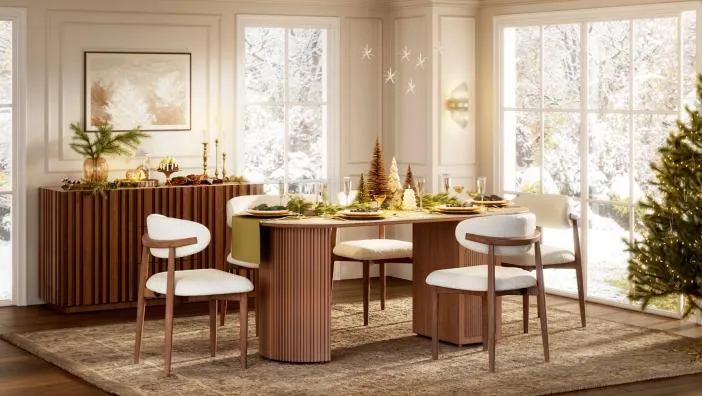
- Measure the table and add 12 inches — a runner should overhang, not stop.
- Count actual chairs, not planned guests; gold plates for ten at a six-seat table is waste.
- Look at your plates under your dining room bulbs — gold reads brassy under cool light.
- Test one window decal in a corner to be sure it peels cleanly.
Gold plates are decorative finish, not dinnerware — most scratch the moment a knife touches them, so use them as chargers under a white plate and keep the cutting on the white. And that olive runner will photograph almost black in a dim room. If you are hosting at night, add a warm lamp or two on the sideboard so the green and gold read the way you intended.
Gold chargers cost about $3 each and give you 90 percent of the look for 20 percent of the price — stack your existing white plates on top and nobody notices. Miniature trees run $5 to $12 at big-box stores, and golden candlesticks are everywhere at thrift shops for under $10 a pair. The fluted table is the only thing worth real money.
28. Dried Orange Slices in the Garland
- White tablecloth, 8 ft: $25–$70
- Evergreen garland, 9 ft: $30–$85
- Dried orange slices, bag: $8–$18
- Pillar candles in orange and red: $18–$45
- Pinecones and cinnamon sticks: $6–$15
- Wine glasses and silver cutlery: owned, or $40–$120
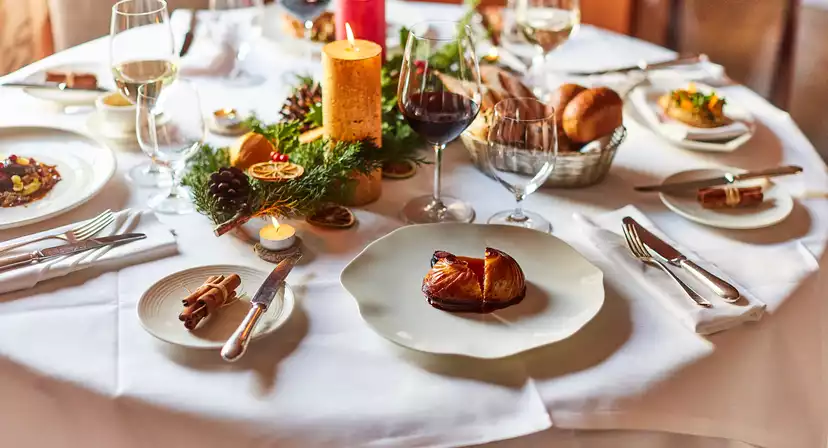
Total: $87–$233. Budget alternative: dry your own citrus at 200°F for three hours and use clippings from the tree — saves about $25.
Dried orange slices are the cheapest way to add warm color to a green garland, and the difference between good and sad is thickness. Slice a quarter inch thick, dry at 200°F for three to four hours, flipping halfway — too thin and they curl into crisps, too thick and they brown. Tuck them in pairs, slightly overlapping, so they catch candlelight like little stained-glass windows.
Dried citrus, cinnamon sticks, and paperwhites have been steadily replacing glitter for several seasons, and the shift is about scent and texture as much as looks. People want a table that smells like something. The whole-natural holiday table also has obvious 2026 appeal — you can compost most of it, and none of it needs a storage bin in January.
29. Red-and-Gold Garland for a Long Table
For a long table — eight feet or more — buy garland at 1.5 times the table’s length so it can loop and pool instead of stretching thin. Keep the finished width under 10 inches so there is still room for chargers and glasses. This is the scaled-up version of Idea #4: same idea, doubled footprint. Seating six or fewer? Halve everything and skip the second candle cluster.
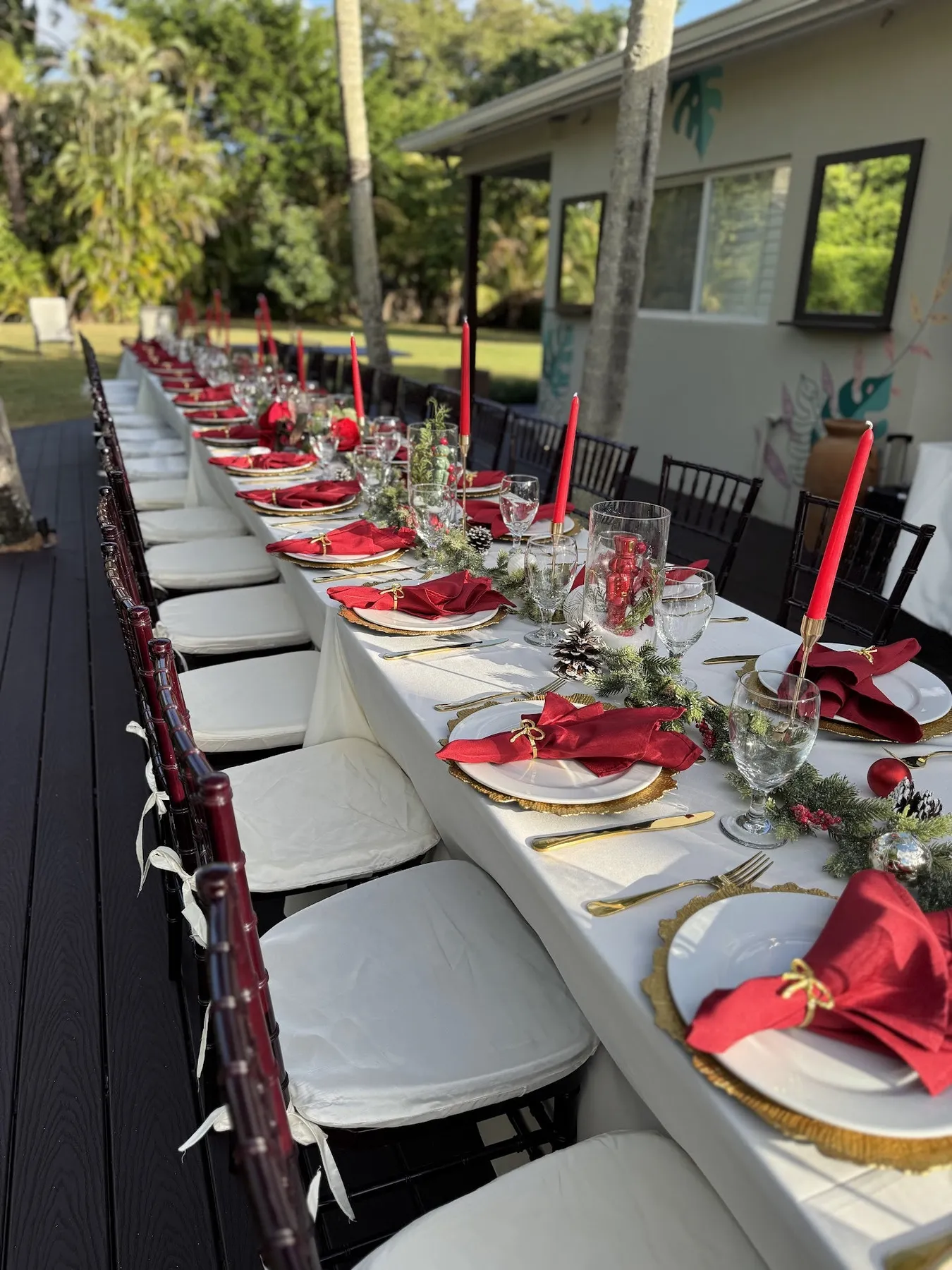
Gold chargers are essentially mirrors lying flat, and on a long white table they bounce every candle flame back up at the faces around them — which is why a table this simple looks warm rather than stark. The red napkins repeat eight or ten times down the length, and repetition at that scale reads as ceremony. Nothing here is complicated; it is just consistent.
- Lay the garland in a shallow wave down the center, doubling it back at both ends.
- Wire in extra pine sprigs wherever it looks thin — usually at the loops.
- Add red berries and pinecones in clusters of three, about 18 inches apart.
- Set red tapers in gold holders at both ends and one in the middle.
- Check the whole run from a standing height and fill any gaps you can see from above.
About an hour for a ten-foot table, roughly $80 to $150 in materials.
30. Pastel Bottle Brush Trees on a Pink Runner
The fluffy pink runner. Not the color — the texture. A flat pink cloth would look like a baby shower; that fuzzy, almost-furred surface is what makes pastel read as cozy and slightly magical instead of sweet. It also gives the bottle brush trees something soft to sit on, so they look nested rather than placed. Swap it for satin and the table loses its charm in one move.
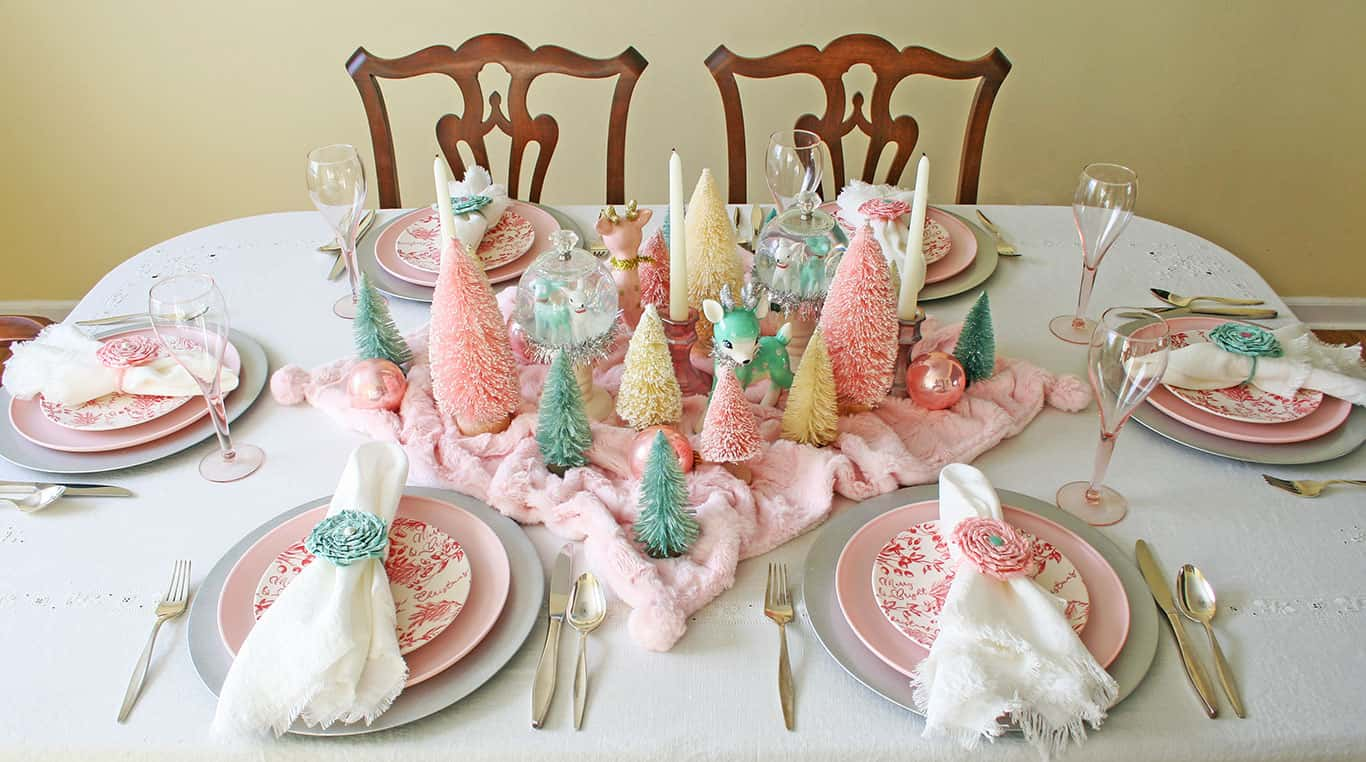
Bottle brush trees are absurdly easy to find cheap — the dollar section at Target, craft-store multi-packs, and thrift stores year-round. Twelve in mixed pastels runs $12 to $20. The ceramic deer can come from a discount store for $8, and the clear globes are repurposed ornaments with the tops removed. Under $70 for a table that looks stylist-built.
Pastels behave very differently at night. In daylight this table is charming; under warm evening bulbs, pale pink can read beige and mint can read grey. Turn the overheads off, use candlelight and one warm lamp, and test the palette after dark before committing. And if toddlers are attending, treat the ceramic deer as sideboard decor, not table decor.
31. Poodles, Bows, and More Red Than You’d Expect
Pink and red only work together when white does the separating. Put a white plate between every pink element and every red one, and keep the two saturated colors from touching directly — the moment they do, they vibrate. If you are using figurines, group them in odd numbers and vary the heights; three poodles at three heights reads as a collection, four at the same height reads as a shelf.
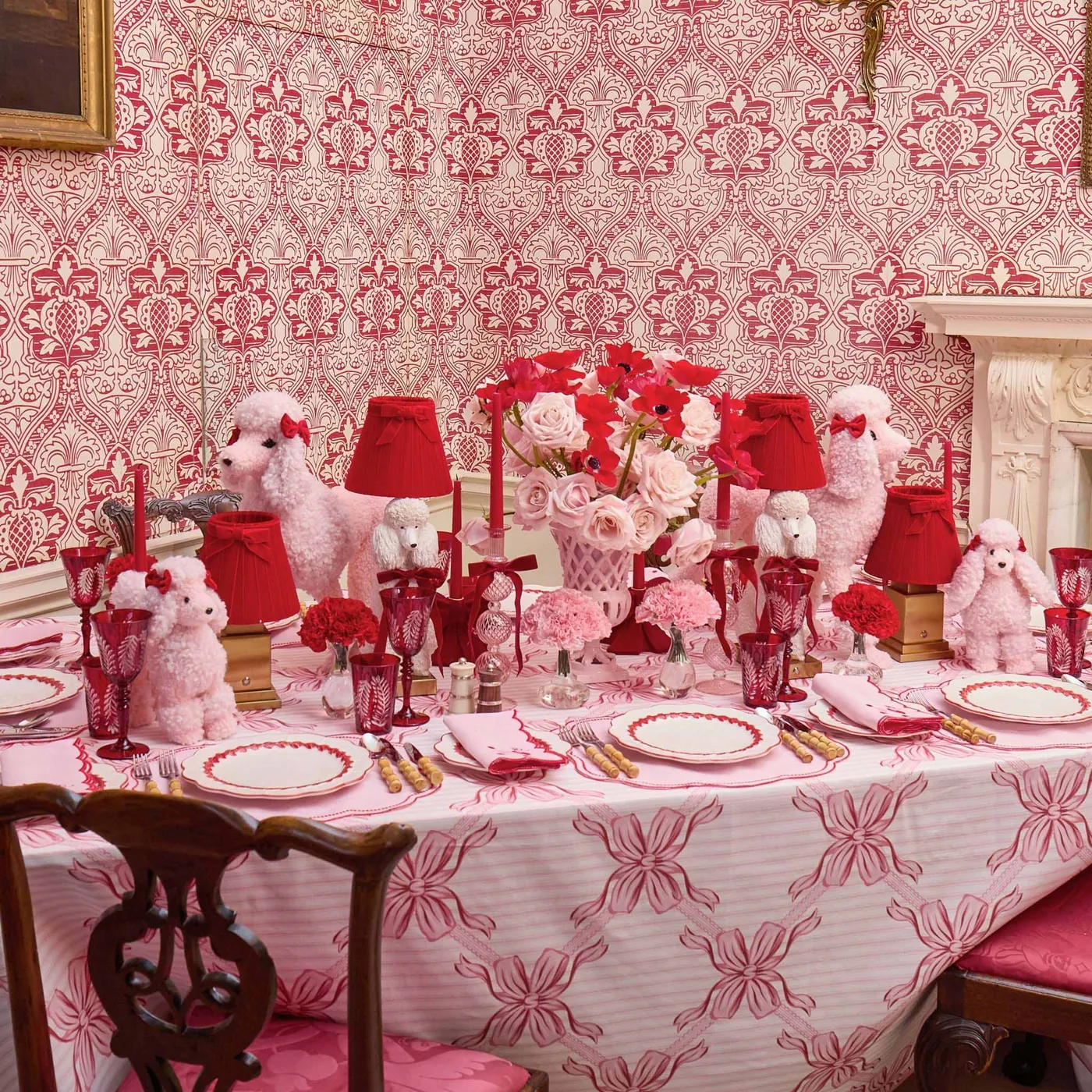
Roughly 45 percent pink-and-white stripe, 30 percent red, 20 percent white, 5 percent gold. That is a lot of pattern, so everything else has to be simple: solid white plates, plain glassware, one floral moment. Swap red for burgundy and the table turns moody and grown-up; swap pink for peach and it softens into something almost springlike. This is the same mistake covered in our wrap-up section — too many strong elements without a referee.
Red patterned glassware is beautiful and completely transparent about its flaws — hard water spots show up like scars. Hand wash and towel dry immediately; never let them air dry upside down. The bow-print cloth needs spot cleaning after every use, so treat stains right away and skip the dryer, because heat sets everything. This is a table you enjoy carefully, not casually.
32. Glitter Chargers and a Tiered Pastry Stand
- Rose-patterned tablecloth: $45–$130
- Red table runner with gold accents: $20–$55
- Gold glitter chargers, set of 8: $24–$60
- Red napkins and gold napkin rings: $28–$70
- Red candleholders and tapers: $30–$85
- Gold tiered dessert stand: $25–$65
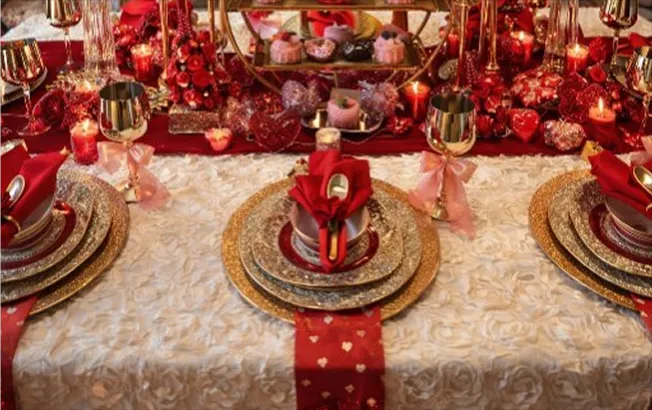
Total: $172–$465. Budget alternative: spray-paint thrifted chargers gold for about $12 total and use solid red napkins instead of patterned glassware.
This much gold and glitter needs room to breathe. Plan on a table at least 42 inches wide and eight feet long — anything smaller and the chargers, candles, and tiered stand start colliding. Ceiling height is not the issue; chair clearance is. You want 30 inches of space behind each chair so guests can push back without hitting a wall.
The tiered stand. Everything else here is flat — plates, cloth, runner, chargers all lie in the same plane. The tiered gold stand is the only thing that rises, and it creates a center of gravity that makes the rest look composed instead of covered. Put the pastries on a flat platter and the whole arrangement deflates.
33. Gold Ornaments Tucked Into Pine Branches
Gold works here because the finishes are mixed — matte, brushed, mirrored, and a few with aged patina. A single uniform gold reads cheap; four finishes together read collected, and the pine branches give them somewhere to hide so it does not look like a bowl of baubles. Warm string lights at roughly 2700K are the other half of the equation — anything cooler turns the gold green.
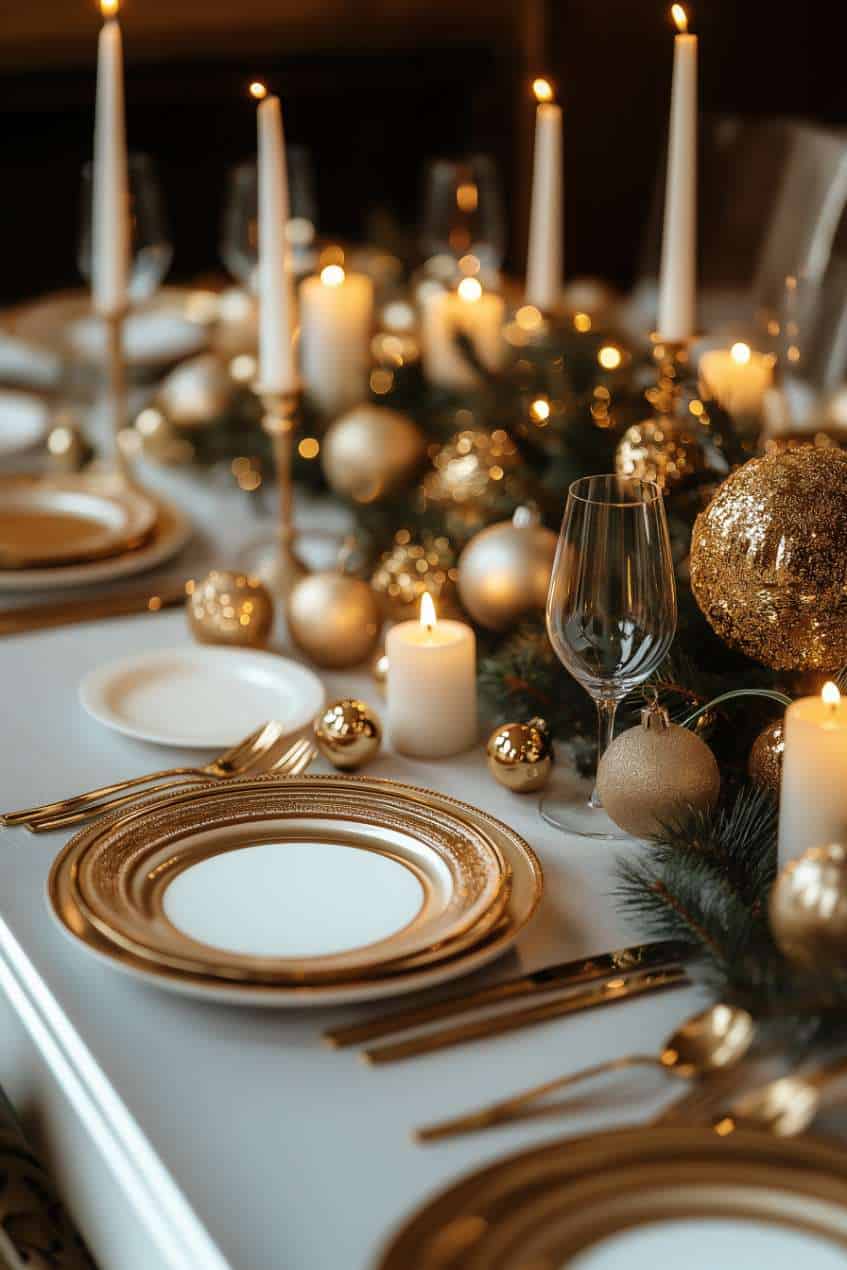
Ornament sets go half price the week after Christmas, which is when you should buy them for next year. Thrift stores sell bags of vintage gold ornaments for $3 to $8 year-round, and they have the patina new ones are trying to fake. Pine branches? Ask a tree lot for trimmings — usually free. This entire look assembles for under $50 if you shop in January.
Tuck ornaments so the metal caps hide inside the branches — visible caps are what make a garland look like it came out of a box. Cluster them in odd numbers, and put the largest nearest the base of the arrangement so the whole thing has visual weight at the bottom. Aim for about one ornament every eight inches; any denser and the greenery disappears.
34. Red Anthuriums Instead of Poinsettias
Anthuriums have quietly become the flower people reach for when poinsettias feel too expected. Those glossy red heart-shaped spathes read as holiday without a single pine needle, and they last two to three weeks in a vase — far longer than most seasonal flowers. Florists have noticed; red anthurium availability has climbed every December for the past few years and 2026 is no exception.
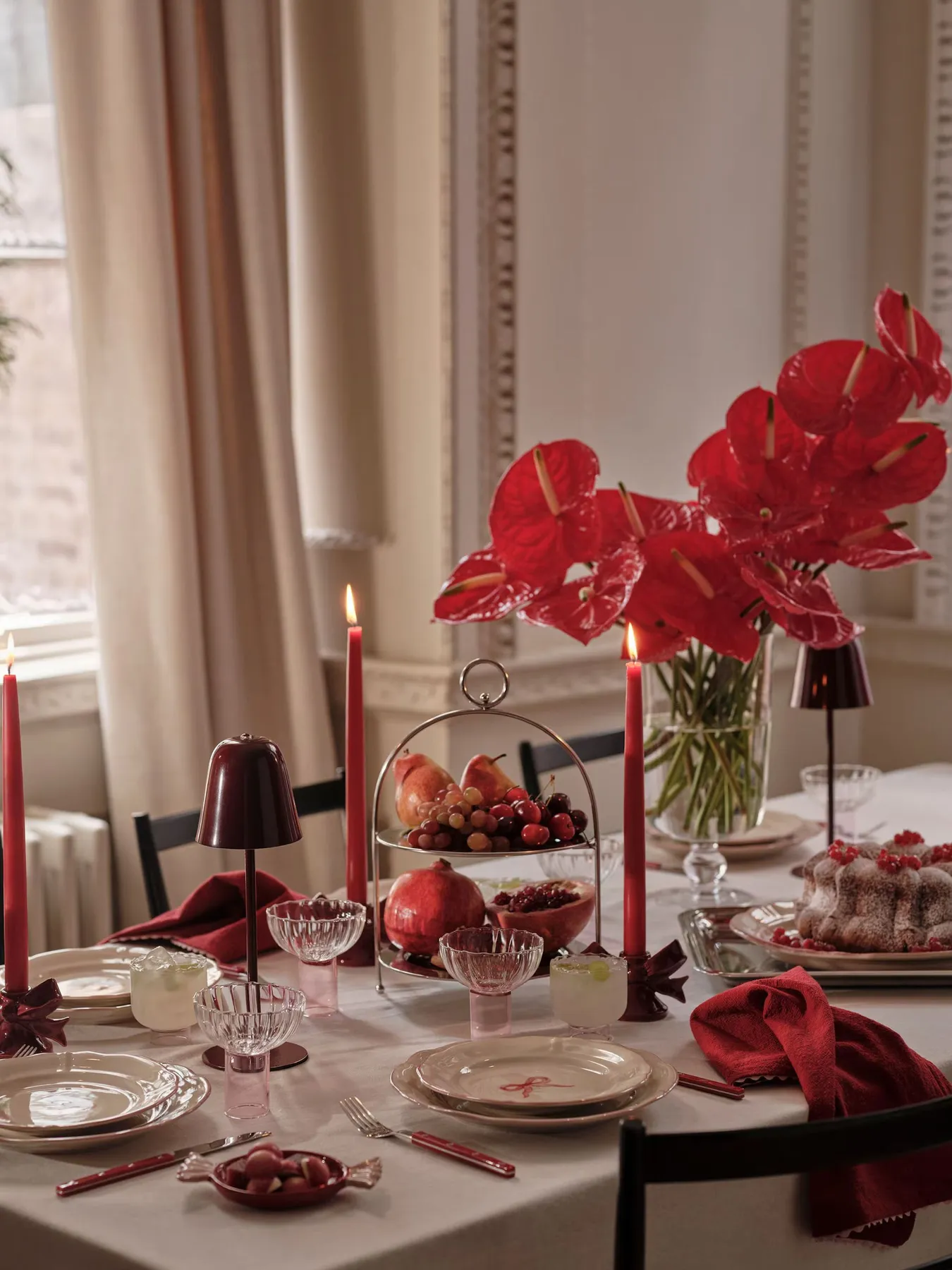
Anthuriums are tropical and they act like it. They hate drafts, dry forced air, and being anywhere near a radiator or heat vent, and they will droop within a day if you ignore that. Keep them away from the fruit bowl too — ripening fruit gives off ethylene that shortens their life. Change the water every other day and recut the stems at an angle.
Roughly 55 percent white (cloth, plates), 30 percent red (flowers, napkins, candles), 10 percent silver (tiered stand, cutlery), 5 percent green. The silver is what keeps this from looking like Valentine’s Day — cool metal against warm red reads festive rather than romantic. Swap the silver for gold and the whole table warms up and softens.
35. Sage Linen with Hellebore and Illustrated Glass
- Recut hellebore stems at an angle and sear the bottom inch in just-boiled water for 10 seconds.
- Plunge into cold water and let them drink for two hours before arranging.
- Build the pine branches first in a wide brass bowl, creating a low, uneven base.
- Tuck hellebore stems in individually, facing different directions — never in a tight bunch.
- Top up the water daily; hellebore droops fast in shallow water.
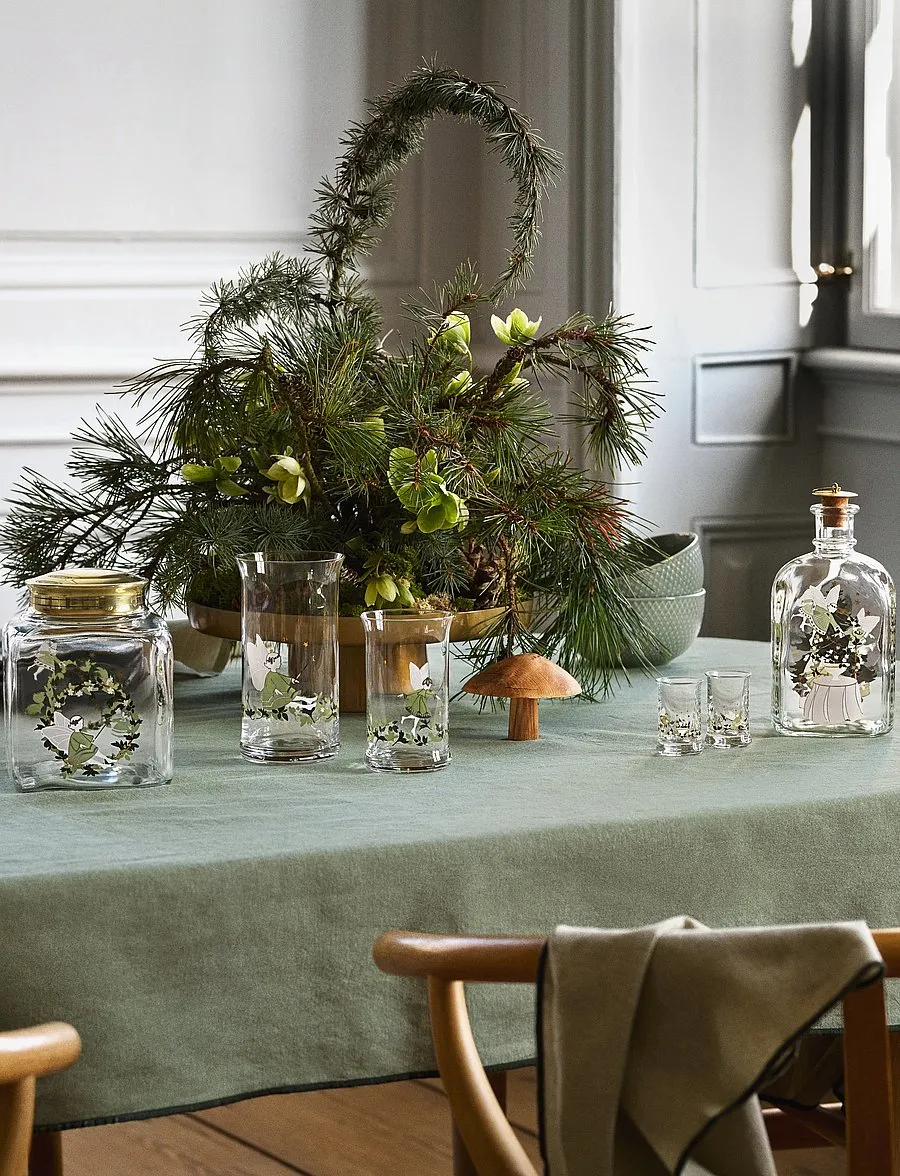
About 30 minutes of arranging, roughly $25 to $45 in stems.
A wide, low bowl reads best on tables 36 to 44 inches across, with the arrangement kept under eight inches tall so sightlines stay open. If your table runs longer than six feet, repeat the same bowl at the other end rather than building one enormous centerpiece — two medium arrangements always beat one that blocks conversation. The illustrated glass can go the full length.
Illustrated nature-themed glassware is having a moment, and it is very easy to fake. Thrift stores turn up vintage botanical jars and glasses for $2 to $5 each, and IKEA carries simple glass carafes under $10. A brass-toned bowl from a discount store runs $12. The sage cloth can be a flat sheet. Total for the whole look: under $60.
Now Put the Phone Down and Pour Something
You do not need any of this to be perfect — you need it to be done, so you can sit down with the people you invited. Pick one idea, raid what you already own, and let the rest go.
And if you have a Pinterest board full of candlelit tables you saved months ago, consider this your sign to finally make one of them happen this year.