
Still scrolling through Christmas tree ideas for 2026 without knowing where to start? You’re not alone — the average Pinterest user saves more tree photos in November than in the other ten months combined, and still ends up decorating exactly the way they did last year.
We spent serious time browsing Target, Walmart, Etsy, Anthropologie, and Amazon to bring you only what’s worth your attention this year, and the range runs from about $12 for a box of ornaments to $650 for a full flocked showstopper.
Inside you’ll find 34 curated ideas spanning grand traditional halls, white-and-silver frost, vintage glass, and blue-and-gold glam — with budget and luxury versions compared side by side and every idea shoppable with direct product links.
What’s driving it in 2026? A visible reaction against the identical, algorithm-approved tree. People want collections, inherited pieces, and color stories that look gathered over years rather than bought in one cart.
Go ahead and save this — you’re going to want to reference it.
1. Rose Gold, Gold, and a White Tree Skirt in a Grand Hall
Rose gold and yellow gold are doing two very different jobs here, and that’s why the tree reads as expensive rather than simply decorated. Rose gold skews slightly pink and cooler, so it catches warm white light and throws it back as a soft blush; yellow gold absorbs the same light and glows. Put them side by side and the tree looks lit from within.

The second principle is scale repetition — every ornament on this tree is roughly the same size, which lets the wide metallic ribbons carry all the texture. One oversized statement piece would break the rhythm completely.
- 8 ft pre-lit artificial tree: $180–$600
- Rose gold and gold bauble sets (60–80 pieces): $60–$160
- Wide metallic ribbon, 3 rolls: $25–$60
- White tree skirt: $30–$90
- Wrap, boxes, and ribbon for the base: $20–$50
Total: $315–$960
Budget alternative: buy the baubles in January clearance and start with a plain unlit tree — you’ll land closer to $180.
2. Gold and Burgundy Under Gothic Wood Paneling
Hang ornaments in threes, not singles. Group three baubles in a loose 6-inch triangle, then push the largest one about 4 inches deeper toward the trunk so it casts a shadow. That depth is what separates a tree that photographs like a catalog page from one that looks flat. On a tree this dense, work in a spiral from the bottom up so you never have to reach through branches you’ve already finished.
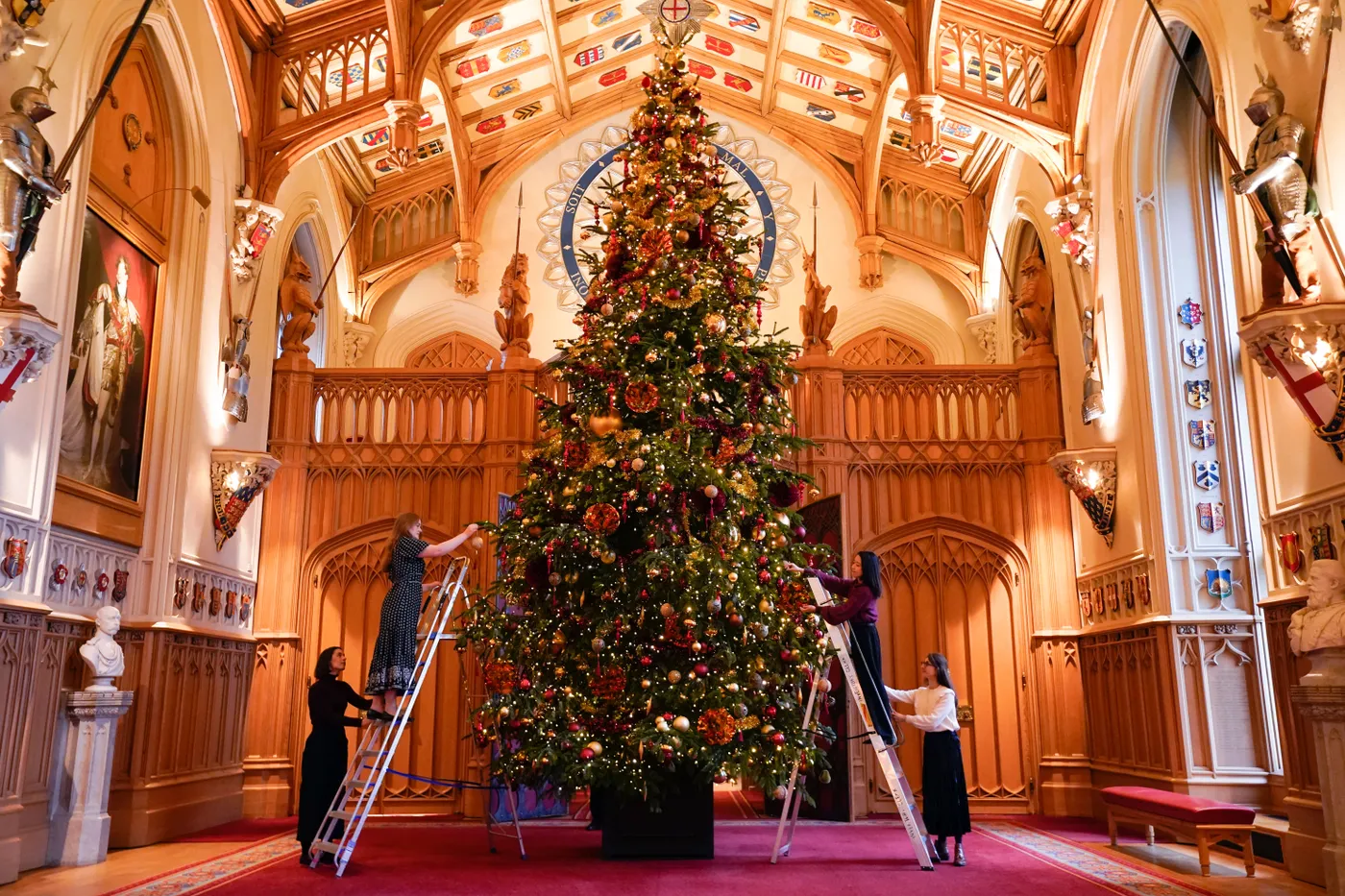
The formula here is roughly 60% deep green foliage, 25% warm gold, and 15% burgundy — with the burgundy concentrated in the lower two-thirds so it doesn’t visually tip the tree over. Swap burgundy for holly green and you get a quieter, more English version; swap gold for antique bronze and the whole thing goes medieval. The ratio is what you keep. Idea #18 runs the same math with a much hotter red.
3. Oversized Red and Gold Bulbs Beneath a Crested Ceiling
The oversized bulbs are the whole trick. On a tree this tall, standard 2-inch baubles vanish — they read as texture, not decoration. These are closer to 5 and 6 inches across, which is the only reason the tree still looks decorated from thirty feet away at the bottom of the hall. Strip them out and you’re left with a very well-lit green cone and a lot of carved wood.
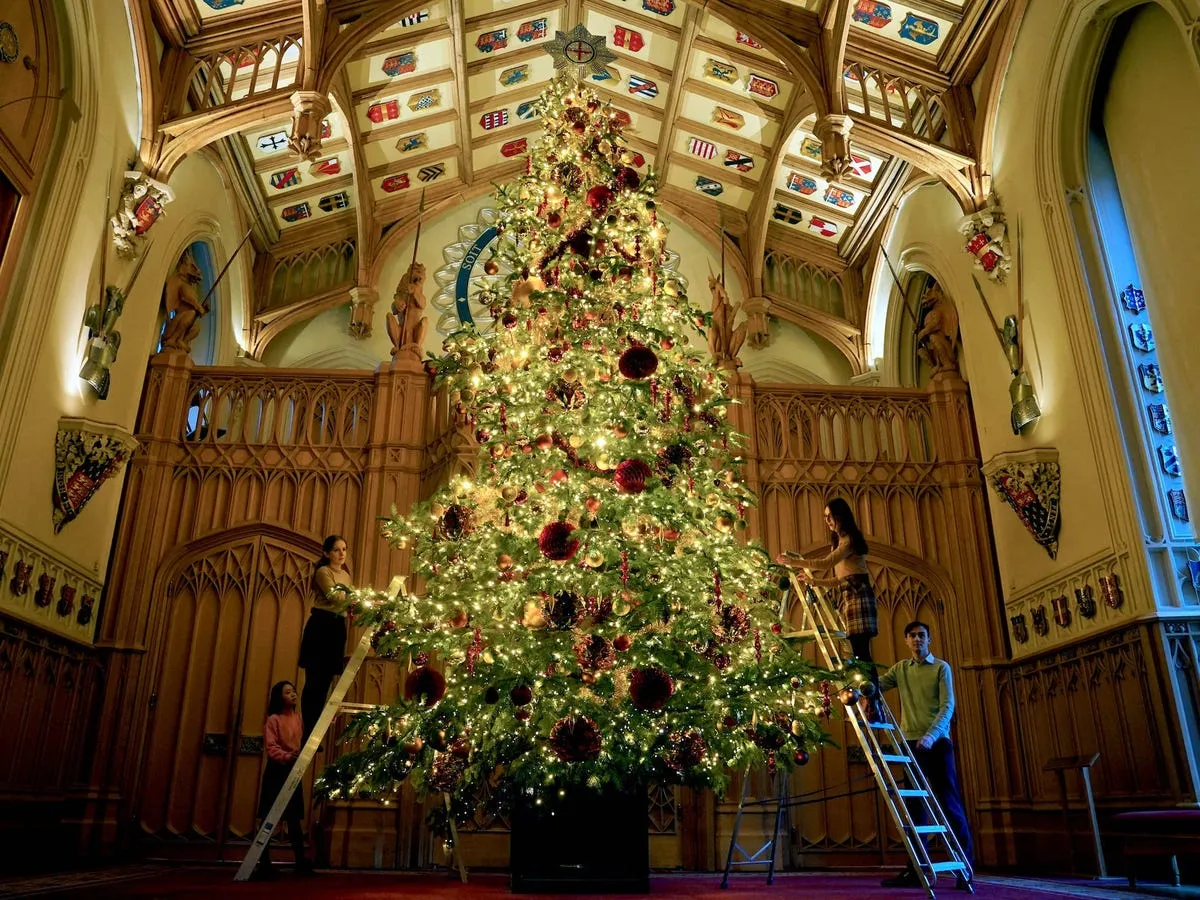
If your tree is under nine feet, size the ornaments down proportionally rather than copying the measurements exactly.
This look needs a ceiling of at least 14 feet to breathe, and a tree in the 12 to 14 foot range. It also needs floor space — plan on a 6-foot radius of clear floor around the base so nothing feels crammed. In a standard 8-foot room, drop to a 7.5-foot tree with 4-inch bulbs and the proportions still hold. Compare with Idea #26, which solves the same problem vertically in a narrow space.
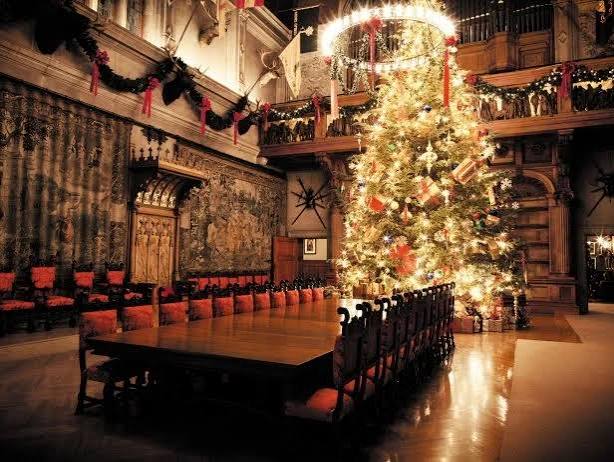
4. A Long Red Dining Table Pulled Right Up to the Tree
Set the table so it reads as part of the tree, not a separate event.
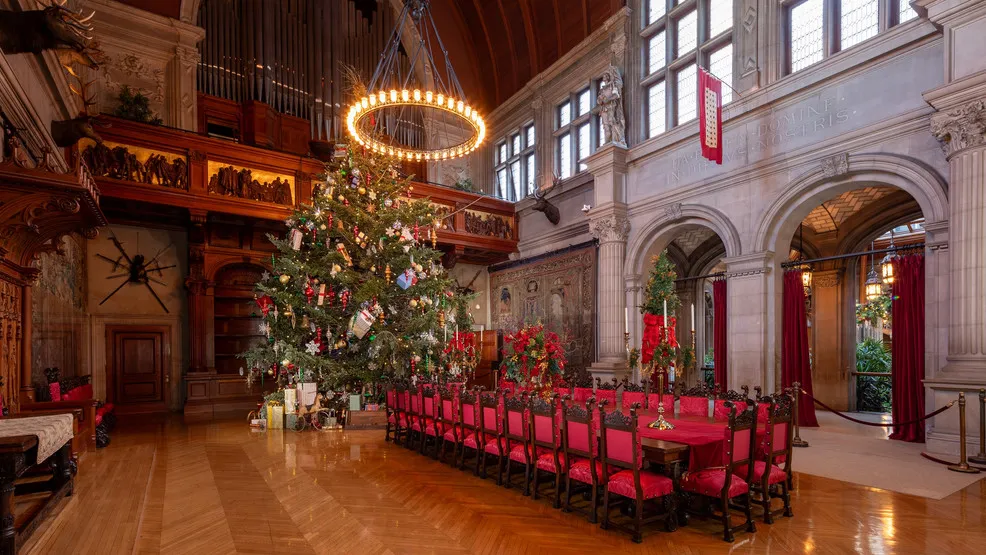
- Measure the gap between tree edge and table edge — aim for 30 to 36 inches so chairs pull out.
- Run a plain red cloth to the floor and skip the runner; the tree’s garlands already supply pattern.
- Use one large centerpiece, like a low bowl of gold baubles, instead of several small ones.
- Match chair upholstery to the cloth within two shades so red reads as a single mass.
- Hang the chandelier so its lowest point sits 36 inches above the tabletop.
Time: about 90 minutes. Cost: $80–$220 if you already own the chairs.
Red cloth plus red chairs plus red curtains is a lot of one color, and under warm bulbs it can drift orange by 8pm. Test your fabric in the actual room light before you commit. A tree this close to a dining table also means water spills and dropped needles near the plates — put a waterproof mat under the stand and skip the floor-length cloth if you have kids who lean on things.
5. Multicolor Lights and a Golden Star Against Woven Tapestries
Multicolor lights spent twenty years as the thing design magazines politely ignored, and they’re back — hard. The 2026 swing toward collected, inherited, slightly imperfect holiday decor pushed warm-white-only trees into hotel-lobby territory, and color strands suddenly read as nostalgic rather than dated. The tapestry backdrop does the rest of the work: heavy woven textiles are having a moment of their own.
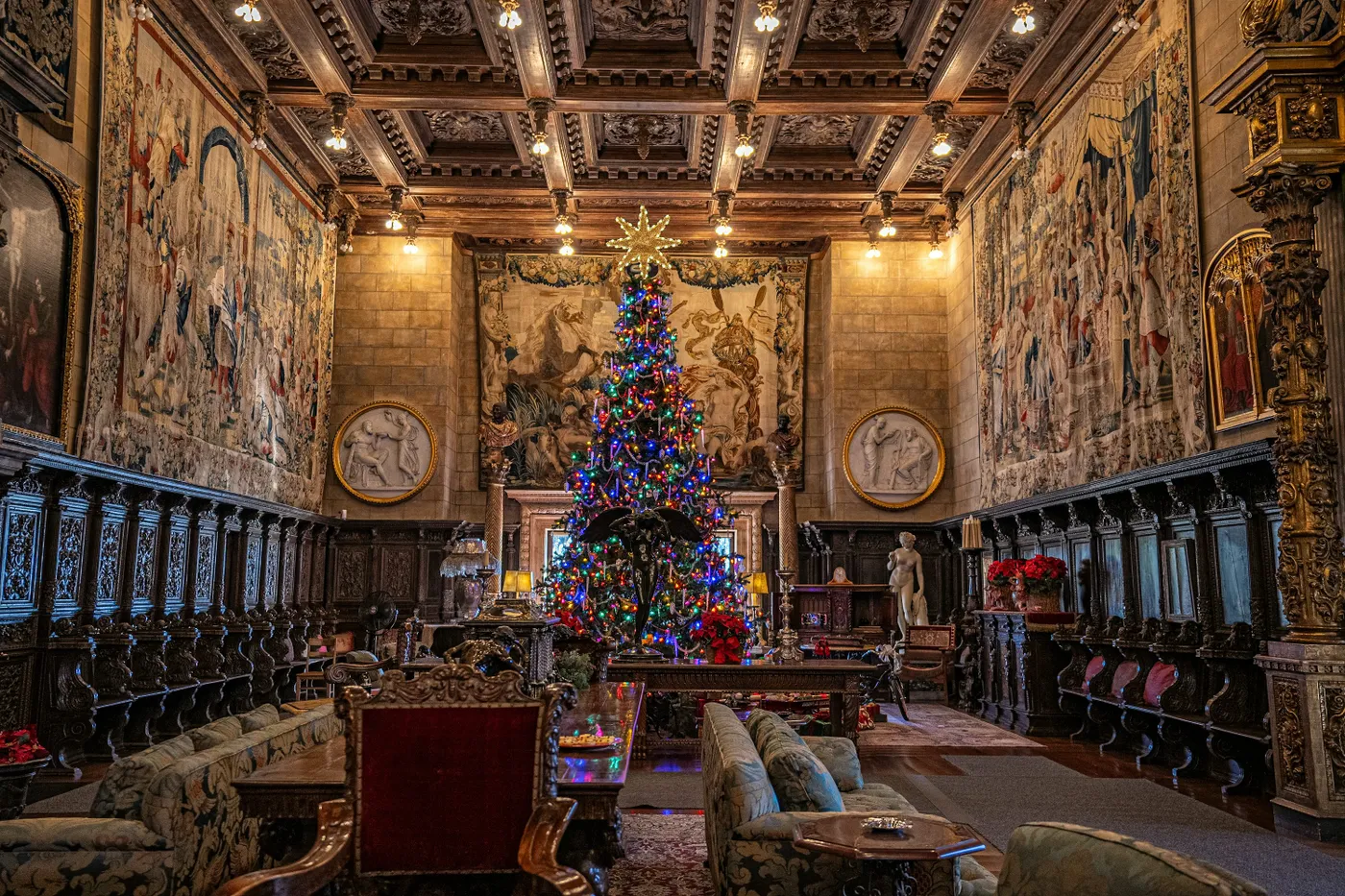
If you want multicolor without the carnival effect, keep warm white as your base and treat color as accent. Run warm white strands through the interior of the tree for glow, then add color strands only on the outer 6 inches of branch. That lands you near an 80/20 mix — enough color to read as festive across the room, while the tree still glows from the inside.
6. Clear Icicle Ornaments in a Stone Arched Foyer
The clear icicles are doing something no colored ornament can: they disappear into the branches and reappear only when a bulb catches them. That flicker-and-vanish effect is what makes this foyer feel cold and glistening rather than simply decorated. Swap them for opaque ornaments and you lose the entire illusion.
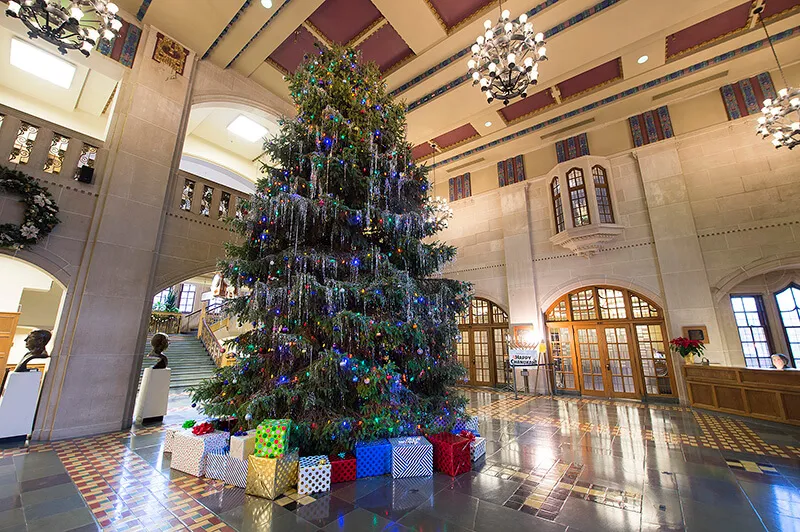
They’re also the cheapest thing on the tree — a box of thirty runs under $20.
You don’t need a stone foyer to get this. A box of clear acrylic icicles from Walmart ($12–$18), multicolor LED strands from Target ($9–$15 per 100 lights), and patterned wrapping paper from a discount store will do it. The real move is the gift cluster: wrap eight to ten boxes, some empty, in mixed patterns and stack them three deep at the base. Compare with Idea #14, which uses the same cluster idea on a staircase.
7. Multiple Gold and Silver Trees Mirrored in Polished Marble
The formula is 50% green, 35% mixed gold and silver, 15% white light — and the silver is deliberately cooler than the gold, which keeps a hallway full of trees from turning into a solid wall of yellow. Repeat the same ornament mix on every tree rather than giving each one a personality; the uniformity is what makes it feel designed.
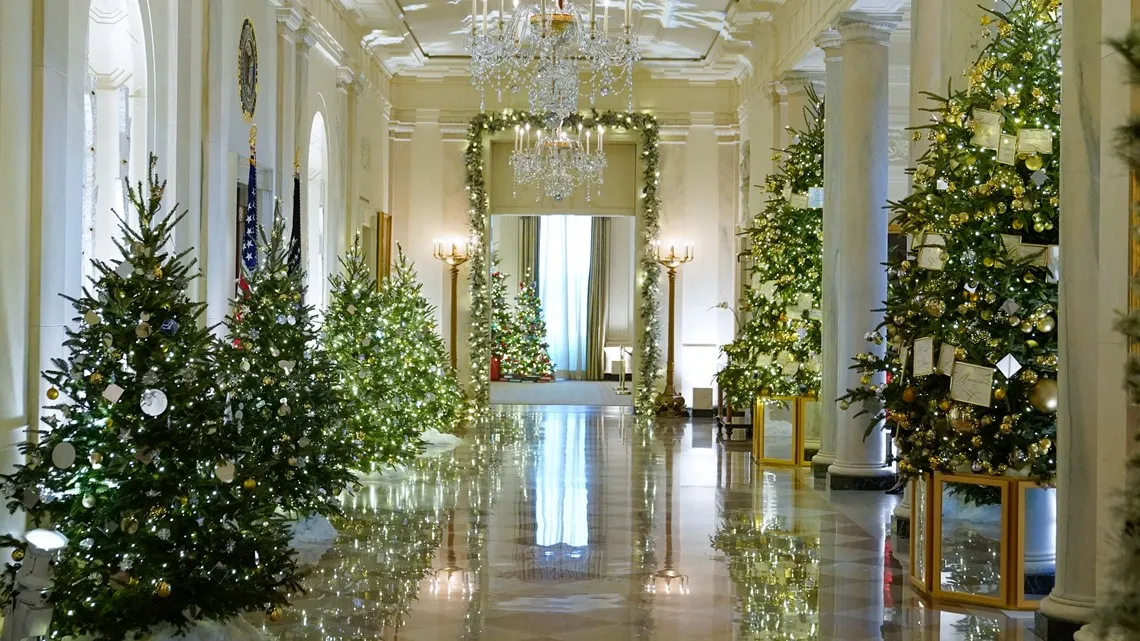
To warm it up, swap silver for champagne and add cream ribbon. To cool it down further, drop the gold entirely.
Polished marble and mirror-finish floors show every needle, every fleck of glitter, and every footprint. Plan on a quick sweep every other day and felt pads under every stand. Glitter-shedding ornaments are the enemy here — look for matte or glass finishes, or seal glittered baubles with a light coat of hairspray before hanging them.
8. Flocked Tree in White and Silver Beside a Fur-Draped Chair
Flocked trees fail when the white is the only cool thing in the room. Here the tree, the armchair, the fur throw, and the mantel all sit in the same cool-to-neutral range, with dark wood flooring underneath to keep it from floating away. That contrast line — white above, dark below — is what makes it look like a room instead of a display.
Silver ornaments also reflect warm white lights rather than absorbing them, so the tree keeps glowing in daylight.
- 6.5 ft flocked tree: $120–$400
- White and silver ornament set (50–70 pieces): $40–$110
- White ribbon garland, 2 rolls: $15–$35
- Fur throw: $40–$120
- Mantel garland and white decor: $35–$90
Total: $250–$755
Budget alternative: buy a plain green tree and a can of spray snow, then hunt silver baubles in bulk — you’ll be around $90.
9. Emerald and Gold Glam Nook Framed by Two Trees
Two trees flanking a seating area only work if they’re treated as a matched pair. Same height, same ribbon, same ornament family — otherwise the eye keeps comparing them and the nook never settles. Keep the pair at least 5 feet apart so the sofa can breathe, and hang pendant lights 30 to 34 inches above the coffee table so the plush characters below stay visible.
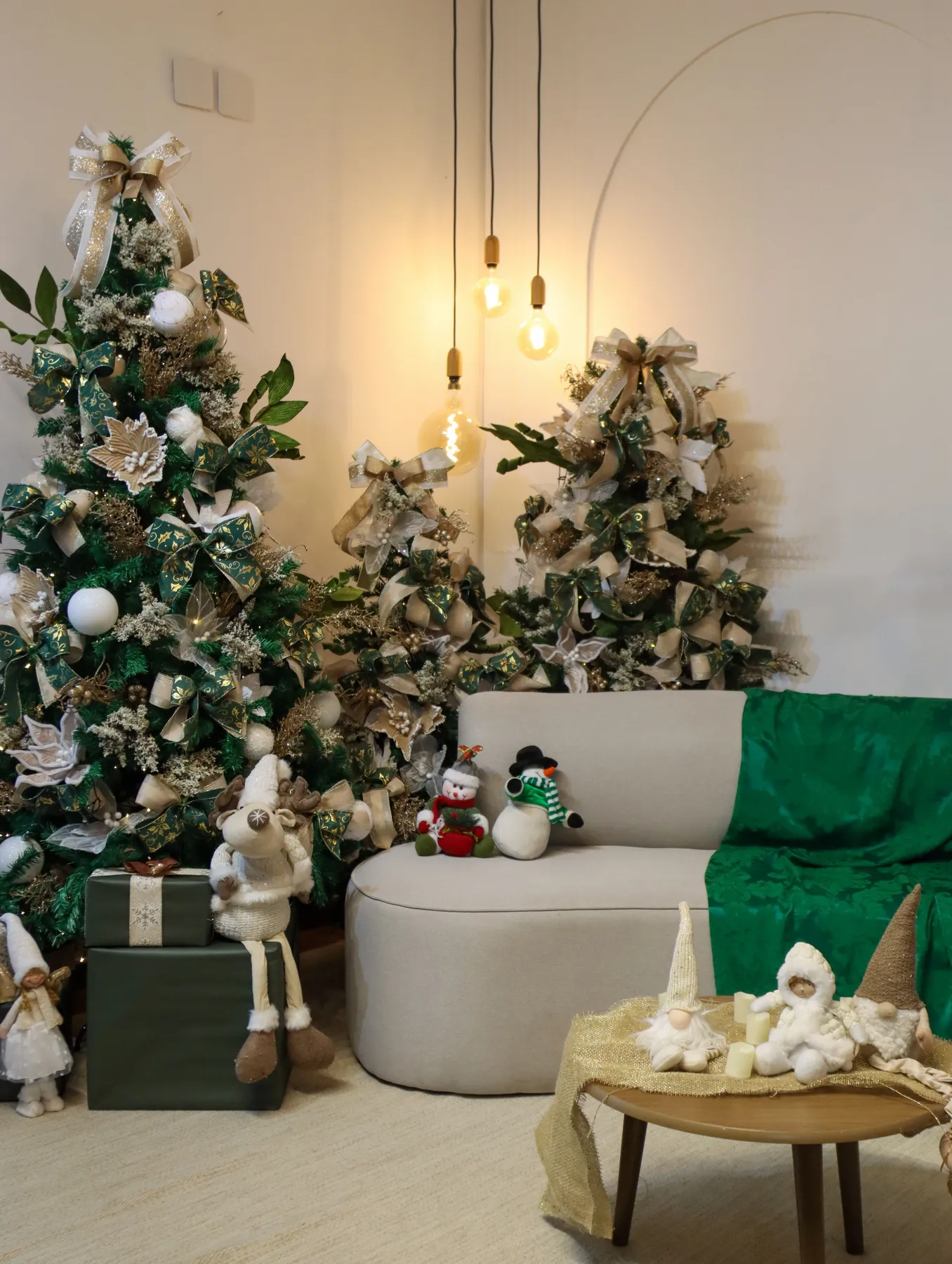
The green satin throw is the unsung hero. It pulls the emerald ribbon color off the trees and onto the sofa, which is what ties the whole vignette together. Without it, those are just two decorated objects sitting near a couch. One throw and the room reads as a single composition instead of three separate purchases.
10. Blue and Warm White Lights on a Night Tree
Two-tone lighting is one of the cheapest ways to make any tree look designed. One strand of cool blue ($14–$20 at Walmart) layered under a strand of warm yellow ($12–$18 at Target) gives you this exact push-pull for under $40. Add star ornaments cut from cardstock and a snowflake topper from a craft store and you’re still under $60. The trick is strand count, not ornament count — go heavy on lights and light on everything else.
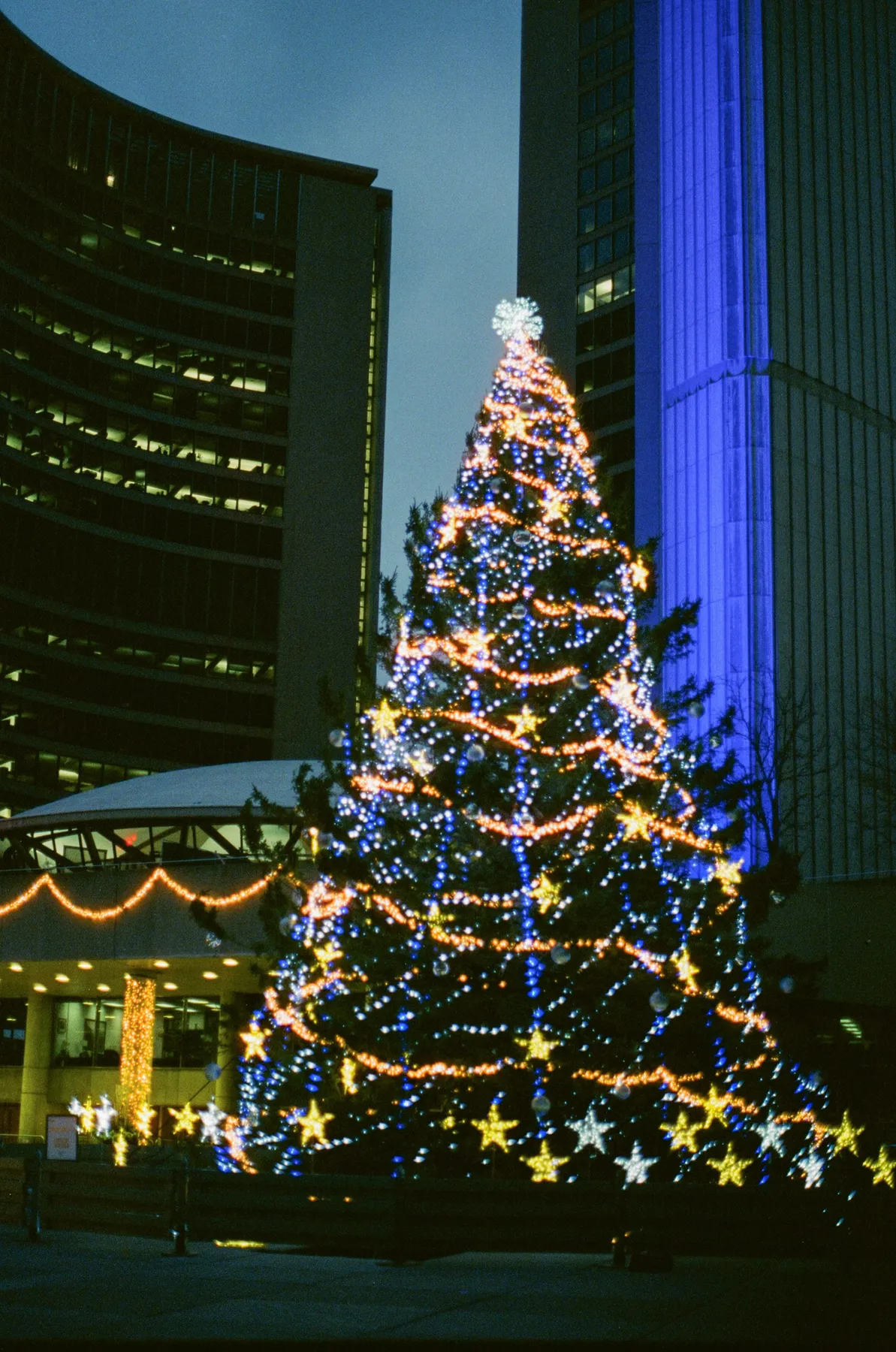
Blue and warm yellow sit near-opposites on the color wheel, and photographing them together is genuinely hard — your phone will push the blues toward cyan and the yellows toward orange. Shoot at dusk rather than full dark, and turn off nearby porch or street lights. Also check that the strands are the same voltage before you plug them into one another.
11. Eclectic Ornaments Below an Arched Skylit Colonnade
The balustrade garland is what carries this look from the tree into the architecture.

- Measure the run and buy pre-lit garland at 1.5 times the length so it can swag.
- Attach with zip ties every 18 inches, hiding each tie inside the greenery.
- Wire in red velvet bows at every post, sized so the tails reach about 12 inches.
- Weave a second, unlit garland in a lighter green underneath for depth.
- Finish the top rail with battery fairy lights on a timer.
Time: 2–3 hours for a full staircase. Cost: $70–$180 depending on length.
This is the one tree in the guide where the ratio runs closer to 40% green, 40% color, 20% white light. The ornaments are deliberately mismatched in shape, era, and finish — the discipline lives in the scale, not the palette. Keep every piece between 2 and 4 inches so density stays even, and let those red bows repeat to give the eye somewhere to rest.
12. Pearl Garlands on a Flocked Tree by a White Brick Fireplace
Pearl garlands on a flocked tree are a texture decision, not a color one. The flocking is matte, the pearls are glossy, the painted brick is flat, and the gray upholstery is nubby — four surfaces, one palette. The red plaid throw and knitted stockings supply the only warm note. One warm accent in a cool room goes a very long way.
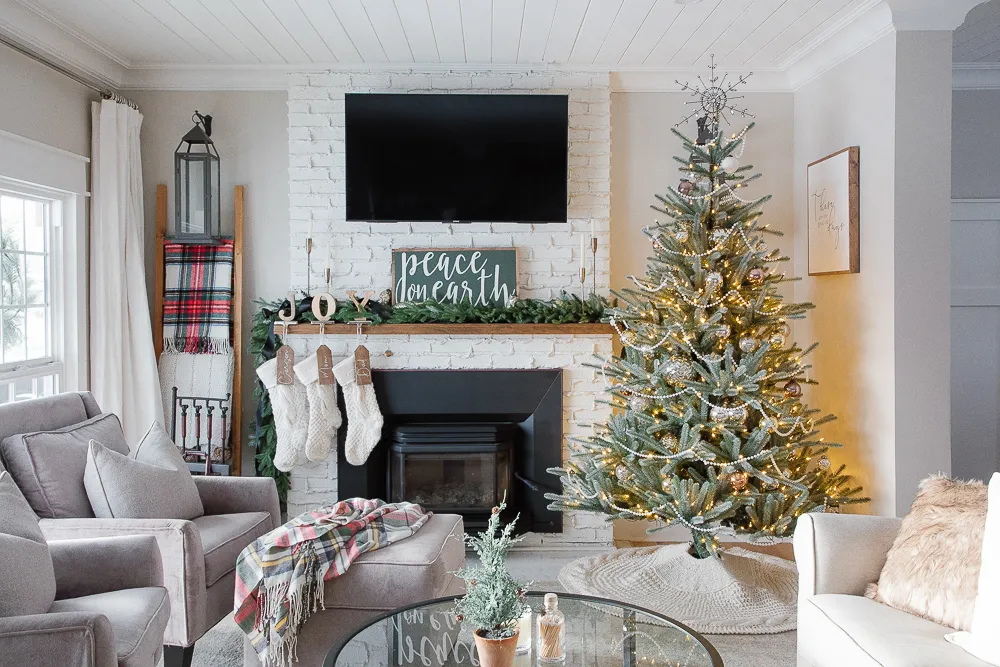
Flocked trees shed. Expect a fine white dust on everything within a three-foot radius for the first week, and again every time you move it. Vacuum with a brush attachment rather than a beater bar, and never store a flocked tree in a humid garage — the flocking can yellow permanently. Painted brick wants a soft brush, not a scrub pad.
13. Deep Red Velvet Ribbons on a Heavily Flocked Tree
Velvet ribbon needs volume, not neatness. Cut 24-inch lengths, fold each into a bow with a 6-inch tail, and wire it to the branch rather than tying it — tied velvet crushes and hangs limp by week two. Place bows every 12 to 15 inches on a diagonal spiral, always at branch ends facing into the room, and brush the nap of every single bow in the same direction before you call it done.
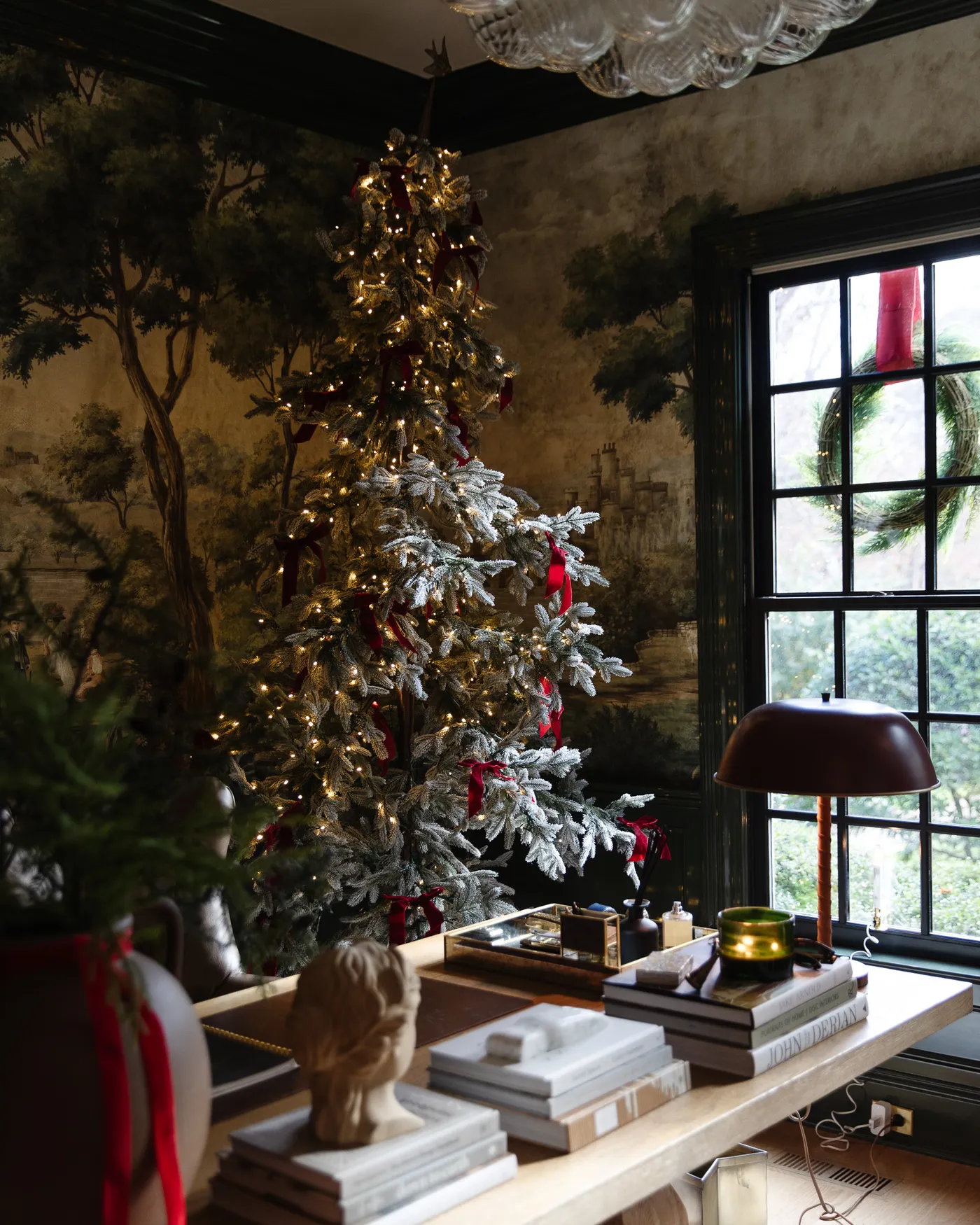
This works best on a 7 to 9 foot tree with a ceiling of at least 9 feet, because flocking plus velvet needs air above it. In a low-ceilinged room, drop to a 6.5-foot tree and cut bows to 18 inches. The scenic wallpaper behind wants a wall at least 8 feet wide to show the repeat. Tighter than that, try Idea #8 — same white-tree feeling, less visual weight.
14. Mini Trees Cascading Down a Grand Staircase
- Measure each tread — you need 14 inches of depth for a 12-inch mini tree.
- Use graduated sizes: tallest at the bottom step, smallest near the top.
- Anchor every pot with museum putty so nothing slides when the stairs are used.
- Match the main tree’s ornaments but scale them down to 1.5 inches.
- Cluster wrapped boxes on alternating steps to create rhythm instead of clutter.
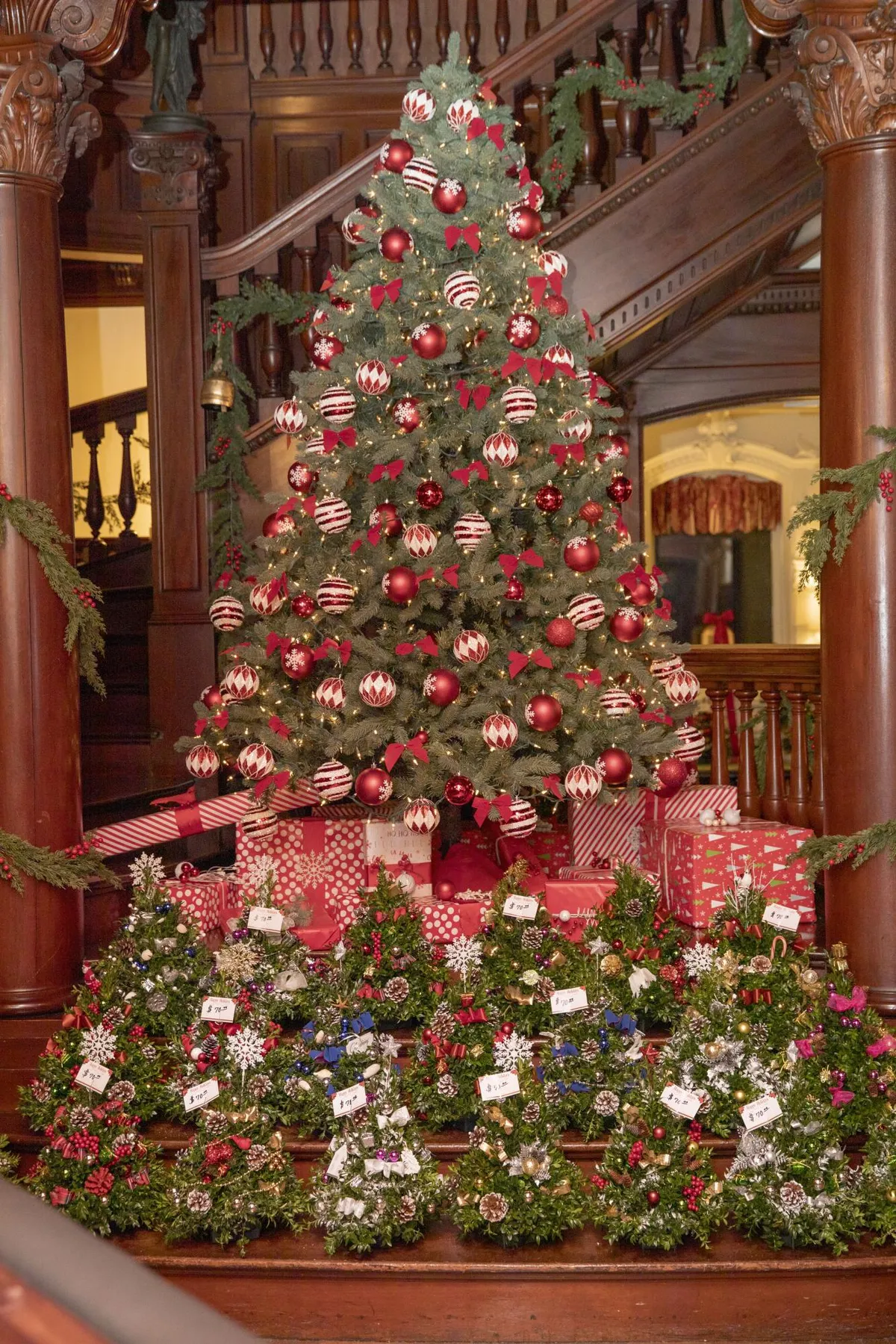
Time: about 2 hours for six steps. Cost: $60–$140 for mini trees plus ornaments.
- Large tree with red and white ornaments: $150–$450
- Six mini evergreen trees (12–24 in): $45–$120
- Red and white ornaments for the minis: $25–$60
- Stair garland with red berries: $30–$80
- Wrapped gift boxes: $15–$40
Total: $265–$750
Budget alternative: skip ornaments on the minis and let the garland do the work — that saves about $60, or use $6 potted rosemary from the grocery store.
15. A Black Top Hat Topper with Frosted Pinecones
Every other tree in this guide tops out with a star, a bow, or nothing at all. This one wears a black top hat embroidered with Merry Christmas in white script, which is why the tree reads as a character rather than a display. It also solves a real problem: heavy toppers tip flimsy top branches, and a hat sits over the leader branch instead of balancing on it. Remove it and you have a perfectly nice tree with no personality.

Build the topper as its own arrangement before it goes near the tree. Wire three frosted pinecones, a sprig of faux pine, and two red berry clusters to a 6-inch floral pick, then hot glue the hat to the pick and let it cure for an hour. Secure the pick to the top branch with two zip ties at different angles so it can’t rotate.
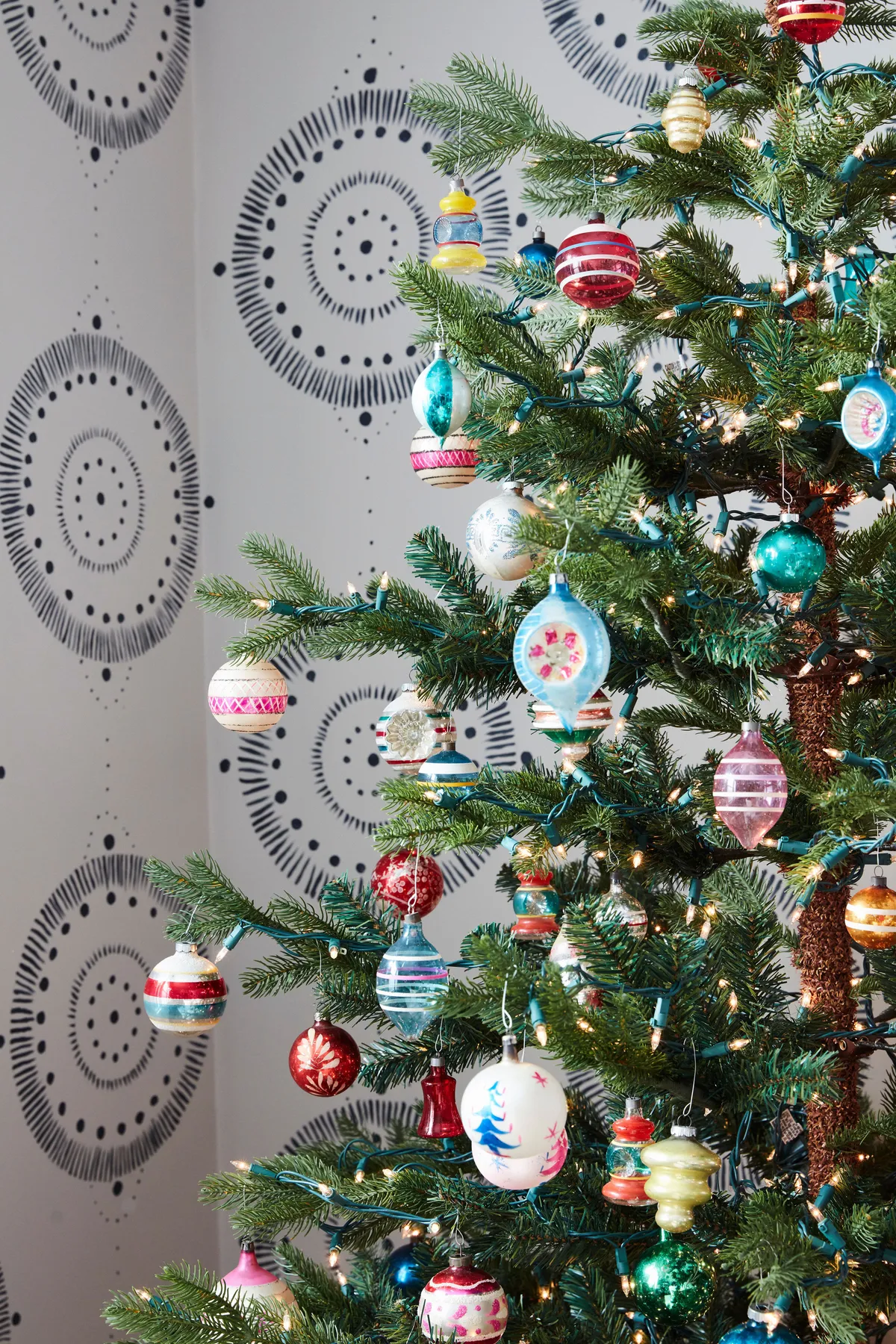
16. Vintage Glass Ornaments Kept in a Divided Box
Glass ornaments chip, craze, and fade if you store them in a hot attic. Keep them in a divided box in a closet that stays between 60 and 75 degrees, wrap each piece in acid-free tissue rather than newspaper since ink transfers, and never hang a pre-1970 ornament by its original thin wire — swap in a proper metal cap and hook. Hand-painted pieces should stay out of direct sun, which fades pigments within a couple of seasons.
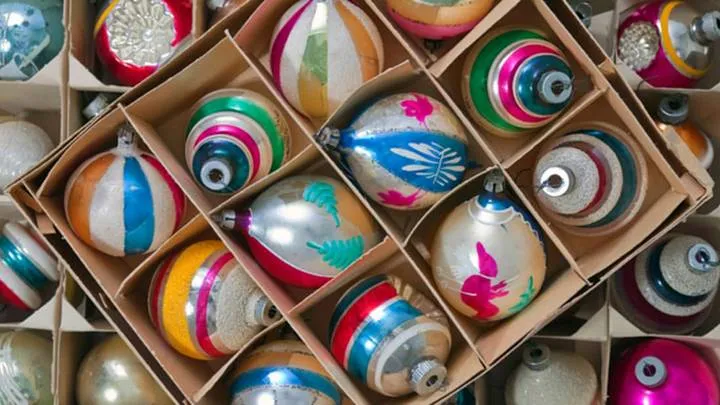
You can build a collection like this for almost nothing if you’re patient. Thrift stores and estate sales sell vintage glass baubles for $1–$4 each, and mixed lots on Facebook Marketplace often run $20 for thirty pieces. Buy a $12 divided storage box and collect in one or two colors so the box eventually looks curated. Check every cap for rust before hanging.
17. Multicolor Strands and a Spiky White Star
Big outdoor trees live or die on infrastructure, not decoration. Count your amperage before you buy a single strand — most households max out around 1,400 watts on one circuit, and a tree this size can pull close to that. Use GFCI outlets, connect no more than three strands end to end, and tape every connection. Multicolor LEDs also photograph beautifully in person and terribly on a phone at night. Accept it and enjoy it live.
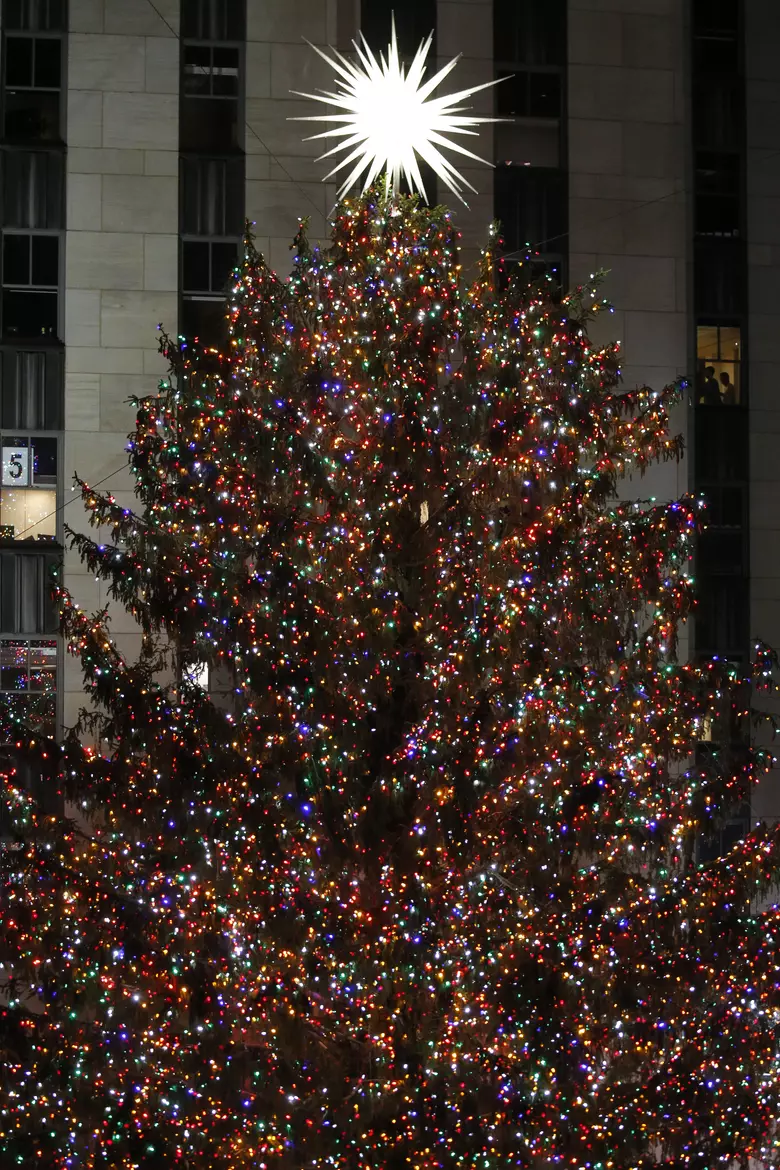
Public tree lightings have quietly become the most-photographed holiday design moment of the year — people show up in pajamas now, and the images travel. That’s pushed civic trees toward saturated multicolor and toppers that read at a hundred yards. A plain white star beats a tasteful gold one that disappears, and the trickle-down is already showing up in residential yards.
18. Glittery Red and Shiny Gold, Up Close
Two-thirds of this tree is red, one-third is gold, and the light does the rest. The key detail is finish mixing within each color: half the reds are glitter and half are glass, half the golds are mirror-shiny and half are satin. That’s what stops a red-and-gold tree from looking like a 1990s department store display. Swap red for green and keep the finish split exactly the same.

Put your sparkle where the light actually hits. Glitter ornaments belong on the outer 8 inches of branch where a bulb sits in close range; matte and satin pieces go inside, where they add depth without competing. A tree where every ornament glitters reads as static. Aim for roughly one glitter piece for every two matte ones, and always hang your largest pieces at eye level.
19. Blue, Gold, and White on a Tall Conical Tree
Conical outdoor trees at this size are usually built on a metal frame, and ornaments have to be tied rather than hung — plan on 12-inch zip ties and roughly 150 ornaments for a 20-foot tree. Blue reads as near-black at distance, so keep blue and white pieces within a few inches of each other to hold the contrast. Under 12 feet, halve the ornament count and go up one size.

Blue and gold works because neither color is doing the same job. The gold is warm, metallic, and reflective; the blue is deep and light-absorbing. Add white and you get a highlight color that separates them. It’s the same principle as Idea #2‘s gold and burgundy, just run in a much colder direction.
20. A Multicolor Tree Built for a Crowd
Trees designed for gathering follow different rules than trees designed for photographs. People stand close, kids touch, and the bottom four feet take real abuse. Skip glass below waist height entirely — use shatterproof plastic and wood — and secure a freestanding base with sandbags. Cords get tripped over, so run them under mats or tape them down before the first visitor walks in.
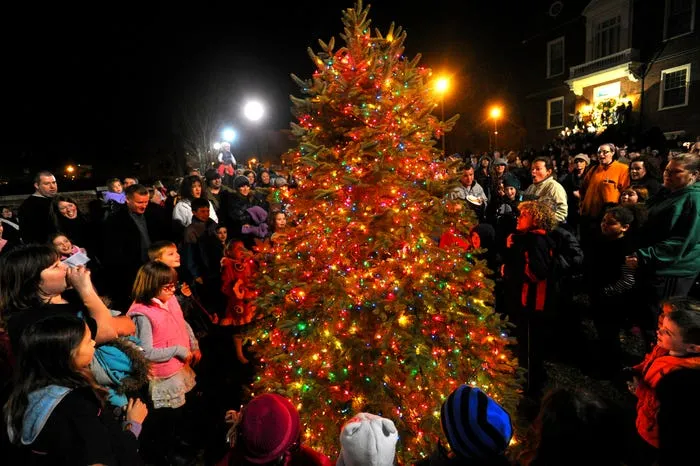
Outdoor lights live a hard life. Expect to replace roughly 10% of your strands each season as moisture gets into the connections, and buy commercial-grade if the tree stays up more than six weeks. LED strands rated for outdoor use outlast incandescent by years and won’t cook the branches. Store everything in a dry bin with cords loosely looped, never coiled tight around your elbow.
21. White Paper Cranes and a Gold Fabric Skirt
- Fold 60 to 100 cranes from white text-weight paper — about 20 minutes per dozen.
- Thread a needle with fishing line and pass it through each crane’s back point.
- Tie off at varying lengths between 4 and 10 inches for a floating effect.
- Hang three-crane clusters along the outer branches, a hand’s width apart.
- Drape gold fabric loosely around the stand rather than tucking it tight.
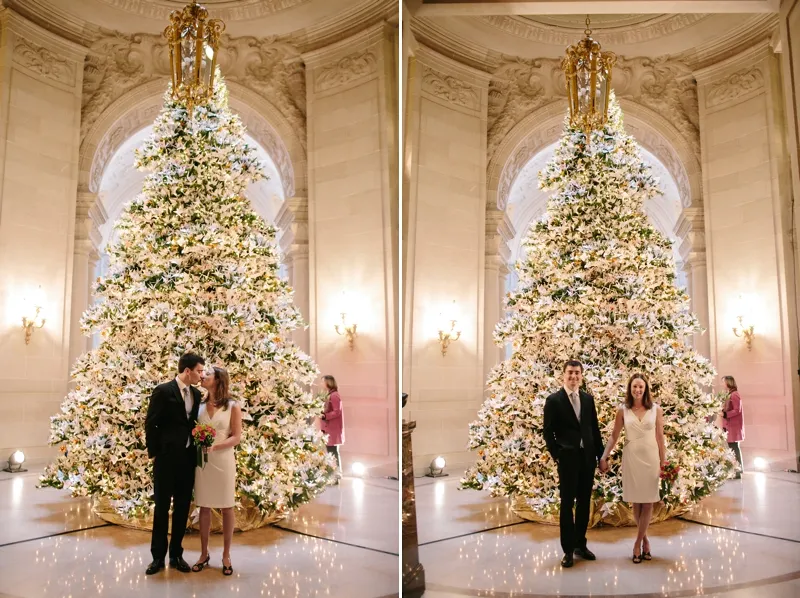
Time: 6–8 hours of folding. Cost: under $25 for paper and line.
The gold fabric skirt is what keeps the paper from reading as a craft project. White origami on green is charming but slightly unfinished; pooling metallic gold at the base gives it a floor, a weight, and a color story. It’s a yard of fabric doing the work of a designer tree collar, and without it the whole thing floats.
22. Warm LED Lights Woven Through Artificial Pine
Light count is the single most common mistake on artificial trees. Aim for roughly 100 bulbs per foot of height — a 7.5-foot tree wants around 750 lights, far more than most pre-lit trees come with. Wrap the trunk first, then work outward along each branch in a zigzag rather than spiraling around it. That’s what produces a deep, soft glow instead of a ring of light at the tips.
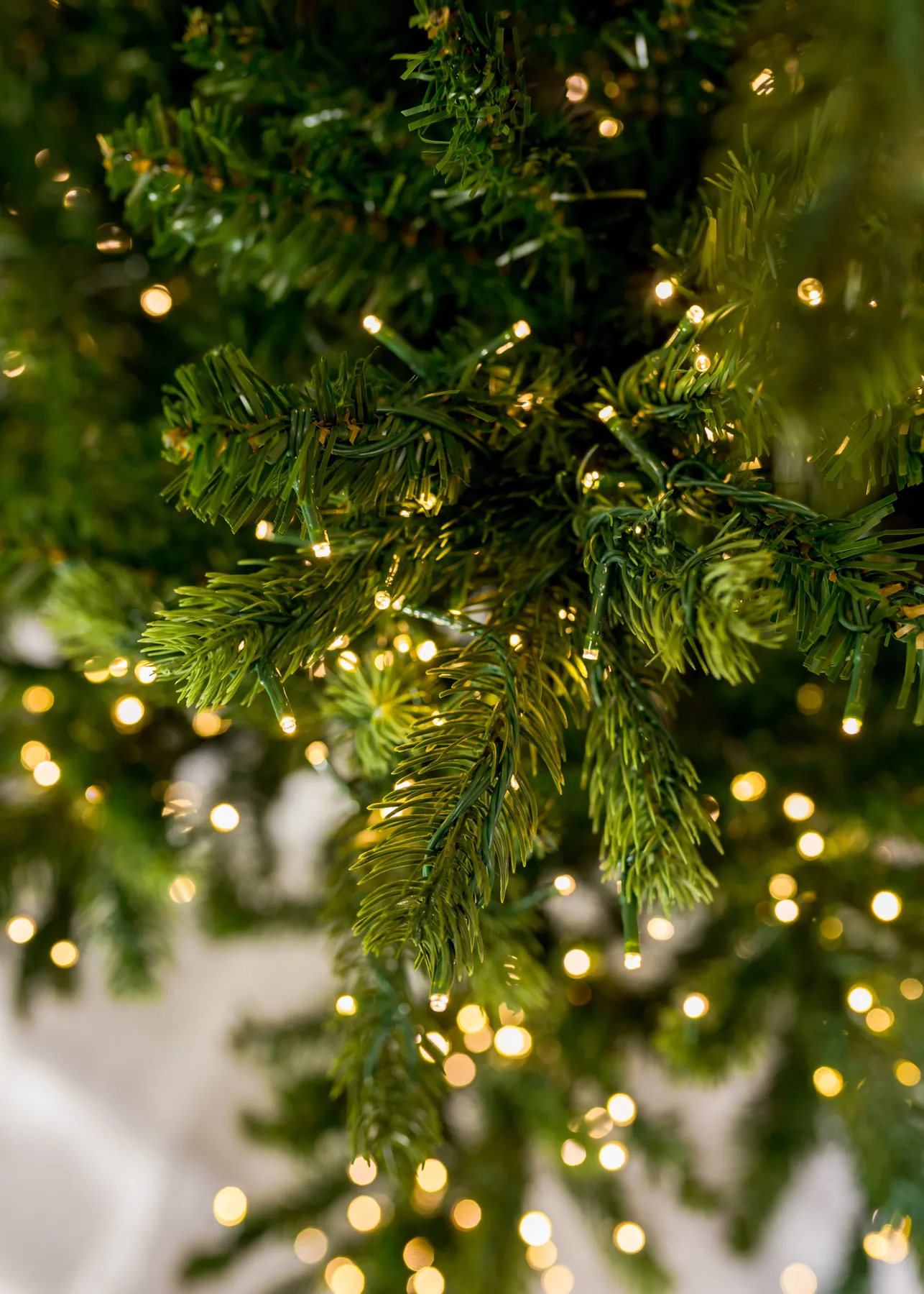
A 100-light strand of warm LED runs $8–$14 at Walmart and Target, so adding 400 extra bulbs to an existing tree costs under $50. A $10 in-line dimmer lets you shift the whole thing from bright to candlelit after dinner. Roughly one strand per foot of tree height is the density to aim for.
23. Silver Tinsel and Vintage Glass Baubles
Tinsel was practically a punchline for two decades, and this is the year it came back — partly through the broader revival of mid-century holiday decor, partly because a generation raised on minimalist trees is now decorating with their grandmothers’ ornaments. It’s cheap, it’s instant sparkle, and it photographs with more movement than any bauble. The catch is that cheap tinsel looks cheap; the fine, hair-thin strands are the ones worth using.
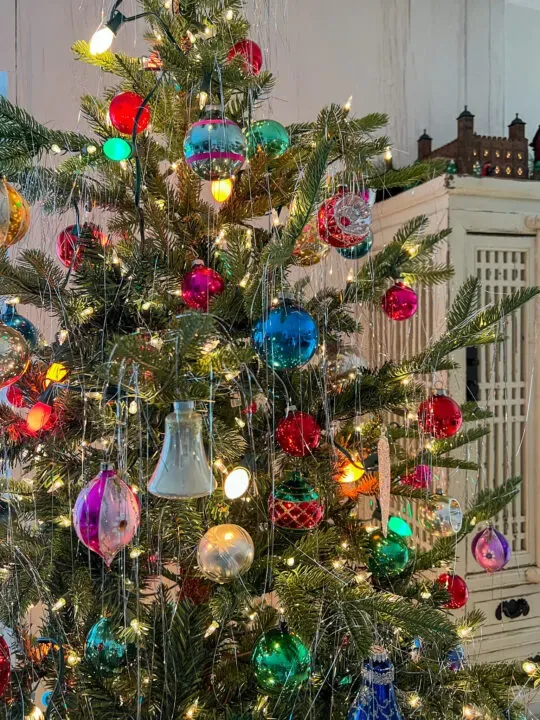
What saves this from being a nostalgia pile is the ornament restraint. Every piece is glass, every piece is saturated, and nothing is oversized — so tinsel reads as texture and ornaments read as pattern. The warm white lights sit low in the branches and glow up through the tinsel rather than washing it out.
24. A Ceramic Hot Air Balloon Ornament Marked 2026
The date is the point. A dated ornament turns a tree into a record — this one will mean something in 2036 in a way no bauble ever will. The white ceramic balloon itself, with Santa riding in a teacup basket above a painted rocking horse, is the kind of detail you only notice up close, which is exactly what a tree needs at eye level. Hang it between 5 and 6 feet, never near the top.
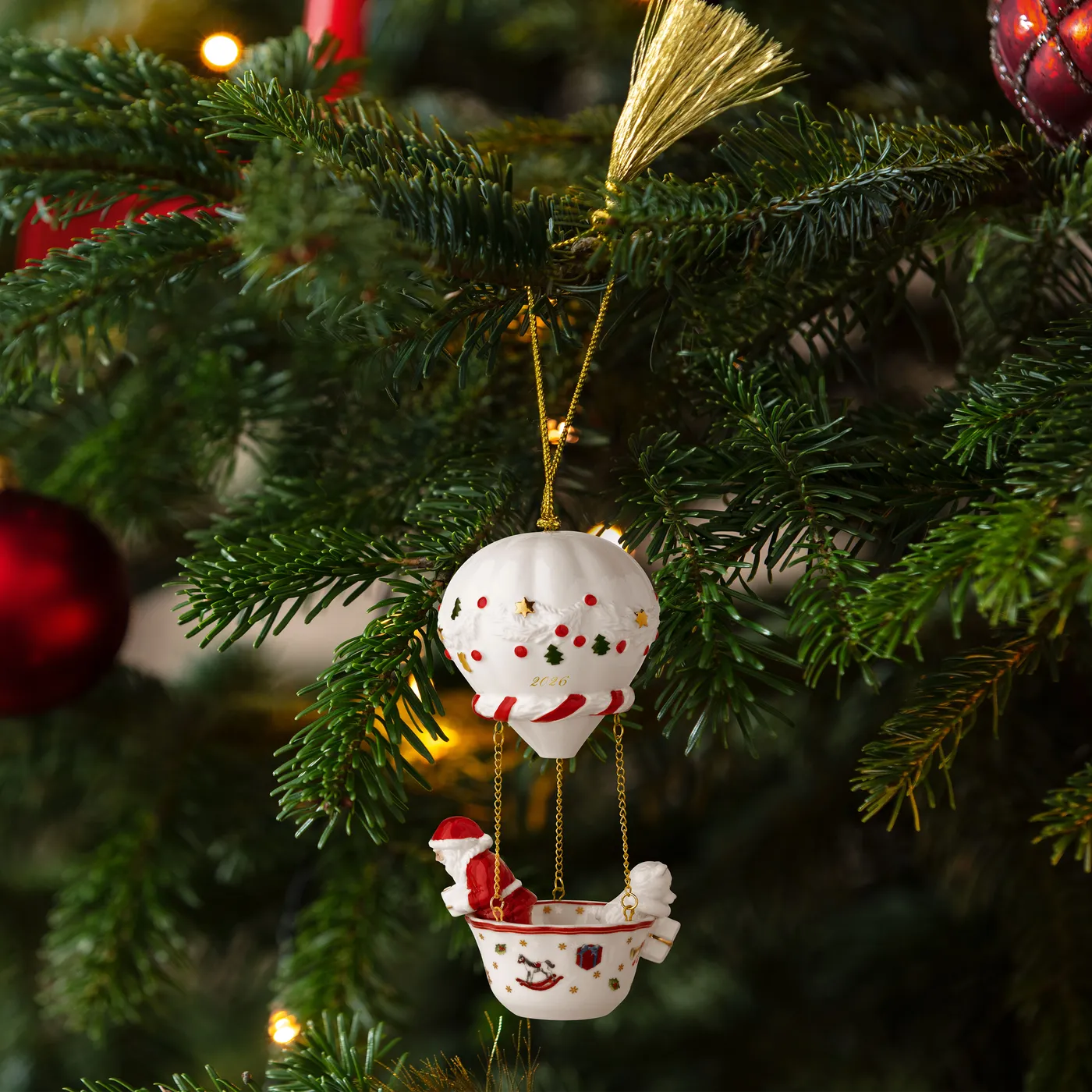
- Weigh it — anything over 8 ounces needs a reinforced branch or wire hook, not a ribbon loop.
- Check the hanger position; ceramic pieces hang best from the top of the balloon.
- Photograph it in daylight, since white ceramic blows out under warm bulbs.
- Write the year on the box in marker so future you remembers.
25. Blue Tinsel and Red Hearts in a Warm Living Room
- 6 ft artificial tree: $60–$180
- Blue tinsel garland: $8–$20
- Mixed gold, red, and silver baubles: $30–$70
- Heart ornaments (set of 6): $12–$25
- Warm white strand lights: $10–$20
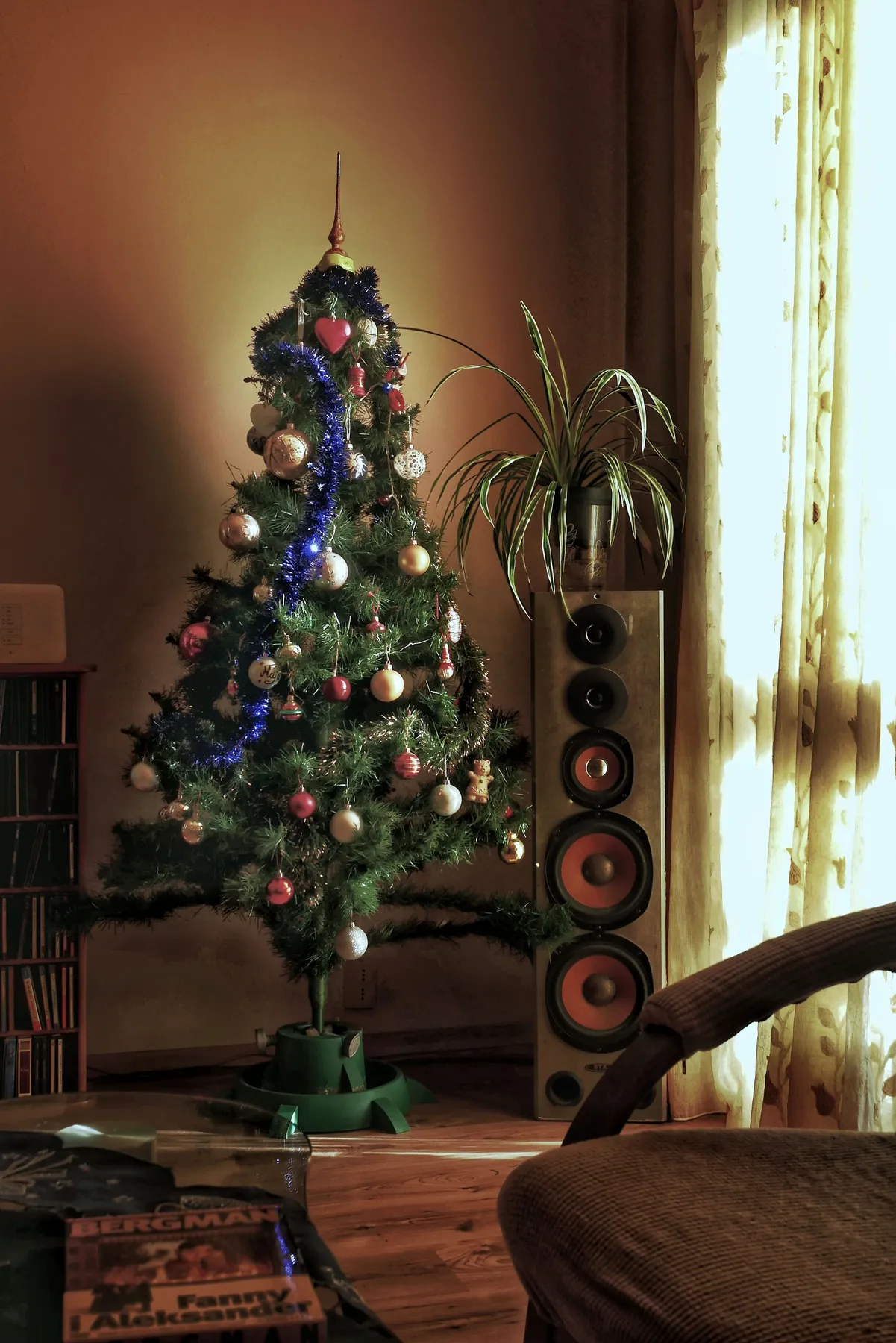
Total: $120–$315
Budget alternative: buy a used tree on Facebook Marketplace in early December for $25–$40 and put the savings into ornaments you actually like.
A tree squeezed between a speaker cabinet and a wall will always look a little improvised, and that’s fine — most of us are working with the space we have. Two things help: clear the floor around the base so the tree has a footprint, and hide the cords in a cover. If it’s blocking a speaker, move the speaker. Sound quality drops faster than tree aesthetics.
26. White and Silver Against a Deep Navy Wall
This is 70% white, 20% silver, 10% warm light — the palest formula in the guide, and the one most likely to become a white blob if you’re careless. The navy wall does the heavy lifting by providing contrast, which lets the tree stay almost entirely white. If your wall is light, swap in one deep accent like a charcoal skirt or a black stand and the formula still holds.
A slender tree in this style wants width, not height. At 7.5 feet tall and about 30 inches wide, it fits a wall run as short as 4 feet, which is why it works in apartments and narrow entries. Keep ceilings at 8 feet minimum and leave 12 inches between tree and wall so lights reflect. For a wider room, Idea #27 runs the same palette at full scale.
27. White and Gold in a Light-Filled Modern Room
White and gold trees usually fail because nothing stops them from blending into a pale room. Here, dark green foliage and silver accents give the eye two anchors, and the large windows provide directional light that makes the metallics actually shine. Daylight is the fourth material in this room — without it, the tree would read as beige.

Note the gift wrap: silver, gold, and white only, no red. That discipline is what makes the base look like part of the tree.
- 7.5 ft tree: $150–$500
- White and gold ornament set (80 pieces): $70–$180
- Gold and white ribbon, 4 rolls: $30–$70
- Extra white strands or pre-lit upgrade: $25–$60
- Coordinated wrap and boxes: $25–$60
Total: $300–$870
Budget alternative: spray-paint thrifted ornaments in two tones of gold — about $20 in paint and one Saturday afternoon.
28. Blue and Gold Over a Checkered Marble Floor
On a black-and-white checkered floor, your tree has to hold its own against a very loud pattern. That means going bigger and denser than feels reasonable: ornaments at 4 inches minimum, ribbons at 4 inches wide, and lights at about 120 per foot. The blue satin bows here are the widest element on the tree, which is exactly why they read from across the hall instead of getting lost in the checks.
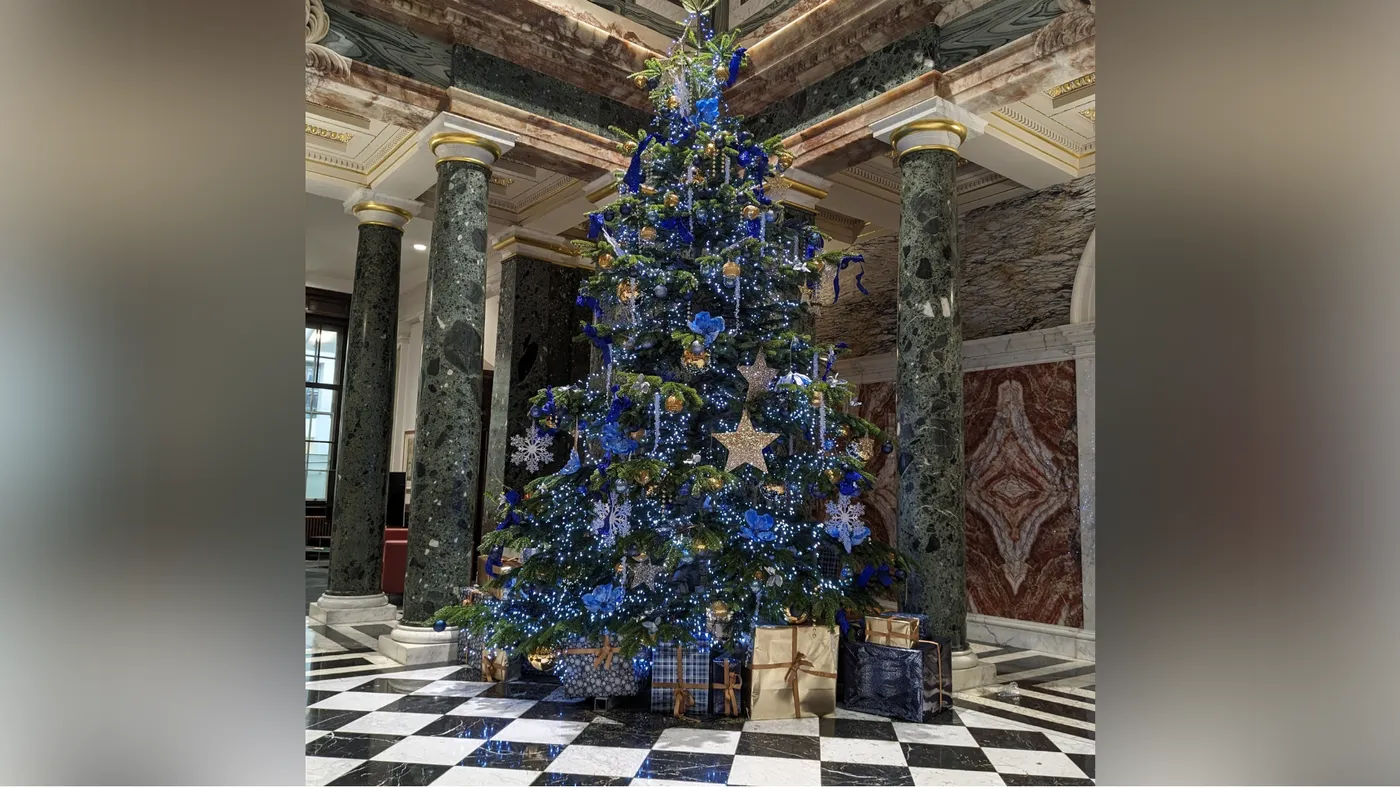
- Measure hall width — you want at least 3 feet of walkway on both sides.
- Check whether the stone is polished or honed; polished needs felt pads under the stand.
- Confirm your blue reads blue, not black, under the room’s actual bulbs.
- Count outlets — a tree this dense usually needs two circuits.
29. Wooden Reindeer and Cotton-Bud Branches
- Start with a dark green tree and leave the inner third unlit for a moodier effect.
- Wire in pinecones every 10 inches, clustered in threes.
- Pull small tufts of cotton batting and tuck them into branch joints — don’t glue.
- Add red berry sprays at branch ends for a single warm accent.
- Drape a chunky dark garland loosely along the bottom third only.
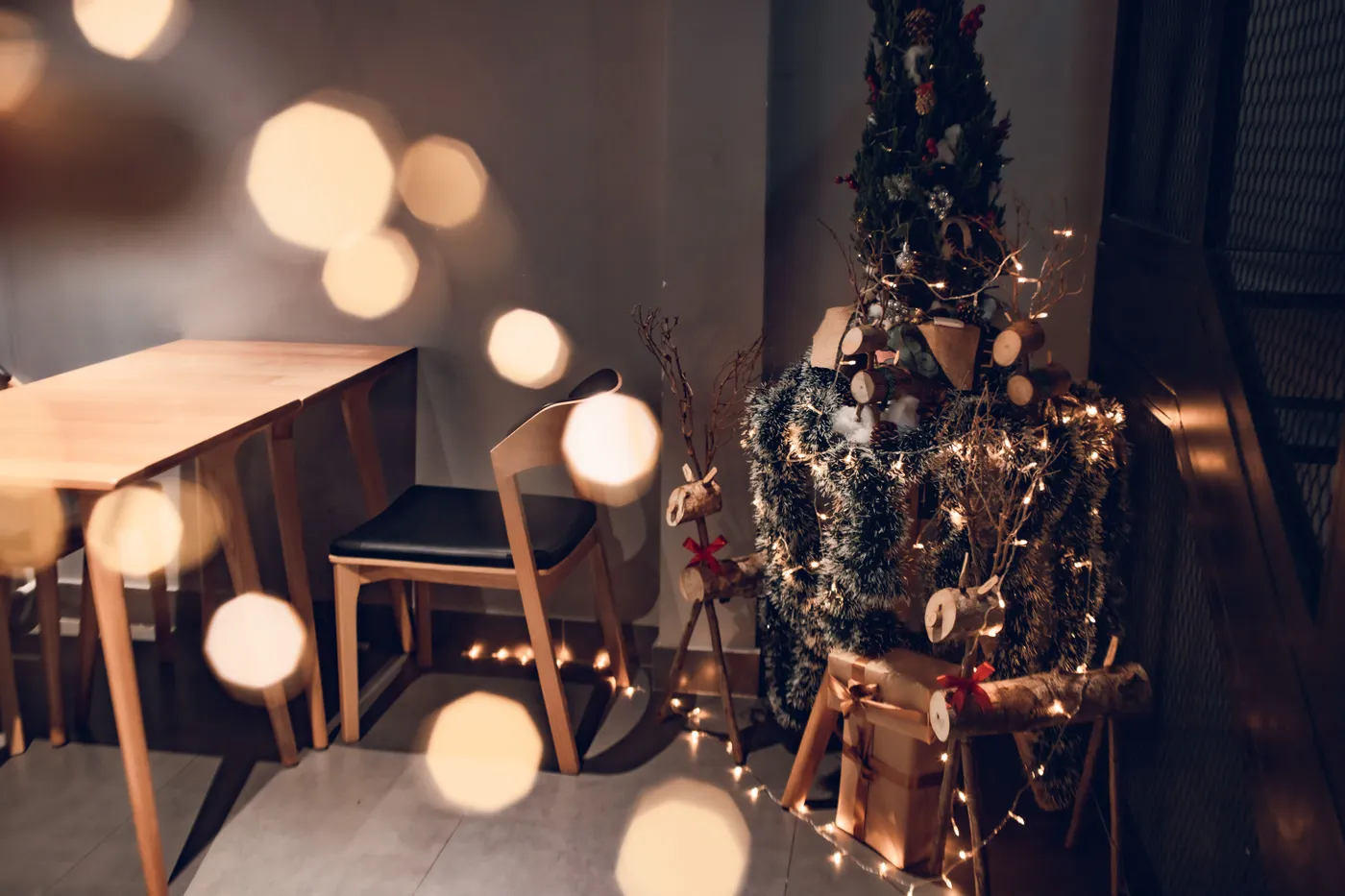
Time: about 90 minutes. Cost: $30–$70 for pinecones, cotton, and berries.
The wooden reindeer at the base are the easiest thing on this list to fake. A $5 scroll saw pattern and a scrap of 1-inch pine gets you a pair in an afternoon, or buy unfinished blanks on Etsy for $8–$15 each and skip the cutting. Kraft paper and garden twine cost under $10 total and look better than glossy paper against all that rustic texture.
30. Cascading Ceiling Lights Around a Colossal Tree
Cascading lights from a ceiling need height to fall through. This only works in a vaulted space of 20 feet or more, with strands hanging in lengths between 6 and 12 feet that never touch the tree. On a standard 9-foot ceiling, do a single swag across the room instead. Check your ceiling material before you buy anything: drywall anchors for plaster, and never hang from a drop-ceiling grid.
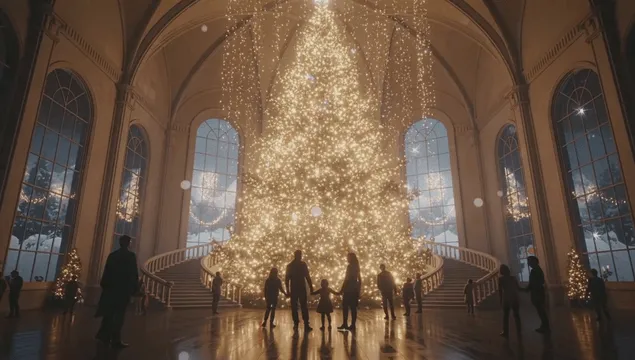
Immersive light installations moved out of art museums and into holiday decor a few years ago, and by now the look has filtered down to anyone with a tall stairwell. The appeal is that it’s lighting rather than decoration — nothing to pack, nothing to dust, and it changes the architecture of a room for six weeks.
31. Gilded Eagle Toppers in a Chandelier-Lit Hall
The eagle toppers. Stars and bows are interchangeable; a gilded eagle is a decision, and repeating it across every tree in the room tells you one person decorated this with one idea. It also echoes the room’s classical architecture in a way a snowflake never could. Remove the toppers and you have four very nice trees that could belong to anyone.
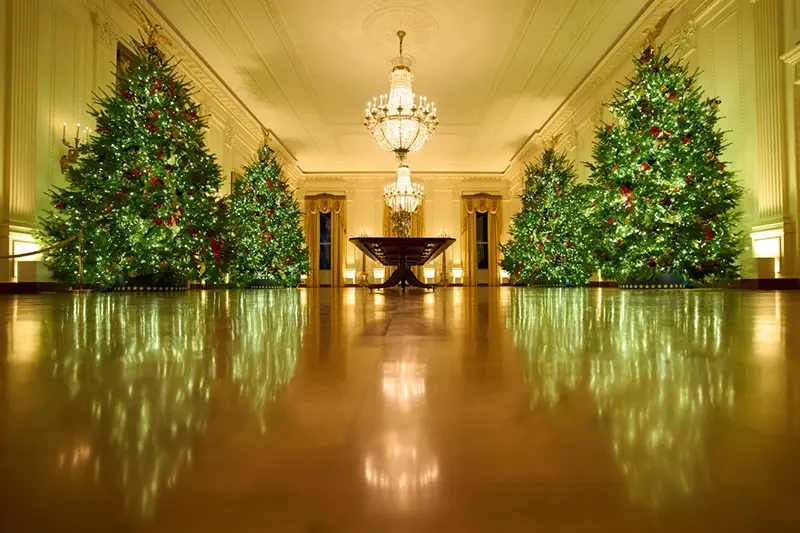
A hall with multiple trees and crystal chandeliers is a dust trap. Chandeliers want a dry microfiber pass every two weeks during the season, and real trees will drop needles into every crystal. Polished wood floors show glitter for weeks, and a lint roller handles it faster than a broom. Budget one full day for the January deep clean.
32. Straw Stars and Pinecones Among Colorful Baubles
Natural materials are what keep a multicolor tree from turning plastic. The straw stars, pinecones, and wood-toned pieces absorb light while the glass baubles throw it back, so the tree has both shine and quiet in the same frame. Roughly a third of the ornaments here are natural or matte, and that’s the number worth remembering when you’re shopping.
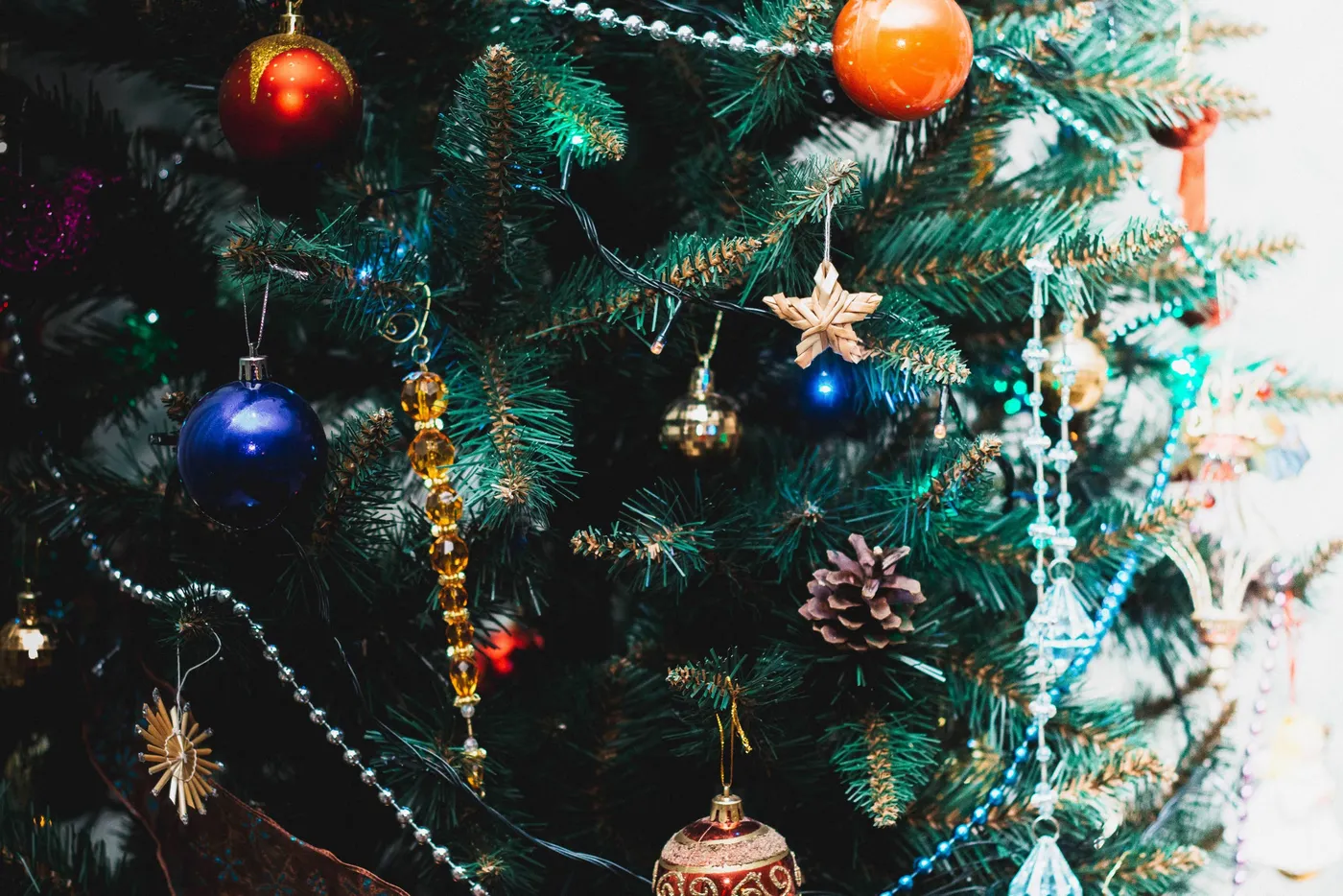
Beaded garlands are the most underused tool on a dense tree. A single strand woven in a loose spiral from the top down, dipping about 8 inches between passes, gives you vertical movement without visual weight. Use two strands of different bead sizes — one at 6mm, one at 10mm — and let them cross twice. Both for under $15 at a craft store.
33. Silver Tinsel, Patterned Tile, and a Grand Piano
A tree this size in a room with live music and hard tile floors is a sound problem as much as a design one. Dense branches and tinsel absorb some reflection, but a stone hall with a piano will echo regardless — placing the tree between the piano and the far wall helps break it up. Keep the piano at least 6 feet away; sap and water do not mix with a soundboard.
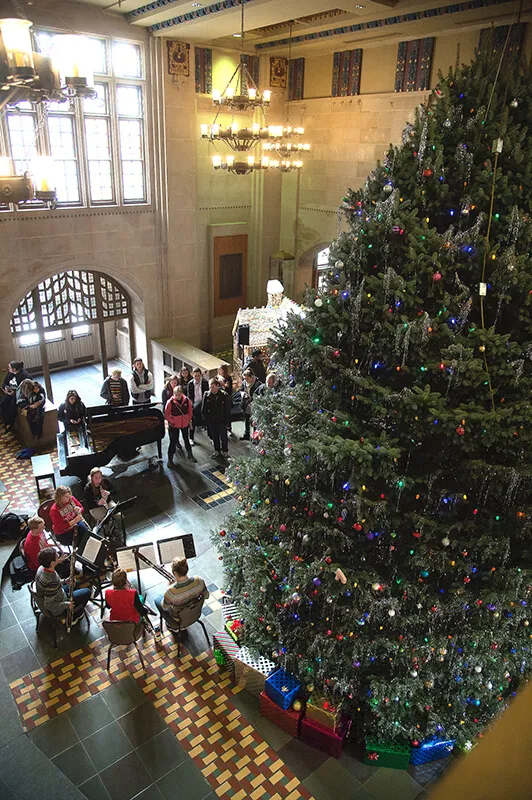
You can get the feeling of a grand hall tree without the hall. Silver tinsel garland at $6 a pack, fifty mixed ornaments for $25, and a strand of warm lights will transform a 7-foot tree for around $60. Wrap eight boxes in kraft paper and stack them unevenly — the pile reads as abundance from a distance, which is the only place it needs to read.
34. Hand-Painted Folk Doll Ornaments in Bright Fuchsia
- Weigh the ornaments — hand-painted wood is heavier than it looks.
- Plan the color story first; fuchsia, lime, and yellow need a neutral tree behind them.
- Hang the busiest pieces at eye level and keep the top of the tree simple.
- Set a per-piece budget, since artisan ornaments run $12–$35 each.
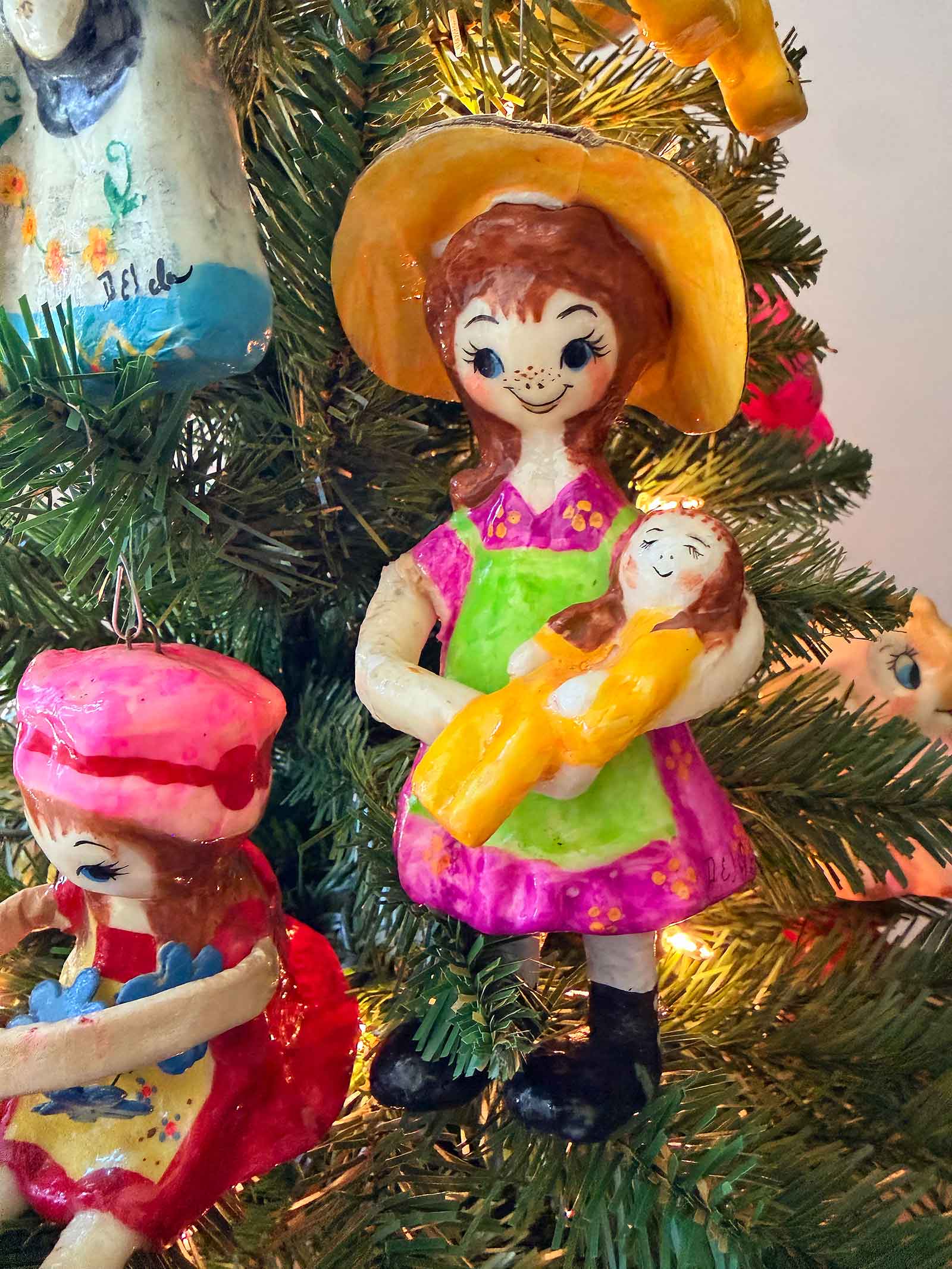
- Green artificial tree, 6.5 ft: $70–$220
- Hand-painted wooden doll ornaments (8–12): $96–$360
- Warm white string lights: $12–$25
- Supporting solid-color baubles: $20–$45
Total: $198–$650
Budget alternative: buy two artisan ornaments a year and fill in with solid baubles. In five years you’ll have a collection nobody can buy in a single trip.
Your Tree Doesn’t Need to Match a Trend — It Needs to Match You
The best tree in this entire list isn’t the biggest or the most expensive one — it’s the one where somebody made a decision and committed to it, whether that’s a gilded eagle on top or a paper crane in the branches. Pick one idea from above, steal the parts that fit your room, and let the rest go without guilt.
📌 Save this to Pinterest for later — next November you’ll be very glad you did.