
You know that feeling when a vintage ceramic Christmas tree stops you mid-scroll — glossy green, tiny plastic bulbs glowing — and suddenly you’re eight years old again? That pull is real, and in 2026 it’s everywhere. We spent serious time browsing Etsy, Target, and Amazon to bring you only the versions worth your shelf space, from $12 minis to $180 hand-thrown statement pieces. Inside are 22 curated ideas covering vintage green reproductions, cream-and-gold neutral sets, blue-green cutout trees, and a few genuinely weird hand-built pieces involving frogs in Santa hats. The 2026 shift is specific: collectors are hunting down original 1970s molds while independent makers bring the craft back, and Pinterest saves for ceramic trees keep climbing. And stay until the end — we break down the most common mistakes that can ruin these looks. Save this post now — you’ll want it when you’re ready to shop.
1. Modern Ceramic Trees That Skip the Kitsch Entirely
Here’s the measurement that changes everything: keep at least four inches of height between each tree in a grouping, and never let the tallest piece exceed one-third of the shelf’s width. Modern ceramic trees read as sculpture, and sculpture needs air around it. If two trees land within an inch of each other in height, they fight — add a fourth element or take one away.
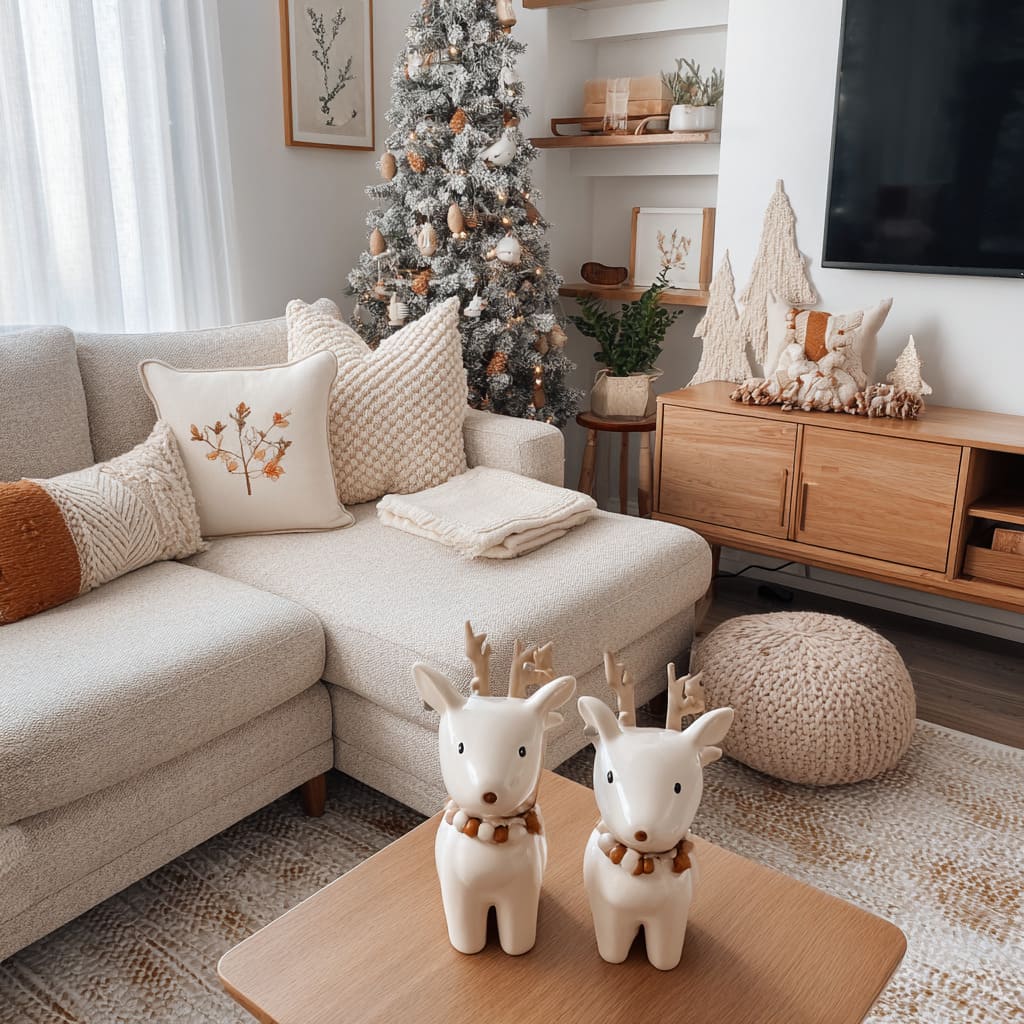
Two things do the heavy lifting in a modern ceramic display: negative space and glaze finish. A matte or satin glaze swallows light, so the silhouette reads first and the color second — the exact opposite of a high-gloss vintage tree that throws reflections in every direction. The empty countertop around each piece works like a picture frame. Crowd it and the whole arrangement collapses into clutter.
2. A Snow-Drift Shelf of Glazed Trees in Green and White
Recreating this exact cluster — two large green, one large white, two small green — costs less than you’d guess.
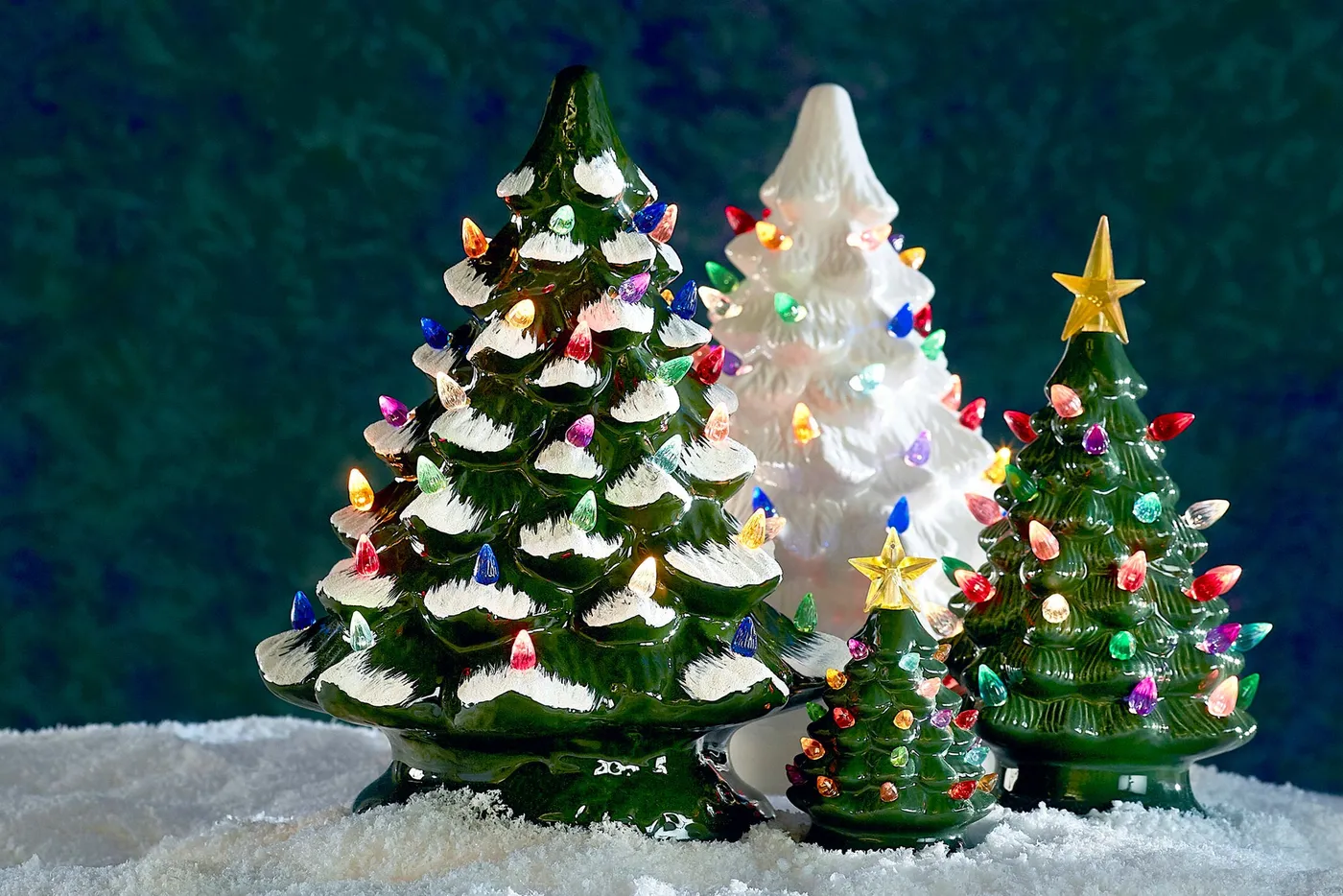
- Vintage-style glazed trees, 11–16 in.: $38–$75 each
- Small 6–8 in. accent trees: $12–$24 each
- Gold star toppers: $4–$9
- White faux snow or buffalo snow: $8–$15 per bag
- Multicolor replacement bulbs: $6–$12 per pack
Total: roughly $130–$260 for the full five-tree arrangement. Cheaper route: hunt Facebook Marketplace and estate sales in November, where original 1970s trees routinely sell for $15–$40 to sellers who have no idea what they’re holding.
The multicolor-bulb tree never really left, but 2026 is the year collectors stopped hiding them. Original Atlantic Mold and Holland Mold pieces are reselling at three to four times their 2020 prices, and people are styling them like sculpture instead of heirlooms. This one has staying power — it’s nostalgia backed by a genuine supply shortage, which is a very different thing from a trend.
Faux snow is gorgeous for three weeks and then it travels. Static cling sends those flakes onto bookshelves, into carpet fibers, and onto anything dark within a two-foot radius. Set the snow inside a shallow rimmed tray so it stays put, and skip it entirely if you have a cat — those tiny bulbs pop loose and are a genuine choking hazard.
3. The Faceted White Tree That Glows From the Inside
The internal light is the whole idea. Strip it out and you’re left with a white geometric object that looks like a museum gift-shop candle holder. Everything else — the glossy white glaze, the dark blurred backdrop — exists to make that warm yellow glow land harder. If your tree runs on a single bulb at the base, upgrade to a short indoor-rated warm-white fairy light strand; the difference between one glowing point and twenty is the difference between a lamp and a lantern.
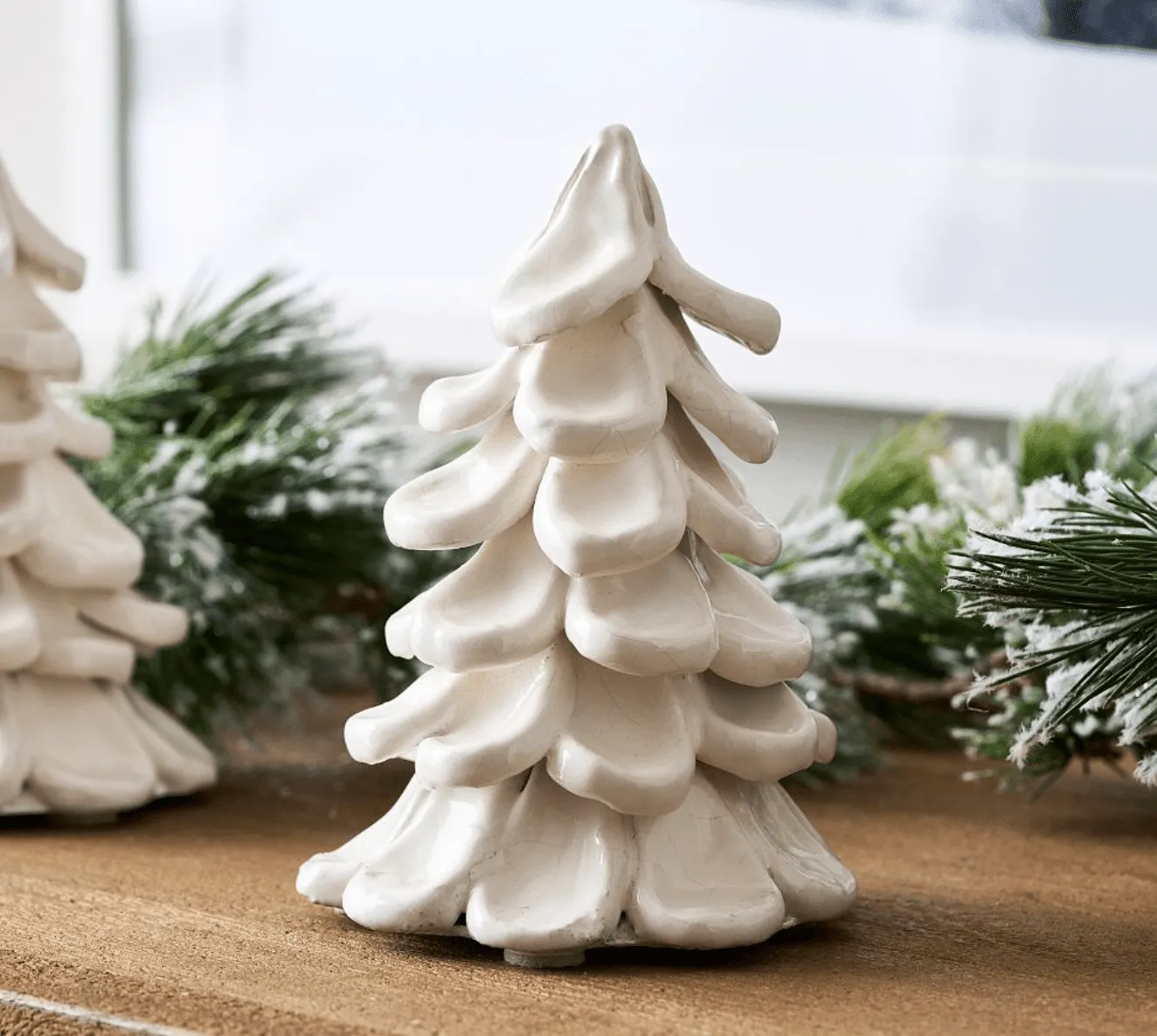
This look is a simple ratio: 70% white ceramic, 20% shadow, 10% warm light. Get those proportions right and the geometry does the rest. Swap the glaze to pale sand or matte black and the mood goes quieter and moodier. Swap the light from warm yellow to cool white and it flips modern-industrial instead of cozy. Keep the darkness behind it either way — a faceted piece in front of a bright window loses every reflection that makes it interesting.
4. Green Glazed Trees Paired With a Ceramic Gingerbread House
Building the gingerbread pairing takes one afternoon.
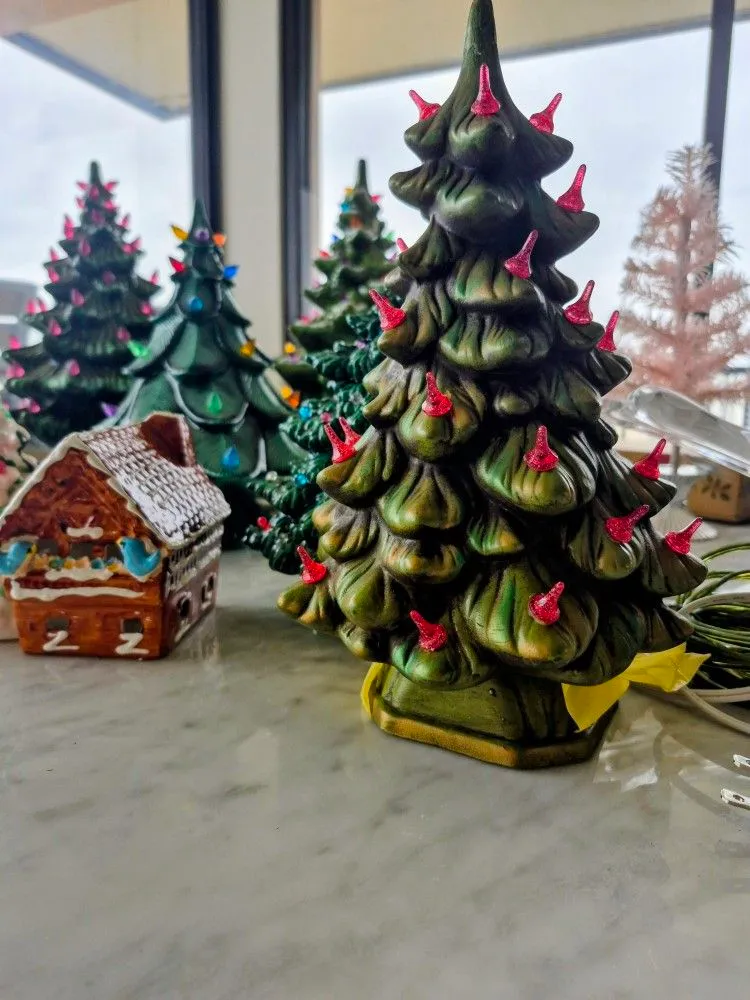
- Clear a level surface — a marble-look tray works best because it bounces the colored bulbs back up.
- Set the largest green tree at the back left, then step down in height toward the right.
- Place the gingerbread house in front and slightly off-center so it overlaps one tree base.
- Add one small pink bottle brush tree at the far edge for a color surprise.
- Tuck loose snow or a few spare bulbs into the gaps to hide the tray edge.
Time: about 30 minutes. Cost: free if you own the pieces, roughly $60–$110 if you’re starting from scratch.
The hand-painted gingerbread houses in this styling usually run $45–$85 on Etsy, and glossy green ceramic trees another $35–$70 each. You can get 80% of the charm for a third of that. Target’s $15–$25 ceramic trees and Walmart’s $10–$18 gingerbread figurines photograph almost identically once the lights are on. Thrift stores are the real goldmine — ceramic trees turn up constantly in December because the person donating them thinks they look dated.
5. Cream Ceramic Trees With Gold Bow Toppers
Two cream trees on pale wood need one thing to keep from disappearing: contrast underneath. A scale-textured off-white glaze sitting on a white console vanishes entirely. Put it on walnut, oak, or weathered pine and the tree finally gets an edge. One more swap worth the money — replace the plastic gold bow with a wired velvet ribbon bow about two inches wide, and the whole thing jumps from craft-store to boutique for under $10.
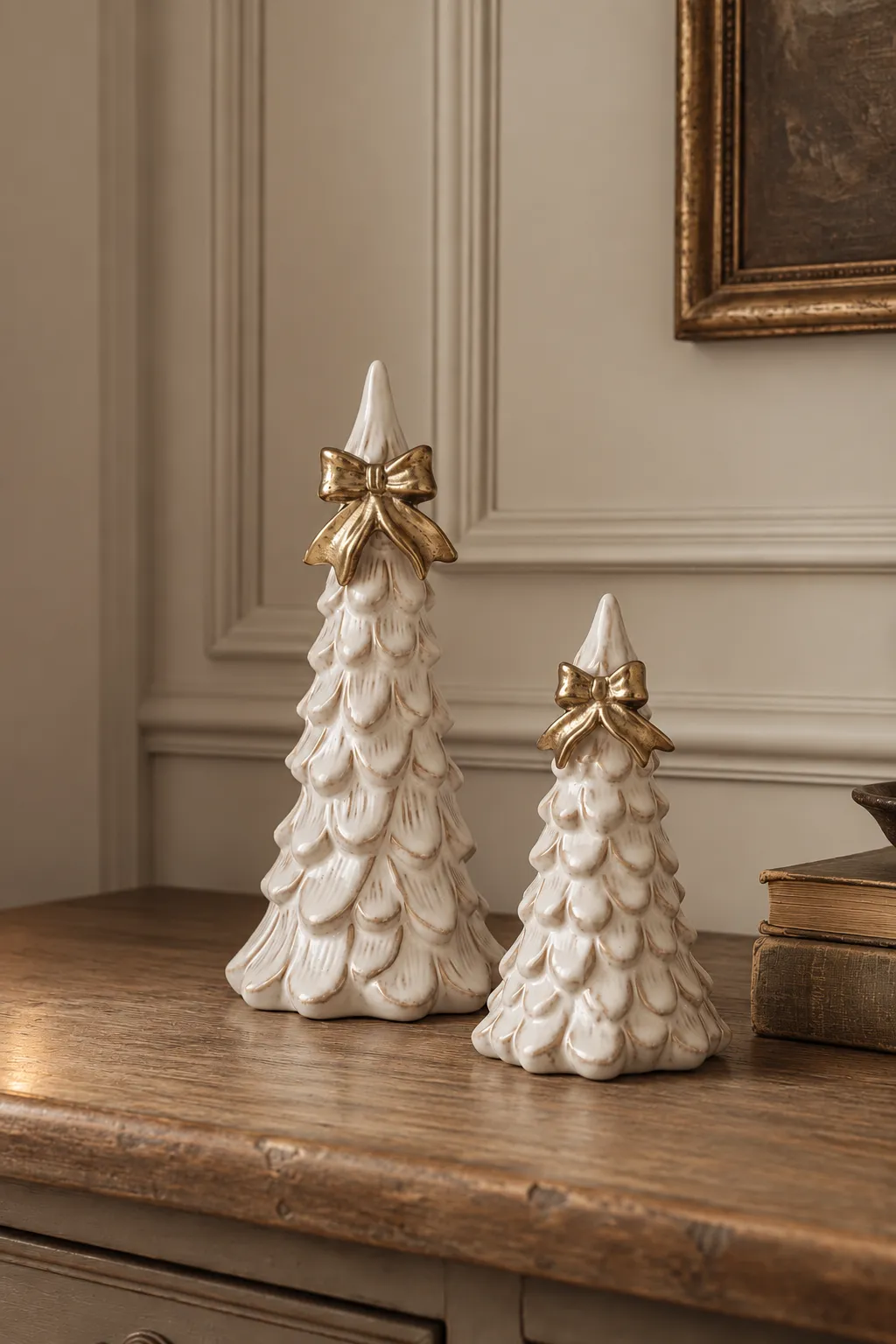
This pairing is deliberately small: two trees, roughly 9 and 13 inches tall, on a surface about 40 inches wide. That’s a console, a dresser top, or a fireplace mantel — not a dining table. Where it fails is ceilings under 8 feet against a dark wall. The beige-on-beige palette needs a light, panel-molded backdrop, which is exactly what makes it read elegant instead of washed out. If your wall is charcoal or deep green, choose a white-glazed tree instead or lay a light runner underneath. For a bolder room, see Idea #13.
6. White Trees, Warm Wood Slats, and a Confetti of Bulbs
Three principles are stacked here and every one of them is doing something. First, contrast: glossy white ceramic against warm brown wood slats gives you both a color break and a texture break. Second, repetition with variation — the same white glaze in three different heights, which reads as a collection rather than a set of duplicates. Third, the surface underneath. That dark speckled top grounds everything; a white surface would have flattened the whole arrangement into one bright blob.
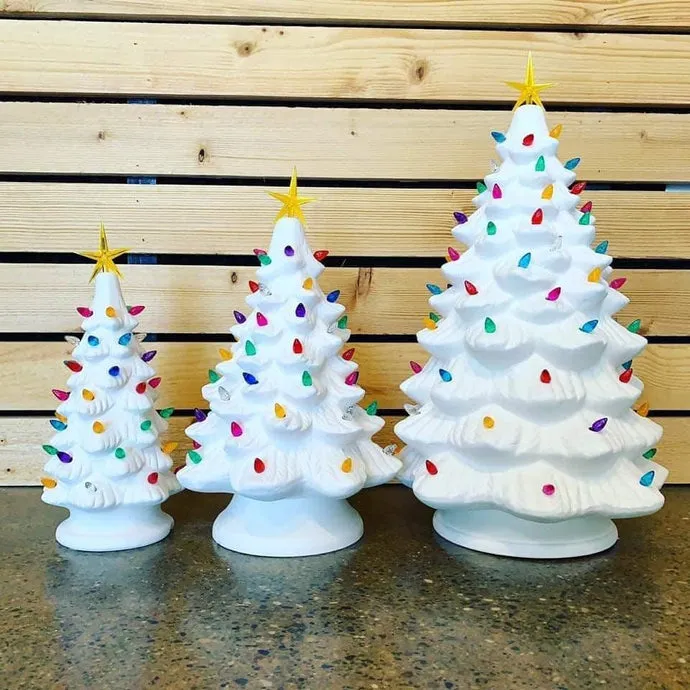
Here’s what three lit white trees actually cost in 2026.
- Large 15–16 in. lit white tree: $55–$90
- Medium 11–12 in.: $35–$55
- Small 6–8 in.: $14–$26
- Star toppers, set of three: $12–$24
- Warm-white LED bulb upgrade: $8–$14
Total: $124–$209. Want the silhouette for less? Buy one large lit tree and two unlit white ceramic trees at $8–$15 each, then group them tightly — unlit pieces read as lit when they’re sandwiched between glowing ones.
7. Three White Trees, Three Completely Different Silhouettes
- Measure shelf depth first — tiered and pleated trees run wider than they look, often 5–7 inches at the base.
- Check your light direction; white ceramic picks up every nearby warm lamp and quietly turns cream.
- Decide on glaze finish before you buy. Mixing glossy and matte white in one group reads as a mistake, not a choice.
- Confirm at least 3 inches of clear space behind the tallest tree so a red backdrop can actually breathe.
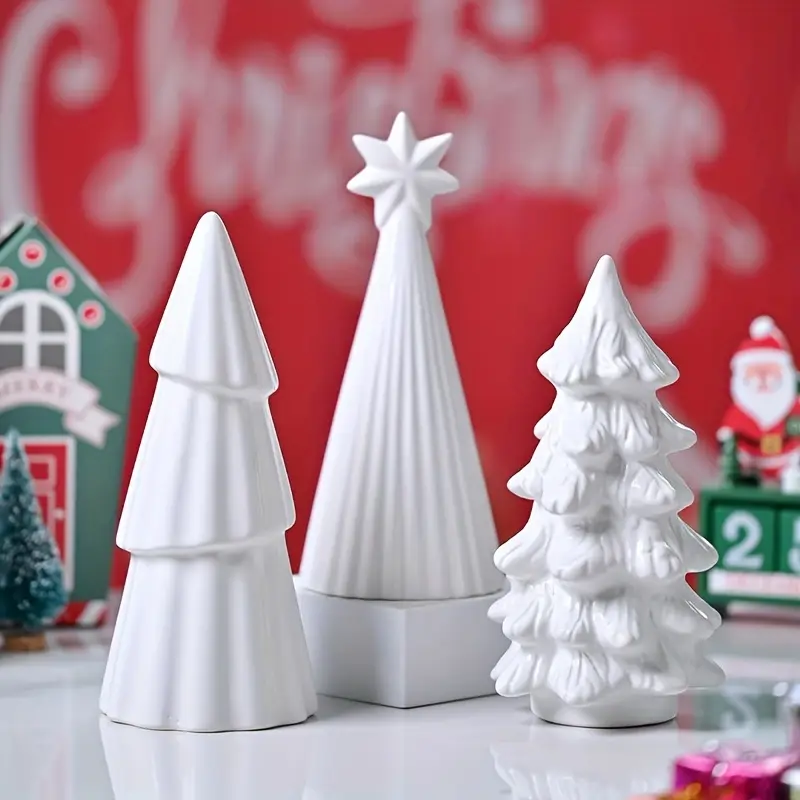
The silhouette variety is the entire point. Three identical tiered trees would just be a collection; three different shapes — smooth tiers, a pleated cone, layered textured branches — become a still life. If you’re only buying one, get the pleated cone with the star topper. It photographs the best, it’s the hardest shape to find secondhand, and it’s the one that reads intentional rather than inherited.
8. A Snow-Dusted Mini Tree Wearing Real Ornaments
Those little red, gold, and blue ornaments are usually glued in place on this style of tree, and the glue is not immortal. Warm rooms, direct sun, and a decade in a box all loosen it. Give each ornament a gentle twist before you set the tree out; a dab of clear craft glue on a toothpick re-seats anything wobbly in about ten seconds and saves you from finding loose baubles in the carpet. Keep it off window sills, too — a glitter-dusted base sheds every time you bump it.
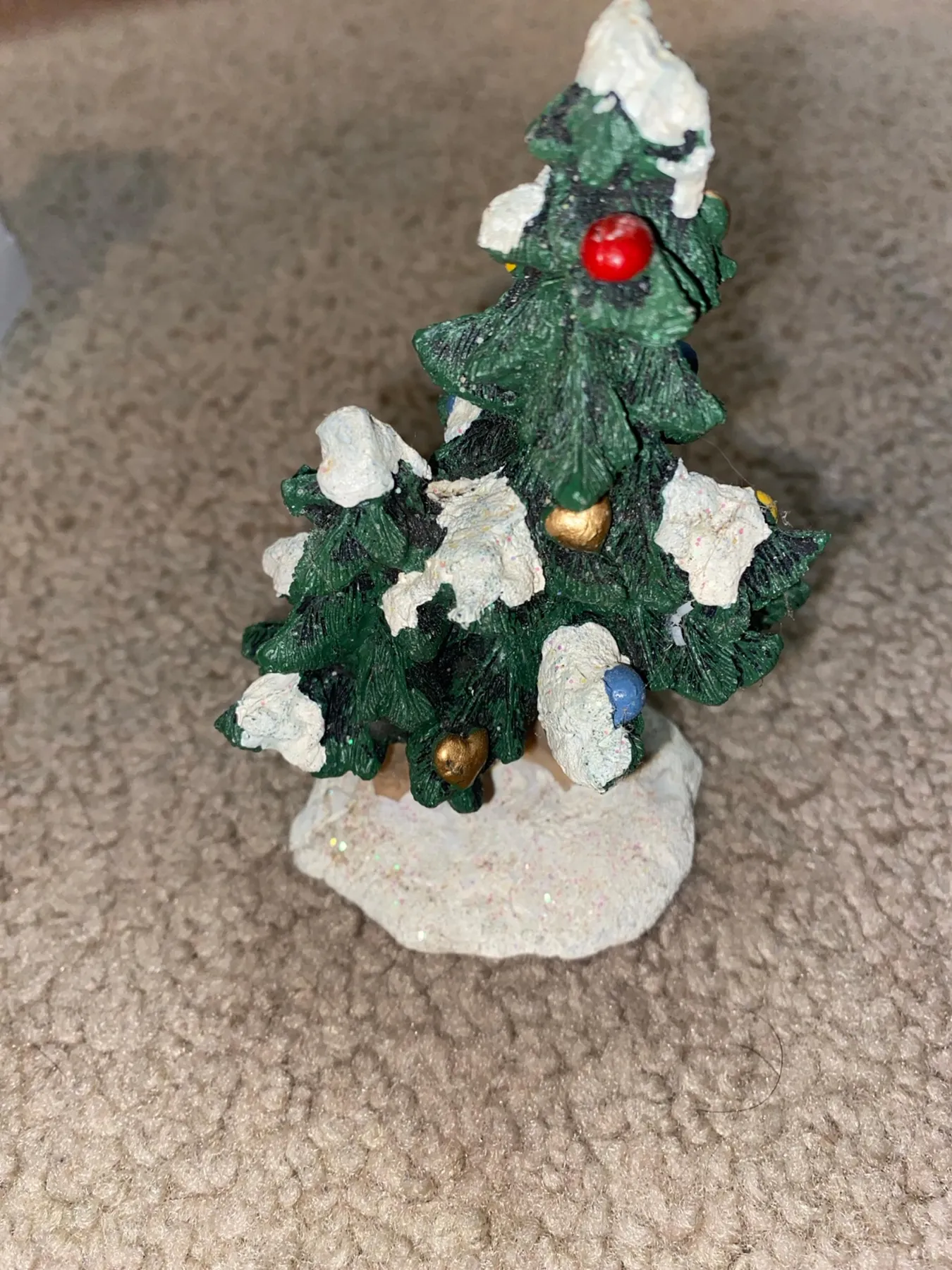
Scale is what separates a charming mini tree from a sad one. On a piece under 12 inches tall, ornaments should be under half an inch across. Anything larger and the tree looks like it’s being swallowed. If you’re adding your own, look for 6–10mm bead garlands and micro ornaments — the same aisle as dollhouse miniatures and cake decorating, not the regular Christmas aisle.
9. White Ceramic Tree, Teal Bottle Brushes, Tiny Gift Houses
The formula: 55% white ceramic, 25% teal, 15% red-and-green pattern, 5% gold. That’s it. Swap teal for blush and the whole thing turns soft and romantic. Swap it for cobalt and you get a sharper, more graphic holiday look. The rule that holds it together is that every accent color has to appear twice — teal on the bottle brush trees and once more somewhere small, red-and-green on the gift boxes and once more in a ribbon. A color that shows up only once looks like an accident; twice looks like a decision. Compare with Idea #4 — same glossy ceramic language, much warmer palette.
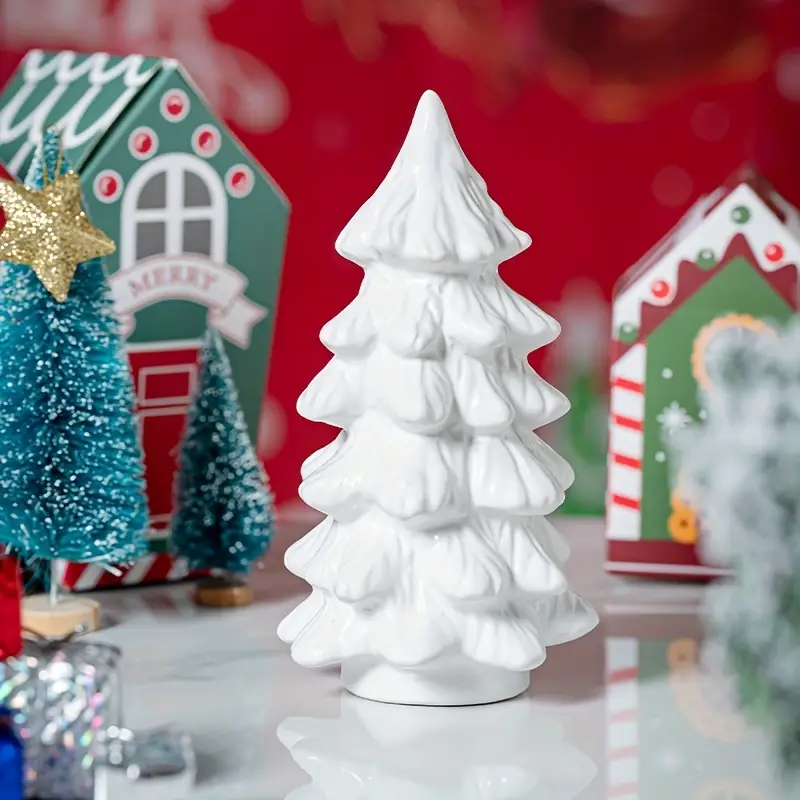
Reflective white surfaces are the cheapest upgrade in holiday decorating. A $6 mirror tile or a white lacquer tray from Target does the same job as a $200 lacquered console. Teal bottle brush trees run $4–$12 each at Walmart and Hobby Lobby, and those house-shaped gift boxes cost almost nothing if you fold them from scrapbook paper. Realistic spend for the whole scene: $40–$70.
10. The Teal Tree Covered in Santa-Hatted Frogs
Call it the joyful-weird shift. After years of muted, everything-beige holiday styling, 2026 shoppers are actively buying humor — and the most-saved ceramic trees on Pinterest are the ones with a personality problem. Hand-built pieces with frogs, mushrooms, and dinosaurs sell out faster than classic reproductions on Etsy. Expect this to run through 2027, largely because it photographs beautifully and nobody needs three of them, which makes it an easy gift.
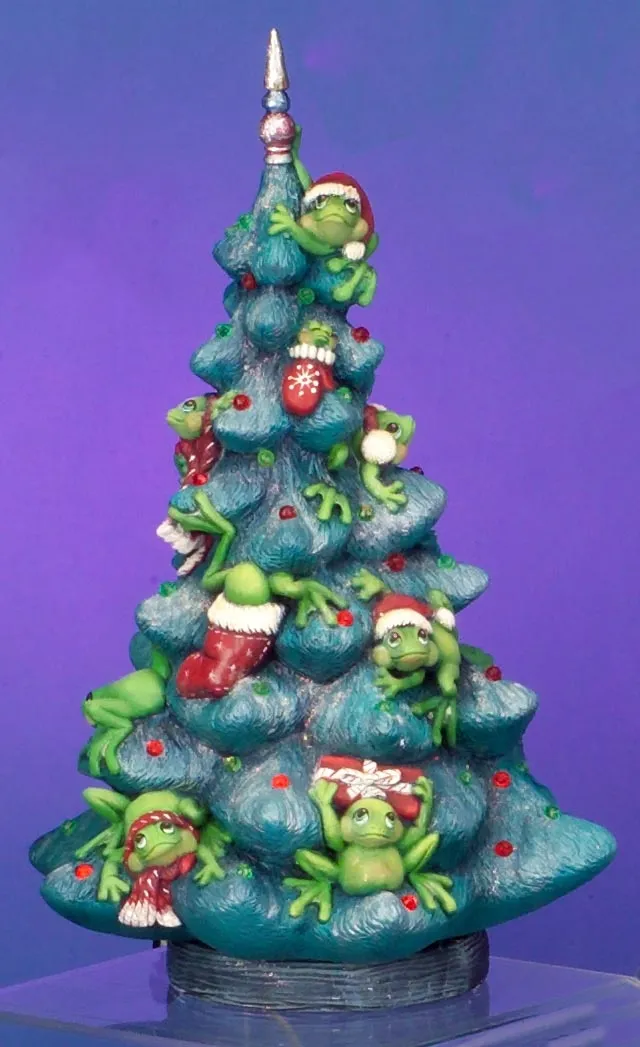
Want the same eccentric energy without commissioning a bespoke tree?
- Start with any teal or deep green ceramic tree, glazed or matte.
- Round up 6–10 small plastic animal figurines from safari tubes or dollar-store packs.
- Make two or three tiny Santa hats from red felt cones, about ¾ inch tall.
- Hot-glue each hat to a figurine head, then rest — don’t glue — the animals on the branches so you can rearrange them.
- Finish with a metallic finial instead of a star to keep the look slightly off-kilter.
Time: about an hour. Cost: $15–$30 on top of the tree.
The silver finial is the quiet hero. On a tree this playful, a gold star pushes it into cutesy and a red bow makes it read as a kids’ craft project. The cool metallic topper pulls the whole thing back toward designed object and stops the frogs from taking over. Remove it and the display loses its straight face — which is exactly what lets it live in a grown-up room.
11. Sage and Off-White Trees Styled on a Stacked Book
Glazed ceramic is the lowest-maintenance holiday decor you can own. A damp microfiber cloth once a year is genuinely it — no wax, no polish, no specialty cleaner. What actually wears out is everything around it. Fresh pine branches drop needles for two to three weeks and stain pale surfaces with sap; switch to faux cedar or preserved greens for zero mess. Berries and pinecones shed too. And those distressed mirror frames are usually MDF underneath, so keep them off humid windowsills unless you enjoy peeling veneer.
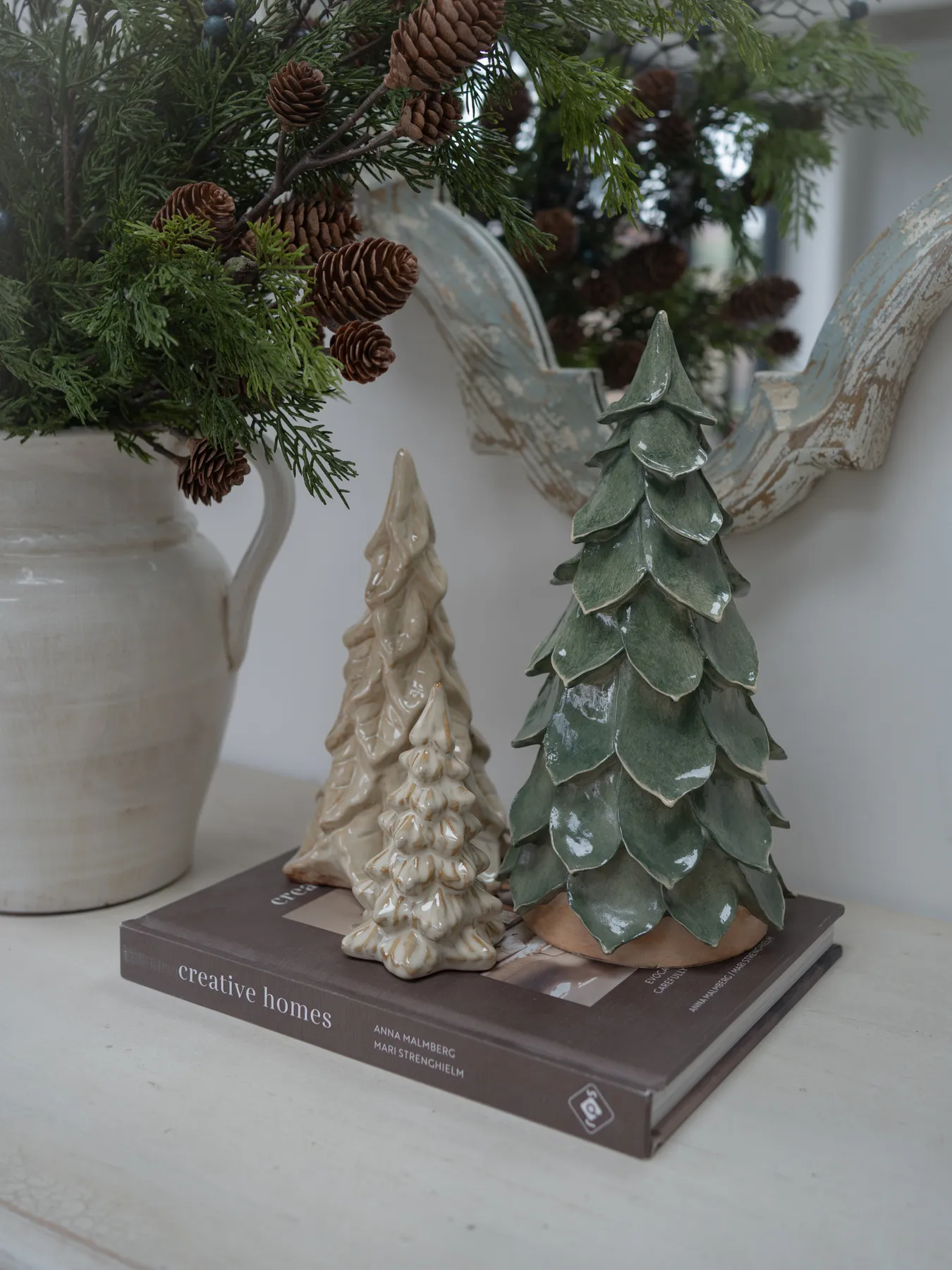
Two details make this arrangement feel collected rather than decorated: the book riser and the color temperature. Lifting the off-white tree onto a dark hardcover creates a two-inch height difference without adding another object, and the dark spine gives the pale glaze something to sit against. Meanwhile the sage green tree and the pine branches are both cool-toned, while the wood and the book are warm. That temperature mix is what stops natural styling from looking flat.
12. Rustic Glazed Trees With Jingle Bells and Evergreen
Rustic styling lives or dies on the vase line. A textured grey-brown crock or stoneware pitcher reads handmade and earthy; a smooth white ceramic vase in the same arrangement reads bathroom. Aim for visible clay grit and a slightly uneven rim. Then cluster bell sizes — three sizes of rusty jingle bells, no more — because a group of identical bells becomes a wind chime. Rusty finish beats bright brass here by a wide margin.
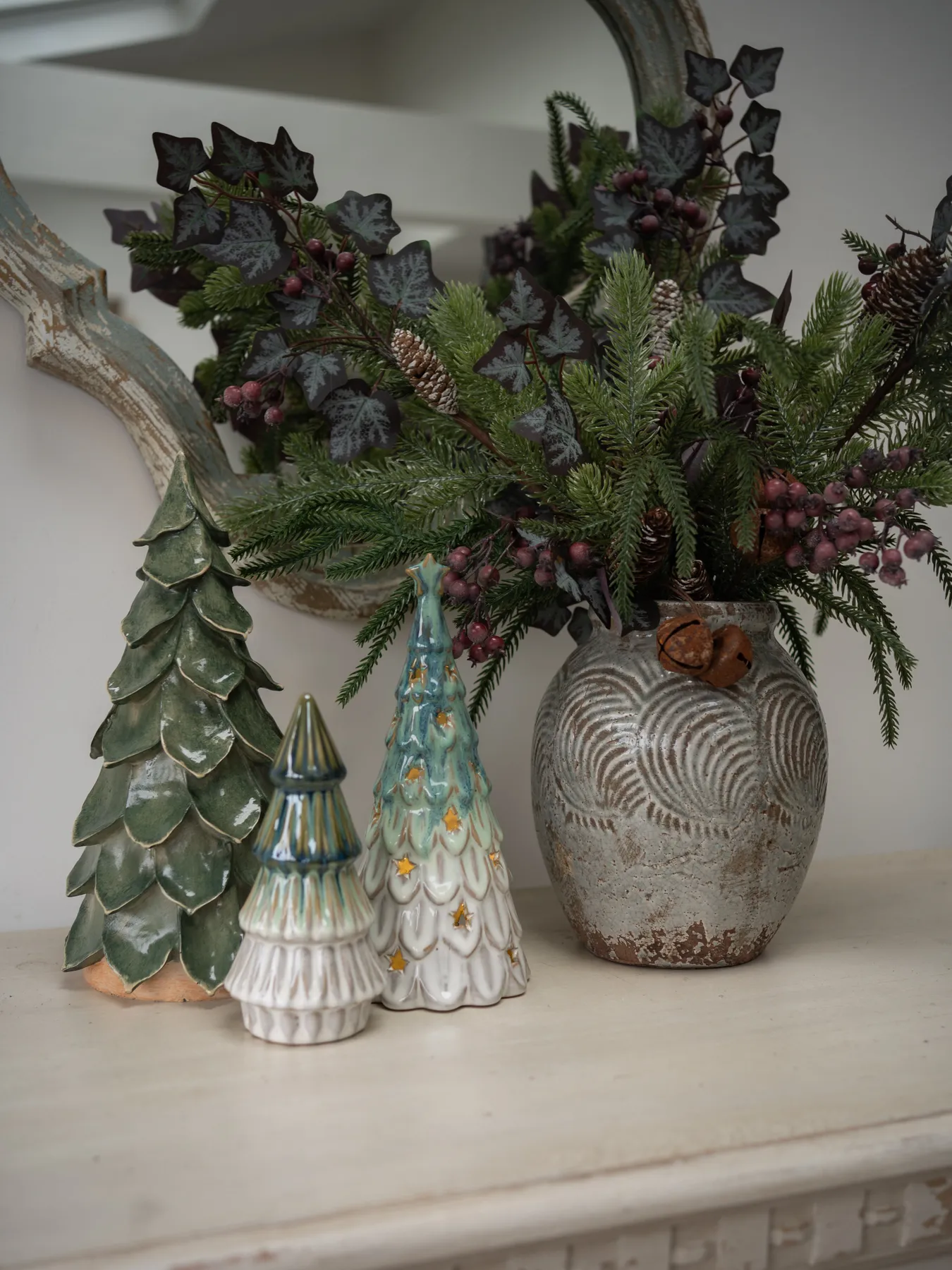
This is a sideboard or console arrangement, and it wants a surface at least 48 inches wide and 14 inches deep. The foliage vase alone usually runs 9–12 inches across at the rim. Ceiling height barely matters; wall width does. On a narrow entry table of 30–36 inches, cut it down to two trees and a single small vase of evergreen. For a tabletop version of the same rustic feeling, look at Idea #16, and if you’re working with a shallow mantel, skip the tall trees entirely — Idea #19 has a slim-shelf setup.
Three things to know before you commit. Real evergreen branches shed, so on a light distressed surface expect to vacuum every few days. Red berries and pets are a bad combination, since several common decorative berry types are toxic if chewed — go faux or keep them high. And a mirror behind the display doubles everything, including clutter. If the reflection shows a charging cable and a pile of mail, you’ll see it every single day.
13. A Green Bird Tree Next to a Gold Bell Tree
The asymmetry is the secret. Two glossy trees side by side would normally beg for matching decorations — instead one carries red birds and a red bird topper while the other carries gold bells and a gold star. Same silhouette, same glossy finish, completely different story on each. Remove either tree’s theme and you’re left with two generic trees. The pairing only works because they’re opposites sharing a base recipe.
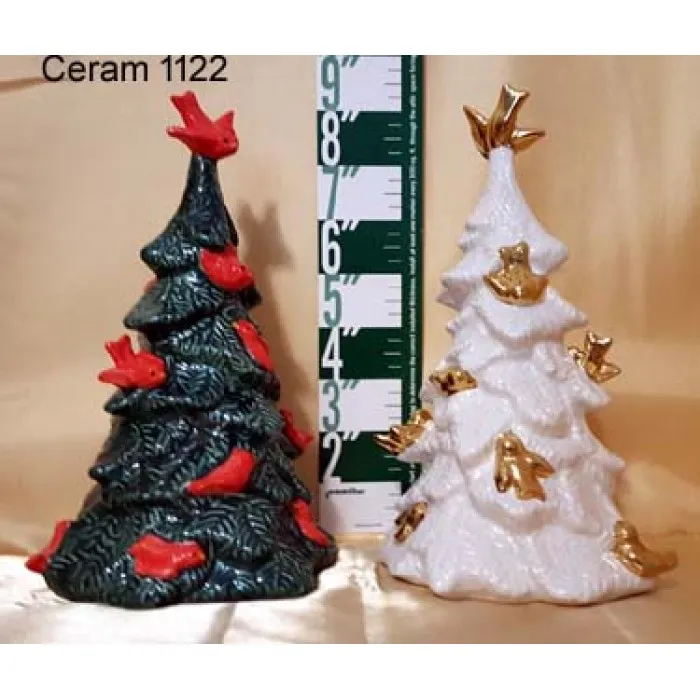
Matching this pair is easier than it looks, since themed ceramic trees are usually sold as one-offs.
- Dark green tree with bird topper and figurines: $45–$85
- White tree with gold bell accents: $40–$75
- Loose ceramic bird and bell ornaments if you’re DIY-ing: $12–$30
- Clear craft glue and a fine brush: $6
- Runner or tray to unify the two: $15–$30
Total: $118–$226 as a pair. Budget route: buy two plain white trees at $18–$30 each and glue on dollar-store bird and bell ornaments. Nobody can tell at three feet.
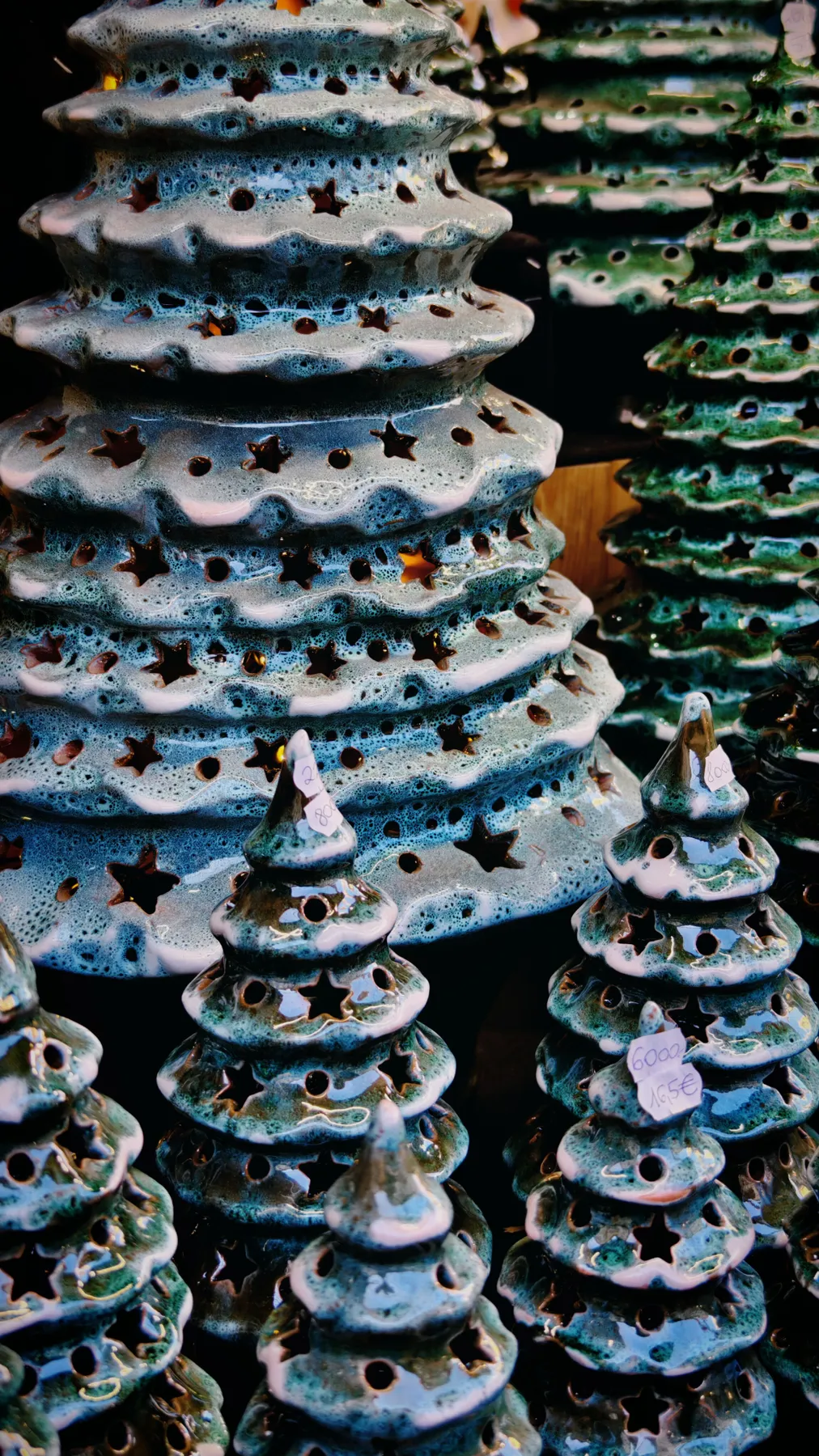
14. Blue-Green Trees That Light Up Through Star Cutouts
Cutout trees are the one ceramic look that genuinely rewards a light upgrade.
- Pull the base and check the bulb socket — most post-1990s models use a standard candelabra size.
- Replace the stock bulb with a 4-watt warm-white LED night-light bulb. It runs cool and lasts for years.
- If your tree is unlit, don’t drill anything. Feed a 10-light micro strand up through the hollow center from the base opening.
- Set the tree in front of a matte, dark surface so the cutouts read as bright stars instead of pale splotches.
- Group three sizes, tallest at the back, so the light sources stack into a triangle.
Time: 20–30 minutes. Cost: $6–$18.
This palette is 60% deep teal-emerald glaze, 25% warm interior light, 10% white glaze accents, 5% dark background. The magic number is light temperature. Warm 2700K makes blue-green glaze look jewel-toned and vintage; cool white at 4000K and up makes the same tree look like a hummingbird feeder. Swap the glaze for matte charcoal and keep the warm bulb, then add a cream table runner so the tree doesn’t dissolve into the wall.
15. Handmade Dark Green Tree With a Blue Star Topper
Hand-built ceramic trees with raised berries and a solid star run $70–$160 from small makers, because someone actually threw, glazed, and fired each one. You can get close for $30–$50. Thrift and estate sales turn up plain green ceramic trees for $10–$25 all through November and December — then add craft-store red berry picks at $5 and a small ceramic star at $6 with a dot of E6000. You keep the handmade silhouette without paying for the maker’s signature.
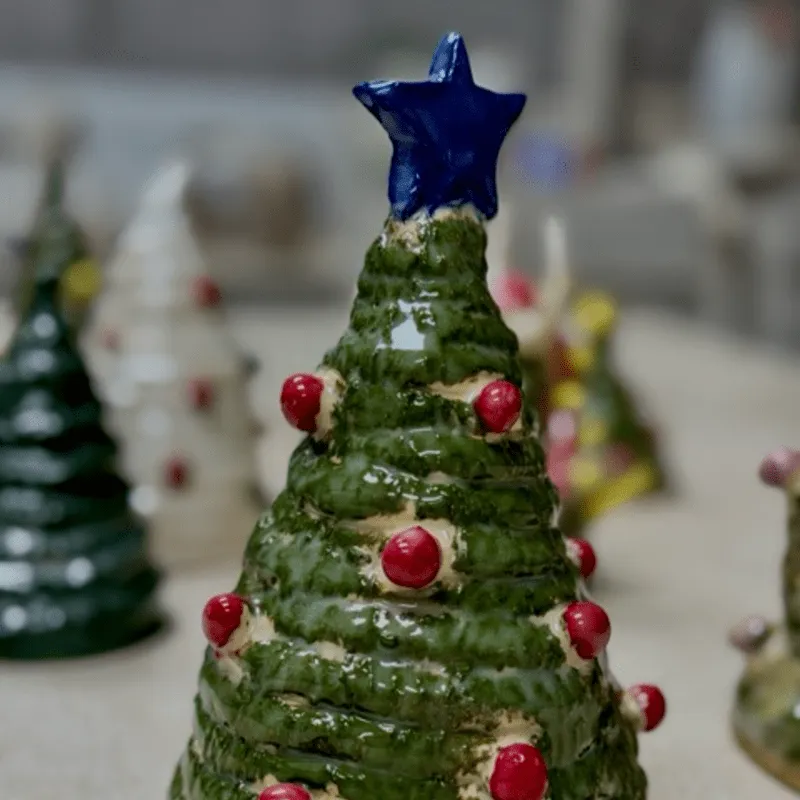
Rough, unglazed-looking surfaces are lovely and they trap dust in a way glossy glaze never will. Plan on a soft dry paintbrush every few weeks through December, and rinse the tree in warm soapy water only if the base and wiring come out completely. Never put a handmade piece in the dishwasher, even if the paint looks sealed. Store it wrapped in cotton cloth or bubble wrap — shelf edges and other ceramic pieces chip that raised berry detailing faster than anything else.
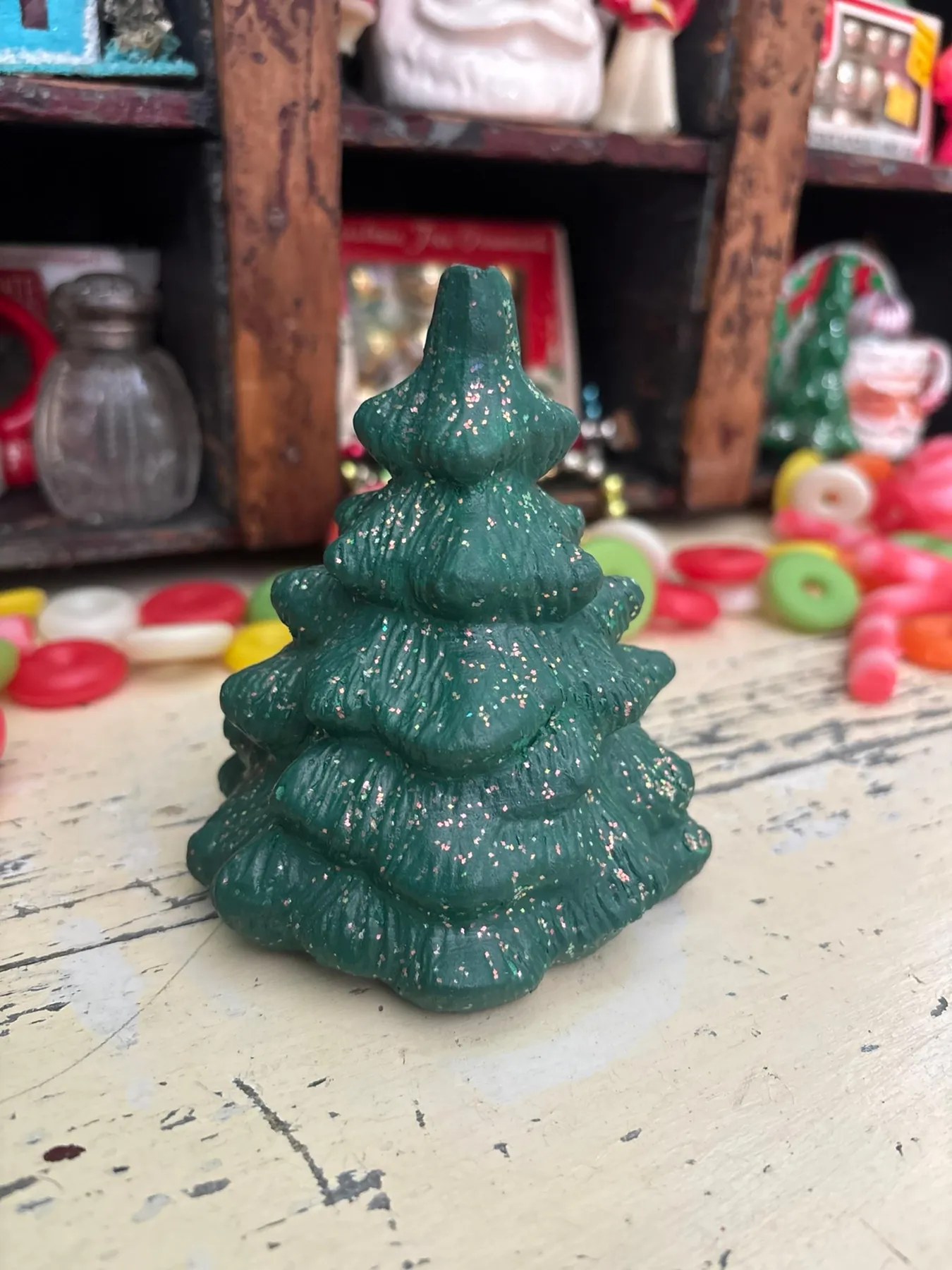
16. A Glittered Mini Tree on a Candy-Strewn Table
This is built for narrow, low surfaces: an 8-inch tree on a 12-inch-deep table or shelf ledge, with nothing in frame except what sits directly around the base. Height-wise it wants to sit below eye level — on a console, a windowsill, or the top of a low bookshelf. Put it on a tall mantel and the glittered detail disappears completely. If your room is big and open, use a cluster of three instead of one; a single 8-inch tree in a large space reads as a leftover. Compare with Idea #20 for a slightly larger tabletop option.
- Check that your surface is genuinely level — glittered ceramic trees wobble and slide.
- Confirm the room can handle loose glitter; it transfers to hands, cloths, and anything set down beside it.
- Decide whether the candy is decorative or edible. Glass jars, not open piles, if kids or pets are around.
- Plan a light source at table height — glitter only sparkles when something is aimed at it.
17. Why Small Ceramic Trees Hold Their Own
Small trees work for a reason that has nothing to do with size: they’re the only holiday object that looks correct in a bathroom, on a kitchen counter, or in a home office. A full-size tree in those rooms is a joke; a five-inch ceramic one is a wink. Scale is doing the humor. Keep it under six inches, give it clear space on all four sides, and it reads as intentional styling instead of a leftover nobody found a home for.
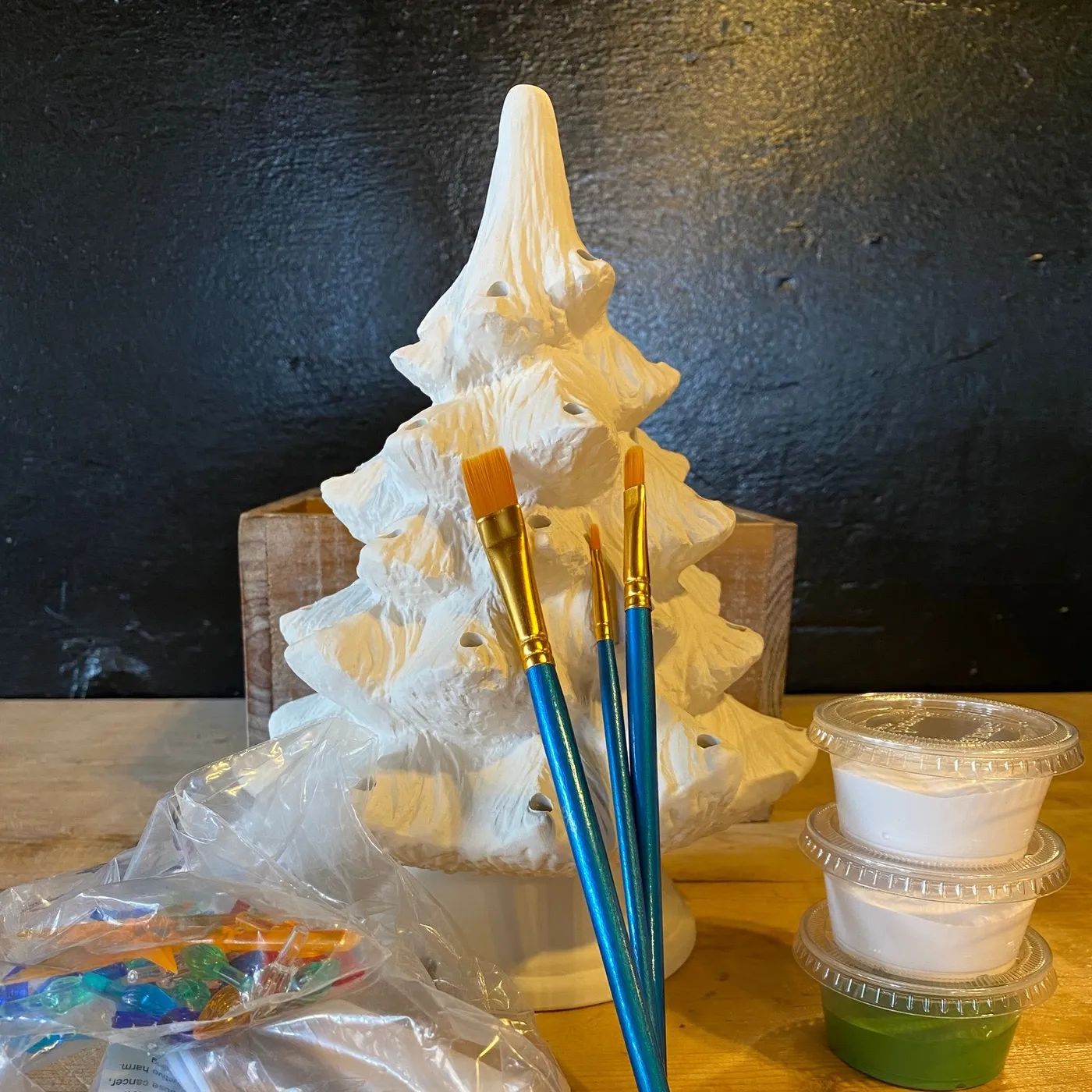
Kiln-fired pieces with internal wiring have one real vulnerability: the bulb socket. Dust and humidity corrode the contacts over time, and the fix is embarrassingly simple — pull the bulb, wipe the socket with a dry cotton swab, and reseat it. Do that once a season and a small lit tree will outlive most of your other decorations. Also check the cord for stiff or cracked insulation every year before plugging in; that’s the failure point on vintage pieces, not the ceramic itself.
18. A Lit Mini Tree on a Crocheted Doily
That burlap-wrapped base is a ten-minute project and it fixes the ugliest part of any mini tree.
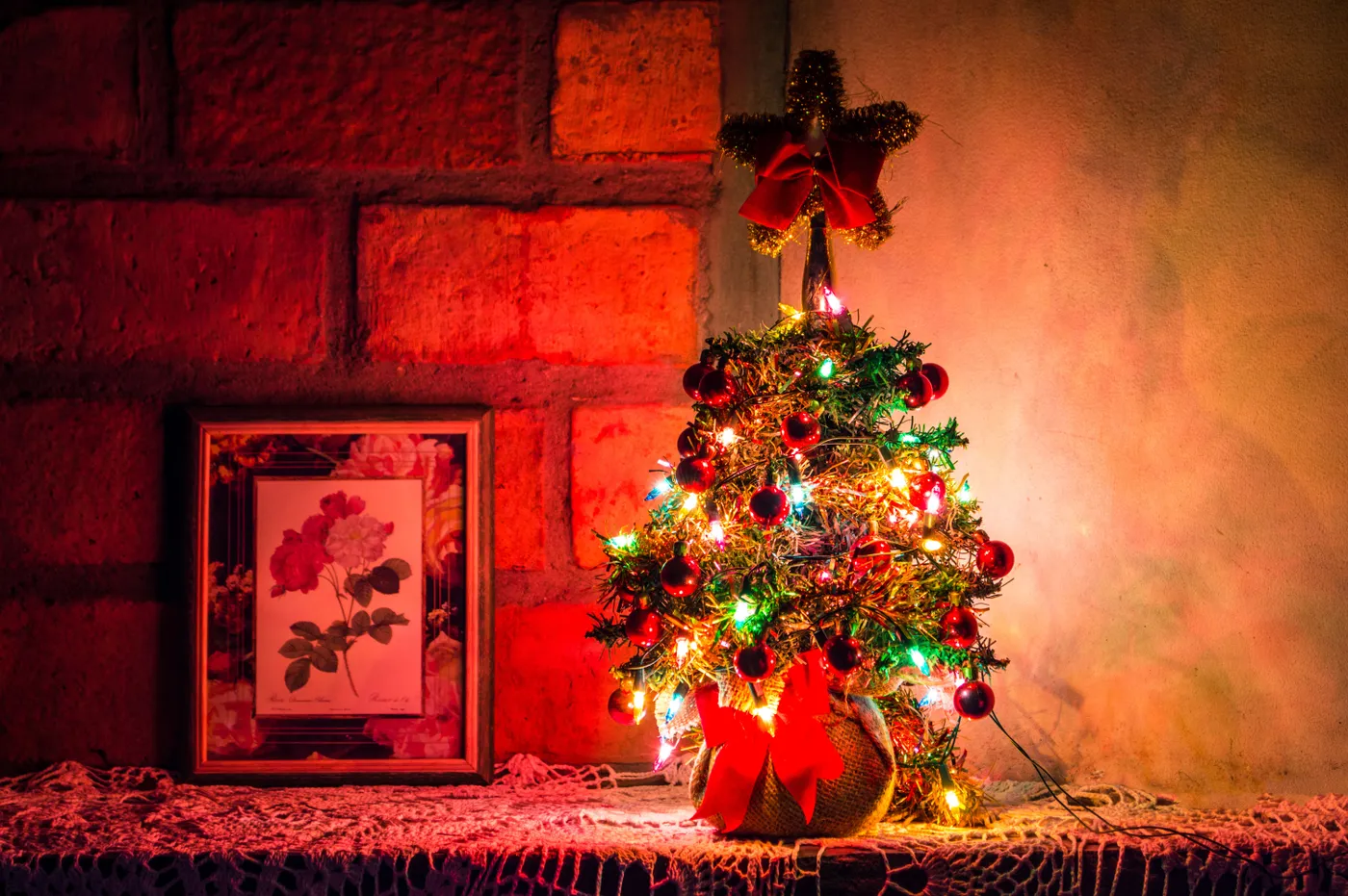
- Cut a 12-inch square of burlap — coarse weave, not the laminated kind.
- Set the tree base in the center and gather the burlap up around the pot.
- Tie it with jute twine about 2 inches below the lowest branches.
- Trim the burlap corners so they hang evenly, roughly 4 inches below the tie.
- Rest the whole thing on a crocheted doily or lace runner so it doesn’t scratch the surface.
Time: 10 minutes. Cost: $5–$9 for burlap and twine.
Two-foot and three-foot artificial trees with built-in lights are the most-failed decor purchase in December. The bulbs are wired in series, which means one dead bulb takes out a whole section and you can’t simply swap it. Test every section in the store or the day the box arrives, keep the receipt, and remember that a $25 tree with replaceable mini lights will outlast a $60 tree with sealed LEDs by several seasons.
- Small pre-lit artificial tree, 2 ft.: $22–$40
- Gold star topper with red bow: $6–$14
- Red ball ornaments, 24-count: $8–$15
- Burlap and jute twine: $5–$9
- Crocheted doily or lace runner: $4–$12, or $1–$3 at a thrift store
- Framed botanical print: $12–$35
Total: $57–$125. Budget version: a $12 thrift-store doily and a printed botanical image in a $6 Walmart frame gets you 90% of this for under $40.
19. Textured White Tree Beside Green Glass Candlesticks
This is a 70/20/10 arrangement: 70% white and light wood, 20% dark green, 10% cream candlelight. The dark green is the load-bearing accent. Move it from ribbed glass candleholders to a plant, a frame, or a ceramic vase and the formula still holds — as long as the green stays dark and matte-adjacent. Go brighter with kelly green or chartreuse and the calm evaporates, and the shelf starts to look like a garden center. Cream pillar candles, not white ones; that yellow undertone is what ties the shiplap to the wood.
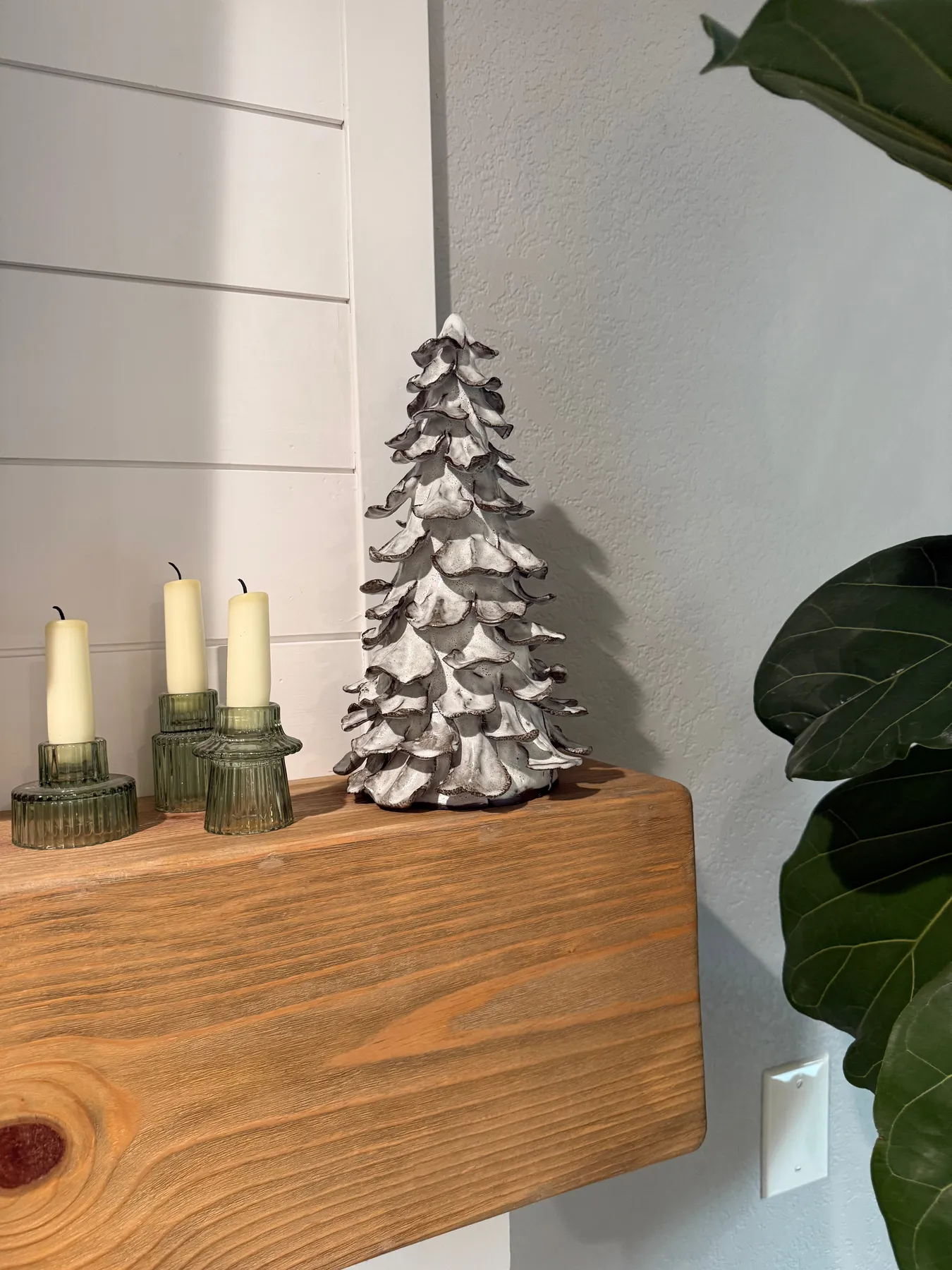
Shiplap-and-shelf styling has matured into what designers are calling quiet holiday — fewer objects, warmer neutrals, almost no glitter. Pinterest searches for textured white ceramics climbed steadily through 2025 and haven’t slowed since. It’s a reaction to years of maximalist holiday content: people still want festive, they just want it to look like it belongs in the room on December 26. This one has real staying power because nothing about it is dated to a single season.
20. Two Snow-Dusted Green Trees, Two Different Shapes
The two trees here run roughly 10 and 14 inches, which is the sweet spot for a centerpiece-scale display. They read well anywhere from a 24-inch shelf to a 60-inch dining table. Room size matters more than you’d think, though. In a small apartment, one bulbous tree is plenty — that fuller silhouette holds a corner on its own. In an open-plan space, use both plus a third, because a single 14-inch object in a 400-square-foot room simply disappears. Working with a genuinely tiny surface? Idea #7 covers the sub-12-inch version.

Snow-textured green ceramic trees are the fastest-selling style at craft fairs, and prices reflect it — $35 to $90 depending on size. Two ways to spend less. One: buy a plain glazed green tree for $15–$30 and add the texture yourself with a stipple brush and matte white acrylic, about 20 minutes of work. Two: watch Facebook Marketplace and estate sales in mid-November, when holiday boxes come out of storage and half of them get listed the same weekend.
21. The Barrel-Base Tree Against Deep Red
- Measure the base diameter — barrel-based trees often run 4–6 inches wide and need a deeper shelf than the height suggests.
- Test the tree against your wall color before committing. A deep red backdrop is what makes green glaze sing, and it will not work against beige.
- Confirm the cord exits from the base, not the side, if the tree is going against a wall.
- Decide your bulb count now — 25 to 40 micro bulbs suits a 12-inch perforated tree; more looks frantic.
- Have a felt pad ready. Glazed bases scratch wood.
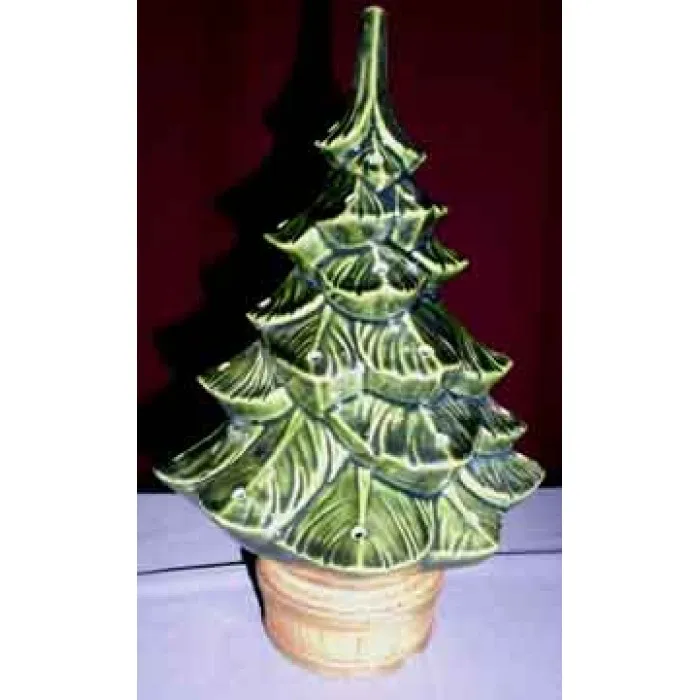
It’s the perforations. A solid glazed green tree is pretty; a tiered one with small circular holes throws dozens of tiny points of light onto the wall behind it, and that’s an effect you can’t get any other way. Everything else — the glossy finish, the pointed top, the light brown base — is supporting cast. If you’re choosing between two trees and one has cutouts, take the cutouts.
22. Frosted Icicle and Bell Ornaments to Finish the Tree
Frosted ornaments need to be a set, not a collection. Pick one texture family — granular faux snow, flocked white, or a matte sugar finish — and stay inside it for every ornament. A single glossy bauble dropped into a frosted cluster looks like a mistake from ten feet away. Work in asymmetry too: hang the large icicle slightly off-center and let the bells fall at different depths using 3-inch and 5-inch hooks. More things to avoid are in our mistakes section below.
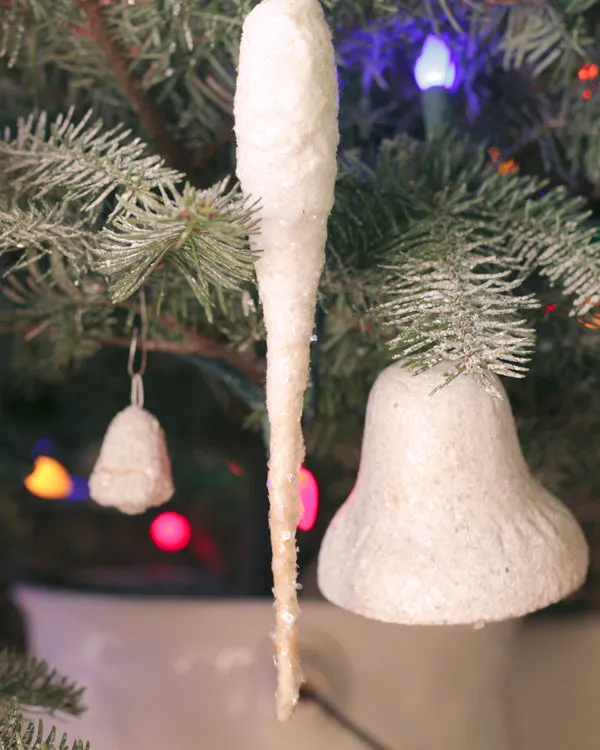
Frosted and flocked ornaments are back because whole-tree flocking is trending down — it’s messy, it’s permanent, and renters can’t do it. Individual frosted ornaments deliver the same snow-dusted look with none of the commitment, and you can pull them onto a ceramic tree, a wreath, or a garland. Expect this one to stay around; it solves a real problem instead of chasing a mood.
Save One Shelf for a Little Glow
Ceramic Christmas trees are one of the few pieces of holiday decor that get better with age — the glaze holds, the nostalgia compounds, and a $20 thrift find can outshine a $200 centerpiece. Pick the idea that matches your room’s light and your shelf’s depth, then build slowly rather than buying a whole display in one trip. If this helped, pin it so you can find it again next November — and tag us when your tree is glowing on the mantel.