
Still scrolling through blue and silver Christmas tree photos without knowing where to start? You’re not alone — the frosty, jewel-toned holiday look has quietly taken over Pinterest boards all fall. We spent serious time browsing At Home, Target, and Wayfair to bring you only what’s worth your attention this year, from $12 ornaments to $450 statement trees. Inside you’ll find 24 curated ideas spanning frosty elegance, traditional toile-and-velvet, coastal navy-and-burlap, grandmillennial chinoiserie, and a few vintage tinsel moments — with budget swaps and luxury upgrades compared side by side. Blue and silver is having a moment because it lets you keep the sparkle of a classic Christmas while skipping the red-and-green cliché, and 2026’s icy, frosted palettes slot right into the quiet-luxury mood still running the decor world. And stay until the end — we break down the most common mistakes that can ruin these looks. 📌 Save this to Pinterest for later — you’ll want to revisit these ideas.
1. Blue and Silver Tree Behind a Toile-Set Holiday Table
The velvet ribbon is doing more work here than any ornament. Wide blue velvet wound through the branches in loose loops soaks up light instead of bouncing it back the way a glossy bauble does, which is why this tree reads soft and deep rather than sparkly and flat. Take the ribbon away and you still have a blue and silver tree — you just lose the plush, collected quality that ties it to the blue and white toile china and the evergreen centerpiece on the table. Velvet is the thread that stitches the whole scene together.
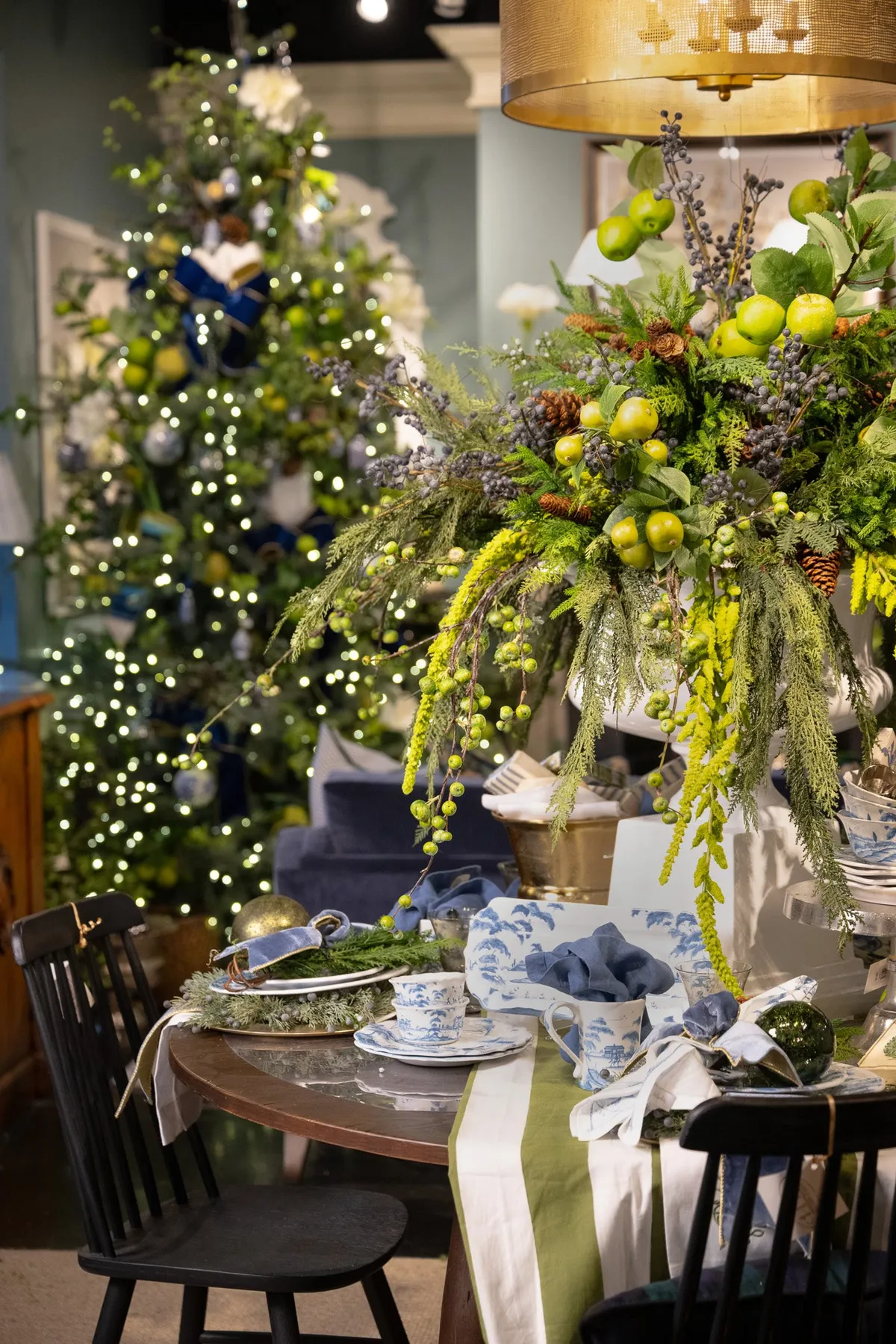
Recreating the table-plus-tree moment isn’t cheap, but it’s not a $3,000 project either.
- Tree plus warm white string lights: $120–$450
- Blue velvet ribbon and silver baubles: $35–$80
- Green and white striped runner, blue toile china (4 settings): $60–$180
- Evergreen, berry, and green apple centerpiece: $45–$120
- Silver flatware and glass accents: $30–$90
Total: roughly $290–$920.
Skip the china entirely and use what you own — a plain white plate with a blue linen napkin reads 80% of the way there.
2. Frosted Faux Tree Dressed in Icy Blue and Silver
Flocked trees eat ornaments. On a frosted branch, anything smaller than three inches disappears into the white, so work in a 3:1 ratio — three 3- to 4-inch baubles for every one 2-inch filler — and hang the large ones on the outer third of each branch. Cut your light blue satin ribbon into 18-inch strips and loop rather than knot; knots read heavy against all that soft flocking. Mix matte and shiny blue baubles in roughly equal amounts so the tree has both depth and sparkle.
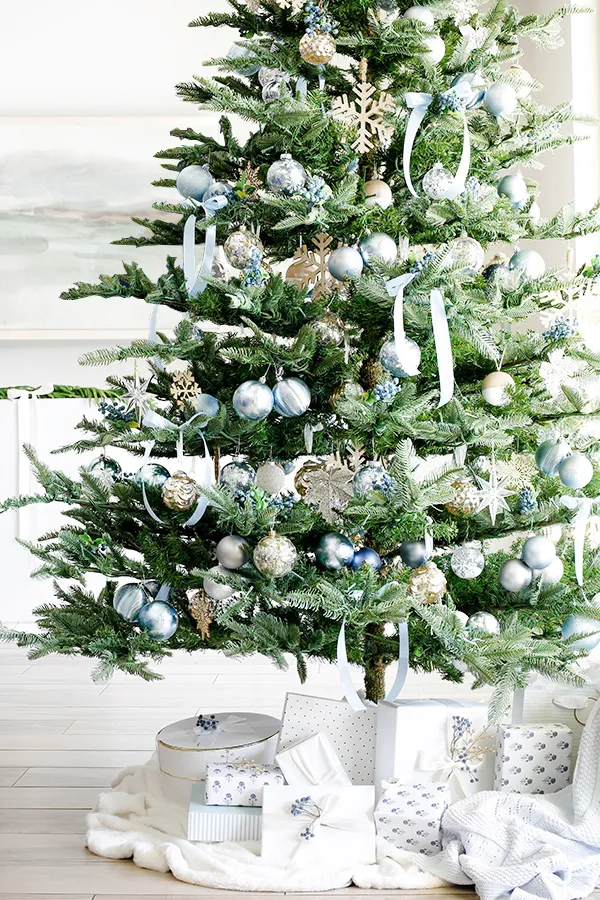
The white faux fur skirt is the diva of this setup. It sheds every time you walk past, collects pine needles like a magnet, and needs a shake-out every few days in December. Flocked branches also drop frost onto the floor, so lay a mat underneath before you assemble anything. Store the skirt in a breathable cotton bag, not plastic — trapped moisture turns faux fur musty by January. A flat woven skirt or a simple white linen drop gives you nearly the same snowy read with a fraction of the fuss.
3. A White Tree Against a Royal Blue Wall
Here’s the formula: 60% white base, 25% royal blue, 15% silver and clear glass. The white tablecloth and white tree are the base, the wall and the blue-and-silver ornaments carry the color, and the champagne flutes and silvered china rims are the punctuation. Swap royal blue for navy and the room goes moodier; swap it for powder blue and it turns soft and bridal. Keep the ratios and you can change the blue every year without rethinking anything else. Compare with Idea #9 — same palette, very different energy.
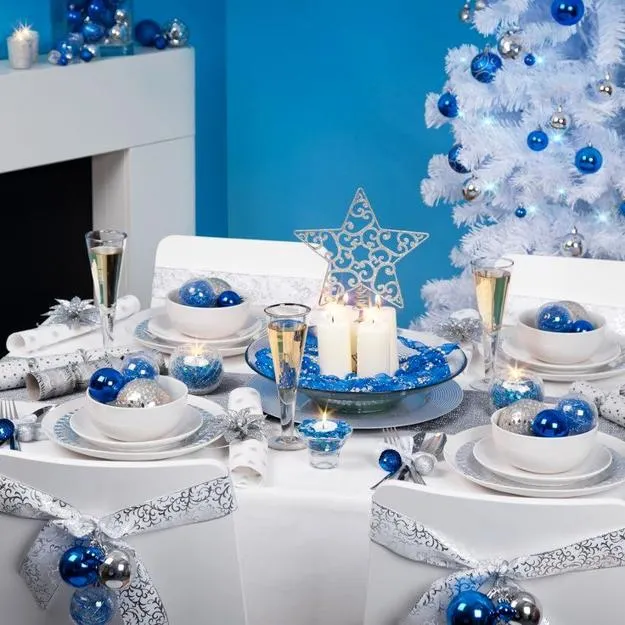
A white tree against a saturated blue wall is striking and completely unforgiving. White trees show dust, fingerprints, and any stray strand of dark tinsel immediately, and artificial ones yellow slightly over the years if they sit in direct sun. Blue walls also shift how the white reads — under warm lamp light it goes creamy, under cool daylight it looks icy. Check your tree in both before you commit, and if kids or pets are in the house, keep the glass ornaments above the three-foot mark.
4. Midnight Blue Tree in a Cozy Bedroom Corner
A dark blue tree swallows light, so it needs roughly twice the illumination of a green one — aim for about 100 bulbs per vertical foot and stay all warm white. Cool white LEDs on navy go gray and dingy fast. Run each strand vertically up the branches in a zigzag rather than wrapping the trunk; you get even coverage and far fewer dark pockets. Two 300-bulb strands will light a 6-foot tree properly, and white ribbon woven through the middle adds bounce without adding bulbs.
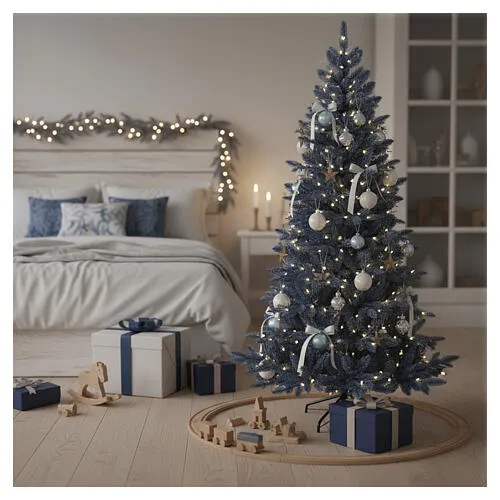
You don’t need a $400 designer tree to get this. Target and Walmart both carry 6- to 7-foot dark blue artificial trees for $60–$110 during the season, and off-brand versions on Amazon land in the same range. The ornaments are where you should spend: one $25 set of silver baubles and a $12 spool of white ribbon carries the entire look. Facebook Marketplace in mid-December is a goldmine — people sell barely used themed trees for a third of retail.
5. Blue, Green, and Ginger Jar Ornaments on One Tree
Three things are happening here. First, color temperature contrast: cool navy velvet bows sit next to warm olive-green ribbon and faux green apples, and that tension keeps the tree from feeling one-note. Second, scale variety — chunky blue and white ceramic ginger jar ornaments, medium velvet bows with gold trim, and tiny pinecones, all different sizes. Third, repetition with variation: the same ginger jar motif reappears at different heights, which is what makes a densely packed tree feel collected instead of cluttered.
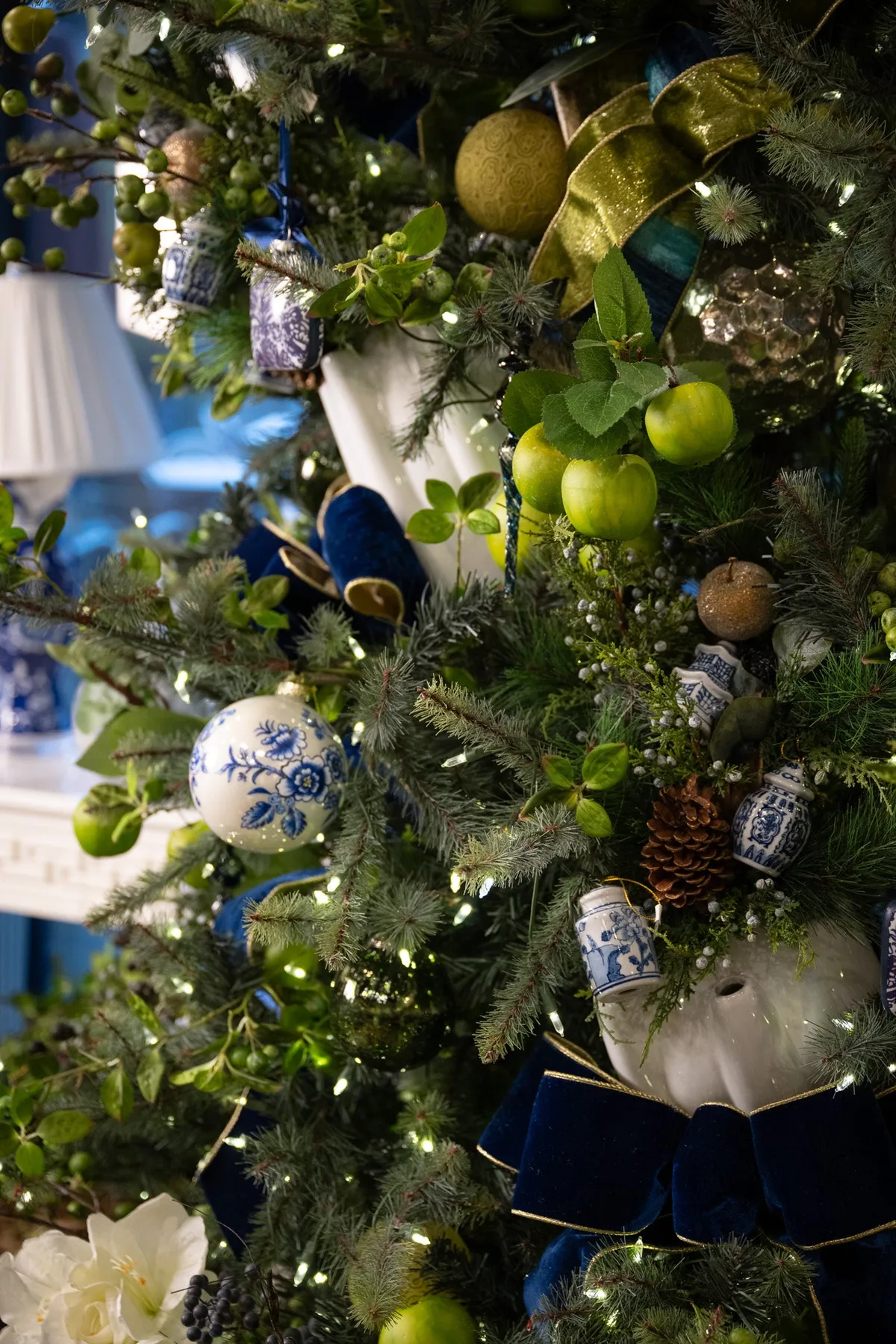
This is the ‘collected Christmas’ look that’s been building for a few seasons — less matchy-matchy ornament sets, more layered pieces that look gathered over years. It rides the same grandmillennial wave that brought back chinoiserie, scalloped edges, and anything that feels inherited. The upside is that it doesn’t date. Navy, white, and green with ceramic accents will look just as good in 2030. Buy one or two statement ornaments a year and let the tree grow with you.
6. Navy and Burlap Ribbons Meet a Coastal Dining Table
It’s the burlap. Navy and silver on their own can skew formal and just a little cold — natural burlap ribbon in that same open weave pulls the whole tree toward the coast. It also does something practical: rough texture beside glossy ornaments makes both look better. Swap the burlap for a satin ribbon in the same navy and you’d still have a nice tree, but it would read ‘dining room,’ not ‘beach house in December.’ The light blue starfish on the wall finishes the thought.
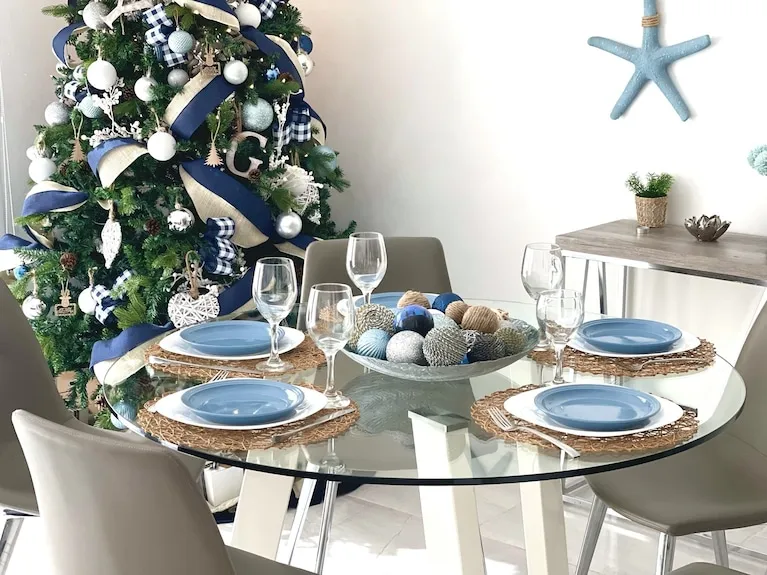
- Artificial tree plus lights: $110–$400
- Navy, burlap, and white ribbon (4 rolls): $28–$60
- Silver and white spherical ornaments: $40–$95
- Glass-top or wood dining table: $180–$900
- Woven placemats and light blue plate set: $45–$140
- Textured sphere centerpiece and coastal accents: $20–$55
Total: roughly $425–$1,650.
Buy the ribbon and ornaments now and let the table setting come from what’s already in your cabinet.
7. Chinoiserie Planter, Blue Bows, and Dried Botanicals
Standing a tree in a ceramic planter is 90% about stability. Set a bag of sand or a brick in the bottom first, drop the tree’s own stand inside, then fill the gap with crumpled paper or a foam block so nothing shifts. Choose a planter roughly one-third the height of the tree — for a 7-foot tree, a 22- to 26-inch pot. If the planter is wider than the tree’s lowest branches, add a riser so the tree sits proud of the rim instead of sinking into it.
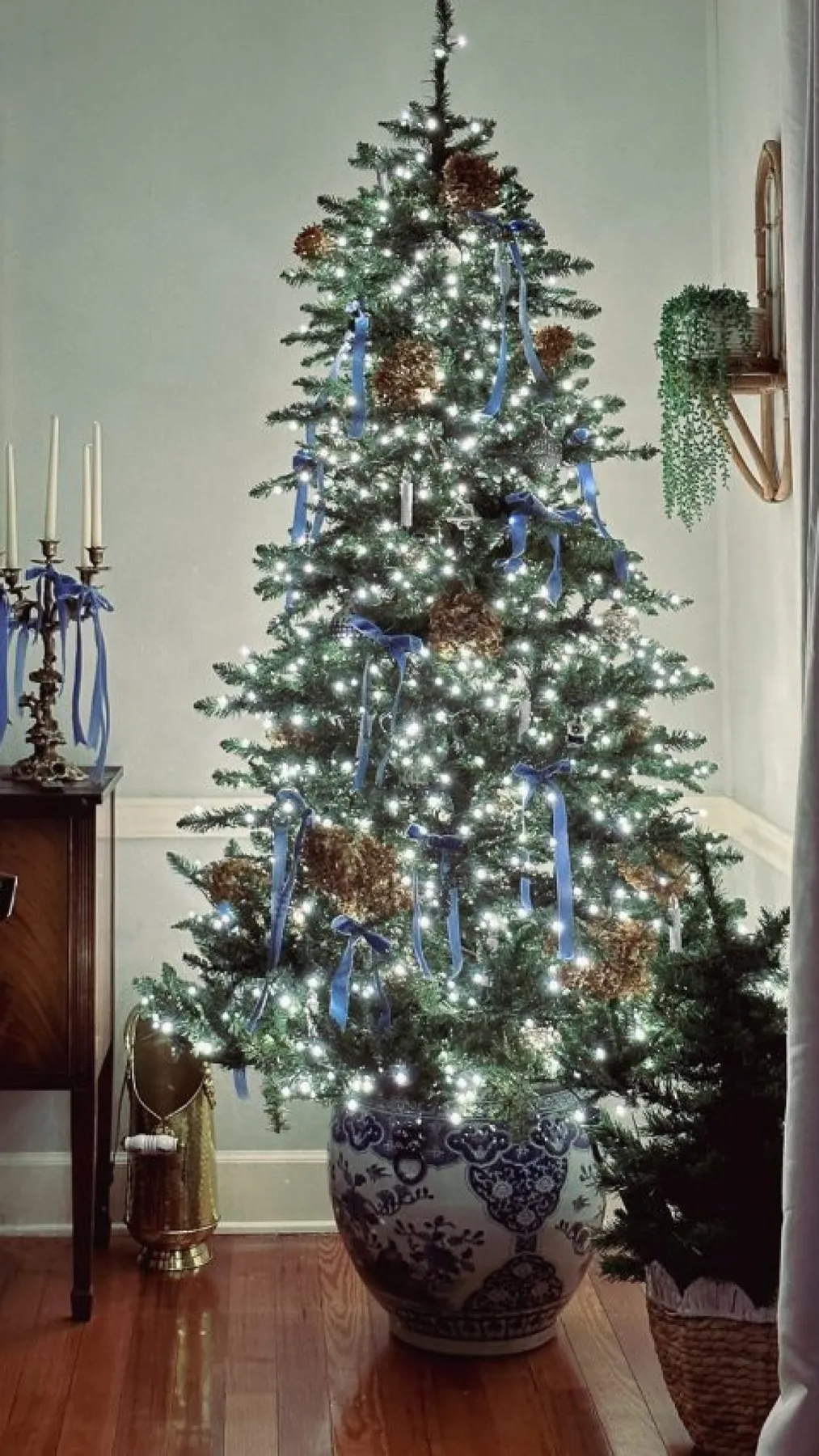
A floor planter needs breathing room. Budget at least 30 inches of clearance on all sides and a 9-foot ceiling if the total height runs over 7 feet including the pot. In a room under 150 square feet, use a 5- to 6-foot tree, or drop the chinoiserie into a smaller cachepot on a side table — see Idea #20 for how that reads. If your ceiling is 8 feet, cap the tree at 6.5 feet so the top doesn’t crowd the crown molding.
8. All-Silver Glitter Tree with Beaded Garland Swags
- Check ceiling height — a 7.5-foot tree plus topper needs 8 feet minimum
- Count existing silver ornaments: you want 60–80 for a 7-foot tree
- Pick one light color temperature and buy every strand in one batch
- Measure the corner — flocked branches add 4–6 inches per side
- Set a hard budget for beaded garland before you walk into the store
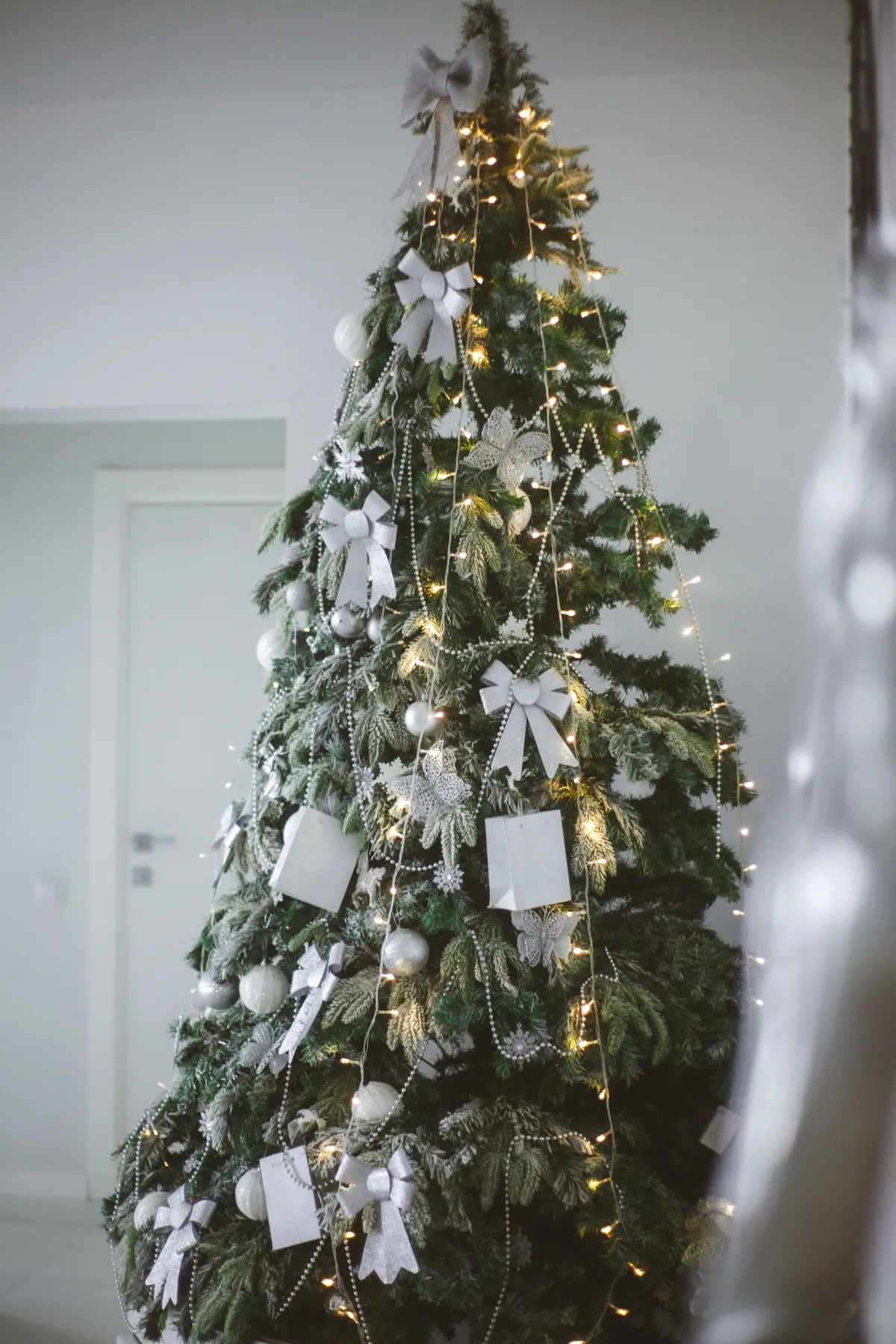
Draping beaded garland so it looks intentional rather than dumped:
- Hot glue a dot at the garland’s end and tuck it deep into a back branch.
- Work in a spiral, letting each swag dip 6–8 inches below the one above.
- Alternate direction every third row so the eye travels diagonally.
- Wire every third contact point to a branch — never knot it.
Plan 45 minutes for a 7-foot tree. Two 9-foot strands of glass or acrylic beads run about $18–$35 each.
9. Matte and Shiny Blue Baubles Under a Silver Star
The ornament formula: 50% matte blue, 30% high-shine silver, 20% white or frosted texture. Matte absorbs, gloss reflects, texture fills the gaps — you get depth without introducing a second color. Keep the blues inside one family: deep navy, denim, and pale ice blue all read as one story, while navy next to turquoise starts to look like two different trees. To warm the whole thing up, trade the white snowflakes for cream and the silver for champagne gold.
The oversized silver star topper is the one element you’d notice missing. On a tree this full, a normal-sized star disappears into the branches. A big one — 10 to 12 inches across — gives the eye somewhere to land and creates a deliberate silhouette. It also echoes the star and snowflake shapes used lower down, so the tree feels composed rather than arranged. If you’d rather the top stay soft, see Idea #16, where an angel does the same job.
10. A Sequined Blue Cone Tree on the Mantel
A sequined cone tree is one of the cheapest ways into this palette. Target and Walmart carry light blue sequin cone trees in the $15–$35 range every November, and HomeGoods usually has a version under $20. The candle holders are the part that looks expensive — thrift stores and estate sales are full of silver plate candlesticks for $4–$12 apiece. One $8 can of silver spray paint revives a set of tarnished brass ones in an afternoon, and thick brown pillar candles cost about $4 each.
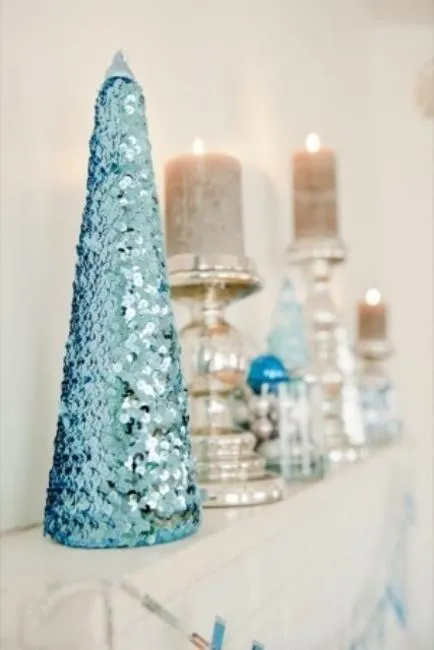
Sequins are magnets for dust and pet hair, and there’s no graceful way to clean them — a lint roller and a soft brush are it. Candle wax is the bigger problem: drips onto a white mantel are miserable to remove, so always use a holder with a lip and never leave a pillar burning under a wooden shelf. If your mantel is styled year-round, store the cone in a rigid box; the paper form crushes easily.
11. A Glitter-Dusted Flat Lay of Blue and Silver Ornaments
Building one coordinated ornament collection instead of five mismatched sets:
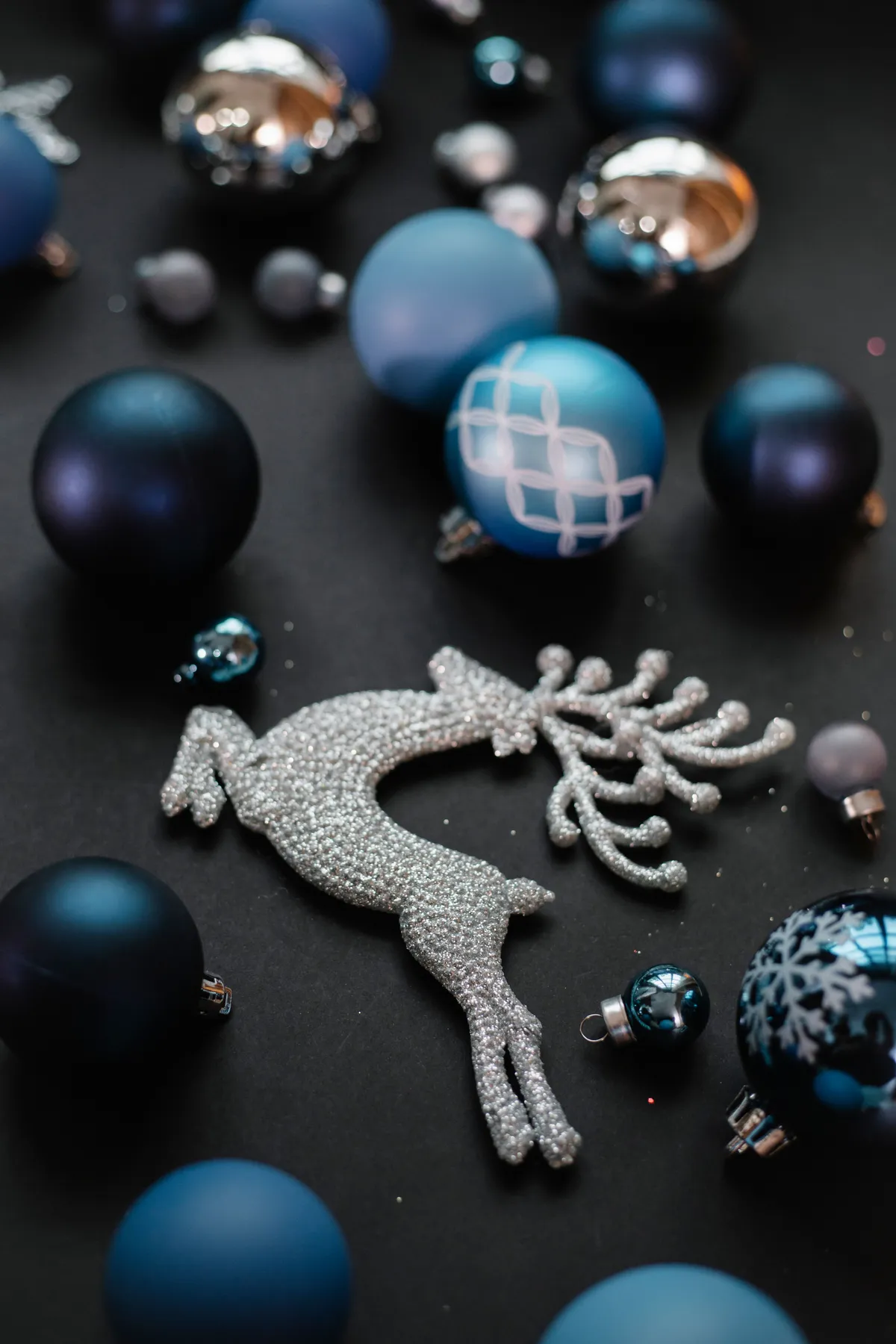
- Pick three finishes only — matte navy, glossy ice blue, silver glitter.
- Buy in three sizes: 4-inch statement, 3-inch middle, 2-inch filler.
- Aim for 12 large, 24 medium, and 48 small on a 7-foot tree.
- Add one wildcard shape — the glitter silver deer here — for personality.
Roughly 90 minutes of shopping and $90–$180. Buy it all in one trip so the finishes actually match once you’re home under different lighting.
Ornament scale is where most trees go wrong. The rule of thumb: one large ornament for every two medium and every four small, and the largest ones belong at the outer tips of the widest branches. Anything under 2 inches should be clustered in threes — a single tiny bauble on a big branch reads as an accident, while three of them read as a decision. Always buy one extra box for the bottom third, which somehow goes sparse every year.
12. Silver Tiered Cone Tree Topped with a Star
Small decorative trees work because they repeat the silhouette of the big one without competing for attention. The tiered cone mirrors the layered branches of a real tree, the silver star echoes the topper across the room, and the reflective surface picks up whatever warm string lights are nearby. Grouped with pine branches and loose ornaments, it reads as part of a scene instead of a lonely object. Repeating a shape at a different scale is the entire trick.
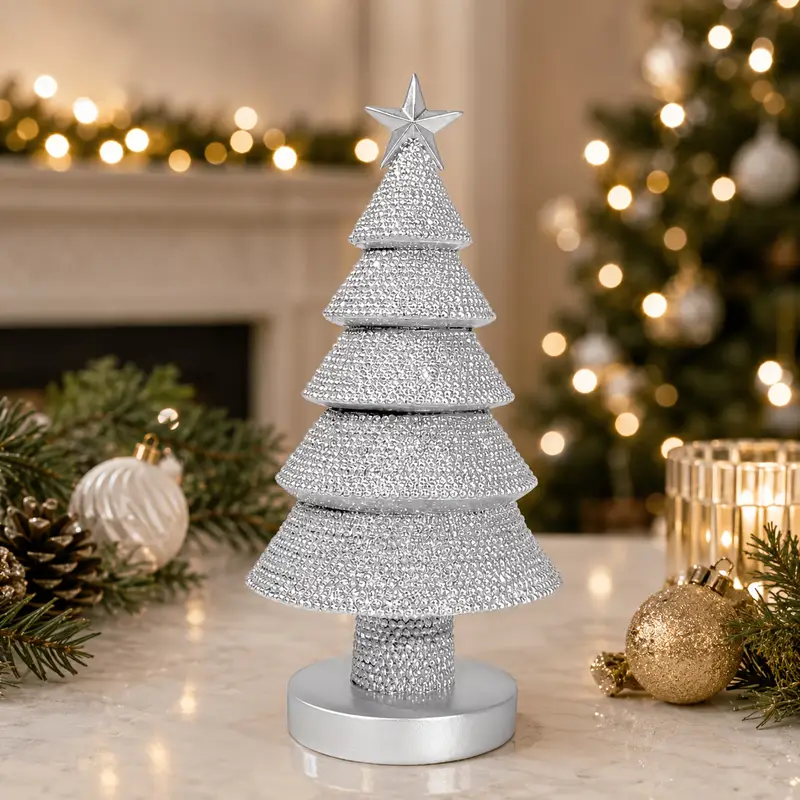
- Silver tiered cone tree, 12–18 in: $25–$70
- Silver star topper or finial: $8–$20
- Loose pine branches, real or faux: $15–$45
- White, silver, and gold filler ornaments: $20–$50
- Warm white battery string lights: $10–$25
Total: roughly $78–$210.
Budget version: a $12 dollar-store cone plus a bag of mixed thrift-store ornaments looks nearly identical once the lights are on.
13. Blue Tapers, Glass Trees, and Bronze Ornaments
The blue taper candles are carrying this runner. Everything else is neutral — white linen, clear glass, soft green tree figurines — and the brass holders add warmth. The tall blue tapers are what tell you there’s a theme at all. Without them, you have a lovely winter table with no color direction. Choose unscented 10- to 12-inch tapers so they clear the ornaments in the middle, and buy two extra, because handmade tapers break at the worst possible moment.
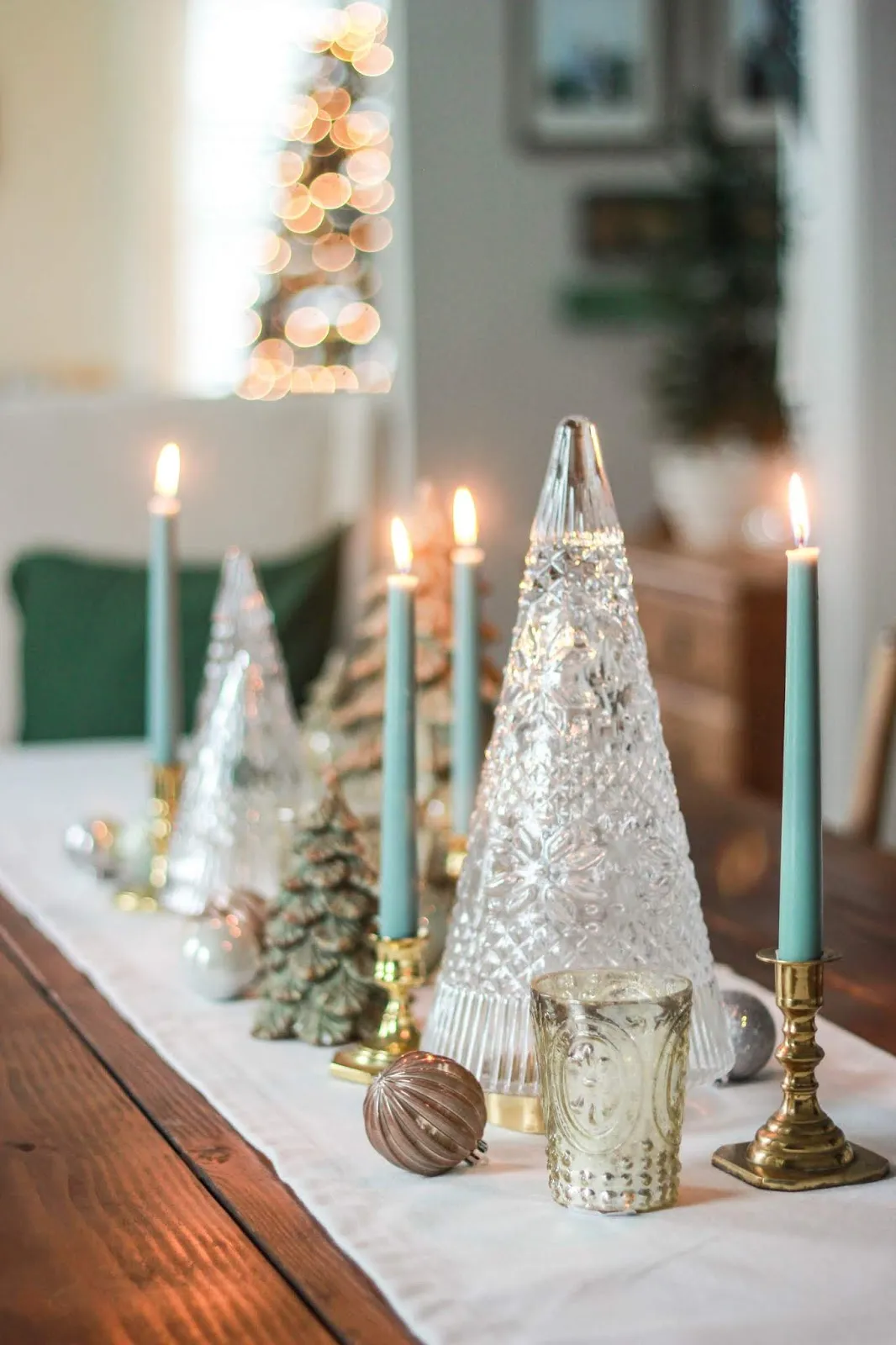
A running centerpiece formula worth stealing: 50% clear or white, 20% green, 20% blue, 10% metal. The clear glass trees and white runner carry the base, greenery adds life, blue candles and baubles provide the accent, and brass is the punctuation mark. Swap the blue for burgundy and you have a Thanksgiving-to-Christmas crossover; swap the brass for matte black and it turns modern. Keep the proportions and it works every year.
14. Frosted Green Glass Tree with Chunky Faux Snow
These little frosted trees live on shelves, mantels, and console tables, so size them to the surface. On a 12-inch-deep shelf, keep the tallest piece under 10 inches so it doesn’t hide the row behind it. A mantel wants a trio — 14 inches, 10 inches, 7 inches — grouped off-center. A full console can take five. For the same frosted look at architectural scale, see Idea #12.
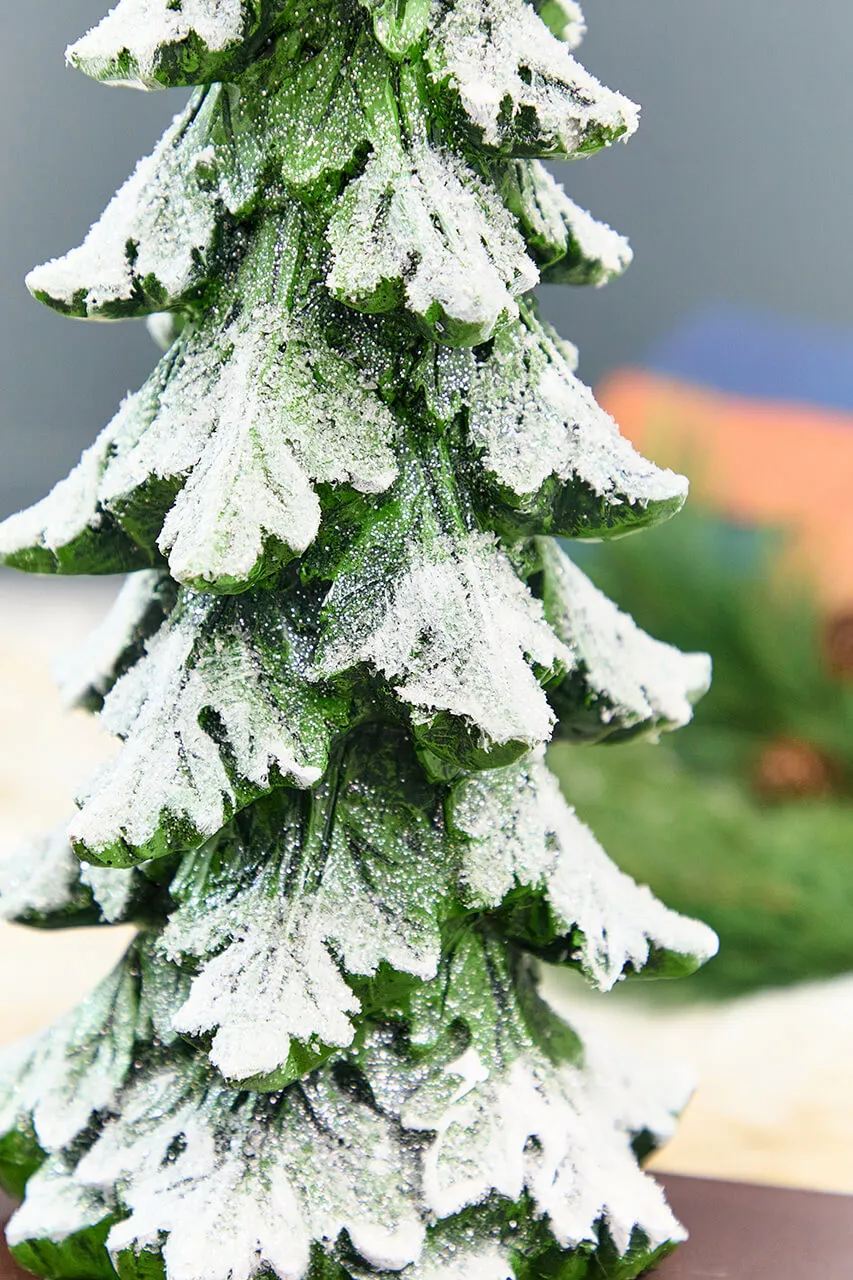
The chunky frosting is the whole appeal and also the problem. On resin or glass, the coating is fragile — one hard knock leaves a bald patch that can’t be blended back in. Pack them with tissue between each piece, never loose in a bin. If the frosting is plastic-based, keep them out of a south-facing window or they’ll yellow by spring. And keep the display shelf above toddler reach, because this material chips rather than dents.
15. Silver Tinsel Trees, Disco Balls, and Faux Snow
Disco balls under a Christmas tree aren’t new — they’ve been the party trick of holiday styling for a few years — but 2026 is the year they went mainstream in retail. The reason is simple: mirrored surfaces multiply whatever light is already in the room, so you get a sparkle effect without adding a single bulb. It’s also the most pin-able thing you can put on a shelf. Verdict: the disco balls are fun, but the slim tinsel trees are the part with real staying power.
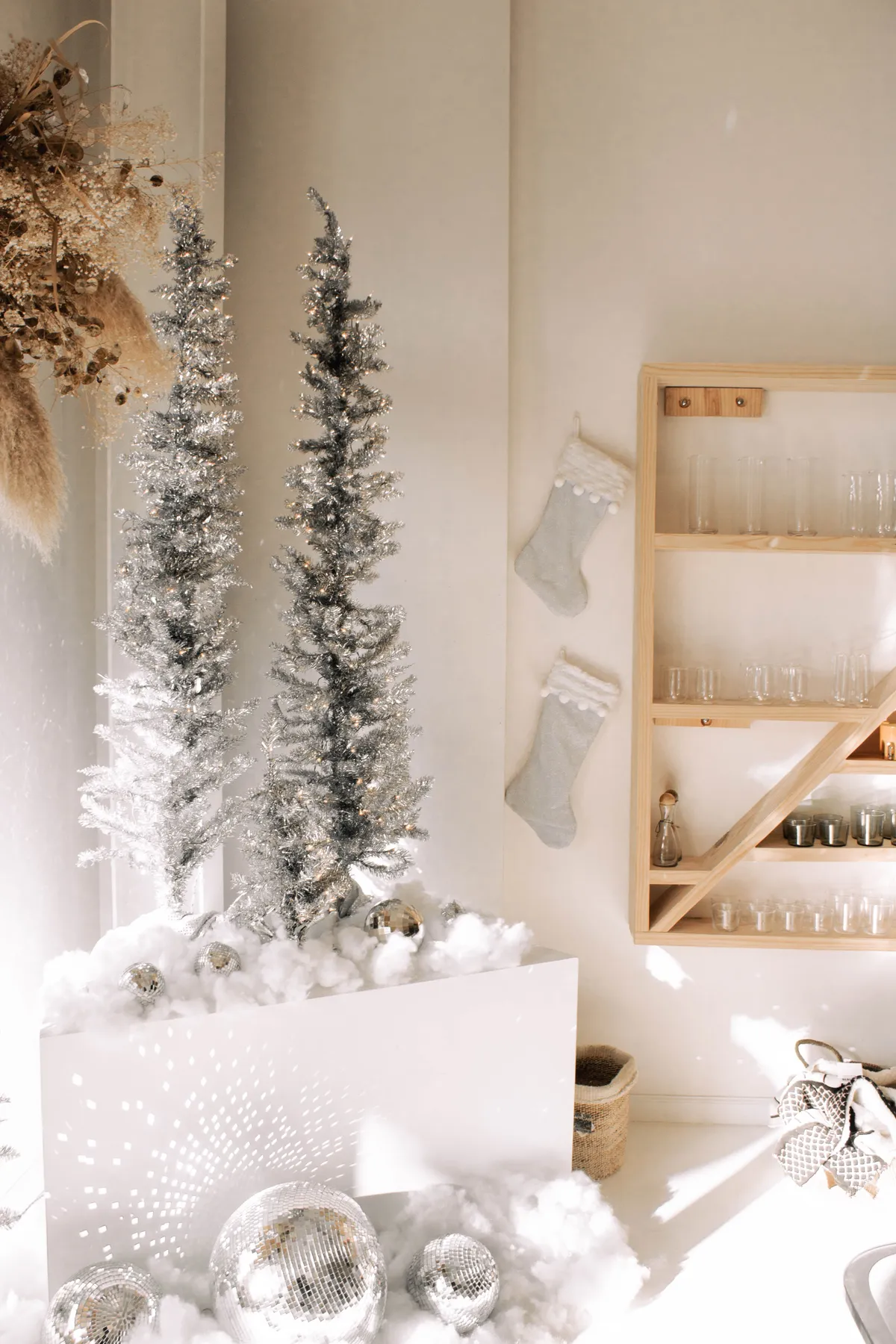
Two slender tinsel trees usually run $25–$60 each at Target or Walmart. Disco balls are where people overspend — a 12-pack of mirrored balls costs $12–$25 online, and craft stores price them similarly. Faux snow flakes are about $6 a bag, and a plain white planter from IKEA is $15–$30. Light blue knit stockings run $10–$18 at Target if you want the full moment. The whole shelf lands under $120.
16. Blue and Silver Tree Crowned with an Angel
Branch picks are the cheapest way to make a tree look expensive. Get 12–18 glittery dark blue picks, trim each to a 6-inch stem, and push them in at a 45-degree angle, following the branch direction rather than fighting it. Space them by counting branches — every fourth branch tip gets one. Then wire sheer silver ribbon into wide 4-inch swags behind the picks. Total cost about $30, and it roughly doubles the tree’s visual density.
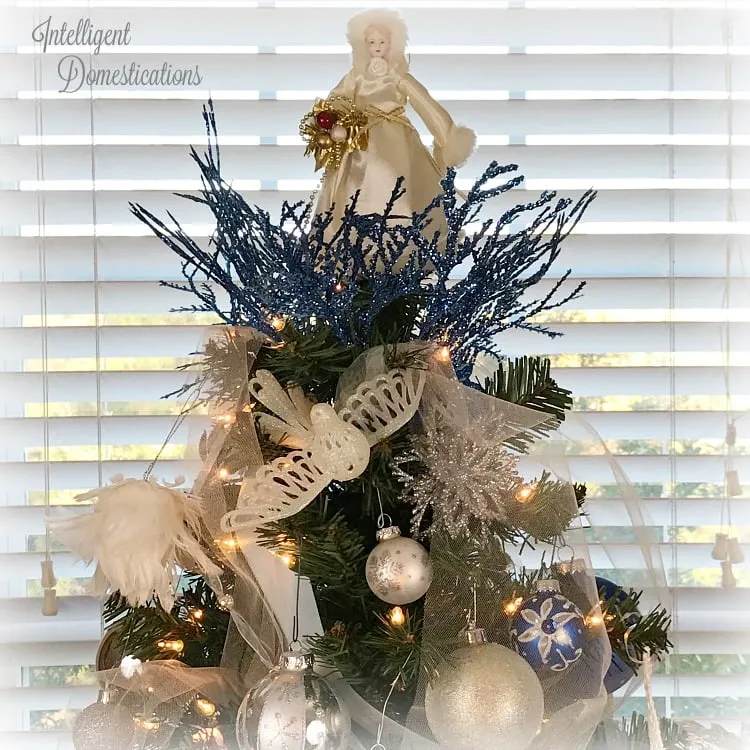
Three principles are doing the heavy lifting. Layering: lights, then picks, then ribbon, then ornaments, each starting from the inside out. Contrast: glittery picks against smooth frosted baubles, sheer ribbon against solid evergreen. And one consistent cool palette — blue, silver, and white with only the tiniest gold accents on the angel — so your eye can travel without stopping. That gold is the single warm note on the tree, which is exactly why it pulls your gaze upward.
17. Real Green Tree with Clear Glass Ornaments
A real tree is a commitment. Plan on a quart to a gallon of water a day for the first week in a warm room, and if you skip two days you’ll know it by the needle drop. Clear glass ornaments are unforgiving — they show fingerprints and they shatter rather than crack, so keep them above reaching height. Real trees also drip sap onto whatever sits underneath. Budget about $15 for a stand mat and a tarp for removal day, and don’t skip either.
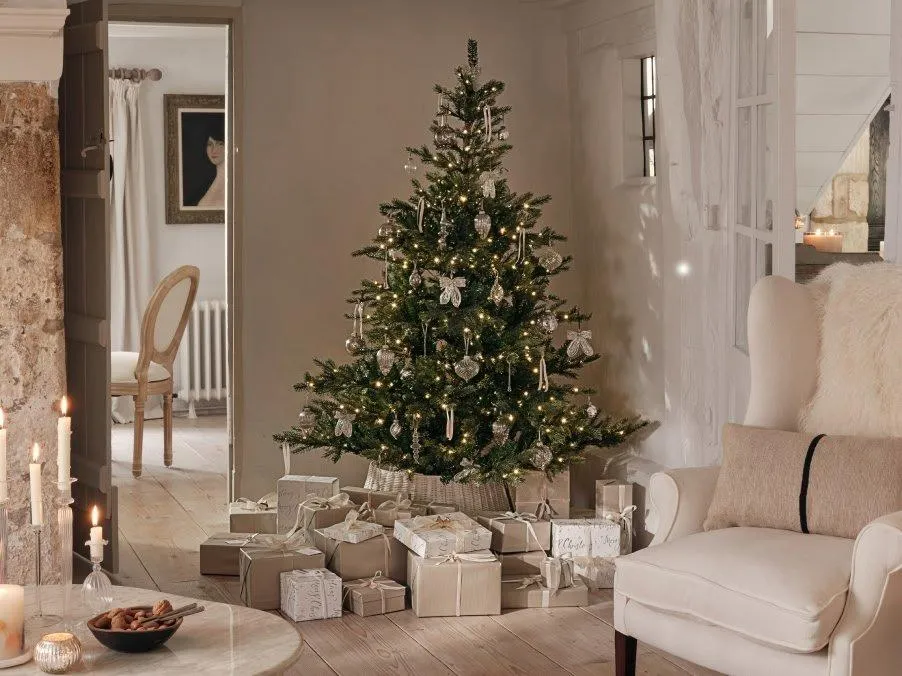
- Measure floor to ceiling, then subtract 12 inches for the topper
- Confirm your stand holds at least one gallon of water
- Sort ornaments into glass and non-glass piles before you start
- Measure the wicker base so wrapped presents actually fit around it
- Clear a 30-inch radius so the armchair isn’t a trip hazard
18. A Christmas Tree Built from Silver and White Gift Boxes
- 16–20 stacked gift boxes in silver and white: $60–$140
- Flocked garland with lights, 3 x 9 ft: $75–$180
- Silver snowflake ornaments and ribbon bows: $20–$45
- Small flocked tree topper: $15–$40
- Snow globe accent: $12–$30
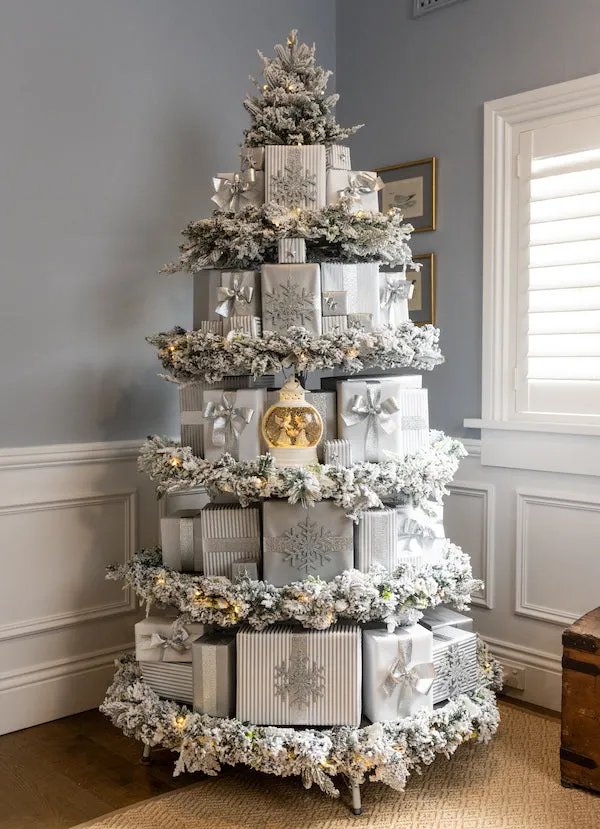
Total: roughly $182–$435.
Budget route: reuse shipping boxes wrapped in dollar-store paper, and buy the frosted garland after December 26 at 60% off for next year.
Building the stacked gift-box tree:
- Start with four of the largest boxes as the bottom tier — keep them the same height or it leans.
- Wrap each box in matte paper, then ribbon, keeping ribbon direction consistent.
- Lay a strand of frosted garland around the base of every tier, tucking ends behind.
- Step back after each tier and check the taper — you want a clean triangle.
- Top with a small flocked tree or one big bow, then set a snow globe at eye level.
About two hours including wrapping, and roughly $80 in fresh materials.
19. Blue Patterned Rug Anchoring a Silver and Gold Tree
This layout wants room to breathe. A round four-seat table needs about 10 feet by 10 feet of floor to leave walking space around the chairs, and the corner tree wants another 3 feet of clearance from the table edge. Eight-foot ceilings handle a 6.5- to 7-foot tree comfortably. In a smaller dining nook, skip the full tree and style a tabletop version instead — the effect in Idea #18 works beautifully on a sideboard.
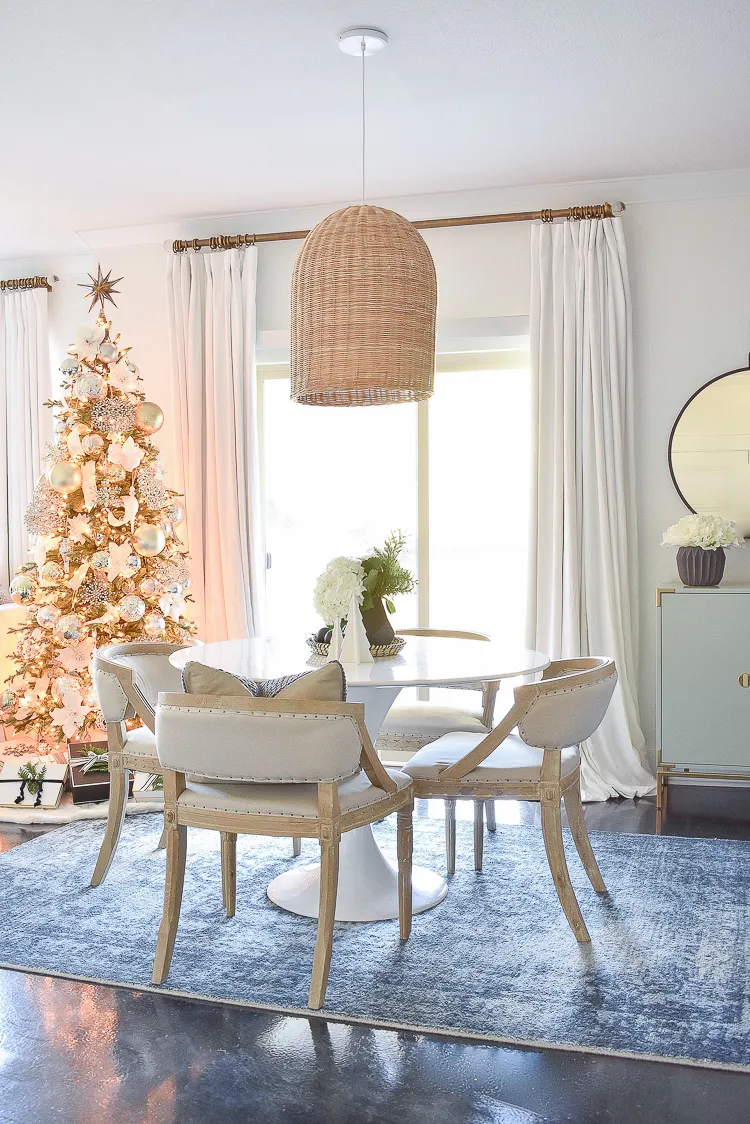
Palette math for a bright dining room: 55% white and light wood, 25% blue, 15% silver and gold, 5% green. The rug and the floor-length curtains carry the blue so the tree itself can stay ornament-light. Swap the patterned blue rug for a solid blue and the room gets calmer; swap it for jute and the tree suddenly has to do all the color work on its own. Anchor the palette on the floor and everything above it can be quiet.
20. Flocked Mini Trees on an Ornate Console Table
Dark floral wallpaper behind small white trees is a gorgeous contrast — and a dust trap. Flocked trees shed onto the paper, and textured wallpaper is not wipeable. If yours is peel-and-stick, know that stray frost will eventually find the seams. A console that’s too narrow is the other trap: two mini trees plus baskets need at least 14 inches of depth, or they’ll hang off the edge and beg to be knocked over every time someone walks past.
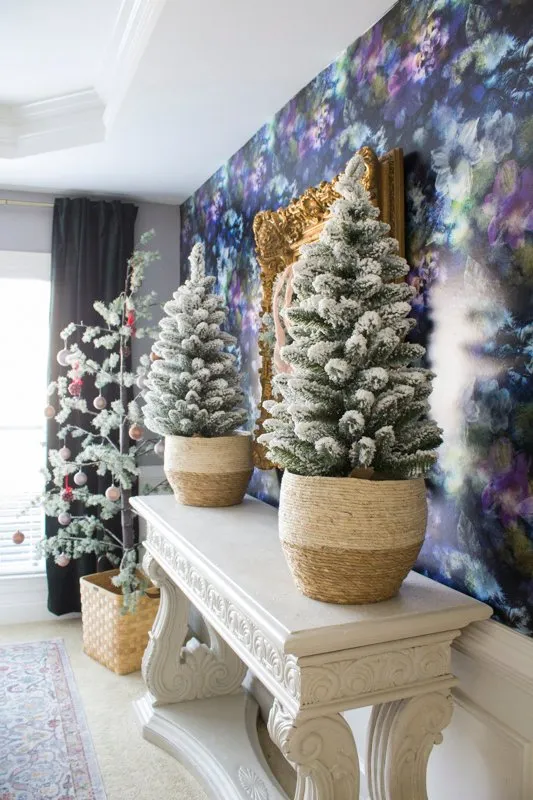
On a console, work in odd numbers and three heights. Anchor two flocked minis in 8- to 10-inch natural fiber baskets, then add one taller element behind them — the slender blush-ornamented tree does that job here. Keep the tallest piece at about two-thirds the height of the mirror above it, and leave at least 4 inches of gap between its top and the frame. Odd numbers look collected; even numbers look like a store display.
21. Mercury Glass Trees with Blue Ribbed Glassware
Mercury glass works because it’s slightly imperfect — the antiqued finish means a mixed group of shapes reads as a collection rather than a matched set. Add white ceramic with a scalloped texture and you get contrast between glossy and matte at the same value, so nothing shouts. The teal and dark blue ribbed glassware picks up the color without introducing anything new. It’s a study in one color family and several surfaces, which is why it never looks busy even when the table is full.
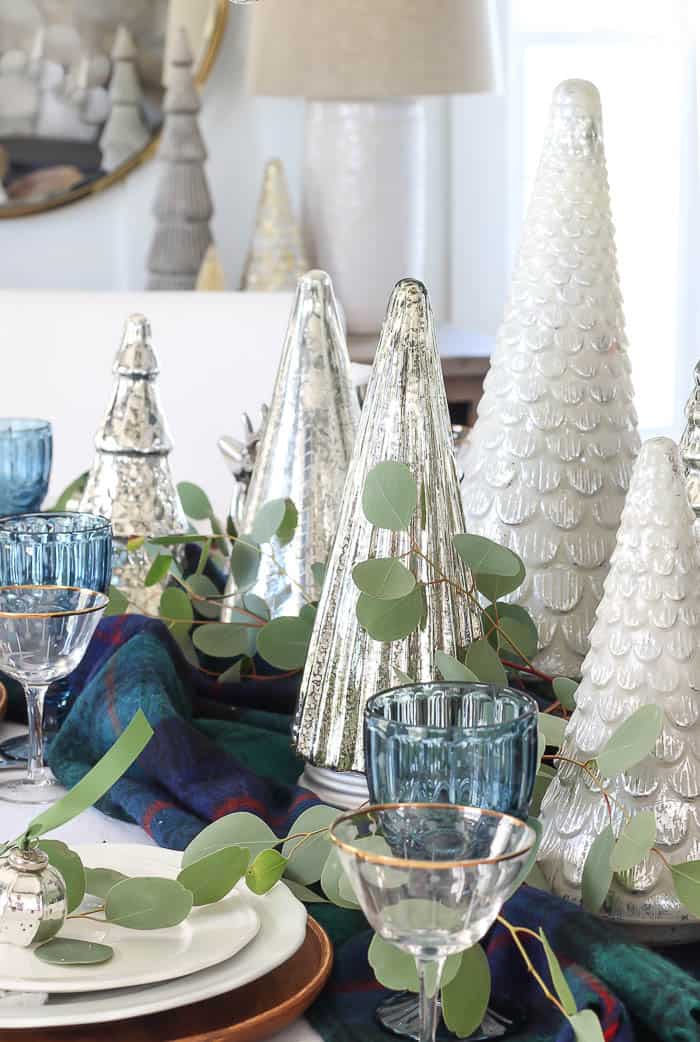
Mercury glass trees run $18–$45 apiece at Pottery Barn and similar, which adds up fast. Target’s Threshold line usually has ceramic and glass versions from $8–$20, and HomeGoods is reliably stocked from October. The real shortcut: thrift stores and estate sales for mercury glass candleholders that read the same way on a table. Blue ribbed glasses are $3–$6 each at discount stores, and a bunch of eucalyptus is about $5.
22. Gold Tinsel Tree with Blue and Green Baubles
Gold tinsel loaded with real blue and green ornaments is the anti-minimalist answer to the last few years of beige Christmas trees. Tinsel has been circling back since 2023, partly through vintage resale and partly because maximalist holiday decor photographs so well. This version is smarter than the 1970s original: matte and glossy ornaments are mixed deliberately, and the pale floral picks cut the shine. Expect tinsel to keep climbing through 2026 — just don’t do an all-tinsel tree unless you’re fully committed.
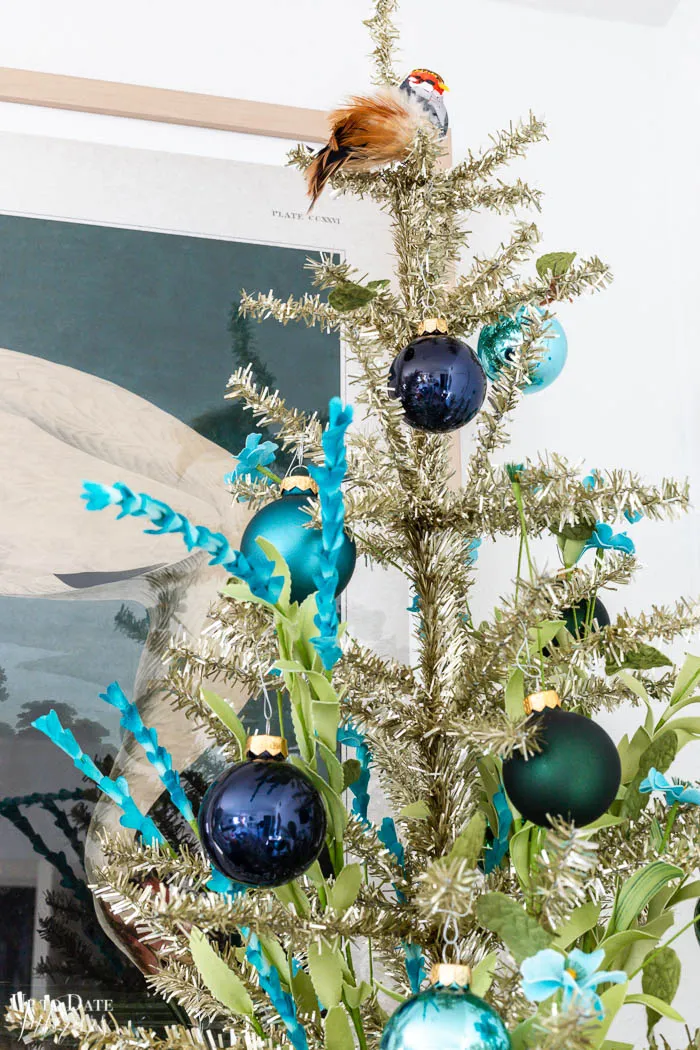
The feathered bird on top is the whole personality of this tree. It’s a strange choice on paper, and that’s exactly why it works. A star would push this into traditional territory; a bird keeps it in the eclectic, slightly vintage register the gold tinsel is already speaking. It also pulls your eye up through the teal and green picks on the way. Remove it and you have a fun tinsel tree. Keep it and you have a point of view.
23. Mirrored Tray, Blue Glass Tree, White Candles
Styling a mirrored tray so it looks like a shop display:
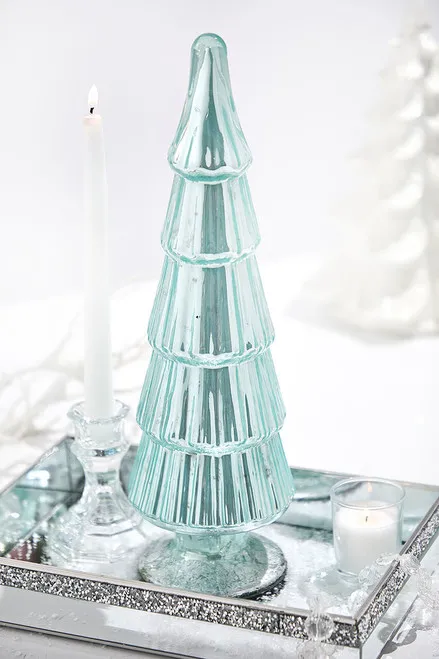
- Place the tallest object first — here the ribbed blue glass tree — slightly off-center.
- Set the tall candle on the opposite side to balance the visual weight.
- Tuck the votive in front and lower, so you get three distinct heights.
- Drape a bead string in a loose S across the front edge.
- Stop there. Mirrored trays punish clutter — three objects plus beads is the ceiling.
Fifteen minutes of work, and about $40–$90 if you’re buying all four pieces new.
The light blue ribbed glass tree is the piece people pay for — $25–$55 at HomeGoods or a boutique. Dollar Tree and Five Below carry small ribbed glass trees for about $5 in season, and the silhouette carries the look fine at a distance. Mirrored trays run $12–$30 at Target, or use a mirrored candle plate you already own. Candles are $2–$6 each, so the whole vignette can land under $30.
24. Silver Tinsel Branches Lit in Multi-Color
Multi-color lights on silver tinsel is a deliberate clash, and the math matters. Think 80% silver, then 20% split across the colored bulbs — green, blue, orange, pink. Any more color and the tinsel disappears entirely. Keep ornaments off, or use only clear glass at most. If you want this energy but softer, swap the multicolor strand for warm white and add a single strand of blue LED instead.
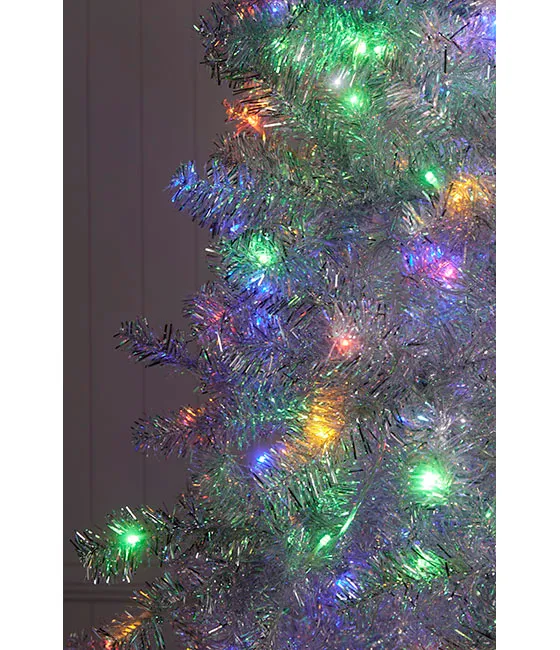
Multi-color LED strands have gotten much better, but cheap ones still cast a hard, clinical glow that can turn silver tinsel gray from across the room. Buy one brand for every strand on the tree — mixing manufacturers means mismatched hues and different blink speeds. Tinsel is also nearly impossible to clean, so plan on replacing it every three to five years, and keep it away from open flames and hot bulbs.
- Confirm every light strand matches in brand, hue, and speed
- Decide on ornaments or none — this look works better bare
- Check the nearest outlet; tinsel trees almost always need an extension cord
- Measure your corner, since silver tinsel can overwhelm a small space
- Set a replacement budget — tinsel has a shelf life of about four years
Your Bluest Christmas Yet Starts Right Here
Whether you go full frosted forest or just swap a handful of ornaments for something icy, blue and silver works because it stays calm enough to live with for all of December. Start with the palette, then let texture carry the rest — velvet, tinsel, mercury glass, whatever your home can actually handle. Pick two ideas from this list, not twelve, and you’ll finish before the eggnog runs out.
Pin your favorites now so you’re not scrolling in a cold parking lot on December 15. Happy decorating. ❄️