
Still scrolling through front door photos at 11 p.m. with seventeen tabs open and no decision made? Same here — which is why this list exists.
We spent serious time browsing Target, Walmart, and IKEA, plus a fair amount of late-night Marketplace hunting, to bring you only what is actually worth your attention this year. Prices run from about $8 for a spool of ribbon to $935 for a full metallic arch installation, and several of these looks come with a budget version compared side by side.
Inside you will find 25 curated ideas spanning rustic natural, traditional red-and-green, modern minimal, and opulent metallic — each one pulled from a real home or a real designer’s work. And stay until the end — we break down the most common mistakes that can ruin these looks.
In 2026 the shift is toward deeper, more saturated doors and looser, wilder greenery. Less matching, more layering.
📌 Save this to Pinterest for later — you’ll want to revisit these ideas.
1. Modern Garland That Skips the Tinsel Fuss
A modern garland earns its keep by doing less. No flocking, no bauble clusters, no cascade of ribbon — just an even, dense run of greens with a consistent shape from one end to the other. That restraint is what makes it read as architecture rather than decoration. The spacing stays steady, the thickness stays steady, and your eye glides along instead of stopping at every ornament. When everything else on the block is red bows and inflatable snowmen, a quiet, unbroken line is the most confident thing on the street.
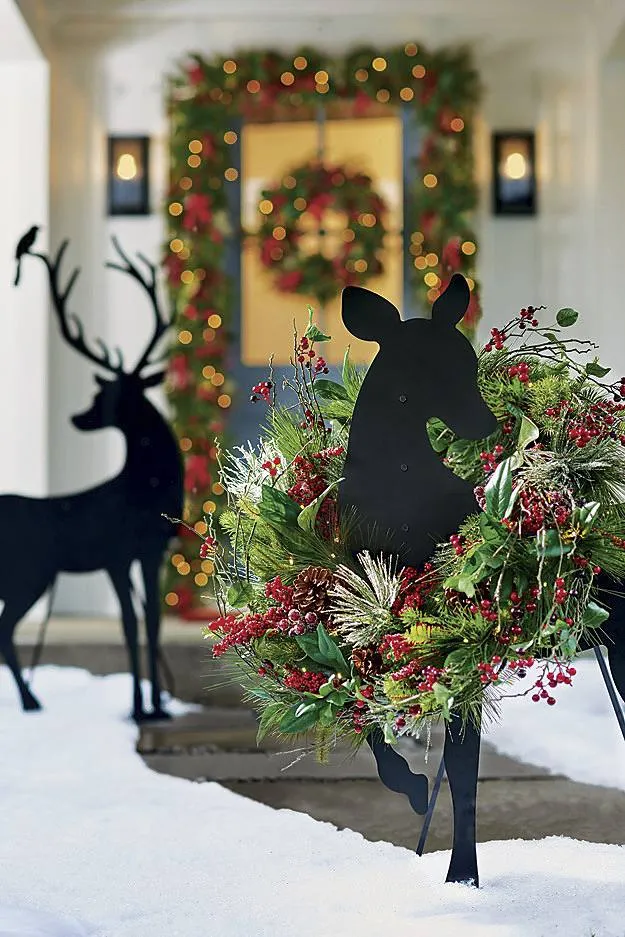
If you want garland that photographs as modern and not crafty, spec it by diameter, not length. Most boxed garlands run 8 to 10 inches and look skimpy over a standard 36-inch door. Go 12 to 14 inches, or twist two 10-inch strands together so the wire hides inside. Then secure it every 18 to 24 inches with clear zip ties rather than hooks — hooks let the greenery sag between anchors, which is the fastest way to make an expensive garland look tired by week two.
2. White French Doors, Wood Siding, and a Vintage Sled
The sled. Everything else here is symmetrical and tidy — two matching wreaths on the glass panes, a white-berry garland tracing the doorframe, a green topiary sitting in a gray wicker basket. The sled sits off to the left, angled, weathered, doing absolutely nothing useful. That is exactly why it works. It gives the composition a coming-in-from-the-snow quality, like the entry just arrived rather than got styled. Take it away and you have a very pretty catalog photo. Leave it in and you have a home.
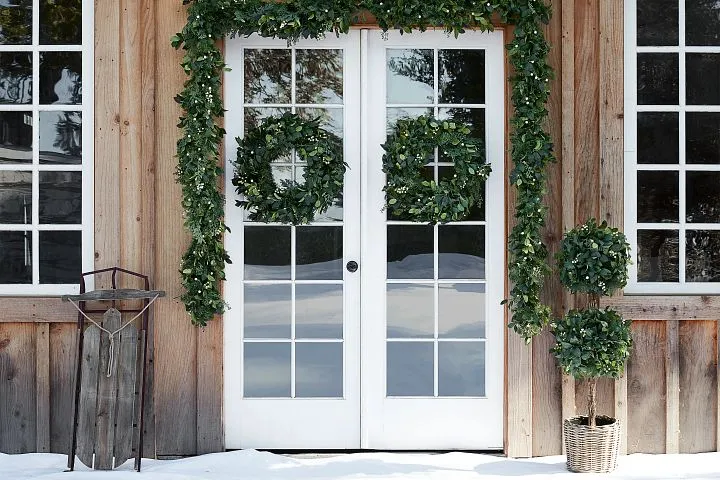
This layout wants a wide entry. You are looking at roughly 8 feet of facade minimum to fit the double doors, the garland swag above, and enough breathing room for the sled and topiary to sit without crowding the frame. An overhang of 9 feet or more keeps the greenery from fighting the roofline. On a narrower single-door entry, borrow the same idea at reduced scale — one wreath, one topiary, and skip the sled rather than shrinking all three. For a tighter version of this same white-and-green discipline, see Idea #11.
3. A Light Blue Door with Dried Orange Slices and Paper Trees
- Mixed evergreen and eucalyptus garland, 20 ft: $60-$140
- Dried orange slice accents: $12-$25
- Full mixed wreath: $45-$120
- Wicker gift basket and filler boxes: $35-$90
- Honeycomb paper trees, set of three: $15-$35
- Exterior touch-up paint: $0-$70
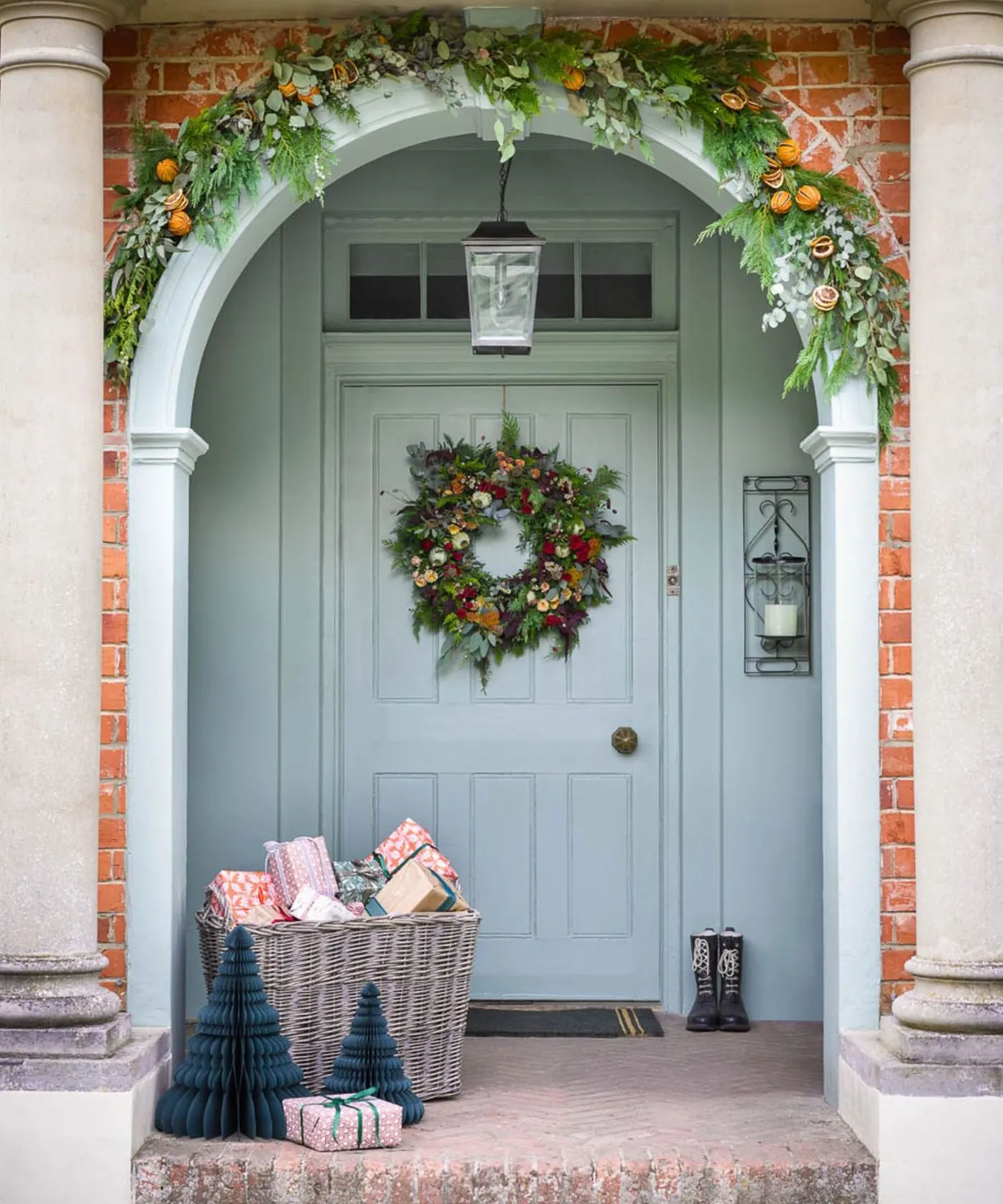
Total: $167-$480
Budget alternative: grab a $25 faux garland from IKEA, dry your own orange slices in a 200°F oven for about three hours, and use a woven market tote you already own in place of the wicker basket. That version lands around $70.
Dried orange slices are the most photogenic thing in this whole setup and also the most fragile. Indoors they hold up for years. On a covered porch they usually survive one season. Fully exposed to rain and freeze-thaw, they darken and curl by mid-December. If your door faces the weather, hang the citrus inside the arch where the overhang protects it and let the outer run stay plain greenery. One more thing: a light blue door shows every scuff and fingerprint, so keep a magic eraser and touch-up paint within reach all season.
4. An Arched Garland Loaded with Pinecones and Pomegranates
On an arched doorway, the garland’s visual weight has to increase as it rises. That means bigger material at the top of the arch — 7 to 9-inch pinecones, whole pomegranates, fat clusters of berries — tapering to slimmer greens as it drops down both sides. Load the bottom and leave the top thin, and the arch looks like it is melting. Start at the apex and work downward, and zip-tie a hidden wire armature to the doorframe first so the shape holds through wind and rain.
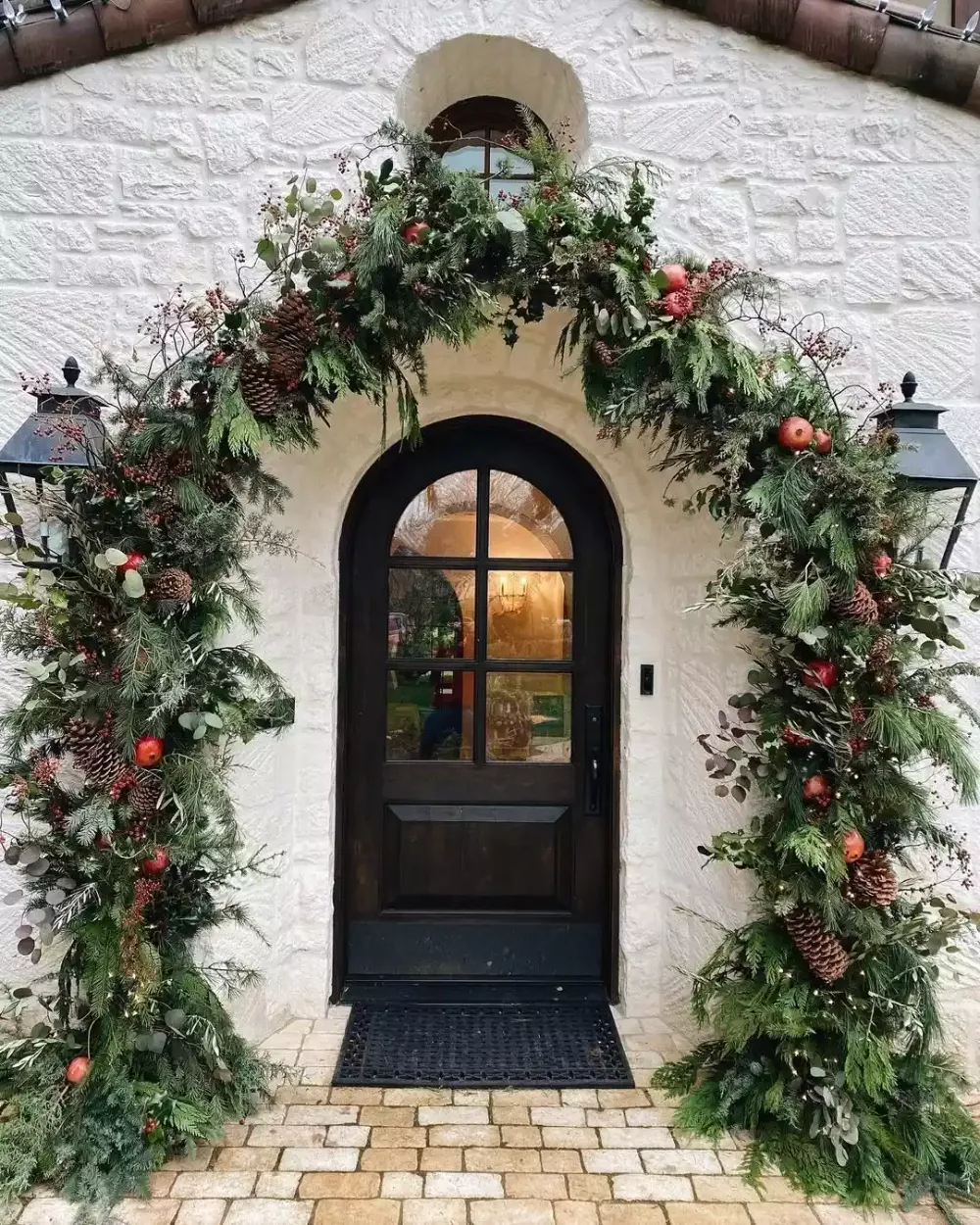
55% evergreen base + 30% natural accents (pinecones, berries, pomegranates) + 10% warm string light + 5% black metal.
The greens carry the mass. The naturals do the talking. The string lights are almost invisible in daylight and completely change the entry after 4:30 p.m. That last 5% is the black lantern sconces — they are not decoration, they are punctuation, and they anchor the white stucco so the garland does not float. Swap pomegranates for magnolia pods and the formula still holds. Drop the lights and the whole thing goes flat by dinner. Compare with Idea #13 for the same arch logic pushed toward metallics.
5. Urn Planters and Garland on a Dark Paneled Door
Three things are doing the heavy lifting here. First, repetition — the wreath, the garland, and both urn arrangements use the same greens, the same red berries, the same pinecones. Nothing new gets introduced anywhere, which is why it reads as one composition instead of four separate purchases. Second, symmetry, which suits a centered dark door with no porch furniture to work around. Third, vertical scale: the tall ornate urns pull the eye up from the welcome mat to the wreath, so the entry feels taller than it actually is.
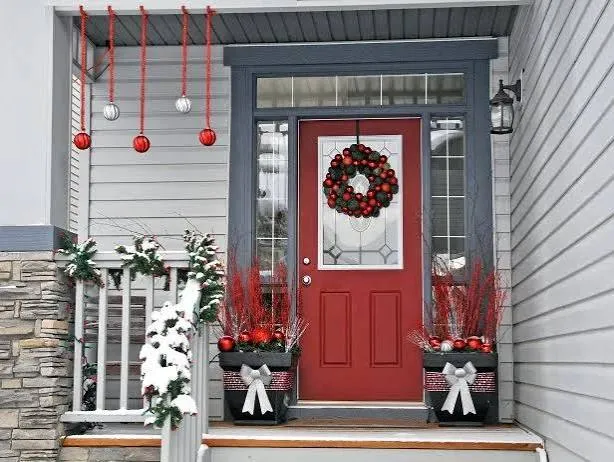
- Measure your door frame width — a garland needs about 12 inches of overhang on each side to look intentional
- Confirm your planters are at least 20 inches tall and frost-proof; thin resin urns crack in a hard freeze
- Check that an outdoor outlet sits within 6 feet before you plan lights in the urns
- See where your porch light throws — a wreath hung straight under a harsh downlight reads as a shadow
- Decide who is watering. Live evergreens in urns need a drink every 3 to 4 days or they drop needles by New Year’s
6. A Eucalyptus Wreath, Striped Ribbon, and Three Rustic Bells
The striped ribbon. A mixed evergreen and eucalyptus wreath is lovely but common, and three distressed metal bells on jute twine are charming but small. The wide black-and-cream stripe is what makes the whole thing land. It is the only graphic element on an otherwise organic, muted green door, and it gives your eye a strong vertical to follow from the gold hardware up to the bells. Take the ribbon away and you have a nice natural wreath. Keep it and you have a styled moment that reads as intentional from the sidewalk.
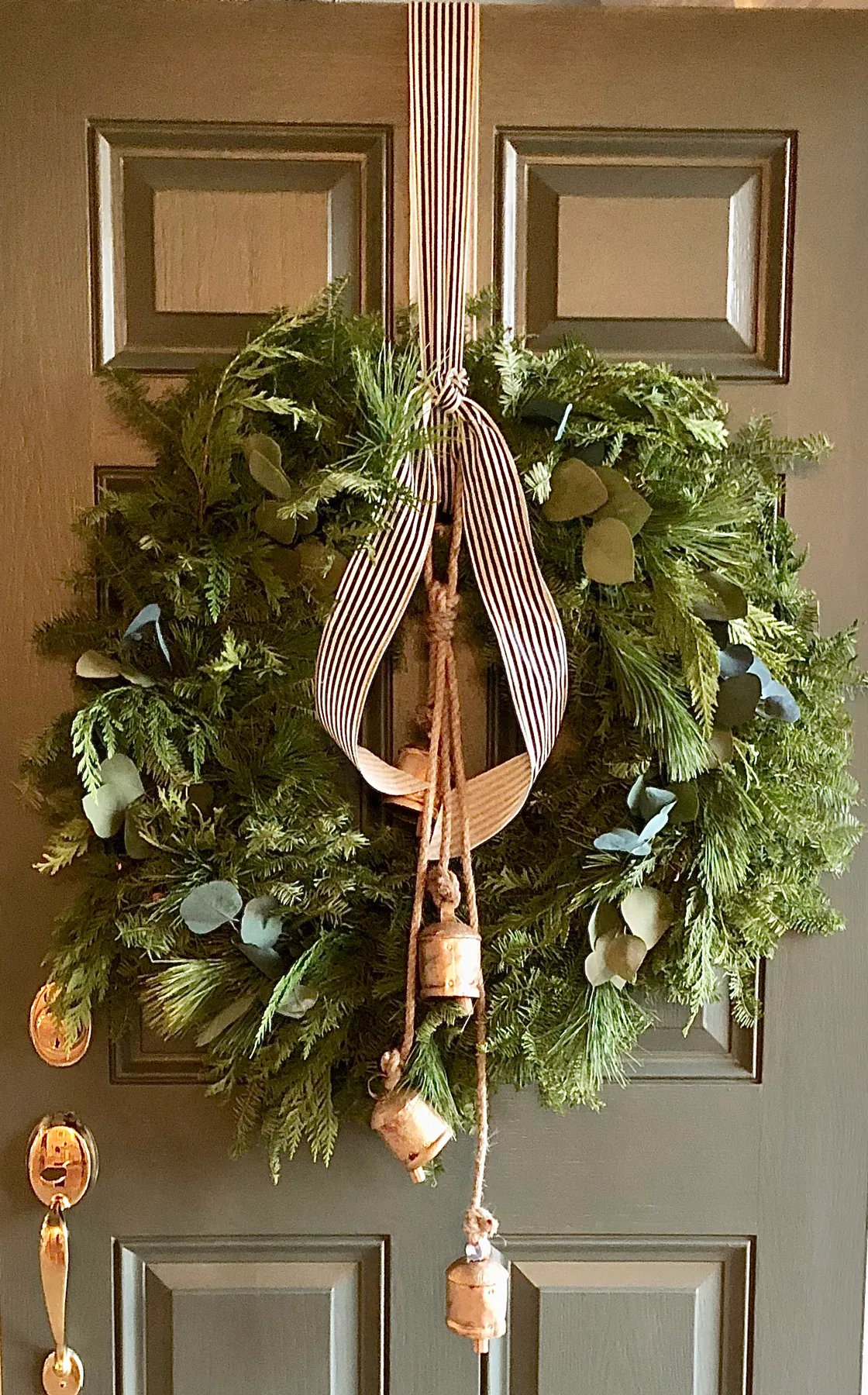
- Loop the ribbon over the top of the door, close the door on it, and trim to length — about 8 inches of tail above the wreath.
- Tie the bow first, loose and slightly asymmetrical, then fluff the loops with your fingers.
- Thread jute through the bells and knot behind the bow so they hang at three slightly different heights. Even spacing looks manufactured.
- Hook the wreath to the ribbon tail, not the door, so the weight does not pull the bow flat.
Time: 20 minutes. Materials: about $12 for ribbon and twine.
7. Poinsettias, Snow-Dusted Pine, and a Merry Christmas Bow
- Poinsettia wreath, 28-30 in: $70-$180
- Snow-dusted garland, two 9 ft runs: $60-$150
- Ornament set in red, white, and gold: $25-$60
- Striped Merry Christmas bow: $18-$40
- Small Santa figures, set of three: $20-$55
- Snowflake window decals: $8-$18
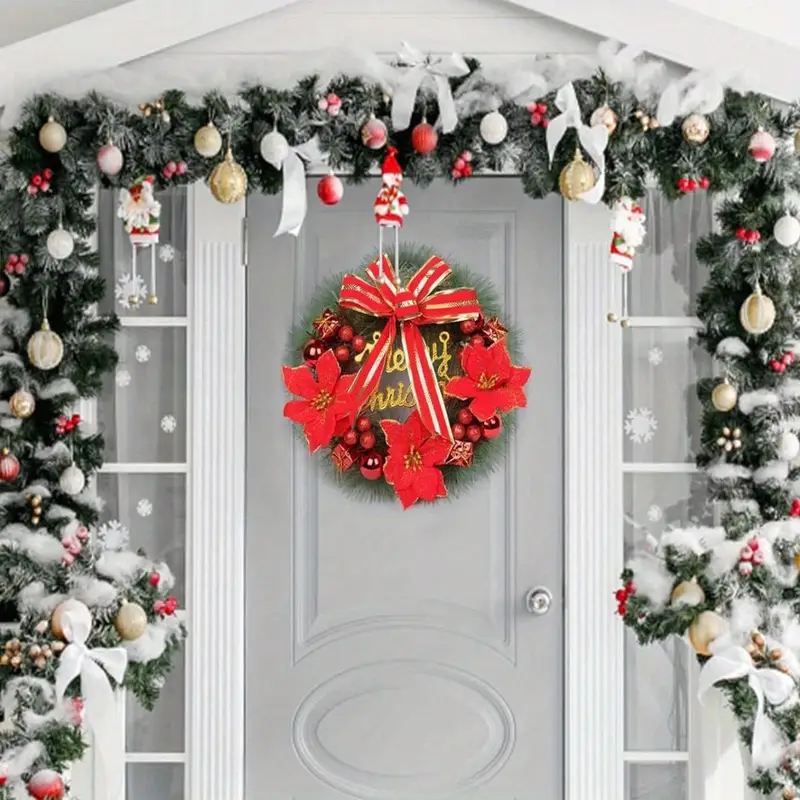
Total: $201-$503
Budget alternative: build the ornament cluster from a $10 dollar-store mixed tub, paint plain pinecones with white-tipped craft paint, and skip the decals entirely — the garland does the work. That gets you to roughly $120.
Snow-dusted garland almost always sheds. Before you hang it, take it outside and shake it hard over a tarp, then hit it with a light coat of matte clear spray to lock the flocking down. On the door itself, keep the wreath’s inner edge at least 12 inches above the handle — anything lower gets knocked sideways every time someone carries in groceries. And put your heaviest ornaments at the bottom of the garland, not the top. Weight pulls downward, and gravity will space them for you.
8. Muted Pink Ribbon and Antique Bells on Beige Double Doors
- 70% deep evergreen
- 20% muted pink ribbon
- 10% antique brass and black
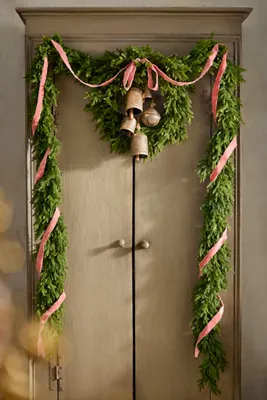
The garland frames the beige doors in a clean rectangle, and that green rectangle is doing more work than it looks like — it is the neutral anchor the whole entry hangs on. The pink is the surprise: textured, dusty, not candy-colored, taking up exactly the remaining accent share. The antique bells, the black rod they hang from, and the round knobs cover the last slice. If pink is not you, this formula swaps cleanly to sage and burgundy, or evergreen and warm cream. Keep the proportions and you keep the calm.
The muted pink is not neutral, and it will either sing or fight your door’s undertone — beige doors come in warm, cool, and greige versions. Buy the ribbon first and hold it against the door in daylight before committing to the whole scheme. Also worth knowing: ribbon woven through garland loses its crispness after a season of sun and rain. Store it rolled around a cardboard tube rather than folded, or you will be ironing textured fabric next November.
9. A Shiplap Entry Corner with a Leaning Mirror and Lit Garland
This corner works because it layers at three heights instead of spreading across one plane. The garland and warm string lights run high along the shiplap, the gray grid mirror fills the middle and bounces that glow back into the room, and the light wood bench, knit pillows, and woven baskets hold the bottom. Nothing is centered and everything overlaps slightly. Nothing here matches, and that is exactly why it works. The mirror alone makes a small corner read twice as bright for the price of one lamp.
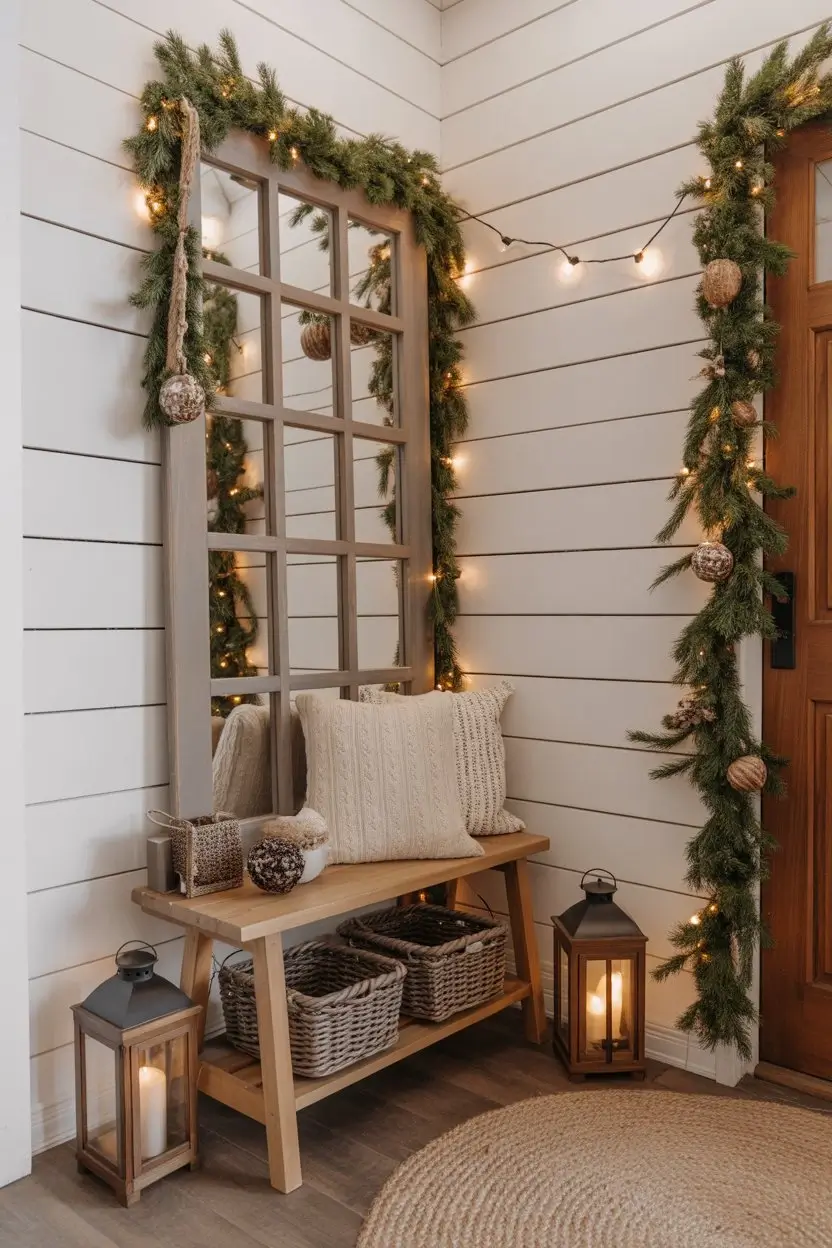
Entryway-as-a-room has been building for years and it has fully arrived. As open floor plans became standard, the entry stopped being a hallway and started being the one place you can layer texture without committing to a whole-room scheme. Search interest in small-entry styling spikes every November and does not drop until February. And this look has staying power because it is built from things you would want in January anyway — a bench, a mirror, a jute rug, storage. Only the garland is seasonal. Compare with Idea #20 if your entry is closer to a closet than a corner.
10. A Pink Poinsettia Wreath with Firewood and a Wooden Sled
Pink poinsettias are usually a florist item, but the vibe is very replicable. Start with a plain grapevine or evergreen base from Walmart for around $15, then add three to five pink poinsettia stems from a craft store at $4 to $7 each. A roll of shimmering pink ribbon runs about $8, and a mixed bag of baubles is $10. That is a $60 wreath instead of a $200 one, and it is bigger. Around it, Facebook Marketplace is full of wooden sleds under $30 in November, and thrift stores almost always have a wicker basket for firewood at $5.
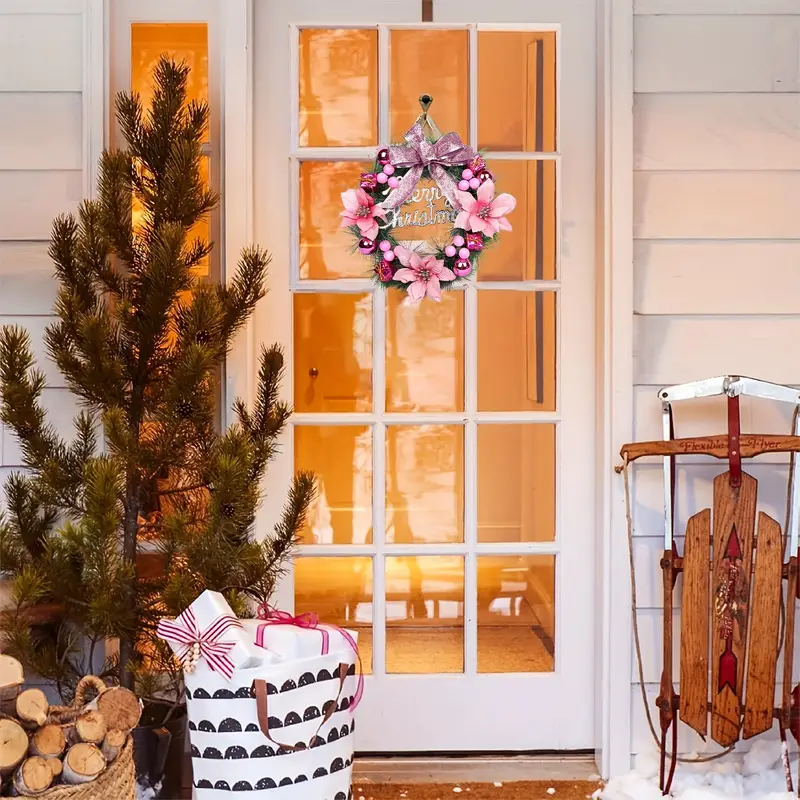
Pink on a white door needs a warm undertone or it turns saccharine. Look for dusty rose, blush, or antique pink — anything with a hint of gray or brown in it — and pair it with plenty of green so the pink reads as an accent rather than a theme. One more thing: if your door has glass panes, hang the wreath so it covers a mullion instead of a full pane. A wreath floating in the middle of clear glass looks unmoored; a wreath overlapping a frame line looks placed.
11. A Natural Evergreen Wreath on Black with Brass Hardware
The brass doorknob. It is about four square inches of metal, and it is the difference between a traditional front door and a traditional front door that was thought about. Against the black panel and white trim, warm brass gives the eye one small bright pause — and it picks up the same warmth as the berry clusters and the pinecone tips without matching them exactly. Swap it for brushed nickel and the whole entry goes cool and a little generic, no matter how good the wreath hanging above it happens to be.
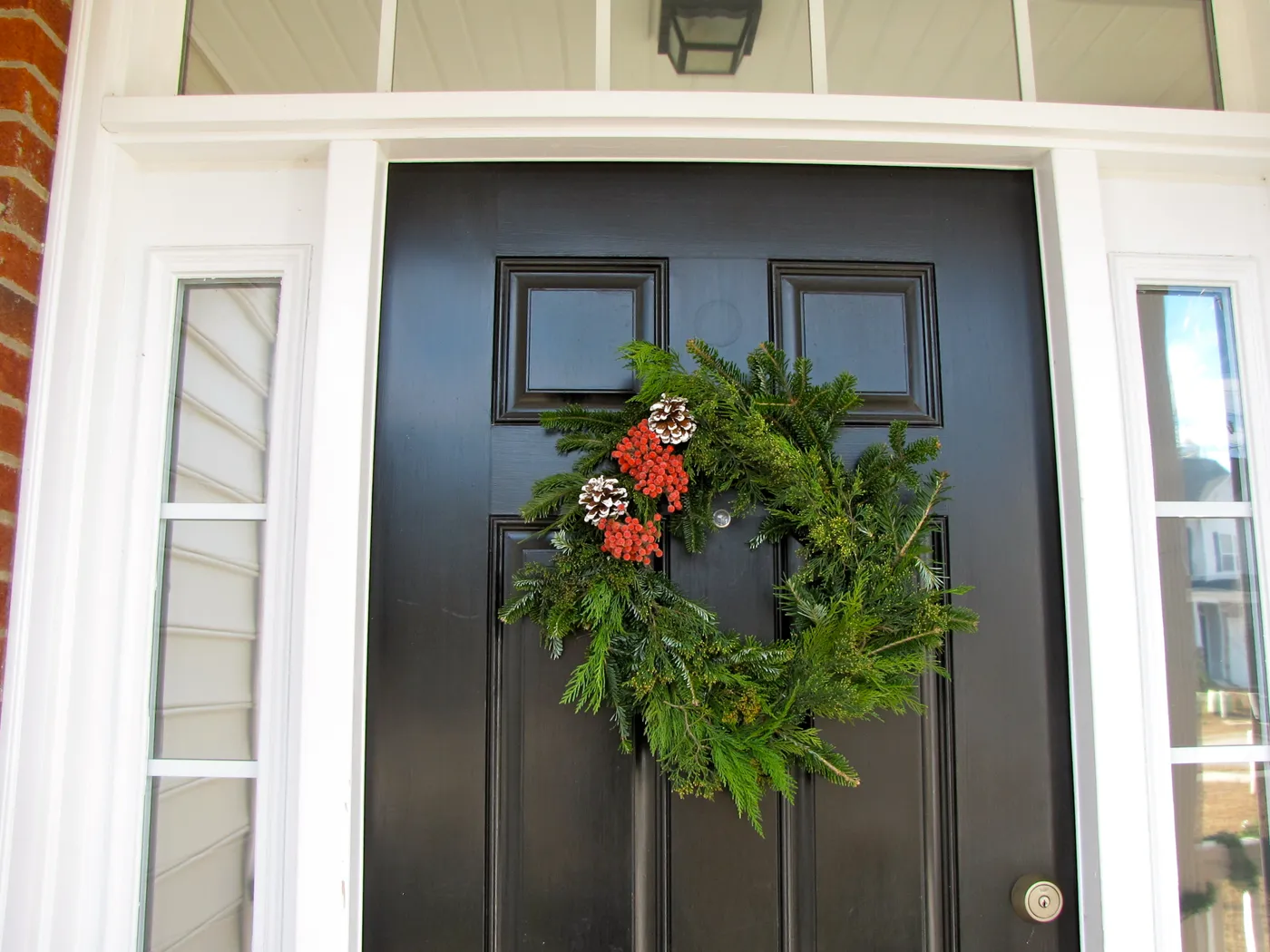
This is the single-door workhorse. It fits a standard 36-inch door with white sidelights and a transom, which means roughly 60 to 72 inches of total entry width and a porch depth of at least 4 feet so the wreath is not crowded by a screen door. If your entry is under 5 feet wide, skip the garland and let the wreath carry it alone — half-decorated beats crammed. For a wider double-door entry that can handle more greenery, see Idea #2.
12. Magnolia Garland Draped Over a White Brick Arch
Magnolia is the rare greenery that actually improves after it dries. Fresh-cut it is glossy green; within a week it fades to a warm reddish-brown with a green underside, which is exactly the two-tone you want against white brick. That color shift is why a magnolia garland looks expensive — it is not a uniform green tube, it is a gradient. The other move is proportion. This one runs thick, roughly 10 to 12 inches, and it hangs high and wide so it frames the arched transom instead of covering it.
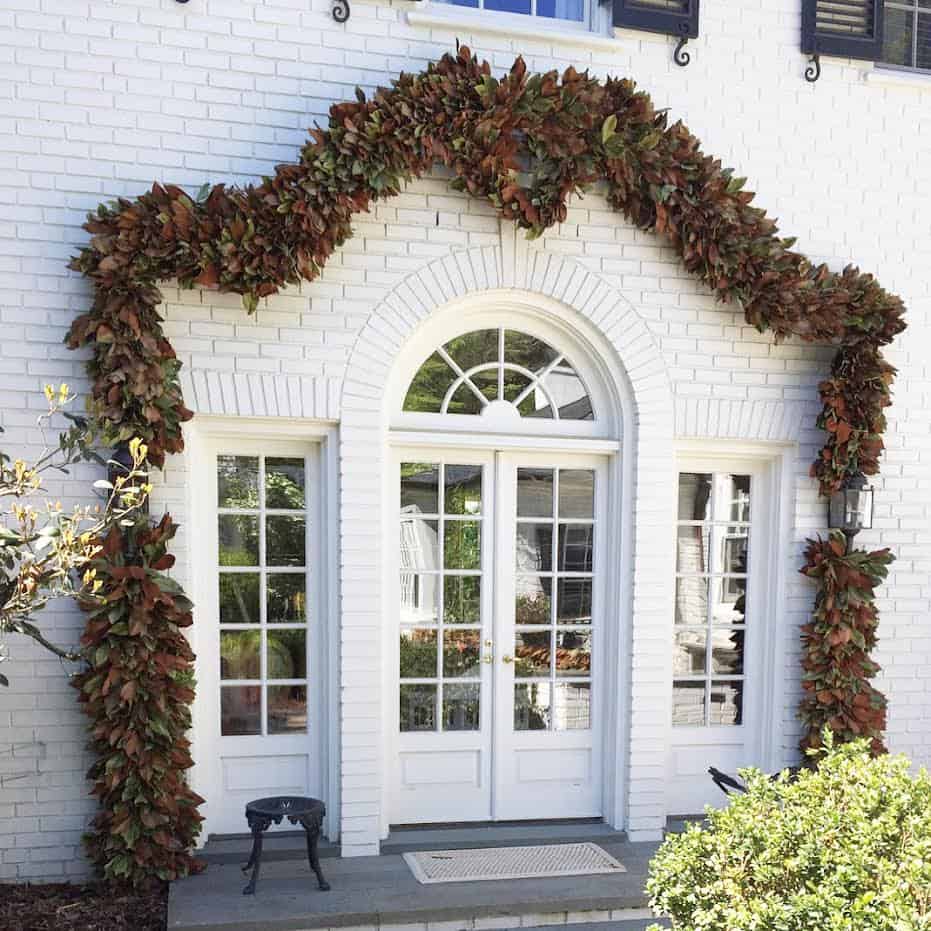
- Buy or cut magnolia three to five days before you need it; fresh branches are stiff and easier to wire.
- Soak the stems overnight, then let them dry completely before hanging — wet leaves stain brick.
- Mount a slim tension rod or floral wire above the arch first, and zip-tie the garland to that rather than the doorframe.
- Add the vertical drops last, working downward, and tuck the ends behind the sconce so they look wrapped.
Time: about an hour for a single arch. Materials: $40 to $80 for greenery and wire.
13. Gold and Copper Baubles on an Evergreen Arch
- Commercial-grade garland, 25-30 ft: $120-$300
- Oversized metallic baubles, 20-30 count: $60-$180
- White faux flowers, 3-4 stems: $24-$60
- Gnarled branch or driftwood accent: $0-$45, often free
- Black rectangular planters with topiaries: $120-$350
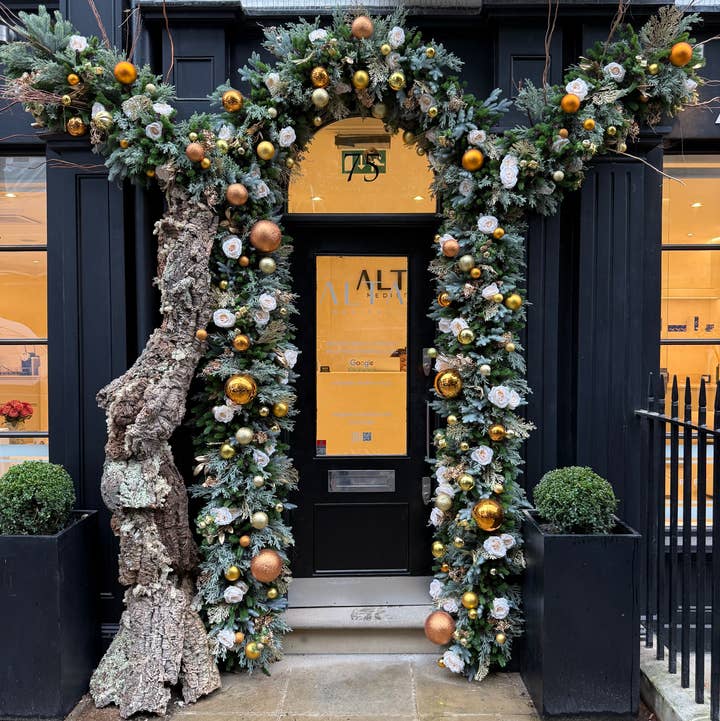
Total: $324-$935
Budget alternative: buy shatterproof ornaments in bulk bags from Target or Walmart at roughly 50 cents each, spray-paint dollar-store baubles in copper, and use a fallen branch from your own yard. That version lands near $180 and photographs almost the same.
Metallic garlands need size variation or they look like a bead necklace. Use three sizes — roughly 6-inch, 4-inch, and 2-inch — in a repeating but not strict pattern, and cluster the largest ones wherever the garland turns a corner or ends. That is where the eye rests. Resist the urge to go all gold, too. Mixing gold and copper keeps the arrangement from flattening under warm porch light, because the two metals catch light at different temperatures and read as depth rather than shine.
14. A Blue Door, a Red-Ribbon Wreath, and a Lit Topiary
This is a narrow-steps entry, and it works because it uses only two vertical elements: the wreath and the topiary. That is about the ceiling for a stoop under 4 feet wide. If your steps run wider than 5 feet, add a matching topiary on the left and the composition still holds; any narrower than that and two topiaries fight the black stair railing. Weathered stone steps with a bit of rise are ideal — a lit topiary on a flat landing just looks like a plant. Ceiling height does not matter here, because nothing hangs.
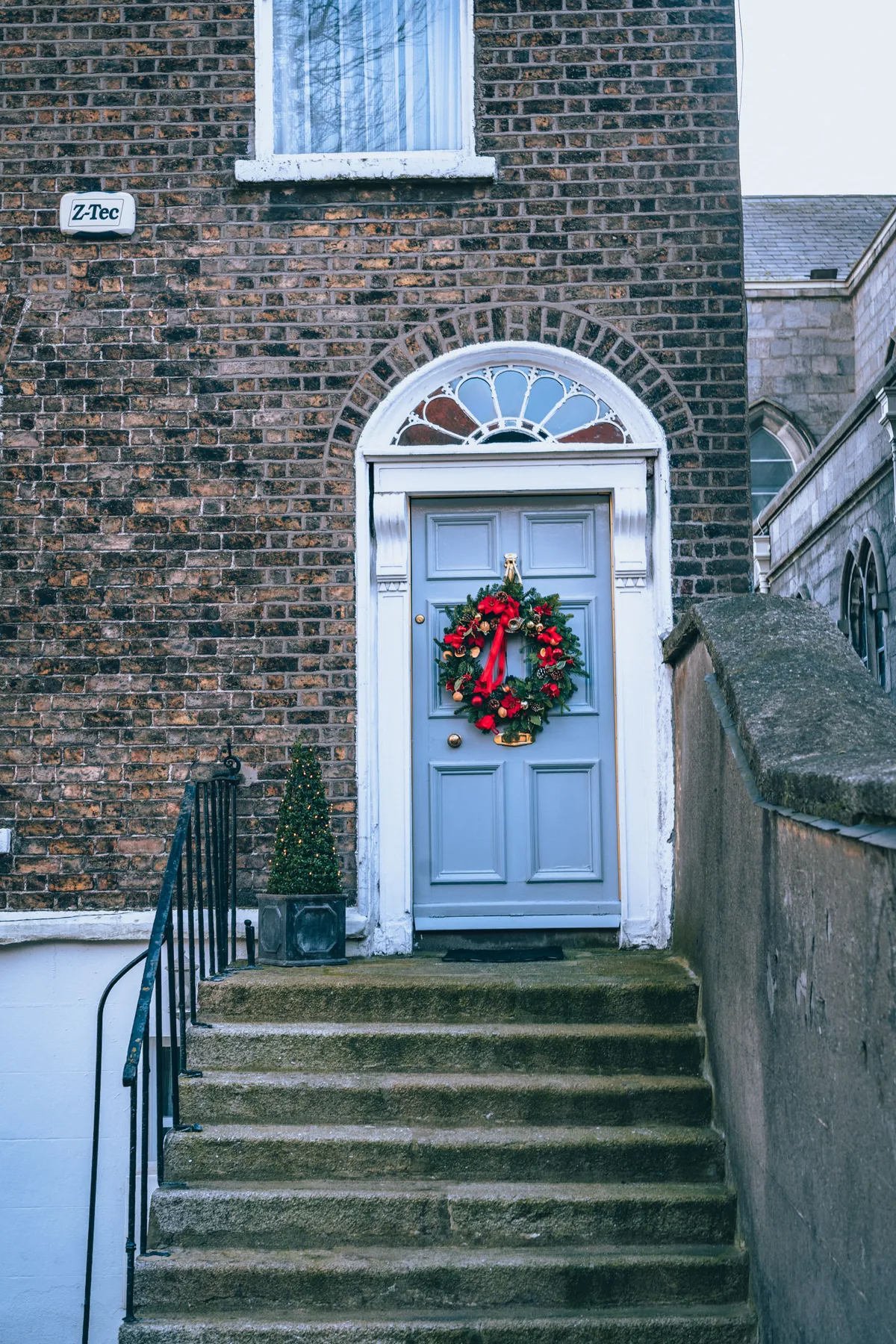
The expensive part of this look is the multi-toned dark brick, and you already have whatever facade you have. What you can replicate cheaply: a $20 potted evergreen from a big-box garden center, a $12 string of battery fairy lights, and a wreath built on a $15 base with dollar-store ribbon. The light blue door itself is the real investment — a gallon of quality exterior paint runs $45 to $70 and will outlast every wreath you ever buy. Same blue as Idea #3, completely different energy.
15. A Berry Wreath That Bridges Autumn and Winter
A berry wreath earns its keep by being the one piece of door decor you can hang in October and leave up through January. To make that work, keep the palette amber, russet, and cream rather than candy red — then swap the ribbon for something darker when December arrives and it reads as Christmas without changing anything else. Add a clip-on ornament or a sprig of fir after Thanksgiving and pull it off in January. One wreath, three months, zero extra storage bins in the garage.
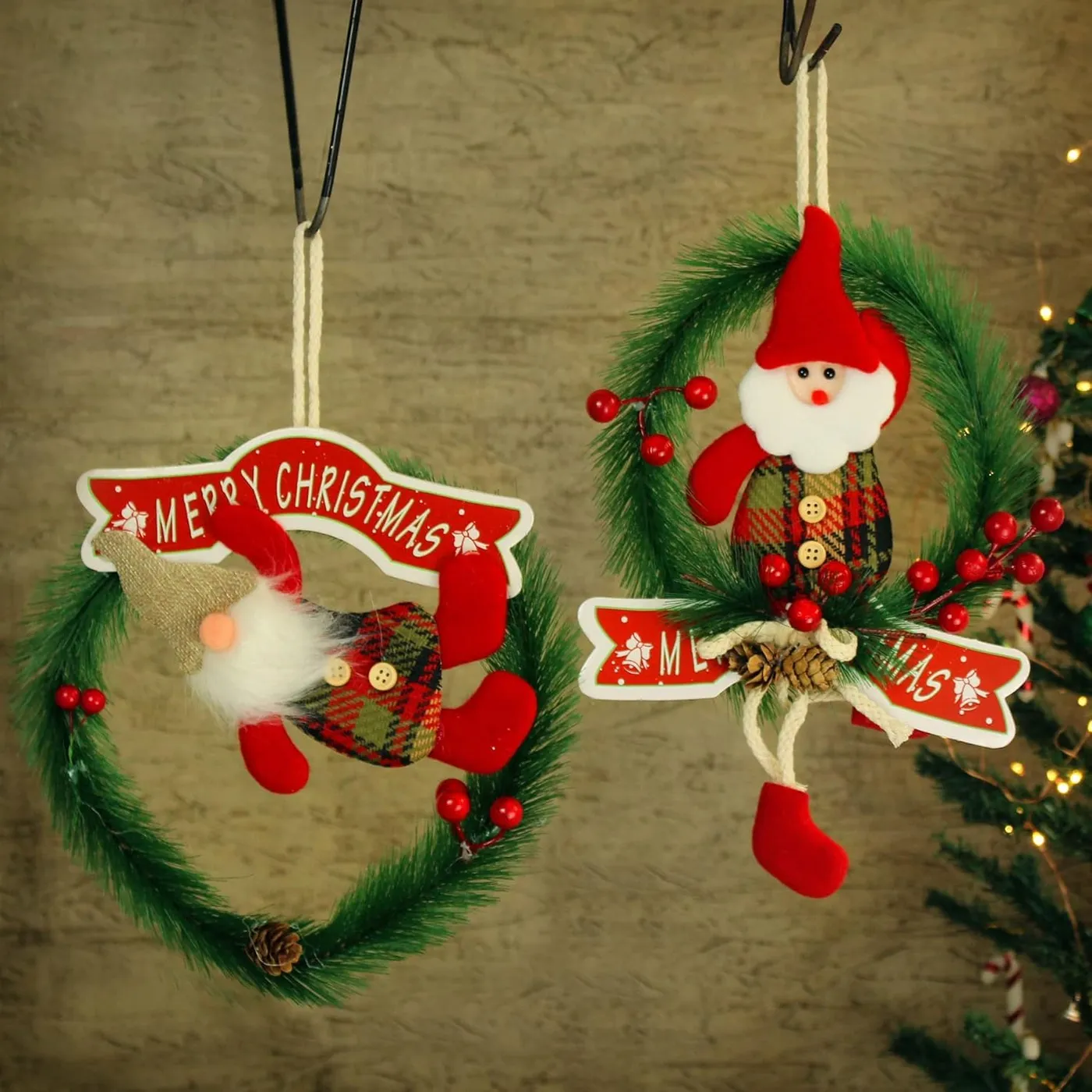
Faux berries fade in direct sun faster than leaves do — expect noticeable dulling after two full-sun seasons, and rotate the wreath a quarter turn every few weeks so one side does not bleach. Real berry stems like hypericum and cotoneaster drop fruit onto your threshold within about 10 days and stain light stone, so keep those on a covered porch. Wipe the wreath down with a dry microfiber once a month. Dust settles into the crevices and makes even a brand-new wreath look tired by mid-December.
16. Red Ornaments and Pinecones on a Slatted Red Door
The horizontal slats. On a flat-paneled door, a garland strung with red ornaments is just Christmas decoration. Against those deep red horizontal lines, dark pine greenery becomes a textural counterpoint — organic curves over hard geometry, green over red. It is the same reason a striped shirt looks good under a textured jacket. The garland alone, without that slatted door behind it, would be pleasant and instantly forgettable. The door is doing the design work here, not the decorations.
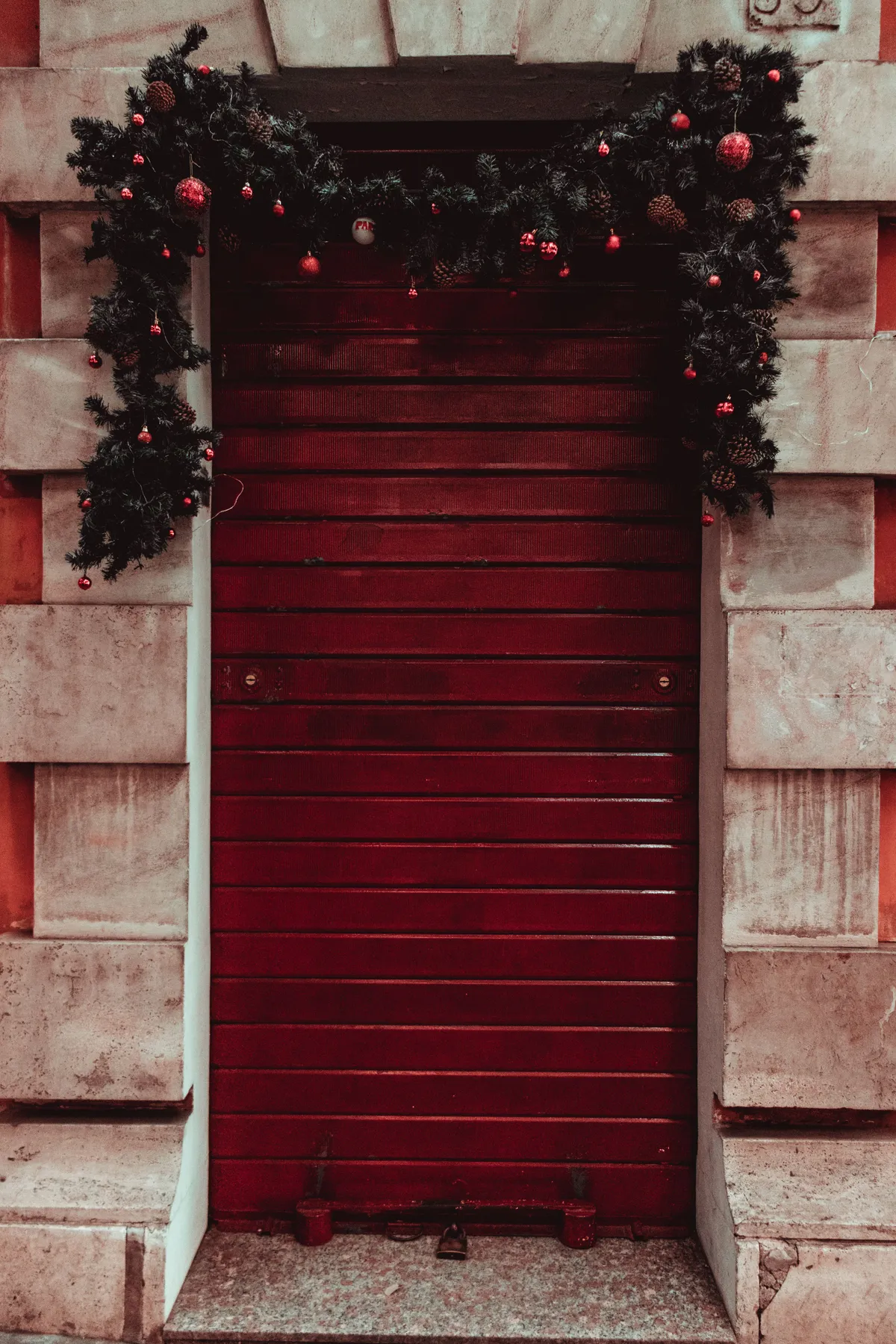
A deep red door plus deep green garland is a lot of saturation at close range, and at dusk it can collapse into one dark mass. If your porch light is cool white, that gets worse — swap the bulb to 2700K warm white and the red will glow instead of muddle. Also glance at whether your red door leans orange or blue before you buy ornaments. Shiny true-red baubles clash against an orange-red door, and a matte finish usually bridges that gap better than gloss ever will.
17. A Red Double Door with Twin Planter Trees
- Evergreen wreath with berries, 30 in: $60-$160
- Matching doorway garland, two 9 ft runs: $80-$200
- Two dark rectangular planters: $90-$300
- Two slim evergreen trees: $60-$180
- Red ribbon accents: $10-$25
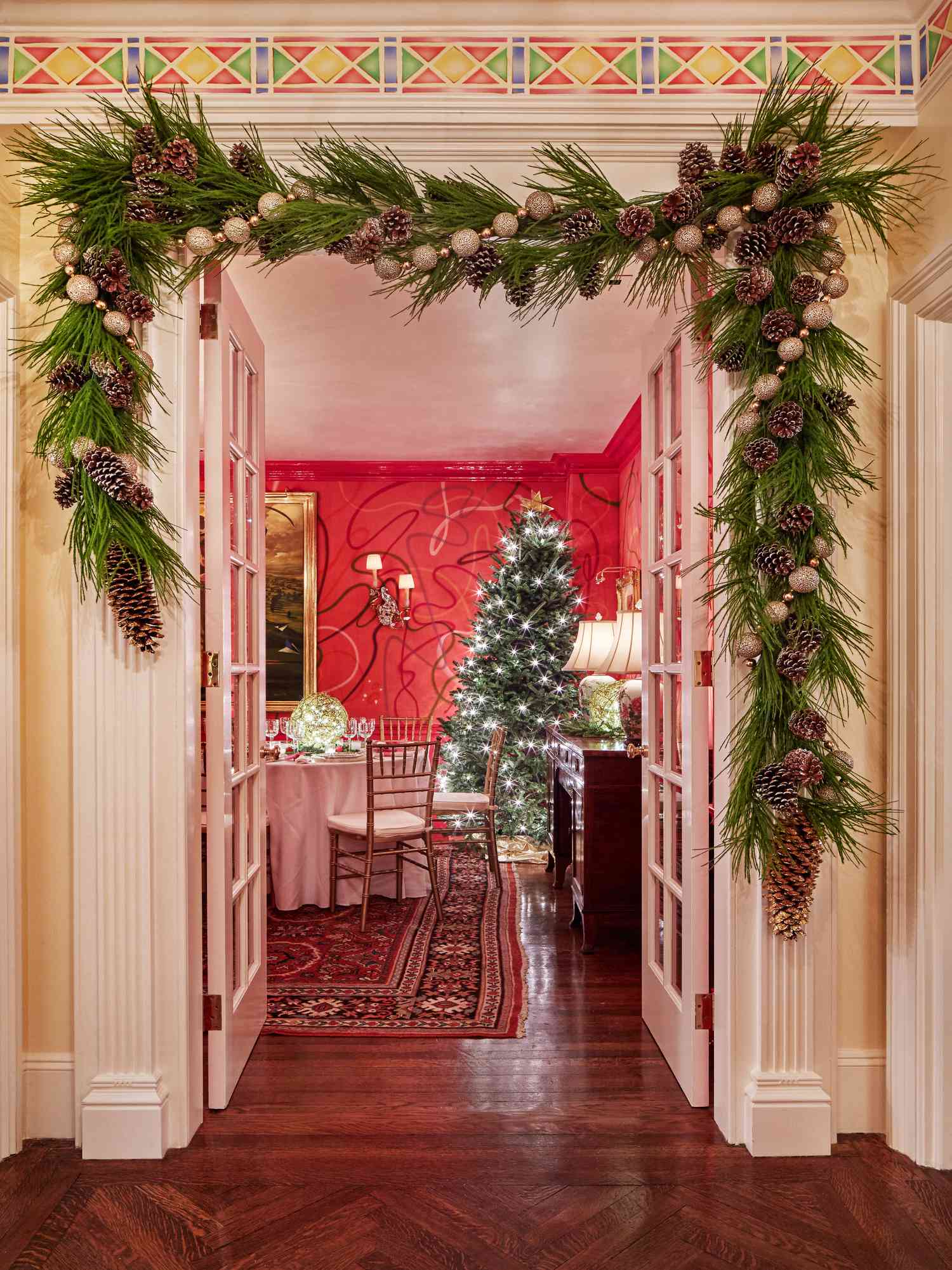
Total: $300-$865
Budget alternative: split one long garland and reshape it across both sides of the doorway, plant two $25 nursery cypresses in plain black bins hidden under burlap, and tie bows from a $6 spool of satin ribbon. That version comes in around $150.
50% red + 35% dark green + 10% charcoal planters + 5% pale gray stone.
The red and green are nearly even here, which is unusual — most holiday entries run 70/30 in one direction or the other. What keeps it from shouting is value: the red is deep, the green is deep, and both sit against pale gray. Trade the dark planters for terracotta and it warms up considerably. Trade the red door for black and the same formula turns moody and modern. Keep the 50/35 split and it holds either way.
18. A Lit Pine Wreath with Merry Christmas Ribbon
Warm white lights on a wreath should be the small-bulb, tightly spaced kind — 50 to 100 lights on a 24-inch wreath, wrapped around the back side of the greenery rather than the front. Wound across the front, you see plastic. Run behind, and you only see glow. Battery packs fit neatly behind the wreath at the top and will last most of the season if you buy the kind with a built-in timer. Set it to come on at 4:30 p.m. and you will never think about it again.
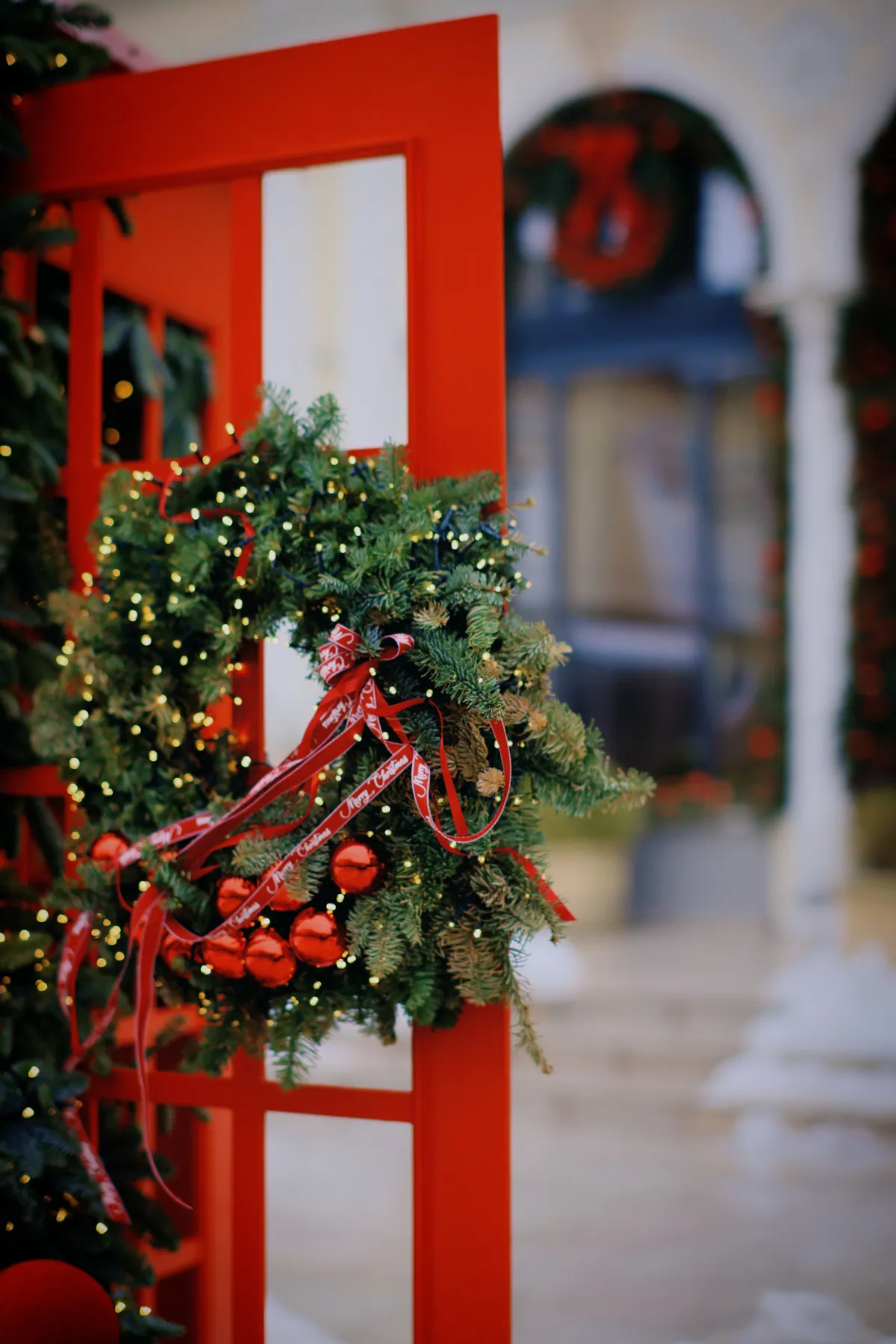
- Cut two equal lengths about 3 feet long, one for each side of the wreath.
- Fold each into a loose loop with a 10-inch tail and pinch the center — do not tie yet.
- Wire the pinched center to the wreath frame behind a branch so the wire disappears.
- Fan the tails outward so they cross below the wreath, then trim each at a slight angle.
- Mist both tails with a light spray of starch so the Merry Christmas print stays facing forward.
Time: 15 minutes. Cost: $8 to $20 for printed ribbon.
19. Installed Garland Lighting with Clean, Hidden Lines
The reason professional installations look different from DIY is almost never the product — it is the wire management. Every connection is tucked behind greenery, the runs stay straight, the spacing between bulbs is uniform, and nothing droops. That is really the whole secret. A $200 garland installed with hidden connections outperforms a $600 garland zip-tied in three places. If you are doing it yourself, the one upgrade worth making is buying a strand long enough to run the entire span in one piece, so there are no mid-run connections to hide.
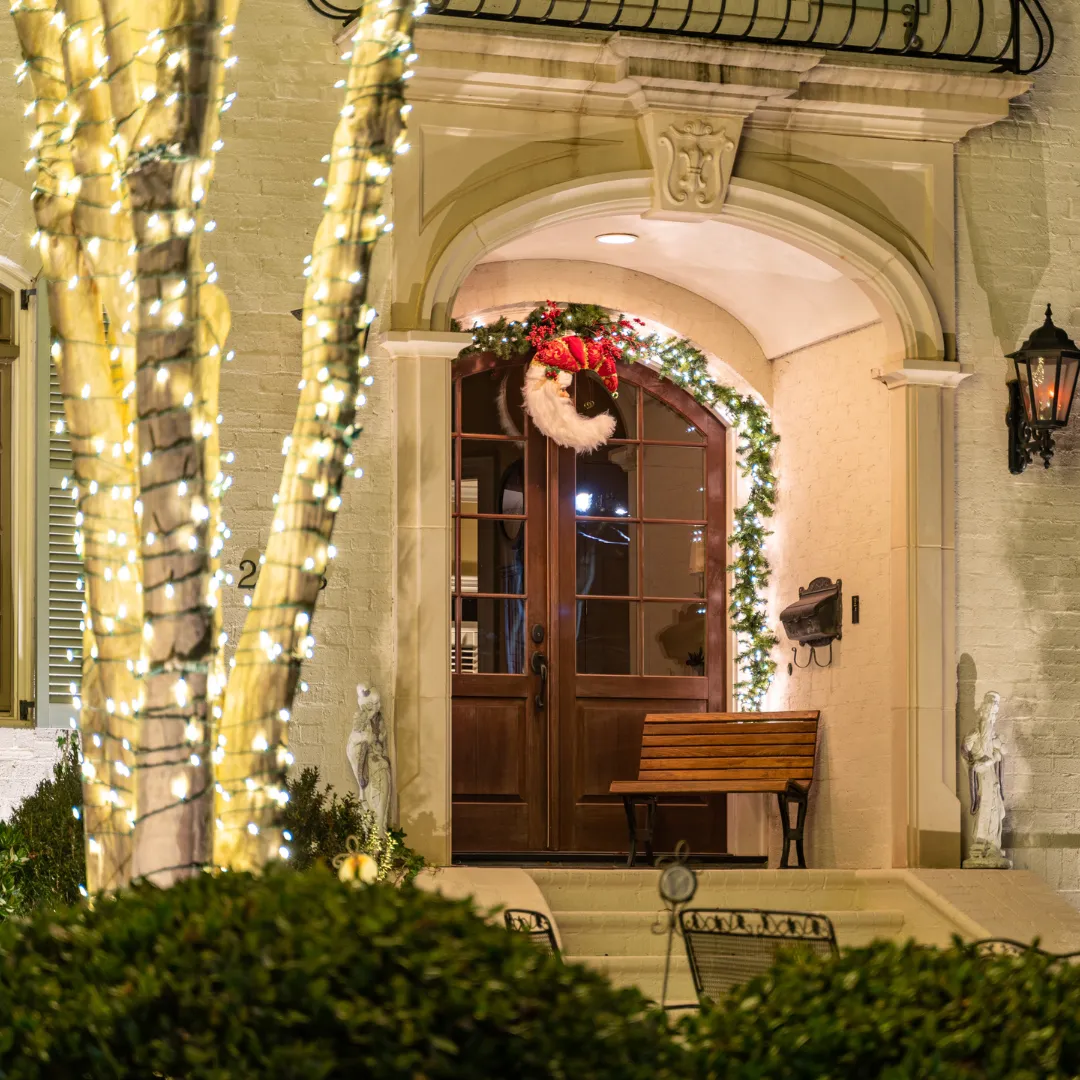
Long runs need more light than you think: plan on roughly one strand of 100 mini lights per 8 to 10 feet, and double that if the garland is 12 inches thick or more. For a single-car garage front, 40 to 50 feet of garland and 400 to 500 lights is typical. Past about 60 feet, split the run into two circuits — chaining more than three light strands on a single plug is the most common cause of a mid-December blackout. For a door-only version of this look, see Idea #25.
20. Small Entry, Big Holiday Energy
Small entries respond well to cheap, high-contrast choices because there is less room for subtlety. A $12 garland from Target, a $5 set of battery fairy lights, a $10 wreath form you decorate with ornaments you already own, and one clearance-bin ribbon — that is a $40 refresh that reads like a lot more. Add a hook-and-loop strip on the back of the door for a lightweight wreath so you are not drilling into a rental. Late November on Facebook Marketplace is when people unload last year’s decorations, often still boxed.
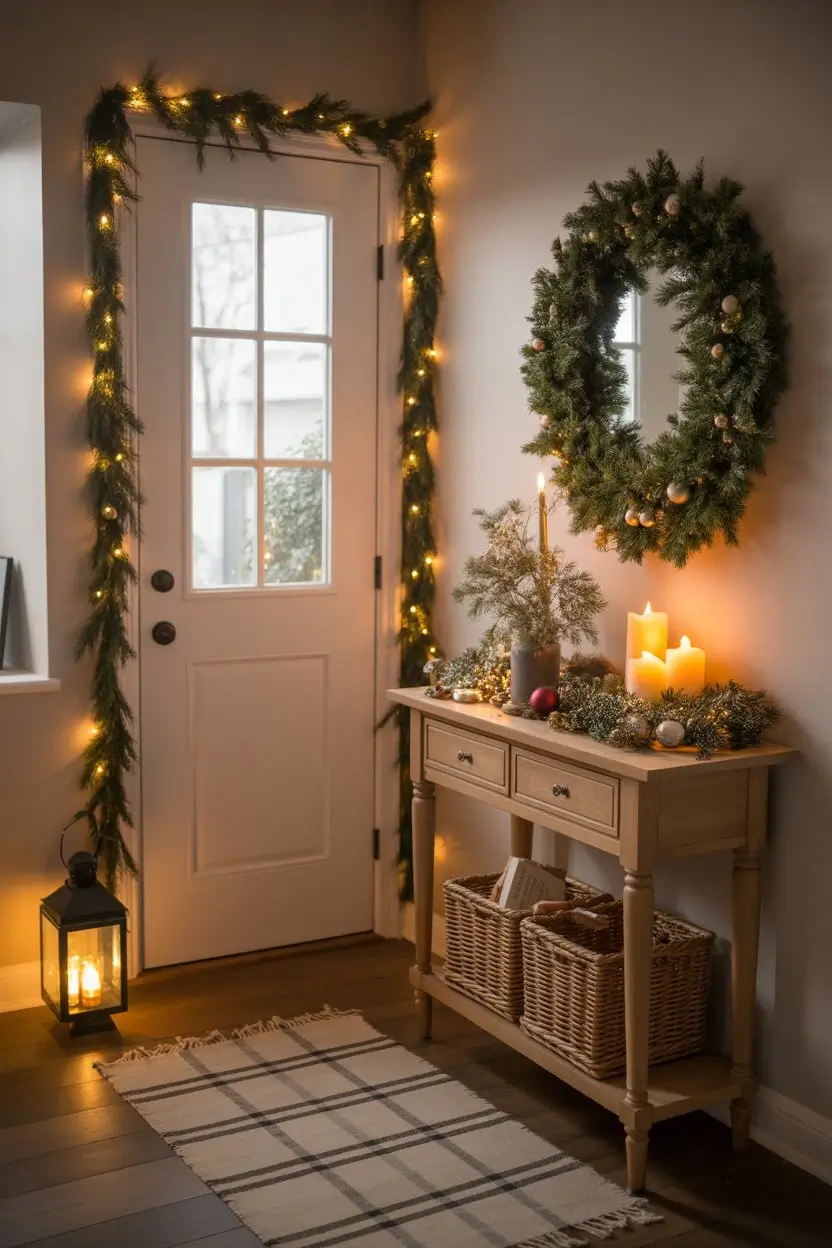
- Measure the door’s swing clearance — a thick wreath plus a coat rack equals a daily collision
- Count your available outlets; battery lights solve a lot in a hallway with no plugs
- Check ceiling height before hanging anything from above — under 8 feet, keep it door-mounted
- Note whether your door opens in or out; outward doors need a flat-backed hanger
- Decide what stays up after January, and buy for that first
21. A Dog Silhouette Wreath on a Dark Gray Door
White-dusted pinecones shed, and on a dark gray door that dust shows against the mat. Shake the wreath out over a bin before hanging, and touch up the tips with a matte white craft spray once a season. The light wood dog silhouette is the piece that will age fastest — untreated pine grays outdoors within a year. A coat of exterior polyurethane takes ten minutes and buys you three or four winters, which is a pretty good trade for something you actually care about keeping.
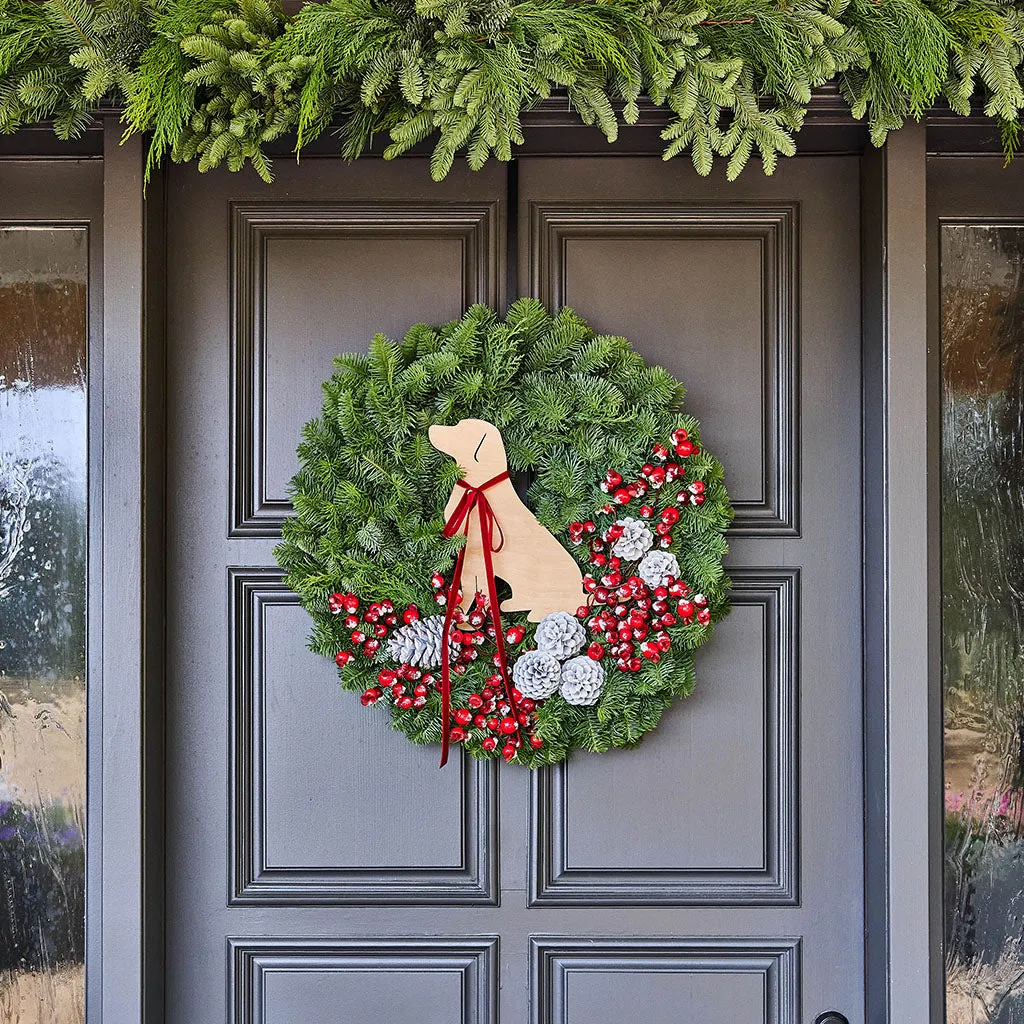
The dog. A red-berried evergreen wreath with white-tipped pinecones is classic and completely anonymous — you have seen it on a thousand doors. The little wood silhouette tied with a red ribbon turns it into a portrait of a household. It costs a few dollars, weighs almost nothing, and does more emotional work than anything else on the entry. No dog? The same slot works with a house number, a monogram, or a tiny pair of skates. For another wreath that says something personal, see Idea #22.
22. Grapevine, Red Berries, and Woven Star Ornaments
- Start with a 20 to 24-inch grapevine base; the vine itself should be the visible texture, not filler.
- Tuck evergreen sprigs into the vine — do not glue. Grapevine holds stems by friction and you can redo it next year.
- Cluster red berries in three odd-numbered groups of five or seven, spaced unevenly around the ring.
- Add brown pinecones in the gaps, pointing outward and slightly down.
- Hang the white woven star ornaments from the top center with thin red ribbon, leaving the bottom third bare.
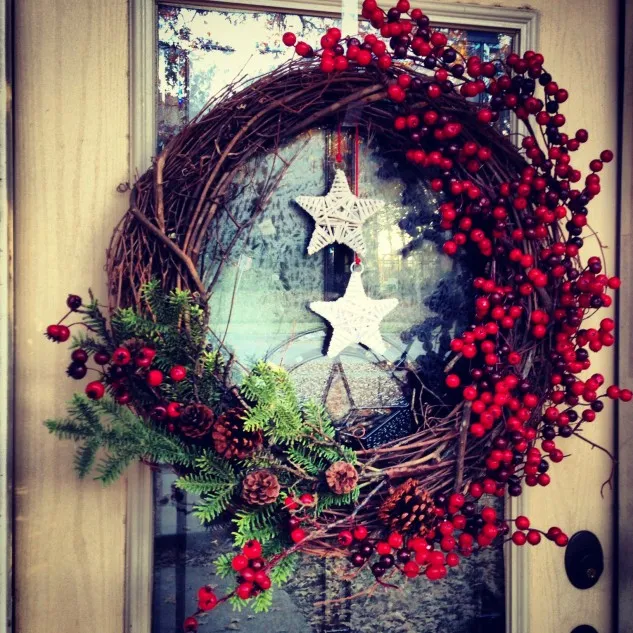
Time: about 40 minutes. Materials: $35 to $70 if you buy the base and stems.
Grapevine bases run $10 to $18 at craft stores and often $3 at thrift shops right after the holidays. Evergreen prunings are free from most Christmas tree lots if you ask in the first week of December — bring your own bag. Berries and pinecones from the yard, sprayed lightly, cost nothing at all. The whole wreath can come in under $25 and look better than the $90 version, mostly because it ends up bigger and looser.
23. A Bright Red Door with Berry-Laden White Brick Planters
Red doors and white brick are having a real moment, partly because so much new construction went gray-on-gray and people are pushing back hard. The Pinterest behavior tells the story: searches for red front doors climb every fall, and save rates jump when the photo includes planters. The berry branches are the newer piece — tall, arching, natural-looking stems in planters instead of clipped topiary balls. Expect that looser planter shape to stick around. It survives winter better and needs far less shaping.
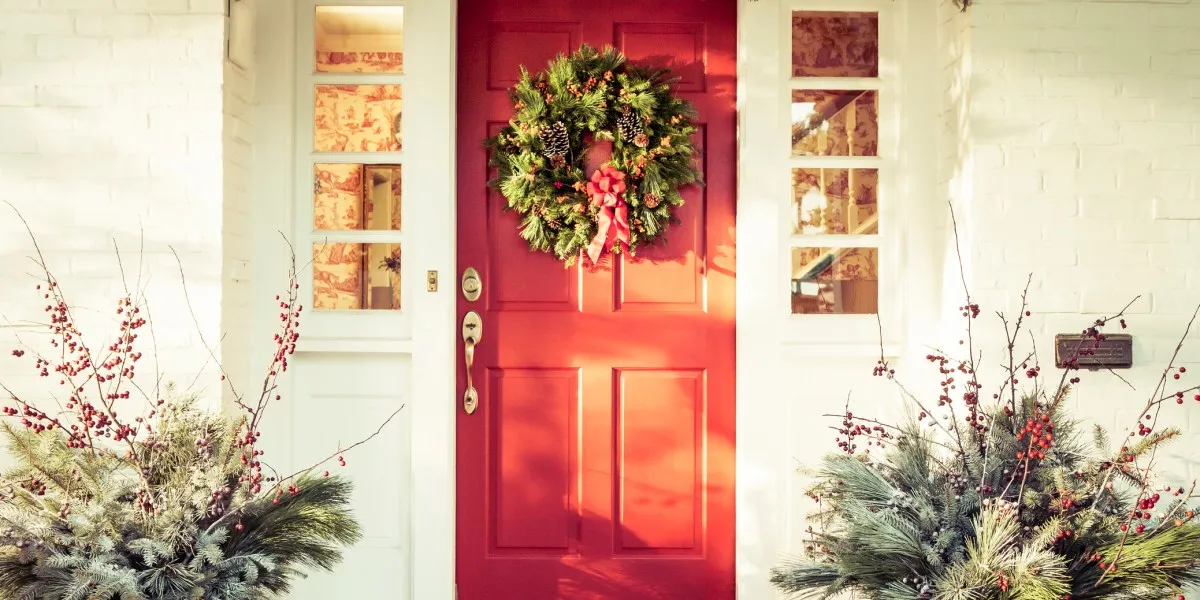
45% red + 30% green + 20% white + 5% brass. White brick is the referee that keeps red and green from shouting at each other. If your facade is tan, cream, or gray-blue, the formula still works — just pull white down to 15% and let your siding color take the rest. The brass hardware is small but non-negotiable here. Against this much red and green, warm metal is the thing that keeps an entry looking designed rather than merely decorated.
24. Flocked Pine Garlands and Pre-Lit Urn Trees
Flocked garland is the highest-maintenance thing on this list, and it helps to know why. The flocking sheds for the first two seasons, especially in wind and freeze-thaw, and once it thins you get a patchy half-frosted look that is genuinely hard to fix. Store it in a breathable bag, never a vacuum-sealed one, and do not shake it out in spring. Pre-lit trees in urns have an even shorter life — the lights usually fail before the greenery does, often in year three or four.
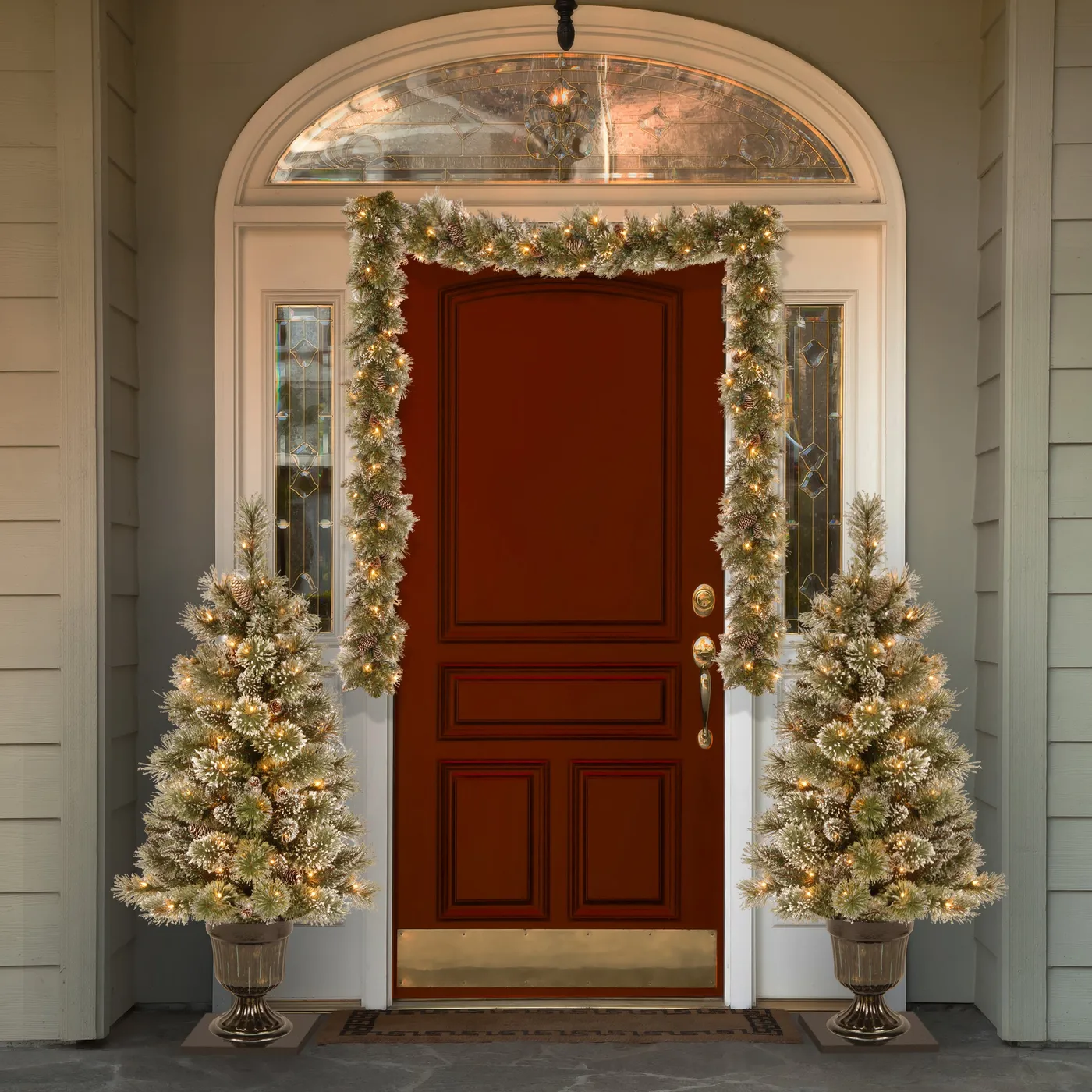
Pre-lit means pre-wired, and pre-wired means a cord running from each urn to an outlet. If your entry has one outlet on one side, you will be running an extension cord across the doorway or down the steps, which is a trip hazard and looks worse than unlit trees. Check outlet placement before you buy the pair, or buy the battery version — more money up front, no cord later. And know that flocked greens on a deep red door photograph much lighter than they read in person. Stand back ten feet before deciding it is too much.
25. A Hanging Door Sign Instead of a Wreath
A wooden hanging sign is one of the cheapest ways to fill a door, and it makes a nice change from wreath number forty. You can buy a pre-cut blank for $12 to $20 at a craft store, paint or stain it, and letter it with a stencil and acrylic paint for under $10. Or hunt Etsy and Marketplace for a used one — plenty of people sell them after a single season. Add a garland swag above it and the door reads fully decorated for around $40 total.
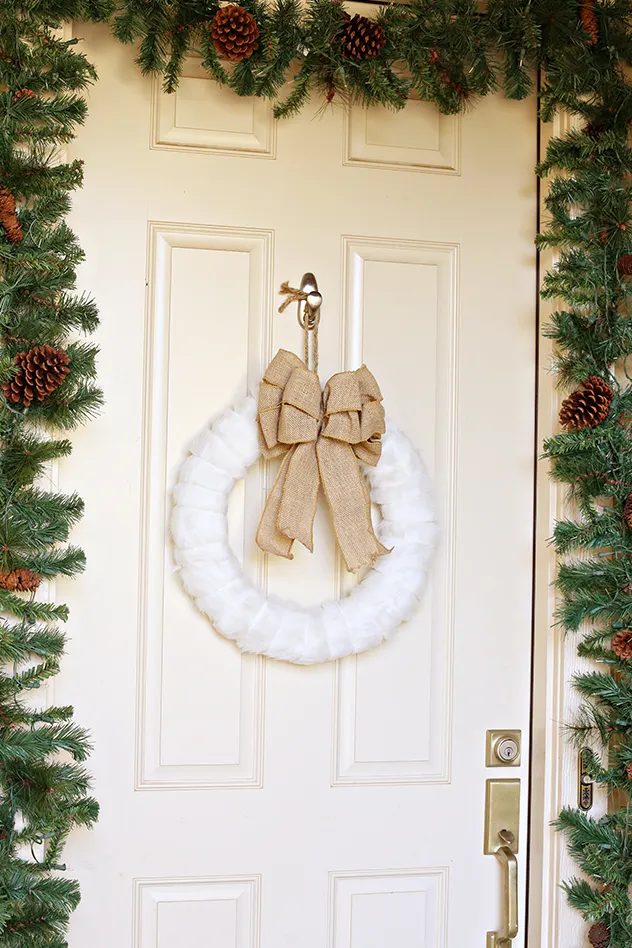
Door signs took off because they solve two problems wreaths do not: they are readable from the street, and they do not die. No shedding, no fading greens, no storage question in January — you simply swap the message. The look has also moved away from cutesy hand-lettered boards toward cleaner typography and natural wood finishes, which is why signs are suddenly showing up on doors that would never have gone rustic. Pair one with a simple greenery swag and you are done in twenty minutes.
Hang It, Light It, Then Go Enjoy the Eggnog
Twenty-five doors, one truth: the entries that look best are the ones where somebody made three decisions and then stopped. Pick your palette, pick your light temperature, pick one thing that is personal — a sled, a dog silhouette, a hand-lettered sign — and let everything else stay quiet. Start with the door you already have and build outward.
📌 Pin your favorite version now so you can find it again in November — and if you try one of these, tag us. We love seeing how it turned out.