
You know that feeling when the house down the street glows like a postcard and yours is still running one tangled strand from 2019? Same. Here’s the fix.
We spent serious time browsing Home Depot, Lowe’s, and Target — plus a few midnight Amazon deep dives — to find only what’s worth hanging this year. Everything here lands between $18 and $1,200, so there’s a version of every look that fits a real budget.
Inside: 29 curated ideas from real homes and real designers — classic roofline outlining, warm white pathways, icicle lights with star drops, nostalgic C9 color, and one very confident magenta-and-orange facade. Budget and luxury versions sit side by side, and most ideas come with shoppable details.
In 2026 the shift is away from more-is-more chaos and toward deliberate color stories. Single-hue warm white schemes are some of the most-saved lighting boards on Pinterest right now, and bin-stored mega-displays are giving way to setups people can actually maintain.
Pin this guide for later — your future self will thank you when it’s time to actually do this.
1. Red and Green Lights on a Snowy Brick Facade
Two colors, one house, zero guesswork. Red and green work here because the brick itself is a warm mid-tone — the lights read as decoration instead of competition. Notice how the strings follow architecture rather than getting scattered across the yard: rooflines, window frames, the main archway. That outlining instinct turns a big multi-gabled facade into one cohesive silhouette instead of a pile of separate decorations.
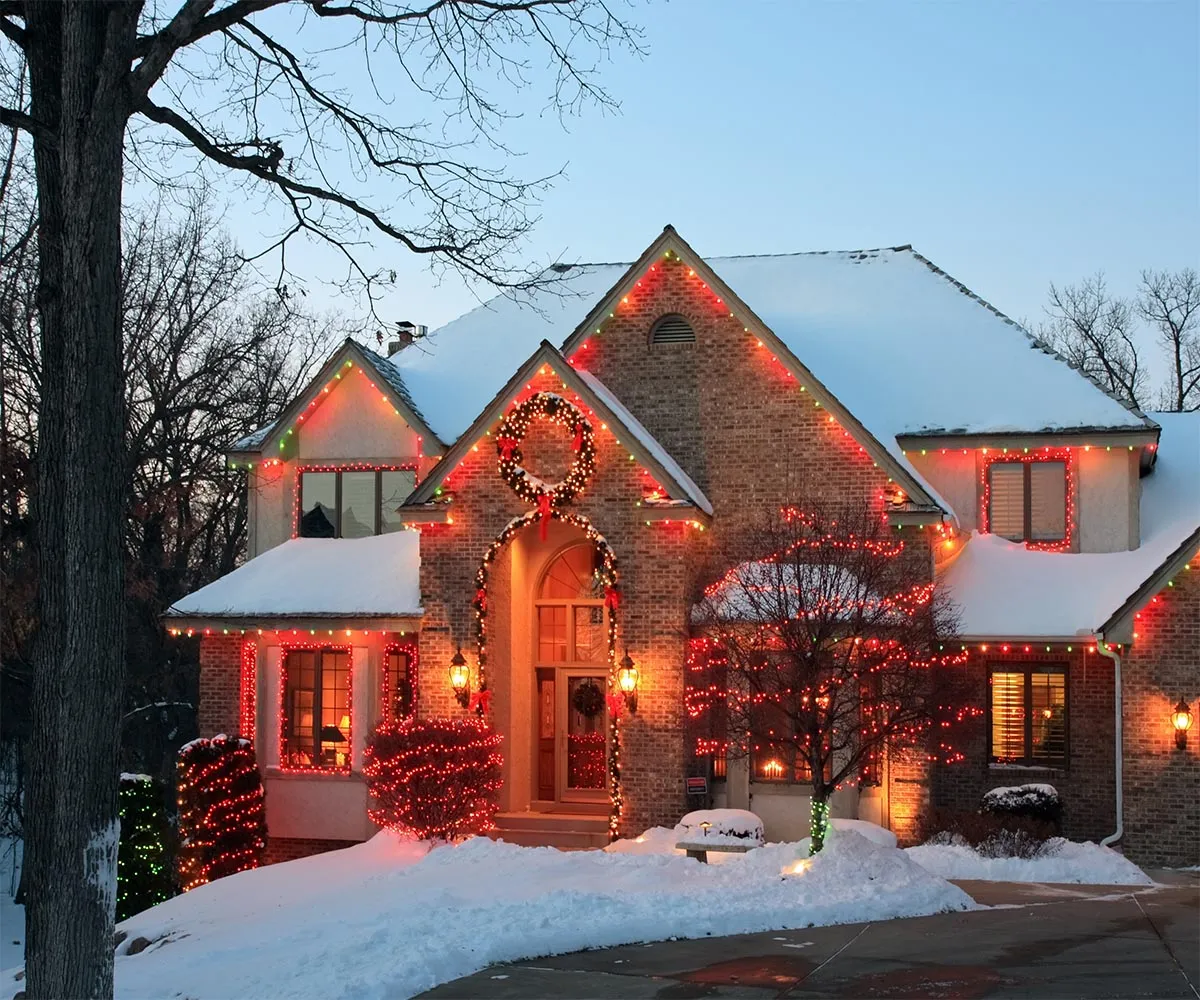
Strip away the wreaths and this house still looks decorated — just anonymous. Those oversized wreaths with red bows on the gables and above the entry do the emotional work, giving the eye a focal point between all that outlining. If your budget stretches to one statement element this year, make it a wreath, scaled so its outer edge measures roughly one-third of the window or gable it hangs on.
2. Solar Stake Lights Along a Snowy Stone Path
Warm white stake lights mark the edges of an irregular stone walk when everything else is buried under snow. Here’s a sequence that survives February.
- Clear the path, then set stakes 4-6 feet apart, alternating sides so the glow overlaps.
- Push stakes into soil or gravel beside the stones, never into the joints where freeze-thaw heaves them out.
- Angle each head toward the walkway, not straight up.
- Dusk-test before the first snow — panels need four-plus hours of direct sun.
Time: about an hour. Cost: $60-$150 for eight to ten lights.
Solar stakes are the lowest-effort option outdoors, right up until December. A snow-covered panel means zero charge, and a buried one means a dead light by nine o’clock. Plan on brushing panels off after storms with a soft car brush. The batteries fade after two or three seasons too, and replacements run $15-$25. If you want zero fuss, low-voltage wired path lights on a timer cost more upfront and never care about the weather.
3. Warm White Outlining That Reaches the Garden Fence
- Main lights: 300-400 ft warm white LED string, $90-$180
- Power and hardware: timer, clips, outdoor extension cords, $40-$70
- Decor and accents: two or three colorful lawn stakes near the porch, $20-$45
- Wall treatment: none — the outline is the decoration
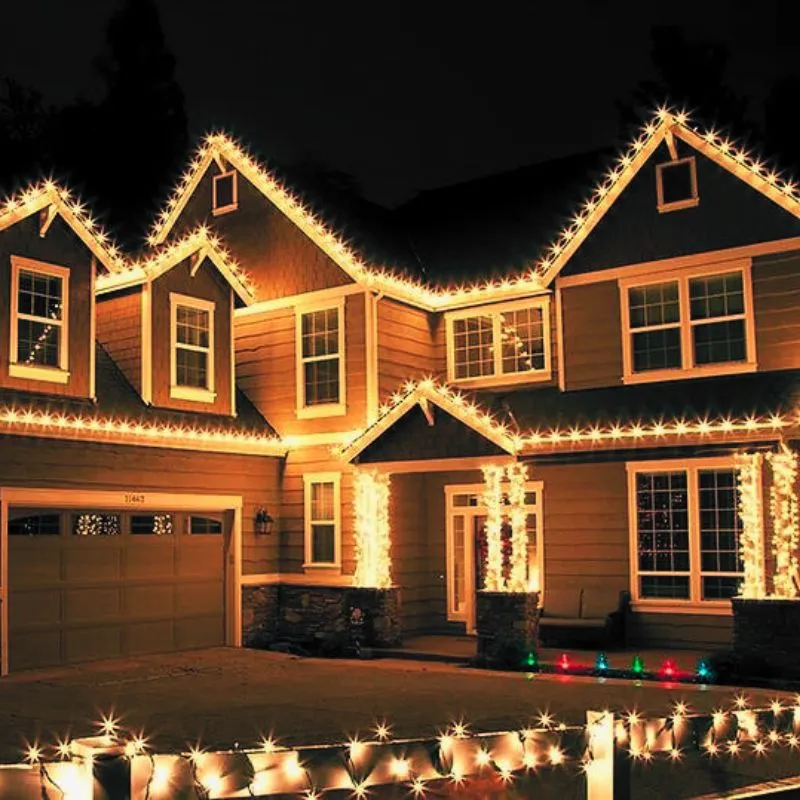
Budget alternative: build the outline from the eaves down instead of across. Two hundred feet on the front roofline plus the porch pillars runs $60-$100 and still reads as a fully decorated house from the street.
The garden fence is the sleeper detail. Most people stop at the roofline, which leaves the bottom third of the scene dark and disconnected. Carrying the same warm white down to a low fence pulls the whole composition forward and makes the front yard feel like part of the display instead of the space you walk through to reach it. Same logic applies to railings and low walls — if it’s a horizontal line, it can carry lights.
4. Faux Pines and Garland Around a Wooden Double Door
The trick here is symmetry — two matching trees, one wreath, one garland, all in the same warm white so nothing competes.
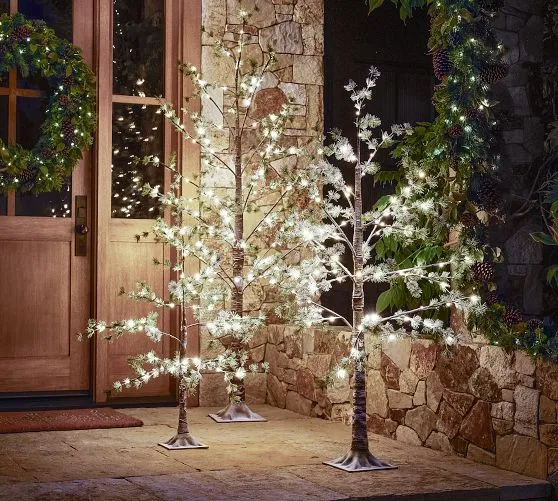
- Set the lit faux pines on either side of the door, outer edges about 40 inches apart. Wider if you have a double door.
- Hang the wreath centered, with its bottom edge at roughly 66 inches from the patio — eye level, not doorknob level.
- Drape the garland over the doorframe, never across the glass panels.
- Run everything into one outdoor smart plug so it all comes on at once.
Time: 45 minutes. Cost: $180-$400 for the trees, wreath, and garland.
You don’t need $400 for a front-door moment. Real talk: the faux pines are where the money goes, and they’re also the piece nobody inspects up close.
- IKEA’s potted faux trees plus a $12 strand of micro lights run about $45 for the pair
- Target or Walmart pre-lit garland: $20-$35
- Facebook Marketplace wreaths in January: $5-$15, and they’ll last years
The whole entry lands under $100 and photographs identically after dark.
5. Warm White Gables on Stacked Stone With Uplighting
Here’s what separates a house that glows from a house that just has lights on it: the landscape spotlights. They wash the stacked stone and shrubs from below while the strings trace the gables from above. Two light sources, one color temperature, and suddenly the stone reads as texture instead of a flat wall. The dark louvered shutters help too — light bouncing off a dark surface creates depth, while light bouncing off white just glares back at you.
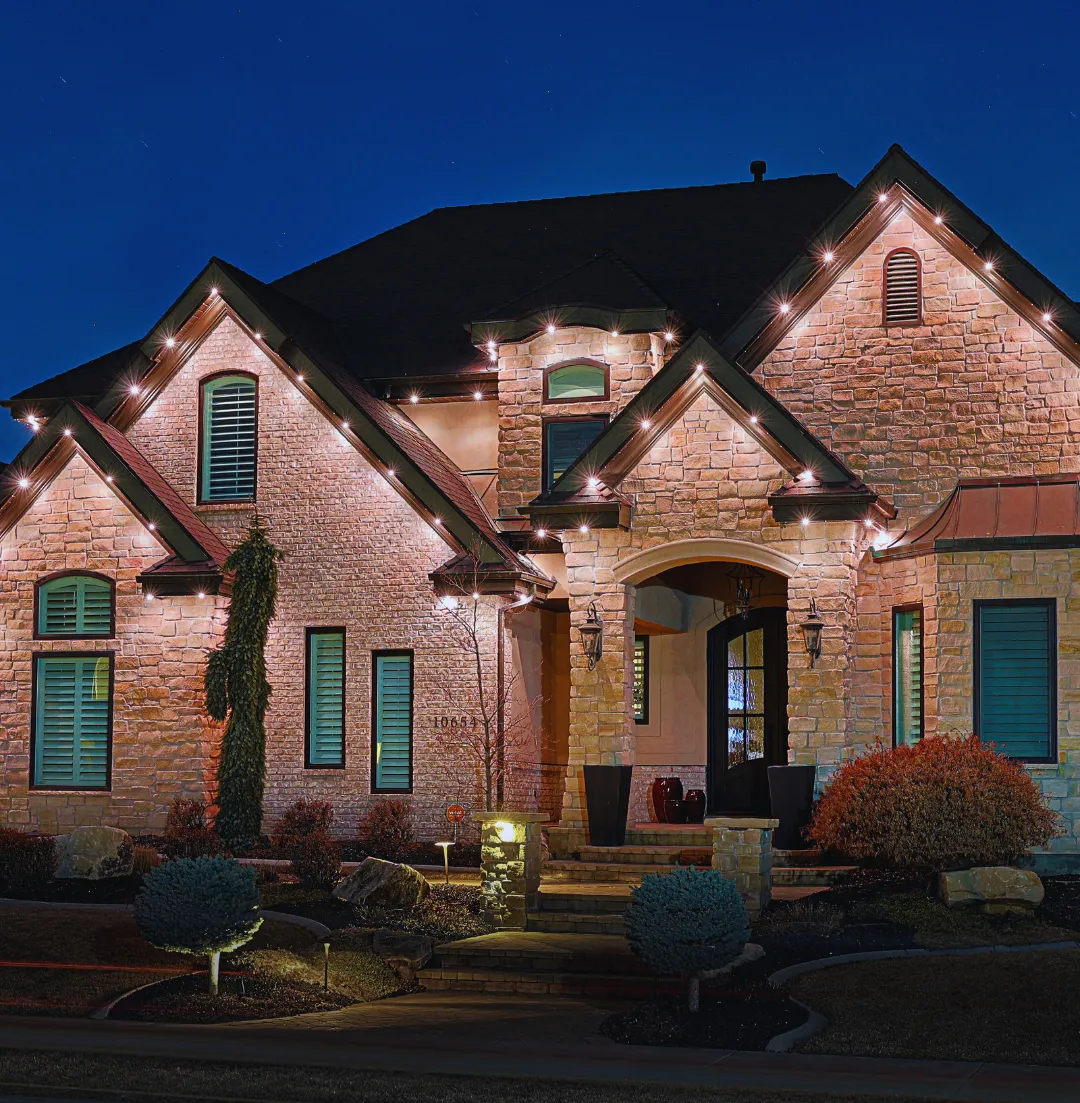
Full gable outlining wants a facade at least 55-60 feet wide and two stories tall to look designed rather than accidental. Uplights sit 12-18 inches out from whatever they’re washing, tilted 30-40 degrees toward it. On a shorter ranch, skip the roofline strings and light three shrubs plus the entry instead — restraint beats coverage every time. For a ground-level version of this glow, see Idea #2.
6. Lawn-Level Light-Up Decor, No Ladder Required
Ground-level yard pieces are the most forgiving way to decorate because nothing needs a ladder, a clip, or a second person holding the extension cord. Walmart and Target drop light-up stakes to $10-$20 in early November, and At Home sells them in multi-packs around $30. Spaced three feet apart across a 20-foot frontage, that’s eight pieces and roughly $120 — less than the strand count alone for one roofline.
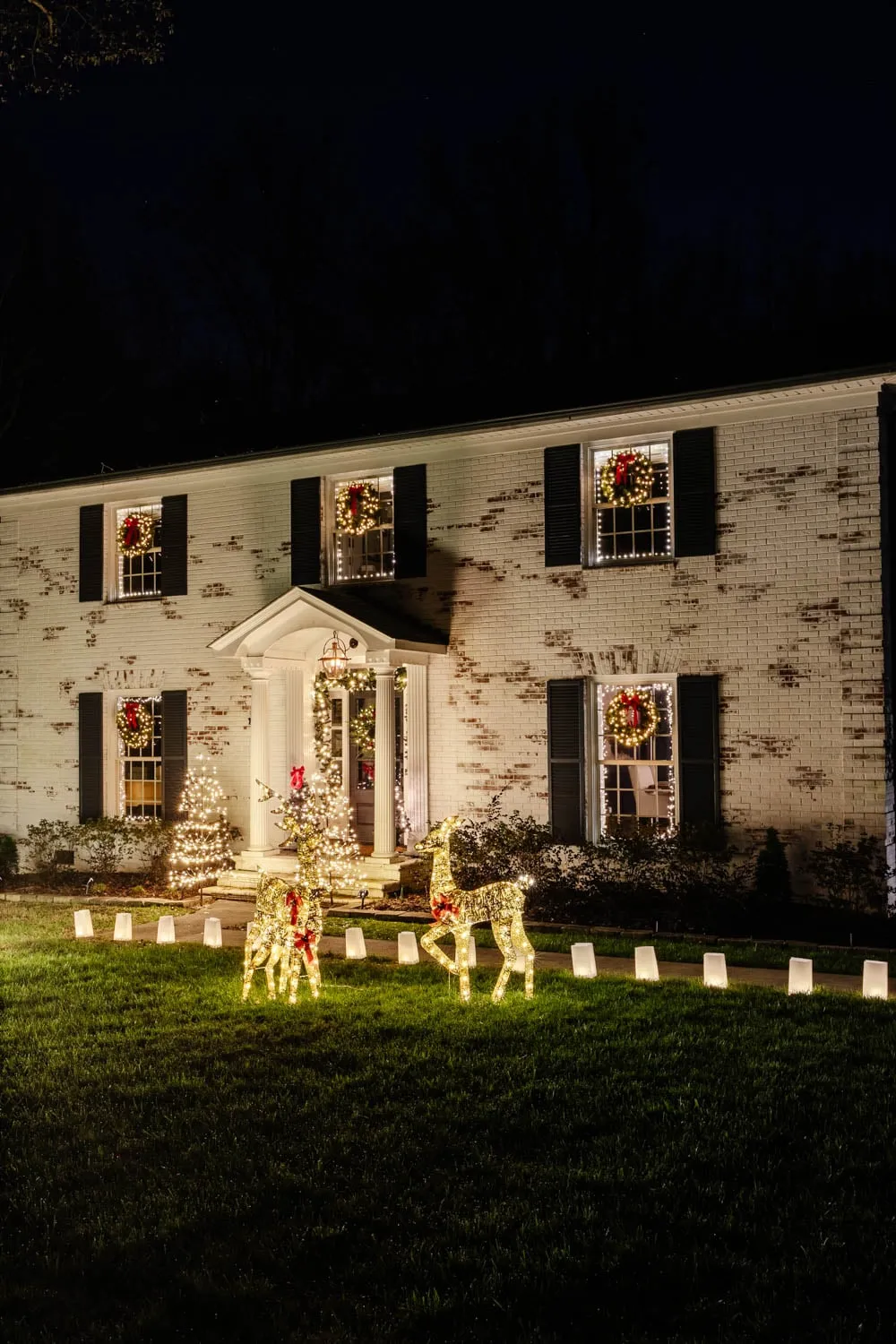
Staked decorations and wind are not friends. A hollow plastic shape catches gusts like a sail, and one good storm will have it lying in the neighbor’s hedge. Look for pieces with a weighted base or a stake you can push 6-8 inches into soil. Check the IP rating before you buy — IP44 is the minimum for anything living outside all season, and IP65 if it sits somewhere that collects water. Cracked stakes in the cold are the most common failure point.
7. Roofline Strings Paired With Column Uplighting
Buy 2700K warm white — not 3000K, and definitely not daylight 5000K. Mixing color temperatures is the single most common reason a decorated house looks off at night; half the strands glow amber, half glow blue-white, and the eye never settles. Match whatever your permanent landscape fixtures already use. Then clip every 12-18 inches along the roofline. Anything looser sags by January and you’re back up the ladder in a scarf. Compare with Idea #15, where color is the entire point.
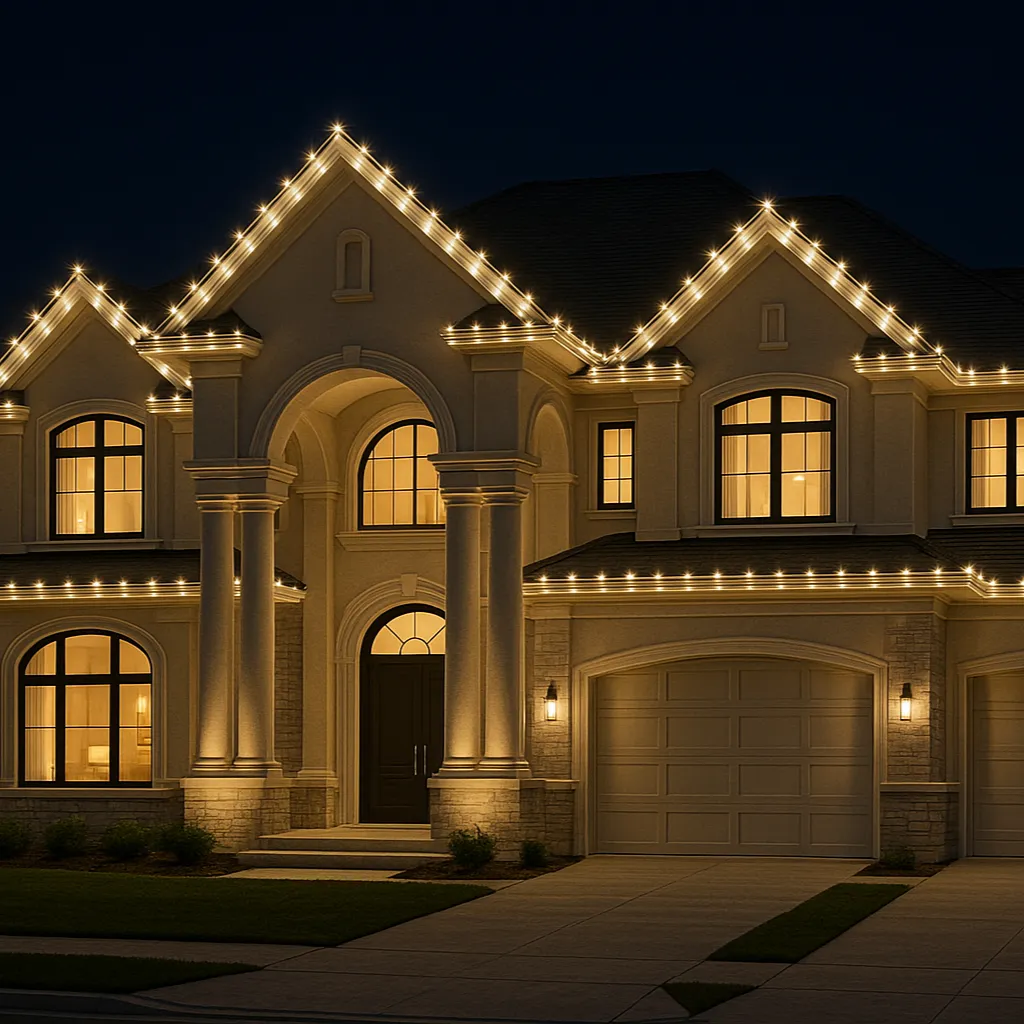
Sixty percent warm white roofline, twenty-five percent architectural up-lighting, fifteen percent garden accents on shrubs and low branches. Swap the up-lighting for cool white and the whole house suddenly looks like a car dealership. Keep the ratio and change the palette, and the same formula works on gray siding, cream stucco, or stone. The 60 percent figure matters: if the roofline strings are less than half the total glow, the uplights take over.
8. Life-Size Nutcrackers Guarding a Warm White Facade
Everything else here is standard issue — outlined rooflines, lit wreaths in the windows, a warm white perimeter on the ground. The nutcrackers are what make the house memorable. Life-size figures work because they break the horizontal rhythm of a light display with two vertical exclamation points at the exact spot where guests arrive. Keep them 18-24 inches off the wall so they read as figures rather than wallpaper, and match their scale to the door — five to six feet tall beside a standard door, taller if you have a grand entry.
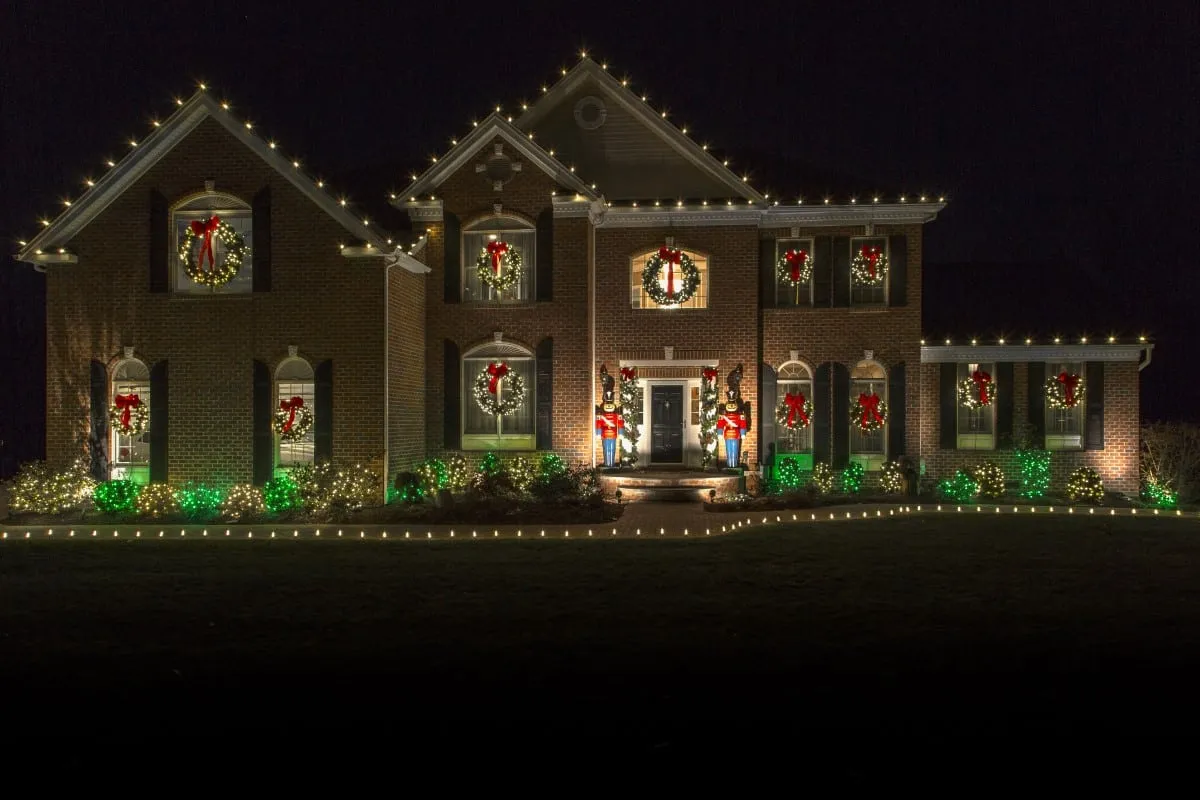
Life-size figures need a flat, level surface and a way to stay upright. Weighted bases, ground stakes, or a discreet sandbag behind the boots — pick one before the first windy night. They also eat real storage space from January to November, so measure your garage corner before you fall in love at the store. And check the cord length: most come with a three-foot lead, which rarely reaches an outlet from where you actually want them standing.
9. Icicle Lights With Star Drops and Wrapped Columns
Icicle lights are measured by drop, not by run. An 18-inch drop strand typically covers 8-9 feet of eave, so measure your total roofline, divide by eight, and that’s your strand count. Hang the stars last, after the icicles are up, so you can space them evenly instead of working around them. Two stars per gable is the sweet spot — three starts to look like a constellation that lost its way.
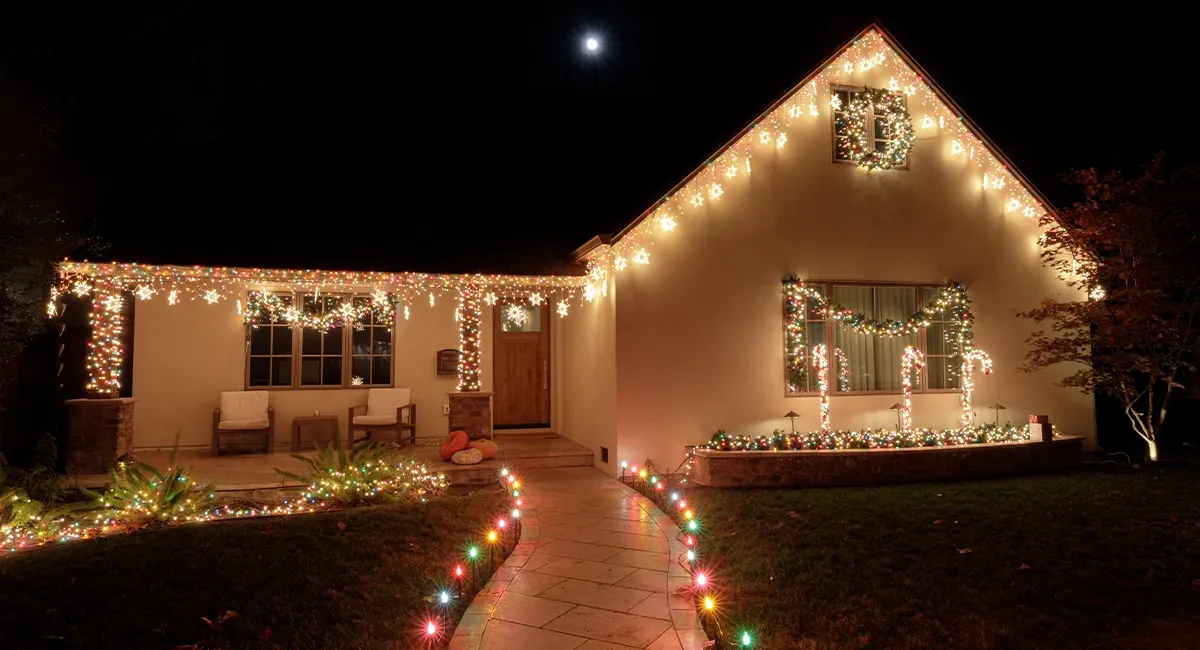
The star drops are the detail that’s been quietly having a moment. Searches for icicle lights with star shapes climbed steadily through 2025, and the look scratches the same late-nineties nostalgia itch that’s been driving decor for a few years now. It also photographs beautifully after dark, because the star shape breaks up the horizontal blur of a plain icicle strand. Staying power? Moderate for the stars. The plain icicle base underneath will outlast the trend by a decade.
10. Oversized C9 Bulbs in Full Crayon-Box Color
Zero white, one hundred percent color — that’s the formula here, and it’s a commitment. C9 bulbs are the big faceted ones you remember from childhood, roughly three inches tall with a visible glow. The rule that keeps it from becoming a jumble: pick four hues maximum and repeat them in the same order for the entire run. Red, green, blue, yellow, then start over. Random color placement looks accidental; a repeating sequence looks designed.
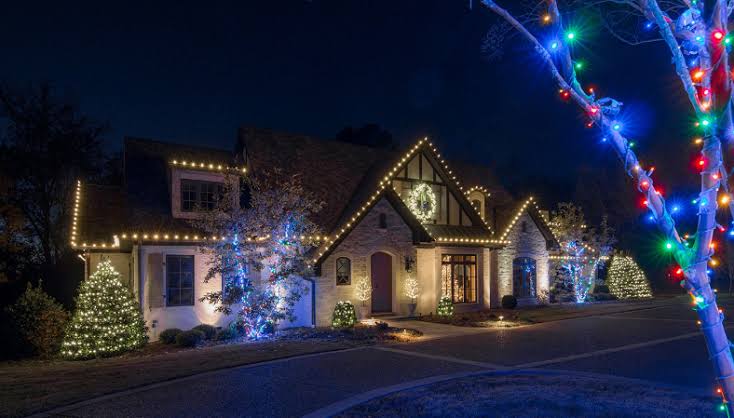
Colored bulbs against snow are a contrast study. Snow bounces light back up, so the colors read brighter and more saturated than they would on bare ground — which is why this scheme never looks as good in July when you test it on the driveway. The brick matters too: a warm red-brown base makes red and green bulbs feel native to the house, where the same strands on cool gray siding would fight the architecture. Matching lights to your materials is the quiet skill here.
11. An Arched Entry Framed in Garland and White Lights
The garland arch is the one element here worth doing by hand rather than buying pre-lit.
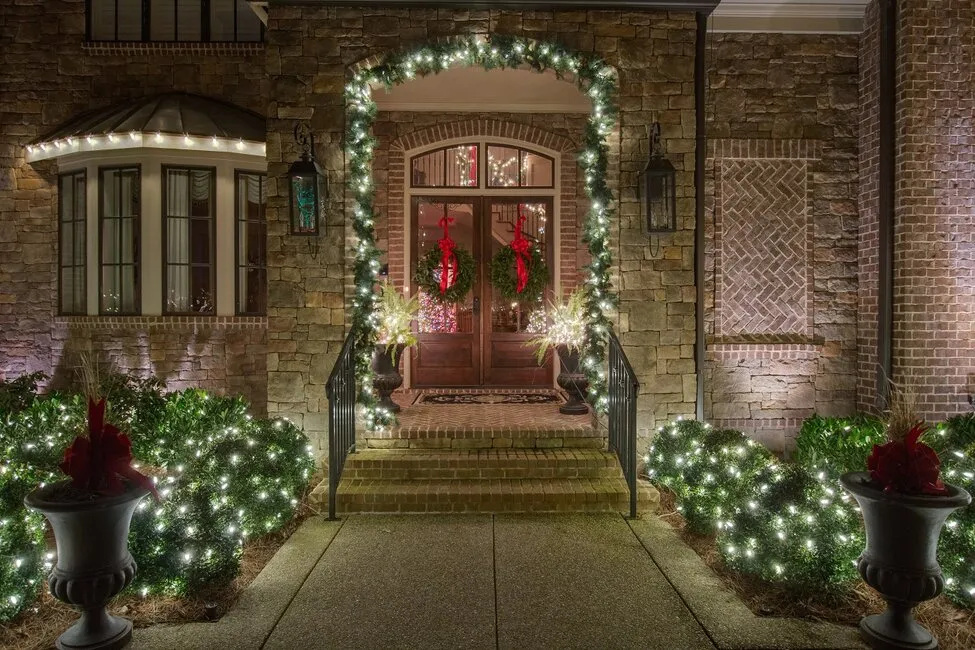
- Start at the bottom left of the doorway and work up, attaching garland with clear zip ties every 12 inches.
- Weave the string lights through the garland after it’s hung, not before — you’ll get better coverage.
- At the arch, double the garland back on itself for a fuller curve.
- Finish with a single red bow at the peak as the focal point.
Time: about two hours. Materials: $70-$150 for garland, lights, ties, and bows.
The dark urns flanking the path are doing more work than they get credit for. They bridge ground level and the doorway, so the eye travels from the lit bushes up through the garland instead of jumping between them. The scale rule: urn height should be roughly one-third the height of your door, and the greenery inside should spill just past the rim. Skip the urns and the entry feels like it’s floating.
12. White Rooflines With Trees Wrapped in Red and Green
- Main lights: 250 ft white plus 150 ft each of red and green, $120-$220
- Power and hardware: clips, outdoor cords, timer, $35-$60
- Decor and accents: none — the color does the talking
- Wall treatment: n/a, this is a light-only scheme
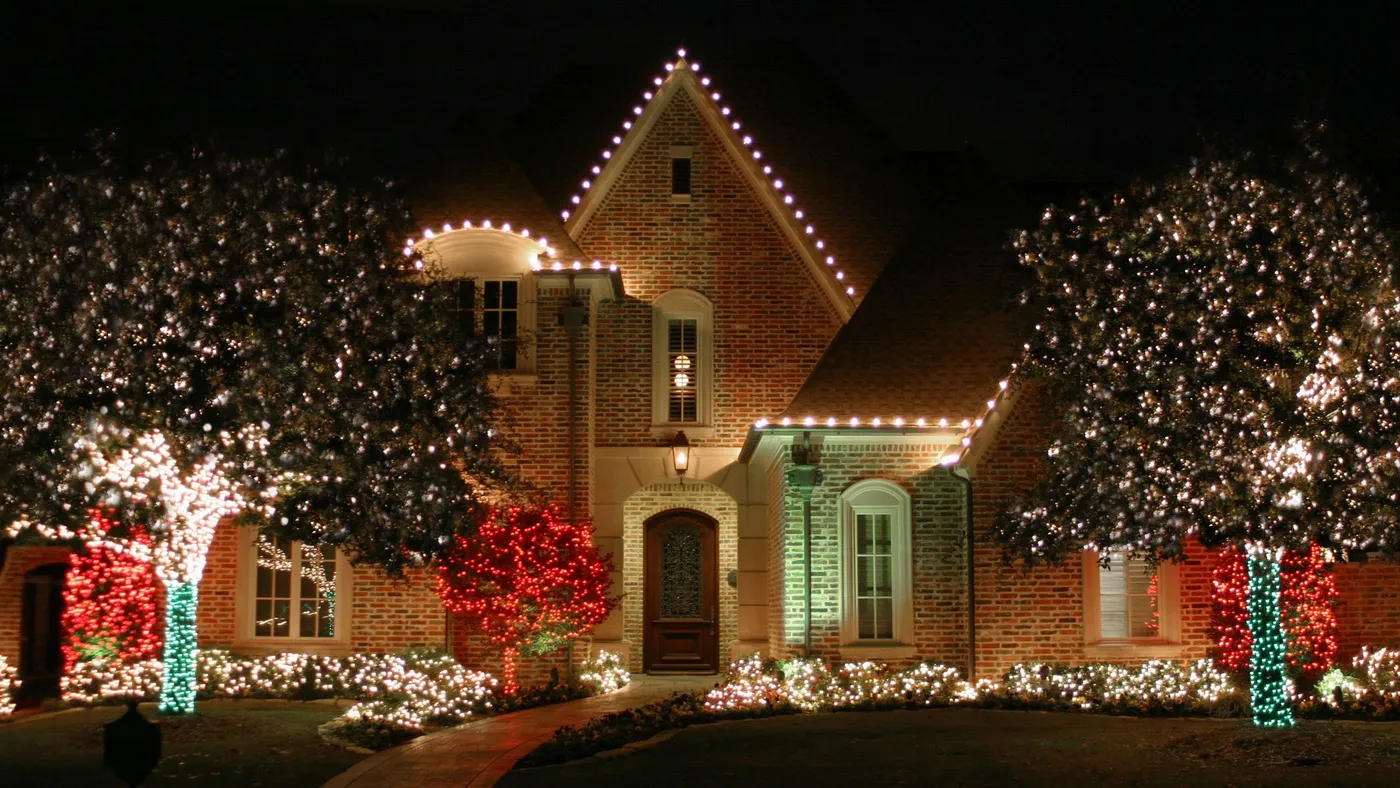
Budget alternative: wrap only the two trees closest to the walk in white and skip the red and green entirely. That’s $70-$90 and still looks deliberate from the curb.
Tree wrapping is the most light-hungry thing you can do outdoors. A medium deciduous tree with a 10-inch trunk takes roughly 300-400 feet of strand to look fully covered, and that’s just one tree. In a yard under 1,500 square feet, pick one hero tree and leave the rest to shrubs. Bigger property? Two trees, wrapped at different densities so they don’t look like twins. See Idea #25 for the version where the tree IS the whole display.
13. Dusk-Timed Outlining on a Gray Multi-Gable Facade
Set your timer for sunset minus fifteen minutes, not a fixed clock time. A basic astronomical timer runs about $25 and adjusts itself all season, which means your lights come on at 4:38 in December and 5:52 in early November without you touching a thing. This matters more than people think — a house that lights up at 4 p.m. in early November looks like nobody’s home, and one that lights up at 9 p.m. looks like a mistake.
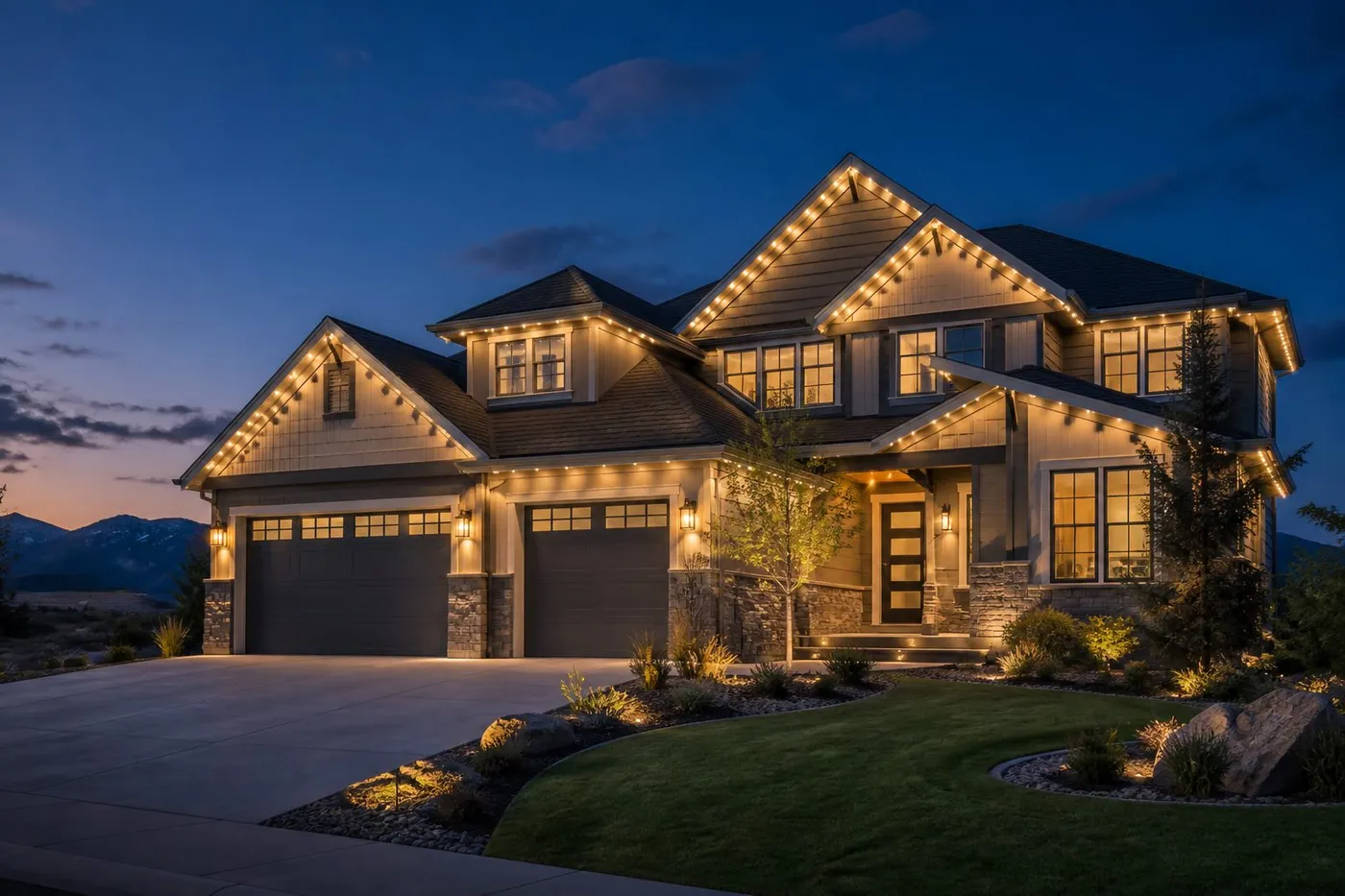
Multi-gable outlining like this wants at least two stories and 50-plus feet of visible frontage, because the whole appeal is the cadence of peaks. One-story homes can borrow the idea by outlining the garage and the entry only and leaving the main eave dark — the asymmetry reads as intentional. If your house has a single long roofline with no gables, uplighting is a better investment than string lights.
14. White Rooflines With Red and Green Shrub Color
Fifty percent white architecture on top, forty percent red and green ground color below, ten percent reflection off the driveway. That last slice is the one people forget: light-colored paving bounces color back onto the bushes and doubles the apparent brightness for zero extra cost. Swap the red for warm amber and the green for teal and you keep the exact same formula — architecture stays neutral, ground goes bold.
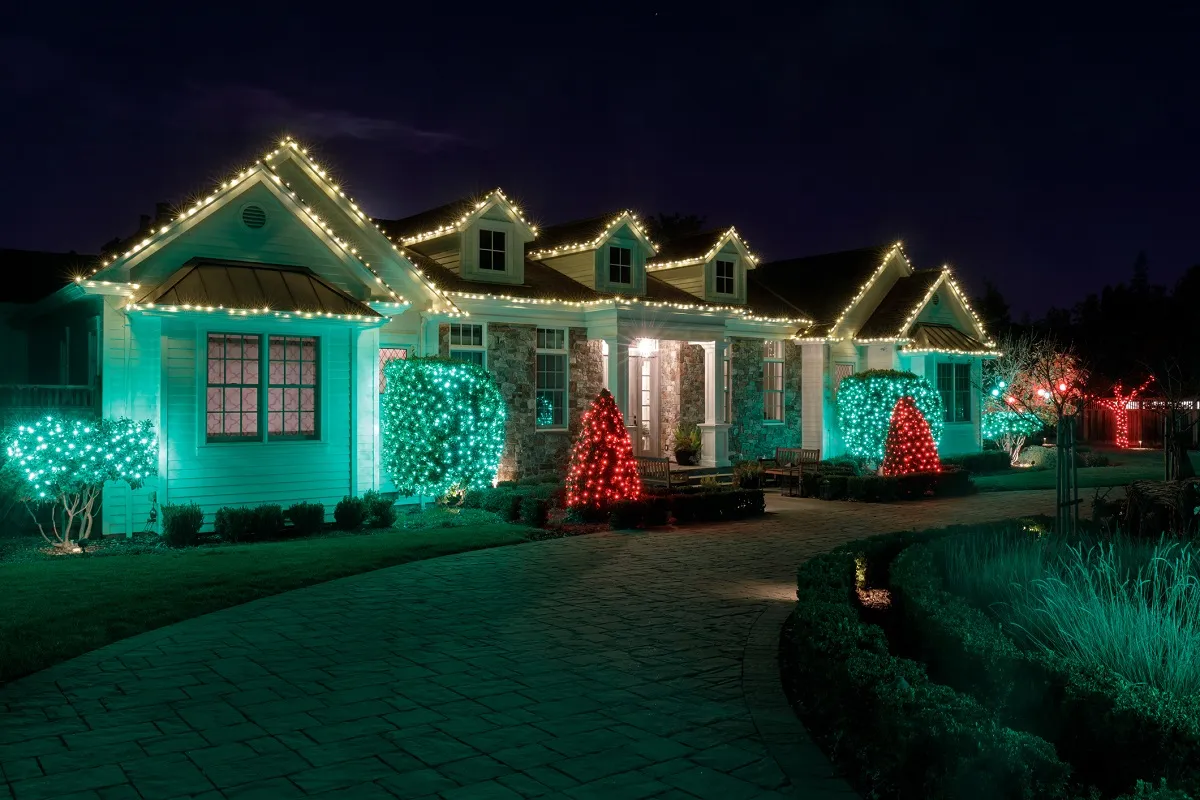
Net lights are the cheat code for this look. A 4×6 net covers roughly 24 square feet of bush in about ninety seconds, versus twenty minutes of winding a strand by hand. Walmart and Target sell them for $12-$20, and pre-lit collapsible conical trees run $25-$45 — the tall red and green cones in this yard are almost certainly those. Buy in early November; by the second week of December the green ones are always gone.
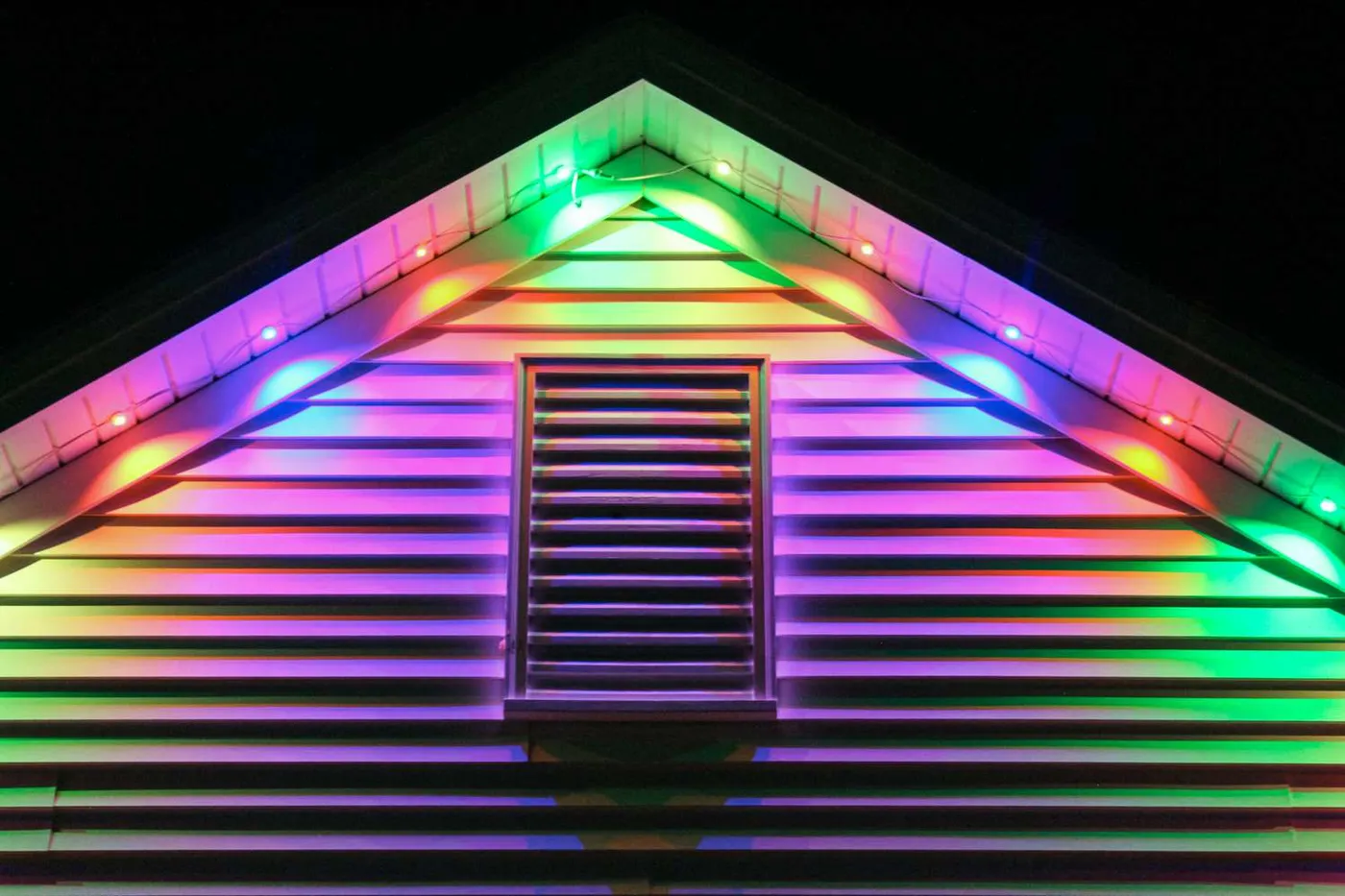
15. Magenta and Orange: The Boldest Roofline on the Block
Two-tone, non-traditional lighting has been building for a few seasons, and 2026 is the year it went mainstream — searches for pink and magenta outdoor lighting are up sharply, and renters in particular love it because it’s fully reversible. The aesthetic borrows from stage lighting and neon signage rather than traditional Christmas decorating, which is exactly why it feels so fresh against brick. Staying power: better than you’d guess. Once the hardware is up, changing the color story costs one order of strands.
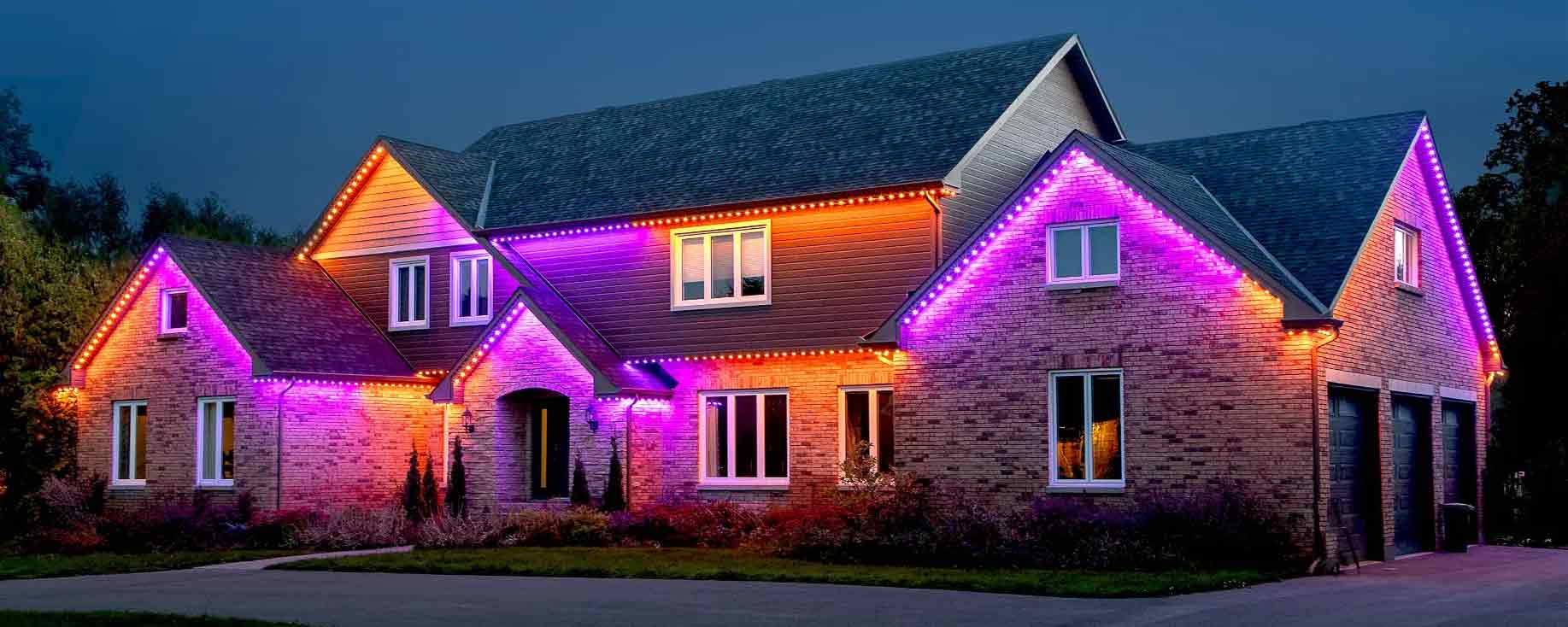
Bold color is a commitment. Three things worth checking before you order 300 feet of magenta.
- Your HOA’s rules on exterior lighting color — plenty specify white only after 10 p.m.
- How it reads from the street. Drive by after dark with a sample strand taped up before you commit.
- Color consistency between brands. Magenta from one manufacturer and magenta from another almost never match.
Buy your entire run in one order and check the batch codes. A second shipment in December can be a different dye lot.
16. Garland-Wrapped Pillars and Oversized Red Bows
Wrapping a brick porch pillar tightly, base to capital, is the difference between decorated and dressed.
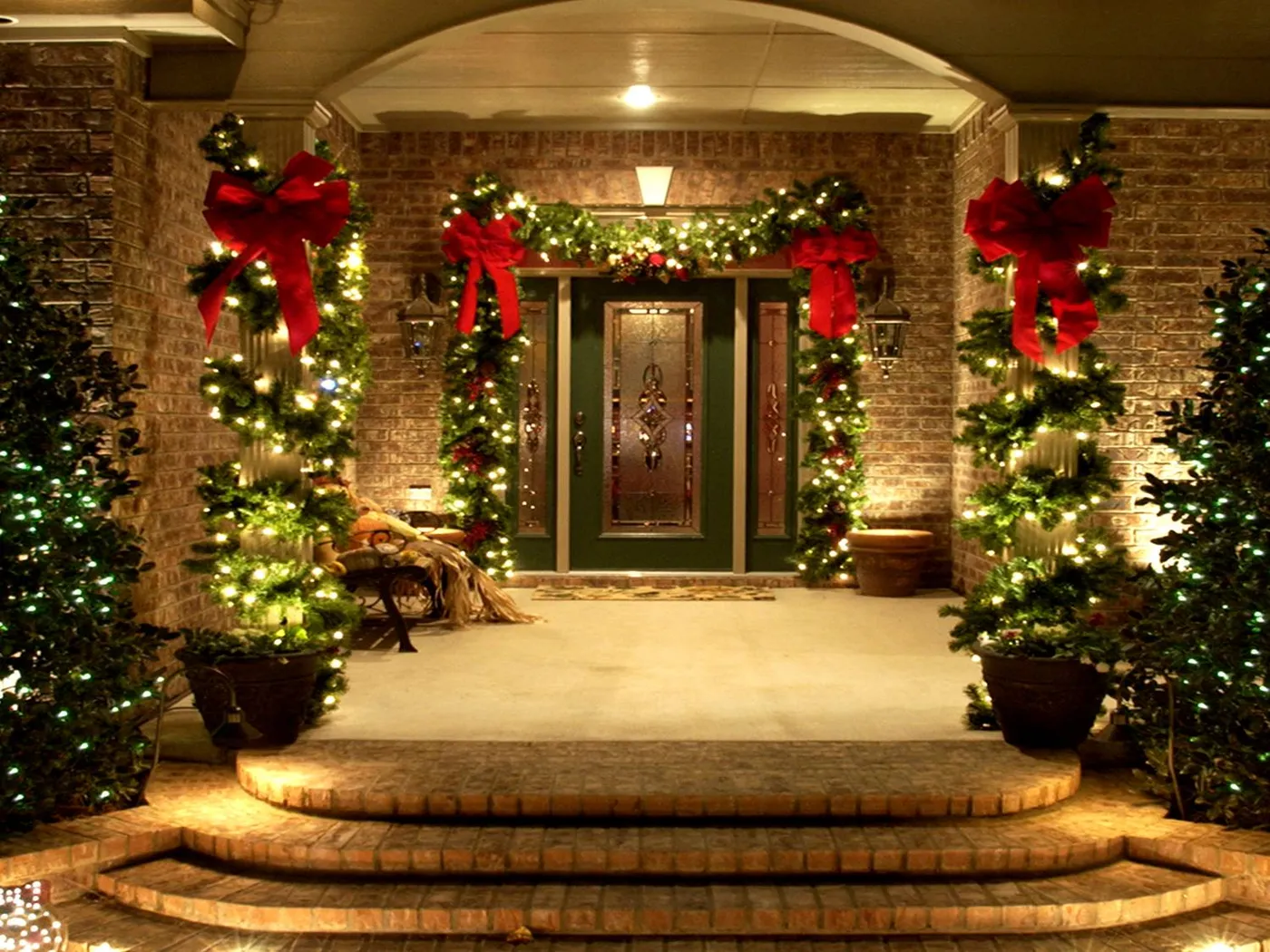
- Start at the bottom, tuck the plug end behind the pillar base, and work upward in a spiral.
- Keep spacing even — about three inches between wraps, tighter if you want a solid glow.
- Attach garland over the lights with clear zip ties at the top, middle, and bottom third.
- Finish with bows at the same height on every pillar so the eye reads a line across the porch.
Time: 30 minutes per pillar. Cost: $45-$90 per pillar for lights and garland.
Real evergreen garland smells incredible for two weeks and then drops needles all over your steps through New Year’s. Faux garland looks nearly identical after dark, never sheds, and stores flat in a bin — which is why you see it on nearly every professionally decorated porch. Whichever way you go, keep garland above knee height on steps so nobody drags a coat through it. Bows fade fastest; replace the ribbon every other season rather than the whole garland.
17. One Bare Deciduous Tree Wrapped Branch to Tip
Bare branches are the best canvas on the property. A deciduous tree with no leaves lets lights read as an outline of the tree itself — every fork and twig visible against the sky — while an evergreen just swallows them into a green blob. That’s why this single wrapped tree carries the whole scene, even with a fully outlined brick house and a lit conifer behind it. If you have one bare tree in the front yard, it’s worth more lights than the roof.
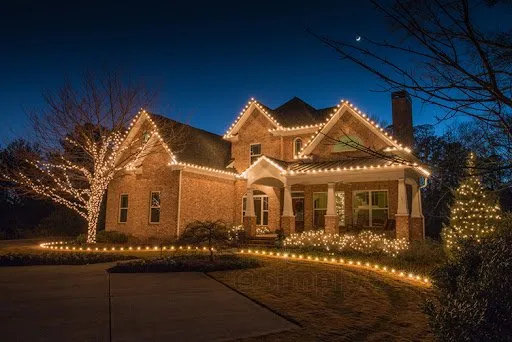
- Main lights: 400-600 ft warm white, $110-$200
- Power and hardware: one heavy outdoor cord, timer, clips, $30-$50
- Decor and accents: none needed
Budget alternative: wrap only the trunk and the first two levels of branches — about 200 feet, $55-$90 — and it still reads as a glowing tree from the curb.
18. Red and White Lights With a Full-Size Santa in the Yard
Inflatables are the highest-maintenance thing in any yard display. Wind tips them, blower motors hum, and by mid-January half the neighborhood’s Santas are slumped over like they’ve had a very long day. An inflatable that’s flat by morning usually has a slow seam leak rather than a dead motor, so check the seams before you buy a replacement. Give it a dedicated outlet or a smart plug too — cycling a blower on the same circuit as 600 feet of lights is exactly how breakers trip.
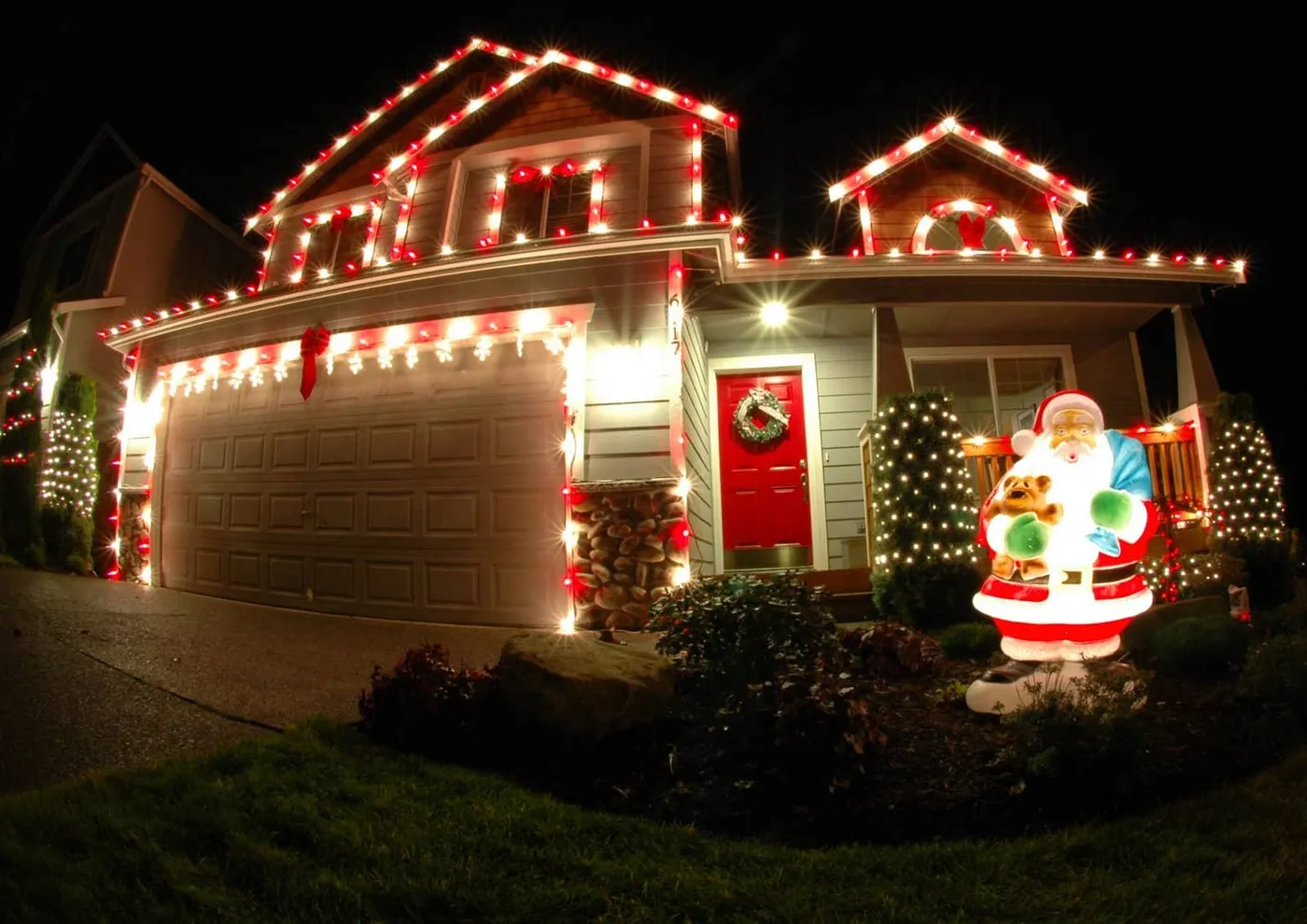
Santa inflatables swing wildly in price. The same six-foot figure runs $40 at Walmart, $90 at a home decor chain, and $200 at a specialty holiday store, and after dark the difference is mostly the quality of the internal LED. Start at the discount end. If you’d rather not deal with blowers at all, see Idea #8 — same joyful-yard energy, no motor required. Snowflake shapes for the garage run $15-$30 and fill a blank wall for almost nothing.
19. Alternating Red and White Along the Hedge Line
Eighty percent white, twenty percent red — and the red only appears in one place. That ratio is why this house reads as elegant instead of circus-y. The alternating pattern works because the eye picks it up as a rhythm; keep it strictly alternating, white-red-white-red, because two reds in a row breaks the beat and looks like a mistake rather than a choice. Want to change it up? Swap red for amber and the whole thing goes gold and cozy.
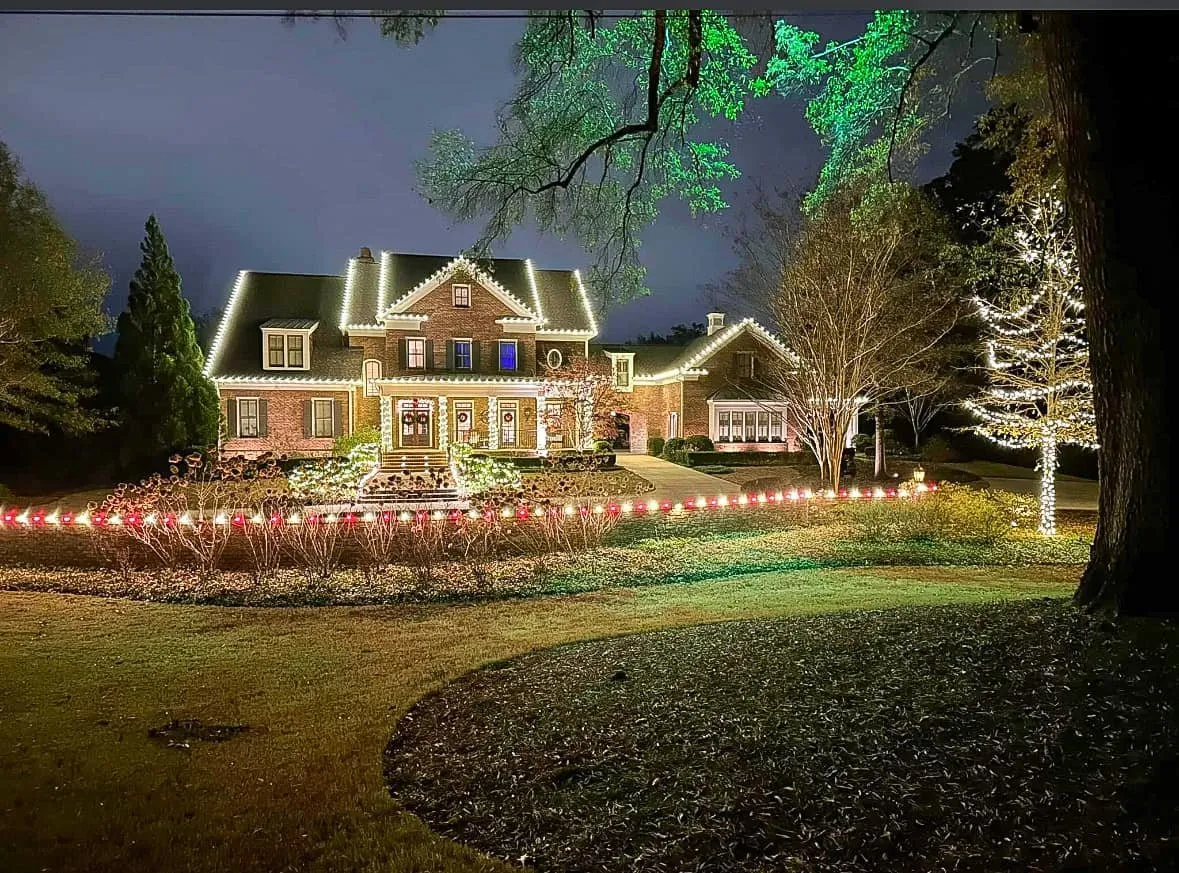
For the green glow on the background trees, use a single outdoor projector placed at ground level 15-20 feet from the canopy and aim it up through the branches — never at the trunk, which just looks like a spotlight on bark. Put the projector on its own timer so it can shut off at 10 p.m. while the rest of the display keeps going. One fixture, 15 feet of distance, and a whole tree turns green for about $60.
20. Warm White Everywhere on a Gray Siding House
Gray siding is the most forgiving backdrop in this entire article. Warm white light on cool gray creates the same temperature contrast that makes candlelight feel cozy in a modern room — nothing about it reads as holiday-specific, which is why it works from November through February. The snow helps twice: it reflects light back onto the facade, and it mutes the ground so the house becomes the only thing in frame. Add the wet driveway reflections and you’ve got a display with almost no ornament at all.
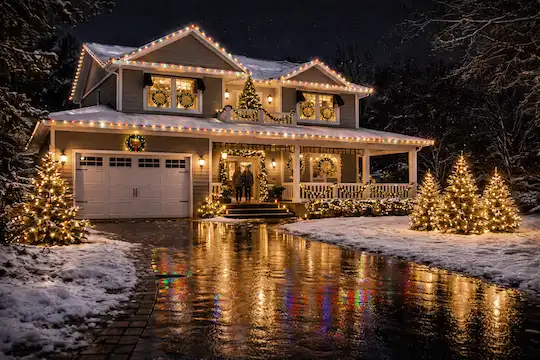
That beautiful glow on wet pavement is free, but it’s also a warning. Meltwater and cords don’t mix, so every connection should be either off the ground, wrapped in a weatherproof cover, or both. Plug everything into a GFCI outlet — if water does get in, the outlet trips instead of the lights shorting. Expect to re-clip a few strands after the first heavy snow slides off the roof; keep a spare bag of clips in the garage.
21. Landscape Uplighting on Stone and a Rock Waterfall
This is architectural lighting, not holiday decorating, and it needs room to breathe: a facade of 3,000 square feet or more, a setback of at least 40 feet, and enough planting beds to hide the fixtures. On a standard suburban lot the same technique works with four to six well-placed uplights instead of twenty. If your yard is small, spend the money on one dramatic tree instead — see Idea #6 for the ground-level approach.
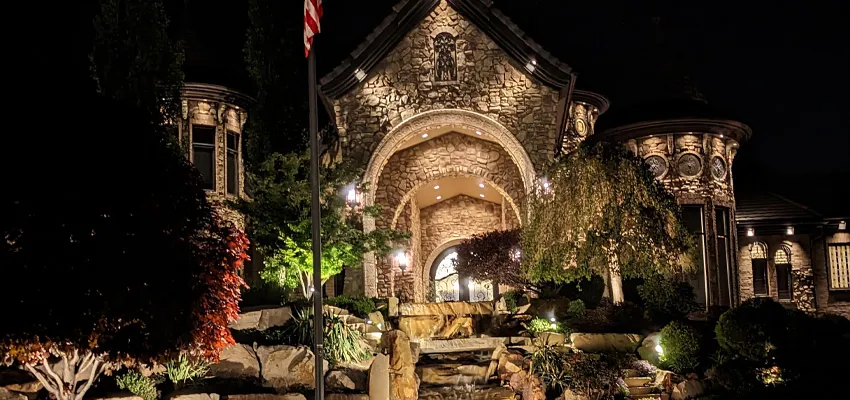
Beam angle is the number nobody talks about. For uplighting a stone facade, use a 30-40 degree narrow beam aimed straight up the wall; a wide 60-degree flood washes everything and flattens the texture you paid for. Space fixtures every 6-8 feet along the wall for even coverage. And keep them out of the sightline from the street — nothing kills a grand entrance faster than a visible black box sitting in the flowerbed.
22. Warm White Outlines and Wrapped Bare Trees in Snow
- Main lights: 400-500 ft warm white for rooflines and bare trees, $120-$220
- Lighting accents: two lit potted evergreens, $40-$90 each
- Power and hardware: clips, cords, timer, $40-$75
- Decor and accents: garland and wreath for the door, $40-$80
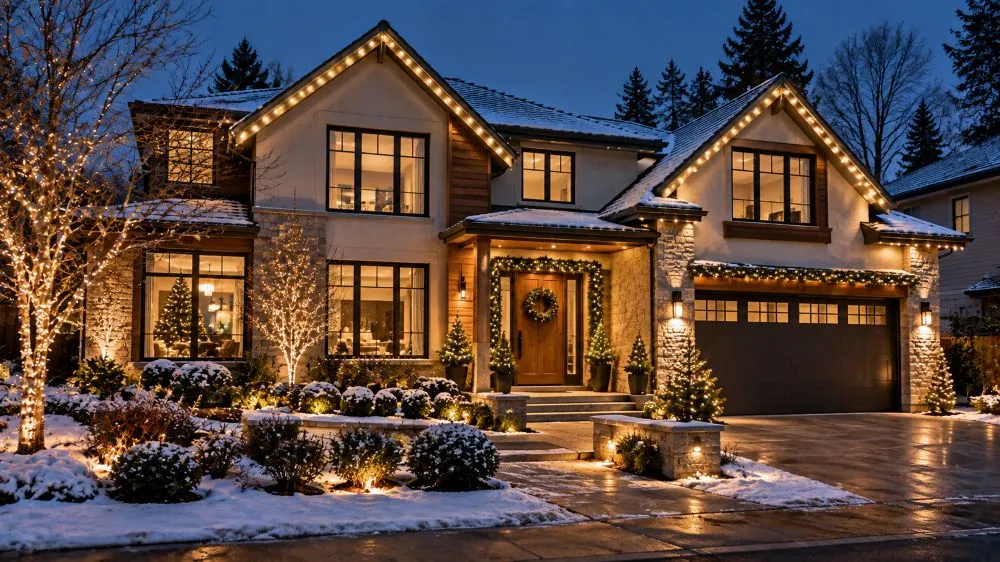
Budget alternative: keep the rooflines and one potted tree, skip the rest. $120-$200, and the composition still holds together.
Before you commit to a scheme this size, run the checklist:
- Measure the total roofline run, then add 20 percent for sag and clip spacing
- Count your exterior outlets and confirm each one is GFCI-protected
- Check ladder height against your highest gable — you need three feet above the roofline
- Confirm you have climate-controlled storage, because heat and sun degrade wire
23. Red and White C9 Peaks on a Dark-Sided House
On dark siding, red C9 bulbs read almost maroon at night — the wall absorbs the glow instead of bouncing it. The fix is contrast: alternate a red peak with a white peak, which forces the red to pop back. Keep spacing at 12 inches for C9, since each bulb is a visible dot rather than a blur, and run the same color sequence up every gable so the house reads as one composition instead of five separate triangles.
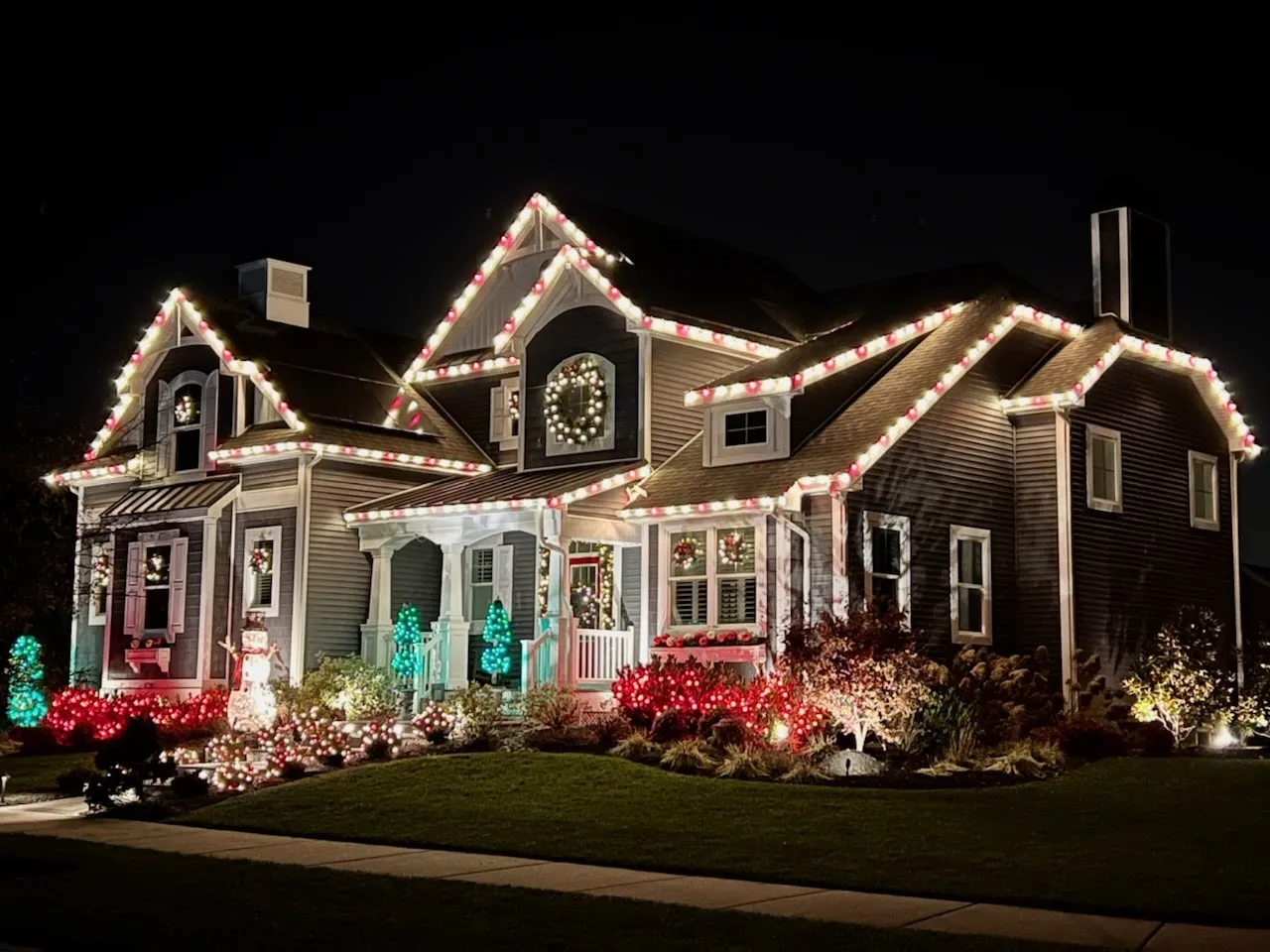
Light-up conical trees are the easiest yard filler in this whole display — stake, plug, done. Big-box stores sell them for $25-$45, and the tall green and blue versions are usually the same mold in different plastic. Bushes wrapped in red can be handled with net lights at $12-$20 each, and window wreaths with built-in lights run $20-$35. The lit snowman is the one piece worth paying up for, since cheap versions look lumpy in daylight and you’ll be staring at it for six weeks.
24. A Victorian Porch Wrapped Column to Column
Wrapping the porch columns is what makes this Victorian read as cared-for rather than just decorated. Columns are the one place where lights follow the architecture of the house itself, and since the porch is where people actually arrive, that’s the detail that gets noticed. Same principle as Idea #16, just vertical instead of along the entry. Wrap tight, base to capital, and don’t stop halfway up.
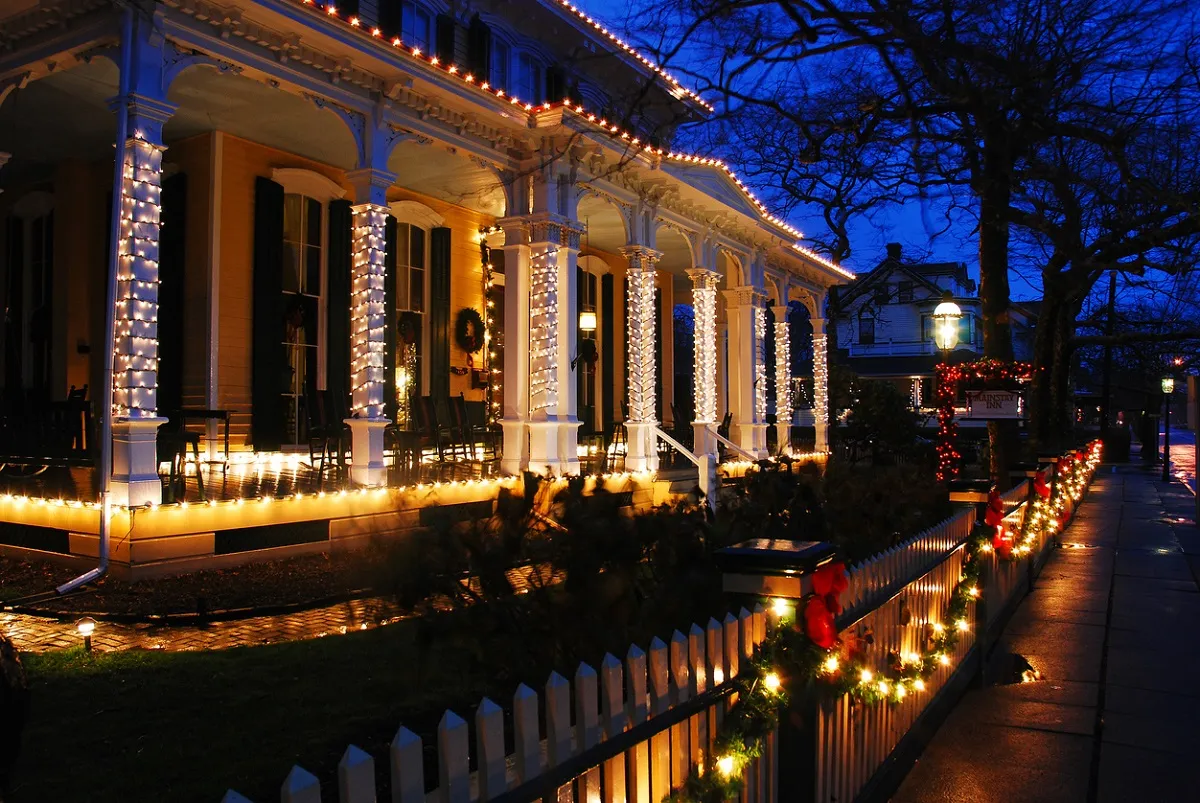
Doing the fence garland properly takes an afternoon, not a weekend.
- Zip-tie the garland to the top rail every 18 inches, keeping the swag between ties consistent.
- Run lights through the garland after hanging, weaving over-and-under rather than coiling.
- Add red bows at every post so the spacing looks intentional from the sidewalk.
- Power the run from one end only — daisy-chaining from the middle causes voltage drop and dim ends.
Time: 2-3 hours for 30 feet. Cost: $80-$160.
25. One Big Tree, Every Color in the Box
Spiraling the strand around the trunk rather than circling it in rings is the difference between a lit tree and a tree that looks like it’s wearing a belt. A spiral follows the tree’s own growth line, so the eye reads continuous motion upward. Then the branches get their own treatment, with light allowed to thin out toward the tips — full coverage at the trunk, sparser at the edges, which is exactly how the tree itself carries weight.
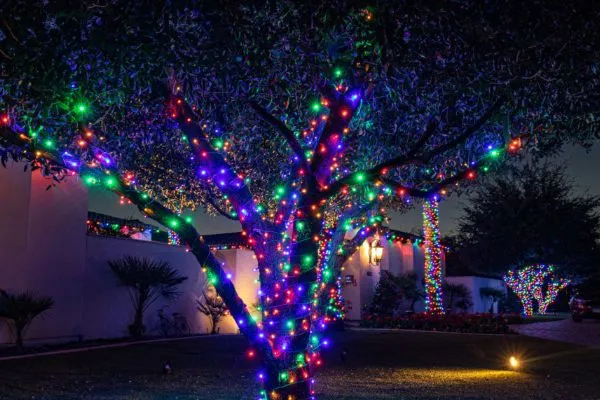
A mature tree pulls real amperage, so don’t treat it like a single strand. Most LED strings draw about 0.02 amps per foot, which means 800 feet is still fine on one circuit — but incandescents draw many times more, and four strands is your practical limit. Check the rating printed on the wire before you chain anything. The lights won’t hurt the tree, but tight wrapping left on for months can girdle thin-barked saplings. Get it off by February.
26. White Brick, White Lights, and a Vertical Chimney Drape
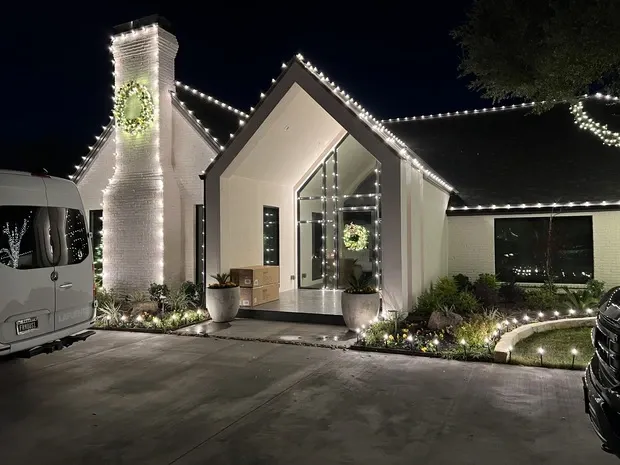
Vertical runs are far less forgiving than horizontal ones. Drape the chimney in straight drops spaced 12-18 inches apart — closer than that and it reads as one solid white column, wider and it looks like an accident. Use a plumb line or a laser level on the first drop, then match every other strand to it. Clip to the mortar joints rather than the brick face, because clips bite into brick and leave marks you’ll still see in daylight. The same spacing works for tall glass entries and narrow gables.
- Measure your tallest vertical run and confirm your ladder actually reaches it safely
- Locate the nearest outlet — long vertical runs usually need their own power source
- Check whether your roof edge accepts clips or needs adhesive hooks instead
- Set a hard budget before you shop, because white-on-white schemes tempt you into one more strand
27. Blue Icicle Rooflines and a Yard Full of Characters
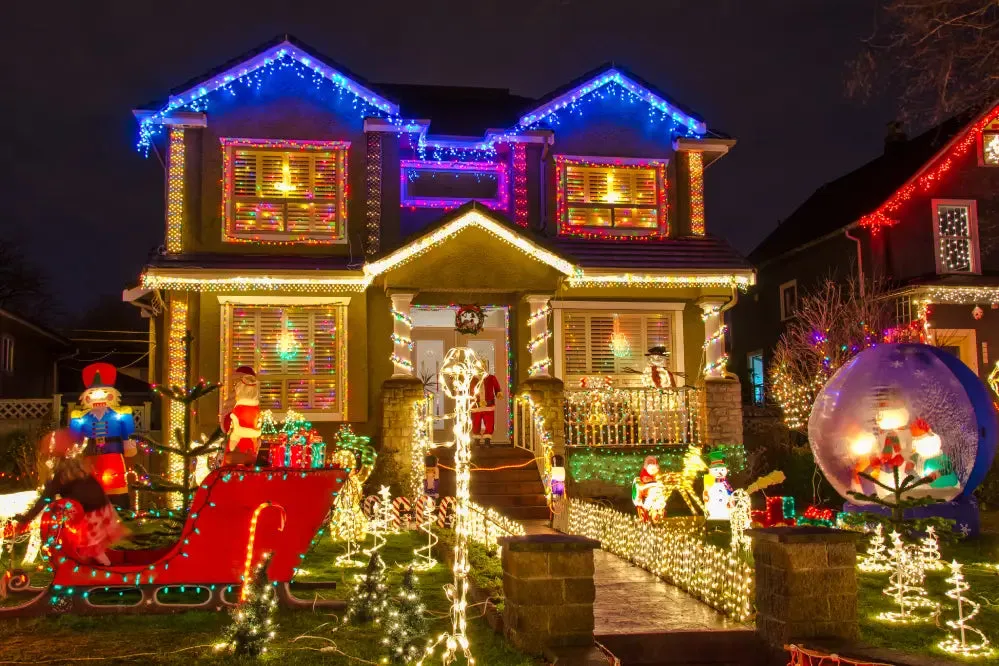
A display this dense has three predictable failure points.
- Power: total the wattage on every strand and keep it under 80 percent of the circuit’s capacity
- Wind: anything inflatable needs 3-4 feet of clearance and a tethered base
- Storage: this volume of decor needs a shelving unit, not a bin
Also decide now whether you’re willing to run it every night. A display this bright becomes a neighborhood landmark, and turning it off for a week reads as a statement.
Maximum-density displays need maximum room. Plan on a yard at least 40 feet wide and 25 feet deep so the figures don’t crowd each other, plus a driveway that isn’t the only path to the front door. The taller pieces — sleighs, nutcrackers, snow globes — should sit at least four feet apart so each one is individually readable. On a smaller lot, pick two characters and one light color and stop there.
28. Alternating Red and Blue Bulbs Along the Eaves
Strict one-to-one alternation, 10-12 inch bulb spacing, and nothing else. This is a ninety percent dark neutral arrangement with ten percent saturated color doing all the heavy lifting — the dark siding and stone veneer are what make red and blue read as graphic rather than chaotic. Swap the pair for any two colors that sit opposite each other, like teal and amber, and the formula holds. Break the alternation and it immediately looks accidental.
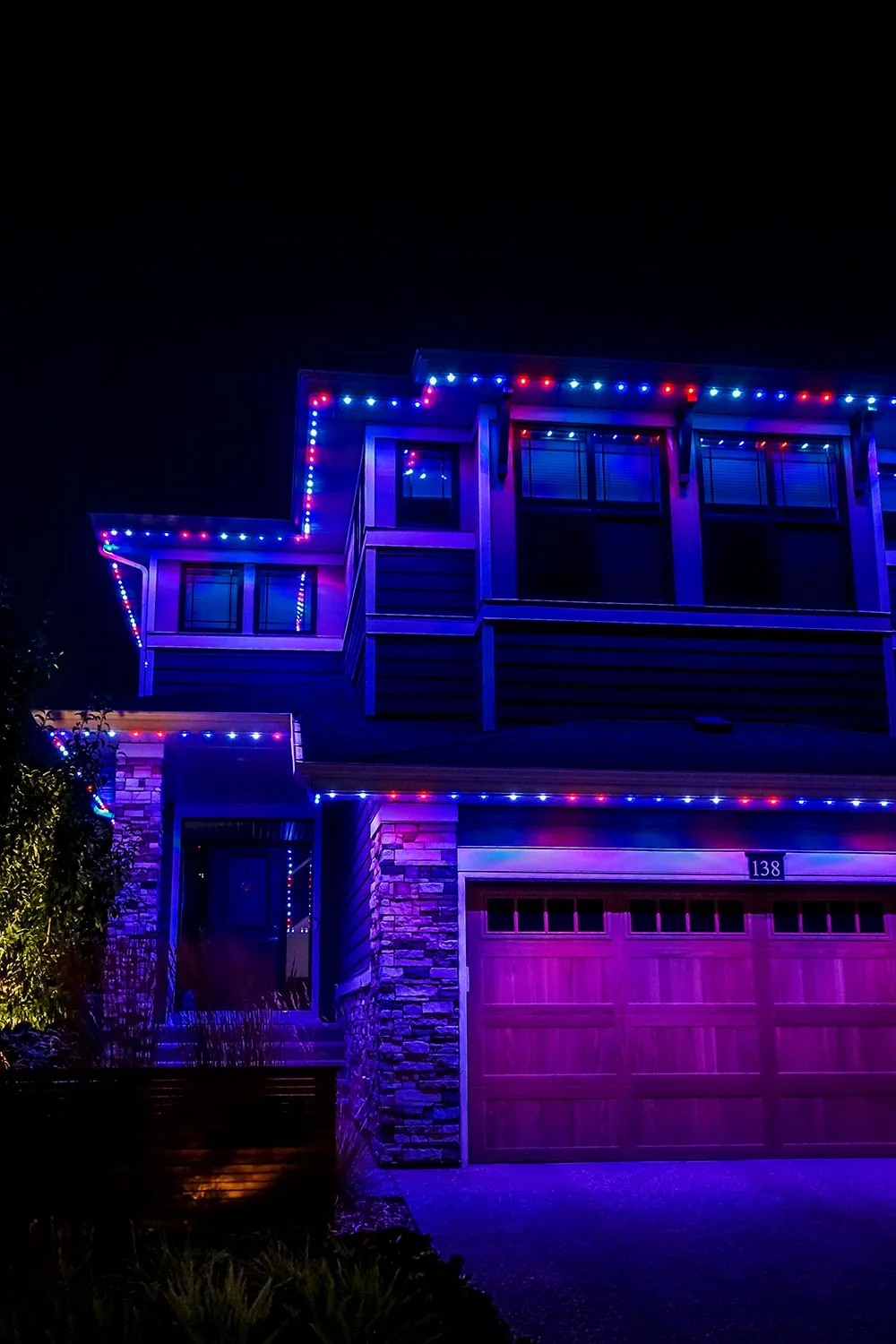
Paired-color schemes are where the non-traditional lighting trend went next. Once people saw that magenta and orange worked, the obvious question became what else. Red and blue has a natural graphic punch that photographs extremely well — which is why you keep seeing it in saved Pinterest boards — and it plays nicely against dark siding where warmer colors get swallowed. It’s a one-season look rather than a classic, but at LED prices that’s a fair trade.
29. Palm Trunks Wrapped in Warm White
- Main lights: 300-450 ft warm white for roofline and palm trunks, $100-$190
- Power and hardware: clips, outdoor cords, timer, $35-$60
- Decor and accents: none — the palms are the display
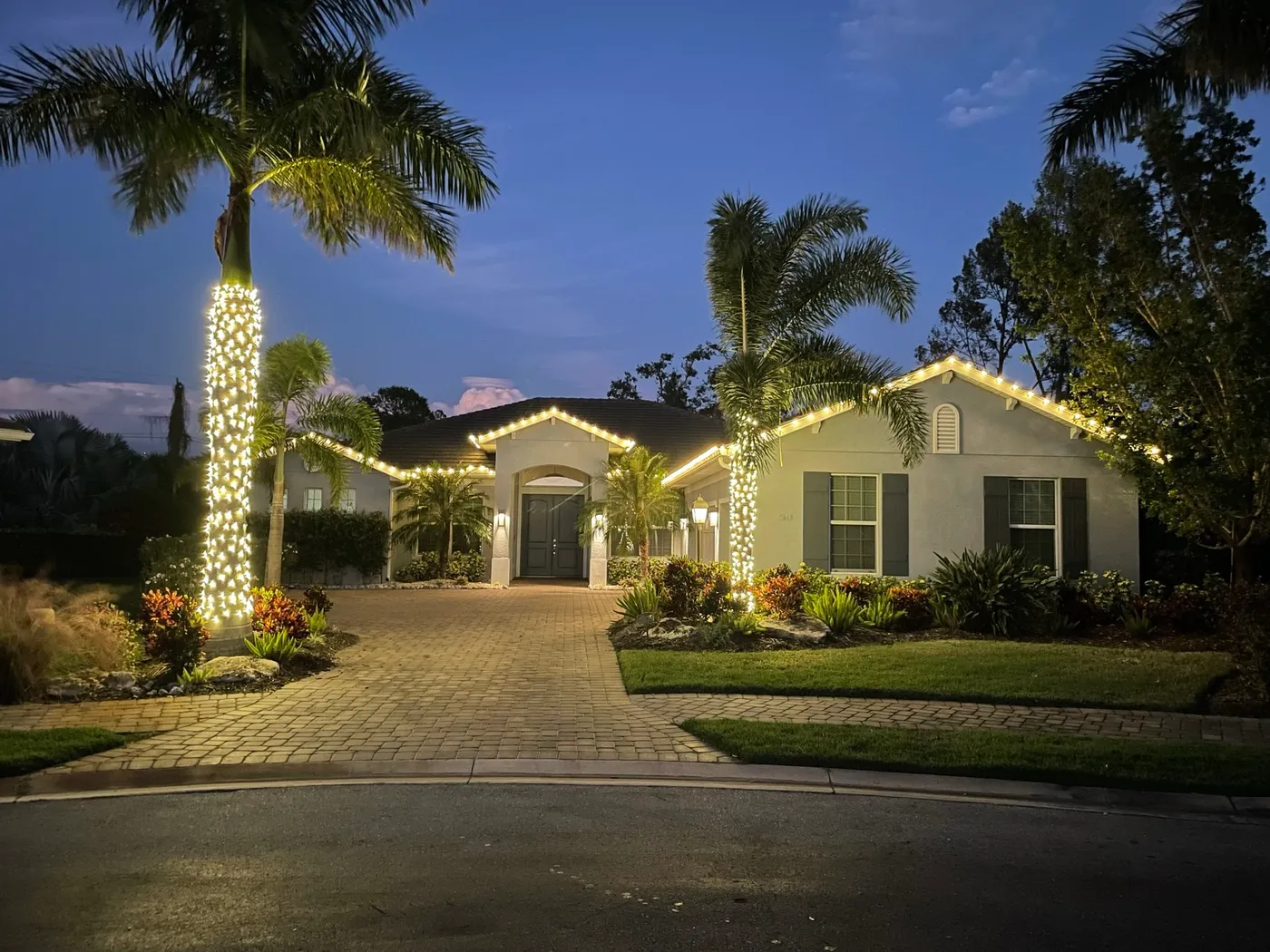
Budget alternative: wrap only the two palms that frame the driveway and skip the roofline entirely. About $60-$90, and the greeting effect is nearly identical.
Palms grow, and a trunk that takes 150 feet of strand this year will want closer to 180 next season, so buy a little extra spool and store it. Fronds hold moisture, so keep the spirals loose enough that water can drain and air can move — tight wraps trap damp against the bark and can invite rot in humid climates. Take everything down by mid-January, since strands left on through spring collect debris in the crown.
Your Roofline, Your Rules — Go Light the Block
You don’t need the biggest display on the street — you need one that’s deliberate, warm, and reachable from a ladder you actually own. Pick the idea that matches your house, buy one color temperature, keep your runs short, and let the architecture do the rest.
📌 Save this to Pinterest so next November’s you has a plan instead of a tangled bin.