
Blue and gold is having a serious moment on Pinterest right now — and honestly, we get it. It is the rare holiday palette that looks expensive in a photo and still holds up in a real living room with a dog, a radiator, and a kid who rearranges ornaments when you are not looking.
We spent serious time browsing Target, Walmart, Amazon, and Etsy to bring you only what is worth your attention, covering everything from $1 dollar-store ornament picks up to $1,050 statement trees and everything between.
Inside you will find 31 curated ideas spanning flocked winter white, jewel-tone velvet maximalism, cabin rustic warmth, celestial navy, and modern black-and-metallic — with budget and luxury versions compared side by side. And stay until the end — we break down the most common mistakes that can ruin these looks.
Blue finally broke the red-and-green monopoly on holiday decorating, and in 2026 it has arrived with gold, mercury glass, and a lot of velvet ribbon. 📌 Save this to Pinterest for later — you will want to revisit these ideas. Some links here are affiliate links; if you buy through them we may earn a small commission at no cost to you.
1. Classic Green Tree, Blue and Silver on a Patterned Rug
What holds this tree together is a deliberate color limit: green branches, blue ornaments, silver ornaments, and nothing else competing. Because the tree itself is plain — no flocking, no spray snow — the blue reads as a real decision instead of a seasonal default. And laying it all on a blue-and-cream patterned rug pulls the floor into the scheme, so the tree does not float in an unrelated room.
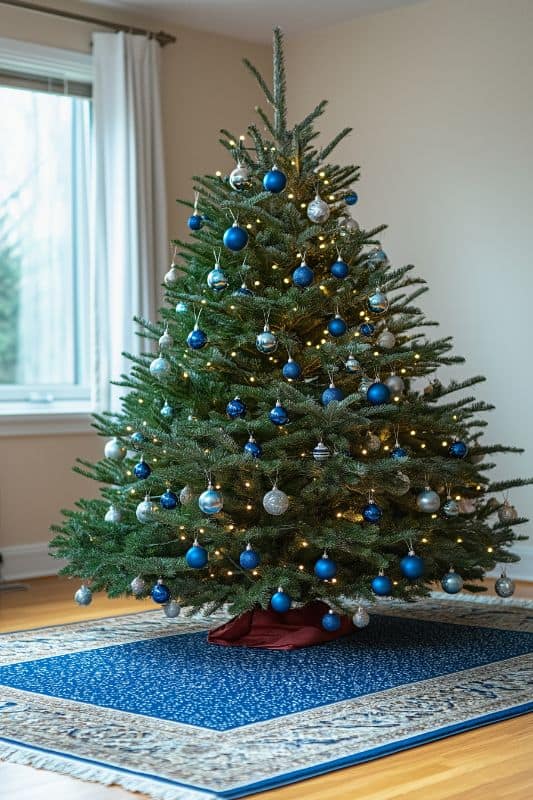
Size your ornaments in thirds and hang them in descending order: the biggest pieces go in the bottom third where the tree is widest, medium ones through the middle, smallest near the top. Keep them about 4 to 6 inches apart and never hang two identical ornaments side by side. If you are short on ornaments, buy an inexpensive set of oversized filler balls — they read as volume from across the room, which is where anyone actually sees your tree from.
2. Cabin Christmas Tree with Muted Blue, Bronze, and Plaid
- Pre-lit tree, 7.5 ft: $180–$450
- Extra warm white string lights: $15–$40
- Textiles — plaid and solid brown ribbon: $25–$60
- Ornaments — matte blue and bronze spheres, floral picks, faux berry sprays: $80–$220
- Wrapping paper and gift boxes: $40–$90
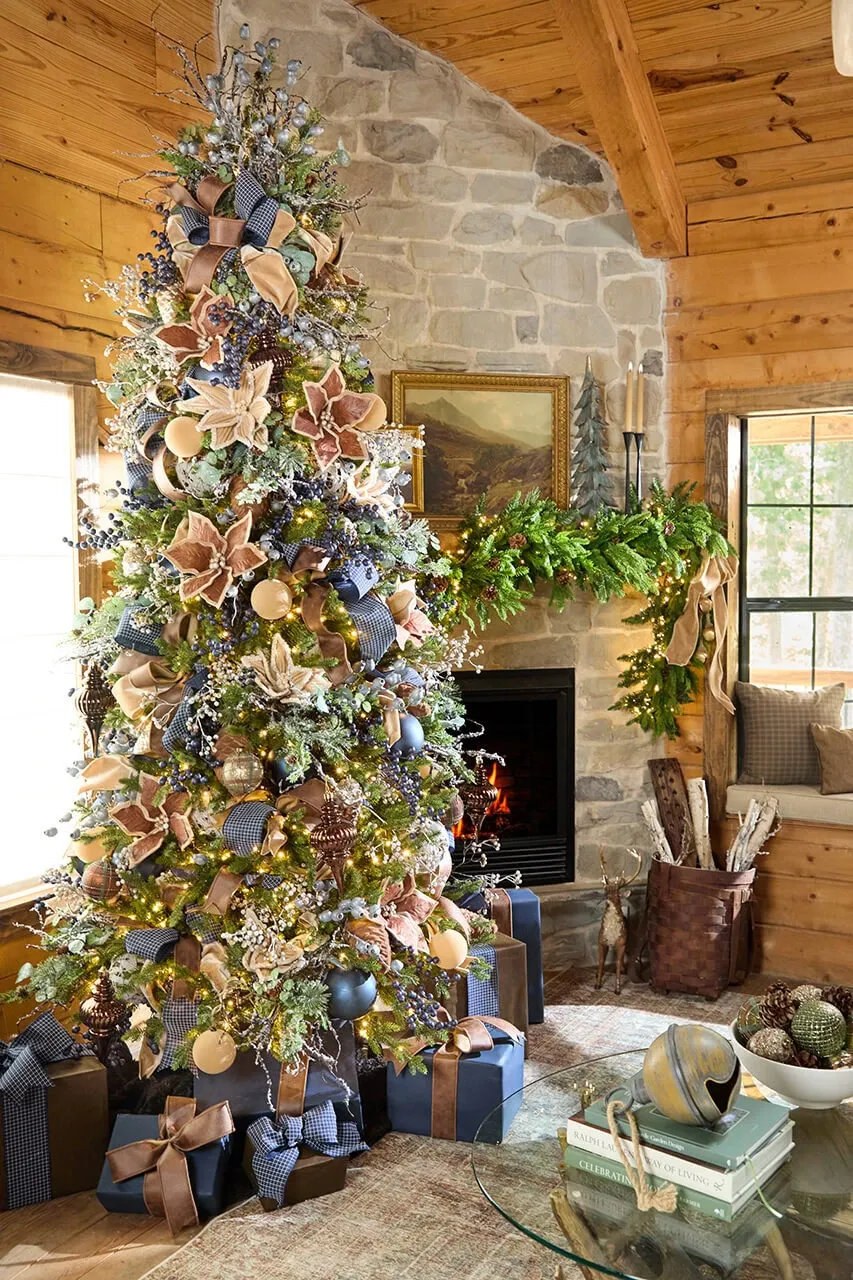
Strip out the plaid ribbon and this becomes blue-and-brown, which is a much flatter story. The plaid is what introduces the cabin, the woodsmoke, the whole reason the bronze works in the first place. It also does quiet structural work: a patterned ribbon breaks up a wall of solid color so your eye keeps traveling around the tree instead of stopping. If you only buy one thing from this photo, buy a wide plaid ribbon and thread it through horizontally, not in a spiral.
3. A Cone of Electric Blue and Warm White Light
Light-only trees have quietly become the front-of-house move, and the reason is practical: they photograph beautifully at night, they need zero storage space for ornaments, and they let you run one bold color story outside while keeping something softer indoors. Electric blue paired with warm white is the version that has held on longest, because the blue supplies the drama and the warm white keeps the whole thing from reading cold and corporate.
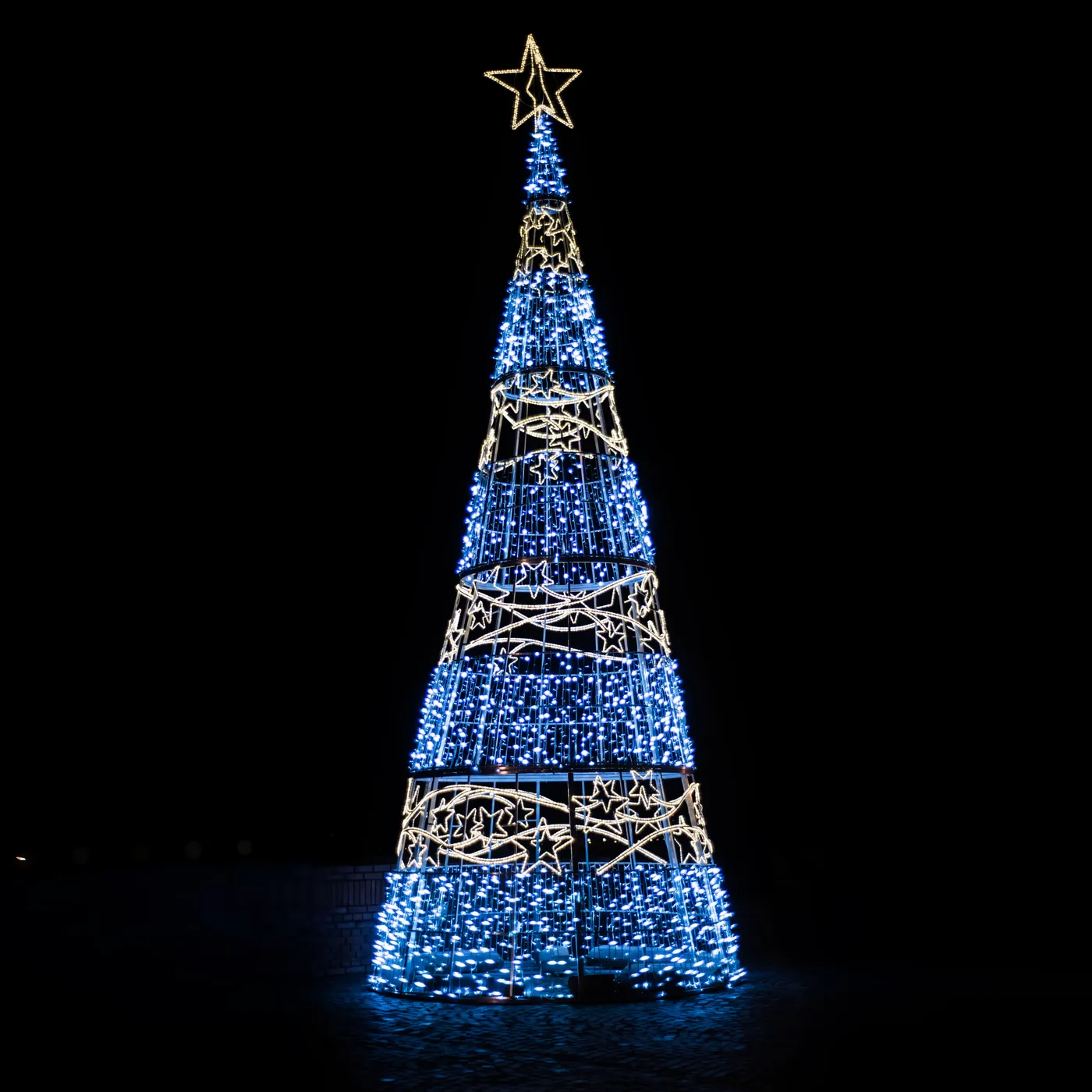
For a light cone, work in three layers: vertical strands for the body, horizontal bands for structure, and one swirling ribbon of light for movement. Keep the warm white elements at roughly a third of the total light volume — that is the ratio that keeps blue from turning icy and flat. Always finish with a single unmissable topper like a star or starburst; without it, the shape starts to read as a traffic cone.
4. Teal and Gold Tree with a Vintage Clock and Fairy Wing
The clock. Everything else here — the teal baubles, the gold lanterns, the fairy wing — is beautiful but predictable. The vintage gold-framed clock is the piece that turns a decorated tree into a story with a beginning and an end. It also does something clever compositionally: a large flat object interrupts the endless roundness of baubles, which is exactly what keeps your eye moving. Find one oversized, non-round object and give it the center of the tree.
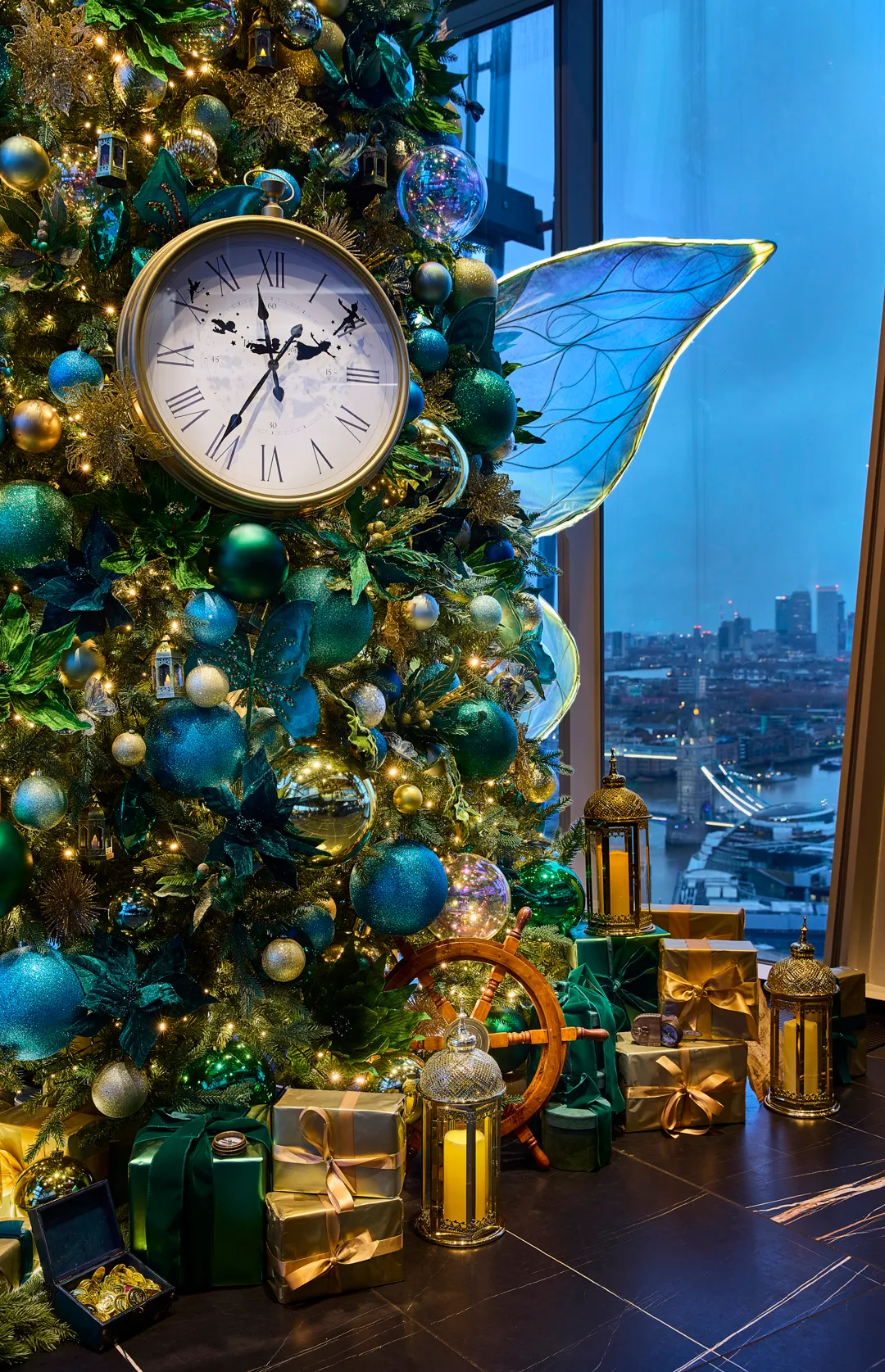
The formula is roughly 55% deep teal, 25% gold, 15% forest green, 5% glowing warm white. Teal does the heavy lifting, gold draws the light, green keeps it grounded, and the glow is the punctuation. To shift the mood, hold the percentages and swap the hue: burgundy instead of teal for a darker, more vintage feeling, or a lighter aqua for a brighter tree. Keep the gold at about a quarter and it will still read expensive.
5. All-Gold Cascading Ribbon Tree with a Statement Bow
- Artificial evergreen tree, 7.5 ft: $120–$400
- Warm white string lights: $15–$35
- Textiles — wide gold ribbon, sheer gold ribbon, bow topper: $30–$80
- Ornaments — gold spheres, stars, bells, glitter picks: $90–$250
- Filler foliage and picks: $25–$60
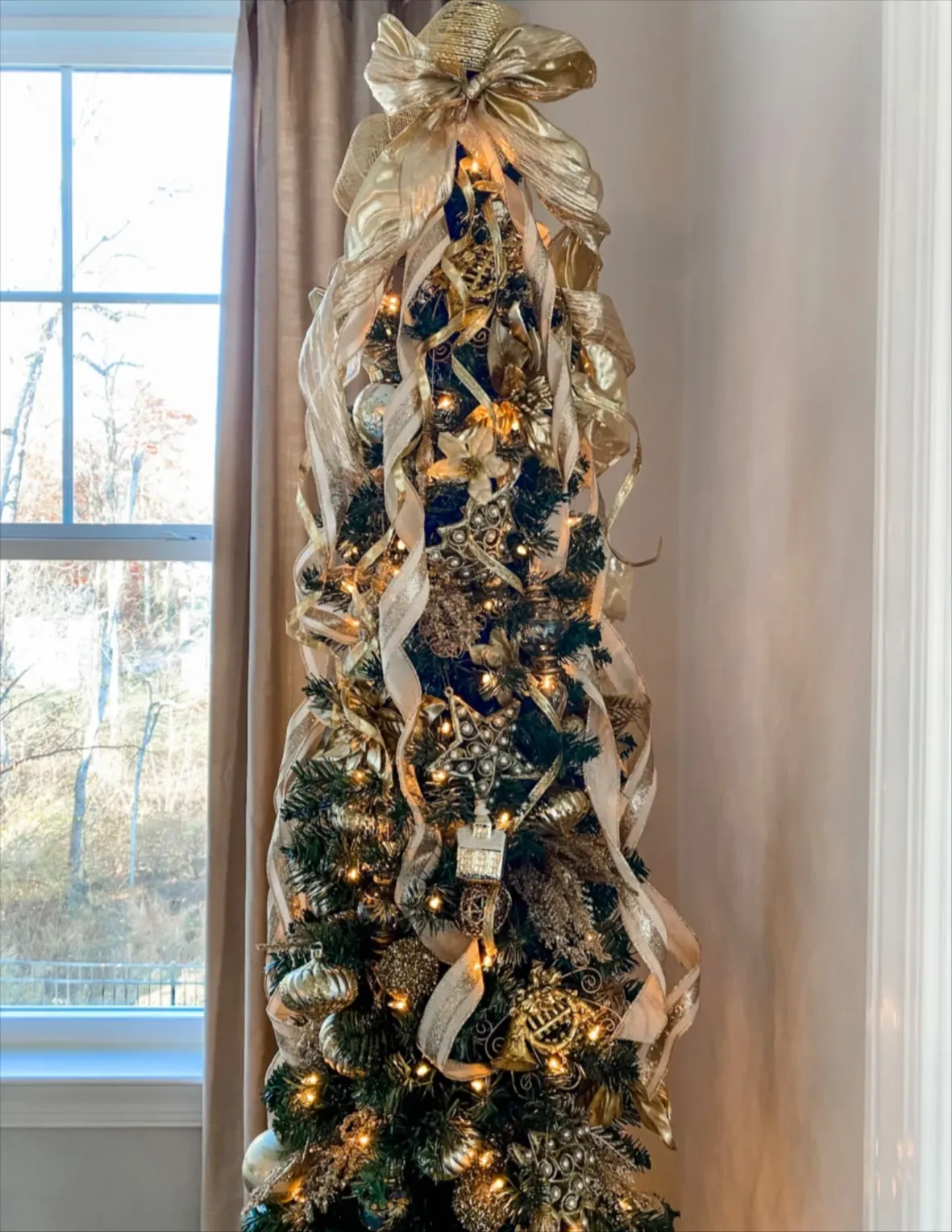
An all-one-color tree only works when the textures are genuinely different, and this one delivers. You get shiny gold, matte gold, sheer ribbon, glittered picks, and small hard bells, so the eye reads variety even though the palette never changes. The cascading ribbons also create long vertical lines, which make a tree look taller and slimmer than it is. If you try this in gold and everything you own is the same finish, it will look like a discount store display.
6. Flocked Tree in Silver, Gold, and Dusty Blue
A heavily flocked tree with a full load of ornaments needs breathing room — plan on at least 10 feet of wall and roughly 120 square feet of floor for a 7.5-foot tree, more if you want gifts visible around the base. Ceilings under 8 feet will make the flocking and the topper feel crowded, so drop to a 6.5-foot tree and keep the topper flat rather than tall. Compare with Idea #21 — the same blue idea at a smaller scale for apartments and tight corners.
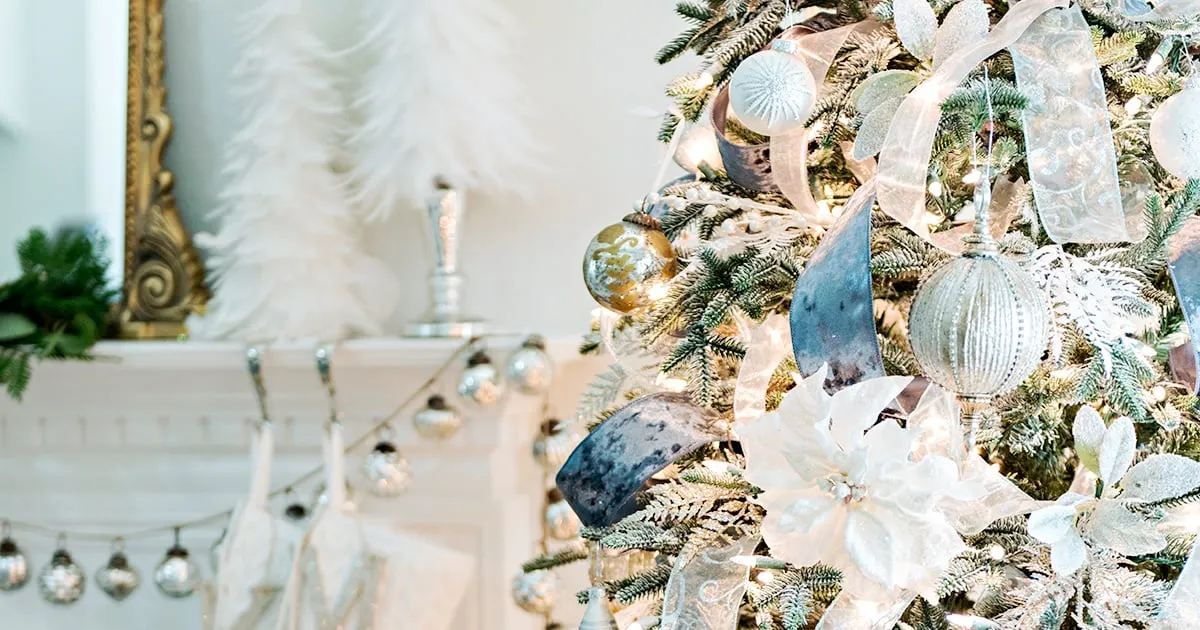
Flocking sheds. It will dust your floor for the first week and again every time you move the tree, so put a mat or rug underneath before you assemble anything. Dusty blue is also a shape-shifter: in a warm-lit room it reads soft and gray-blue, but under cool daylight LEDs it can turn noticeably gray. Before you commit to a whole tree of it, hang three ornaments in the actual spot and look at them at night.
7. White Flocked Tree with Blue, Silver, and an Outline Star
- Measure your ceiling to the inch — a flocked tree plus a tall topper needs 8.5 feet minimum.
- Check where the room’s light comes from; a white tree in a dark corner goes gray by 6 p.m.
- Count your blue ornaments before buying more — you need roughly 12 to 15 pieces per foot of tree height.
- Confirm your lights are warm white, not cool white, before you string a single strand.
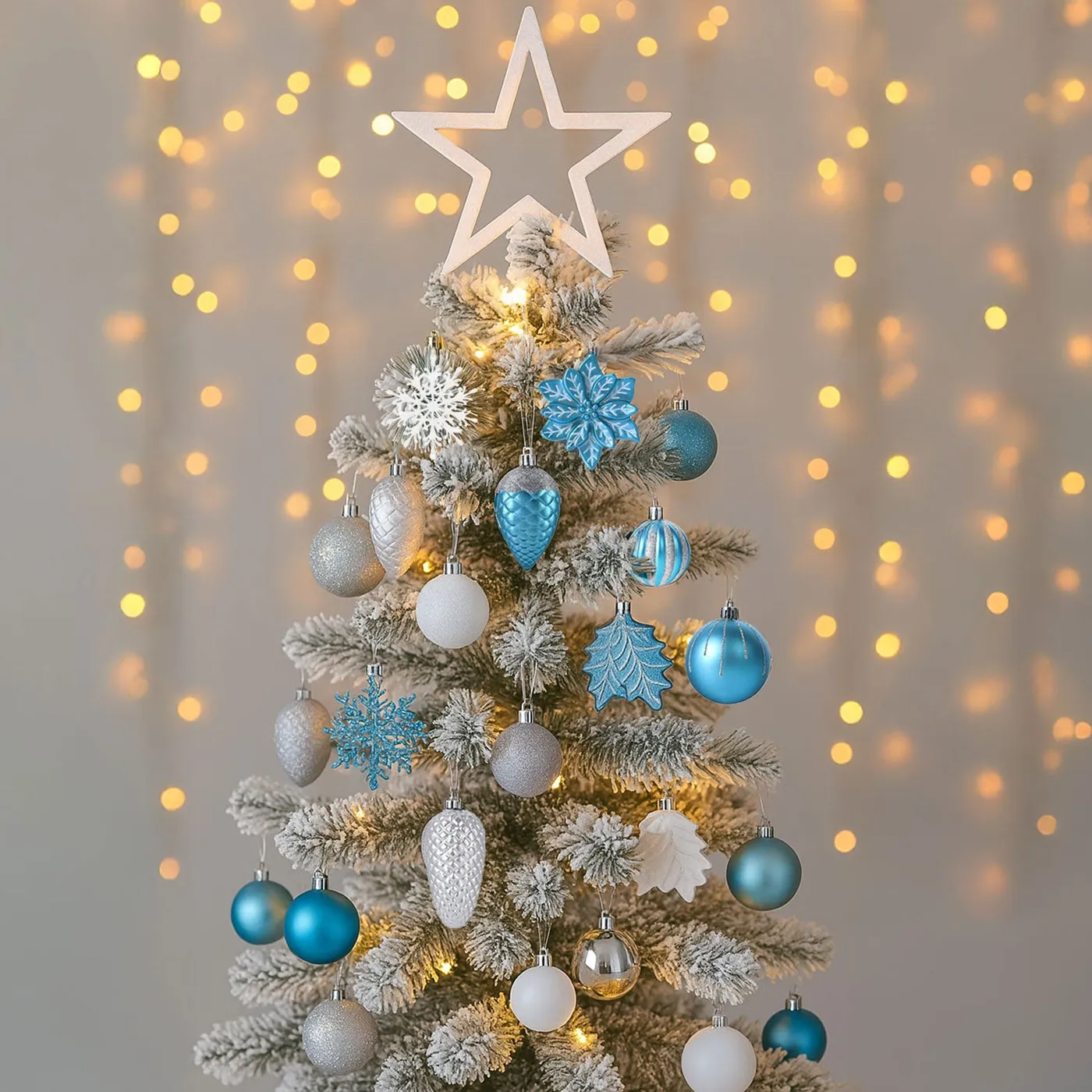
Read this tree as 60% white, 25% blue, 10% silver, 5% warm glow. The white base is the flocking, the outline star, and the matte ornaments, which is why the blues can go bold without overwhelming anything. To make it feel less wintery, swap the silver for champagne gold and keep everything else — same formula, warmer result. To push it colder and more modern, trade the matte white ornaments for pearl and let the blue drop a shade deeper.
8. Jewel-Tone Velvet Ribbons and Eucalyptus Branches
- Start with lights only — three to four strands of warm white on a 7.5-foot tree, woven in and out of the branches.
- Cut velvet ribbon into 3-foot lengths and drape them vertically, tucking the ends deep into the branches rather than looping them.
- Add large matte and metallic baubles next, spaced a hand-width apart, in navy, burgundy, gold, and mustard.
- Finish by tucking eucalyptus sprigs between ornaments so they trail outward and soften the edges.
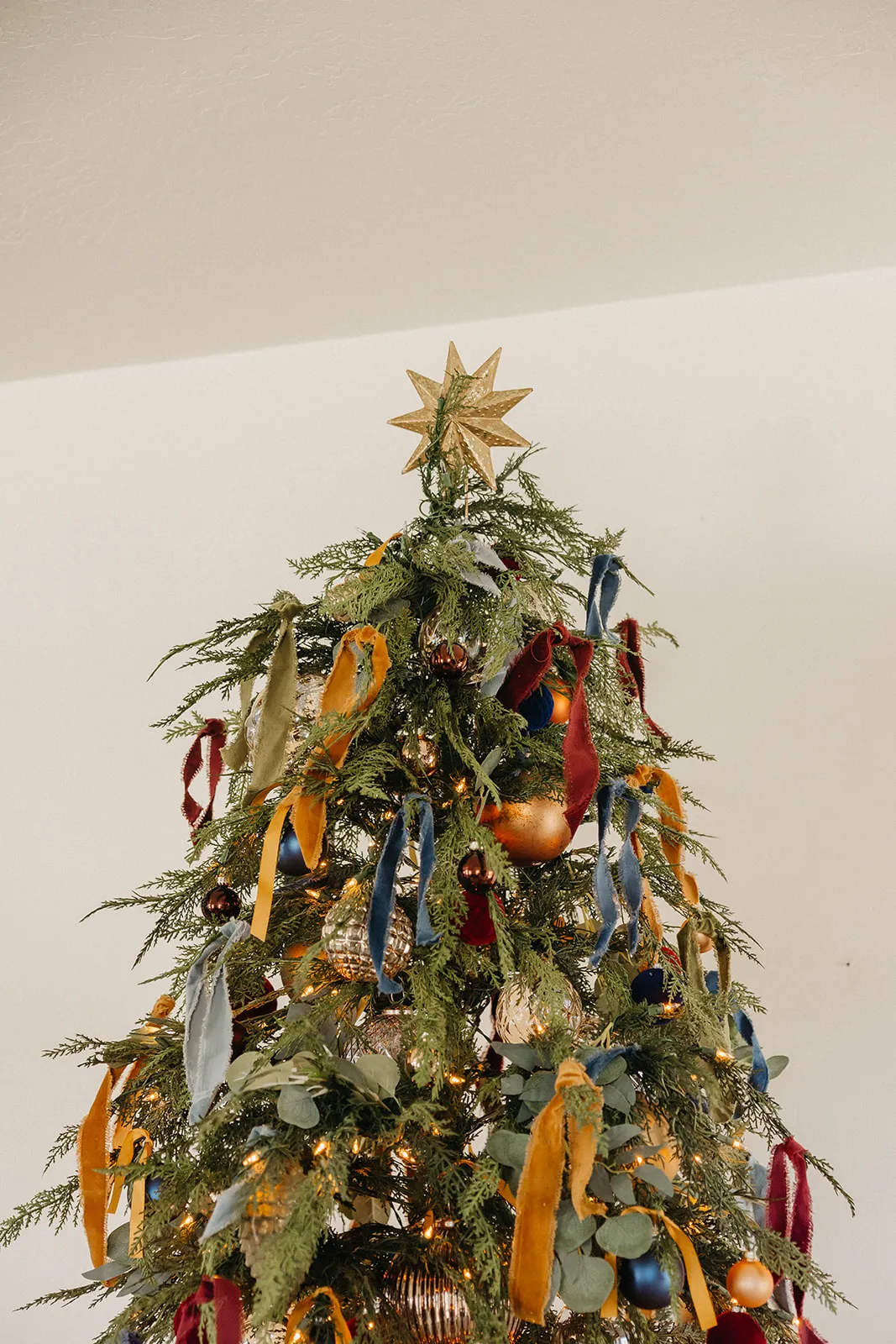
Time: about 2 hours for a 7.5-foot tree. Ribbon and picks run $40–$90. The eucalyptus is the piece that matters most — without it this is a lovely jewel-toned tree, still just ornaments on branches. The eucalyptus adds a matte, dusty green that does not match anything else, and that slight mismatch is what makes the whole thing feel collected instead of purchased.
9. Frosted Tree with Matte, Glossy, and Velvet Blue
When you decorate in one color, finish variety replaces color variety — and the rule of thumb is roughly one third matte, one third shiny, one third textured (velvet, ridged, flocked, or beaded). Hang them so no two finishes sit adjacent; you are aiming for a checkerboard of textures across the branches. Keep your smallest ornaments at eye level where people actually look, and let the big textured pieces sit low and high, where they read as silhouette rather than detail.
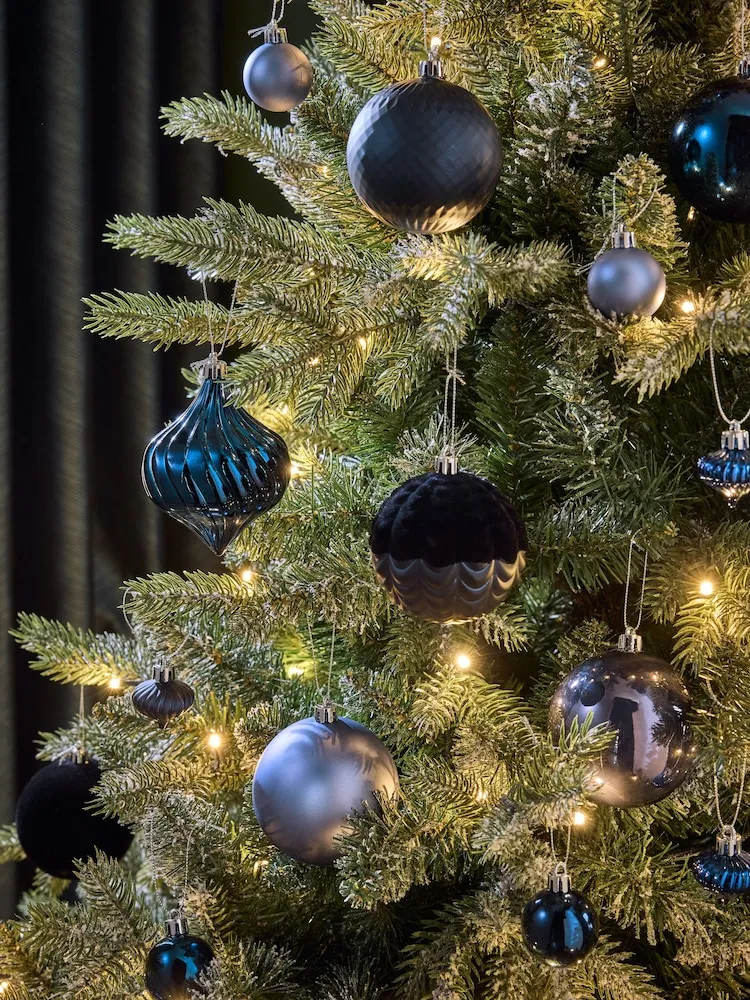
Frosted branches and velvet ornaments are the two most delicate things on any tree. Frosting flakes off when you grip a branch, so lift the tree by the trunk only. Velvet ornaments collect dust and lint that a damp cloth cannot fix — a soft brush is your best option. If you have cats, this is the tree they will notice first, because velvet ornaments land quietly and therefore make excellent toys.
10. Mustard Gold Velvet Ribbon over Dark Blue Baubles
This one runs about 50% deep forest green, 20% mustard gold, 20% dark blue, 10% metallics and eucalyptus. The surprise is the mustard — it is the warm note that keeps dark blue from going funereal. Change the mustard to copper and you get a moodier, more autumnal tree; change it to pale gold and the whole thing brightens into something almost traditional. The dark blue stays constant either way.
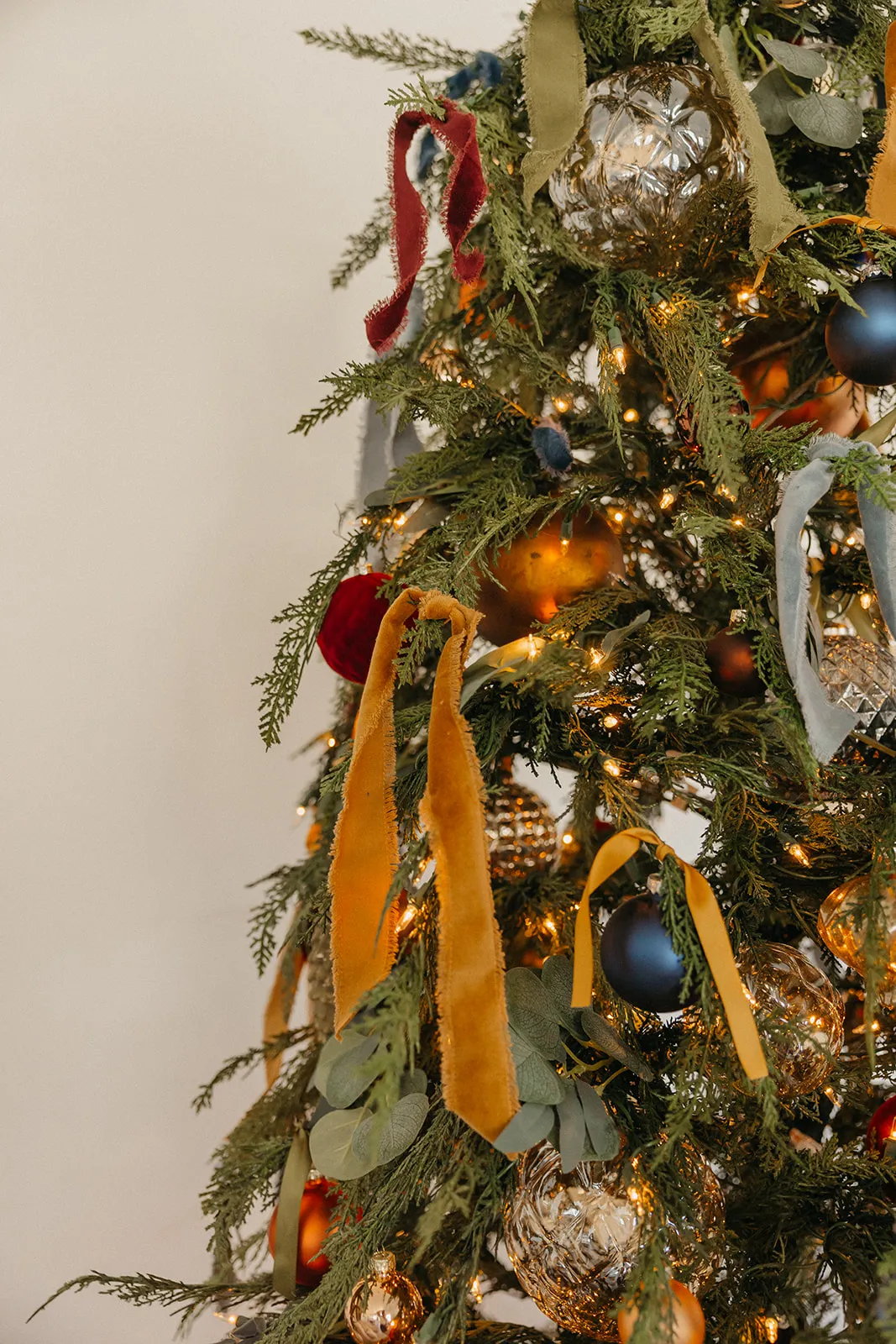
Velvet ribbon is where this look gets expensive, and it is also the easiest place to cheat. A 10-yard roll of wide velvet ribbon at a craft store runs $12–$25, and you only need about three rolls for a 7.5-foot tree. For ornaments, mix a $20 set of matte blue balls from Target with metallic gold pieces from a thrift store and a handful of dollar-store mercury glass lookalikes. Trim this tree for under $100 if you buy ribbon off-season.
11. Matte Blue Ornaments with a Single Gold Stripe
The gold stripe is doing all the work. Each ornament is a plain matte sphere, which on its own is fairly dull, but one horizontal band of metallic gold gives it structure and reflects light at the exact angle where your eye lands. It also solves a common problem with blue-and-gold trees: too many finishes competing for attention. Here the finish is consistent and the pattern creates the rhythm, so the tree looks curated rather than collected.
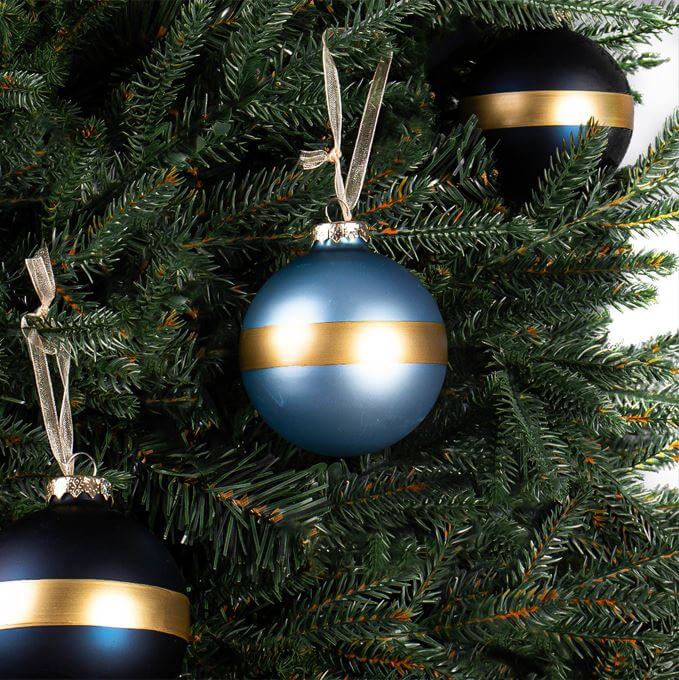
Hang striped or banded ornaments so the stripe stays horizontal — it is tempting to let them tilt, but tilting breaks the rhythm fast. If you want the pattern to feel deliberate, dedicate one whole section of the tree to these and keep the rest solid. Hang them from a narrow ribbon rather than a wire hook; the sheer gold ribbon in this tree is part of the design, not a hardware afterthought.
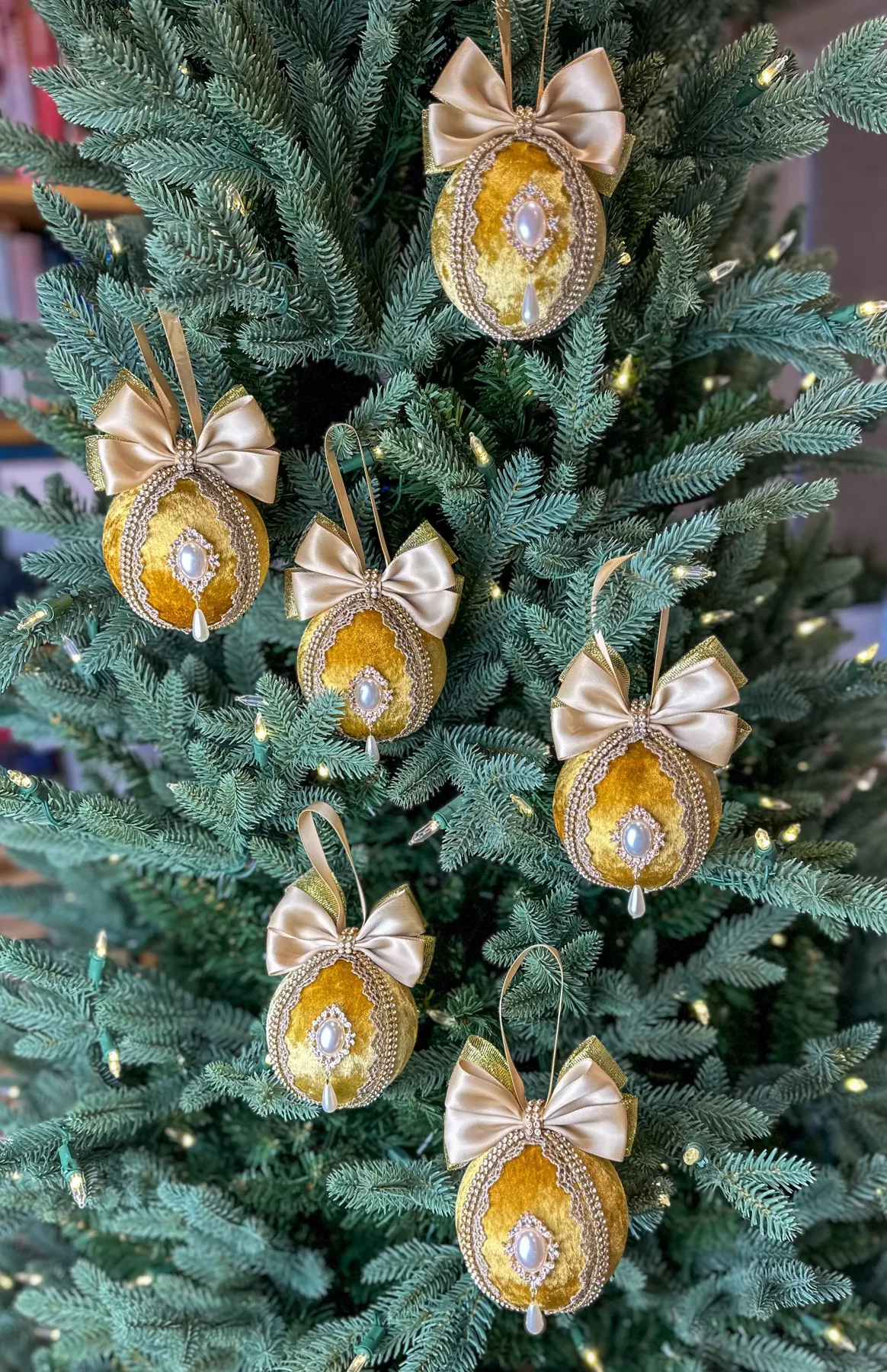
12. Blue-Green Needles with Gold Velvet and Pearl Baubles
Ornaments with velvet flocking, pearls, rhinestone trim, and satin bows are the highest-maintenance pieces you can hang. The velvet flattens where it touches the branch, the pearls yellow slightly over years of sunlight, and rhinestone settings loosen. Expect to replace two or three of these each season. Store them in individual tissue-lined boxes, never stacked, and keep them away from a sunny window — sun does more damage to satin and pearl than age does.
- Measure your ceiling — a blue-green tree with tall ornaments needs 8 feet minimum.
- Decide your light color first; pearls go greenish under cool white LEDs.
- Set a total ornament count so you do not overbuy: about 15 pieces per foot of tree.
- Check that the gold in your ornaments matches the gold in your bows, or the difference will glare.
13. Starry Deep Blue Baubles and Embroidered Gold Ribbon
The celestial theme — stars, deep navy, gold mercury glass, candlelight — is having a moment because it lets people do a blue-and-gold tree that still reads traditional. Navy is the safe blue: it photographs as elegant rather than icy, works with brass and mercury glass, and does not fight a warm glow. Embroidered ribbon is the new part. People are buying patterned ribbon instead of solid and treating it as the main event rather than an accent.
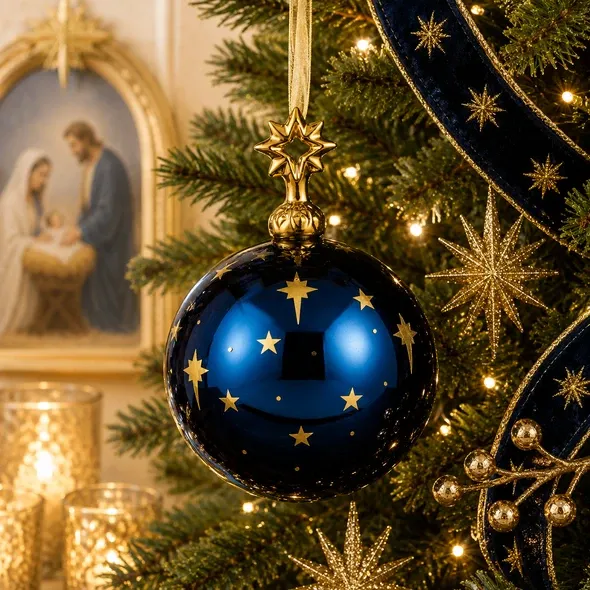
The look comes from two things you can fake well: embroidered navy ribbon, which runs $15–$30 a roll and goes far, and gold mercury glass. Real mercury glass is expensive; modern glass with a gold interior finish costs $6–$14 per holder and reads identically with a candle inside. A gold-framed piece as a focal point can come from a thrift store for under $20. This is the budget version of Idea #4 — same gold-on-blue focus, fewer statement pieces.
14. Deep Blue Velvet Bow with Gold Lace Trim
- Cut two lengths of wide velvet ribbon — one 24 inches, one 14 inches — plus a narrow strip for the hanging loop.
- Form the larger loop first, pinch the center, and secure it with floral wire rather than tying.
- Layer the smaller loop on top of the first, offset slightly, and wire it in place.
- Hot-glue a strip of gold lace trim along the outer edges of both loops.
- Attach the narrow hanger, then fluff the loops by hand so the velvet stands up instead of collapsing.
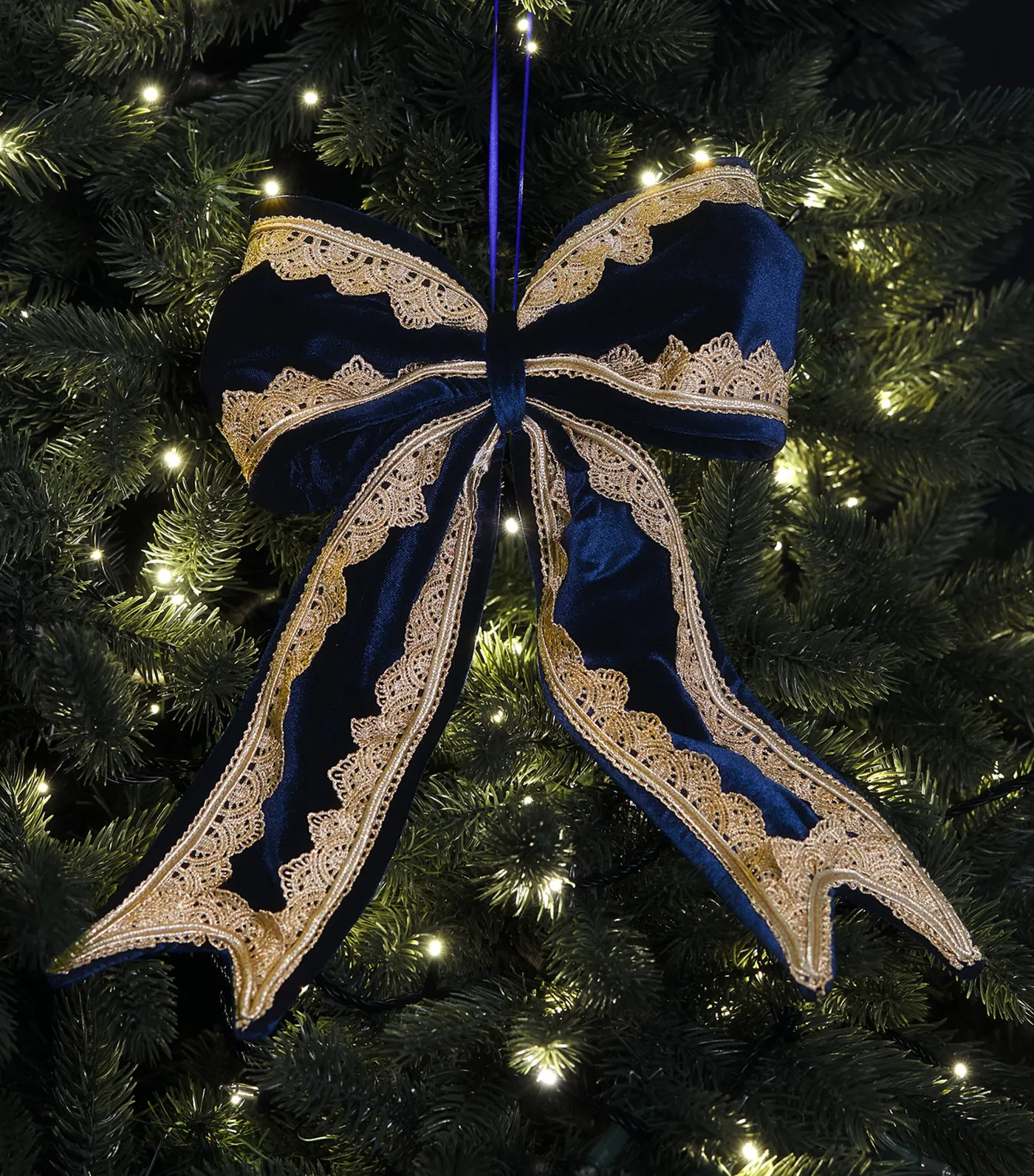
Materials run $8–$20 and this takes about 25 minutes. Make three and cluster them. But scale matters: on a 7.5-foot tree, a 12-inch bow can sit near the top without dominating. On a 6-foot tree, keep it to 8 inches or it will look like a hat. On a skinny pencil tree, skip the oversized bow and use three smaller ones down the front instead.
15. Blue, White, and Natural Wood on Dark Pine
Mixing one non-Christmas material — wood, paper, or raw linen — is the fastest way to make a themed tree feel like a decorated room instead of a display. Budget about 10 to 15 percent of your ornament count for natural pieces: a wooden bead garland, a paper honeycomb ball, a braided straw star. They cost almost nothing and they break up all that shiny glass. Just keep the wood tone warm; cool gray wood fights warm string lights.
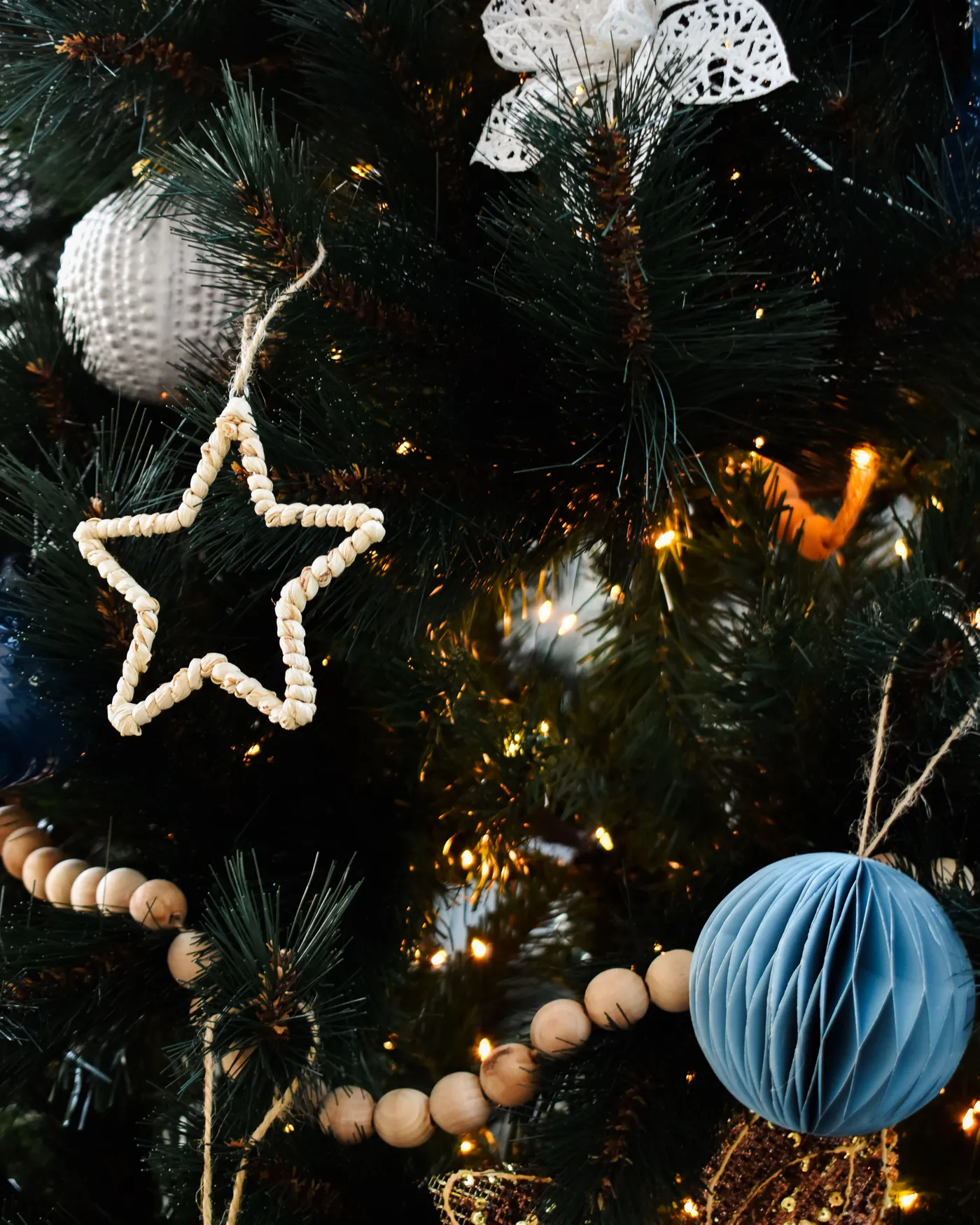
Paper ornaments and dark artificial pine are a risky combination. Honeycomb balls crush if you store them wrong, and dark green needles hide them completely unless they are hung near the tips. Warm string lights are also a real fire consideration with paper, which is exactly why LEDs matter here. If you have young kids, put the paper pieces up high; they look like something you are allowed to squish.
16. Winter Mantel with Velvet Stockings and Frosted Pinecones
- Stockings with faux fur cuffs, set of four: $60–$180
- Mantel garland — frosted pinecones, snowflakes, silver reindeer: $40–$120
- Lighting — warm white fairy lights or battery candles: $15–$45
- Name tags and embroidery: $10–$35
- Greenery for the mantel top: $25–$70
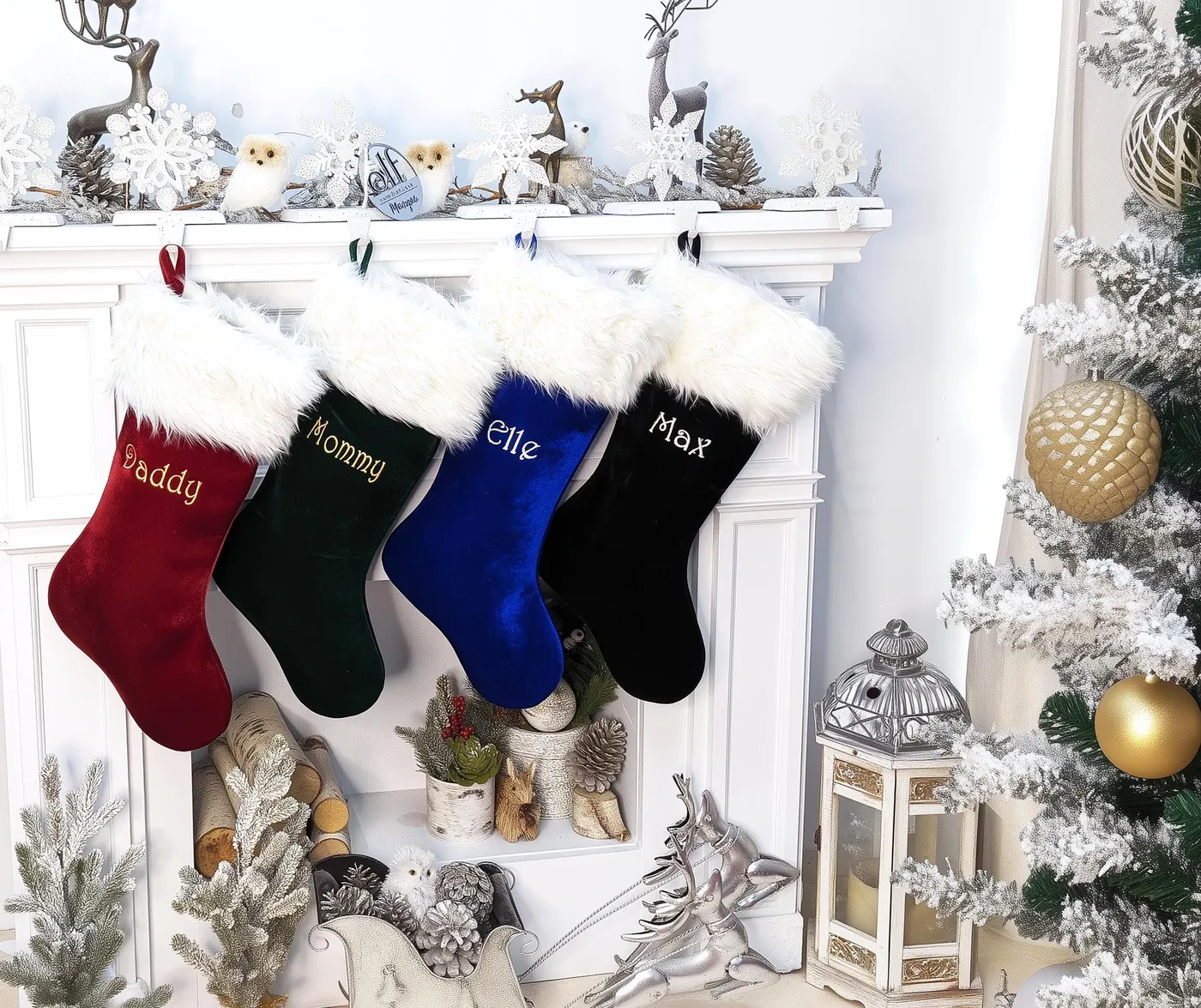
The four stockings are the whole point, and they work because they are the same shape in four different colors — red, dark green, royal blue, black. That is repetition plus variation, the most reliable trick in holiday decorating. The blue and black keep it from becoming a cartoon Christmas, and the identical white fur cuffs tie four totally different colors into one set.
17. Frosted Teal Mercury Glass with Gold Glitter Swirls
Mercury glass is one of those finishes that looks incredible in a product photo and slightly different in your living room. The frosted teal is genuinely lovely, but the gold glitter swirl is fragile — it flakes, and once it flakes you cannot fix it. This kind of ornament belongs in a vignette on a shelf or table, not on a busy tree where it gets handled. Style it where people will actually pick it up and look.
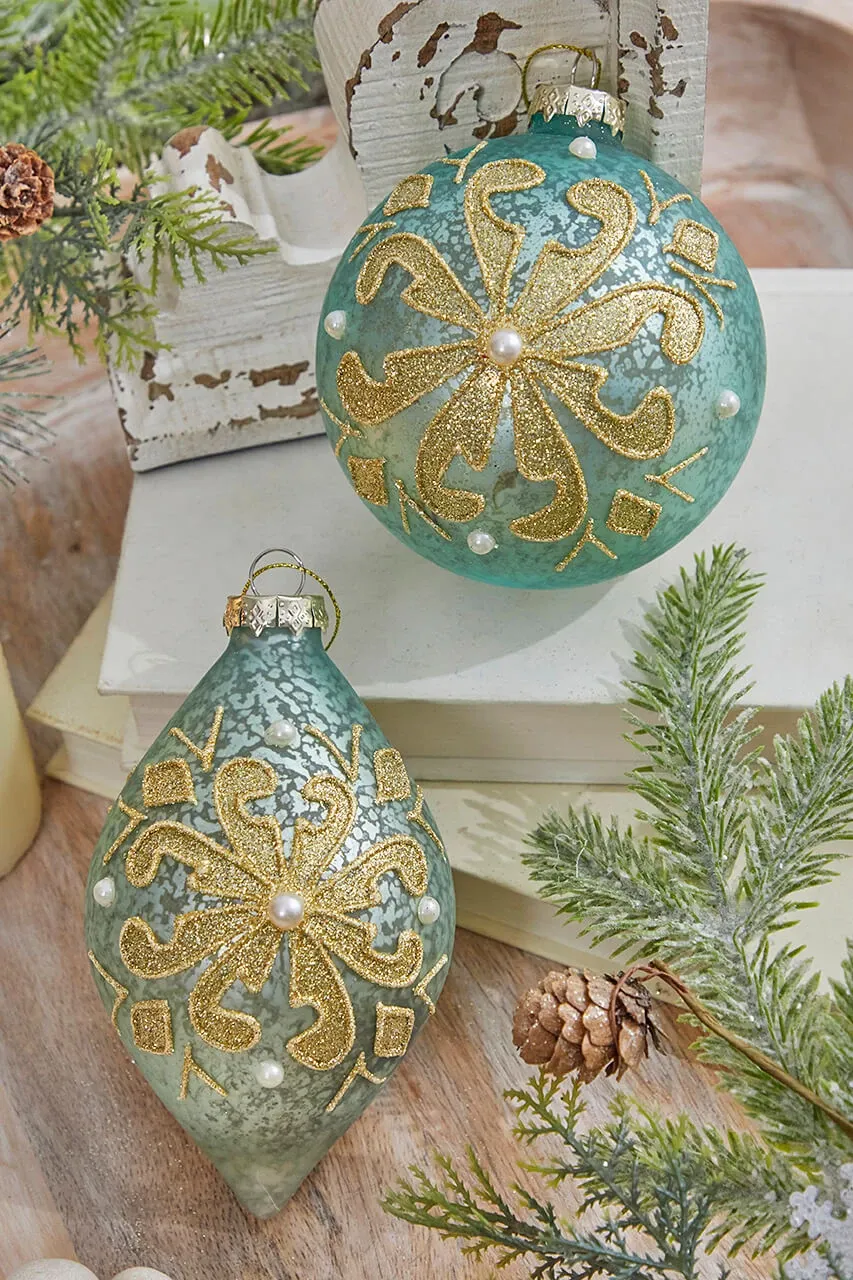
Treat a tray or shelf like a mini tree: about 60% white and natural wood (books, distressed wood, a plate), 30% teal, 10% gold glitter and pearl. That is the ratio that makes these ornaments look styled rather than just set down. Swap teal for deep burgundy to move this into warmer, more traditional territory — the ratio stays identical. Compare with Idea #28, which uses a plate of ornaments the same way.
18. Emerald Ornaments on a Cream Mantel with Gold Berries
The cream mantel. Not the ornaments — those are beautiful, but emerald green baubles are everywhere. What makes this scene work is the pale, matte surface underneath, which lets deep green and gold read as jewel tones instead of disappearing into a dark wood surround. Change the mantel to stained oak and the whole arrangement loses half its impact. If your mantel is dark, lay a runner in cream or natural linen before you set anything on it.
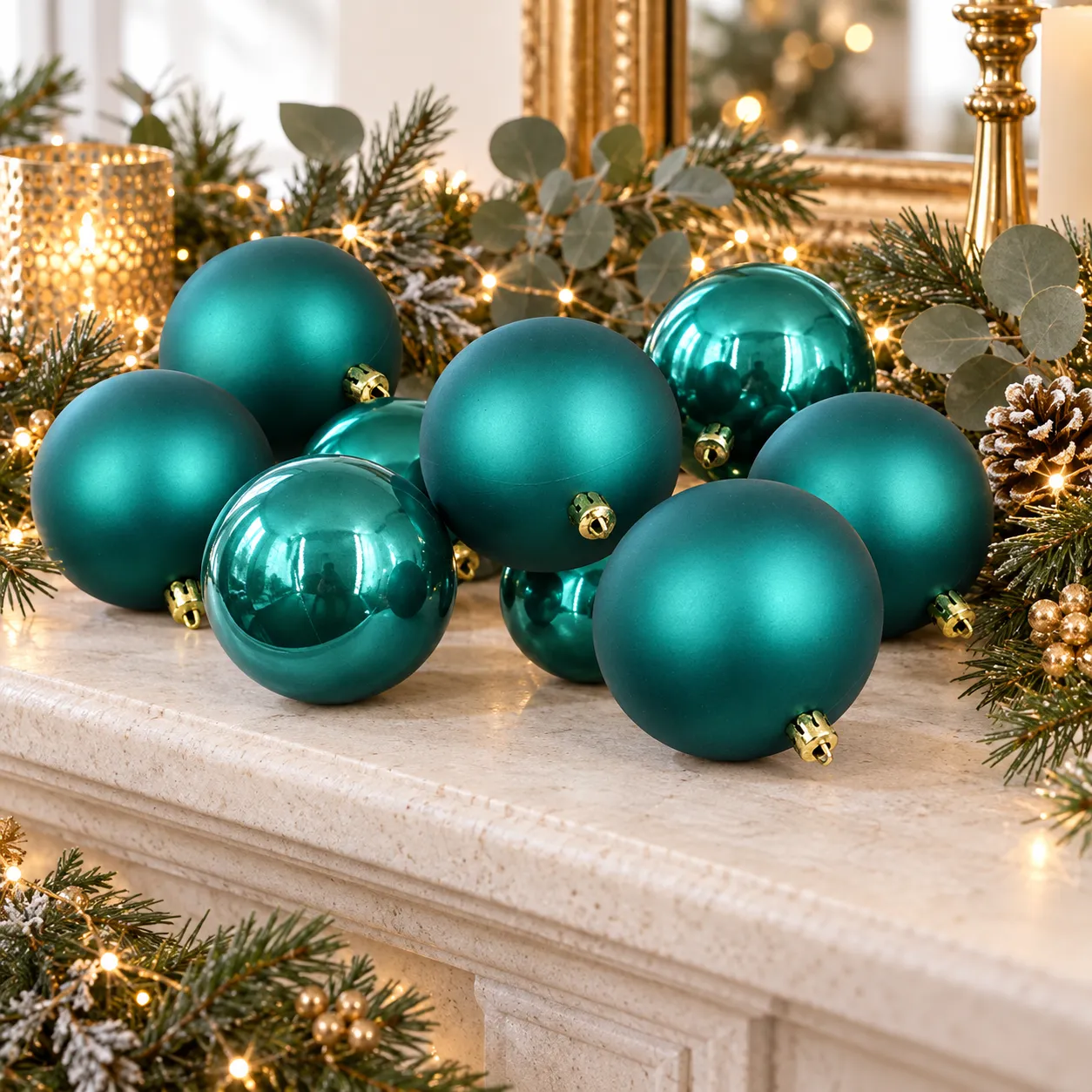
Build a mantel garland in three depths: greenery flat against the surface, ornaments nestled an inch or two forward, and a few pieces hanging over the front edge. That overhang is what keeps a mantel from looking like a shelf of unrelated objects. Keep the garland asymmetrical — heavier on one side, tapering off — and run your lighting from the bottom up so the cord hides in the foliage.
19. Blue and Silver Ornament Mix on Dark Green Branches
Blue and silver is the easiest palette to do cheaply, because every dollar store and big-box retailer carries both. A 30-piece set of mixed blue and silver balls runs $15–$25 at Walmart or Target, and adding one box of oversized silver balls ($10–$18) gives you the scale variation that makes a tree look expensive. Shop the after-Christmas clearance in January and you can stock two seasons for under $40.
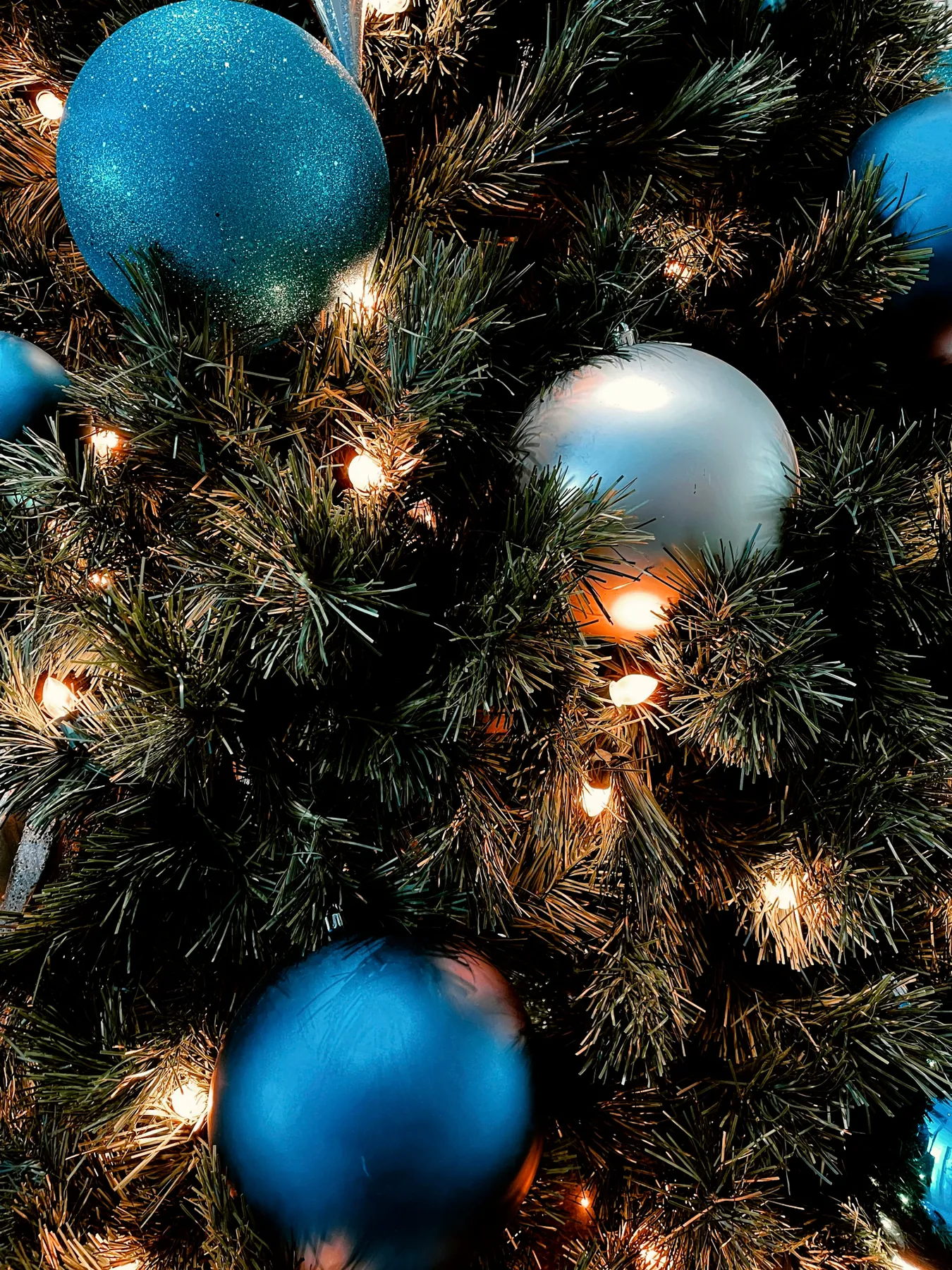
Silver is the great unifier in a blue scheme. Pure blue on green can look cold and slightly flat, but silver balls catch warm string lights and bounce them back as highlights, giving the tree depth without adding another color. Keeping the ornaments round while varying the finish — some glitter, some matte, some shiny — means the eye reads rhythm rather than clutter. This is the same palette as Idea #1, simplified.
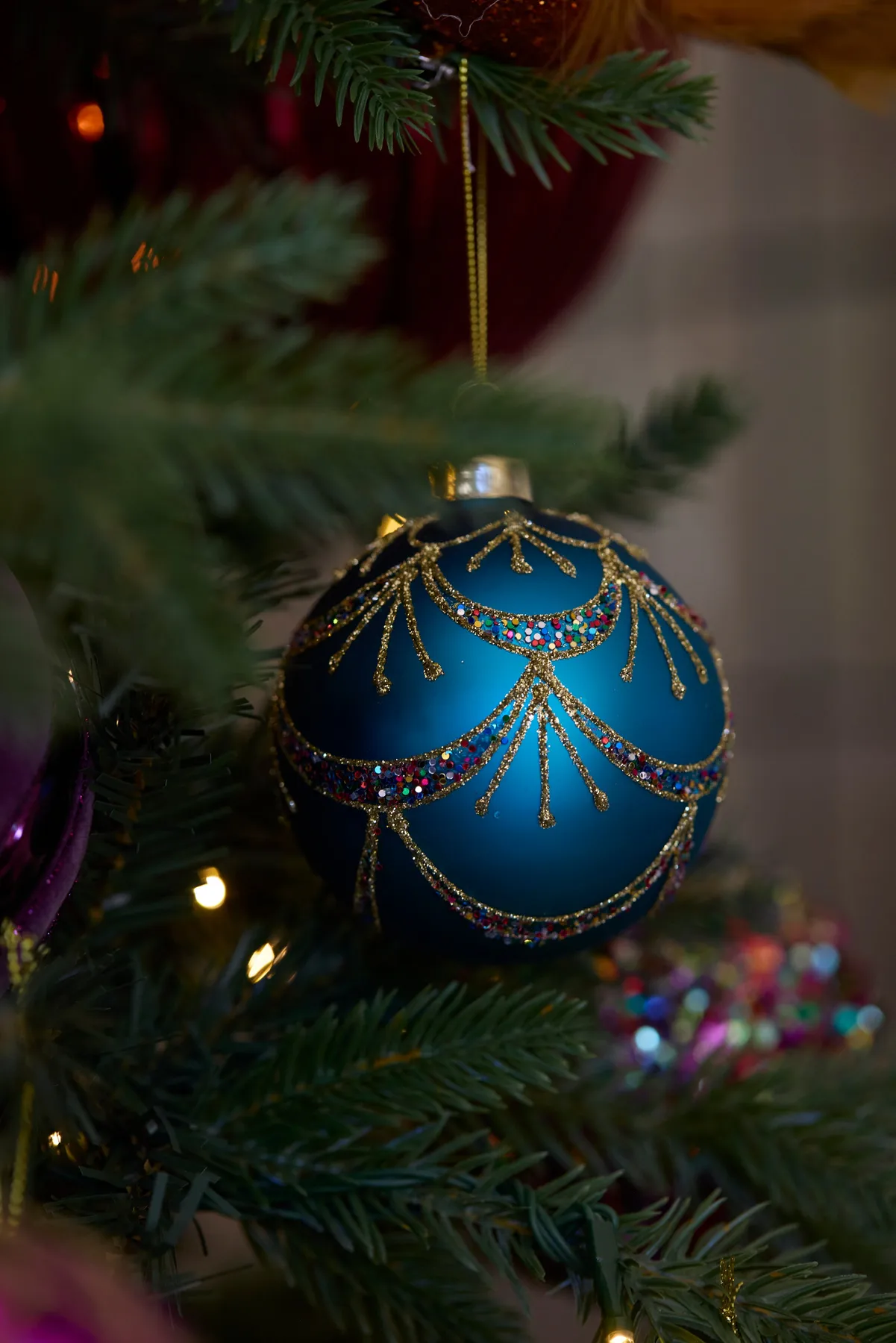
20. Teal Bauble with Gold Glitter Scrollwork and Sequins
Statement ornaments like this one need space to be seen, which usually means fewer ornaments overall. On a 6-foot tree, plan on 8 to 12 statement pieces and let everything else be small and quiet. On a 9-foot tree you can get away with 20 to 25, as long as they are spread evenly rather than clustered near the top. If your tree is under 5 feet, skip statement ornaments entirely and go all small.
- Sort your ornament collection into loud and quiet piles on the floor before you hang anything.
- Place the loud pieces first, roughly equidistant, using the tree’s natural branch tiers as guides.
- Fill between them with the quiet pieces until no bare branch is visible from three feet away.
- Hang the last two or three loud pieces where the tree catches evening light from a lamp or window.
About 90 minutes for a 7.5-foot tree, and zero extra cost — it is a sequencing change, not a purchase.
21. Light Blue Ornament Mix: Ribbed, Wavy, and Scaled
Here the formula is 50% pale blue in mixed textures, 30% white, 15% silver, 5% warm glow. The pale blue is a single hue spread across glitter, ribbed, geometric, wavy, and scaled finishes so the tree never looks repetitive. To warm this up, shift the silver to champagne and swap white ornaments for cream. To cool it down, add a few pieces of deeper navy — maybe 10 percent — and the whole tree gains contrast.
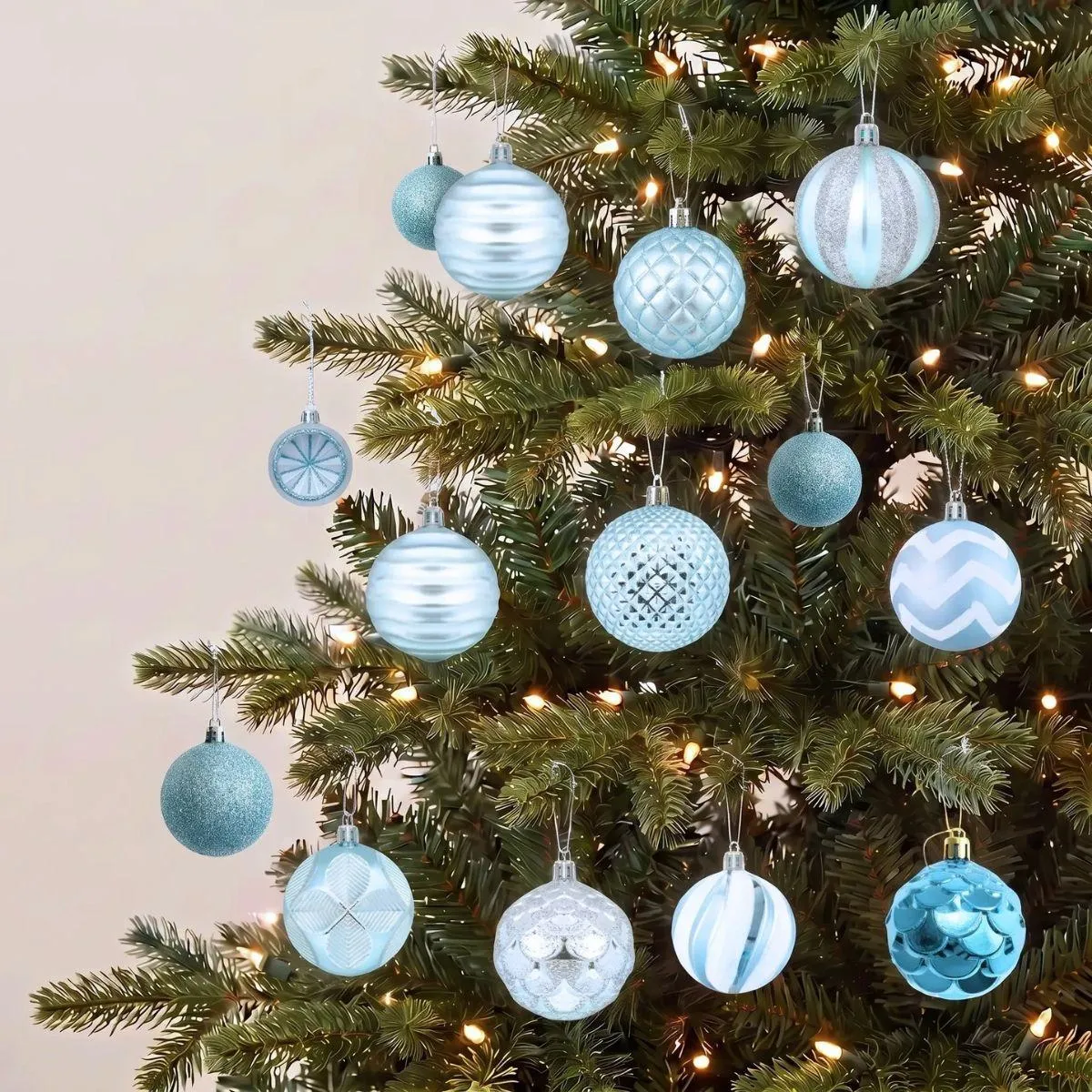
Pale blue is the most light-sensitive color on this entire list. In a north-facing room or under cool LEDs it turns gray and slightly sad; under warm bulbs it looks crisp and wintry. Before you buy a full set, hang five pale blue ornaments in the actual spot and photograph them in daylight and at night. If your room leans cool, add navy and silver to anchor the pale pieces — that is exactly what makes this tree work.
22. Blue Baubles and Folded Gold Paper Stars
Folded paper stars cost almost nothing and look like something you bought at a design shop. A pack of origami star paper runs $6–$12 for 100 sheets, and a full tree’s worth takes one evening in front of a movie. Pair them with a $20 set of assorted blue balls from Target — matte, glossy, glittered, and striped — and you have this whole look for under $45. Thrift stores are also full of blue glass ornaments in January.
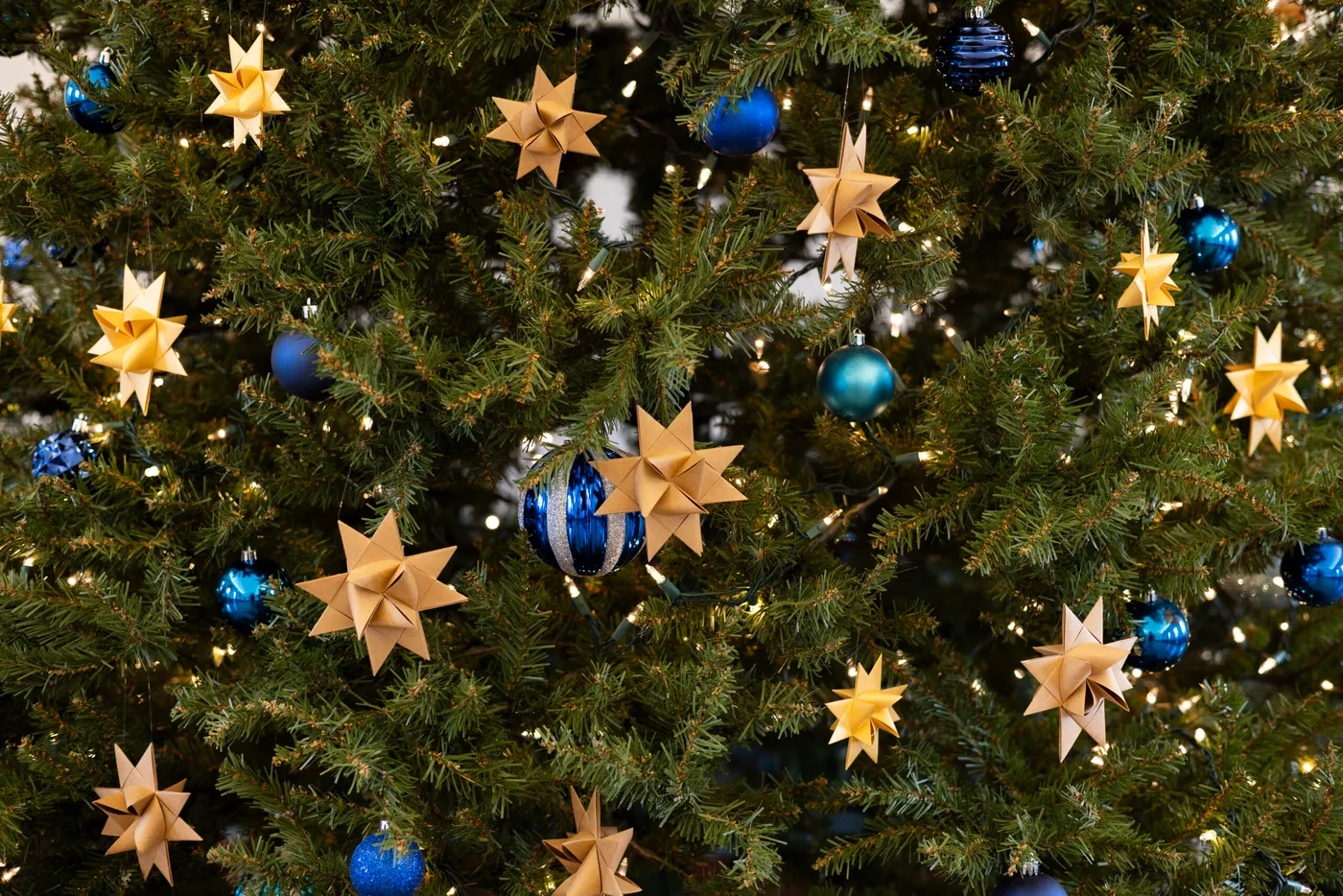
Paper ornaments need to be weighted and hung with a loop, not a wire hook, or they will crease at the top. Use a needle and thread through the center point so the star hangs perfectly balanced. Gold paper reads warmer than gold foil, so if your tree lights are warm white, stick with paper — and mix two sizes, roughly 3-inch and 5-inch, so the stars have a hierarchy instead of a uniform scatter.
23. Flocked Tree with Multi-Color Lights in a Cozy Room
Worth being honest about: not every beautiful tree is a blue-and-gold tree. This one runs multi-colored lights, and it works because the room does the color work — a lit wooden fireplace, a snowy window, warm beige curtains, and flocked branches heavy with white. It is a reminder that a restrained palette is a choice, not a requirement. If you want blue and gold, put your money in the ornaments and keep the room quiet.
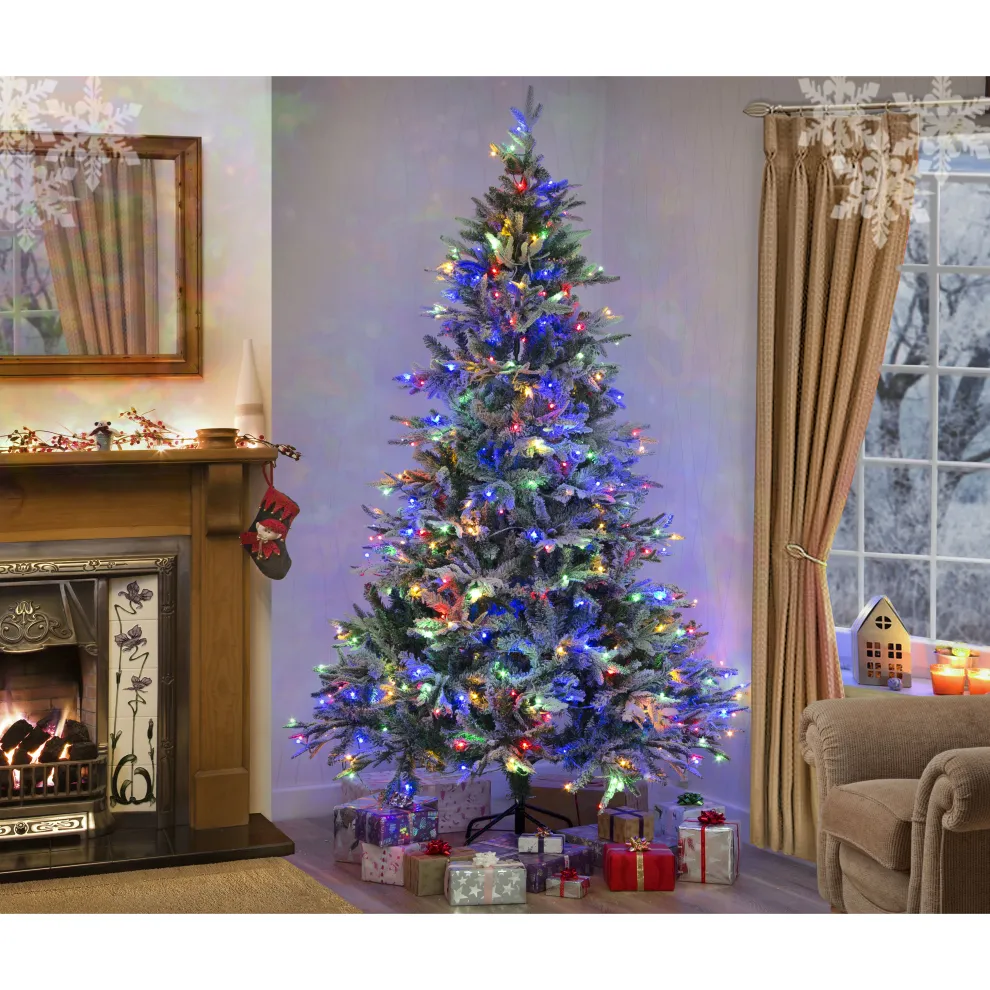
- Flocked tree, 7.5 ft: $200–$500
- Multi-color string lights, 600–1,000 bulbs: $25–$70
- Wrapping paper and gift boxes: $40–$100
- Beige patterned curtains: $60–$200
- Faux fire insert or mantel lighting: $50–$180
The lit wooden fireplace is the one thing. Without it, this is a nice tree in a nice room. With it, the scene has a second light source, and that is what makes the flocking glow instead of just sitting there. Two warm light sources in one room is the most reliable way to make a December interior feel photographed.
24. Twisted Light Blue Icicle Among Frosted Branches
Glittered icicle and glass ornaments are beautiful and unforgiving. The glitter sheds onto the branches, and once a flocked tree has glitter in it, that tree is a glitter tree forever. Store glass or glittered pieces individually in tissue or old egg cartons, and resist the urge to wipe them — a damp cloth dulls glitter instantly. Compare with Idea #27 for the same frost-and-blue effect with sturdier ornaments.
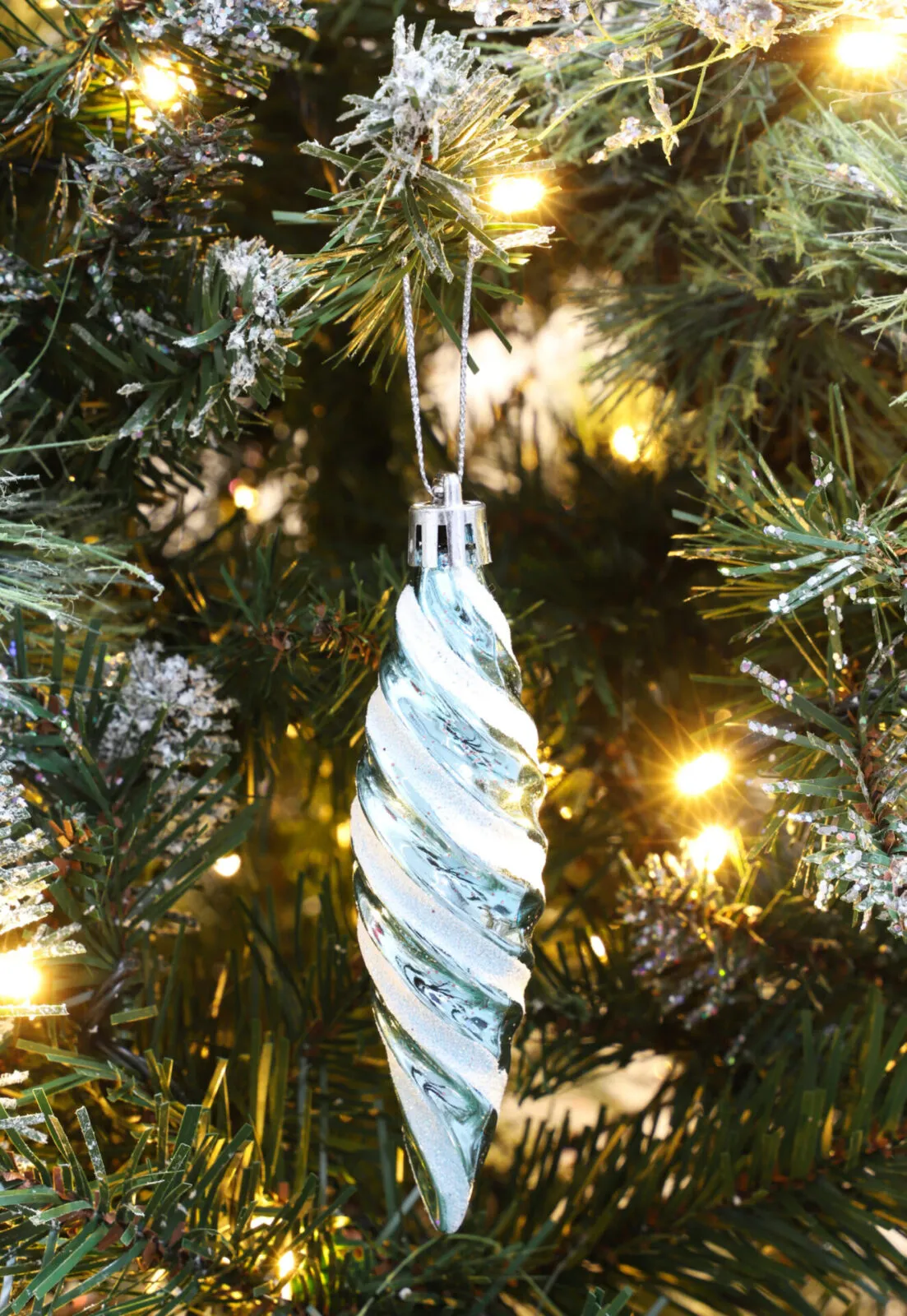
The single ornament works because of contrast, not quantity. A slim, twisted, cool-toned icicle against a mass of dark green and warm white light reads like a tiny piece of winter caught in the branches. Frosted tips on the needles make the effect twice as convincing, because the ornament and the branch share a texture. Put this same ornament on a bare, unfrosted tree and it just looks like plastic.
25. Black Tree, Gold and Silver Balls, Woven Basket Skirt
- Black artificial tree, 7.5 ft: $150–$450
- Gold and silver ball ornaments, roughly 80 pieces: $60–$160
- Woven basket or collar tree skirt: $35–$90
- Warm white string lights if unlit: $20–$50
- Gift wrap in neutral tones: $30–$70
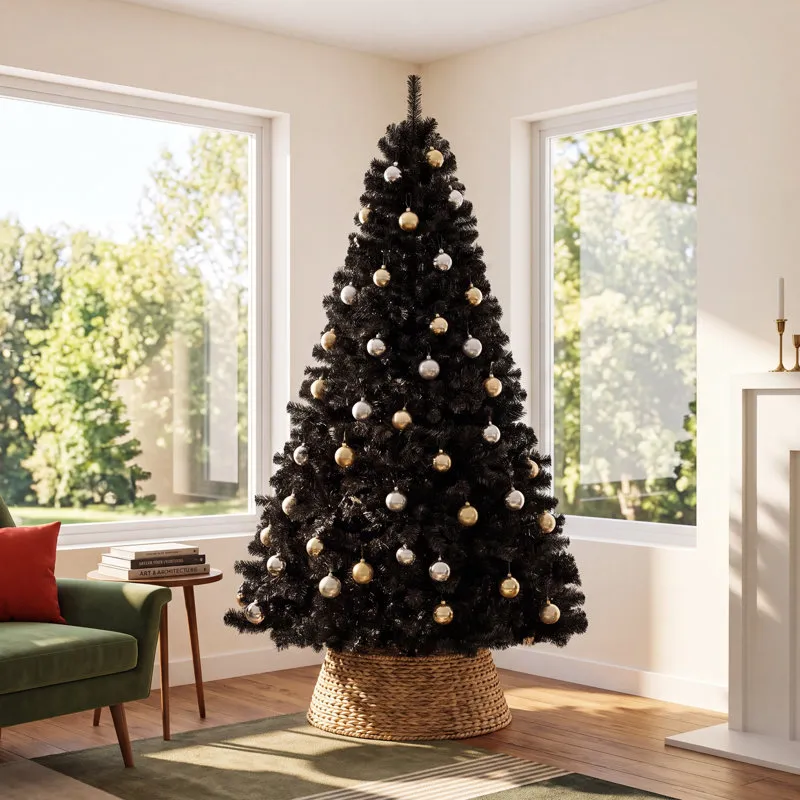
This is the most space-efficient tree on the list. Because the ornament count is low and the color is dark, it reads formally in rooms as small as 90 square feet with 8-foot ceilings. It also works in high-ceilinged spaces where a traditional green tree can look lost. Just keep it at least 18 inches from a sofa or armchair in the same tones, or a black tree beside a black chair starts to disappear.
26. Flocked Tree with Blue Icicles and Striped Candy Ornaments
- Count your ornament storage before you shop — this look needs individual wrapping, not a bin.
- Test your flocked tree in place for shedding before you put down a rug you love.
- Decide whether you want novelty pieces or an all-glass tree — mixing both takes restraint.
- Check that your blue beaded garland drapes without tangling around the light strands.
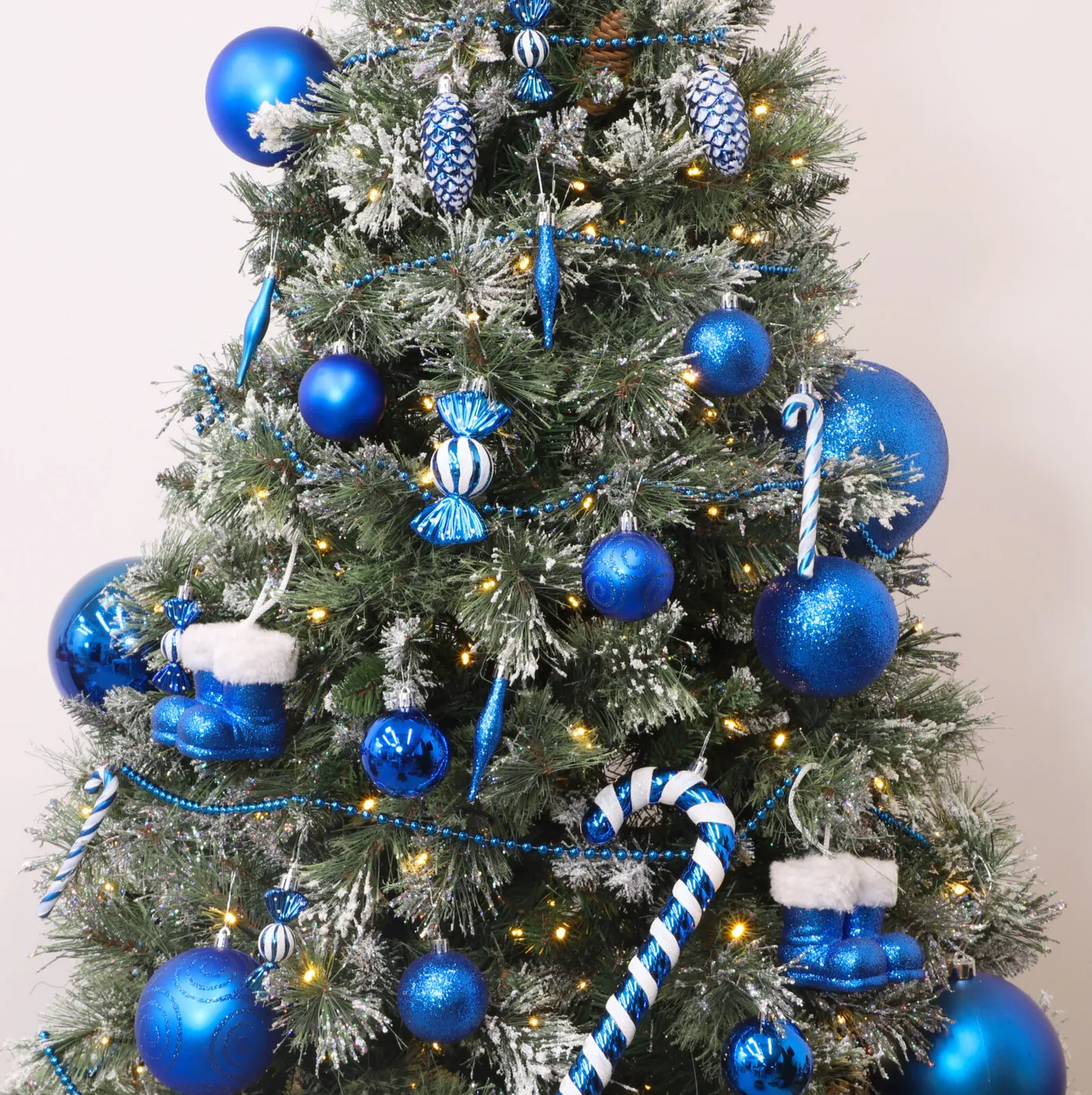
Novelty ornaments are the fastest way to make a coordinated tree look like a collection of souvenirs. Two or three candy canes or glitter boots as accents: charming. A dozen: the tree loses its point of view. The blue beaded garland is also heavier than it looks — it sags between branches and will pull a light strand down with it if you are not careful. Drape it in short loops and anchor the ends deep.
27. Small Blue Baubles on Frosted Green Branches
Small ornaments work best in odd-numbered clusters rather than spaced evenly around the tree. Think in threes: three small blue balls close together, then a gap of frosted branch, then three more. This gives a heavily frosted tree room to breathe and keeps it from looking like a craft store exploded. On a 7.5-foot tree you can fit roughly 200 small ornaments this way, and the frosted tips do the visual work of the missing filler pieces.
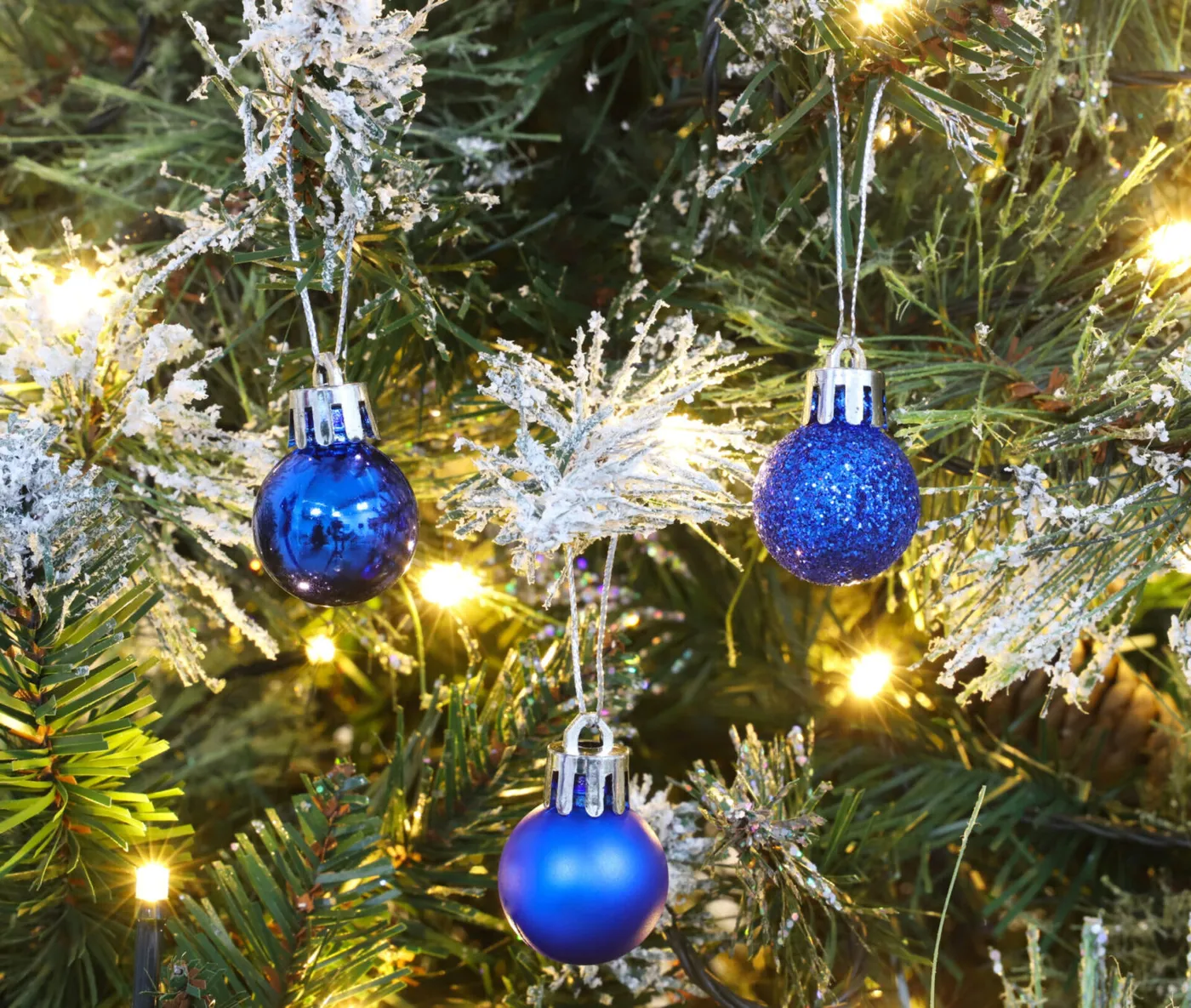
Frosted trees change your ratios. Allow roughly 45% white frost, 35% blue, 10% silver caps, 10% warm light. Because so much of the tree is already white, you need less white among the ornaments — which is why a handful of small blue balls is enough here. If your tree is not frosted, push blue up to 50% and add white ornaments to compensate. Same effect, different route.
28. A Plate of Matte Blue and Embossed Gold Ornaments
- Start with a flat white plate or shallow bowl — matte, no pattern.
- Fill it with ornaments in two finishes only: matte blue and glossy gold.
- Add two embossed gold pieces on top for texture, facing the light.
- Scatter three or four loose ornaments on a textured fabric beside the plate instead of stacking them.
- Place the arrangement on a surface with a warm lamp nearby, never in direct overhead light.
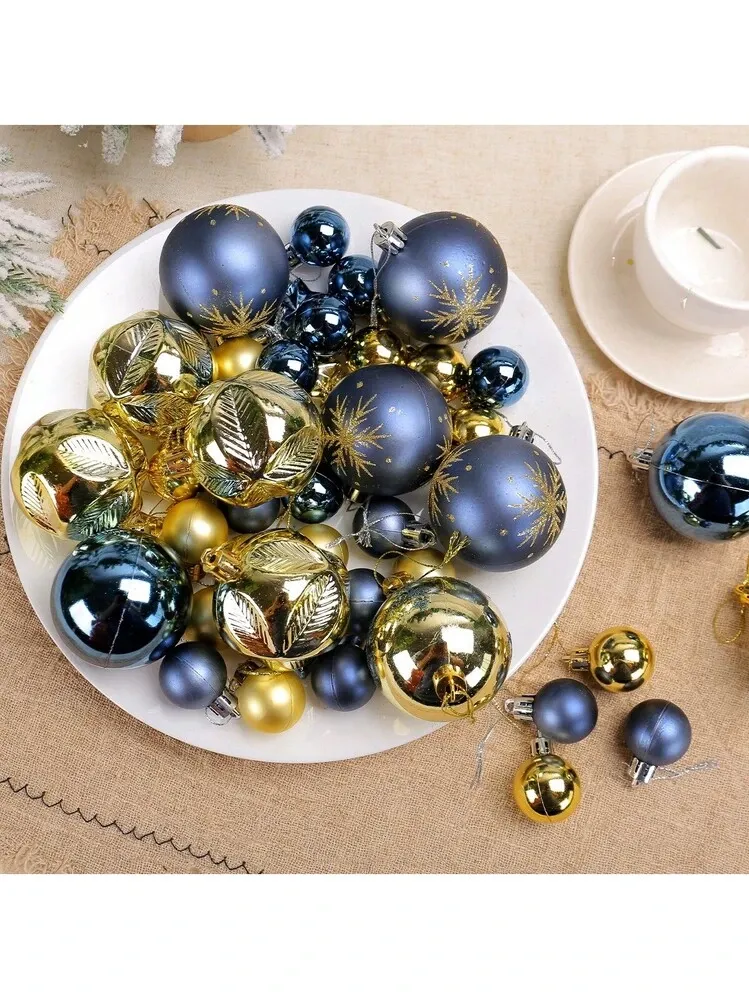
Five minutes, zero cost if the ornaments are already yours. The fabric matters more than the plate.
The ornaments here are the everyday kind — the ones that turn up in supermarket sets and dollar store multipacks. Matte blue with a gold snowflake is a $1–$3 ornament; embossed glossy gold balls run $2–$5 apiece. A full bowl of twelve costs under $40 at Walmart or Target. The look comes from the arrangement and the white plate, not the price tags.
29. Lush Green Wreath with a Blue and Gold Bow
The bow. A big, slightly asymmetrical blue and gold bow at the twelve o’clock position gives this arrangement a face — a single point of focus that everything else orbits. Without it, you have a very good pile of ornaments. The bow also introduces two colors at once in one shape, which is an efficient way to establish a palette in an arrangement with no tree lights to help. If you do one thing here, make it a bow you actually love.
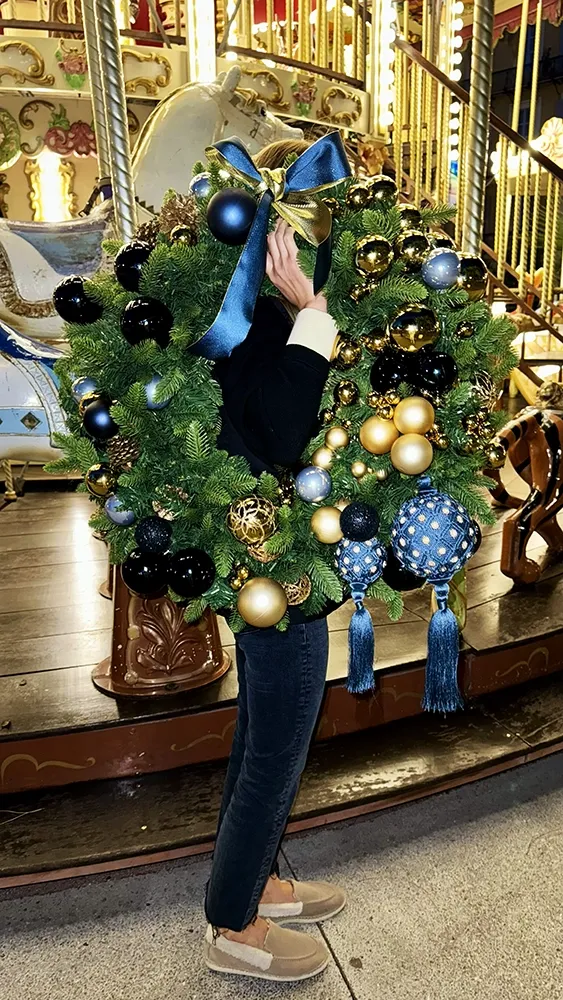
The black ornaments are the secret. Blue and gold on their own can get sweet; a handful of matte and shiny black spheres drags the whole thing toward sophisticated and gives the gold something to glitter against. The blue tassels add vertical movement, so the shape reads as foliage and drapery rather than a circle. It is the same trick as a black tree — one dark element makes everything around it look more expensive.
- Large faux wreath or greenery ring: $35–$120
- Assorted gold, blue, and black ornaments, 25–30 pieces: $50–$140
- Wide blue and gold ribbon for the bow: $12–$35
- Blue tassels and small picks: $10–$30
- Floral wire and hanging hardware: $5–$15
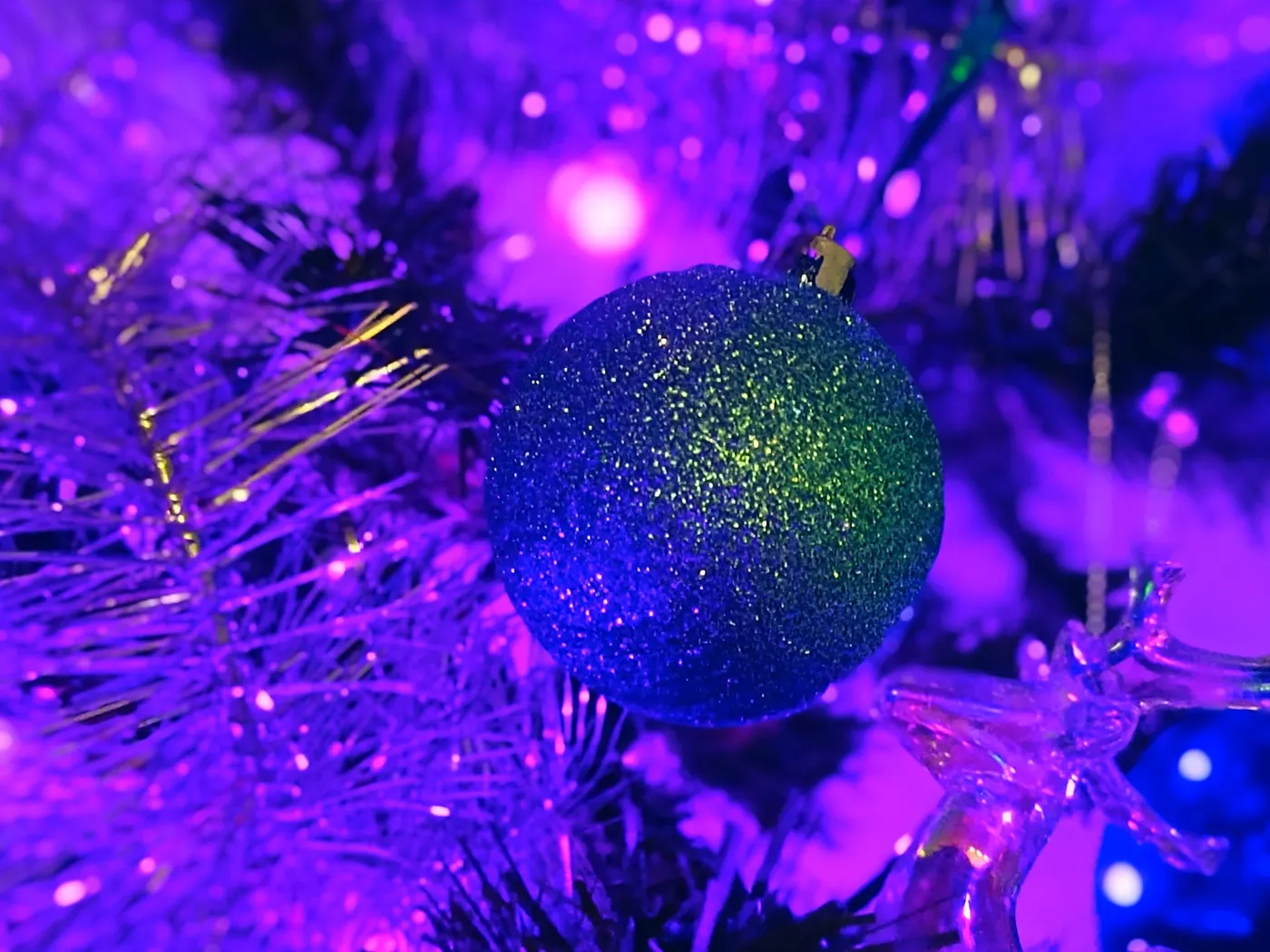
30. Iridescent Blue-Green Glitter on a Purple-Lit Tree
Purple and pink lights are fun in person and genuinely tricky at home. They change how every color on the tree reads — blue turns violet, green turns teal, gold goes brassy. The iridescent blue-green ornament is doing something clever by shifting color as the light hits it, which is why it holds up here. Just know that once those strands go on, you cannot judge your ornament palette by daylight. Compare with Idea #31, where warm golden light makes blue-green read completely differently.
If you want colored lights and a blue-and-gold palette in the same room, isolate them. Run the colored strands on one element — a smaller secondary tree, a wreath, a garland — and keep your main tree on warm white. That way blue and gold keeps its true color and you still get the pink glow in the corner of your eye. Trying to do both on one tree almost always ends in a compromise nobody loves.
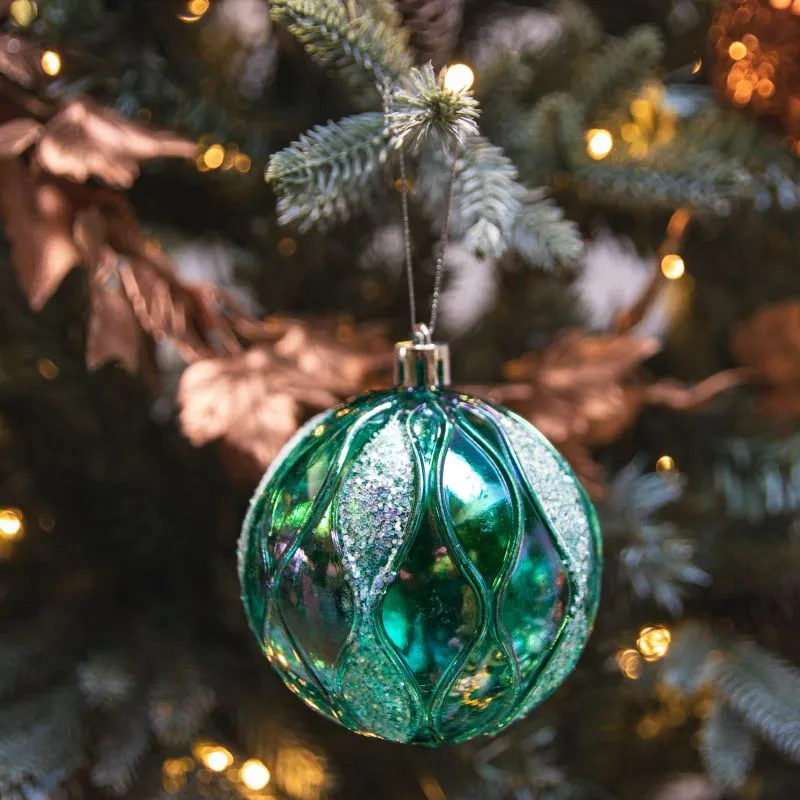
31. Emerald Glass Ornament with Silver Glitter Waves
Ornament size should scale with tree height and branch density. On a full 8-foot tree, a 4 to 5-inch statement ornament can sit anywhere and hold its own. On a 6-foot tree, keep statement pieces under 4 inches, or hang them low where the branches are strongest and the scale reads right. On a sparse or pencil tree, skip anything over 3 inches — the branches cannot support the visual weight.
Glass ornaments with a silver glitter finish have a short honeymoon. The glitter holds for three or four seasons, then starts shedding along the wave pattern, and there is no way to restore it. Handle them by the cap, not the body, and store them upright so the glitter never rests against another ornament. Expect a five-year lifespan and enjoy them while they are crisp.
- Pick three ornaments in one color family that differ in size — small, medium, large.
- Hang them together in a tight triangle where the tree meets light from a nearby lamp.
- Leave 6 inches of bare branch around the cluster so it reads as intentional.
- Repeat the cluster on the opposite side of the tree at a different height.
- Photograph the tree and check that the clusters balance rather than mirror each other.
Steal One Idea, Not All Thirty-One
You do not need to rebuild your whole holiday in blue and gold — pick one thing from this list, do it properly, and let the rest of the room stay quiet. The trees that look best are almost always the ones where somebody made one confident decision instead of twelve hesitant ones. Start with the ornaments you already own, hang them in the actual room, and adjust from there.
📌 Pin this guide now so it is waiting for you when the boxes come down from the attic — and tag us when you share your blue-and-gold tree this year.