
I don’t know about you, but my Pinterest feed started serving Christmas door ideas somewhere around mid-October, and the scroll is real. We filtered through hundreds of wreaths, swags, plaid bows, and light-wrapped topiaries at Etsy, Target, Walmart, and IKEA to find the 31 that actually look good on a real front door, from about $14 to $260.
Inside you’ll find rustic farmhouse greenery, traditional red-and-green classics, pastel whimsy, and natural botanicals — with budget and luxury versions compared side by side and every idea shoppable with direct product links. What’s driving 2026 is texture over tinsel: dried citrus, copper magnolia leaves, buffalo plaid, and flocked branches are what people are saving this year. And stay until the end — we break down the most common mistakes that can ruin these looks.
📌 Save this to Pinterest for later — you’ll want to revisit these ideas.
1. Turquoise Door, Plaid Pocket, and Vintage Snowshoes
A teal or turquoise door is already loud, so everything around it has to stay calm — and that’s exactly what happens here. The crossed vintage snowshoes add a strong vertical line against horizontal beige siding, while the plaid fabric pocket holding evergreen branches and red berries pulls the red straight out of the ribbon. Almost nothing on this porch is shiny. Raw birch logs, matte greenery, and a worn green bench give your eye somewhere to rest, and forest green repeats three times — bench, potted evergreens, birch buckets — which is what keeps a busy entry from tipping into clutter.
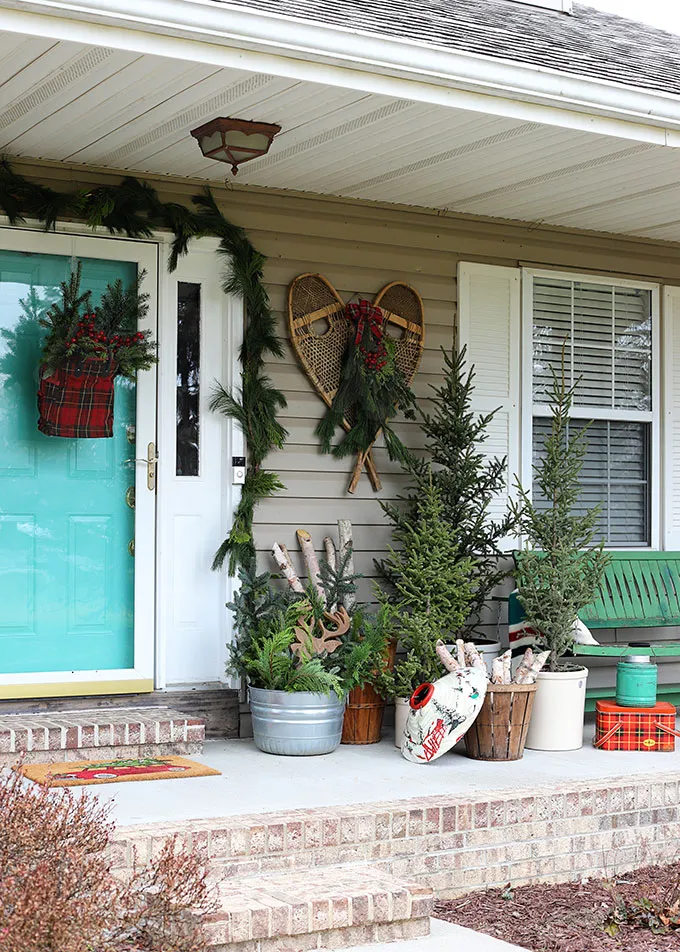
Hang the snowshoes so the spot where they cross sits about 60 inches off the ground — eye level for most adults — and drive two screws into the siding instead of one. A single anchor point lets a crossed pair slowly rotate out of alignment by mid-December. For the fabric pocket, fold a 12-inch square of plaid over a thin wooden dowel and staple the fabric to the back, then tuck one floral foam brick inside. That holds three evergreen sprigs and five berry stems without sagging.
Vintage snowshoes aren’t a random prop, either. Searches for collected, thrifted winter porch decor have climbed for three seasons straight as people move away from inflatables and synchronized light shows toward things that look inherited. It photographs warmer, it stores flat, and it doesn’t need an outlet. Notice the plaid here is muted and wool-toned rather than bright tartan — that’s the whole difference between styled and seasonal-aisle.
2. Pinecone and Dried Orange Wreath on a Sage Green Door
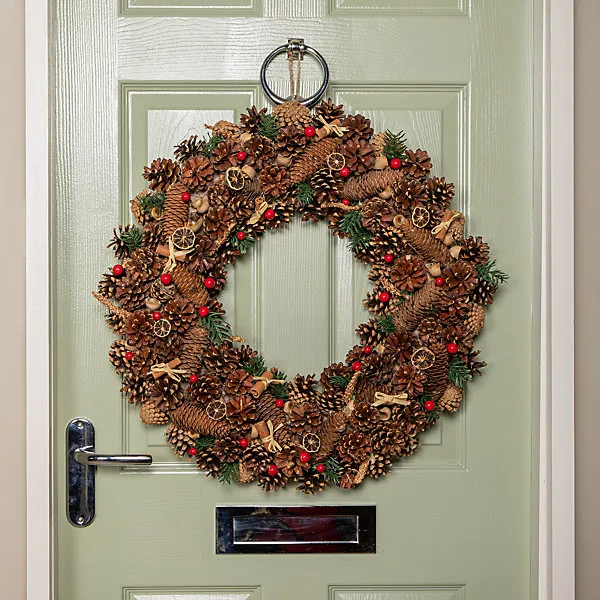
Dried citrus is the difference between a wreath that looks bought and one that looks made. Here’s the version that doesn’t crumble:
- Slice navel oranges a quarter inch thick — thicker slices mold, thinner ones curl.
- Blot both sides on paper towels; skip this and they brown in the oven.
- Bake at 200°F on a wire rack for three to four hours, flipping at the two-hour mark.
- Cool completely, then let them sit uncovered for a full day before wiring.
- Thread floral wire through the rind, never the flesh — the flesh cracks.
Roughly five hours of hands-off oven time and about $10 in oranges, plus a few dollars of florist wire.
Dried orange slices fade to a dull brown within one season in direct sun, so keep this wreath under a covered porch or on a door that faces north or east. The pinecones are the other risk: glued while damp, they’ll drop scales all winter, so let them dry indoors for a week first. At the end of the season, store the wreath in a paper bag with a silica packet rather than a plastic bin — plastic traps any remaining moisture and turns the citrus moldy by spring.
3. Light Blue Door with a Plaid Bow and Light-Wrapped Trees
The formula is roughly 50 percent cool blue, 35 percent evergreen, 15 percent red. The light blue door is the base, the wreath and the light-wrapped potted trees carry the green, and red shows up only in the plaid bow and the poinsettias at the base — that 15 percent is doing all the work. To shift the mood, keep the math and swap the ingredients: a navy door, white amaryllis instead of poinsettias, and a cream-and-navy ribbon turn this into something far more formal. For the same cool-blue base scaled up to double doors, see Idea #12.
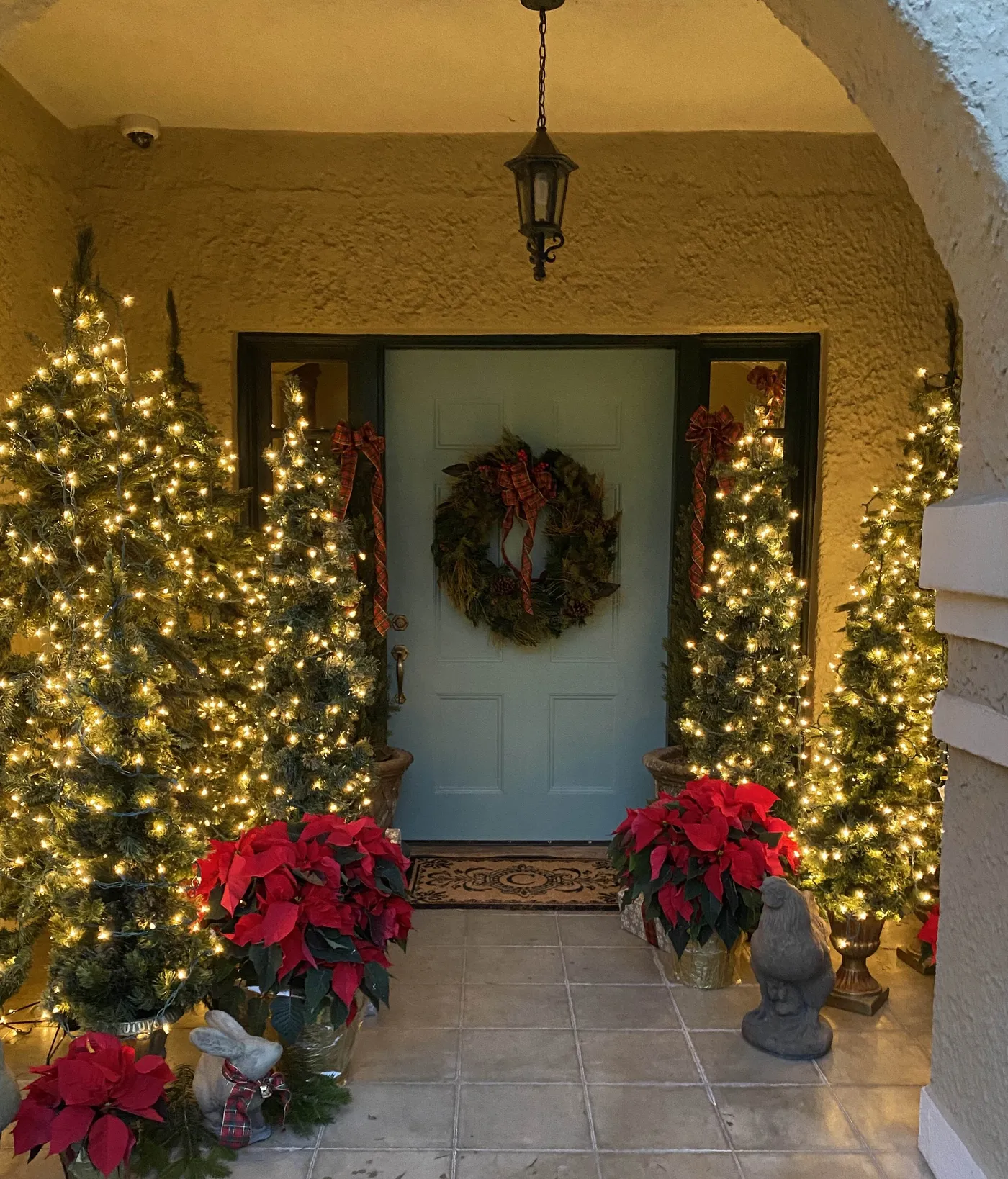
Poinsettias are tropical plants dressed up as winter decor. Below about 50°F they drop leaves within a day or two, and below freezing the stems go soft and black. If your porch is exposed, buy faux poinsettias — the good silk ones read fine from the sidewalk — or keep the real ones inside by a bright window and treat them as a swap-in for photos. One more thing: warm white fairy lights around 2700K look like candlelight, but the 5000K daylight strands will make this blue door look like a hospital corridor.
4. Full Cedar Wreath with a Deep Red Bow on Weathered Planks
What this actually costs to recreate:

- 24-inch mixed cedar and pine wreath: $45–$120 fresh, $30–$60 faux
- Wired dark red ribbon, 2.5 to 4 inches wide, 3 yards: $12–$35
- Floral wire and tape: $5–$10
- Heavy-duty over-door hook or wall hanger: $8–$25
- Extra pinecones or berry picks: $10–$30
Total: $80–$220
Budget alternative: a $25 faux cedar wreath from Walmart, a $9 roll of wired ribbon, and a $6 hook gets you 80 percent of the look for about $40. Fresh greens are lovely, but they’re the first line item you can cut.
Take away the bow and this is just another green wreath. The oversized structured bow — wired, double-looped, with tails long enough to reach the bottom third of the wreath — is what makes the whole weathered-plank composition read as deliberate instead of improvised. If you buy nothing else, buy four-inch ribbon. Two-inch ribbon on a 24-inch wreath always looks like an afterthought, and nothing else you add will fix that ratio.
Saturated, slightly vintage red is quietly replacing bright cherry red going into 2026 — it photographs richer against weathered wood and doesn’t read candy-cane. Pair that with the ongoing pull toward unfussy, natural greenery and you get exactly this: no glitter, no tinsel, just foliage and fabric. It’s the same shift that made undyed linen and velvet ribbon the default for people who decorate early and leave it up through January.
5. Flocked Pine Swag with Dark Velvet Bows and Trailing Tails
Flocked greenery dies on a door that gets wet — the flocking pills and sheds the moment it rains. On a covered wall like this white-painted brick, it’s perfect. If you’re doing the flocking yourself, spray the branches with adhesive and dust them over a cardboard box, holding the can 10 to 12 inches away; any closer and you get wet clumps instead of snow. Also, tie a knot at the end of every trailing ribbon. Long tails in pink, green, and gold look beautiful for about three windy days before they fray into fringe.
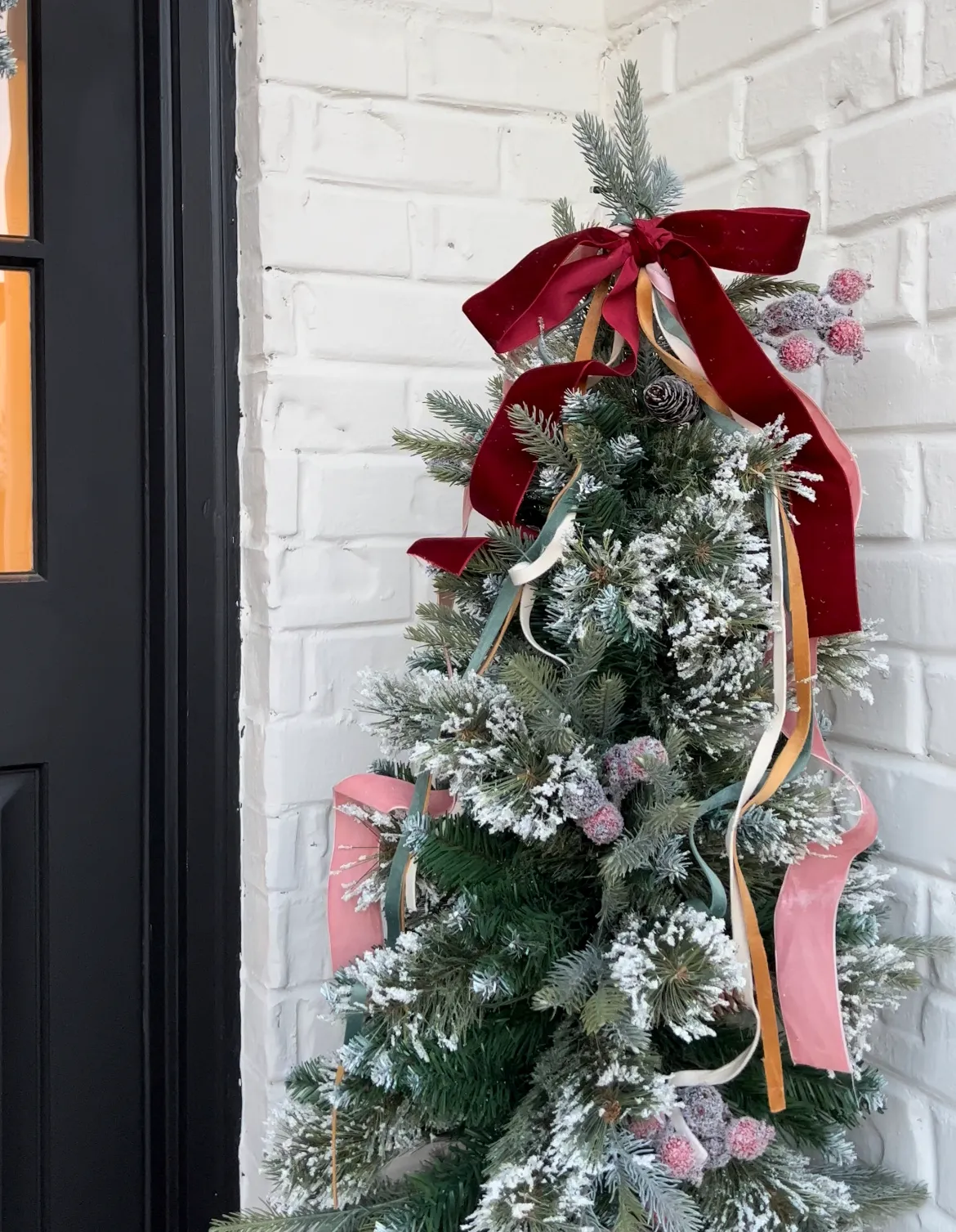
A swag needs to relate to the door beside it, not fight it. For a standard eight-foot wall and a 36-inch door, a 36- to 42-inch swag hung so its lowest tip lands just above the doorknob is the sweet spot. With nine- or ten-foot ceilings, jump to 48 or 54 inches and add a shorter second layer behind it for depth. On a narrow stoop under about six feet wide, skip the swag and use a single wreath — otherwise you’ll be squeezing past your own decorations. Tight entryways do better with the compact styling in Idea #10.
6. Gingerbread and Peppermint Wreath with a Glittery Red Bow
The single element holding this together is the oversized glittery red bow sitting low and to the right, not centered at the top. That off-center placement breaks up the ring of gingerbread men and swirled peppermint discs, which would otherwise read as a perfectly rigid circle. Swap in a standard top-center bow and the wreath instantly looks like a craft-store kit instead of something you styled. Asymmetry is the free upgrade that almost nobody bothers with.
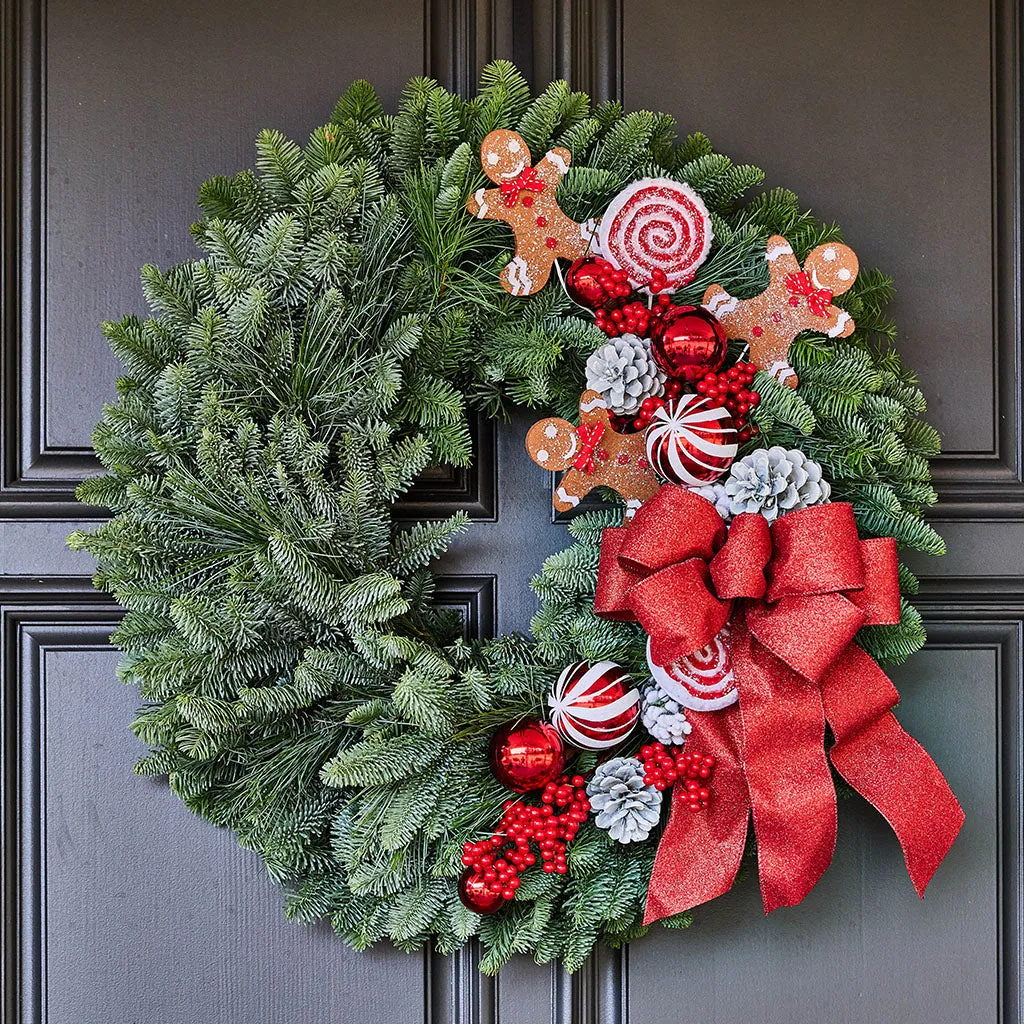
You can build this for under $30. A plain 18-inch faux evergreen wreath runs $10 to $15 at Walmart or IKEA, a pack of gingerbread cutouts and peppermint ornaments at Dollar Tree is about $8, a roll of wired red ribbon is $4, and frosted pinecones can be scavenged off an old garland or bought as a $3 bag. The trick is quantity — buy two packs of ornaments so the wreath looks dense, because sparseness is what gives cheap projects away.
Glitter sheds. It will land on your doormat, your shoes, and eventually your hallway floor, which is fine unless your entry is a magnet for it. Candy-shaped ornaments crack in cold, and peppermint swirls are usually painted plastic — a hard freeze can make the finish flake. This is a great wreath for a covered porch, a garage-to-house door, or an interior door, and a poor one for the windy side of the house. If you want something that survives weather, look at Idea #19.
7. Black Door with Burlap Bow, Berry Wreath, and Frosted Tree
A black door is negative space, and that’s why this works: the green-and-red berry wreath floats against it like a painting on a dark wall. The buffalo check blanket and the burlap bow are two different textures doing the same job — they break up flat surfaces so your eye keeps moving. And the rustic console table gives the entry three distinct heights: the tall frosted tree, the mid-height lantern, and the low tabletop arrangement. Nothing competes, because everything sits at a different level.
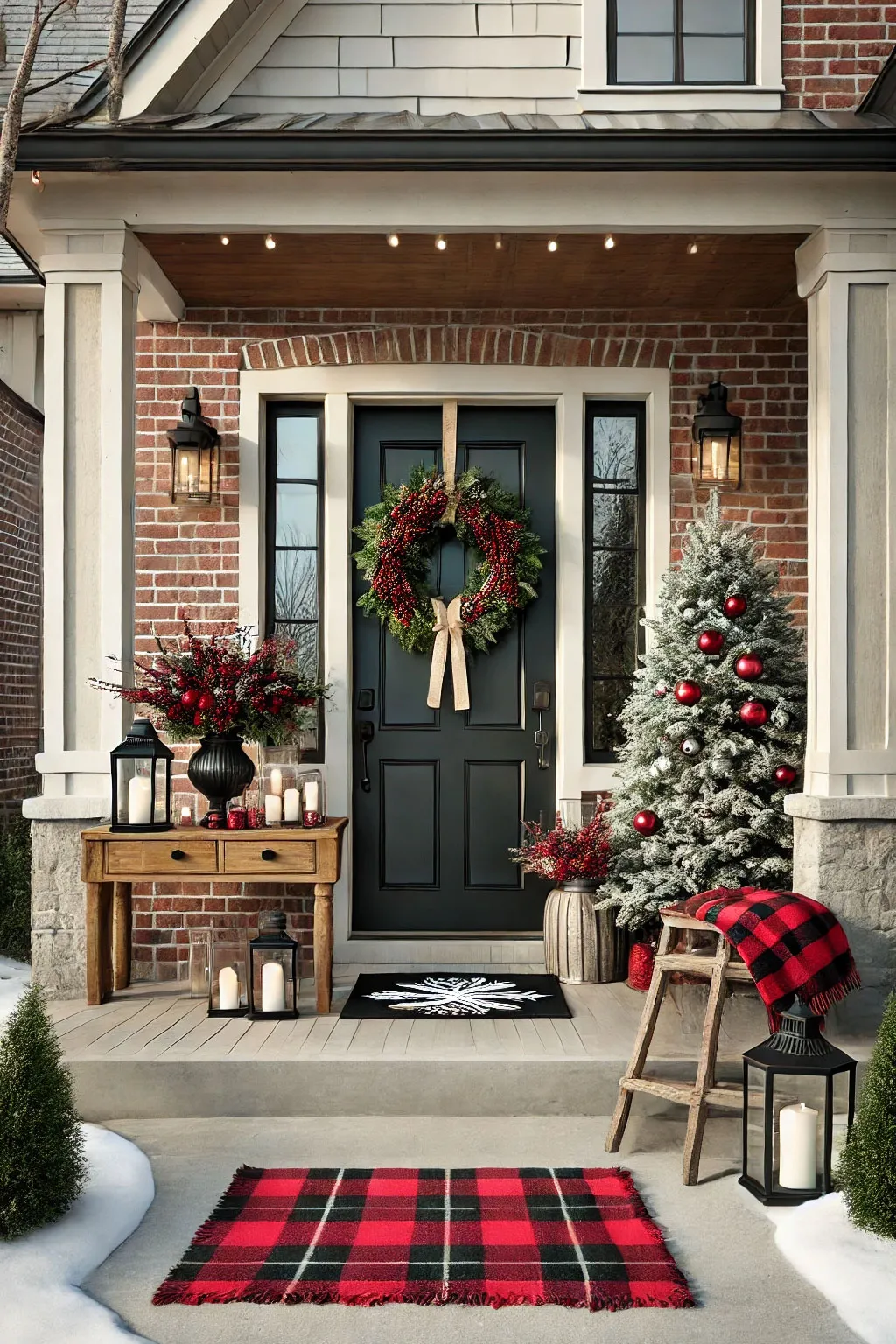
Styling that console takes about 20 minutes and costs nothing if you already own the pieces:
- Put the tallest thing at the back and to one side — here, the frosted tree.
- Place the lantern on the opposite side to balance the weight without mirroring it.
- Add a stack of two books or a low box to create a mid-level platform.
- Tuck red floral picks into a small vase and let them spill slightly over the front edge.
- Leave at least one third of the surface empty — a fully covered console reads as clutter from the driveway.
8. Gray Door with Draped Cedar Garland and a Bell Wall Hanging
Fresh cedar garland will drop needles for the first week and again in January, and it leaves a faint resin residue wherever it touches paint. Line the top of the door frame with clear removable tape or a strip of felt before you drape, and shake the garland outside before you hang it. If your door faces full sun or gets rained on, cedar dries to a dull olive-gray in about two weeks. The faux cedar garlands from IKEA and Target now come in genuinely convincing versions if you’d rather not babysit it.
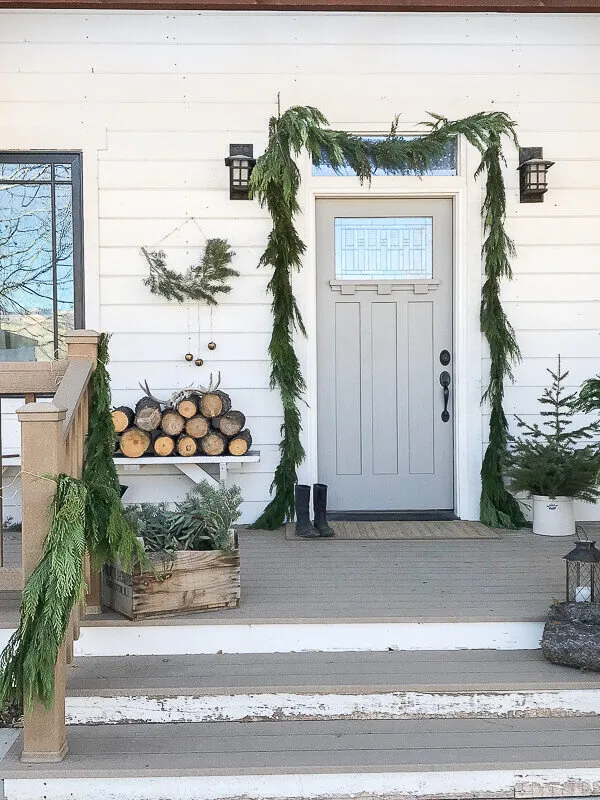
Think of it as 70 percent neutral, 20 percent natural green, 10 percent wood and metal. The light gray door and white siding are the base, the draped cedar and potted evergreen sapling carry the green, and the wooden bell hanging, stacked birch logs, and black rain boots deliver the last 10 percent. Swap the gray for a warm greige and the cedar for eucalyptus and the same math gives you a softer, more coastal result. The formula never changes — only the ingredients.
This layered look needs vertical room and at least four feet of wall beside the door for the bell hanging and the log stack to breathe. On a narrow stoop under five feet wide, pick one element — probably the bell hanging — and keep the garland minimal. On a wide porch you can repeat the log stack on both sides. If your entry is closer to a hallway than a porch, the single-wreath approach in Idea #23 will serve you better than a full drape.
9. Black Door with Buffalo Check Bow and Stacked Finials
Approximate cost to build this entry from scratch:
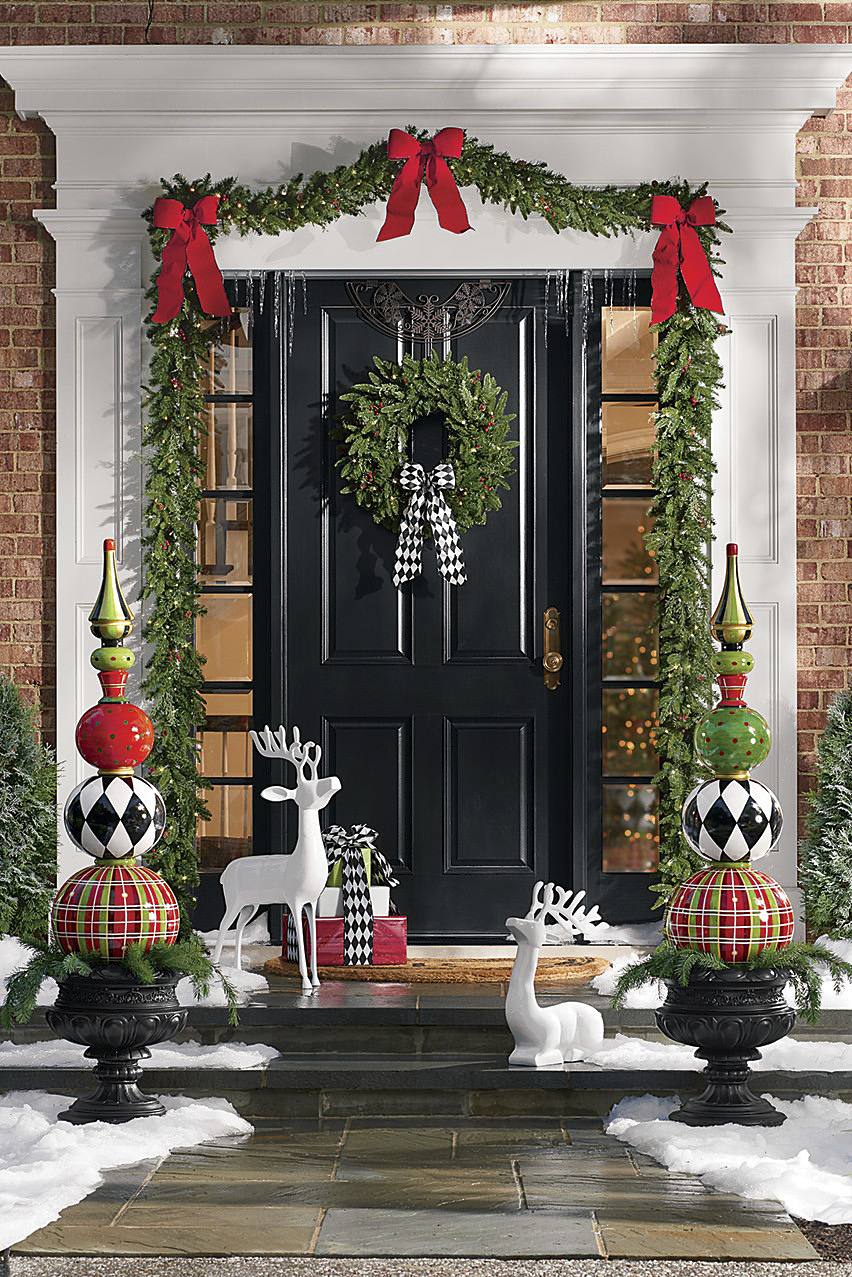
- 22- to 24-inch faux evergreen wreath: $30–$70
- Buffalo check wired ribbon, 2.5 inches, 3 yards: $10–$22
- Two tall urn planters: $40–$160
- Oversized finials or 9- to 12-inch ornaments, set of six: $25–$60
- Nine-foot pre-lit garland: $35–$90
Total: $140–$400
Budget alternative: two 24-inch urns from Walmart at around $15 each, big ornaments from Dollar Tree at about $1.25 apiece, a $12 wreath, and a $9 ribbon bring this to roughly $75 — and nobody walking up your steps will know.
Don’t fill urns with ornaments alone. They settle, shift, and tip. Flip a nursery pot or a chunk of pool noodle upside down inside the urn to build height, then sit the finials on top so only the top third of each ball shows. If your planters are light plastic, add a couple inches of sand or pea gravel in the base; a tall urn full of ornaments becomes a wind sail on a breezy street, and there’s nothing festive about chasing a ball down the sidewalk in the dark.
10. Pastel Pink Double Doors with Flocked Mini-Tree Wreaths
The oversized multicolored bulb ornaments are the whole point. Everything else here — pastel pink doors, flocked wreaths with tiny bottlebrush trees tucked inside, snow-dusted garland, gold nutcrackers — is soft and small-scale. The giant bulbs are the one element that refuses to behave, and that contrast is what stops the entry from reading like a nursery. Take them away and the composition collapses into something sweet but forgettable. Scale jumps like this are the cheapest way to make a carefully coordinated doorway feel designed.
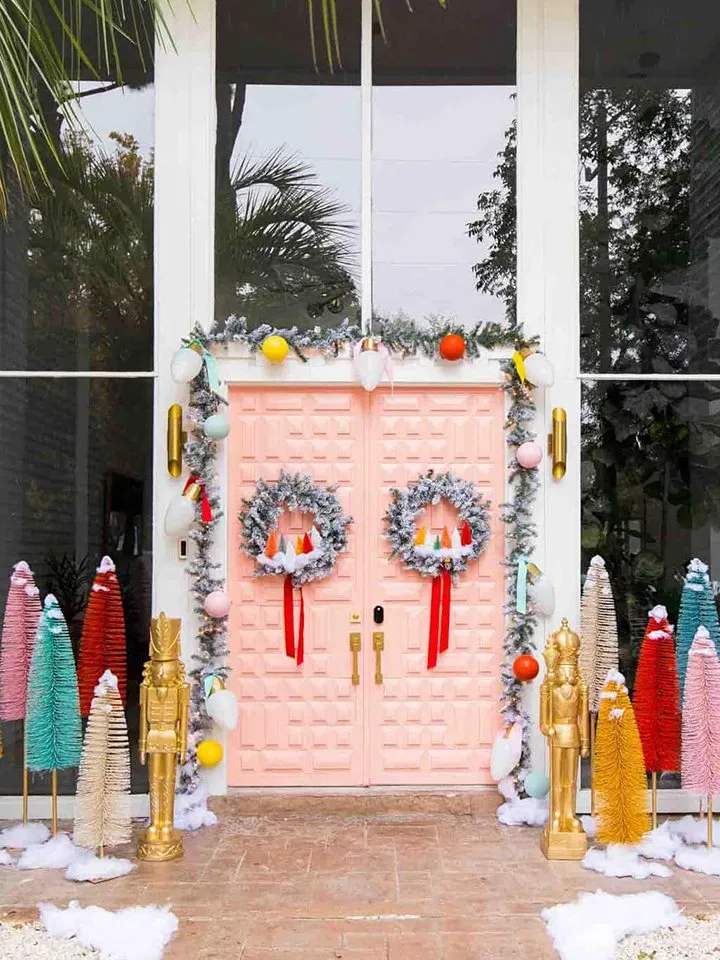
Pastel Christmas has been quietly growing for a few years and it’s hit full stride going into 2026 — pink trees, mint and blush ornaments, candy-colored everything. It’s the counter-movement to the rustic farmhouse look that dominated the 2010s, and it pulls directly from the vintage kitsch collecting happening on Pinterest and Etsy. Honest verdict on staying power: pink Christmas is a personal choice rather than a passing fad, and the people who go for it tend to keep it for years. Just don’t expect it to help sell your house in February.
Double doors usually run 60 to 72 inches wide, so use two 22- to 24-inch wreaths hung at matching heights, with the bottom of each wreath landing about a third of the way down the door. Keep accent ornaments in the 4- to 6-inch range; anything larger starts to look like clutter on a narrow frame. If your double doors measure only 60 inches total, drop to 20-inch wreaths. On a small single door, the scaled-down version of this mood is Idea #12.
11. Classic Wreath on a White Paneled Door with Gray Siding
This is the most reproducible look in the entire article. A faux evergreen wreath from IKEA runs about $12, a spool of red ribbon is $4, a bag of small red ornaments is $5, and a magnetic or over-door hook is $6. That’s roughly $27 for a wreath that holds its own against a $200 boutique version. Two snow-dusted potted evergreens from Walmart at about $20 each finish the doorway, so you’re still under $70. Thrift stores are also full of wreath forms in December — grab a wire frame for $2 and rebuild this with dollar-store greenery every year.
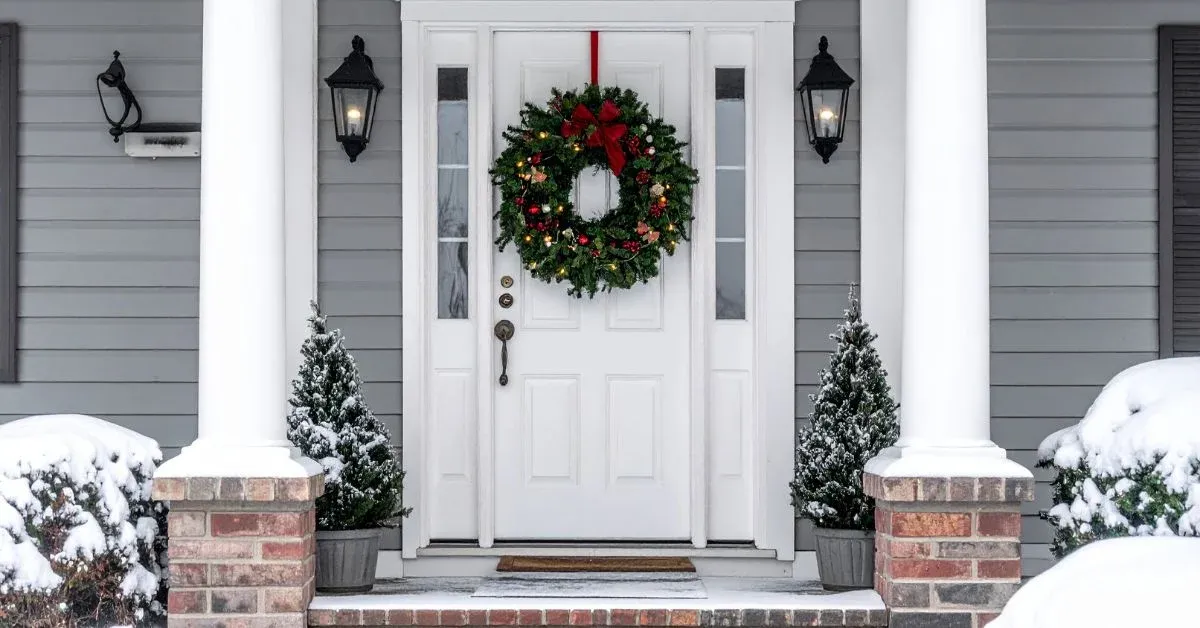
Three things are doing the heavy lifting. First, the red ribbon hanger lifts the wreath’s visual center above the door’s midline, which makes the whole entry feel taller. Second, the two potted evergreens create true symmetry — same height, same distance from the frame — and symmetry is what makes a front door read as welcoming at a glance. Third, the black wall lanterns repeat the dark note of the house numbers and the mat, tying the composition together without adding a single new color. Simple, and almost impossible to get wrong.
12. Black Multi-Pane Door with Red Velvet Bow and JOY Doormats
Layering two mats takes fifteen minutes and about $40:
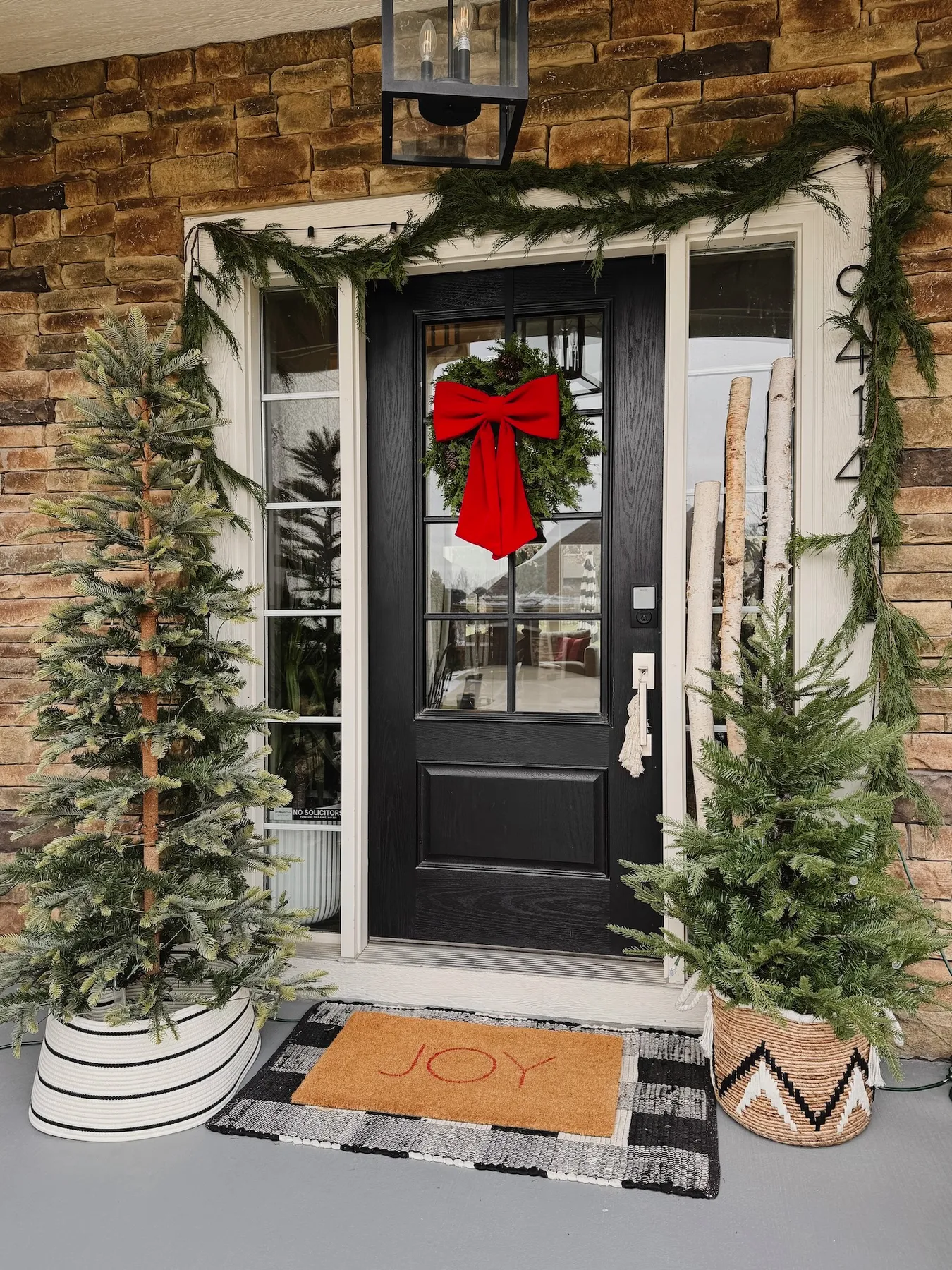
- Start with the larger mat — a 24-by-36 buffalo plaid or rubber-backed base.
- Center the smaller 18-by-30 lettered mat on top, about two-thirds of the way up.
- Leave a three- to four-inch border of the base showing on the sides and the top.
- Angle the top mat just slightly — two or three degrees — so it looks placed, not measured.
- Shake both weekly and bring them in during rain; soggy coir mats stain stone porches.
Skip the layering if your threshold is low enough that the door drags the top mat every time it opens.
Printed and plaid mats fade faster than plain coir — expect noticeable dulling after one sunny season, so buy them knowing they’re a two-to-three-year item, not an heirloom. Buffalo check in particular shows dog hair and road salt badly. Velvet ribbon on an exterior door also needs replacing most years; it crushes flat where the wreath rests against it, and once velvet creases it doesn’t come back. Buy two spools in November when it’s cheap and store one flat in a drawer.
13. Double Light Blue Doors with Matching Eucalyptus Wreaths
Here’s the ratio: 55 percent light blue, 30 percent deep green, 10 percent black and white, 5 percent brass. The doors are the base, the eucalyptus wreaths and boxwood carry the green, the striped ribbon bows and black planters deliver the graphic black-and-white, and the brass pulls and white flowers are the seasoning. Change the doors to charcoal and the striped bows to solid black and you keep the exact same formula with a much moodier result. That 5 percent metallic is what makes it look expensive — never skip it.
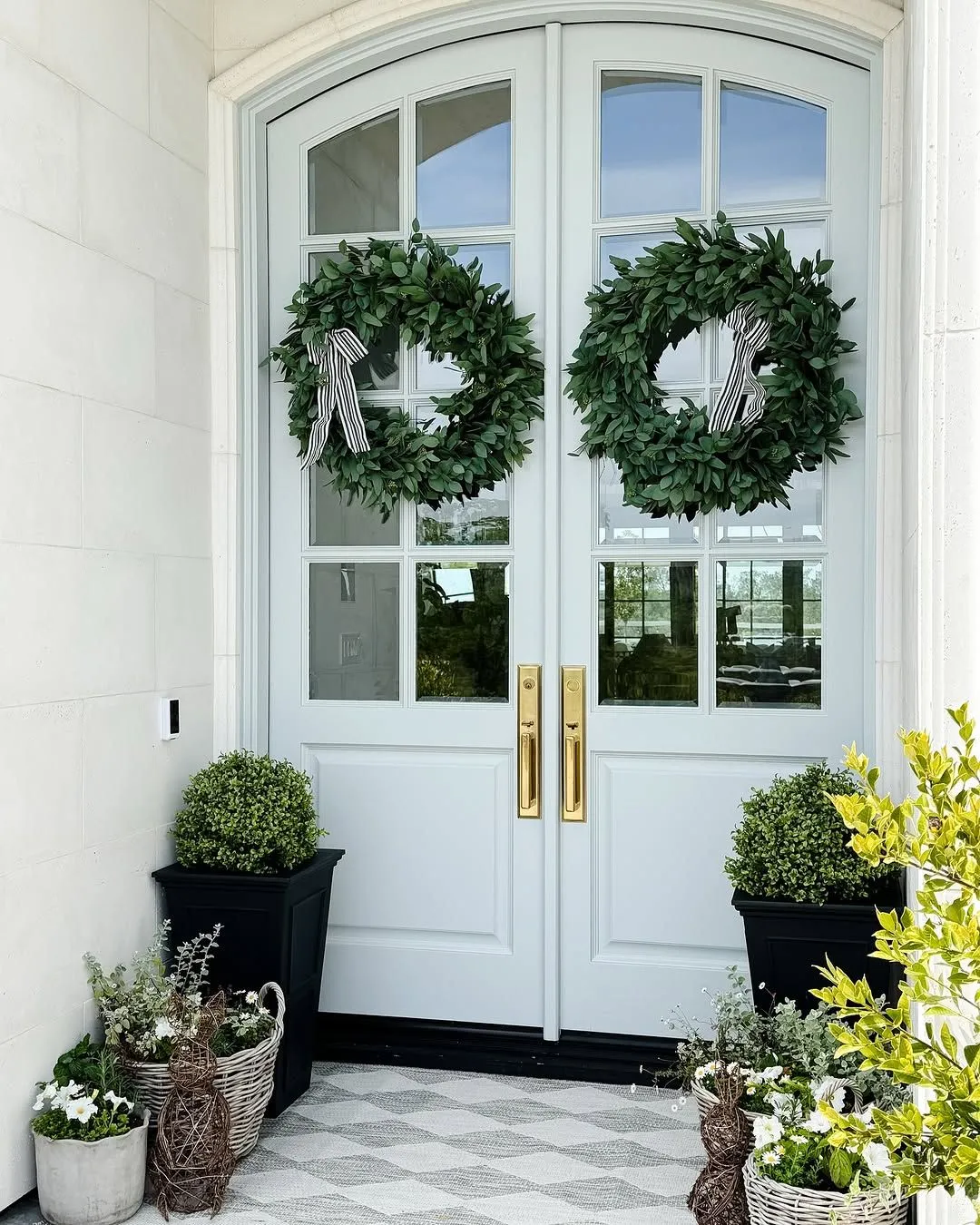
Measure the full width of your double doors and divide by two. That’s your maximum wreath diameter — a 60-inch opening means 26-inch wreaths at the absolute largest, and 22 inches is usually better. Hang both so their centers sit at the same height, roughly 60 to 66 inches from the ground, and resist the urge to center each wreath on its own door panel rather than on the opening. On a single door, this exact palette scales down beautifully; see Idea #2 for the one-door version.
Two eucalyptus wreaths from a florist will run $140 to $250. Two faux eucalyptus wreaths from IKEA or Target cost about $18 each, and honestly, on a bright blue door faux reads fine — the door is doing the talking. Add a $7 roll of black-and-white striped ribbon and two tall black planters from Walmart at about $22 each. The woven baskets are the easiest thing to fake: a $12 basket and a $6 bunch of faux white blooms get you there. Total for the whole doorway, around $110.
14. The Red Flag: What Makes Door Decor Fail by January
If there were a warning icon for holiday door decor, it would point at weight. A fresh 24-inch evergreen wreath runs 8 to 12 pounds, and most decorative over-door hooks are rated for three. Check the rating printed on the back — if there isn’t one, assume three pounds. For anything heavier, use a wreath hanger with a wide flat blade that spreads pressure across the top of the door, and add a felt pad where metal meets paint. A $12 hook is cheaper than repainting a door in March.
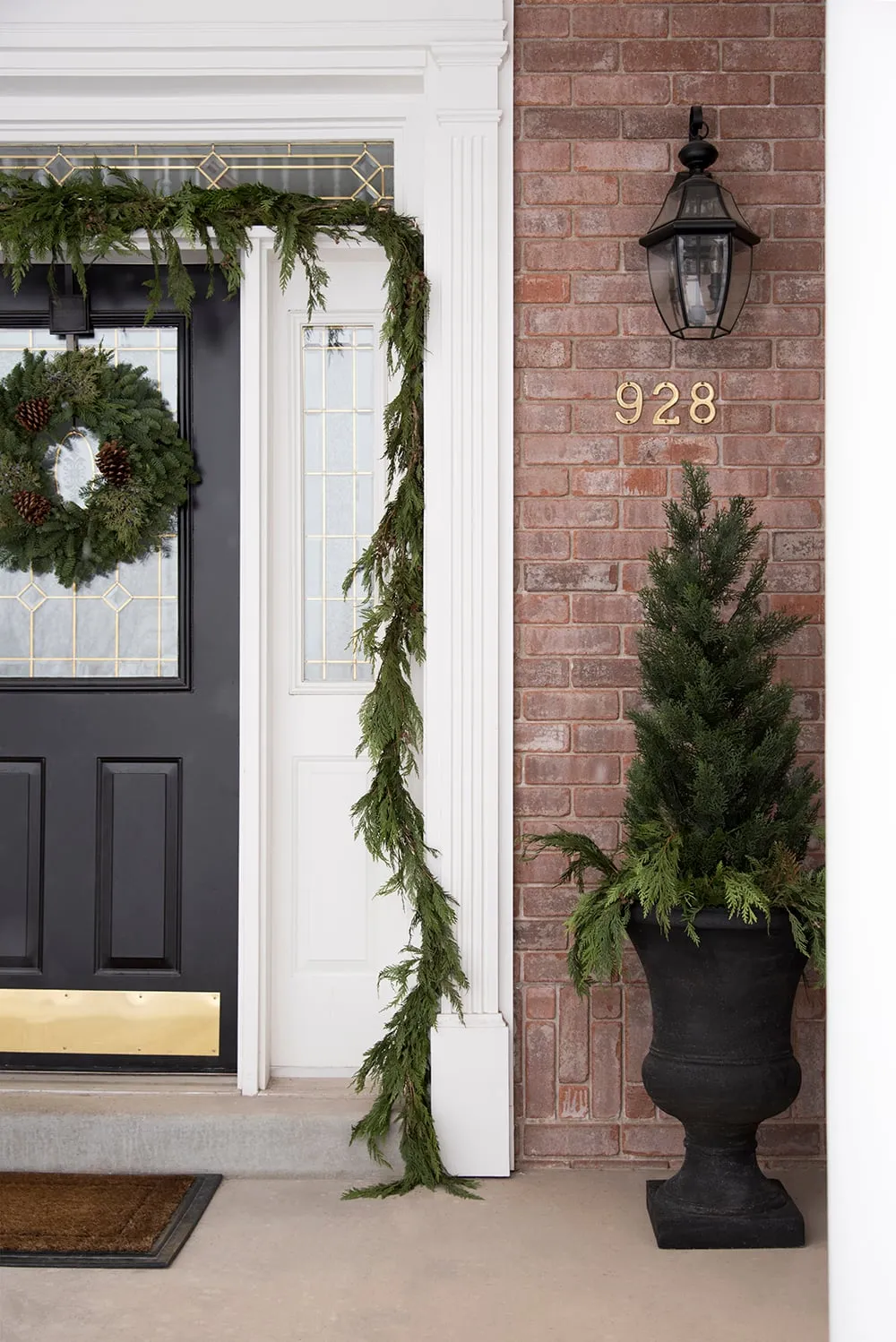
that matters more than the wreath, the ribbon, or the color scheme is the hanger — and it’s the one thing nobody photographs. A flimsy hook that lets a wreath slide down two inches a week will make an expensive wreath look sloppy by New Year’s. Test yours empty first: hang it, close the door, and open it five times. If the hook shifts, walks, or catches on the frame, it will do that every single day for two months. Fix it before you decorate, not after.
15. Measure First: The Door Gap Nobody Checks
Ten minutes with a ruler saves an afternoon of frustration:
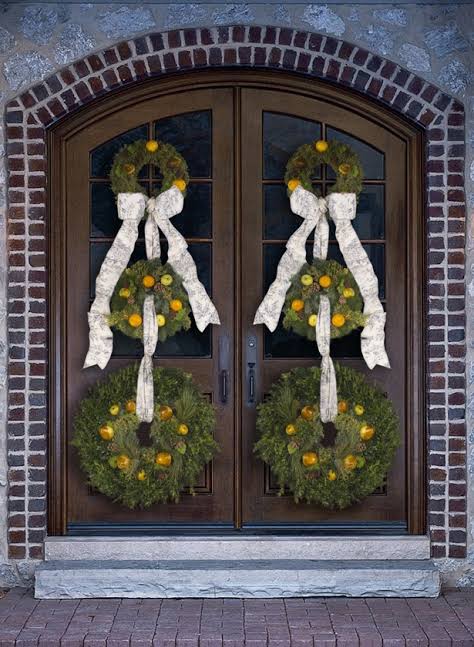
- Slide a piece of cardstock along the top edge of your closed door to feel the gap.
- Measure the door width and the height from the floor to the top edge.
- Weigh your wreath on a kitchen scale — yes, actually weigh it.
- Choose a hanger rated for at least twice the wreath’s weight.
- Do a full dry run with the empty hook before adding a single ribbon.
Cost: nothing. The most common surprise is a storm door with a gap under a quarter inch, which rules out most over-the-door hooks entirely.
A few door types fight back. Steel doors won’t hold magnets, so those popular magnetic hooks are out. Vinyl and composite doors can discolor under adhesive strips, and cold weather makes adhesive let go right when you least want it to. Storm doors with tempered glass usually can’t take a screw anywhere visible. If you’re in any of those situations, hang the greenery on the wall beside the door instead of on the door itself — the flocked swag in Idea #4 was built for exactly that.
16. Deep Blue Door with a Soft Pink and White Floral Wreath
When a wreath sits inside the upper window panes rather than on the door face, you can’t use a screw or a nail — so use a clear outdoor-rated suction cup with a metal hook, or run a ribbon over the top of the door and clip the wreath to a loop on the inside. Wipe the glass with rubbing alcohol first; suction fails on a dusty or cold pane. And keep the blooms strictly white and soft pink against deep blue. Add a single coral or hot pink flower and the whole thing goes from serene to confused.
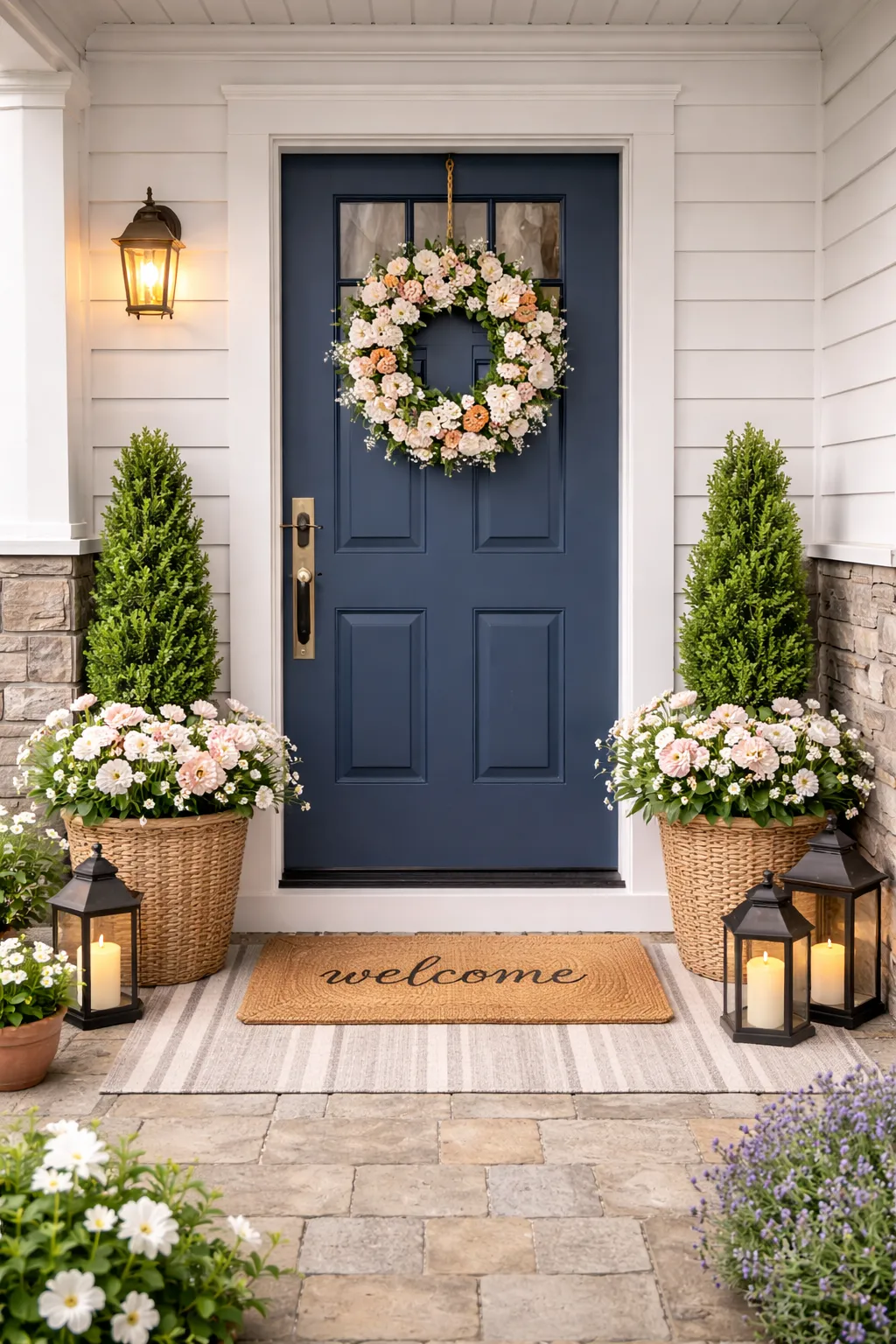
The good news is that this look is nearly impossible to overspend on, because the drama comes from the door color, not the flowers. A faux topiary tree in a woven basket runs about $18 at Walmart or Target, the basket itself $12, and a pair of black metal candle lanterns around $15 each. Add a layered doormat setup for $30 and you’ve built this entry for well under $120 — versus $400 or more if you buy live topiaries and a florist-made wreath.
17. Salmon Pink Door with Dusty Roses and a Gold-Trimmed Bow
Here’s what this entry actually adds up to:
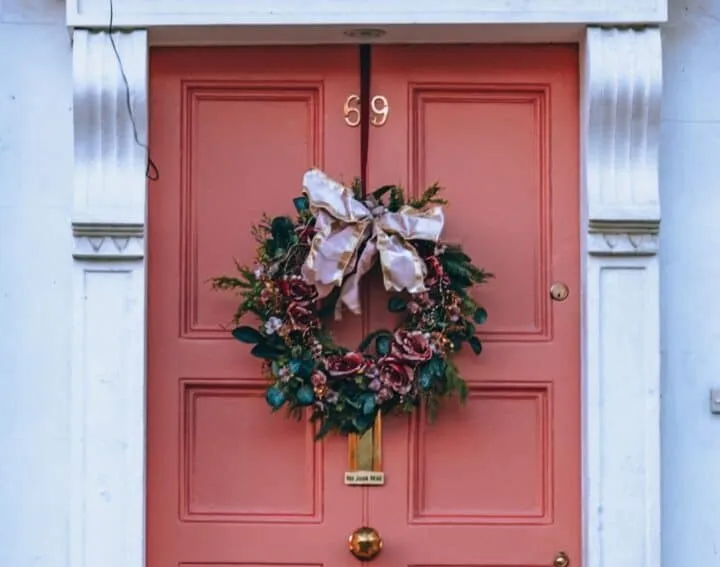
- 22-inch evergreen wreath base: $25–$60
- Faux dusty rose and dark pink blooms, two bunches: $16–$40
- Wide pale pink ribbon with gold edging, 2 yards: $10–$26
- Brass house numbers, set: $25–$70
- Exterior paint, one quart, if you’re going pink: $30–$55
Total: $106–$251
Budget alternative: skip the paint and the house numbers, and you’re at roughly $38 for a $18 wreath, $12 of faux roses, and $8 of ribbon. The door color is the expensive part, and it lasts a decade.
Building the bow so it doesn’t sag takes about 15 minutes:
- Cut two yards of ribbon and fold it into four loops of equal size.
- Pinch the center hard and wrap it with 22-gauge floral wire — not tape, which slips in the cold.
- Cut two tails twice as long as the loops and angle the ends.
- Wire the bow to the wreath’s top-left, slightly off center, so the loops read fuller.
- Fluff each loop outward with your fingers, then hang immediately.
18. Horizontal Cedar Swag with a Center Velvet Bow
The math is simple: 60 percent white, 30 percent green, 10 percent red. The white paneled door is the field, the horizontal fir and pine boughs plus the berry twigs carry the green, and the single center bow delivers all the red at once. Because the swag runs horizontally instead of hanging vertically, it reads wider and calmer than a wreath. Swap the red velvet for deep burgundy and the same formula turns moody; swap it for plaid and it goes full cabin. Only the 10 percent ever changes.
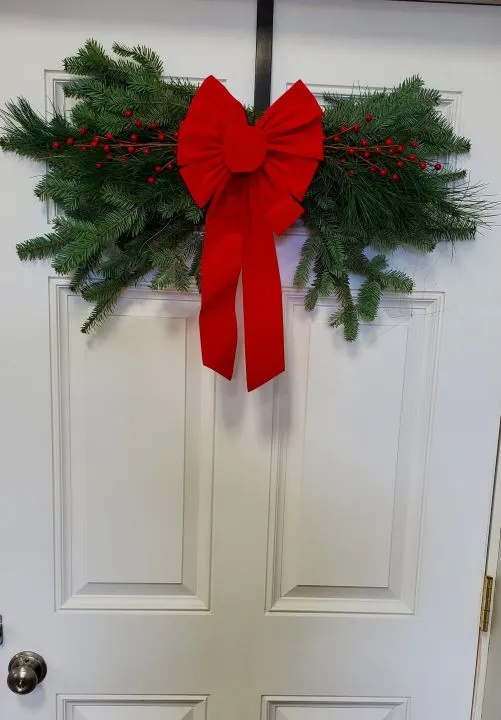
Two practical warnings. Fresh greens leave sap on white paint, so put a strip of painter’s tape behind every point where the swag touches the door, and wipe the frame with a damp cloth the day you take it down — white doors show every trace. Second, a horizontal swag is heavier than it looks and it pulls straight down on a single hook. Use a stout, wide-blade over-door hanger, or better, a black metal swag hanger with a flat back that distributes the load across six inches instead of one.
19. Airy Eucalyptus Wreath on a Charcoal Arched Glass Door
Arched openings break the usual rules. Measure the arch’s width at its widest point, then choose a wreath roughly a third of that — typically 20 to 24 inches for a standard 36-inch arch. Hang it so the wreath’s center sits in the middle of the arch opening, not at the peak, or it will look like it’s sliding off. A round wreath on an arched door also needs more breathing room than usual; leave at least four inches of glass visible on all sides so the shape contrast reads as intentional.

The one element doing the heavy lifting here is texture variety, not color. Eucalyptus, mixed broad leaves, small berries, and tiny white floral clusters are all the same green family — the interest comes from matte versus glossy, spiky versus soft. Remove the white blooms and the wreath goes flat and one-note. That restraint is what makes it look expensive. Compare it with Idea #1, which uses the same rule with dried citrus instead of flowers.
Fresh eucalyptus dries instead of rotting, which sounds like a win until you notice it also shrinks. A wreath that looks generously full in November will show visible gaps by mid-December, so wire in three or four extra stems up front. The dried leaves also go brittle and shed, and if you hang it indoors the scent fades in about ten days. If there are curious pets in the house, keep it out of reach — eucalyptus is not something you want chewed on.
20. Dark Green Door with a Velvet Bow and Glowing Lanterns
You don’t need to repaint a door to get this mood — but a quart of exterior paint in a deep forest green is about $35 and it lasts eight to ten years, which is some of the cheapest drama in home decorating. Faux frosted fir trees run $25 to $45 each at Walmart or Target, and honestly the cheap ones look better here than expensive flocked versions, because the flocking hides the plastic. Pre-lit garlands are $25 at IKEA. Two lanterns and a set of LED pillar candles come in under $40 together.
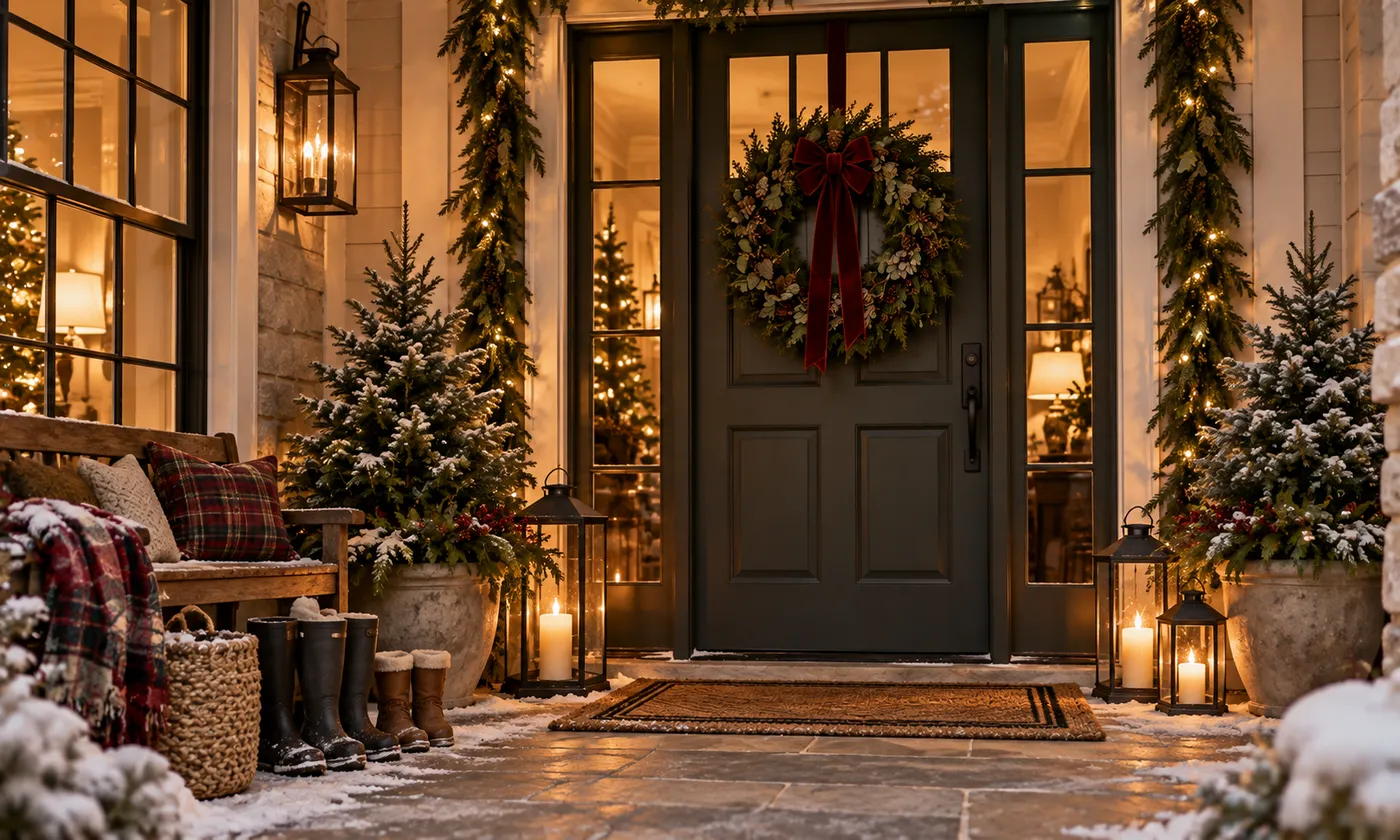
Light temperature is what separates this from every other decorated porch on the street. Use 2700K warm white bulbs, not the 4000K cool white that’s probably in your porch fixture right now — it’s the difference between candlelight and a parking garage. Whether you go with real candles or LED pillars, place the lanterns so they sit just below the bottom edge of the wreath; light coming from underneath makes the deep red velvet glow, and light from above flattens it into dark maroon.
21. Magnolia and Pine Wreath with Copper-Toned Leaves
Layering three textures into one wreath takes about 40 minutes once your materials are gathered:

- Start with a grapevine or wire base and attach pine and fir sprigs first, working in one direction.
- Add magnolia leaves in small clusters of three, alternating green side up and brown side up.
- Tuck pinecones into the gaps between clusters, not on top of them.
- Step back every ten minutes — wreaths look fuller up close than they do from the sidewalk.
- Wire the last few pieces while the wreath is hanging, so you fill gaps where they’ll actually be seen.
Materials run $45 to $90 depending on whether you forage the magnolia.
What makes this work is contrast within a narrow palette. The glossy broad magnolia leaves sit next to fuzzy needle pines, and the rough wooden pinecones break up both. The secret is that magnolia leaves have a brown, suede-like underside — flipping a few face-up turns that into a warm copper accent instead of a flaw. Everything stays in the green-to-brown family, so the texture does all the talking and the wreath never feels busy.
22. Buffalo Plaid Bow Swag with Snow-Dusted Pinecones
Snow-dusted greenery is a commitment. Faux frost sheds every time you move the swag, so hang it once and leave it alone — and if you live somewhere that actually snows, the first real storm will make your artificial dusting look silly by comparison. In warm climates it just reads odd next to green grass. A good compromise is a light dusting on the pinecones only, which reads as frost from a distance but never looks like a lie up close.

For a front door, a swag 36 to 42 inches wide and about 18 inches tall sits nicely across the middle third of the door. Hang it so the top edge is roughly level with the top third of the door, leaving the doorknob and mail slot clear. If your door has a narrow glass insert, keep the swag on the solid panel portion. On doors narrower than 32 inches, a swag this size will look like a garland that lost its way — use a wreath instead.
Buffalo plaid is one of the few holiday patterns that has genuinely earned its place. It’s been in steady rotation for over a decade now, it works in October as readily as December, and it’s already in most people’s closets, which is why it keeps showing up in wood-cabin styling, farmhouse styling, and even the newer pastel Christmas looks. This one is not going out of style.
23. One Wreath, Three Ribbons: The Swap That Saves Money
How you store a wreath decides whether it lasts three years or ten. Never bag it in plastic — trapped moisture mildews faux greenery and molds real foliage within a season. Instead, wrap the wreath loosely in acid-free tissue, lay it flat in a cardboard box that’s at least two inches larger in every direction, and store it somewhere cool and dry. The garage rafters in summer are not that place. If your wreath has berries, remove them first; berry clusters are the first thing to flatten and the hardest thing to fluff back.
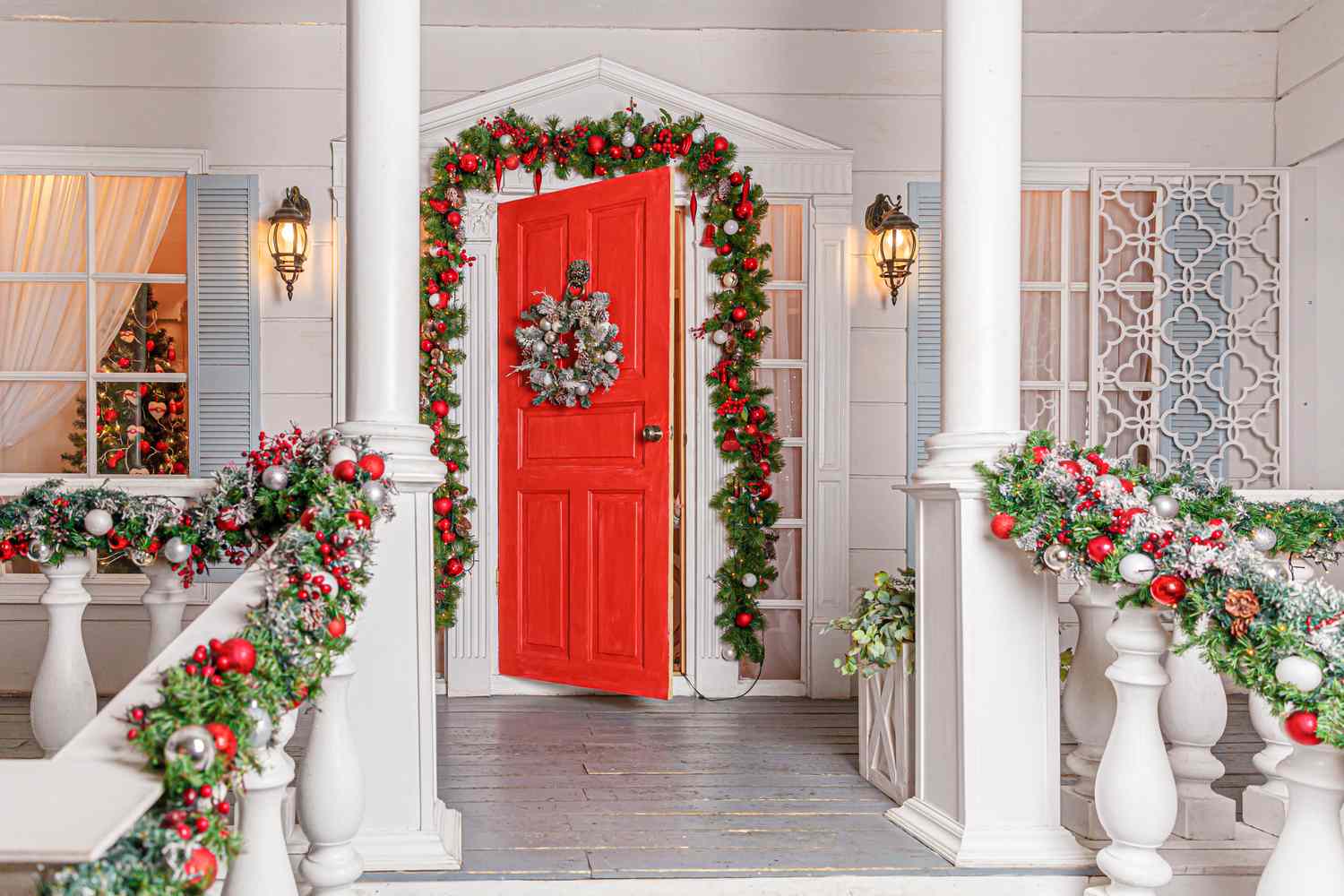
Here’s the buy that actually saves money: instead of three $120 wreaths for three different moods, buy one good $40 faux evergreen base and three $8 rolls of ribbon. A buffalo check bow in early December, a wide burgundy velvet bow for the week of Christmas, and a cream linen bow that carries you into January — same wreath, roughly $64 total. Add a $6 ornament pack you can tuck in or pull out and you’ve got a wardrobe, not a collection. Thrift stores are also worth a December look for wire wreath frames at $2 apiece.
24. Grey Door Wreath with Brass Bells and Long Velvet Streamers
Two small brass bells, hung at the bottom of the wreath rather than the top, add something no ornament can: sound. It’s a tiny detail that most people feel before they identify it. Attach them with a short length of twine through the wreath’s lower wire, spaced about three inches apart, and make sure they hang free rather than resting against the door — bells pressed flat against wood don’t ring. Skip this entirely if anyone in the house naps near the entry.

Long velvet streamers look luxurious and behave badly. The rule that keeps them elegant: the tails should end no lower than one third of the way up from the bottom of the door, and they should always hang from the top of the bow rather than from the wreath’s base. Anything longer than about 30 inches reads as an accident, and it will tangle in the door sweep every single time you come home with groceries.
The one element that makes this wreath feel collected rather than bought is the cluster of red berries and pinecones sitting low and to the left, breaking the ring. Without that asymmetry, a wreath with a symmetrical bow and symmetrical streamers reads as one solid, slightly stiff circle. That single off-center detail is the cheapest design upgrade in this whole article.
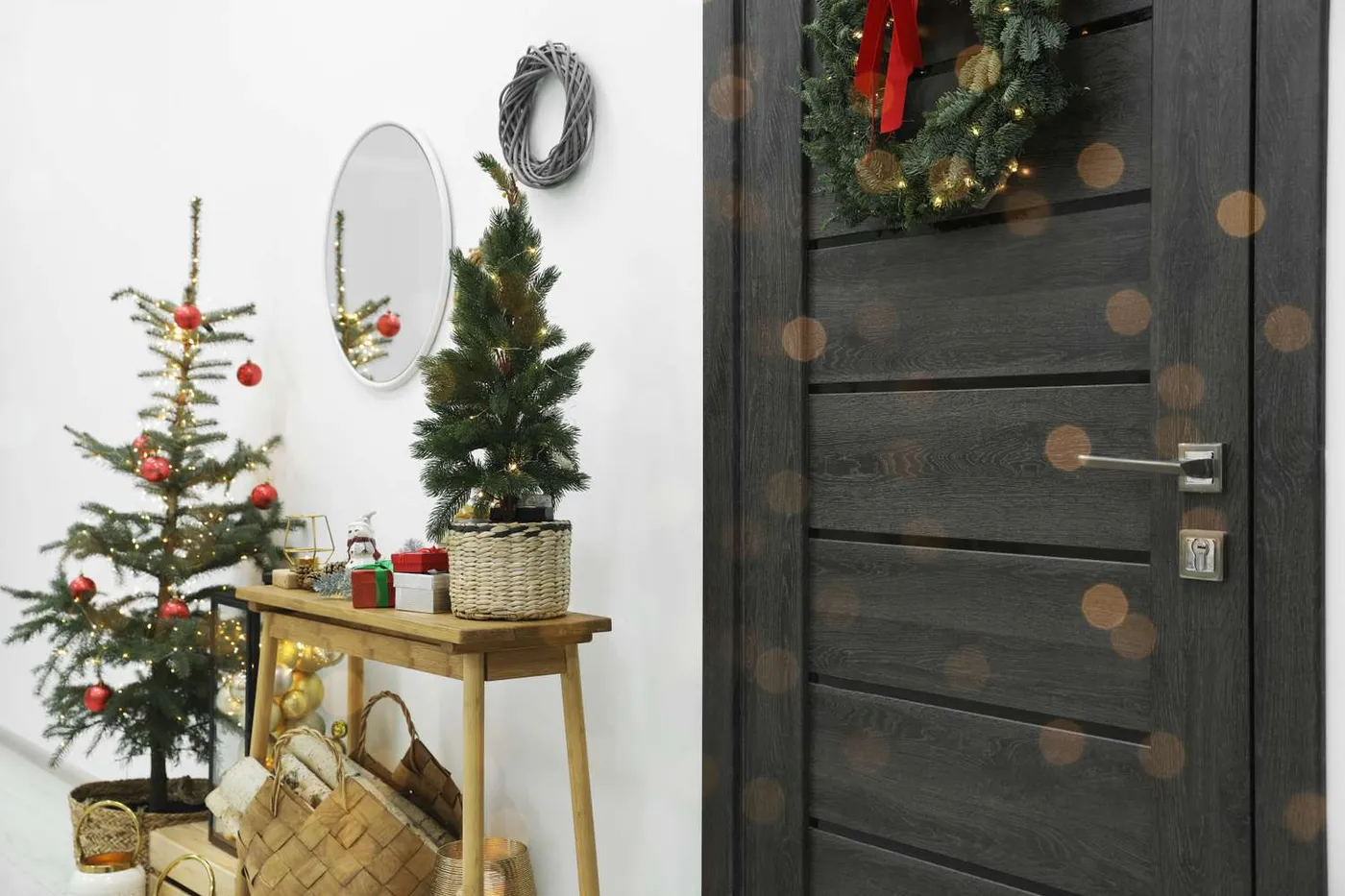
25. Evergreen Wreath on Dark Wood Glass with Warm Interior Glow
That soft golden blur behind the glass is doing half the work, and it takes about 20 minutes to create:
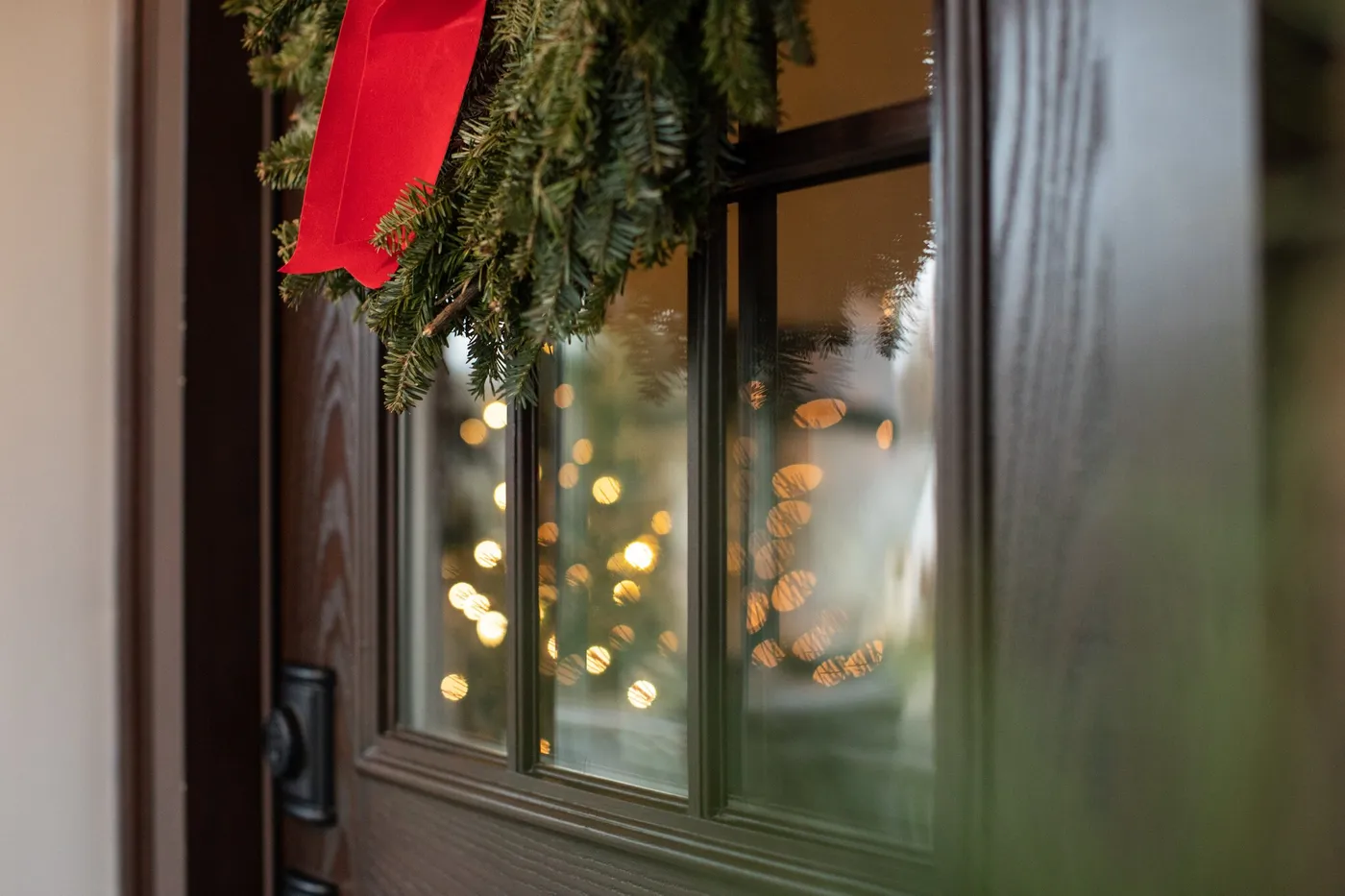
- Hang a strand of warm white lights 12 to 18 inches behind the door, inside the room.
- Use 2700K bulbs only — daylight white kills the effect instantly.
- Loop the strand loosely so it sits at different depths; a flat line of lights looks like a runway.
- Dim the room’s overhead lights or turn them off entirely.
- Shoot or stand back six feet — the blur only appears when the lights are slightly out of focus.
Cost: $12 to $20 for a strand of warm LED lights.
The whole look here is a $20 wreath and a $5 satin ribbon, and it’s the lighting that makes people stop. A plain faux evergreen wreath from Walmart runs $18, wide red satin ribbon is about $5 a roll, and a 9-foot strand of warm LEDs is $12. Total, under $40 — versus $150 or more for a fresh wreath of the same size. If you want the fresh look for a few weeks, buy a $25 fresh wreath and accept that it’ll be brittle by New Year’s.
26. Dense Evergreen Wreath with Red Berries and Trailing Ribbon
This is a three-ingredient wreath — greenery, red berries, pinecones, plus a bow — and the discipline is what makes it work. Notice the bow’s loops are roughly one third the width of the wreath itself; anything larger and the bow becomes the wreath. The ribbon tails trail down the center, which draws the eye vertically and makes the whole thing look longer than it is. And the berries are clustered in groups of three or four rather than scattered singly, so they read as deliberate spots of red instead of confetti.

Full transparency: this is the most duplicated wreath in America. To keep it from looking like everyone else’s, change one variable and change it hard. Go with a hardwood handle pair instead of ribbon, or swap red berries for white ones, or use a five-inch-wide velvet ribbon instead of two-inch satin. Buy from a local grower rather than a big box if you can — the foliage density is usually noticeably better, and it’s the one thing you can’t fake from the street.
27. Illuminated Pine Wreath with Poinsettias Above a Gold Mantel
The ratio is 55 percent neutral white, 30 percent green and red, 15 percent warm gold. The plain white wall and the neutral shelf are the field, the pine wreath and red poinsettias carry the color, and the gold ornaments, conical trees, and tiny wooden houses supply the warmth. Go heavier on the gold and this turns glam; drop it entirely and you have a very traditional red-and-green display. One caveat: keep the gold in a single finish. Mixing bright yellow-gold with antique brass is the fastest way to make an arrangement look assembled from three different houses.
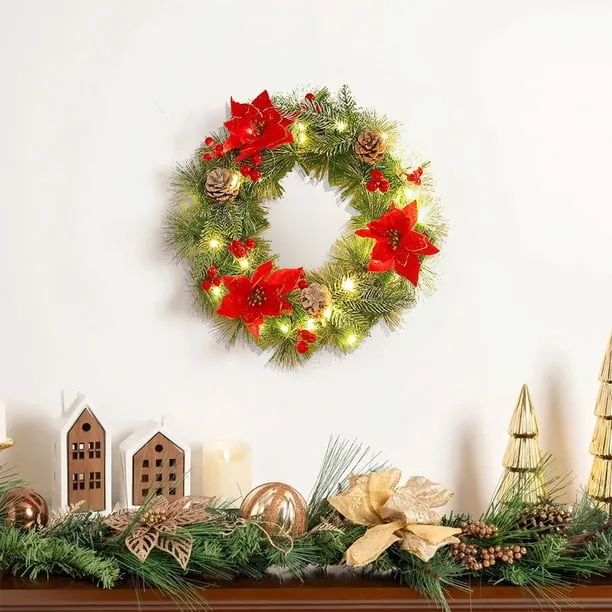
The one element that transforms this from a wreath on a wall to a whole vignette is the warm white fairy lights woven through the pine. They’d read as decorative on their own, but combined with the lit garland below, they connect the wreath and the mantel into one continuous glow. Remove them and you have two separate, slightly disconnected decorations. If you only have budget for one upgrade here, spend it on lights, not ornaments.
28. Botanical Dried Fruit and Thistle Wreath on Muted Green
When the wreath and the door are nearly the same green, size carries the whole composition. Choose a wreath diameter of at least one third the door’s width — 14 to 18 inches on a standard 36-inch door — and offset the color difference by using lighter silver-green eucalyptus and pale bleached foliage against the deeper muted door. Anything smaller than a foot in diameter will disappear into the paint. You can see the same principle at work with the sage door in Idea #1.
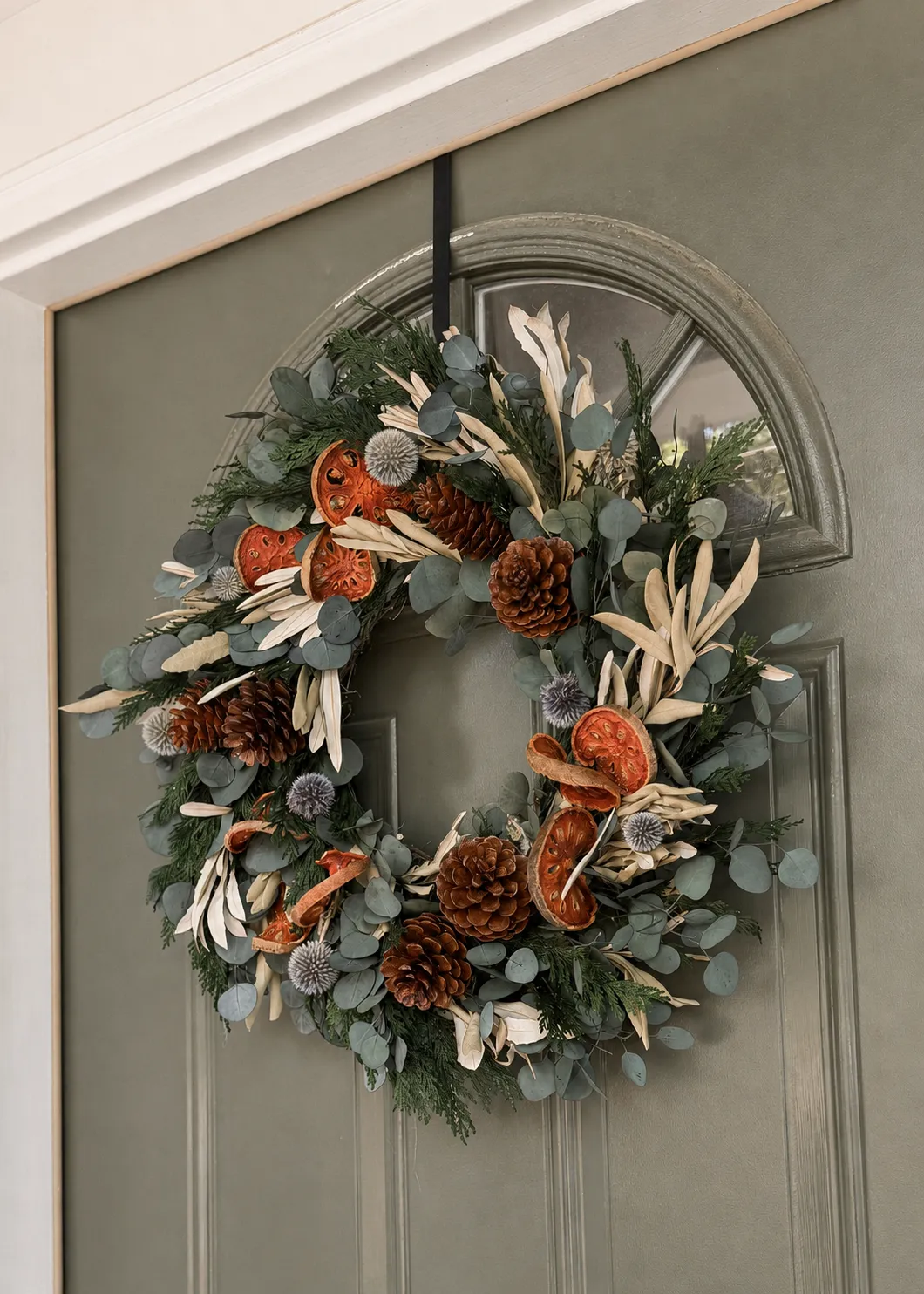
Dried botanicals are delicate in ways people don’t expect. Bleached and dried leaves crumble if you handle them more than a few times, thistle pods shatter on impact, and dried citrus can attract pantry moths if it’s stored somewhere warm. Keep the wreath away from direct sun, which bleaches the rust-orange citrus to tan in about six weeks, and pack it with a cedar block rather than mothballs each spring. Expect to rebuild it every other year.
The dried floral trend isn’t slowing down. It’s the natural endpoint of a shift toward lower-waste decorating that started with thrifted furniture and moved into holiday styling — people want something that looks foraged, not manufactured, and dried citrus, thistle, and bleached foliage pull that off better than anything plastic. Reframe it as a piece that lives into January and you’ve bought yourself two extra months of decor.
29. Heavily Flocked Pinecone Wreath with Red Berries and Baubles
The biggest mistake with flocked wreaths is over-flocking. Stop when about 60 percent of the needle surface is covered; if you keep going you get clumps that fall off in sheets the first time someone brushes past. If you’re flocking your own, work in thin layers with a fine mist of adhesive between each, and let the wreath sit for 24 hours before hanging. Also, tap the wreath gently against your palm over a trash can before it goes on the door — anything loose now is something you won’t be sweeping off the entry floor in January.

A pre-flocked wreath from Walmart or Target runs $22 to $35, and at that price it’s rarely worth DIY-ing. Add $6 of red berry picks from Dollar Tree, $5 of white frosted mini ornaments, and a $7 spool of ribbon if you want a bow, and you’re at roughly $45 for a look that reads as $150 from the sidewalk. The one thing worth paying more for is berry quality — cheap red berries look pink in sunlight, which is the giveaway on an otherwise convincing wreath.
30. Dark Grey Arched Door Wreath Paired with a White Stone Urn
Styling a large urn so it looks abundant rather than stuffed takes about 30 minutes:
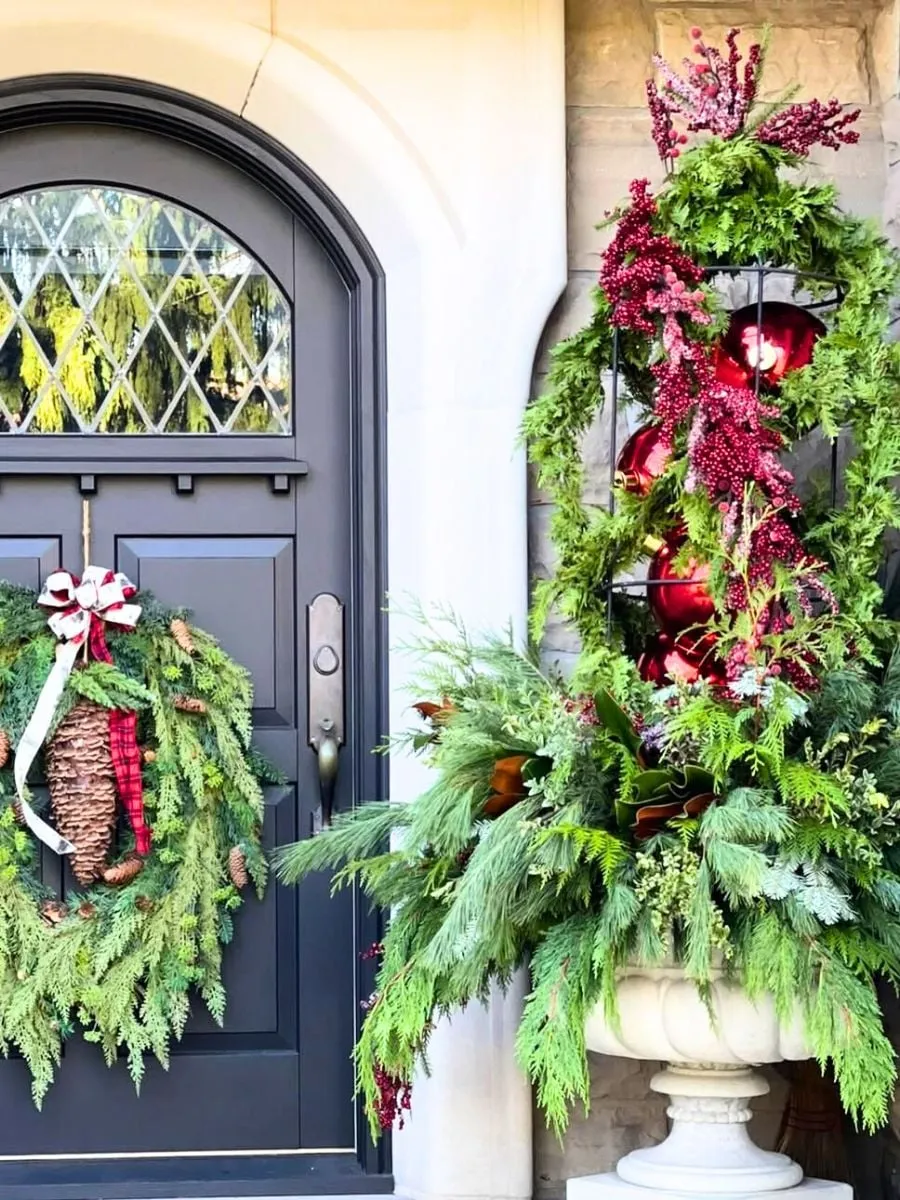
- Fill the bottom third with sand or gravel for weight, then add a nursery pot upside down.
- Insert the tallest evergreen branches first and fan them outward in a wide V.
- Layer mid-height branches over the rim so they spill past the edge by six to eight inches.
- Add red berry sprays in the middle zone — never at the very top, where they look like antennae.
- Finish with oversized ornaments tucked low and half-buried, so they read as growing out of the arrangement.
Budget $60 to $140 with real greens, or about $35 with faux.
The reason this front door works so well is echo. The wreath on the dark grey door picks up the exact same evergreen and red berry that spill out of the urn, so the two elements read as one composition instead of two decorations placed near each other. The oversized pinecone in the wreath is the cable that ties them together — remove it and the wreath becomes generic while the urn carries all the personality.
31. The Element Every Door Display Is Missing: Warm Light
Here’s the unglamorous truth: most front doors are lit by a builder-grade fixture with a 4000K bulb, which turns red velvet purple and makes fresh greenery look plastic. If you photograph your door after dark — and you will, because everyone does — you’re fighting your own light. Swap the bulb for 2700K, add a dimmer switch if the fixture allows it, and everything you’ve hung instantly looks more expensive. Under $15, and it beats anything you can buy at a craft store.
Think of an evening entry as 70 percent dark neutral, 20 percent green, 10 percent warm light. The door and siding are the base, the wreath and garland are the color, and the glow from a lantern or string lights is the accent that makes the other two visible. Push the light higher than 10 percent and the entry turns into a light show; drop it to zero and all your careful styling vanishes at 5pm. The math is the same whether it’s a wreath, a swag, or a pair of planters.
So the one thing that would improve almost every door in this article is a warm bulb you probably already own the socket for. Get that right and even a $25 wreath looks curated on a dark December evening. Get it wrong and a $300 wreath looks like it’s being interrogated. Start there before you buy a single ornament.
Your Door Is the Handshake — Make It Count
Thirty-one ideas later, the pattern is clear: the front door that works isn’t the most decorated one, it’s the one where two or three things are done deliberately — a color that repeats, a bow that’s actually the right width, a warm bulb doing quiet overtime. Pick one idea from this list, steal the details that fit your entry, and don’t overthink the rest.
📌 Save this to Pinterest before you head to the store — and if you try one of these, tag us. We love seeing a front door that finally looks like it belongs to the house behind it.