
You know that feeling when the tree is finally up, the mantel is done, and then you look at the dining table and it is still very much a Tuesday? That gap between the rest of the house and the table is where most December stress lives.
We spent serious time browsing Anthropologie, Target, and Etsy to bring you only what is worth your attention this year — settings that photograph beautifully and survive an actual dinner with gravy. Everything here runs from about $4 for a napkin ring up to $380 for a full dressed table, and where it makes sense we put the budget version right beside the splurge.
Inside you’ll find 32 curated Christmas place settings for 2026: traditional red-and-green, rustic woodland, elegant gold-and-grey, and the newer earthy modern look, with budget and luxury takes compared side by side.
What is pushing this in 2026 is a swing back toward full traditional dressing — patterned cloths, scalloped plates, real tapers — after a few years of pared-back minimalism. People want the table to feel like an occasion again, not a backdrop.
And stay until the end — we break down the most common mistakes that can ruin these looks.
📌 Save this to Pinterest for later — you’ll want to revisit these ideas. (Some links here are affiliate links, which may earn us a small commission at no cost to you.)
1. Red, Green, and Silver in the Most Classic Sense
What keeps this table on the right side of classic instead of cluttered is the value structure. A saturated red cloth owns most of the visual field, white plates give the eye somewhere to rest, and silver appears only in small reflective pieces — trees, a reindeer, stacked gift boxes. Three ingredients, three jobs, no fighting. The green arrives last, through the wreath on the wall and the curtains framing the room, so it wraps the table rather than competing for space on it.
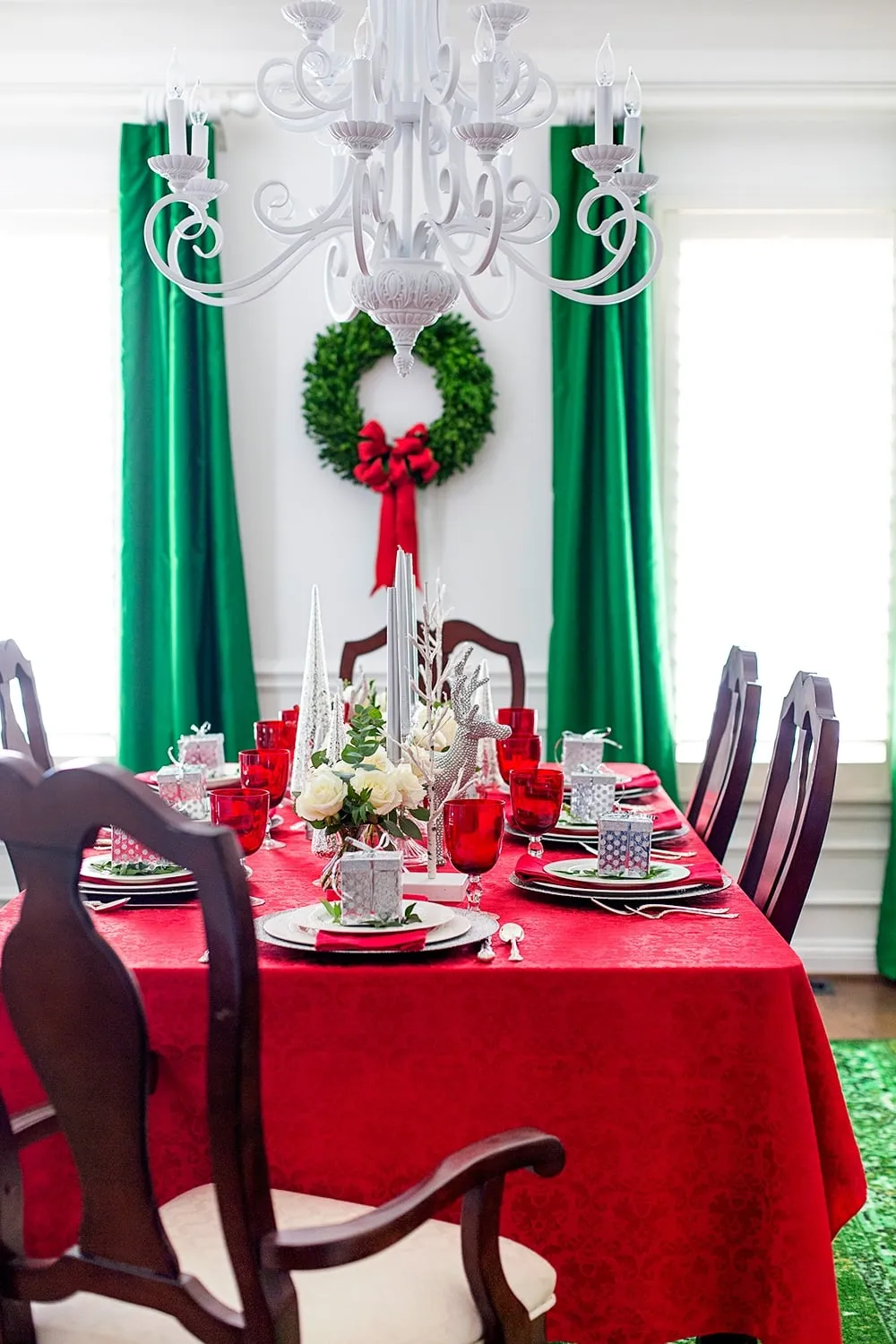
- Textured red tablecloth: $30–$70
- White dinnerware, service for 8: $60–$180
- Red glass goblets, set of 6: $40–$90
- Silver trees, reindeer, and gift boxes: $45–$120
- White roses or good faux stems: $25–$60
- Green wreath and red bow: $20–$45
Total: roughly $220–$565. Budget alternative: a red flat sheet hemmed into a cloth, thrifted goblets, and one silver reindeer instead of a herd lands the same look for under $130.
2. Scalloped Green Plates Against Deep Navy Walls
Strip everything else away and this setting still works, and it works because of the striped charger peeking out beneath the scalloped green plate. That red-and-white ring separates green from red, adds pattern without committing to a printed cloth, and costs almost nothing. Lose it and the plates float on the table looking orphaned. Keep it and the whole setting snaps into focus — even the tumblers suddenly make sense.
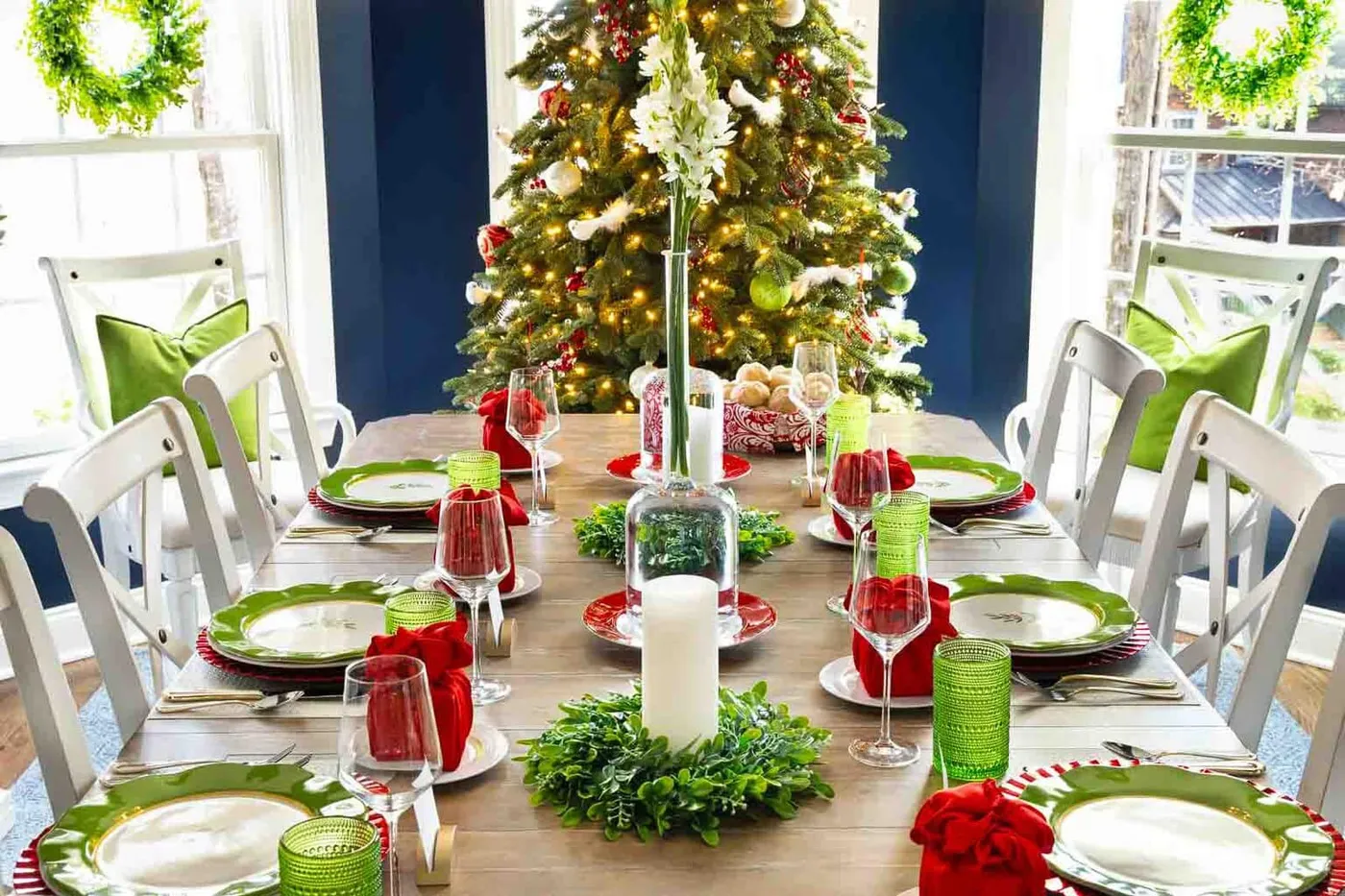
Charger rule of thumb: it should extend 1.5 to 2 inches past the dinner plate rim, no more. Go wider and your guests’ elbows are hanging off the edge before the plates even land. And those bright green seat cushions are the cheapest move in the room — new cushion covers on X-back chairs run about $15 each and change the entire mood of the table.
3. Sage, Gold, and Brass Deer Down the Center
Think of this table as a formula rather than a shopping list: about 55% light sage and cream, 30% deep forest green, and 15% gold and copper shine. Swap sage for warm grey and the setting goes modern in an afternoon. Swap the copper cutlery for brushed steel and it cools off considerably. Keep the ratio intact and you can replace every single object on the table without losing the look — the proportions are what you are actually copying.
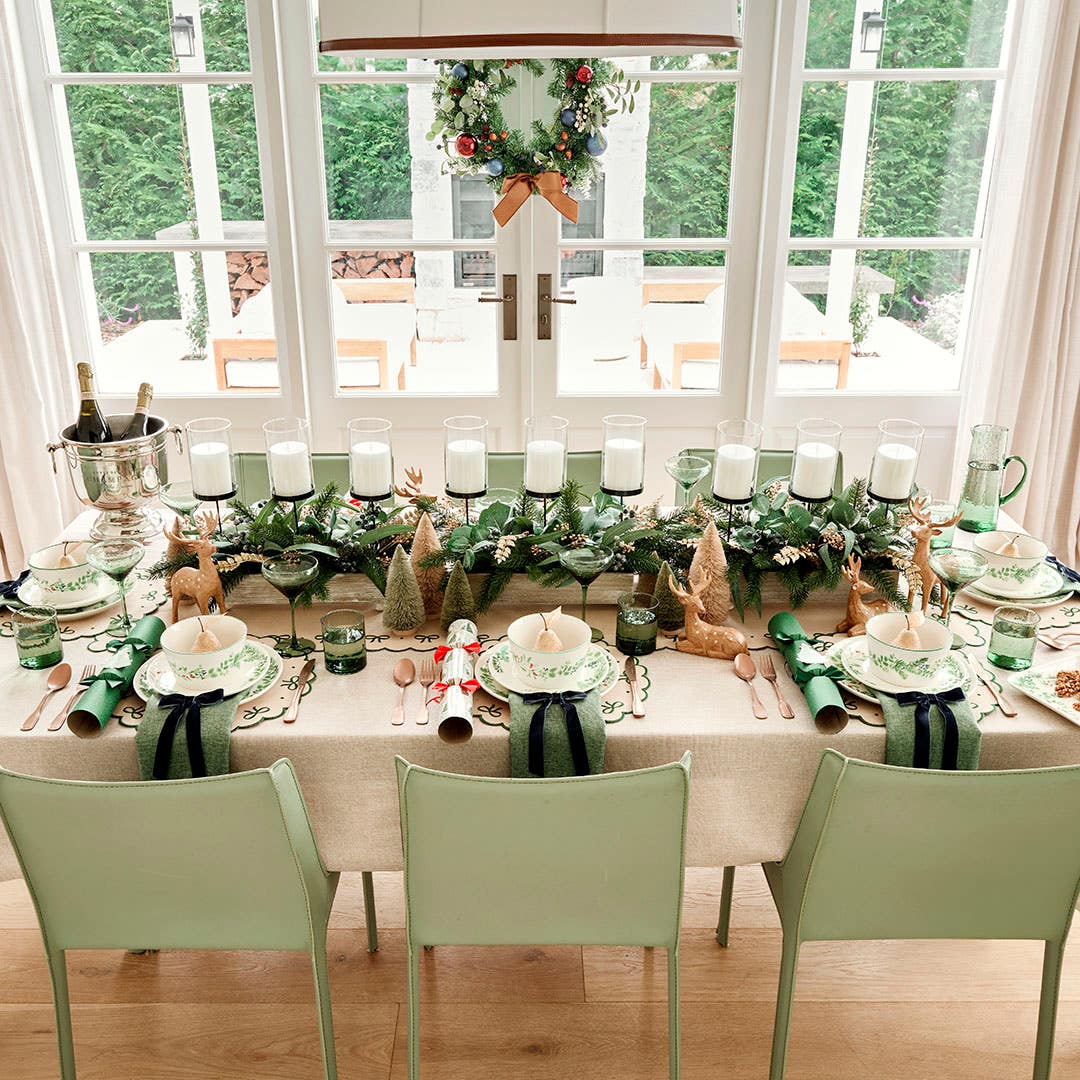
This is a long-table idea, full stop. It wants a rectangular surface of at least 84 inches so the greenery-and-candle run can breathe between place settings, and it needs a generous 30 inches per seat or the centerpiece starts crowding elbows. In a room under 11 feet wide, see Idea #12 for a tighter version of the same formality.
4. Pinecone Candles in an Ornate Brass Urn
- Line the urn with foil, then set a soaked block of floral foam inside so boughs stay put.
- Insert evergreen stems at a low 45-degree angle first, then fill the gaps so no foam shows.
- Tuck miniature ivy topiary at each end to add rounded, leafy contrast.
- Seat the pinecone candles last, checking that each flame has two inches of clear air above it.
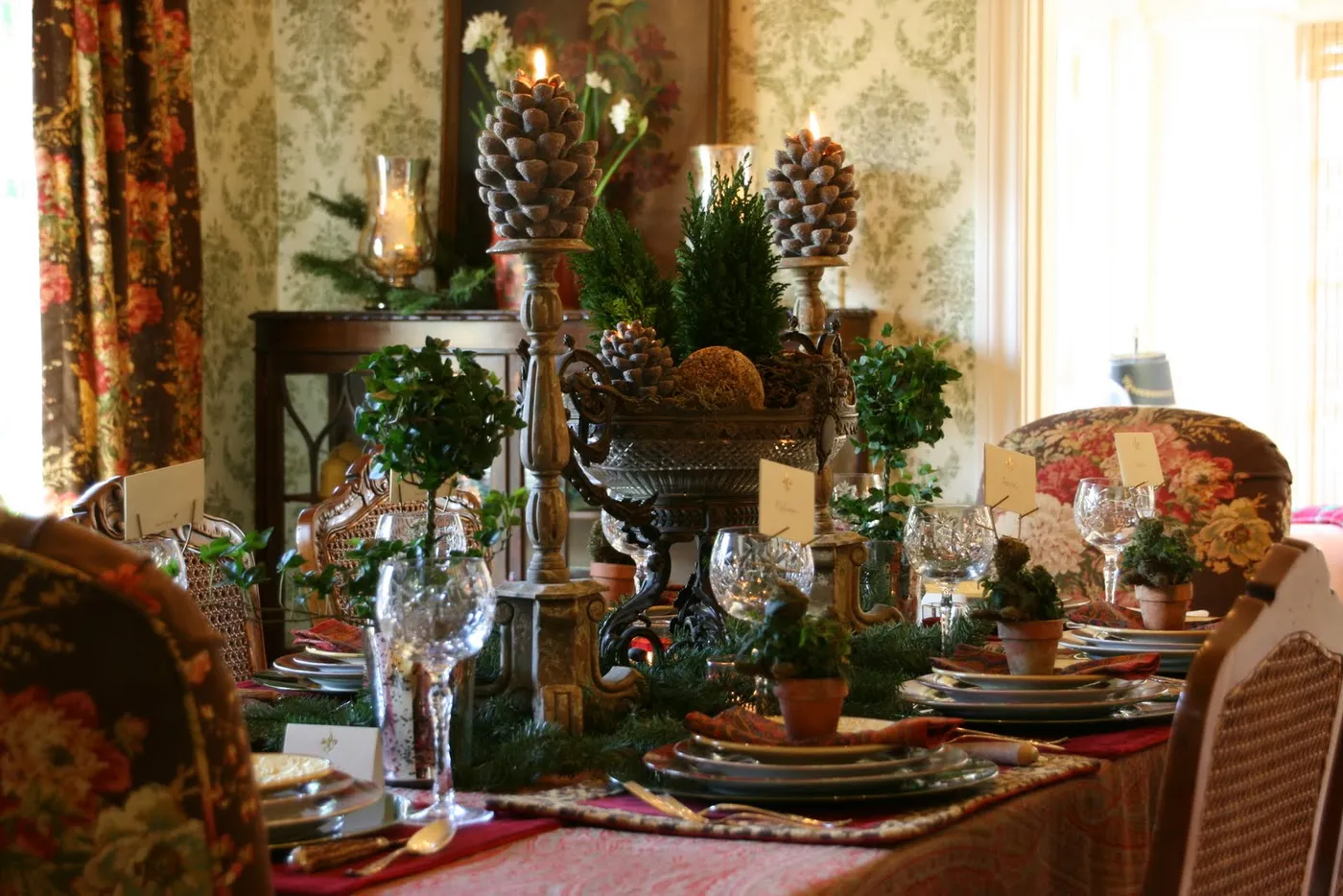
Budget about 45 minutes and $40–$70 in materials, most of it for the foam and the candles.
pinecone candles drip in unpredictable directions, and they will absolutely weep wax onto your evergreen boughs by dessert. Use flameless versions inside the pinecones if children or pets are anywhere near, and keep the whole arrangement at least a foot from the wallpaper and floral curtains behind it. Cane-backed chairs plus patterned walls is already a lot of texture — resist adding a printed runner.
5. Powder Blue and Pale Wood for a Quieter Christmas
You do not need a $200 table to get this. Round woven placemats run about $4 each at IKEA, plain white plates are $1.50 apiece at Target, and the light blue napkins can be dyed at home with a $6 packet of dye. The wooden bead garland is a $5 craft store strand, and those tiny white tree charms are inexpensive bead-barrel earrings clipped apart. Total for six seats: under $80, and nobody at the table will know.
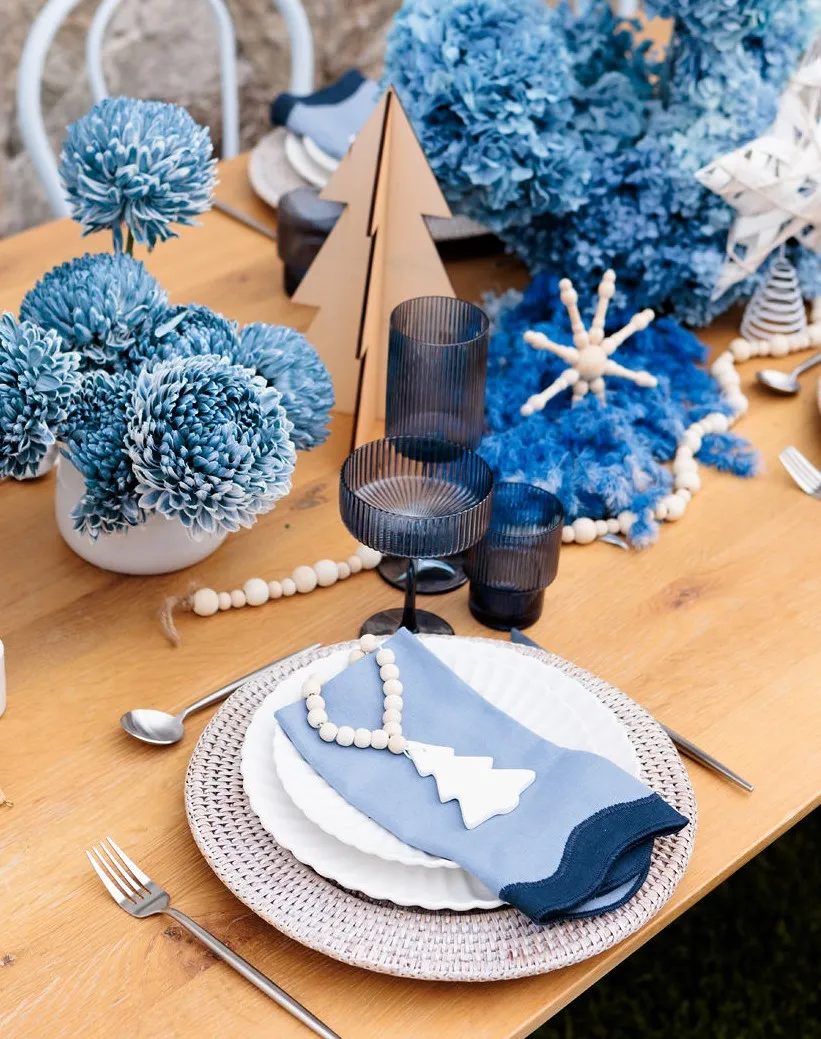
This cooler palette is why the idea has legs. After years of red-and-green dominance, blue holiday tables picked up serious traction as people with non-traditional interiors wanted a Christmas that matched the room they actually live in year-round. Blue is not a fad here — it is what happens when holiday decor catches up to the rest of a house.
6. A Dough Bowl Full of Apples and Evergreen
The single element carrying this whole table is that old wooden dough bowl. Not the apples, not the pinecones — the bowl itself, with its worn walls and visible grain. A ceramic vessel would read farmhouse-cute; the raw wood reads like something that has been in the family and gets pulled out every December. If you own one, use it. If you do not, spend your money here before you spend it on plates, and check Idea #4 for the more formal alternative.
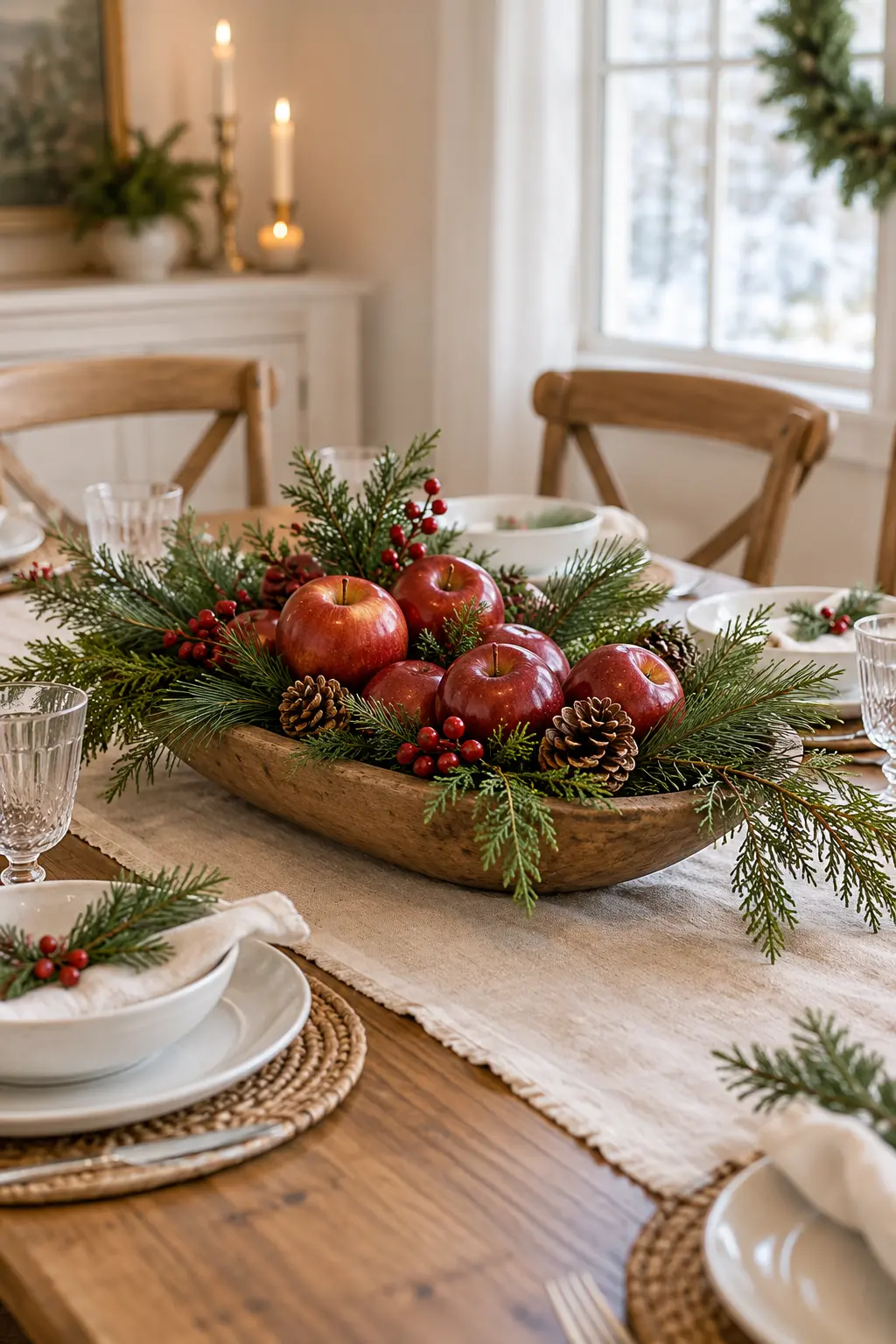
Honest upkeep: real apples need swapping every five to seven days before they soften, and evergreen branches indoors drop needles within about two weeks of cutting. Plan to refresh greenery mid-month. If your bowl is dry and untreated, rub it with food-safe mineral oil once a season so it does not crack — and never put wet fruit directly against bare wood without a liner.
7. Charcoal, Gold, and a Little Dark Purple
Dark-on-dark only works if there is something bright to aim the eye at. Here it is the white napkins, the gold cutlery, and the clear champagne flutes — without those, the grey tablecloth, grey placemats, and grey plates merge into one soft blur after dark. Watch the round table size, too. A 48-inch round seats four comfortably and six only if everyone likes each other; a 60-inch round is the real six-person size, and grey placemats on a small round will visually shrink it further.
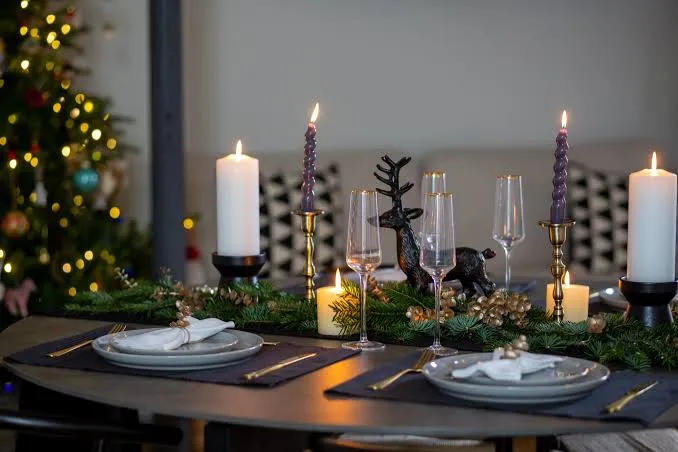
Candle heights want odd numbers and deliberate staggering — think three tapers at 10, 8, and 6 inches rather than a matching set. Keep flame tops under about 15 inches above the table so nobody has to crane around them, and mix three cream tapers with one or two dark purple for that smoky surprise without turning the whole centerpiece funereal.
8. Black Deer Plates on a Grey Plaid Runner
Roughly 70% black, white, and grey, 20% forest green, and 10% gold. Because the base is neutral, you can slide the accent anywhere you like: swap the green satin napkin bows for burgundy velvet and it goes warm; swap them for silver ribbon and it goes frosty. The gold cutlery stays in both versions. That is the whole trick — one neutral foundation, one accent that can be changed for $20 in ribbon.
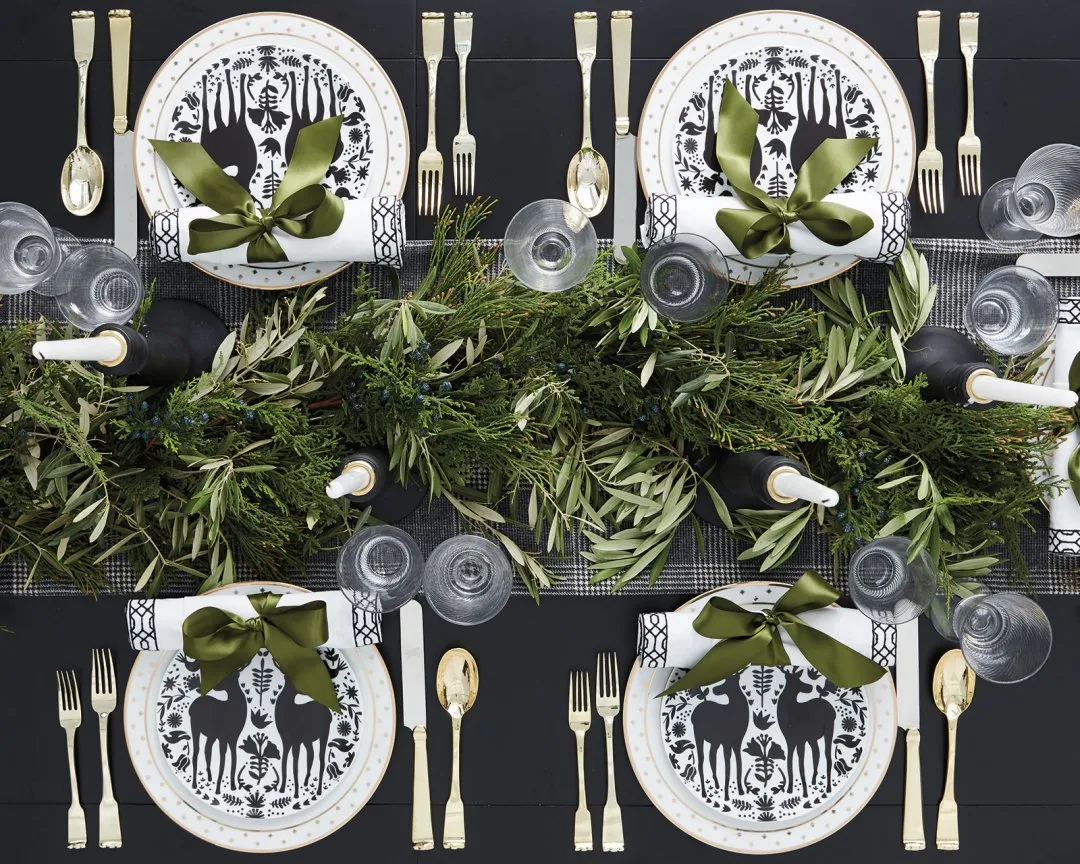
Two principles are quietly doing the work. First, repetition: the deer motif on the plates is echoed by the greenery and the organic feel of the olive branches, so nothing looks random. Second, texture contrast: mixing feathery evergreen with flatter olive branches stops a single-species garland from reading like a wreath laid on its side. The plaid runner adds the only straight lines on the table, which is why it steadies everything.
9. Gold Reindeer Threaded Through a Berry Garland
Garland math: measure your table length, add 12 inches per end so it drapes rather than stops dead. A 72-inch table wants about 8 feet of garland, and the gold reindeer should sit at three or four points along it — odd numbers, uneven spacing, tallest element slightly off-center. Anything shorter than 6 feet of garland on a full dining table will look like a scarf that shrank in the wash.
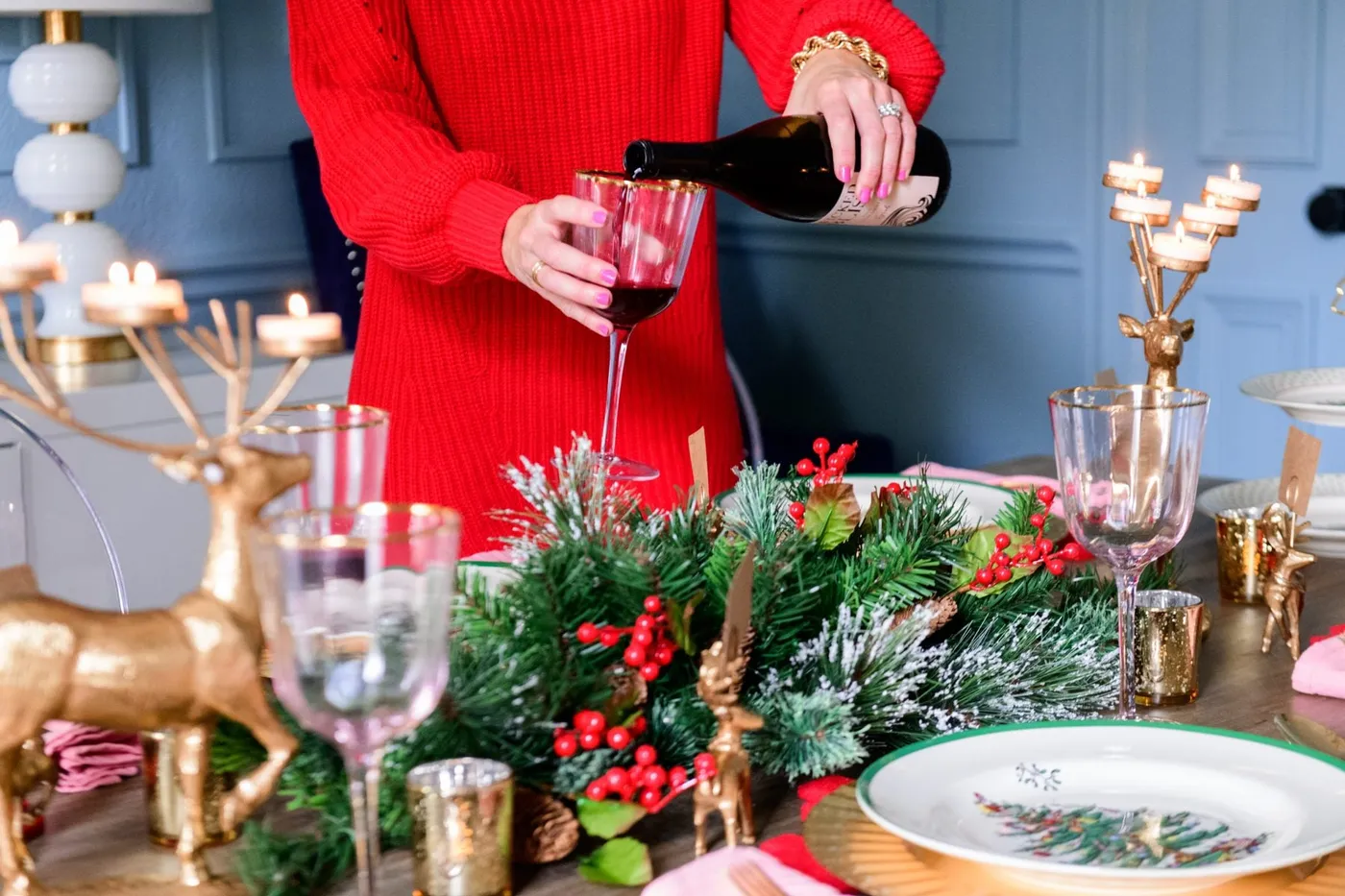
by buying two cheap 6-foot evergreen garlands and twisting them together — doubled garland looks twice as expensive for half the cost. Gold reindeer figurines are $2–$5 at craft stores in November, and pink-tinted stemware turns up constantly at thrift shops for $3 a glass. The white plates with the green rim and tree motif are the only piece worth spending on, since they are what your guests will actually remember.
10. A Frosted Bottle-Brush Forest Under String Lights
Bottle-brush trees shed their flocking every time you move them, so handle them once and leave them alone. The white coating also yellows if stored in a hot attic or a sunny box, so keep them in a cool closet wrapped in tissue. Battery string lights are the hidden cost here: a set of three centerpiece lights runs about $12 and eats batteries every three to four weeks of nightly use, so buy rechargeable AAAs and save yourself the December 23rd emergency run.
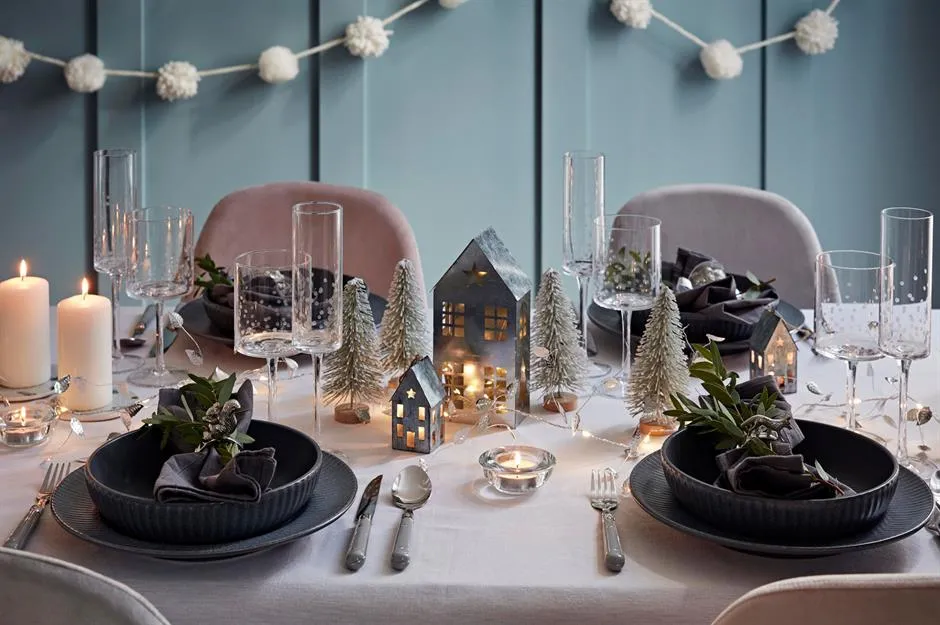
Hide the battery packs inside one of those little metal house lanterns and run the wire along the back edge of the centerpiece so it disappears behind the trees. Warm white only — 2700K — because cool white against a dusty blue wall turns the whole scene clinical. Two strands, layered front and back, beat one strand wrapped around everything.
11. Nutcracker Placemats and Red Glass Chargers
The nutcracker-shaped placemat is the whole personality of this table. A round woven mat would leave you with a perfectly nice red-and-green setting and nothing to talk about. The shaped mat gives each guest their own little soldier, and it layers underneath the red glass charger so the silhouette still reads. That is the piece to hunt for at vintage markets and on Etsy, because it is the difference between a table and a memory.
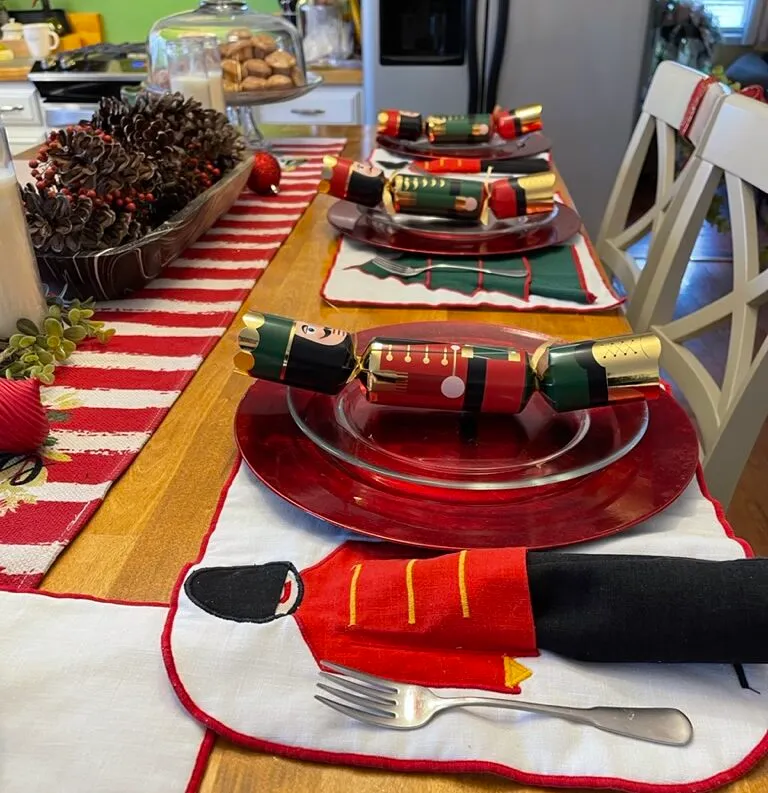
Nutcracker everything is having a moment — the ballet-adjacent, slightly whimsical holiday look has been climbing on Pinterest for a couple of seasons now, and 2026 is the year it goes mainstream. The good news is staying power: nutcrackers have been Christmas staples for a century, so the pieces you buy now will not look dated in three years. The Christmas crackers on each plate push it fully into playful territory, which suits a house with kids far better than a fussy gold setting would.
12. Four Scalloped Plates, Four Different Christmas Scenes
You can buy these as a matched set, or you can do what collectors do and buy them one at a time. Single vintage scalloped Christmas plates run $8–$15 each on Etsy and often $3–$6 at thrift stores in early December, which means four mismatched scenes cost less than one boxed set — and look more interesting. This is essentially the budget route to Idea #18, where two stacked scalloped plates anchor a full formal setting.
- Choose a dark surface — deep green, charcoal, or black — so the cream rims separate cleanly.
- Space the plates evenly with about 2 inches of air between rims, or lean them if this is a display.
- Group whole walnuts in a small pile off to one side rather than scattering them between plates.
- Light from the side, not above, so the scalloped edges cast a shadow and the illustrations stay readable.
Fifteen minutes, four plates, one bag of walnuts.
13. Cream China, Gold Rims, and a Golden Centerpiece
Cream on cream sounds flat until you notice what the dark chargers are doing — they are the separator between the textured cloth and the china, and without them the place settings dissolve into the tablecloth. Then the red tapers supply the only saturated color in view, which is why two small candles carry the entire focal point. The evergreen and berries around the golden centerpiece are supporting cast, not the star, and that restraint is exactly why this reads expensive.
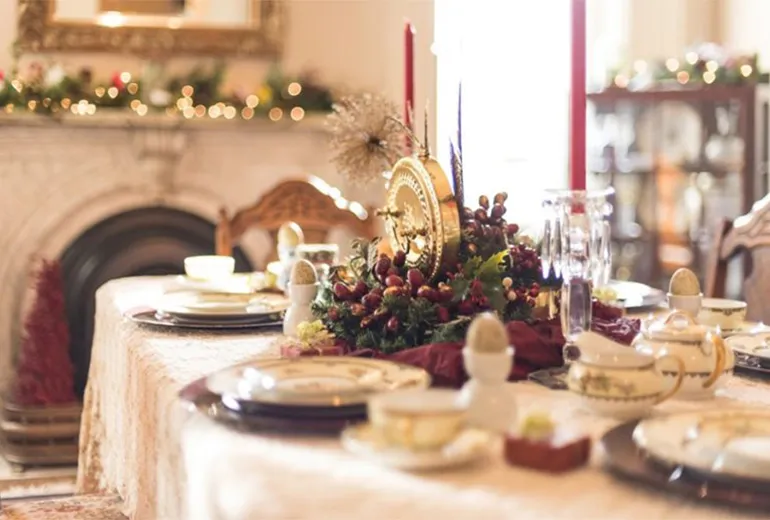
This is a forgiving look for medium rooms. It works from about 10 by 12 feet up, on rectangular tables 72 to 96 inches long, and it wants a ceiling of at least 8 feet if you are keeping a chandelier over the table. Smaller dining nooks should look at Idea #6 for the round-table version, where the centerpiece shrinks and the drama comes from candlelight instead of scale.
14. Deep Red Roses, Big Nutcrackers, Damask Walls
You can absolutely get a rose-and-berry run for grocery-store money. Two dozen roses from the supermarket cost about $20 in December, and cutting the stems short and packing them into low wet-foam trays makes them look three times the price — tall arrangements read cheap, low dense ones read florist. Strip every leaf below the waterline, and top the foam with berry sprigs to hide the mechanics.
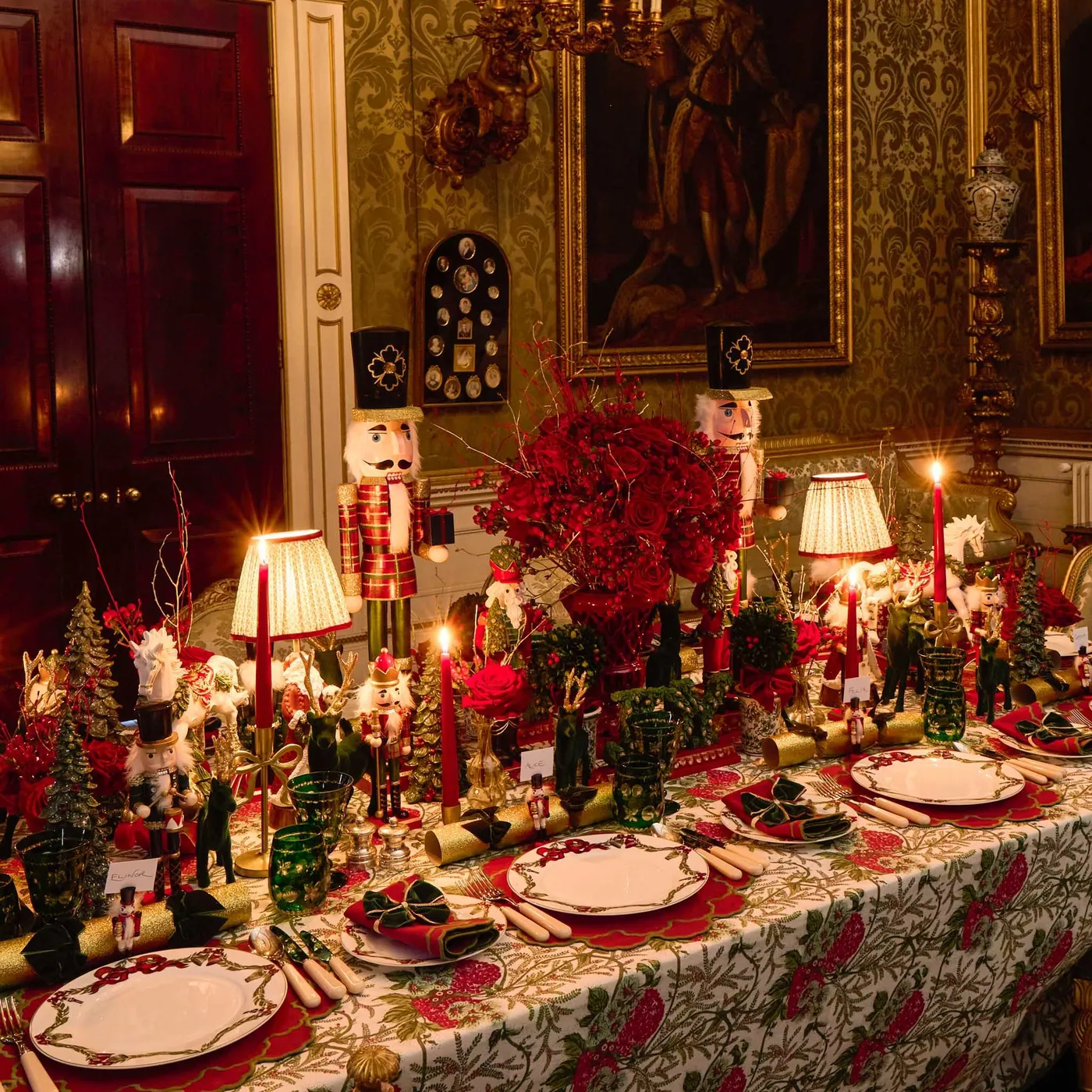
The color recipe is 60% deep red, 25% forest green, 10% gold, 5% cream. That tight a red dominance only works because the botanical tablecloth and damask wallpaper are already busy — in a plain room you would drop red to about 40% and let cream carry the base. The green patterned glasses are the wildcard here: they sit at the very edge of the palette and stop the whole room from becoming a single red note.
15. Wood Slice Chargers on a Rustic Plank Table
Two warnings before you commit. Natural wood slice chargers are rarely flat, so a wine glass on one will wobble — seal the underside with a couple of coats of polyurethane and check for rock before the guests arrive. And a bare plank table with a white runner down the middle looks incredible until someone sets down a hot dish; use trivets, and treat the wood annually so ring marks from a sweating glass do not become permanent souvenirs.
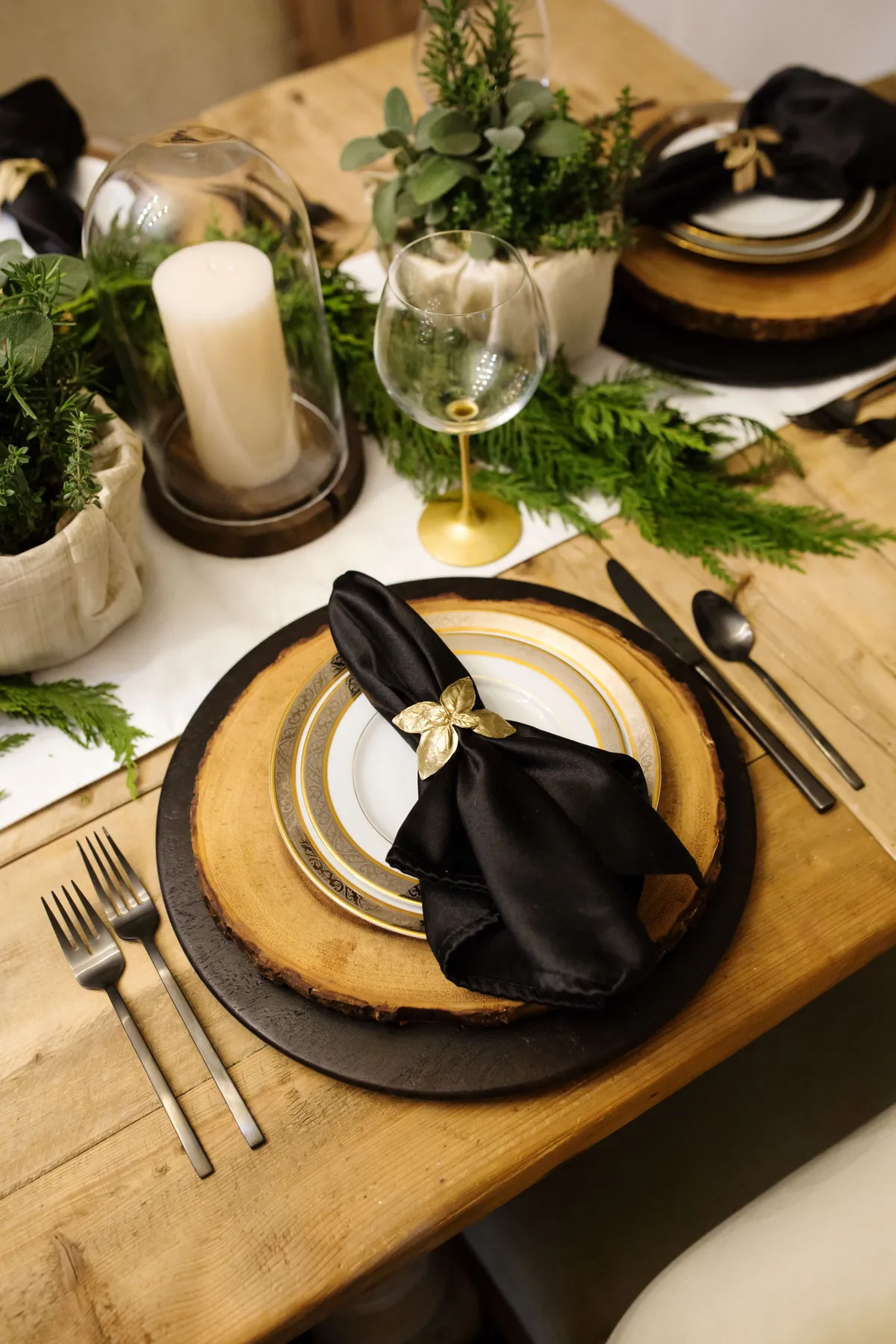
The forest-floor approach is where holiday decor has been heading — real branches, wood grain, herbs in pots, less plastic shine. What makes this version work rather than looking like a craft fair is the restraint in the plates: white with a thin gold and dark rim, which lets the wood and greenery be the rustic element instead of competing with it. Potted herbs down the center are a nice touch because they survive past December 25th.
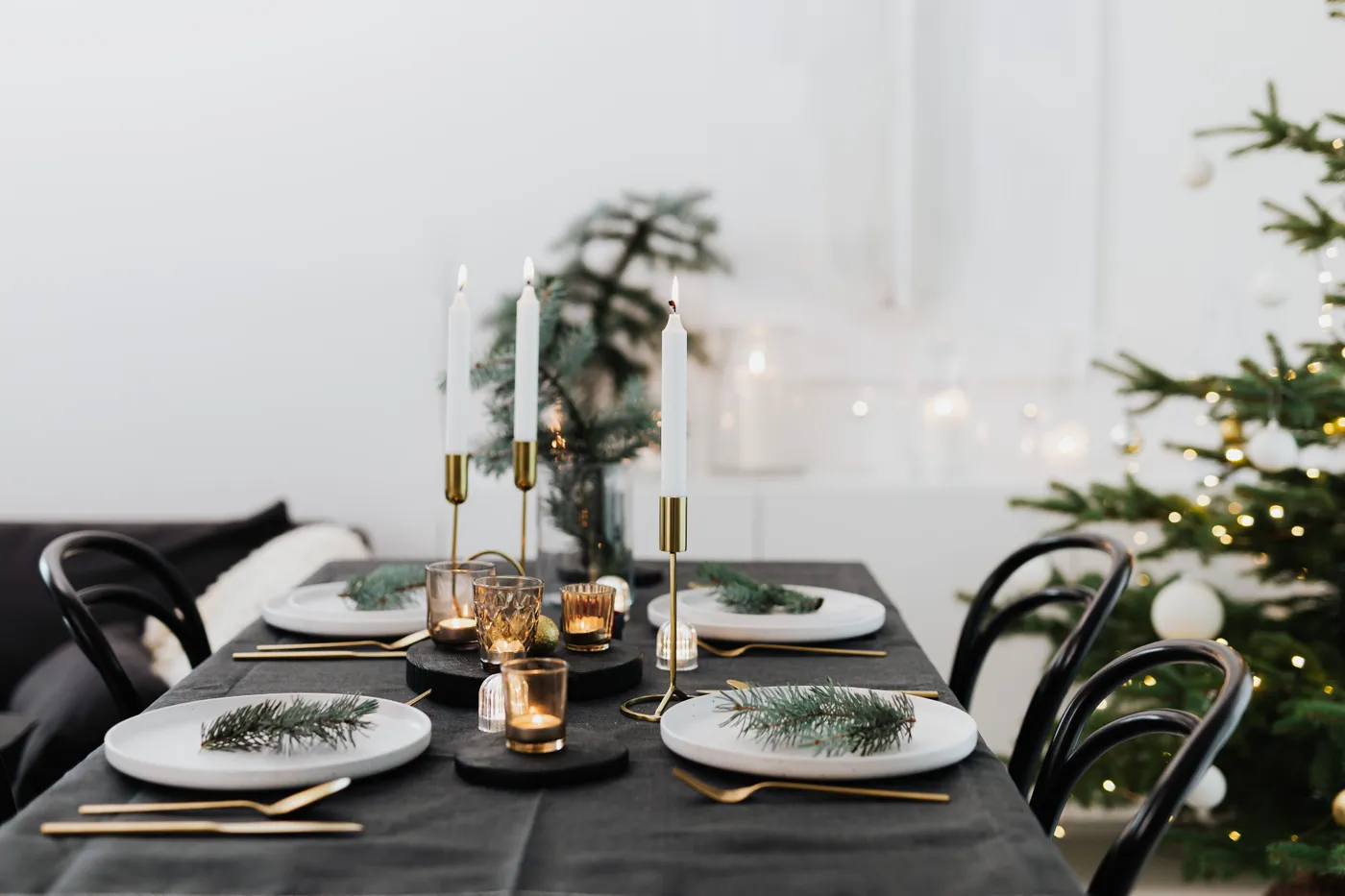
16. Dark Linen, White Plates, Gold Flatware
Run through this before you buy anything.
- Measure the table’s full length and width — the cloth should hang 10 to 12 inches on every side.
- Count your seats and match flatware sets; gold sets are usually sold in fours, not eights.
- Check where the tree’s light cord reaches before you lock in a centerpiece layout.
- Test one full place setting with a real plate, glass, and napkin before buying for twelve.
A dark grey linen cloth is the most forgiving surface in this entire article — it hides wax, red wine, and the crumbs nobody notices until January. That said, it shows lint and flour, so keep a lint roller in the sideboard. This look is happiest on rectangular tables of 72 inches or more, and it is the natural contrast to Idea #22, where warm naturals replace all that cool grey.
17. Neon Green Bust and Black Plates Under Fairy Lights
That neon green bust is doing something no centerpiece of pinecones could do: it makes the table feel young. Against black plates, dark wood, and gold cutlery, a single pop of electric green reads as deliberate mischief rather than a mistake, and it gives the eye a place to land in a room that is otherwise all shadows. Take it away and you still have a beautiful, moody, slightly serious table. Keep it and people lean in.
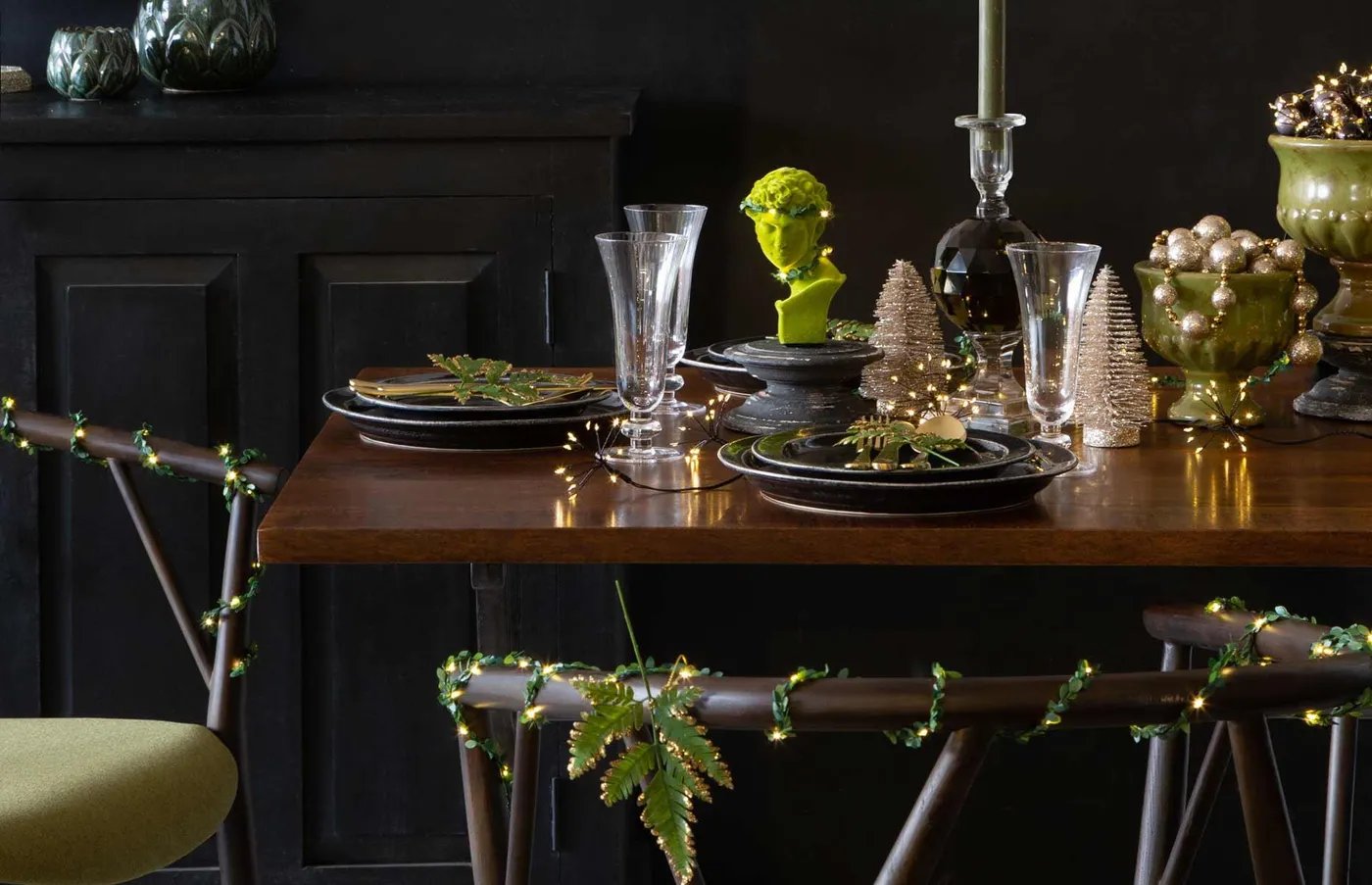
Practical side of all that glow: a dozen LED strands means a dozen battery packs, and cheap string lights will chew through AAAs in about three weeks of nightly use. Buy rechargeables, hide the packs inside the bowls and under the garlands, and expect the leaf garlands on the chair backs to get crushed the first time someone scoots in. Twist them loosely so they can be reshaped, and store them wrapped around cardboard rather than stuffed in a bag.
18. Winter Scene Plates on a Deep Green Cloth
The reason this simple setting photographs so well is figure-ground contrast. A cream scalloped plate on a dark green cloth has maximum separation, so the hand-painted winter scene stays legible from across the room. Stack two plates instead of one and you double the scalloped silhouette, which reads as far more expensive than it is. The clear stemware nearly disappears against the cloth, which is the point — it keeps attention on the illustration.
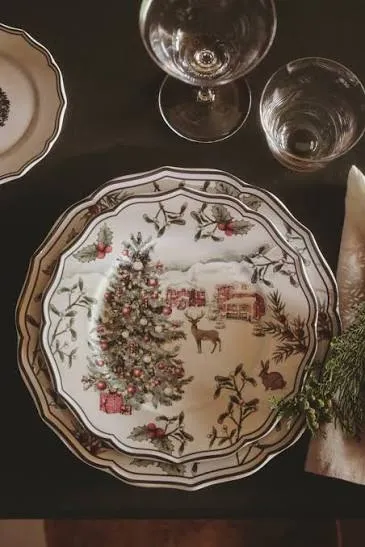
Skip the elaborate napkin fold. A simple flat or single-cuff fold laid across the plate, with one evergreen sprig tucked at about the two o’clock position, is the move. Anything fancier hides the artwork you just paid for. If you want a small cone wired into the sprig, do it before the napkin goes down so the cone sits on top rather than poking your guest.
19. Red Damask, Sage Chairs, and a Candlelit Tree
Roughly 50% deep red, 30% sage and pine green, 20% brass and cream. The sage chairs are what make this work — put the same tablecloth with dark green chairs and the room goes heavy. Push the green lighter and the red brightens by comparison. If you wanted to swap the patterned red cloth for a solid, drop red to 35% and add cream, or the table becomes a single block of color.
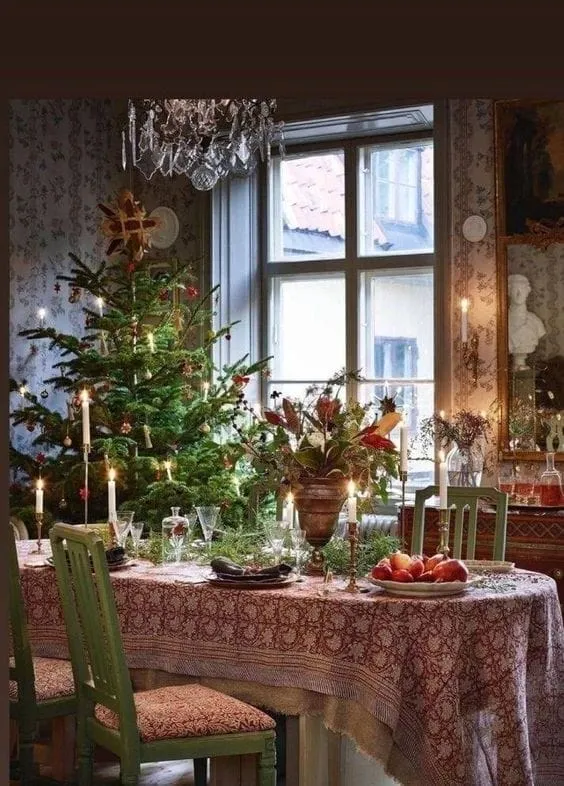
on the tree: real candles clipped to live branches is a tradition, and also why fire services have opinions. If you go that route, never leave the room, keep a bucket of water within reach, and trim any branch directly above a flame. Otherwise use clip-on LEDs — from two feet away nobody can tell, and you get to enjoy the glow without the vigilance. Also size the cloth to the round table properly; too-small round cloths are the most common reason a round diner looks unfinished.
20. Stacked Gold-Rimmed Plates with a Tiny House Ornament
- Stack the plain gold-rim plate underneath and the patterned one on top, offset very slightly so both rims show.
- Fold the white napkin into a narrow rectangle and slide on the gold ring, leaving a small gap.
- Tuck a greenery sprig through the ring first, then hook the house ornament onto the ring itself.
- Set the napkin bundle to the left of the plates, or centered on top if you are not serving family-style.
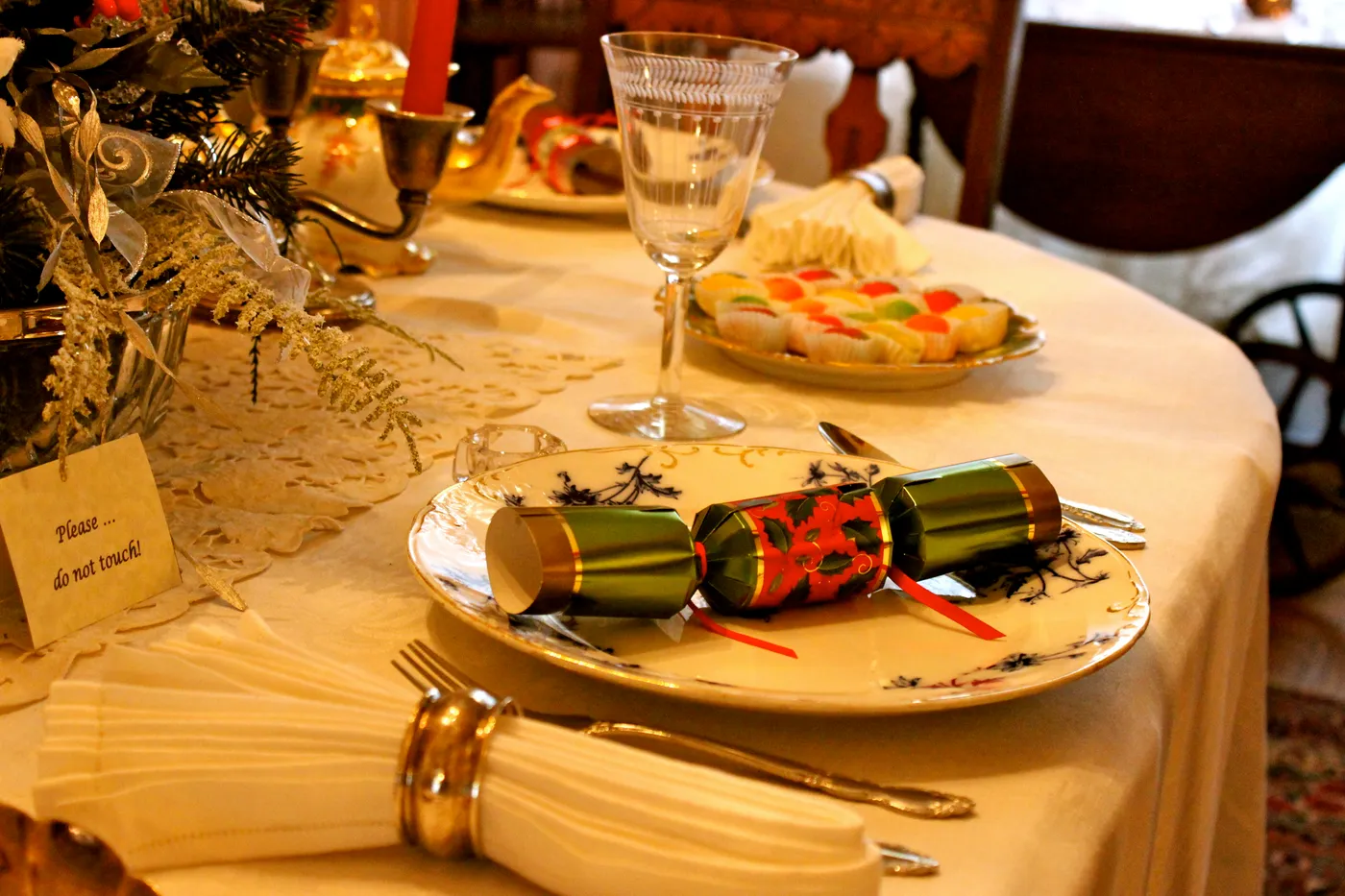
About ten minutes for a full table, and a materials cost of roughly $8 per setting if you already own plates.
For less: Target’s Threshold line does white plates with a gold rim for $4 each, and miniature house ornaments show up in dollar bins and craft stores for $1–$3. The gold flatware is the only piece where cheap looks cheap — spend there, save everywhere else. Compare with Idea #24 if you want more shine and less restraint.
21. Grey Pillar Candles in a Red Berry Garland
The dark grey pillar candles are the reason this table reads sophisticated instead of predictable. Red berries and green ivy on a light grey cloth is a pleasant, familiar combination; the moment you set three charcoal pillar candles down the middle, the palette turns editorial. Grey candles are also the single easiest upgrade to any Christmas table — one $8 pillar does more than a new set of napkin rings.
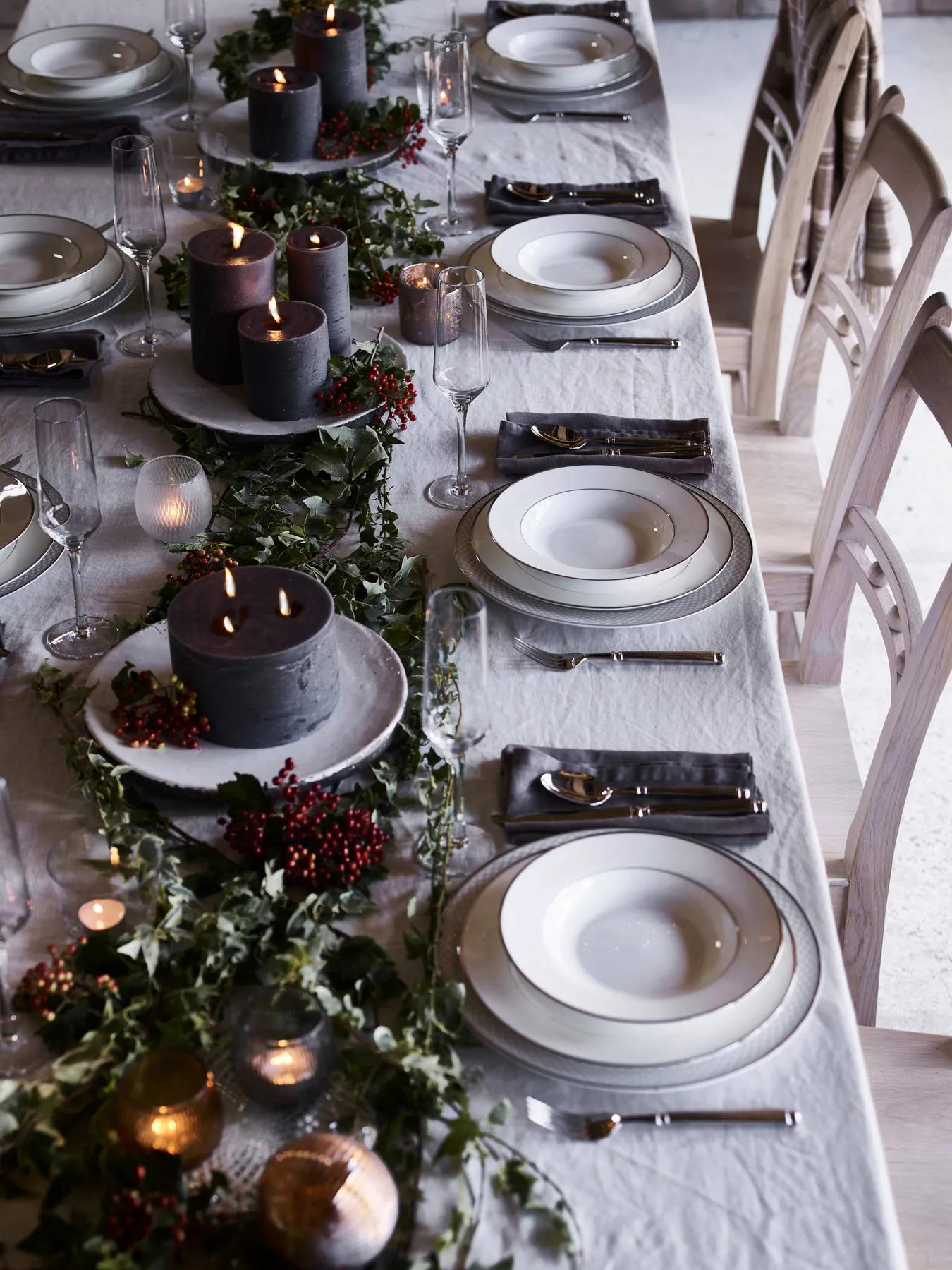
Plan the run first. On an 8-foot table you want roughly 7 feet of garland, with pillar candles placed every 18 to 24 inches and staggered off the centerline so they do not form a ruler-straight row. Mix pillar heights between 4 and 8 inches, and drop glass votives into the gaps at table level. Keep everything under eye height when seated so conversation flows over the centerpiece rather than around it.
22. Woven Placemats, Gold Cutlery, One Green Sprig
Texture is the whole game at this scale. A dark woven placemat is matte and rough, the plates are smooth and glossy, the gold bowl is reflective, the napkin is soft — four surfaces in the space of twelve inches, and that is why a setting with almost no color still feels rich. If you are recreating it, do not skip the woven mat. Swap it for a smooth charger and everything collapses into flatness.
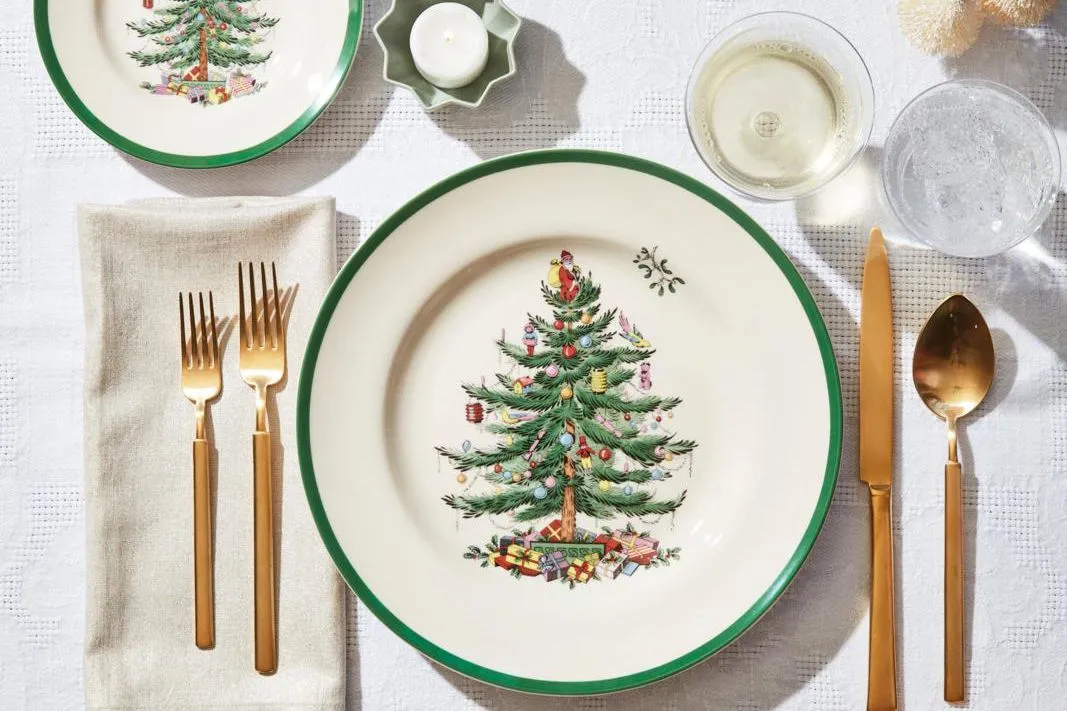
The one-sprig styling is very much of the moment. After years of maximal table decor, the look that is getting saved on Pinterest right now is a single natural element, one narrow ribbon, and one small metallic object. It is faster to set, cheaper to buy, and it photographs better than a crowded plate. The gold bell is optional and honestly the best part — it gives each guest something small to take home.
23. Pampas Grass, Copper Flatware, and Black Chargers
- Choose five to seven pampas stems and trim them to different heights so the arrangement has a slope.
- Anchor the vase with an inch of sand or gravel — tall dried stems tip over in an empty vessel.
- Set the tallest stems left of center, then work down and right so the vase does not look symmetrical.
- Add two or three stems of deep red dried foliage at the base for weight and color.
- Place black candlesticks with burnt orange tapers at either end, and skip water entirely.
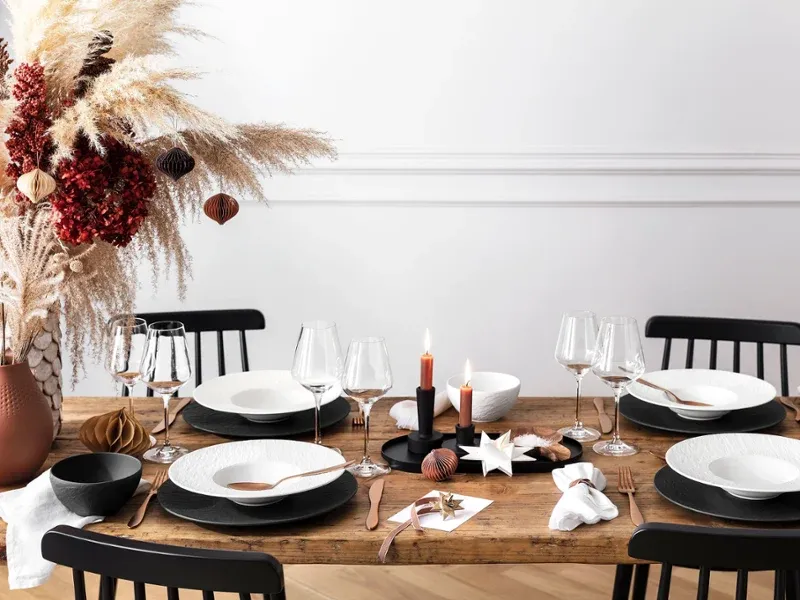
Twenty minutes, no water, no wilting, and it lasts the whole season.
The thing you cannot skip is the copper flatware. Against matte black chargers and stark white bowls, that warm rose-gold tone is what stops the table from looking grim. If copper is not in the budget, brushed brass does the same job for half the price.
24. Olive Green Cloth, Scalloped Tree Plate, Green-Handled Cutlery
An olive green tablecloth is one of the easiest things to fake. Buy three yards of olive cotton-blend fabric for about $20 and hem it, or use a flat sheet in a similar tone. The star plate is the spend — white scalloped with a tree motif and a holly border — but you only need as many as you have guests. The green-handled cutlery is a Target and HomeGoods staple at around $25 for a four-piece set, and it is what makes the setting look designed.
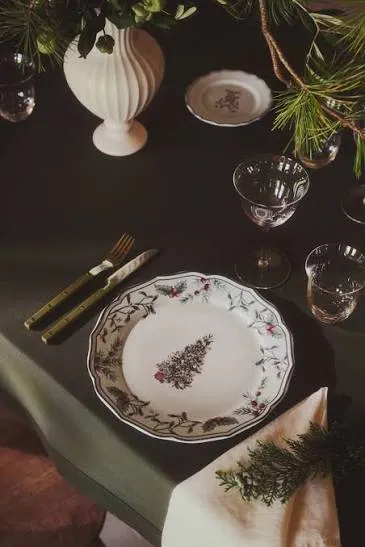
Tying the cutlery handles to the cloth color is a genuinely useful trick. When two elements share a hue, the eye reads the whole table as intentional even if you assembled it from three different stores. It also means you can change the entire look next year by buying one new cloth — the plates and cutlery will follow it anywhere.
25. Mercury Glass Trees on a Gold-Patterned Table
Metallic finishes look expensive when you cap them at two. Here the gold-rimmed chargers and polka-dot plates are one family, the mercury glass trees and candelabra are the other, and the white ceramic bowl is the pause between them. Add bronze, copper, or rose gold to this table and it stops reading like a dining room and starts reading like a display case. Pick two metals, repeat each of them three times, then stop.
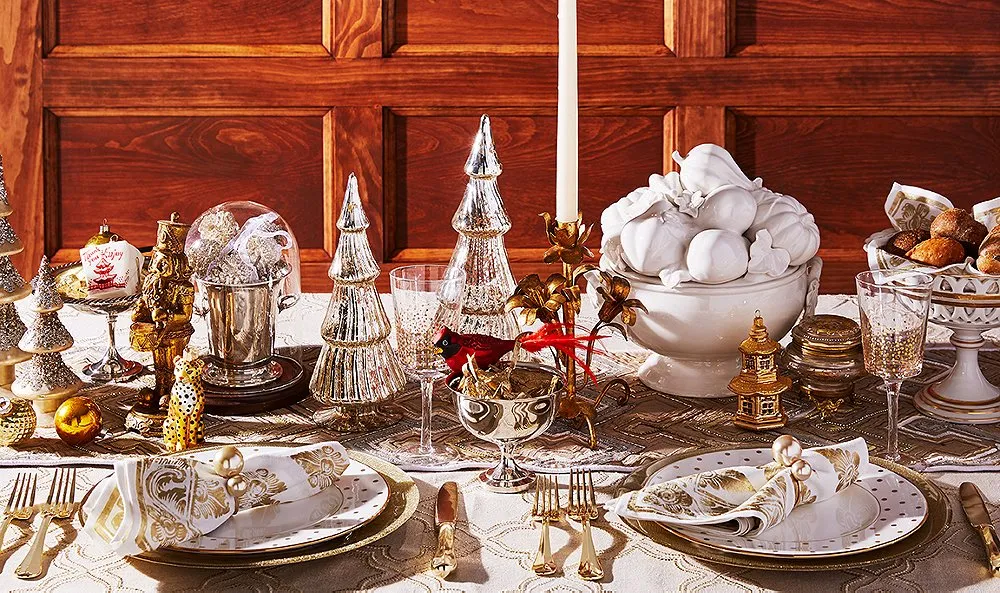
This is a big-table look and it knows it. You want at least 96 inches of table, or a round of 60 inches or more, because that forest of mercury trees needs a long run to look like a landscape instead of a cluster. Ceiling height matters too — a low-hung fixture over an 8-inch-tall tree arrangement gets crowded fast. If your room is smaller, Idea #17 does a similar mood with black plates and far less surface area.
26. Victorian Red Damask with a Miniature Village
Red damask wallpaper, red plates, red goblets, red bows, and a red-toned village is a lot of red, and the room only survives it because of the black fireplace and the white mantel trim. If your own room lacks those dark anchors, cut one red element — start with the goblets and use clear glass. Also, build that miniature village on a riser. Villages set flat on the table disappear behind the centerpiece; six inches of elevation and suddenly it is a scene.
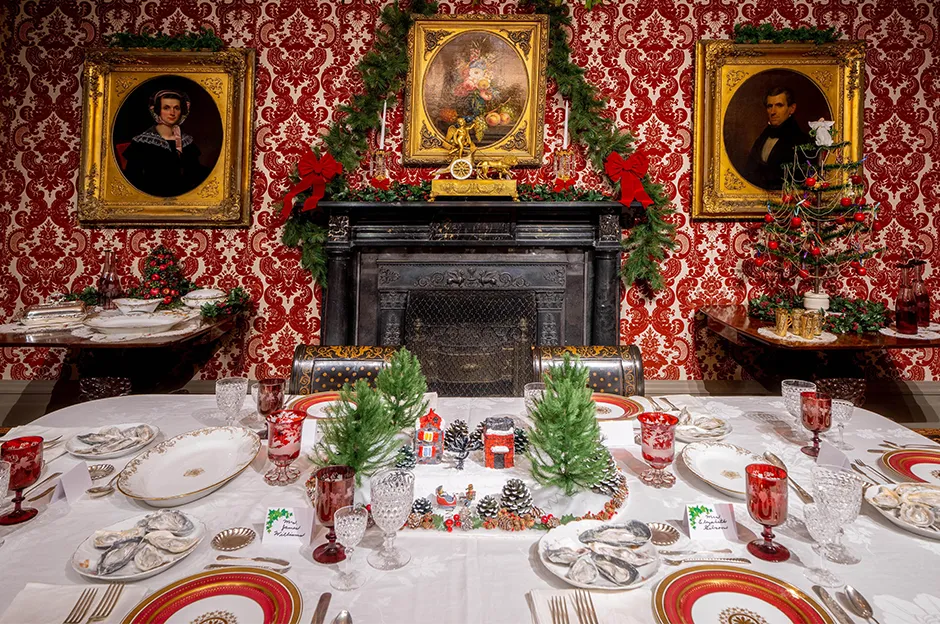
Upkeep is real with this much decoration. Evergreen garlands draped over gold frames shed needles onto whatever is below within about two weeks, so plan a mid-December refresh and vacuum the frames, not just the floor. Fabric wallpaper in a dining room collects cooking aerosol over the years — a yearly gentle wipe-down with a dry microfiber keeps it from dulling, and never use anything wet on it.
27. Scrolled Silver Chargers and Painted Tree Plates
- Press the white linen cloth first — creases read as cheap under a chandelier, no matter what the china cost.
- Center each scrolled silver charger a hand-width from the table edge, then eyeball the spacing between all seats.
- Layer the tree plate on top, then set silver flatware directly on the cloth, not on the charger.
- Fold the napkin simply and place it left of the forks, then pour the wine only once everyone is seated.
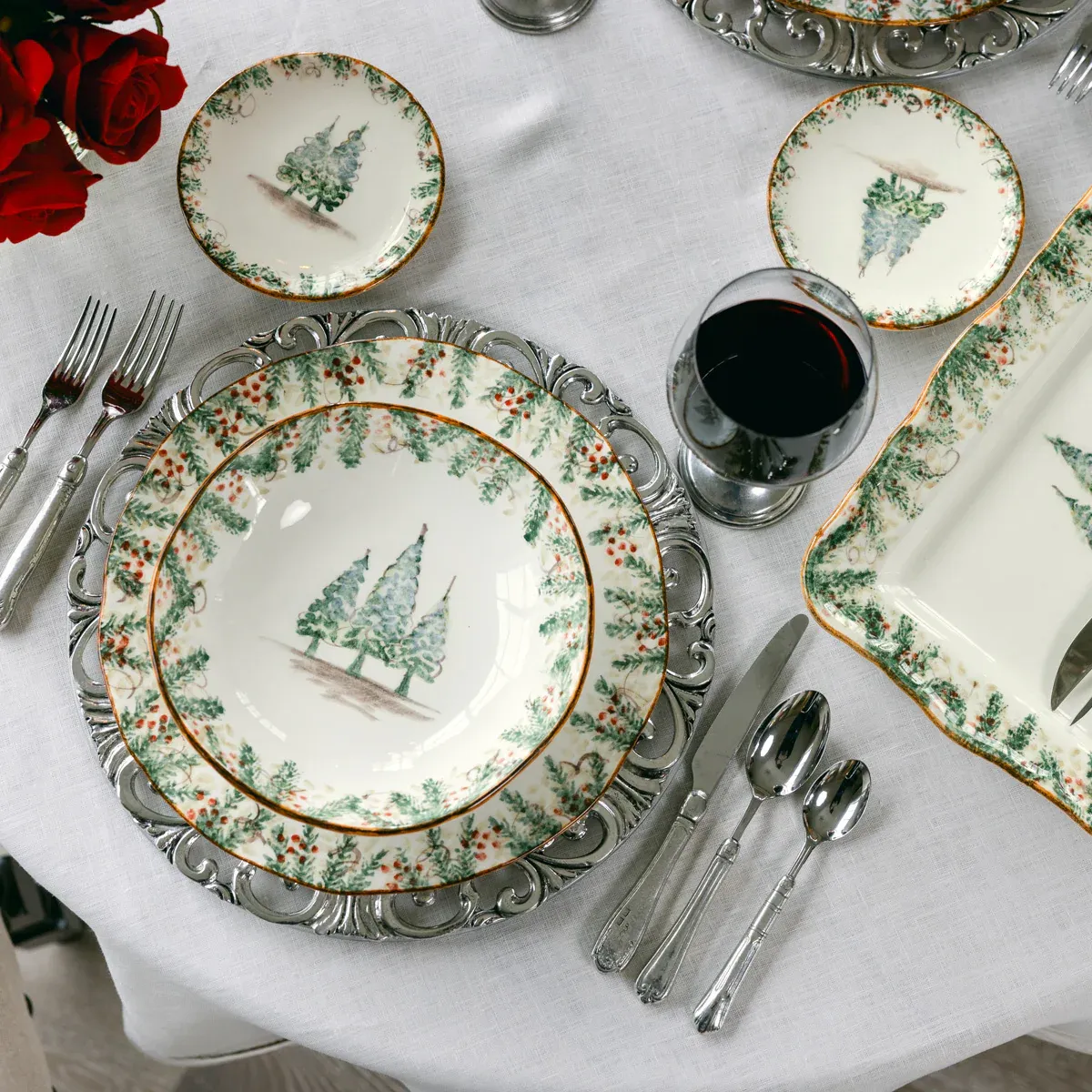
Setting a table for eight takes about twenty minutes once the linens are pressed.
- Scrolled silver chargers, set of 4: $40–$90
- Cream porcelain tree plates: $12–$25 each
- Silver-plate flatware, service for 8: $80–$220
- White linen tablecloth: $45–$110
- Stemware, set of 6: $30–$75
Total: roughly $230–$620. Budget alternative: craft-store chargers at $3 each and a plain white cloth do 80% of the work for about $90.
28. Dark Purple Runner, Plaid Napkin, Gold Charger
The ratio here is roughly 70% dark purple, 15% gold, 10% plaid, 5% white. Purple as a base is the unexpected part, and it works precisely because it is not red or green. Swap the purple cloth for deep charcoal and the plaid napkin suddenly carries all the personality; swap it for black and the gold charger does all the talking. The plaid stays constant in every version, which is why the setting never loses its holiday footing.
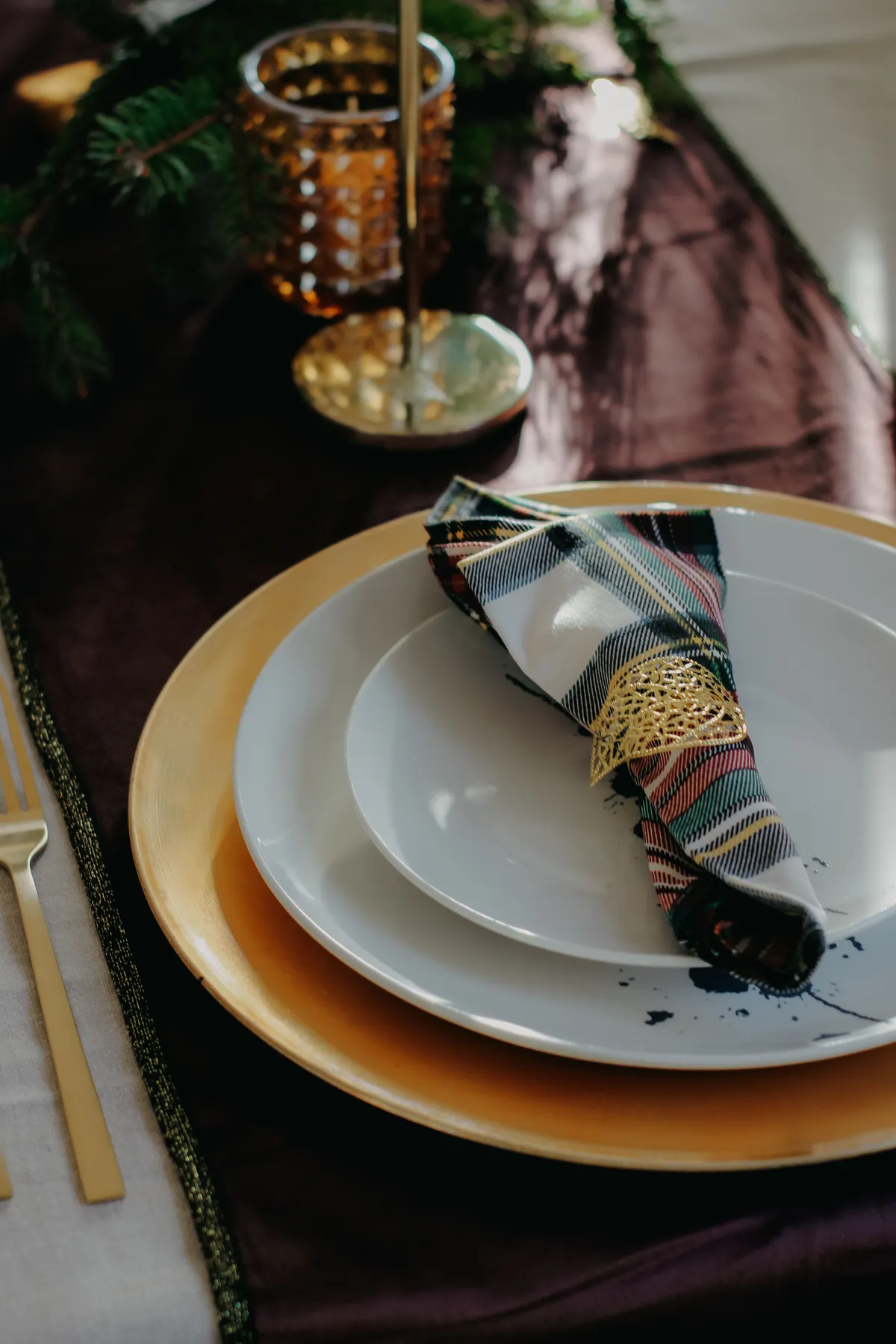
Plaid is quietly becoming the napkin of the season, especially in rooms where a full tartan tablecloth would feel like too much. It gives you the snow-lodge feeling in a 20-inch square. Purple, meanwhile, is the color that keeps showing up in 2026 holiday palettes precisely because it photographs warm under candlelight without looking like a repeat of last year.
29. Red Woven Charger on Bare Light Wood
Red woven chargers run $4–$8 apiece at HomeGoods and Walmart, and they are the entire color story here. The white plate is any white plate you already own, the gold star ornament is a dollar or two in a multi-pack, and the plaid napkin is four yards of fabric cut and hemmed for about $12. Six place settings for under $60, and the bare wood table does the rest. If you want the fuller version of this red-and-gold idea, see Idea #30.
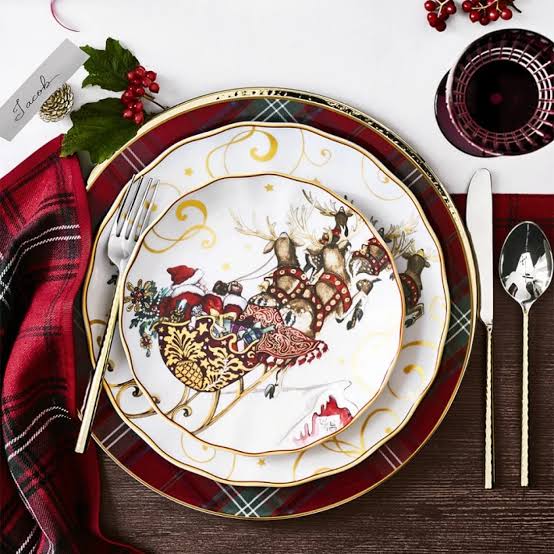
One caution with bare light wood: it marks. Water rings, hot dishes, and red wine all leave evidence, so either seal the top with a matte polyurethane or accept that it will develop a patina — some people love that, and some people will not. Also check that your woven chargers sit flat. The cheap ones warp, and a wobbling charger under a full plate is how gravy ends up on the tablecloth.
30. Red Velvet Deer and a Toile Tablecloth
A red-and-white toile cloth is the smartest kind of patterned neutral — it has enough visual texture to fill a large table, but the colors are so limited that nothing on top of it fights. Layered with deep red scalloped placemats and gold-rimmed white plates, the pattern recedes and the place settings read clean. Then the velvet deer, with their gold antlers, add the one thing a flat cloth cannot: dimension.
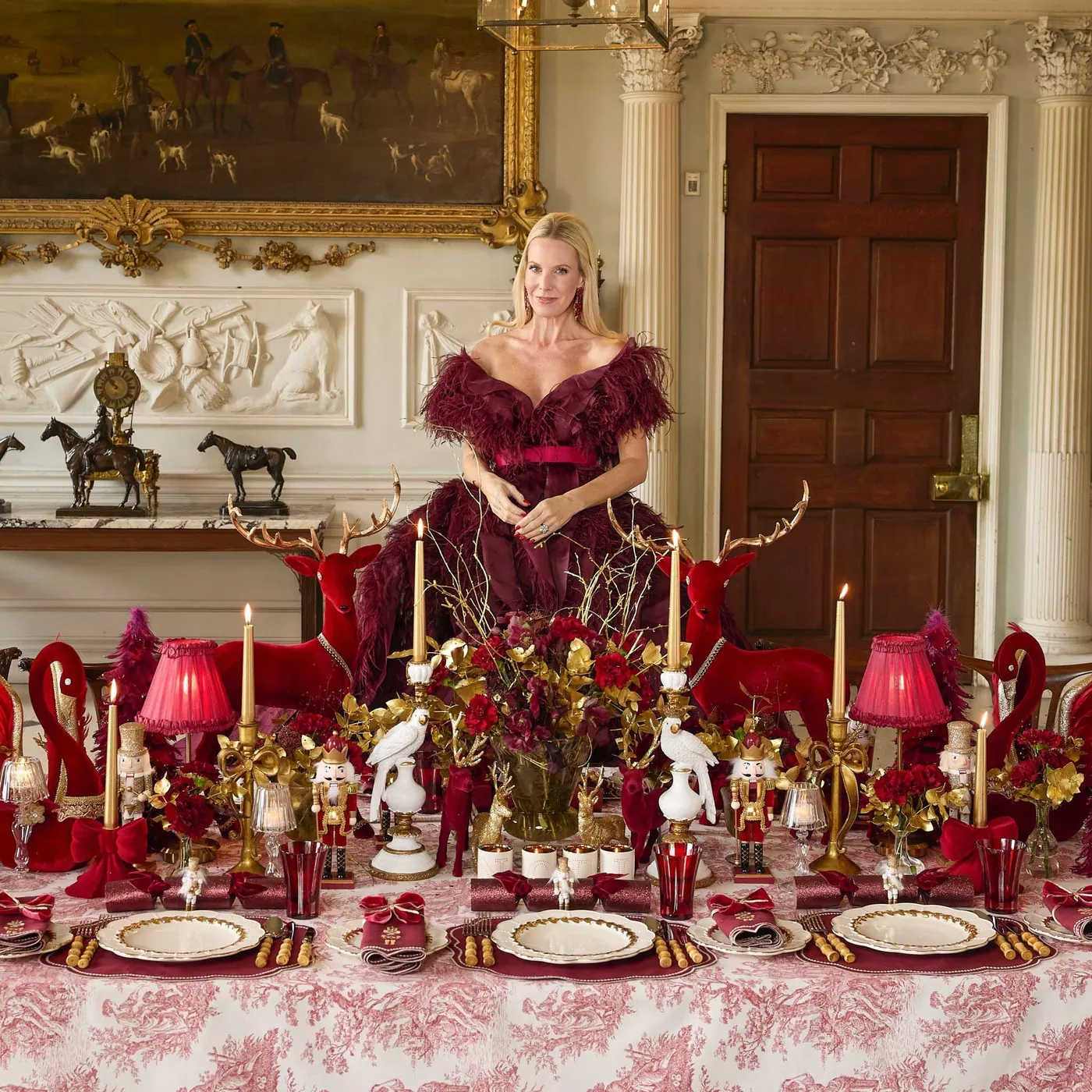
Velvet needs a light hand. Brush the nap in one direction with your palm before guests arrive, and never store the deer pressed against anything, or the pile will crush permanently. Set the deer on stacks of two or three books to get the antlers above the flowers, and keep the tallest element of the whole centerpiece under about 14 inches so nobody is talking around a velvet barricade.
31. Green Paisley Cloth with a Lit Tree Beside
- Lay the paisley cloth and check the pattern repeat sits centered, not running off one end.
- Use plain white napkins and simple gold cutlery — pattern on pattern is where these tables go wrong.
- Keep plates dark-rimmed so they separate from the busy cloth underneath.
- Pull chairs out 36 inches from the table edge before you finalize tree placement.
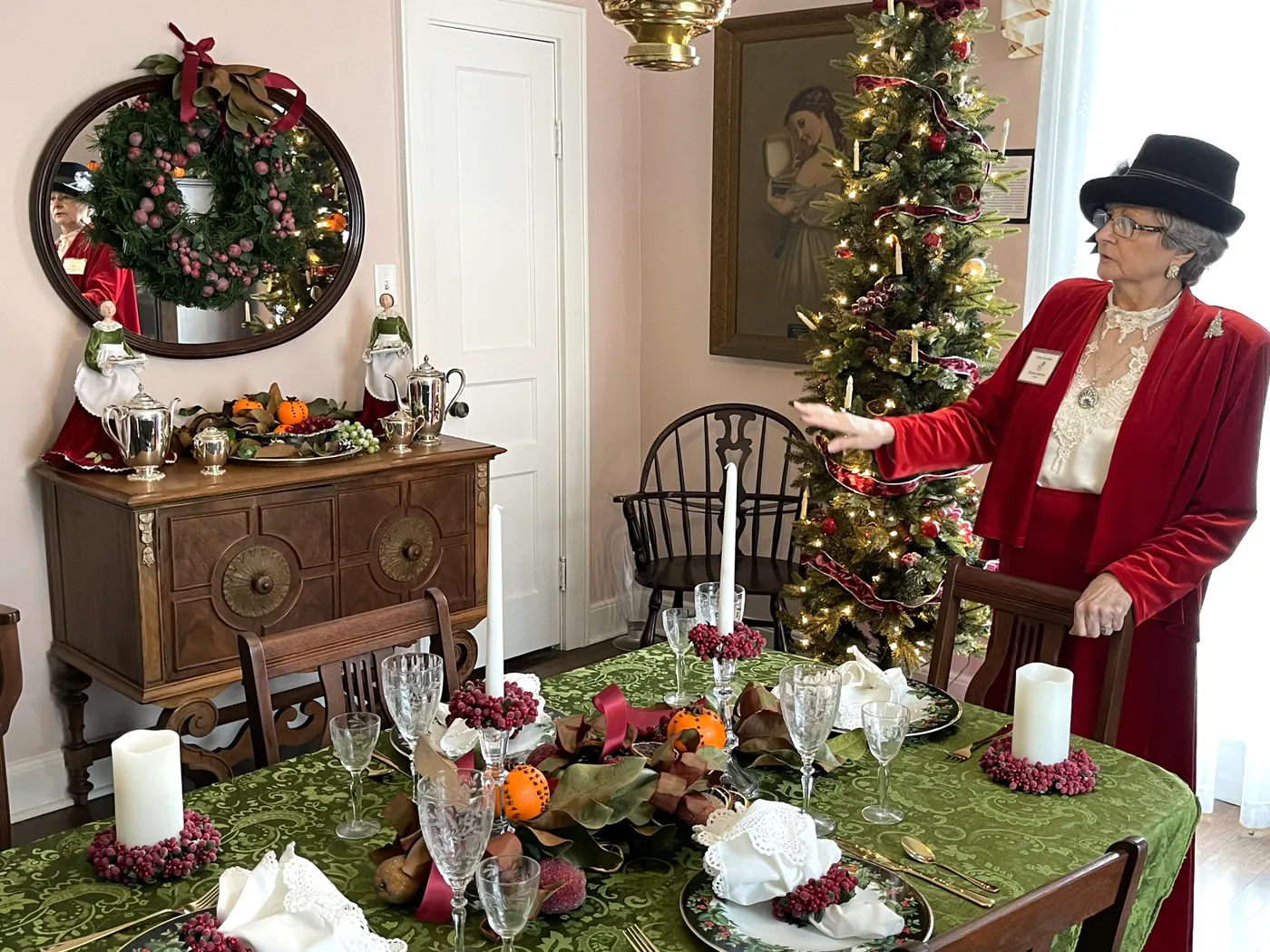
Fifteen minutes if the cloth is already pressed.
Room math matters more than usual here because the tree lives right next to the table. You need a clear 36 inches behind each chair for pulling out, plus at least a foot between the tree’s widest branch and the nearest chair back. In a room narrower than 11 feet, move the tree to the opposite corner and let the sideboard carry the holiday weight instead — the table can handle being the quieter element.
32. Gold Cloth, Red Chargers, Sunburst Mirror Above
The element that makes this room feel like an event is not on the table at all — it is the sunburst mirror over the mantel, catching and bouncing every candle flame back down onto the gold cloth. Without that reflection, the same table is beautiful but flat. With it, the whole room glows twice. If you have a mirror anywhere near your dining space, point the light at it before you buy another centerpiece.
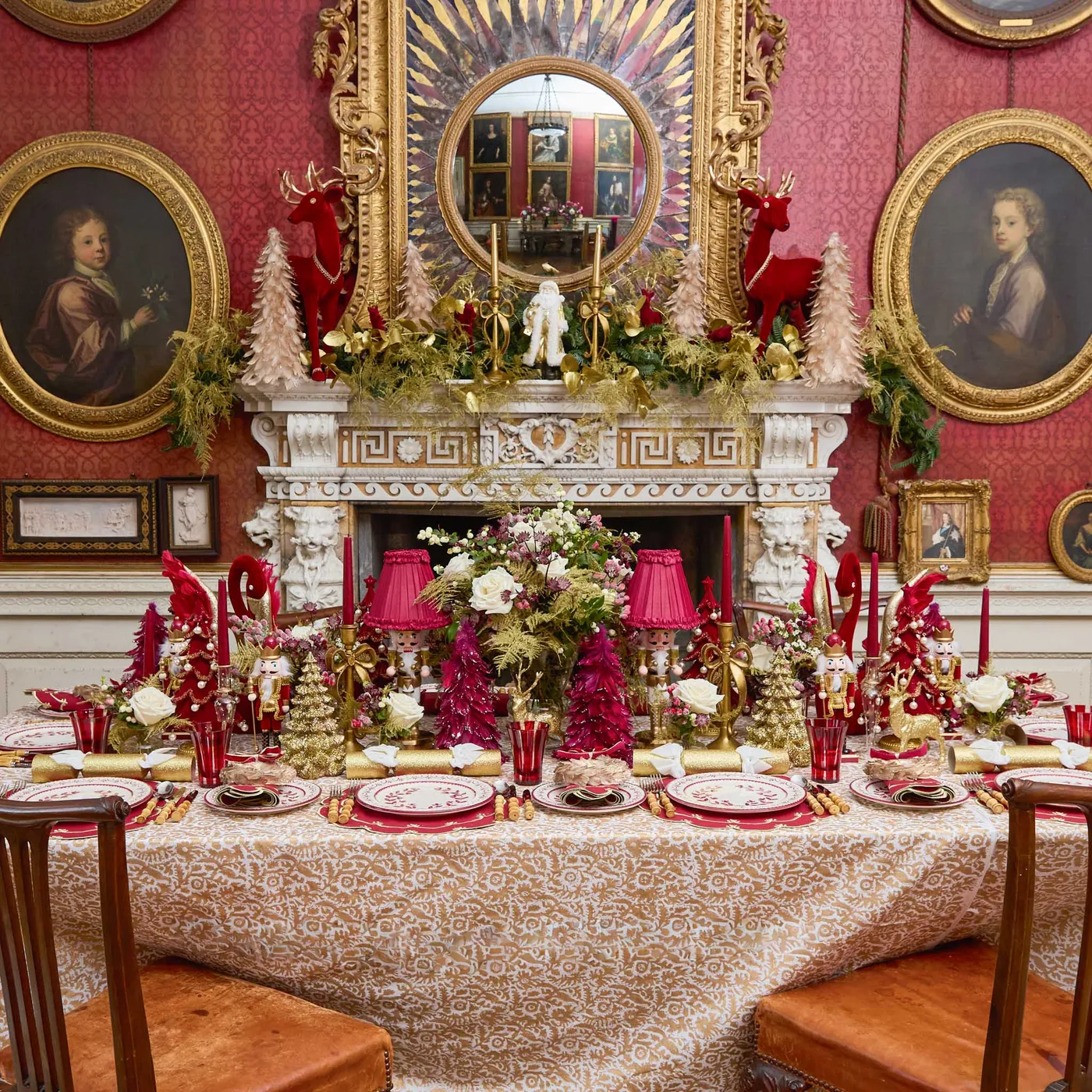
The mix is about 45% gold, 35% deep red, 15% white and cream, 5% green. Notice that green is barely present — unusual for Christmas, and the reason this reads opulent rather than traditional-cute. Swap the gold cloth for ivory and the red climbs visually to 60%, so you would then cut back to red chargers only and let the flowers go white.
Thirty-Two Tables, One Very Merry December
You do not need all thirty-two of these — you need one that feels like your house, done properly. Pick a single idea, steal the palette, and let the details be simpler than you think they should be. The best Christmas tables are the ones where the host is sitting down too.
📌 Pin your favorite setting now so it is waiting for you when the boxes come out next December.