
Christmas tree trends are having a moment on Pinterest right now — and the save counts explain why. The trees people are pinning in 2026 don’t look like showroom displays. They look like someone actually lives there: flocked to the hilt, loaded with velvet ribbon, styled around a fireplace that’s genuinely lit.
We spent weeks combing through Etsy, Anthropologie, Target, and Walmart listings, plus a mountain of saved photos from real homes, and narrowed it down to 32 ideas that deliver — everything from a $14 paper ornament to a ceiling-height gold-bronze tree that costs four figures to replicate. Budget and luxury versions sit side by side here, so you can see exactly where the money goes and where it genuinely doesn’t need to.
Expect heavy flocking, a real return to red-and-gold traditionalism, a surprising amount of pink, and tree skirts that finally get treated like furniture. And stay until the end — we break down the most common mistakes that can ruin these looks.
📌 Save this to Pinterest for later — you’ll want to revisit these ideas.
1. Flocked Branches, Maroon Velvet, and Three Glowing Gold Stars
That wide gold ribbon isn’t spiraled — it’s cut into lengths and tucked. Buy 4-inch wired ribbon, cut 6-foot sections, fold each into a soft V, and press the fold into the branches every 10 to 12 inches so the tails fall vertically. A 7.5-foot tree takes about eight sections. Wired ribbon holds its shape all season; the cheap acetate stuff droops by New Year’s.
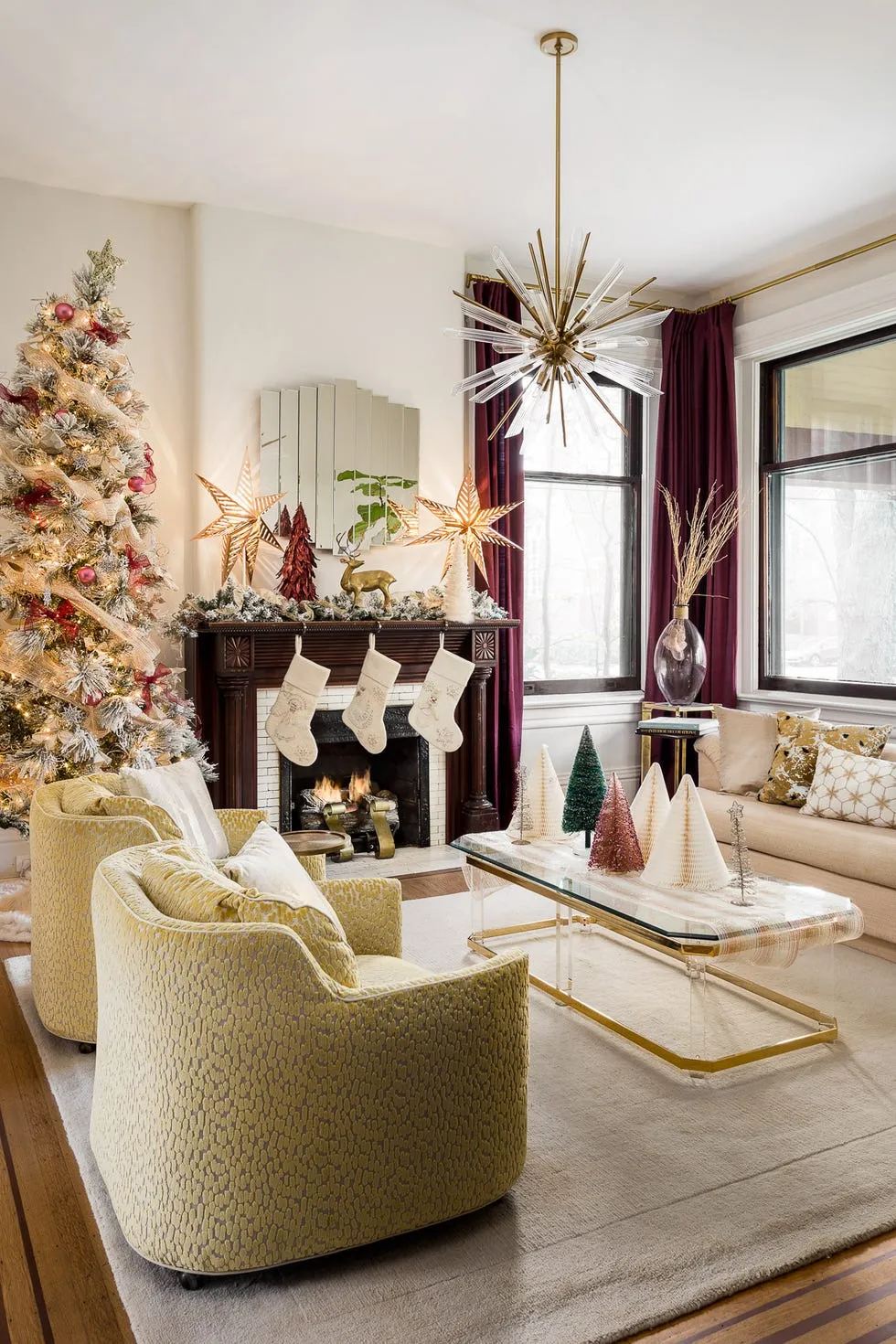
Three gold stars on the dark wood mantel, graduated in size and spaced unevenly, do the same job as the maroon ornaments across the room — they repeat a shape instead of a color. Against that mantel the creamy flocking reads almost like snow, and the textured yellow armchairs pick up the warm light without competing for attention. Pull the stars out and the whole wall goes flat.
2. Warm White and Multi-Color Living on the Same Tree
The single thing worth copying here is the light mix — roughly two-thirds warm white to one-third multi, which is why the tree reads cozy instead of chaotic. The wide pale-gold ribbon spirals in loose horizontal passes, about four wraps total, and does the heavy lifting so the ornaments don’t have to. A white skirt on a wooden floor finishes it without adding a single color.
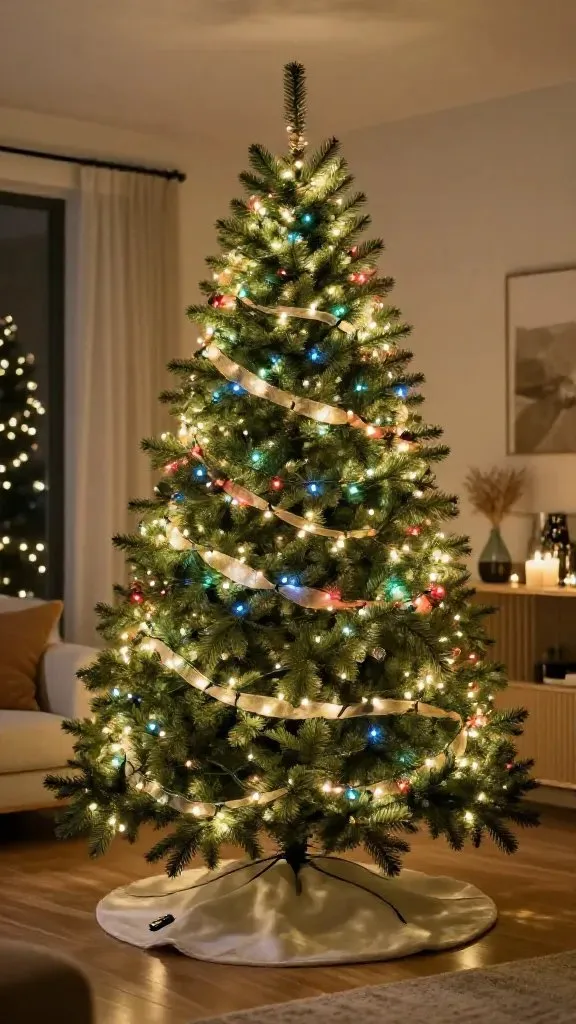
Multi-color strands are where trees go wrong. Different brands run different greens and blues, so buy every multi set from one product line in one order — and check the color temperature before you commit. If the rainbow still feels like too much for your room, Idea #19 shows the same tree silhouette in nothing but warm white, red, and gold.
3. The Rustic Dining Room That Decorates Its Ceiling Beams
Roughly 50 percent natural wood, 30 percent evergreen, 15 percent cream and off-white, 5 percent glow. Swap the furry white stools for leather and it still works; swap the rustic table for glass and the whole room tips cold. The rule is that the neutrals stay matte and the greens stay dark — it’s the candles, the fire, and the string lights doing all the shining.
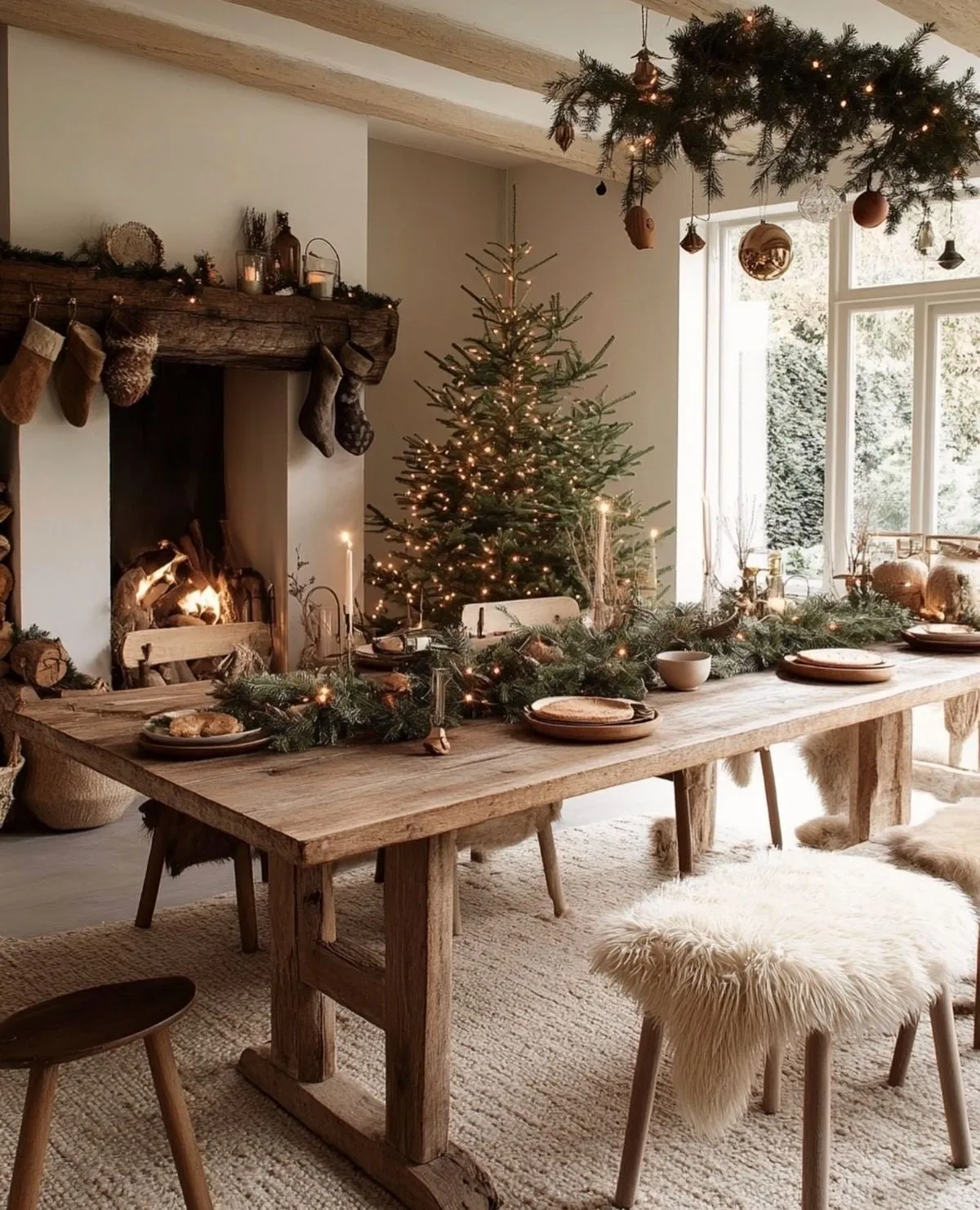
Hanging garland from beams:
- Measure the span and add 30 percent for swag.
- Screw small cup hooks into the beam, never the drywall.
- Wrap lights around the garland before it goes up — never after.
- Hang from the center first, then work outward.
- Finish with loose sprigs and a few natural-toned ornaments.
About 45 minutes per beam, $60 to $90 in materials.
This is the chalet drift — people are decorating the architecture, not just the tree. Exposed beams and substantial wood mantels have been among the most-saved real-estate features on Pinterest for two years running, and garland is the cheapest way to make a room feel like it was built for December.
4. A Slender Frosted Tree Holding Its Ground Against Dark
Pencil and slim trees live in the 6.5 to 7.5 foot range with a 24 to 30 inch base spread, which makes them the right call for a 10-by-12 living room where a full 8-footer would eat the walking path. Keep the tree at least 18 inches from a working fireplace opening, and hang the silver tinsel in vertical strands rather than spirals so the tree reads taller than it is.
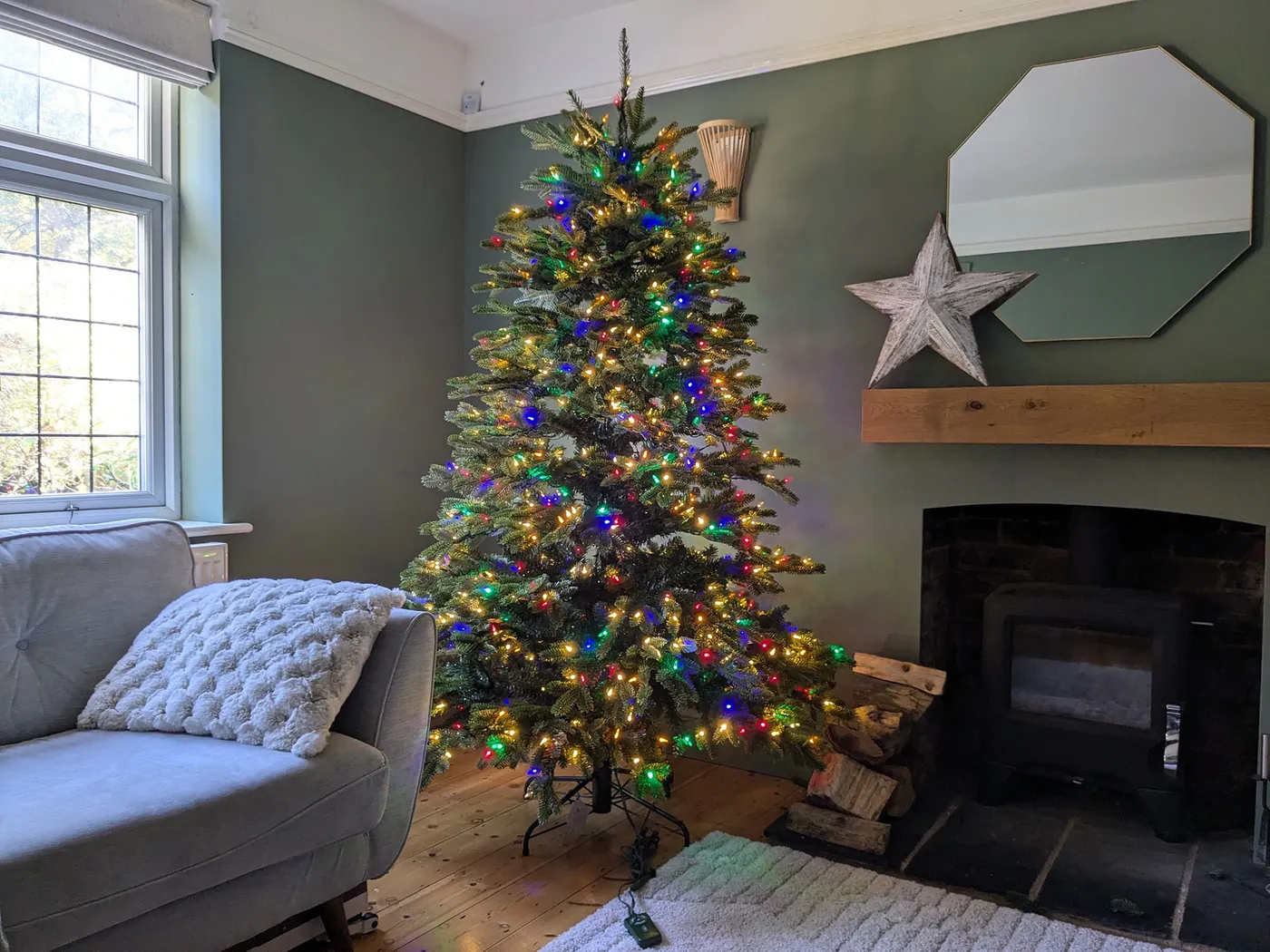
The ornament ratio on a slim tree: three small, two medium, one large, repeated. Large white and silver balls sit in the bottom two-thirds where the branches are strongest, with tinsel and icicles taking the top third. Stick to two finishes — matte and glass — or all that silver turns into visual noise. The silver deer statue on the mantel is the third repetition of the same metal.
5. A Tree With Nothing But Lights, and a Striped Basket
Skip the pre-lit. A plain 7-foot green tree runs $60 to $110 at Walmart or Target, and 600 warm white minis cost about $25. The striped woven basket is the kind of thing thrift stores and Facebook Marketplace hand you for $8 to $15, and a fluffy throw from a home goods store fills it for another $20. Under $150 for the whole corner on that light blue-green rug, and it looks intentional rather than unfinished.
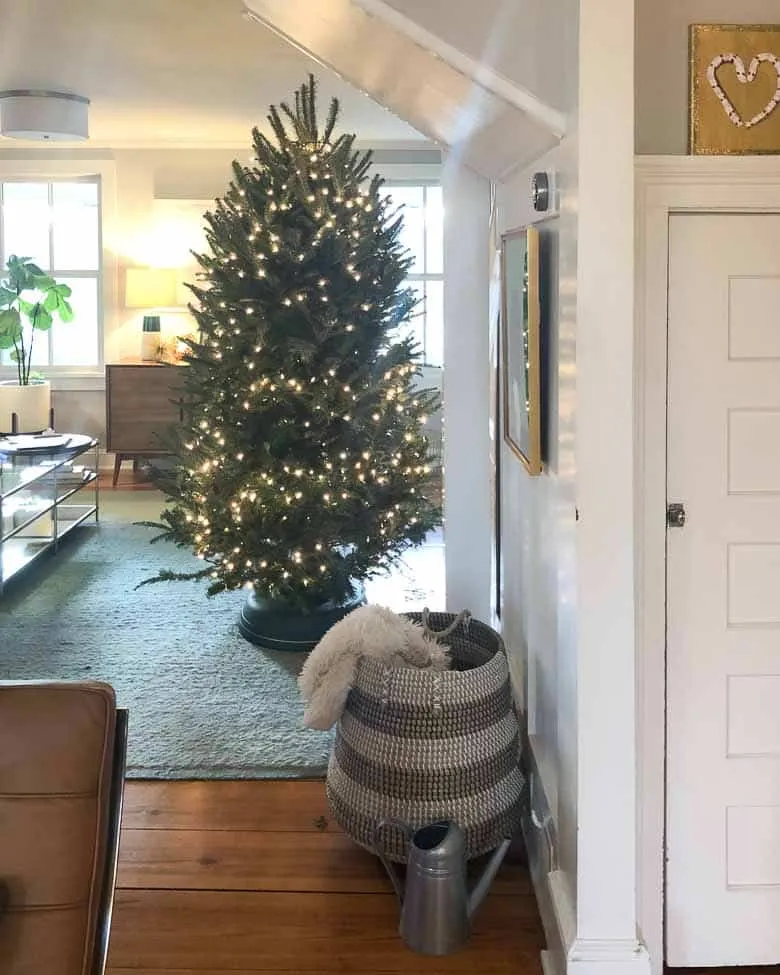
Unlit trees plus your own strands means stringing 600 lights by hand — about 45 minutes, plus untangling. And mini lights have a lifespan: expect five to seven seasons before sections start dying mid-December. Buy one extra strand every year and label your storage box, because the year you don’t is the year the top third goes dark.
6. Striped Bows, Clear Glass Baubles, and a Live Fire
The red-and-white striped bows pick up the pattern in the armchairs across the room, which is why the scene reads designed instead of assembled. The paper chain garland on the white mantel adds a craft texture that glass baubles can’t, and the layered light — fire, lamp, candles, tree — keeps everything soft. Strip the bows out and you’d have a nice tree and a disconnected room.
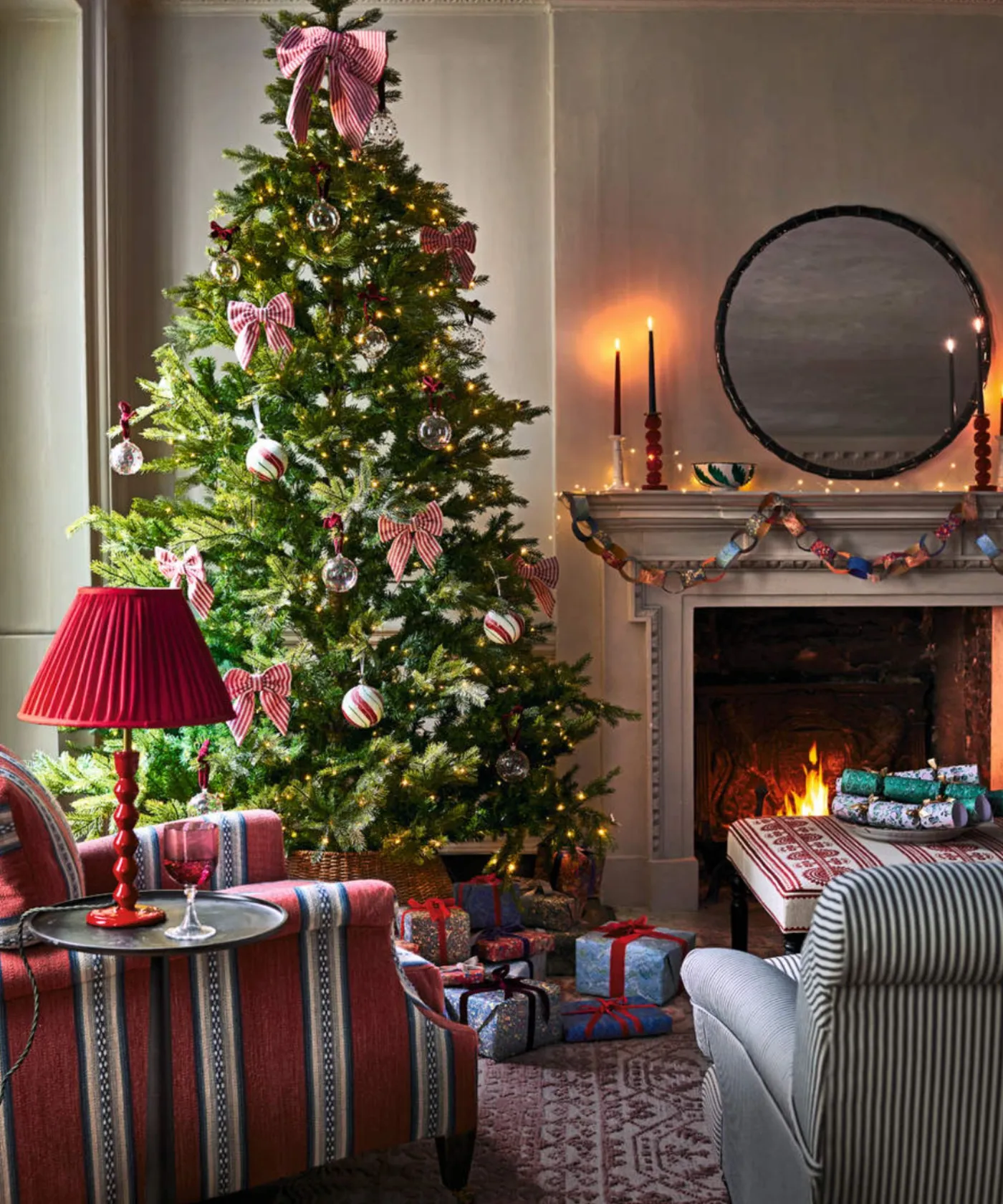
A live fire next to a decorated tree is lovely and also a genuine risk. Keep three feet of clearance from the hearth, water a fresh tree every single day, and never let the paper chain or a fabric bow hang where a spark can reach it. If the tree starts dropping needles, the fireplace stays off. That part isn’t negotiable.
7. Frosted Pink and Champagne, Topped With a Gold Starburst
- Flocked 7.5-ft tree: $180–$450
- Warm white lights: $25–$60
- Pink and champagne ornaments (70–90 balls): $120–$300
- Floral picks and clusters: $40–$90
- Gold starburst topper: $25–$70
- Fluffy white skirt: $30–$90
- Total: roughly $420 to $1,060, depending on the tree.
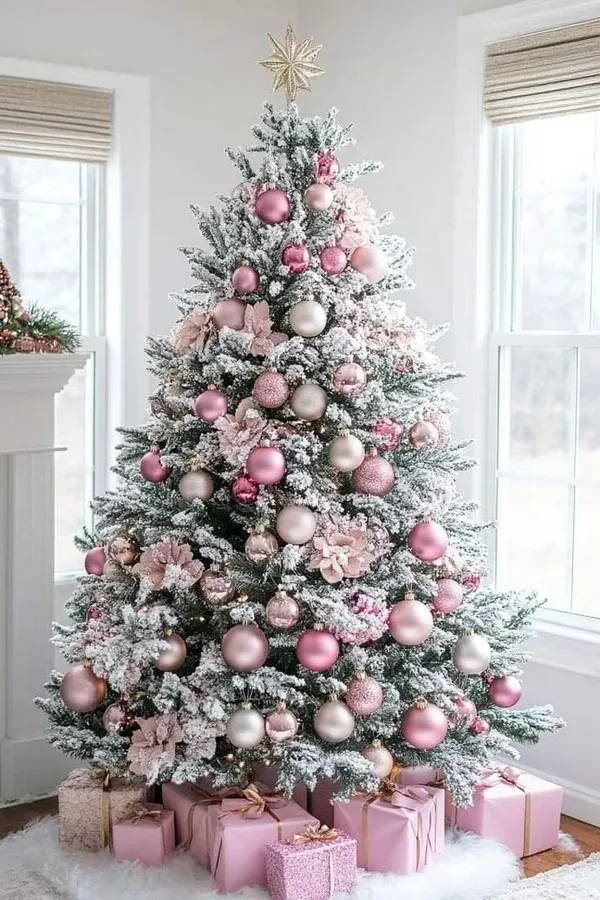
Budget alternative: a $90 green tree you flock yourself with a $20 spray can, dollar-store ornaments in two shades of pink, and handmade ribbon roses gets you 55 percent of the way there for about $220.
Cluster the pale pink florals in threes at the branch tips, never singly, and keep every cluster in the lower two-thirds. Then follow the ten-percent rule: no ornament larger than about a tenth of the tree’s height. On a 7.5-foot tree that means nothing past 4 inches — which is why the big pink flowers read as flowers rather than as ornaments.
8. Grey Ornaments Are What Keep Red and Gold From Feeling Dated
Trees with this much architectural company want height — 7.5 to 9 feet under a 9- or 10-foot ceiling, sitting 12 to 18 inches off the wall so the stick-woven skirt has room to spread. On herringbone floors, angle the tree so the pattern runs toward the room rather than along the wall. It makes a narrow space read wider than it is.
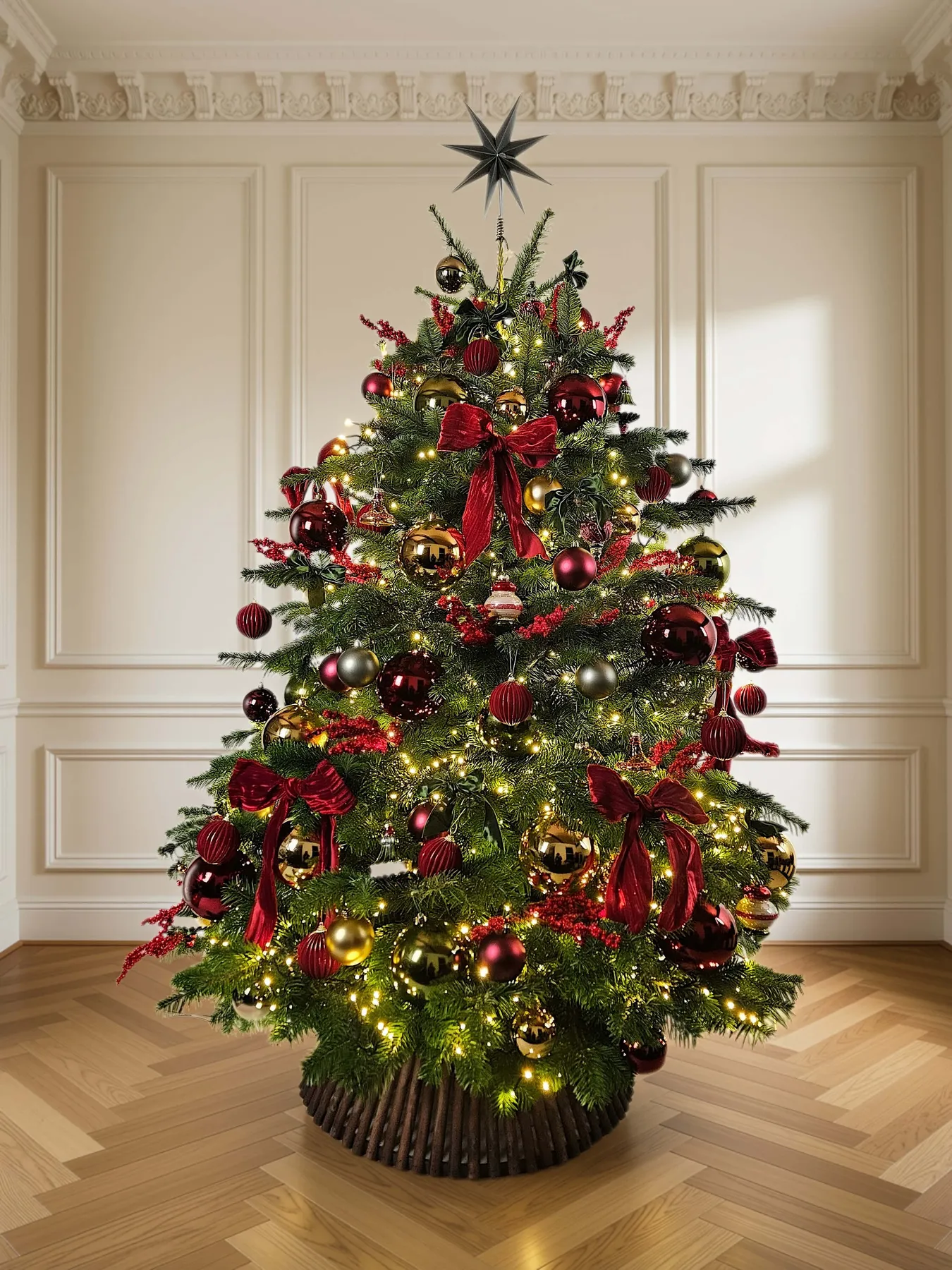
The grey ornaments. Maybe eight or ten of them out of a hundred, tucked low and off-center, and they’re the reason those deep red velvet bows don’t look like a 1994 department store window. Grey cools the red down just enough. Pull them out and the tree is still pretty — it’s just a period piece instead of a room that belongs in 2026.
9. Silver, White, and Furry Spheres Against Deep Blue Paneling
About 45 percent cool silver and white, 35 percent deep blue wall, 15 percent warm light, 5 percent gold for warmth. The formula travels: paint the wall forest green, swap silver for brass, and you have a completely different room with the same proportions. What you can’t change is the temperature split — the wall stays cool, the light stays warm, and that tension is the entire look.
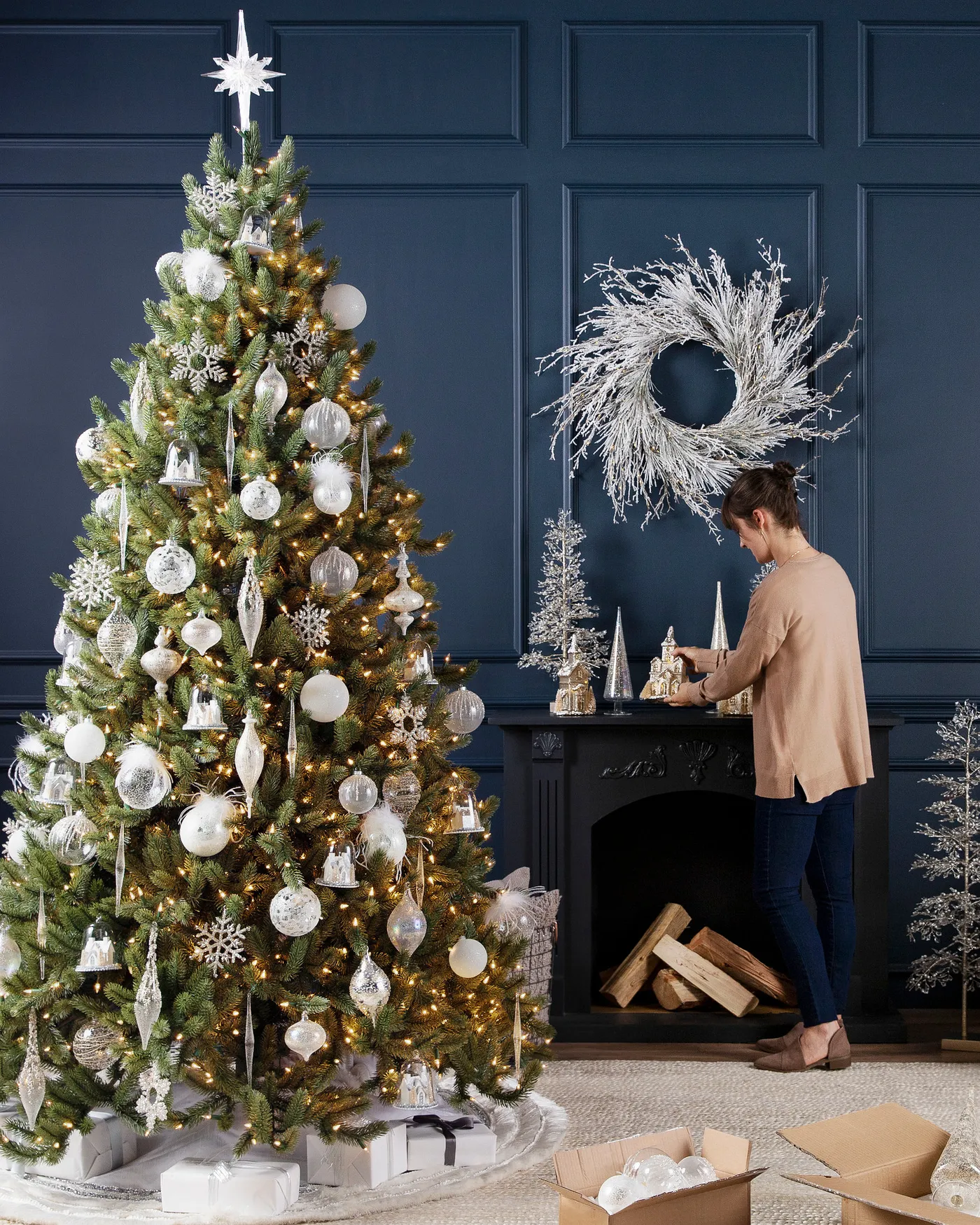
The blue paneling is doing more for this tree than any ornament on it, and a gallon of deep navy runs $35 to $60. Do the wall first. Then hit Walmart or At Home for a tub of silver balls — expect $15 to $25 for fifty — and add white snowflake cutouts from a craft store for $6. The clear star topper is the only piece worth real money.
10. Ceiling-Height Grandeur in Gold and Bronze, With Red Berries
Maximalism came back, but quieter than the 2019 version — fewer colors, more metal, bigger scale. Gold and bronze have become the safe luxury palette because they read expensive under warm light without demanding a specific wall color, and a dark wall behind them does the rest. This is the tree people screenshot and never build, and honestly, a ceiling-height tree is a commitment, not a trend.
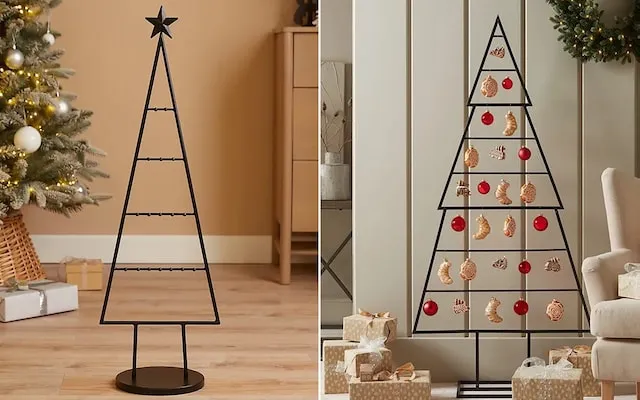
Metallic finishes dull. Gold and bronze ornaments pick up fingerprints and lose their shine after three or four seasons, especially stored in a hot garage. Wrap them individually in tissue. A tree this tall also means a ladder, two people, and roughly four hours of setup — plus storage space most of us genuinely do not have.
11. A Foldable Paper Tree That Fits on a Side Table
Battery fairy lights, not plug-in. Run two 20-light copper strands down the folds and hide the battery pack behind the base of the tree — a small plate or a stack of two books works. Keep the gold and deep red ornaments under 2 inches so the paper doesn’t bow, and weight the bottom fold with a couple of coins taped inside so it doesn’t slide on the table.
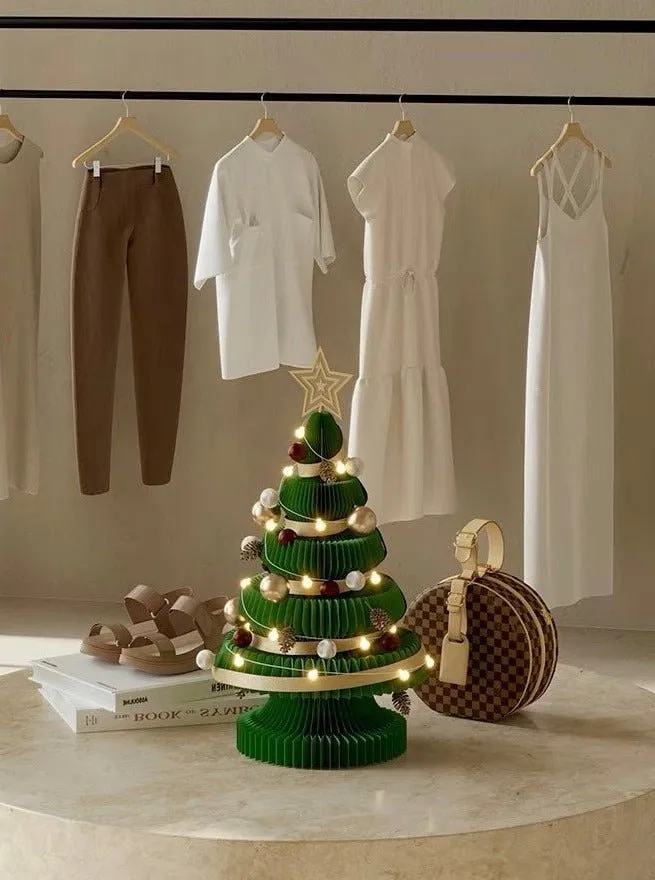
Paper and heat don’t mix. Skip incandescent bulbs entirely, keep the tree off radiators and away from candles, and don’t leave the lights on unattended. Also be realistic about size: the accordion tree is a tabletop moment, not a room’s centerpiece. Great for a studio, a hallway console, or a kid’s room where a seven-footer is simply never happening.
12. Snowflake Cutouts and a Matte Black Star Stand
The stand. A matte black star-shaped base instead of a skirt is the whole personality of this tree — it lets the light wood floor show through and makes the green, white, and silver read graphic rather than sweet. It also solves the problem every skirt has: hiding a plastic bucket. Compare with Idea #20, where velvet does the same job with far more drama.
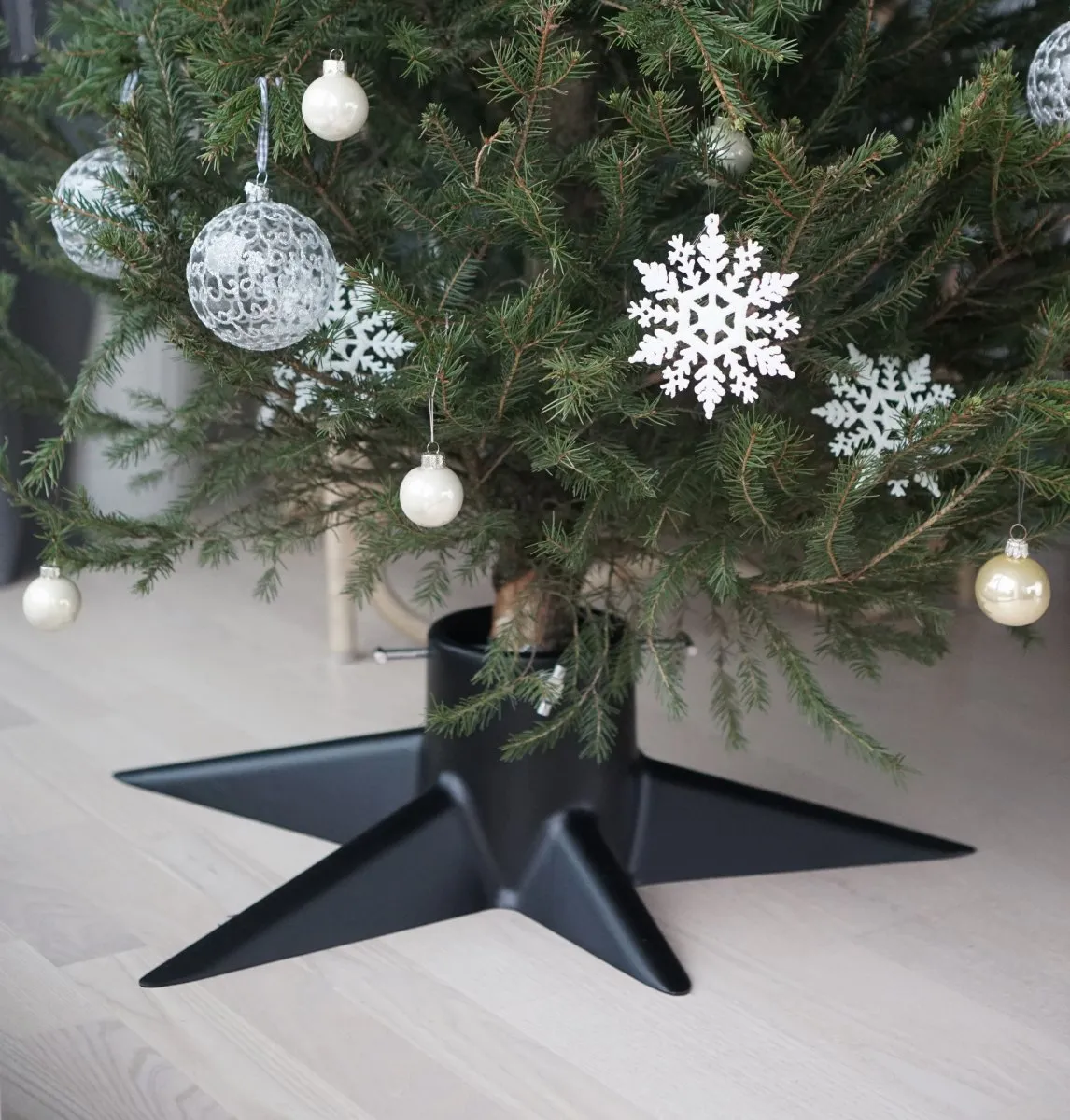
A real tree in this style wants 6 to 7 feet with a stand footprint of 22 to 24 inches, which means roughly 3 feet of clear floor on every side — more than a skirt needs, because there’s no fabric to soften the edge. On pale wood floors the black base creates a hard contrast line, so keep the surrounding furniture low and quiet.
13. Gold Spheres, Bronze Gloss, and a Dark Brown Ribbon
Roughly 60 percent frosted white-green, 25 percent gold and bronze, 10 percent dark brown, 5 percent pure glow. The brown is the sleeper — it’s what keeps gold from going brassy. Swap brown for black and it turns modern; swap it for cream and the tree goes bridal. Hold the gold mix at about two glossy to one matte to one glitter and you’ll never end up with a flat-looking tree.
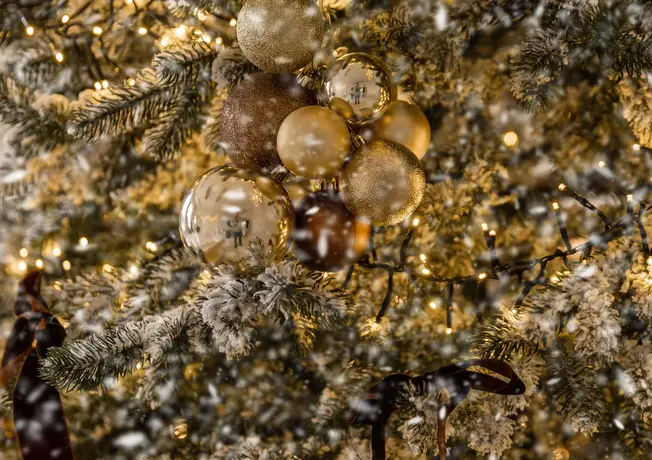
Finish mixing is the quiet trick. Under warm string lights a matte gold ball absorbs and a glitter one throws light back, so the same color reads three different ways at three distances. The flocking adds a fourth texture at branch level. That’s why this close-up feels expensive — nothing in it is unusual, it’s just varied.
14. A Layered Garland With Matte Red and Gold Glitter
Building one six-foot section:

- Start with a dark green roping base plus a lighter blue-green sprig.
- Wire in dried golden-bronze botanicals every 10 inches.
- Add red foliage and berry clusters in threes.
- Place the matte red ball and gold glitter ornament last, slightly recessed.
- Weave warm orange lights through the garland, not around it.
About 30 minutes and $40 to $70 per section.
Hardware store pine roping is roughly $12 for 25 feet and looks better than it has any right to. Add one $5 bunch of dried eucalyptus, a $3 bag of faux berries, and a dollar-store pack of red and gold balls, then wrap a single strand of warm lights through it. Under $35 per section, a fraction of what a pre-decorated garland costs.
15. A Pink Tree Loaded With Rose Gold Bells and Velvet Bows
- Pink 7-ft artificial tree: $120–$300
- Rose gold ornaments, bells, and candy canes: $80–$200
- Satin and velvet ribbon for bows: $30–$60
- Fluffy white collar or skirt: $20–$40
- Warm white lights: $20–$50
- Total: about $270 to $650, and the tree is most of it.
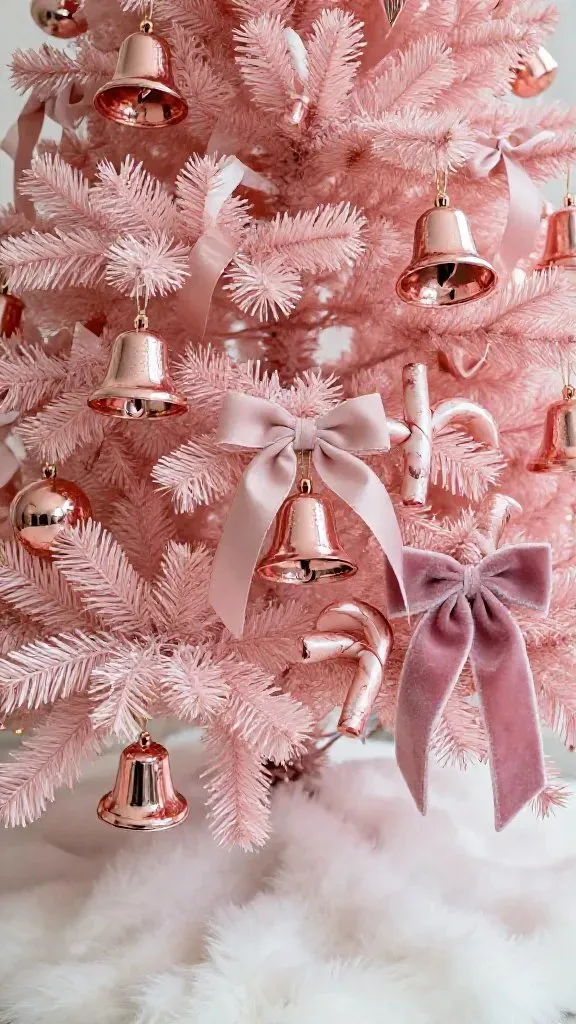
Budget alternative: a white-flocked $80 tree, two shades of pink ribbon, and dollar-store rose gold balls gets you the same mood for under $160.
Mix satin and velvet bows at roughly two satin to one velvet, and keep every bow between 6 and 8 inches wide — smaller disappears into the branches, bigger looks like a gift wrap accident. For a softer take on the same palette, Idea #7 uses flocking and floral clusters instead of a colored tree.
16. Red Mid-Century Ornaments on a Silver Tinsel Tree
Tinsel trees are back because the people decorating now grew up with a grandmother’s silver tree and no longer think of it as tacky. It’s nostalgia with a graphic edge — foil throws light in a way flocking never will. Expect to see it in small apartments and on tabletops rather than as a main tree. The trend has legs, but it’s a cameo, not a lead.
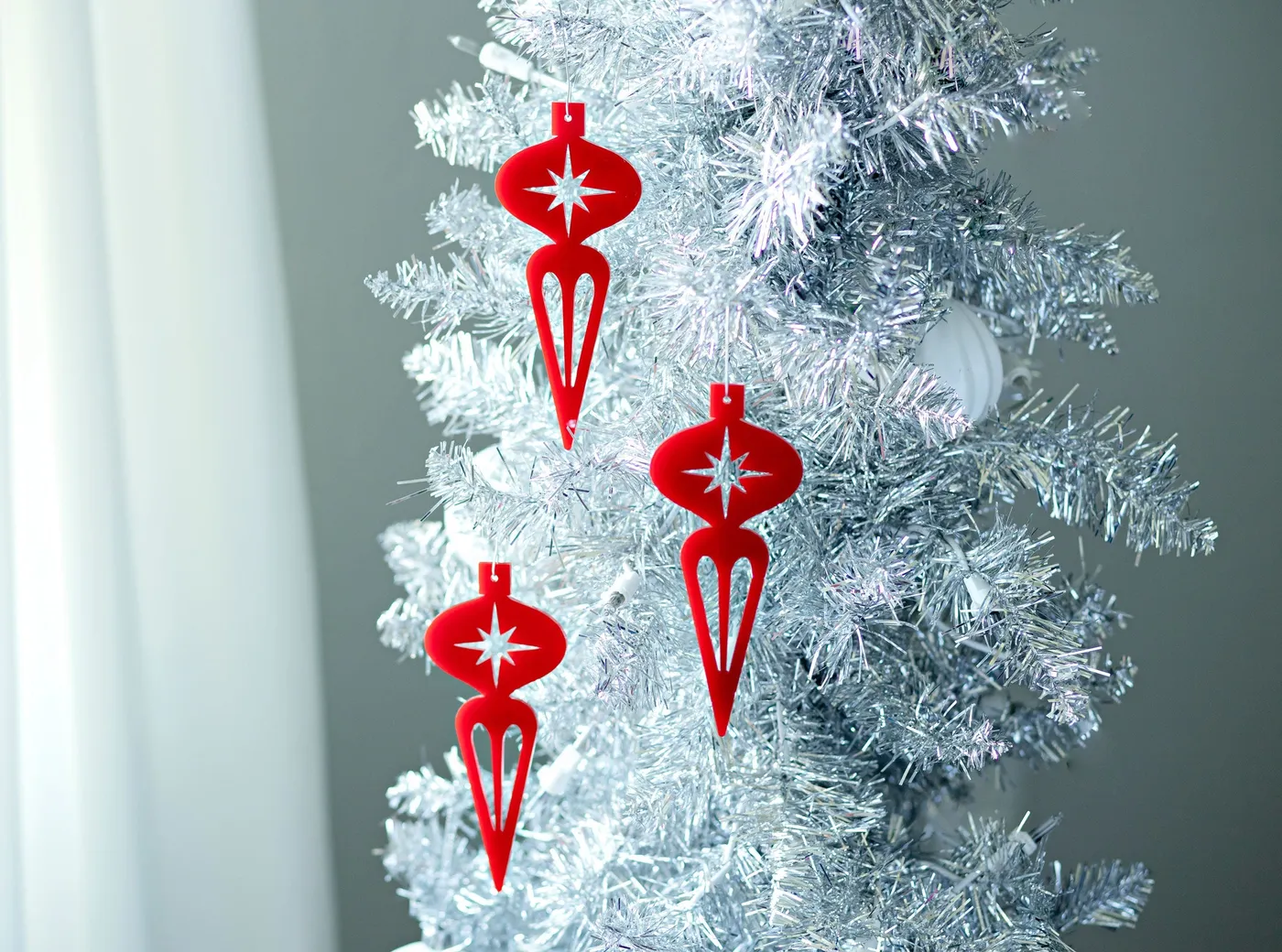
Tinsel trees usually top out around 4 to 6 feet, which makes them ideal for a 100-square-foot corner or a small dining room table. Keep at least 12 inches from that sheer white curtain behind it — foil near fabric near a radiator is a bad combination. The red star-cutout ornaments need to be large, 3 to 4 inches, or they vanish in the shine.
17. Fuchsia Velvet Bows Against Burgundy and Matte Gold
Fuchsia and burgundy can go muddy fast under warm bulbs. Test the two together in the actual room before you commit, and put a single matte gold ball between them wherever they touch. Velvet bow loops also crush — store them flat in a box, not bagged, or you’ll spend next December steaming ribbon instead of actually decorating.
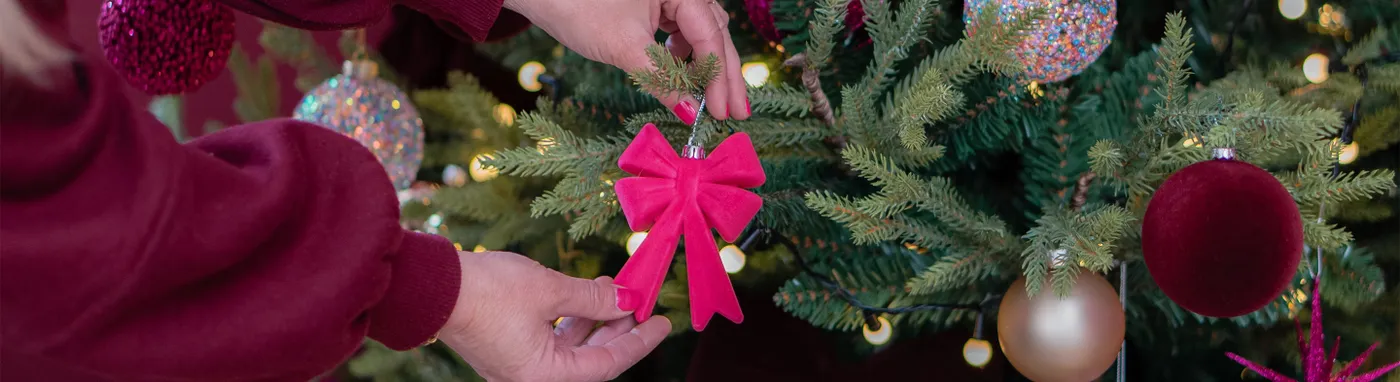
About 55 percent green branches, 25 percent fuchsia and burgundy, 15 percent matte gold, 5 percent glitter. The matte gold is the bridge here — gloss gold would fight the velvet and silver would kill the warmth entirely. Swap fuchsia for plum and burgundy for rust and you get a fall-adjacent version that still reads Christmas.
18. Velvet Poinsettias, an Elf, and an Owl on Red and Green
The figural ornaments — the elf, the owl, the white candle shapes. They’re the reason this tree looks collected over twenty years rather than bought in one afternoon. Perfect trees photograph well and feel impersonal; two or three odd little characters at eye level make guests walk over and point. Buy one new figural ornament a year and stop apologizing for the weird ones.
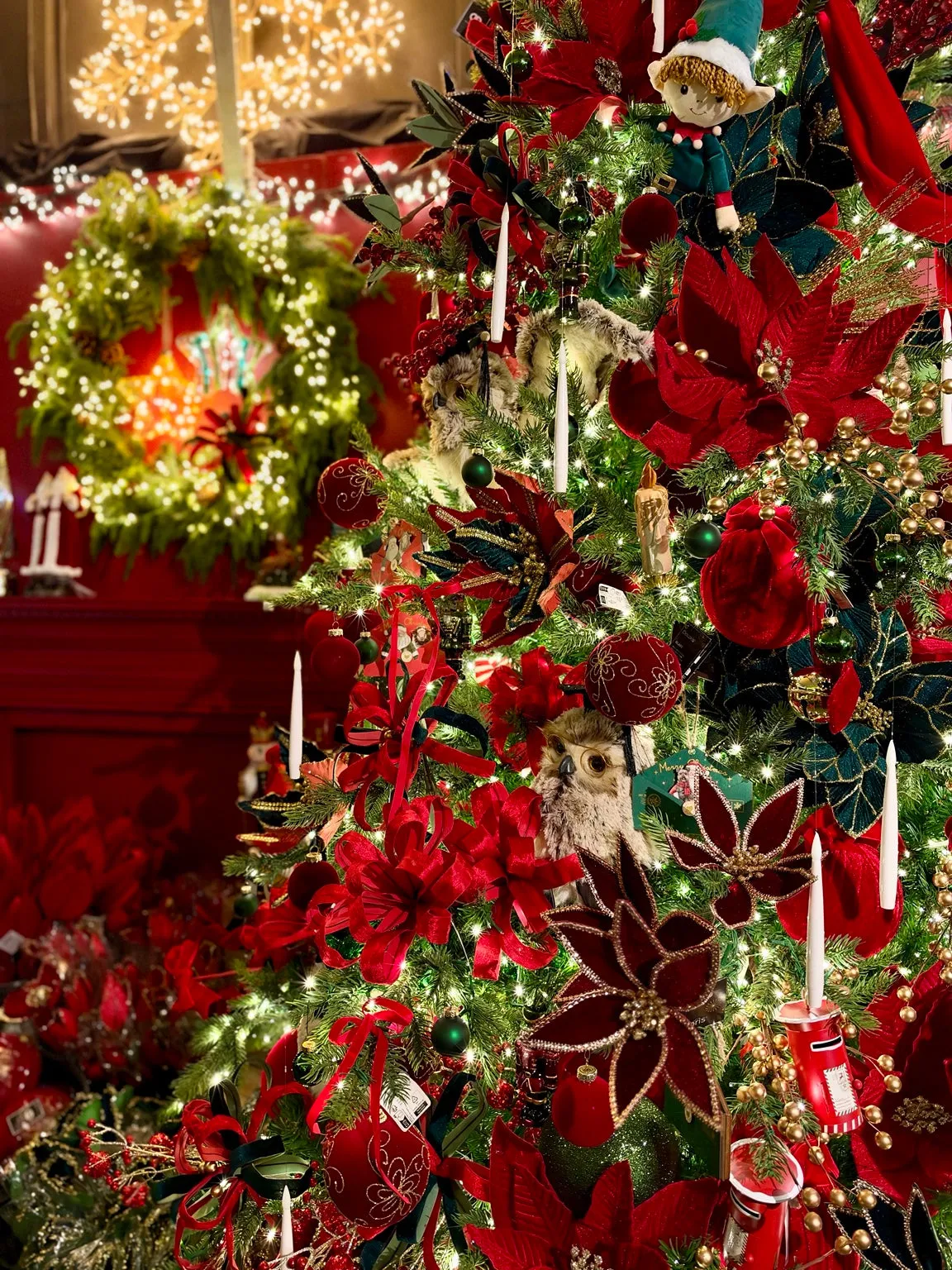
Hanging gold bead garland:
- Start at the top back, where nobody looks.
- Make three or four loose swags per side, never a spiral.
- Anchor each swag with a hidden ornament hook.
- Let the lowest swag sit about a third of the way up.
- Set the velvet poinsettias where the garland turns.
Roughly 20 minutes, and the beads run $12 to $20 a strand.
19. Deep Red and Bright Gold, Lit Entirely in Warm White
This is the most forgiving look in the whole article to do cheaply. Tubs of red and gold shatterproof balls run $15 to $30 for fifty at Walmart, and mixing two tubs of each gives you the density you see here. Shop thrift stores for the older glass balls — a buck apiece, and their slightly deeper red is what makes the palette look collected instead of flipped.
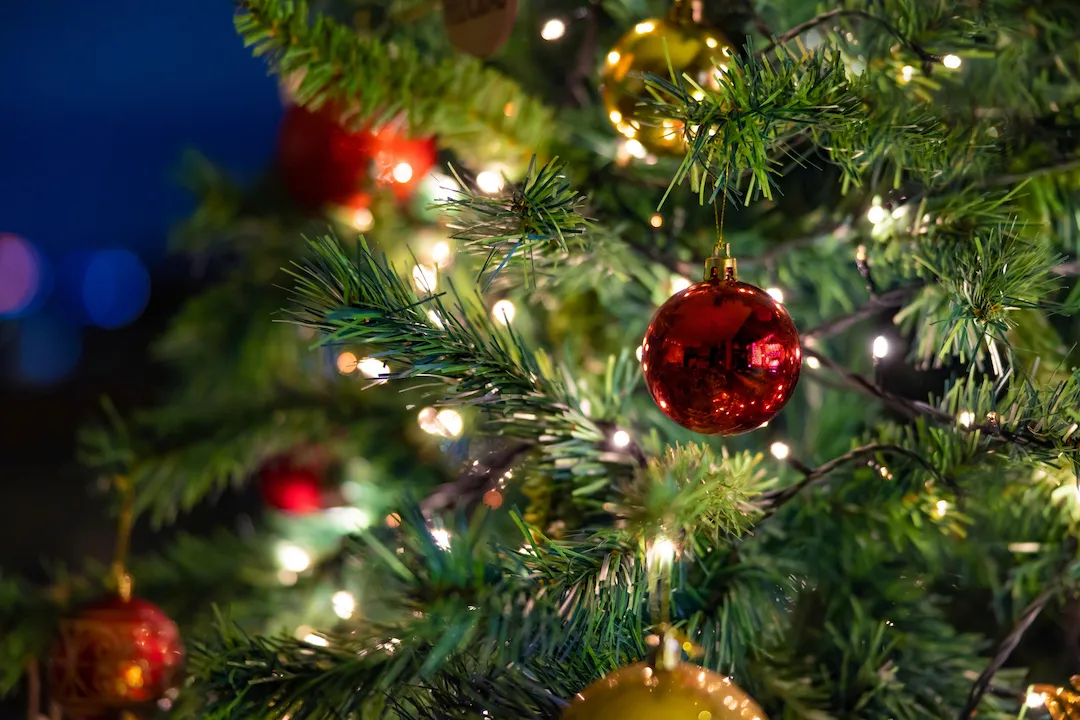
Dark, out-of-focus backgrounds do enormous work. Against a deep navy or charcoal wall, red and gold ornaments read brighter and more saturated because there’s no competing detail behind them. The warm white lights sit around 2700K, which pulls gold toward amber. Move this exact tree in front of a beige wall and it loses half its punch.
20. A Velvet Skirt With Warm Fringed Trim and Bronze Balls
Velvet shows everything — pet hair, pine needles, the faint ring where a gift box sat. Vacuum it on the lowest setting with a brush attachment, and expect to spot-clean twice a season. Fringe tangles if it’s bagged, so lay it flat or hang it. Most velvet skirts are dry clean only, which is a $25 to $40 bill you should build into the budget now rather than in January.
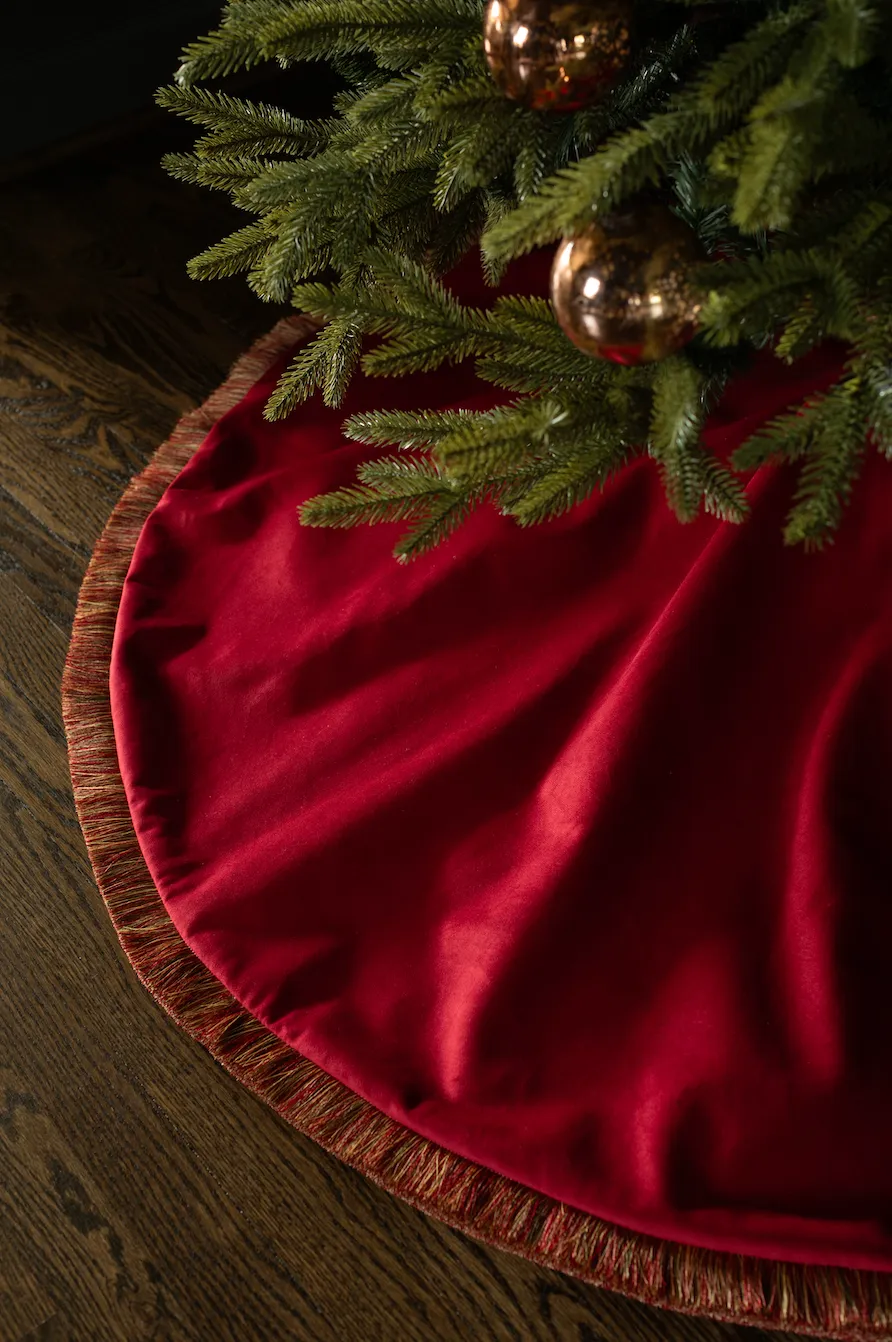
The skirt should measure about one and a half times the tree’s widest branch spread. A 7.5-foot tree with a 50-inch spread needs a 72 to 75 inch skirt. Anything narrower and the stand peeks out the moment someone sits on the floor; anything wider and it swallows the room. Measure the spread in the store, not at home in the dark.
21. Ruffled Red Velvet, Three Bows, and Warm White Lights
- Ruffled velvet tree skirt: $90–$250
- Three matching velvet bows: $20–$50
- Red, white, and gold ornaments: $60–$150
- Warm white lights: $20–$40
- Total: around $190 to $490, and most of it is the skirt.
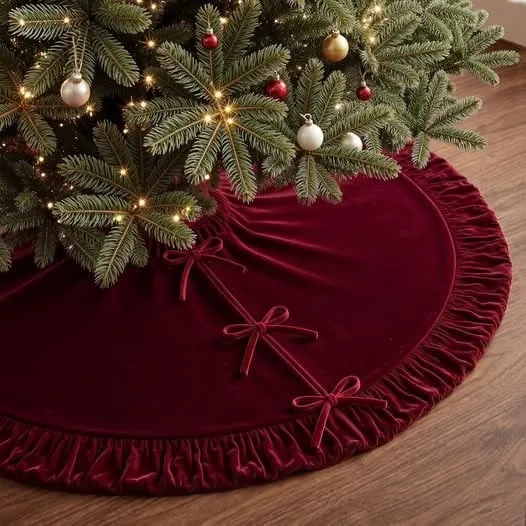
Budget alternative: three yards of velvet-look fabric from Joann for $30 to $45, a rolled hem, and a $10 bow-tied sash gets 80 percent of the effect — no sewing machine required.
A skirt like this suits a 7 to 7.5 foot tree in a room with at least 3 feet of clear floor in every direction, since the ruffles need breathing room to sit properly. On dark wood floors the deep red reads almost burgundy at night, which is exactly why the warm white lights matter more here than they would on a pale floor.
22. Sculptural, Space-Age Baubles That Read as Little Objects
Space-age is having a moment — the shapes that showed up in 1960s design are back, and they’ve landed on ornaments. Think pieces that look like small objects rather than balls: matte finishes, odd silhouettes, chrome that refuses to be shiny. It’s an easy trend to try because a handful of sculptural ornaments reads as a statement without you redoing anything else on the tree.

Keep it at roughly 70 percent classic to 30 percent futuristic so it reads as a choice rather than a theme. The classic 70 does the heavy lifting — warm lights, ordinary reds and whites — and the odd 30 gives the tree a personality. Push past half and it starts looking like a display at a trade show instead of something in your living room.
23. A Cream Folded Paper Ornament Against Dark Branches
The ornament is matte paper, and that’s the entire point — set against dark fir with one glittery silver sphere just out of focus, the cream paper looks softer and more expensive than any glass. The white hanging string is visible, which most stylists would hide; here it reads as handmade and deliberate. One hero ornament at the tip, everything else blurred behind it.
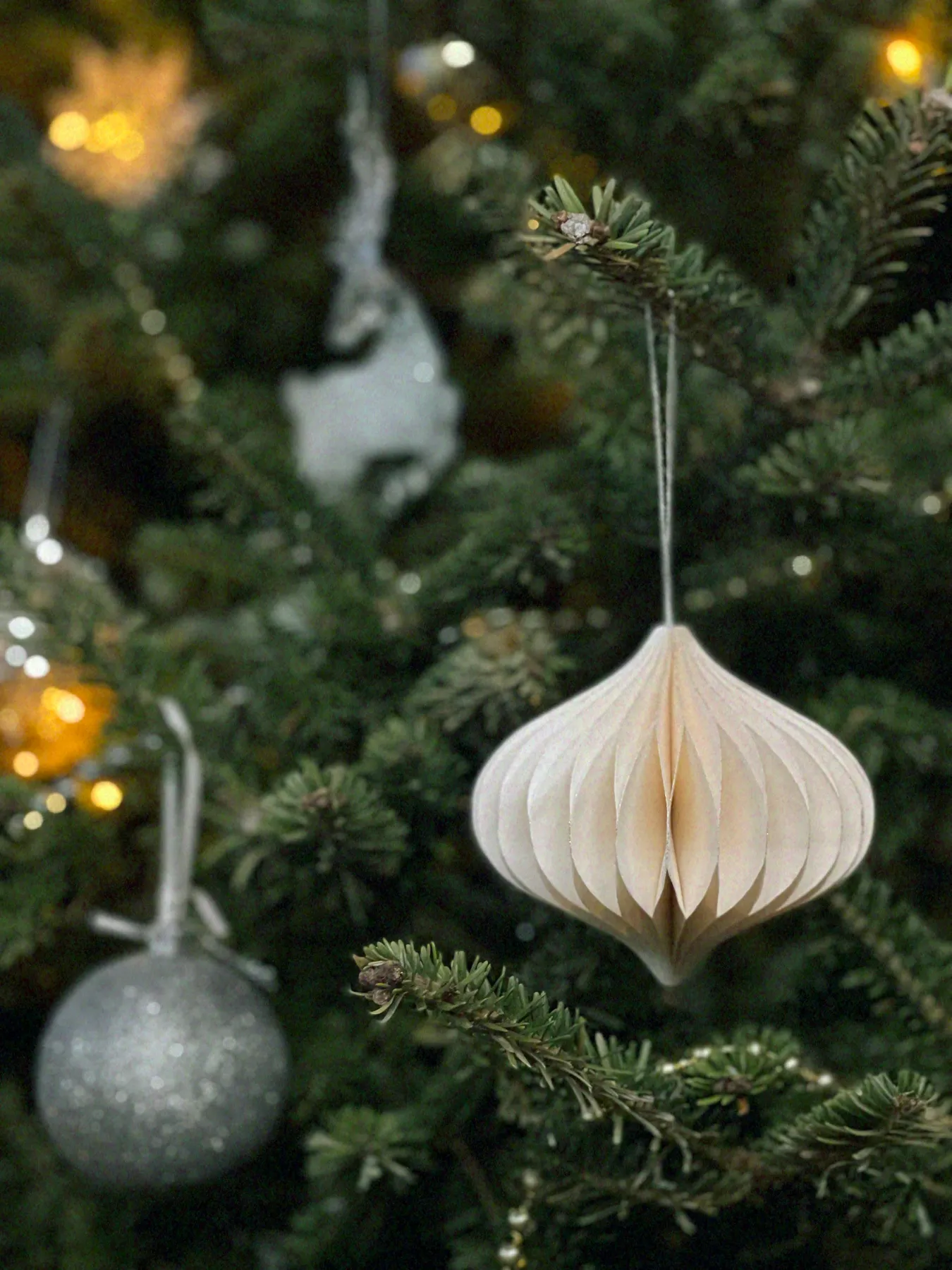
A 5-inch paper ornament reads clearly from about three feet away, which makes it a front-of-tree piece rather than filler. Paper weighs almost nothing, so it can hang from the thinnest branch — but that also means it swings. On a 6 to 7 foot tree, place four to six of them at eye level and leave the top for the glass pieces.
24. Matte Pink and Shiny Gold on a Full Green Tree
For ribbon garland, plan about 1.5 yards of ribbon per foot of tree height and keep the width between 2.5 and 3 inches. Weave it in and out of the branches every third branch rather than wrapping — you want it to disappear and reappear, not circle the tree like a stripe. Press the ribbon flat against the branch with a clip where it turns.
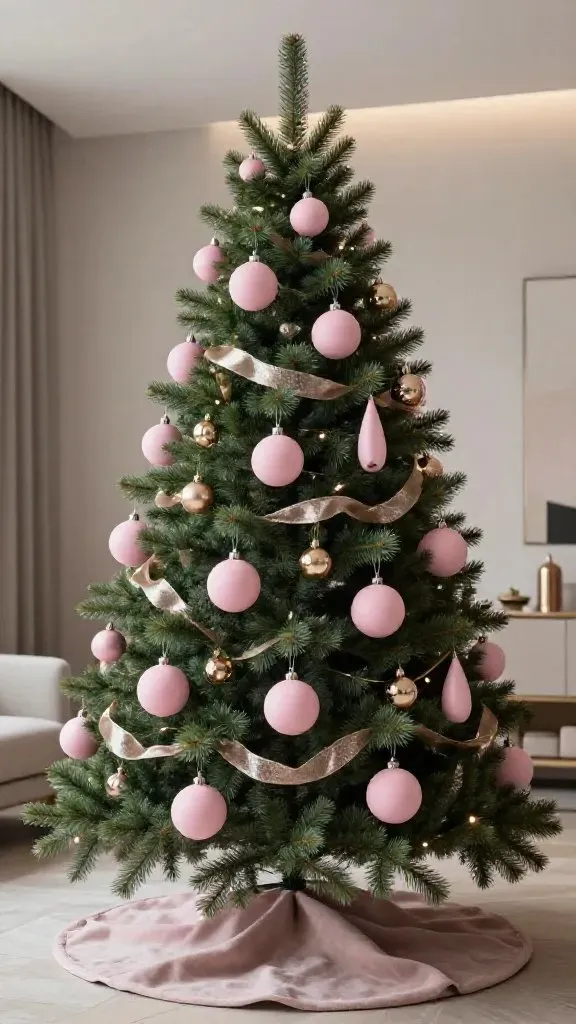
The soft pink fabric skirt is doing more than you’d think. Without it, pink ornaments on a green tree read as a color scheme; with it, the pink looks grounded in the room. It’s the same reason Idea #15 works at the opposite extreme — the base tells you what the palette is about before you’ve even looked up.
25. Flocked Branches Over a Buffalo Plaid Skirt
Heavily flocked trees shed, so plan placement around your vacuum. Keep the tree out of a walkway and at least 2 feet from that white painted brick wall — white on white looks flat in photos and dusty in person. A 7.5-foot flocked tree wants about 5 feet of wall width and a rug long enough to catch the snowfall of coating that comes off it.
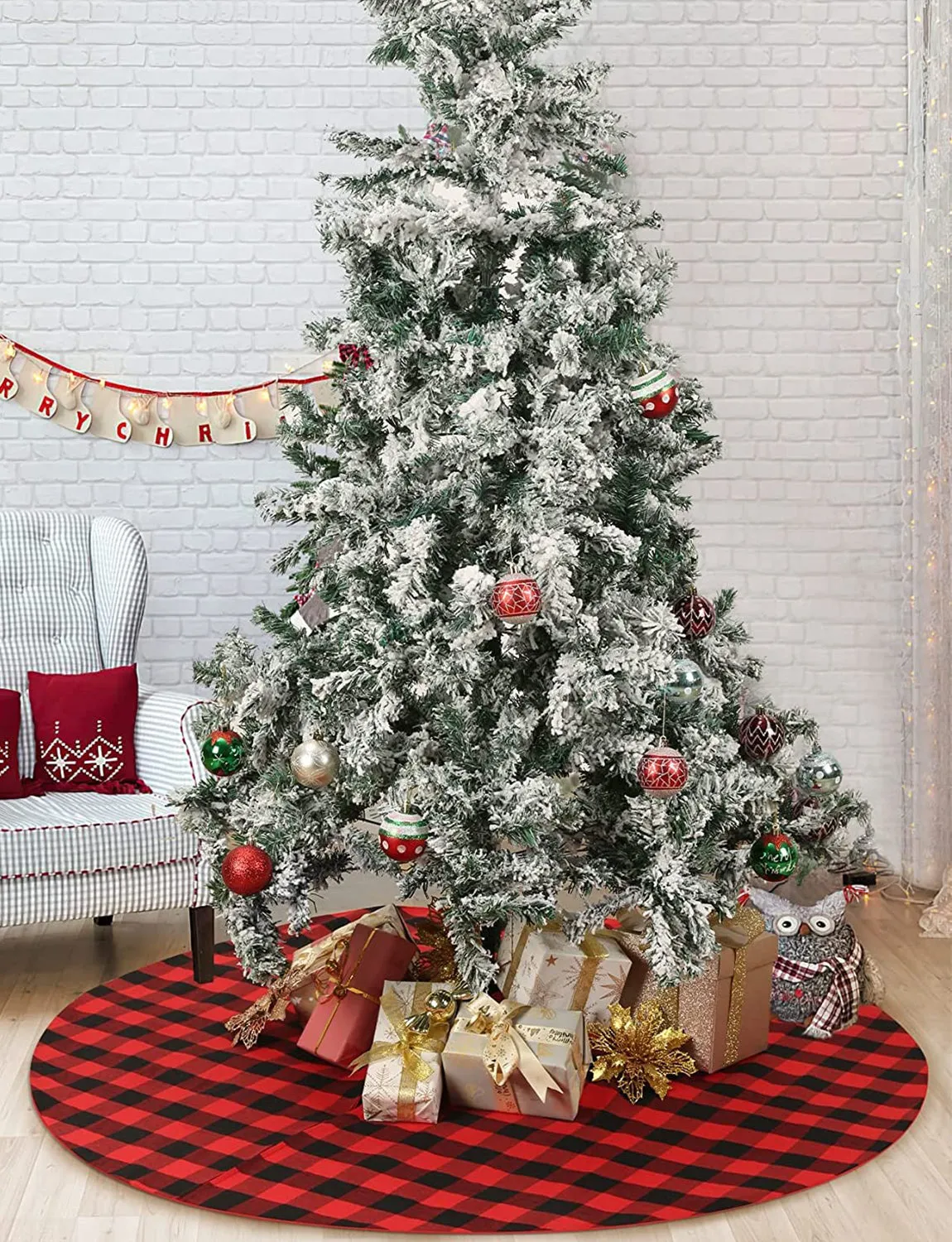
Buffalo plaid fabric is $12 to $25 a yard at Walmart or Joann, and the skirt here is essentially one gathered round — two and a half yards, a hem, and a ribbon tie. Assorted round glass ornaments in red, green, and silver are everywhere for about $20 a set. The flocked tree is the only real expense, and Target’s 7-foot version lands around $100 in season.
26. A Vibrant Red Corduroy Skirt Under Heavy Frosting
Making a corduroy skirt:
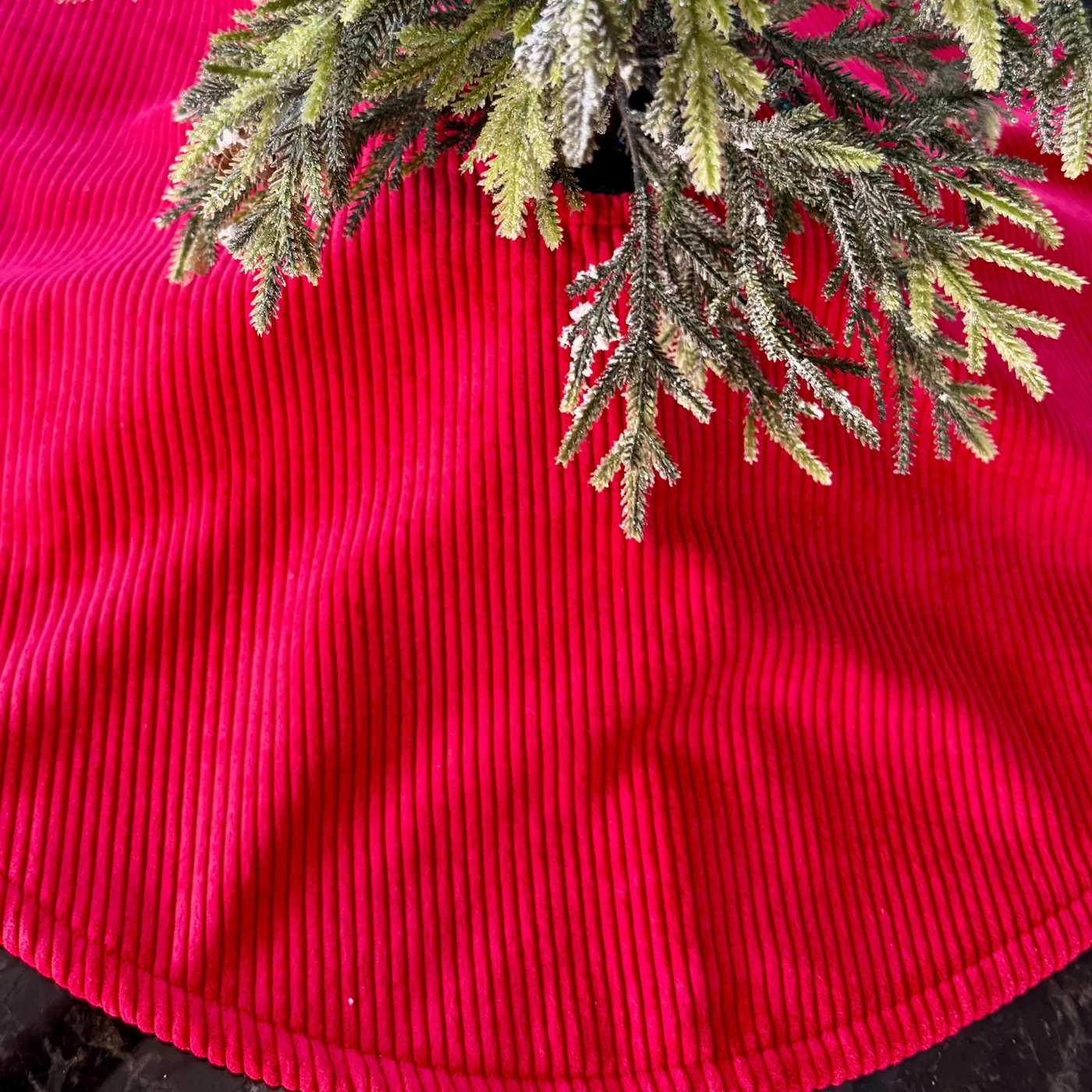
- Cut two half circles from 2.5 yards of wide-wale corduroy.
- Cut a 5-inch opening at the center point.
- Sew the halves together, then press the seam flat.
- Hem with a 1-inch fold, or fuse it if you don’t sew.
- Finish the center opening with ribbon ties.
About 1.5 hours and $30 to $45 in fabric.
Flocked branches shed glitter and fake snow every time you breathe on them, and corduroy is a magnet for both. Vacuum the skirt weekly with a brush head, and expect the ribs to crush where gifts sit — a quick steam brings them back. Skip both if you have a white dog. The alternative is a plain cotton skirt you can machine wash.
27. Leopard Print, Cream Fluff, and Reflective Silver Baubles
About 60 percent green branches and dark wood floor, 20 percent red-and-pink leopard, 15 percent silver, 5 percent cream trim. The small scale of the print is what makes it work — a bigger leopard would fight the ornaments, but at this size it reads almost as texture from across the room. Swap the silver for gold and it turns warm and vintage; keep the silver and it stays sharp.
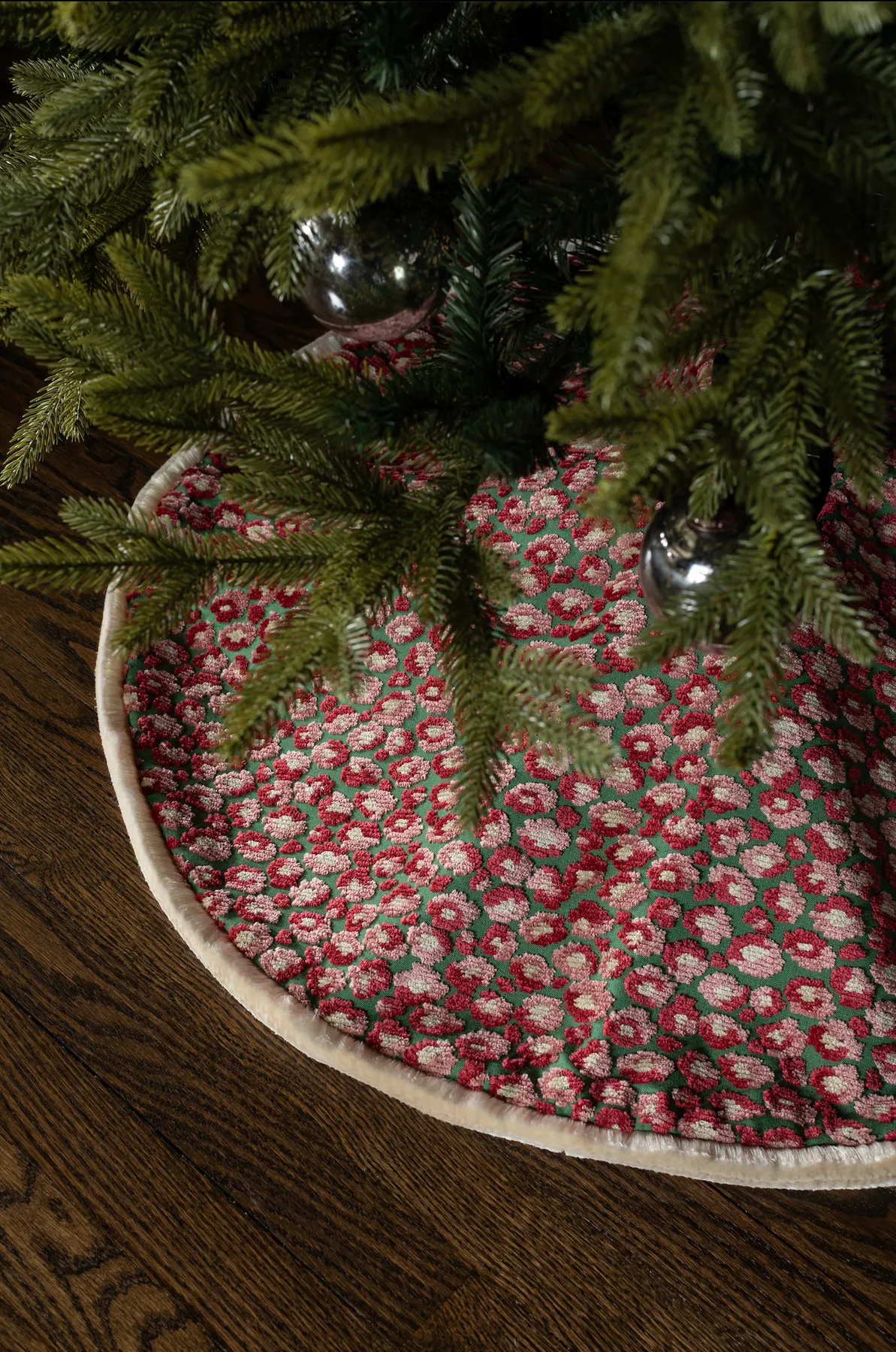
The tonal bridge is doing the quiet work. Red and light pink in the print echo the reds on the tree, and the cream trim echoes the flocking, so a pattern that should clash feels deliberate instead. Reflective silver balls then bounce warm light back down onto it. Pattern, tone, reflection — three moves, all pointing the same direction.
28. Setting a Fresh Tree Into a Bright Red Metal Stand
A fresh tree drinks about a quart of water per inch of trunk diameter on day one, then a gallon or more daily. Check it twice a day for the first week. If the water level ever drops below the cut, sap seals the trunk and it stops drinking — you’ll need to re-cut an inch off. Which is why a red metal stand with a wide basin beats a prettier one with a narrow reservoir every single time.

Sort ornaments into three baskets before anything goes on the tree: small, medium, large. Hang the largest in the bottom third where branches are strongest, mediums through the middle, smalls at the top and deep inside to fill gaps. It sounds fussy and it takes ten minutes — but it’s the difference between a tree that looks styled and one that looks emptied onto.
29. Red, Gold, Pinecones, and a Burlap Santa Skirt
The pinecones and wooden snowflakes. Glass and metal reflect light, which is lovely, but they all feel the same in the hand and the eye. Natural texture breaks that up and makes the red and gold read richer by contrast. It’s also the cheapest thing on the tree — and the reason this version feels warmer than Idea #25, which is all glass and flocking.
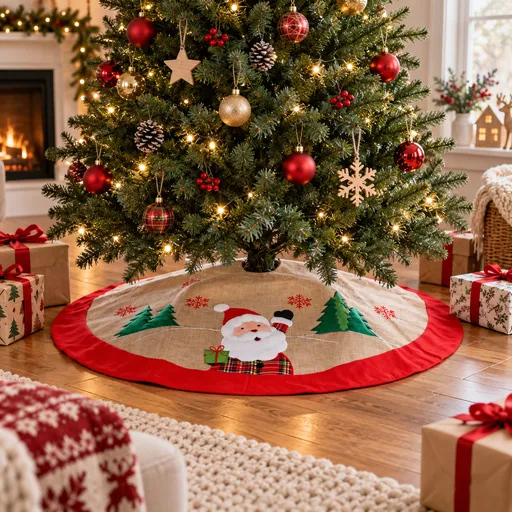
Wiring pinecones:
- Wrap a 6-inch piece of floral wire around the base, twisting twice.
- Leave a 3-inch tail and curl it into a hook.
- Tuck the hook over a strong inner branch, not a tip.
- Cluster in threes at different depths.
- Add a wooden snowflake beside each cluster.
Twenty minutes for a dozen, and about $10 in materials.
30. Three Kinds of Ribbon, Cream Planters, and a Small Forest
The multi-tree look works when the trees are 4 to 6 feet and sit in planters 14 to 18 inches across — anything smaller tips, anything larger hides the trunk. You need about 9 feet of ceiling and a wide entry or open-plan corner to pull it off. Three trees spaced 3 to 4 feet apart read as one arrangement; two always look like a mistake.
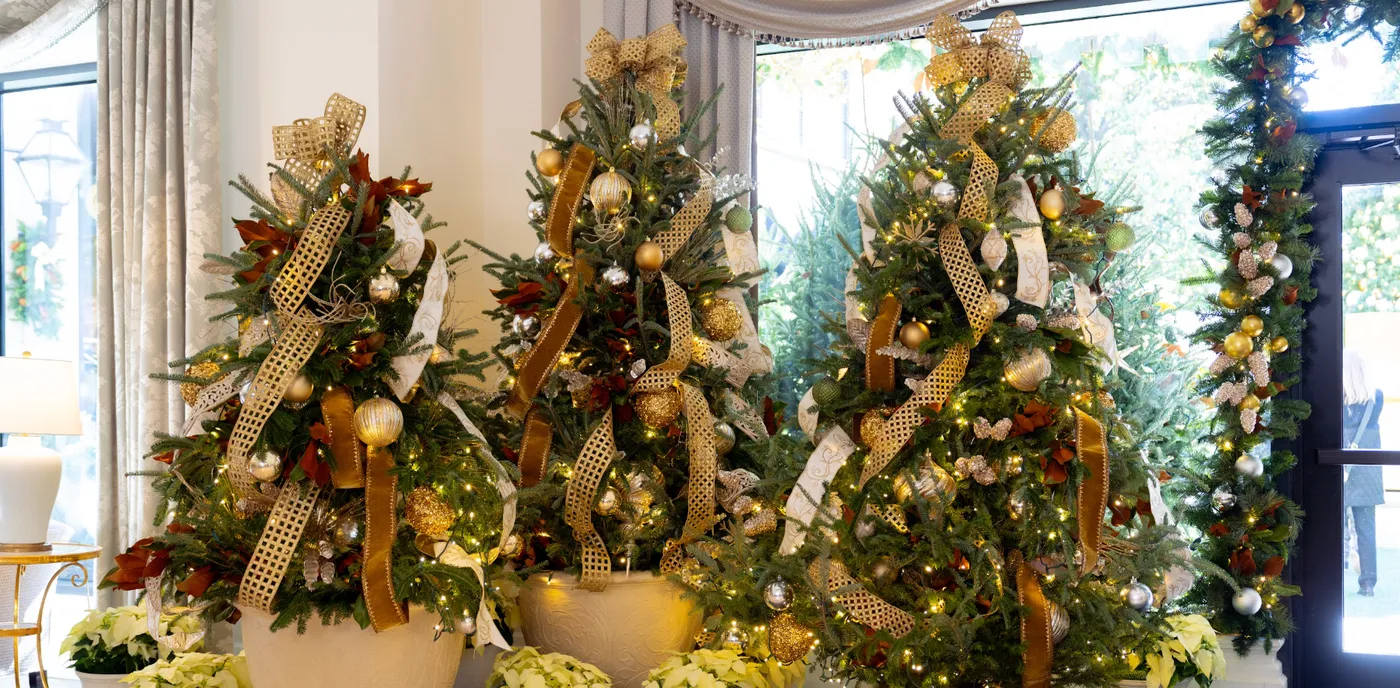
The tree forest is a direct answer to open floor plans. One 8-footer in a 400-square-foot great room looks lonely, so people are doing three smaller trees instead — and it lets you split a palette, with gold and silver mesh and velvet ribbon in one planter and patterned white ribbon in the next. Expect this one to stick around, because it solves a spatial problem rather than chasing a color.
31. A Pearl-and-Gem Velvet Ball Among Gold Metallic Leaves
Jeweled ornaments disappear unless you cluster them. Group three pieces at eye level in each quadrant of the tree, roughly 12 to 18 inches apart, and keep each cluster within a hand’s width so it reads as one moment instead of three lonely balls. Put the disco ball ornaments deep inside the branches — they’ll throw light outward instead of blinding anyone standing beside them.
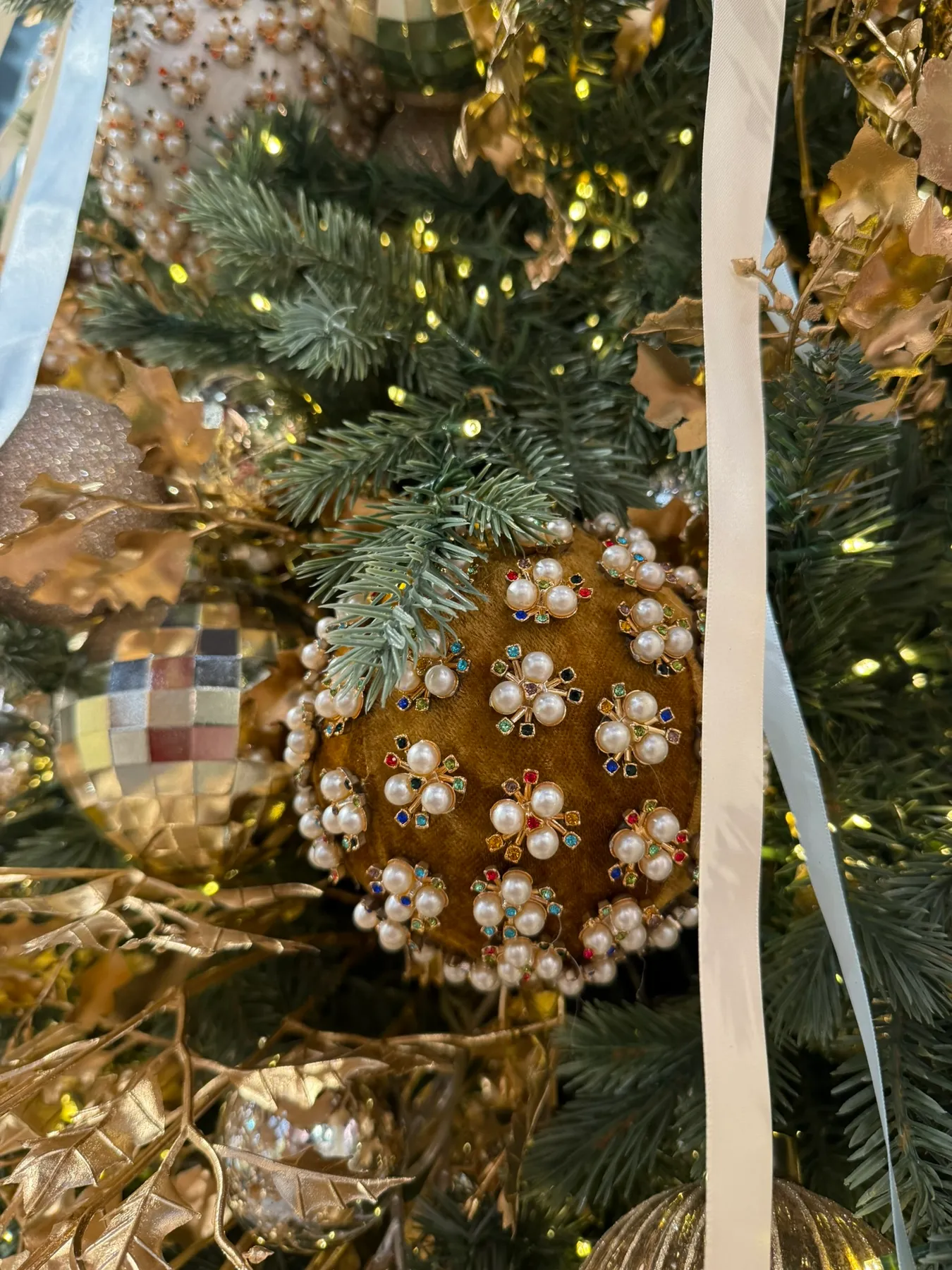
Roughly 70 percent classic gold and cream, 20 percent brown velvet, 10 percent disco. The brown velvet is the unexpected piece — it keeps the gold from feeling like a hotel lobby and gives those colorful gems something dark to sparkle against. Swap brown for emerald and you get a richer, more traditional version with exactly the same bones.
32. Red and Pink Stripes With Metallic Gold Braid
Two cuts of fabric — one deep red, one pale pink — plus a half yard of gold braid gets you this skirt for about $30. Cut alternating wedges, sew them into a circle, and run the braid along the hem by hand. It’s a two-hour project, and the imperfection at the seams reads as handmade rather than sloppy down at tree-base level.
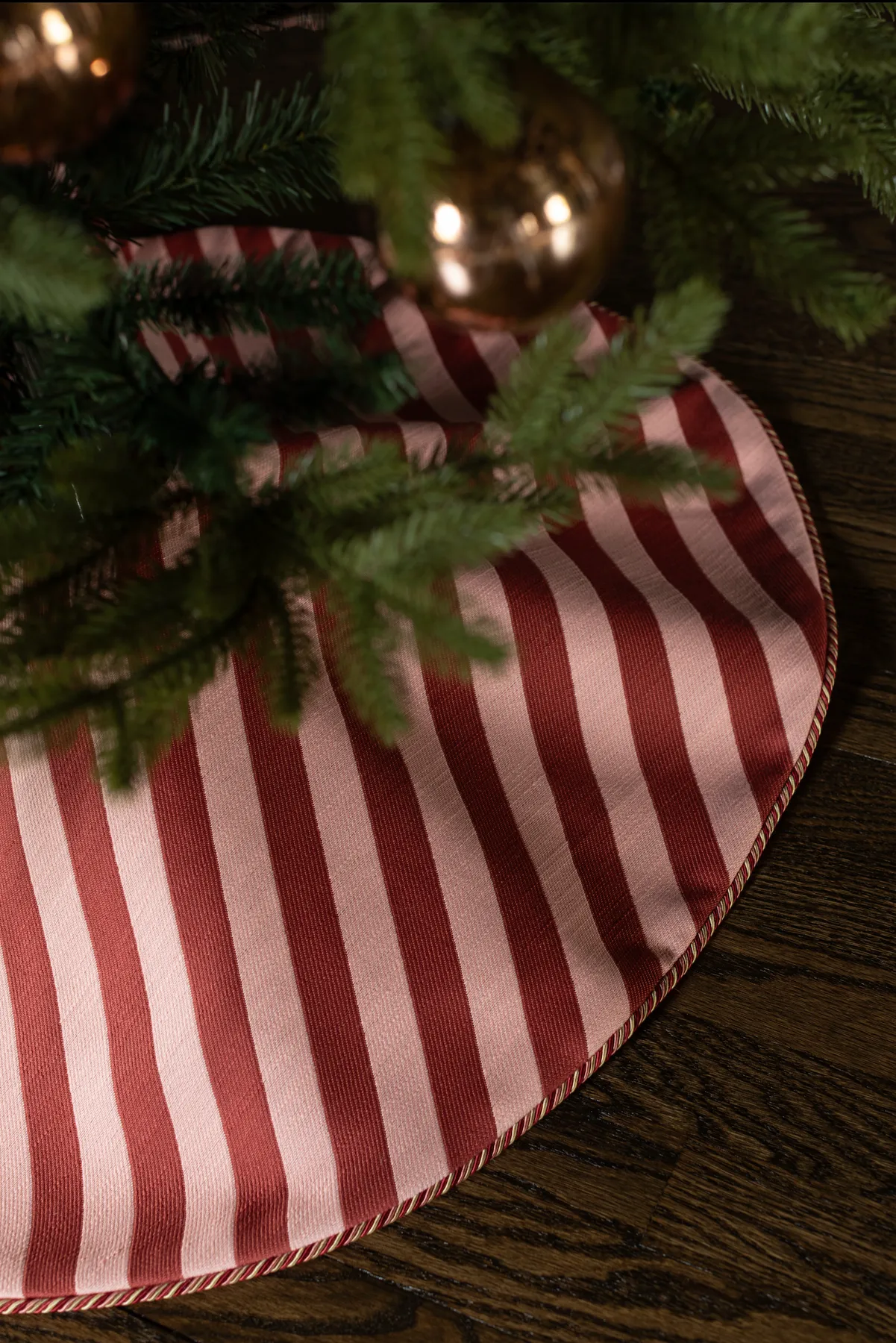
Striped circular skirts are unforgiving. If the wedges aren’t cut on the same grain, the stripes lean and the whole thing looks drunk. Cut both colors at once, stacked, with the same template — and buy 20 percent more fabric than you think you need. Or buy the finished skirt and spend your weekend on Idea #27 instead.
One Palette, One Tree, One Very Good December
Here’s the honest truth about every tree in this article: none of them are complicated. They’re a palette, a texture, and one deliberate decision — the grey ornaments, the matte black stand, the pinecones nobody expects. Pick your one thing, buy the base before the baubles, and stop scrolling when your gut says yes.
Now go save the two or three that made you stop — and tag us when yours is up. 📌 Pin this guide for later, because next December you’ll want it back.