
You know that feeling when you’re three rooms into a holiday home tour and the hallway — the part nobody’s supposed to notice — is the thing you can’t stop staring at? That’s the premise of this whole guide. Hallways are the most ignored square footage in the house, and the easiest place to make a real statement, precisely because nobody expects it.
We spent serious time browsing Target, IKEA, Amazon, Etsy, and HomeGoods to bring you only what’s worth your attention this year — 32 hallway Christmas ideas from $8 to $2,400. Traditional red-and-gold grandeur, cozy English-cottage greenery, whimsical frosted snowman scenes, and clean modern neutrals all get the full treatment, with budget and luxury versions compared side by side.
The 2026 shift is away from one hero tree toward layered, walk-through decorating — garland on every doorframe, mirrors framed in greenery, second trees tucked into foyers. It’s the year the hallway stopped being a pass-through.
And stay until the end — we break down the most common mistakes that can ruin these looks.
This post contains affiliate links, which means we may earn a small commission at no cost to you. 📌 Save this to Pinterest for later — you’ll want to revisit these ideas.
1. An All-White Foyer Where the Tree Becomes the Backdrop
In a room this pale, lighting temperature does more work than any ornament. Warm white bulbs at 2700K read as candlelight against cream walls and pale stone; the same tree lit at 4000K goes clinical blue and the whole foyer starts looking like a showroom. Put the tree on a dimmer and run it around 60% brightness while the chandelier is on — that’s the sweet spot where the glow reads warm instead of blown out.
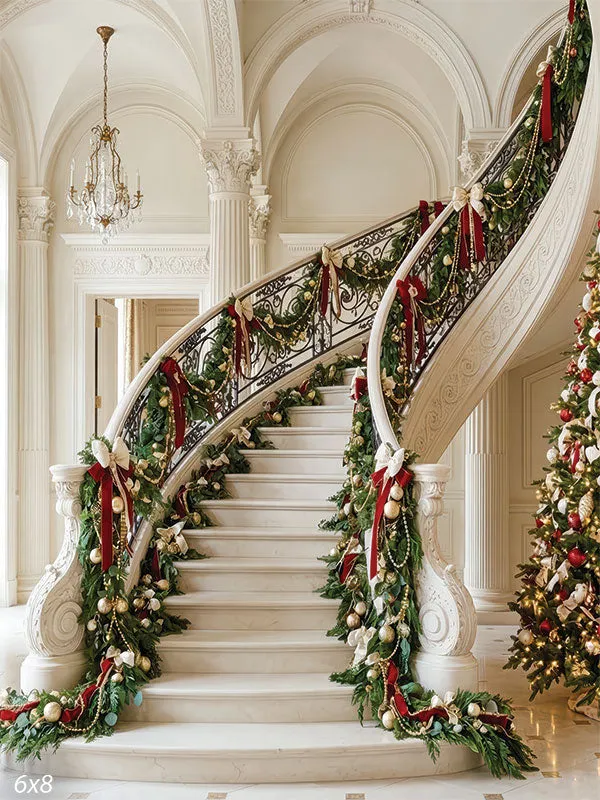
Two things keep this from feeling empty rather than elegant. The first is contrast: deep green is the only saturated color in a room of white, cream, and marble, so your eye goes straight to the tree and nowhere else. The second is vertical stacking. Curved staircase, chandelier, tree — three heights along one axis, nothing fighting for attention. Take the curve out and it flattens into a hotel lobby.
2. A Curving Staircase Dressed in Garland, Red Bows, and Mini Trees
- Banister garland, two 9-ft mixed-pine strands plus 200 warm white lights: $120–$260
- Wired velvet ribbon for 8–10 bows: $25–$60
- Ornaments in red, mint, and gold, 60-piece mix: $45–$110
- Deep red patterned stair runner, 26 in x 12 ft: $180–$650
- Six mini decorated trees, 18–24 in: $90–$240
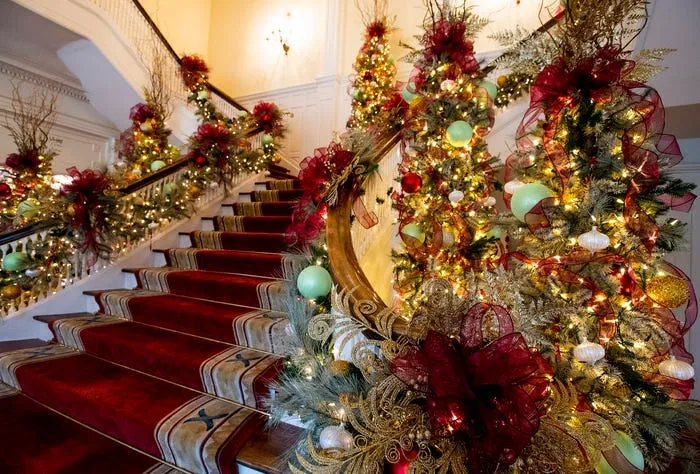
Total: $460–$1,320. Budget alternative: skip the runner, cut the mini trees to three, and buy garland by the case at Costco — roughly $210–$380 for the same overall impression.
The patterned velvet runner is the piece holding this whole staircase together. Without it you’d have a beautiful garland floating over bare treads with nothing to ground it, and your eye would keep sliding down to the floor. It’s also practical: a deep red runner hides the scuffs and footprints a light staircase collects all winter.
Scale matters. This treatment wants at least 14 feet of stair run and a two-story foyer with 18-foot ceilings or higher. Below that, the garland starts eating the space it’s supposed to decorate.
3. Garland Over the Doorway — No Nails, No Regrets
- Measure the doorframe width and add 12 inches of overhang on each side — garland that stops at the trim always looks like it ran out.
- Wipe the trim with rubbing alcohol and let it dry. This is the step people skip, and it’s why their hooks fail in week two.
- Press two 5-lb Command hooks into the trim, one near each corner, and let them cure a full hour.
- Run floral wire through the garland’s spine, then loop it over both hooks so the weight is distributed.
- Fluff every branch outward, then tuck in battery lights and one oversized ornament cluster near the low point.
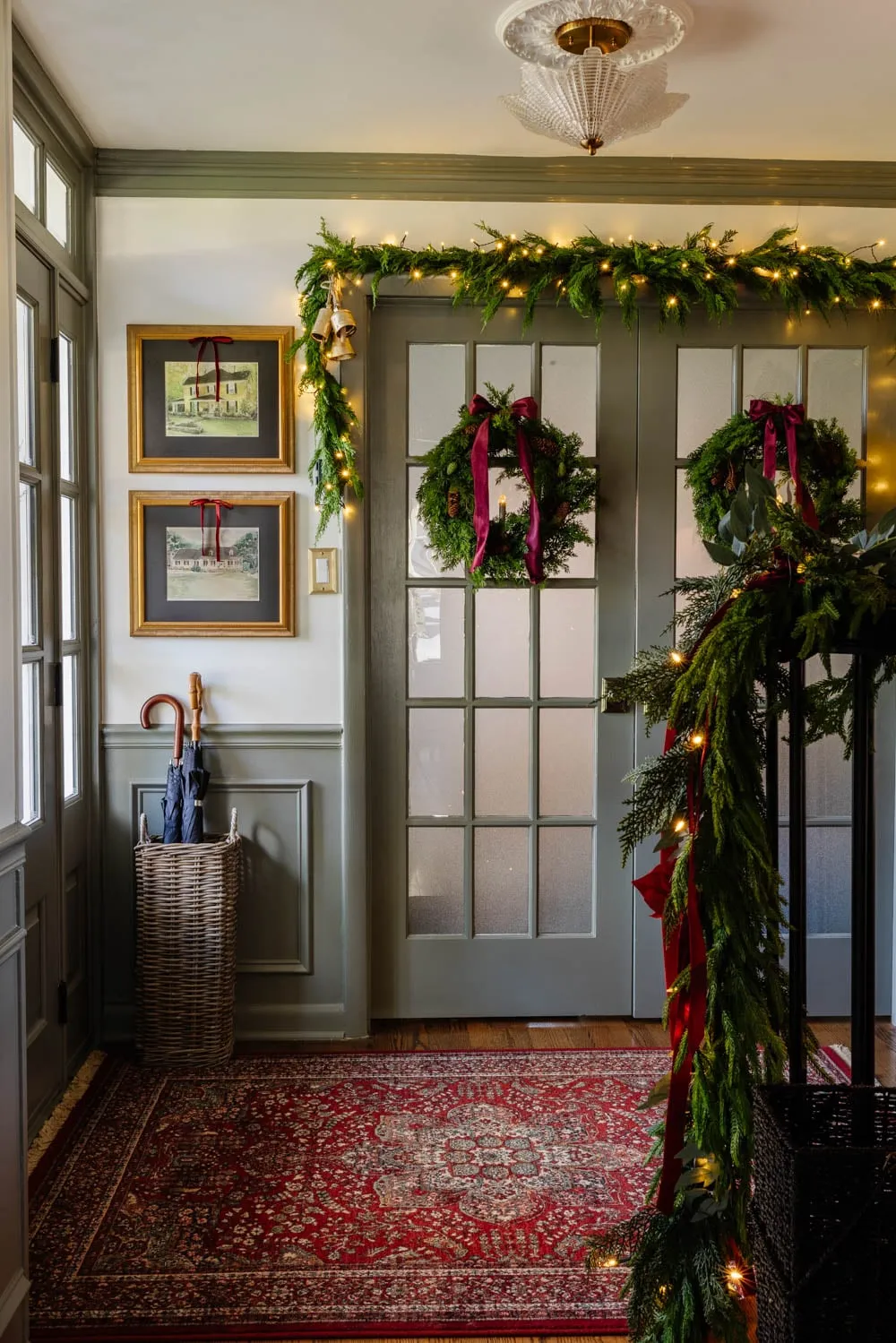
Budget about 35 minutes and $25–$50 in materials for a 6-foot doorway.
A 9-foot lighted garland can weigh 4 to 6 pounds, and all of that is hanging on two adhesive strips. If a door actually swings through that frame, keep at least 3 inches of clearance or you’ll re-hang it every December. And avoid hooks on trim painted less than a year ago — that paint will come down with the adhesive in June.
4. A Black Console, a Garland-Framed Mirror, and One Small Tree
Read this entry as percentages: 60% black metal and warm wood, 25% evergreen, 10% gold, and 5% red. That last 5% is doing all the personality work — the Santa figurine, the gift bags, the one red-and-white ribbon — while the gold stays on the mirror frame, the baubles, and the candleholders where it can catch light. Swap red for copper and you get the same structure with a calmer, more modern feel. Swap the black console for raw oak and the whole thing goes Scandinavian.
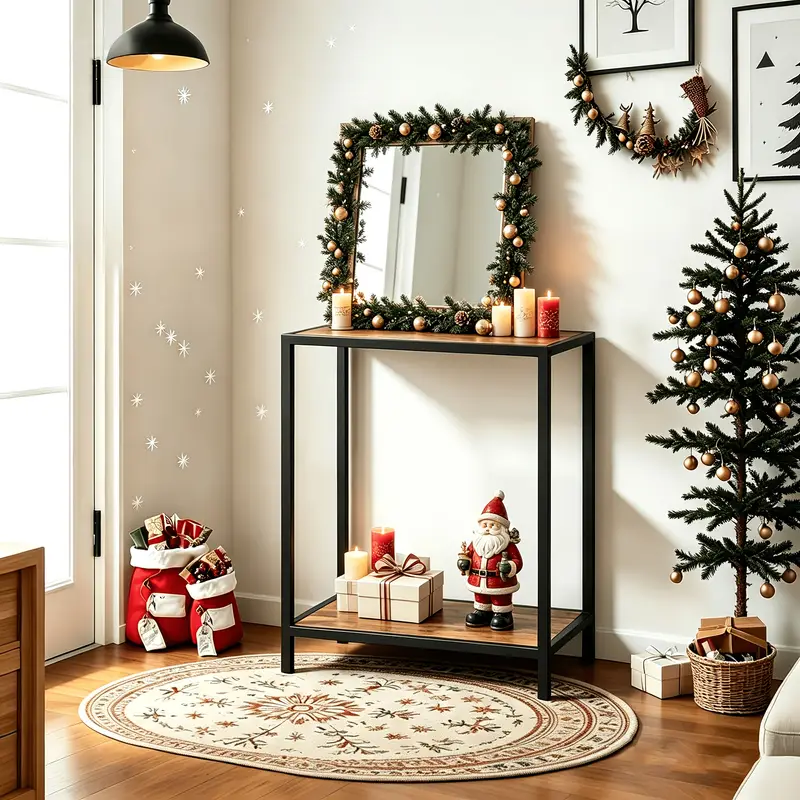
You don’t need much to rebuild it. A 30-inch black metal console runs $70–$120 at Target or Walmart, a plain square mirror is $30–$60, and two 6-foot faux garlands at $12 each from a dollar store will frame it just fine. The trick most people miss is matching garland to tree — buy the small tree first, then hunt for greenery in the same tone. Mismatched greens in one tight entry read as an accident, not a choice.
5. Museum-Level Foyer Styling You Can Scale Down
Symmetry is the fastest way to make a small foyer look considered. Pair your console with two identical objects and keep the outer edge of each within 3 inches of the console’s end. Then hang art or a mirror so its center sits 60 inches off the floor — not 57, not 63. In a room you walk through in four seconds, that 60-inch line is the difference between styled and slightly off.
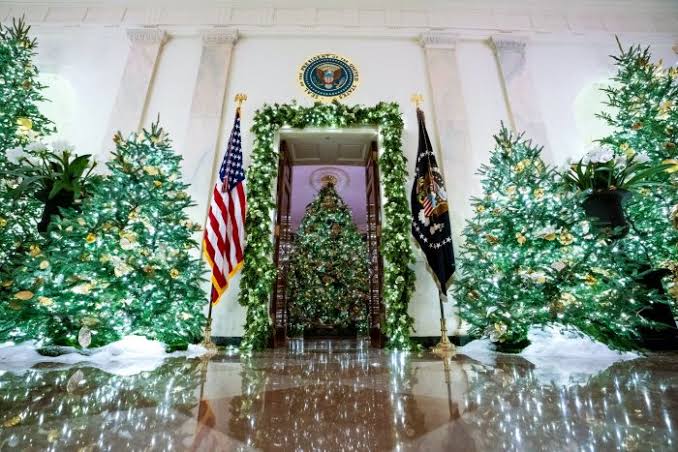
Before you commit to anything:
- Measure the clear walking path and confirm you’ll keep at least 36 inches of it open.
- Check which way the front door swings — decor on that side gets hit.
- Note where your overhead light actually lands at 6 p.m. in December. That’s your real lighting condition.
- Confirm at least one outlet is reachable without a cord crossing the walkway.
6. Red and Gold in a Marble Hallway, Anchored by a Gold Mirror
- 7.5-ft pre-lit tree with 600 warm white lights: $220–$600
- Red-and-white ornament set, 100 pieces: $60–$140
- Matching garland plus wreath in the same greenery: $110–$280
- Ornate gold mirror, 30 x 40 in: $150–$500
- Dark wood console with carved detail: $300–$900
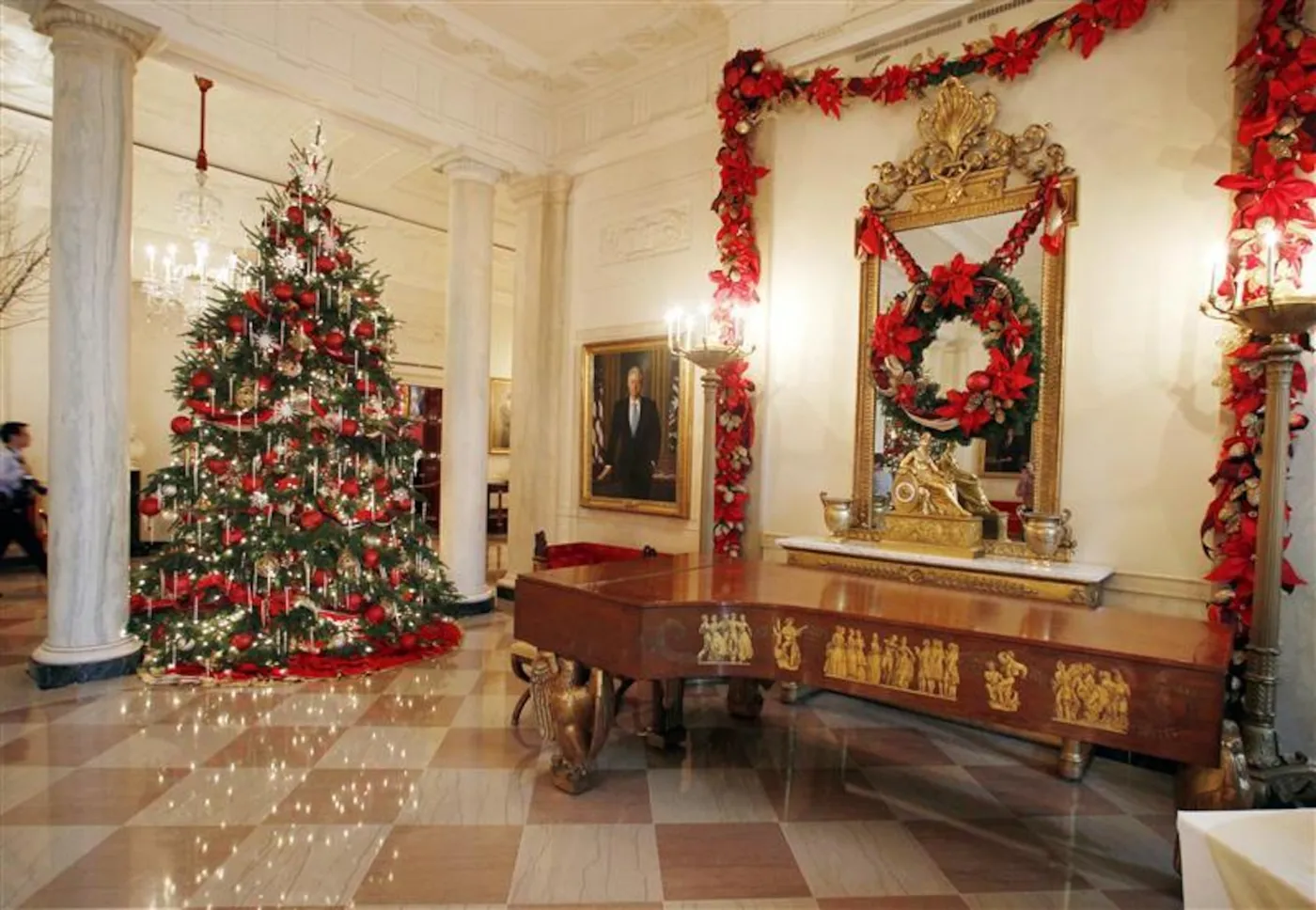
Total: $840–$2,420. Budget alternative: skip the carved console and keep the mirror plus the matching garland-and-wreath pair — around $340–$780 for about 80% of the look.
The matching garland and wreath on that dark console is the element you can’t cut. They rhyme — same greenery, same berries, same ribbon, one above the other — and that repetition is what reads as designed rather than decorated. Mismatched garland and wreath sharing one sightline is the most common shortcut in traditional hallways, and it’s visible from the front door.
7. Blue Butterflies on a Deep Red Wall — Yes, Really
Read this room as percentages and it stops being intimidating: 55% deep red walls and drapes, 25% evergreen, 12% gold, and just 8% bright blue. The red and gold set a period-correct stage; the butterflies are the plot twist. To copy the structure without the insects, swap that 8% for white ceramic birds, pale pink glass ornaments, or matte black bows — the formula holds as long as the accent stays small and repeats.

What makes this read as 2026 rather than 1994 is a shift in how people treat traditional red-and-green. Instead of abandoning the palette, decorators thread one unexpected color through it:
- Pick an accent that appears nowhere else in the room — no matching pillows, no coordinating rug.
- Cap it at roughly 10% of visible Christmas decor so it stays a wink, not a theme.
- Repeat it at three different heights so it looks intentional.
8. Portraits, Columns, and a Parade of Lit Trees
What makes this hallway work is axis, not ornament. Every tree lines up on the same centerline and the portrait hangs dead center above them, so your eye travels the hall in one smooth line instead of bouncing. Then there’s temperature contrast — warm 2700K tree lights against cool grey-and-white stone — which is what makes the glow feel like it’s coming from inside the trees rather than sitting on top of them.

This is a big-space move. You want a hallway at least 6 feet wide with 12-foot ceilings and room for three or more trees. Below 12 feet, tall pre-lit trees crowd the ceiling line and the procession becomes a traffic jam. For a roomy-but-not-grand hall, the two-tier console setup in Idea #31 handles tighter square footage far better.
9. A Warm Entryway Lit by Lanterns, Garland, and One Tall Tree
Nothing here is precious. Battery-operated wall lanterns with faux candles run $40–$70 for a pair, a 7-foot pre-lit tree with a star topper is $150–$280 at HomeGoods or Wayfair, and a 9-foot garland with pinecones and berries lands around $35 at Target after Thanksgiving. The stockings are the cheapest thing in the shot and the most personal — use the ones your family already owns instead of buying a matched set.
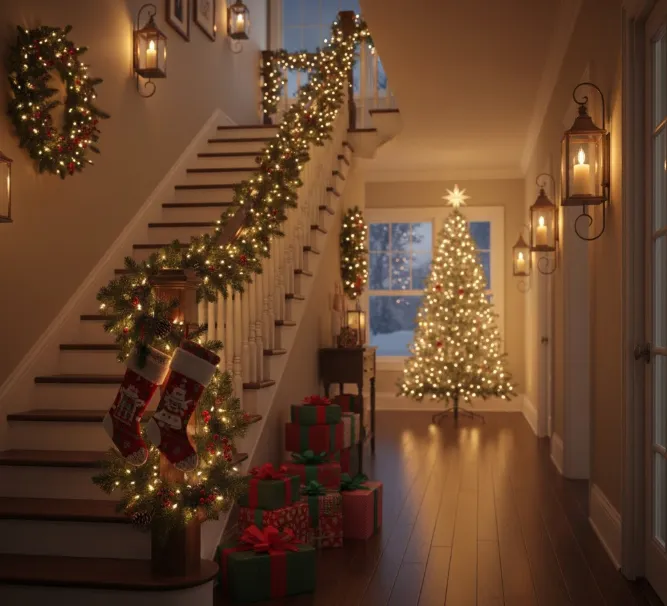
Two realities of this setup. Battery lanterns on a 6-hour timer need fresh AAs roughly every five weeks, so buy a 48-pack in November and park it in the entry closet. And garland wrapped with berries near a door people actually use will shed berries — check the strand after a week, re-secure anything loose with floral wire, and accept that a few casualties by New Year’s are normal.
10. The Garland Test: What Actually Survives a Busy Hallway
- Lay the garland flat on the floor and separate every branch by hand. Ten minutes, and it doubles the apparent volume.
- Zip-tie two identical strands together, offsetting them by a few inches so the tips interlock instead of stacking.
- Wind lights in a loose spiral at roughly 6-inch intervals — tight coils read cheap.
- Add three or four oversized picks at irregular intervals: pinecones, magnolia leaves, berry clusters.
- Tuck the ends into a basket or urn instead of letting them dangle.
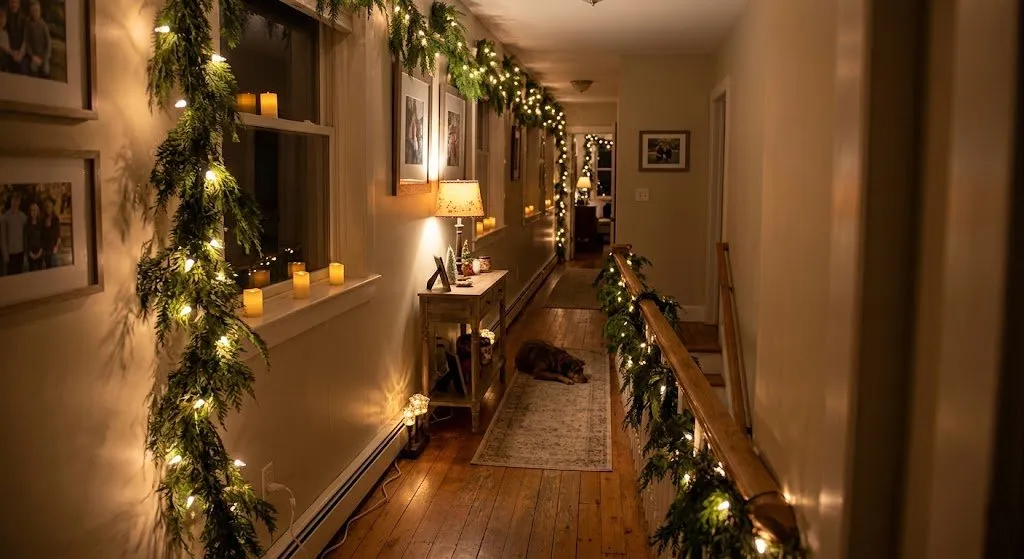
Here’s the ratio the pros use: one real-touch garland for every two cheap ones. The real-touch strand supplies the believable structure while the cheap ones fill volume, which gets you a $250-looking garland for about $70. Buy the real-touch strand first so you can match the green.
11. Narrow Hall, Big Cheer: Working With 36 Inches
In a hallway 36 to 42 inches wide, you have room for decor that projects no more than 6 inches off each wall, leaving a comfortable 32-inch walking path. A standard 12-inch-deep console in a 36-inch hall leaves you 24 inches — passable, but only if nothing sits on the opposite side. Stick to slim consoles 10 to 12 inches deep, wall sconces instead of table lamps, and wreaths instead of floor trees.
The unglamorous part: a hallway is an egress path, and it has to stay one. Nothing belongs in the walkway — no basket of gifts, no extension cord, no tree skirt creeping past the console legs. If you have kids, pets, or anyone using a cane or walker, that 32-inch standard goes up to 36. Wide wreaths and wall-hung ornament clusters deliver all the festive payoff with none of the floor footprint.
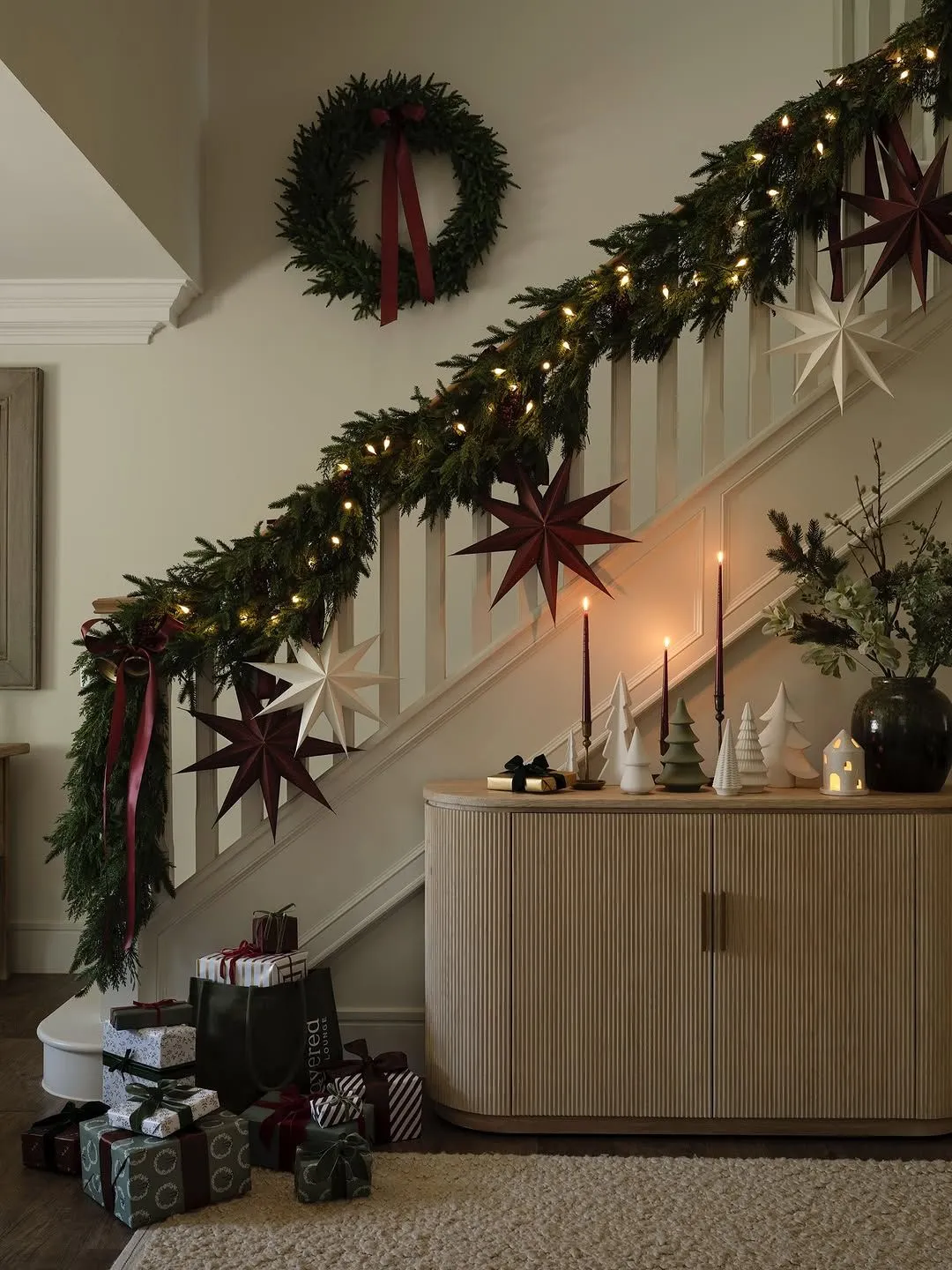
12. Paper Stars and Velvet Ribbon on a White Staircase
- Two 9-ft green garlands with warm white lights: $80–$180
- Red velvet ribbon, 2 in wide, 20 yards: $18–$35
- Large paper star ornaments, set of 6: $25–$55
- Fluted light wood console table: $180–$400
- White and green ceramic tree figurines, set of 2–3: $40–$110
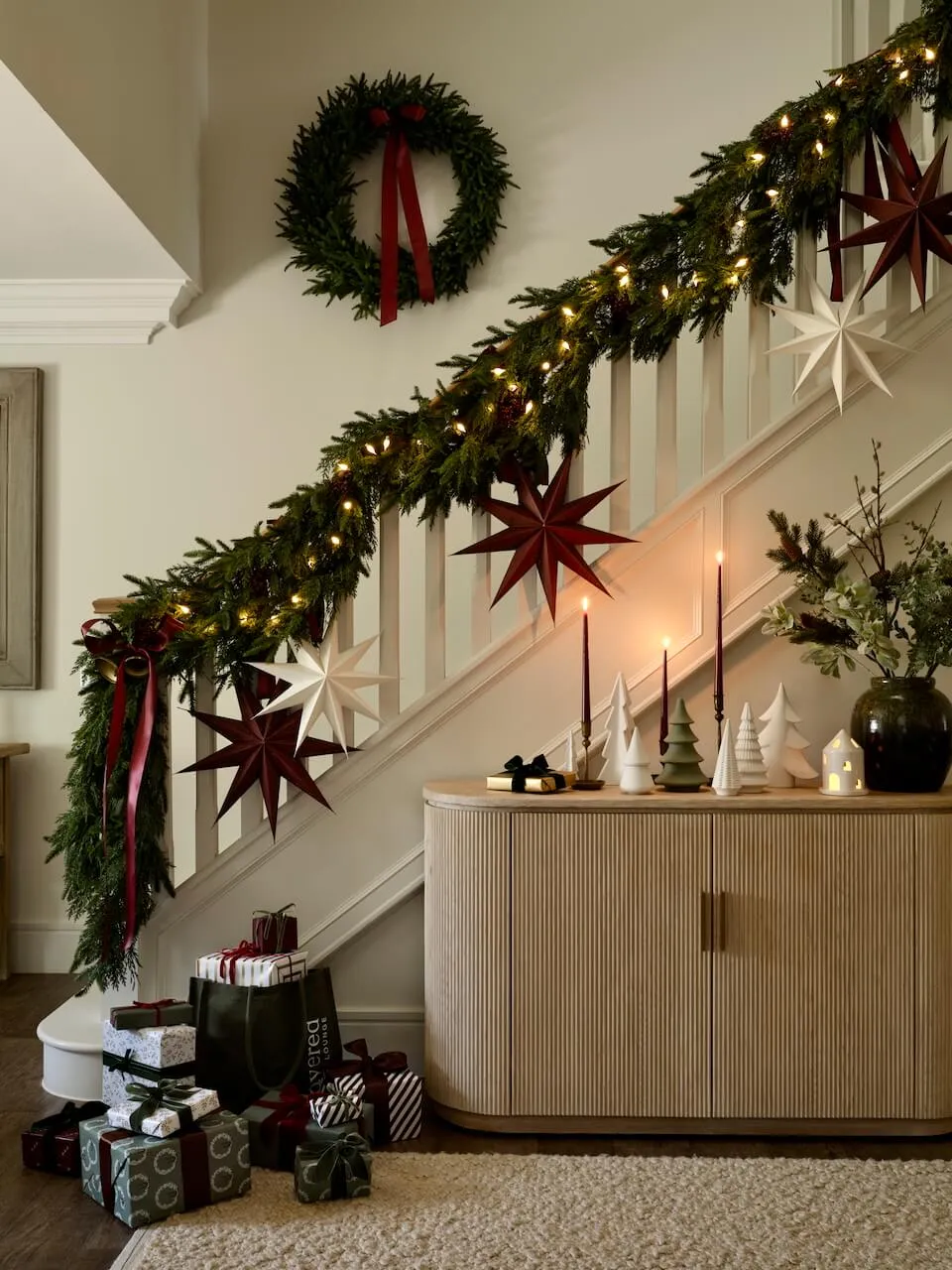
Total: $343–$780. Budget alternative: thrift the console and fold the stars yourself from flat paper — roughly $140–$300.
The oversized paper stars are what lift this out of standard-issue Christmas. They’re a deliberate scale jump — everything else on that garland is small and round, and these are big and graphic, which stops your eye mid-sweep. The layering does the rest: lit garland above, stars at mid-height, ceramic trees on the console below. Three tiers, three materials, one red-green-cream story.
13. Frosted Greenery and Gold on a Greige Staircase
Know how much frost is enough. Flocked garland reads as fully white from 3 feet away and almost unflocked from 10 feet — and in a staircase hallway you’re nearly always viewing from 10 feet or more. If you want a visible frosted effect, choose a frosting level labeled medium-to-heavy, or add a light dusting of spray snow yourself after hanging. Then match the ornament finish: frosted greens want matte and brushed gold, not mirror-polished orbs.
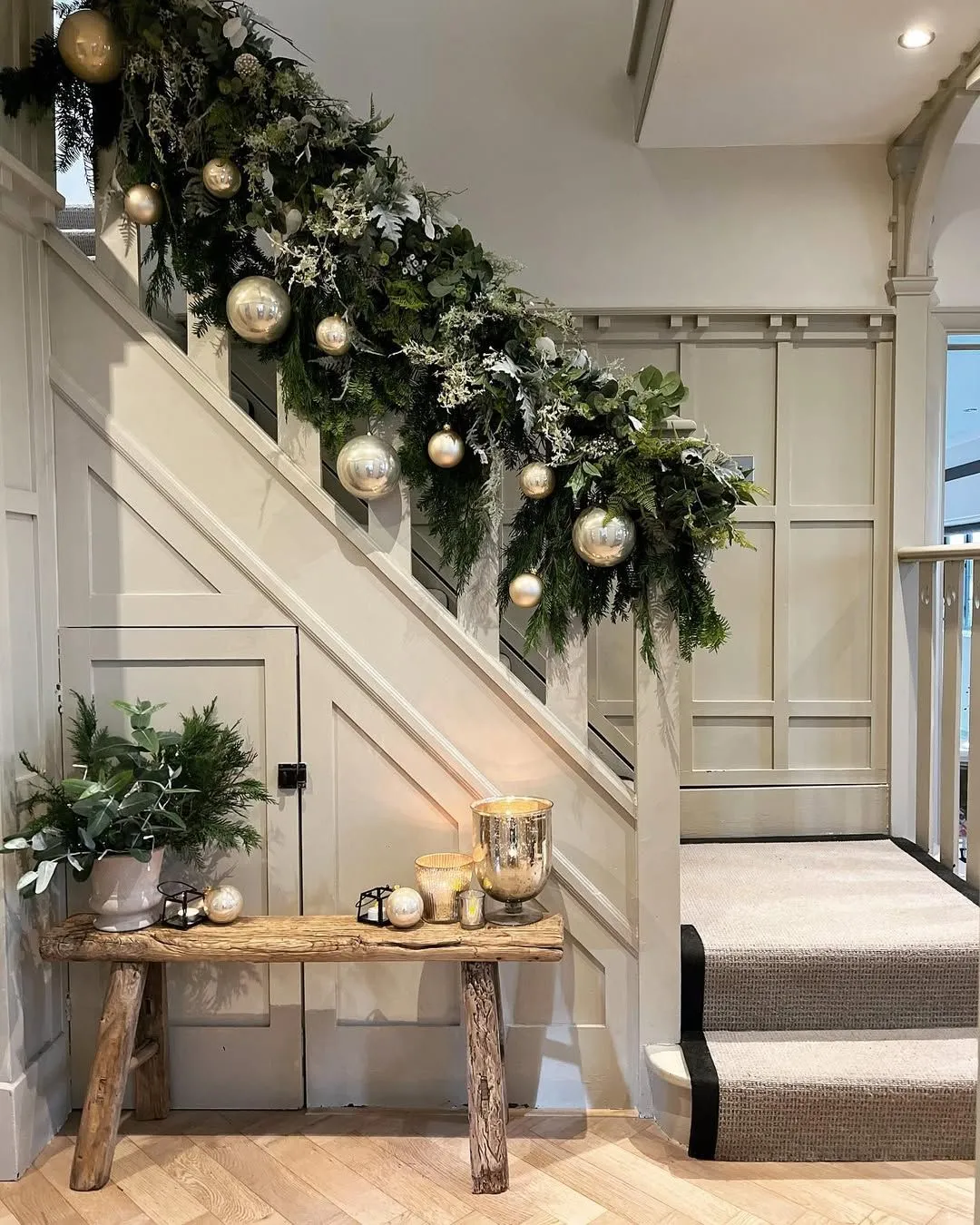
Frosted garland sheds. Expect a light dusting of white flakes on the treads for the first week, and again every time you fluff it — which means a lint-roller or handheld vac pass most mornings in December. The candles on the bench below are lovely but need real attention, so if you won’t be in the room, switch to flameless LED pillars. Budget about $15 a season for batteries and $20 to replace garland every three or four years.
14. Plaid Ribbon and Blue Wallpaper in a Small Entry
The palette math runs roughly 50% light blue, 30% white, 12% evergreen, and 8% brass and red combined. Blue comes from the textured wallpaper and the patterned vase; white from wainscoting and the console; brass from the pendant, hardware, and mirror frame. That 8% is where the holiday lives — red berries, a red-and-navy plaid ribbon, one red toile detail. Switch blue for sage and plaid for ticking stripe and the same formula becomes a coastal Christmas without changing a single placement.
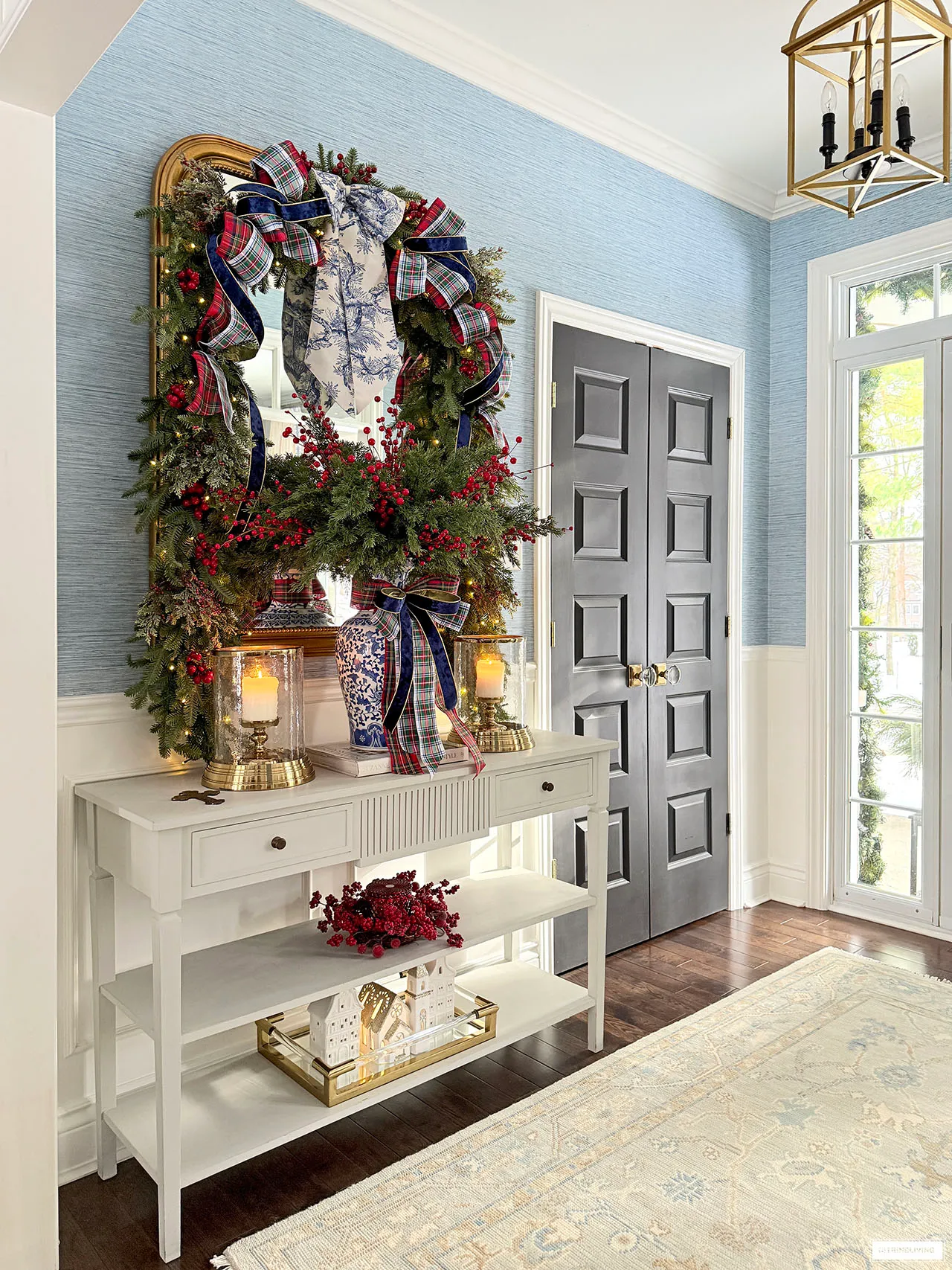
Textured wallpaper is where budgets go to die, so price peel-and-stick grasscloth-look panels at $30–$55 a roll instead of installed paper. The console is a $90–$160 Target find, a gold mirror can come from a thrift store for $20–$40 with a coat of Rub ‘n Buff, and the brass pendant is $60–$120 at Wayfair. Mixing three ribbon patterns on one garland costs under $25 and is the fastest way to make a builder-grade entry feel collected.
15. An Arched Mirror Framed by Two Mini Trees
- Center the console on the wall and hang the arched mirror so its widest point sits at eye level, about 58–62 inches off the floor.
- Set two mini trees on the floor, tight against the console legs, one per side — no taller than 24 inches so they don’t block the mirror’s curve.
- Drape garland over the top corners of the frame and let it fall about 18 inches down each side. Go slightly asymmetric for a less formal feel.
- Add berries and pinecones only where the garland meets the frame, not evenly spaced.
- Finish with one gold lamp on a single end of the console and a wreath on the adjacent wall to carry the eye around the corner.
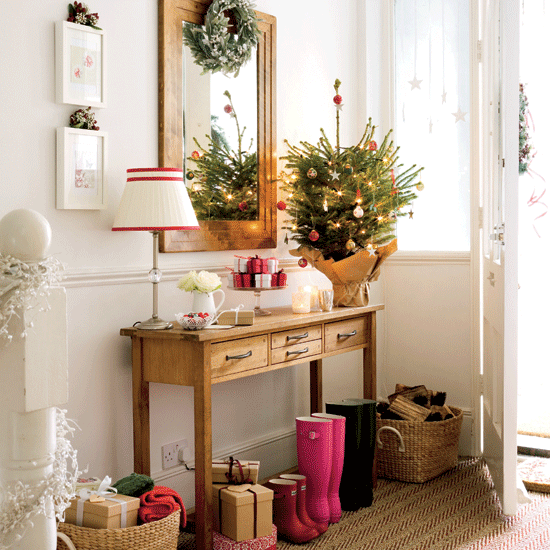
Time: about 45 minutes. Materials: $60–$140 if you already own the mirror.
The arch is doing quiet work — its curve echoes the way the garland drapes, so the two shapes read as one composition rather than a mirror with decoration attached. Compare with Idea #4: same mirror-and-garland idea, but a square frame reads crisper and more modern while the arch reads softer and traditional.
16. A Rustic Console With a Lit Wreath and a Real Poinsettia
This look is genuinely cheap to build. A weathered wood console from Facebook Marketplace runs $40–$90, an illuminated wreath is $25–$45 at Walmart, the oversized lantern with a candle is $18–$35 at HomeGoods, and a potted poinsettia is $8–$15 at any grocery store in December. Add a $10 berry garland from a dollar store, tuck it around the lantern base, and the whole vignette lands under $150. The woven baskets are the smartest piece in the shot — they hide whatever you actually need to store in your hallway.
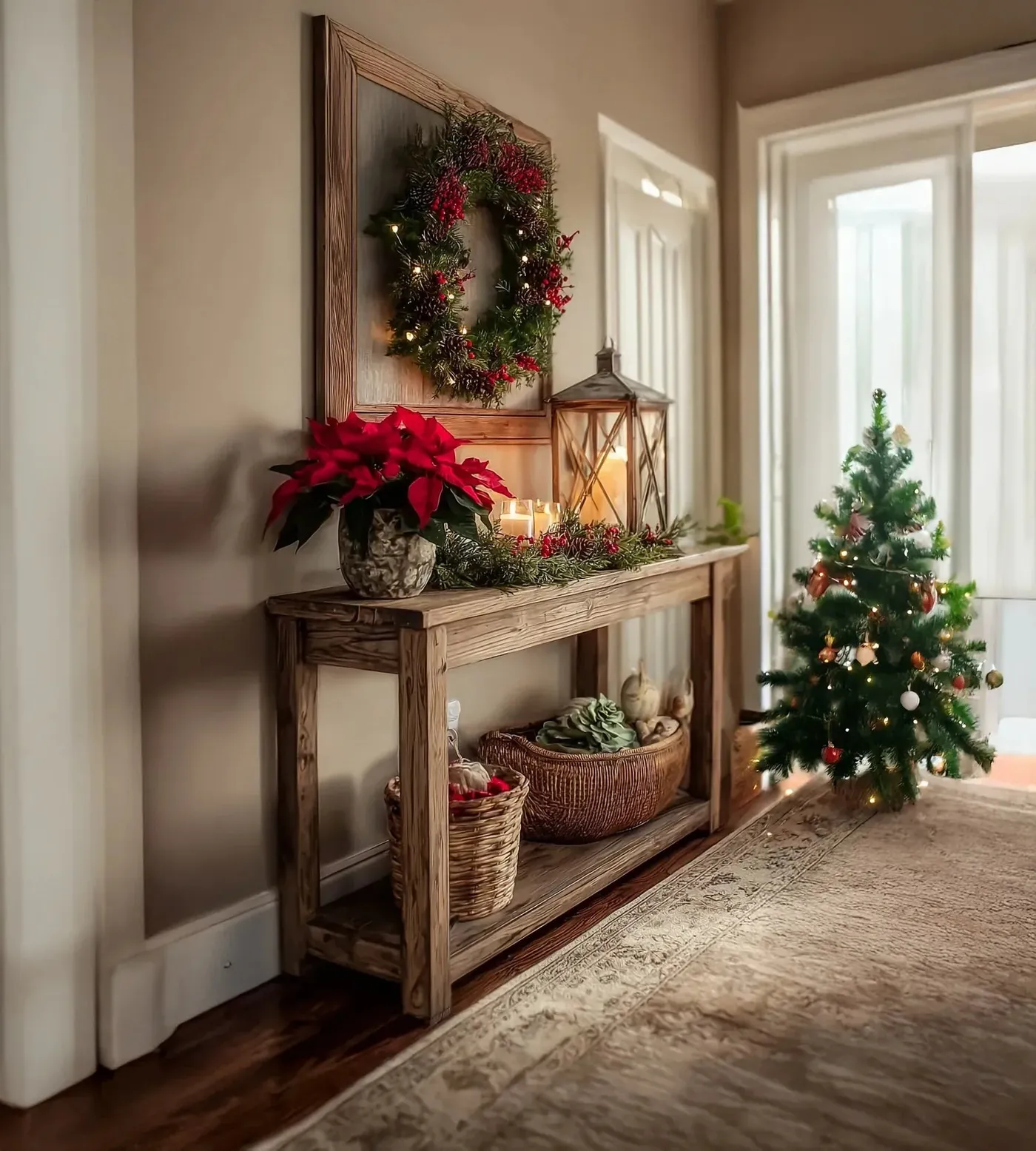
A real poinsettia is also a real commitment. They drop leaves when stressed by drafts, they want bright indirect light, and they’re toxic to cats and dogs — mildly, but enough that a chewer shouldn’t have access. If your hallway is dark or you have a curious pet, swap it for a red-berried faux arrangement or a red amaryllis in a heavy pot that won’t tip.
17. Garlands on Every Doorframe of a Dark-Wood Hall
This is the English-country-cottage look that’s been quietly climbing on Pinterest for three seasons, and 2026 is the year it went mainstream: dark wood paneling, layered greens, garland on every single opening rather than one hero moment. It’s a reaction to years of minimal, monochrome holiday styling — people with older homes got tired of fighting their architecture and started leaning into it instead. The upside is staying power, because paneling and greenery don’t date the way a themed tree does.
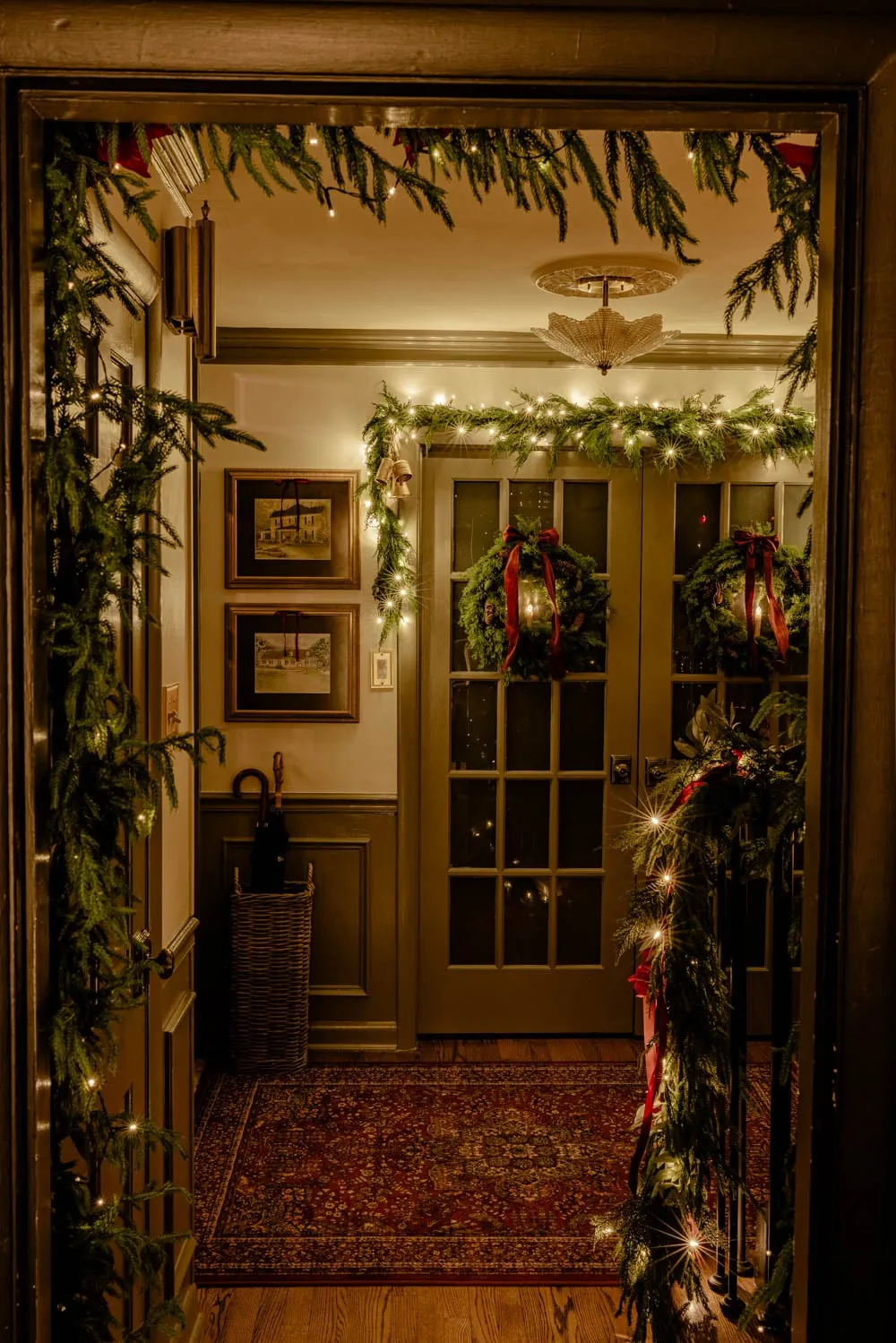
- Four 9-ft garlands in mixed evergreen: $140–$320
- Two large wreaths, 24–30 in: $70–$160
- Red velvet ribbon, 40 yards: $30–$60
- Washable red patterned runner, 2.5 x 8 ft: $60–$180
- Framed vintage artwork or print: $40–$150
Total: $340–$870. Trim roughly $120 by using three garlands and leaving the stair railing bare.
18. A Whimsical Snowman Staircase in Mint and Frosted White
This is a two-story-foyer treatment, full stop. You need a staircase at least 42 inches wide — narrower and a plush armchair at the landing blocks the rail — plus enough ceiling height that flocked trees don’t scrape the second-floor trim. If your stairs are 36 inches, keep the flocked trees, lose the chair, and move the snowmen from the landing down onto the treads.
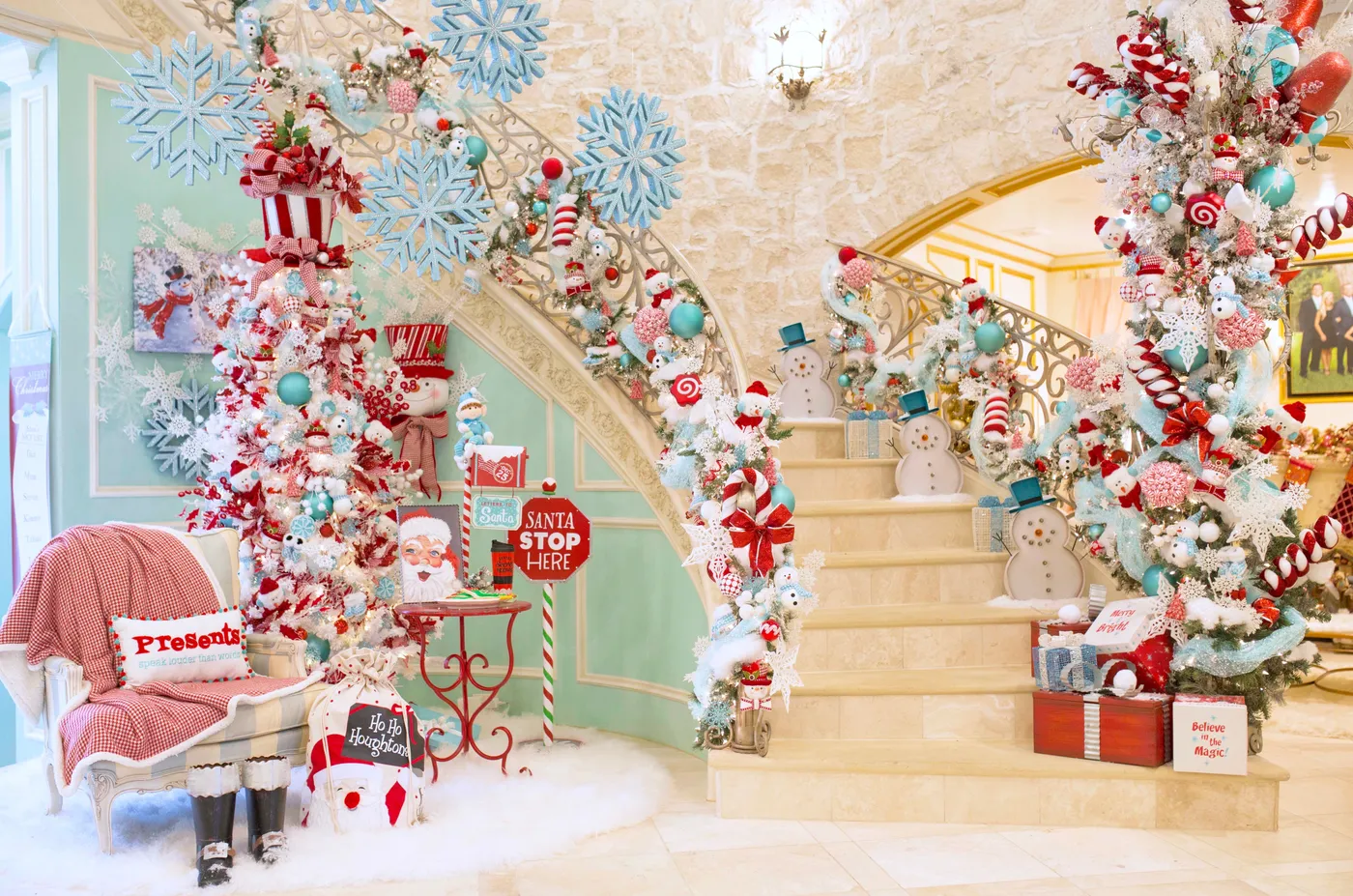
Hanging the big glittery snowflakes is where most people go wrong. Use clear fishing line, not ribbon, and stagger them at roughly 18, 30, and 42 inches off the floor so they form a diagonal instead of a straight line. Your base-layer shopping list:
- Two or three flocked trees in graduated heights (4 ft, 5 ft, 6 ft).
- Clear hanging line plus small ceiling hooks rated for 2 lbs.
- One repeated motif — snowmen, candy canes, or snowflakes. Pick just one.
19. A Nutcracker Wall Built From Baubles and Bows
The ornament mosaic wall is the entire idea. Take it away and you have a perfectly nice hallway with trees, ribbons, and nutcracker statues — pleasant, forgettable, the kind of thing you’d walk past. With it, the wall becomes the main event and everything else is supporting cast. It’s also the cheapest big-impact piece in the room: a foam board, a glue gun, and 150–250 shatterproof ornaments in red, green, and gold, which is about $80–$150 if you buy bulk after Thanksgiving.

Upkeep is the trade-off. A wall of baubles is a wall of dust, and the flat tops of ornaments catch everything — budget a 15-minute microfiber pass every two weeks in December. Glued ornaments do pop off in a warm hallway, so keep the glue gun handy and press them back while the glue is still warm. Store the finished panel wrapped in a sheet rather than dismantling it, and next year is a 10-minute job.
20. A Leaning Gold Mirror, Bells, and a Wicker Gift Basket
- Dark wood console table, 48 in: $180–$450
- Large ornate gold mirror, 36 x 48 in: $180–$600
- Two 6-ft garlands with berries plus a set of gold bells: $60–$140
- Wicker basket and kraft-paper gifts: $30–$70
- Fluted white ceramic table lamp: $45–$110
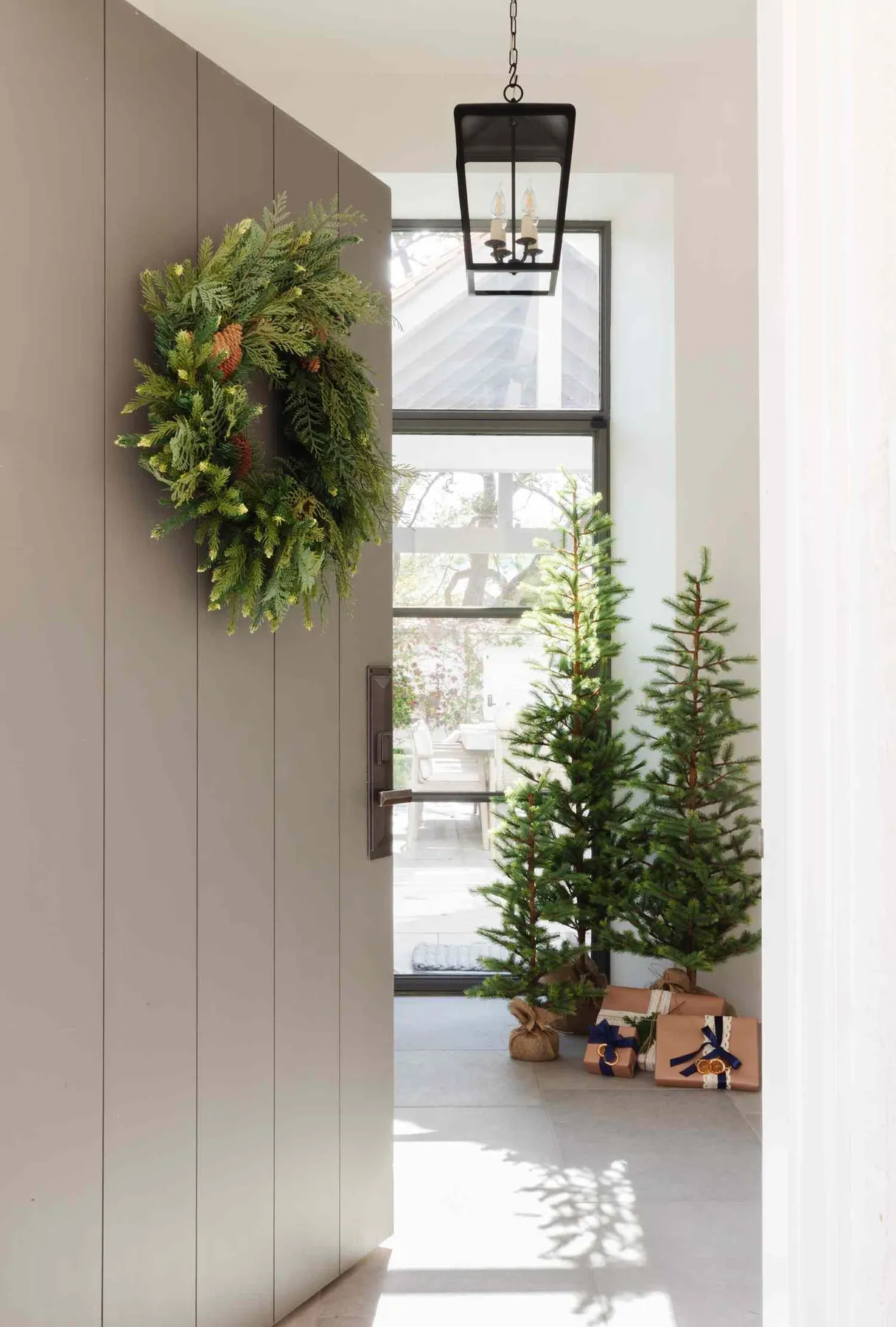
Total: $495–$1,370. Budget alternative: a $60 Wayfair mirror plus a $12 tube of gold Rub ‘n Buff, a $99 IKEA console, and thrifted bells — about $220–$380.
Before you lean a mirror instead of hanging it, check three things:
- The console’s back edge is flat and flush against the wall.
- The mirror sits at no more than a 10–12 degree angle — steeper is a tip risk in a brushed-past hallway.
- No floor vent or register sits behind it, pushing warm air up the glass.
Also confirm the bells aren’t hanging where a coat sleeve will snag them. If you have kids or a dog with an enthusiastic tail, hang the mirror and keep everything else.
21. Kraft Paper Gifts and Gold Baubles Under the Banister
The formula is 60% light neutral, 25% evergreen, and 15% metallics and red combined. That heavy neutral base is what keeps a hallway from feeling like a store display, and it’s why kraft paper works so well here. A roll of brown kraft paper is $6–$9, a spool of red satin ribbon is $4, and that combination wraps 20 gifts for under $20. Mix the wrapped boxes with a couple of plain gold-ornament clusters and the grouping reads expensive.
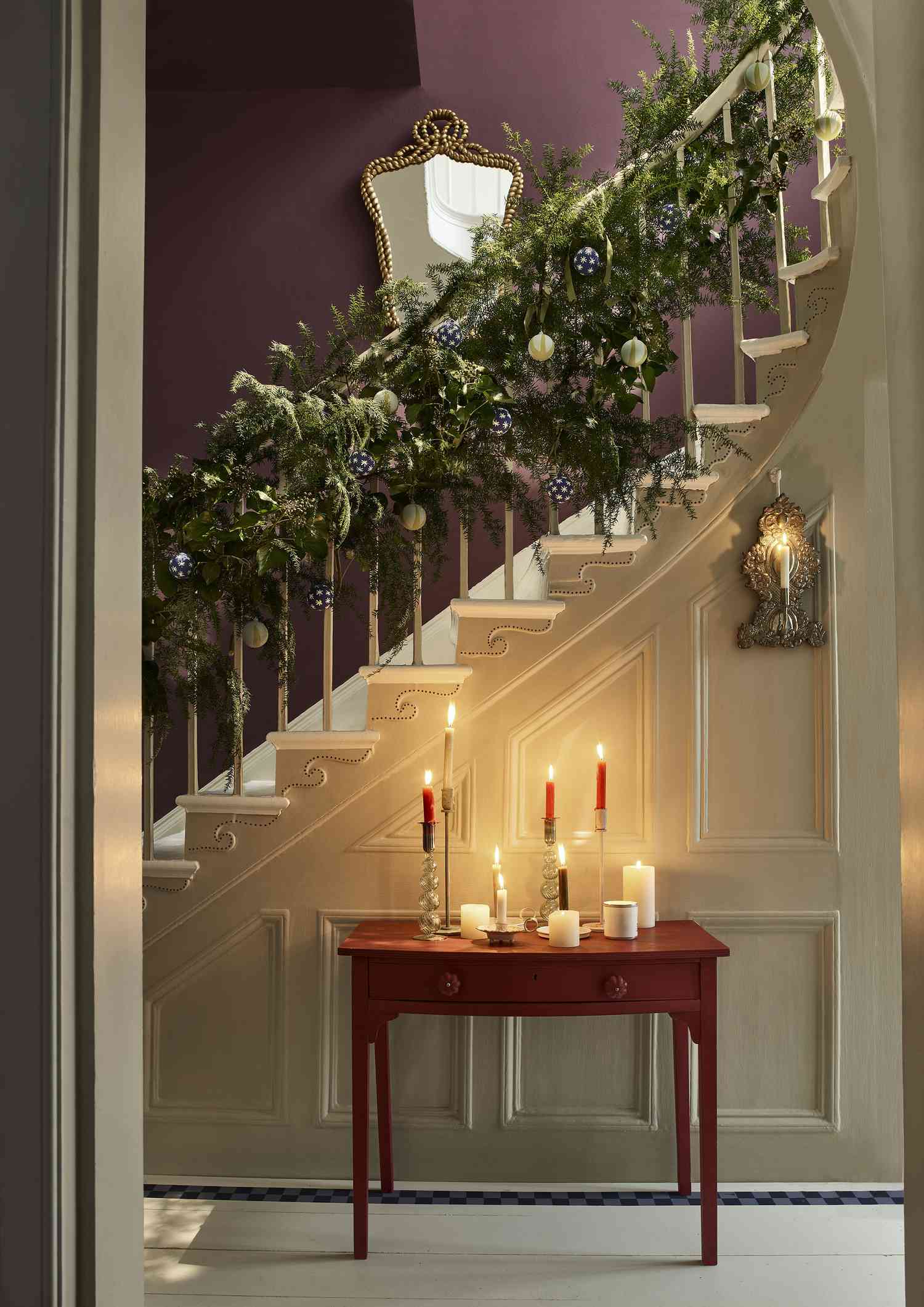
Metallic gold is the connector. It shows up on the baubles, the mirror frame, and the ribbon, tying the banister to the floor. Swap gold for matte black and the same layout goes moody and modern; swap it for pewter and it reads farmhouse. Compare with Idea #13 — same greige backdrop, but that one leans on frosted greenery and candles while this one leans on shine.
22. A Lit Tree Between Stone Walls and Glass Display Cases
Rough stone is cold, literally and visually. That’s exactly why one warm-lit tree in the middle of a stone corridor reads dramatic instead of austere — you’re watching two color temperatures argue, and the warm one wins. The glass cases reinforce it, because the tree’s reflection doubles the light without doubling the clutter. If your hallway is any kind of hard surface — stone, tile, brick — one well-lit tree will outperform five small decorations every time.
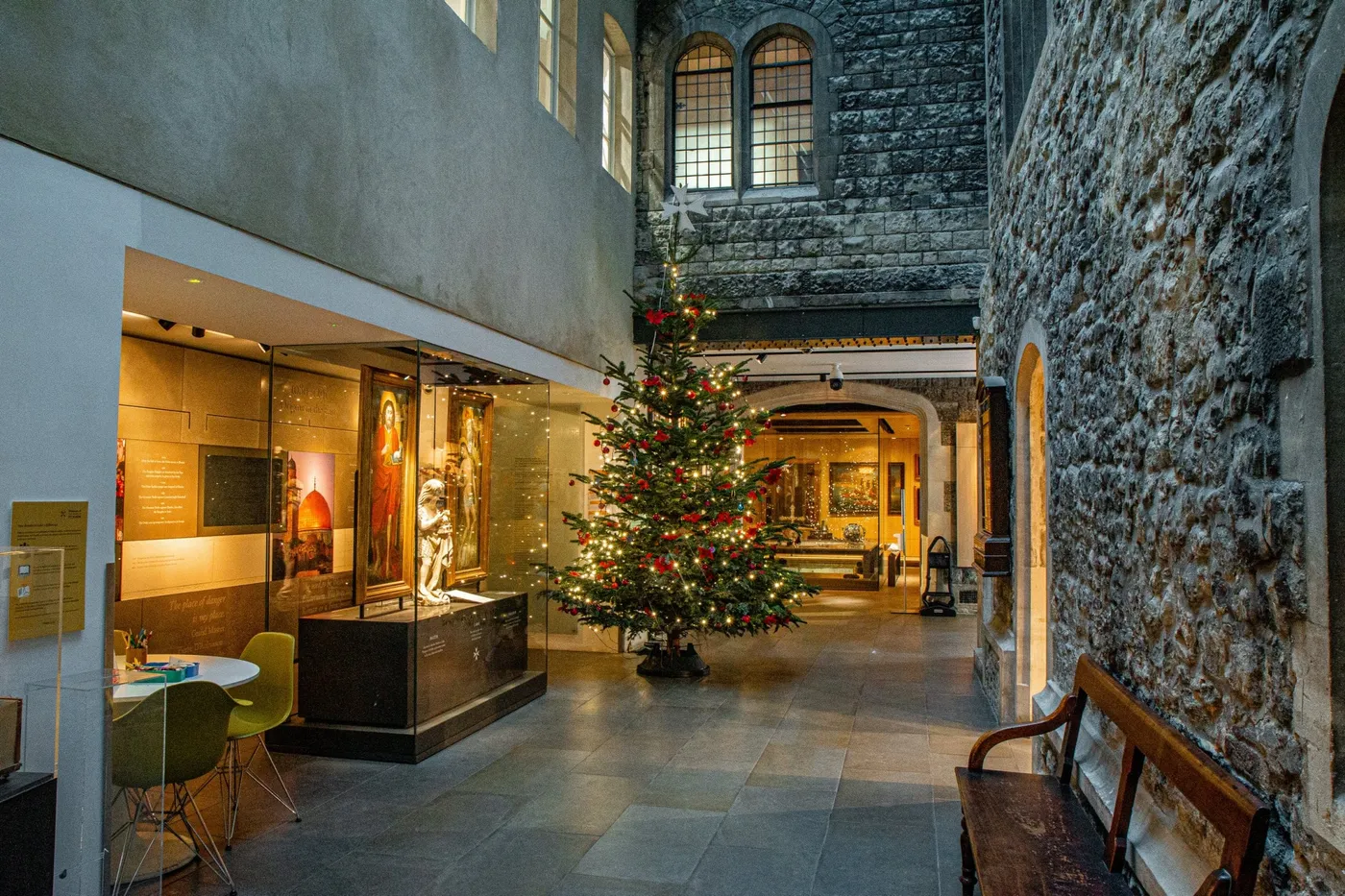
You need width for this. Roughly 8 feet of hallway and ceilings of at least 9 feet, with the tree kept about 4 feet from any wall so you can walk a full circle around it. A standard 3-foot-wide hall can’t take a centered tree at all — in those, keep the tree small and against one wall and let a lit garland carry the drama instead.
23. A Golden Eagle Topper Above a Blue-and-Red Garland
Depth is what separates a mantel garland from a mantel swag. You want three layers: a base of 12-inch-deep greenery wired to the mantel, a middle layer of magnolia or cedar for texture variation, and a front layer of baubles, cream flowers, and ribbon set slightly forward so it catches light. Anything under 10 inches deep on a fireplace this size will look pinned flat to the wall.
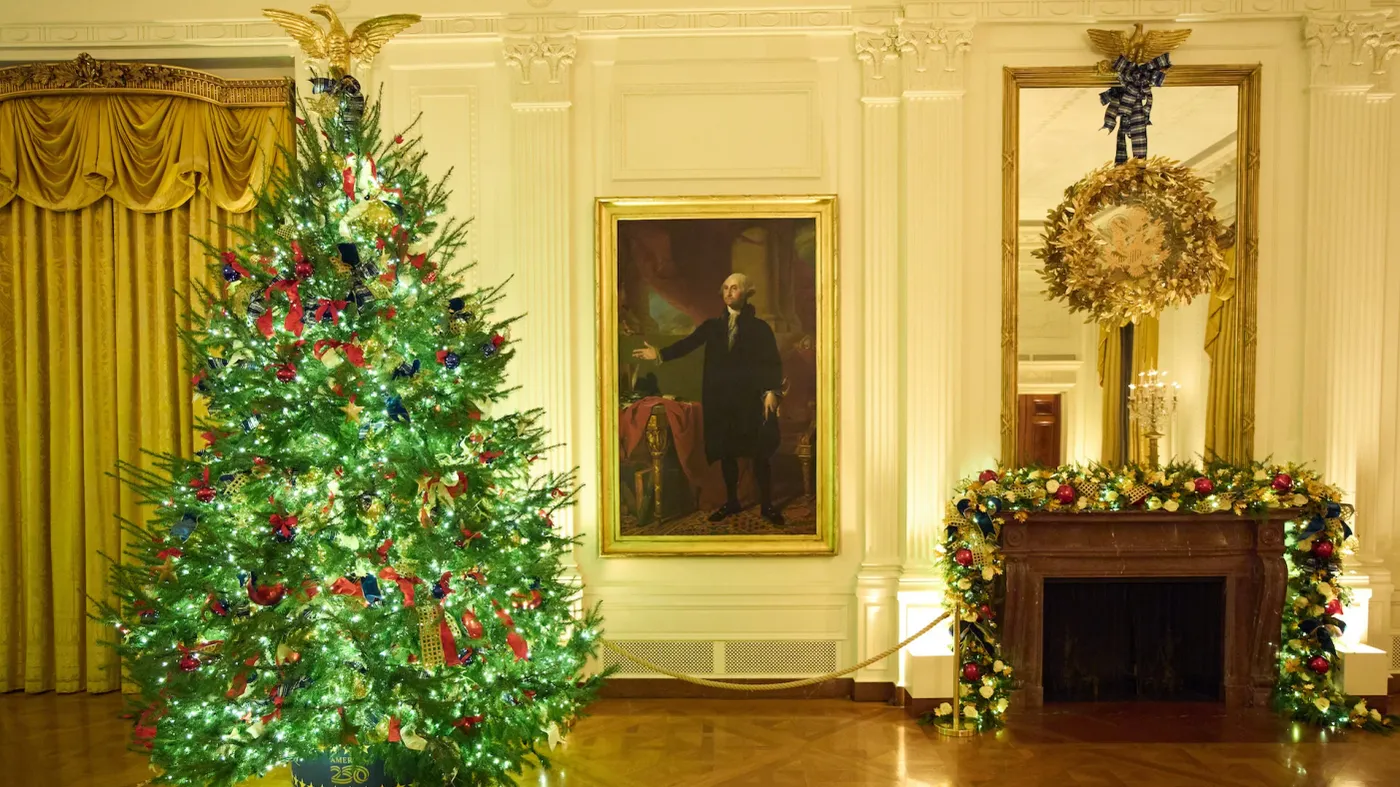
Red and blue together is having a real moment, and it’s a smart one — it keeps the traditional red-and-green vocabulary without the cliché, and it photographs beautifully against gold. It has legs because it’s rooted in historic decorating rather than a fast social-media idea, so it will still look right in five years.
- Lit tree, 7.5 ft: $220–$600
- Deep mantel garland plus greenery picks: $120–$280
- Blue and red ribbons, 30 yards combined: $25–$55
- Gold ornaments and cream floral picks: $70–$160
Total: $435–$1,095. Three small gold wreaths instead of one large one saves about $80.
24. White Lighted Branches Around a Bronze Statue
Those tall white lighted branches are the entire mood of the space. Everything else in this hallway — the gold molding, the mosaic floor, the crystal chandelier — is warm and dark, and the branches cut straight through it with bright white light. Remove them and you’d have a handsome but heavy corridor. Keeping them is what turns a formal hallway into something that seems to glow from within, and they add height without adding bulk the way real greenery does.
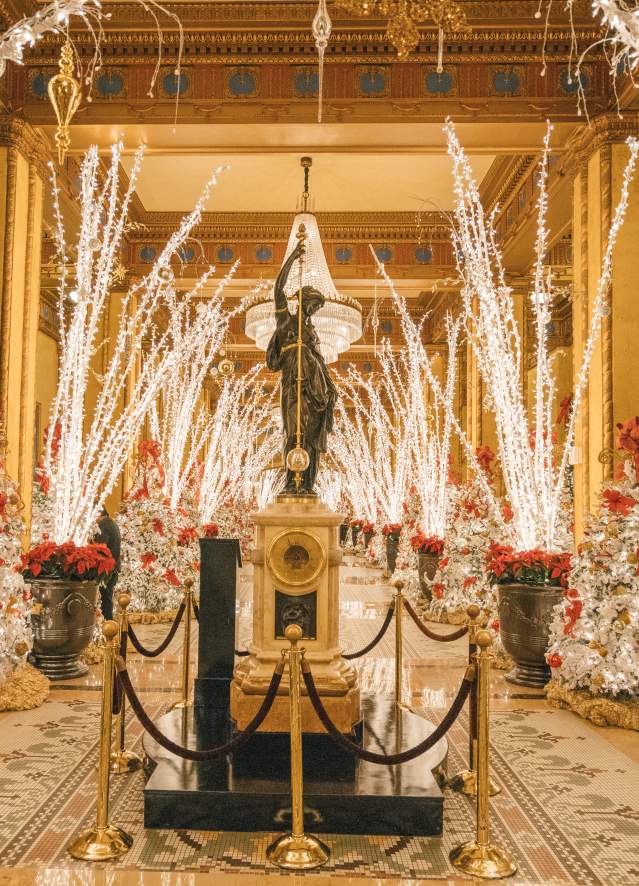
Branch height drives everything. You want them to reach at least two-thirds of the ceiling height, so a 12-foot ceiling wants branches around 8 feet, and you need about 3 feet of clearance around the pedestal so the arrangement reads as a display rather than an obstacle. This is a 10-foot-ceiling-and-up idea — below that, the branches crowd the molding and the effect collapses. Under a 9-foot ceiling, the leaning mirror setup in Idea #20 works far better.
25. Conservatory-Style Garland: Dense, Long, and Lit
- Buy garland by the linear foot, not the strand — plan 1.5 feet of garland for every foot of wall you’re covering.
- Build in sections no longer than 8 feet. Anything longer is impossible to hang straight without a second person.
- Run a thin tension wire along the wall and attach each section with florist wire every 18 inches, not tape or hooks.
- Weave the lights in after hanging, working top down so the cord stays hidden behind the greenery.
- Add weight at every corner — a cluster of pinecones or magnolia leaves keeps the garland from drifting out of line.
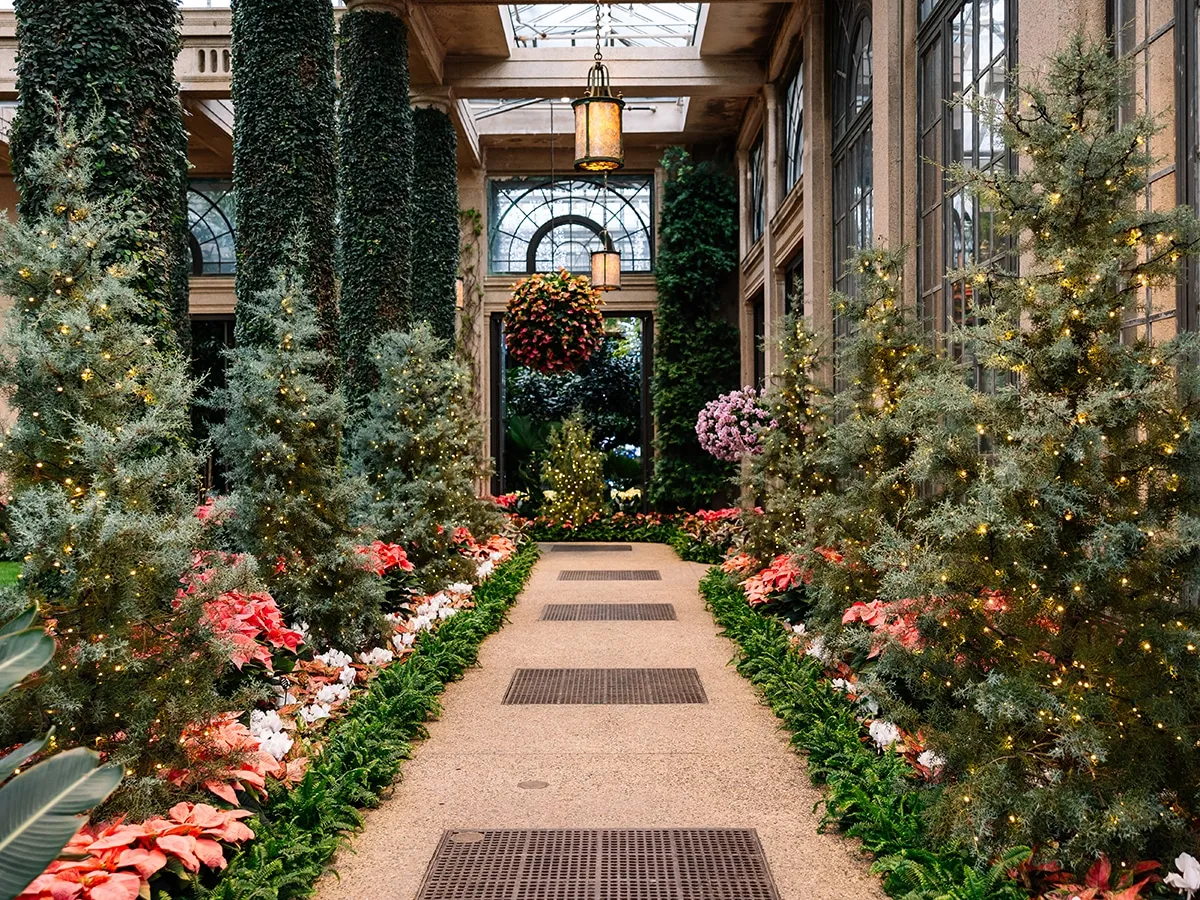
Time: 2–3 hours for 20 feet. Materials: $150–$350 depending on greenery quality.
- A 20-foot run can hit 20 pounds, so anchor into studs rather than drywall anchors.
- Switch to LED. Incandescent bulbs on dense garland get genuinely warm, and LED cuts both fire risk and the electric bill.
- Keep the strand at least 7 feet above the floor anywhere people walk underneath, and check that nothing dips near a fixture.
26. How to Make a Long Hall Feel Like a Grand Corridor
Long hallways don’t need more decor, they need rhythm. Space your garland drops or wreaths every 8 to 10 feet — closer reads cluttered, farther and the hall feels empty between stations. Then repeat exactly three elements at every one: the same greenery, the same light temperature, the same ribbon. Repetition over distance is what makes a corridor feel intentional, and it costs nothing.

You can fake conservatory density for a fraction of the price. Buy two 9-foot faux garlands per station at $15–$25 each from IKEA or Amazon, zip-tie them together, and add one real cedar sprig from a $6 grocery-store bunch at each tie point. Nobody sees the whole strand at once — they see clusters of greenery as they walk past. One $6 bunch of fresh cedar can freshen 20 feet of faux garland, and the scent is what people actually remember.
27. Restraint in Red: Keeping a Hall Calm at Christmas
Cream and gold hallways look effortless in photos and take real work in December. Cream fabric shows every pine needle and footprint, gold metallics show fingerprints, and garland on light walls leaves faint resin marks if it sits in one spot too long. Plan on a weekly microfiber pass and a handheld vacuum, and put felt pads behind every garland tie point so the wall doesn’t get scuffed. Budget $20–$30 a season for replacement ribbon and a small can of touch-up paint.

Before you hang anything:
- Confirm whether your walls are flat or textured — adhesive hooks fail on textured finishes.
- Check the vent or thermostat location; warm air shortens the life of real greenery by days.
- Decide your maximum color count and write it down. Three is the ceiling for a calm hallway.
- Photograph the empty hall from the front door before you start, so you can reset next year.
28. Studio-Sized Entry Christmas, Scaled Honestly
In a 4-by-4-foot entry, you can decorate vertically and that’s about it. A tabletop tree taller than 24 inches will make the space feel like a closet, and anything on the floor becomes something you trip over in the dark. Wreaths, a narrow wall shelf, garland over the doorframe, and a slim over-the-door hook are your whole toolkit. Test it the honest way: turn off the lights and walk in with your arms full of groceries. If you hit something, it goes.
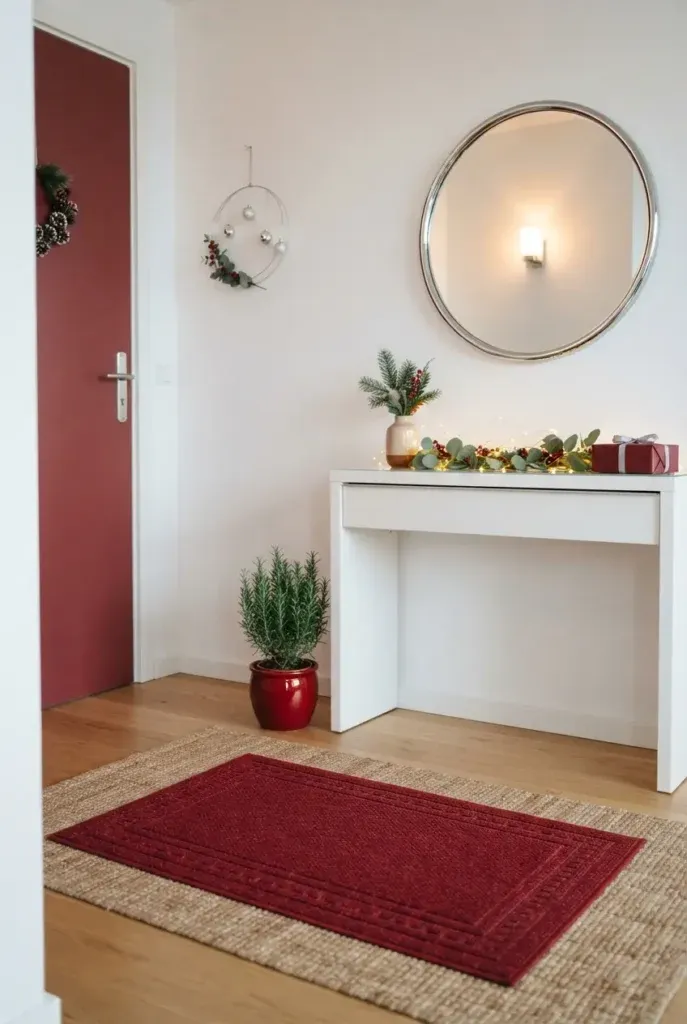
What makes a tiny entry feel festive is density, not volume. Three small things seen together — a lit wreath, a bowl of ornaments, a candle — register as a decorated space, while one large object in a small room just registers as an obstacle. Keep everything within 8 inches of a wall, and repeat the same material in all three spots so it reads as a scheme rather than souvenirs. Compare with Idea #11, which solves the same narrow-space problem at a slightly larger scale.
29. The Console Table That Does All the Holiday Work
Keep your hallway console at 12 inches deep or less. In a 40-inch hall, a 16-inch-deep console drops the walking path to 24 inches and suddenly everyone’s turning sideways. Slim consoles are also easier to style, because a narrower surface forces you to choose three or four objects instead of eleven. If you need storage, go up instead of out — a wall shelf 30 inches above the console holds twice what the tabletop can.
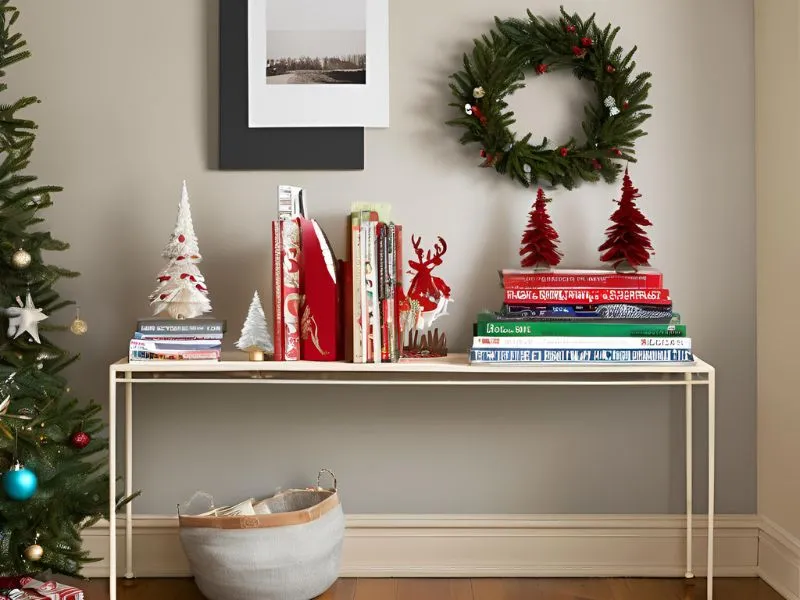
- Clear the surface completely and wipe it down.
- Place the tallest object — lamp, mirror base, or tree — slightly off-center, around the one-third mark.
- Add a mid-height item (a bowl, a stack of books, a lantern) on the opposite third.
- Fill the middle with one low, spreading element like a garland drape or a bowl of greenery.
- Finish with three small accents grouped in pairs, not scattered evenly.
Fifteen minutes, and zero dollars if you shop your own house first.
30. Classic Foyer Christmas That Never Looks Dated
The formula that keeps working: 70% neutral (cream walls, wood, natural greenery), 20% red, 10% gold. That ratio has been stable for a century because it’s really just a warm neutral base with a strong accent and a little shine. Move the numbers and you move the mood — 50% neutral with 40% red gets you a vintage candy-shop foyer, and 80% neutral with 10% red gets you a quiet Scandinavian entry. The structure never changes.
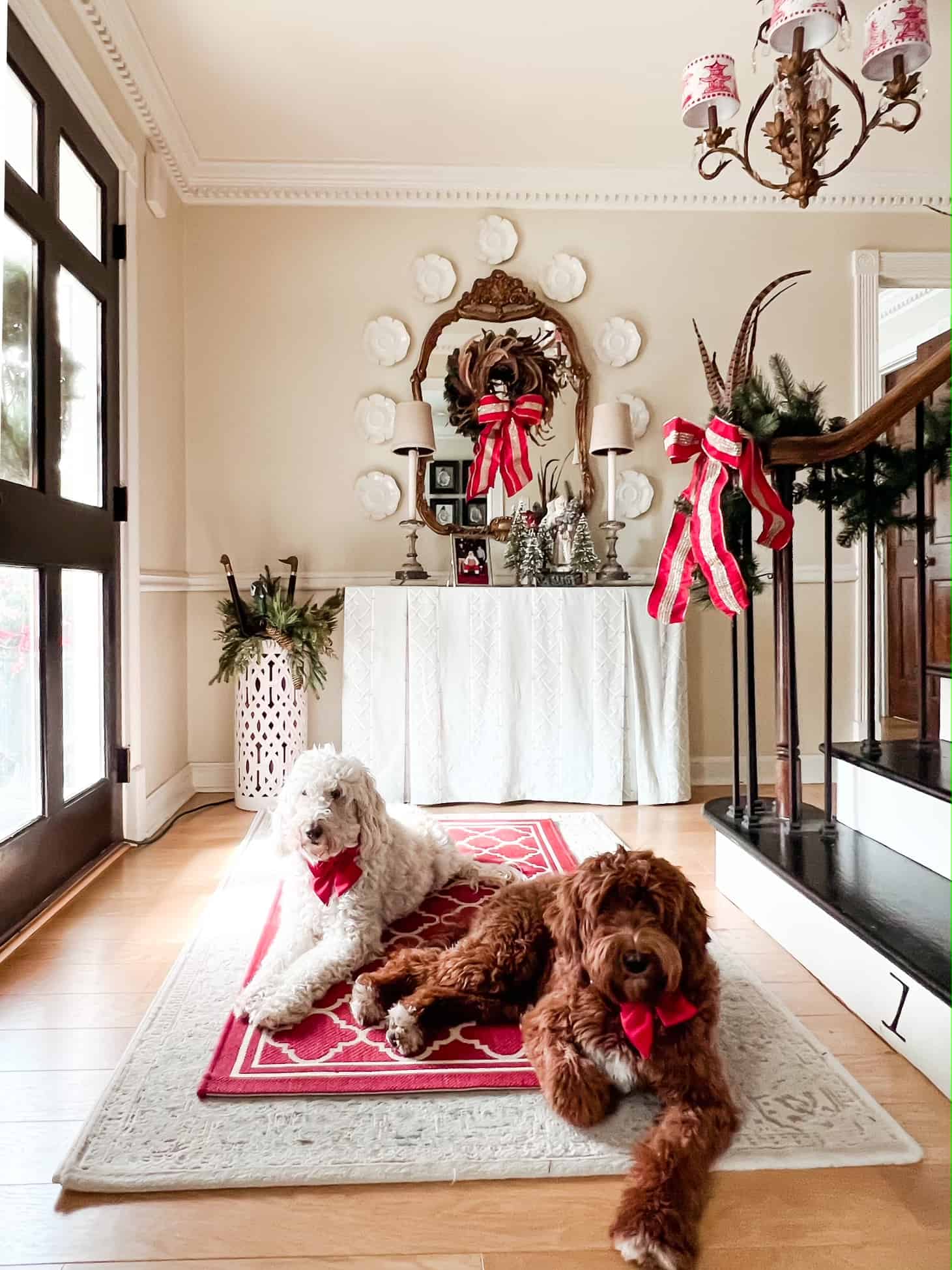
Here’s the part nobody mentions: real greenery in a foyer needs water and cool air, and most foyers are the warmest, driest spot in the house. Fresh garland hung over a heat register will be brown in nine days. If your entry runs warm, either commit to faux mixed with a few fresh sprigs you replace weekly, or choose cedar and pine over fir, which hold their needles much longer. Nobody has ever noticed a mixed garland from the front door.
31. A Two-Tier Farmhouse Table for a Skinny Hall
Two-tier entry tables are built for halls between 32 and 40 inches wide. Look for one around 31.5 inches wide and 12 inches deep — that leaves a 20-inch path in a 32-inch hall, which is tight but workable if nothing else lives on the floor. The lower shelf is the secret weapon: it holds baskets, boots, and gift overflow that would otherwise eat your walkway, which is why these tables outperform a standard console in narrow spaces. Just keep the lower shelf under 10 inches tall so it doesn’t visually close off the floor.
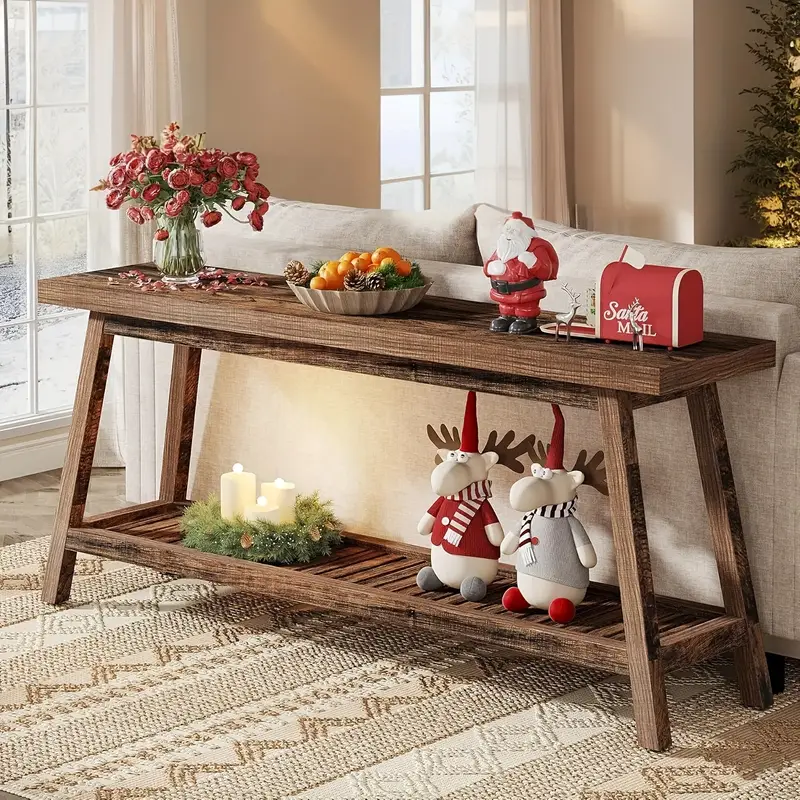
Prices swing wildly for near-identical furniture. The same basic two-tier farmhouse table runs $45–$80 on Temu, $90–$150 on Amazon, and $180–$300 at a furniture retailer. Check the assembled depth in the specs — 12 inches is the target, and several listings measure 15 inches or more, which defeats the purpose entirely.
32. Where to Put a Second Tree (Hint: Not the Living Room)
A hallway tree works because it’s the one spot in the house with no competition. No sofa, no TV, no coffee table — just a tree and a wall, which means you can go bigger and simpler than anywhere else. Undecorated or lightly decorated, a hallway tree reads as a design choice. The same restraint in a living room just reads as unfinished.
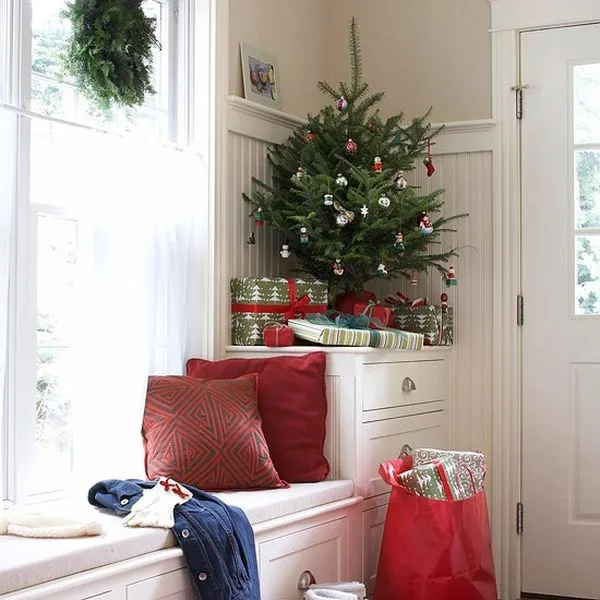
that makes it work is a dedicated light source. Hallways rarely have good lighting, so a tree with its own warm white lights plus a nearby lamp or sconce gives you two layers — and that’s the real minimum for the tree to look intentional rather than stranded.
This is the fastest-growing use of hallway square footage in holiday decorating right now, especially in homes that downsized their main tree. A slim 5-to-6-foot tree costs $60–$150 and takes up under 2 square feet, which most hallways can genuinely spare — as long as the branches stay at least 30 inches from any doorway.
Your Hallway Deserves Better Than a Pass-Through
You walk through that hallway a dozen times a day, which makes it the hardest-working square footage in your house — and the most forgiving place to try something you’d never risk in the living room. Start with one idea, live with it for a week, then layer the next. And if you only do one thing this year, make it the garland over a doorframe. It’s thirty minutes and about thirty dollars, and it changes the entire mood of the way you come home.
📌 Pin your favorite ideas now so you can find them again when the boxes come out of the attic.