
Fabric Christmas ornaments are having a genuinely loud moment on Pinterest right now — and if your saved board looks anything like mine, half of it is hand-stitched linen and the other half is velvet nutcrackers.
We spent serious time browsing Etsy, Amazon, and Target to bring you only what’s worth your attention this year, from $6 twine-loop fabric balls to $180 heirloom-quality embroidered pieces. Inside you’ll find 32 curated ideas spanning handmade rustic, traditional embroidered, cozy plush, and modern monochrome styles — with budget and luxury versions compared side by side.
The 2026 shift is personalization with restraint: pet silhouettes, monograms, and one-of-a-kind motifs stitched into fabric instead of printed on ceramic. And stay until the end — we break down the most common mistakes that can ruin these looks.
This post contains affiliate links. If you buy through them, we may earn a small commission at no extra cost to you.
📌 Save this to Pinterest for later — you’ll want to revisit these ideas.
1. Cream Fabric Stockings Anchored by Red Cuffs and Berry Garland
Strip the red out and this mantel falls apart. Four cream stockings against a white mantel with a green garland is a lovely, quiet scene — and a completely forgettable one, because nothing directs your eye anywhere. The red cuffs on those stockings, paired with the tiny red berries threaded through the pine and the velvet bow on the wreath, create a rhythm your eye follows left to right without noticing it’s being led. That repetition is the entire design. Everything else — candles in glass, decorative metal hooks, the embroidered characters — is supporting cast.
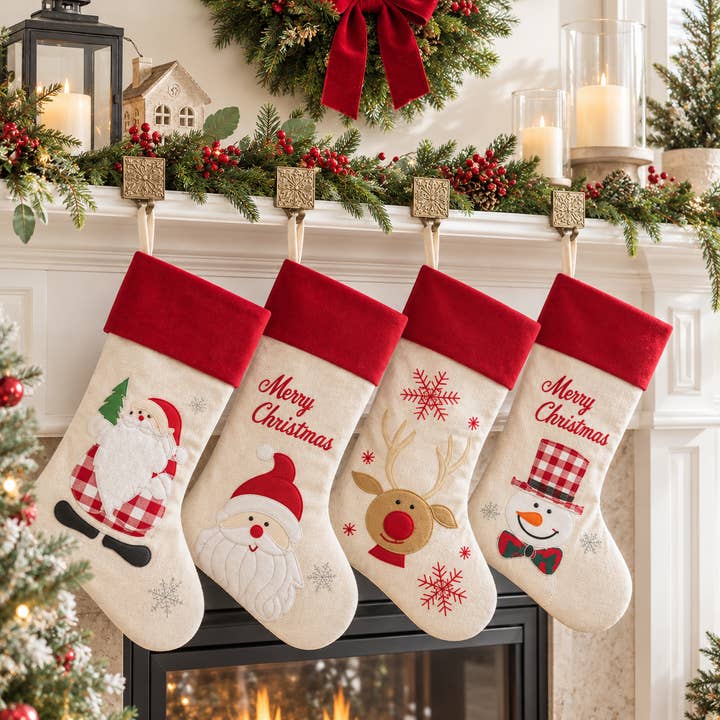
Embroidered stockings are showpieces, not sacks. Load one with anything heavier than a paperback and it sags at the toe, which drags the appliquéd cuff out of shape — and the cuff is the part everyone actually looks at. If your family expects full stockings on Christmas morning, hang these on the mantel and keep a plain second set for the real gifts. Also check your hardware: decorative metal hooks hold far less weight than a screw-in cup hook, and mantel trim is not a load-bearing surface.
2. Blanket-Stitched Linen in Mitten, Tree, and Bird Shapes
Here’s the actual sequence for one blanket-stitched linen ornament, start to finish.
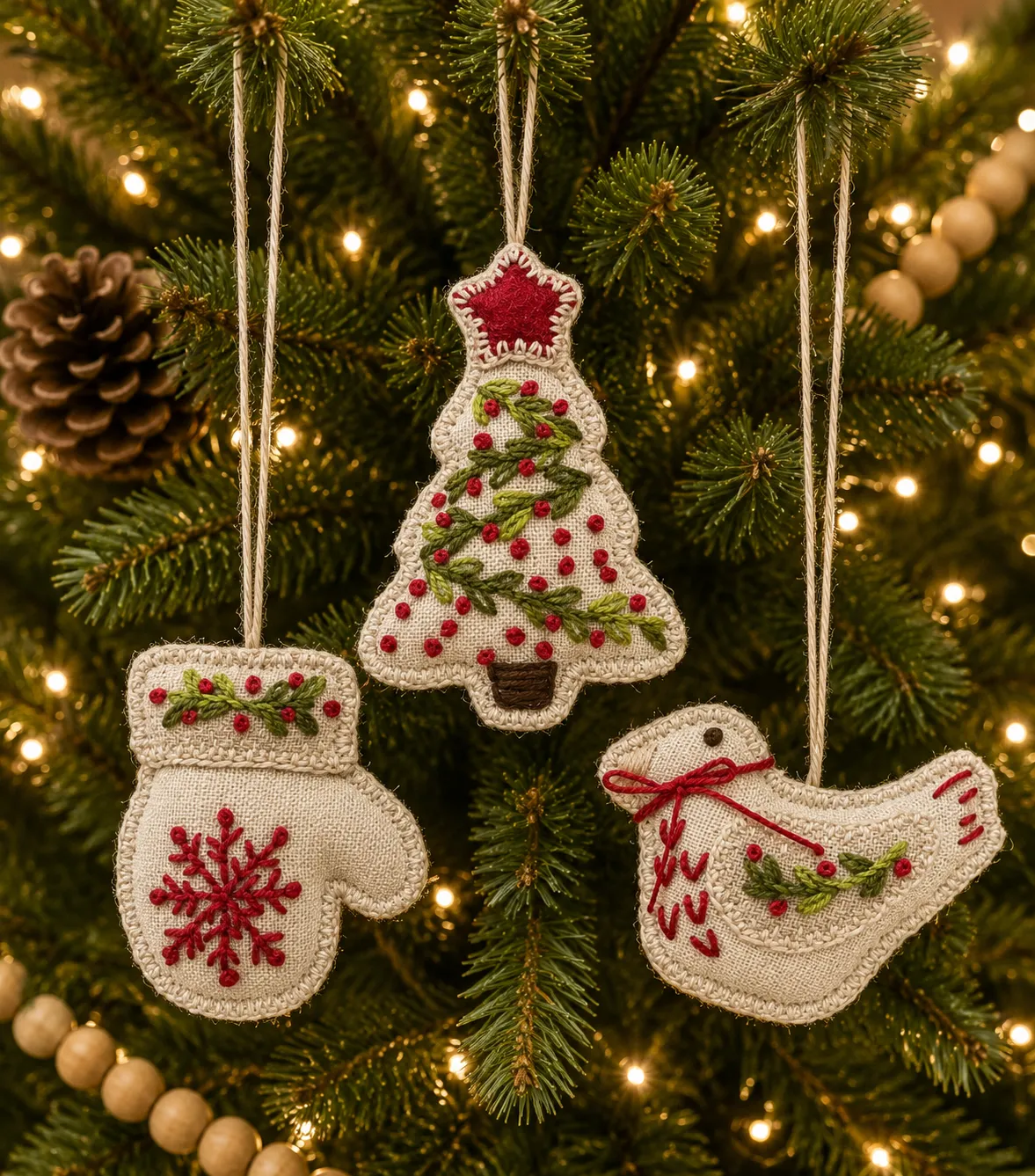
- Trace the shape onto two 4-inch linen squares and cut just outside the line.
- Embroider the motif on the front piece first — red and green floss, two strands, backstitch for outlines.
- Layer the pieces wrong sides together and pin. No turning, no seam allowance to hide.
- Blanket stitch around three-quarters of the edge with a 1/8-inch stitch depth.
- Stuff lightly with wool roving, close the last section, and knot a twine loop into the top.
Roughly 90 minutes per ornament and about $12 in materials for three.
Three shapes, one palette, zero chaos. The mitten, tree, and bird all sit on the same off-white linen, so the eye reads them as a set before it reads them as individuals. What keeps that from being boring is texture variance: the embroidery is flat, the blanket-stitched edge is raised, and light stuffing gives each piece a soft middle. Warm fairy lights do the rest — linen absorbs light instead of bouncing it, so the glow comes from behind the ornament, not off it.
3. Soft-Bodied Fabric Ornaments with Matte Plush Texture
Fabric ornaments are light-absorbing, which means they vanish into a tree at a distance. Fix it with depth: hang each cluster of three fabric ornaments at staggered distances from the branch tip — roughly 2, 5, and 8 inches — rather than lining them up along the outside edge. You get overlapping silhouettes and real shadow, which reads as intentional layering. Also, keep fabric pieces at least 3.5 inches tall. Anything smaller and the stitching detail stops existing from across the room, which defeats the entire point of handmade.
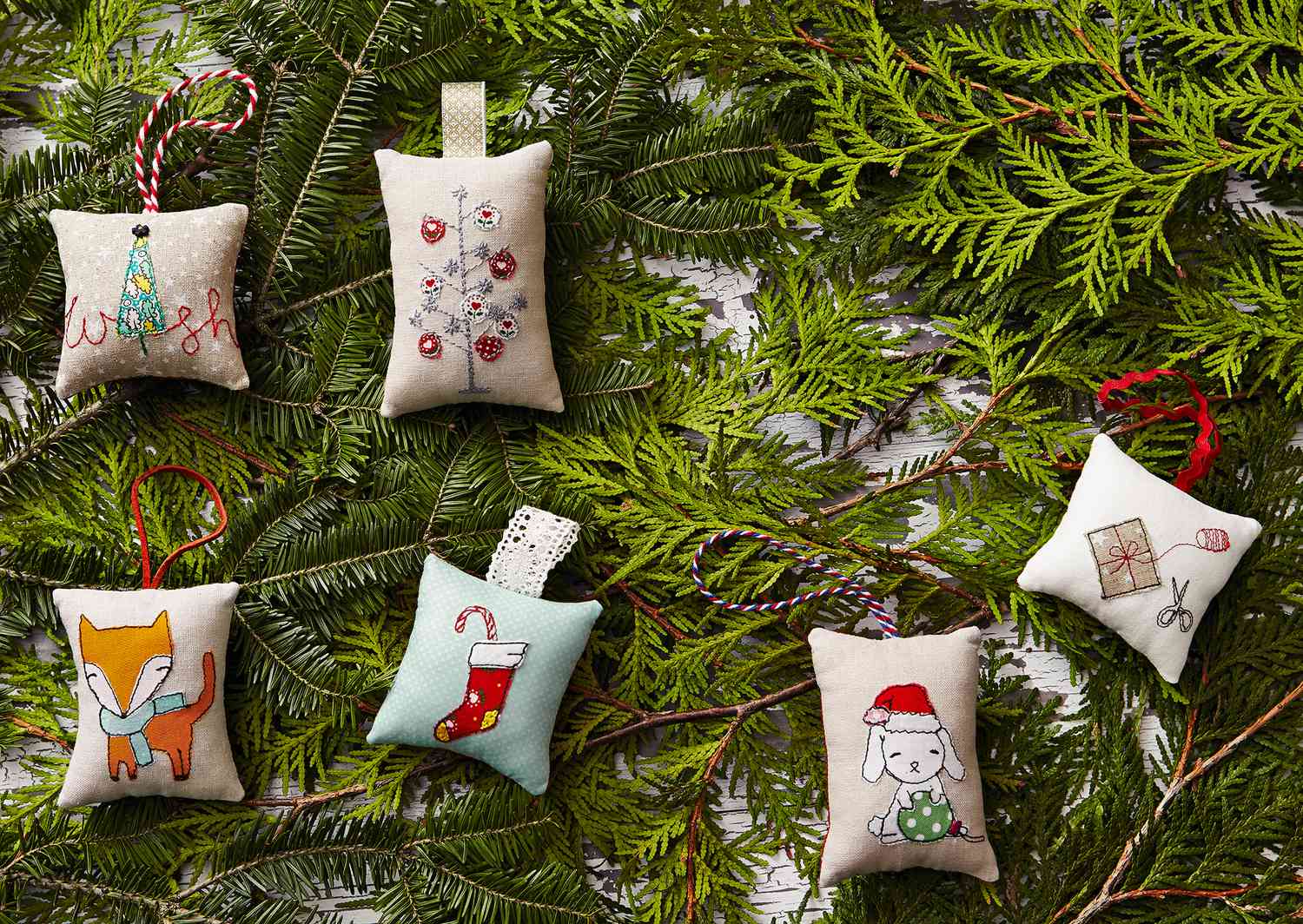
The formula behind this tree is roughly 70 percent matte fabric, 20 percent something with sheen, and 10 percent raw natural material. That last slice — twine loops, wood buttons, unfinished linen edges — is what keeps a fabric-heavy tree from looking like a craft fair table. Swap the palette freely: cream fabric with sage ribbon and brass, or deep red with ivory ribbon and blackened metal. Just keep the ratios. Drop the shiny 20 percent and the tree goes flat; push it past 30 percent and the handmade ornaments stop being the story.
4. A Black Cat at the Window, Stitched in Miniature
Pet portraits on ornaments are one of 2026’s most-saved holiday categories, and it’s not just sentimentality — it’s the shift from printed photo transfers to stitched likenesses. Embroidery abstracts: a black cat at a window becomes a silhouette and a swatch of navy night sky rather than a snapshot. That reads as decor instead of keepsake, which is why it’s moving from custom Etsy shops into mainstream ornament collections. Personalization with restraint tends to stay popular. Full-color photo transfers tend to date fast.
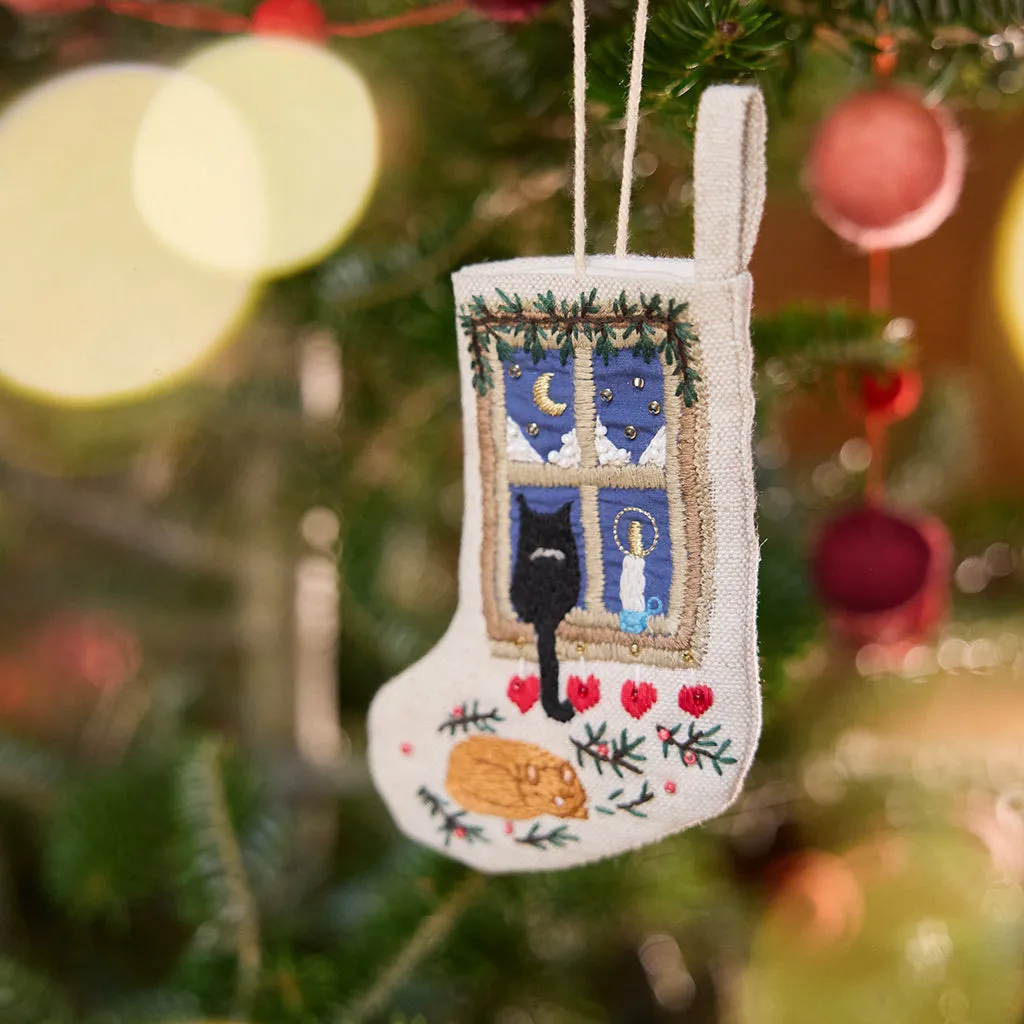
It’s the window. Not the cat, not the stocking shape — the window frame with the navy night sky behind it. That small rectangle turns a cute animal ornament into a tiny scene with a story, and it’s the reason this piece works hung on a tree or standing on a shelf. Notice how the sleeping golden animal at the base stays soft and unfinished, giving your eye somewhere to rest after the high-contrast black silhouette above it.
Etsy sells downloadable silhouette patterns in the $6–$12 range, and you can print the transfer straight onto off-white linen with a home inkjet. Blank mini stockings run $3–$5 each at craft stores, or sew your own from a fat quarter. Total for a first handmade version: under $20, and closer to $8 for each one after that.
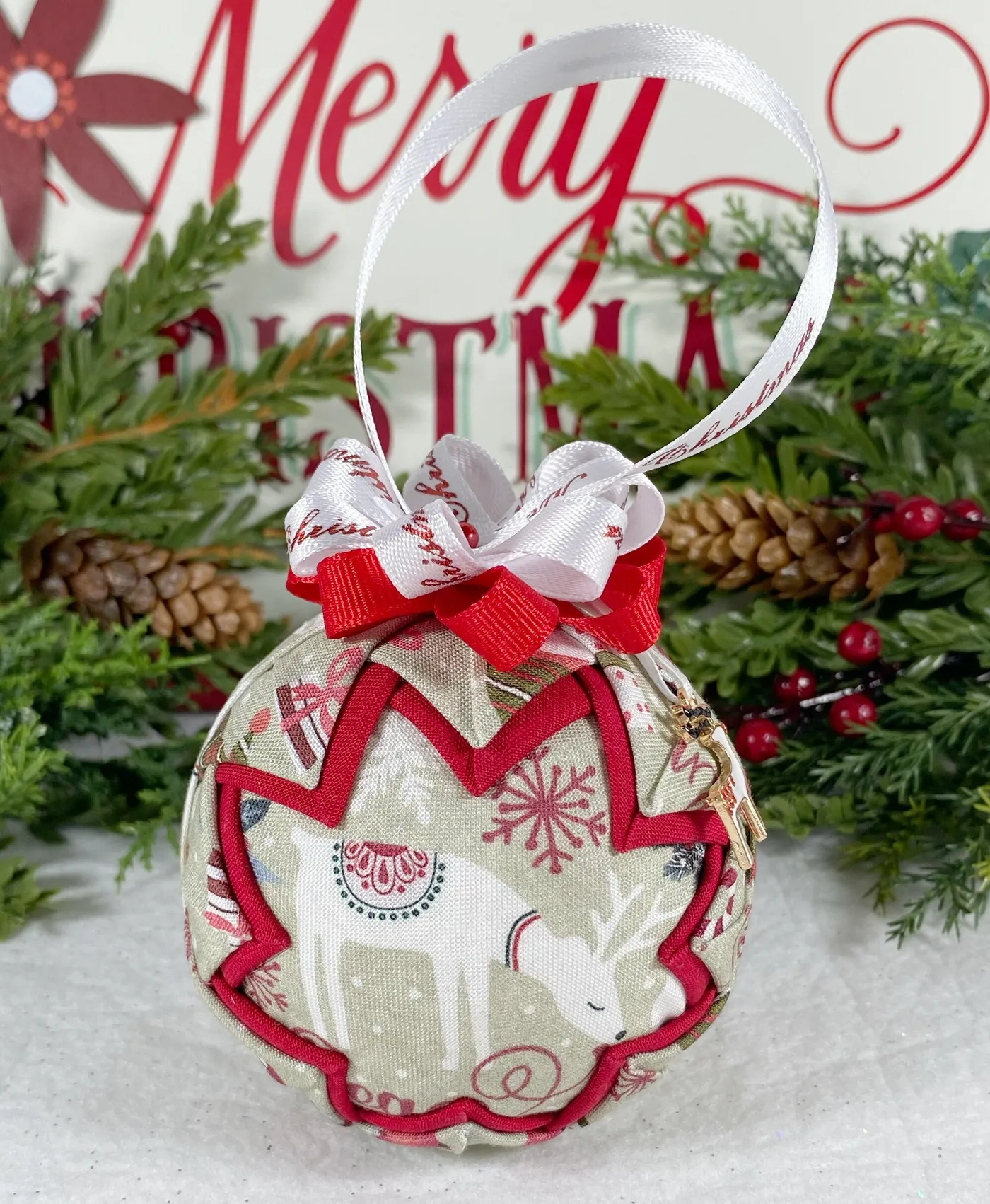
5. Quilted Ball Ornaments Divided by Red Ribbon Trim
Recreating a set of six of these segmented quilted balls, assuming you already own a sewing machine and basic tools:
- Three to four patterned cotton fat quarters: $12–$28
- Red grosgrain ribbon for the segment dividers: $4–$9
- White satin ribbon for loops and layered bows: $5–$11
- Ball forms and polyester batting: $8–$16
- Fine pins, needle, and thread: $6–$12
Total: $35–$76 for six ornaments, about $6–$13 each.
Budget alternative: skip the layered bows, pull fabric and ribbon from your scrap bin, and cover dollar-store foam balls instead. That lands you around $15 for the set.
Two things go wrong with segmented balls. First, weight: fabric-wrapped forms hang heavier than they look, and on a sparse branch they drag the tip down and rotate so the divider seams face the wall. Pin them to a sturdy interior branch, never an outer tip. Second, ribbon fraying — grosgrain cut on the bias unravels within a season. Seal every cut end with a swipe of clear-drying fabric glue before you pin it down, and store the set in a divided box rather than a plastic bag.
6. Punch-Needle House, Heart, and Sheep on Twine Loops
These three work together because no two of them are made the same way. The snowy house is flat embroidery. The heart uses raised punch-needle loops that sit proud of the linen. The sheep is loop pile so dense it reads as fur. Three completely different surface heights, one cream base fabric, and a red thread that appears in all three. That’s the trick: repeat the color, vary the texture. Swap the sheep for a fourth flat embroidered piece and the trio goes limp, no matter how pretty the individual ornaments are.
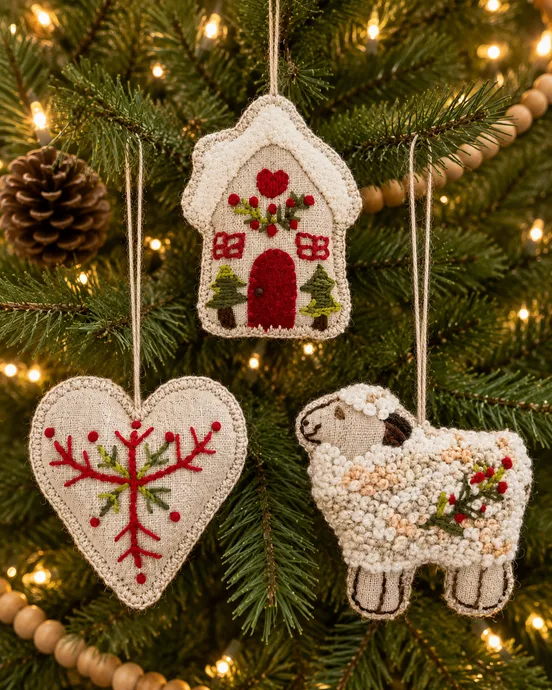
Ornaments in the 4–5 inch range need breathing room, which means a tree at least 6.5 feet tall with needle lengths around 1.5–2 inches. On a 4-foot tabletop tree, three of these will eat the whole silhouette. If you’re working with something smaller, look at the mini stocking in Idea #4 instead — same handmade character at roughly half the visual weight. Ceiling height matters too: if the tree top sits within a foot of the ceiling, oversized ornaments make the room feel compressed.
7. Beige Stocking Ornament Wrapped in Twisted Gold Cord
Metallic trim reads best in a narrow band on the tree. Keep gold-corded pieces between 36 and 60 inches off the floor — eye level when you’re standing, which is where people actually look. Above and below that band, stick to matte fabric and natural twine. Cap your metallic-accented ornaments at about 20 percent of the total count. Push past that and a tree stops looking warm and starts looking like a display window, because gold cord catches light from every angle and flattens the depth you built with the fabric pieces.
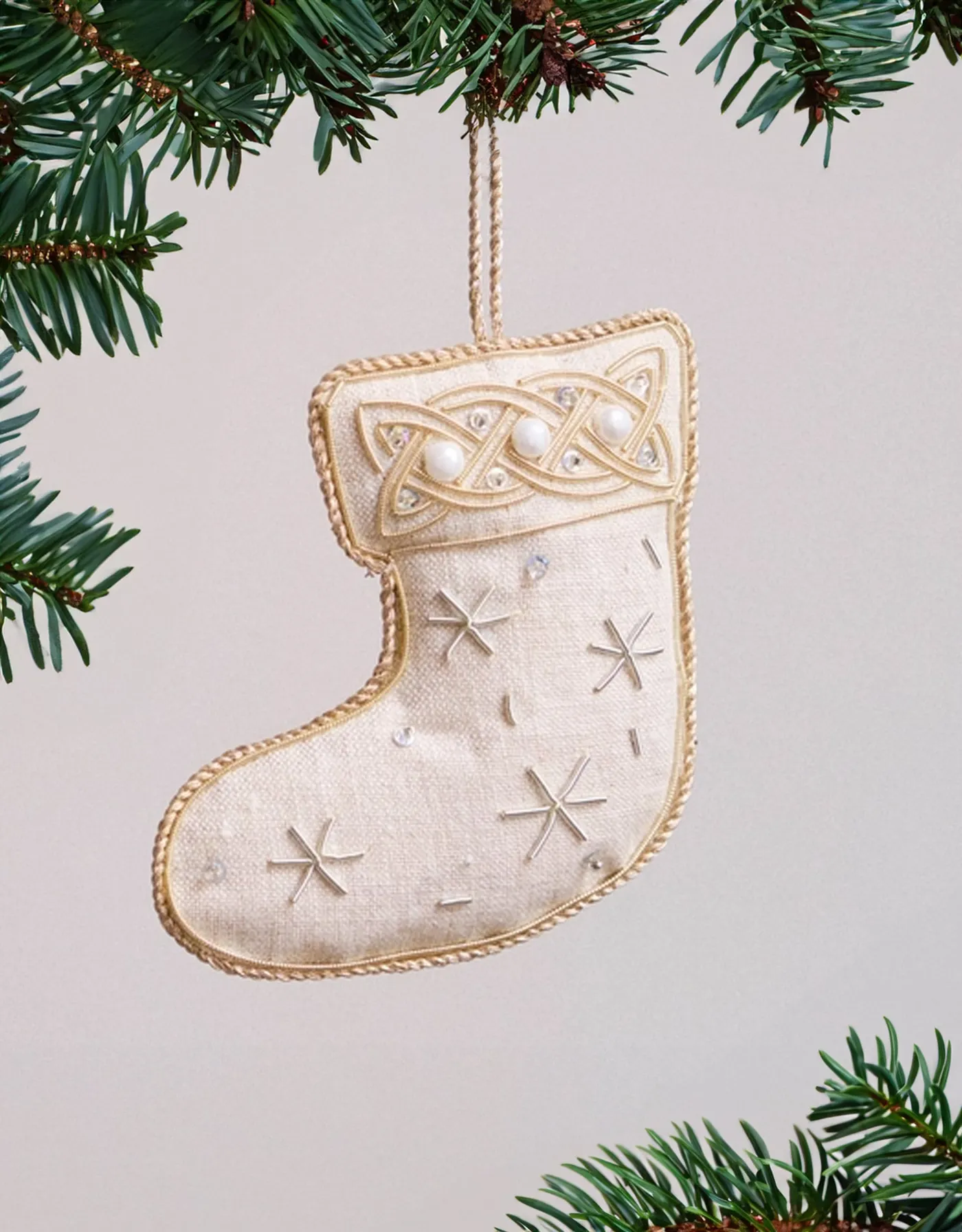
The braided cuff. Everything else on this stocking — the twisted gold border, the beaded star accents, the padded beige body — is beautiful and completely standard for a traditional ornament. The cuff is where someone made a decision: three strands braided and pinned flat, with pearl beads set into the gaps. It gives the top third of the ornament a different texture from the bottom two-thirds, and it’s why your eye keeps traveling upward. Without it, this is a very nice stocking ornament.
8. Ticking Hearts, Gingham Spheres, and a Braided Fabric Garland
The braided fabric garland is what ties this tree together, and it’s the easiest thing here to make.
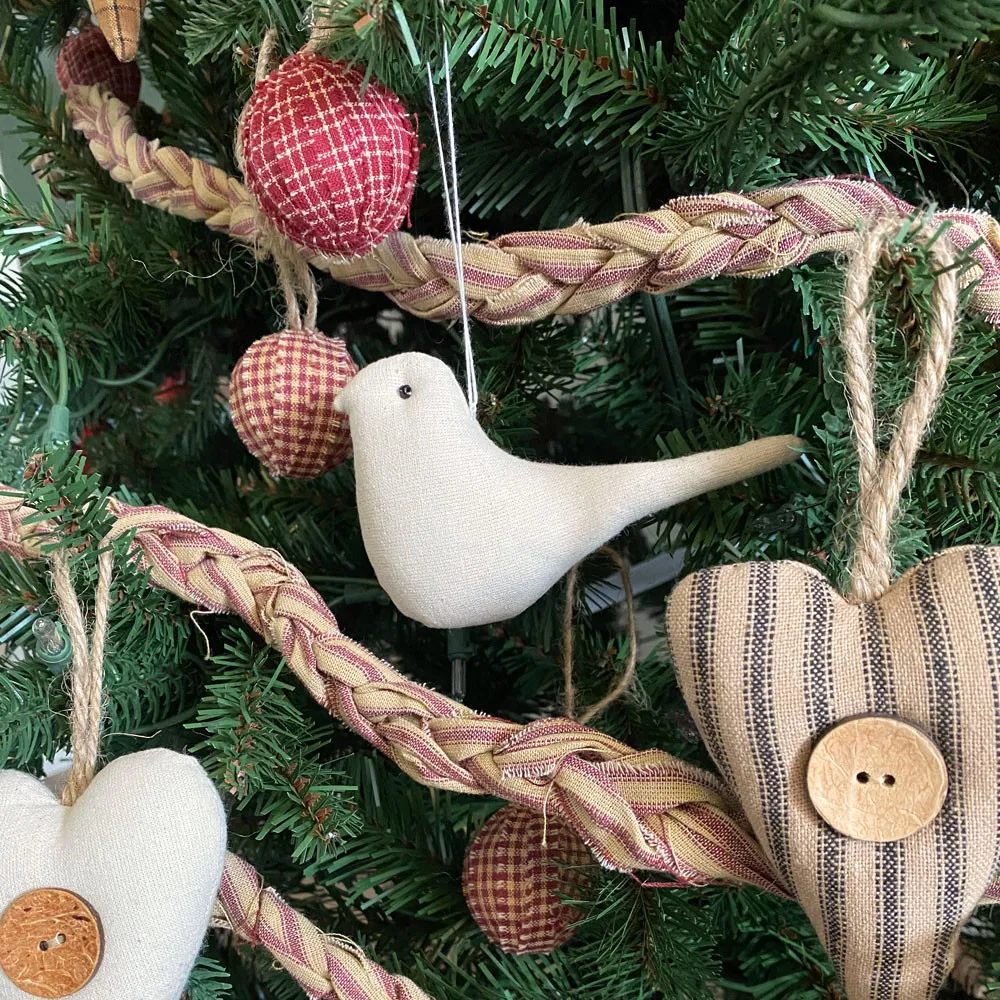
- Tear — don’t cut — three strips of quilting cotton, each about 2 inches wide and 45 inches long. Tearing gives you a soft, frayed edge.
- Knot the three strips together at one end and tape it to a table edge.
- Braid loosely, keeping the strips flat rather than twisted, so the pattern stays visible.
- Knot the far end and fray the last inch with your fingers.
- Drape in gentle swoops, pinning at each branch with a bent paper clip.
About 25 minutes and $6 of fabric per 4-foot strand.
Most of this tree came from the thrift store. Men’s cotton dress shirts give you ticking stripe and plaid fabric for $3–$5 each, and one shirt yields four to six ornaments. Wooden buttons from a jar cost a dollar or two. Old wool sweaters felt beautifully in a hot wash and cut into hearts and birds without fraying. Total for a tree this full: under $40, most of which is stuffing and thread.
9. Bright Red Fabric Stars Nestled with Pinecones
Red cotton fades, and it fades fastest on a tree that sits near a window. Two or three seasons of direct winter sun turns a saturated crimson into dull brick, and once it goes you can’t bring it back. Store these wrapped in acid-free tissue in a dark bin, never a clear plastic bag on a sunny shelf. Natural pinecones need attention too — they can carry sap and tiny insects, so bake them at 200°F for an hour before they go on the tree. Bleached or sprayed cones skip that step but shed flakes.
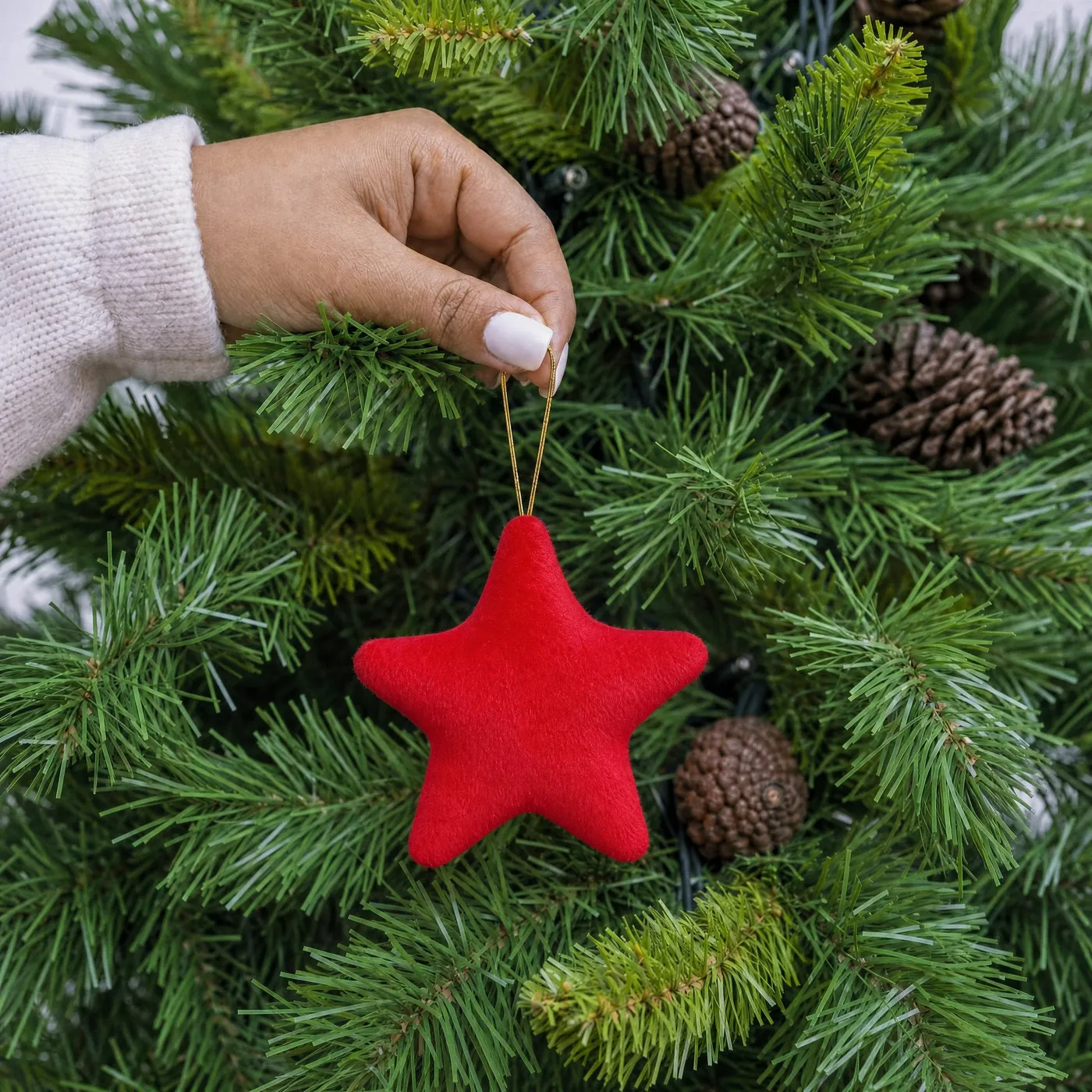
Roughly 60 percent green needles, 30 percent red, and 10 percent natural brown. Those pinecones are doing more work than they look like they’re doing — they’re the neutral that lets a very loud red feel grounded instead of candy-cane. Swap the red for deep mustard and the cones for walnut shells and you have an entirely different, warmer tree using the identical formula. Drop the natural 10 percent and the palette goes hard and artificial. Push it to 25 percent and the red stops being the point.
10. Botanical-Print Stars Warmed by Pinkish-Brown Velvet Ribbon
The print on that star is busy — leaves, stems, small flowering shapes — and it stays calm because the fabric sits on a light off-white ground. Busy print on a light base reads as texture. Busy print on a dark base reads as noise. Then the pinkish-brown velvet ribbon on the neighboring ornament adds sheen, which padded cotton doesn’t have. Value match, texture contrast: both ornaments land in the same soft mid-tone range, so they read as siblings, but one is matte and one catches the light.
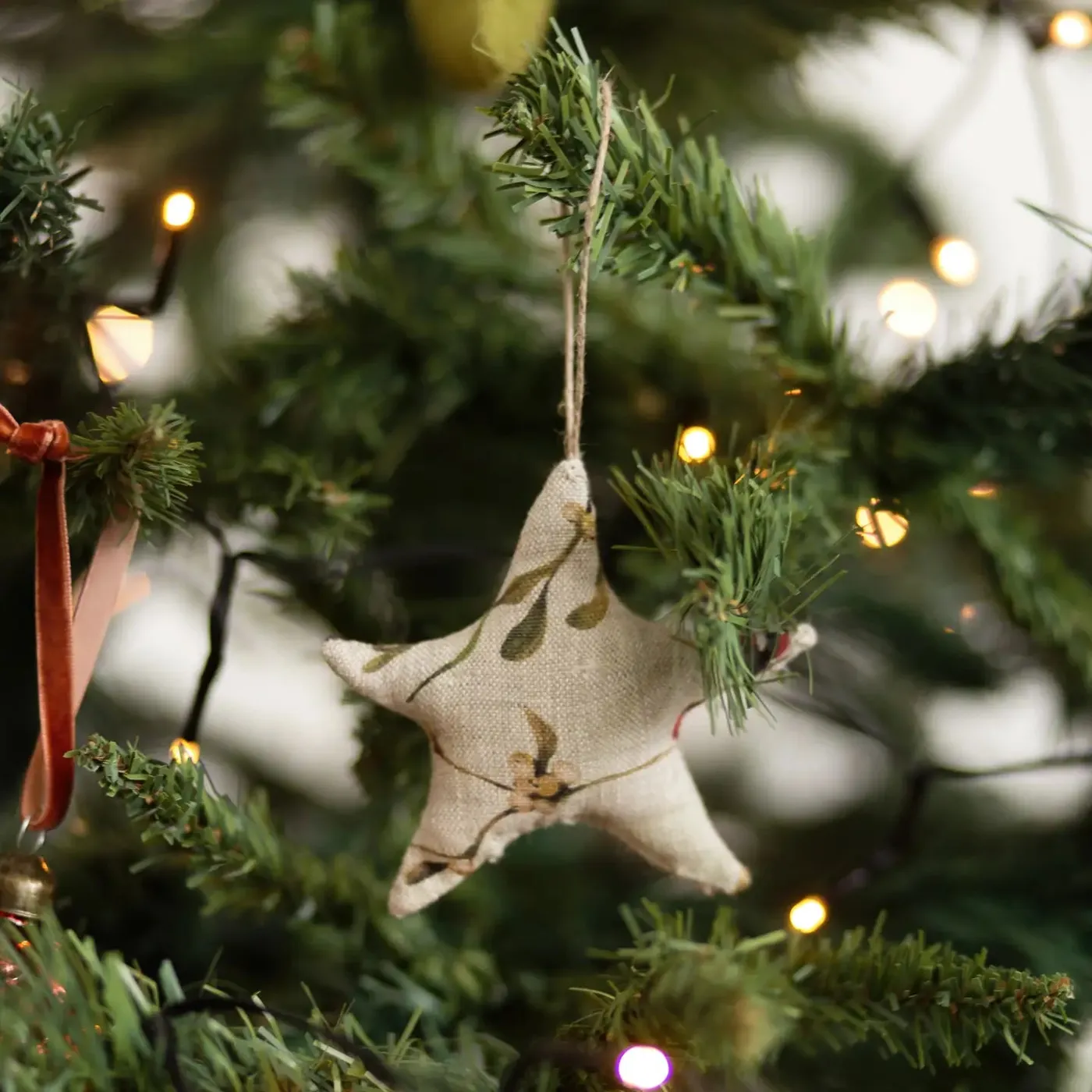
Warm white means 2700K, and it matters more with fabric than with glass. Cool 4000K string lights turn cream linen grey and make pale pinks look beige. For a six-foot tree, aim for roughly 100 to 150 warm-white mini lights per vertical foot — call it 600 to 900 total — and string them as close to the trunk as you can, then pull the branches out over the cord. Front-facing light on fabric kills the texture. Light from behind it makes the weave glow.
11. Rectangular Tree Ornaments Looped with Pink Ribbon
The pink ribbon loop. Everything else here follows a predictable, pleasant formula — off-white fabric, a green embroidered tree with a gold star topper, a brown trunk. Beautiful, but you’ve seen it. Then the loop is pink, and suddenly the ornament has an opinion. It’s a one-dollar detail that repositions the whole piece from rustic to slightly modern, which is why these outsell the identical ornament hung on jute twine. If you’re making them yourself, this is the single swap worth making.
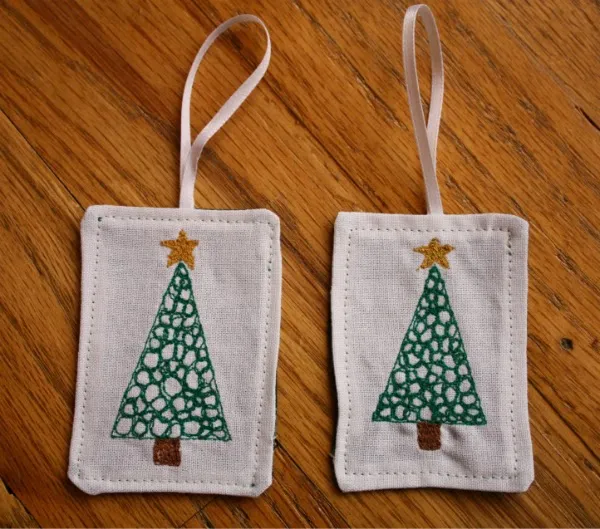
Flat rectangular ornaments have two problems. First, they hang crooked — the loop sits at top center, but the weight distribution isn’t symmetrical, so they tilt. Sew a small weight, like a coin, into the bottom corner seam and they’ll hang plumb. Second, they disappear on a tree viewed at an angle because they have no volume. Hang them alongside something dimensional, or cluster three at different heights so they read as one larger shape. On a shelf or a wreath, neither issue applies.
12. Knitted Gnomes and Bundle-Carrying Figures in Mixed Yarn
Figural ornaments run 5 to 7 inches tall, which makes them the loudest thing on any tree. On a 7-footer, keep it to 8 to 10 figures maximum, spaced at least 15 inches apart, and let everything else stay small and quiet. On a 6-foot tree, six is plenty. If your tree is under 5 feet, save these for a mantel garland or a shelf vignette instead — figures this size crowd out every other ornament you own. Compare with Idea #21 for a small-scale option that plays nicely in tight spaces.
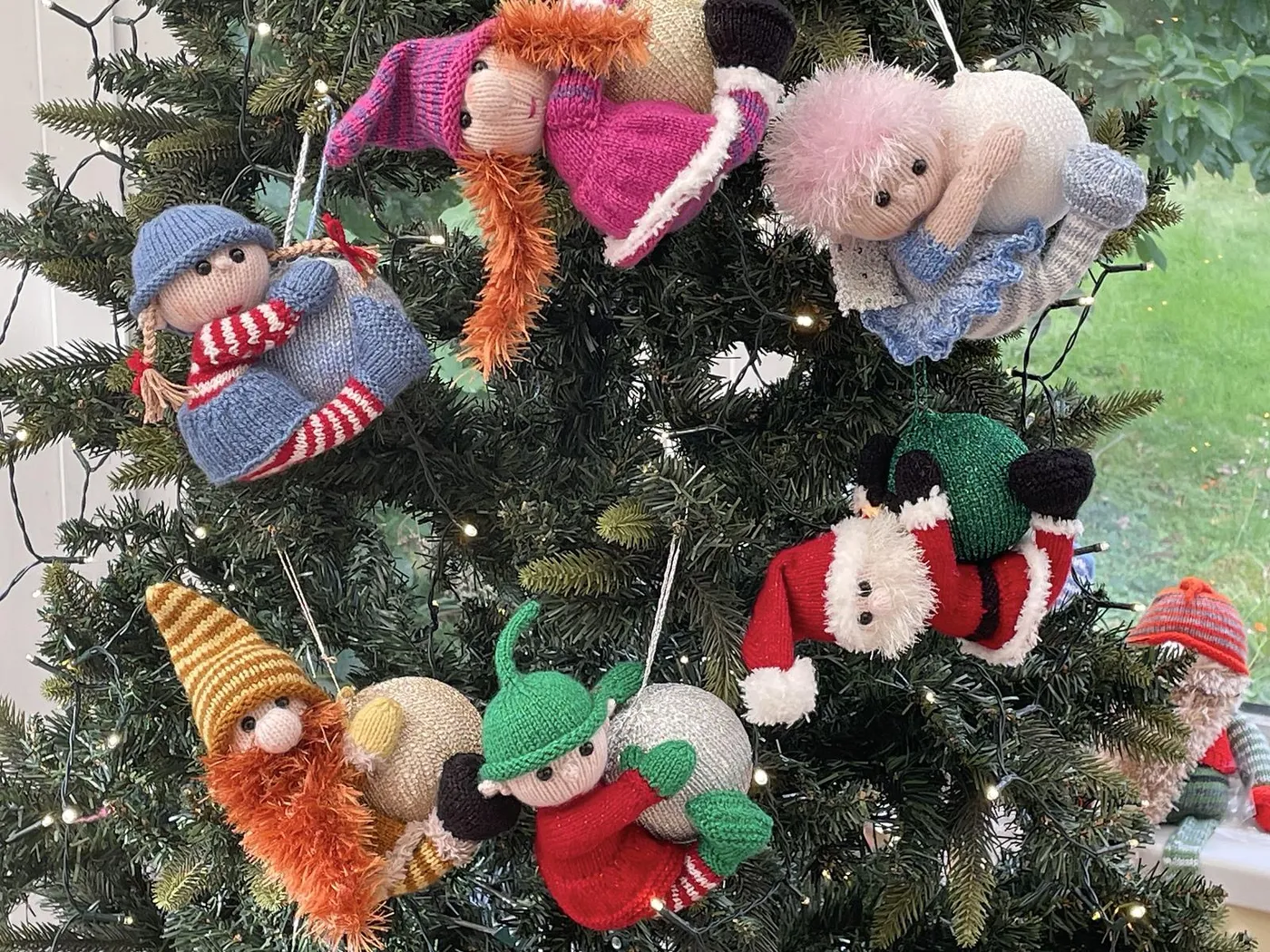
Knit figures are the one category where buying beats making. Hand-knitting a 6-inch gnome takes an experienced knitter four to six hours, and a decent one on Etsy runs $18–$35. Instead, hunt thrift store sweater racks for textured knits at $4–$8, felt them in a hot wash, and cut simple cone and mitten shapes from the felted wool. Add a wooden bead head and a scrap of yarn for hair. You’ll get a similar cozy, handmade density for roughly $30 total instead of $200.
13. Velvet-Coated Nutcrackers with Painted Wooden Faces
Here’s the body construction, which is the part that makes these read as expensive.
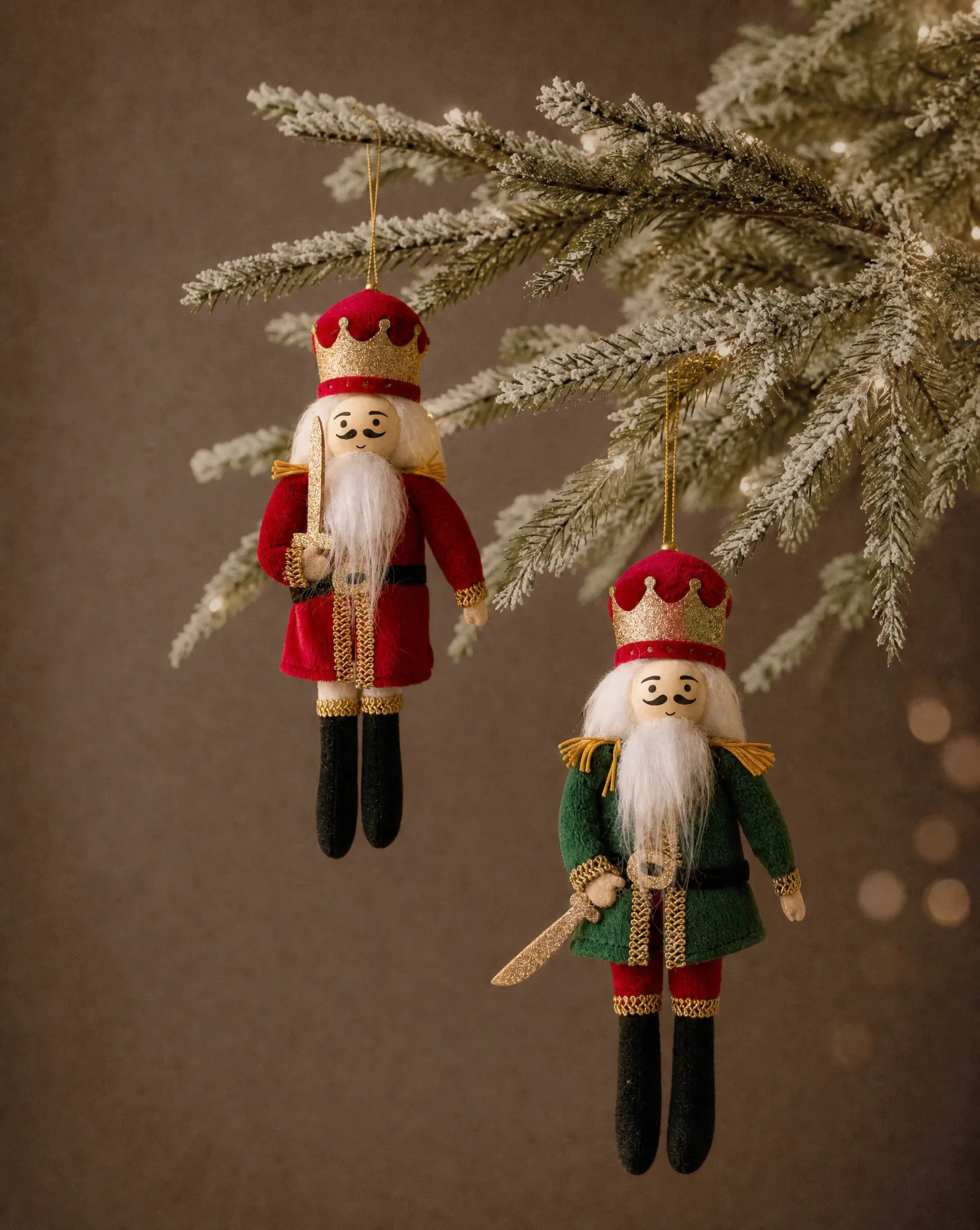
- Cut a 3-by-6-inch rectangle of velvet — thin, non-stretch, not upholstery weight.
- Fold right sides together and sew a 1/4-inch seam up the long edge to make a tube.
- Turn it right side out and slip it over a cardboard or batting-stuffed core.
- Run a gathering stitch around the top and bottom, pull tight, and knot.
- Glue on a painted wooden bead head, a faux fur beard scrap, and a gold glitter crown.
Roughly 45 minutes each, about $7 in materials per nutcracker.
Nutcracker ornaments are having a moment bigger than the ballet. The grandmillennial love of velvet, gold trim, and classic holiday iconography has pushed them from the back of the ornament bin into featured collections for 2026. What’s changed is the construction: plush bodies with painted wood faces instead of all-wood figurines. They photograph better, they survive being dropped, and they don’t chip. The risk is abundance — this is a look that gets kitschy fast if you own twelve of them.
14. Felt Trees and Purple Diamonds with Gold Rickrack
Felt ornaments go limp and sag over a season unless you stiffen them. Two ways: iron fusible interfacing onto the back of the felt before cutting, or dip finished pieces in a 1:1 mix of white craft glue and water, shape them, and let them dry on wax paper overnight. The glue method leaves a slightly stiff, almost vintage finish that suits rickrack trim. Use a 1/8-inch hole punch for the hanging hole and reinforce it with a dab of glue, so the satin ribbon doesn’t chew through the felt by January.
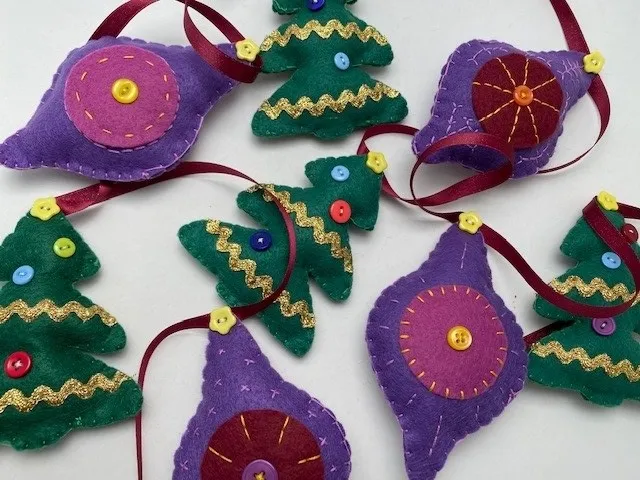
Purple is the reason this set works and the reason it could easily fail. Placed against green felt trees, a saturated purple reads as a deliberate accent rather than a mistake — it’s adjacent enough to red to feel seasonal without being red. The diamond shape matters too: geometric forms next to organic tree silhouettes give the arrangement two different rhythms. If every piece had been a tree, no amount of color would have saved it from looking repetitive. The buttons add a third small repeated element that ties the purple pieces in.
15. Blue Snowflake-Grid Quilted Trees with Grey Trunks
Those blue grid lines are quilted, not printed, and the trick to straight machine quilting on a small ornament is a walking foot plus a 1-inch grid drawn in water-soluble marker before you start. Quilt the lines in one direction first, then the other — never pivot at corners. Use thin cotton batting, not polyester, because poly loft fights a tree shape this small. And leave the outer 1/4 inch unquilted so the edges stay soft when you turn and stuff the ornament.
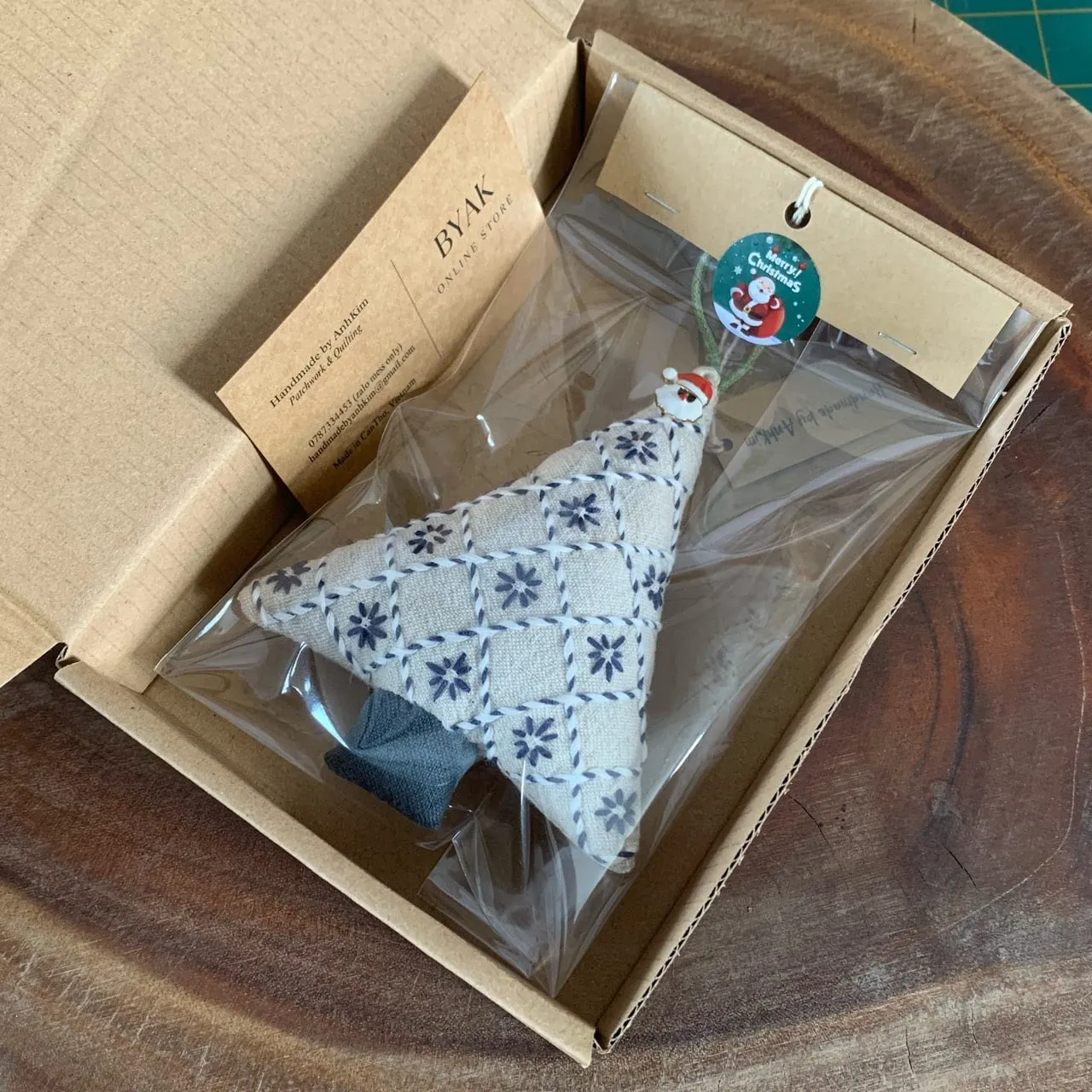
65 percent warm beige base, 25 percent soft blue, 10 percent dark grey and kraft. It’s a cool-toned holiday palette with almost no red in it, which is exactly why these look modern sitting next to a traditional tree. Swap the blue for sage and the grey for walnut brown and you have the same formula in a warmer key. The kraft box is part of the formula, by the way — neutral, uncoated packaging makes a $12 handmade ornament gift and photograph like something that cost three times as much.
16. Oversized Faux-Fur Ornaments Grounded on a Vintage Rug
Before you commit to a floor arrangement like this:
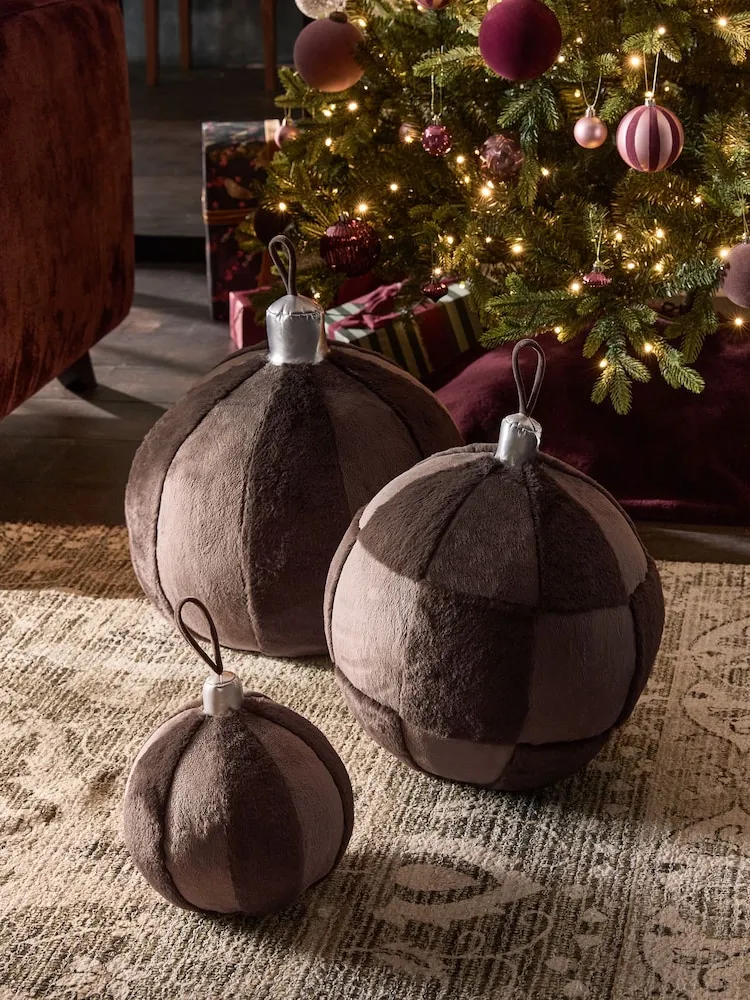
- Measure your floor space first — three of these at 12–14 inches across need roughly a 3-by-3-foot clear zone.
- Check where the tree light hits the floor and place the plush pieces in that pool, not in shadow.
- Confirm your rug can handle faux fur shedding; a dark rug hides it, a cream one does not.
- Decide whether these are floor decor or tree ornaments — at this size, they can’t be both.
- Set a budget floor of $45 minimum; oversized plush pieces are rarely cheap, and cheap ones look flat.
This is a floor vignette, not a tree ornament, and it only works in a room with at least 80 square feet of open floor near the tree. In a tight apartment corner, three 12-inch plush balls will look like abandoned pillows. If your space is smaller, scale down to a single hand-held piece, like the plush antler ornament in Idea #24. Ceiling height is the other factor: in a room under 8 feet, oversized floor decor plus a full tree compresses the whole view.
17. Folded Fabric Stars Pinned into Poinsettia Shapes
These are pin-secured, which means they can and will come apart. Every folded point is held by a single straight pin pushed into the foam core, and foam relaxes over time — especially in a warm room near a fireplace. Check the pins each season and push any loose ones back in. Keep them away from toddlers and curious cats for obvious reasons. If you’re hanging them anywhere above a sofa or a crib, add a dab of hot glue at each point as insurance.
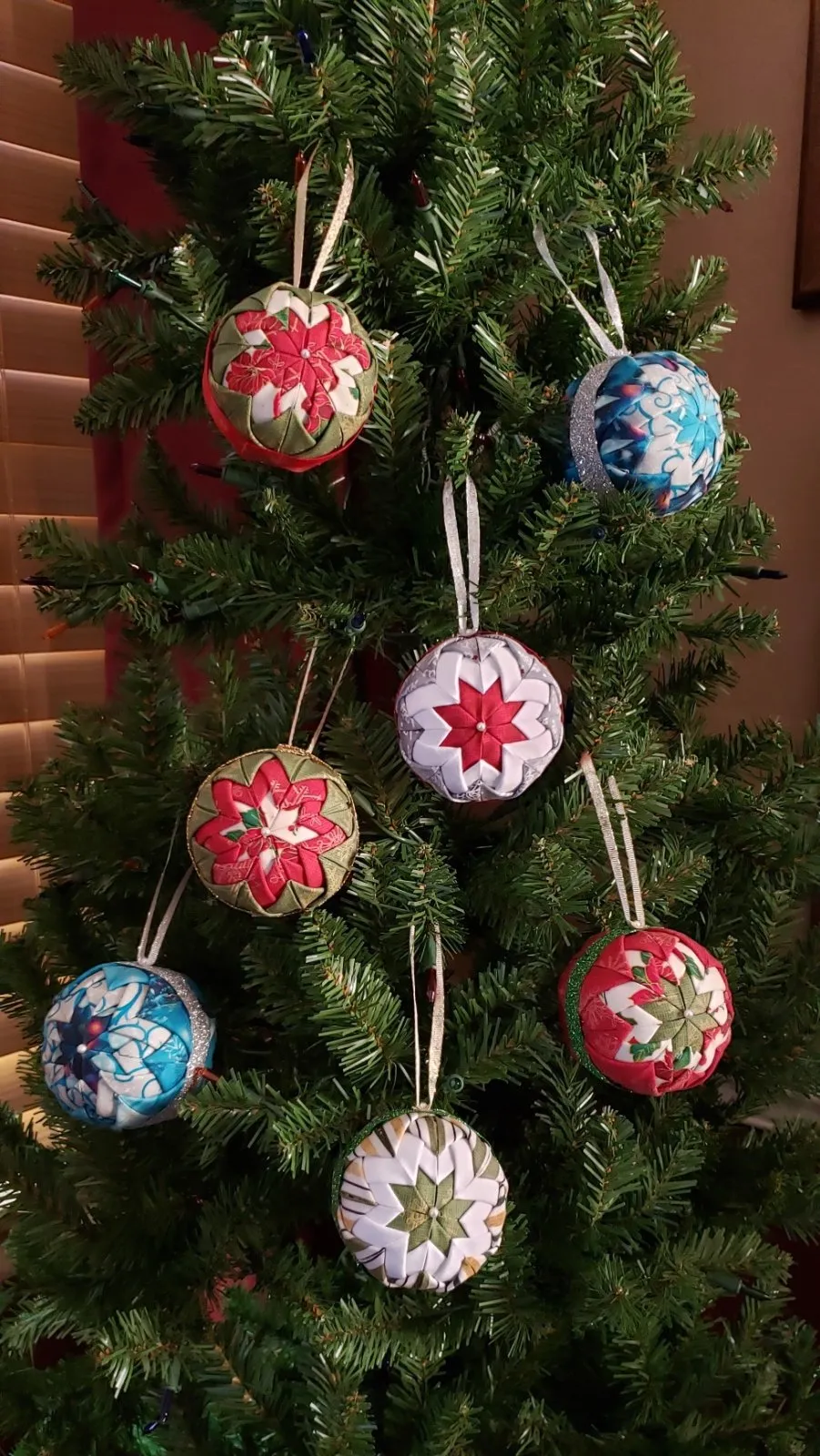
The materials here are almost embarrassingly cheap. Foam balls run $1–$2 each. Fabric squares can come from a fat quarter bundle at $12 for eight prints, which covers roughly a dozen ornaments. Ribbon for loops is a few dollars, and you already own the pins. Realistic total: about $30 for twelve ornaments, or $2.50 each. Compare that to $14–$22 per ornament at a craft fair. If you’re making these as gifts, buy the foam balls in bulk online — craft store markup is brutal.
Cut your fabric squares at exactly 2.5 inches for a 3-inch foam ball and you’ll get clean points every time. Bigger squares and the folds overlap into mush; smaller and the foam shows through. Press each square with an iron before folding — creased fabric folds predictably, and you’ll finish a ball in 20 minutes instead of 40. Push pins in at a consistent 45-degree angle and work in rings from the top down, rotating each square a quarter turn so the pattern stays symmetrical.
18. Gingham and Stripe Trees on a Working Craft Table
Setting up a full ornament-making session for a dozen fabric trees:
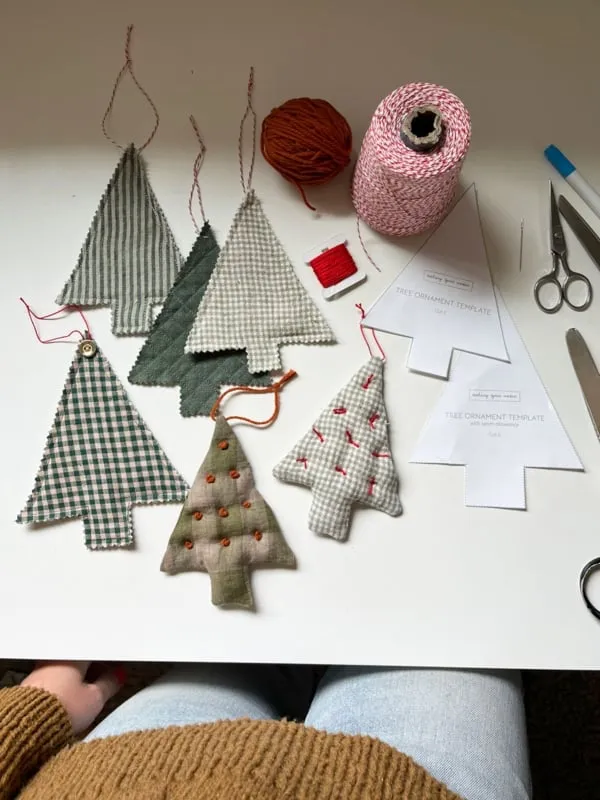
- Assorted quilting cotton, half-yard cuts: $18–$36
- Fiberfill stuffing, one bag: $6–$12
- Baker’s twine and rust yarn for hangers: $4–$10
- Paper, pencil, and template plastic: $3–$8
- Scissors, needle, and thread if you need them: $15–$35
Total: $46–$101 for roughly twelve finished ornaments, about $4–$8 each.
Budget alternative: check the remnant bin at any fabric store first. End-of-bolt cuts run $2–$4 and give you more pattern variety than a single fat quarter bundle.
The templates. Not the gingham, not the sage green, not the rust yarn. Those paper shapes on the table are what turn a pile of fabric into a repeatable ornament you can make twelve of without measuring again. Trace once onto template plastic or card stock and every tree comes out the same size, which matters enormously when they hang together on a tree. Freehand cutting gives you a charming set that reads as sloppy the second there are more than three.
19. Seven Patterned Trees Arranged in a Triangle on Black
This is a photograph, but the arrangement is a real design lesson. Seven ornaments in a triangle — five along the bottom, three above, one at the top — create a pyramid that reads as a single composition instead of seven separate objects. Against black, the pink, red, and green patterns pop with a graphic clarity you’d never get on white. If you’re staging ornaments for a photo, a market stall, or a holiday card, this is the fastest way to make a collection look intentional.
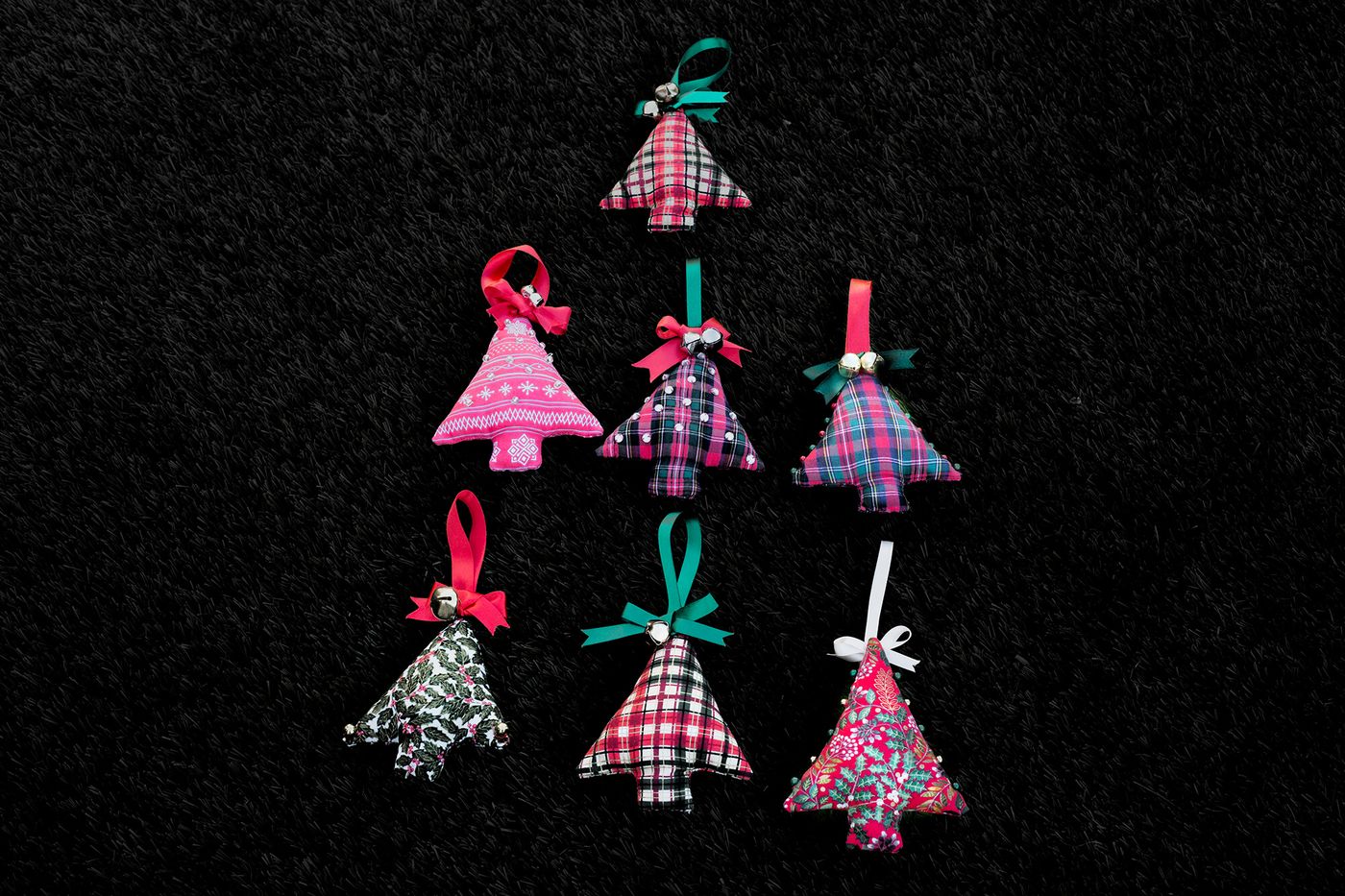
Padded cotton ornaments collect dust in the weave, and picking at them only pushes it deeper. Vacuum once a year with a brush attachment on the lowest setting, holding the fabric taut. If they pick up a stain, blot — never rub — with cool water and a drop of dish soap, then air dry flat so the batting doesn’t bunch. The small jingle bells will tarnish; a quick swipe with a jewelry cloth brings them back. Store these flat in a box rather than hanging them in a closet, where they’ll crease.
20. An Illuminated Plush Tree with a Gold Star Topper
If you’re adding light to a plush piece, use a battery pack with a remote, not a cord — and choose warm white LEDs at 2700K. A 10-light string draws almost nothing and runs 40+ hours on two AA batteries. Run the wire down the back and hide the pack in the base or clip it under a shelf. Critically, never run lights on a plush that gets hot; LED only, and check after 30 minutes that the fabric near each bulb is cool to the touch. Anything warm means the lights are wrong.
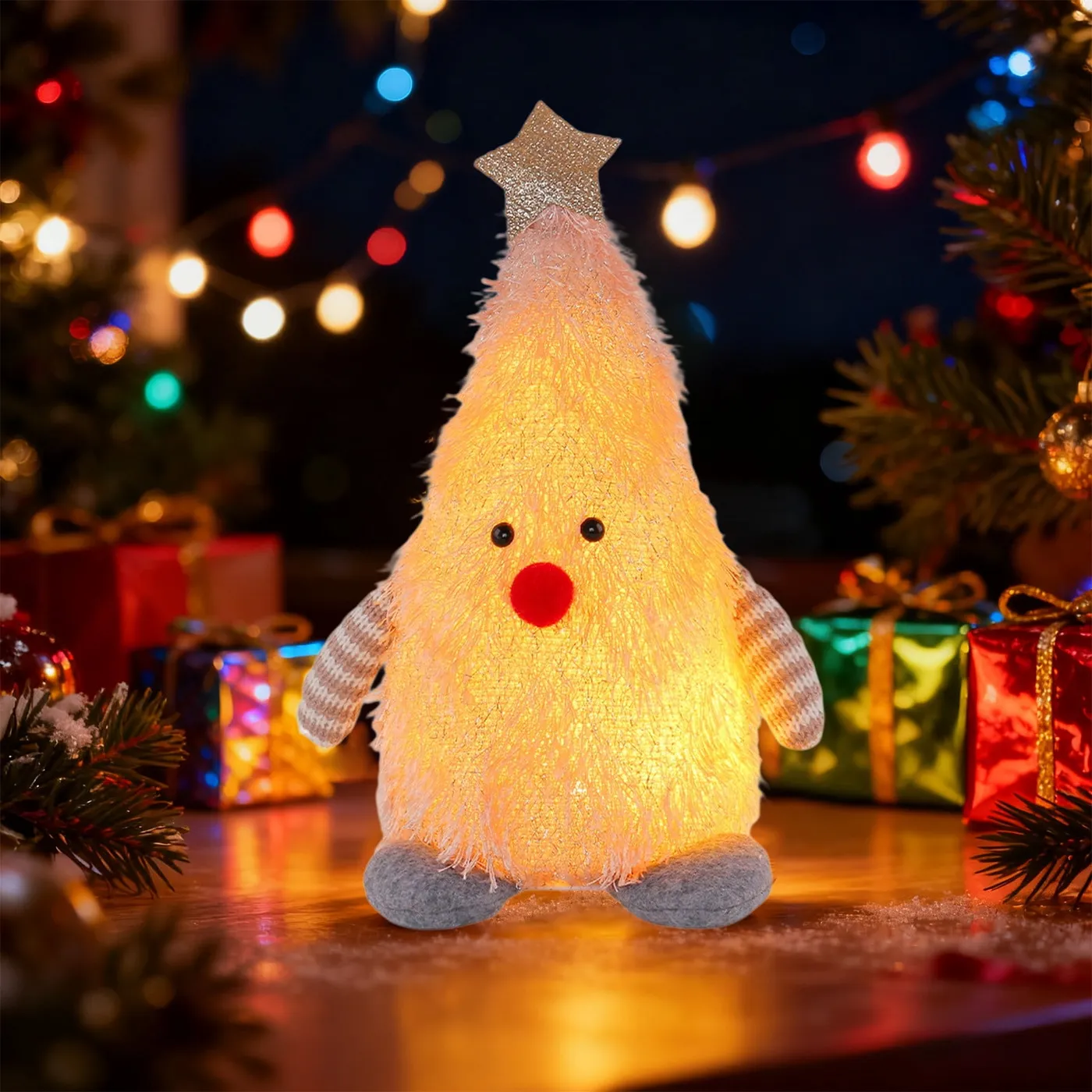
Peach-pink body, grey felt feet, red pom-pom nose, gold glitter star — that’s roughly 70 percent warm neutral, 20 percent cool grey, 10 percent metallic. The grey is the quiet hero. Without it, a peach plush with a red nose and a gold star tips straight into saccharine. The cool grey gives your eye one place to land that isn’t sweet. Swap the grey feet for ivory and you lose the whole effect. Apply the same formula to any pastel holiday piece: keep one cool, desaturated note in the mix.
21. A Plush White Sphere Topped with a Tiny Santa Hat
At four inches across, this is the size that works on almost any tree. It reads clearly on a 6-foot tree and doesn’t overwhelm a 4-foot tabletop version. If your tree is dense with 2-inch needles, hang these slightly forward of the branch tip so the white sphere isn’t swallowed. Three to five of them on a mid-size tree is plenty — they’re high-contrast, so they register from across the room. On a full-size 8-foot tree, cluster them in a loose diagonal band rather than scattering them evenly.

The hat. A plain white plush ball with a gold hanging cord is nice, quiet, and completely anonymous on a tree. Add the miniature red-and-white Santa hat and the ornament gains a personality that nothing else in the set has. It’s the smallest element here — maybe two inches of fabric — and it does 90 percent of the work. That’s also why the piece photographs so well: the white sphere gives the camera a clean, bright surface, and the red hat gives it one sharp point of color.
22. Three Tiered Folded Trees on Weathered Wood
Layered folded trees look like an heirloom project, but they’re built from strips. Grab two holiday-print fat quarters at $3–$5 each, plus a solid for the trunk, and you have enough for one tree. Ribbon and a stray button or two finish it. Total per ornament: about $7, and closer to $4 if you’re cutting from a scrap pile. Facebook Marketplace and estate sales are gold mines for vintage Christmas prints — someone’s 1980s fabric stash is exactly the right scale for this pattern.
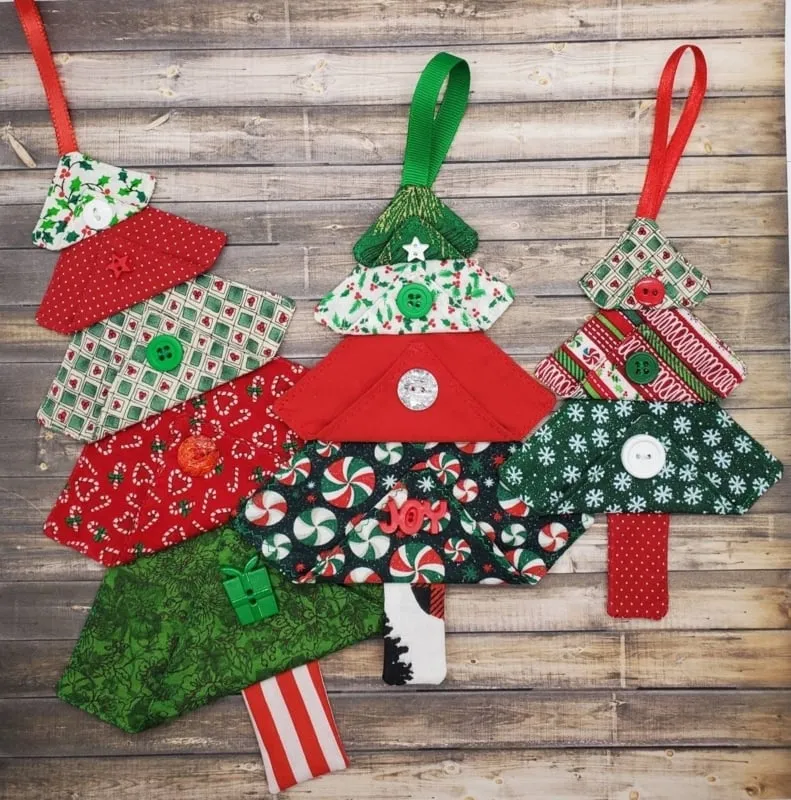
The tiered construction is the problem. Each layer is a folded strip, which means each layer can shift, gap, or sag — and when one tier droops, the whole cone looks lopsided. Weight the bottom tier with a small disc of cardboard or a washer stitched into the base. Also skip satin ribbon for the hanging loop on anything over 6 inches; satin slips in a knot. Use grosgrain or twine. And if you’re stacking these for storage, wrap each one individually, or you’ll spend December ironing folds out of a tree.
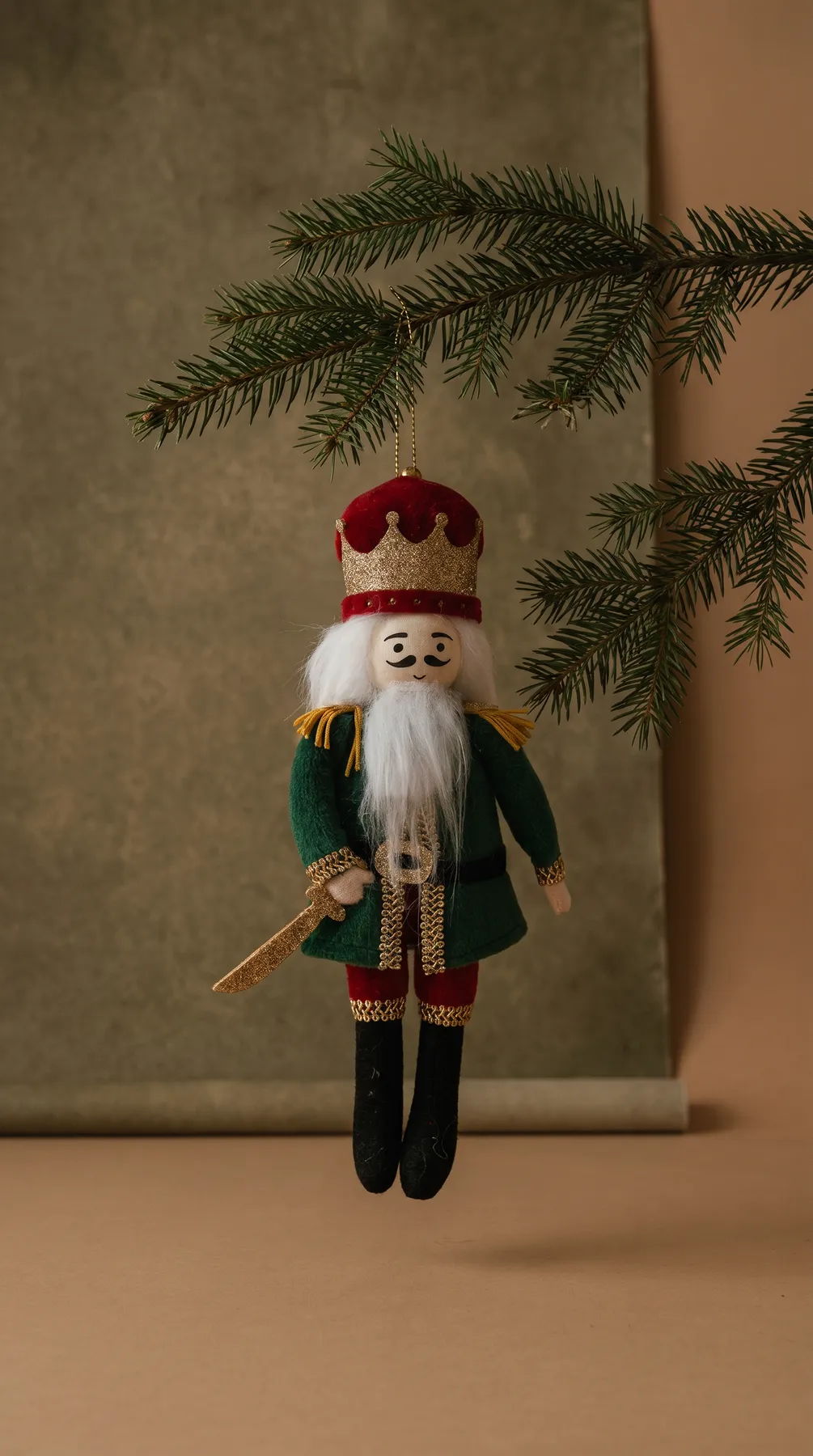
23. A Plush Nutcracker with Gold Sword and Fuzzy Beard
Making the fuzzy beard, which is what sells the whole face.
- Cut a 2-by-3-inch rectangle of white faux fur, backing side up.
- Run a gathering stitch along one long edge with doubled thread.
- Pull the thread to gather it into a crescent, then knot off without trimming the tail.
- Trim the fur pile away from a 1/4-inch strip along the un-gathered edge so you have flat fabric to glue.
- Glue that flat strip under the wooden bead head, beard hanging free.
Ten minutes, a scrap of fur, about $2.
The proportions are doing quiet work here. The crown is small, the beard takes up nearly a third of the figure, and the body is short and wide. That’s caricature, not portrait — and caricature is what makes a nutcracker ornament charming instead of stuffy. The gold glitter on the crown and sword catches warm tree lights and gives the plush surfaces something crisp to play against. A fully plush nutcracker with no shine anywhere would read as a stuffed toy.
This is the same nutcracker revival as Idea #13, executed in a softer, more plush direction — which is where 2026 is heading. Velvet and wood feel dressed up; padded fabric with fuzzy beards and glittered trim feels like something you’d actually let a kid carry around the house. Expect the plush version to outlast the formal one, because it works on traditional and whimsical trees alike, and it survives storage better — which nobody talks about but everybody notices in year three.
24. Round White Ornaments Sprouting Plush Antlers
Novelty shapes need their own zone on the tree. Group all your animal and figure ornaments in one band — usually the lower two-thirds, where kids and guests actually look — and keep the top third traditional so the tree doesn’t read as a toy display. Also, when gluing plush elements onto a fabric sphere, apply hot glue to the fabric, not the fur backing, and press for a full 30 seconds. Fur is porous and grabs glue unevenly; the fabric side gives you a bond that survives a drop.
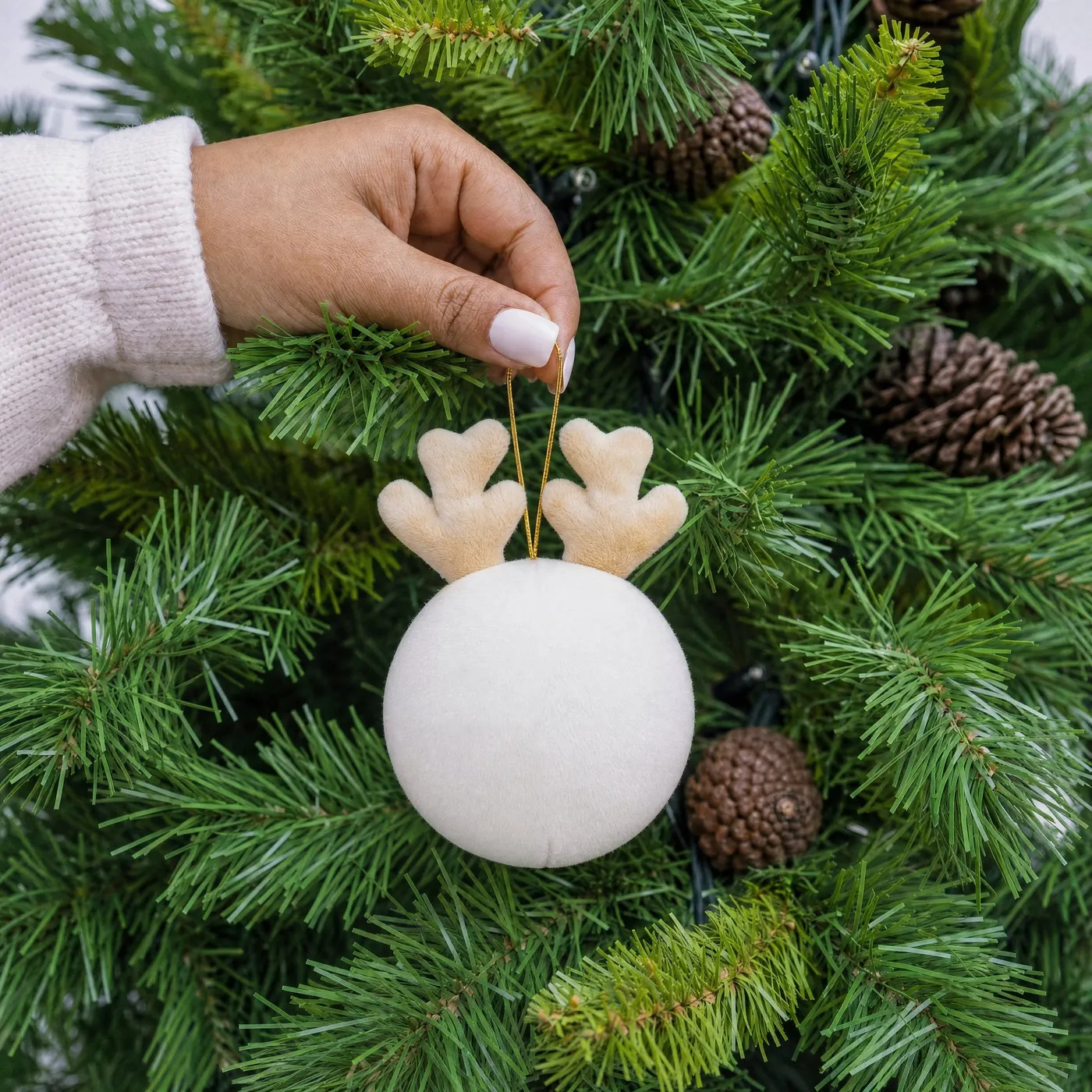
70 percent white fabric, 20 percent beige plush, 10 percent gold cord. It’s a near-monochrome ornament, and that’s exactly why it works in a set — pale pieces become the visual rests between louder ornaments. Swap the beige antlers for charcoal felt and the whole thing turns graphic and modern. Swap them for forest green and it goes traditional. Keep the gold cord either way; it’s the one warm metallic that reads well against white, because silver disappears into a bright white surface.
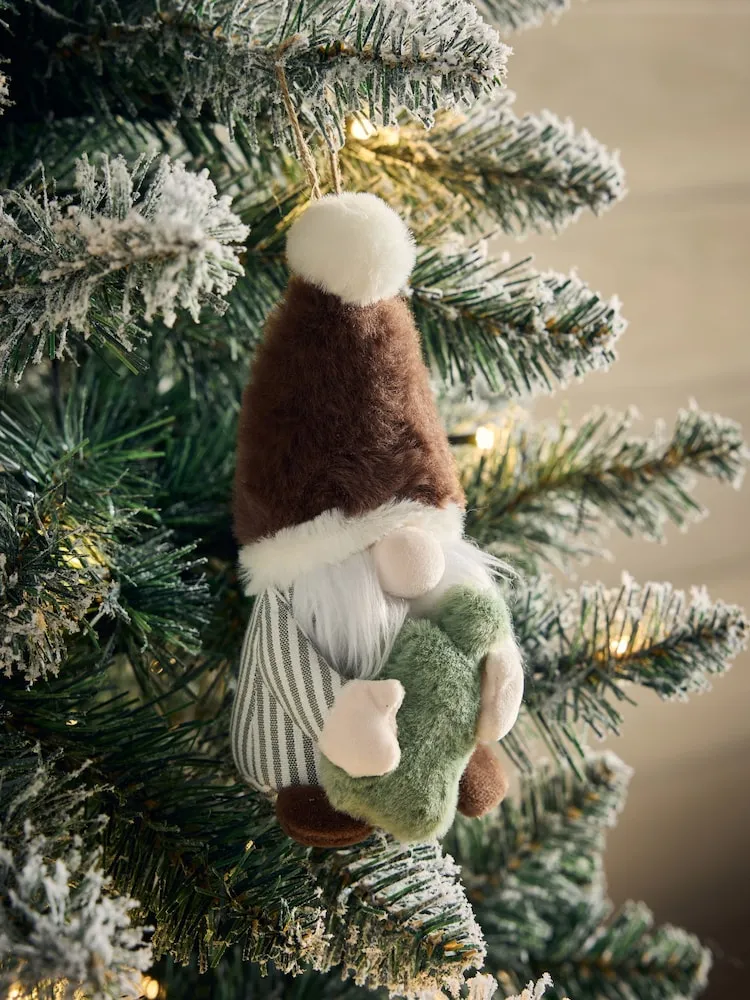
25. Plush Gnomes Carrying Their Own Little Trees
The little fabric tree in the gnome’s arms is the part that makes people pick it up.
- Cut two triangle shapes from sage green quilting cotton, 3 inches tall.
- Sew right sides together along both long edges, leaving the base open.
- Turn and stuff lightly with a cotton ball’s worth of fiberfill.
- Machine or hand stitch a 1-inch brown felt trunk to the base.
- Hot glue the finished tree to the gnome’s front, tucked under the beard.
About 15 minutes and roughly $1.50 in materials per gnome.
Brown hat, white fur beard, striped tunic, sage green tree — that’s 50 percent brown, 25 percent white, 15 percent sage, 10 percent stripe. The sage tree is the only cool color in the whole ornament, and it’s what stops the brown from reading muddy. If you’re making a set of gnomes and want variety, vary the tunic stripe, not the hat. Changing the hat color breaks the family resemblance instantly; changing the stripe keeps them related while making each one distinct.
26. Quilted Snowflake-Lattice Trees on a Branch Ladder
The branch display is free if you have a yard or a park nearby — one straight 3-foot branch and two scrap wood blocks do the whole thing. Ornaments themselves: quilting cotton remnants at $2–$4 each, plus buttons from a jar. Total for a display of six ornaments and the stand: right around $25. If you’d rather buy, Target and Walmart carry quilted fabric ornaments in the $5–$9 range during the holidays, and they photograph just as well in a branch arrangement.
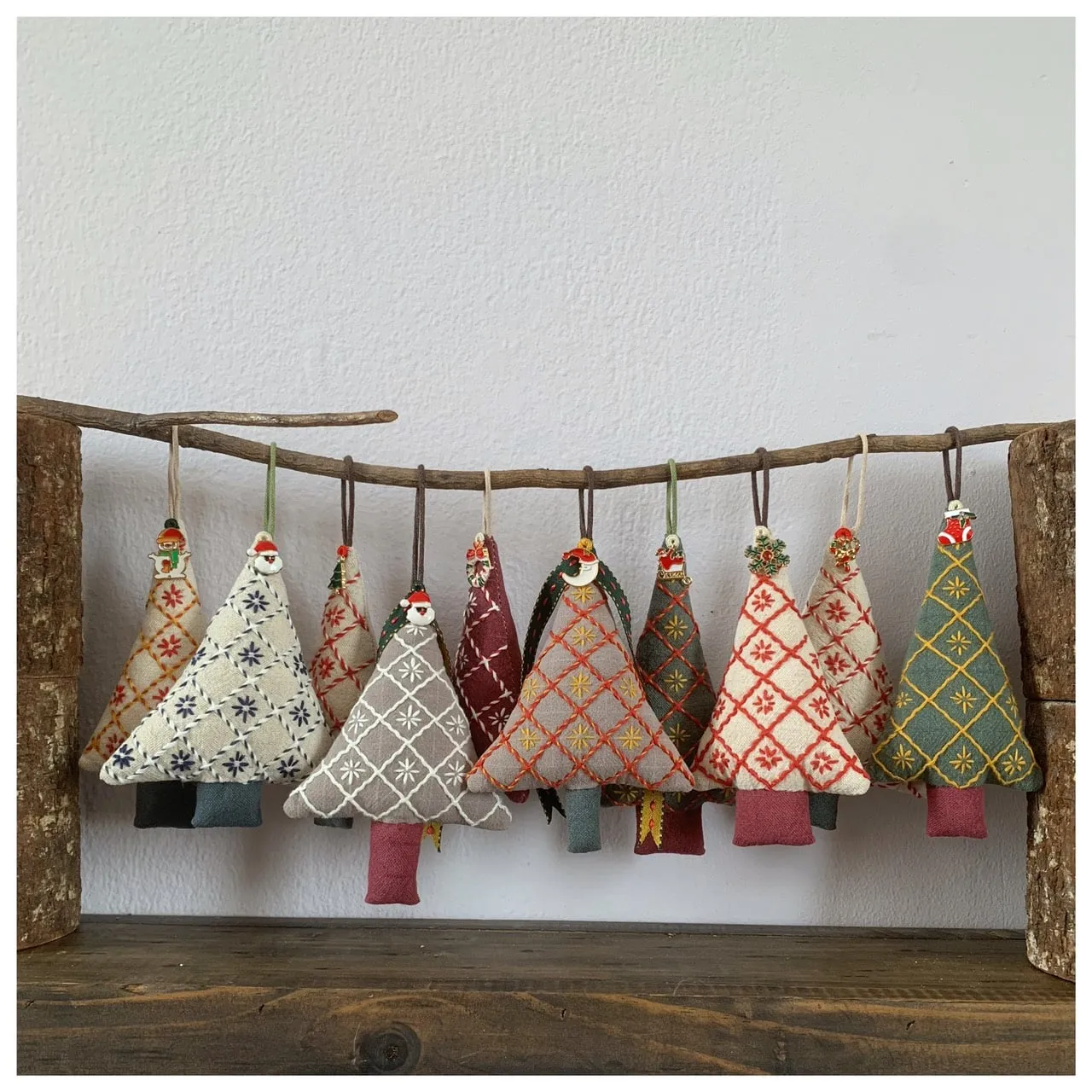
Natural branches bring guests. Even a dried branch can harbor small insects, and it’ll drop bits of bark onto whatever’s beneath it. Bake it at 200°F for 45 minutes on a foil-lined sheet, let it cool completely, then seal it with a matte spray so it doesn’t shed. Quilted cotton ornaments themselves are low-maintenance — brush with a soft brush, spot clean with a damp cloth. But buttons loosen. Check them once a season and re-stitch with doubled thread; losing one to a hardwood floor is a two-minute repair you’ll put off for two years.
27. Felt Mice, Rabbits, and Plum Puddings with Holly
These work because each figure is a tiny narrative. A rabbit wearing a plum pudding body and a holly hat. A grey mouse holding a candy cane and a gingerbread man. A brown mouse in a green outfit with a gingerbread man of its own. That’s three stories, not three shapes — and stories are why small ornaments get picked up and examined. The shared felt material and the consistent twine loops are what keep three completely different characters feeling like a set rather than a random collection.
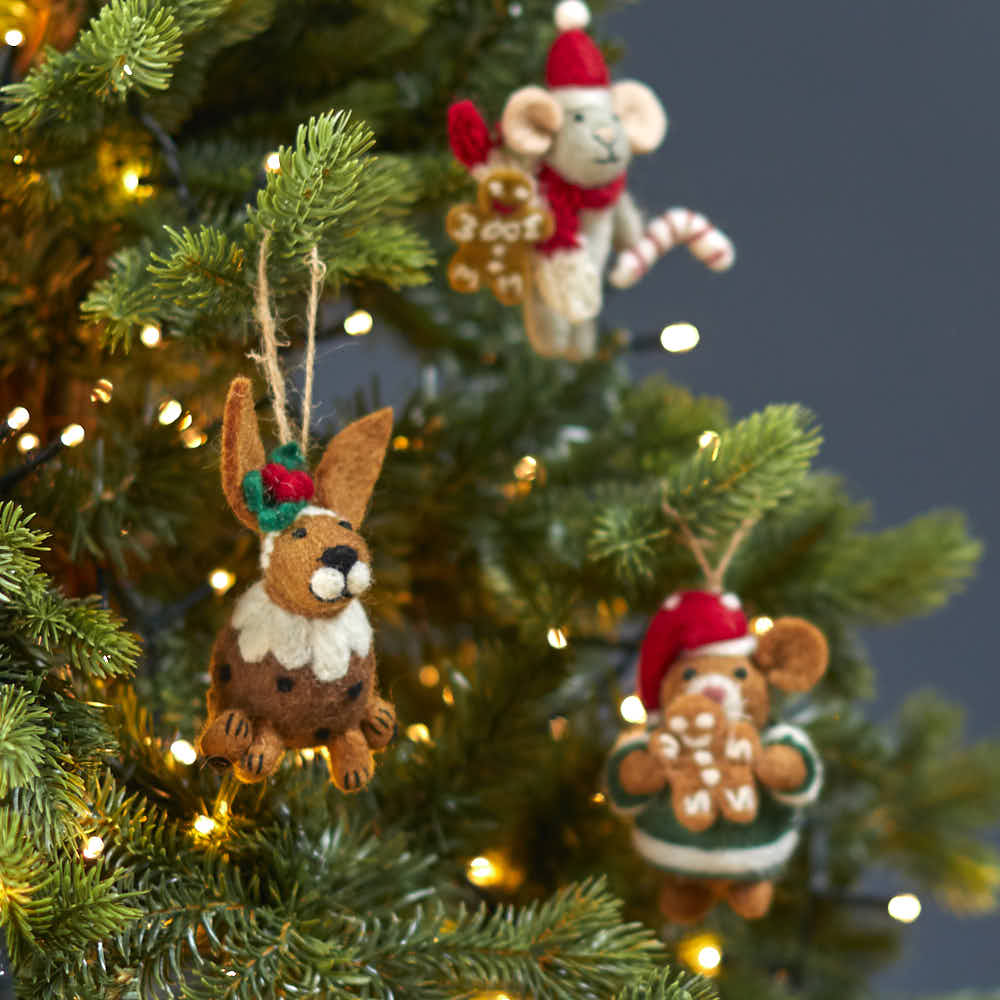
Felt figurines need a wire armature if you want the limbs to hold a pose. Use 20-gauge craft wire — thick enough to hold, thin enough to bend through a 1/4-inch felt limb. Bend each leg wire into a shallow U at the foot so it doesn’t poke through. And when you’re assembling tiny props like candy canes, thread them onto the arm wire rather than gluing; glue joints on felt fail within a season because the fibers compress. Wire and thread hold. Glue is the shortcut you’ll regret in January.
28. A Plush Santa Suspended in a Wire House Frame
Ornaments-as-objects is the 2026 story. Rather than hanging a small figure on a branch, you hang a small figure inside an architectural frame — a wire house, a hoop, a shadow box — so the piece has its own stage. Dusty pink and soft green are driving it, part of the pastel holiday shift that’s been building for two seasons. Pinterest and Instagram both reward this because framed objects photograph better than objects alone. Whether it lasts past 2027 is an open question; frames are a lot of work for a small ornament.
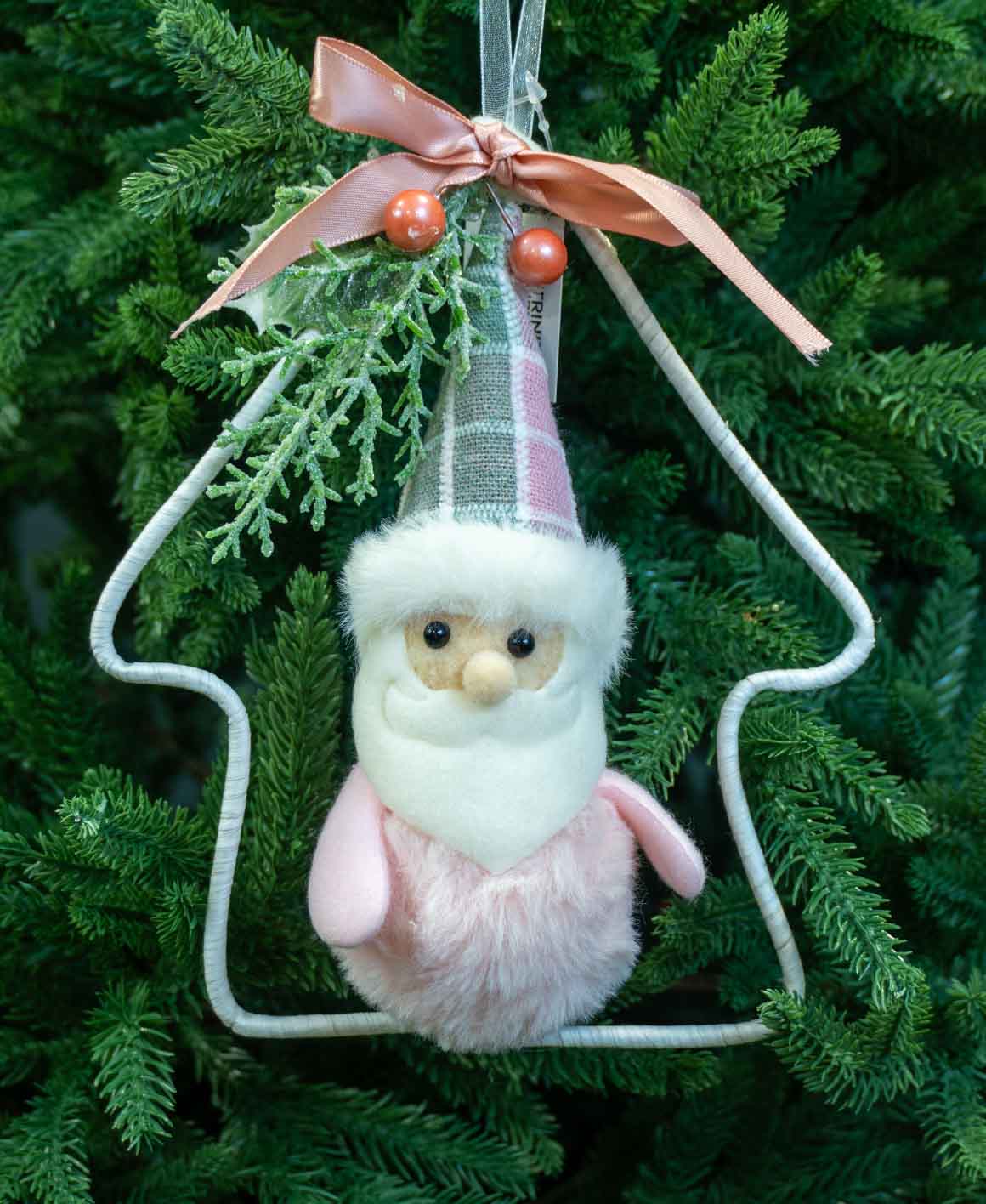
Wire frames catch on everything. Wrap one into a bag of ornaments and you’ll pull out a tangle. Store each framed piece in its own small box, or hang them on a wall rack instead of a tree. Also, that plush body is nearly weightless — the wire frame carries the piece’s mass, so the hanging loop needs to be anchored to the frame, not the Santa. If the loop is stitched to the plush, it will tear through within a season. Compare with Idea #20 — same whimsical, softly lit energy with none of the frame drama.
29. Black and White Cord-Wrapped Ornaments on Fresh Pine
Garlands live in a different scale world than trees. A strand draped across a 5-foot mantel needs ornaments spaced every 8 to 10 inches — more than that and the garland reads as dead space. That’s roughly six to eight ornaments per 60 inches. If your mantel is 8 feet or longer, go to every 12 inches and let the greenery breathe. And if the mantel is the only place you’re decorating this year, this is the vignette to copy — it delivers a full holiday impression with about a third of the material a tree requires.
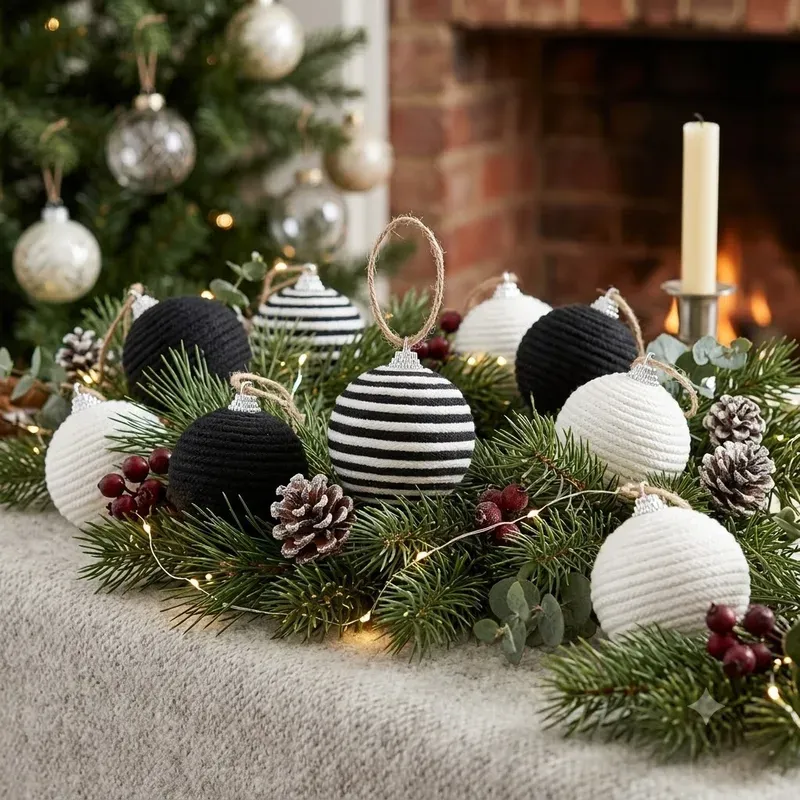
The cord wrap. Black and white is a severely limited palette, and if these were plain fabric spheres, the whole garland would read as a black-and-white photo and stop there. The horizontal cord adds a third element — line — on top of the palette’s contrast. It also catches light in a way flat fabric doesn’t, so the ornaments read as textured rather than painted. Everything else on the garland is green, brown, and red. These are the only pieces that aren’t seasonal colors, and that’s why they feel modern.
Wrapping a ball in cord takes about 15 minutes once you’ve done one.
- Start with a 3-inch foam ball and a spool of 2mm cotton cord.
- Apply a thin line of tacky glue around the ball’s equator and press the cord end into it.
- Wrap continuously, nudging each pass tight against the last — no gaps, no overlaps.
- Work from the equator toward one pole, then start a fresh cord at the equator and go the other way.
- Finish by tucking the end into the pole and covering it with the hanging loop.
About $3 in materials per ornament.
30. Quilted Stars, Woven Balls, and a Burlap Ribbon Garland
A tree this dense looks expensive. It isn’t. The quilted fabric stars are handmade from remnants; the woven texture balls are $4–$7 each at Target or Walmart; the gold baubles are the kind that come in a 30-pack for $12. The burlap ribbon is $6 for a 30-foot roll. Layer cheap, high-quantity fillers with a few standout handmade pieces and the eye reads the whole thing as considered. Compare with Idea #9 — a much sparser approach using the same red, green, and natural palette.
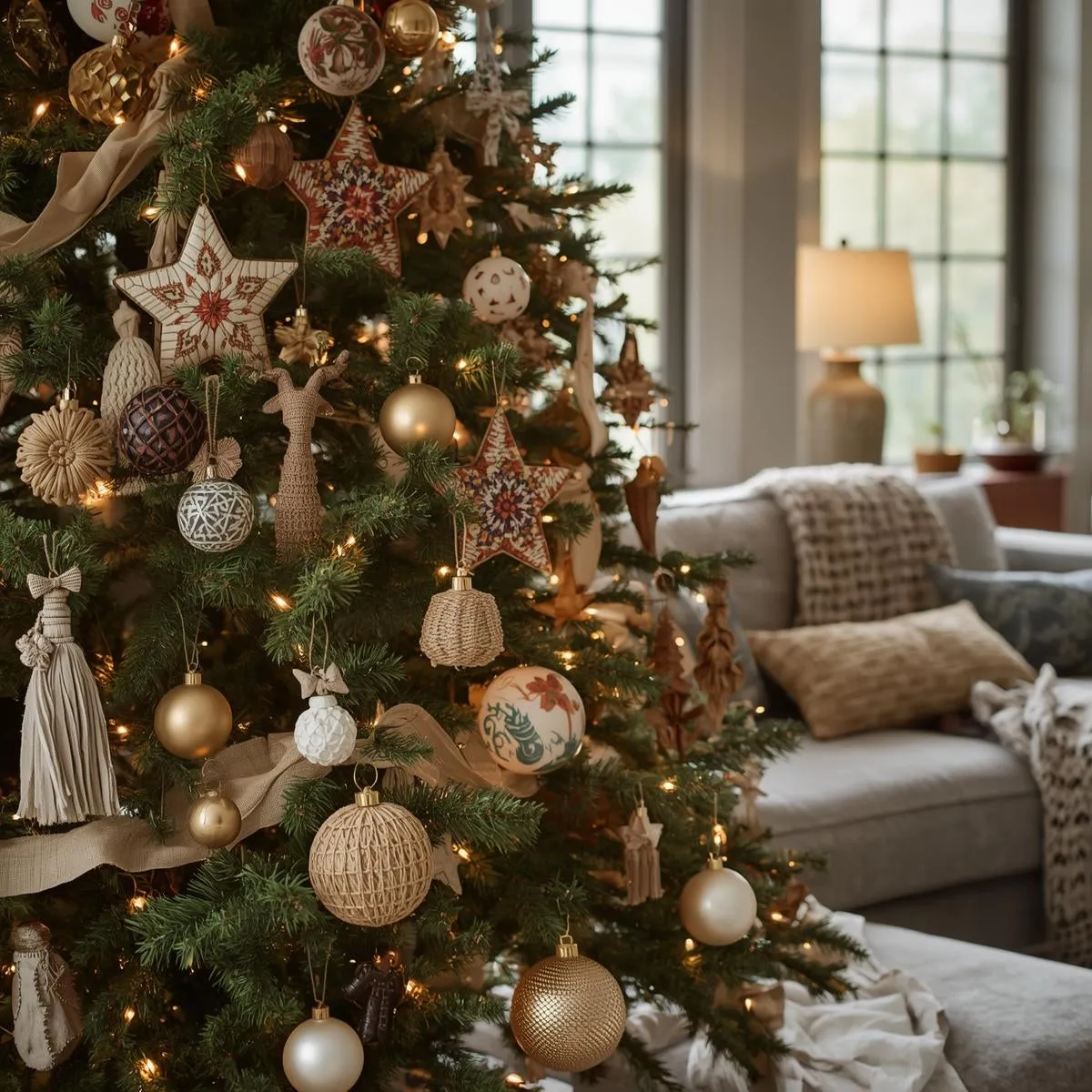
With this many textures, the risk is visual noise. Fix it with strict repetition: burlap ribbon swoops at even intervals — every 18 to 24 inches of tree height — and one consistent hanger type across the whole tree. Twine loops throughout, or ribbon throughout, never mixed. Mixed hangers are the fastest way to make a full tree look cluttered, because the eye registers the loops as their own pattern layered on top of the ornaments. One hanger type, one ribbon rhythm, and density becomes texture instead of chaos.
31. Grey Frayed-Edge Poinsettias Dusted with Frost
Grey is the unexpected choice for a holiday flower, and it works because the shape does the seasonal work instead of the color. A poinsettia silhouette in soft grey reads as winter immediately — your brain supplies the rest. The frayed petal edges add a softness a crisp cut edge wouldn’t, and the frost dusting gives the flower a slightly aged, almost fabric-antique quality. Small beaded clusters in the center catch warm light, which is the one bright note on an otherwise muted ornament.
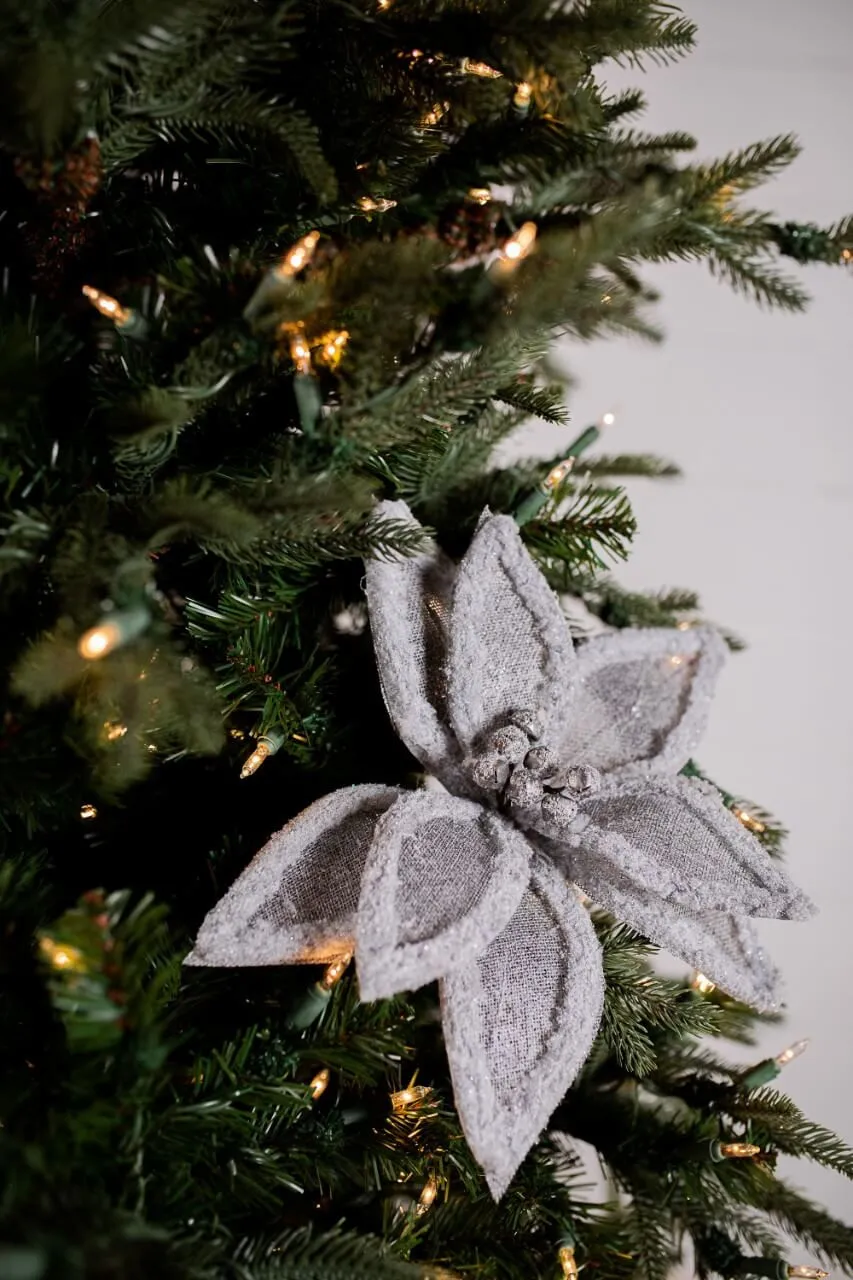
Roughly 50 percent grey fabric, 30 percent white frost, 15 percent green foliage behind, 5 percent gold bead. The green is only visible because the ornament sits in the tree — it’s the contrast that makes the grey read as a flower rather than a shape. Swap grey for cream and the ornament becomes traditional and slightly ordinary. Swap it for deep burgundy and it goes formal. Grey is what makes it modern, which is why it photographs so well against warm string lights.
32. Vintage-Print Fabric Balls on Simple Twine Loops
The twine. These ornaments are made from mismatched vintage-print fabric — florals, ticking, tiny geometries, all in cream and taupe and charcoal — and any of a dozen ribbon choices would have ruined them. Satin would look cheap. Grosgrain would compete with the prints. Twine is the one hanger that says “I didn’t try too hard,” which is exactly the message this set needs. It also keeps the palette completely neutral: no color enters the ornament except through the fabric itself.
Three-inch fabric balls are the most flexible ornament size there is. They work on a 4-foot tabletop tree, a 6-foot living room tree, and a garland, which is why you see so many of them. For a tree with 1.5-inch needles, hang them at the branch tip; for deeper 2-inch needles, push them inward so the ball sits in the greenery and the print reads through the gaps. If your tree is over 7 feet, mix in a few 4-inch pieces so the smaller ones aren’t lost.
Fabric balls are quiet, which is the point and also the risk. On a tree loaded with high-contrast ornaments, a set of muted neutral balls will disappear completely. Either commit to a full neutral tree or use these as connective tissue between louder pieces — never both. Storage matters too: stuffed fabric spheres flatten if they sit under weight. Pack them in a single layer in a rigid box, or hang them on a dowel in a closet rather than burying them in the ornament bin.
Thread, Twine, and a Tree That Looks Like You
Here’s what I keep coming back to after looking at hundreds of these: the ornaments people save, screenshot, and actually make are almost never the most complicated ones. They’re the ones with one clear idea — a red cuff, a pink ribbon, a pair of plush antlers — executed patiently. Pick two or three from this list, give yourself a weekend, and let the rest of the tree stay quiet.
And if you only do one thing this year, do the depth trick. Push a third of your fabric ornaments inward. It costs nothing and it changes everything. 📌 Pin this guide now — next December you’ll be glad you did.