
You know that specific Pinterest rabbit hole — the one that starts with a single flocked garland and ends forty minutes later with six saved photos of miniature snowy villages? Faux snow Christmas decor is having a major moment right now, and the 2026 version is noticeably more refined than the glitter-bomb garlands of years past.
We spent serious time browsing Costco, Temu, and Decorators Warehouse to bring you only what’s worth your attention this year, across price points from about $12 to $349. Inside you’ll find 34 curated ideas spanning rustic woodland vignettes, traditional red-and-green flocked garlands, winter-white miniature villages, and soft gold-and-green elegance — with budget and luxury versions compared side by side.
What changed for 2026 is the texture story: designers are reaching for matte faux snow and deeply flocked branches instead of high-shine glitter, because it photographs like real frost instead of craft-store sparkle. And stay until the end — we break down the most common mistakes that can ruin these looks. 📌 Save this to Pinterest for later — you’ll want to revisit these ideas. Some links here are affiliate links; if you buy through them we may earn a small commission at no extra cost to you.
1. Flocked Evergreen Branches With Warm Lights and White Berries
Here’s the trick that separates real-looking flocking from craft-store frost: run your warm white lights underneath the flocking, not over it. Tuck the wire along the main branch so the bulbs peek through the needles and the snow reads as lit from within. On branches like these, thin 100-bulb warm white strands with green wire disappear completely. Aim for one bulb cluster every 4 to 6 inches — denser looks fake, sparser looks sad.
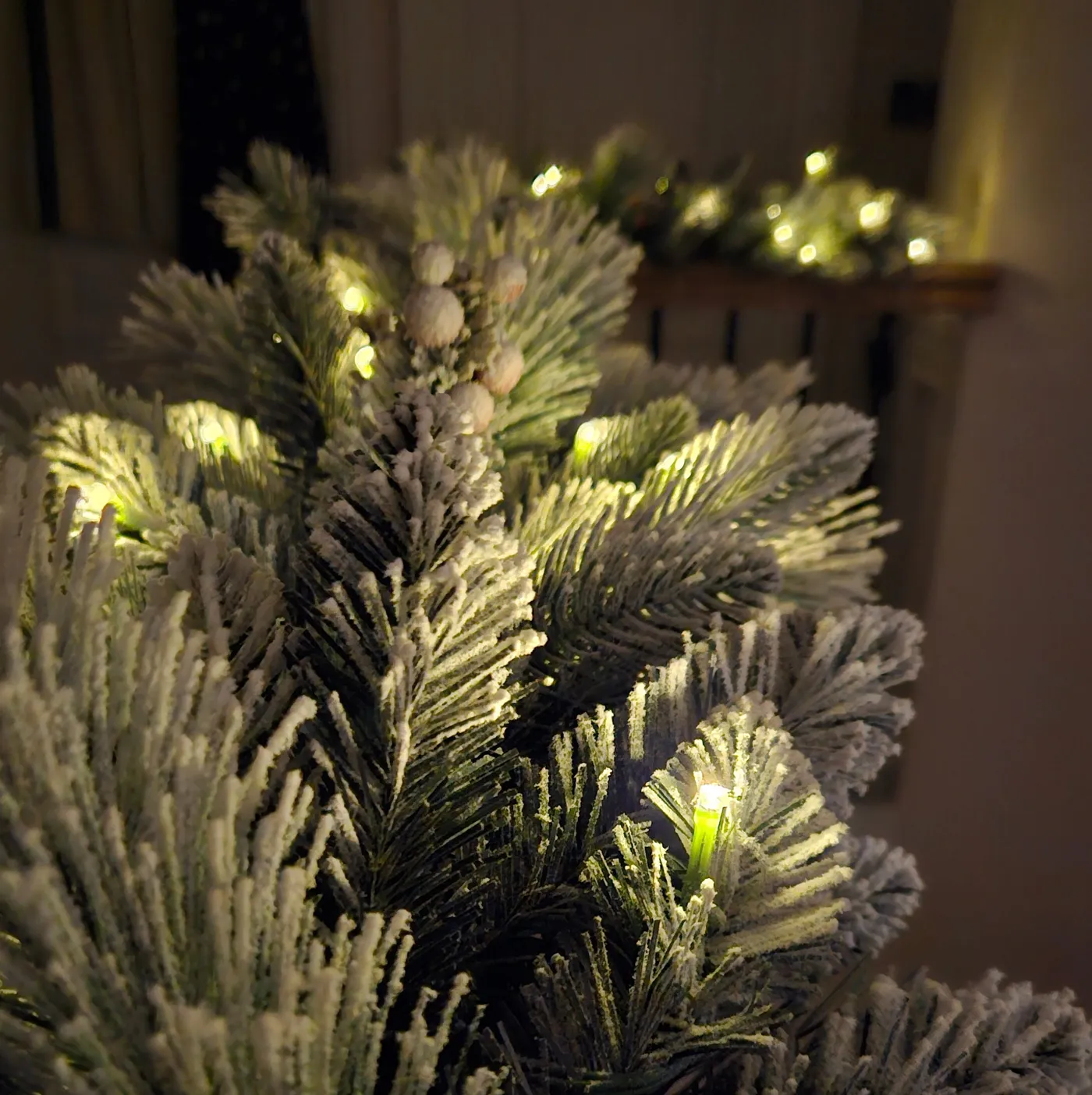
The white berries are what make this work. Without them, you just have frosted greenery — pretty, but flat. Those clusters of off-white fruit give the branch a mid-tone between dark needles and bright snow, and they catch the light instead of swallowing it. Keep them sparse and irregular: three or four clusters on a single branch is plenty. Cluster them evenly and it starts to look manufactured.
2. Rustic Faux Snow Vignette With Lanterns and Birch Logs
Here’s what it costs to pull this little scene together on a dark wood surface:
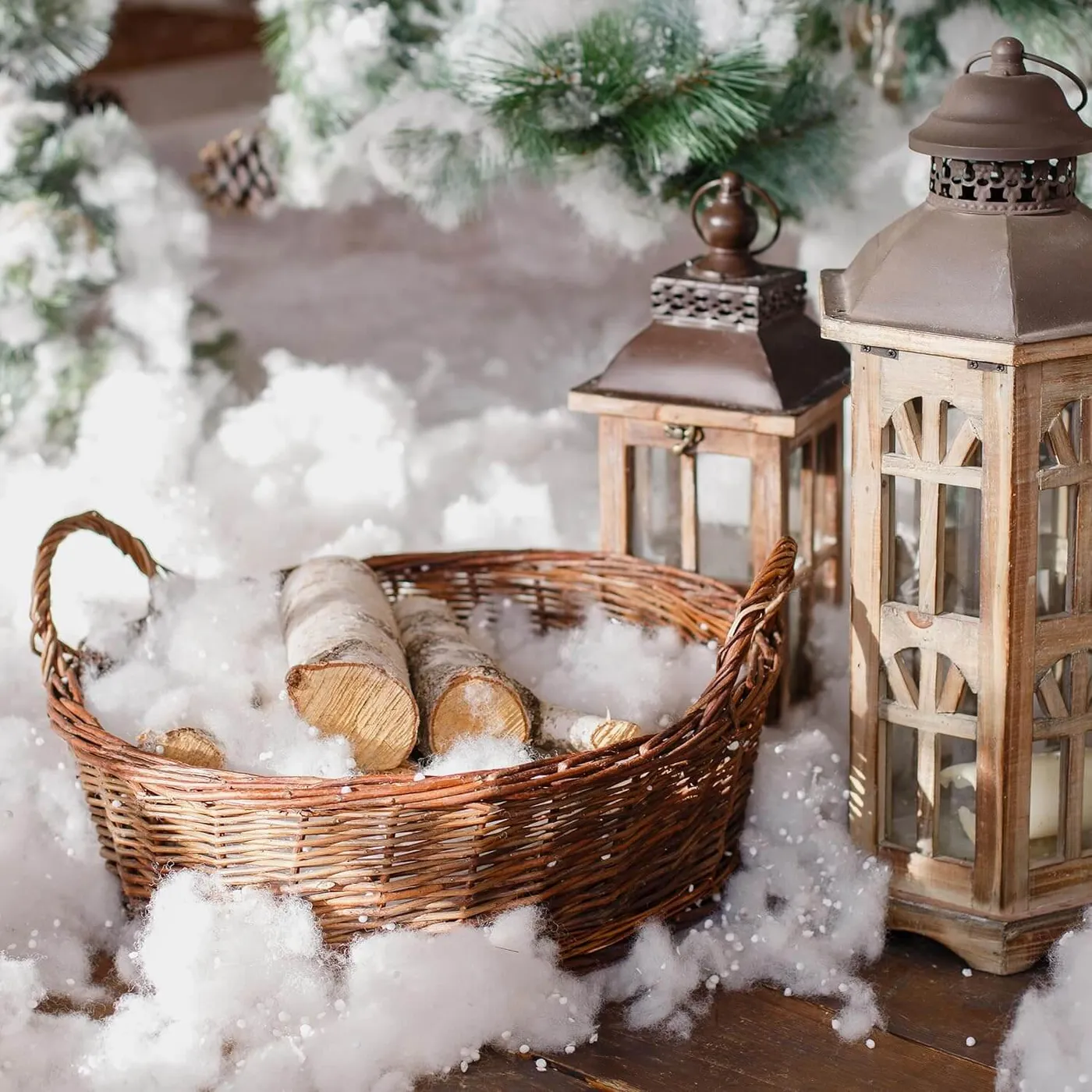
- Wicker basket: $18–$45
- Birch logs, 6–8 pieces: $15–$40
- Two wooden lanterns, small and large: $30–$90
- Faux snow, 5 lb bag: $12–$25
- Flocked greenery and a pinecone or two: $10–$30
Total: $85–$230. Budget alternative: a thrifted basket, birch from the fireplace pile, and dollar-store snow gets you there for $35–$60.
Why it works: this whole thing runs on height variation. The tall lantern, the medium lantern, the basket — three distinct heights and three distinct widths, arranged so nothing lines up. Designers call it stair-stepping, and it’s the reason a random pile of pretty objects reads as clutter while this reads as composed. The birch logs do quiet heavy lifting too: their pale bark echoes the faux snow, so the vignette feels like one palette instead of five.
3. Frosted Pine Garland With Glossy Red Berries and Pinecones
The formula here is 60 percent deep green pine, 25 percent white flocking, 10 percent bright red berries, and 5 percent brown pinecone. That last 5 percent is the piece people skip, and it’s the piece that keeps the red from feeling like a fire alarm. Swap the red berries for burgundy or copper and the garland goes moody and grown-up; keep the exact same ratio and it still holds together. Compare with Idea #19 — same formula, different setting entirely.
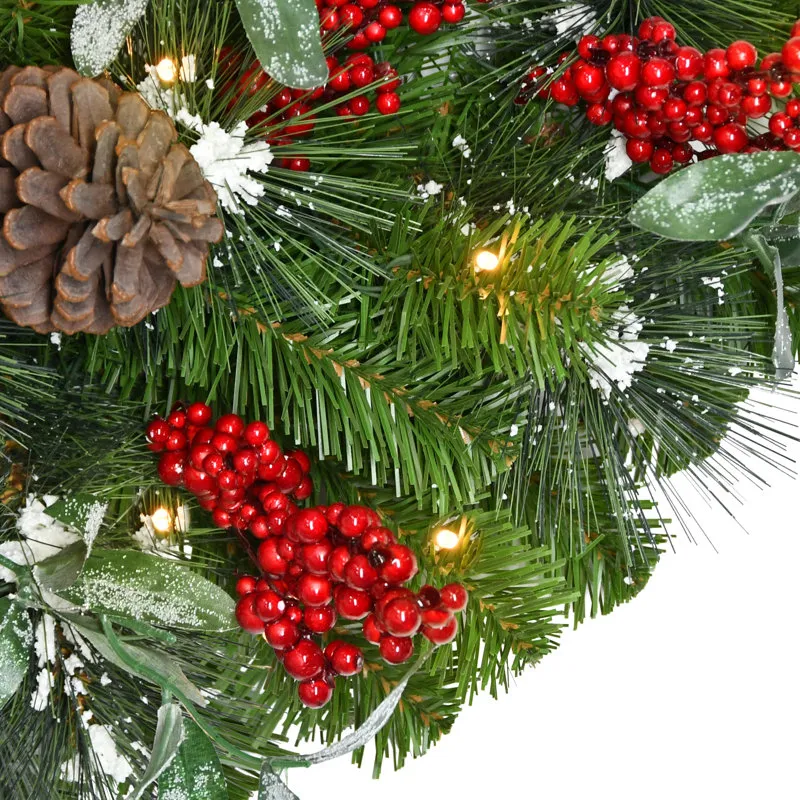
Glossy faux berries in direct sunlight will fade within a season or two, and cheap red dye can transfer onto pale mantels. Keep garlands off south-facing windowsills and out of reach of anyone under four feet tall. Also — the thing nobody warns you about — heavily flocked garlands shed. Expect a light dusting of white flakes every time you move one, so lay a sheet down before you hang it.
4. Faux Snow Christmas Swag With Pinecones, Berries, and LED Lights
Build a swag that actually looks even:
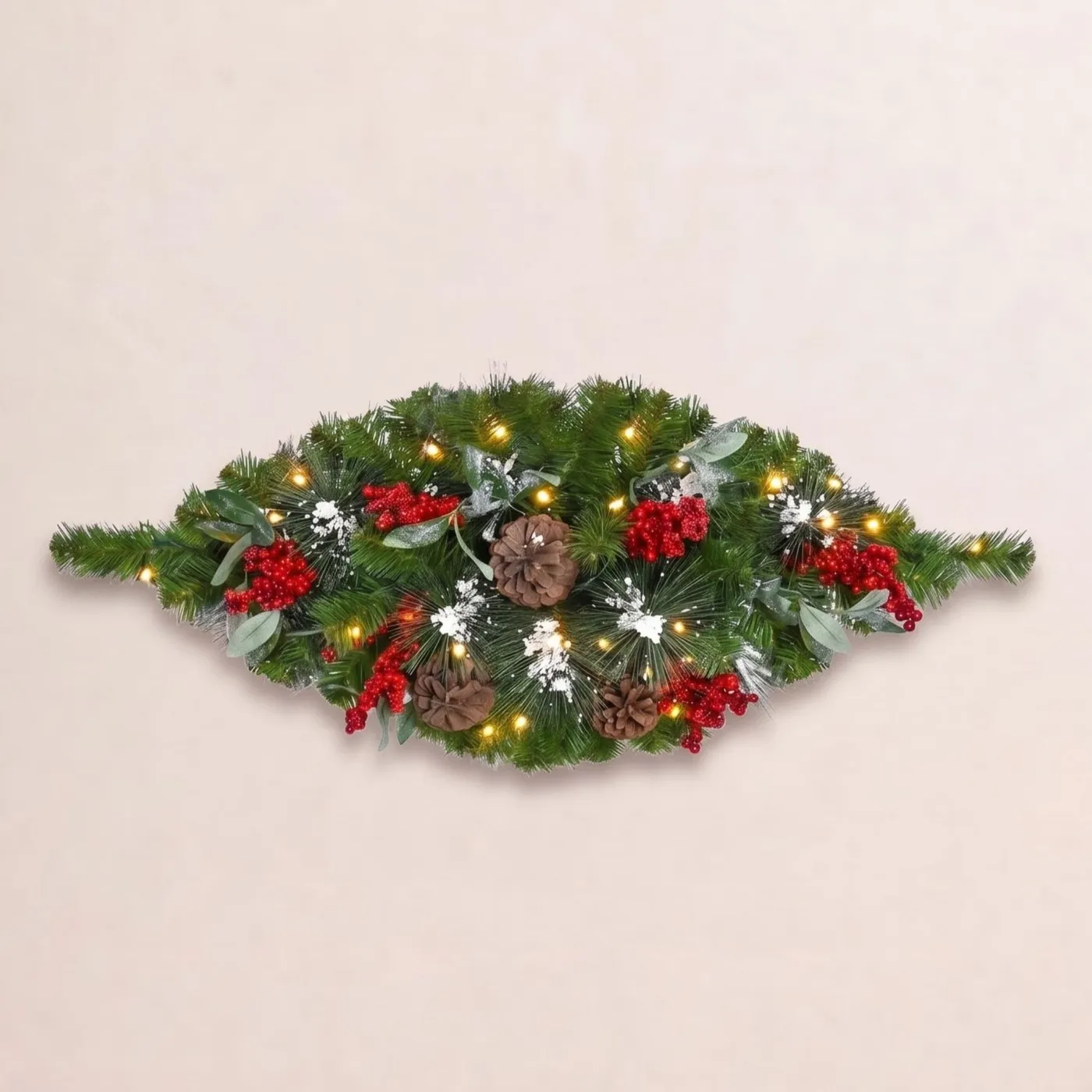
- Lay it flat and fluff every branch outward — 5 minutes, free.
- Wire three pinecones into the center third, never the ends.
- Add berry clusters in odd numbers, 4 to 6 inches apart.
- Weave warm white LED wire behind the greenery, never on top.
- Hang with two hooks so the swag swoops instead of sagging.
Time: about 40 minutes. Materials: $15–$40 if you’re adding to a swag you already own.
Symmetrical swags are harder than they look. Measure from the center out — if the left side is 22 inches, the right side needs to be 22 inches, and the pinecones should mirror at the same distance. The spiky silver-tipped accents here are the exception to the rule: scatter those unevenly so the whole thing doesn’t look stamped. That single imbalance is what keeps a formal swag from feeling like a store display.
5. Snow-Heavy Conifer Branch With Dark Red Berries
It’s the thickness of the snow. This branch isn’t dusted — it’s loaded, with white sitting in fat clumps on top of the needles rather than sprinkled between them. That’s the difference between a winter branch and a branch someone sneezed powdered sugar on. If you’re flocking your own, build it in two passes: a fine spray first to give the needles grip, then a heavier coat while the first is still tacky.
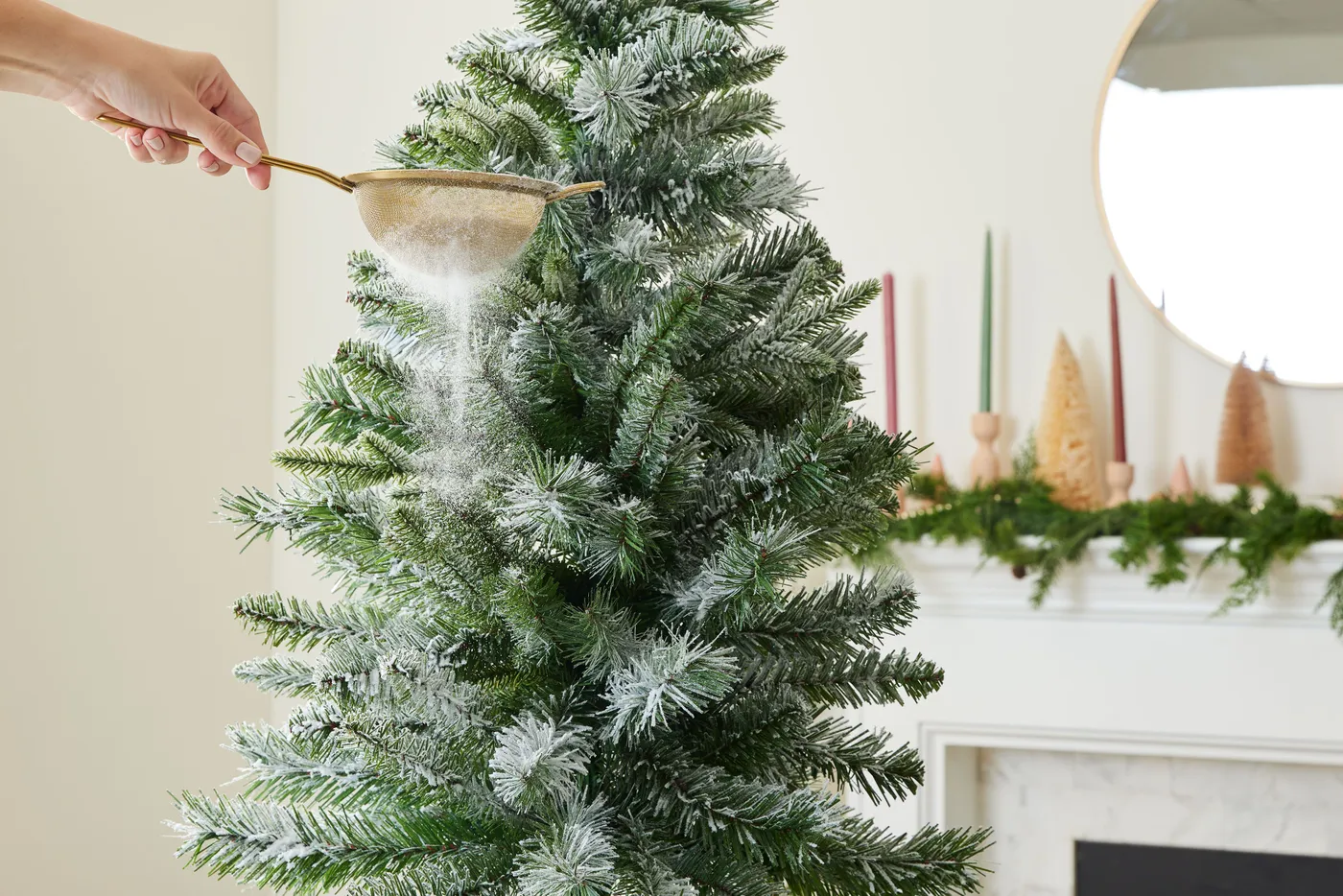
You don’t need a $60 designer branch for this. Grab a plain faux pine stem, a can of spray adhesive snow, and a bag of craft snow, then load it heavily in two passes. Roughly $14 total:
- Faux pine stem: $3–$6
- Spray adhesive snow: $6–$9
- Craft snow flakes: $4–$7
- Dark red berry picks: $3–$8
Facebook Marketplace in late November is full of people selling last year’s greenery cheap.
6. Whimsical Flocked Tree With Snowmen, Teal Accents, and a Winking Santa
What this cheerful corner actually costs:
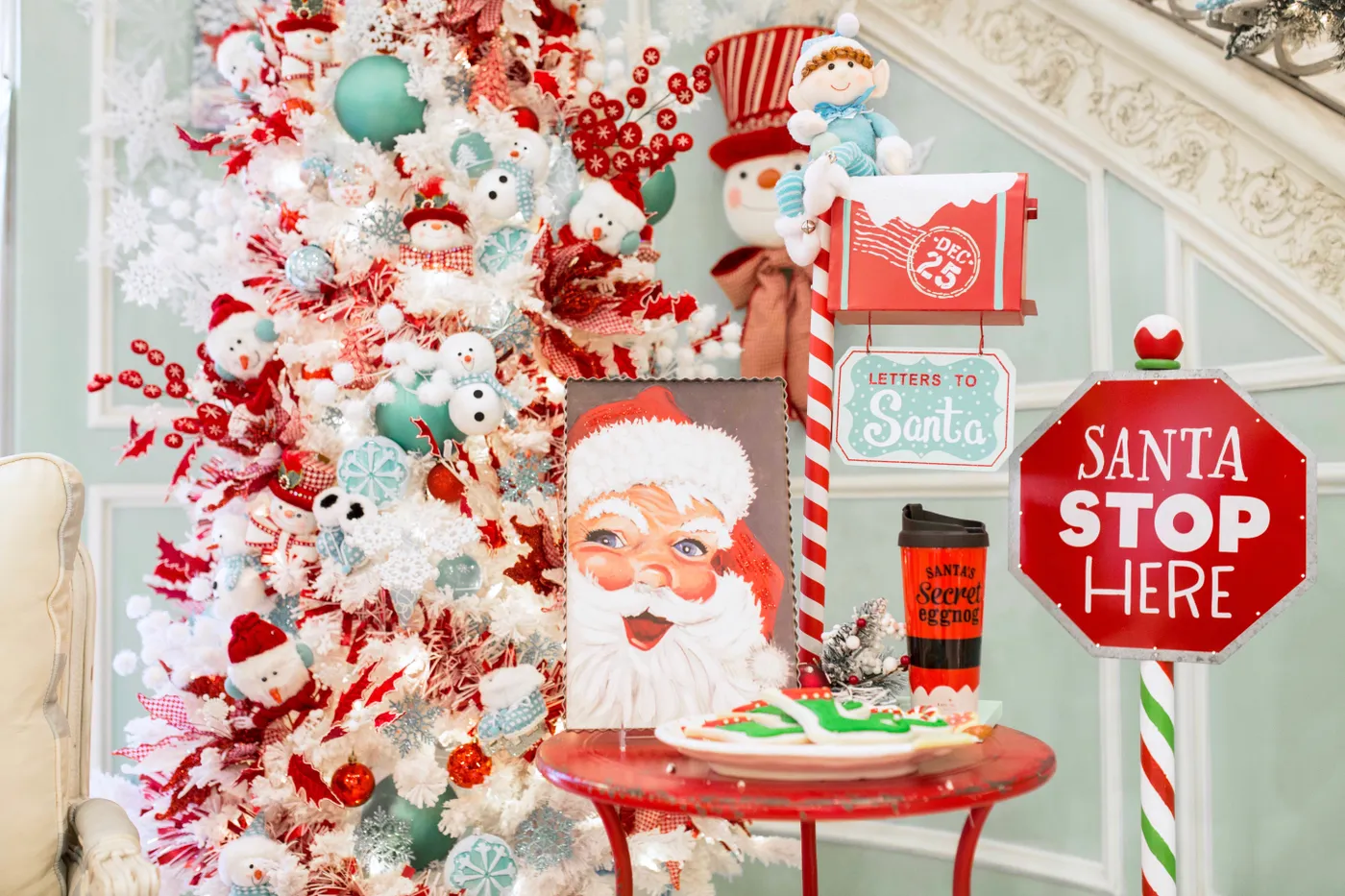
- 6.5 ft flocked tree: $120–$300
- Ornament set, snowmen and snowflakes: $40–$90
- Plaid ribbon, two rolls: $12–$28
- Vintage Santa portrait print and frame: $20–$55
- Letters to Santa mailbox: $25–$60
- Distressed red accent table: $60–$180
Total: $277–$713. Budget alternative: skip the new table and paint a thrifted side table red — about $30.
Storybook Christmas decor has been climbing on Pinterest for a couple of seasons, and this is the year it went fully nostalgic. The shift is cultural more than aesthetic: after years of stark minimalism, people want their holidays to feel like a memory. Teal mixed into red and white is the tell — a slightly off-register choice that reads vintage rather than catalog-perfect. It has staying power, mostly because the ornaments are the personality.
7. Heavily Flocked Pine Garland Against a Charcoal Wall
Two principles are doing all the work. First, contrast: heavy white flocking against a deep charcoal wall makes the snow read brighter than it actually is, which is why this garland looks expensive under ordinary room light. Second, texture repetition — the rough grain of the wooden mantel plays against the soft flocking, so nothing in the frame is smooth. Put this same garland against white shiplap and it disappears.
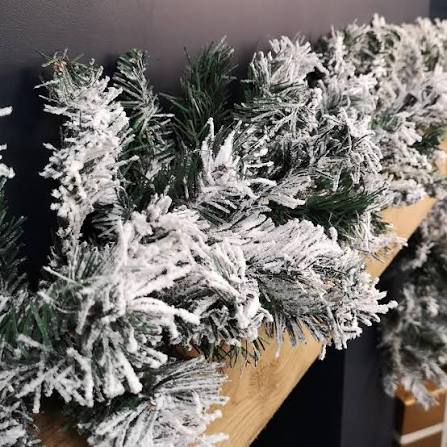
This look needs a mantel at least 60 inches wide and a wall dark enough to create the contrast. Standard 8-foot ceilings are fine, but a 9-foot flocked garland is the sweet spot — shorter and it looks like a scarf, longer and it puddles on the floor. If your mantel is under 48 inches, size down and skip the drape entirely. For a similar dark-wall effect in a narrower space, see Idea #12.
8. Tall Flocked Tree With Powder Blue and Grey Gift Wrap
This is a cool-palette formula: 55 percent white flocking, 30 percent evergreen, 10 percent powder blue, 5 percent grey and silver. The gifts do the color work so the tree itself stays quiet. Swap powder blue for blush and grey for warm taupe and you have the same room in a warmer mood — the ratio never changes, only the temperature. Keep the ribbon metallic either way, because it’s the only thing in the frame catching light.
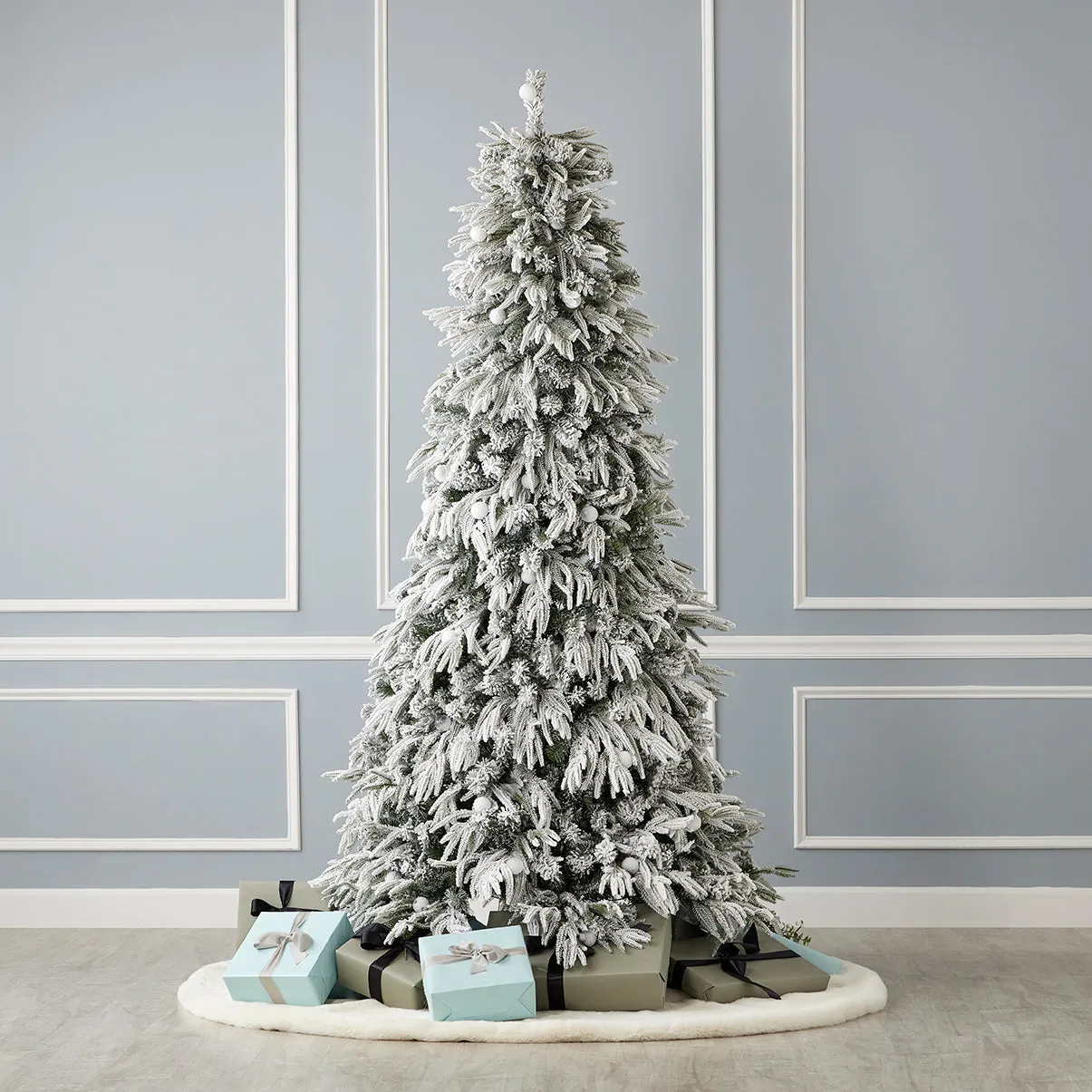
Flocked trees are magnetic to dust, and you can’t vacuum them the way you would a plain tree. Plan on a soft brush attachment on low suction once mid-season, and never wet-wipe flocking — it smears. The white faux fur skirt beneath this one needs a shake-out every week or so. Expect to lose a little flocking each year when you pack it up; that’s normal, not a defect.
9. White Frosted Village Mantel With Pom-Pom Stockings
Set the scene in five steps:
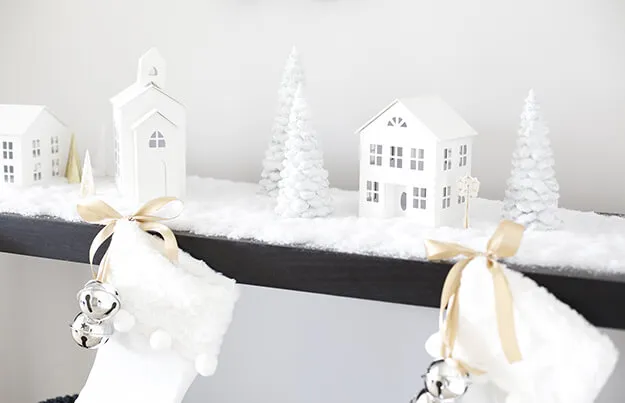
- Lay a towel on the mantel, then a thick layer of faux snow — this protects the wood.
- Place the tallest building off-center, then step down in height left and right.
- Tuck frosted bottle-brush trees behind the houses to hide the seams.
- Run one warm white strand along the back of the snow layer only.
- Hang stockings from gold ribbon so they clear the snow line.
Time: 45 minutes. Materials: roughly $30 if the village is already yours.
Starting from scratch:
- Paper village houses, set of 5: $18–$45
- Frosted bottle-brush trees, 6: $15–$35
- Faux snow, 5 lb: $12–$25
- Pom-pom stockings: $25–$60
- Gold satin ribbon and jingle bells: $10–$22
Total: $80–$187. Budget alternative: print free village templates online and glue them to card stock — under $15.
10. Illuminated Miniature Village on a Carved Wood Table
Check these before you commit a single house:
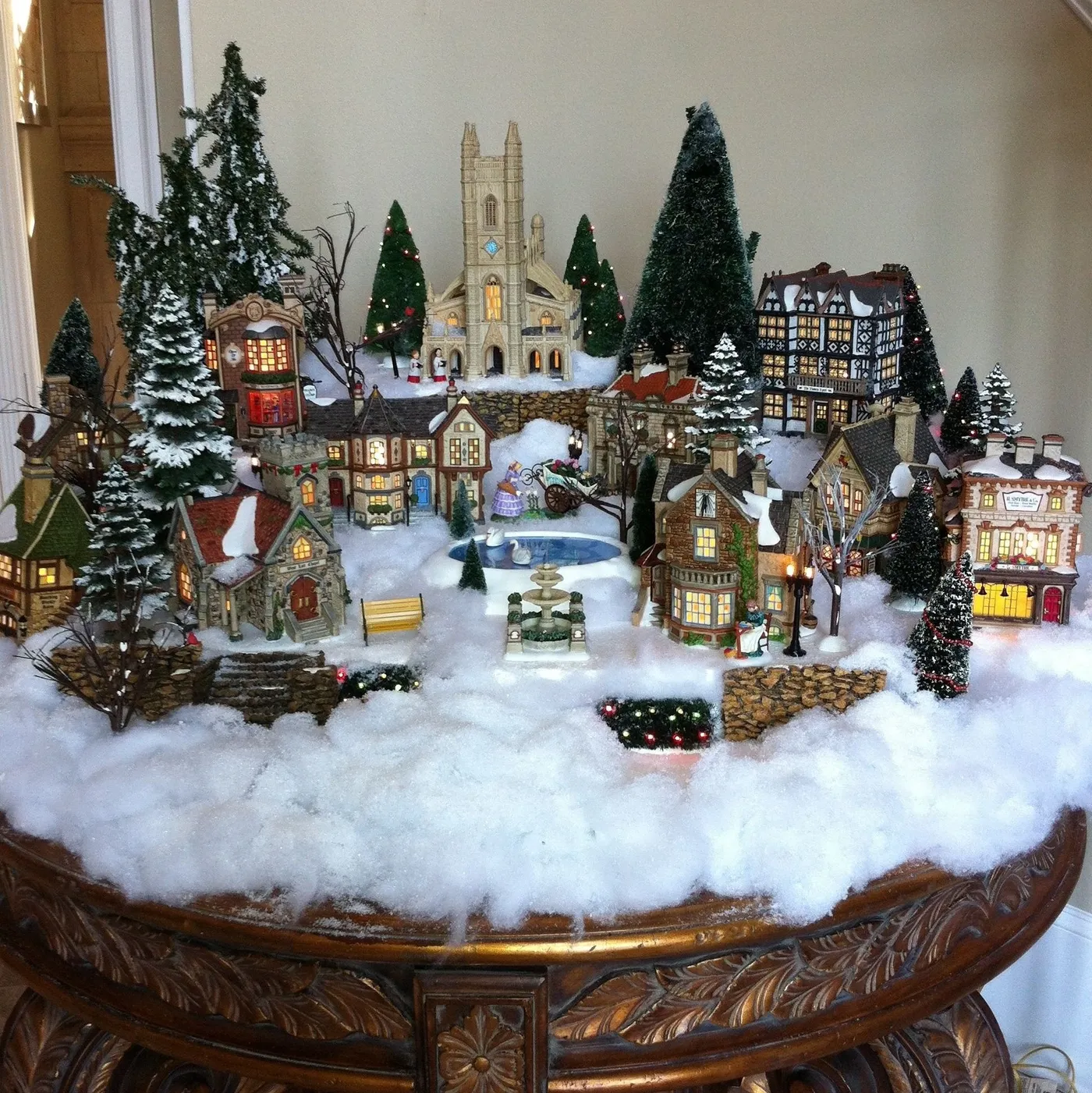
- Measure the table — you need at least 36 inches of depth for a two-row village.
- Count your outlets; lit villages usually need two to three power strips.
- Check the table’s finish before laying snow directly on it.
- Confirm the room can be dimmed, or the lights won’t read at all.
- Set a hard budget before you buy building number four.
Village displays fail when everything is the same height. Use books or small boxes under the snow to build two or three tiers, then hide the risers with snow and trees. Keep the tallest building at the back corner, never dead center — the eye needs somewhere to travel. And leave one bare patch of snow with nothing on it. Negative space is what makes a village look like a landscape instead of a shelf.
11. Flocked Tree in a Woven Basket Collar With Deep Green and Gold
The woven basket collar is the quiet hero here, and it’s also the easiest thing to fake. A $12 IKEA basket with the handles tucked in looks nearly identical to a $90 tree collar. Deep green baubles are the cheapest color to buy in bulk — Target and Walmart both stock 30-count green sets under $15 in early November. Topper aside, you can build this whole tree for under $200 if you already own the tree.
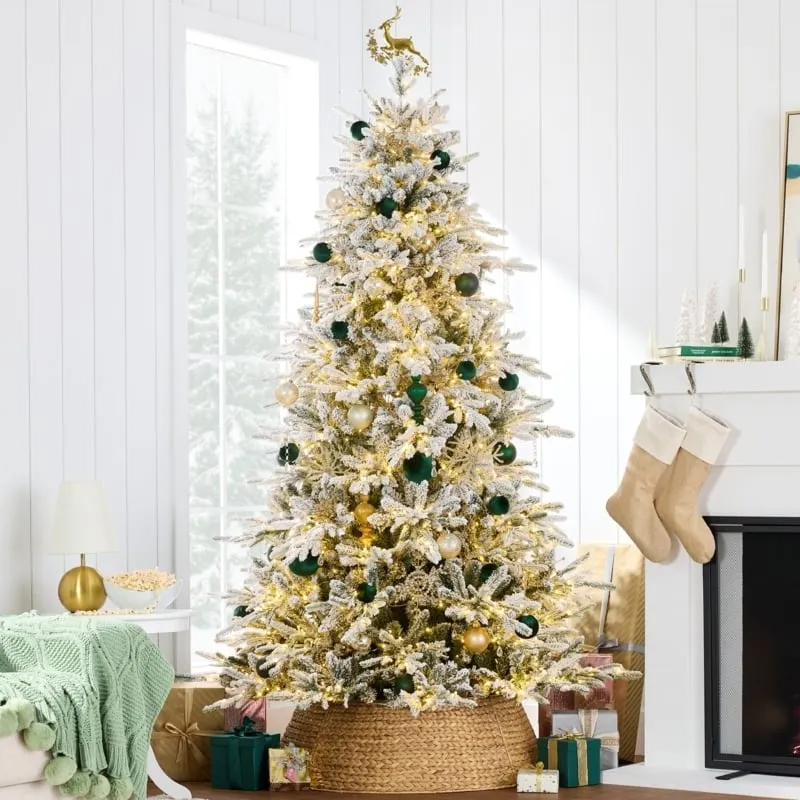
Three things make it land: the basket breaks up the tree’s bottom edge, the green ornaments echo the needles so the tree reads tonal rather than striped, and the gold arrives in small doses — topper, a few baubles, lamp base — never as a full set. That restraint is why it looks elegant instead of decorated. Compare with Idea #29, which uses the same basket trick against a warmer brown wall.
12. Flocked Wreath and Garland on a Charcoal Paneled Wall
If you want a wreath to look substantial on a large wall, go up a size from what feels right — 24 to 28 inches is the minimum for a standard door, but on a paneled wall like this one, 30 inches reads better. Hang it lower than instinct says: 5 to 6 inches above the console top, so the wreath and garland feel like one composition instead of two decorations floating in space.
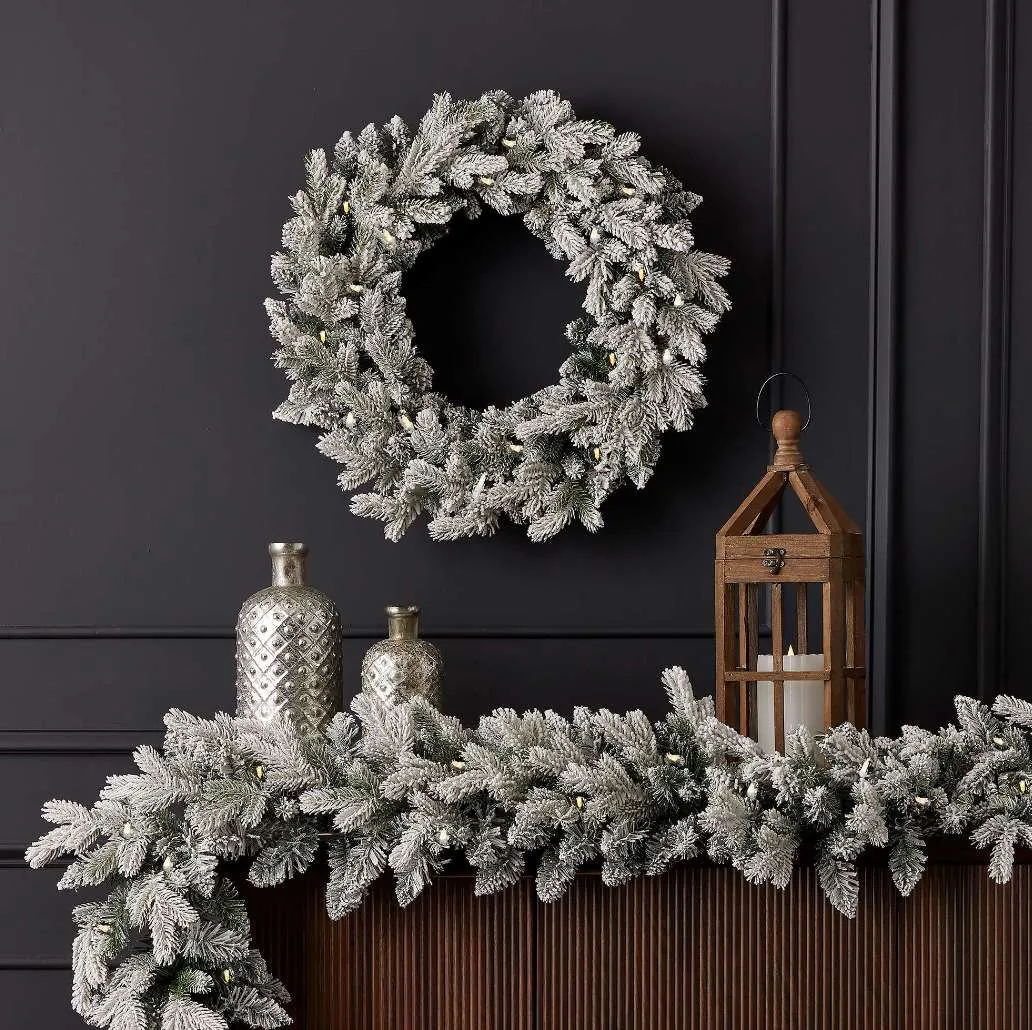
Two practical things. Flocked wreaths are heavy — a 30-inch one can run 6 to 8 pounds, so use a proper wall anchor, not a thumbtack and hope. And warm white lights on a flocked wreath need to be LED, full stop. Incandescent bulbs run hot enough to discolor the flocking over a season, and you won’t notice until the snow goes faintly yellow.
13. Nine-Foot Flocked Fir Garland Draped and Drooping
A 9-foot garland is the right call for a staircase rail or a span over 7 feet, and the wrong call for a standard 5-foot mantel, where it will puddle on the floor. Rule of thumb: garland should overhang each end by 6 to 10 inches. Nine feet covers a 7-to-8-foot span comfortably. If you’re working with an 8-foot ceiling, keep the swoop shallow — deep drapes eat headroom fast.
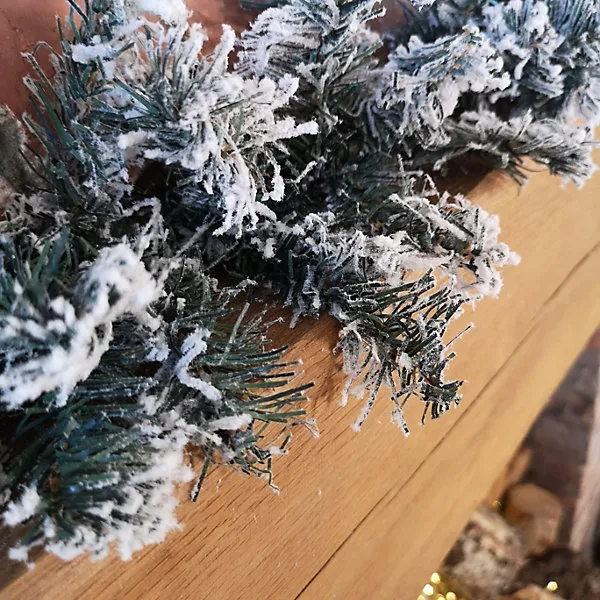
The flocking density is what you’re actually paying for. A cheap flocked garland has snow sprayed on the outer tips; a good one has it pressed into the branch structure so you see white in the gaps, not just on top. Hold a garland up to the light before buying — if you can see straight through the middle with no white, it’ll look thin on the wall no matter how you style it.
14. Bagged Soft-Flake Artificial Snow for Indoor Coverage
Soft polyester snow is the most forgiving option for indoor use and the messiest. It clings to everything — carpet fibers, wool coats, the dog. Vacuum it with a hose attachment rather than a beater bar, or you’ll grind it into the pile. It also compresses over a season, so fluff it by hand and top it off. And real talk: avoid it entirely on any surface where kids eat.
You don’t need the specialty Christmas stuff. Polyester quilt batting pulled apart by hand gives you the same soft drifts for a fraction of the cost, and a $6 bag of buffalo snow from the hardware store covers a console top. Thrift stores in January are goldmines — people dump entire snow villages once the season ends. Buy for next year, not this one.
15. Tabletop Snow Vignette in White, Blue, or Pink
Tabletop snow vignettes live or die on a 70/20/10 split: 70 percent white snow and pale neutrals, 20 percent color (this is where blue, pink, or teal enters), 10 percent shine. Keep the color in one material so it reads as deliberate rather than accidental. Swap the 20 percent for burgundy and the same vignette goes traditional; swap it for pale pink and it goes soft romantic. The bones stay put every time.
Five steps to build one:
- Choose a tray or board to contain the snow — $0 if you own one.
- Mound the snow higher at the back, tapering to nothing at the front edge.
- Set the tallest object one-third from the left, not in the middle.
- Add two smaller pieces at varying depths for layers.
- Tuck in one live sprig so the artificial reads as intentional.
16. Frosted Tree With Classic Red and Green Over a Red Tree Skirt
The red tree skirt is doing something sneaky: it visually anchors the tree to the floor, so the flocked white doesn’t float. Below it, the cream shag rug adds a second soft circle, and the knitted throw on the gray sofa pulls both red and green out into the room. That’s repetition across three zones, and it’s the reason the palette feels intentional instead of themed.
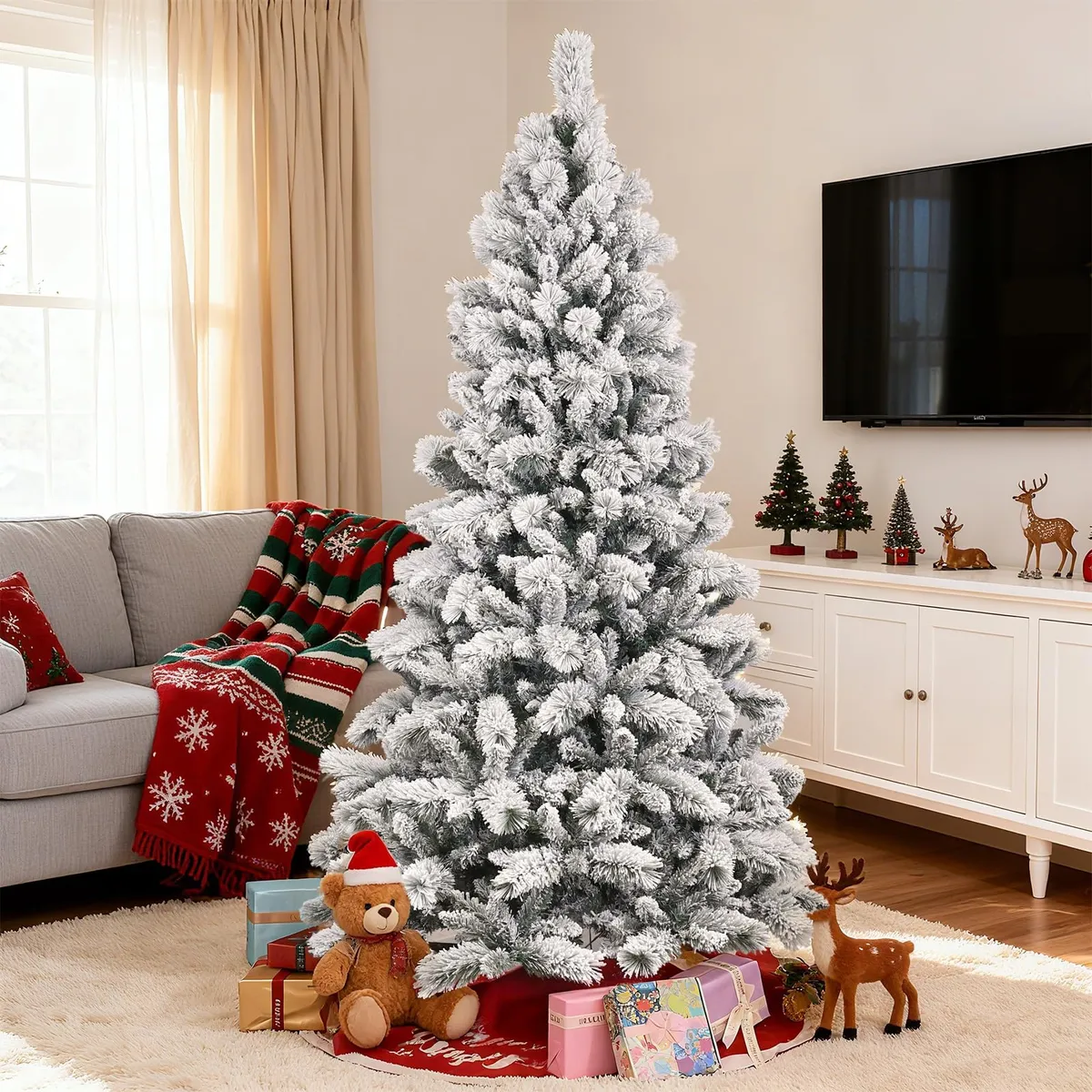
For the whole setup:
- 7.5 ft flocked tree: $150–$400
- Red fabric tree skirt: $20–$50
- Red and green ornament set: $30–$70
- Knitted throw and pillow: $30–$65
- Wrap and ribbon for gifts: $25–$60
Total: $255–$645. Budget alternative: a red flat sheet tucked around the base looks identical from three feet away — $8.
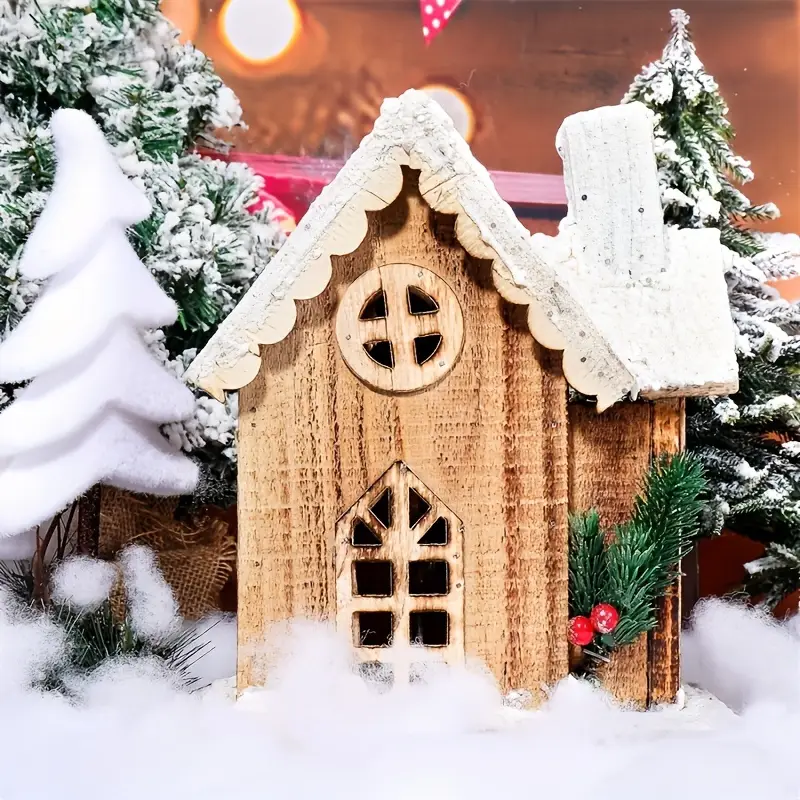
17. Lit Wooden Snow House With Spruce Sprigs and Red Berries
Small lit décor like this reads best at eye level or below — mantel, console, entry table — never high on a shelf where you can’t see the window glow. And group it with two objects of different heights. A single lit house alone on a tabletop looks like a nightlight; the same house with a candlestick and a small tree beside it looks like a scene someone composed.
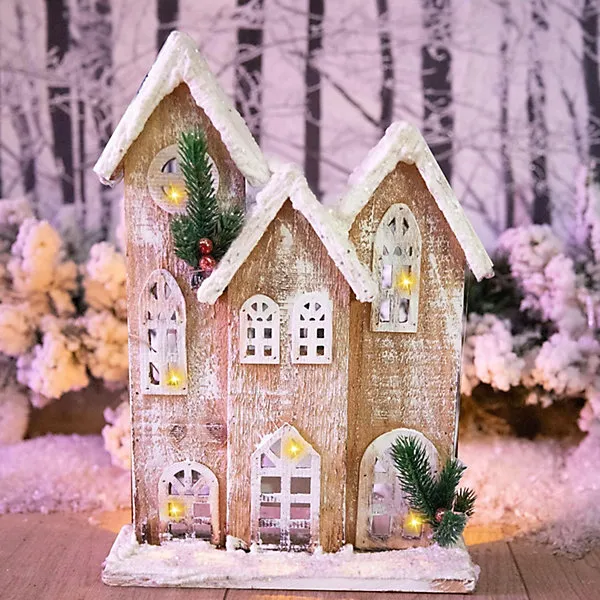
Battery-operated houses are charming until you’re changing AAAs every nine days. Look for a model with a built-in timer — six hours on, eighteen off — and use rechargeables. Also check the glitter: loose glitter on a piece that sits near a candle is a genuine fire hazard. If the finish sheds, seal it with a light coat of matte spray before you display it.
18. Pine and Berry Garland With Bells on a Stair Rail
The bells. Most garlands are visual only — you look at them. Add a few small bells and the garland announces itself every time someone walks past. It’s the cheapest upgrade in Christmas decorating and the one people actually remember. Hang three or four bells in the bottom third of the rail, where they’ll genuinely get brushed by a shoulder.
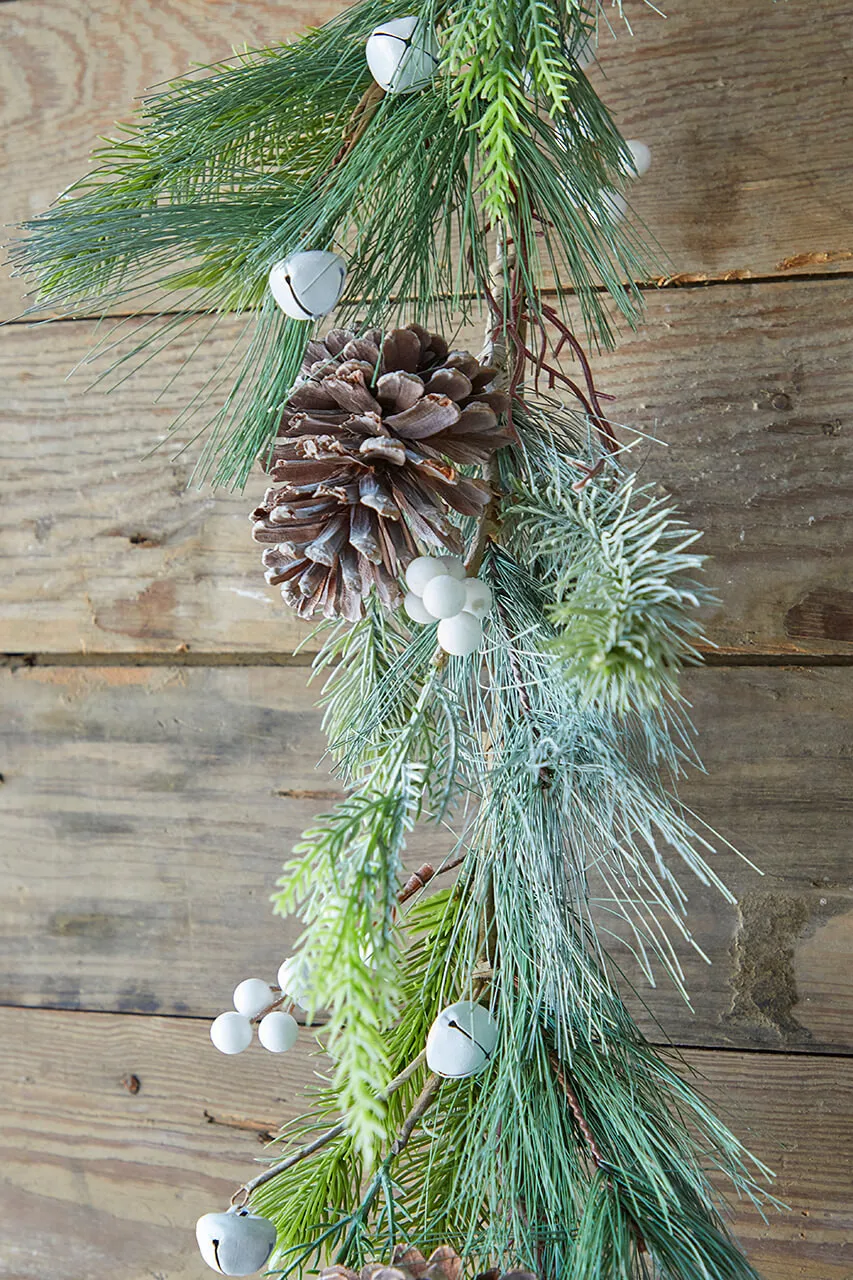
A stair rail garland needs to run the full length plus 12 inches at each end, or it will look like it gave up halfway. Measure the diagonal, not the run — most people under-order by two feet. Six-foot garlands suit a short half-flight; anything longer needs a 9-foot. Pair with Idea #27 if you’re doing the whole banister.
19. Heavily Flocked Garland on a Black Metal Railing
How to attach it so it stays put:
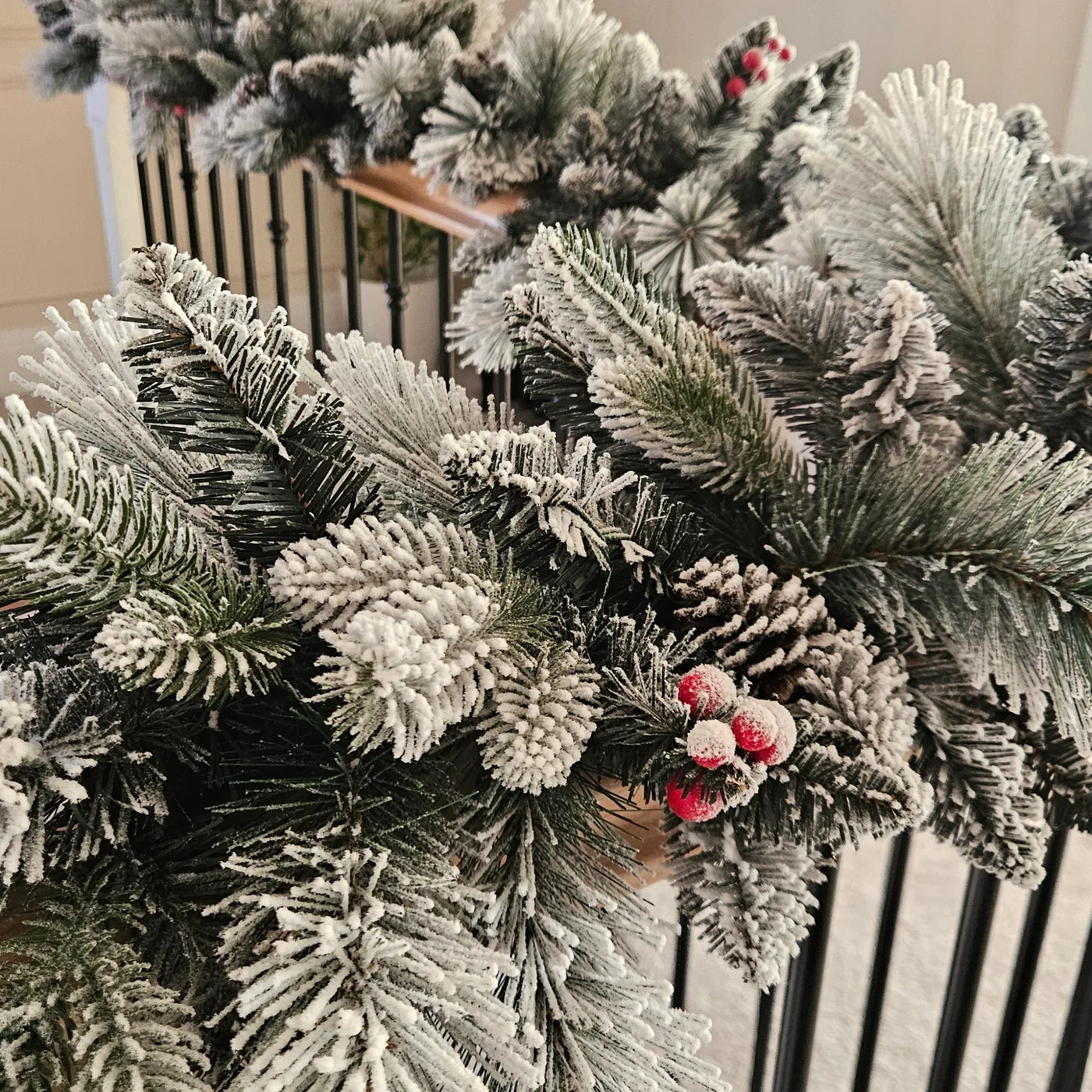
- Use zip ties in the same color as the railing, never twist ties.
- Zip every 18 inches, snug but not crushing the branch structure.
- Wire pinecones first, then berries — heavier elements sit lower.
- Fluff every branch outward after hanging, never before.
- Clip the tie tails flush so nothing catches a sleeve.
Time: 30 minutes for a 9-foot run. Materials: under $10 in zip ties.
Black railings are an advantage — they disappear behind dark green needles, which makes the garland look like it’s suspended in air. Lean into it: dark wire, dark ties, and flocking on the upper surfaces only. The contrast against black metal does more for the white snow than any extra coat of flocking would.
20. Winter White Entryway With Frosted Mini Trees and a Shag Runner
This entryway is almost entirely value-driven, not color-driven: white walls, white console, white rug, white trees — and the whole thing stays interesting because of texture. The formula is 80 percent white, 15 percent light wood, 5 percent brass. If you want to warm it up, change the wood tone; if you want drama, change the rug. The white stays exactly where it is.
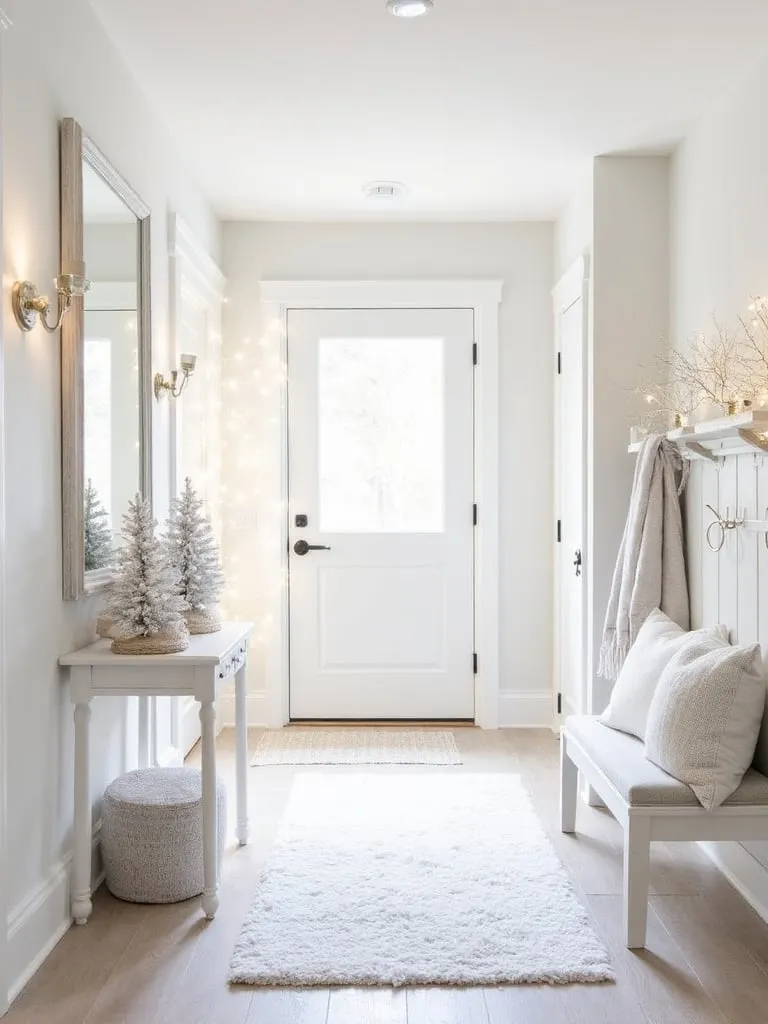
- Check the entry’s natural light before committing to all-white — north-facing rooms go gray.
- Measure the runner width; leave 4 inches of floor visible on each side.
- Confirm there’s an outlet near the console for the string lights.
- Test how the shag rug handles wet boots before winter really starts.
21. Tiered Village Display With Skiing Animal Ornaments Below
Here’s the build cost:
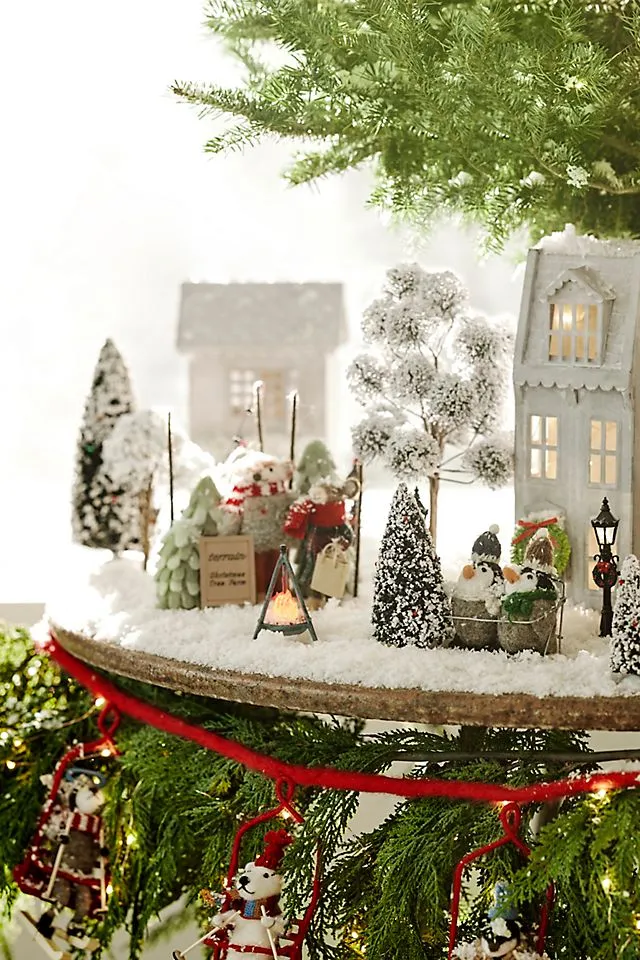
- Tiered wood shelf or crates: $25–$70
- Miniature houses, set of 4: $20–$55
- Frosted trees, mixed sizes: $15–$40
- Faux snow, 5 lb: $12–$25
- Red felt garland: $10–$22
- Skiing animal ornaments, set of 4: $15–$35
Total: $97–$247. Budget alternative: thrifted village pieces in January run $2–$5 apiece.
The two levels tell a story — formal village up top, playful ski slope below — and that contrast keeps a large display from feeling like one long shelf of stuff. The red felt garland also frames the lower level, giving the eye a clear place to stop. For a single-level version that fits on a bookshelf, see Idea #31.
22. Winter Wonderland Foyer With Layered White and Frosted Branches
The winter wonderland foyer is having a real moment — frost-and-branch entryways have climbed steadily on Pinterest over the last two seasons, and it makes sense. It’s the one space where you can go theatrical without committing the whole house. In 2026 the look has softened noticeably: less silver spray paint, more natural branches with a light dusting of snow, and warmer bulbs instead of cool white.
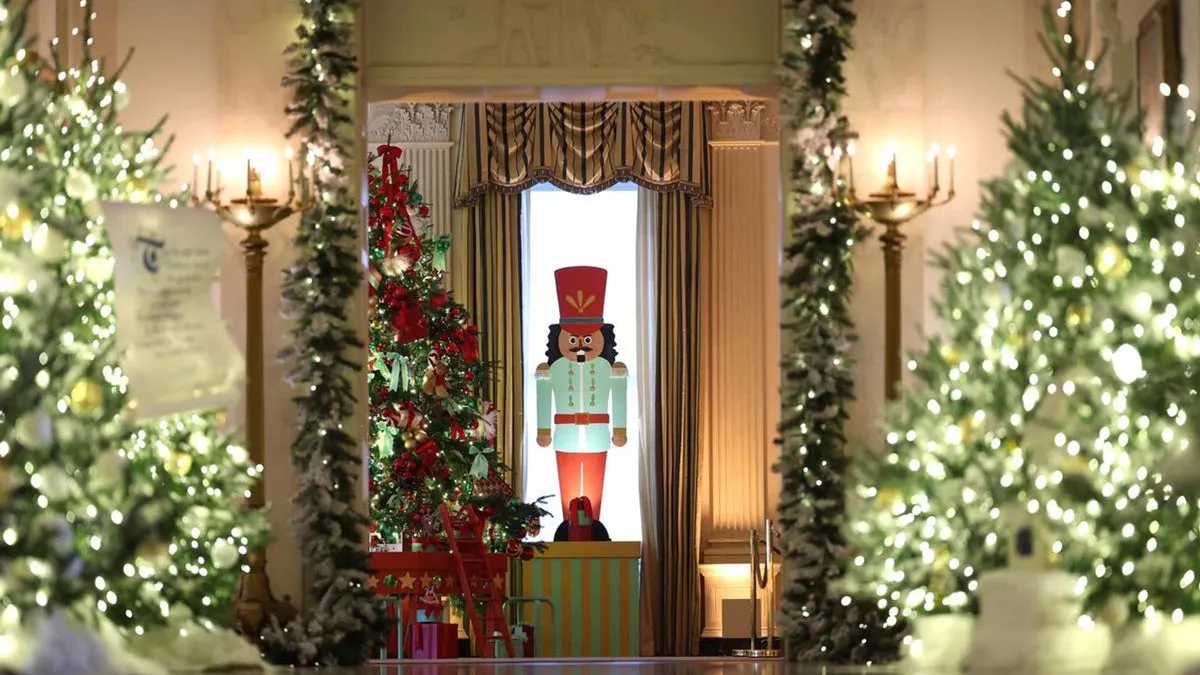
This one needs vertical space — a foyer with at least a 9-foot ceiling and roughly 6 by 8 feet of clear floor. Below that, branches start crowding the door swing. If your entry is narrow, keep the snow and branches on one side only and mirror it with a single light source. The tighter version of this same idea works in half the footprint.
23. Frosted Branches and Snow Drifts in a Narrow Entry
You can build this on a very small budget. Florist-quality frosted branches run $6 to $12 a stem at craft stores in early November, but plain manzanita or curly willow from the yard works just as well with a light coat of spray snow. Walmart sells a $4 bag of faux snow that covers a console top completely. Total outlay: under $40 for a foyer that looks like a hotel lobby.
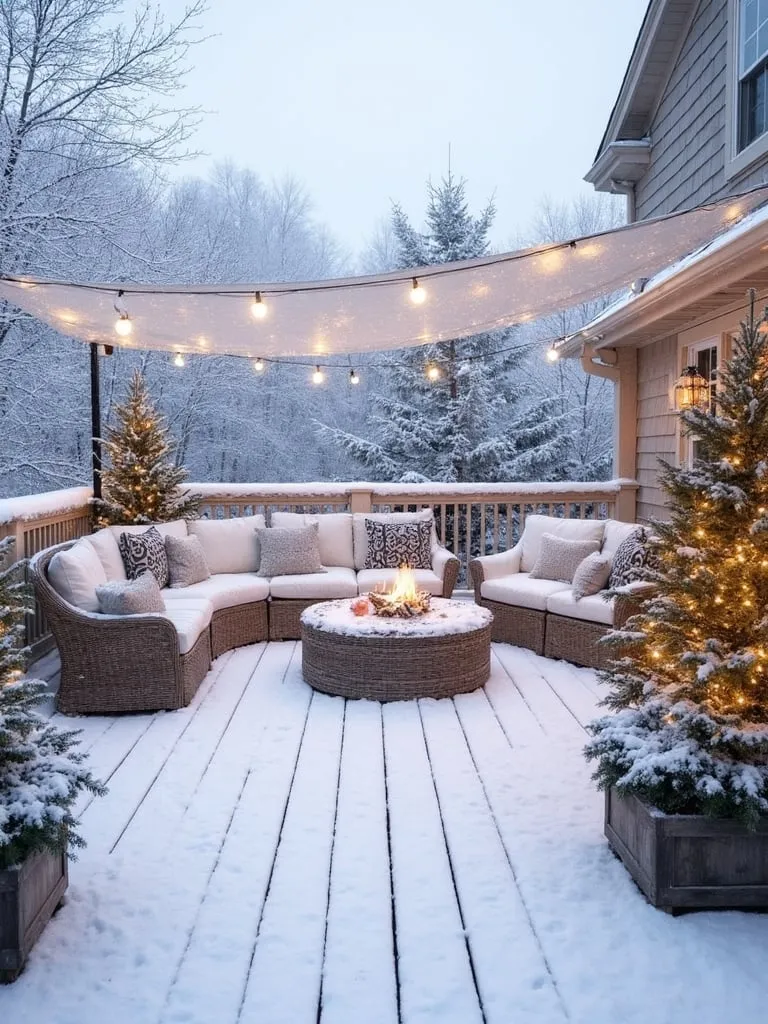
A word of caution about faux snow in an entry: it’s directly in the path of wet boots, wind, and whatever the dog drags in. Loose snow on the floor becomes a slipping hazard in seconds. Keep it contained in a tray or up on a console surface, never on the floor itself, and vacuum weekly. If you have toddlers, skip the loose stuff entirely.
24. Unlit Flocked Tree Built for Heavy Snow Coverage
Unlit flocked trees are the smarter buy if you plan to add your own lights, because you control where the glow lands. Wrap the trunk first, then work outward along each branch, keeping wire on the underside. A 7.5-foot flocked tree takes roughly 700 to 900 warm white mini lights to look right — more than you think, and flocking eats light, so err high rather than low.
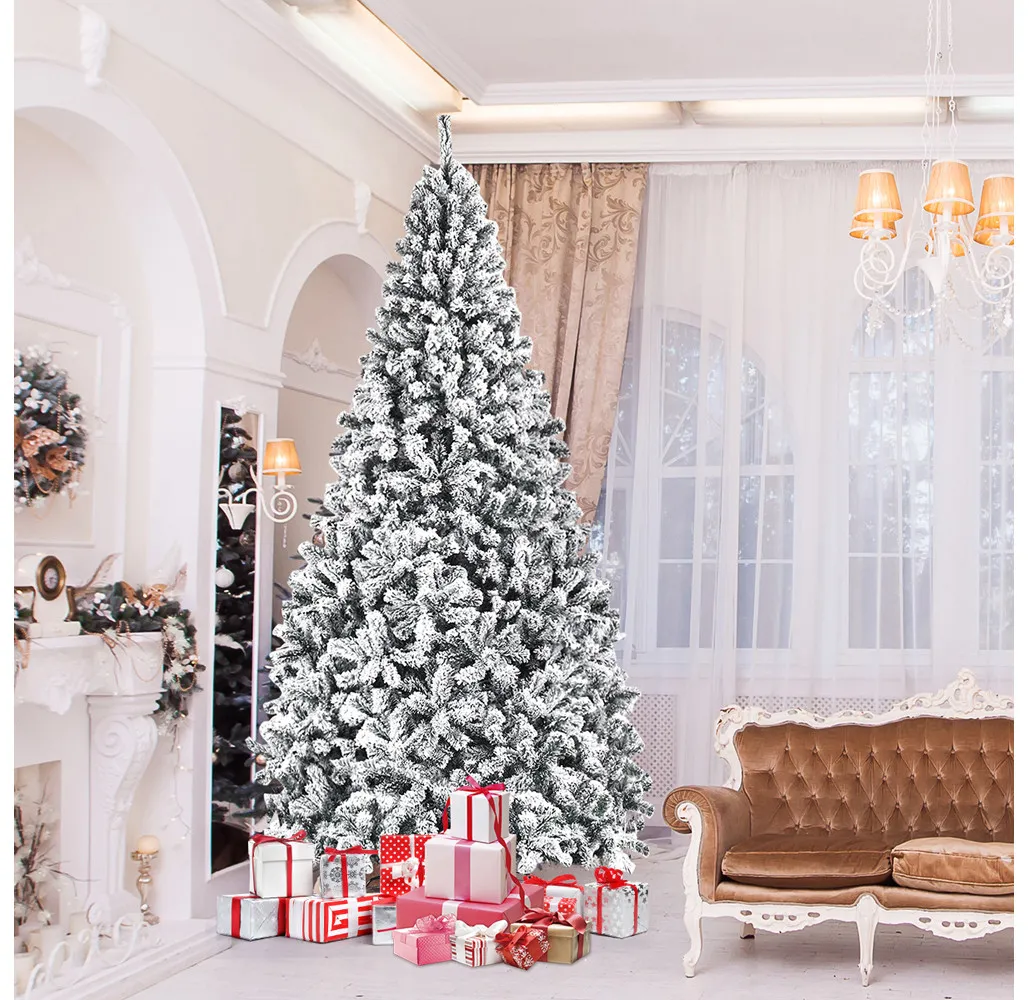
Flocked trees hold up five to seven seasons if you store them properly, and about two if you don’t. Use the original box or a proper tree bag, keep it in a dry space, and never store it somewhere damp — flocking absorbs moisture and yellows. Expect to shed a cup or two of white flakes every year during setup. That’s normal. A full bald patch is not.
25. Gold Candlesticks and Muted Green on a Dark Wood Console
It’s the aged gold. Bright brass would make this arrangement look like a wedding; this burnished, slightly tarnished gold reads collected and old. Paired with a muted, almost gray-green vase and dried eucalyptus, the whole vignette sits in that narrow space between festive and year-round — which means you can leave it up through January without anyone thinking you forgot to put Christmas away.
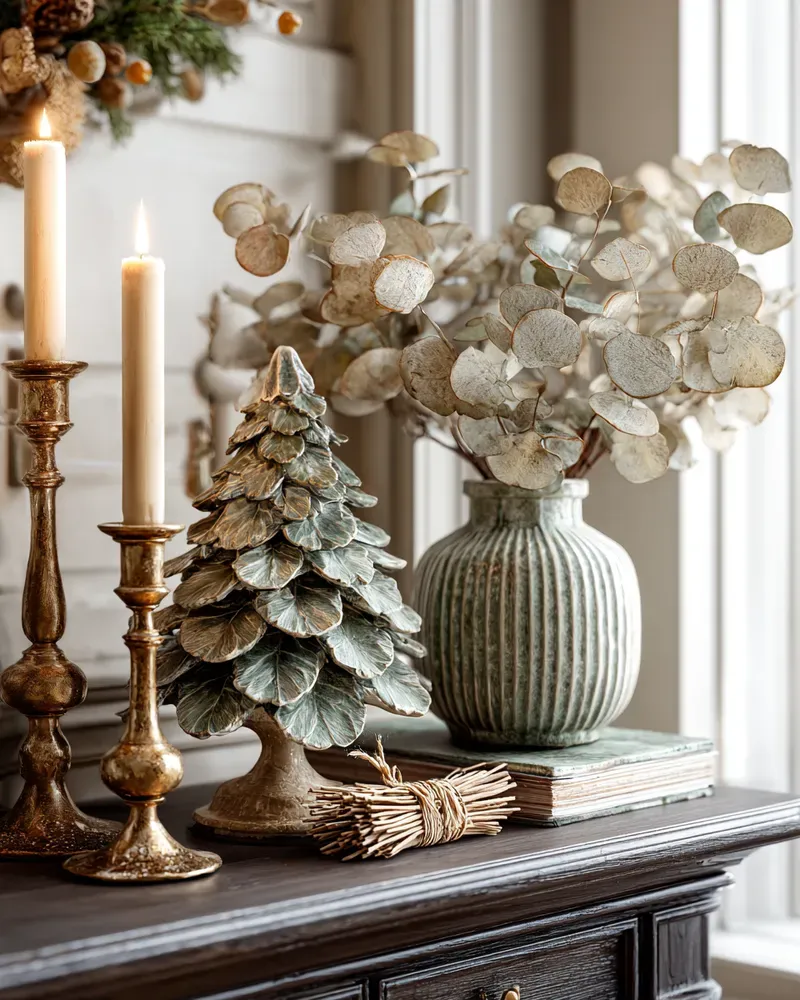
Count the proportions: 50 percent dark wood and shadow, 30 percent muted green, 15 percent cream, 5 percent aged gold. The cream tapers are the only real light source, so they get to be the focal point without competing. Change the green to deep burgundy and this exact formula becomes a Thanksgiving centerpiece. The bones stay; only the accent moves.
26. Flocked Greens Across Mantels and Shelves in Mixed Scale
Varying scale is the whole trick: a wide garland on the mantel, a mid-size tree on the shelf, a small flocked pick tucked into a bookcase. Same material, three sizes, which gives the eye a rhythm as it moves across the room. Do it all at one size and the room reads like a store display. That repetition of white across separate surfaces is what makes the whole space feel snowed-on.
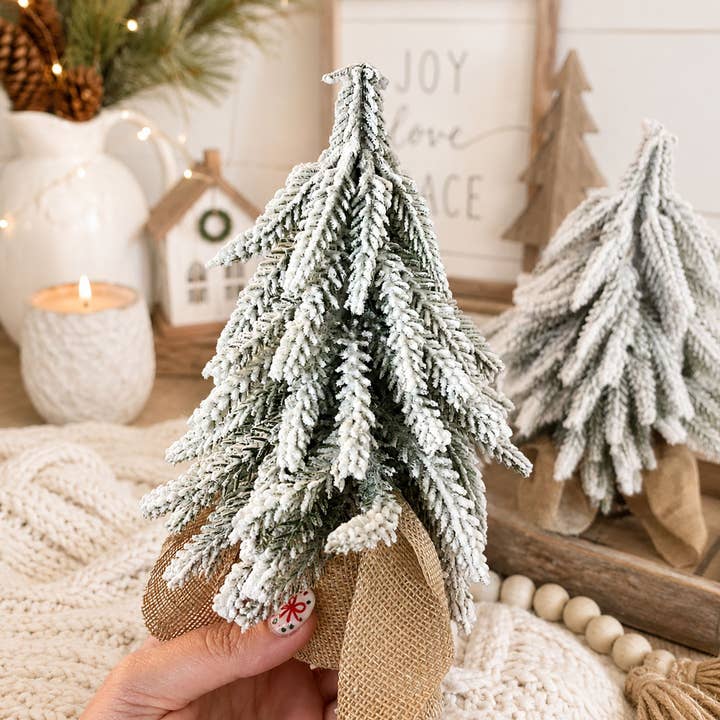
The shopping list:
- Flocked garland, 6 ft: $25–$60
- Flocked tree, 3 ft: $30–$70
- Flocked picks, set of 6: $10–$25
- Faux snow, 5 lb: $12–$25
- Warm white mini lights: $10–$20
Total: $87–$200. Budget alternative: buy one long garland and cut it into three lengths — under $40 total.
27. Flocked Garland Layered Over a Dark Wood Console
A console garland should run about one and a half times the width of the console — so a 60-inch console wants a 7- to 9-foot garland. Anything shorter looks like a decoration; anything much longer and you’re fighting the floor. If your console is narrow, cascade one end down the side instead of draping both. It’s the same trick used in Idea #13, just tighter.
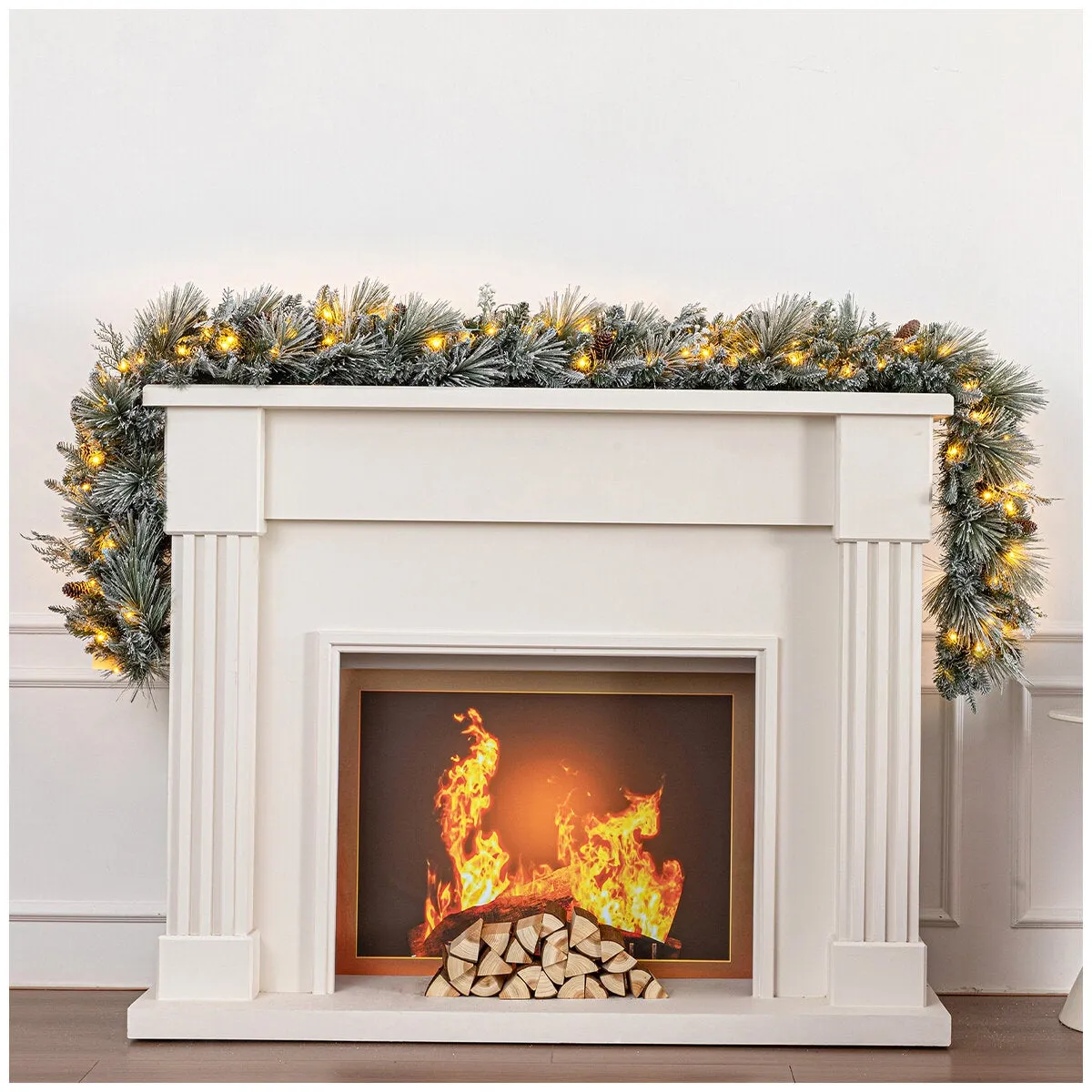
How to style it without overthinking:
- Clear the console completely before you start — no shortcuts here.
- Anchor the garland at both ends with removable hooks.
- Shape one shallow dip in the center, then fluff outward.
- Set a candle or lantern on top of the garland, not beside it.
- Leave one third of the console surface bare.
Time: 25 minutes. Materials: $0 beyond the garland.
28. Pre-Lit Flocked Garland With a Warm, Steady Glow
Pre-lit is convenient and slightly limiting. If a bulb section fails, you’re either restringing the whole thing or hiding the dead run behind a pinecone. Check that the strand is replaceable before you buy, and that the plug end reaches an outlet without an extension cord dangling in view. On flocked pre-lits, also confirm the bulbs are LED — incandescent will discolor the flocking by February.
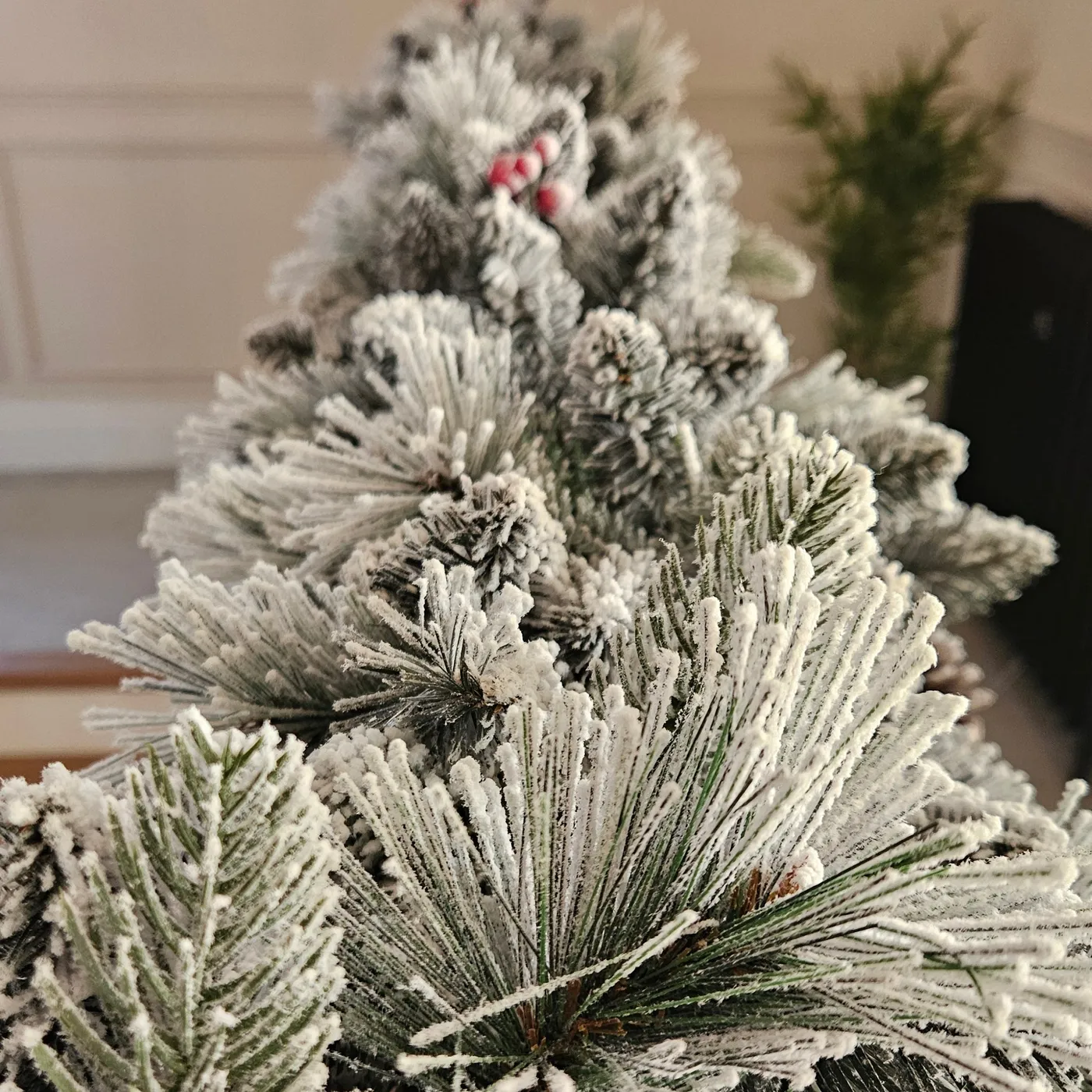
Unlit garland plus a $9 strand of battery fairy lights gets you the same look for roughly half the price, and you can swap the lights when they die instead of replacing the garland. Target and Walmart both sell 20-foot warm white micro strands under $12 during the holidays. The trade-off is a battery pack to hide — tuck it behind a pinecone and nobody will ever know.
29. Flocked Tree in a Basket Against a Warm Brown Wall
Brown walls and flocked trees are an underrated pairing, because brown is a warm neutral and warm neutrals make white snow look soft rather than stark. If you’re painting for this look, go two shades deeper than you think — the flocking bounces so much light that a mid-tone reads light on the wall. And put the gold sconces on a dimmer; the wall color is the star here, not the lighting.
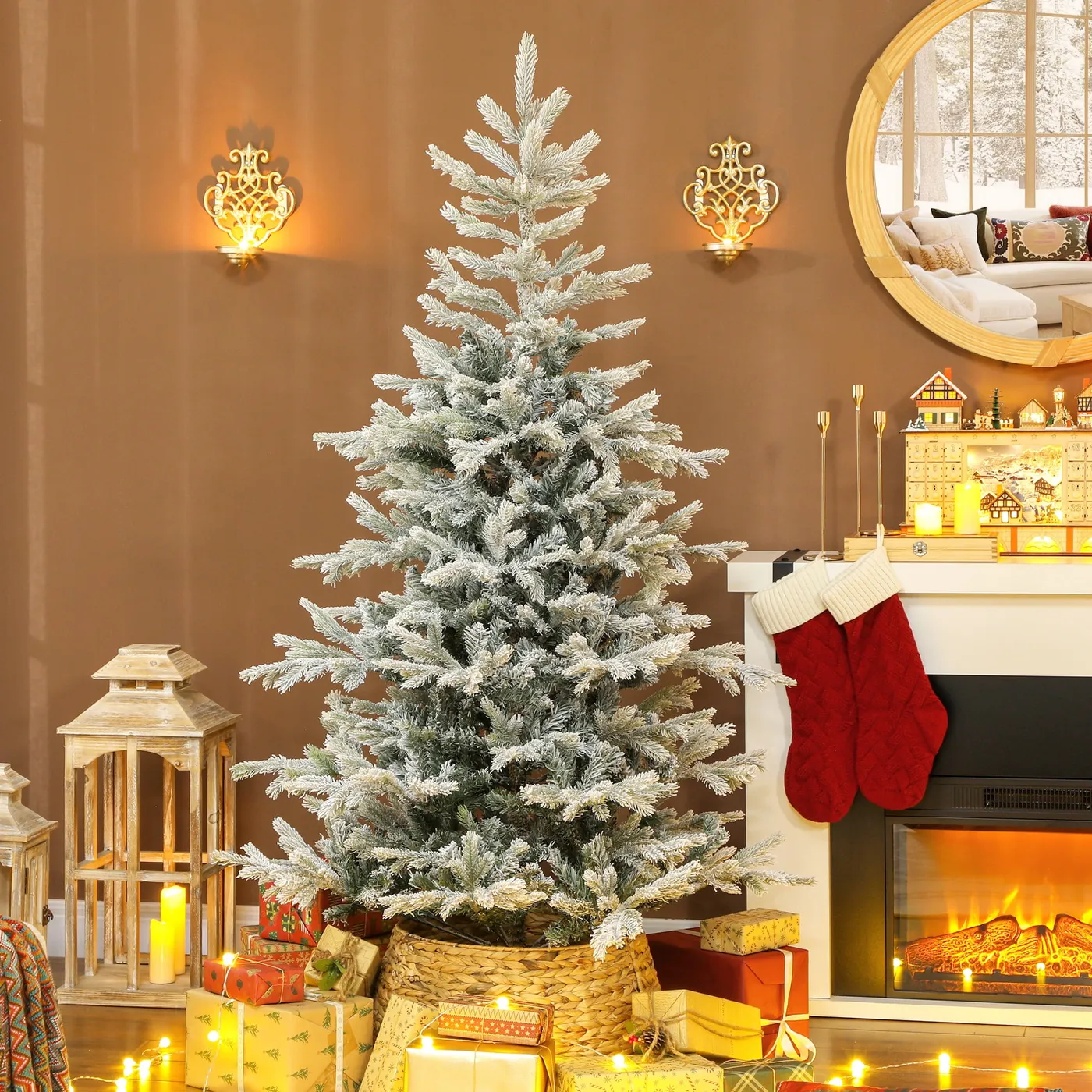
Warm brown as a room color has been climbing back for a couple of years, and holiday decor is following right behind it. Instead of the all-white, cool-toned Christmas that dominated the late 2010s, 2026 leans toward brown, cream, burgundy, and aged gold — a palette that photographs warm and feels cozier in person. Flocked greenery is the bridge that keeps it from feeling dark.
30. Faux Snow Bauble Diorama With Tiny Figures
Make one in an evening:
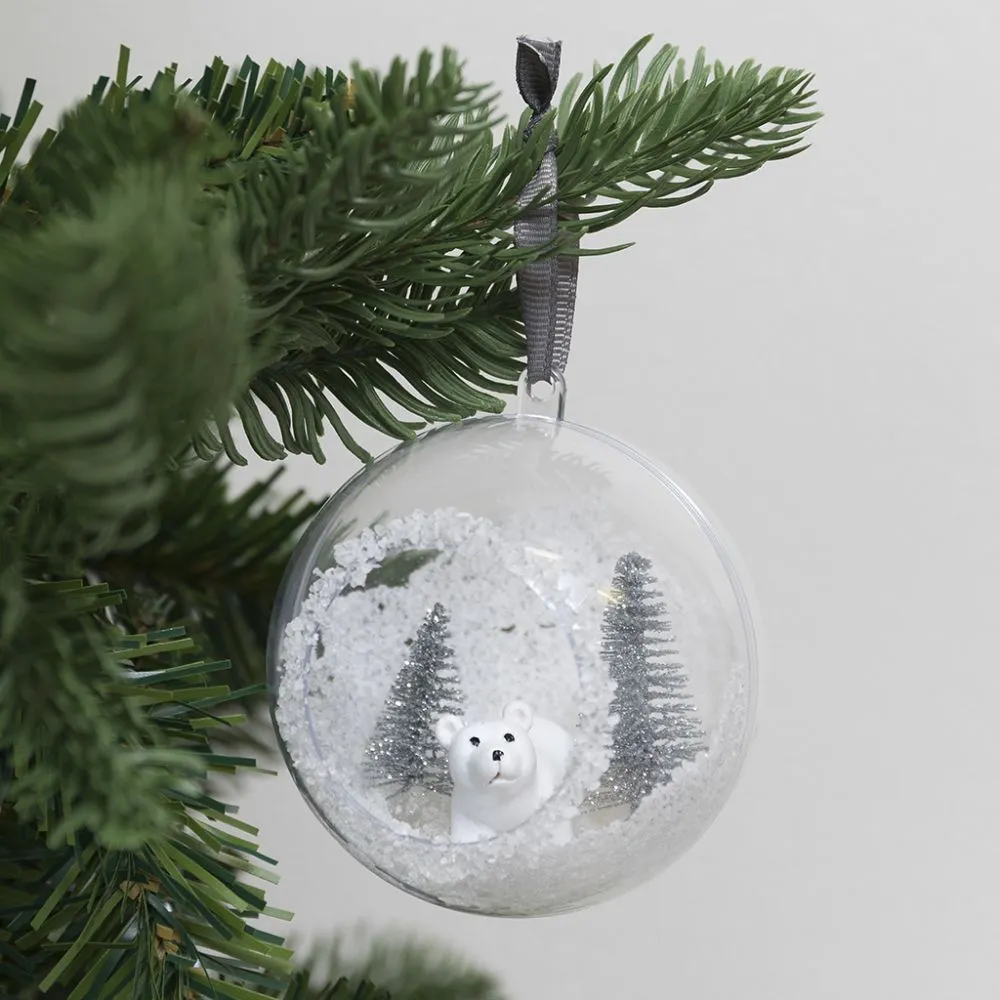
- Choose a fillable bauble with a flat back or a cut window — $3–$8.
- Spoon in faux snow, filling about a third of the way.
- Hot-glue a tiny figure to a toothpick and plant it in the snow.
- Add one small bottle-brush tree for scale.
- Seal the seam with a thin bead of glue and cure overnight.
Total time: about an hour plus drying. Materials under $12 per bauble.
Craft stores sell fillable plastic ornaments for $3 to $5, and the miniatures come in multipacks under $10 — enough for half a dozen baubles. Split a pack with a friend. Temu and dollar stores carry tiny trees, fences, and figures for $2 or less each. The whole set of six costs less than one store-bought diorama ornament.
31. Miniature Village With a Lit Red Barn on Stepped Levels
The red barn. Everything else in this village is white, green, or gray — the barn is the only saturated color, and it pulls your eye straight to the center of the composition. That’s intentional and worth copying. Pick exactly one building in your village to be the colored one, light it from inside, and let everything else stay muted. Two colored buildings and the magic evaporates.
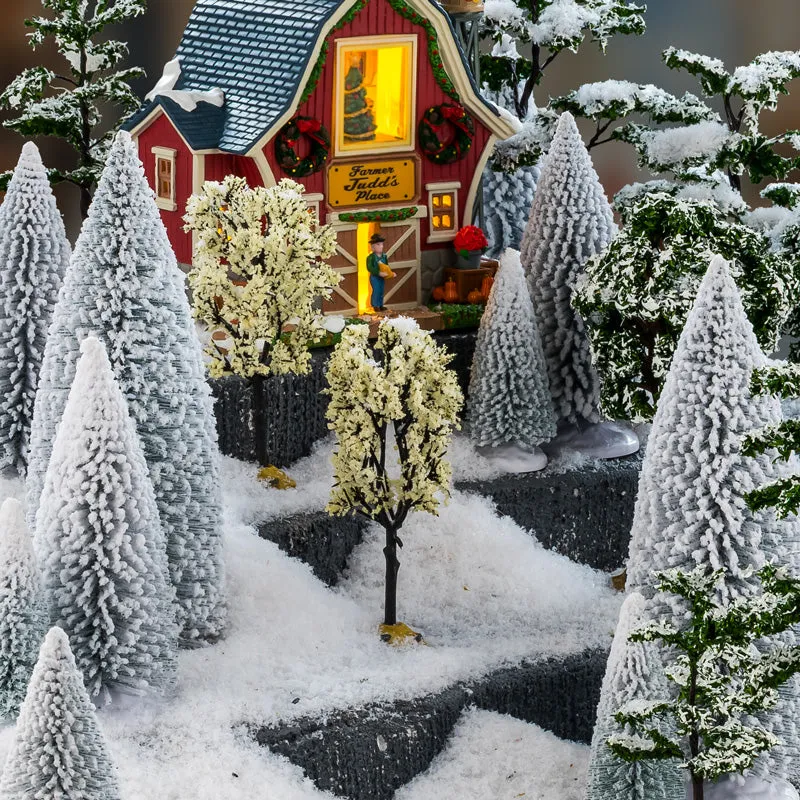
Villages need depth more than width. A display 30 inches wide and 18 inches deep holds three rows comfortably. Stepped risers six inches apart give you the layered look without needing a deeper table. If your surface is shallow, build up instead of back. See Idea #21 for the tiered version that fits on a shelf.
32. Miniature Winter Scene With a Lighted Log Treehouse
What it costs to build this little scene:
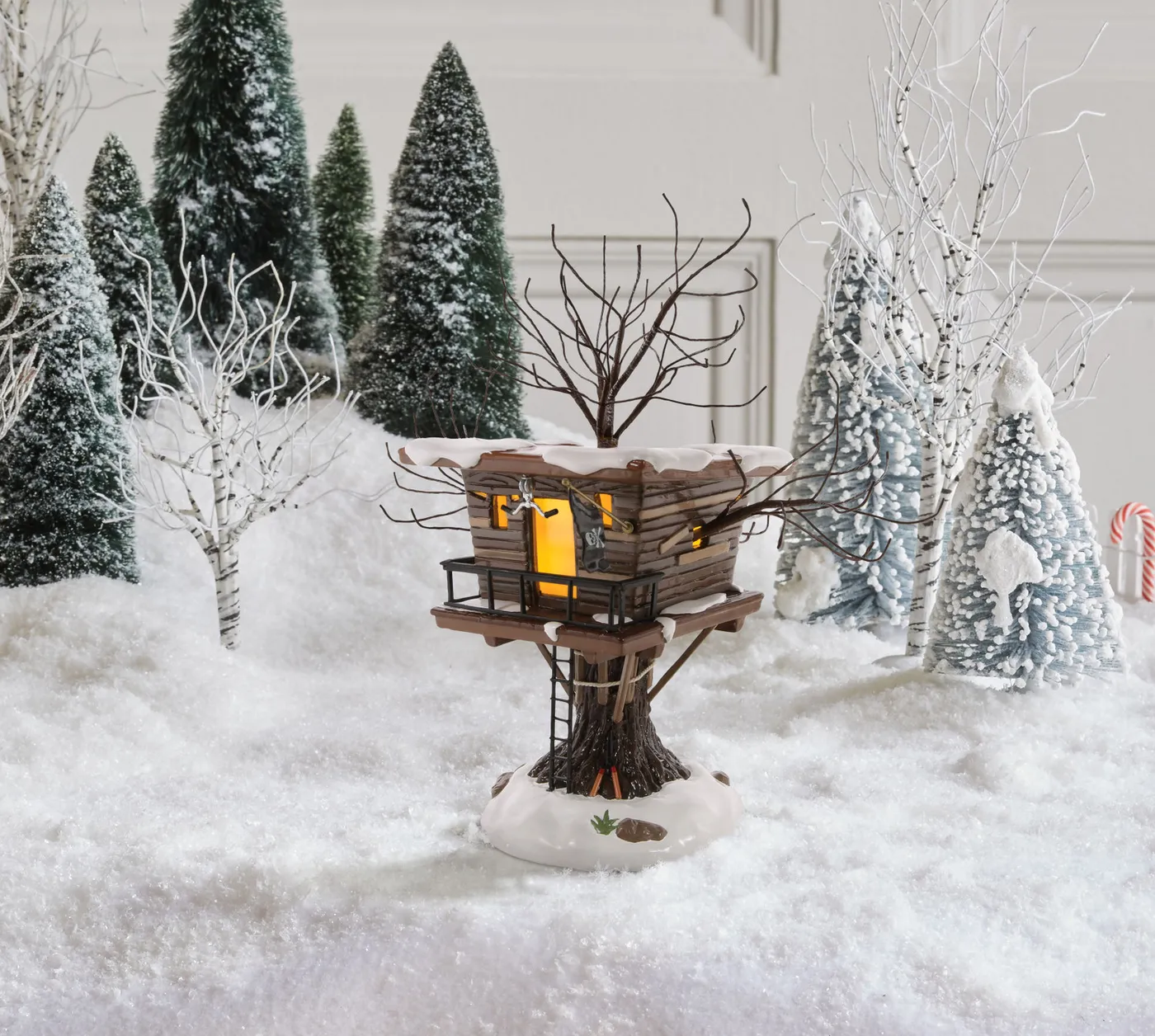
- Lighted treehouse piece: $22–$55
- Bottle-brush trees, mixed greens and blues: $12–$30
- Bare branch trees: $8–$20
- Sparkling faux snow, 5 lb: $12–$28
- Shallow tray or board base: $10–$25
Total: $64–$158. Budget alternative: skip the seasonal aisle and check the toy section for mini trees — often $1 each.
The color story does the work here. Dark green and light blue bottle-brush trees together create depth without adding another material, and the warm yellow window light gives the scene a single focal point. Mixing frosted and unfrosted, tall and short, is what keeps a miniature landscape from looking like a row of identical trees. Variation, not volume.
33. Flying Gold Reindeer Wall Display With a Star Trail
This is the 60/25/10/5 formula scaled up: 60 percent white wall and faux snow, 25 percent warm white light, 10 percent gold, 5 percent silver and red. The gold is concentrated into one continuous swoosh rather than scattered, which is why the wall reads as a single gesture instead of a collection of ornaments. Remove the gold and the entire display goes flat.
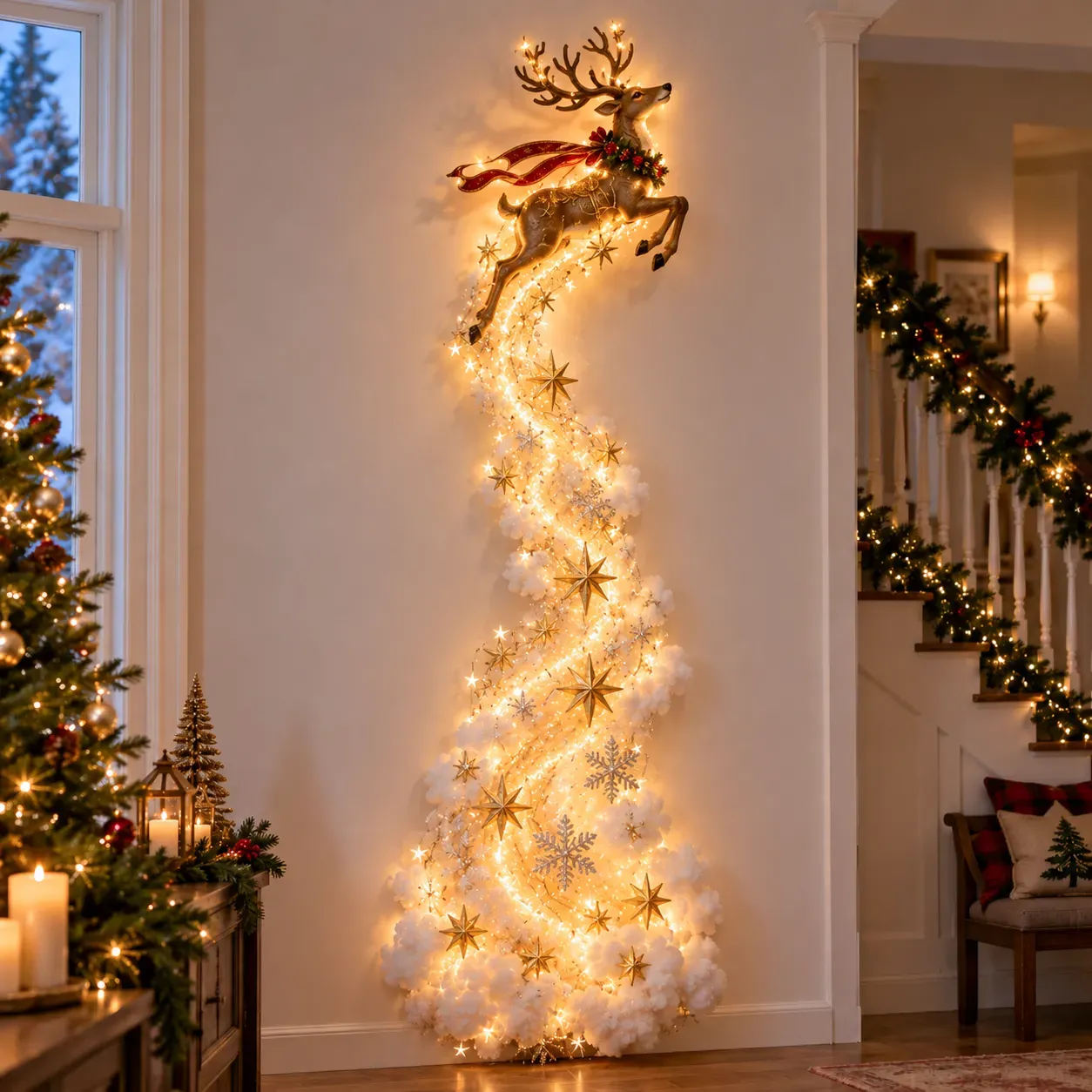
Wall displays like this need a plan on paper first. Trace the swoosh with painter’s tape before you commit a single hook — you’ll change your mind twice, and tape is cheaper than spackle. Keep the reindeer at roughly eye level and let the trail rise toward the ceiling. Space the stars and snowflakes 8 to 12 inches apart so the composition has air; tight clusters read as a blob from across the room.
34. Miniature Snowscape With Teal Bottle-Brush Trees and Fairy Lights
Run through this before you start building:
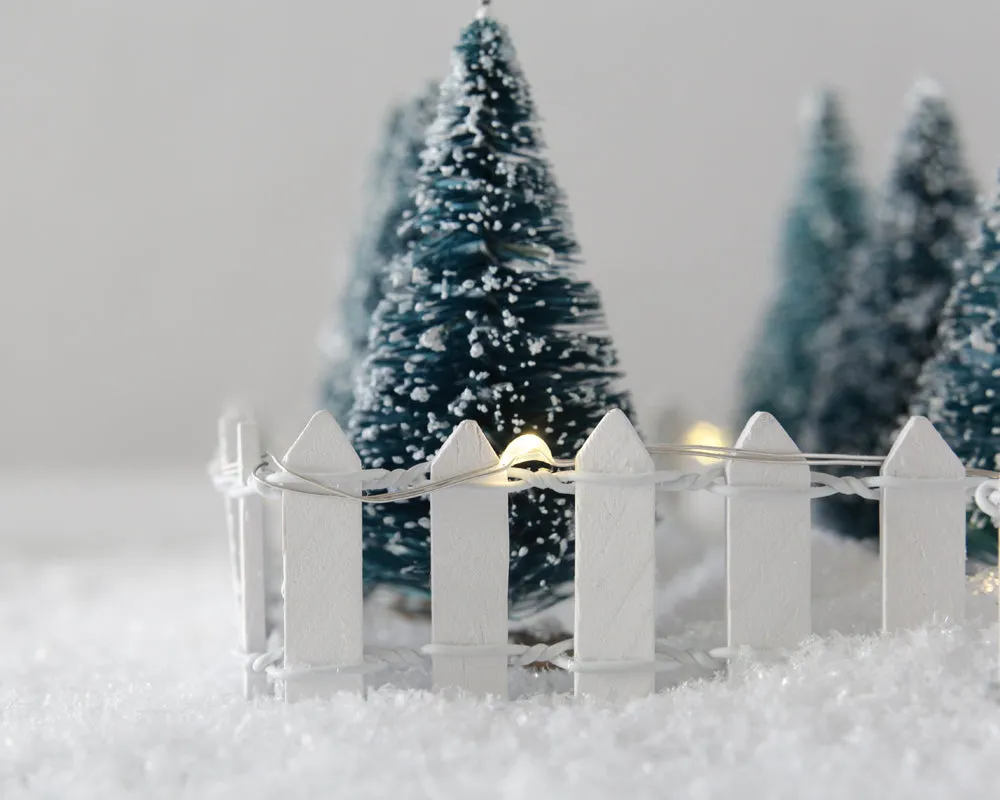
- Decide on your base first — a tray makes the whole scene movable.
- Check that fairy light batteries are reachable without dismantling the scene.
- Test the teal against your room’s palette; it reads greener at night.
- Keep the display out of direct sun or the flocking will yellow.
Bottle-brush trees shed bristles, especially the inexpensive ones, so lift them by the trunk. Faux snow in an open display collects dust fast — a pass with a hairdryer on cool, held at arm’s length, does more than any cloth. Fairy light batteries last roughly three to four weeks of evening use; buy rechargeables and keep a spare set charged so the scene never goes dark mid-season.
Let It Snow — Just Not on the Good Furniture
Faux snow is one of the few holiday tricks that genuinely works at every budget — a $4 bag from the hardware store can carry the same weight as a $400 flocked tree if you place it with intention. Start with one surface you already love, build up in three heights, and let the white do the rest.
📌 Pin your favorite ideas now so you have the exact shopping list, ratios, and measurements ready when the holiday aisles open in October.