
Still scrolling through colored Christmas lights on house 2026 photos without knowing where to start? Same. This is the year the front of your house finally gets the treatment it deserves, and the good news is you don’t need an install crew or a second mortgage to pull it off.
We spent serious time browsing Home Depot, Walmart, and Target to bring you only what’s worth your attention this year, with displays ranging from about $8 for a single strand to $400 for a full multi-layered setup. Inside you’ll find 36 curated ideas spanning warm white classics, saturated multi-color rooflines, blue-and-white nativity scenes, adobe-friendly color blocking, and figure-heavy yard displays, with budget and luxury versions compared side by side.
Here’s what’s shifting in 2026: warm white still dominates Pinterest, but the fastest-growing saves are gradient and two-tone LED runs, plus smart timers that light the house and the interior windows at the same moment. And stay until the end — we break down the most common mistakes that can ruin these looks.
📌 Save this to Pinterest for later — you’ll want to revisit these ideas.
1. A Full-Property Warm White Glow With Lit Yard Figures
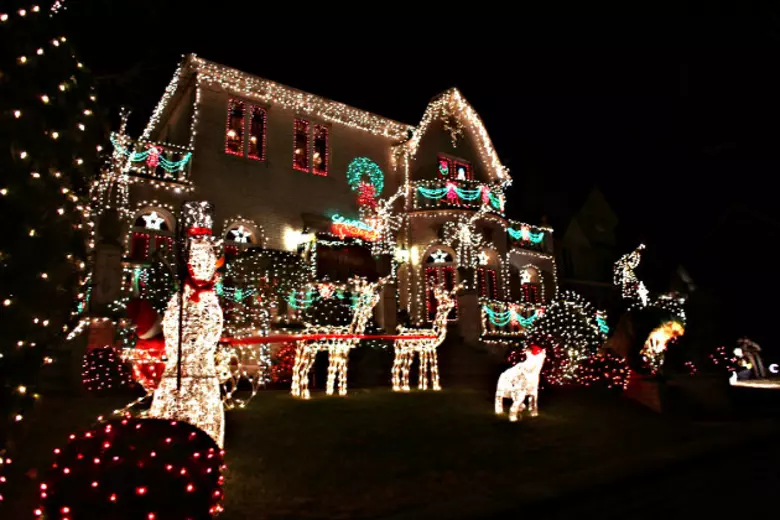
One color, everywhere. Every roofline, window, and porch runs the same warm white temperature, so the eye reads the architecture first and the garlands, lit reindeer, and polar bear second. The teal glow on the Season’s Greetings sign is the only temperature break in the whole scene, which is exactly why it reads.
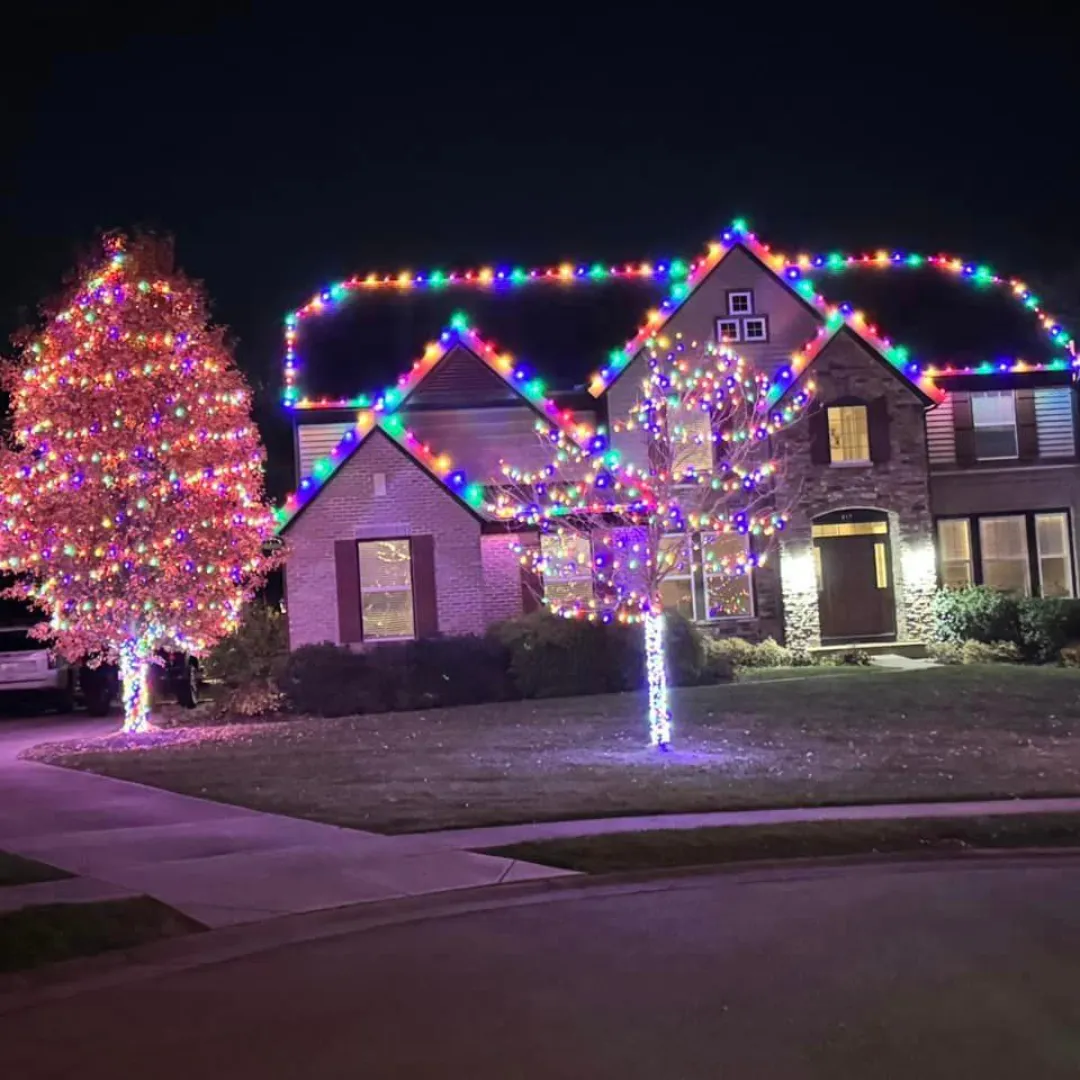
2. Multi-Color on the House and One Tree That Steals the Show
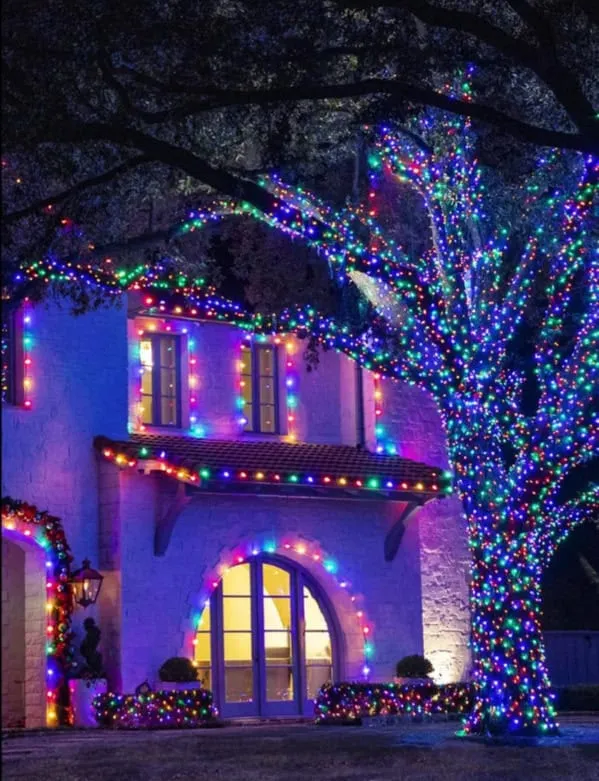
The tree. Take it away and you have a nice house with standard roofline lights. Add it and the corner becomes a landmark. Enveloping one large deciduous tree in the same multi-color strands used on the facade doubles the apparent size of the display without adding a single inflatable.
3. Gradient LED Rooflines Over Stacked Stone Cladding
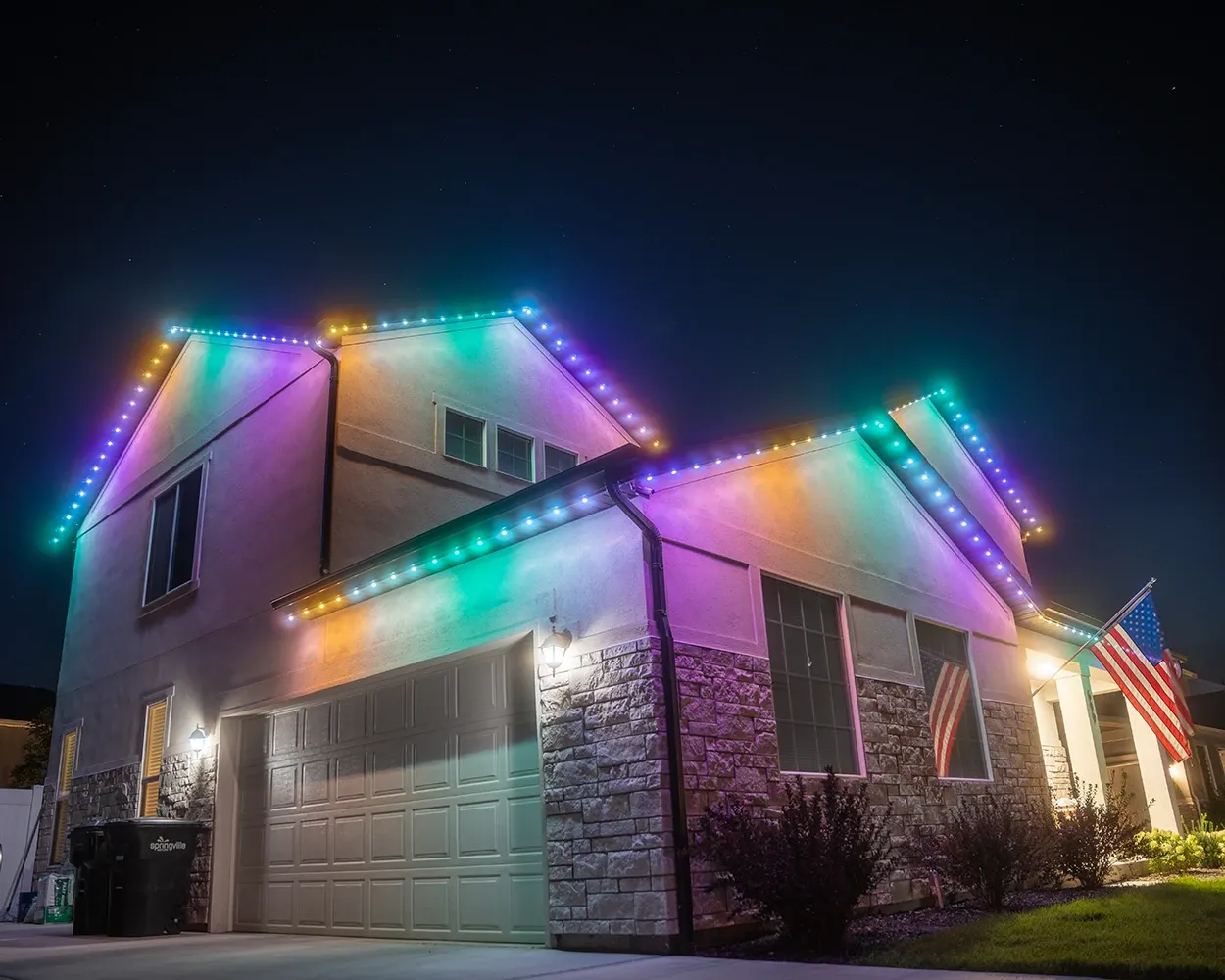
A gradient roofline only looks smooth because each run is one continuous reel, with no color switching mid-strand. For clean gable gradients, use 12V addressable LED rope and hide the controller behind a fascia board. Keep runs under 32 ft before adding a power injection point, or the far end visibly dims.
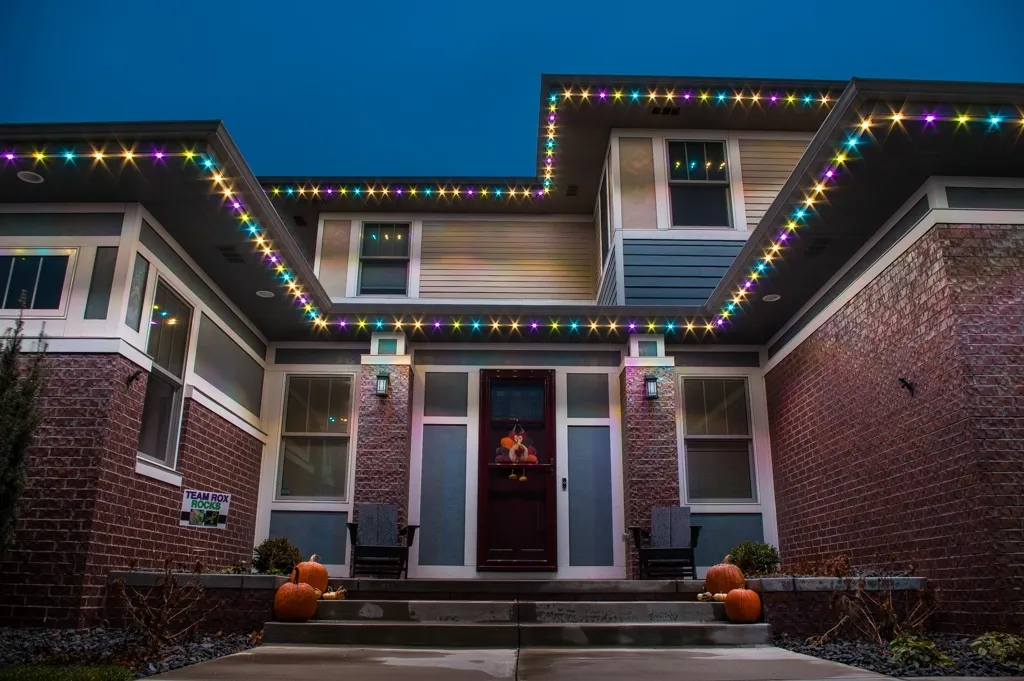
4. Red, Green, and Purple Eaves on a Dark Brown Facade
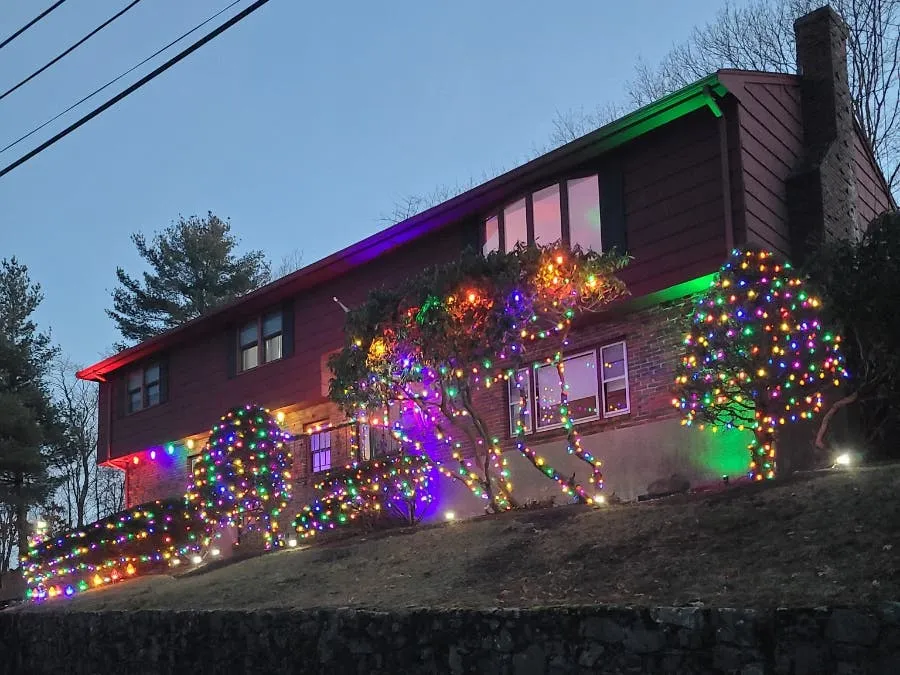
The formula: roughly 55% warm amber eaves, 30% saturated color split across red, green, and purple, and 15% deliberately unlit dark siding. That unlit portion is the secret — the brown siding acts as negative space, which is why the greens look so rich. Swap purple for cobalt over brick and the math still holds.
5. Adobe Walls, Warm White Roofline, and Color-Coded Trees
To recreate this adobe-and-stucco look:
- Warm white roofline strands, 150-200 ft: $60-$120
- Color-coded tree and bush sets: $80-$180
- Lit wreath for the garage door: $25-$60
- Timers, clips, and cords: $30-$50
- Total: roughly $195-$410 for a mid-size frontage
Buy multi-strand packs rather than singles and you cut the tree portion nearly in half.
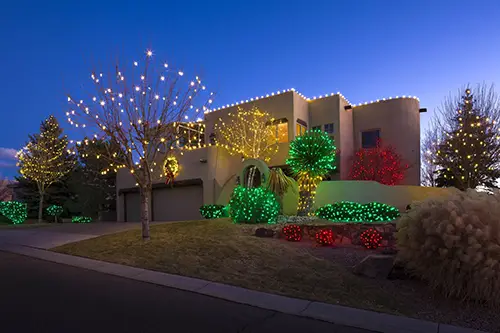
6. Santa on the Roof and Candy Canes Everywhere
A single-story roofline is easy to reach. A climbing Santa figure is not. Anything above the gutter line means ladder work on a pitched surface, and most homeowners policies exclude falls during decorating. If you want roofline figures, hire the install — typically $300-$600 for a two-story facade.
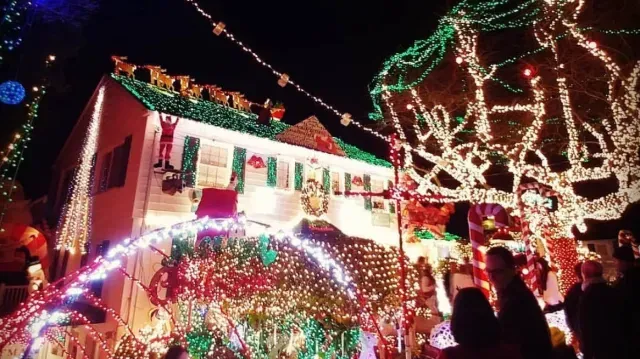
7. A Santa Garage Mural With Cool Blue Icicle Roofline
To project a mural onto a garage door without buying a projector:
- Measure the door panel and order a light-diffusing template film.
- Clean the door and let it dry fully — dust shows through projection.
- Mount the projector 8-10 ft back, centered and level.
- Focus after dark, then lock the keystone setting.
About 90 minutes and $150-$400 depending on rent or buy.
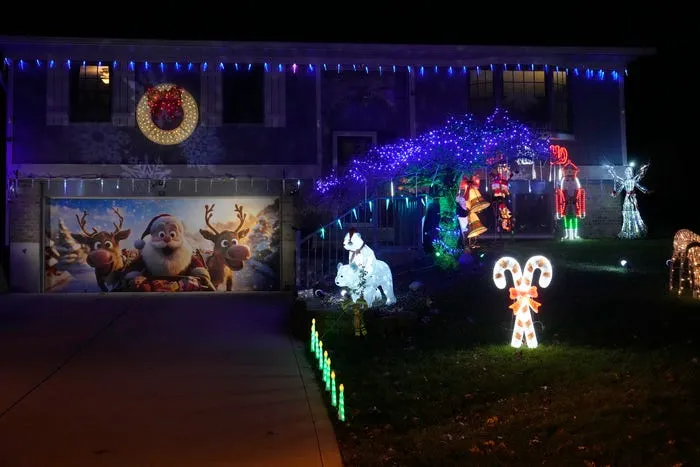
8. Multi-Color Rooflines and a White Tree Glowing Purple
A multi-color roofline plus a freestanding yard tree needs at least 40 ft of frontage to breathe, otherwise the purple spill reads as a stain rather than a glow. A 25-ft facade can carry the roofline alone. For tighter, porch-focused frontages, lean on the approach in Idea #9 instead.
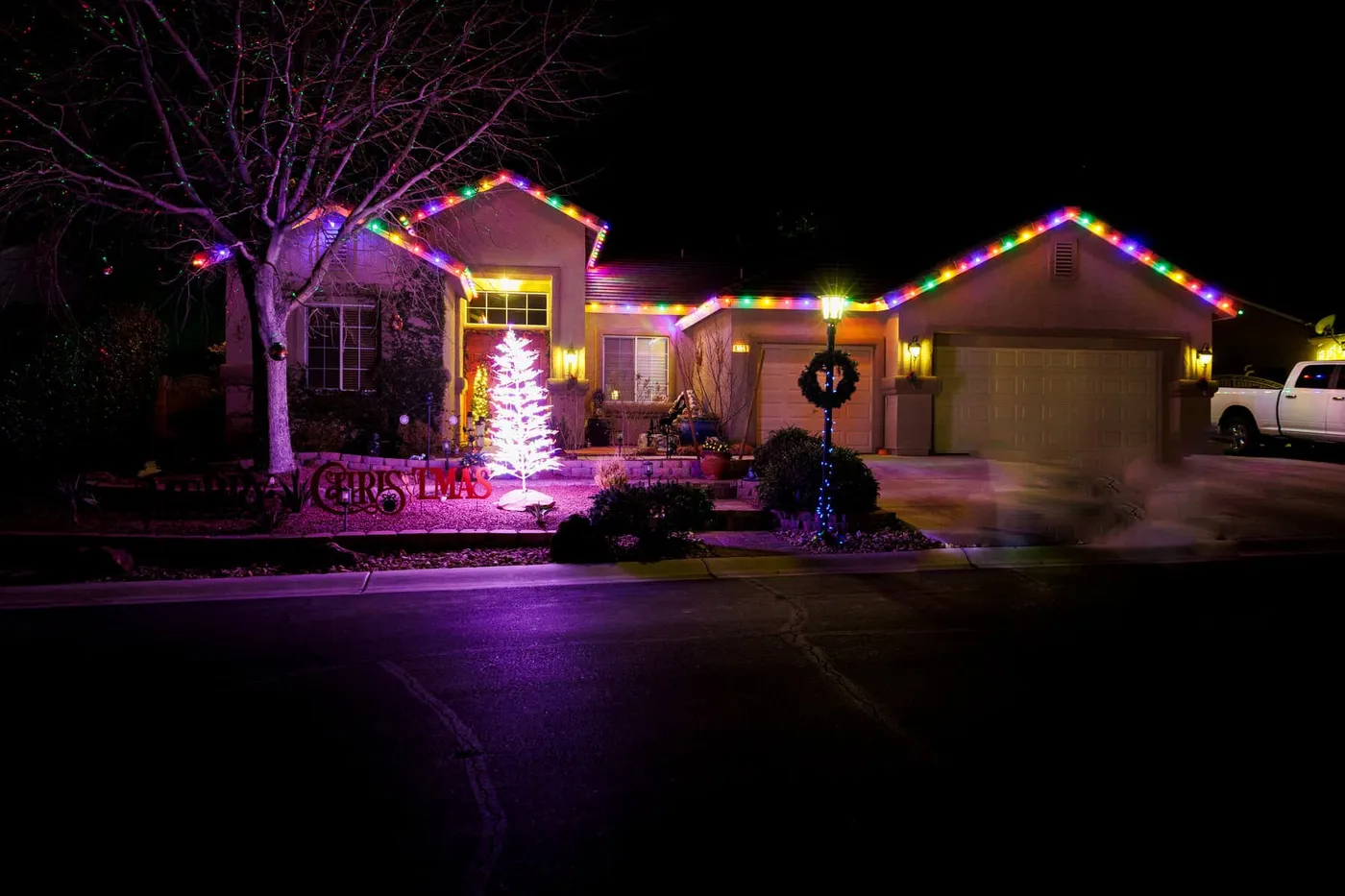
9. Warm White Rooflines With Oversized Red Wreaths
Traditional red-and-warm-white is the look that refuses to die, and 2026 proves it: warm white exterior lighting searches keep climbing while rainbow LED searches have flattened. The reason is photographic. Warm white reads beautifully on a phone at night, while saturated multi-color blows out. It is the most shareable lighting scheme there is.
10. A Repeating Red-Blue-Green-Yellow Bulb Pattern on Brick
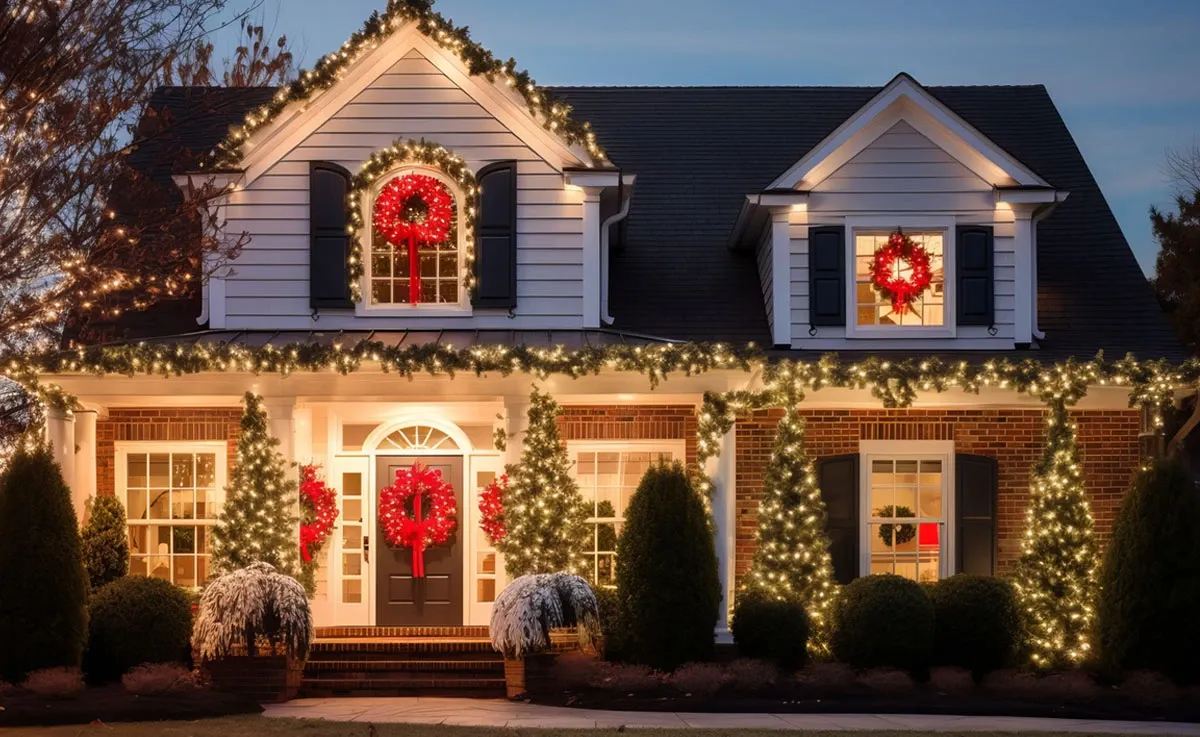
Multi-color incandescent strands are the most bulb-hungry option you can hang — expect 5-8% failure per season and full replacement every two to three years. LED multi-color costs more up front ($15-$25 per 100 count versus $6) but runs eight to ten seasons. Wipe strands dry before storing; dust is what kills contacts.
11. White Roofline Lights With Warm Yellow Window Framing
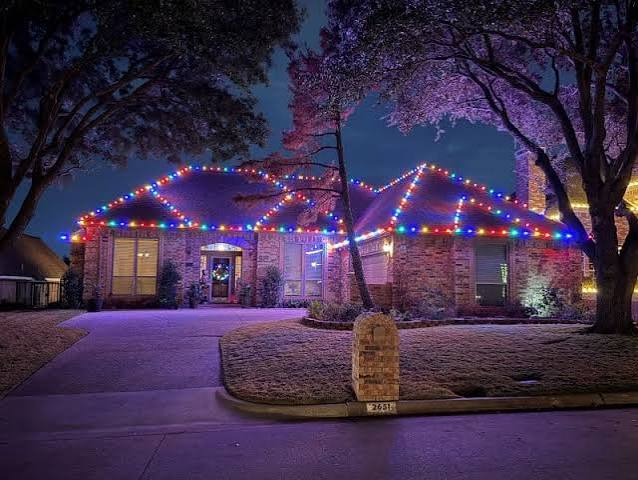
The white-roofline-plus-warm-window trick is pure contrast and the cheapest version of this look. Target’s 100-count warm white LED strands run about $8 each, and you’ll want seven or eight for a modest two-story. Skip the inflatables and hang two lit wreaths on the shutters instead, about $12 each at Walmart.
12. Snow-Dusted Bushes Blanketed in Warm White
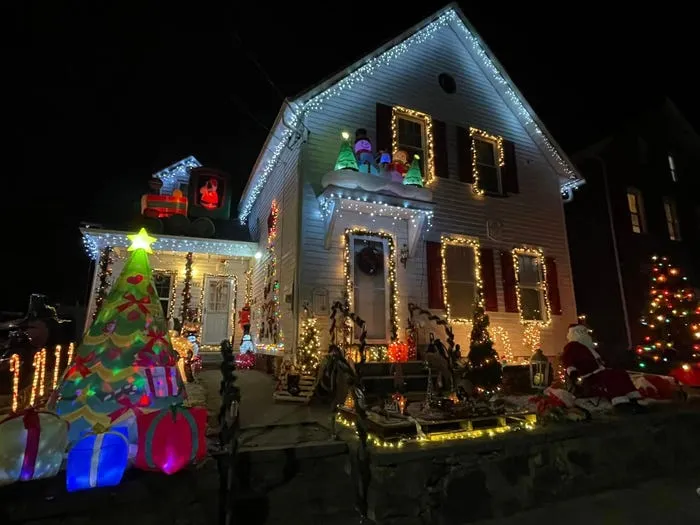
Before you drape every bush in sight:
- Confirm each shrub is a compact variety that holds net lights without crushing.
- Check you have an outdoor GFCI outlet within 25 ft.
- Photograph the layout in daylight so you can repeat it in half the time next year.
- Buy net lights, not strands, for rounded shrubs.
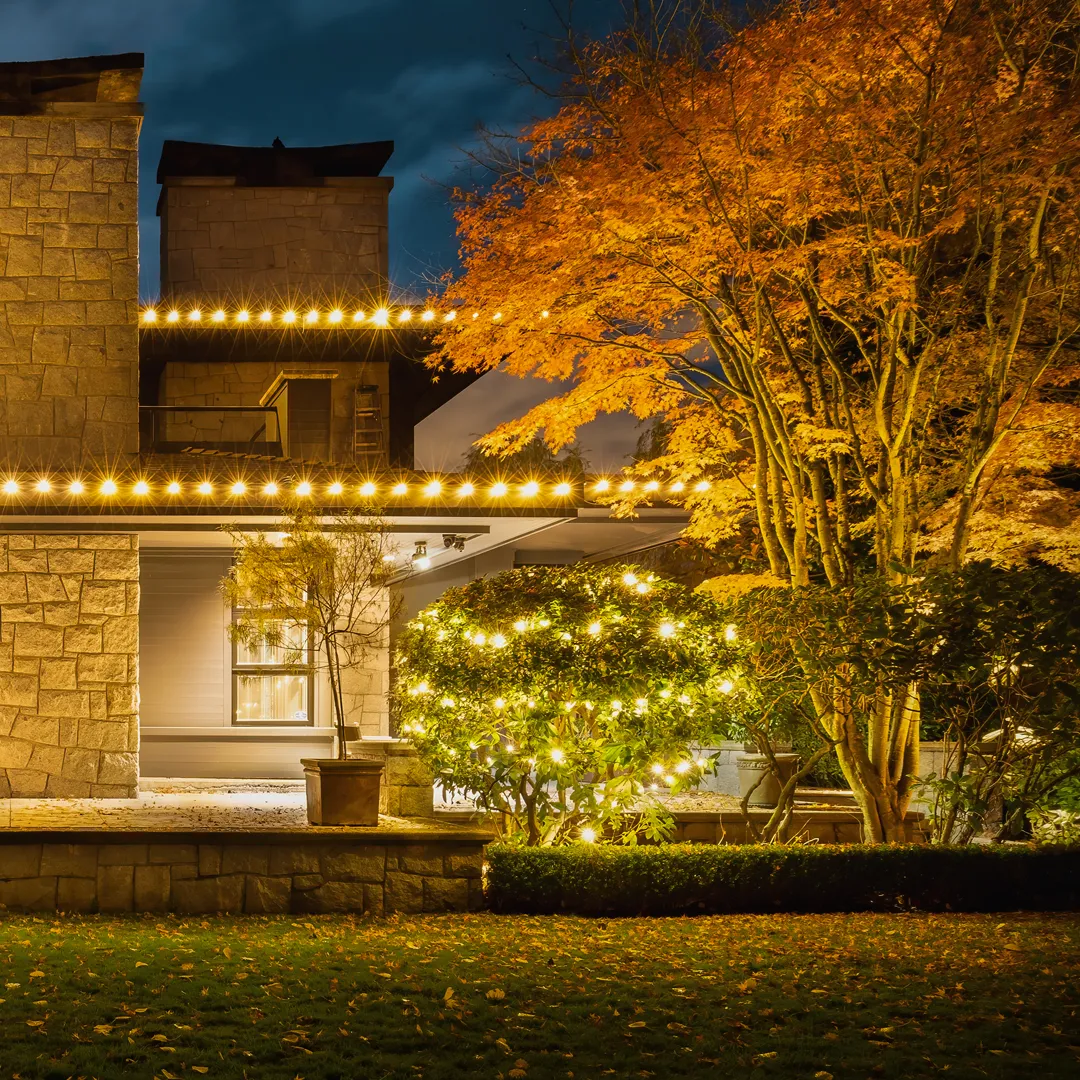
13. Modern Stone Facade With an Orange Tree Still Holding Leaves
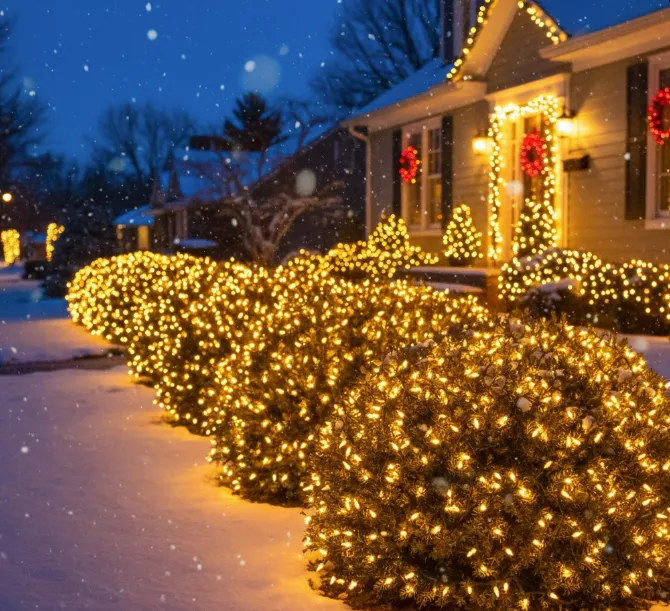
Warm white against an orange-leafed tree is a pairing you can copy for almost nothing. IKEA outdoor LED sets start around $10, and one 30-ft strand draped through the branches is genuinely enough. The orange foliage does the heavy lifting — resist adding red and you get the same golden feel for under $60.
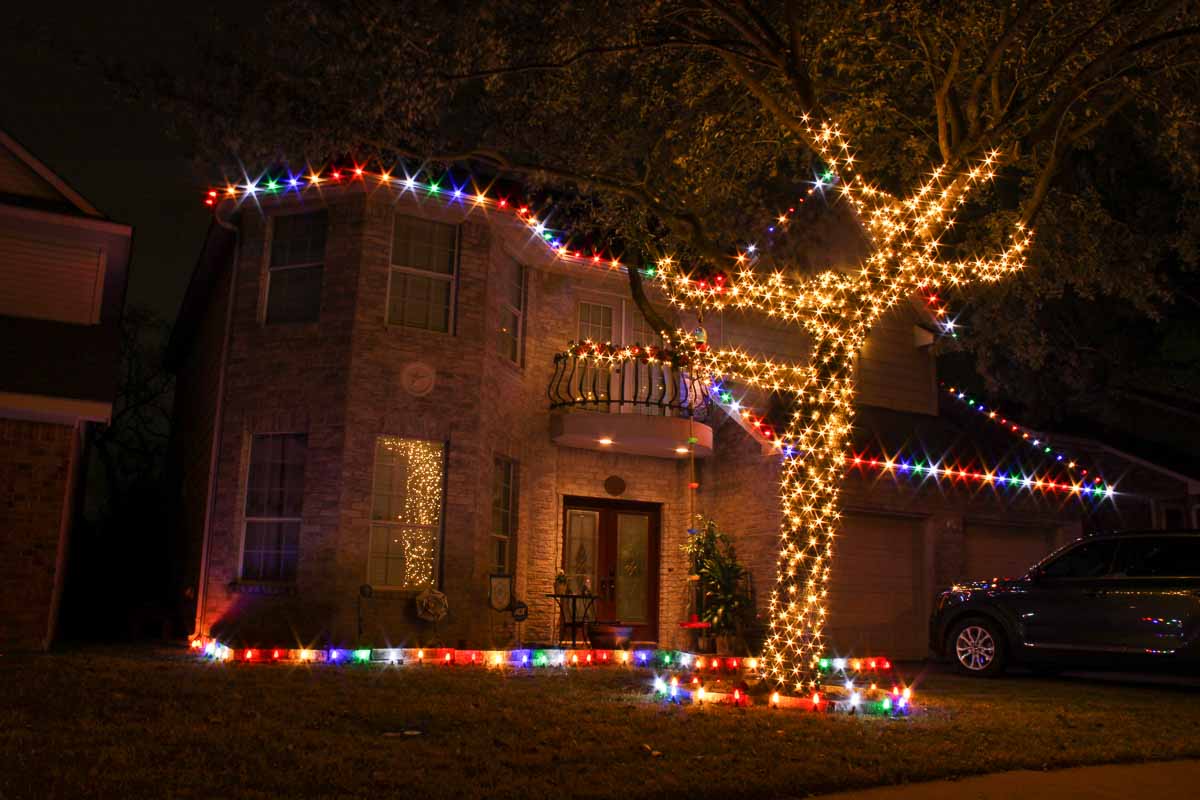
14. Multi-Color Roofline With a Warm White Wrapped Tree
When a multi-color roofline shares a wall with a single-color tree, keep the two from touching — leave at least one unlit architectural element between them. On this brick facade it is the balcony, acting as a visual comma. On a flat continuous wall, run multi-color on the gables only and send warm white down the vertical edges.
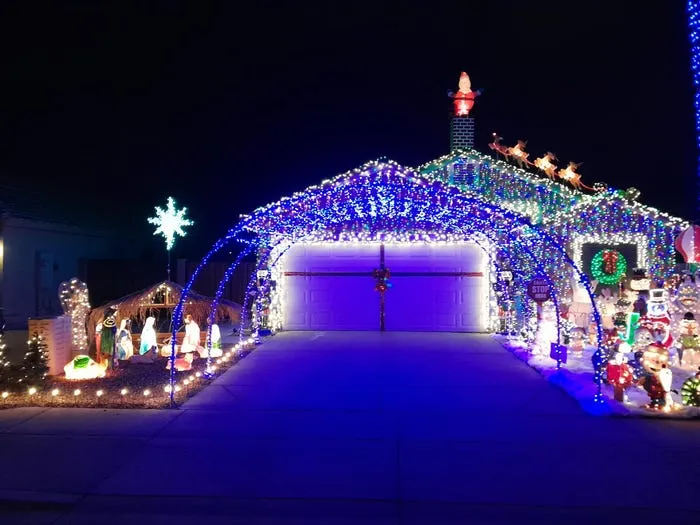
15. A Blue and White Blitz With a Lit Nativity Scene
Two colors, one temperature. Blue and white sit on the cool end of the spectrum, so they cast a silvery light that makes everything look crisper than warm light ever will. The red and green figures only work because they are the exception. A blue-and-white house reads as a single object, which makes the driveway arch feel like an entrance.
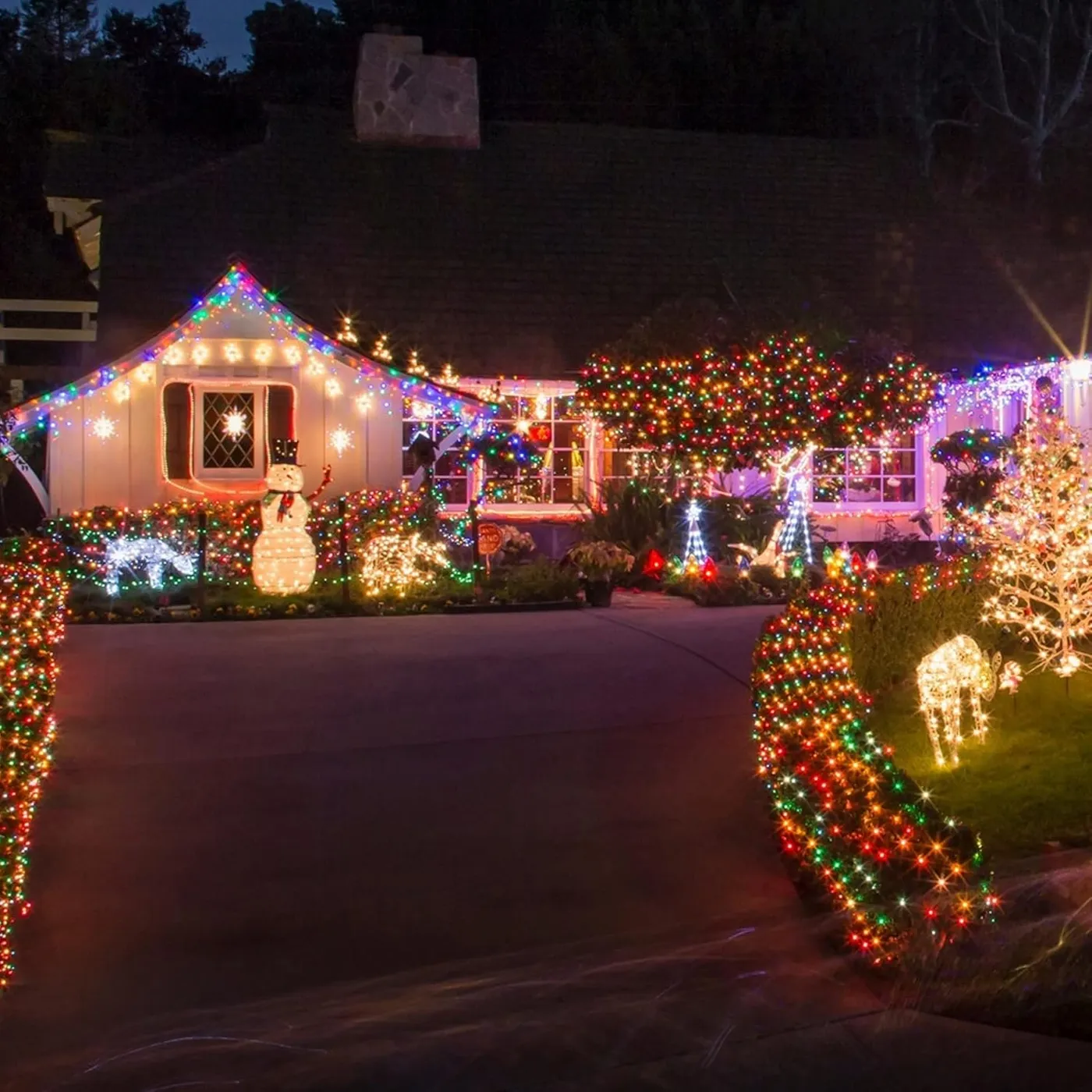
16. Multicolor Outlines on a White Facade, Snowman Included
The driveway outline. Take it away and this is just another bright house on a bright street. Lining the driveway edges in the same multicolor strand used on the gables and rooflines creates a corridor the eye can follow. That is the difference between decorating and composing, and it costs about two extra strands.
17. Total Warm White Coverage From Roof to Driveway Edge
This one runs about 80% warm white, 15% character cutouts like the retro RV and station wagon, and 5% dark hedge left deliberately unlit. Full coverage only works when the palette is completely flat — one temperature, no exceptions. Want color instead? Keep the coverage and swap the entire warm white for a single saturated hue.
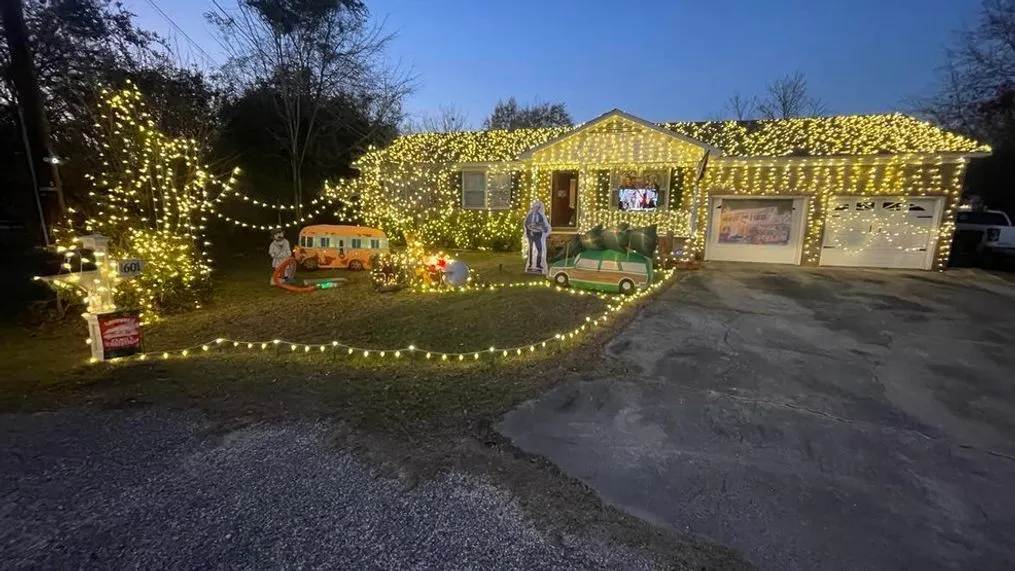
18. Starburst Multicolor Lights Anchored on a Stone Facade
Building a starburst on a gable:
- Anchor a hook at the gable peak and one at each facade corner.
- Run strands radially from the peak to the corners — six to eight spokes reads best.
- Zip-tie each spoke to a light PVC ring where they converge.
- Cap the center with a pre-lit star to hide the knot.
Two hours and about $40 in parts.
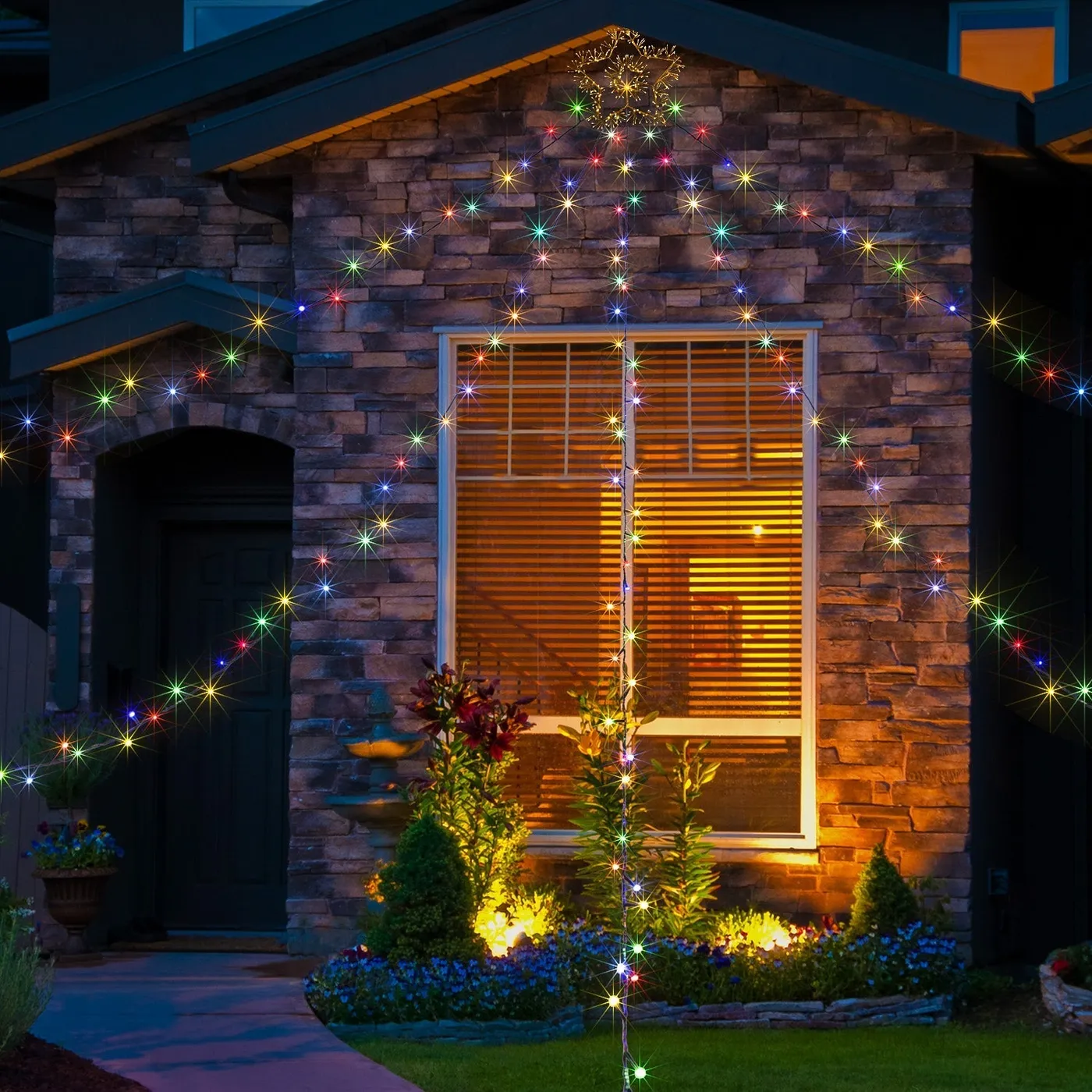
19. Wrapped Tree Trunk Meets Warm White Icicle Roofline
Trunk wrapping makes small frontages feel rich, because it adds vertical light without adding width. This display works on a facade as narrow as 20 ft — the icicle roofline holds the top, the wrapped trunk holds the middle, and the lit pathway grounds it. Under 20 ft wide, drop the pathway lights and let the trunk carry it alone.
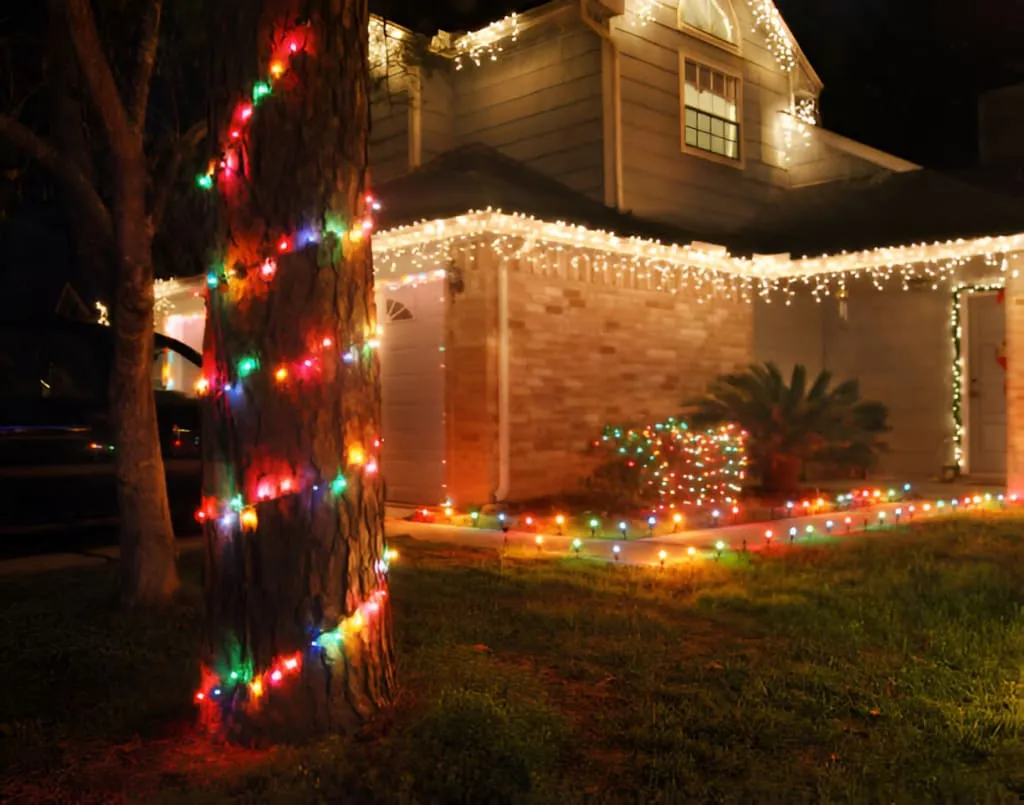
20. Multicolor Tracing the Gables and Arched Entryways
Outline lighting works on brick because brick is rough — it scatters light instead of reflecting it, so the rooflines look painted on rather than studded. Notice the arches get identical treatment to the gables: the display traces the house’s real silhouette instead of decorating past it. Try a smaller dose of this with Idea #9.
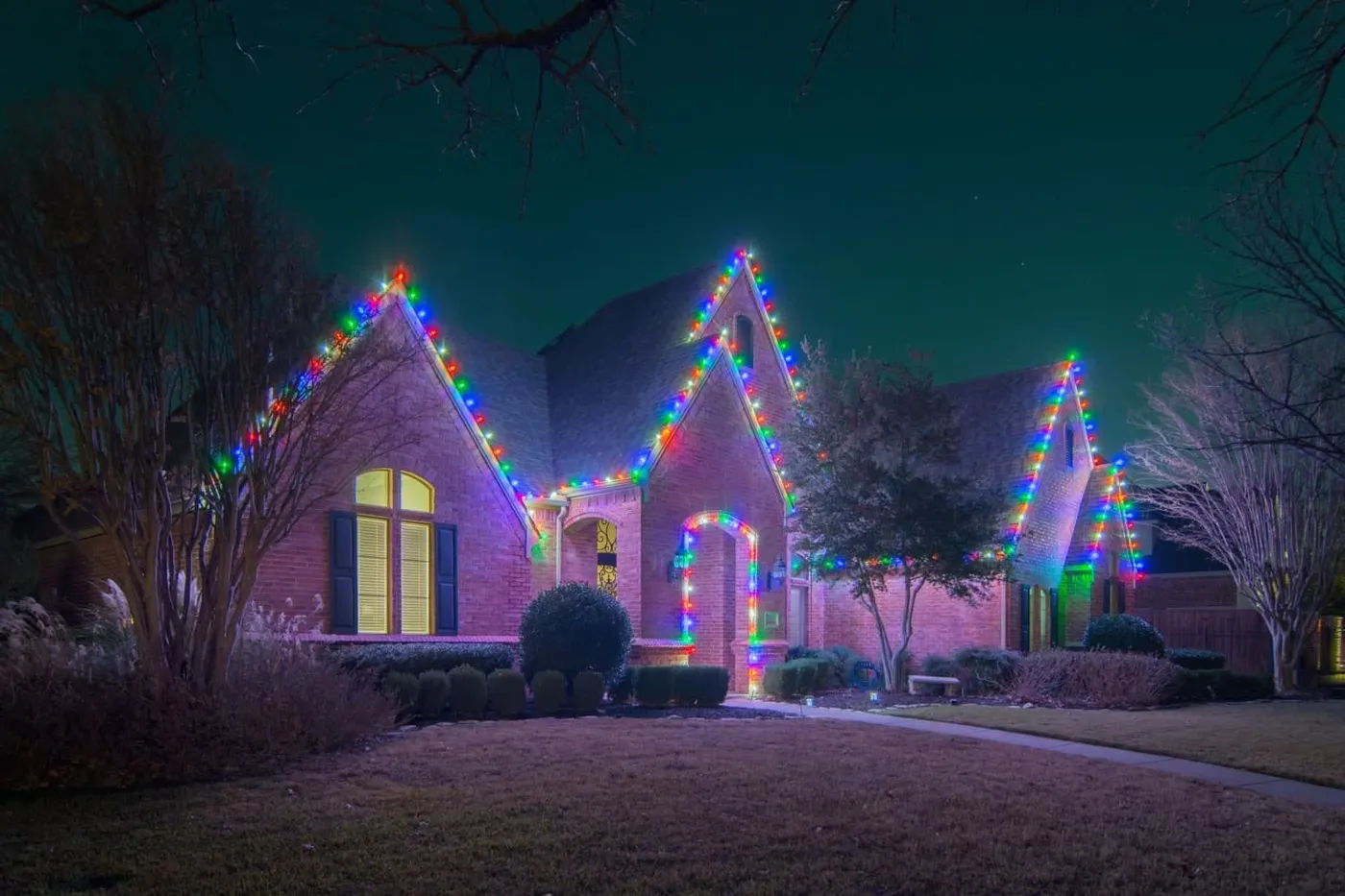
21. Dark Brick, Multicolor Arches, and Glowing Interior Windows
Interior window glow is the detail people forget to plan, and it is having a moment. In 2026, homeowners are putting warm smart bulbs on a 5 p.m. schedule so the inside lights up the same minute the outside does. It costs almost nothing and doubles the depth of the display. Dark brick holds that contrast without fighting it.
22. Snowflake Cutouts and Icicle Lights on a Brick Facade
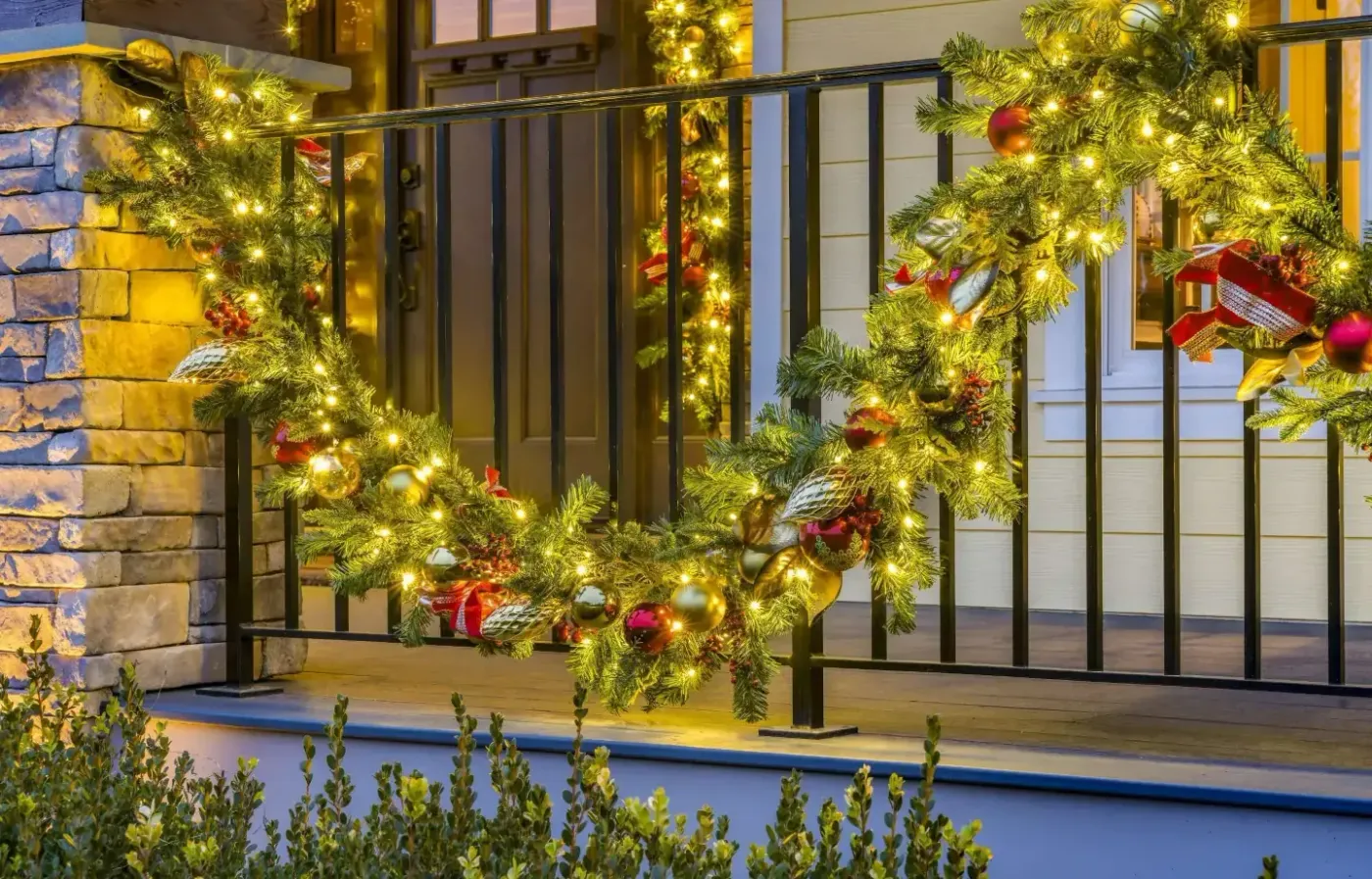
Snowflake and star cutouts are the one decoration that ages well — metal or heavy plastic survives a decade of storage. Icicle strands are the fragile part: the drape wires kink and the tiny bulbs snap. Store icicles hanging from a dowel in a closet instead of bundling them in a bin and you get four or five seasons instead of two.
23. A Warm White Starburst Fanning Over the Front Door
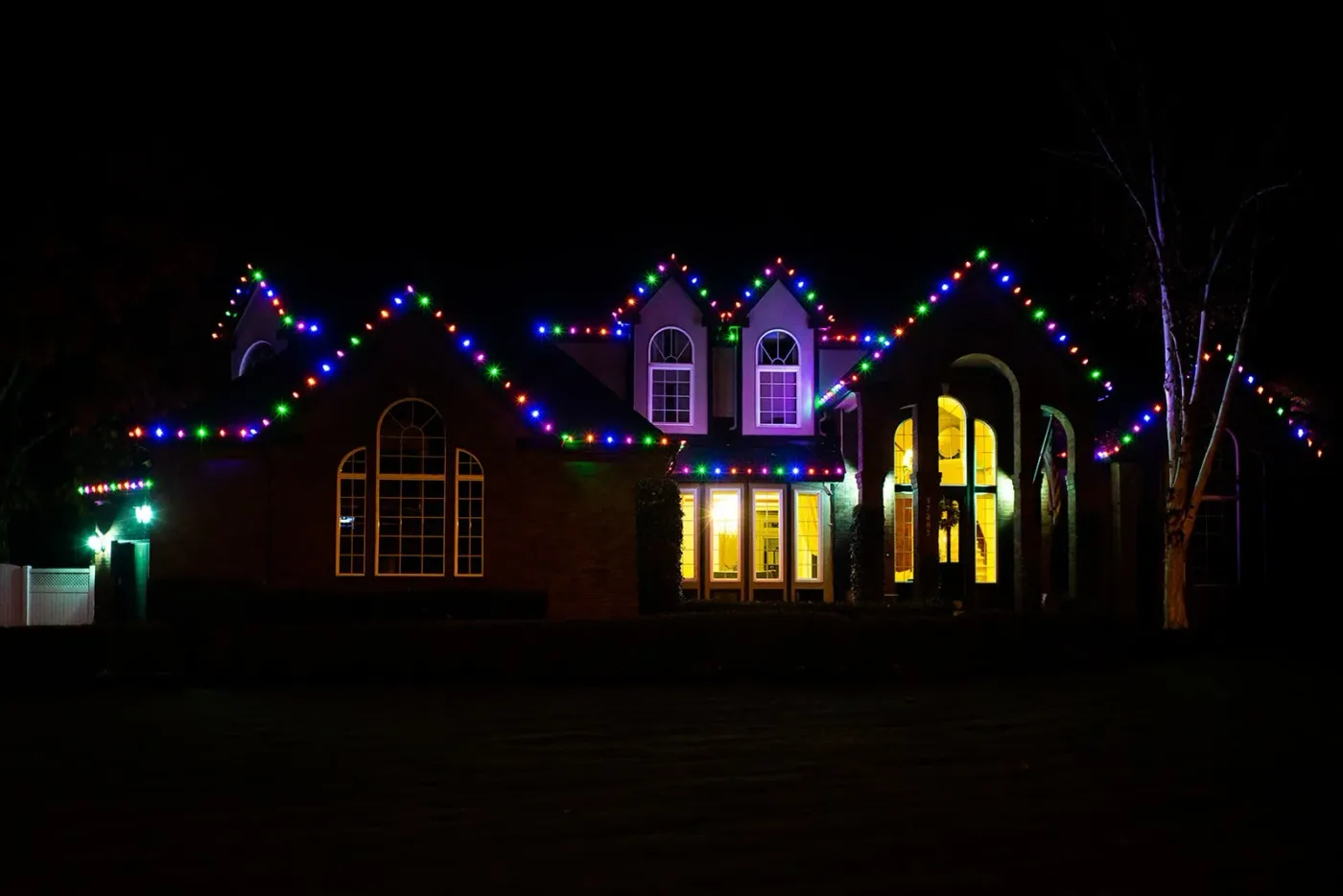
Anchor a starburst at the door’s centerline, roughly 18 in. above the header. Most people mount it too low, which crowds the doorway and forces guests to duck around strands. Eight spokes at 45-degree increments across a 5-ft span is the sweet spot for a standard single door — any more and it reads as a spiderweb.
24. Classic Multi-Color on a Snowy Roofline and Windows
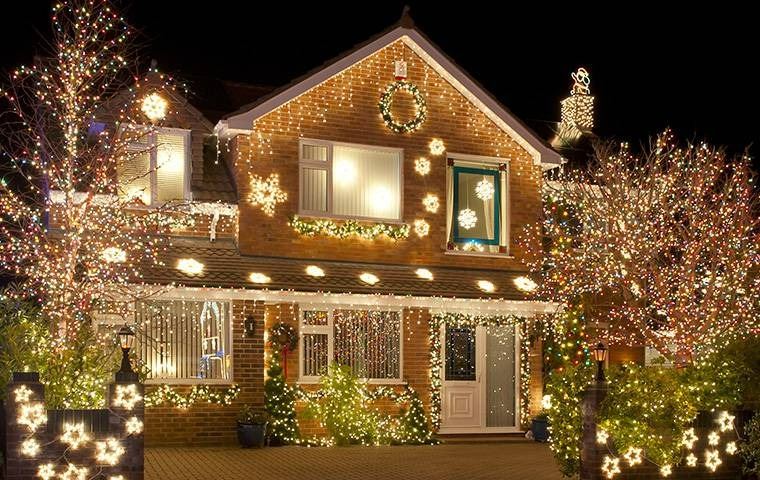
The dark shutters. That is the one thing holding this together. On a cream facade with multicolor bulbs everywhere, the shutters provide a fixed dark shape that keeps the roofline from looking like it is floating in the air. No shutters? Use dark window boxes instead and get most of the same anchor.
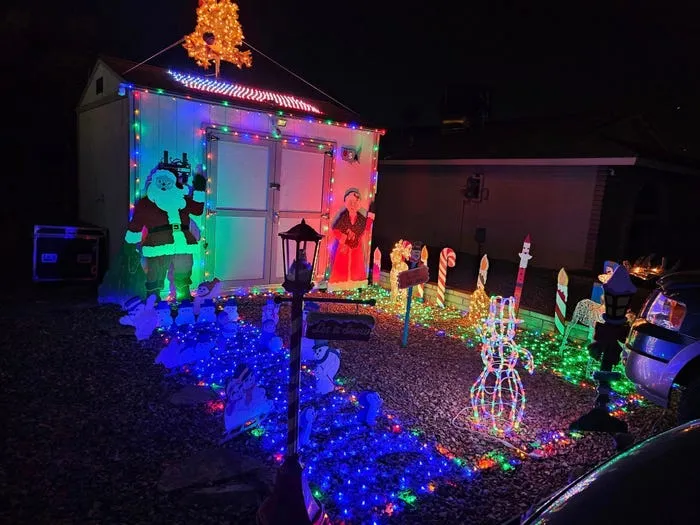
25. Turning a Plain White Shed Into a Holiday Backdrop
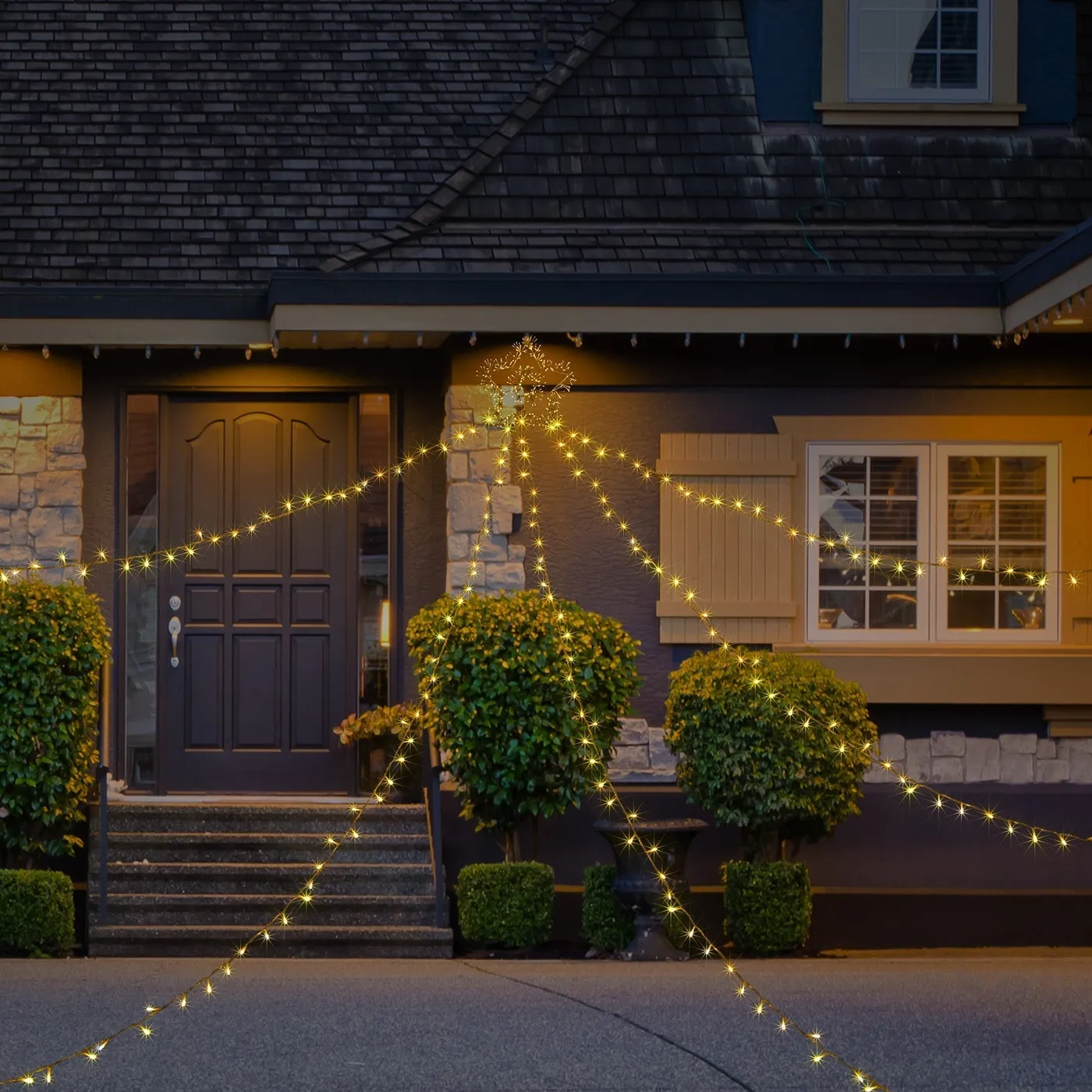
A white shed is the cheapest possible canvas for a big display, and nobody minds. Outline the gables with four or five $8 multi-color strands from Walmart, then raid the yard for figures — the Santa cutout, candy canes, and wire snowman here are all in the $20-$40 tier. Budget $150 and the whole property reads as one display.
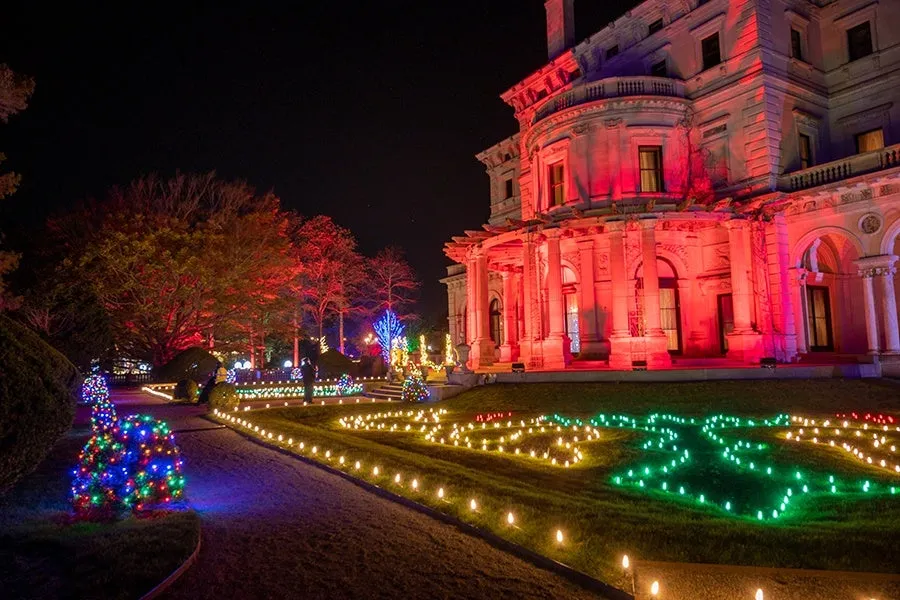
26. A Stone Mansion With a Red Wash and a Lit 2026
Architectural wash lighting changes everything here — the stone reads as red because the light is aimed up the walls, not at the shrubs. The lawn displays then sit in a completely separate layer. That separation is why a lit 2026 in green and yellow does not clash: the red lives on the building, the numbers live on the ground, and they never compete.
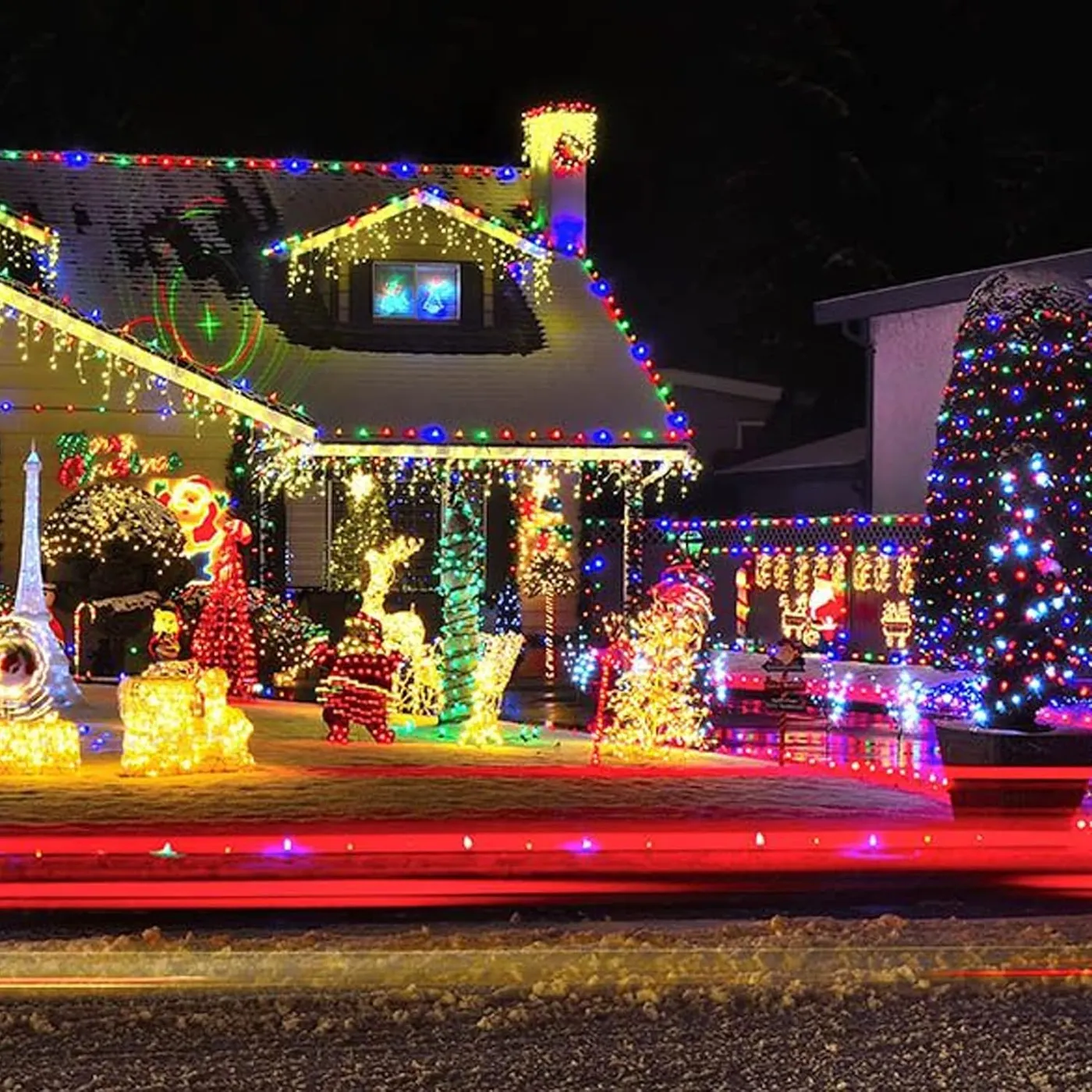
27. Roofline, Eaves, and Chimney All Lit With Projections
Lighting the chimney is the tell that a property has real vertical scale — this house needs roughly 10 ft of wall height for the chimney run to look deliberate. On a single-story with an 8-ft plate, skip it and put those strands on a front fence instead. Compare with Idea #6 if your home is compact but you still want big impact.
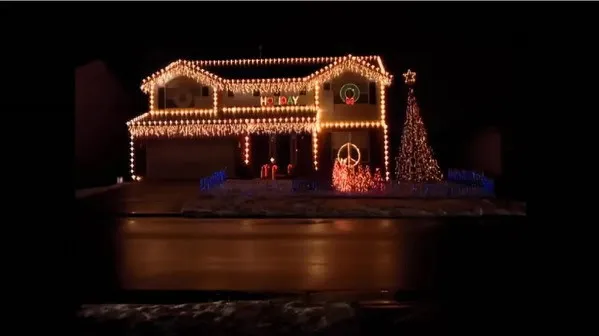
28. Warm White Outlines With a Red Holiday Sign
The mix here is 65% warm white outline, 20% red statement pieces like the HOLIDAY sign and peace sign, 10% blue ground line, and 5% left unlit. That blue ground strand is the sleeper element — it gives the yard a boundary. Swap the red for lime green and the same recipe turns modern and citrusy.
29. Oversized C9 Bulbs on Windows and Porch Railings
C9 bulbs look wonderful and cost real money to run. An incandescent C9 strand pulls about seven watts per bulb, so 200 bulbs is 1,400 watts. LED C9s use roughly 0.5 watts each and pay for themselves in two seasons. Also check your porch railing — many are aluminum, and included clips scratch powder coat permanently.
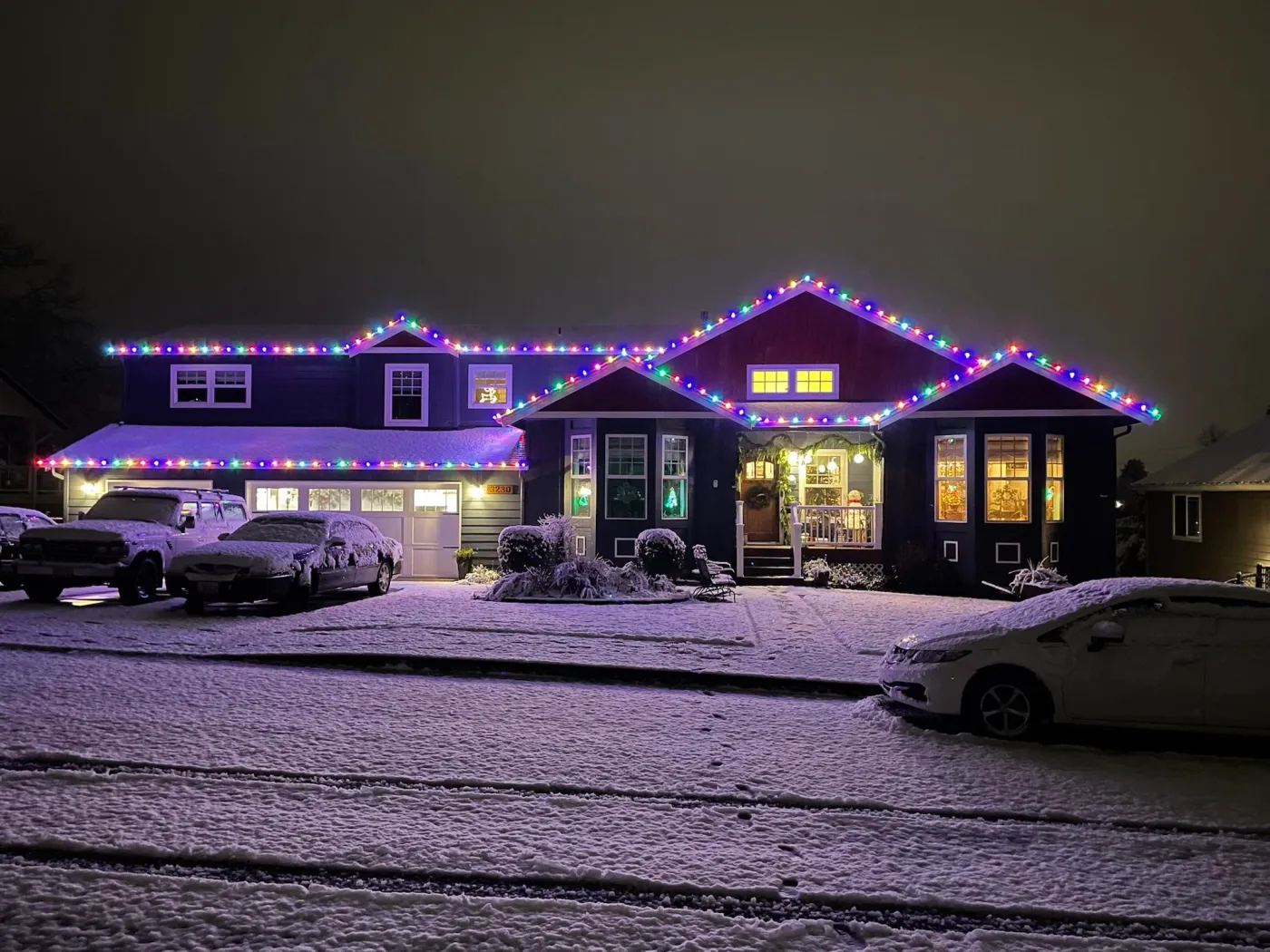
30. Multicolor Rooflines Against Fresh Snow and Dark Siding
A few things to confirm before you commit on a dark-sided house:
- Test a stretch of lights against the siding after dark — dark walls swallow color.
- Check roof snow load before climbing up with strands in hand.
- Verify your outdoor outlets are GFCI, especially in freeze-thaw climates.
- Measure the gable run before buying.
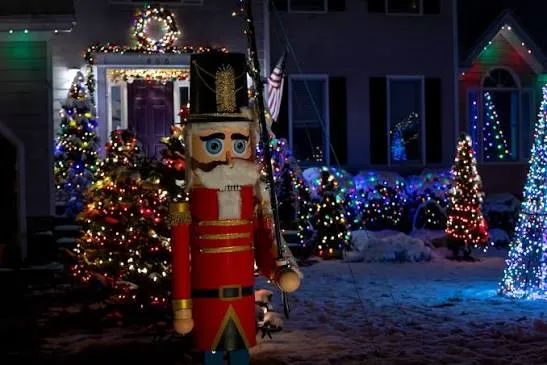
31. Two Fully Wrapped Trees as Bookends for the Roofline
Two wrapped trees flanking a roofline is the most photographed exterior look there is, and it is also the cheapest big-impact option. A 6-ft deciduous tree takes about four to five 100-count strands. At $8 each from Target, that is roughly $40 per tree. Add one strand along the eave and you have the whole look for under $120.
32. C9 Bulbs at Dusk, Hung With Simple White Hooks
Hanging C9s so they look straight from the street:
- Clip white plastic hooks under the shingle edge every 12 in.
- Work in 10-ft sections, clipping as you go instead of dragging the full run.
- Leave a drip loop where the strand meets the extension cord.
- Add a plug at each gable end so nothing wraps a corner.
About 45 minutes and $20 in hooks.
33. Multicolor Along a Wrap-Around Porch and Gazebo
Porch-forward lighting is quietly overtaking roofline-only displays. People have used their front porches more since 2020 and want them to feel like rooms after dark. A wrap-around run also photographs better than one flat segment because there is depth and a destination. Gazebos and covered porches are basically free real estate for lights.
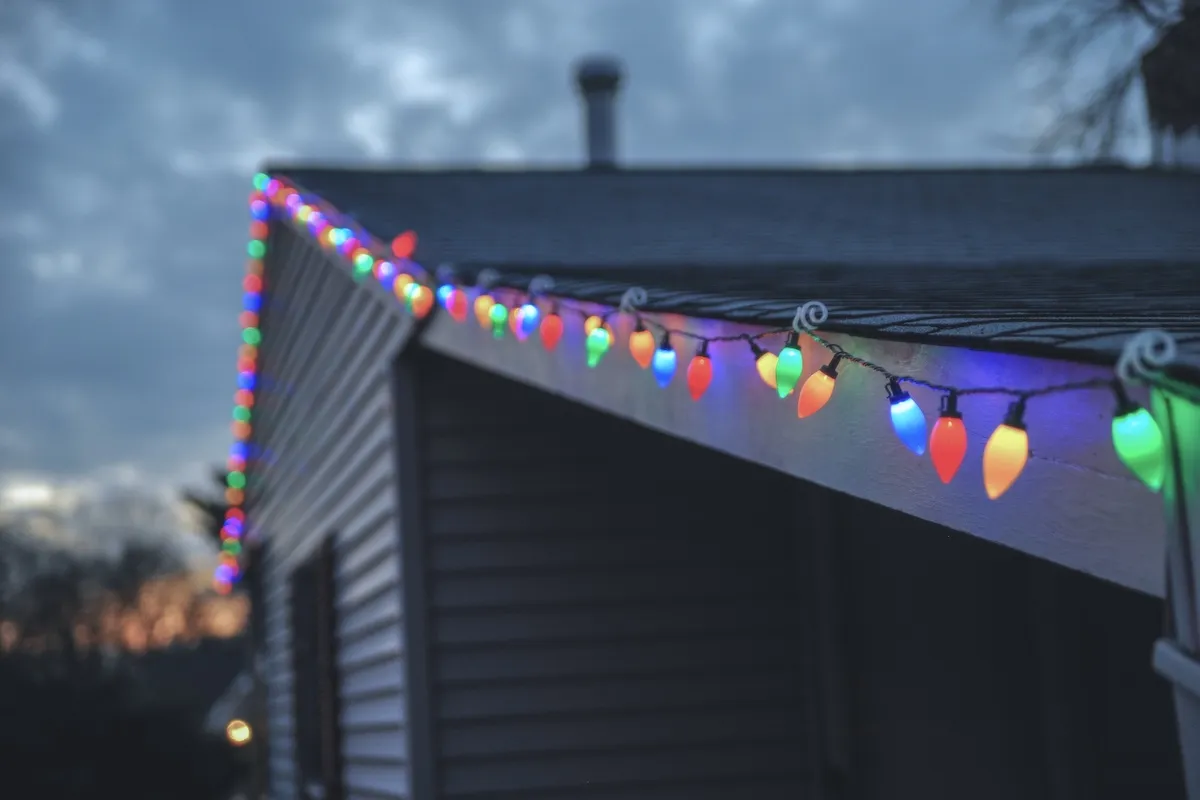
34. Spiral Light Trees With Vertically Draped Pillars
Vertical pillar drapes are the most underused trick in exterior lighting. Run the strand straight down the front face of each pillar and anchor every 2 ft — do not spiral, which looks messy from the street. Three spiral trees with star toppers need a lawn at least 20 ft wide, or the forms visually merge into one blob.
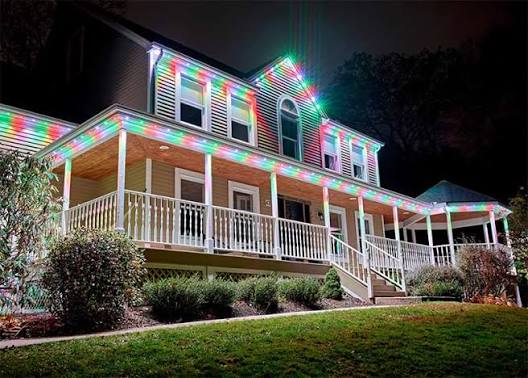
35. Alternating Red and Blue LEDs Casting Purple Light
The purple. That is what makes this memorable, and it happens almost by accident — alternating red and blue LEDs mix in the eye and on the concrete below. Remove either color and the whole thing goes flat. Compare with Idea #23 for a similar two-tone approach with a much warmer result.
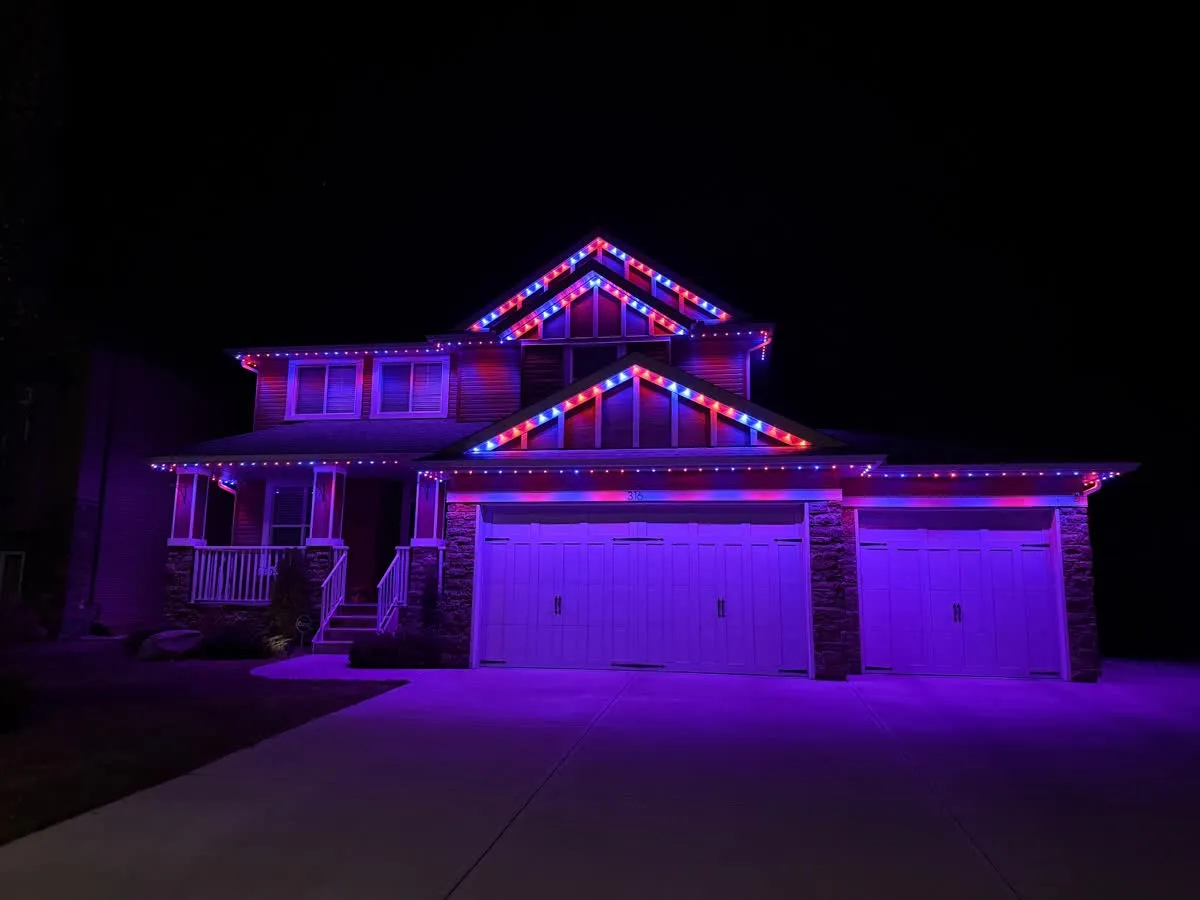
36. Extravagant Festive House With Dense Warm White and Colored Lights
Layering is the whole story here: architecture first, then figures, then greenery. Warm white outlines the house, colored garlands and wreaths sit on top of that, and the lit snowman, sleigh, reindeer, and polar bear fill the yard at eye level. Each layer has its own job, which is why so much decoration still reads clearly instead of becoming glare.
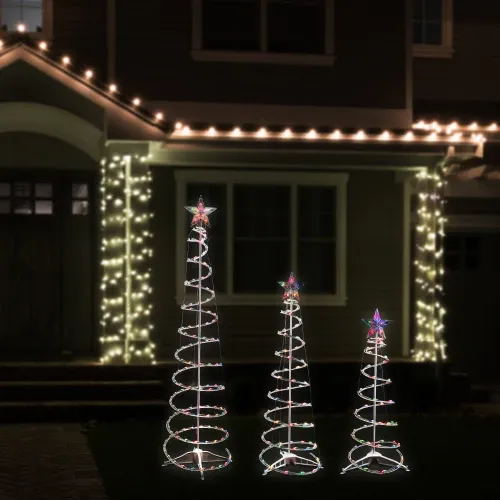
Make the Whole Street Slow Down and Look
Start with one layer — the roofline, or a single wrapped tree — and let it sit for a night before you add anything else. Most great displays are just two or three decisions made confidently, repeated consistently around the house.
📌 Pin your favorite idea from this list so you can find it again when the strands go on sale in early November.