
You know the scroll: two hundred photos deep into the traditional Christmas tree tag, and every tree looks either styled by a set designer or exactly like the one your neighbor has had since 2009. The ones that actually work tend to have the same three ingredients — one classic palette, one unexpected texture, and lights that are warm, not white.
We spent serious time browsing Etsy, Target, Walmart, and IKEA to bring you only what’s worth your attention this year, from $12 ornaments to a $480 heirloom topper. After filtering through hundreds of options, we narrowed it down to 30 ideas that actually deliver.
Inside you’ll find four directions — Victorian vintage, flocked and pastel, classic red-and-green, and full jewel-tone maximalism — with budget and luxury versions compared side by side. And stay until the end, we break down the most common mistakes that can ruin these looks. In 2026 the shift is toward trees that look inherited rather than purchased as a set, which is why tinsel, mercury glass, and multicolor bulbs are suddenly everywhere again. 📌 Save this to Pinterest for later, you’ll want to revisit these ideas.
1. Victorian Parlor Glow: Red Ribbon, Antiques, and a Brass Chandelier
Wired ribbon is the difference between a tree that looks styled and one that looks tied in a hurry. Cut 18-inch lengths, pinch each into a soft loop, and wire it to a branch every third row, working top to bottom so the ribbon steps down in a gentle spiral instead of stacking in clumps. Skip the bow spree — four or five loops total is plenty when the ornaments and the dark wood already carry the color.
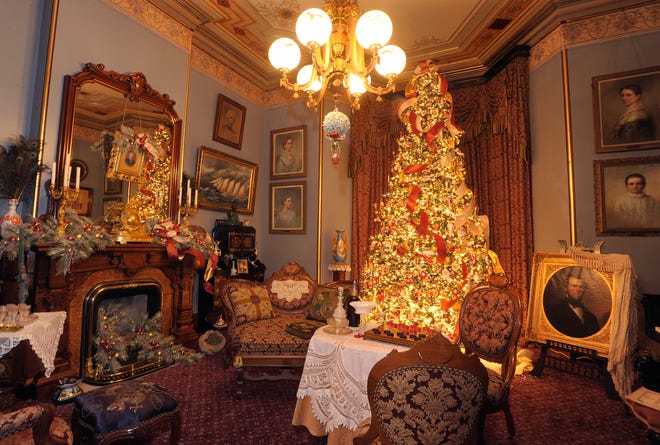
The most valuable thing in this room isn’t the tree. It’s the gold-framed mirror above the mantel, sitting directly in the tree’s line of sight, doubling every warm bulb and red ribbon and making the parlor read twice as deep as it actually is. Take the mirror away and the whole scene goes flat, no matter how many ornaments you hang or how well the antique settee is placed.
2. Crimson Walls, Gold Molding, and a Tree That Fills the Room
Three things are doing the heavy lifting here. First, tone-on-tone saturation — deep red walls and red ornaments sitting in the same color family, so nothing fights for attention. Second, the ornate gold-detailed ceiling molding, which gives the eye somewhere to rest between all that red. Third, the patterned red rug repeating the palette at floor level so the room doesn’t float away.
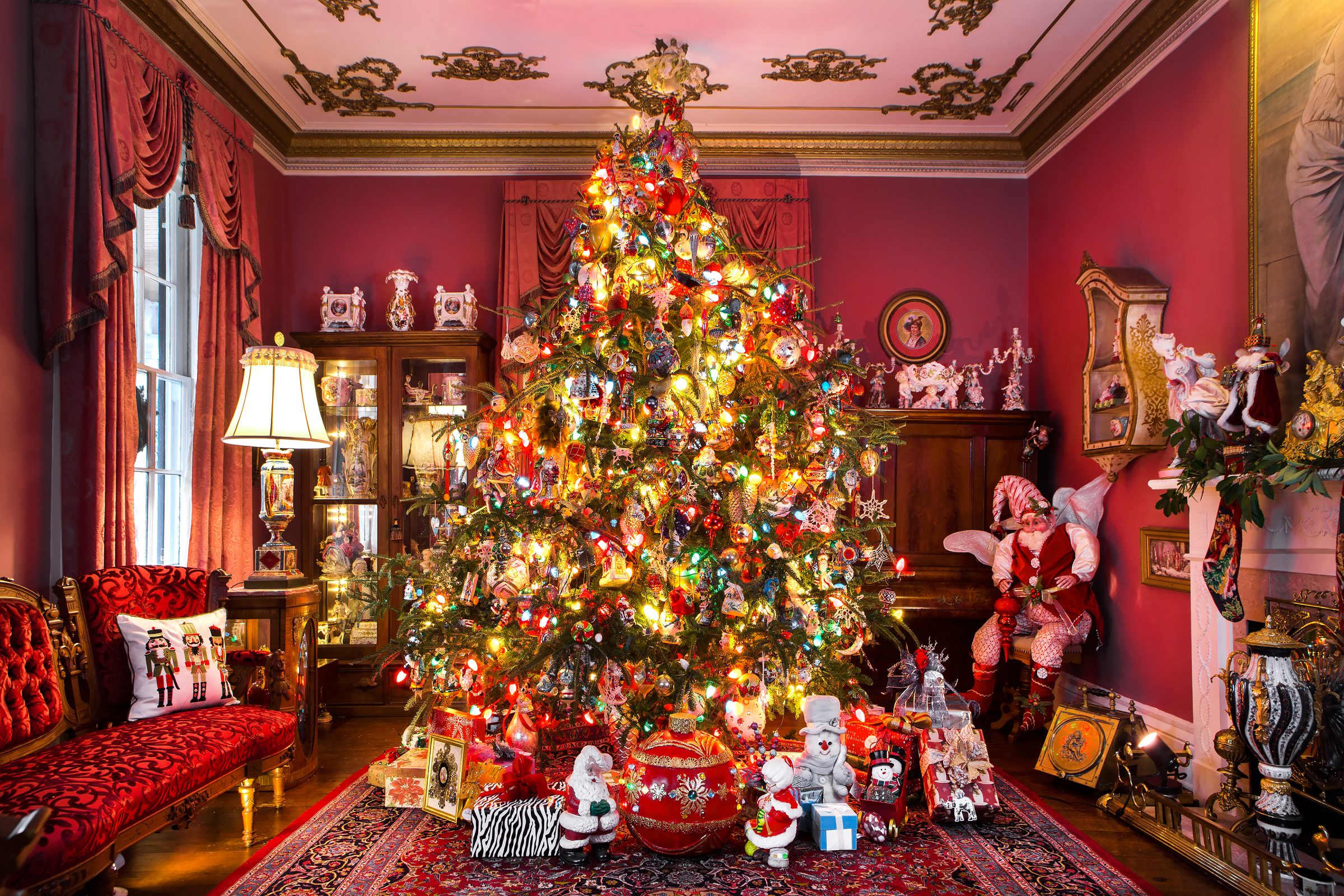
This is a tall-ceiling look. Saturated walls plus a densely lit tree need vertical space to breathe — think 10-foot ceilings at minimum, with about 3 feet of clearance on the tree’s open sides so the light actually bounces. In a standard 8-foot room, take the same palette down to a 6.5-foot tree and let the furniture and rug carry the drama instead.
3. Sparse Branches, Silver Tinsel, and Multicolor Lights
Sparse trees are having a moment — the kind with visible gaps between branches that let you see the gathered drapes behind them. Tinsel is the tell: it reads as inherited, not shopped. The nostalgia cycle has swung hard toward the 1970s and 80s, and multicolor bulbs on a tree with real air in it photograph better than the packed, all-white-light look everyone built in 2021.
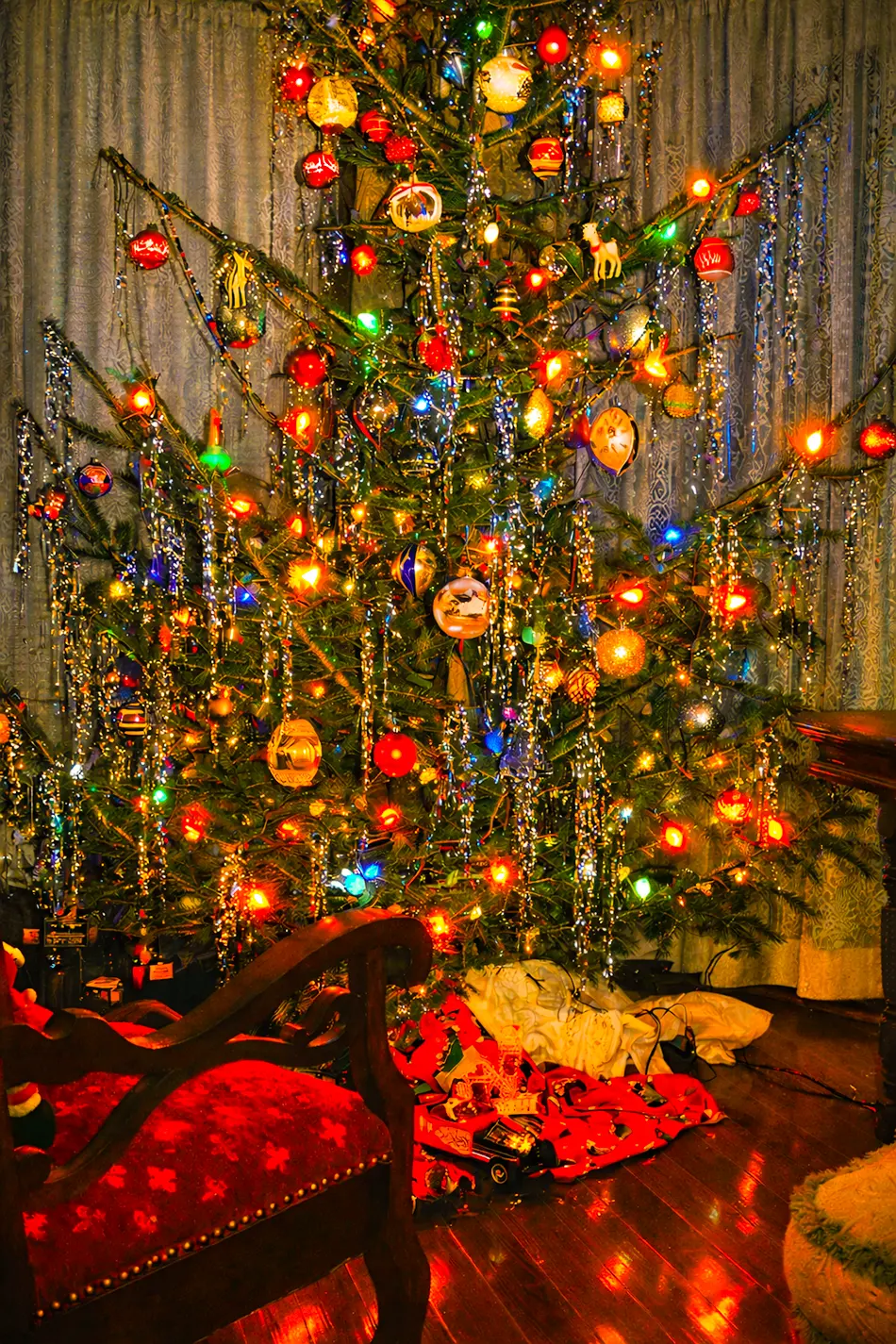
The formula here is roughly 20% tree, 50% ornament, 30% light, deliberately top-heavy on decoration. To swap it without losing the vibe, keep the ratio and trade silver tinsel for gold, replace multicolor bulbs with warm white, and let vintage glass balls in red, blue, and green stay the constant. Pull the tinsel entirely and the tree loses about ten years of charm, so keep at least a few strands.
4. A Crimson Warning: When Red and Gold Stops Working
Here’s the honest part. A deep red ornament against a deep red wall with gold on every surface is a gorgeous idea right up until the lights come on and the room turns into one flat ruby blur. If you can’t tell where the tree ends and the wall begins from the doorway, you’ve overdosed. Adding more red won’t fix it — subtracting something will.
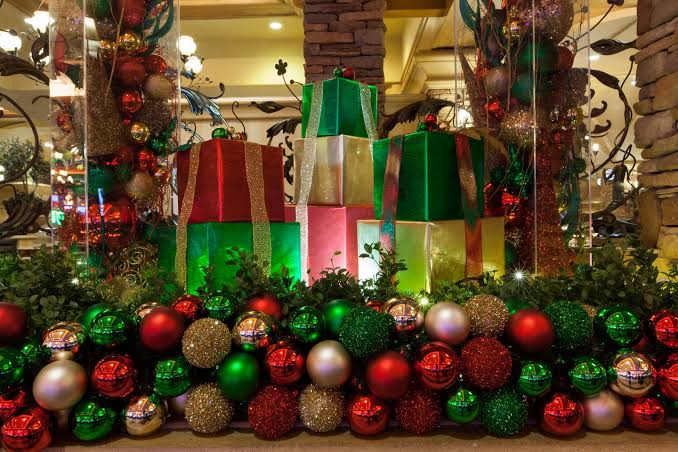
Keep one metal, one red, one green, and one wildcard. A scheme stays legible at roughly 60% green or neutral, 30% red, 10% metallic. If the walls are already red, drop the red from the tree and let gold and glass carry it; if the tree is loaded with red, keep the walls and rug quiet. Two strong reds in the same sightline read as an accident, not a decision.
5. Flocked Branches, Vintage Glass, and Pink-and-Green Stockings
Here’s what a flocked tree loaded with vintage glass actually costs to build from scratch — and how it looks in a darker room in Idea #14.
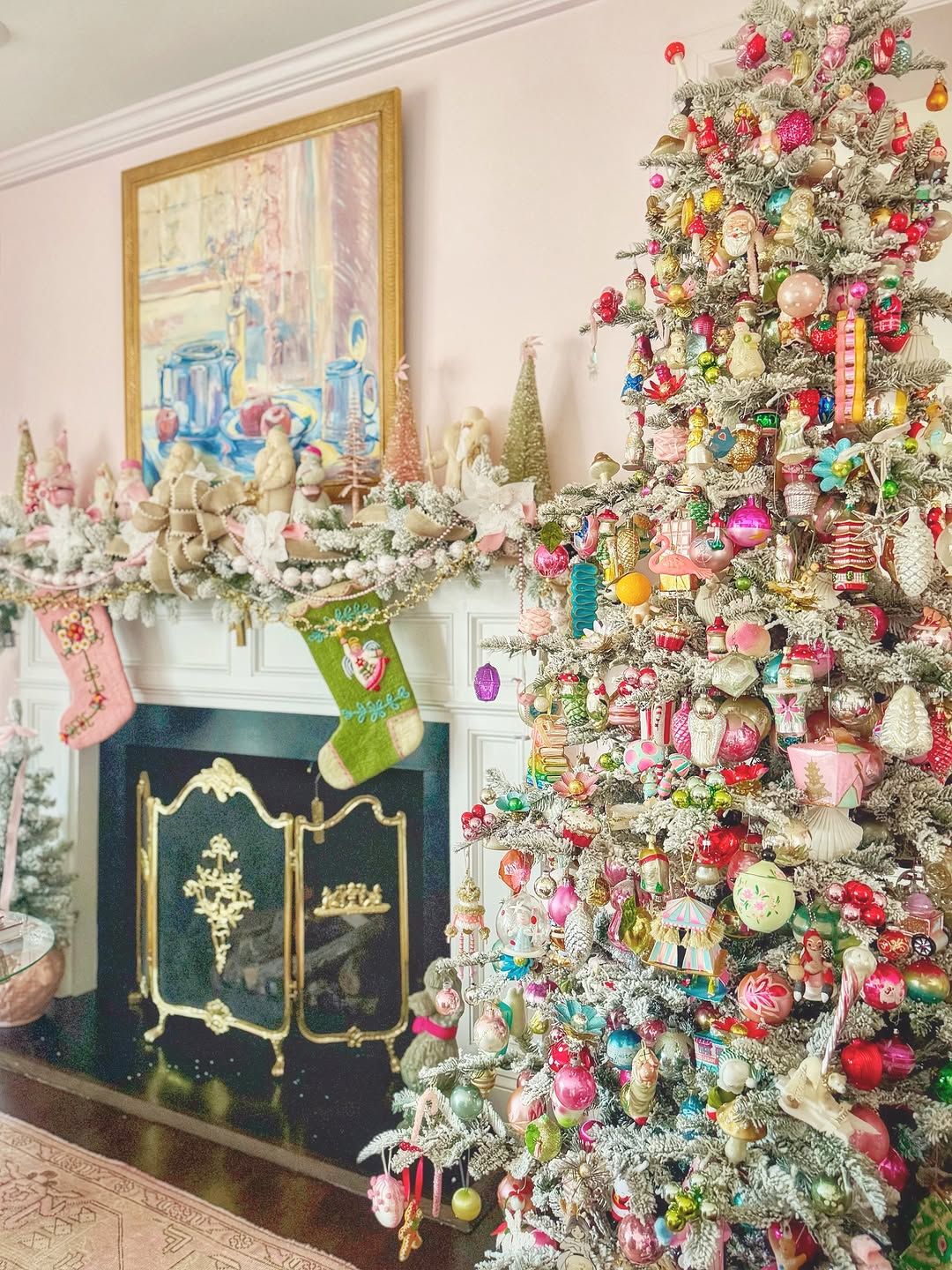
- Flocked pre-lit tree, 7.5 ft: $180–$450
- Vintage-style glass ornaments, 40–60 pieces: $90–$300
- Flocked garland and mantel styling: $40–$120
- Pink and green stockings with holders: $30–$90
- Figurines and still-life accents: $25–$150
You can fake almost all of this. A $35 can of spray flocking on a tree you already own, glass ornaments from thrift stores and estate sales at $1–$3 apiece, and two stockings from Target at about $12 each gets you most of the charm for under $200. Facebook Marketplace is packed with flocked trees in January, when sellers are motivated and no one else is shopping.
6. Red and Gold Baubles Under a Vaulted Glass Ceiling
Rooms with 14-foot-plus ceilings are the only place a 10- to 12-foot tree reads as furniture rather than decoration. You want at least 4 feet of clearance around the base for gifts and foot traffic, and the star should finish 12 to 18 inches below the beam or arch it sits under. Any closer and the whole thing feels pinched, no matter how good the ornaments are.
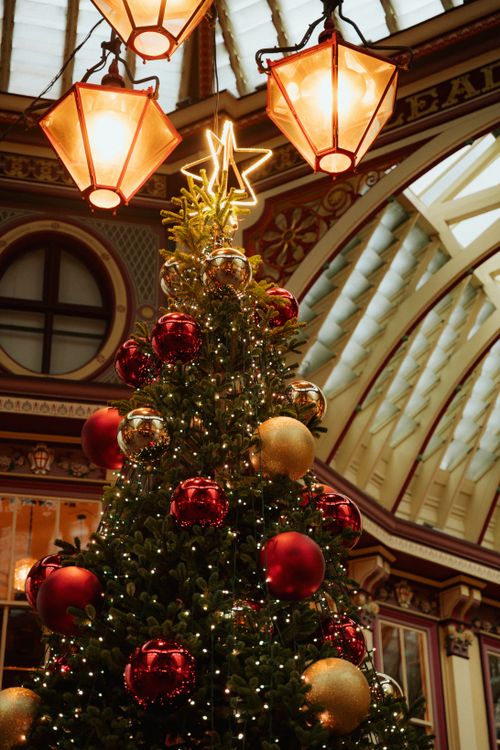
When a tree gets this tall, ornament size has to scale with it or the branches swallow everything. Use 4- to 6-inch spheres on the outer third of each branch, and mirror them with at least one matte-finish set so the glossy ones have something to play against. Standard 2.5-inch ornaments on a 12-footer effectively disappear from six feet away.
7. Gold Starbursts, Glass Icicles, and a Whisper of Red Velvet
Read this tree as a ratio: about 45% green branch, 30% metallic gold, 15% clear glass, 10% soft red. The gold starbursts are punctuation, the beaded garland is connective tissue, and the small red velvet ribbons are what keep it from sliding into an all-gold display. Trade the gold for champagne silver and the tree cools down instantly — keep the white fabric ribbon as your neutral anchor either way.
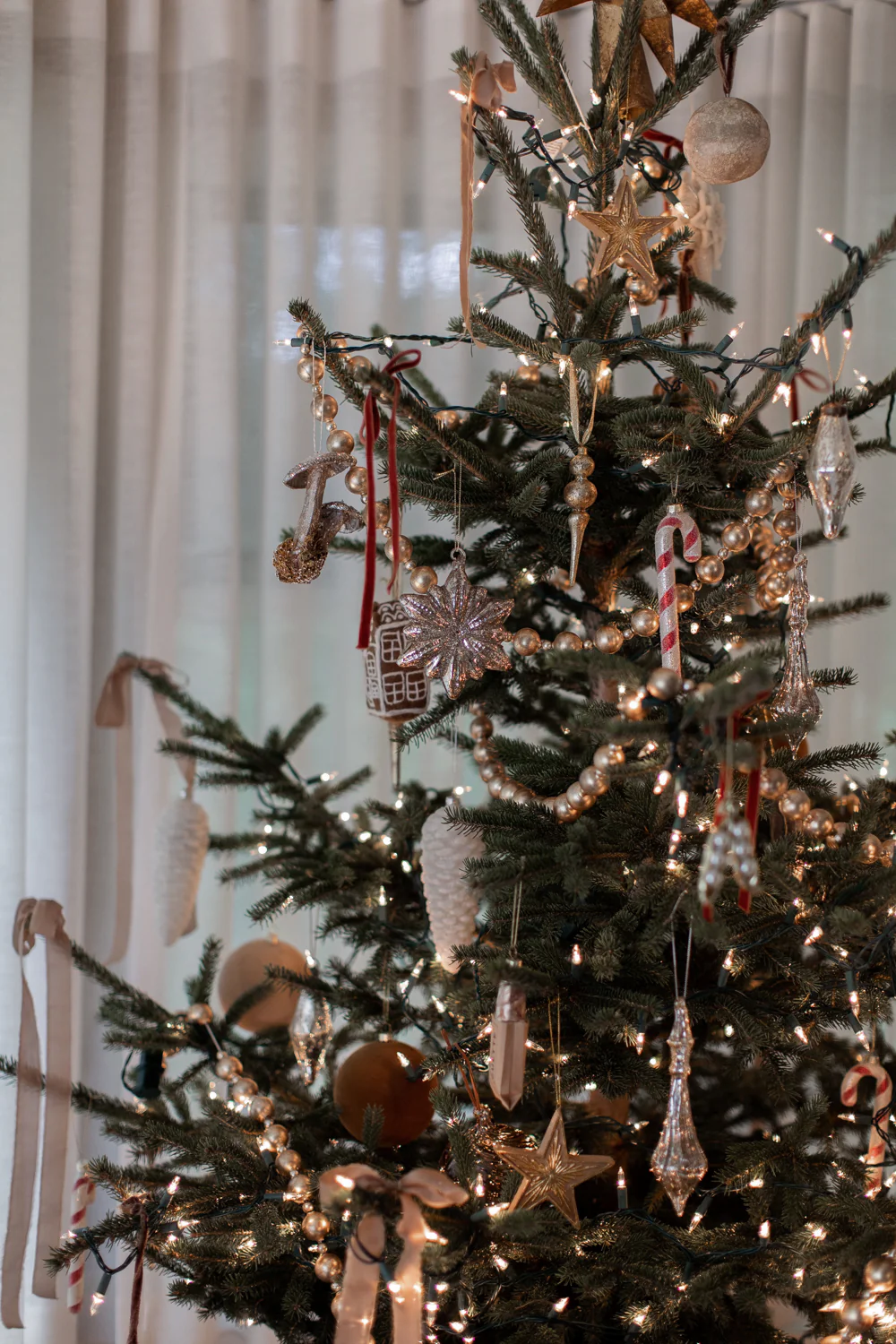
Beaded garland looks effortless and absolutely isn’t.
- Start at the top and tuck the end behind a branch rather than looping it over the front.
- Work in a shallow spiral, about one full turn every 14 inches of tree height.
- Let the strand sag 3 to 4 inches between branches so it reads as draped.
- Add the glass icicles last, always just below a light so they catch the glow.
- Step back every three rows and correct any straight lines.
Time: about 45 minutes on a 7-footer. Garland runs $18–$45.
8. Glossy Red and Gold Baubles, Up Close and Warm
Hang your largest ornaments deep in the tree, not out on the tips. Placing a 4-inch glossy sphere a full branch length inside makes the tree read as dense and hides the wire, while smaller ornaments sit out front where the bulbs hit them directly. That’s the trick behind every photo where the tree looks bottomless instead of hollow.

Everything in this close-up works because of one decision: the lights are warm, not white. Amber-toned fairy lights turn red glass into something closer to stained glass and make gold read like brass. Switch to cool white bulbs and the exact same ornaments look cheap and clinical. It’s the least expensive, most overlooked upgrade you can make to any tree this year.
9. Matte Black Spheres and Crystal on Dark Green Velvet
Contrast and repetition do all the work. The matte black spheres give the eye a place to land between all that shine — without them, the crystal cuts and metallic red picks would blur into one bright smear. The beaded garland repeats, the floral picks punctuate, and the dark green velvet behind the tree absorbs light so nothing competes for attention.
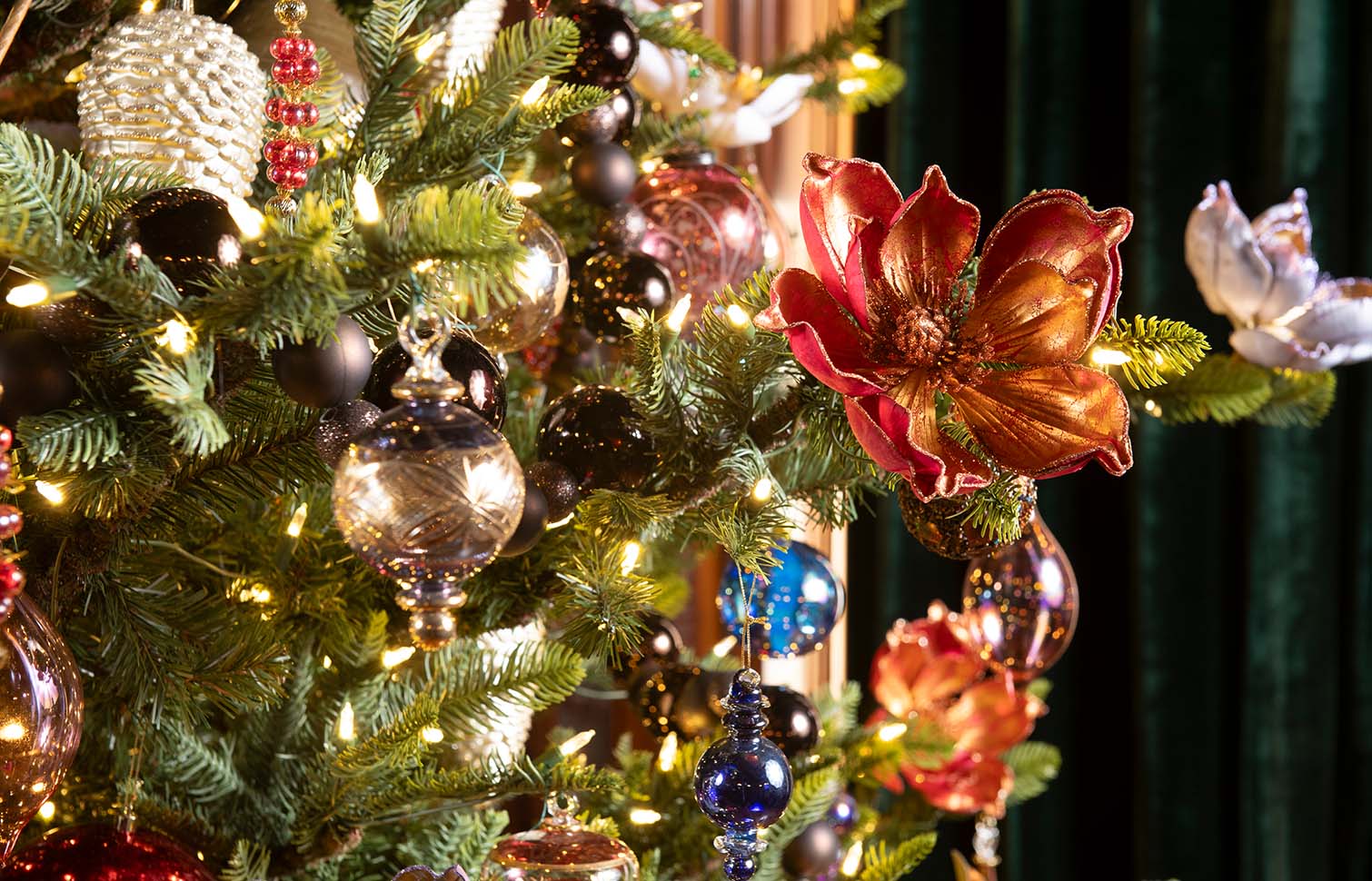
A warning about those metallic floral picks: they’re heavier than they look, and on a real tree the weight will pull a branch down within a week. Wire them close to the trunk rather than out on the tip, and never hang glass directly below one. Also worth knowing — matte black ornaments show dust faster than anything else on the tree, so keep a soft cloth handy.
10. Disco Balls and Pink Velvet: A Sweeter Take on Tradition
Mix finishes in threes — matte, velvet, and mirror — and never let all three sit adjacent. The silver disco ball works here specifically because the pink velvet ornaments around it are soft and light-absorbing; put two mirrored pieces side by side and they cancel each other out. Hang snowflake cutouts flat against the branch instead of letting them dangle, so they read as a pattern rather than clutter.
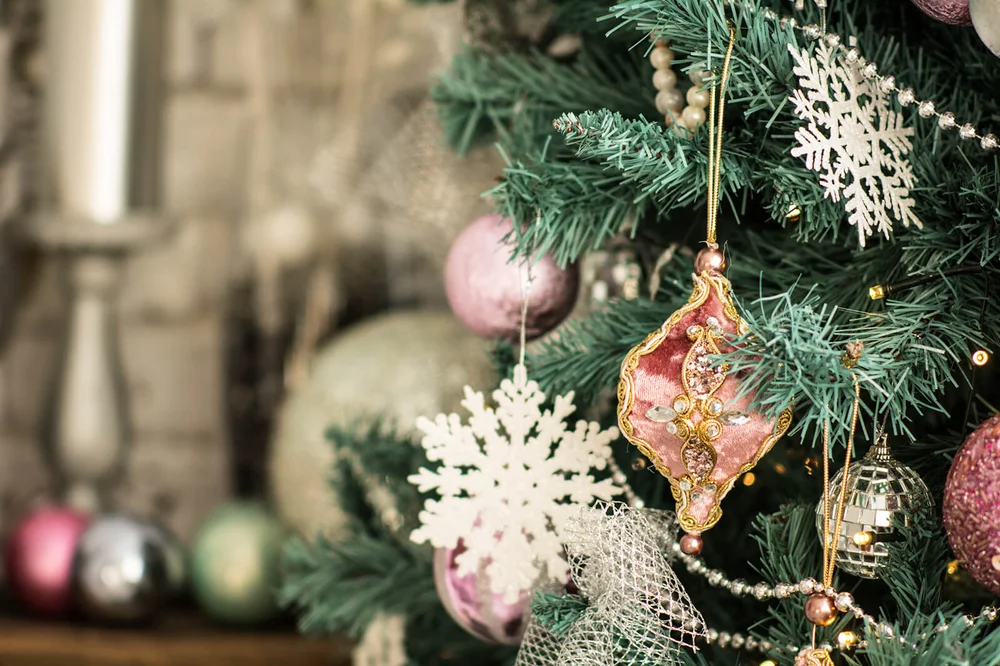
Pastel trees got written off as a lockdown fad, and they’re still here. Part of the reason is practical: pink velvet and silver look right in a nursery in December and stay acceptable through January. The version actually working in 2026 is pink on green with silver, not an all-white tree — the green branches are what keep it feeling like Christmas instead of somebody’s birthday.
11. The Papercut Santa Medallion Worth Building Around
that makes this ornament worth building a branch around is the indented glass medallion under the Santa. That concave reflector bends warm light back out into the room, which is why vintage glass looks lit from inside and most modern ornaments don’t. Take the medallion away and you’re holding a flat paper cutout. Keep it, and a $6 piece can carry an entire section of tree.
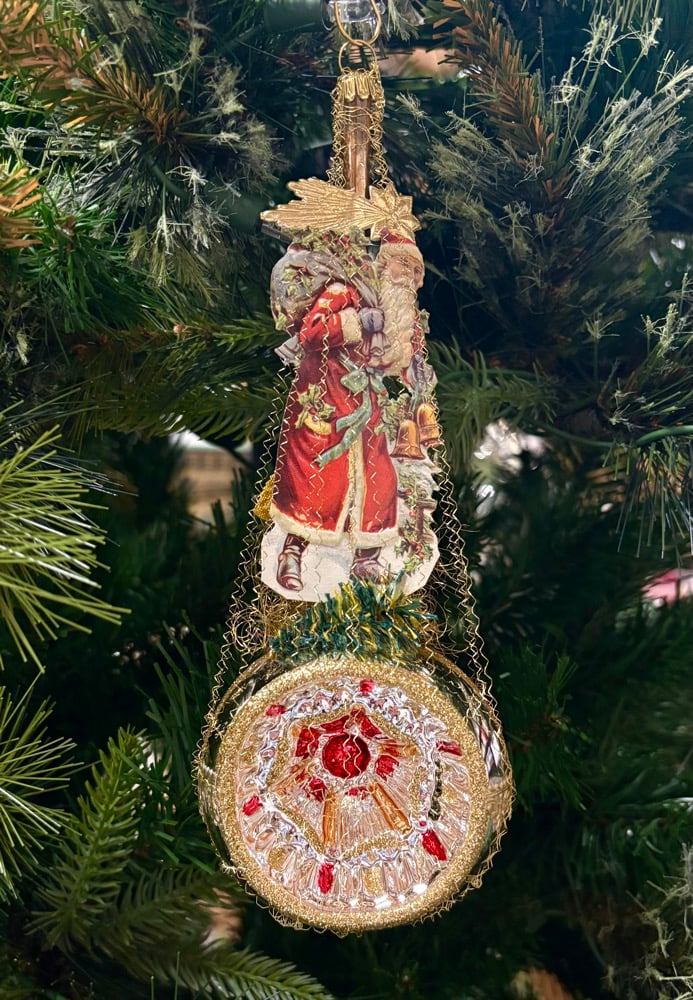
Heirloom glass needs slightly different handling than everything else.
- Hang it at eye level, roughly 4 to 5 feet off the floor, never low where gifts and pets reach.
- Use a wire hook instead of a ribbon loop — ribbon hides the gold cap that makes these special.
- Leave about 6 inches of bare branch around it so reflections don’t overlap.
- Photograph it with the room lights off and the tree lights on, that’s when the medallion fires.
Cost: a pack of 100 wire hooks is about $5.
12. A Beaded Gold Star Topper With a Holy Family Center
A topper is a scale decision before it’s a style decision. This one works because the beaded starburst is roughly one-seventh the height of the tree — on a 7.5-footer that’s a 12- to 13-inch piece. Anything bigger than one-fifth of the tree’s height starts to look like a hat, and you want at least 8 inches of room between the top of the star and the ceiling above it.
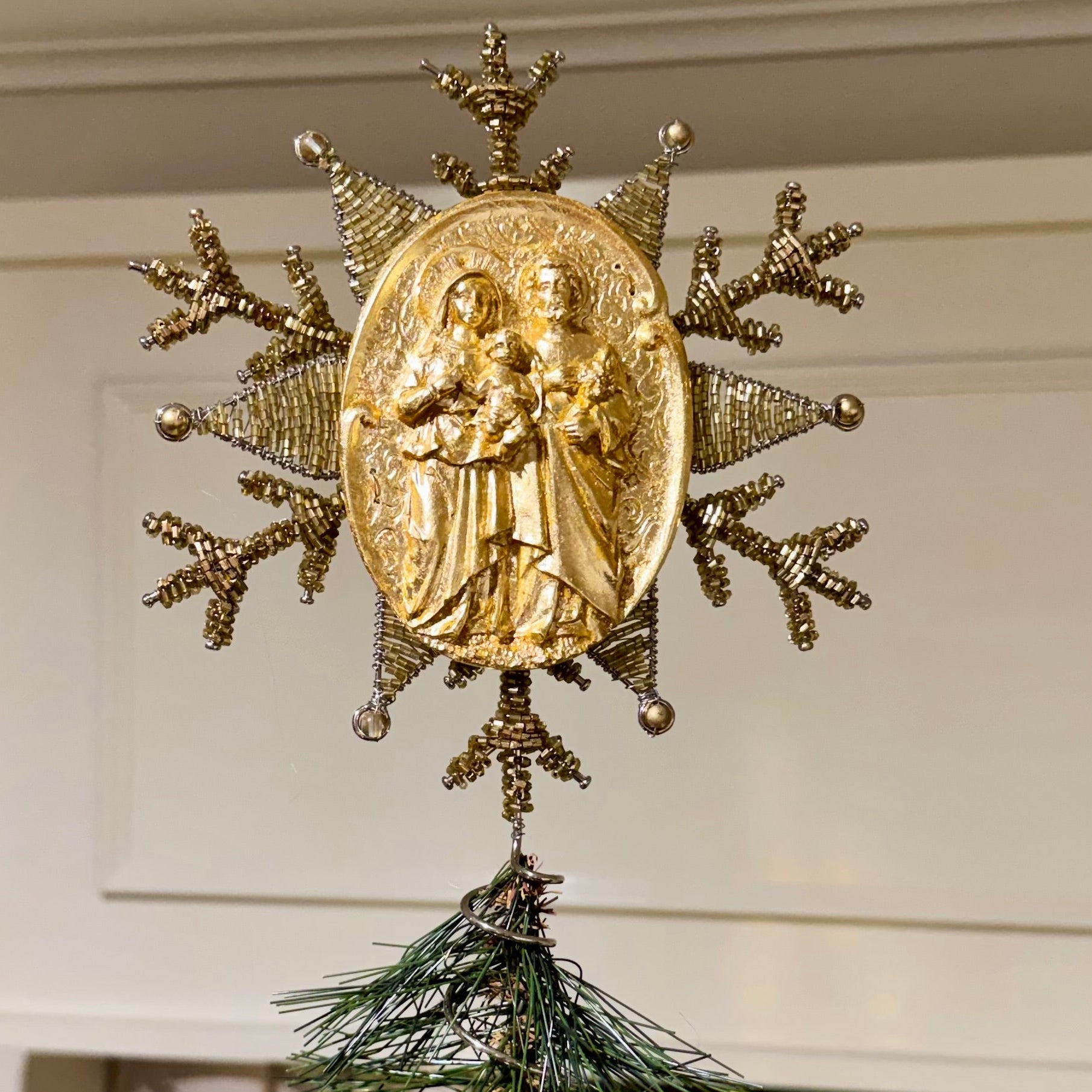
Heirloom and religious toppers are quietly outselling novelty ones right now, and 2026 catalogs reflect it — the trend is toward pieces that could plausibly have belonged to a grandparent, built on weighted metal frames rather than hollow plastic. The practical upside: they’re heavy enough to sit straight in the top branch without tipping, which no lightweight star has ever managed.
13. Classic Red Balls, Beaded Garland, Warm White Lights
What a genuinely classic red-and-green tree costs if you build it from scratch — and it’s the same look Idea #6 scales up to a vaulted room.
- Pre-lit 7.5 ft evergreen: $150–$400
- Red ball ornaments, 60-piece set: $40–$120
- Beaded garland, 3 strands: $25–$60
- Tree skirt or collar: $25–$80
- Wrapping paper and ribbon: $20–$50
This is the tree people recreate badly because they add too much. What’s actually working: one ornament type repeated at even spacing, one strand of beaded garland at a consistent spiral, and warm white lights on every branch instead of a few decorative strands up top. The gifts are wrapped in the same palette, which is why the whole corner reads as a single photograph.
14. Flocked Tree, Leather Sofa, and a Dough Bowl of Ornaments
The dough bowl is the move, and you can absolutely copy it for about $30. Walmart and Target both sell wooden bowls in the $25–$45 range — fill one with ornaments you already own plus a bag of mixed bulbs from a dollar store. The rows of small cone trees on the shelves are a $1–$3 item each at craft stores, and thrifted ones spray-painted matte white look identical from across the room.
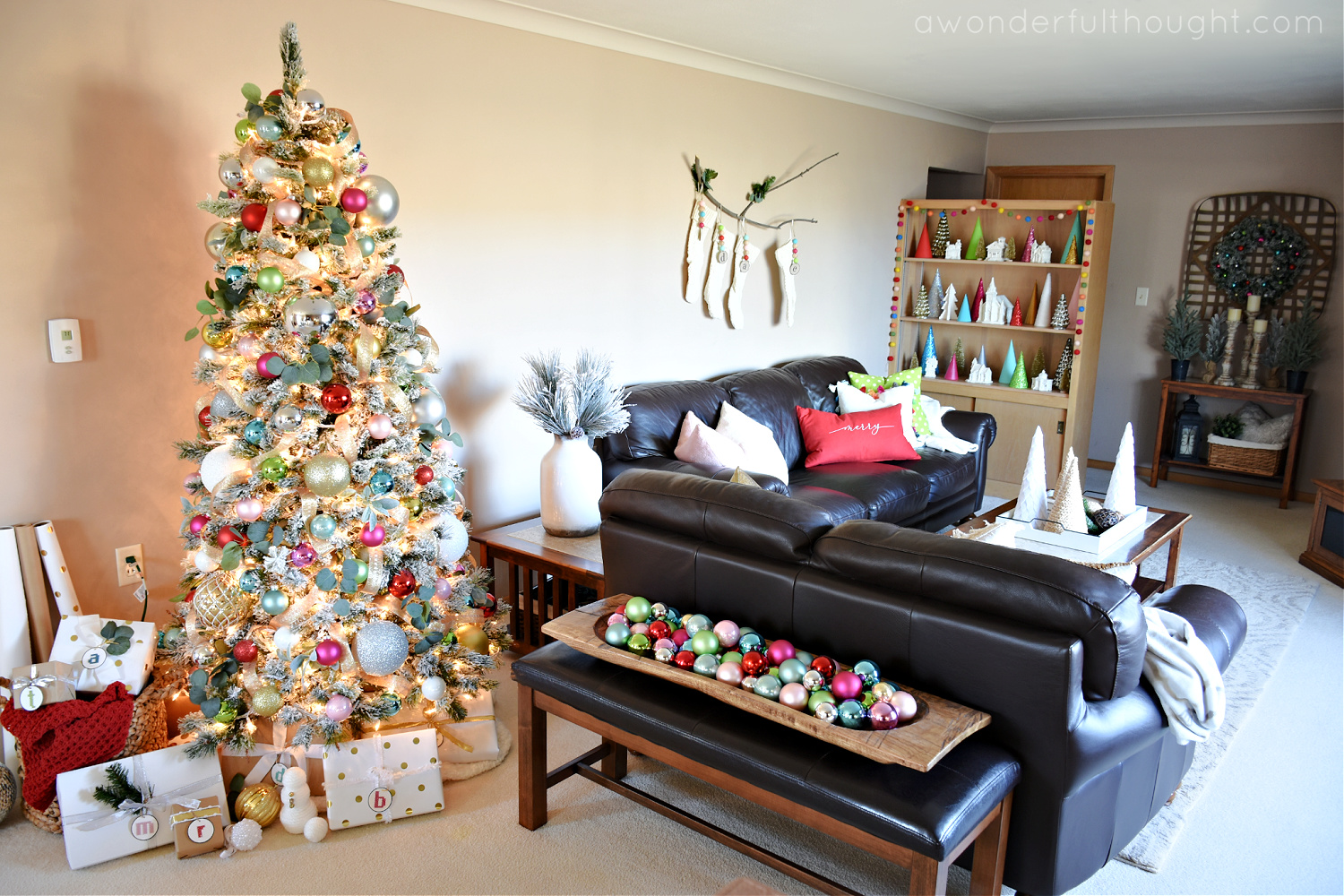
about dark brown leather next to a flocked tree: the flocking sheds, and it shows on leather like nothing else. Keep a lint roller in the drawer and shake the tree skirt out weekly, outside rather than indoors. Flocking on a live tree also yellows near heat vents by mid-January, so keep the tree at least a few feet away from any register.
15. Centerpiece: Red Candle, Pinecones, Buffalo Check
- Start with a low, wide vessel — 18 to 24 inches across for a table that seats six.
- Build a base of pine, layering it so it overhangs the bowl edge by about 4 inches.
- Tuck pinecones in at three points only; perfect symmetry kills the ease.
- Set the red pillar candle in the center and check that it sits below eye level.
- Finish with a velvet bow tied off-center and two or three glossy red ornaments resting on the greens.
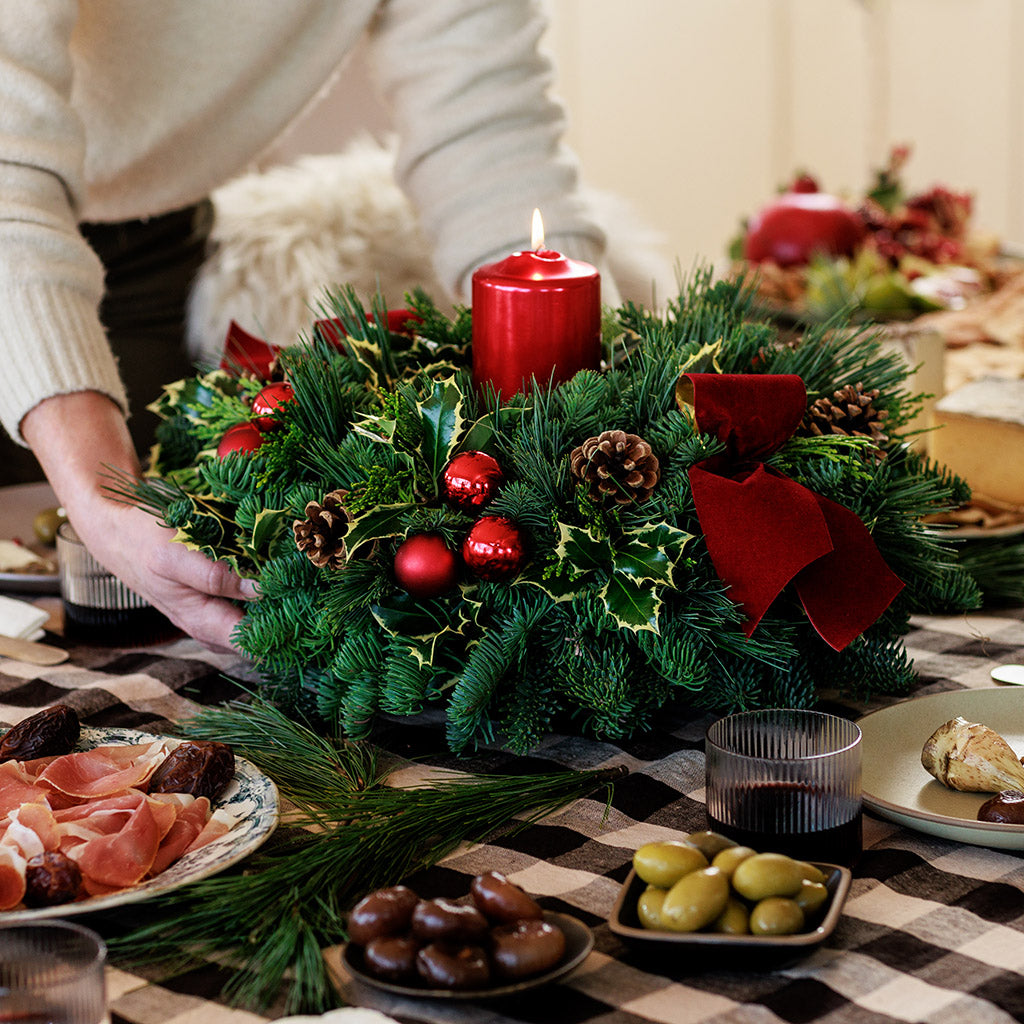
Time: 25 minutes. Cost: $20–$45.
The formula on this table is 55% black and white check, 30% pine green, 15% ruby red. Because the check is doing all the pattern work, everything else can be solid. Swap the buffalo check for plain cream linen and you’d need to double the red to keep it feeling festive — that’s the trade: pattern buys you permission to use less color.
16. Uniform Red Stars on Green — Orderly and Bright
This one is built for a corner. Red star ornaments on a full green tree want about 30 to 36 inches of clearance from the nearest wall on two sides, and the light gray armchair needs a minimum of 24 inches from the tree so nobody leans into branches to sit down. It works beautifully in a 10×12 room; below about 8×10 the whole setup starts to feel like a hallway.
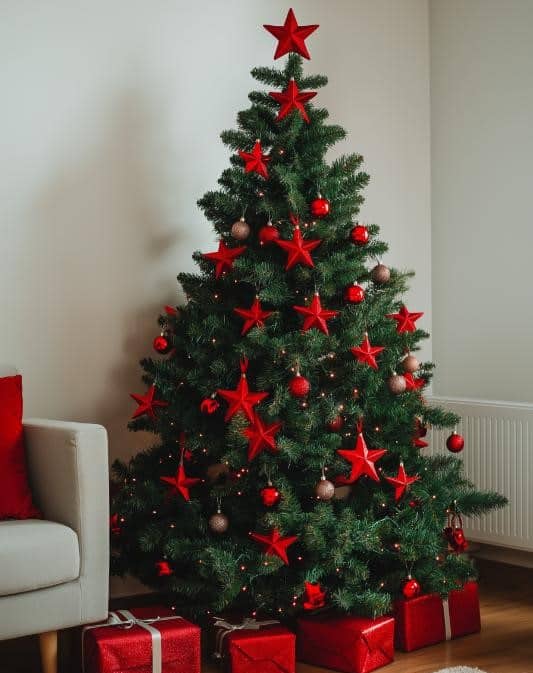
Dimensional star ornaments are the one piece that’s hard to fake, but everything else is easy. Red ball ornaments in bulk run $12–$20 for 50 at Walmart. Red wrapping paper with white ribbon is the cheapest way to make the base look styled — the presents under the tree do nearly as much work as the top of it, and nobody is checking whether the paper was expensive.
17. Silver Tinsel Cascades Against Floor-to-Ceiling Curtains
Tinsel is gorgeous for about three seasons and then it’s a commitment. It tarnishes, collects dust like a magnet, and flattens against the branch if you pack it into a bag. Plan on replacing it every two to three years, and store it coiled in tissue rather than bagged — that’s how it ends up crushed. A silver beaded garland gives the same shimmer with a decade of life left in it.
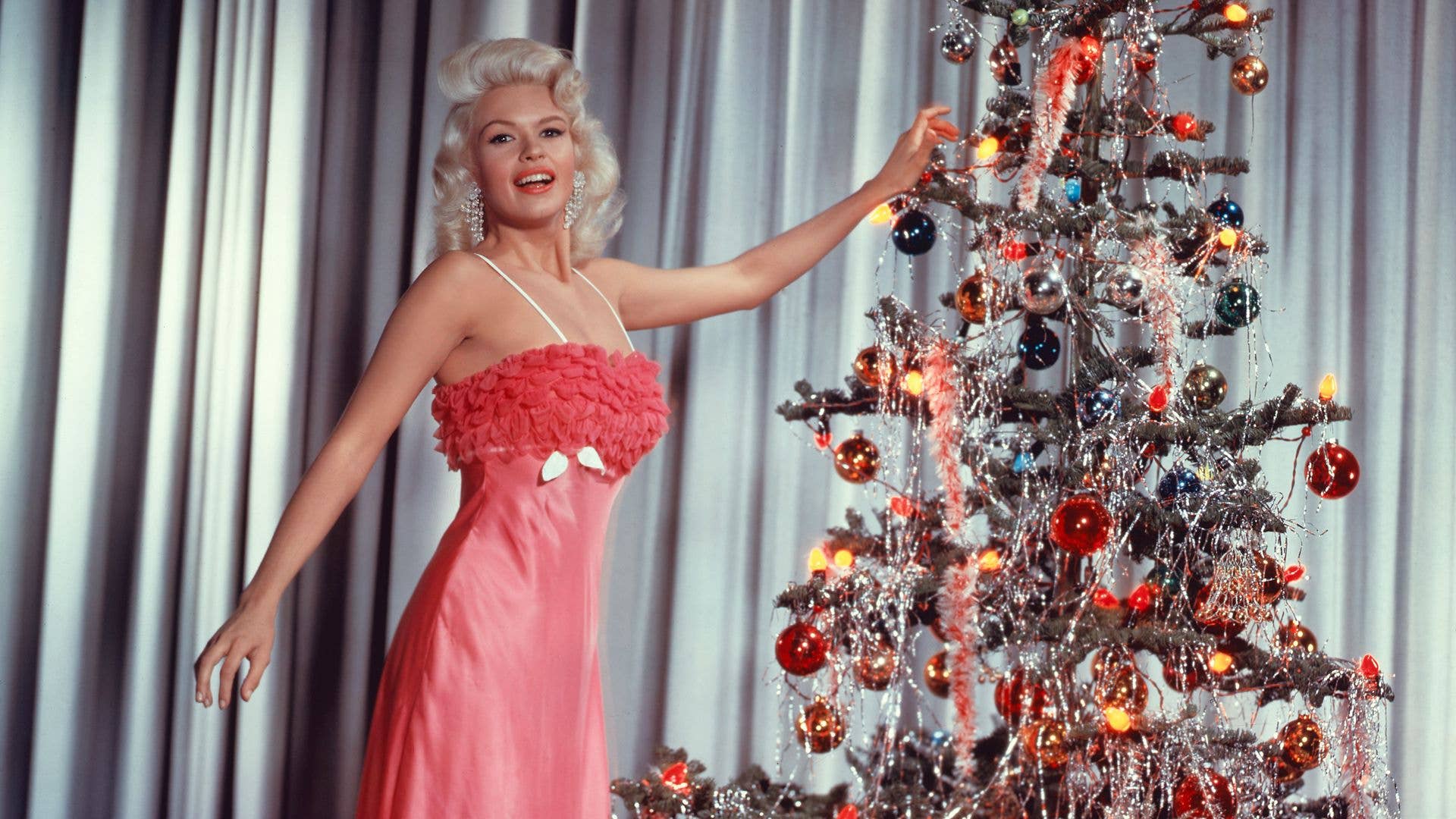
Tinsel came back because the whole aesthetic came back: pleated curtains, colored glass, and light that looks like it came from a bulb instead of an LED strip. The trees getting the most saves right now are the ones that look inherited rather than purchased as a set, and nothing signals inherited faster than silver tinsel draped over a full green tree.
18. Gold Ribbon and Pastel Bulbs, Poured Into a Dough Bowl
Gold ribbon woven horizontally through the branches is what holds this tree together — it gives the eye a line to follow through all that multicolor and echoes the gold caps on the ornaments. The dough bowl in the foreground repeats the styling at table height so the bottom of the tree doesn’t feel empty. That repetition across two heights is what makes a busy tree look intentional. Compare with Idea #14, same bowl, much darker room.
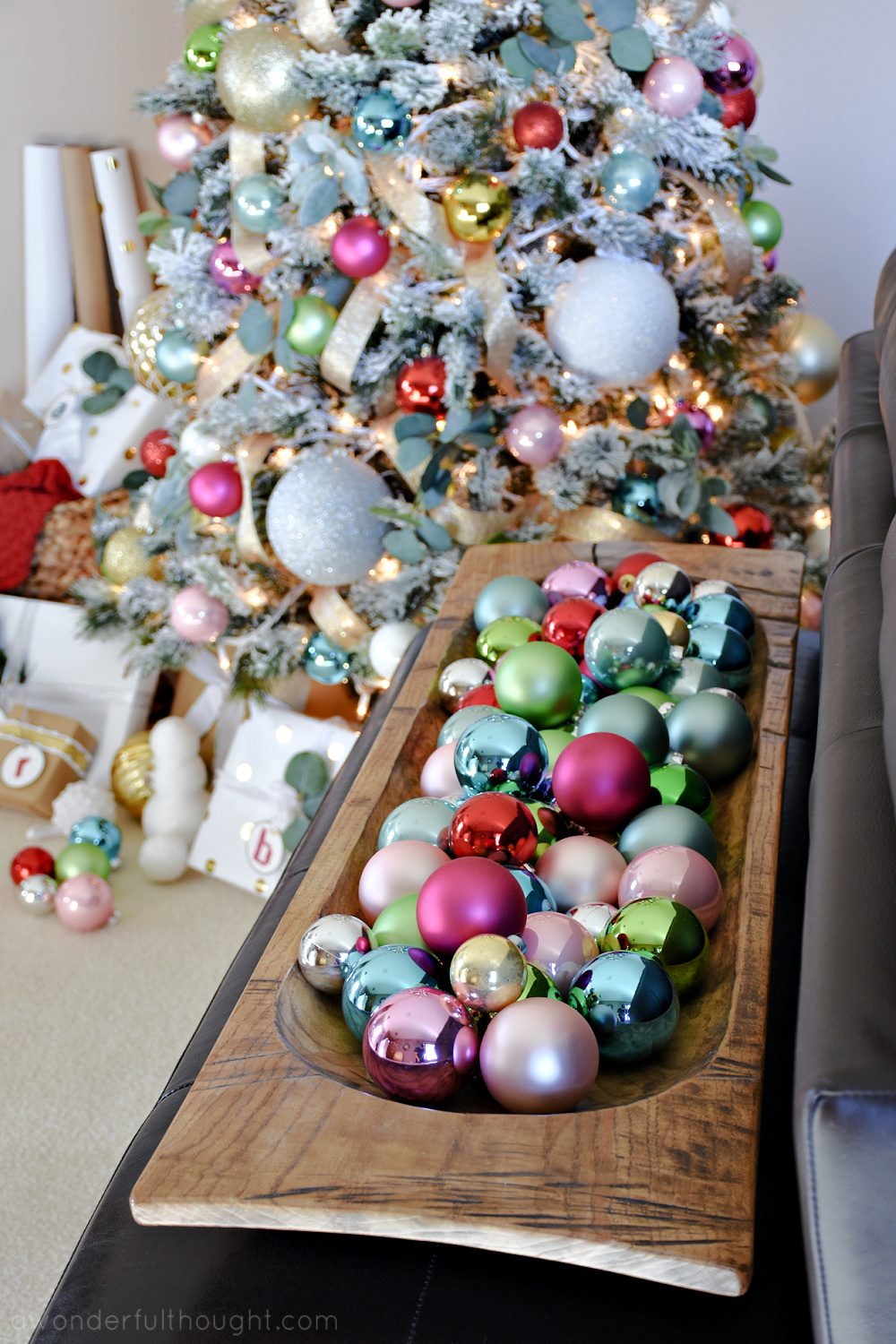
Flocked trees with pastel ornaments photograph beautifully and hide one flaw: pastel bulbs wash out under warm lights, so the blush pink you bought in daylight can read beige by 8pm. Buy ornaments in person when you can, or look for saturated pastels rather than chalky ones. And resist adding a fourth pastel — pink, mint, and aqua is already a lot of competing cool tones.
19. Lime Green Glass and a Little Red Elf
One oddball ornament can anchor an entire section of tree. Hang the strangest piece you own — a lime green glass ball, a vintage elf, whatever doesn’t match anything — and then build two rings around it using ornaments that echo its colors. That’s how a mismatched collection reads as a collection instead of a box of leftovers nobody wanted to hang.
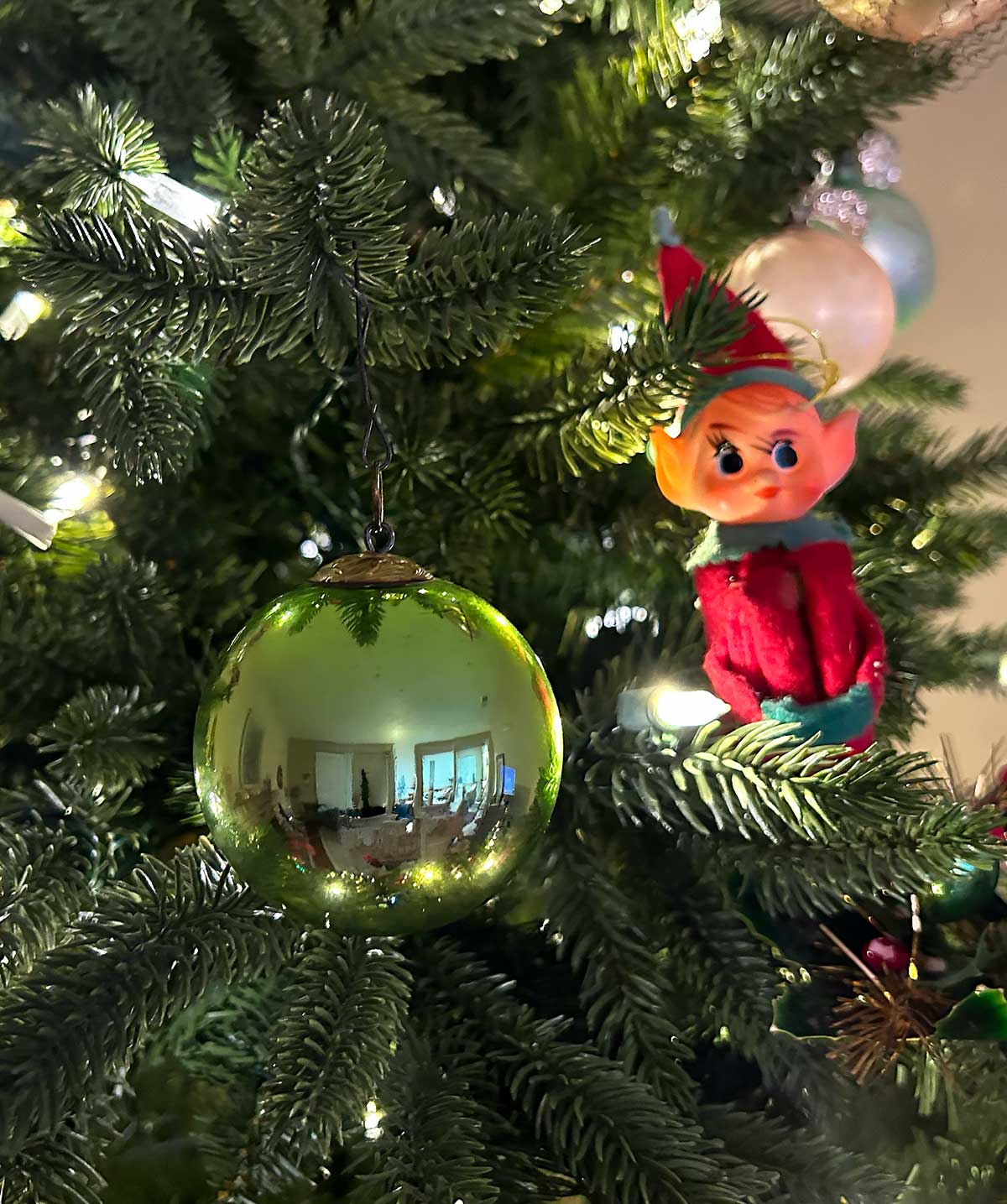
- Pick your anchor ornament and hang it at eye level, facing the room.
- Ring it with three ornaments in the same green family, each about 6 inches away.
- Add two red pieces farther out to break up the green.
- Tuck a warm white light directly above so the glass catches a highlight.
- Repeat the cluster once on the opposite side of the tree for balance.
Time: about 15 minutes per cluster.
20. Victorian Santa Riding a Red-and-Gold Glass Globe
The glass globe is the entire ornament. Everything else — the Santa cutout carrying toys, the gold tinsel fringe, the two green bells hanging from their spiral arms — exists to frame a red and gold patterned sphere that reflects the whole room back at you. Lose the globe and you have a nice figurine. Keep it and the piece reads as an antique, which is exactly why it gets saved.
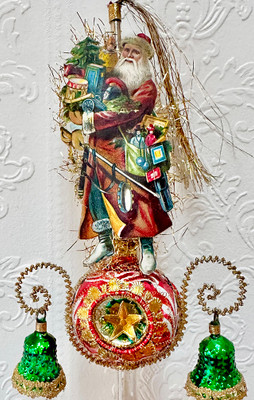
Ornaments with tinsel fringe and swinging bell arms are the most fragile things on a tree. Store them in a divided box with the bells wrapped separately — bend a bell arm once or twice and the wire fatigues until it snaps. Keep them out of direct sun, too; the red printing on vintage-style glass fades toward orange after a couple of seasons near a bright window.
21. Pale Pink Tinsel Bauble Meets a Red Glass Santa
Pair a soft ornament with a saturated one and let the lights do the separating. A pale pink glass bauble with tinsel trim sitting near a molded red Santa gives you a dramatic color jump, but the two pieces are nearly identical in scale, so the eye reads it as deliberate rather than random. If they also differed in size, the brain would file it under mistake.
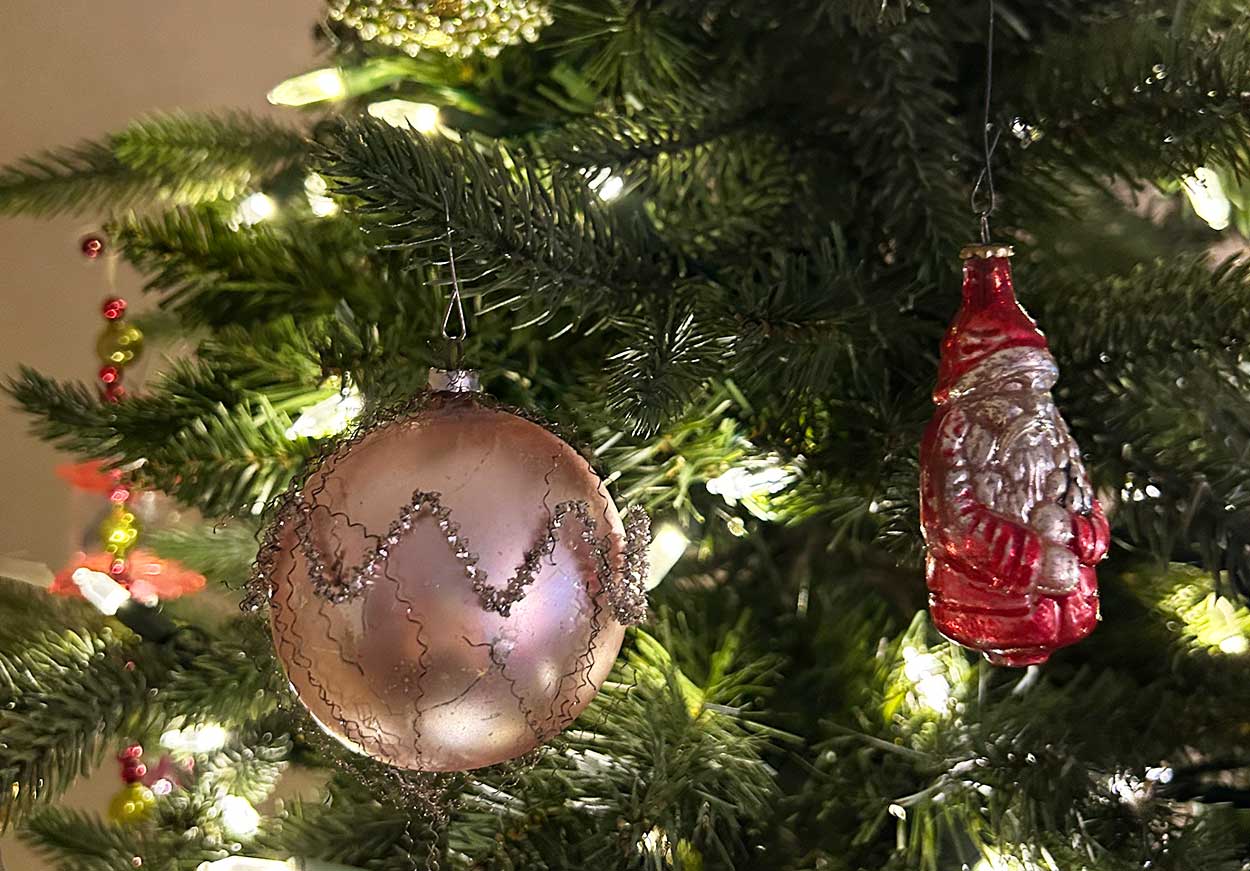
- Group ornaments in pairs of two — soft plus saturated — instead of singles.
- Keep paired pieces within about 8 inches of each other on the same branch plane.
- Hang the darker piece slightly lower so overhead light rakes across it.
- Leave bare branch between pairs; the gaps are what make the pairs visible.
Time: about 30 minutes on a 7-footer.
22. Mercury Glass Baubles With That Mottled Antique Finish
The palette math here is simple: 70% deep forest green, 20% antique silver and champagne gold, 10% warm amber light. Because mercury glass is mottled, a single ornament carries two metals at once, which is why two colors are enough. Swap the silver for bronze and the tree warms up noticeably; swap it for bright chrome and the whole thing turns modern in about four seconds.
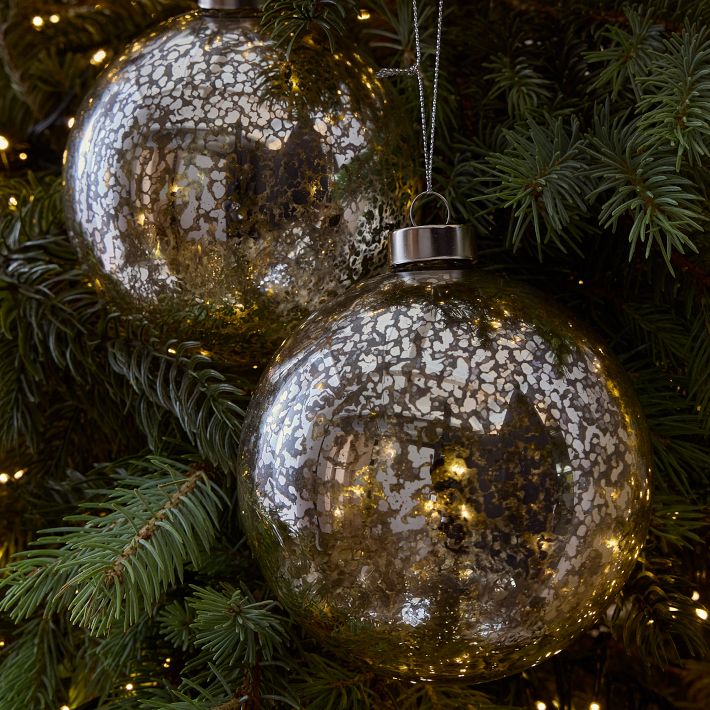
Mercury glass is silvered on the inside, and that coating is always the first thing to go. Never wipe it with glass cleaner — a dry microfiber cloth only. Store them in a single layer rather than stacked, and expect the finish to dull gradually from the cap down, where moisture collects. Dulling is fine and often looks better; flaking isn’t, and flaking happens when they get wet.
23. Jewel-Toned Poinsettias and a Mantel That Answers Back
The poinsettia picks in red, blue, and gold work because they’re the biggest shapes on the tree and they repeat at a steady rhythm, roughly one every 18 inches, so the eye reads them as a pattern before it reads them as flowers. The patterned ribbon echoes the ornament colors, and the white mantel repeats the same red-and-gold story at a different height. Same palette, different energy from Idea #9.
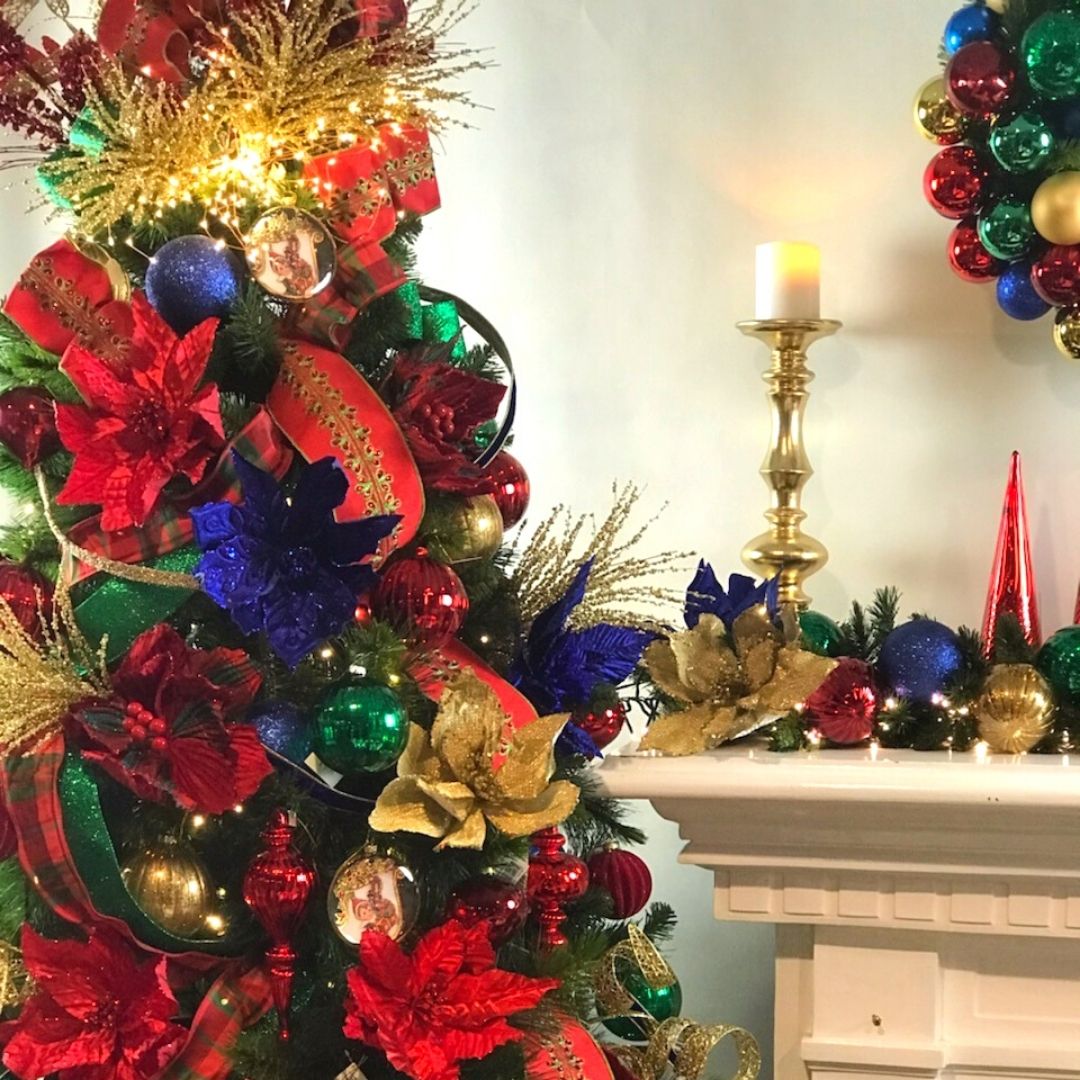
Big floral picks need a big tree. On anything under 7 feet, a 10-inch poinsettia bloom dominates the whole thing and you’ll be pulling it out by New Year’s. Check the stems before you buy, too — the cheap ones are plastic-wrapped wire that snaps when you bend it, and once it snaps you can’t reattach it without tape showing.
24. Three Bottlebrush Trees on a Snowy Shelf
This is the most affordable idea in the whole article. Bottlebrush trees run $3–$8 each at craft stores, and miniature ornaments are often sold in 20-piece packs for a couple of dollars. Faux snow is about $5 a bag and lasts for years. Three decorated trees for under $40. If you find old ones at a thrift store, a $4 can of silver or pink spray paint resets them completely.
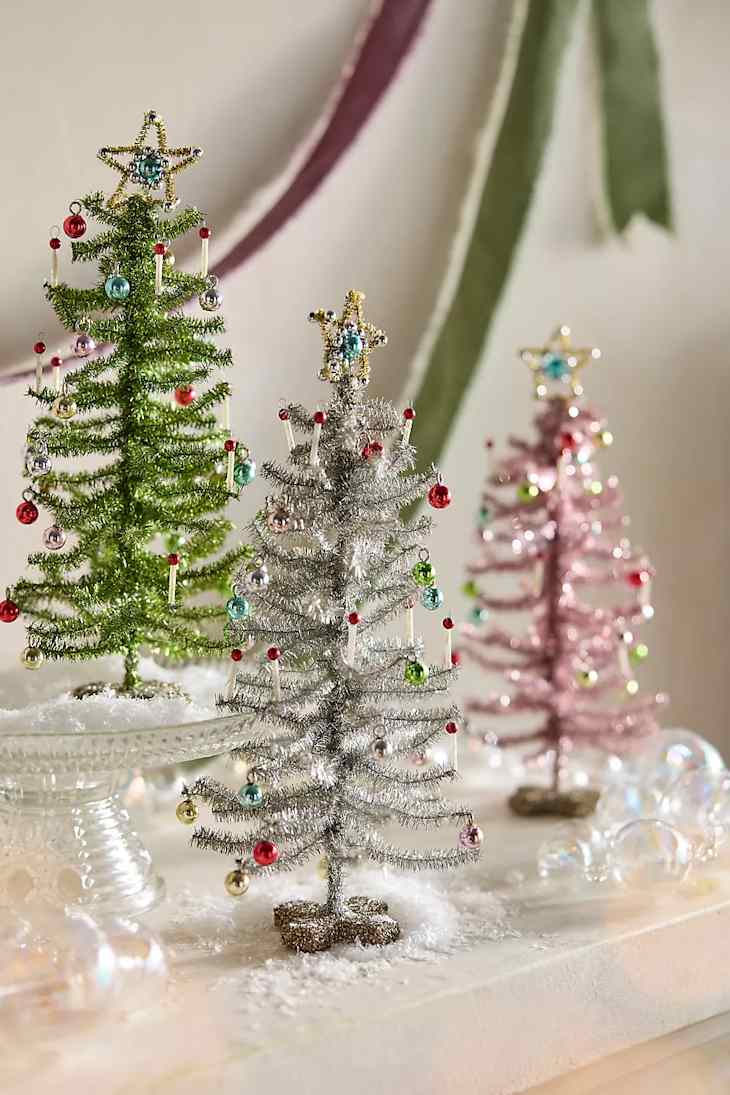
- Set each tree on a small white plate or coaster to contain the snow.
- Lay a thin layer of faux snow at the base rather than packing it around the trunk.
- Hang ornaments from the outer tips only — bottlebrush bristles snap if you push into the core.
- Add a star topper by pushing straight down, never twisting.
- Finish with a few iridescent glass baubles lying loose on the snow.
Time: 20 minutes. Cost: $35–$60 for all three.
25. One Oversized Poinsettia Against White Wainscoting
When the wall behind the tree is plain white with wainscoting, the tree has to supply all the contrast, which is why one huge ornament beats ten medium ones. Place a single oversized piece at chest height and center it in front of the brightest section of lights, then give it about three bare inches of branch on each side so nothing crowds it.
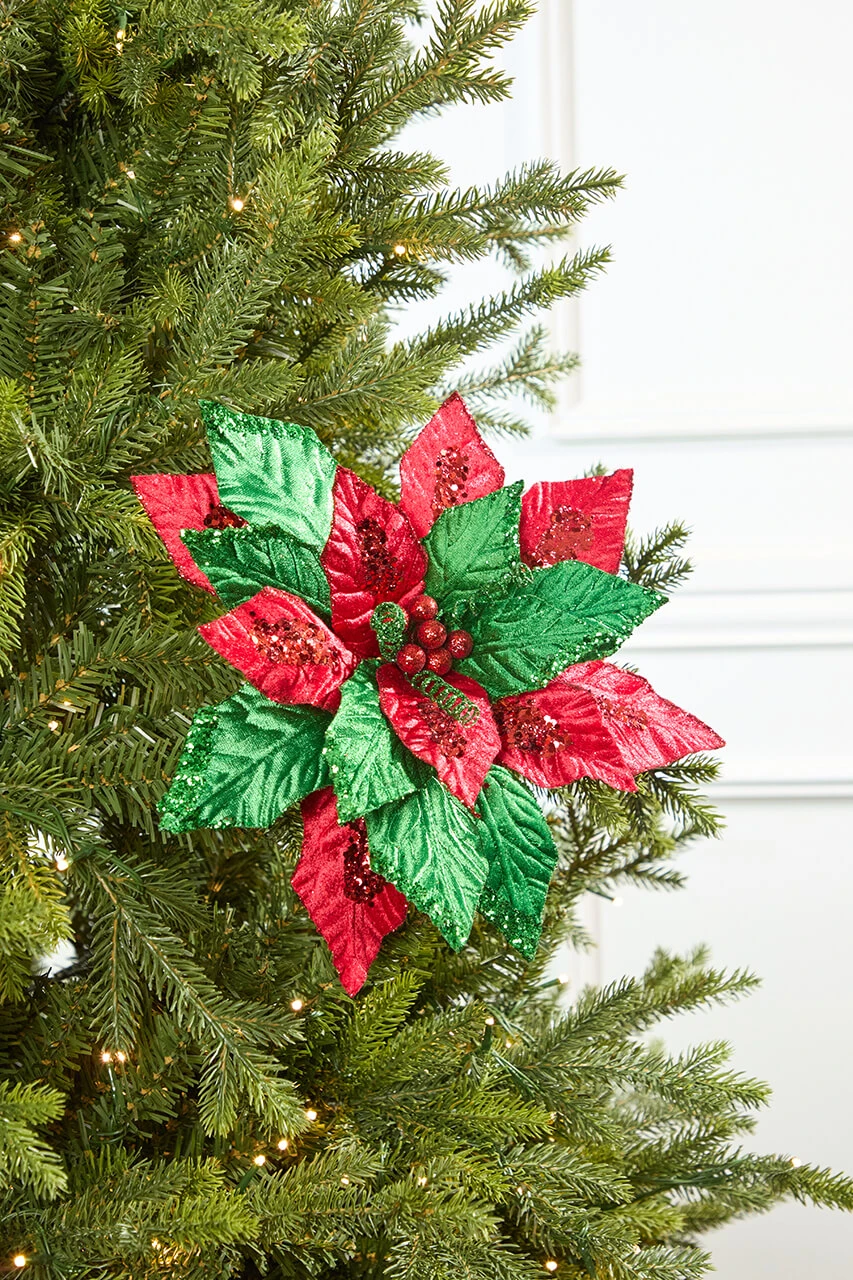
Remove the poinsettia and this is just another green tree with warm lights. The oversized bloom with alternating red and green fabric leaves is doing the entire job: it sets the palette, gives the eye a focal point at human height, and makes the white wainscoting behind it look intentional instead of empty. Sparkle spread over a large surface reads from across the room; glitter on ten small things doesn’t.
26. The Christmas Dinner Table With Floating Gold Ornaments
Roughly what this table costs to recreate for six people.
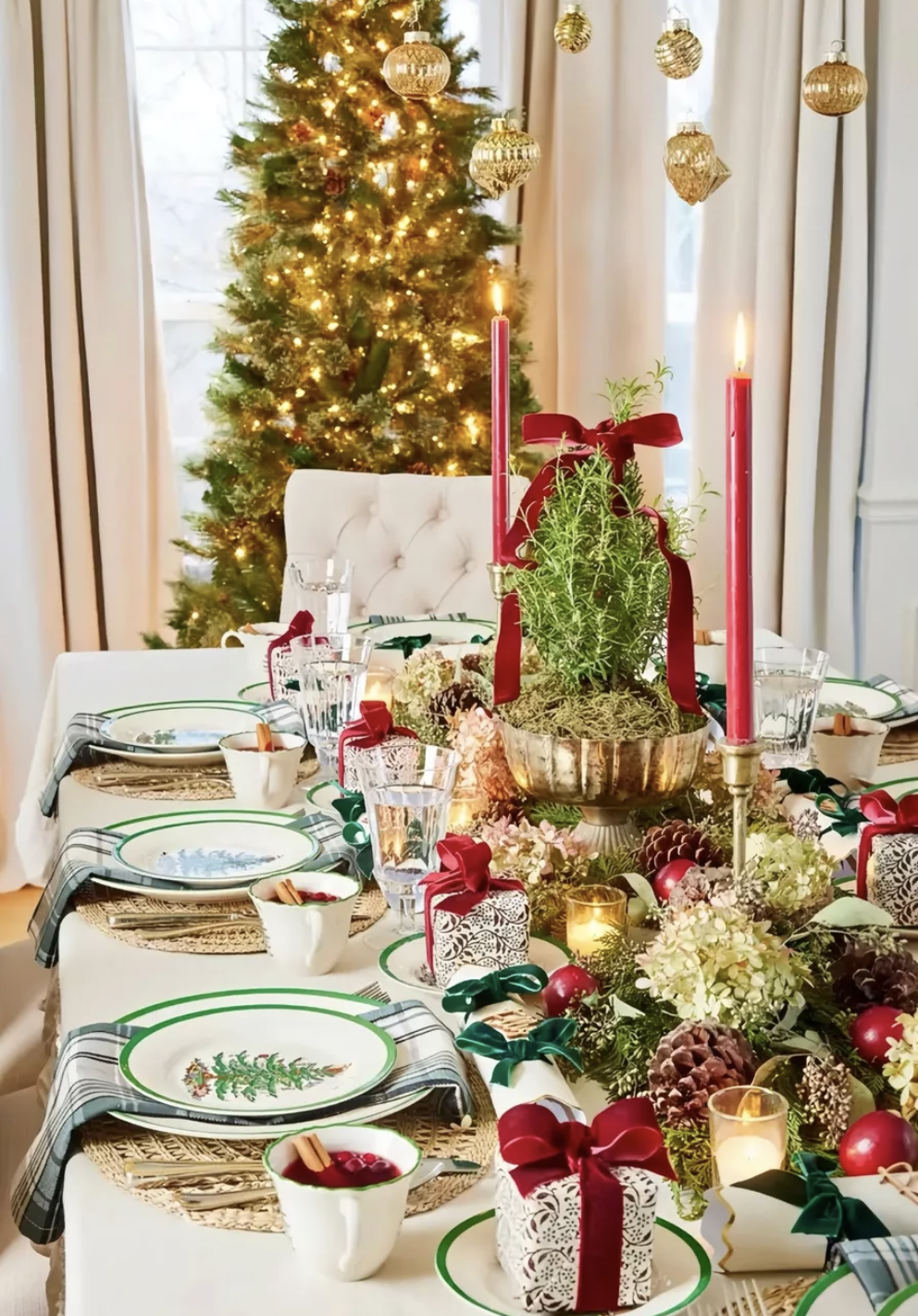
- Holiday dinnerware, service for 6: $60–$180
- Plaid napkins and rings: $25–$60
- Centerpiece greenery, pinecones, candles: $40–$90
- Brass candle holders, pair: $20–$55
- Potted rosemary topiaries: $12–$25 each
- Floating gold ornaments and line: $15–$40
The setup wants a table at least 72 inches long — the centerpiece alone needs 30 inches of running length, and you still need elbow room for six. Ceiling height matters more than you’d expect because of the floating ornaments: hang them a minimum of 24 inches above the table so guests aren’t ducking, and only in a room with 9-foot ceilings or higher.
27. A Felt Teddy Bear With a Red Scarf and Holly
Handmade felt ornaments are the friendliest budget category here: felt sheets cost about 50 cents each, and a bear this size uses maybe two. If you don’t sew, glue works — a hot glue gun, a spool of embroidery floss for the hanging loop, and an afternoon. Target and Walmart sell felt ornament kits for $8–$15, and Etsy sellers list finished bears around $12–$22.
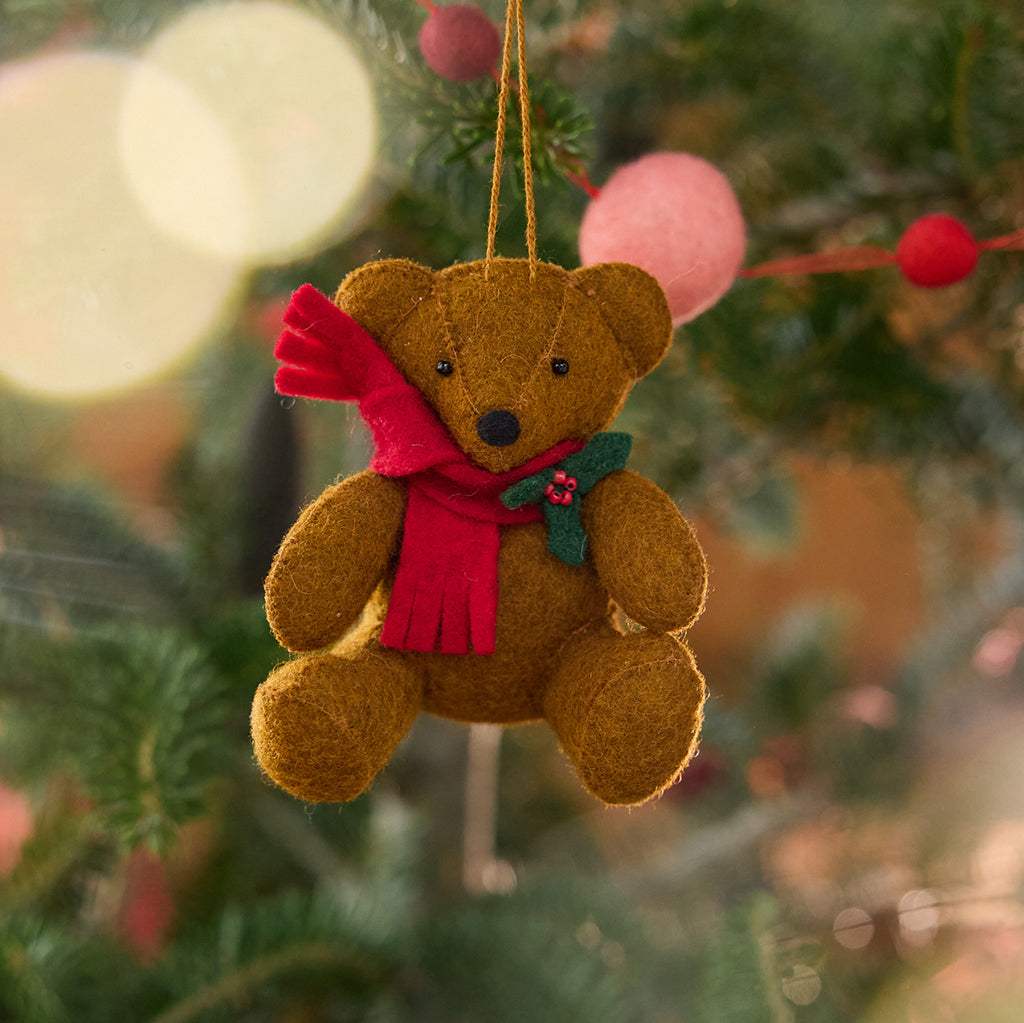
Felt is durable, but it does two things worth knowing. It attracts pet hair and lint immediately, and it fades — a red felt scarf hung near a sunny window turns pink within a couple of Decembers. Keep handmade pieces on the side of the tree away from direct sun and brush them with a soft toothbrush rather than washing them. Similar care routine to the vintage glass in Idea #11.
28. Striped Teardrop Glass on Flocked Branches
Two ideas meet here: horizontal stripes on vertical drops, and cold white flocking against warm light. The striped teardrops repeat at irregular intervals so the eye wanders instead of marching in a line, and the small pinecones give the flocked branches a texture to sit against. The softly blurred second tree behind adds depth, a hint that this is part of a collection rather than a single object.
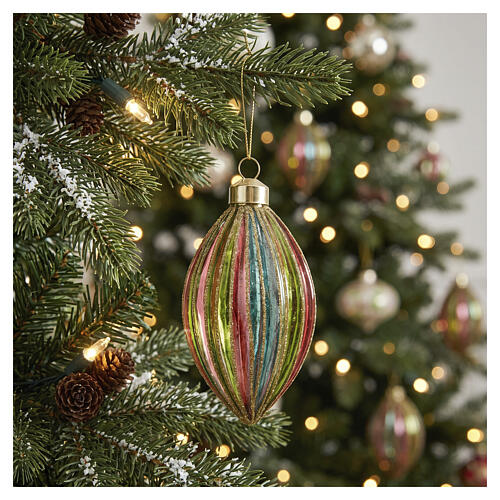
On a flocked tree, hang the ornament so its cap sits just under a light rather than beside it. Light from above turns the vertical stripes into a stripe of glow, which is the entire reason this shape works. Also keep flocked trees under seven and a half feet if you’re decorating from the floor — flocking makes branch tips nearly invisible, and you’ll break glass reaching in blind.
29. A Tabletop Tinsel Tree With Sledding Figurines
Tabletop tinsel trees are $8–$18 at Walmart and craft stores, and the vintage figurines are the fun part — rummage sales, estate sales, and eBay lots will get you a small collection for $20–$40 total. If you can’t find figurines you love, dollar-store miniatures repainted with craft acrylic read surprisingly close from a foot away.
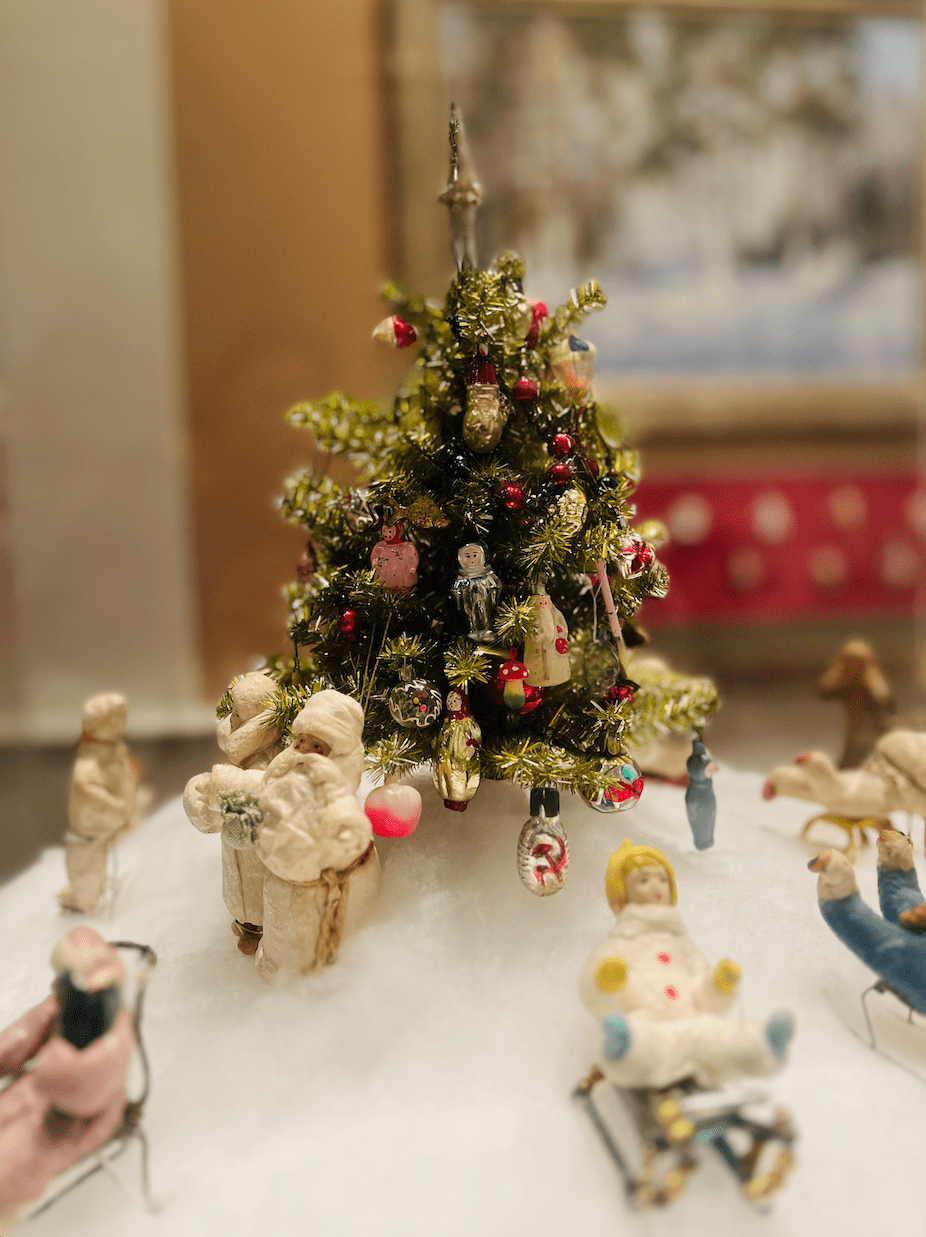
Small vignettes are the easiest thing in the world to over-style. Once you have four or more figurines around one tiny tree, it stops looking collected and starts looking like a shelf in a shop. Cap it at three or four pieces, keep them facing roughly the same direction, and leave a little bare snow between each one. Put it somewhere guests won’t brush past — tinsel trees tip if you breathe on them.
30. Dried Orange Slices, Deep Red Bows, and Candlelight
- Slice oranges a quarter-inch thick and dry them at 200°F for 3 to 4 hours, flipping once.
- Tie deep red ribbon into simple two-loop bows, about a dozen for a 7-foot tree.
- Wire the bows to branches on a loose diagonal, never in a straight line.
- Hang orange slices just below a light so they glow from behind.
- Add matte ornaments last so they absorb the shine the candle lights create.

Time: one afternoon. Oranges and ribbon: $15–$25.
Dried orange slices are lovely for one season and they do not keep past it — humidity softens them, and they can attract pantry moths if you store them indoors over summer. Toss them in January and dry a fresh batch next year. Candle-style lights mean real bulbs, so test every strand before hanging; replacing a bulb on a decorated tree is a genuinely miserable evening. For a lower-fuss version of the same red-and-green feel, see Idea #13.
Thirty Trees, One December, and Yours to Build
Somewhere in these thirty trees is the one you’re actually going to build — probably a mashup of the classic red-and-green and one detail that made you stop scrolling, whether that’s tinsel, a dough bowl, or one oversized poinsettia. Start with the palette and the lights, add one thing that feels unmistakably like you, and stop before it looks perfect; trees that look lived-in always photograph better than trees that look finished.
Pin the idea you’re copying right now, so next December you’re not starting from a blank search bar again.