
You know that feeling when you finally find Christmas decor that looks exactly right for your home — and it costs less than a fancy candle? We spent serious time browsing Etsy, Walmart, and Target to bring you only what’s worth your attention this year. Inside are 33 curated farmhouse Christmas ideas, from snow-dusted porch garlands and vintage ski vignettes to quiet neutral trees and handmade wreath projects — covering rustic farmhouse, nostalgic traditional, soft neutral, and collected vintage styles, with budget and luxury versions compared side by side and shoppable links for most of them. Prices run from about $12 to $480, so there’s a version of every look that fits a real budget. Farmhouse Christmas is having a genuine moment in 2026 as people lean into warm 2700K lighting, thrifted one-of-a-kind pieces, and decor that looks inherited rather than purchased. And stay until the end — we break down the most common mistakes that can ruin these looks. 📌 Save this to Pinterest for later — you’ll want to revisit these ideas.
1. Snow-Dusted Garland and a Nutcracker on the Porch
Three things carry this porch: the snow-dusted garland running the roofline and down the pillars, the green wreath on the natural wood door, and the nutcracker standing at ground level. That’s a deliberate vertical rhythm — high, eye level, floor — and it’s exactly why the whole setup reads collected instead of store-bought. The frosted pine planters in the wooden crates repeat the garland’s color without repeating its shape, and one small red accent keeps all that white, wood, and frosted green from going flat.
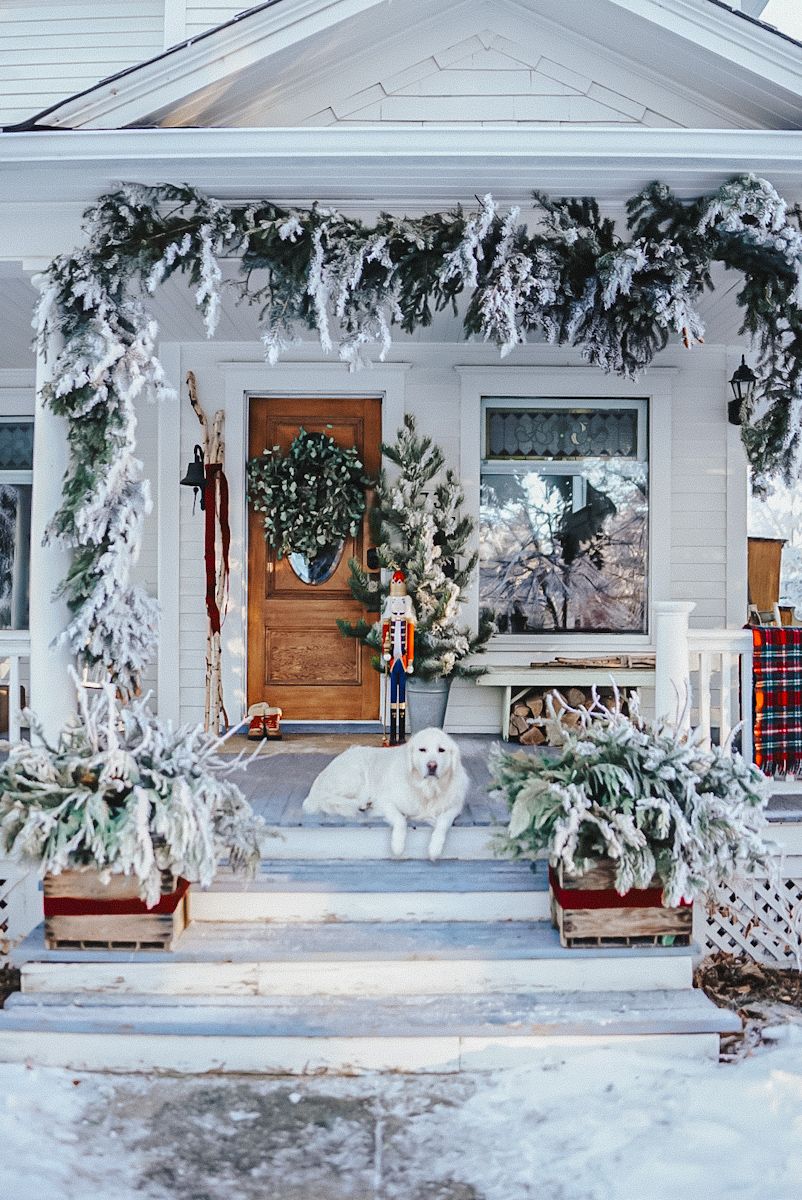
Zip-tie garland to a railing or roofline every 18 inches so it can’t swing, but bend each section into a shallow arc first. Straight garland looks like rope; a slight droop between ties looks like it grew there. Mixing real and faux? Use real-touch pine as the 60 percent base and tuck fresh cedar sprigs into the front — the cedar keeps its scent for about three weeks in cold air while the faux holds the structure once the fresh parts dry out.
2. Buffalo Check Pillows and a Pine-Wrapped Chandelier
Strip the layers back and the math is simple: roughly 60 percent cream base from the sofa, geometric rug, and walls, then 25 percent black-and-white buffalo check on the pillows, 10 percent barn red in the throw and the deer motif, and 5 percent dark wood and black metal from the glass-top coffee table and chandelier. The check does all the pattern work, which lets the red stay quiet. Swap in a charcoal windowpane plaid and the room goes moody; swap the red for mustard and it becomes a completely different holiday without moving a stick of furniture.
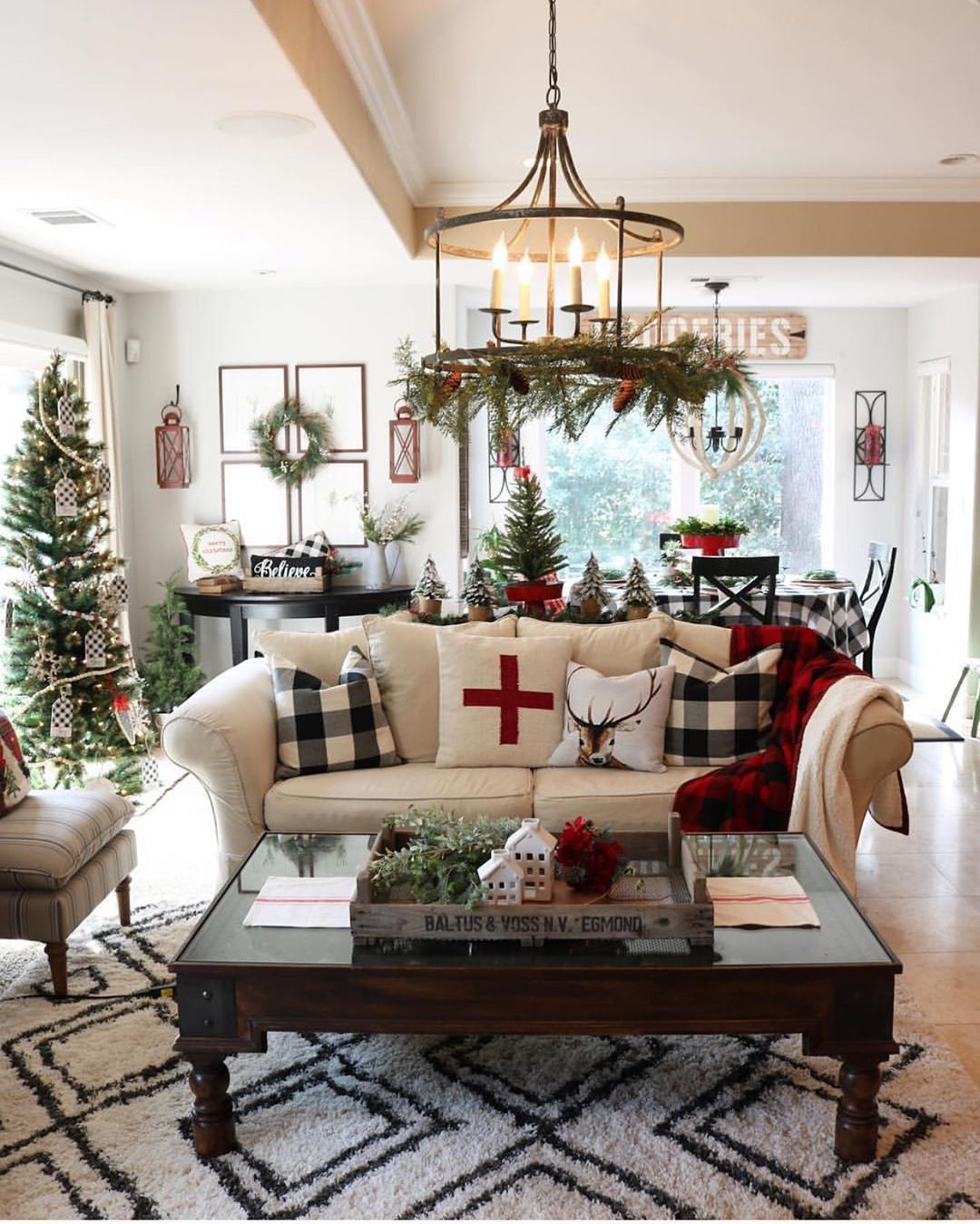
Take away the pine branches wired onto that overhead metal chandelier and the room goes flat. Everything else lives below eye level — the pillows, the rustic tray with its little house figurines, the tree’s patterned tags and beads. The garland is what pulls the tree’s greenery up into the middle of the room and connects the ceiling to the sofa, so your eye travels instead of stopping at the table. It’s about four feet of greenery and five minutes of work.
3. A Candy Cane Wreath That Reads Charming, Not Cheesy
- Bend two 12-inch wire wreath forms into a cane shape — one for the hook, one for the straight stem — then zip-tie them where they overlap.
- Wire small evergreen bundles onto the frame with 24-gauge floral wire, working in one direction so the tips overlap and hide the mechanics.
- Wrap striped ribbon around the straight stem every 3 inches, tucking each tail behind the greens.
- Hang it on a clear adhesive hook rather than a nail so the shape sits flush against the door.
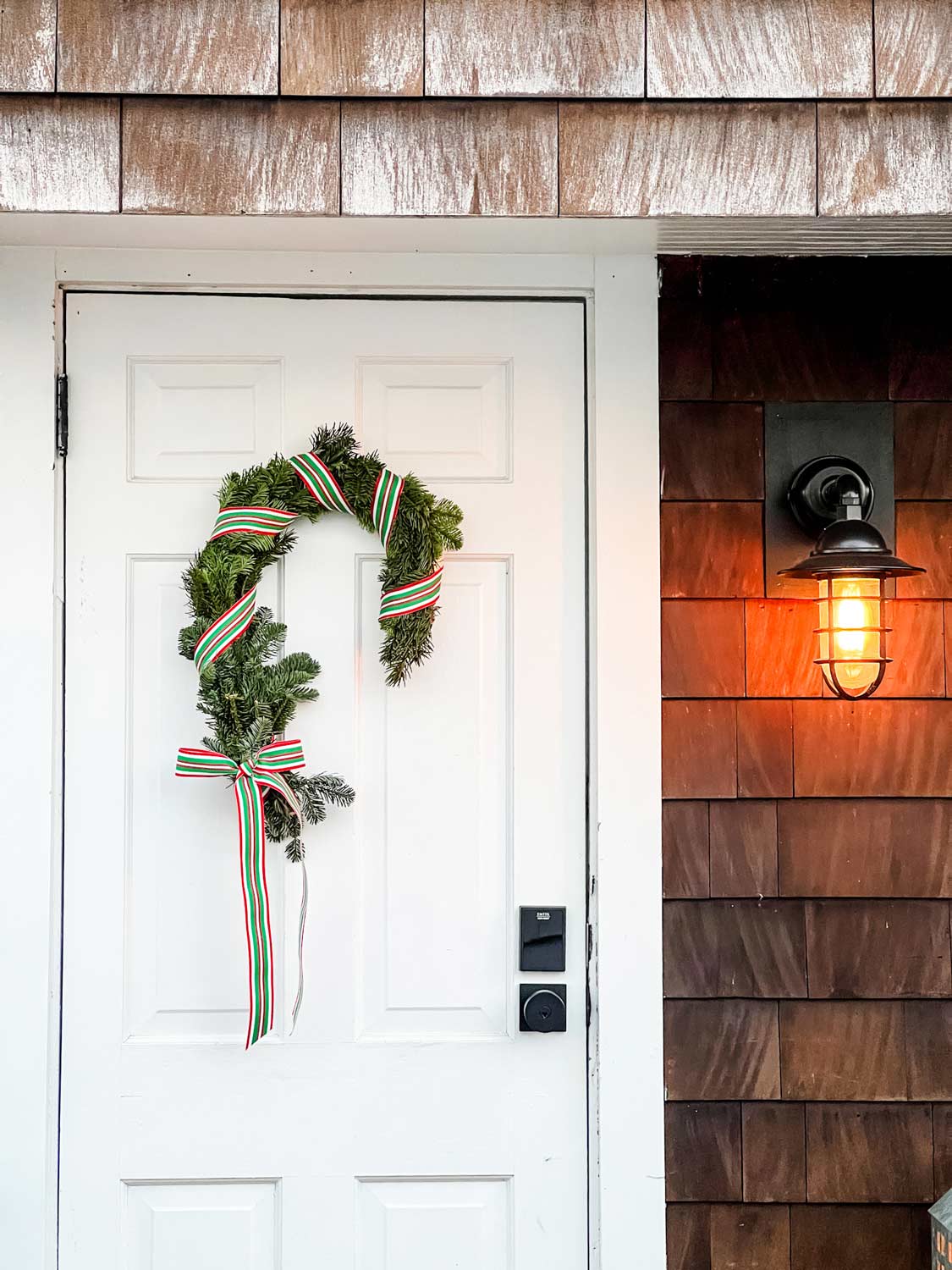
Plan on 45 minutes and $30-$45 in materials.
Honest caveat: shaped wreaths are a personality choice. On a white paneled door with a black sconce nearby, the candy cane reads charming because the background is calm. Put the same wreath on busy siding or a dark door and it just looks like a green blob with a hook. Also check it after dark — a strong sconce throws a shadow across the curve, and nothing kills a candy cane faster than the wrong shadow making it look like a number nine. Compare the classic evergreen wreath in Idea #1 if you want the safer bet.
4. Vintage Skis, Snowshoes, and a Frosted Mantel Wreath
This is ski-lodge nostalgia, and it’s everywhere in 2026 — not because anyone actually skis, but because it’s the one holiday look you can build from things you already own or find at a Saturday estate sale. Wooden skis and snowshoes leaning against a stone fireplace read as collected rather than themed, which is why the look has staying power. The frosted wreath above the metal holiday sign and the little tree in its wooden bucket are the only pieces that say “Christmas” out loud; everything else just happens to be beautiful in winter.
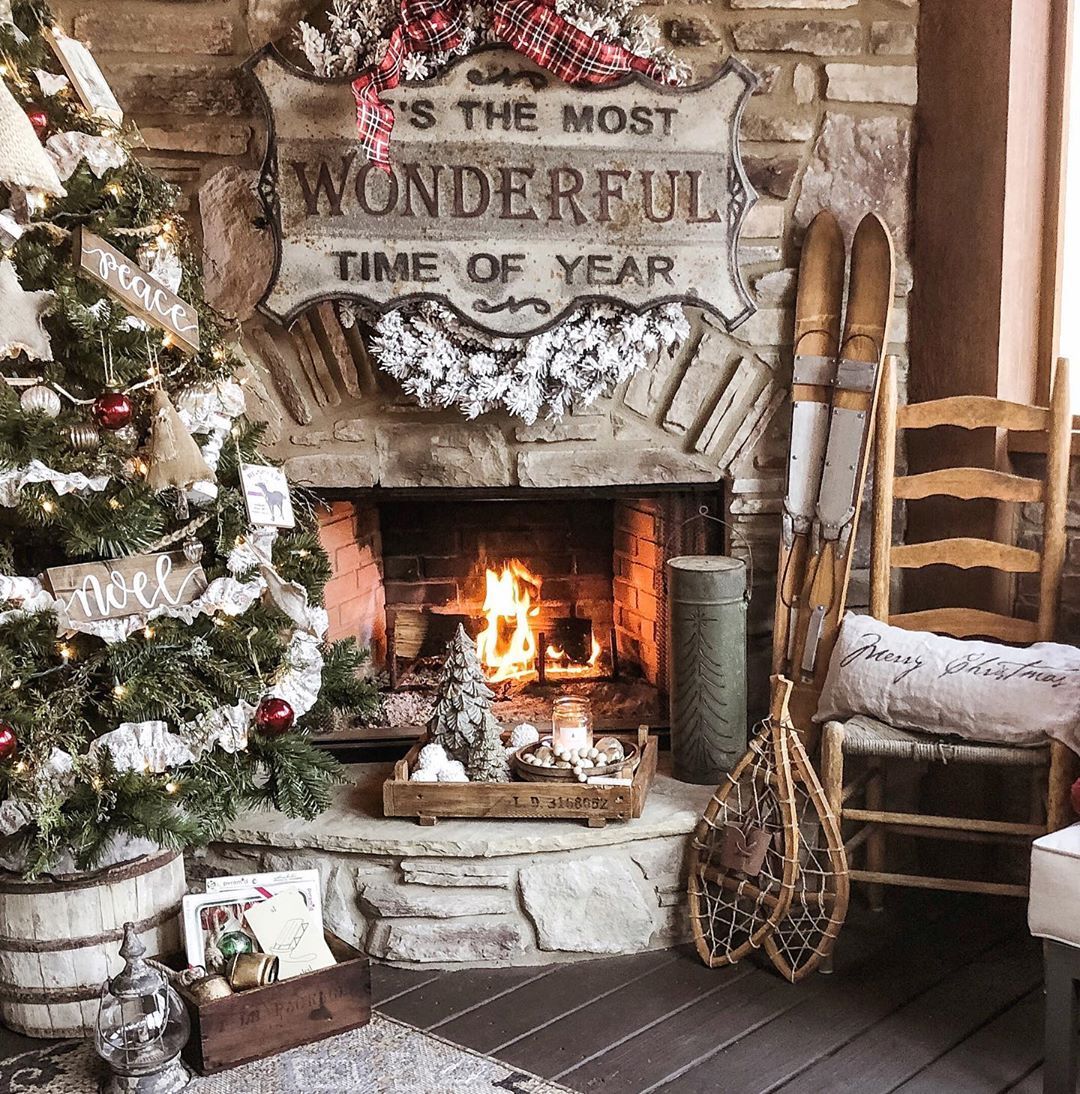
on upkeep: a fresh tree in a wooden bucket drinks a quart of water a day that first week, so check it morning and night or you’ll be sweeping needles by the 20th. Wooden skis and snowshoes collect dust and cobwebs fast in a corner — a dry microfiber cloth once a month is plenty. If that stone fireplace actually burns, wipe the mantel and any galvanized metal weekly, because soot film plus winter humidity will pit cheap metal over a season or two.
5. Burlap Bows and Wooden Beads on a Quiet Green Tree
Light density is the difference between a tree that glows and one that looks like you plugged it in and forgot about it. For an even glow, plan on 100 mini lights per foot of tree height — about 750 for a 7.5-footer. Space ornament clusters 8 to 10 inches apart and always group in threes: one large, one medium, one small. Keep ribbons to two widths only, 3-inch and 6-inch, so burlap reads as a design decision rather than a craft project, and let the pinecones and wooden bead garland fill the gaps between clusters.
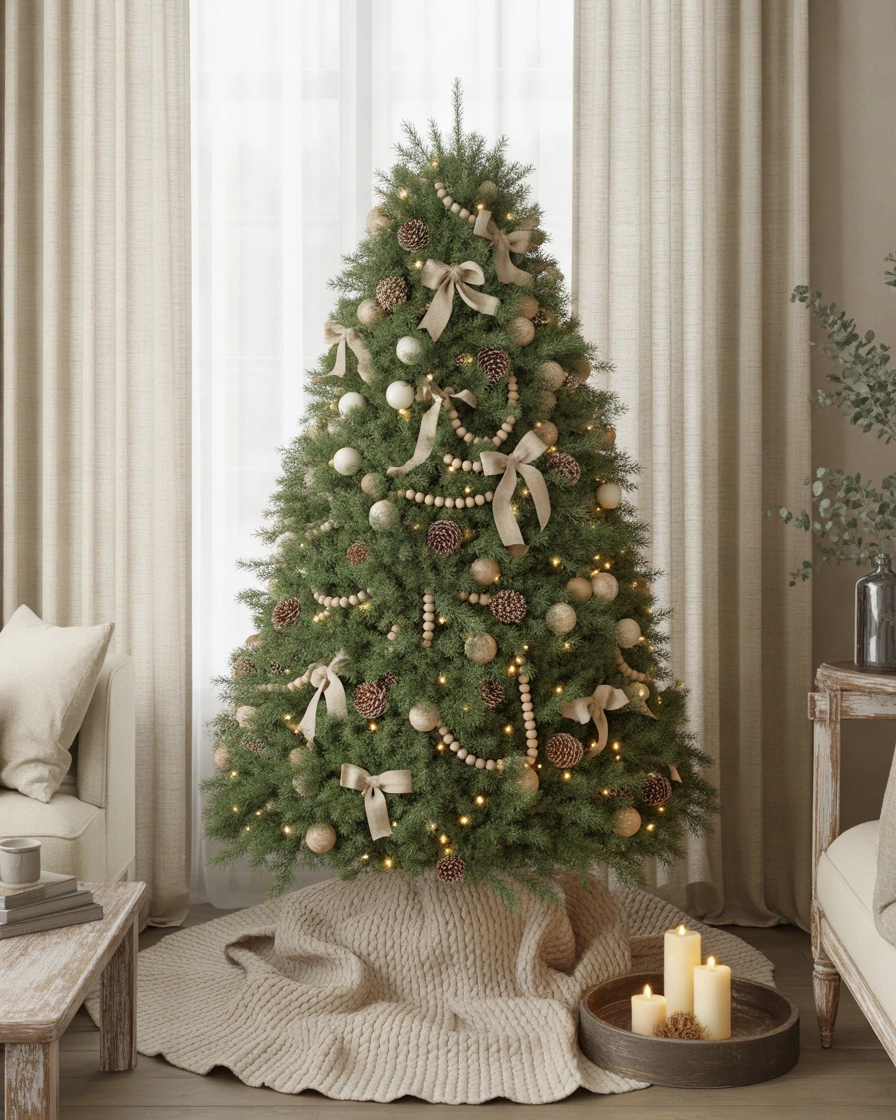
A 7.5-foot tree needs a 9-foot ceiling to look right; under 8 feet, drop to a 6.5- or 7-footer. Leave at least 12 inches on every side for gifts and that chunky knit skirt, and give the whole thing a 10-by-10-foot corner if you want people to walk around it rather than squeeze past. Working with a narrow footprint instead? A slim profile solves the same problem in roughly half the width.
6. A Dough Bowl Centerpiece Filled With Bottlebrush Trees
- Dough bowl, 18-20 inches: $35-$85 (or $15-$25 thrifted)
- Faux fur or flannel table runner: $20-$40
- Five to seven bottlebrush trees: $3-$8 each
- Glass votives with candles or LEDs: $12-$25
- Carved wooden mushroom or similar focal piece: $18-$40
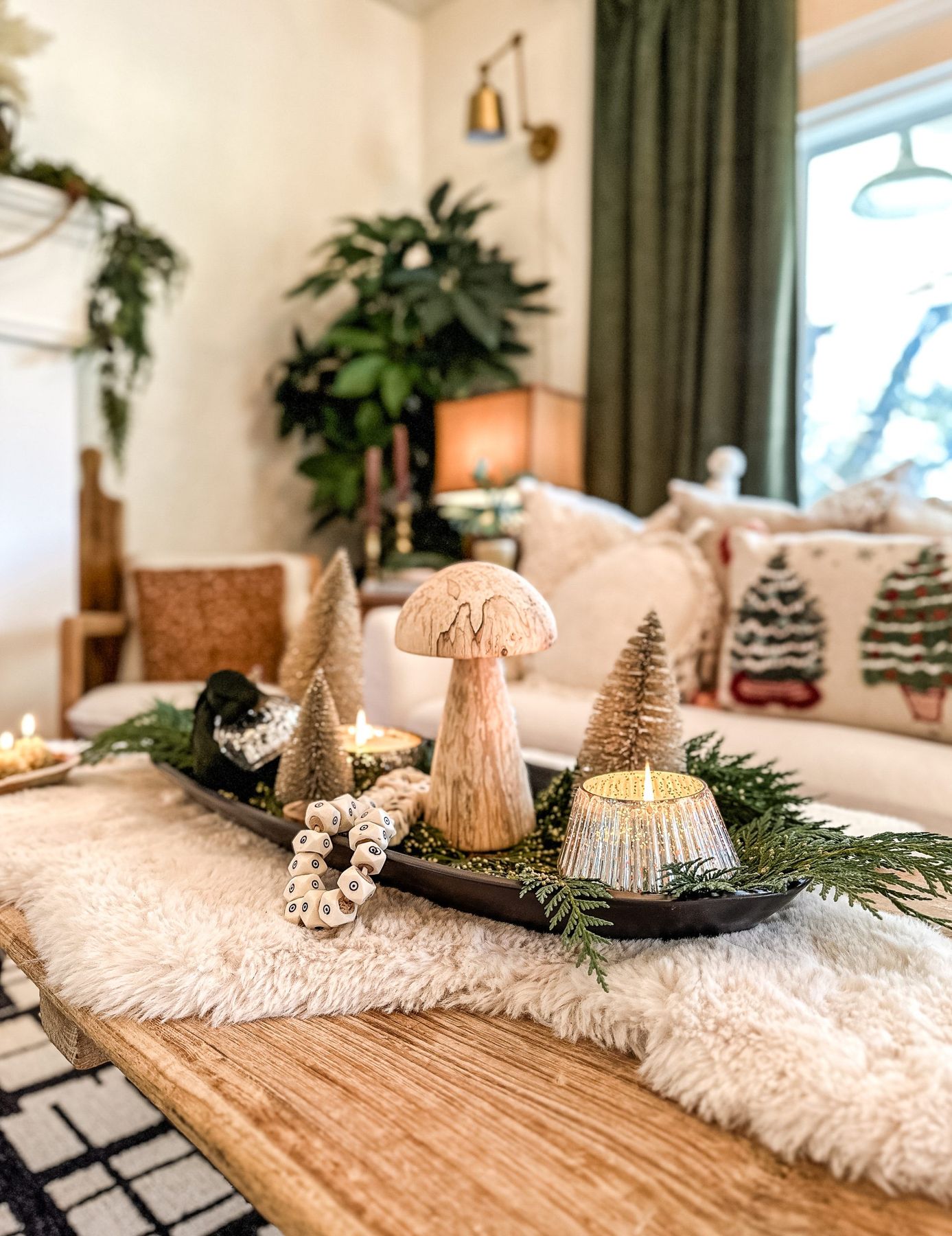
Total: $125-$250. Budget alternative: thrift the bowl, keep three trees instead of seven, and use candles you already own — about $60 all in.
Candles and faux fur are a bad marriage. Keep every real flame at least 12 inches from anything fuzzy, or switch to LED votives and never think about it again. Dough bowls are usually unfinished wood, so a wet glass will leave a ring you cannot sand out — set candles on a small plate or cork coaster. And bottlebrush trees shed their bristles like a husky in July, so arrange them once at setup and then leave them alone.
7. White Shiplap, Black Metal Chairs, and a Corner Tree
What makes this work is the contrast between crisp white shiplap and dark industrial metal, warmed up by the gold light coming off that ornate chandelier and the tree. The shiplap’s vertical lines echo the chair legs and the tree itself, so the room feels taller without a single architectural trick. And the long evergreen garland running down the table repeats the tree’s green at a much lower level, which keeps your eye moving between the two instead of letting the lit corner feel like a separate, ignored zone.
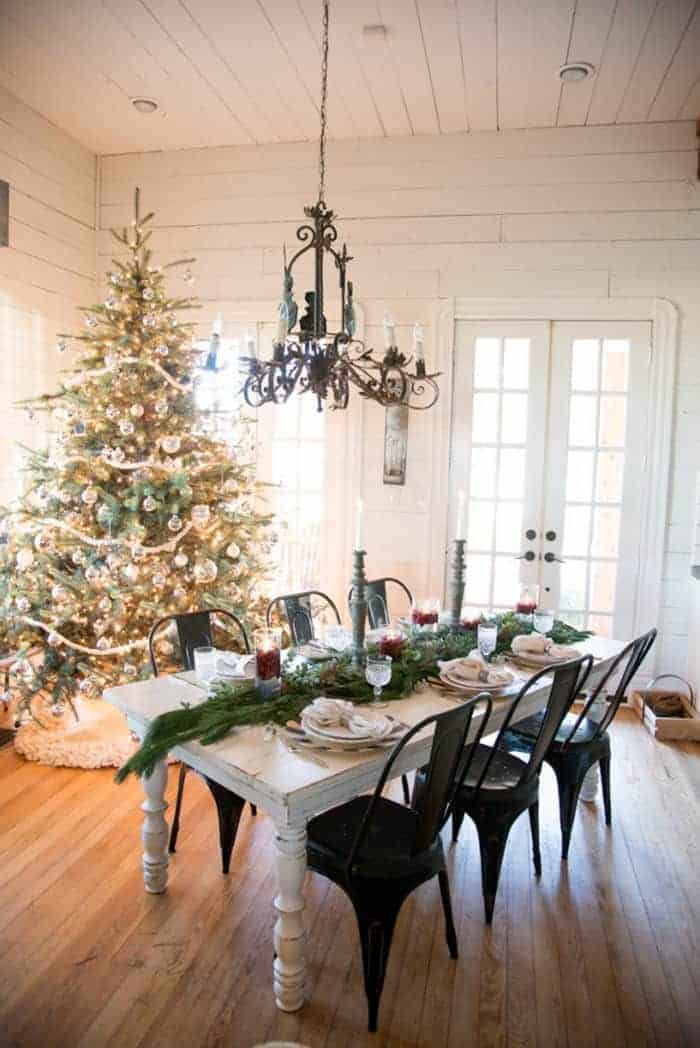
For a garland table runner, go 1.5 times the table length, then pull it back 6 inches from each place setting so nobody is eating around pine needles. A six- to eight-seat dining room wants at least 12 by 12 feet, and the distressed white table here reads best between 72 and 84 inches. Short on space? Put the greenery in one low bowl instead of a full runner and let the tree carry all the drama.
8. Magnolia Leaves Mixed Into Pine for Real Depth
The formula for this garland is about 70 percent pine needles, 20 percent magnolia leaves, and 10 percent something feathery for movement. That last 10 percent keeps it from looking like two separate things stapled together — it softens the edge where the broad magnolia leaves meet the needles. Swap the magnolia for eucalyptus and the whole thing turns cool and silvery; swap it for salal and it goes darker and more woodland. The percentages stay exactly the same.
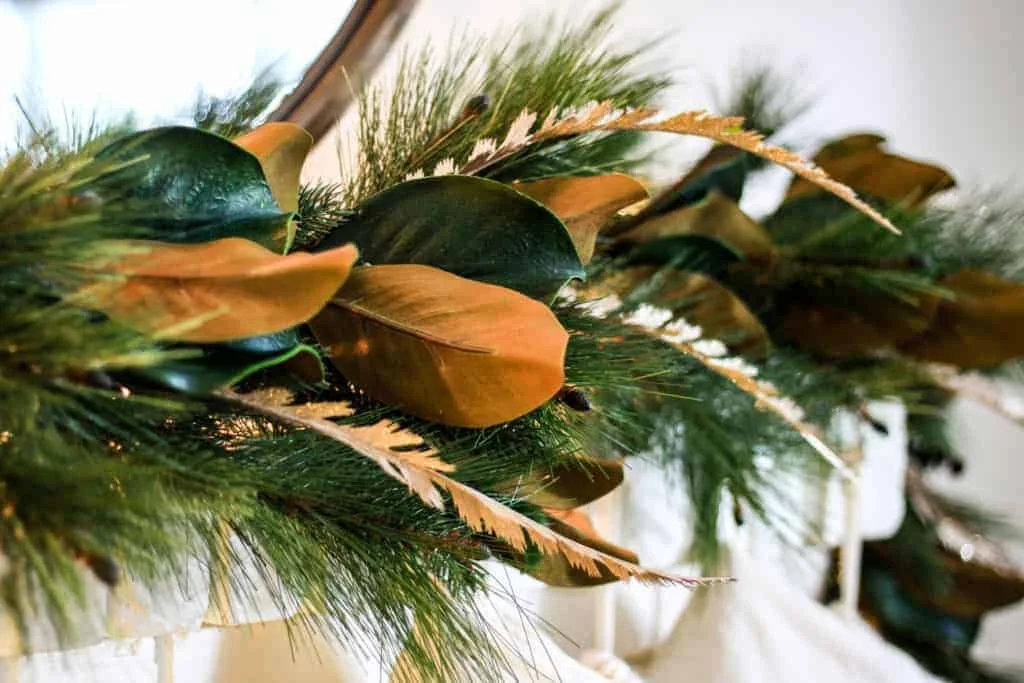
Magnolia leaves have a brown, velvet underside that most people never show — and that’s the secret. Flip roughly half of them so those warm brown undersides face out and you get instant depth plus a wood tone that ties into every piece of furniture in the room. Wire each stem individually rather than bundling them, and aim for at least three different foliage textures per foot of garland. Two textures look cheap. Four look chaotic.
9. A Blanket Ladder Dressed With Mini Wreaths
You do not need a $300 designer ladder display. A plain six-foot blanket ladder runs $30-$60 new online, but Facebook Marketplace and estate sales cough them up for $10-$25 most weekends. Mini pine wreaths are $6-$12 each at Walmart or Target, a felt pennant banner is $12-$18 on Etsy, and a printable quote sign costs a few dollars to download and frame yourself. The whole setup lands under $70 if the ladder is already yours.
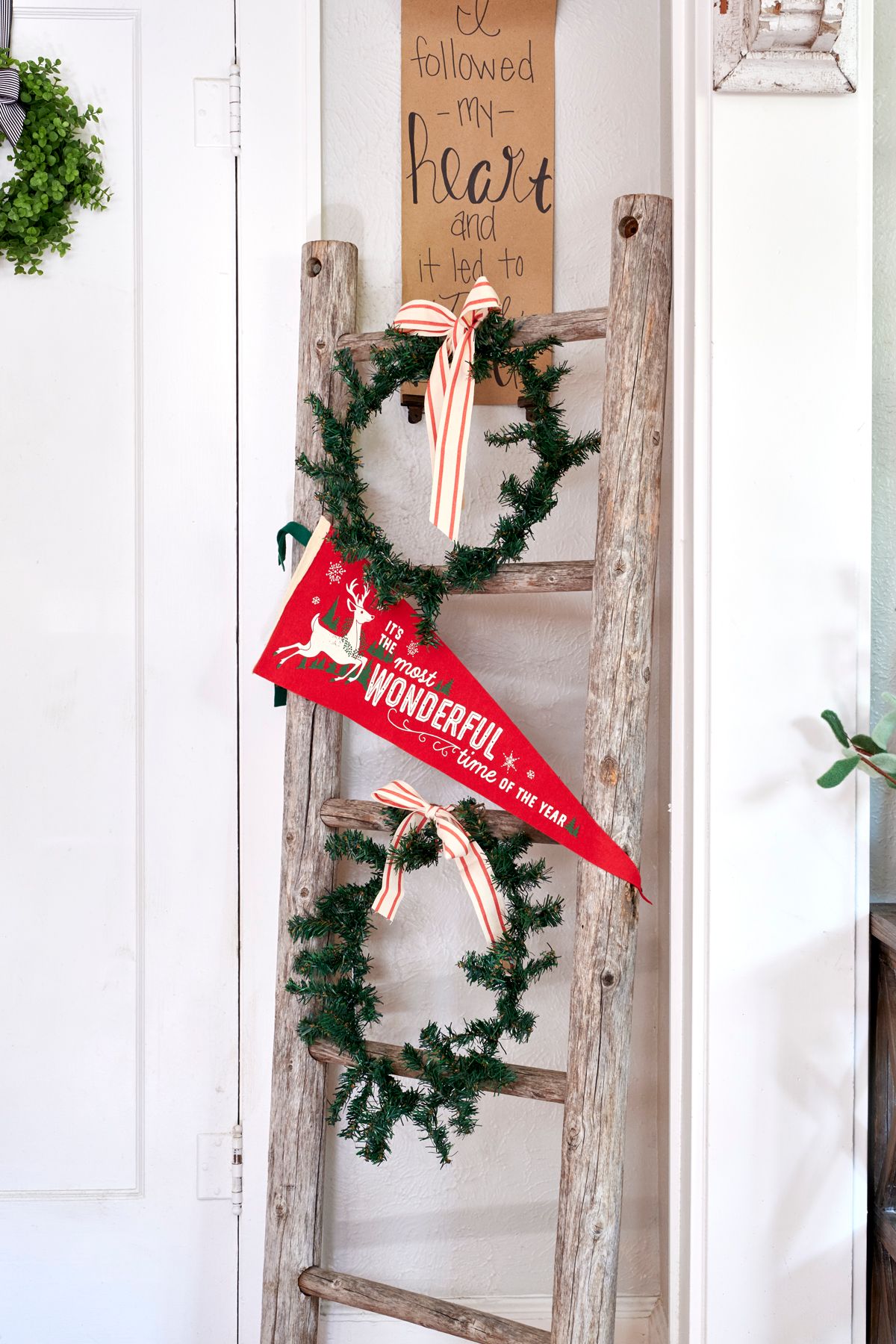
- Lean the ladder against the wall at roughly a 15-degree angle and strap the top to a stud so it cannot slide.
- Tie a mini wreath to the second rung and another to the fourth with striped ribbon.
- Pin the felt pennant diagonally across rungs three through five — diagonal, not straight across, or it reads like car-lot bunting.
- Hang the vertical quote sign just above the top rung.
- Leave the lowest two rungs empty so the display has room to breathe.
About 20 minutes and $25 if you already own the ladder.
10. A Wreath Tied Inside the Window With Soft Ribbon
The single best move here is that the wreath hangs inside the window on a light fabric ribbon instead of outside the glass. That one choice turns the window into a frame of light rather than a dark rectangle on the wall — the evergreens get backlit, which does more for the room than any string of lights could. Everything else in the nook is quiet on purpose: neutral window-seat pillows, spindle-back wood chairs, pillar candles in glass jars. Take the wreath away and it’s just a breakfast nook in December.
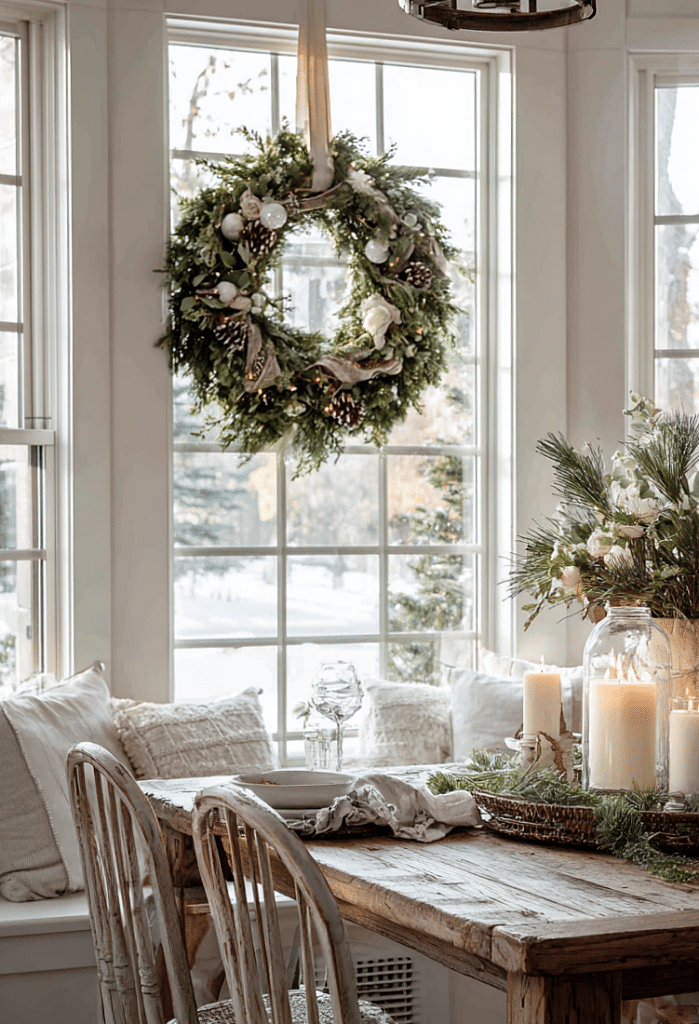
Wreath sizing against a window is simple math: aim for about half to two-thirds the window width. A standard 36-inch window wants something in the 22- to 24-inch range; bigger and you’re blocking the light you were trying to feature. The nook itself needs roughly 5 by 7 feet for the table, chairs, and a walkway, and the ribbon should be long enough that the wreath sits in the upper third of the glass. For the louder version of this same window, see Idea #20.
11. Red Pennants, a Painted Vintage Chair, and a Very Full Tree
This is the collected-over-years look, and it’s a big reason farmhouse Christmas hasn’t gone anywhere in 2026 — people are tired of buying an entirely new theme every November. Felt pennant banners, a painted vintage chair holding wrapped gifts, pattern-mixed quilts, and a tall armoire all read as inherited rather than purchased, which is exactly the point. Shop estate sales in September and October, when nobody’s thinking about Christmas and the good painted furniture is cheap.
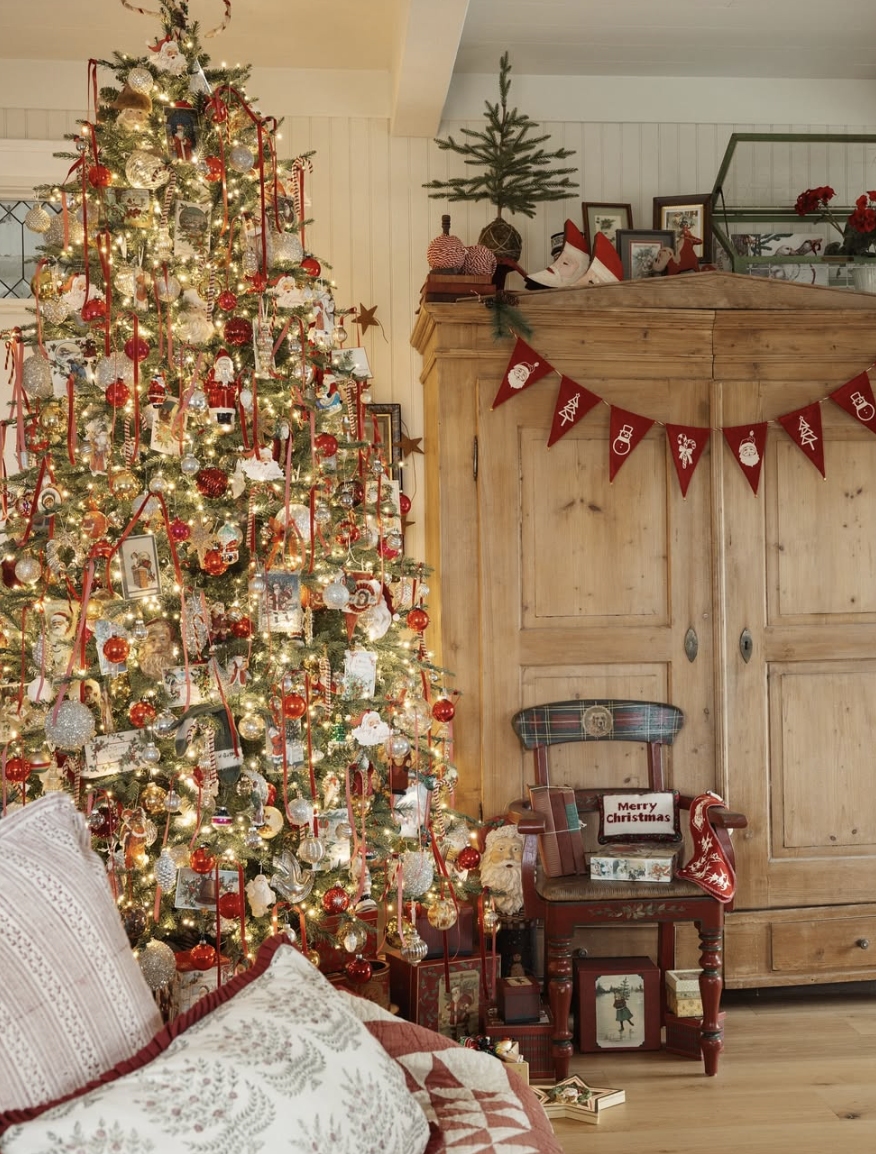
Two practical notes before you load a tree this heavily. First, weight: hundreds of ornaments plus a full garland can tip a flimsy stand, so use a metal stand rated for your tree’s height and keep the water reservoir topped up — a dry tree gets brittle and heavy ornaments drag branches down. Second, if kids or dogs share the house, keep the breakable family pieces above the 36-inch mark and put the cheap fillers down low.
12. Wreaths in Every Window and Luminaries on the Walk
Window wreath math first: a 22- to 24-inch wreath is right for a standard 36-inch window, hung about 6 inches below the top sash so it doesn’t fight the trim. Then solve the real problem — nobody wants to walk around the yard flipping switches. Put every plug on one outdoor timer, and use warm-white bulbs only. Mixing warm and cool LEDs across a facade is the fastest way to make a beautiful house look like a discount mattress store.
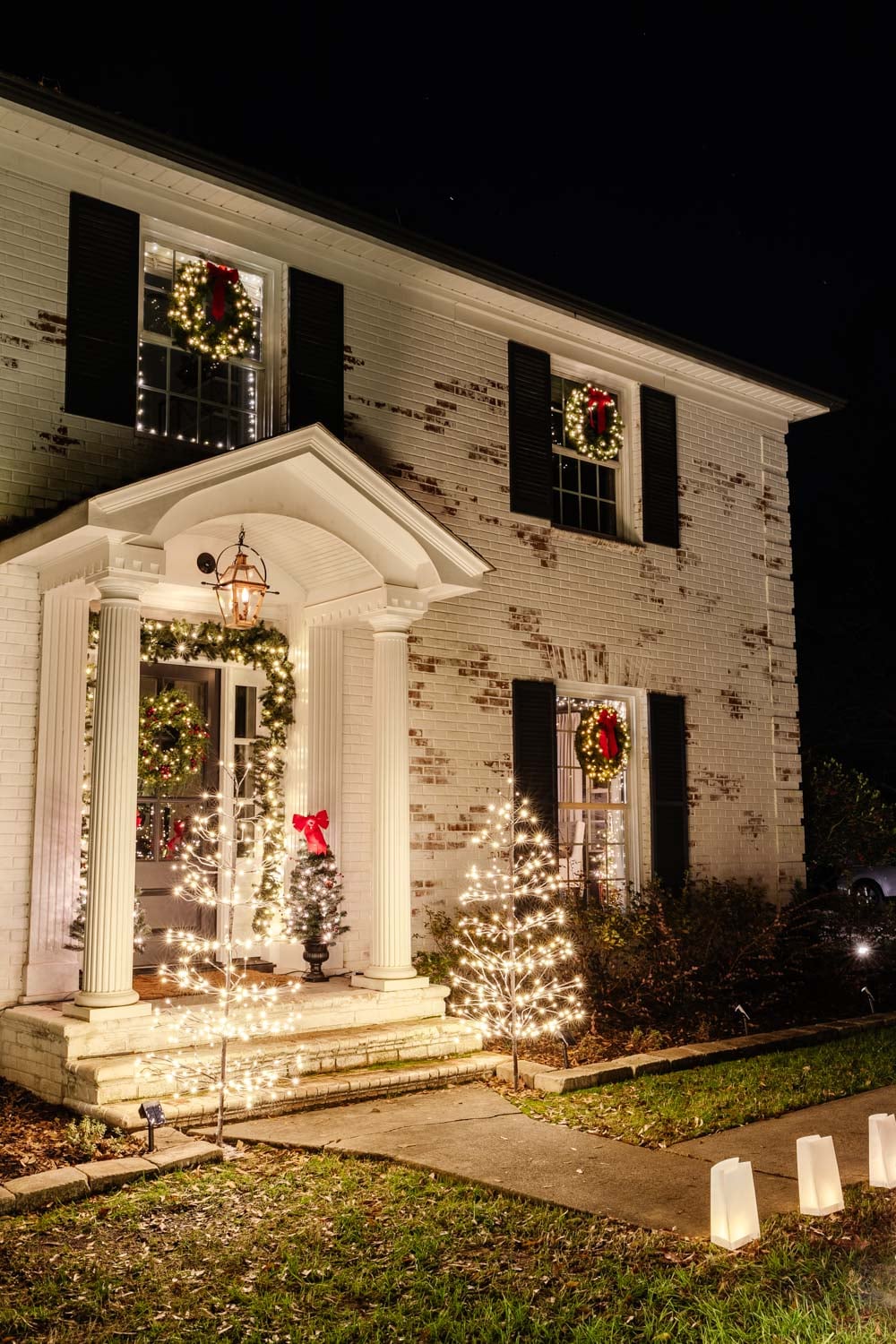
Six windows for under $200, easily. Pre-lit wreaths that run $75-$120 at a decor store are $20-$30 at Walmart after Thanksgiving, and many are battery-powered with built-in timers. The wire-frame cone trees? Swap them for solar path lights angled up into potted evergreens — about $3 each. And those glowing walkway luminaries are just paper bags weighted with sand and an LED tealight, roughly $8 for 50 bags. Nobody driving past will know the difference.
13. A Dark Door, Cream Ribbon, and a Railing Garland
The formula on this entry is close to 50 percent dark from the door and black sconce, then 30 percent green from the pine wreath and railing garland, 15 percent white from the porch railing and geometric floor tile, and 5 percent warm brown from the shingle siding. That cream ribbon is what separates the greens from the dark door — without it, everything mushes into one dark mass. Push it lighter by swapping the geometric tile for solid slate, or go bolder with a brass sconce instead of black.
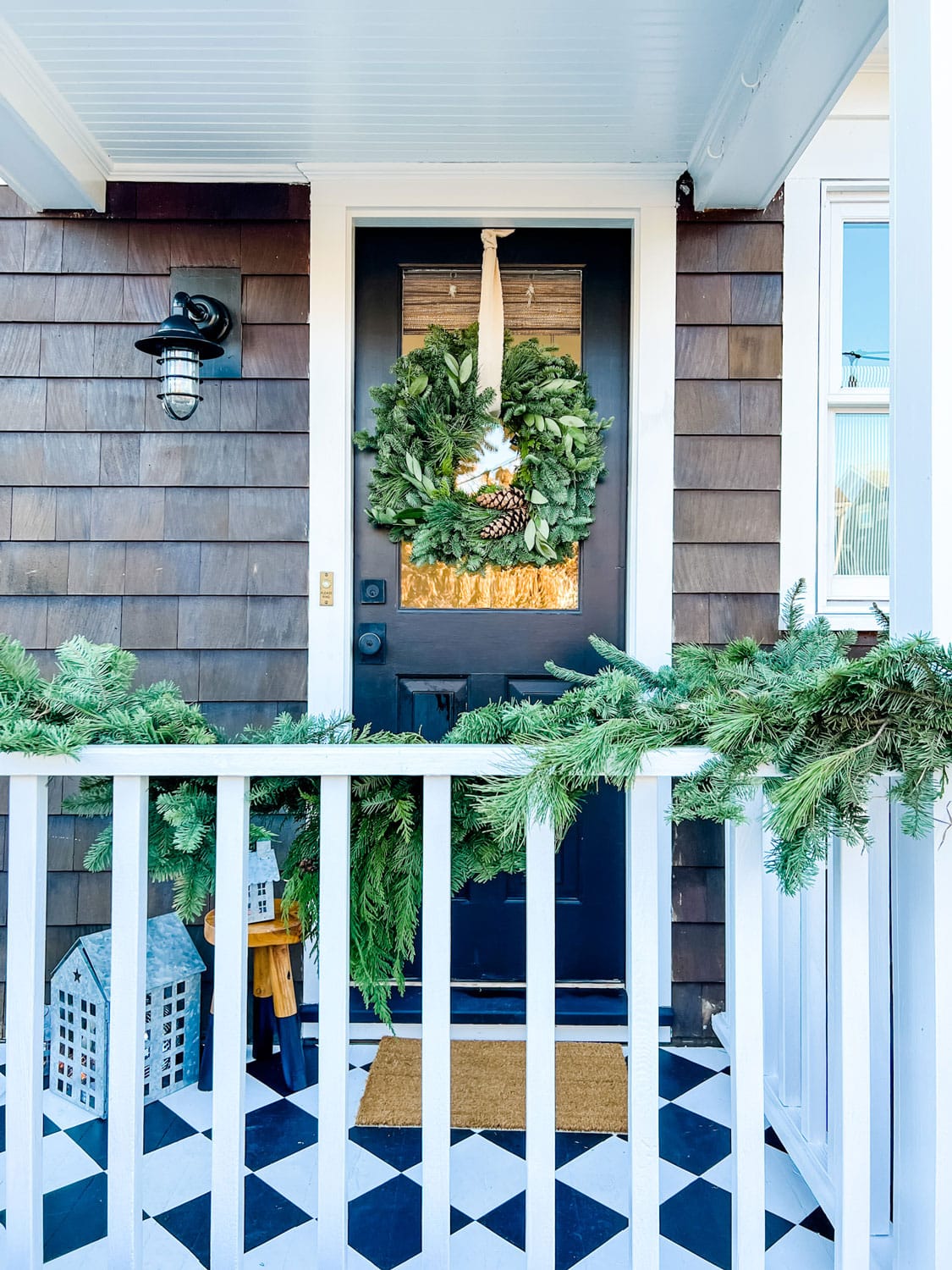
Three things make it work. The black-and-white geometric tile echoes the black sconce and door, so the floor and the wall feel like one thought. The cream ribbon gives the wreath a visible outline against a dark door — a green wreath on a dark door with no ribbon is essentially camouflage. And the garland draped over the white railing adds a horizontal line that breaks up all the vertical architecture without blocking a single bit of light.
14. Red Berries Against Weathered Plank Wood
Eight to ten clusters of bright red berries are the entire reason this wreath works. Strip them out and you have a perfectly nice evergreen wreath that looks like every other evergreen wreath on the block. The berries also create a rhythm — red, green, red, green — that reads clearly from 20 feet away, which is exactly how far people stand when they walk up to a door. Keep the clusters uneven in number and placement; symmetry here makes it look manufactured.

If this is hanging outside, know what real berries do: they freeze, they drop, and birds eat them by mid-December. Faux berry sprays hold up far better and look identical from the sidewalk. Also check the weight — a dense evergreen wreath loaded with pinecones and berries can hit 5 or 6 pounds, so use a hook rated for it rather than a suction cup that gives up on the first cold night.
15. Black Lanterns and Potted Evergreens on Brick Steps
Proportions matter more than decorations on a stoop. With steps 4 to 5 feet wide, you want planters in the 12- to 14-inch range and evergreens that top out around 3 to 4 feet — tall enough to frame the door, short enough that you can see over them. Keep lanterns to two per side, staggered in height rather than matched. Smaller entry? One planter on each side and skip the lanterns entirely; the garland and wreath already do the heavy lifting.
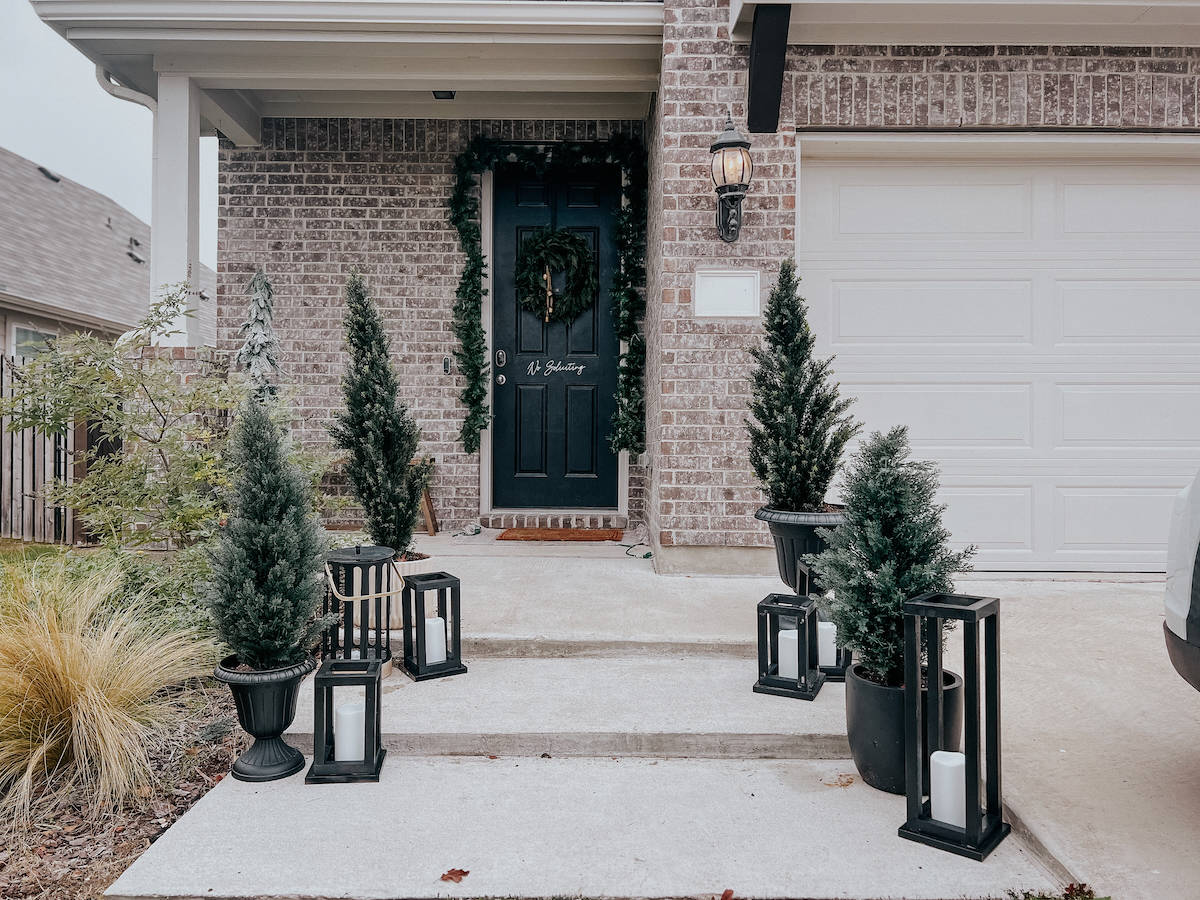
Outdoor greenery has a short life. Fresh garland on a covered porch holds about two to three weeks before it browns; mist it every few days and it’ll stretch closer to four. Black metal urns and lanterns rust at the base where water collects — set them on a small riser or dump them out after storms. And skip real candles outside; a flameless pillar with a warm bulb looks the same after dark and survives wind, rain, and the neighbor’s cat.
16. Plum Pillows and a Magnolia Garland on White Brick
The round mirror is doing more work than it looks like. It bounces the garland’s light back into the room, so the fireplace glows from two directions at once. Layering knit and fur stockings with plum, white, and brown pillows also keeps the sofa from defaulting to red-and-green — plum is the unexpected note that makes the whole wall feel considered instead of catalog-ordered. And the black metal fire screen gives the soft arrangement one hard, grounding edge.
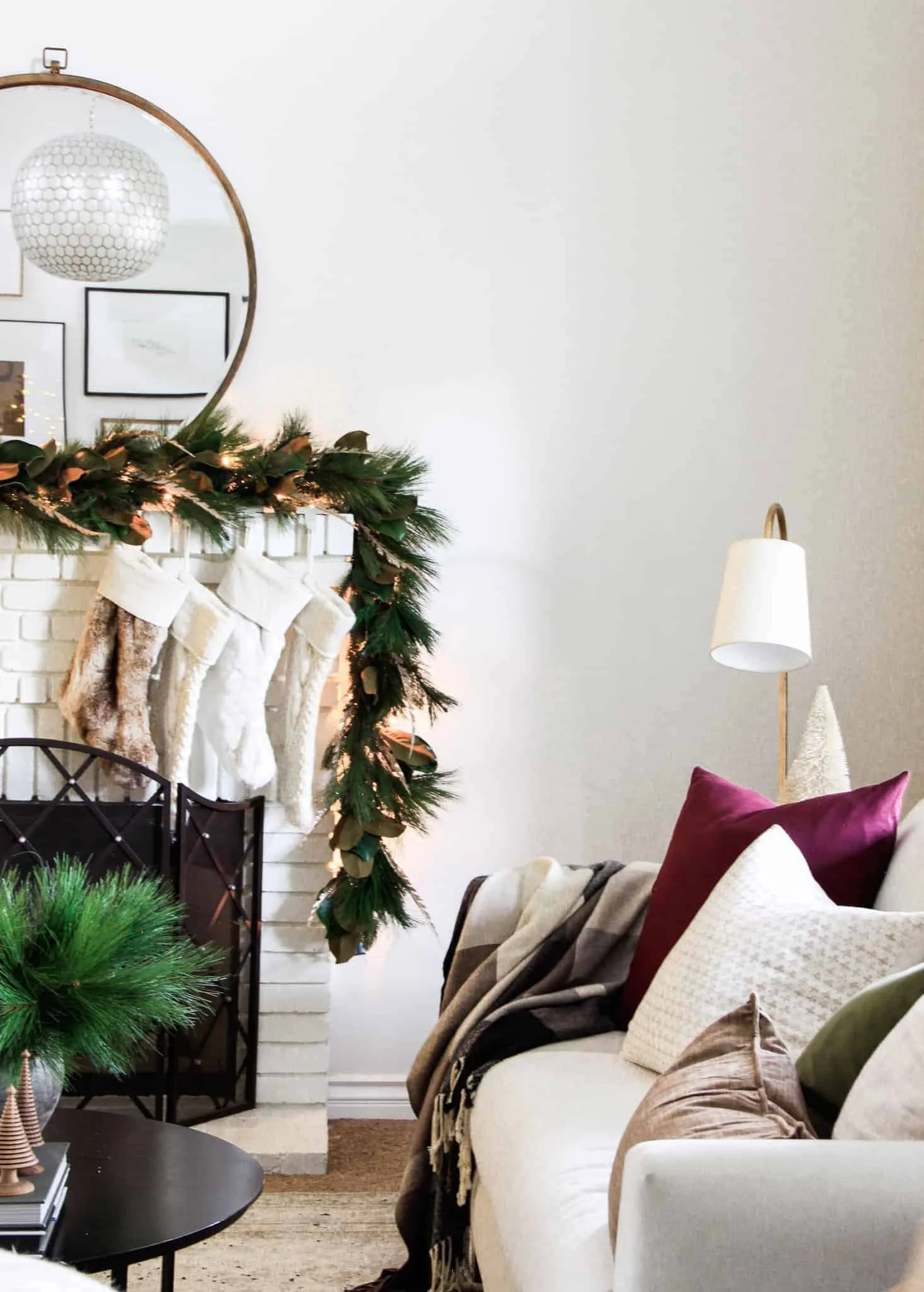
Garland proportions: run it 1.5 times the mantel width so the ends can drape down the sides, and let it swag 6 to 8 inches below the mantel edge. Hang stockings on small hooks screwed into the underside of the shelf, then lay the garland in front — that’s how you get stockings that show instead of disappearing into the greenery. If you like the candle glow happening here, move the dough-bowl styling from Idea #6 to a side table beside this sofa.
17. Warm White Lights That Read Classic, Not Flashy
- Pre-lit garland, 9 feet: $40-$90
- Lit wreath with red bow: $30-$70
- Two lit twig cone trees: $50-$120
- Outdoor timer and extension cords: $20-$40
- Hooks, clips, and mounting strips: $10-$20
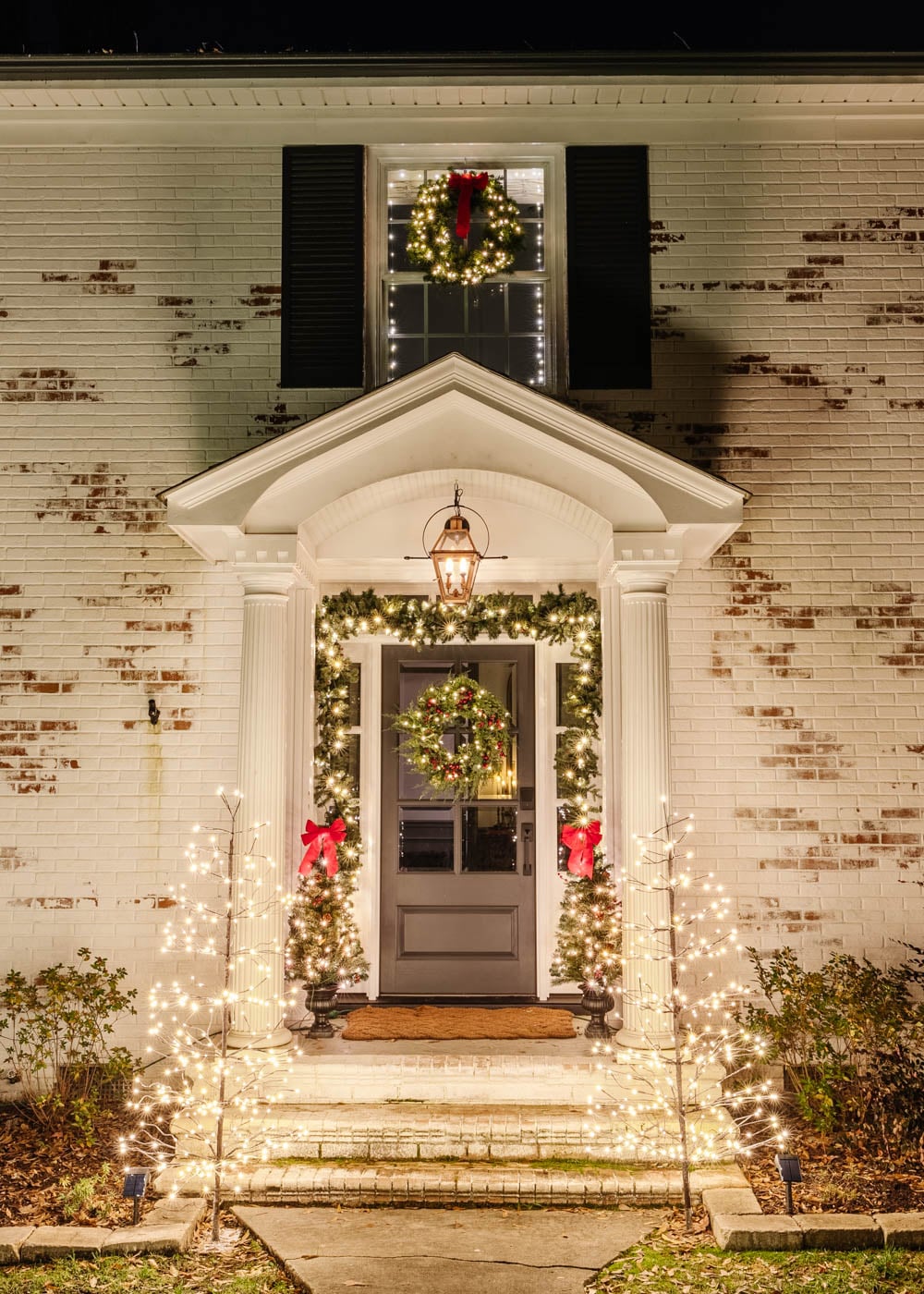
Total: $150-$340. Budget alternative: three plain wreaths, two strings of warm-white LEDs, and one timer — roughly $90 for the same outline of light.
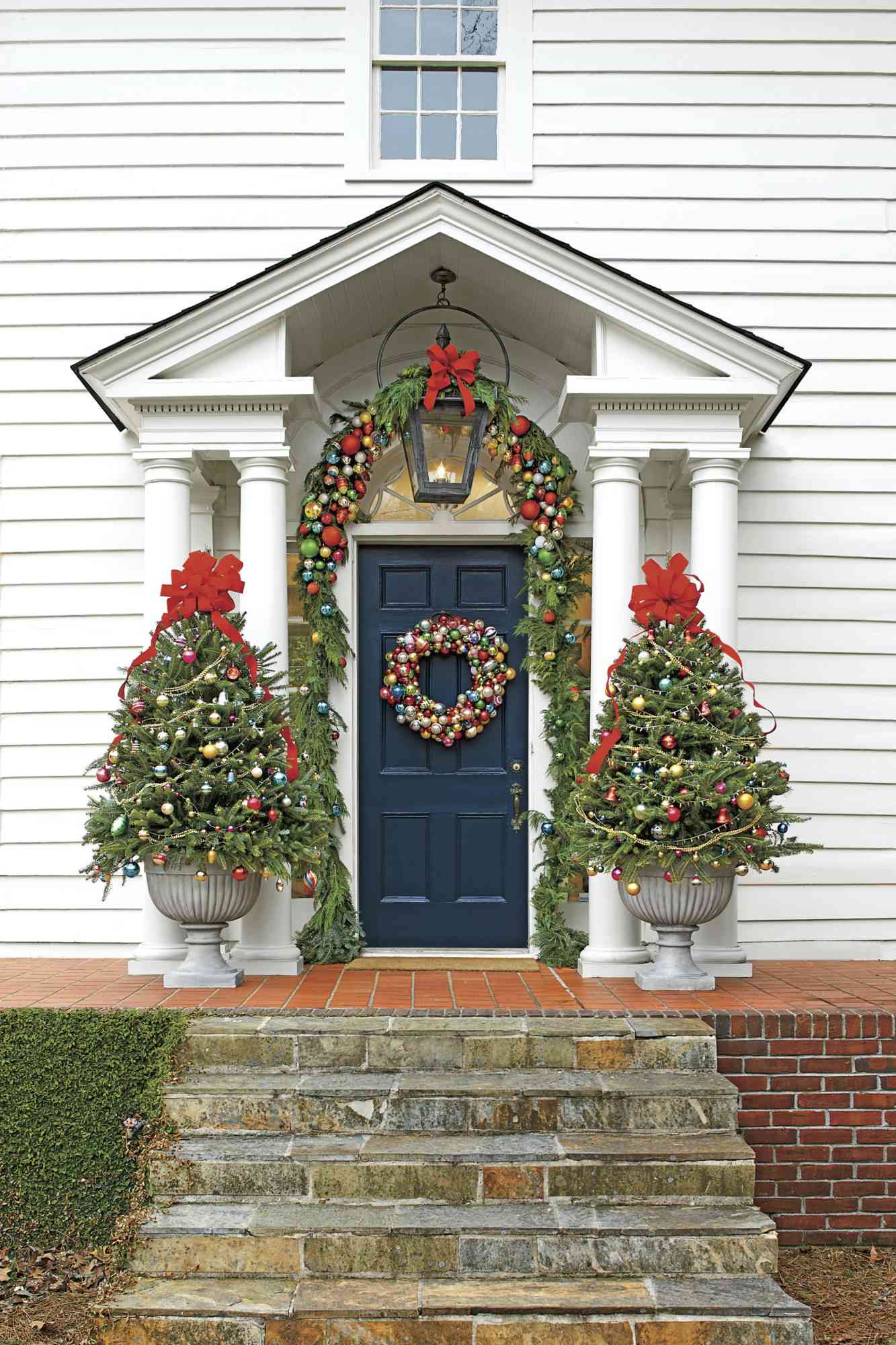
Warm white is the whole story in 2026. The blue-white LEDs that dominated the 2010s read cold and cheap against whitewashed brick and dark shutters, while 2700K bulbs make the same house look like it belongs in a holiday movie. Whitewashed brick itself is still climbing as the fastest way to make evergreens pop, and battery-powered pieces with built-in timers have finally turned a whole facade into a plug-and-forget project.
18. A Red Door That Does All the Work
One saturated color, used everywhere, beats five colors used carefully. The red door, the wreath on it, the porch garland bows, and those rows of red below the side windows all repeat the same note, so your eye never has to decide where to look. Snow does the rest — it’s a free white backdrop that most people spend real money trying to fake indoors. And the symmetry of the swags along the windows makes the whole house feel balanced from the street.
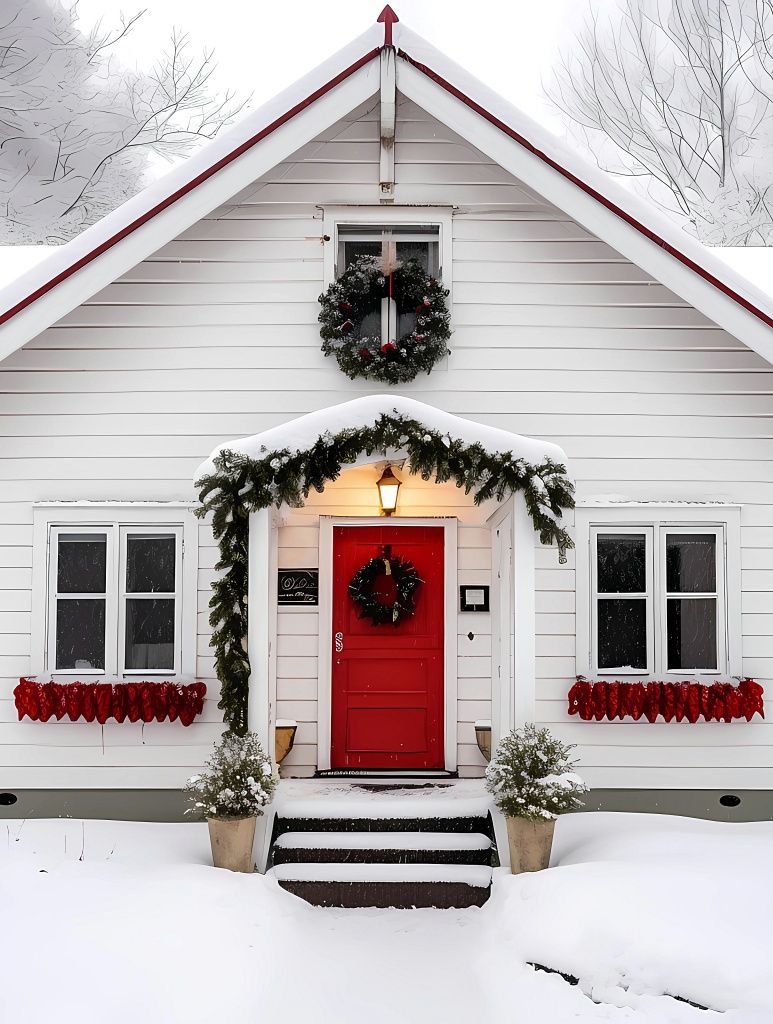
That impact costs less than people assume. A gallon of good exterior red runs $35-$60, versus $400 or more for a new front door. Old wreaths you already own? An $8 can of glossy red spray paint plus fresh ribbon makes them look purchased this season. Those rows of red under the windows are ornament balls and berry sprays from the dollar store, maybe $10 total. Set a $100 ceiling and you can still out-decorate the whole block.
19. Wooden Beads and Faux Antlers Instead of a Bow
- Start with a 14-inch wooden bead hoop — Etsy sellers carry them for about $18 — and decide which half will be beads and which will be greenery.
- Wire mixed greens to the lower half, building outward from the center so the shape stays balanced.
- Add a strip of faux fur along the transition line to hide the mechanics.
- Wire on pinecones, frosted eucalyptus, and three to five small gold bells, keeping the bells near the bottom so they move.
- Tuck two faux antlers in at an angle — one pointing up, one out — for asymmetry.
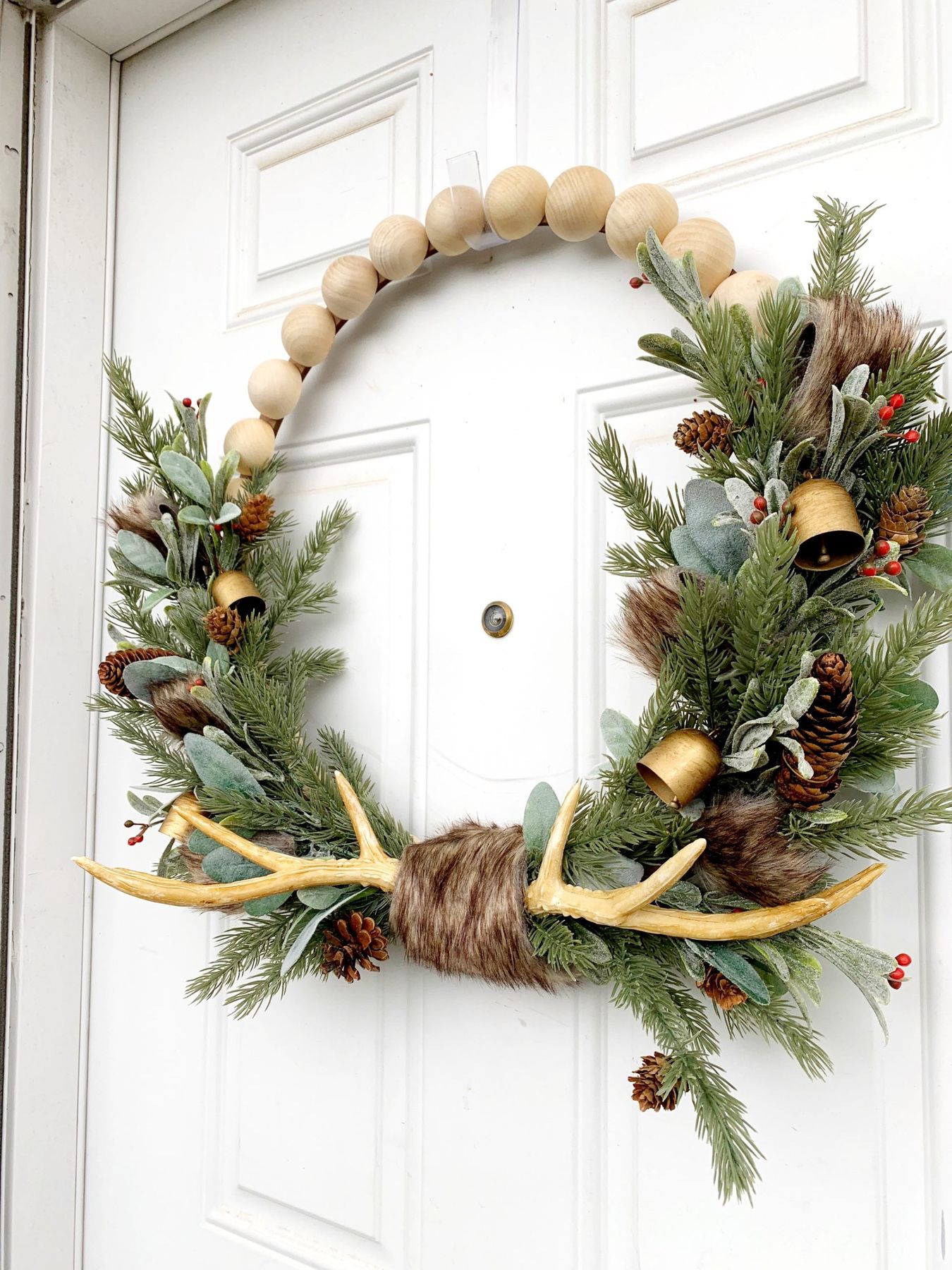
Roughly 60 to 90 minutes and $45-$70 total.
Scale is where wreaths go wrong. On a standard 36-inch door, a 24-inch wreath reads intentional; anything under 18 inches looks like a small hoop someone forgot to finish. Hang it so the top of the wreath sits 6 to 8 inches below the top edge of the door — high enough to feel deliberate, low enough that the beadwork sits near your eye line when you reach for the handle.
20. Plaid Curtains and a Wreath Hung on the Window
Roughly 55 percent warm wood from the long table, mismatched spindle chairs, and distressed china cabinet; 25 percent white from the paneled walls; 15 percent red-and-green plaid in those curtains; and 5 percent brass from the candle glow. The plaid is doing all the pattern work, which is why there’s no printed tablecloth and the runner stays plain. Trade the plaid for solid crimson and it goes traditional; trade it for a ticking stripe and it turns cottage without touching a single piece of furniture.
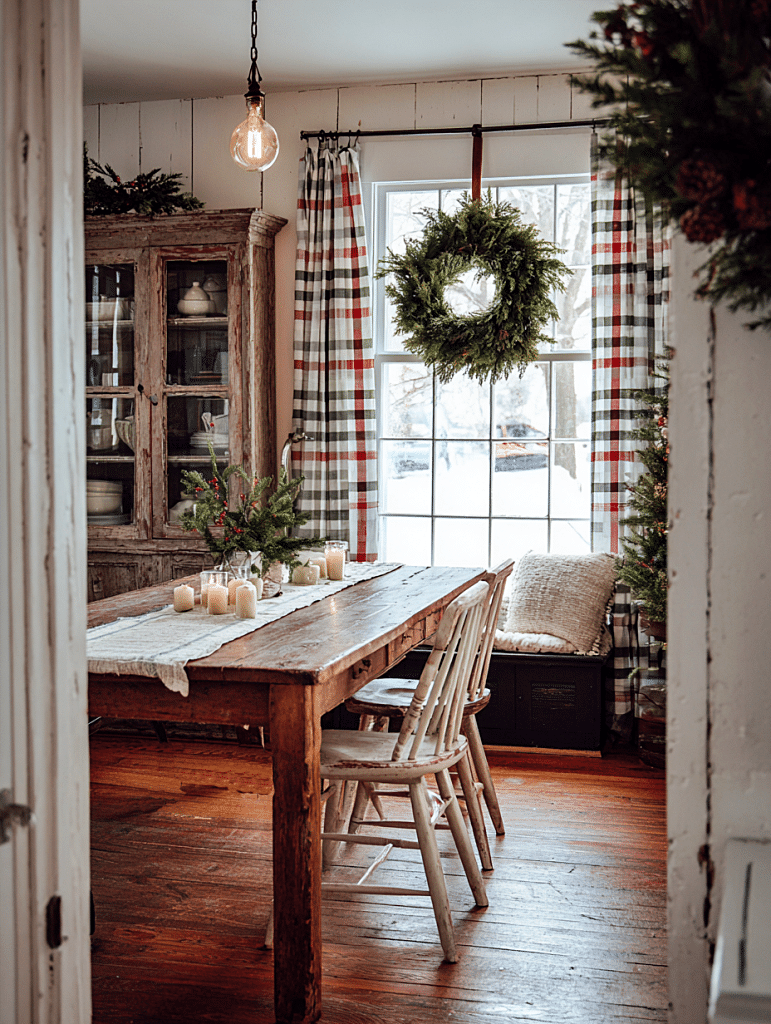
For six people, you want a table between 72 and 84 inches, with a runner 12 to 14 inches wide so there’s room for plates on both sides. The window wreath should land in the 20- to 24-inch range for a standard window, hung with a ribbon long enough to sit in the upper third of the glass. This is the louder sibling of Idea #10 — same window idea, more pattern, more energy.
21. Juniper Berries, Dried Citrus, and Muted Velvet
The dried citrus slices and that muted velvet ribbon are the difference between a wreath you bought and a wreath that looks like it came from a farm stand. Everything else — the cedar, the pinecones, the blue juniper berries — is texture. The citrus is the only element with a shape you can identify from across the yard, and the soft sage-beige ribbon keeps it from tipping into craft-fair territory. Skip the ribbon and it gets busy fast.
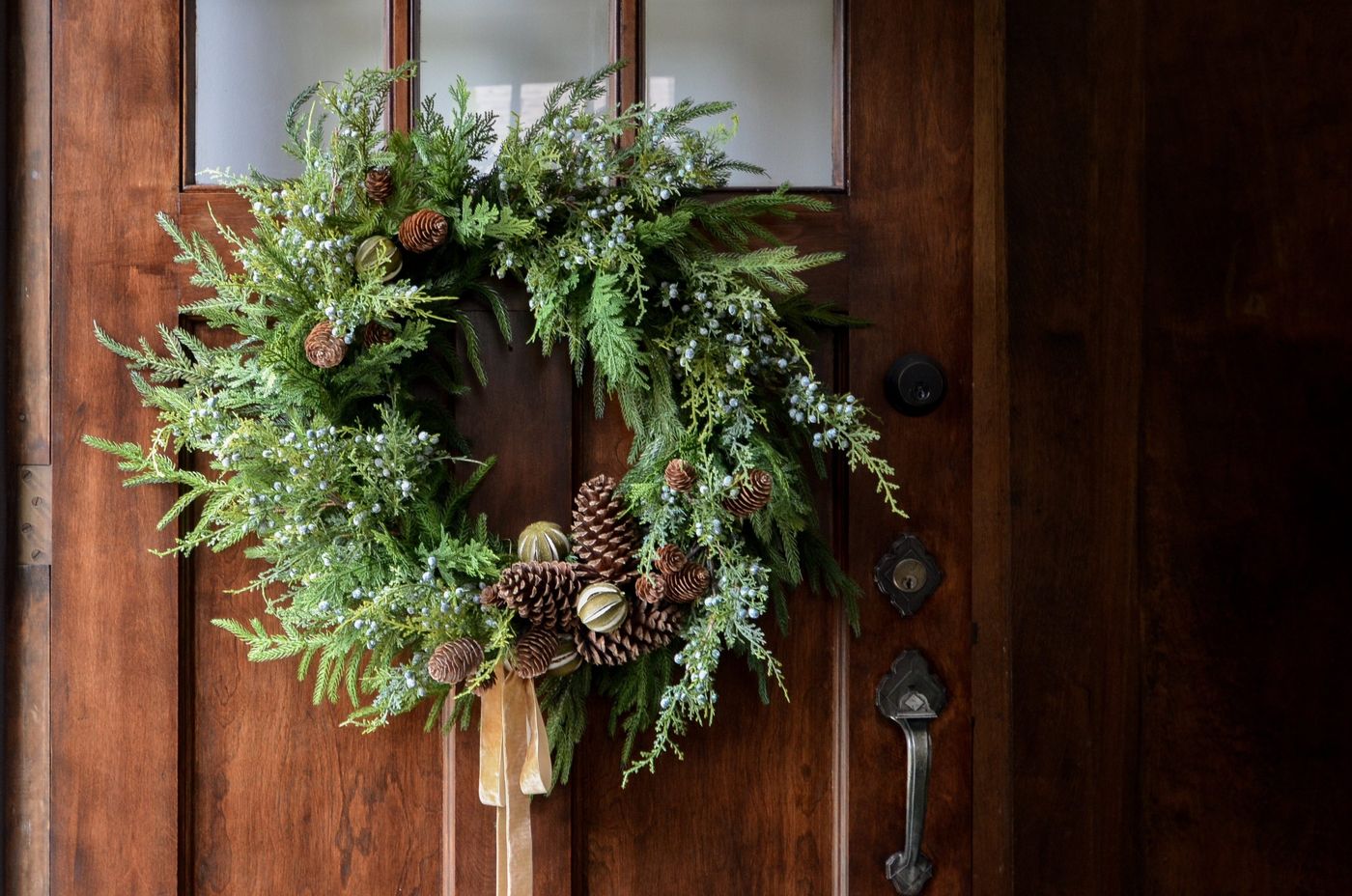
Fresh wreaths indoors dry out in three to four weeks, faster if you have forced-air heat. Mist the back of the wreath every other day and keep it away from vents. Dried citrus darkens over the season — that’s normal and honestly part of the charm. Juniper berries drop, and they can leave small stains on pale floors and table linens, so hang this one somewhere forgiving or slip a felt pad underneath.
22. A Gold Mesh Bow That Steals the Whole Wreath
Gold mesh ribbon is about $5 a roll at Walmart, a wire wreath form is $6, and a bag of zip ties is $3. Add an evergreen wreath you already own or one from a big-box store for $25, and you’ve recreated a $120 florist look for roughly $30. The trick is proportion: the bow should be about a third of the wreath’s total width. On a 24-inch wreath that’s an 8-inch bow — bigger than most people dare, and exactly right.

Mesh ribbon is a diva. It unravels at the cut ends, so seal them with a dot of hot glue or a lighter held close for a second. Store it flat in a bag, not crushed in a bin, or next December you’ll be ironing mesh, which is as annoying as it sounds. And check that gold in the actual room at night — mesh looks expensive under warm light and cheap under cool white LEDs.
23. Birch Twigs and Glittered Poinsettia Petals
Break the arrangement into 60 percent evergreen, 20 percent brown tones from the pinecones and birch twigs, 15 percent red from the berries and poinsettia petals, and 5 percent sparkle from the glitter-dusted pieces. The birch is what makes it read farmhouse instead of florist — those pale twigs add height and a vertical line that round cones and berries simply can’t. Swap birch for dried branches and it turns moodier; swap the red berries for white and you’re in full neutral territory.

Glitter is a permanent decision. It sheds onto tables, floors, and whatever you set beside it, so if this arrangement sits on wood, put a tray or runner underneath. Red berries stain — real ones will mark a pale tablecloth — and birch bark peels over time, which looks charming outdoors and slightly sad indoors by February. If it’s a fresh arrangement, change the water every two days or the whole thing sours in a week.
24. Oversized Bells and a Silent Night Sign
Oversized bells are having a moment, and it’s easy to see why: they’re the one farmhouse accessory that reads festive from across the room without introducing a single new color. Paired with a framed Silent Night sign above the mantel, the whole wall becomes a statement instead of a shelf crowded with small objects. It also fits the 2026 preference for fewer, larger pieces over lots of little ones — a shift that started when people got tired of dusting.
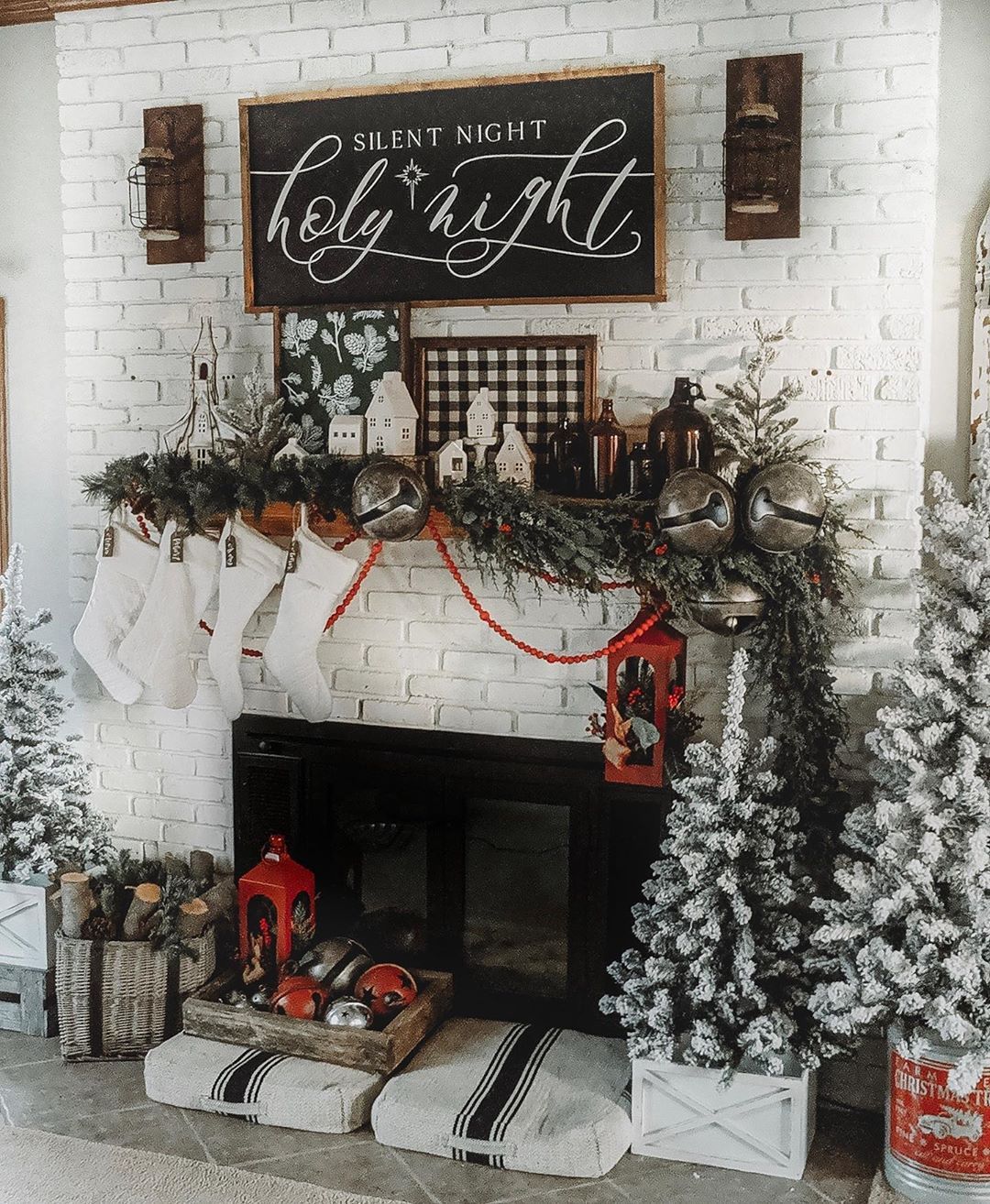
Hang the sign 8 to 10 inches above the mantel so the garland has breathing room, and keep the sign’s width under two-thirds of the mantel width or the proportions go top-heavy. Bells belong at the two ends, where they won’t compete with the garland’s center. Then drape the red beaded garland in one loose line through the greenery — beaded strands look messy the moment you try to loop them twice.
25. Brass Candlesticks, Plaid Ribbon, and a Fireplace Tree
Three repeats make this corner feel designed. The plaid ribbon in the tree echoes the plaid blanket at the base, the magnolia leaves in the mantel garland match the ones tucked into the branches, and the deep red ornaments pick up the red in the wrapped presents. Tall brass candlesticks warm up a palette that would otherwise read cold green, and the round mirror doubles the candle glow without adding a single plug.
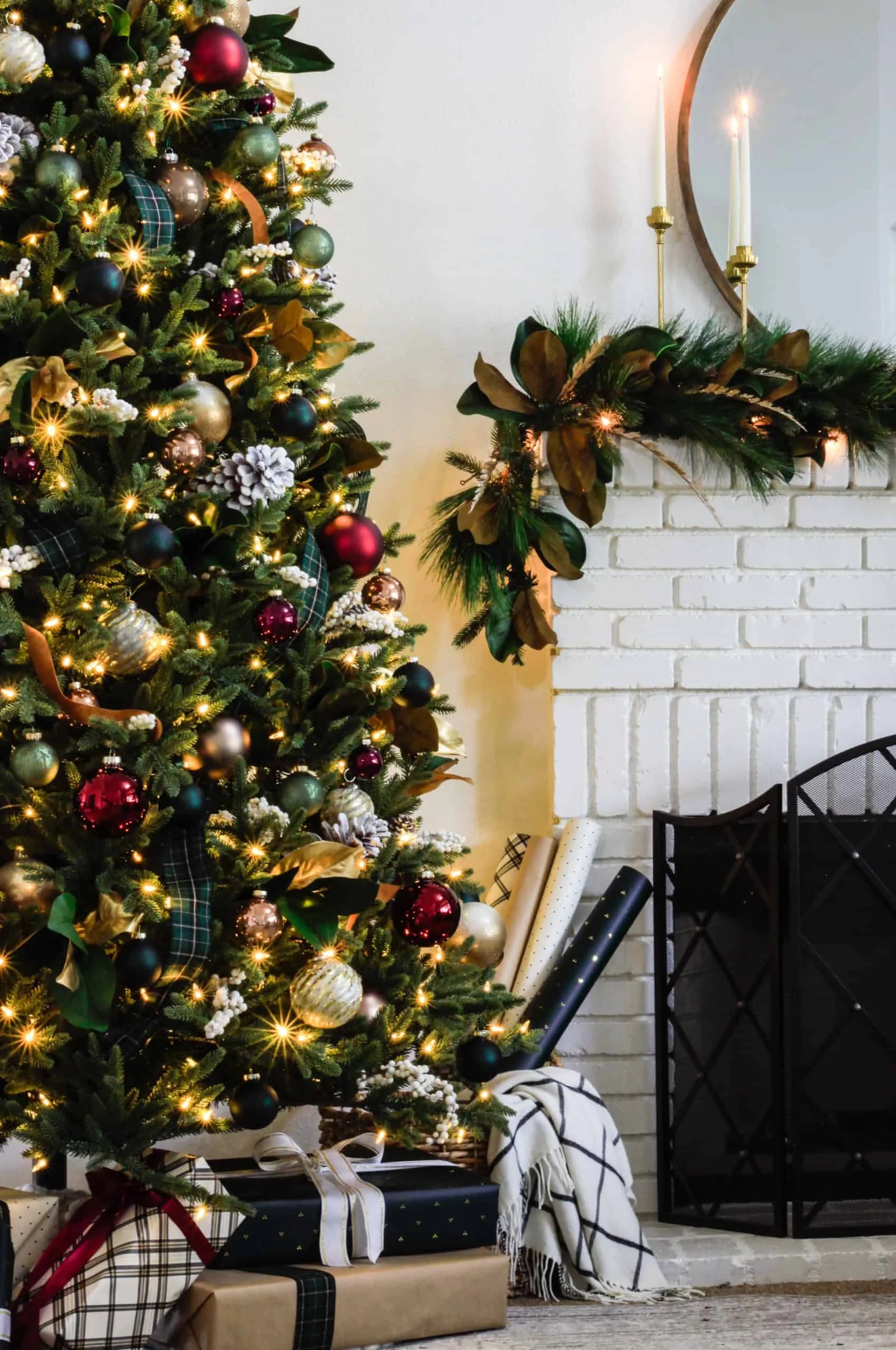
A 7.5-footer wants a 9-foot ceiling, and if the tree sits beside a working fireplace, leave at least 18 inches of clearance from the firebox — more if the hearth is shallow. Closer than that and you’re essentially drying out your own Christmas tree next to an open flame. Run the garland 1.5 times the mantel width, and keep the tallest candlesticks under 12 inches so they don’t block the mirror.
26. A Light-Wrapped Archway Over the Front Steps
The archway look is mostly fairy lights and patience. A 300-LED warm-white string runs about $15 at Walmart, zip ties are $3, and thrifted brass lanterns show up on Facebook Marketplace for $12-$20 each. Line the steps with mason jars holding LED tealights — roughly $2 apiece — and add two cone light sculptures if you want the glow to reach the ground. Under $120 for the whole entry, lights included.
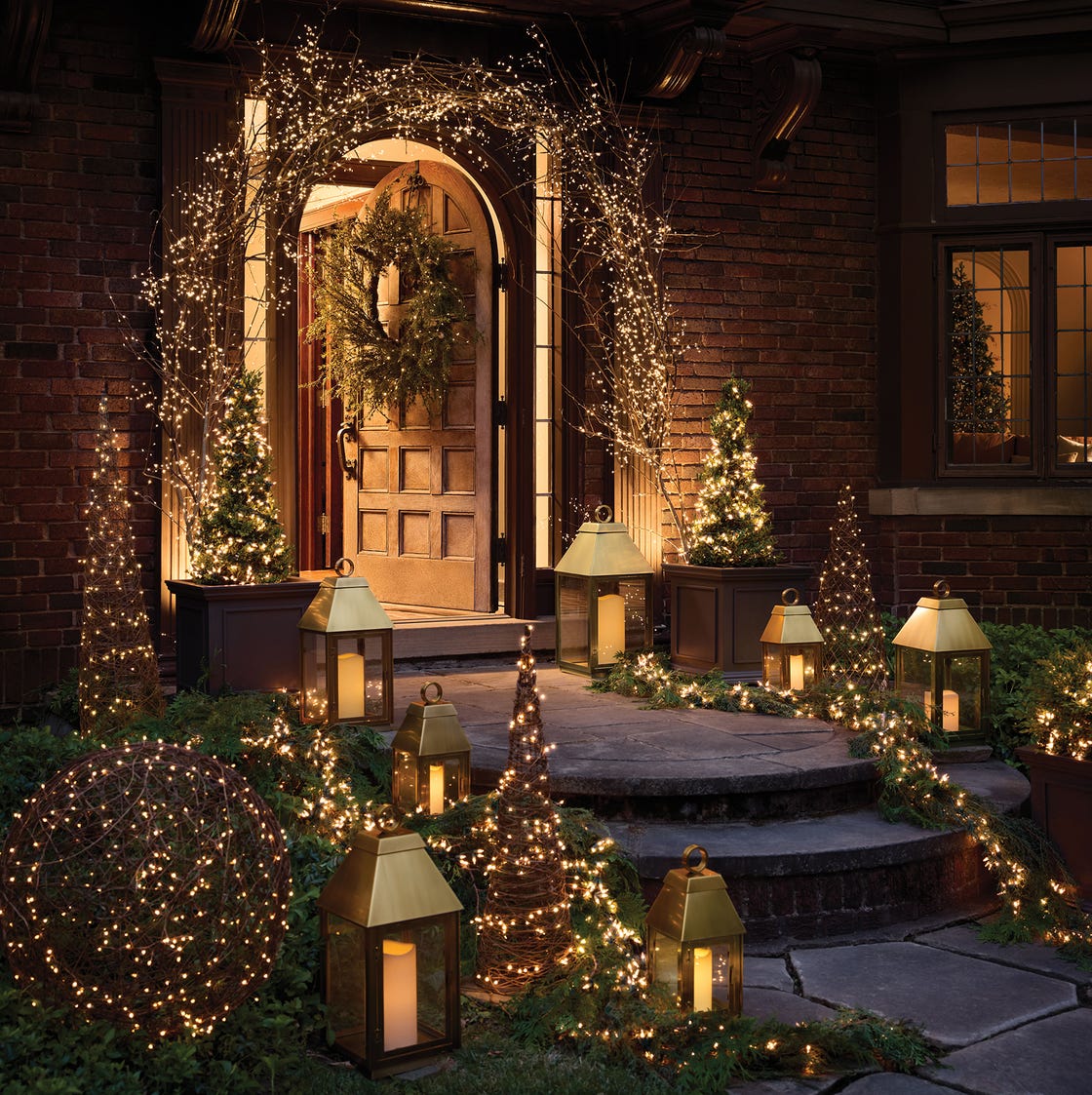
Twinkling, layered light instead of one bright blob is the outdoor story for 2026, and it’s why this entry feels magical rather than blinding. The trick is three separate light sources at three heights: the arch overhead, the lanterns at knee level, and the garland hugging the steps. Everything sticks to warm white so nothing competes. It’s the same principle behind Idea #17, just wrapped around a door instead of a facade.
27. The Vintage Truck With a Tree Tied to the Roof
If the tree on the roof is the plan, take it seriously: lay a blanket or cardboard on the roof, tie at the trunk and again near the top, and drive under 40 mph with no highway detours. Sap and needles will land on paint, so wash the roof within a day. And do not leave a tree strapped to a car overnight — it dries out, and dried trees shed a shocking amount of debris into every seam you own.
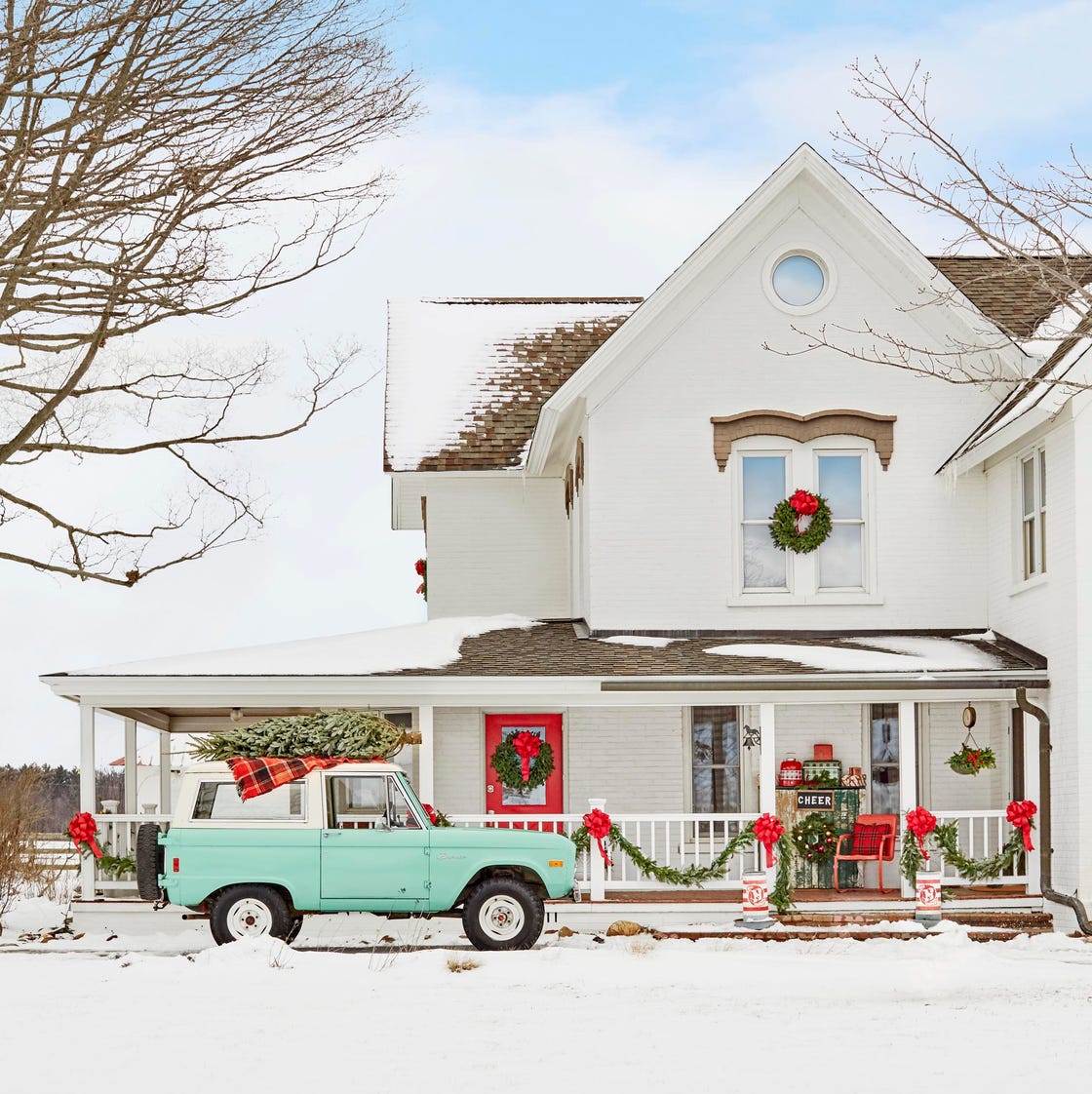
The vintage turquoise truck is the reason this photo stops you, and it’s worth being honest about what it is: a photo moment, not decor. The garland and oversized red bows on the porch railing are the actual decorating. If you have a driveway and a neighbor with a classic car, borrow it for an hour and take the picture. If not, the garland and bows work exactly as well on their own and take ten minutes to hang.
28. A Slim Tree in a Basket With a Knit Throw
Slim trees usually run 28 to 30 inches wide, so they need only about 15 inches of clearance — enough for the corner beside a brick fireplace or a narrow wall in an entry. A 6.5- to 7.5-foot slim fits rooms under 11 by 11 comfortably, and because it’s pre-lit, there’s no bulb spacing to fight with. Want the wide, full-skirted version instead? Plan on nearly double the footprint, a ceiling of at least 9 feet, and floor space around the base for gifts.
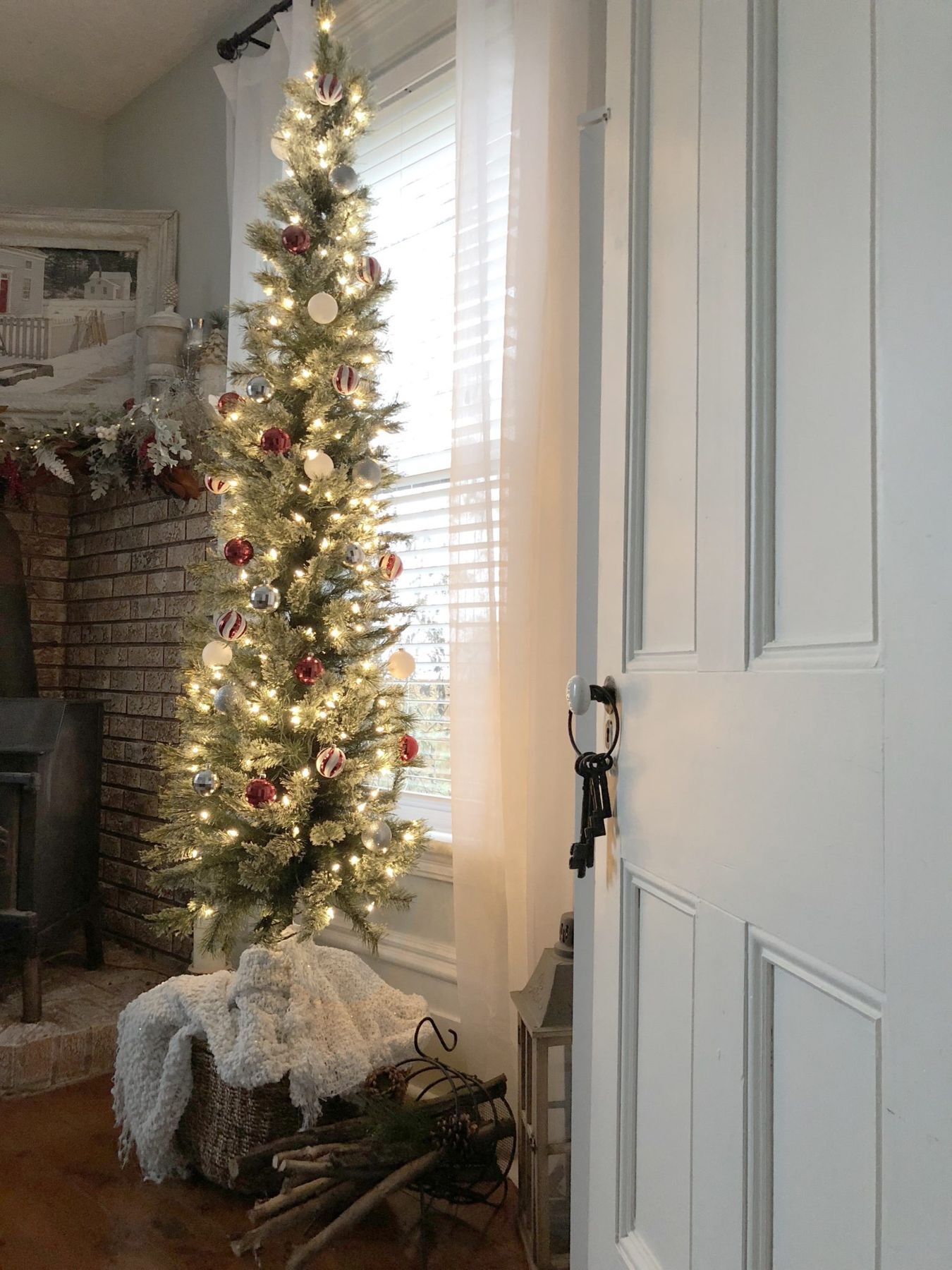
A woven basket from a thrift store is $8-$20 and does the job of a $60 designer collar. Pre-lit slim trees land between $70 and $120 at Walmart in early November, and dollar-store ornaments in white, silver, and red fill a seven-footer for about $25. The white knit throw draped over the basket edge? Target, around $20, and it’s the detail everyone asks about. Whole look under $180.
29. Handmade Wooden Trees With Hand-Painted Polka Dots
- Cut 1-by-6 pine into three triangles at 12, 15, and 18 inches tall.
- Sand the edges, then paint two trees in a dark distressed finish and leave the third natural.
- Dot the painted trees with white using a pencil eraser dipped in craft paint, and use black dots on the natural one.
- Glue a small wooden star to the top of each.
- Let them cure overnight before grouping.
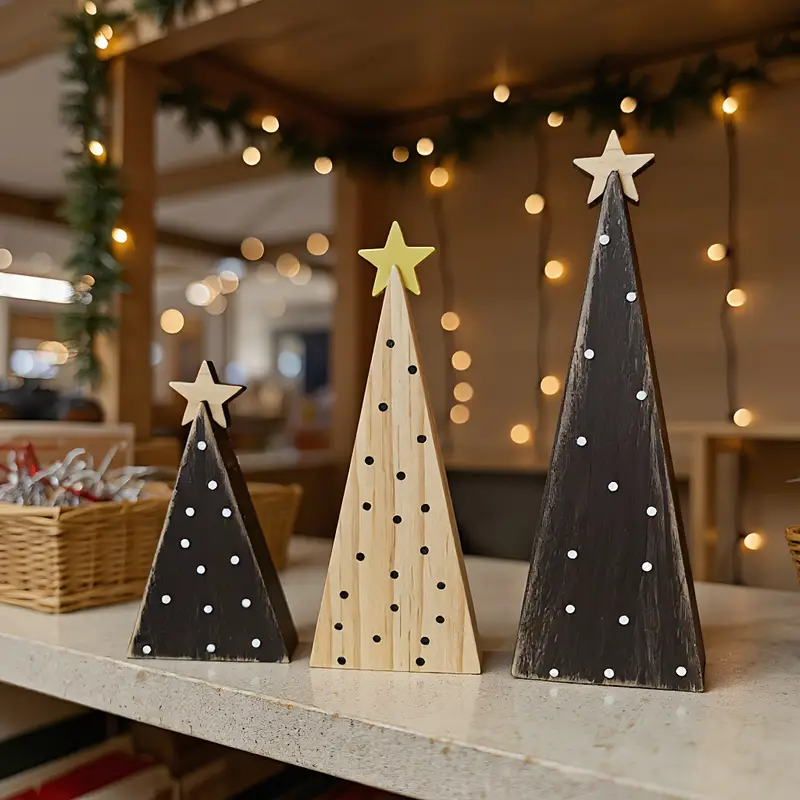
Two hours of work and about $25 in materials.
Group them in odd numbers with graduated heights — 12, 15, and 18 inches works because your eye reads a slope instead of a row. Keep the tallest in the center or just off-center, and leave 3 to 4 inches between each so the silhouettes stay distinct. If you build a second set, flip the finish — natural in the middle, dark on the outside — and the grouping reads completely differently on the same shelf.
30. Cinnamon Sticks, Twine, and a Wreath in Progress
- Measure the door or window and choose a frame 4 to 6 inches smaller than the opening.
- Buy your greens within 24 hours of building so they don’t dry out on the counter.
- Cover the work surface — sap and needle debris get everywhere.
- Count your accents in advance: 8 to 10 pinecones, 5 berry clusters, 2 cinnamon bundles.
- Set a budget cap before you shop; wreath supplies add up faster than the wreath itself.

Fresh handmade wreaths read differently than anything store-bought because the imperfections are visible — a slightly uneven fringe, a sprig poking out at an odd angle, a pinecone sitting deeper than the rest. That’s the charm of farmhouse style at its best. Burlap, twine, and cinnamon sticks only make sense here; on a polished store wreath they’d look like a costume. Keep it slightly rough and it looks like it belongs to your house.
31. Plaid Pillows and a Glowing Tree in a Neutral Room
After dark, the tree’s warm string lights are the only real light source in this room — and that’s the entire design. The neutral sofa, the wooden coffee table, and those plaid throw pillows all stay quiet so the tree can carry the color. Swap in a brighter lamp or a cooler bulb and the cozy effect collapses in about five seconds. Sometimes the single most important element in a room is restraint everywhere else.
Pillow math keeps a sofa from looking like a pile. Use 22-inch down inserts in 20-inch covers so they stay plump, then build in threes: two 20-inch squares plus one 14-by-22 lumbar per seating area. Limit plaid to one pillow per group and let solid cream or charcoal carry the rest. Same logic applies on the coffee table — keep every object under 12 inches tall so you can still see across the room. If plaid starts multiplying on you, the mistakes section below is worth two minutes.
32. A Wooden Cutout Tree Standing in a Dough Bowl
- Cut wooden slats into graduated lengths and stack them from longest at the bottom to shortest at the top, forming a tree silhouette.
- Glue and clamp the slats, then drill a small hole through the base for a dowel stand.
- Set floral foam in the dough bowl and push the dowel in so the tree stands upright.
- Fill the bowl with pinecones, cotton bolls, and fresh evergreen clippings, tucking moss over the foam.
- Run a burlap runner underneath and stop there — the arrangement needs nothing else.
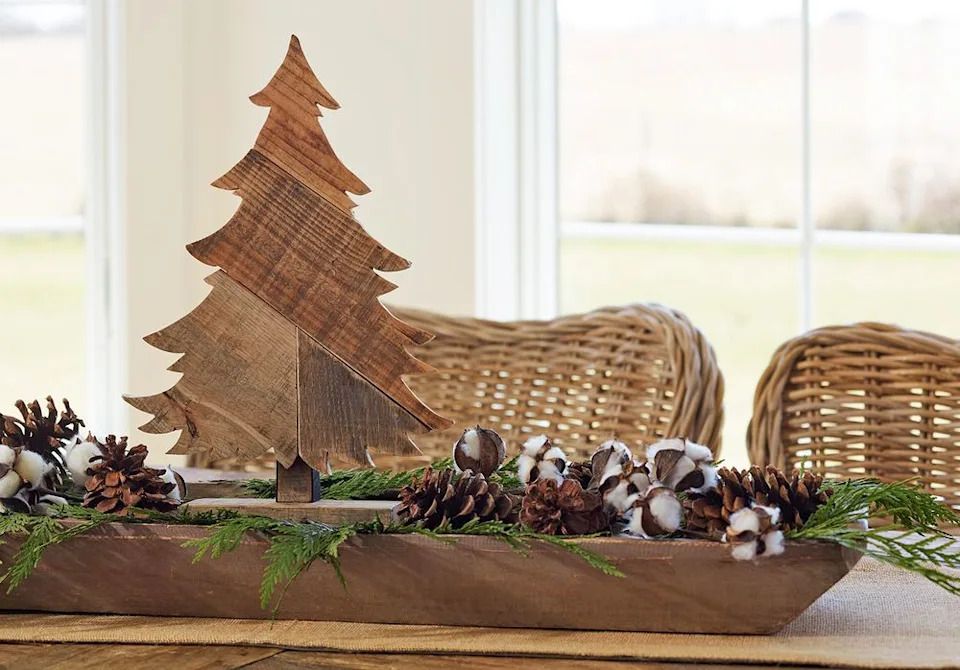
About 45 minutes and $20 if you’re working from scrap wood.
You can skip the woodworking entirely. Dough bowls turn up at thrift stores and estate sales for $15-$25, and Etsy sellers sell ready-made wooden cutout trees for $18-$35 if you’d rather not cut anything. Cotton bolls run about $10 a bag online, and pinecones are free if you know anyone with a pine tree. Even buying everything new, the centerpiece lands under $80 — a third of what a florist charges for an arrangement half this size.
33. Potted Evergreens Lit on a Covered Porch
A covered porch needs at least 6 by 10 feet to pull this off without feeling blocked. Use planters in the 14- to 16-inch range and evergreen trees between 3 and 5 feet, staggered in three heights rather than lined up like soldiers. Keep a 36-inch walking path clear, and place the firewood rack at the far end so it stops the eye instead of interrupting foot traffic. A wood rack with a string of lights on it is the detail that makes the whole thing feel like a room.
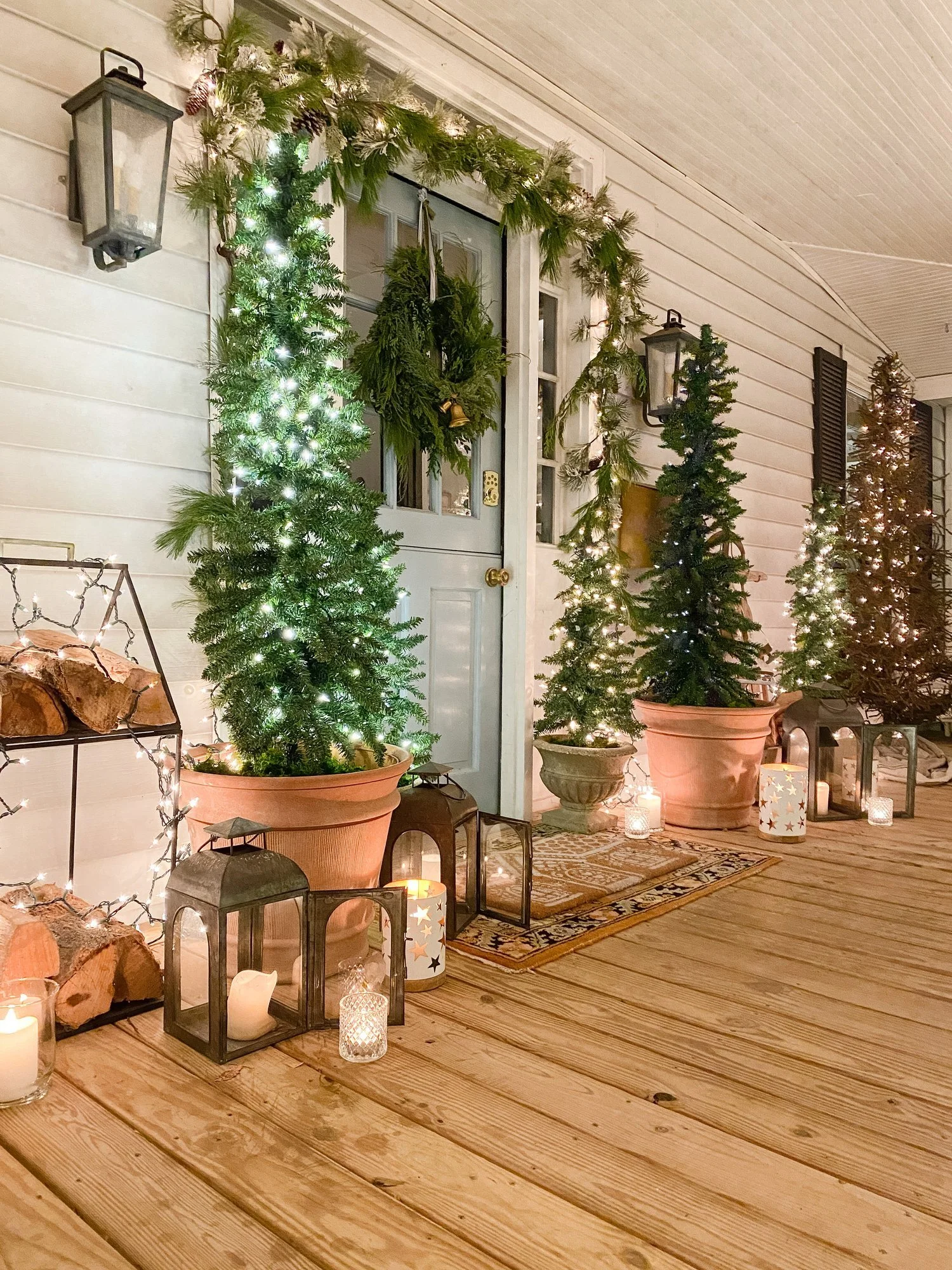
Potted, lit evergreens are the porch story for 2026 because they’re reusable — pull them inside after the season or let them live out there year-round. The look leans on terra cotta, white siding, and one soft color on the door rather than a big red statement, which is why a pale blue door works here; it reads calm against all that green light. Warm 2700K bulbs on timers keep it from looking like a storefront.
Your Farmhouse Christmas, One Wreath at a Time
Start with the piece you’ll see every single day — a wreath on the front door, garland on the porch railing, or that dough bowl on the coffee table — and let the rest of the house catch up next weekend. Farmhouse style has never been about buying everything at once; it’s about layering things that look like they’ve been around a while. 📌 Pin your favorite ideas from this list so they’re waiting for you when the boxes come down from the attic.