
Somewhere between the third batch of cookies and the fortieth saved Pinterest photo, your kitchen quietly becomes the room you actually live in all December — and the one you decorate last. That’s the gap this guide closes.
After filtering through hundreds of options across Target, HomeGoods, and IKEA, we narrowed it down to 32 ideas that actually deliver, with price tags running from about $5 to just over $1,300. You’ll find traditional red-and-green kitchens, organic rustic greenery, modern minimal styling, and elegant gold-and-white tablescapes — and for the bigger looks, budget and luxury versions sit side by side so you can see exactly where the money goes. This year’s version of holiday decorating is noticeably quieter: sage and olive replacing neon green, warm 2700K glow replacing cool white, and restraint replacing the everything-at-once approach. And stay until the end — we break down the most common mistakes that can ruin these looks.
📌 Save this to Pinterest for later — you’ll want to revisit these ideas.
1. Evergreen Garlands and Plaid Runners in a White Bay-Window Kitchen
Take the plaid runners out of this kitchen and you still have a lovely garland over a bay window. What disappears is the echo. That crimson ornament up at eye level suddenly has a partner underfoot, and the room reads as one deliberate scheme instead of a decorated window. Runners are also the least invasive way to bring holiday color into a kitchen — no drilling, no paint, nothing to undo in January. Two of them laid end to end will outperform a shelf full of figurines.
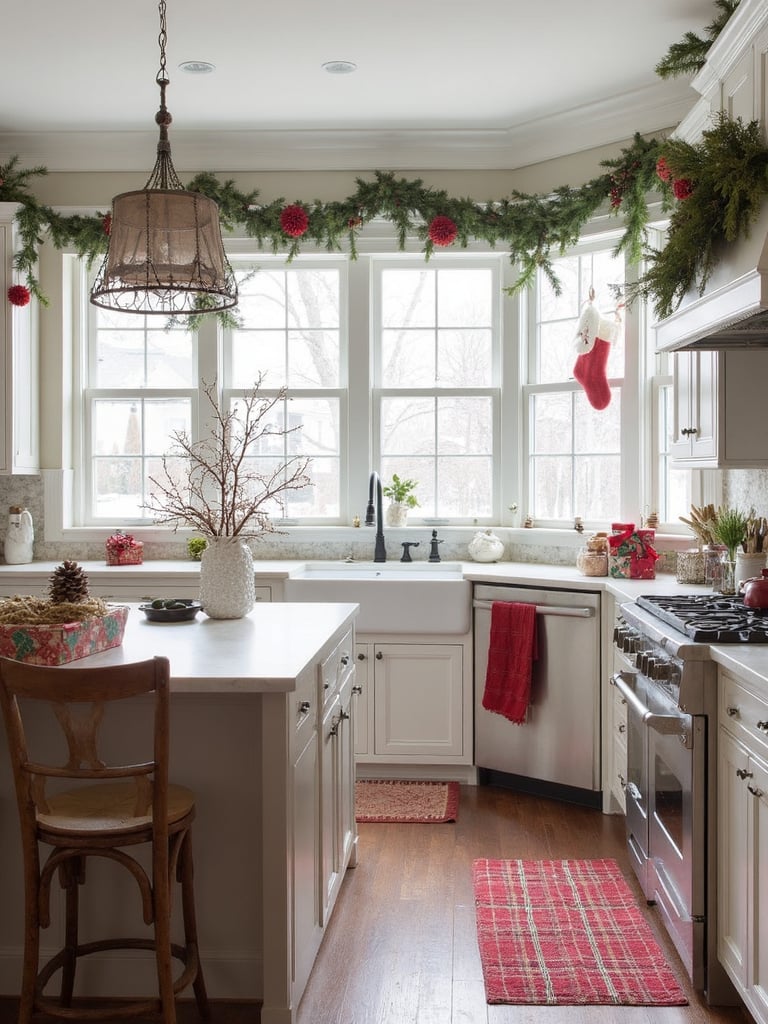
Three things are quietly doing the work here. The garland follows the arch of the bay window instead of cutting straight across, so it frames the view rather than blocking it. The palette is ruthlessly limited — white, crimson, dark wood, evergreen — which is why a window piled with ornaments still reads calm. And the heights stagger: garland high, runners low, a pinecone centerpiece at counter level. Your eye travels the room instead of landing in one spot, and that’s what keeps a bright white kitchen from feeling overstuffed.
2. Crimson and Charcoal: A Two-Tone Holiday Palette That Reads Instantly
Think of a holiday kitchen as a formula: 70% neutral base, 25% deep red, 5% something dark and grounding — charcoal, black, or oil-rubbed bronze. That last 5% is what keeps red from sliding into Valentine’s Day territory. Trade the charcoal for navy and you get a coastal Christmas; trade it for walnut and the room turns farmhouse. The formula survives either swap. Just make sure the dark note repeats in at least three places, or it reads as an accident rather than a decision.
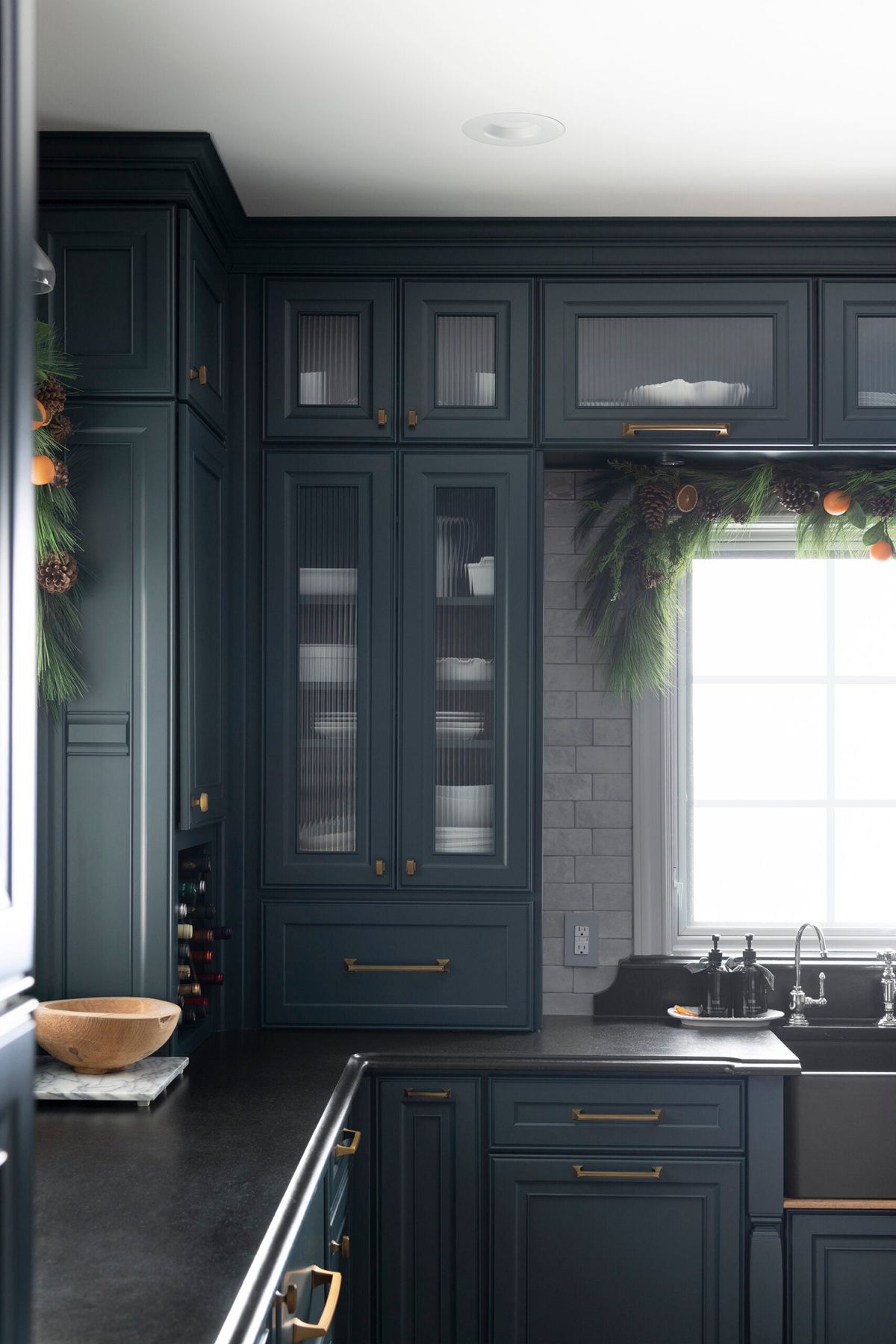
Choose one red and commit to it. A true crimson used at three different heights — counter, cabinet, floor — looks intentional; an orange-red sitting next to a blue-red in the same sightline looks like leftovers from two different storage bins. Buy your ribbon, ornaments, and towels in one shopping trip from the same dye lot, and photograph the receipt. Next December you’ll want that exact shade again, and cranberry means something different at every single retailer.
3. Pinecone Garland and Poinsettias Around a Deep Earthenware Sink
Hanging a pinecone garland above a window and three small wreaths in the panes takes about 45 minutes and roughly $70 to $130 in materials.
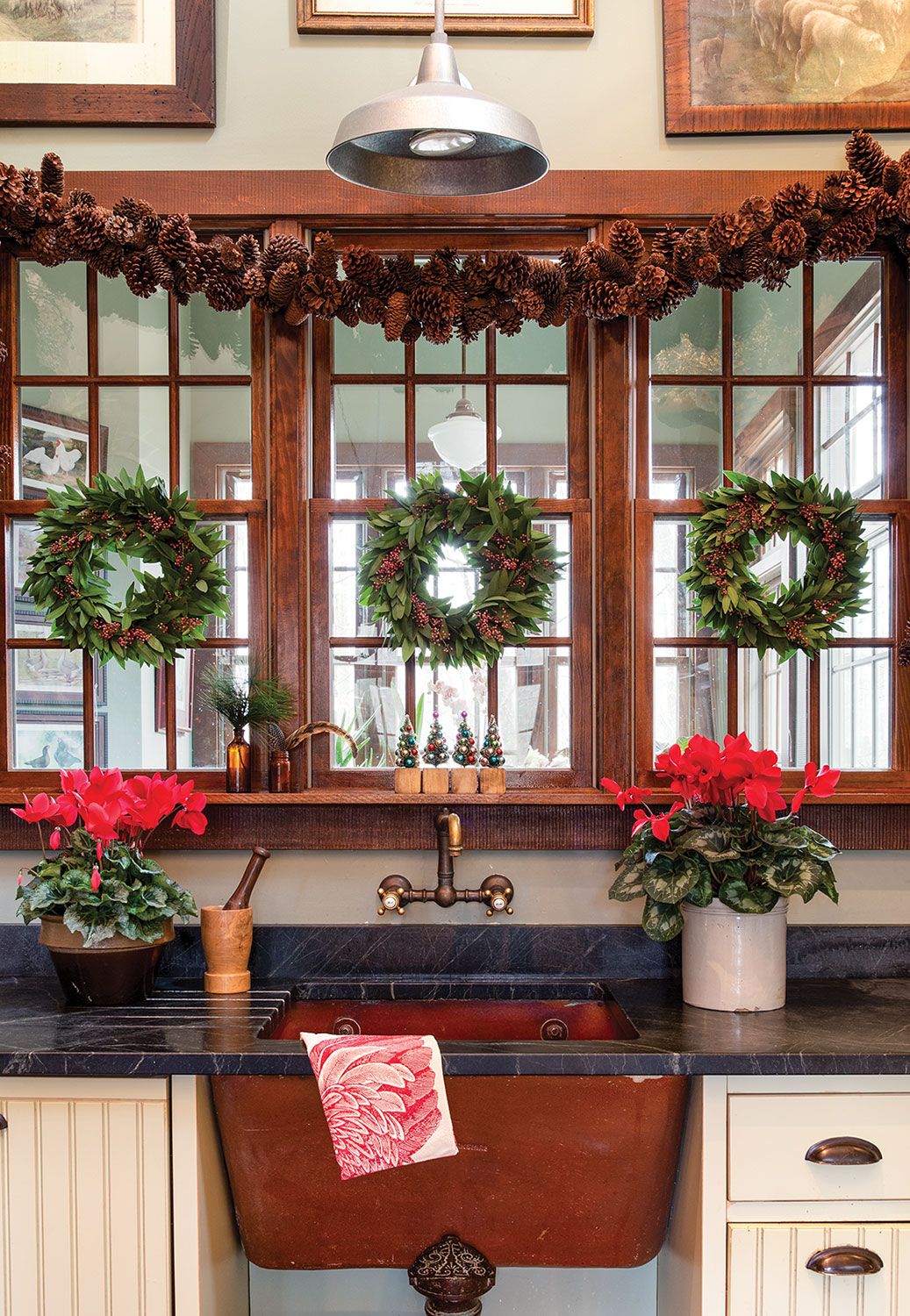
- Measure the window frame’s top edge and add 20% so the garland can swag instead of pulling straight.
- Screw two small cup hooks into the frame itself — not the wall — at each corner.
- Fluff the garland on the floor first and wire in any loose pinecones before it goes up.
- Hang the three small wreaths on clear suction cups at eye level in each pane, berries facing out.
- Set the poinsettias in pots slightly wider than the sink so leaves never brush the faucet.
Fresh garland over a working sink is a commitment. Expect needle drop the moment your kitchen hits 70 degrees, and expect it to land in the sink, the drain, and the sponge. Mist it every other day or it dries out within a week, and keep it away from the dishwasher’s steam vent. Poinsettias are also mildly toxic to cats and dogs, so if your counter is a landing pad for a curious pet, go faux — good faux poinsettias read convincingly at arm’s length.
4. Mirrored Cabinets, Ornate Wreaths, and a Miniature Village
This look is 90% decor, which is the good news.
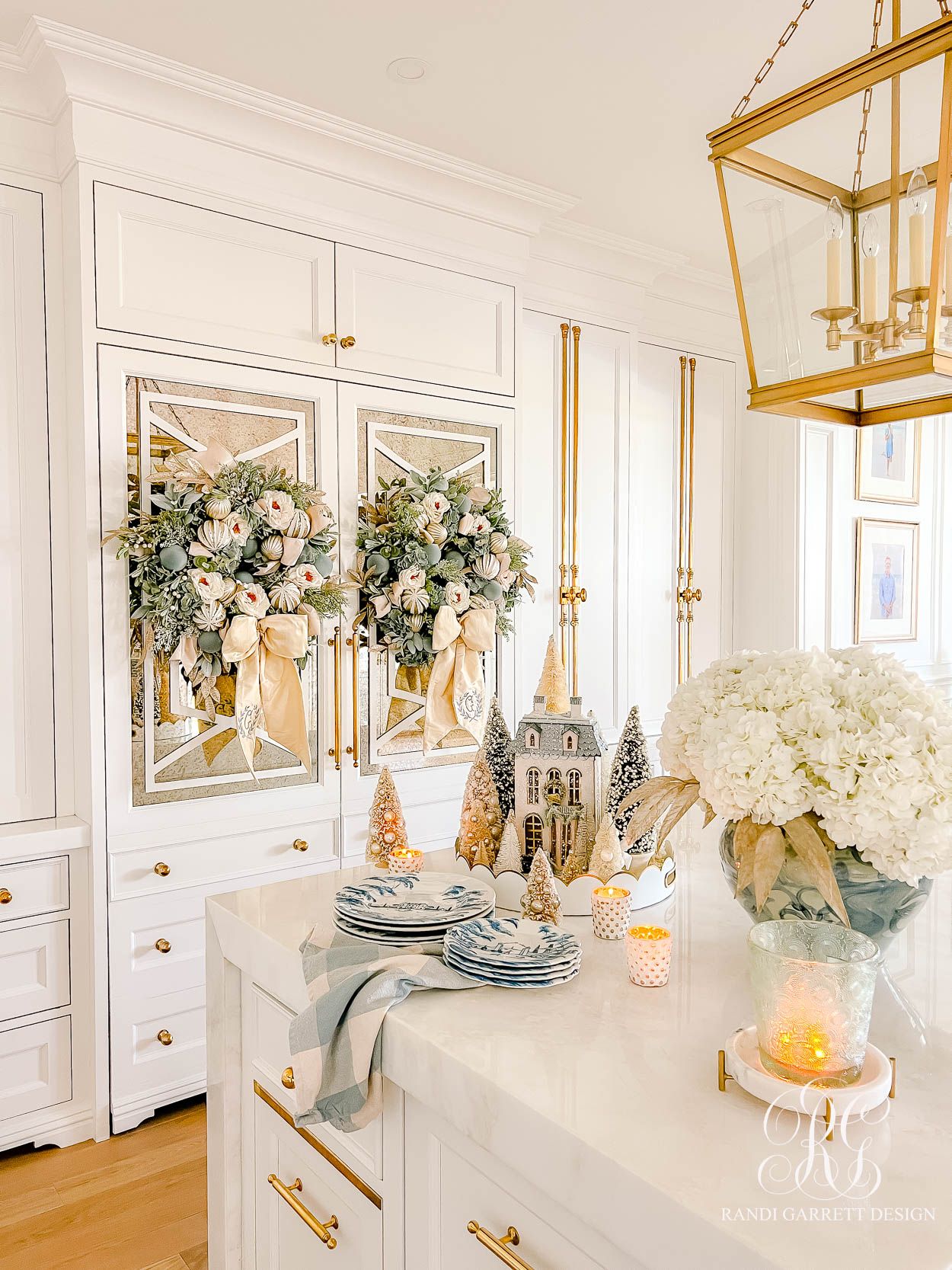
- Oversized wreaths with bows, six of them: $180–$420
- Miniature village, 8–12 pieces: $90–$350
- Tiered brass candle holders and tapers: $60–$180
- Stacked blue-and-white patterned plates: $40–$150
- White hydrangea stems, 18–24: $90–$200
Total: $460–$1,300, or about $250 if you thrift the village, swap in faux hydrangeas, and tie your own bows from a $12 spool of ribbon.
The mirrored panel inserts are the whole trick, and they cost nothing extra if your cabinetry already has them. Hang a wreath on a mirrored refrigerator panel and you don’t get one wreath — you get a wreath plus its reflection, which reads as a garland across the entire run of cabinets. Take the mirror away and you’d need twice as many wreaths to fill the same visual space. Before you buy six of anything, walk your kitchen and count the reflective surfaces.
5. Holiday Red on a Dark Backdrop: Contrast Without Chaos
Red doesn’t change color when you change the surface behind it — your eye does. Placed against something dark, crimson reads deeper and richer because contrast is doing the heavy lifting; the same red against a bright white backsplash can look flat and a little cheap. Dark cabinets also absorb the visual weight of dense decor, so you can hang a heavier wreath or pile on more ornaments before the room tips into chaos. One catch: dark surfaces show dust and grease splatter immediately, so keep decor out of the cooking splash zone.
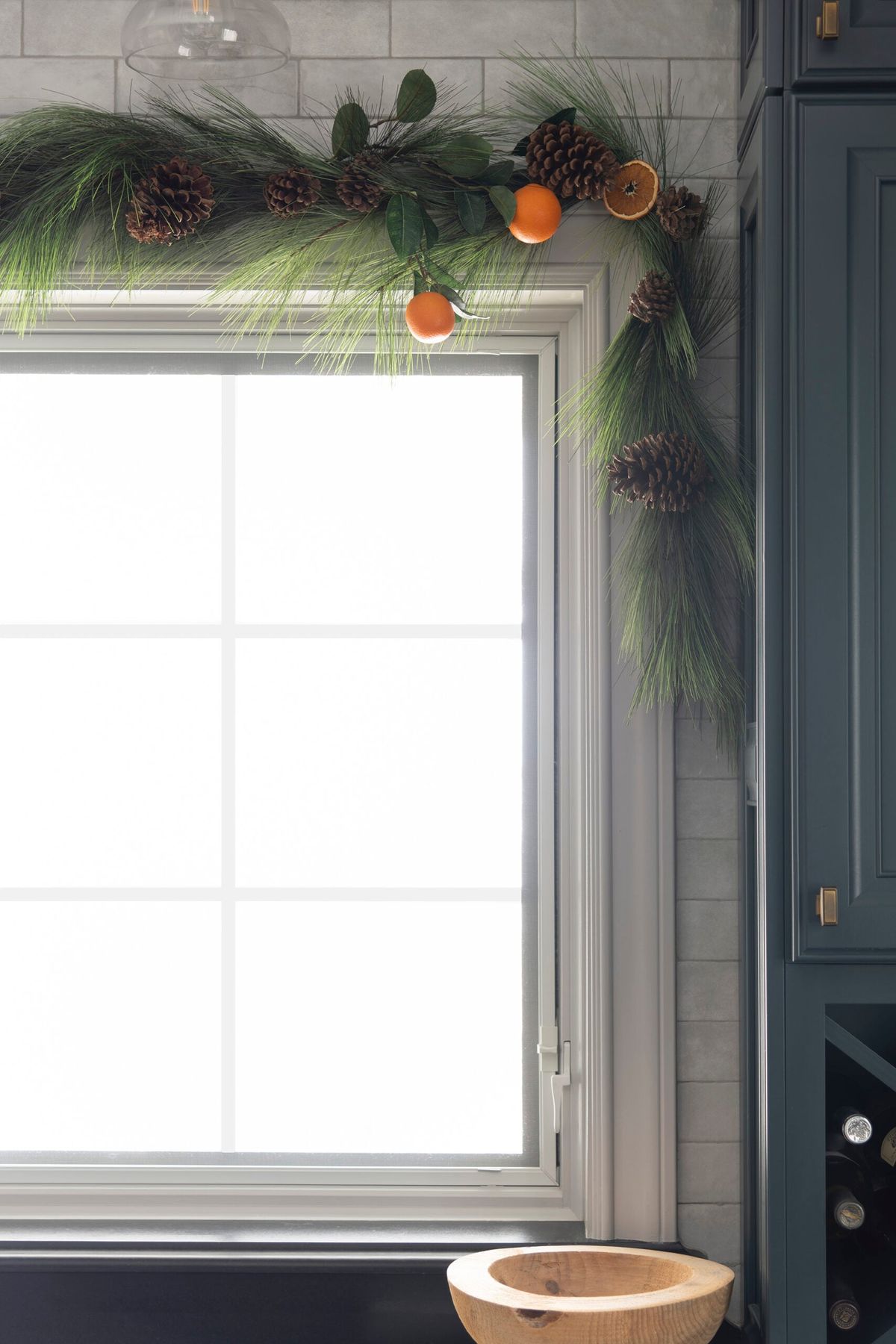
A dark-backed holiday kitchen is one of the cheapest looks to fake. A $12 roll of matte black removable wallpaper on a single backsplash section gets you the contrast for a season. Red glass ornaments run $6–$10 a dozen at Walmart or Dollar Tree; pair them with a $15 faux pine garland from IKEA and hang it on $5 clear hooks. Facebook Marketplace fills up with last year’s red decor every January at a third of retail — set a saved search in November.
6. Red Ribbons and Warm String Lights Along the Cabinet Run
Warm white only — 2700K to 3000K. Once you cross 4000K, holiday lights turn white cabinets blue-gray and make even good garland look like a hotel lobby. Count bulbs before you buy: roughly 50 per foot gives you the dense, glowy look under a cabinet run, and 25 per foot reads sparse and a little sad. Buy the strand with green wire if it’s sitting against greenery, and plug everything into one switched power strip so you’re not crawling under the cabinets every night.
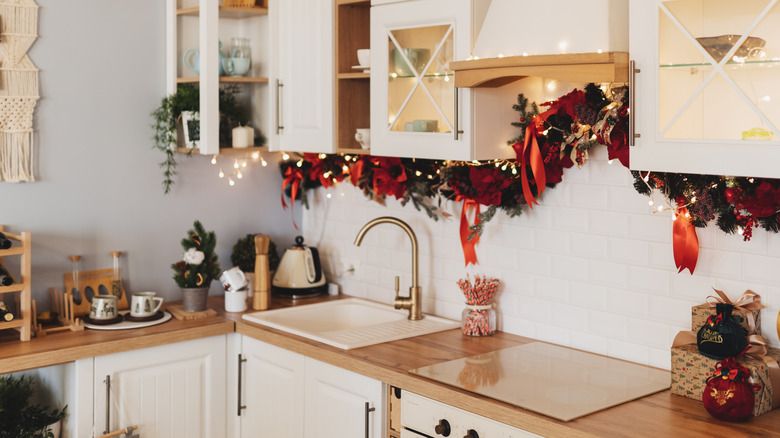
This cabinet-run treatment works best in kitchens between 90 and 250 square feet with at least 18 inches of clearance between the counter and the bottom of the uppers. Tighter than that and garland swallows your workspace; taller than 24 inches and you’ll want a thicker 4-to-6-inch garland or it looks like string. In a galley layout, run lights along the window wall only — corners are where glow turns into glare. If you’d rather scale back, see the single-garland version in Idea #12.
7. The Order of Operations for Decorating a Christmas Kitchen
Twenty minutes with a tape measure will save you an entire return-shipping season.
- Measure every counter run and write the numbers down — you’ll be shocked how little clear surface you actually have.
- Photograph the kitchen at night with the lights on, then again in daylight. Most kitchens fail at night, not at noon.
- Mark your two never-decorate zones: the work triangle and the landing space beside the sink.
- Pick one anchor — a garland, a wreath, a centerpiece — and build outward from it.
- Buy for the anchor first, live with it for a week, then add the small stuff.
Before you commit:
- Counter clearance: leave at least 18 inches of uninterrupted work surface, always.
- Outlet count: how many free plugs are within reach, and are any of them switched?
- Lighting: note whether your kitchen reads warm or cool after dark.
- Storage: where does all of this live for eleven months? If you can’t answer, buy less.
- Kids and pets: anything within 36 inches of the floor should be unbreakable.
8. Merry Christmas Runner, Candy Cane Jars, and a Bright Island
Jars of candy canes look charming until mid-December, when kitchen humidity turns them into a sticky, fused block you have to chisel out. If you’re set on candy, choose individually wrapped pieces and drop a silica packet into the bottom of each jar. Runners on an island also slide the second someone leans on one — a 12-inch rubberized shelf liner underneath fixes that for about $8. And if you have counter stools, keep the runner plus centerpiece under 10 inches wide so knees have somewhere to go.
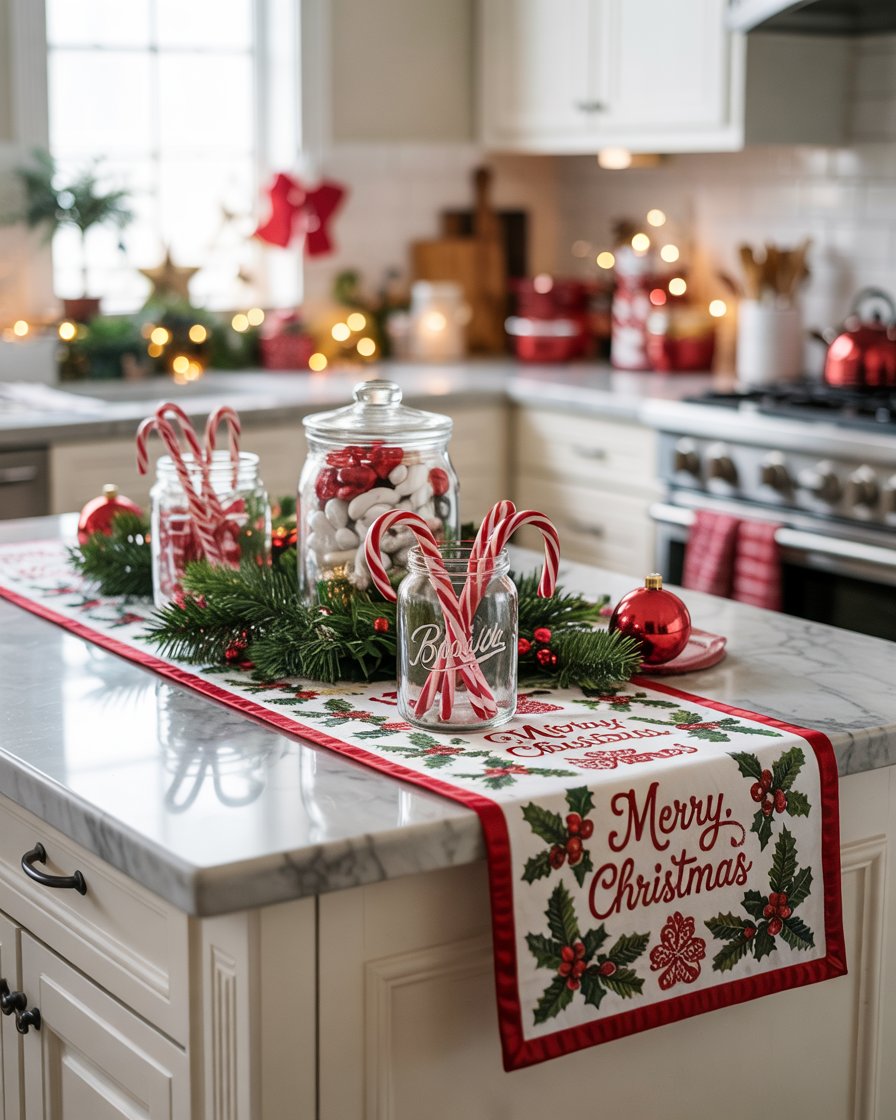
The runner is the spine of this island, and everything else organizes itself around it. Without it, the candy cane jars and loose greenery just float on marble with no relationship to each other. With it, the jars become bookends and the greenery becomes a center line. If you buy one thing for an island this year, buy the runner — 18 to 20 inches wide for a 36-inch island, and long enough to leave 6 inches of bare stone at each end.
9. Hand-Painted Garland Frames on Cream Cabinet Doors
Cream 60% + forest green 25% + crimson 10% + brass 5%. The green and red arrive almost entirely as accents, and that’s what keeps a decorated kitchen from looking like a card shop. Swap forest green for sage and the room softens toward cottage; swap cream for true white and it snaps into something crisp and graphic. The brass is the constant. Remove it and the cream goes slightly yellow while the red starts to feel loud.
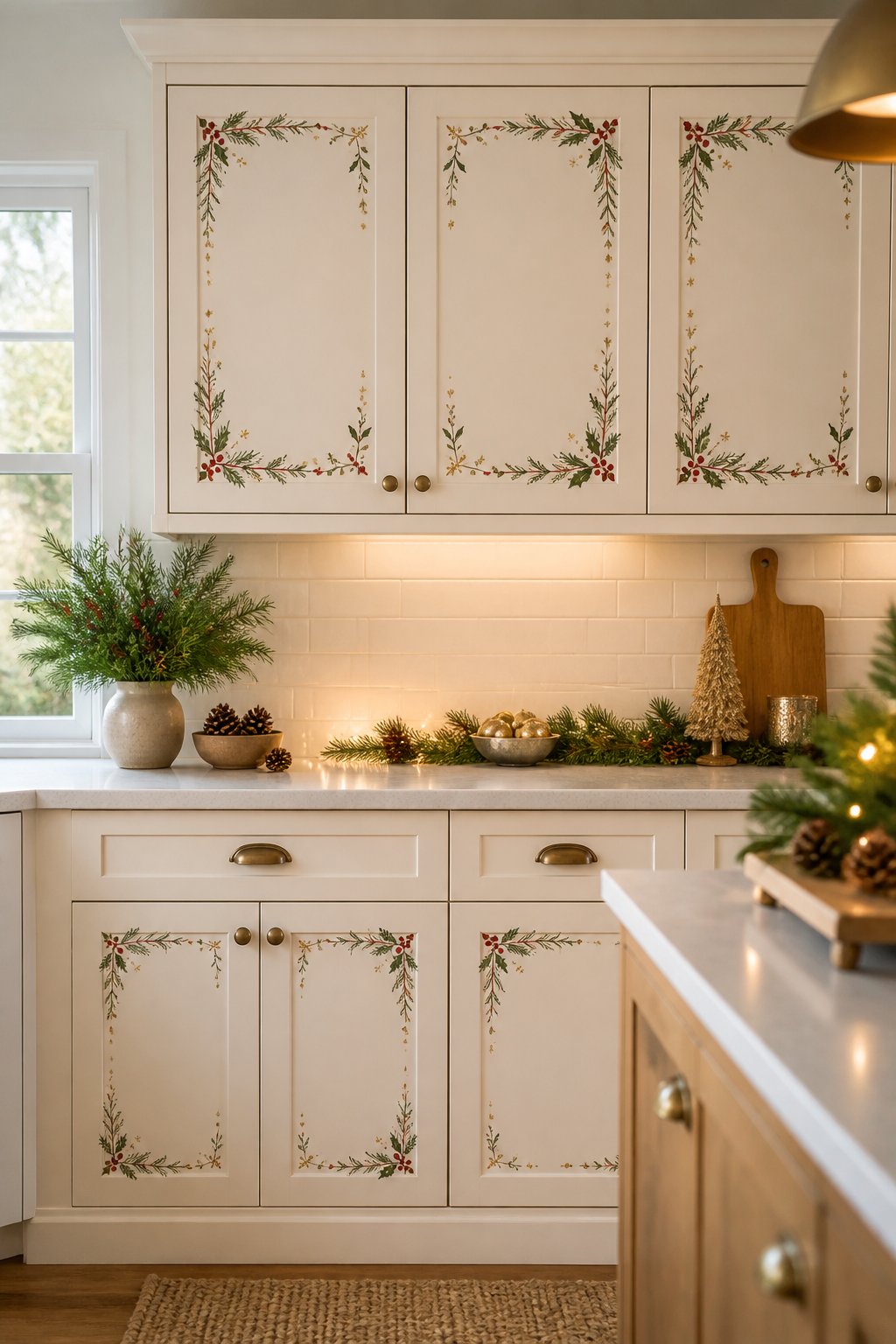
- Hand-painted botanical trim on six doors, pro: $450–$1,200
- DIY paint kit and liner brushes: $35–$70
- Miniature tinsel tree, 18 inch: $18–$45
- Pinecone bowl and extra greenery: $25–$60
- Warm LED under-cabinet strip, 6 feet: $25–$50
Total: $100–$200 as a DIY project, or $550–$1,375 hired out. Budget alternative: paint two doors instead of six and add a peel-and-stick garland decal to the rest for about $14.
10. Trailing Greenery on a Lantern Pendant and Burlap-Bowed Stools
The trailing-greenery moment started with chandelier garlands in dining rooms and has moved into kitchens, where the pendant over the island is the natural place for it. What separates the current version from the glitter-heavy look of a few years ago is restraint: faux greenery that reads like a real sprig, burlap instead of sequins, and bows that hang rather than shout. Designers keep calling it organic neutral — festive at a glance, calm at 7 a.m. on a Tuesday. It has staying power because it isn’t tied to a single holiday motif.
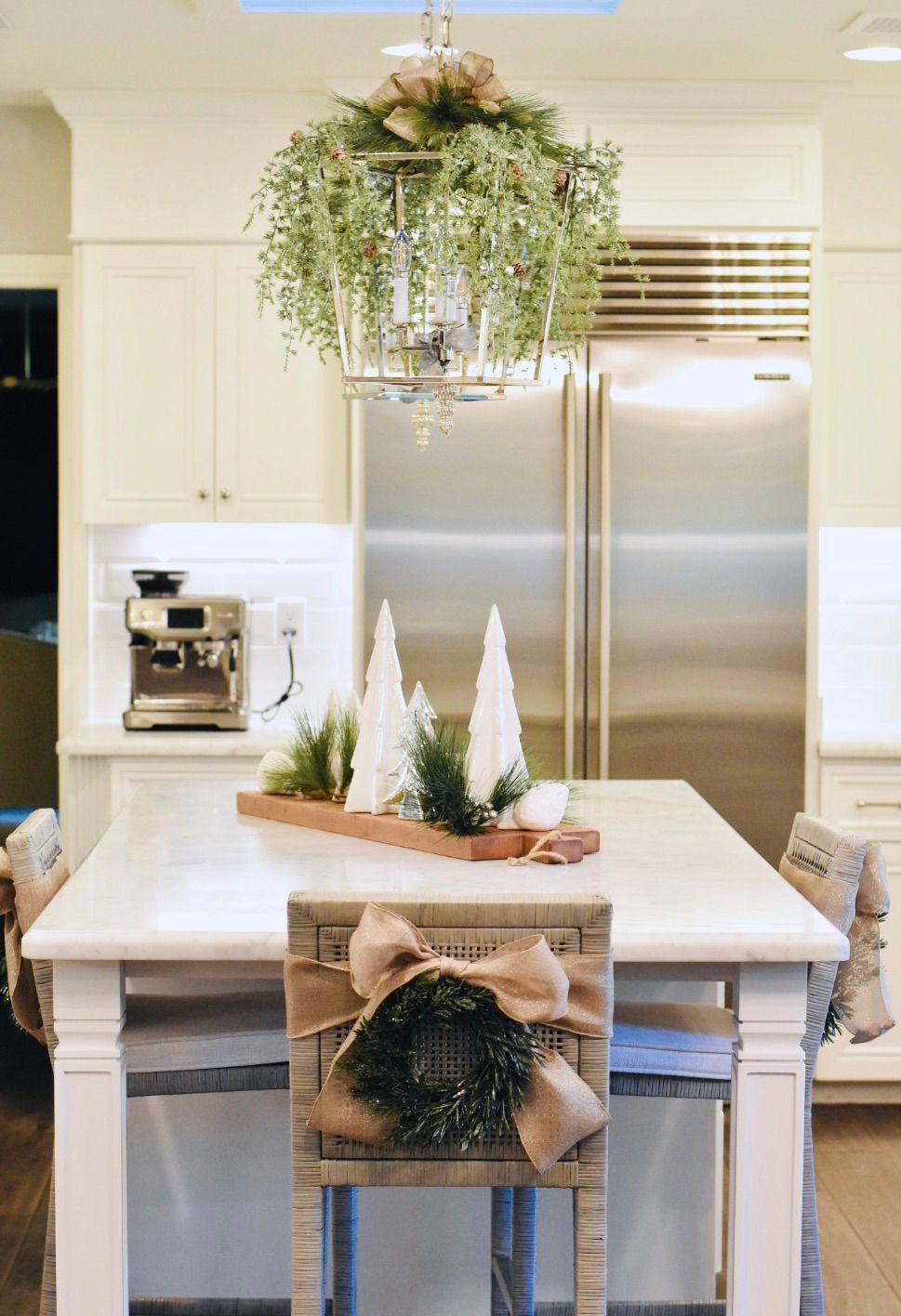
Everything here repeats at three heights. Greenery above eye level on the lantern, mini wreaths at stool height, white ceramic trees at counter level. That vertical repetition is why the room photographs so well — the eye has a clear path down. The white ceramics also do quiet work by matching the cabinets, so the festive elements read as texture rather than clutter. If you’d rather keep the pendant bare, the minimal version lives in Idea #22.
11. Frosted Wreaths, Red Bows, and a Red Stand Mixer
Hang wreaths on cabinet doors with adhesive hooks rated for at least 2 pounds, and skip any door you open more than twice a day — swinging a wreath into a granite edge chips the finish and dulls the bow fast. Place it so the bottom of the wreath sits about one-third up the door face; centered looks heavy and hides the hardware. On recessed-panel doors, the hook goes on the flat stile, never the recessed center, or the wreath tilts permanently.
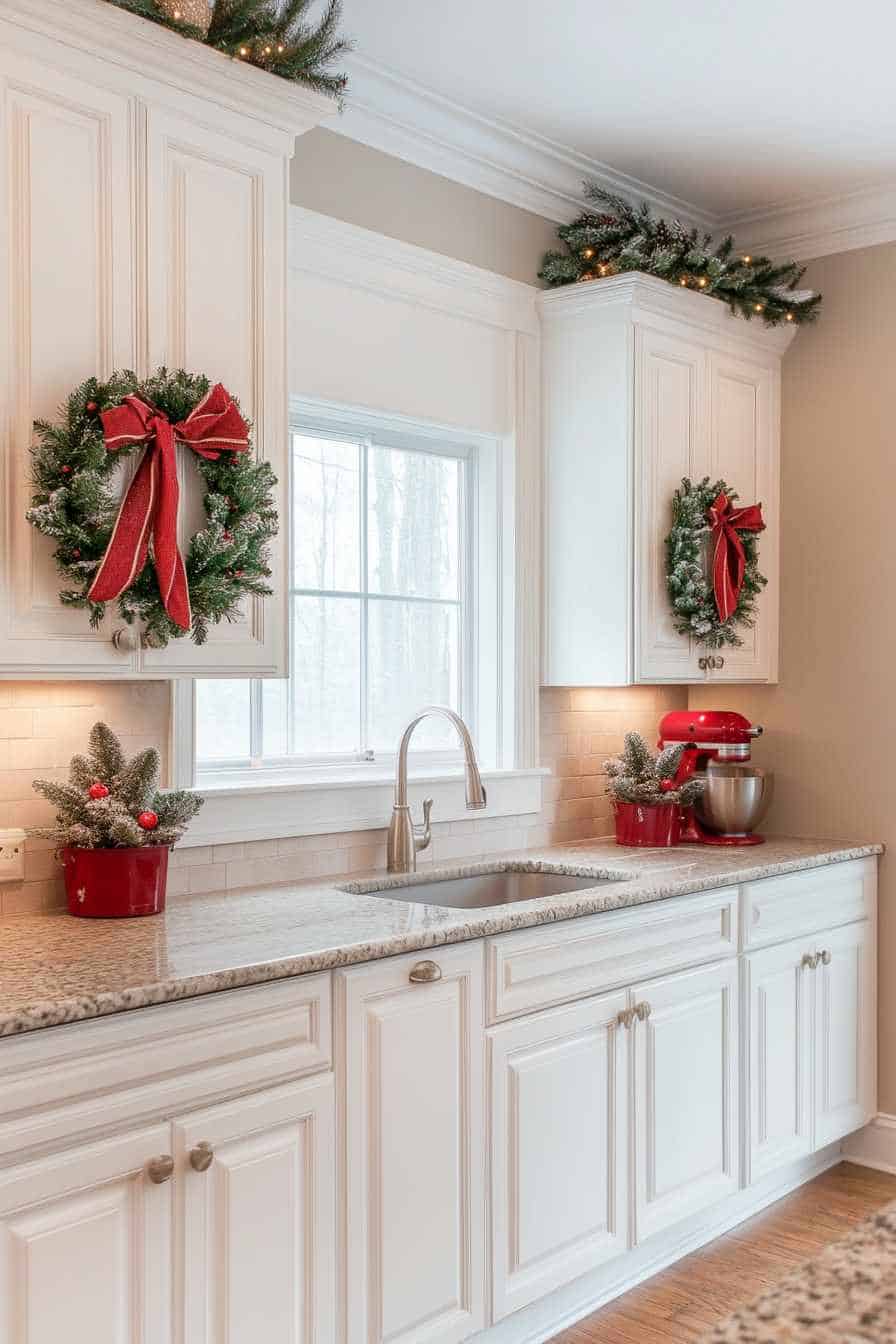
The most expensive item in this kitchen isn’t decor at all — it’s the stand mixer on the counter, and a red appliance genuinely earns its place twelve months a year. If you don’t own one, put that money into decor instead. Frosted wreaths run $8–$15 each at Walmart, HomeGoods, or Michael’s with a coupon. Red bows are $1–$3 each, or free if you tie them from a $6 spool. Mini tabletop pines in red pots are $5–$12 at Trader Joe’s. Six doors, decorated, for under $80.
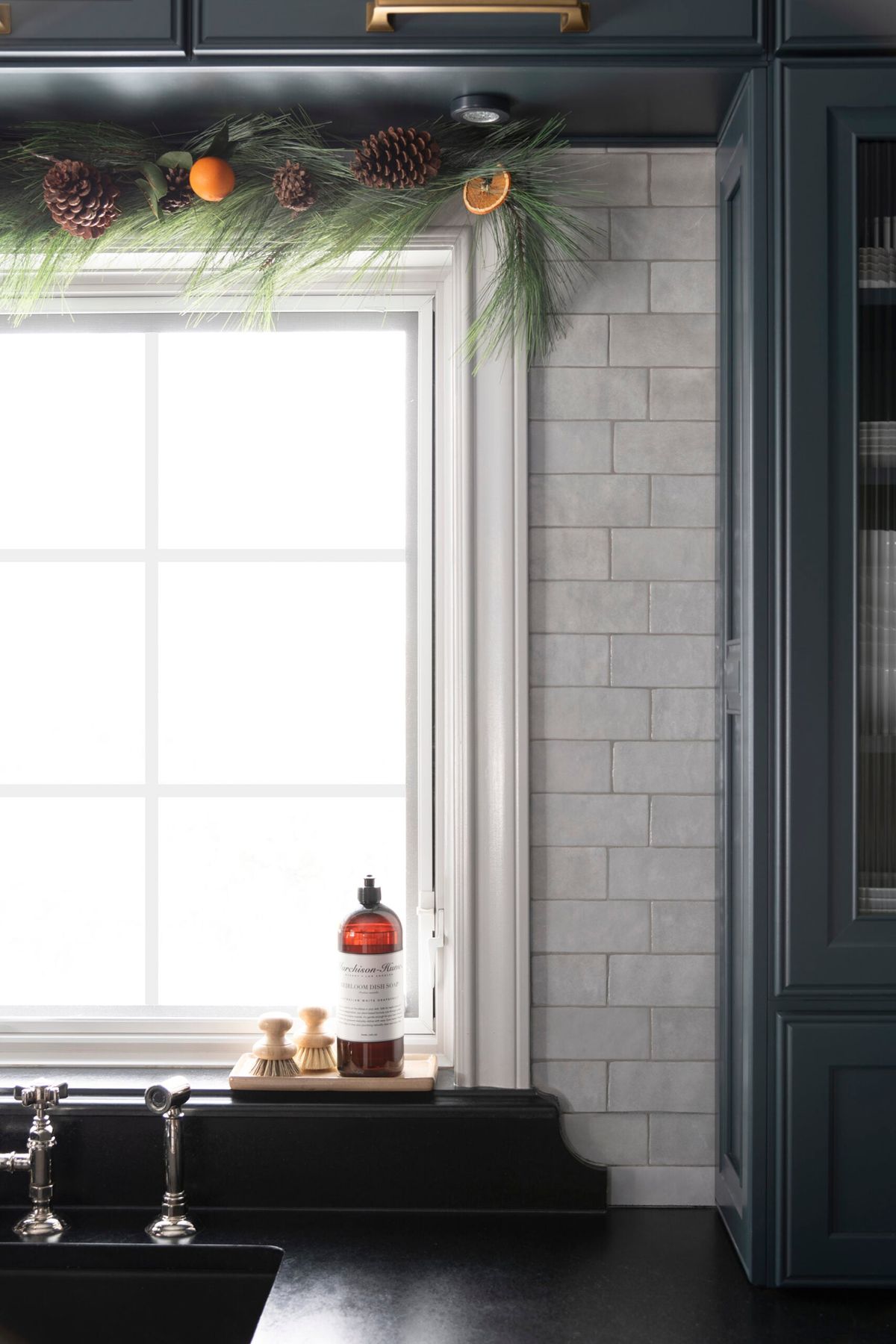
12. One Long Garland Above the Sink Window, Nothing More
Restraint. That’s the element, and it’s the hardest one to buy. There’s one garland, two small wreaths, and red ribbon — nothing on the counters, nothing on the floor, nothing hanging from the hood. Remove the discipline and you’d lose what makes this kitchen feel grown-up: the way the white cabinets and subway tile get to stay visible. If your kitchen already feels busy, this is your blueprint. One element executed well beats six elements executed adequately.
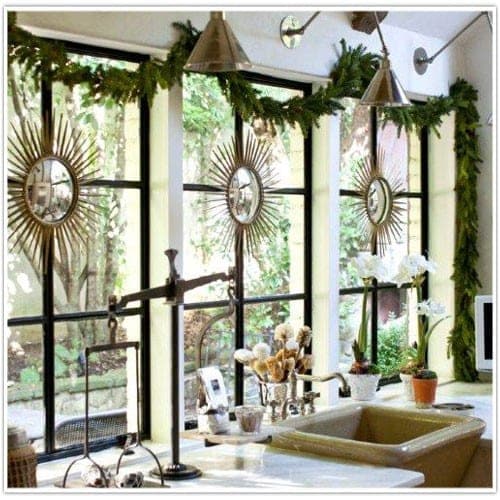
Polished nickel faucets and hardware show every water spot, and that’s doubly true in December when you’re washing cookie sheets three times a week. Wipe the faucet with a microfiber cloth after the last dish of the night — fifteen seconds, every night, or the spots will etch. Garland hung directly above a sink also collects cooking grease, so plan on replacing fresh greenery every four to five weeks. Sealed faux greenery wipes clean and won’t shed needles into your disposal.
13. Rustic Stars and Tassels on a Fresh Window Garland
Draped garland looks best when it’s about 1.5 times the width of the window it hangs over — a 36-inch window wants roughly 54 inches of garland so it can actually dip in the middle. Anything shorter pulls into a straight line and loses the swag entirely. Fresh evergreen is heavy: a 6-foot mixed garland runs 3 to 5 pounds, which means real anchors, not suction cups. Keep the bottom of the swag at least 8 inches above the faucet so you can still fill a stockpot without fighting branches.
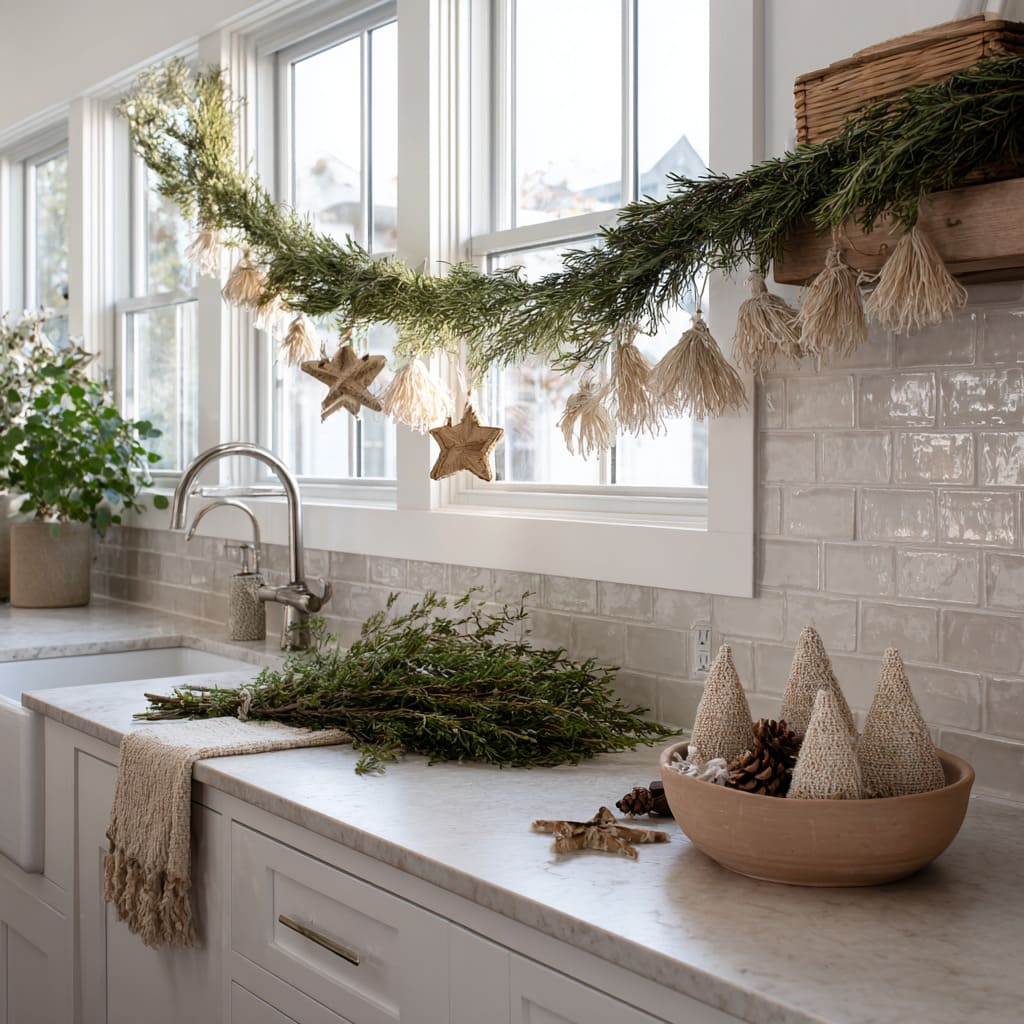
Forest green 50% + natural beige 30% + white 15% + warm terracotta 5%. That’s the organic-rustic formula, and the terracotta does more than you’d think — it’s what stops the green and white from reading cold. Swap terracotta for black and you get a moodier, more modern garland; swap it for copper and the window goes slightly vintage. The proportions hold either way, which is what makes this formula reusable for every holiday on your calendar.
14. Dark Green Base Cabinets with a Leaning Pine Wreath
Leaning a wreath against a backsplash takes ten minutes and about $12 of materials.
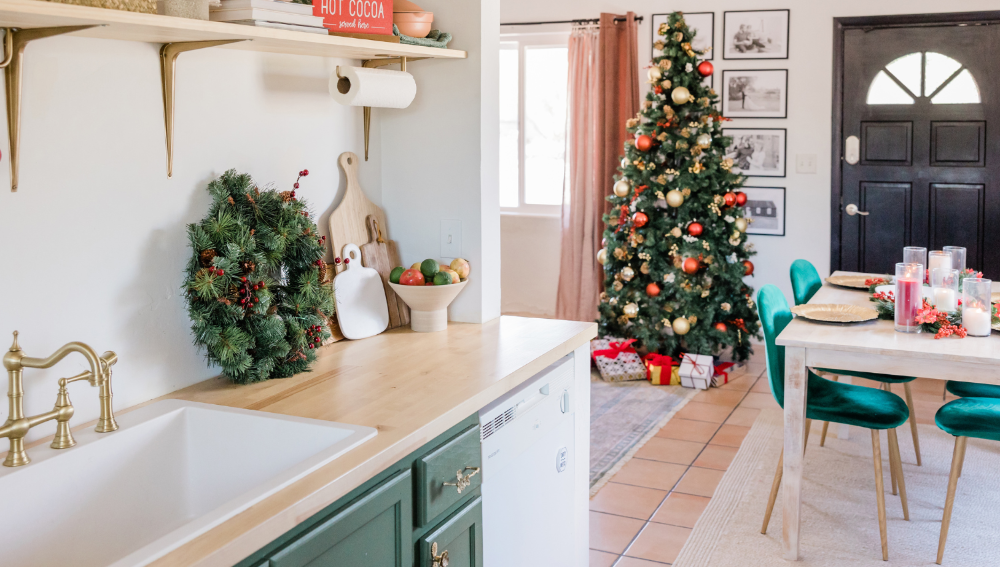
- Choose a wreath at least 20 inches across so it holds its own against a full cabinet run.
- Attach a small 1-inch adhesive bumper to the back of the wreath’s bottom edge.
- Set it on the counter and lean it back against the tile at roughly 15 degrees.
- Tuck the base behind a soap dispenser or a small crock so it can’t slide forward.
- Keep it at least 6 inches from the edge of the sink to avoid splash and spray.
Dark green cabinets do something useful: they make brass look warmer and red look richer. What they don’t forgive is a cool-toned bulb. If your under-cabinet lighting runs above 3500K, green paint turns gray-blue and red berries go muddy — swap the strip lights before you decorate, not after. Compare the hanging version in Idea #3 — same pine, different attitude.
15. A Lit Wreath on the Range Hood and Glass-Front Cabinets
Decorating a range hood is the one holiday idea that comes with a genuine safety note. Keep any wreath at least 6 inches above the top of the hood and never attach anything to the hood shell itself — heat rises, and grease vapor coats greenery within a week. Route cords down the side of the hood and secure them with clips, never across the front where a pot can snag them. With a gas range and a high-volume vent, this is the spot for battery-operated LED strands, full stop.
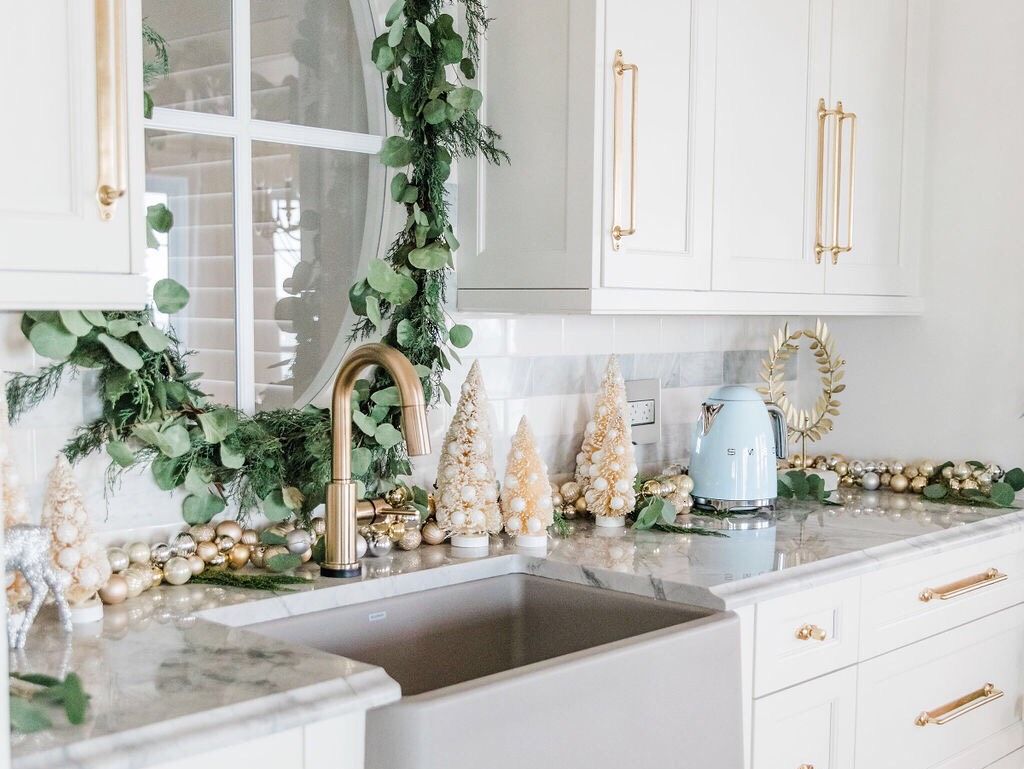
The wreath on the hood replaces a fireplace mantel. In a kitchen without one — which is most of them — you still need a single focal point, and the hood is the tallest, most unavoidable surface in the room. Every other decoration here stays small on purpose: the tabletop trees top out at 12 to 16 inches. Put something substantial on the hood and the small stuff can stay small. Without that anchor, the room becomes a scattering of little trees with nothing holding it together.
16. Silver Tinsel Cone and Framed Art on a Granite Counter
Tall silver tinsel cone, 24–30 inch: $25–$60. Framed botanical Christmas print, 11×14: $20–$70. Red wire candle holder with pillar candle: $15–$40. One bunch of evergreen and pine clippings: $8–$16. Thrifted wood-look frame: $4–$12. Total: $72–$198, or about $30 if you lean a thrifted silver tray against the backsplash instead of buying the tinsel tree. Same vertical silver note, none of the shedding.
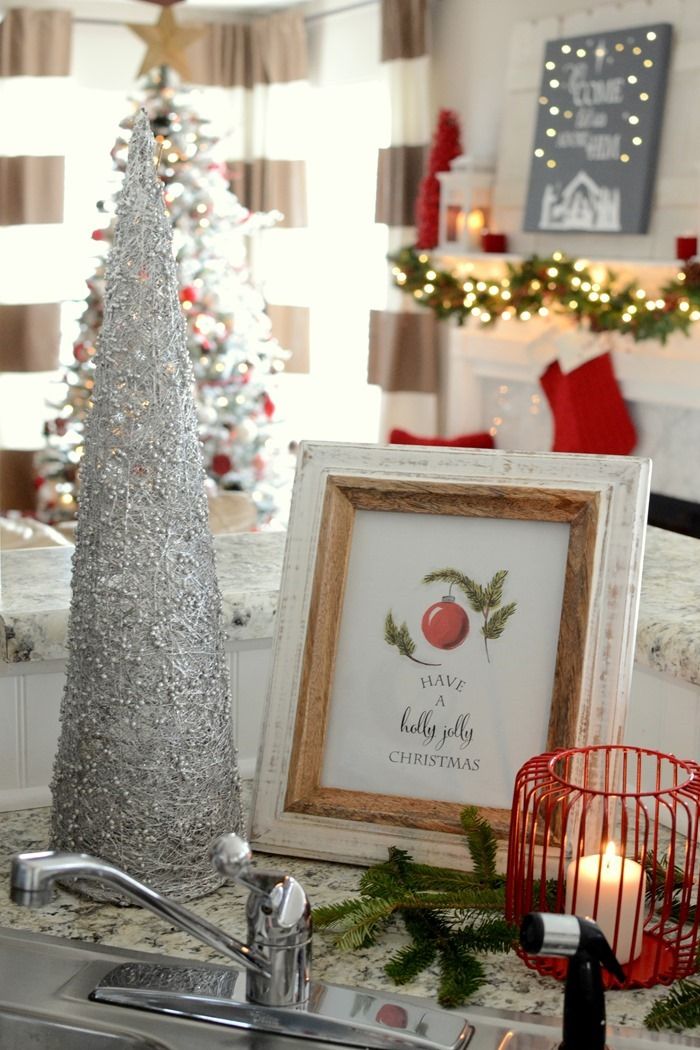
This vignette wants a stretch of counter at least 30 inches wide with 8 inches of wall behind it. The tallest element goes at the back, roughly 24 to 30 inches tall, and everything else steps down in 4-inch increments so the grouping reads as a triangle. Keep the whole arrangement under 24 inches wide and 8 inches deep. If you’re working with less than 30 inches of counter, drop to two objects: the frame and the candle.
17. Layered Cutting Boards and Frosted Trees at the Farmhouse Sink
The charm here is a grouping of five to seven objects at three different heights, with nothing in a matching set. Wood, marble, ceramic, glass, and a woven towel — five materials, one palette. That variety is what makes a sink-side vignette feel collected rather than purchased. The frosted trees also earn their spot by matching the window light: white on white at the brightest part of the kitchen reads soft instead of stark. Put anything glossy or dark right there and the whole corner sharpens up.
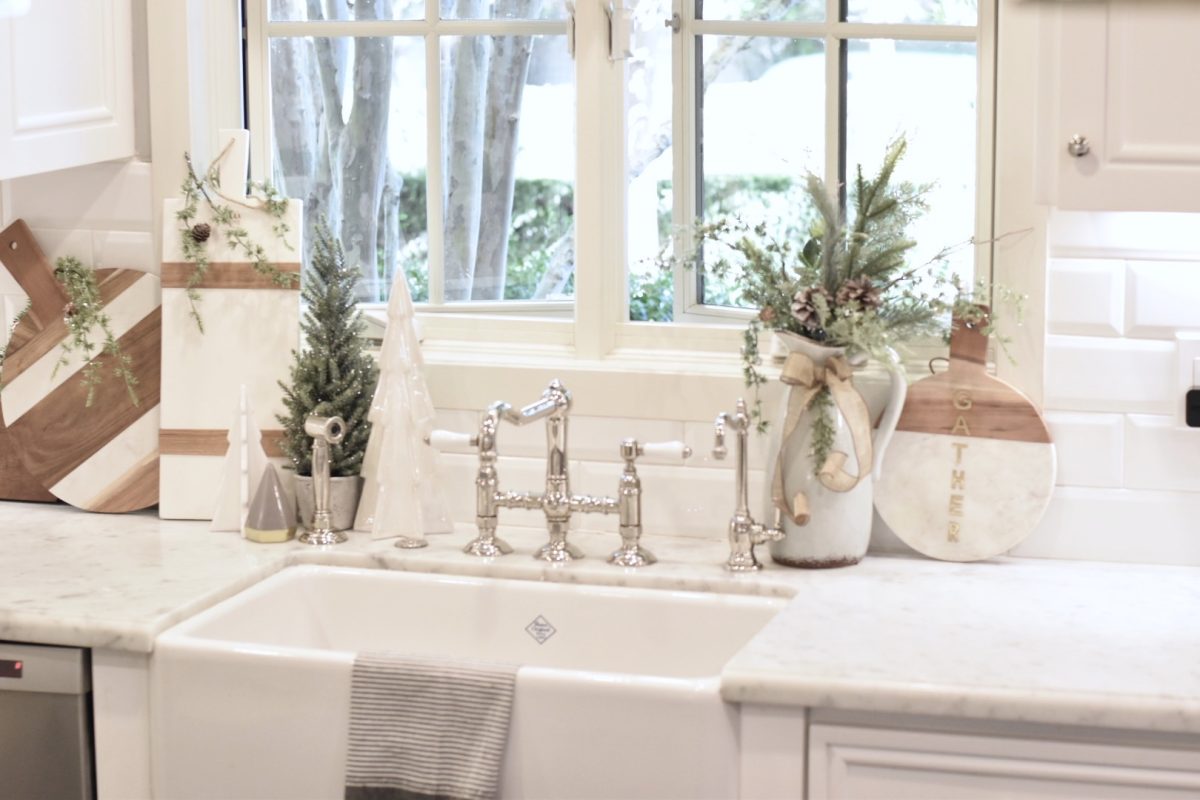
Under-$60 version: a marble-look cutting board from Target ($12), a wooden board from IKEA ($8), and a thrifted white pitcher ($5). Mini frosted trees are $4–$9 each in Walmart three-packs, and grocery-store pine stems cost about $6 a bunch. Skip the bridge faucet upgrade — that’s a $250–$600 plumbing change nobody will see under a garland. The layering is what people notice, and layering costs nothing but the discipline to lean one board against the wall instead of both.
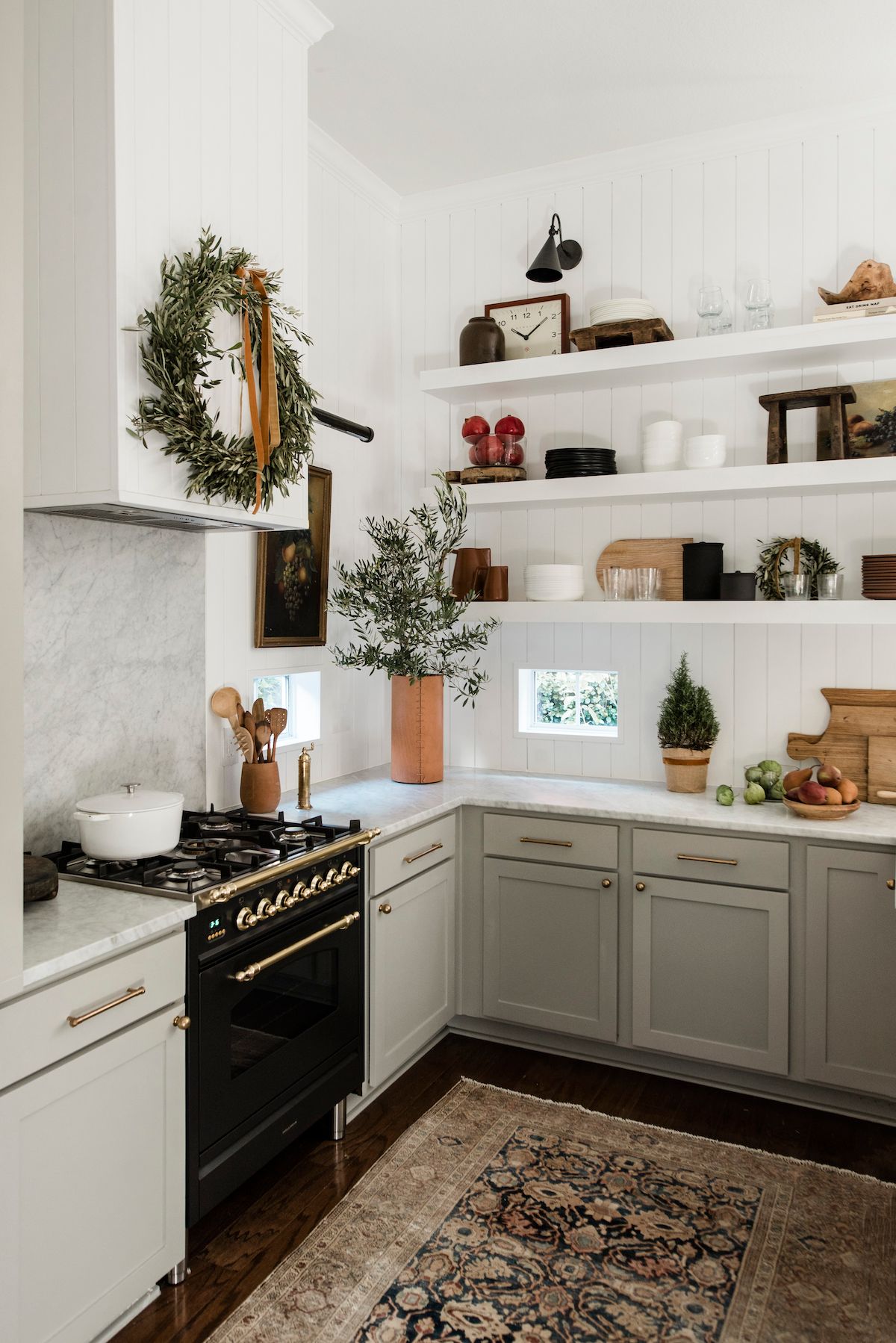
18. Sage Cabinets, an Olive Wreath, and Open White Shelves
Before you commit:
- Confirm your wall color temperature — vertical plank walls look warmer under 2700K lighting and cooler above 3500K.
- Measure shelf depth; open shelving under 12 inches won’t hold a wreath plus pottery.
- Check that your range hood can take a wreath without blocking the vent grille.
- Decide whether the runner rug can handle crumbs — vintage-pattern flatweaves clean up better than wool.
- Budget for brass hardware if you’re swapping: a full kitchen runs $180–$400.
Sage green kitchens have been climbing steadily for years, and the holiday styling followed. Olive branches instead of pine are the newer twist — same silhouette, softer color, and it photographs beautifully against white plank walls. It also solves a practical problem: olive garland doesn’t announce Christmas quite so loudly, so you can leave it up through January without anyone side-eyeing you. That extended-season flexibility is exactly why designers keep reaching for it.
19. Frosted Mini Tree and a Tiny Wreath on Off-White Cabinets
Backlight beats frontlight for frosted decor. Put the miniature frosted tree directly in front of a window, ideally with a sheer or no covering at all — from inside you get a soft halo, and from the street the tree reads like a lantern. If your window faces the road, that’s the one decoration your neighbors will actually see. Keep the tree under 20 inches; anything taller starts blocking the light it’s supposed to be catching.
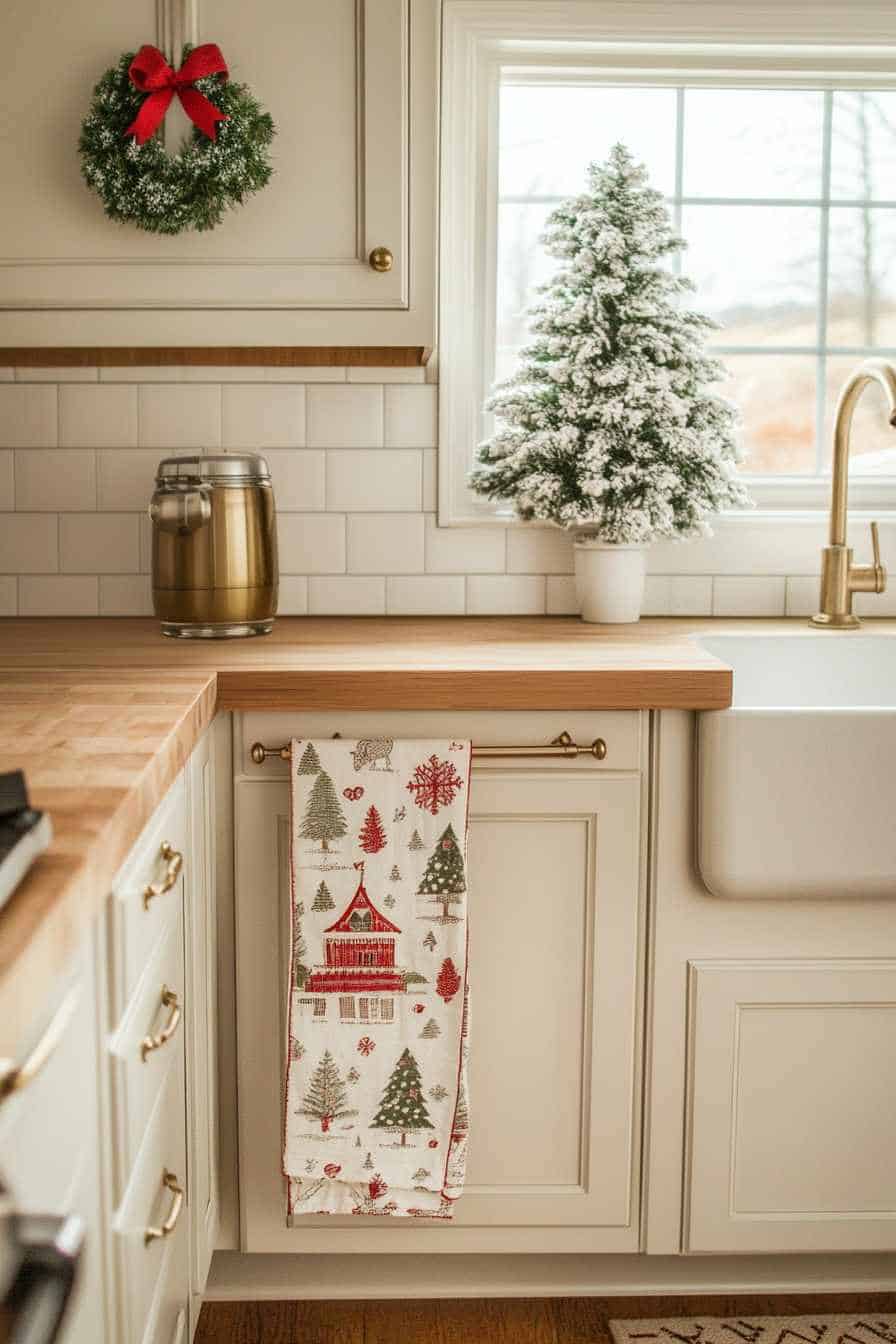
Flocked and frosted decor sheds. Every time you bump it, you’ll find white dust on the counter and in the sink drain. A quick spray with matte sealer (about $8) locks most of it in. The tiny wreath on the cabinet door is adorable and also the first thing to catch on a sleeve — hang it on a door you don’t use for daily dishes. And keep any red-ribbon accent out of direct sun; bright red dye fades to pink faster than any other holiday color.
20. Sage Island, White Perimeter, and a Leopard-Print Mat
White 55% + sage green 25% + light wood 15% + animal print 5%. That leopard mat works because it’s treated as a neutral, not a statement — it sits in the same value range as the wood floor, so it grounds the sink without competing with the wreath. Trade it for a plain jute rug and the room goes softer and more traditional. Bring in a red patterned mat and suddenly you have two prints arguing. The 5% rule saves you here: pattern only works at small scale. If you love the sage, the full sage-cabinet version is Idea #18.
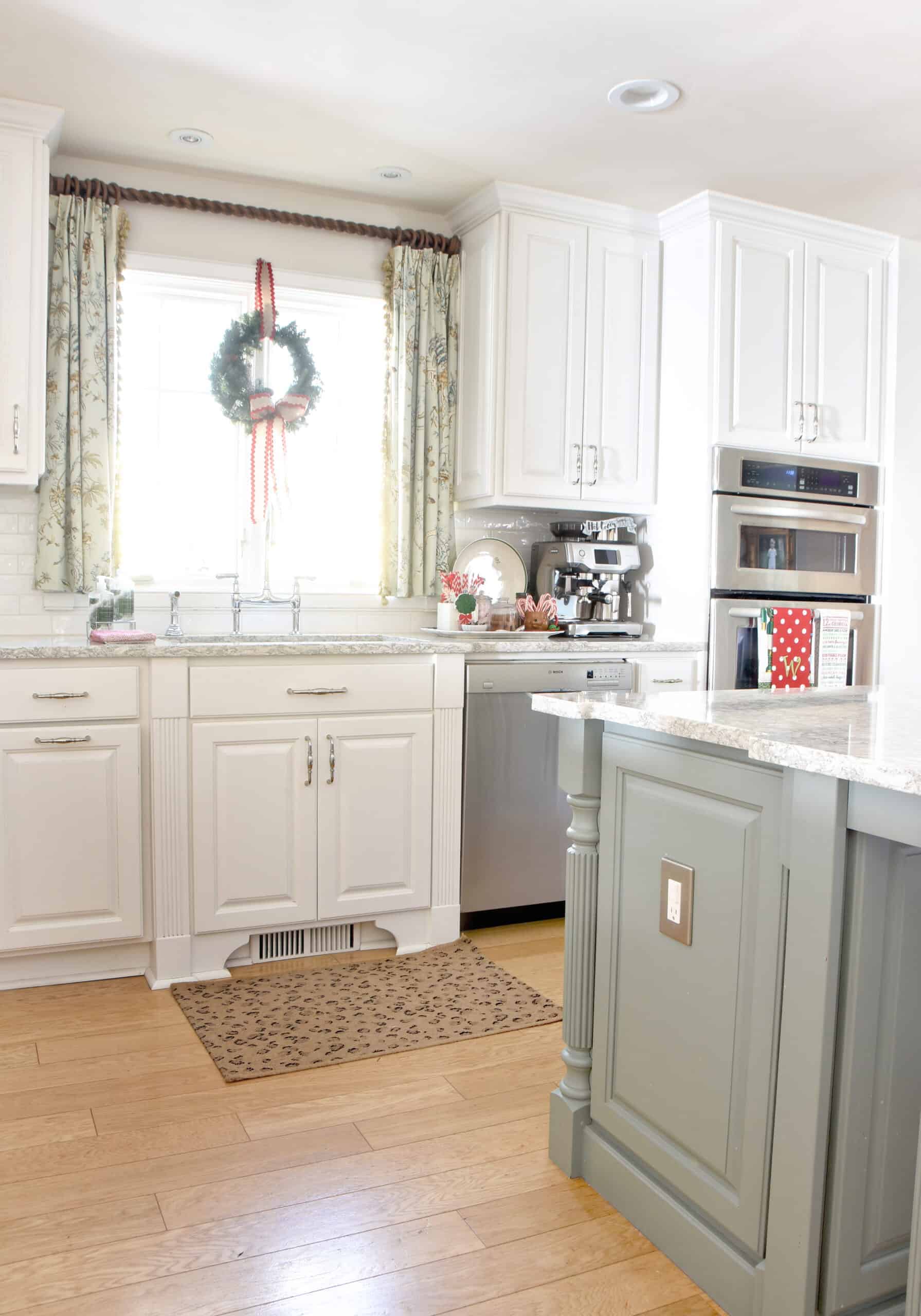
Hanging a small wreath in a window without blocking light takes about 15 minutes and $5–$10.
- Choose a wreath 10 to 12 inches across — anything larger eats the light.
- Cut a length of 1-inch-wide ribbon equal to twice the window’s height plus 12 inches.
- Loop the ribbon over the top casing and knot it behind the wreath’s wire frame.
- Hang so the wreath’s center sits at roughly 60% of the window’s height.
- Tug the knot tight and trim the tails on an angle so they don’t fray.
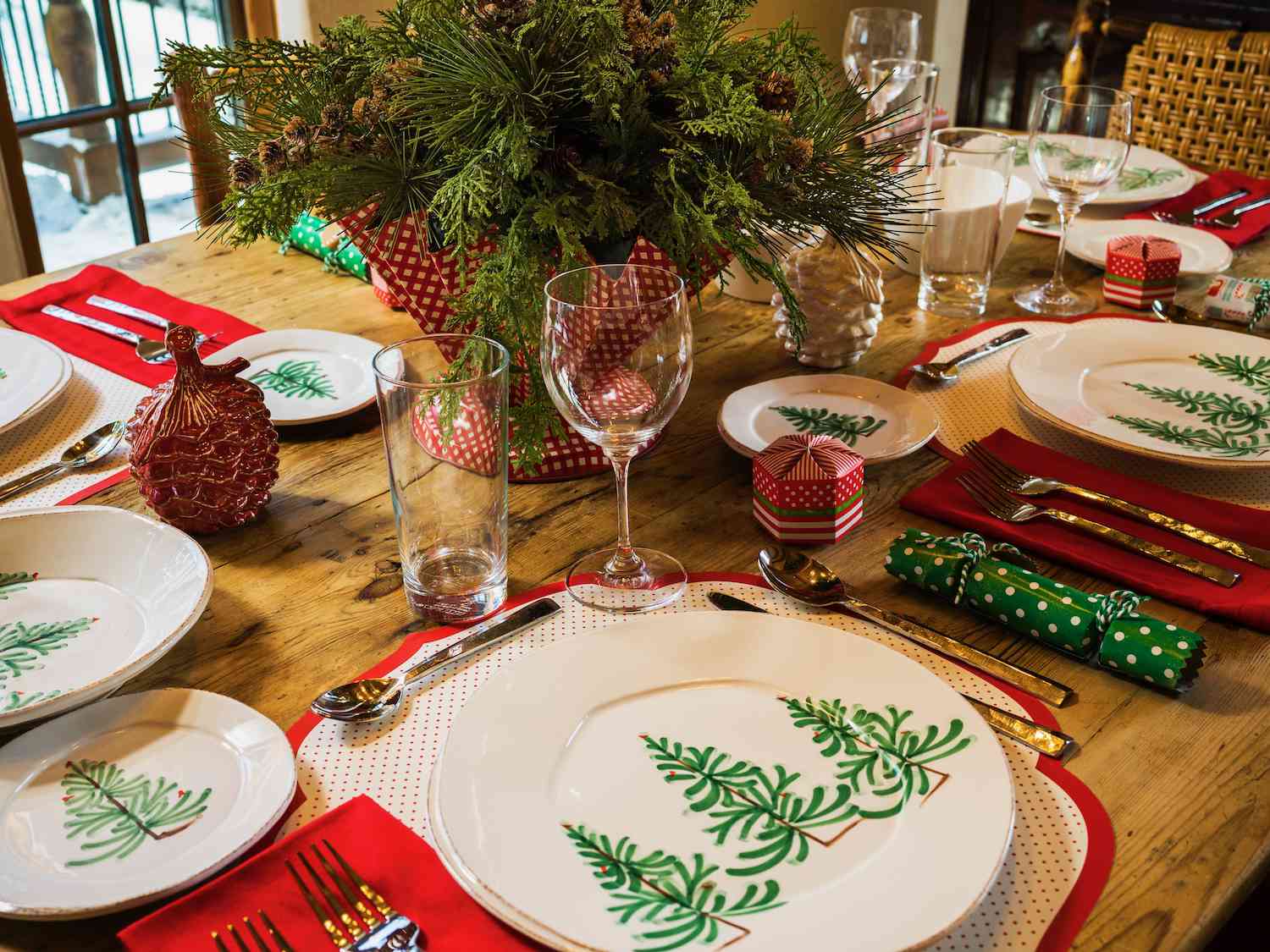
21. Red Napkins, Wooden Chargers, and a Pinecone Tablescape
Six red knotted napkins. That’s the detail that turns a nicely decorated table into a set one. Nothing else in the arrangement carries that much color, and the knot gives it shape — a flat folded napkin on a white plate disappears entirely. Learn one knot and repeat it six times. It takes about ninety seconds per setting and costs nothing beyond napkins you probably already own. Repetition, not quantity, is what makes a table read formal.
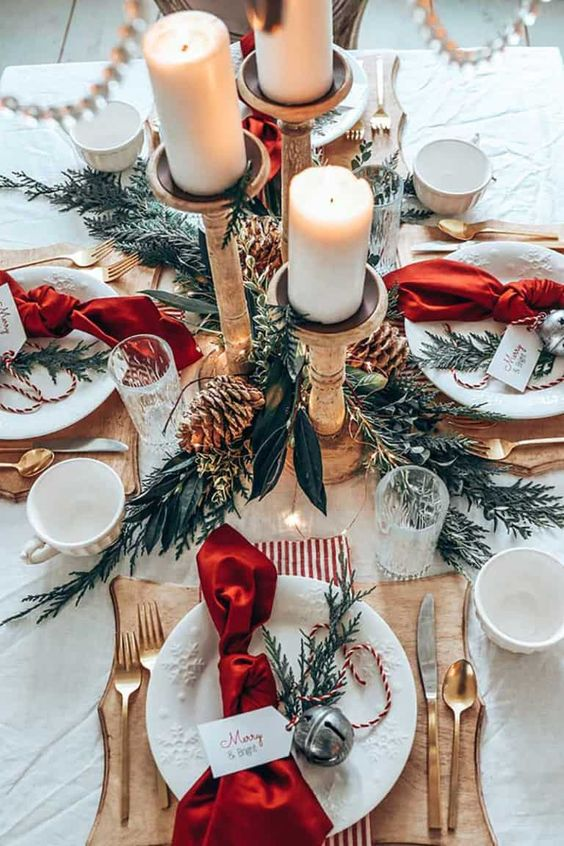
- Wooden chargers, set of 6: $36–$90
- Red cloth napkins, set of 6: $20–$50
- Gold flatware, service for 6: $40–$120
- Wooden candle holders, set of 3: $30–$75
- Evergreen, pinecones, and string lights: $25–$60
Total: $151–$395, or roughly $40 if you skip the chargers and use warm neutral placemats plus $4 jingle-bell place cards.
22. Sparse Pine Garland on a Floating Shelf in a Minimal Kitchen
Sparse garland only works at a specific density: one sprig cluster every 8 to 10 inches, with a total drop of no more than 6 inches below the shelf edge. Denser than that and you’ve built a busy kitchen; sparser and it reads unfinished. This style also needs shelf length — figure at least 16 inches of shelf per cluster, and leave the outer 4 inches of every shelf empty. On a 12-inch shelf, one long cluster centered is the entire arrangement.
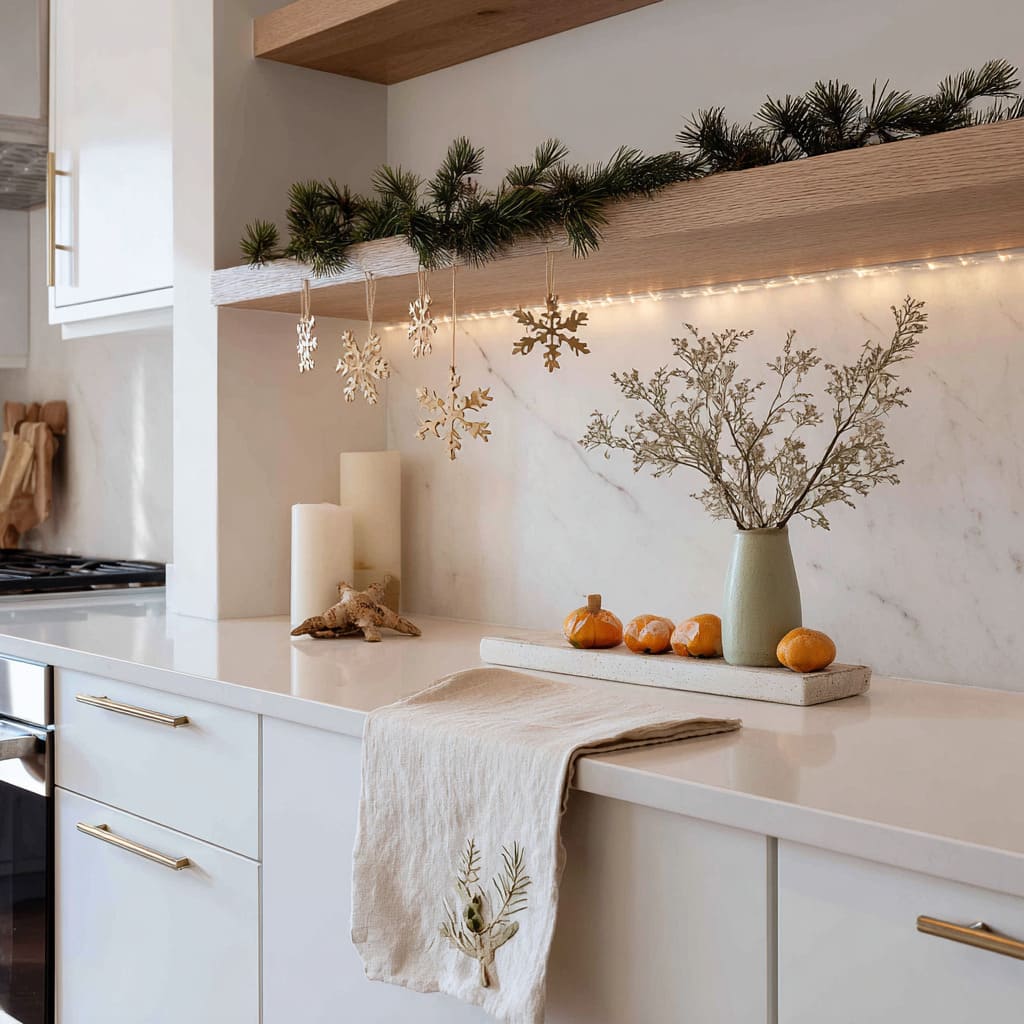
Negative space is the whole design, and it’s harder than it looks. The snowflake ornaments hang in the gaps rather than filling them, which keeps the shelf reading as a shelf and not a display case. Undercabinet strip lighting underneath makes the garland cast shadows onto the marble backsplash, so the wall itself becomes part of the decoration. Bring in thick garland and you lose the shadows — and the shadows are doing about half the work.
23. Glass Cloches Full of Ornaments and a Frosted Leaf Wreath
Glass cloches are dust magnets and fingerprint magnets, and inside a kitchen they also collect a fine film of cooking oil that dulls the shine within a few weeks. Rinse them in warm water with a drop of dish soap, dry with microfiber, and resist putting anything glittered inside — glitter migrates. Brass pulls and sconces tarnish unevenly in humid rooms; a pass with a jeweler’s cloth once a month keeps them from going dull around the edges.
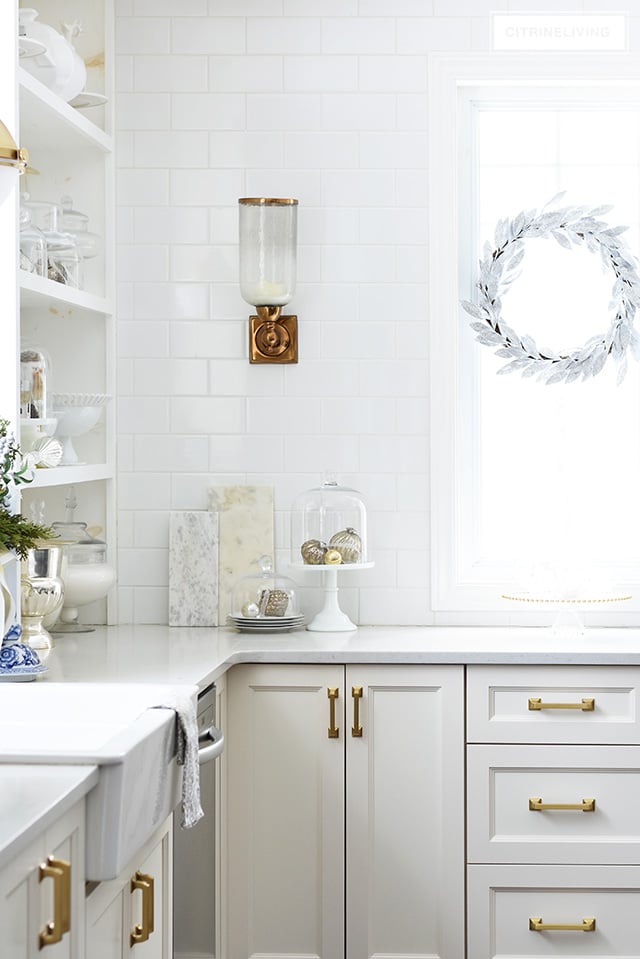
Scale your ornaments to the cloche. A 6-inch dome wants ornaments 1.5 to 2 inches — larger looks crammed, smaller disappears. Group three cloches in graduated sizes (6, 8, and 10 inches) with 2 inches of breathing room between them, and keep the set on a tray so it reads as one object instead of three. Hang the window wreath at the top third of the glass, not centered; a centered wreath blocks the view you paid for.
24. A Gold Velvet Bow Above a Porcelain Farmhouse Sink
The gold velvet bow. It’s about $8 of ribbon and it’s the difference between a garland you hung and a garland you styled. Velvet catches light in a way satin and grosgrain don’t, so at 6 p.m. with the kitchen lights on, that bow glows. Center it exactly on the window’s vertical midline — an off-center bow is worse than no bow at all. Then leave it alone. Adding three more bows would turn this farmhouse kitchen into a gift shop.
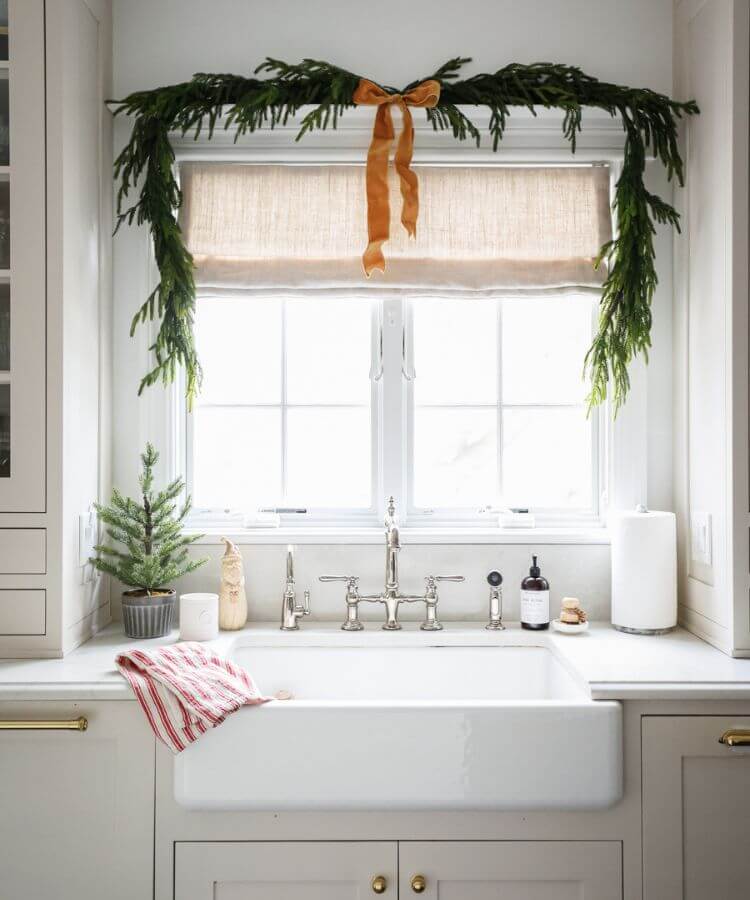
Velvet and steam are enemies. A bow hung directly above a sink develops a soft, flat sheen after a few weeks of dishwasher humidity, and once velvet crushes, it doesn’t come back. Leave 14 inches of clearance between the bow and the faucet, and run the exhaust fan every time the dishwasher runs. Polished chrome also shows water spots almost immediately — a squeegee-style wipe after the last rinse keeps the whole window area looking sharp.
25. Brass Faucet, Pine Sprigs, and a Blue-and-White Towel
Everything festive in this sink area costs about $25. Pine sprigs from a grocery-store bunch run $6–$8 and last two weeks in water; a simple glass bud vase is $4 at IKEA or free from a thrifted set. The blue-and-white towel is $8–$14 at HomeGoods or Target, and one good towel does more for a sink corner than a shelf of figurines. Skip the floral designer entirely — a $6 bunch of pine is the whole arrangement.
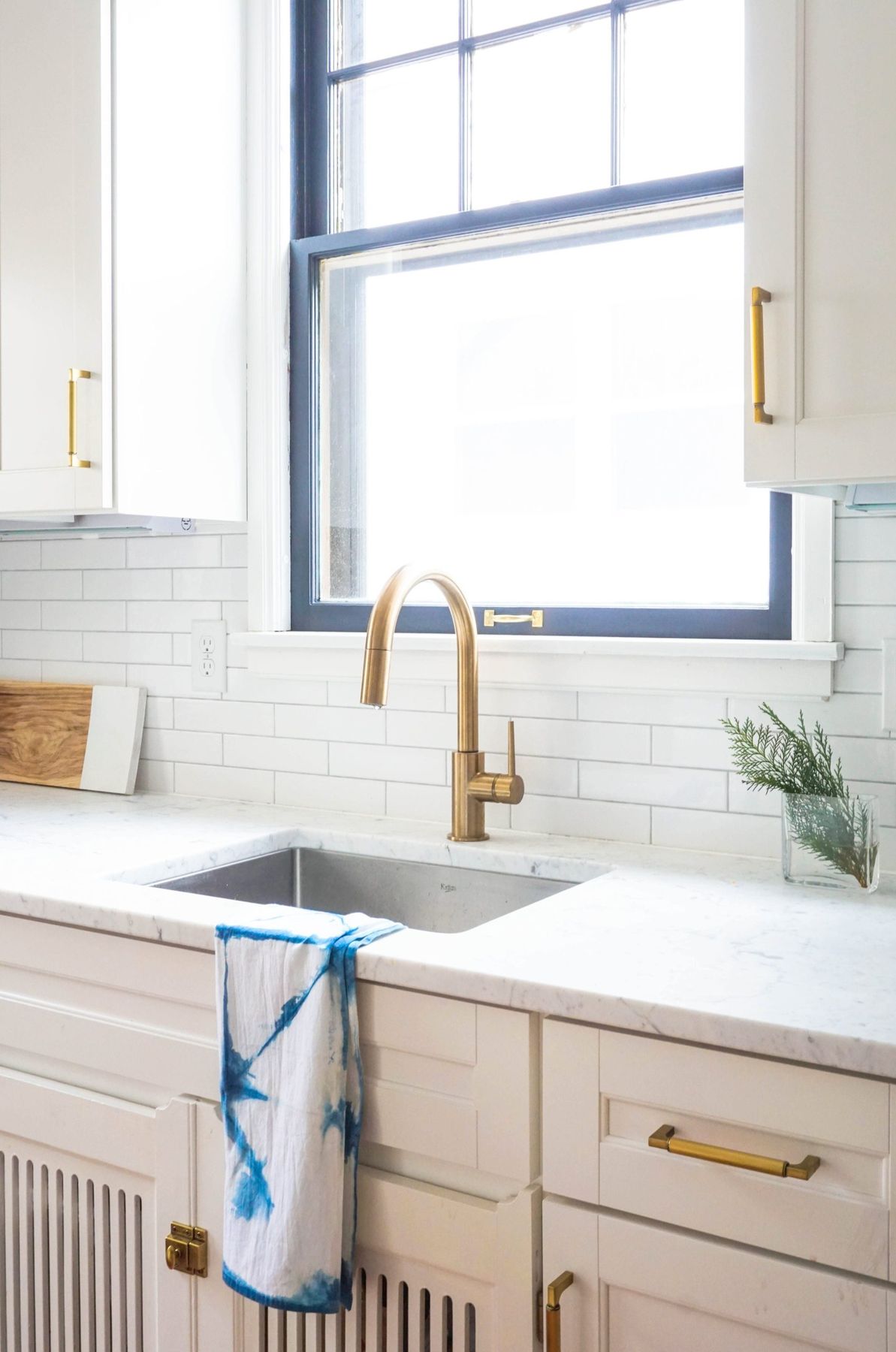
White 80% + brass 15% + blue 5%. That’s it. The blue appears in exactly one place, which is why the corner stays calm — add a second blue element and the balance tips into coastal theme rather than holiday. Swap blue for red and you get a classic Christmas sink; swap it for black and everything sharpens. The brass is what makes the white read warm instead of surgical, so don’t skip it.
26. Pine Garland Table Runner with Mercury Glass and Gold Balls
Building a garland runner takes about 30 minutes and $60–$140.
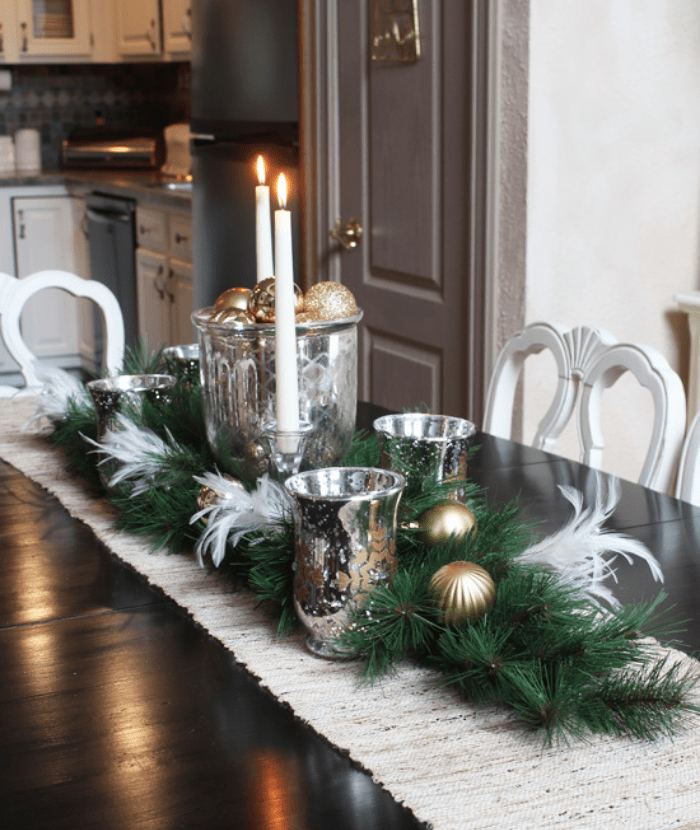
- Lay a textured neutral runner down first — it protects the table and keeps greenery from scooting.
- Set the garland on the runner and shape it into a gentle wave rather than a straight line.
- Place candleholders at thirds along the garland, not evenly spaced.
- Tuck gold ornaments into the gaps at varying depths so the surface looks layered.
- Finish with white feathers or dried stems at both ends to fade the garland out.
Candlelit tablescapes are having a real moment. Pinterest boards have been filling with taper candles for the past few seasons, and the mercury glass revival is riding along with the broader return to vintage glass. What’s changed lately is the height: designers now keep everything under 14 inches so people can actually see each other across the table. This garland-runner approach also earns its keep because a swap of ornaments takes it straight through New Year’s.
27. A Merry Christmas Sign on the Range Hood Mantel
- Framed merry christmas sign, red frame: $18–$45
- Pine garland for the hood mantel, 6 feet: $30–$70
- Red, black, and white ornament set: $15–$40
- Small potted tabletop evergreen: $12–$30
- Clear hooks and clips: $6–$12
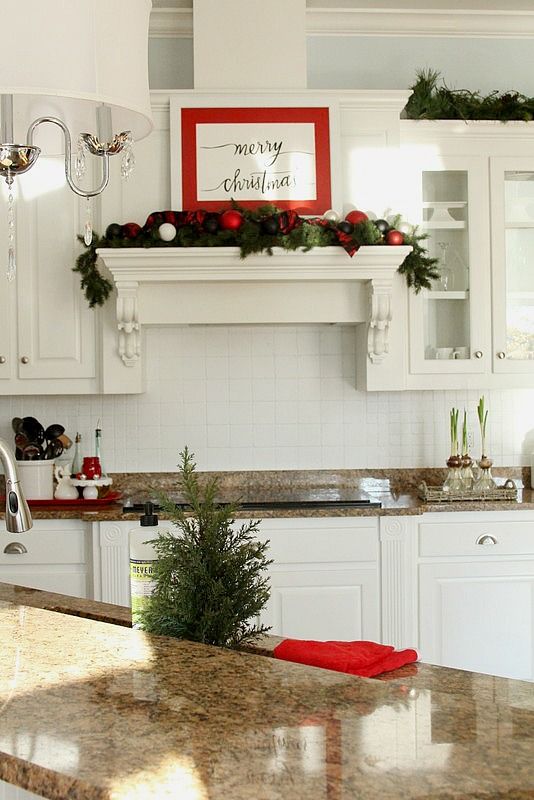
Total: $81–$197, or under $20 if you print the sign at home and clip branches from your own tree trimmings. Those fresh clippings also smell better than anything you can buy.
Range hood mantels are usually 6 to 8 inches deep, which is the minimum for resting a garland. If yours is shallower than 5 inches, don’t fight it — hang the garland on the wall above the hood trim instead, using two adhesive hooks rated for 3 pounds. The framed sign should be about one-third the width of the hood; a 36-inch hood takes a 10-to-12-inch frame. On anything wider than 48 inches, the more restrained treatment in Idea #15 works better.
28. Plaid Chair Ribbons and a Crystal Chandelier in Pale Blue
Pale blue walls give red something to sit against, and that’s the whole reason this room feels bright instead of heavy. Blue and red sit close in value, so the contrast comes from saturation rather than light and dark — a subtler, more grown-up kind of festive. The plaid ribbons tie the chairs into the scheme without adding furniture. And the tiered crystal chandelier earns its place by bouncing candlelight around; in a room this pale, one sparkling element keeps everything from going flat.
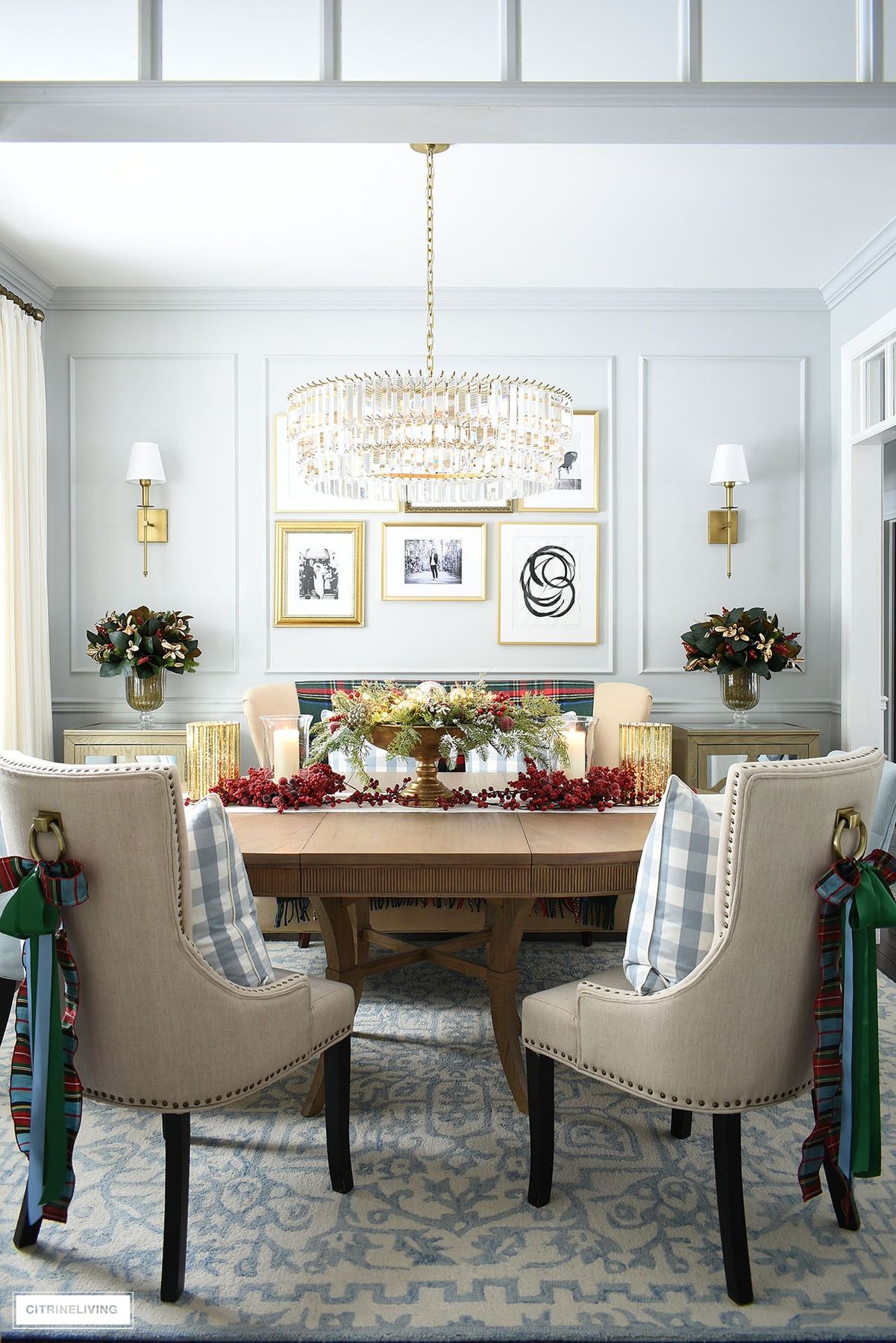
Plaid ribbon is the cheapest redesign in this entire article. A 10-yard spool runs $6–$12, and tying six chair backs takes about ten minutes. Thrifted gold frames are $2–$5 each at Goodwill; paint them all one color and you have a gallery wall for under $30. Skip the crystal chandelier, or hunt Facebook Marketplace, where people offload them for $80–$200 when they’re downsizing.
29. A Lantern Wreath Centerpiece on a Checkered Tablecloth
Keep your lantern under 12 inches tall and under 8 inches wide for a table where people actually eat. The rule of thumb: everything sitting between the plates should top out around 14 inches, or your guests spend dinner leaning sideways to talk. Nestle the lantern inside the wreath rather than setting it on top — the wreath becomes the base, the candle becomes the focal point, and you get an instant centerpiece for about $40 in materials.
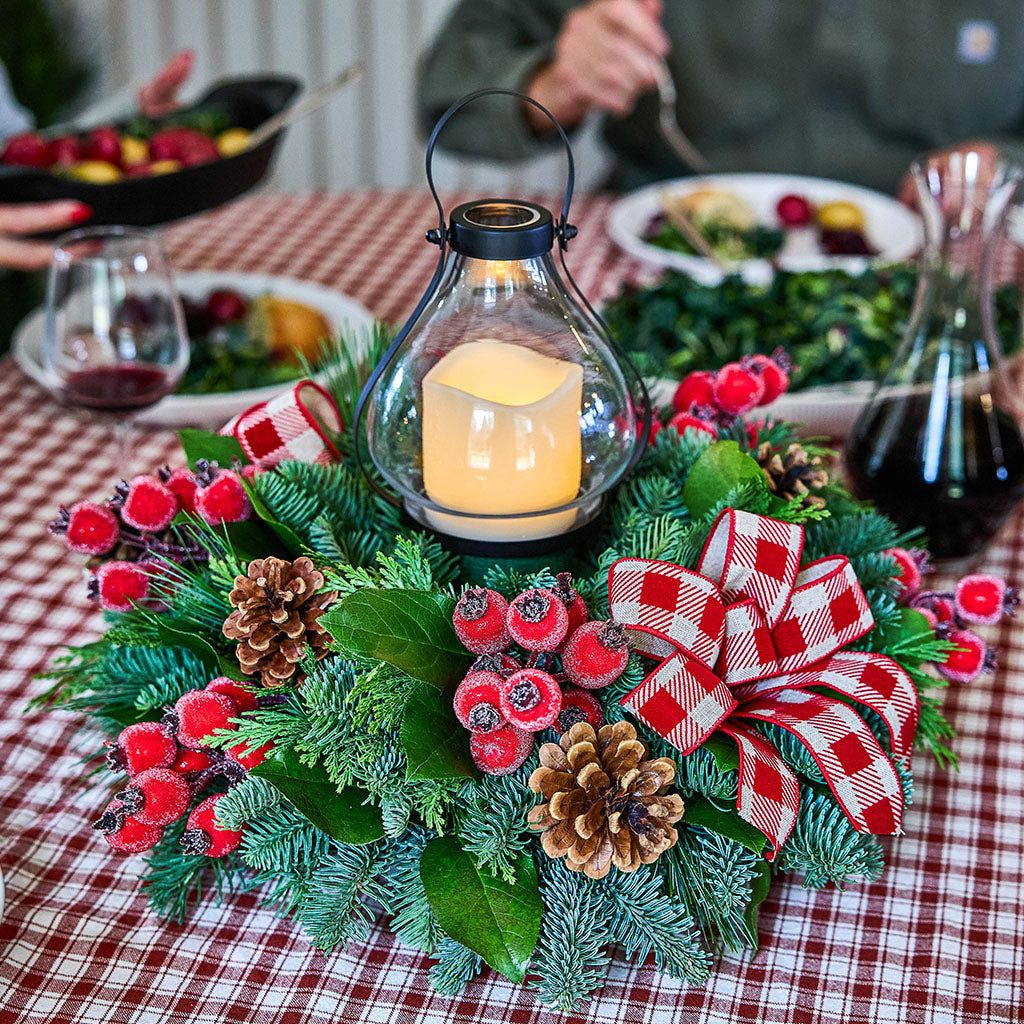
Faux frosted berries shed a waxy dust onto tablecloths, and red-and-white checkered linen is unforgiving — one cranberry sauce drip is forever. Pre-treat stains with cold water within an hour; hot water sets them. Candle soot is the other quiet problem: trim wicks to a quarter inch before every lighting and keep flames away from the pine. If the wreath is fresh, plan on replacing it in three weeks — dried pine near an open flame is the one thing here worth being genuinely careful about.
30. Dried Citrus and Taper Candles Along a Wooden Table
The dried citrus. It’s the detail that makes this table smell like something, and scent is the most underrated design element in holiday decorating. Whole studded oranges and dried slices threaded into the garland also break up the green so the runner doesn’t read as one solid mass. Without them you have a standard evergreen table garland. With them you have something guests notice before they sit down and ask about before dessert.
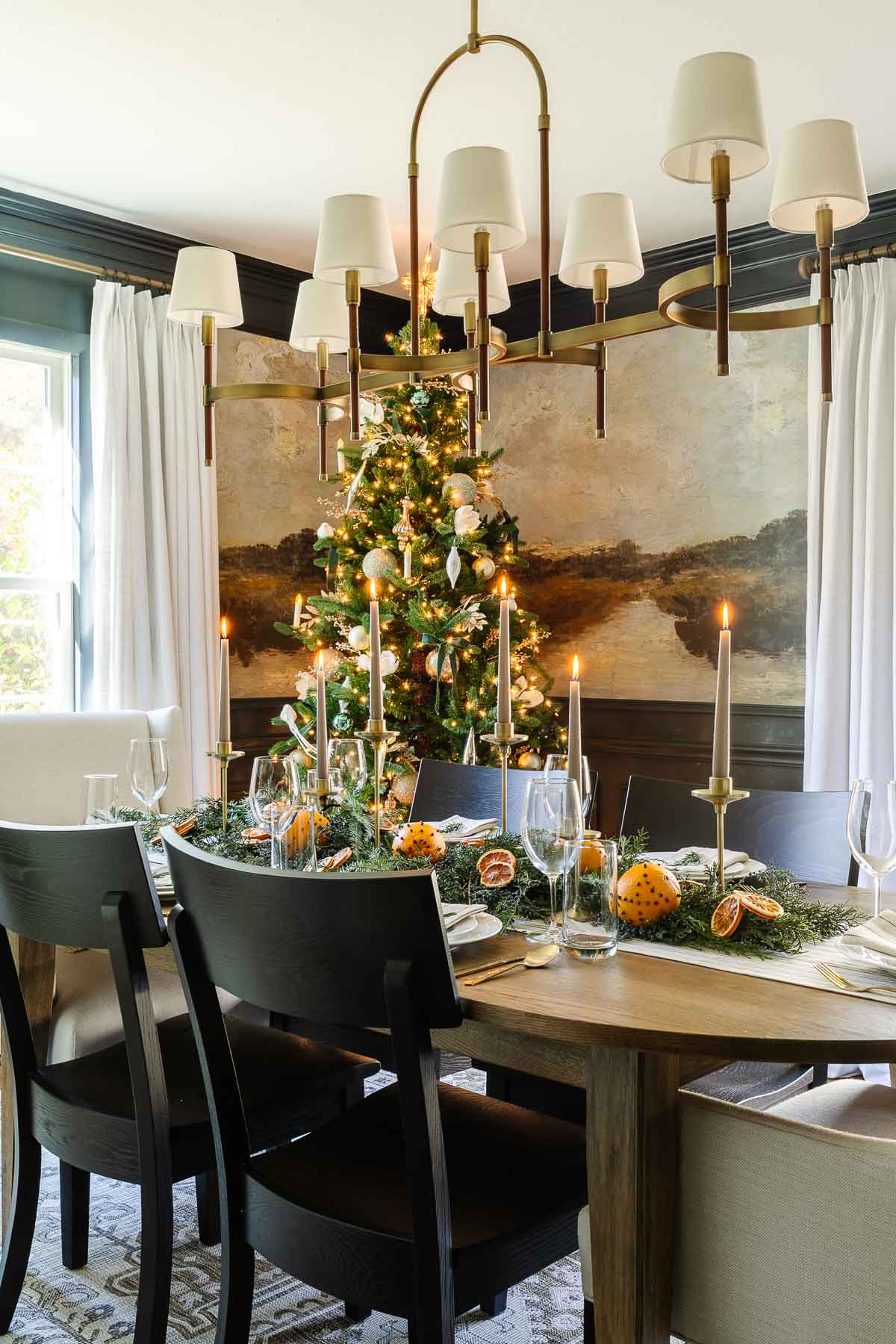
Fresh garland plus tall tapers is a combination that requires attention. Never leave lit candles unattended, and trim wicks to a quarter inch so flames stay low and steady. Dried citrus can go soft and mold in a humid dining room — dry the slices fully in a 200-degree oven for three hours first, or buy them pre-dried. Fresh evergreen also sheds onto wood, so put a runner underneath and wipe the table each night rather than letting needles sit on the finish.
31. Red Roses, Red Tapers, and Pinecones on White Linen
White linen 50% + red 30% + brass 15% + green 5%. Red roses instead of poinsettias is the swap that makes this table feel romantic rather than traditional, and it works because the flowers match the tapers almost exactly. Trade roses for white tulips and the table goes quiet and elegant; trade them for amaryllis and it turns bold and architectural. The brass isn’t optional — it’s the only warm element, and without it, white and red read cold.
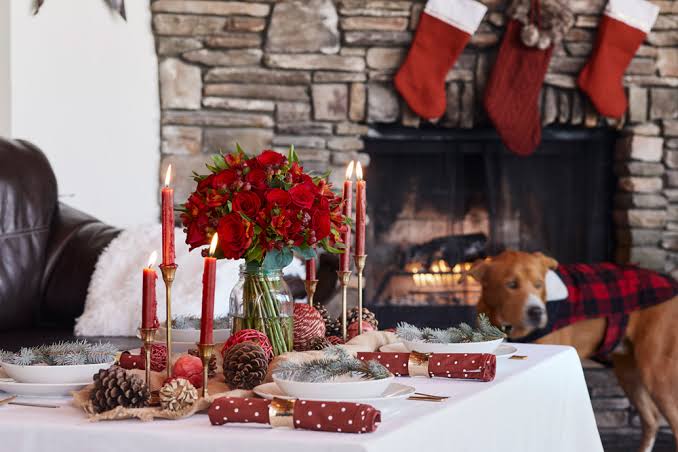
Before you commit:
- Measure your table’s usable center width and leave at least 14 inches of plate-to-plate clearance.
- Count seating before buying candles — one taper per two guests is plenty.
- Check the tablecloth actually fits: a standard eight-seat table needs a 90×156-inch cloth.
- Confirm any roses are unscented varieties if food is being served.
- Have a non-flammable tray ready for the pinecones and candles.
32. Pine Garland Across Wooden Shelves Under Glass Pendants
Garland over open wooden shelving should run about 1.25 times the shelf’s length so it can loop at the ends. On shelves 30 to 36 inches wide, use a 4-inch-wide garland; anything thicker blocks the shelving below. If your shelves sit lower than 20 inches above the counter, skip the shelf entirely and drape the garland over the pendant instead. Leave at least two shelf sections completely bare — that emptiness is what makes greenery look intentional in a small kitchen. Compare with Idea #6 — same move, more ribbon and a bit more glow.
Glass pendant shades and evergreen are a quiet pairing: the glass doesn’t compete with the green, and it lets warm light spill downward onto the wood instead of pooling in a shade. That’s why this kitchen reads warm at night with almost nothing on the counters. The garland also follows the shelf line, so it echoes the architecture instead of fighting it. Swap in opaque metal pendants and you’d lose the glow entirely.
Come December, Your Kitchen Will Already Be Ready
You don’t need to do all thirty-two of these — you need one anchor, one palette, and the discipline to leave a little counter empty. Start with the idea that matches the light you already have, add the rest next year, and let the room evolve instead of reloading it every November.
📌 Pin your favorites now so next December you’re decorating, not researching.