
You know that feeling when you finally find the exact handmade Christmas angel you pictured in your head — and then can’t remember where you saw it? That’s most of November for anyone who saves holiday decor to Pinterest. So we did the scrolling: after filtering through hundreds of options at Etsy, Anthropologie, Terrain, World Market, and Target, we narrowed it down to 34 ideas that actually deliver — from about $8 for a single ornament to $175 for a full gold-figurine vignette.
Inside you’ll find felted folk angels, crocheted figures, folded fabric ornaments, wooden peg dolls, paper bead and copper wire pieces, plus tabletop displays and tree-topper styling — with budget and luxury versions compared side by side so you can see exactly what a smaller spend buys you. And stay until the end — we break down the most common mistakes that can ruin these looks.
Handmade angel decor is having a real moment in 2026, driven by a wider shift toward upcycled materials and figures with a range of skin tones and hair textures — pieces people keep for decades instead of replacing each January.
📌 Save this to Pinterest for later — you’ll want to revisit these ideas.
1. Dainty Lace Angels on a White Winter Wonderland Display
The snowy, textured ground is doing more work here than anything else. Without it, a pink lace angel and a white one are just two ornaments hanging in space. With it, you get a whole landscape — a frosted miniature evergreen, a white house figurine, and soft lights blurred behind them. If you’re building a display shelf or mantel vignette this year, spend your first dollars on that base, not the angels. A bag of faux snow, a slab of white felt, or even a shallow tray of quilt batting makes $12 ornaments look like a curated collection.
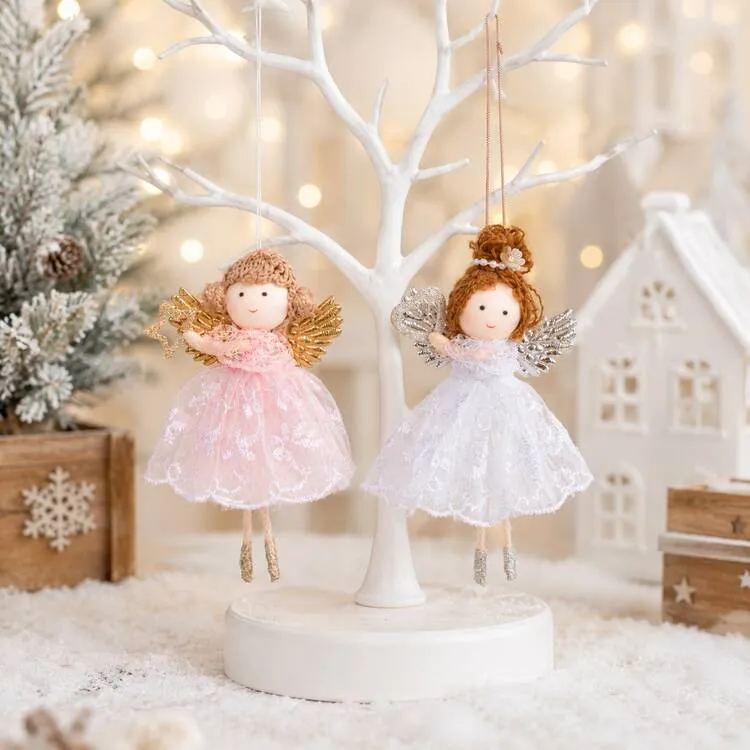
The color formula is roughly 70% white + 20% pale pink + 10% gold and silver glitter. White owns the base, the display stand, and the tree. Pale pink shows up exactly once, on a single lace dress. Glitter lives only in the wings. That ratio is why the pink reads as charming instead of candy-shop. Swap pink for sage and the same math turns calm and wintry; swap it for powder blue and you get something closer to an heirloom nursery. Keep the metallic under a tenth and you can change the accent color every year without rebuilding anything.
2. Felted Tree Topper With Iridescent Sequin Sparkle
Before you commit to a felt topper, measure your tree. A topper looks right when it’s about one-eighth the tree’s height — a 7.5-foot tree wants something in the 9 to 11 inch range. Any smaller and it disappears against the top branches; any bigger and it looks like it’s wearing the tree instead of sitting on it. Then, instead of trusting the branches to hold it, tape a wooden skewer or a length of heavy floral wire to the inside of the cone body and push that down into the top. Your angel stands straight all season, sequins and all.
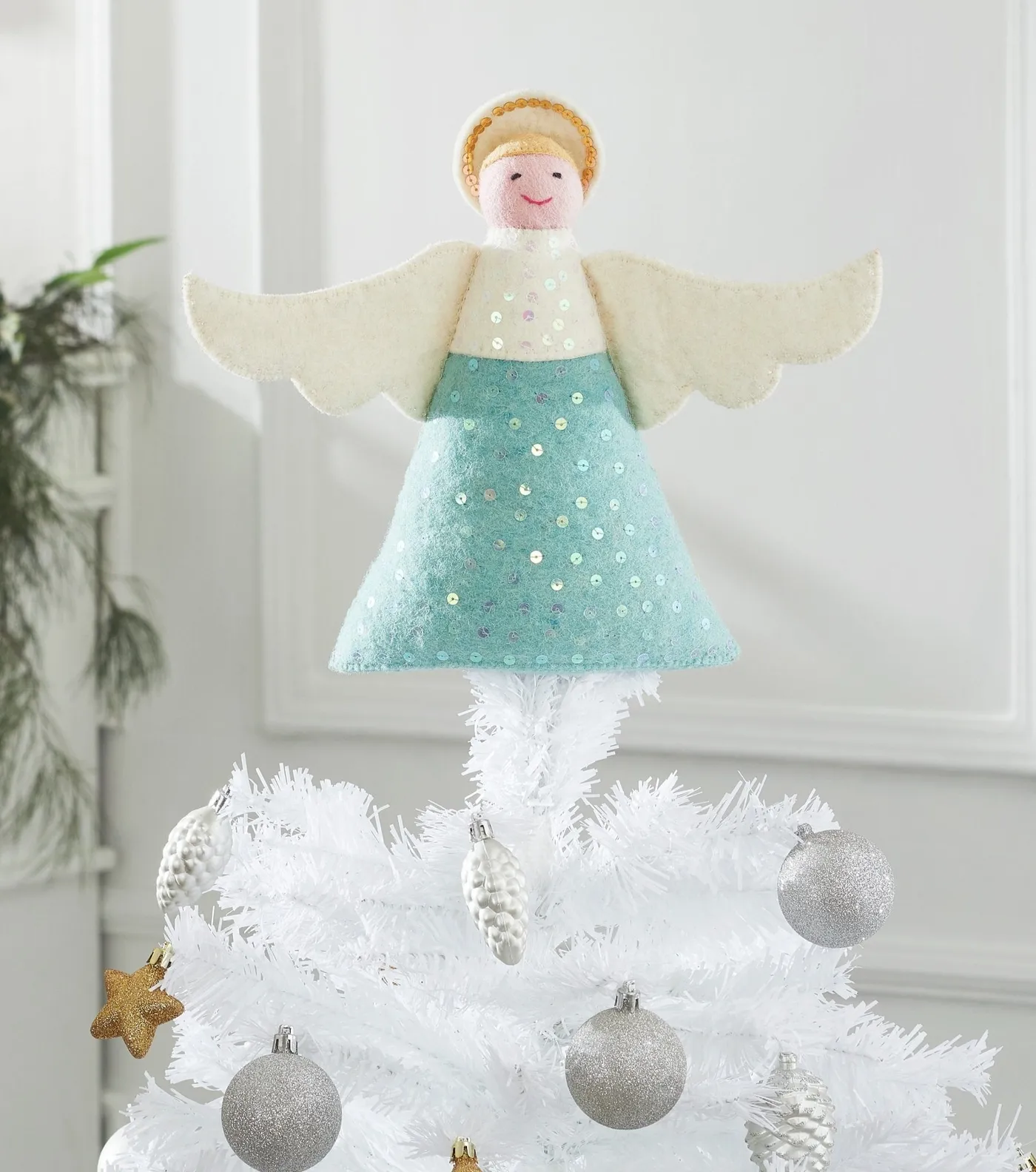
Two things are quietly doing the heavy lifting in this tree. First, contrast: that pale blue skirt against a white tree gives you color without noise, and the cream wings soften the handoff. Second, shape repetition — round silver balls, star-shaped gold ornaments, and a halo echoing the stars. Rounds and points, alternating all the way up. It’s a simple rhythm, and it’s why the tree feels designed rather than decorated. Pick one shape to repeat in two sizes and let everything else be a different texture of the same two colors.
3. A Felted Angel Topper With Red Berries and Flocked Pine
Flocked branches look magical and shed like a snow globe in a wind tunnel. If you’re loading a topper onto flocked pine with berry clusters, expect a light dusting of white flakes on the floor every time someone walks past — and expect those berries to be a genuine choking hazard if you have toddlers or curious dogs. Want the look with less trouble? Swap fresh berries for felt balls in the same bright red, and shake the tree outside once before you bring it in. Your vacuum will thank you.
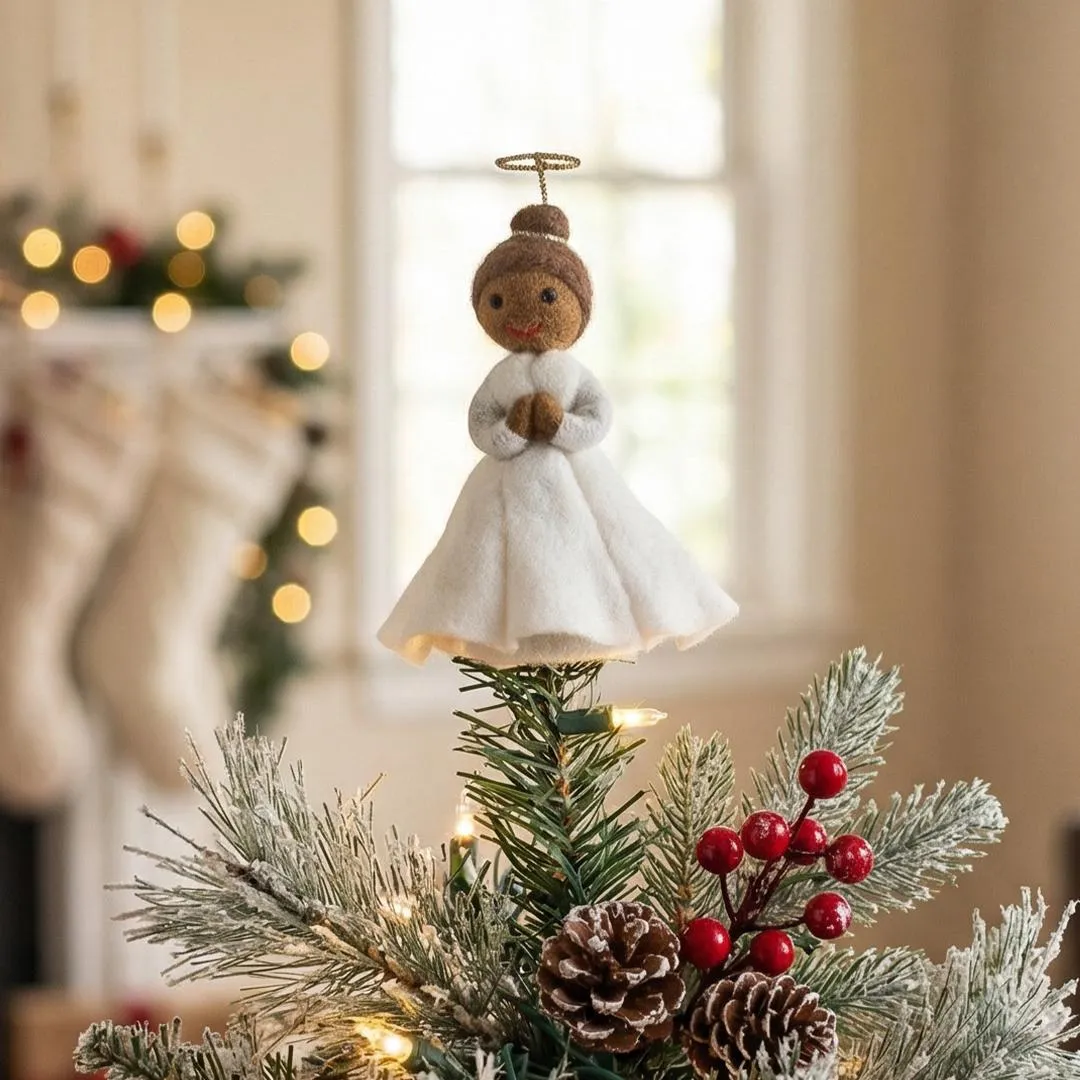
Angels with a range of skin tones and hair textures have moved from craft-fair niche to mainstream request, and felted wool is the medium of the moment because it takes pigment so beautifully. The figure here — deep brown complexion, low bun, plain white dress, slender gold wire halo — feels traditional and current at once. That’s the 2026 story in handmade decor: keep the heirloom silhouette, update who gets to be the heirloom. Needle-felted toppers are also the piece people keep for decades, so treat it as a buy-once purchase.
4. Pleated Paper Angels With Wooden Bead Faces
Making the pleated paper angel takes about 25 minutes and roughly $4 in materials.
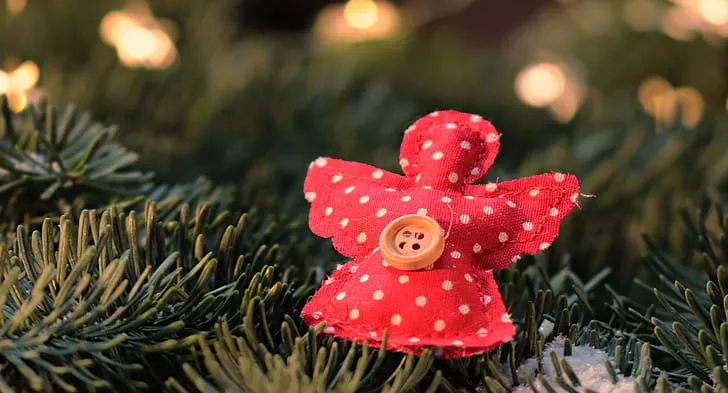
- Cut a 4-inch circle from cardstock, then cut it in half.
- Fold each half into a tight accordion with 1/4-inch pleats.
- Pinch the stack at the center and fan the pleats outward into a skirt.
- Glue a 3/4-inch wood bead on top for the head.
- Draw the eyes and mouth with a fine-tip permanent marker or acrylic pen.
- Attach a small gold jump ring at the top and thread it with twine.
You don’t need a craft room to get this look. A pack of cream cardstock ($6), a bag of 3/4-inch wood beads ($4), and a fine-tip brown marker gets you a dozen finished angels for under $15 total. Thrift stores are goldmines for the pleated pieces themselves — vintage paper angels from the 70s and 80s turn up constantly for a dollar or two, usually already finished. Compare with Idea #5 — same delicate-figure feeling, built with a hook and yarn instead of paper folds.
5. Crocheted Cream and Red Angels With Kraft Gift Styling
- Two crocheted angels (cream + red): $18–$40 each, or about $12 in cotton yarn if you crochet
- Kraft gift box with twine: $3–$8
- Spool of cream ribbon: $4–$7
- Pine sprigs: free from a tree lot, or $6 for a bundle
- Light wood tray or board: $15–$30
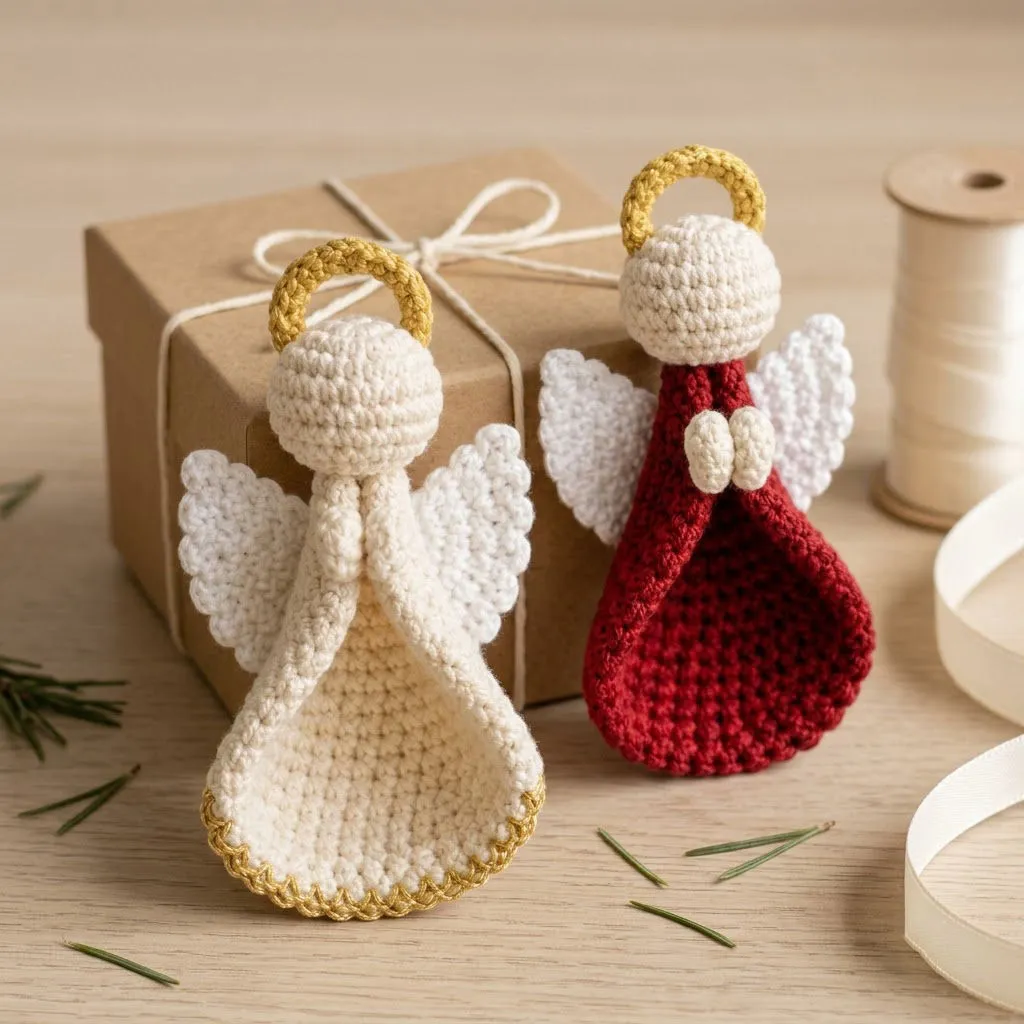
Total: $52 to $125, and the angels last forever if you keep them out of direct sun. Skipping the tray and styling on what you already own drops this under $40.
The kraft box with twine is the whole trick. It tells a story — these angels aren’t just decorations, they’re a gift mid-process, and that spool of ribbon says somebody made them with their hands. Take the box away and you have two nice crocheted figures sitting on a board. Leave it in and the scene becomes a moment. It’s the cheapest part of the arrangement, too. Add one prop that implies an activity: a half-wrapped box, a pair of scissors, a basket of yarn. Narrative beats quantity.
6. Folded Fabric Ornament in Green, Red, and White
The color math is 50% green + 30% red + 20% white, with a single line of gold star fabric running through the center. What makes it work is that red and green aren’t scattered — they’re layered in horizontal bands, so the ornament reads as a gradient rather than a jumble. Try the same formula with navy, cream, and blush and you get a completely different ornament from identical folding steps. The proportions are the recipe; the colors are just the flavor. Stay near half-and-half on your two dominant colors, or one will start to bully the other.
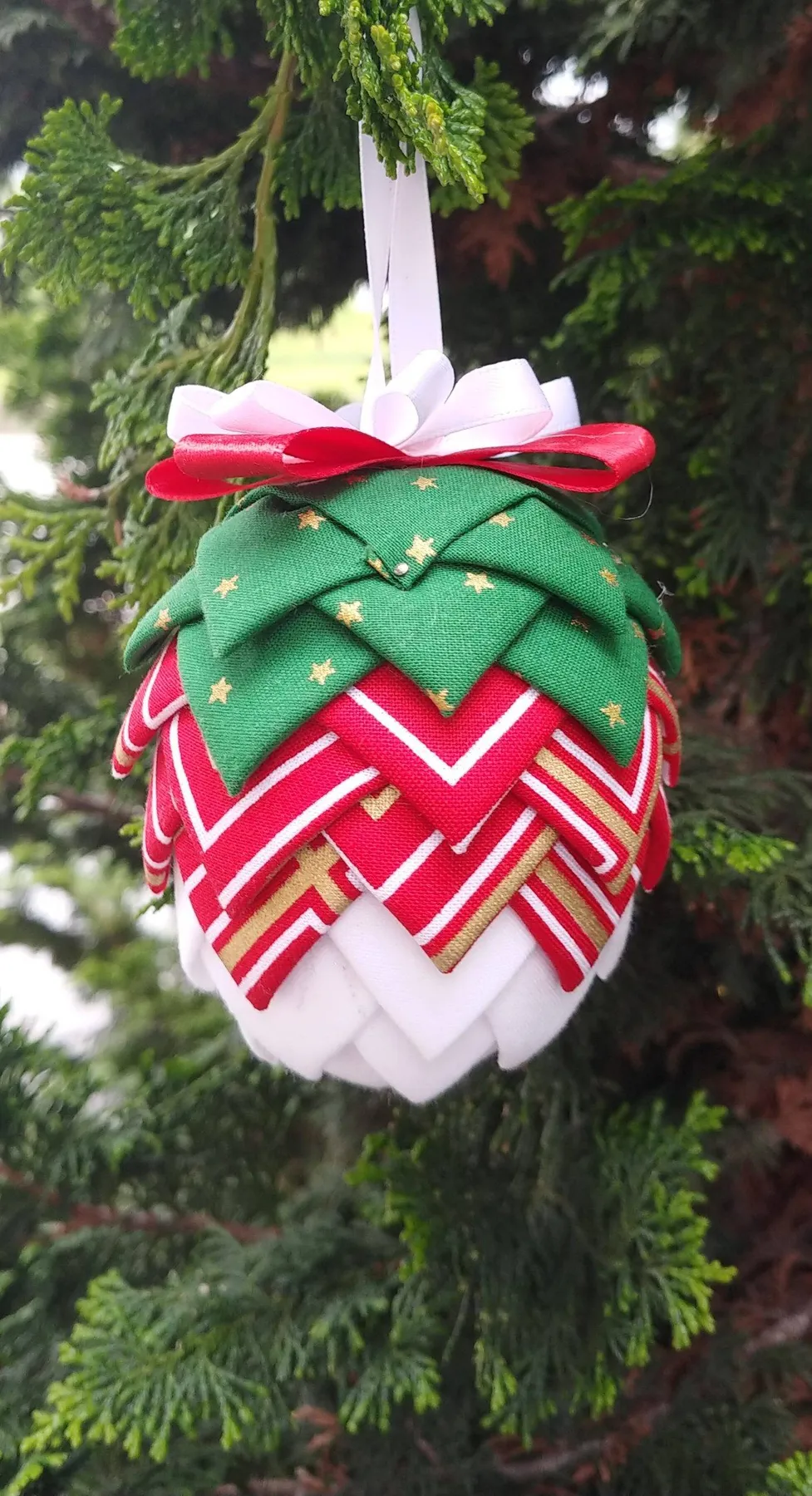
Fold-and-stack fabric ornaments look complicated and are secretly forgiving. Because each layer is a folded square pinned to a foam core, the edges flare outward and catch light in a spiral — that’s where the texture comes from, not the fabric itself. It also means imperfect cuts disappear. Use interfacing-backed quilting cotton rather than thin craft cloth; the extra body holds the fold instead of sagging after a week. Stack rows bottom-to-top so each new layer overlaps the one below, then finish with a bow that hides the pins.
7. Cream and Gold Embroidered Angel Tree Topper
With heavily beaded toppers, attachment method matters more than the beads. Sew sequins and metallic thread through the fabric and into a felt backing rather than gluing — glue stiffens sheer fabric, yellows over time, and pops off in cold rooms. Use a beading needle and doubled thread, working in small clusters rather than one at a time for speed. Keep the embroidery weight balanced, too: if you’re adding metallic thread to the bodice, leave the sleeves plain. Otherwise the gown becomes one continuous shimmer with nowhere for the eye to rest.
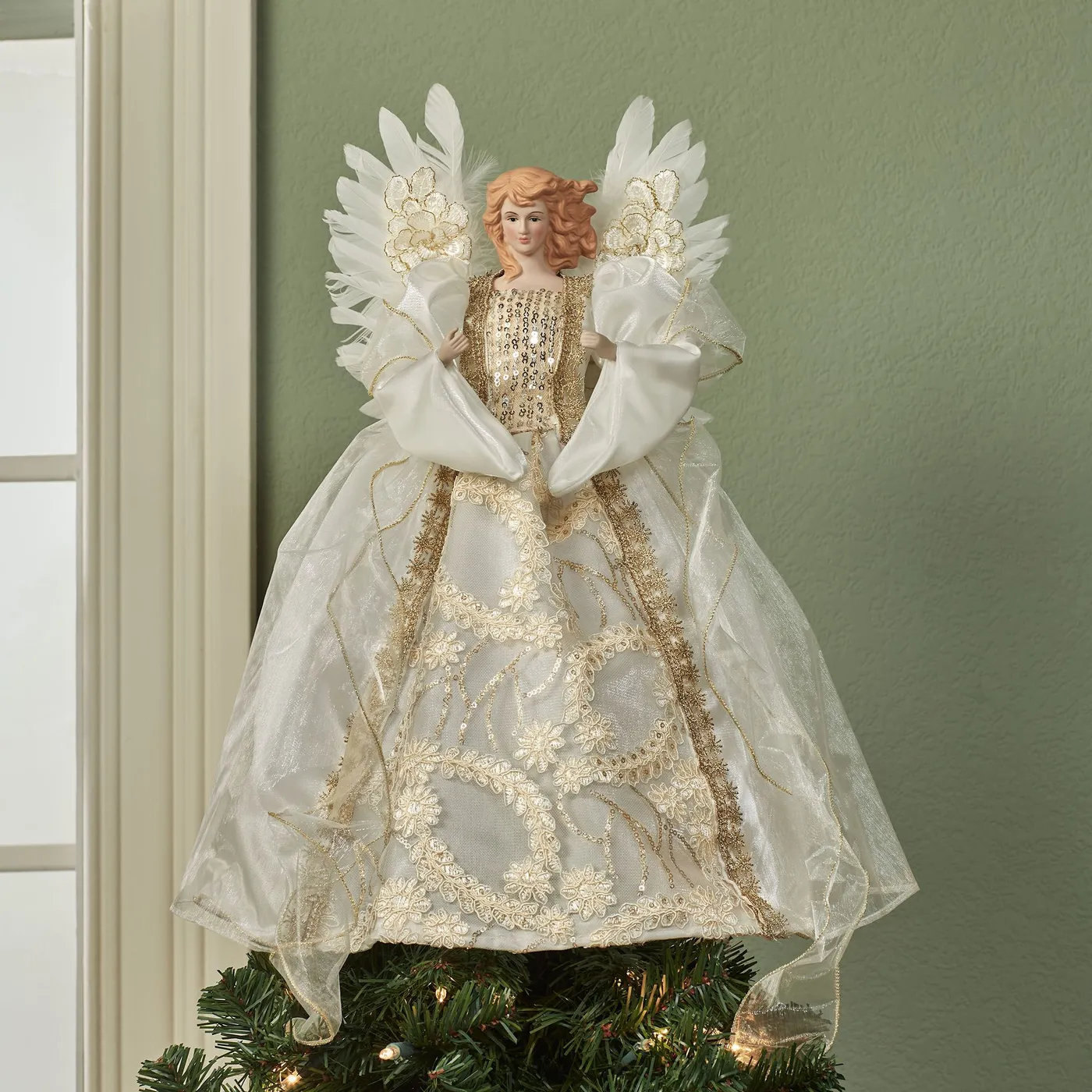
This is a full-gown topper, so it needs room to breathe. Plan on a tree 6 feet or taller — on a 5-footer, the skirt swallows the top third. You also want at least 20 inches of clear vertical space above the tree’s highest point if it sits under a soffit, and 8-foot ceilings for a 7.5-foot tree with a topper this tall. Working with a low ceiling or a tabletop tree? See Idea #20 for a tabletop arrangement with the same elegance and none of the height commitment.
Gold sequins and metallic thread are the parts that age first. They tarnish in humid rooms, dull in direct sun, and snag on everything — including the branches they’re stored against. Wrap the topper in acid-free tissue and store it in a box, not a plastic bag, which traps moisture. Dust it with a soft makeup brush rather than a cloth, which pulls at loose stitching. Real gold-tone trim looks tired after 15 to 20 seasons, and cream fabric yellows faster near a window.
8. Feathered Tulle Angels in Jewel-Bright Colors
Color is back on the tree, and it came back loud. After years of neutral, woodland, and all-white trees, the pendulum is swinging toward saturated jewel tones and nostalgic trims — the kind of things that look like they came out of a 1980s family box. Feathered, tulle-skirted angels sit right at that intersection of vintage and craft. This look has staying power because it’s built from pieces people already own and inherit. If you’re on the fence, don’t commit the whole tree — cluster five or six bright angels in one section and let the rest stay quiet.
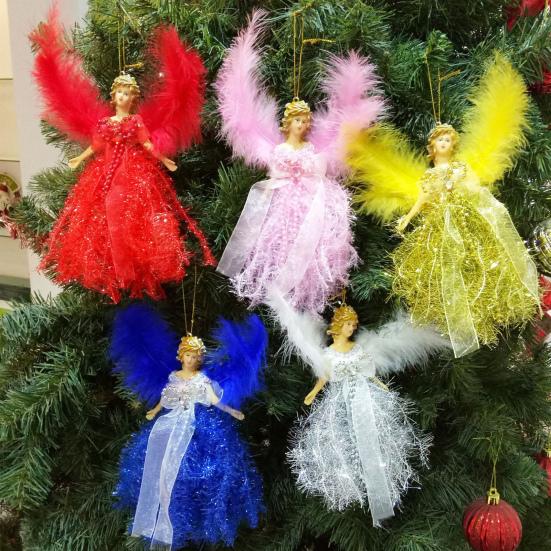
Two honest warnings. Tulle crushes: stack these in a bin with anything heavy and the skirts look deflated by December, so store them hanging or in a single layer with tissue between. And those painted plastic faces can yellow and go tacky over time, especially in garages that swing in temperature. If you’re making your own, brush a matte acrylic sealer on the face before you paint. If you’re buying vintage, check that the paint isn’t already cracking at the nose and eyes — that’s the first place it goes.
9. Handmade Angel With a Patterned Headwrap and Gold Wings
A headwrap angel takes about 40 minutes and costs around $7 each.
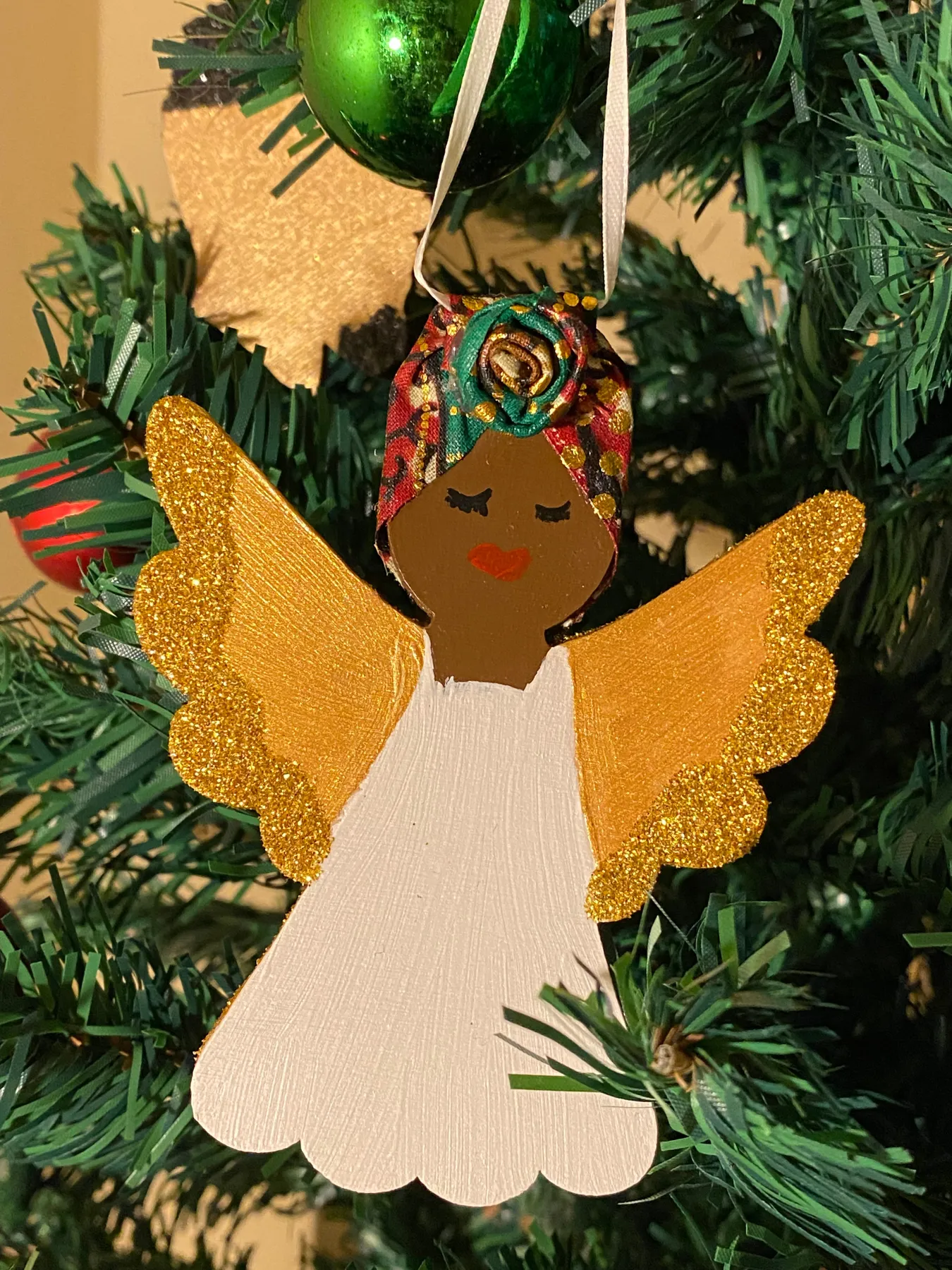
- Start with a 2-inch wood bead or peg head, paint the face in acrylic, then seal it.
- Cut a 2 x 3-inch rectangle of patterned quilting cotton for the headwrap.
- Fold it over the crown and hot-glue the ends at the back, leaving a tail on one side.
- Roll a tiny scrap of the same fabric into a rose and glue it at the temple.
- Build the body by wrapping cream fabric or lace over a cone of batting.
- Cut two wing shapes from gold glitter cardstock and glue them at the back.
- Add a yarn or twine loop at the top for hanging.
For gold glitter wings that read as metal rather than craft-store sparkle, cut the shape from heavy cardstock twice and glue the layers back to back with glitter facing outward. Edge only the outer border with glue and glitter and leave the center matte — that contrast is what sells it. Skip thick glitter glue, which dries lumpy and clouds. Fine metallic glitter over a thin layer of tacky glue, tapped off and dried flat, gives you a clean sharp edge that still catches tree lights from across the room.
10. Plush Angels With Braided Twine Legs and Bells
Everything in this arrangement is a dollar-store build. White felt hats come from the craft aisle ($1.25), polyester batting fills the bodies ($3 a bag), and the pastel pink and blue dresses are cut from $1 fleece throws. The braided legs are kitchen twine and the little bells are a 12-pack for $2. Total for a set of six: under $20. Real talk on Facebook Marketplace — search “vintage Christmas angel ornaments” in November and you’ll find lots of 12 to 20 for $10 to $15, usually already in good shape and far cheaper than new.
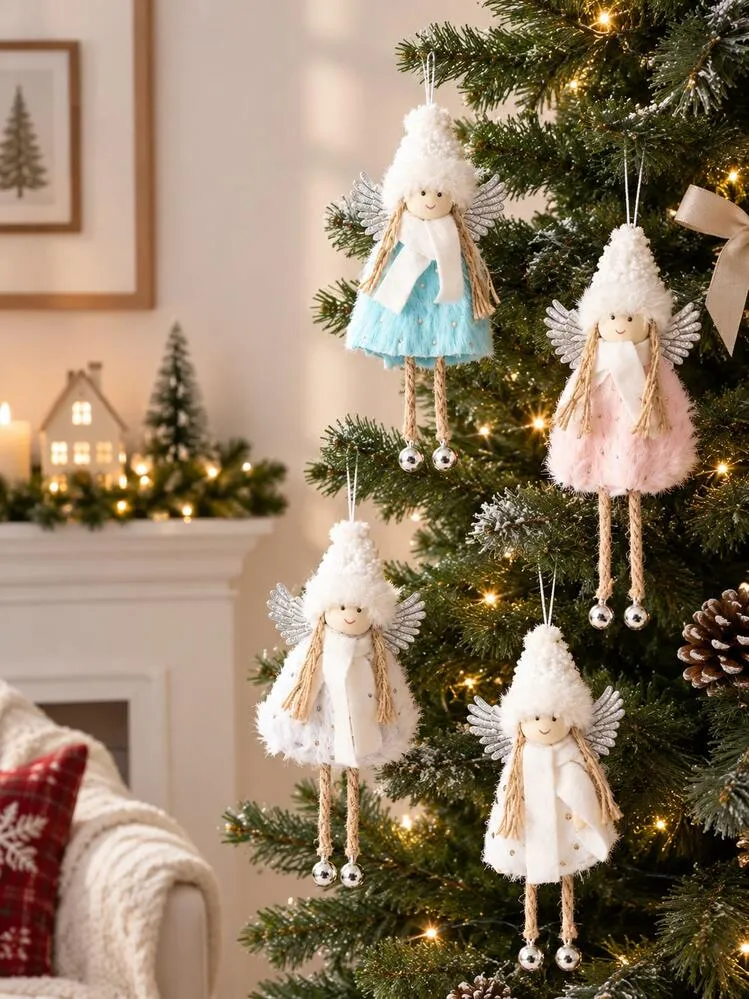
The palette splits 60% white + 25% pastel + 15% silver, which is why the cluster feels soft even with six figures hanging close together. White carries the hats, dresses, and tree. Pink and blue each appear once or twice. Silver lives only in the glitter wings and the tiny bells. That restraint is what keeps pastels from turning into a nursery. To shift the mood, hold the 60/25 split and swap the pastels for warm caramel and rust — same softness, completely different season.
11. Fluffy Angels Wearing Reindeer Antlers
This works for a reason nobody expects: comedy. Reindeer antlers on an angel is a visual joke, and jokes read at a distance — exactly what you need on a crowded tree. The antlers also add vertical height, so the ornaments occupy more branch space with less crowding, which is a practical bonus. The silver glitter wings and boots tie the pair together so they never look like two random ornaments. If you’re making your own, pick one absurd accessory and commit fully. Halfway whimsy looks like a mistake; full whimsy looks intentional.
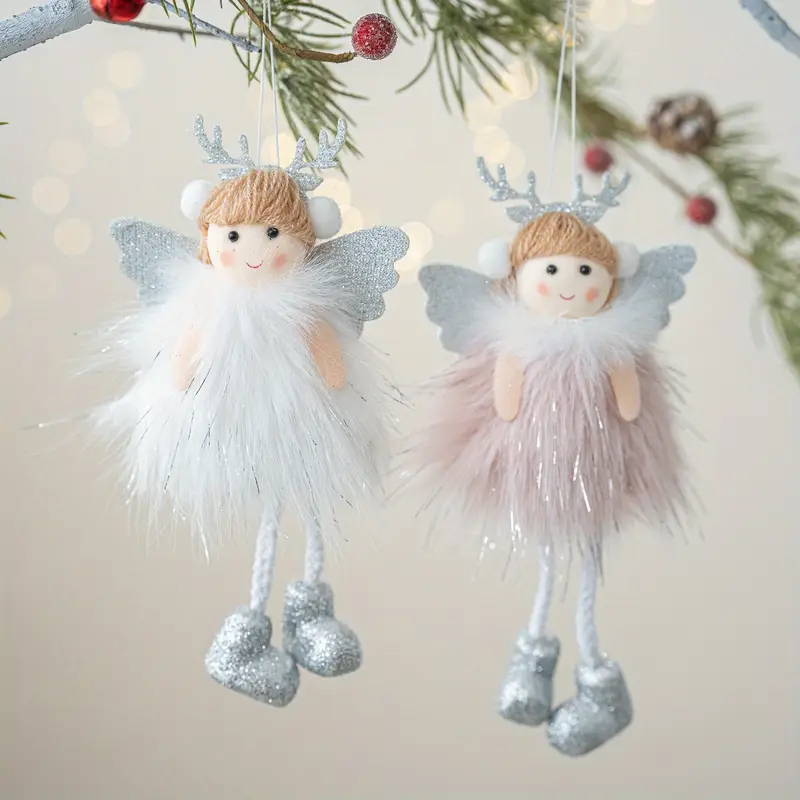
- Check branch spacing — these need about 4 inches of clearance so antlers don’t tangle
- Weigh one ornament; anything over 3 ounces needs a wired hook, not a wire loop
- Decide your count before you hang — odd numbers cluster better than even
- Confirm pets can’t reach the low branches, because antlers are pull-toys to a cat
12. Cream Felt Angel With a Red Stitched Heart
A felt angel with a stitched heart runs about 30 minutes and $3.
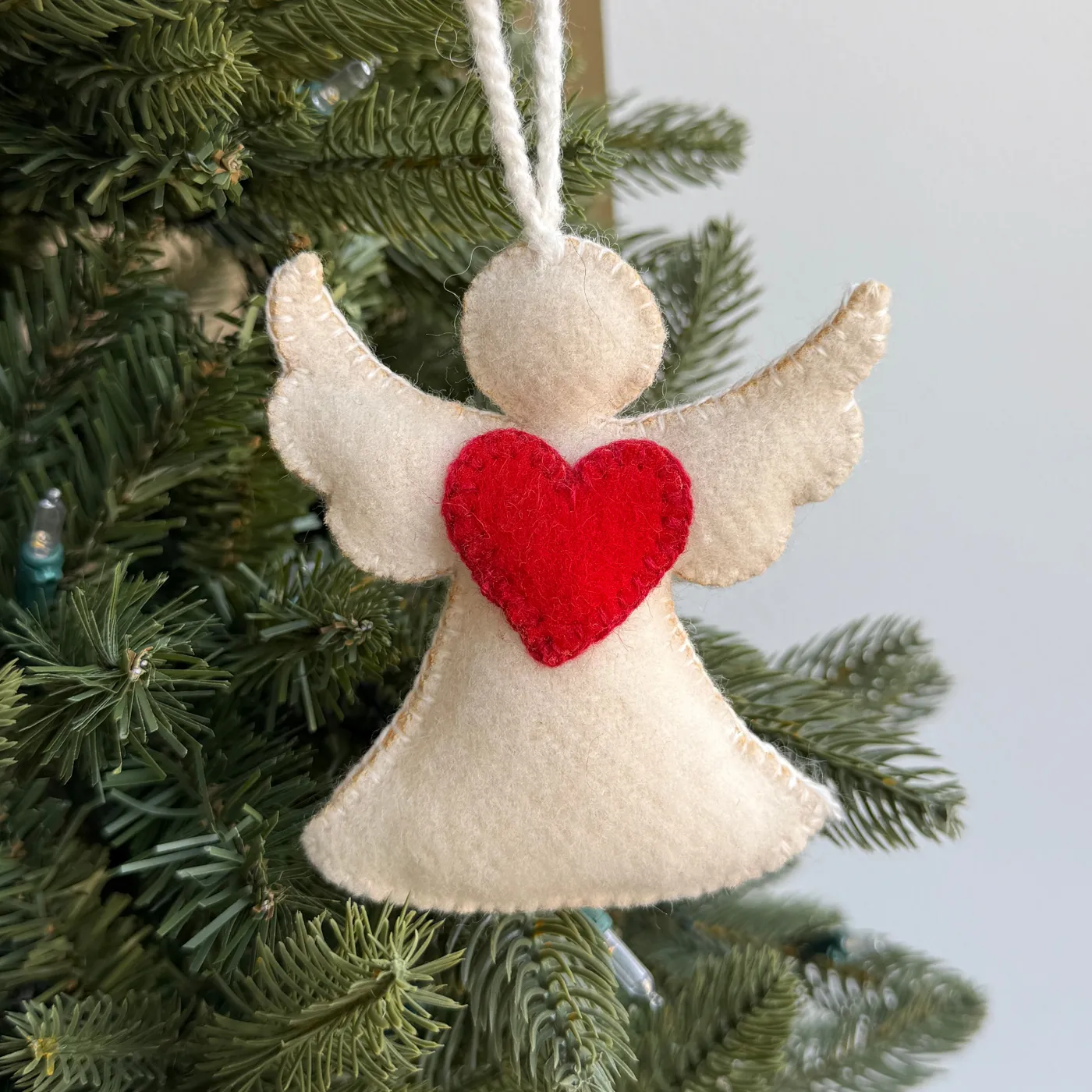
- Draw a simple angel silhouette on paper and cut it out as your pattern.
- Trace it twice onto cream wool-blend felt and cut both shapes.
- Cut a 1.5-inch red felt heart and pin it to the front piece.
- Blanket-stitch the heart down with cream embroidery floss.
- Whip-stitch the two body pieces together, leaving a small gap at the top.
- Stuff lightly with a cotton ball, close the gap, and thread a twisted yarn loop through.
The visible stitching is the point here. Machine-perfect edges would kill this ornament. Those slightly uneven blanket stitches and the small tail of thread at the heart are what tell you a person sat down and made it. So resist the urge to hide your work — use a contrasting floss if you want the stitches to read as decoration, and leave the knots showing on the back. It’s also the fastest way to make a batch feel personal: vary the heart color, vary the stitch color, and no two look alike.
13. White Cut-Out Angels in a Pinecone Table Garland
This works on a dining table 60 to 72 inches long. The long, low line of garland wants at least 5 feet of surface or it looks cramped at the ends. Keep the angels between 6 and 14 inches tall — anything shorter is lost inside the pine, and anything taller blocks sightlines across the table. Ceiling height barely matters since everything sits below 16 inches. If your table is under 4 feet, try Idea #18 instead, which puts the angels on wrapped gifts and takes up almost no room at all.
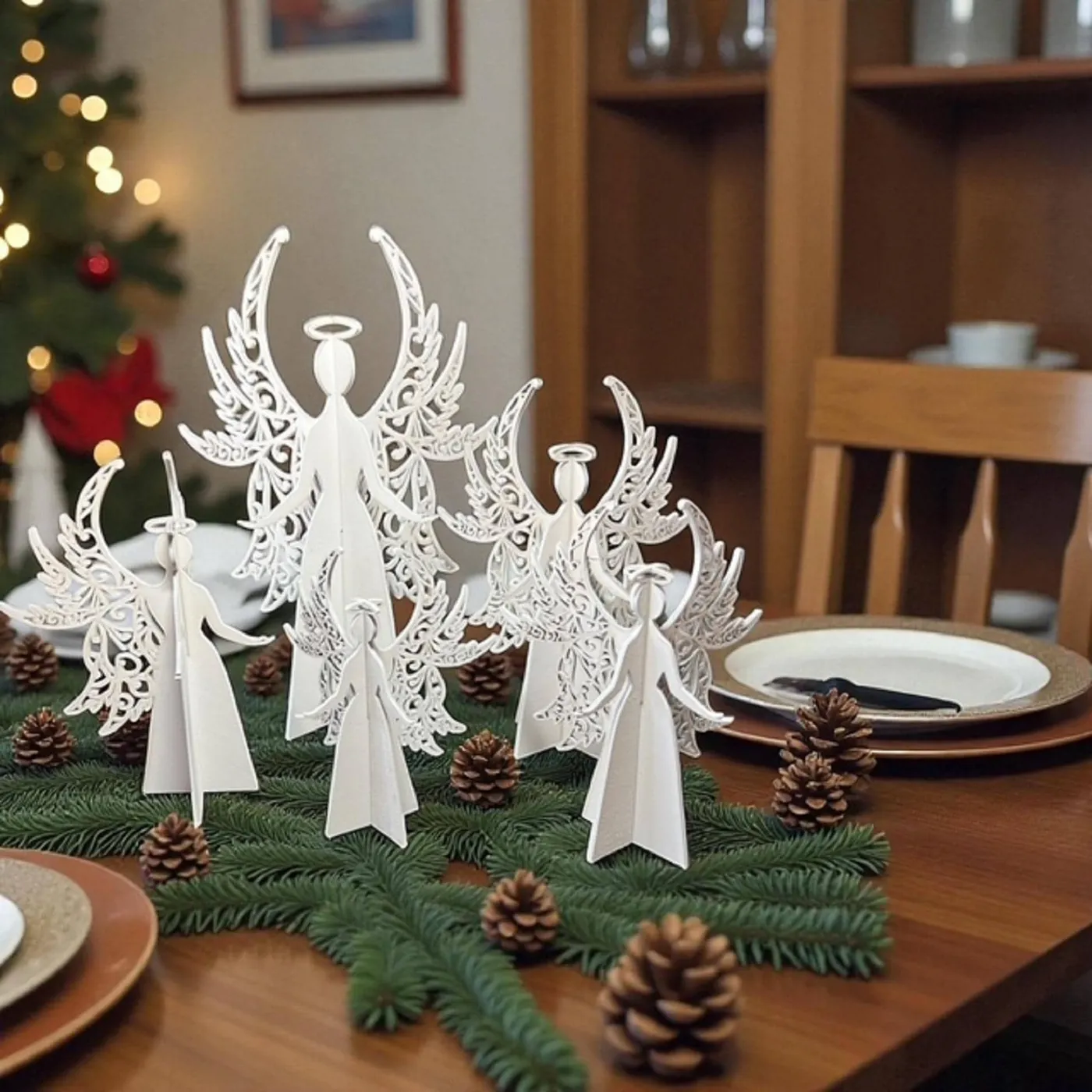
- Faux pine garland (6 ft): $18–$35
- White cut-out angels (set of 6): $12–$28
- Pinecones, bag of 20: $8–$14
- Wooden table runner or charger plates: $20–$45
- Battery-operated warm LED string: $10–$18
Total: $68 to $140. Gathering pinecones from a park instead of a craft store, and reusing a runner you already own, brings the realistic version in around $40.
14. Pink Tulle Angel Holding a Golden Star Wand
To get a tulle skirt that flares instead of drooping, gather it onto a small foam cone rather than stuffing it. Cut tulle into 6-inch-wide strips, run a gathering stitch along one edge, and hot-glue each strip in overlapping rows from the bottom of the cone upward — about four rows for a full skirt. Tulle has no weight, so the cone is what gives it structure. For the wand, bend 18-gauge gold wire into a star, wrap it with metallic thread, and glue it into a rolled cardstock tube before attaching it to the hand.
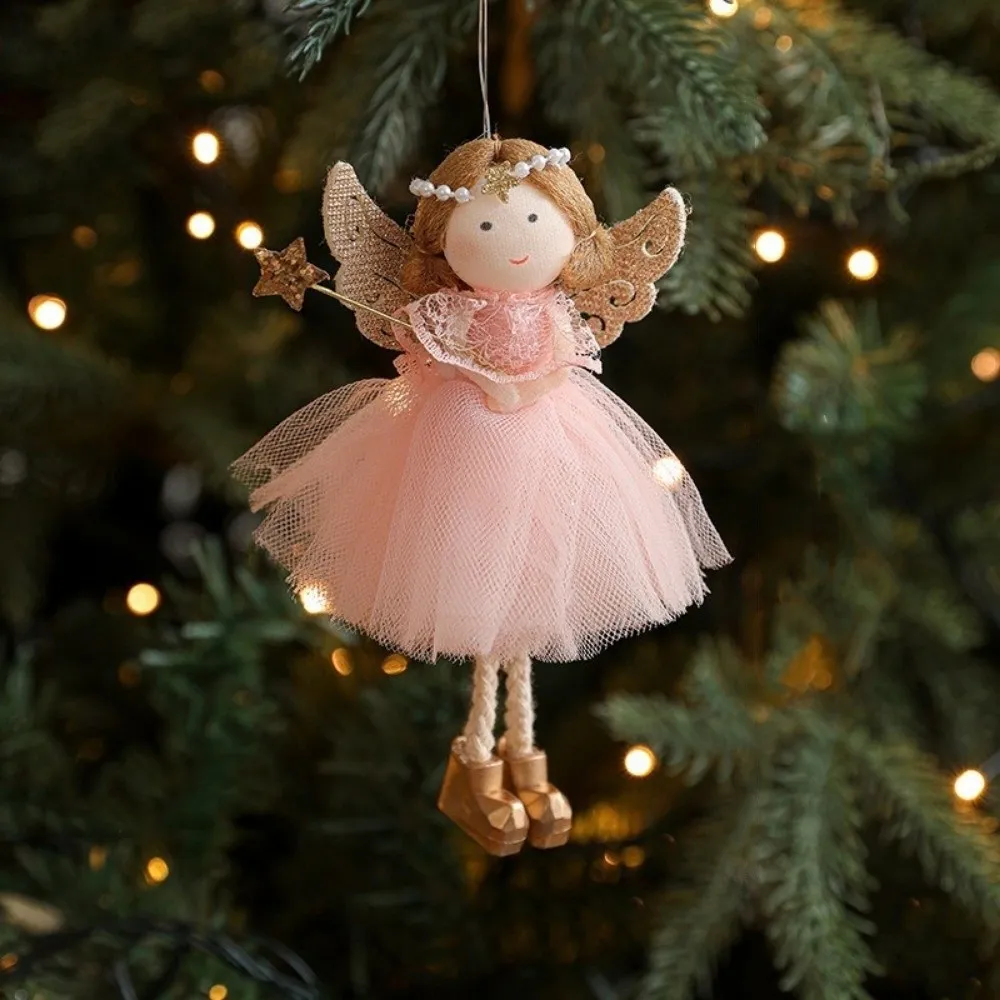
Tulle snags on everything, including itself, and gold glitter sheds for years no matter how well it’s sealed. Store these individually — a shoebox with tissue between each angel, or better, a hanging ornament bag. Expect the rope legs and golden boots to fray first, so dab the knots with clear-drying fabric glue before they go up. If you’re buying rather than making, look for ornaments where the glitter is embedded in the fabric rather than glued on top; those hold up four to five times longer.
15. Crocheted Pink Angel With a Wooden Doll Head
The mix runs 55% soft pink + 30% white + 10% green + 5% light wood. The wood is the wildcard and it’s what keeps this from reading as purely sweet — that tiny wooden head and the natural twine add a warm, almost toy-like note. For a cooler version, hold the same math but shift pink to dusty blue and keep the wood exactly where it is. The wood is doing the grounding work, so don’t swap it for plastic. One natural element in an otherwise pastel palette is the difference between charming and cloying.
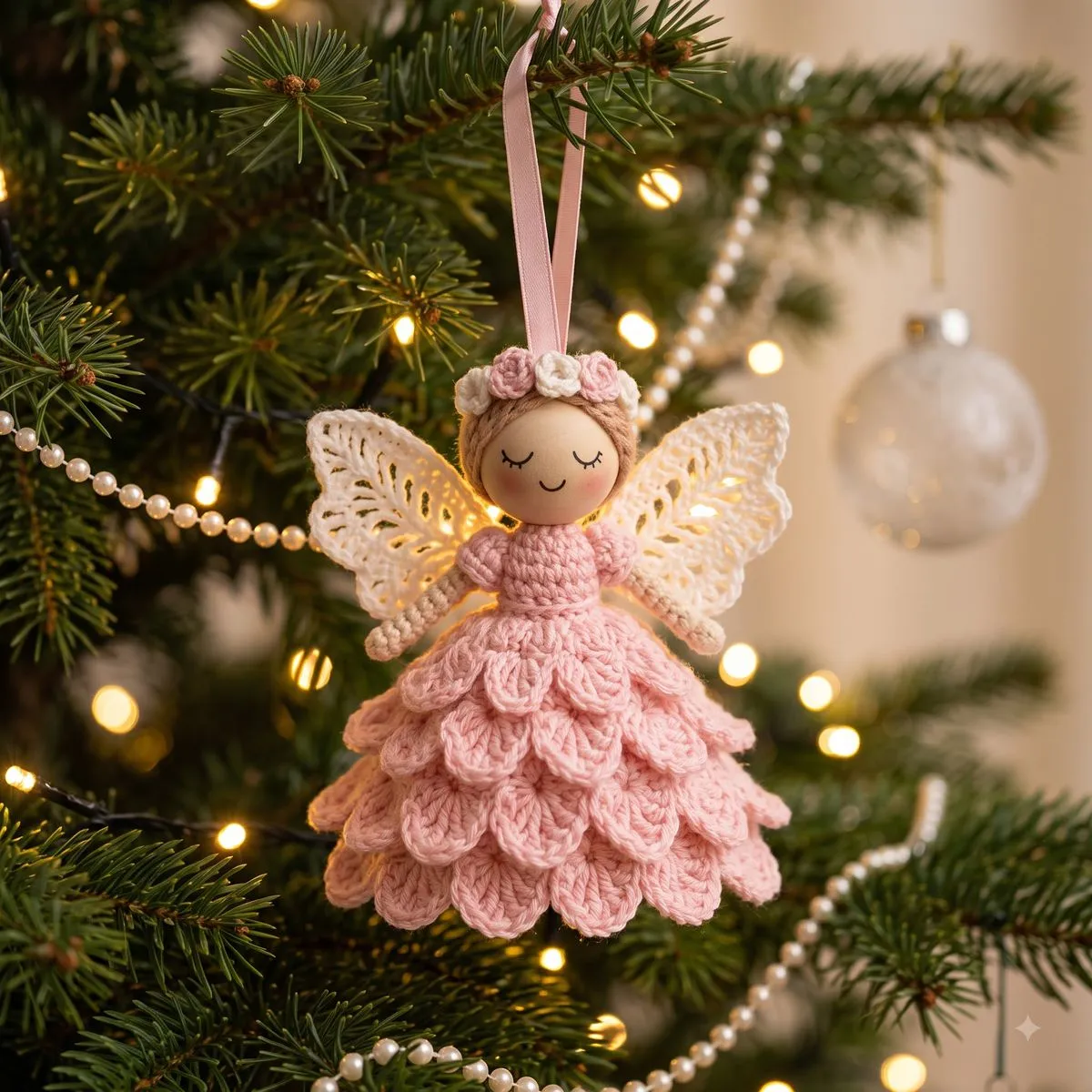
Crochet looks effortless and isn’t. Two things trip people up: cotton yarn holds its shape beautifully but takes forever to dry after blocking, while acrylic is cheap, fast, and slightly shiny in a way that reads as store-bought. For small ornaments, a cotton-acrylic blend is the honest compromise. Also, seal a wooden doll head before attaching it to yarn — raw wood wicks moisture out of the crochet and can leave a ring. And block your pieces, even the tiny ones. They triple in polish for 20 minutes of work.
16. Crocheted Angel With Orange Yarn Hair and a Red Heart
This little crochet angel takes about two hours once you know the stitches, and roughly $4 in yarn.
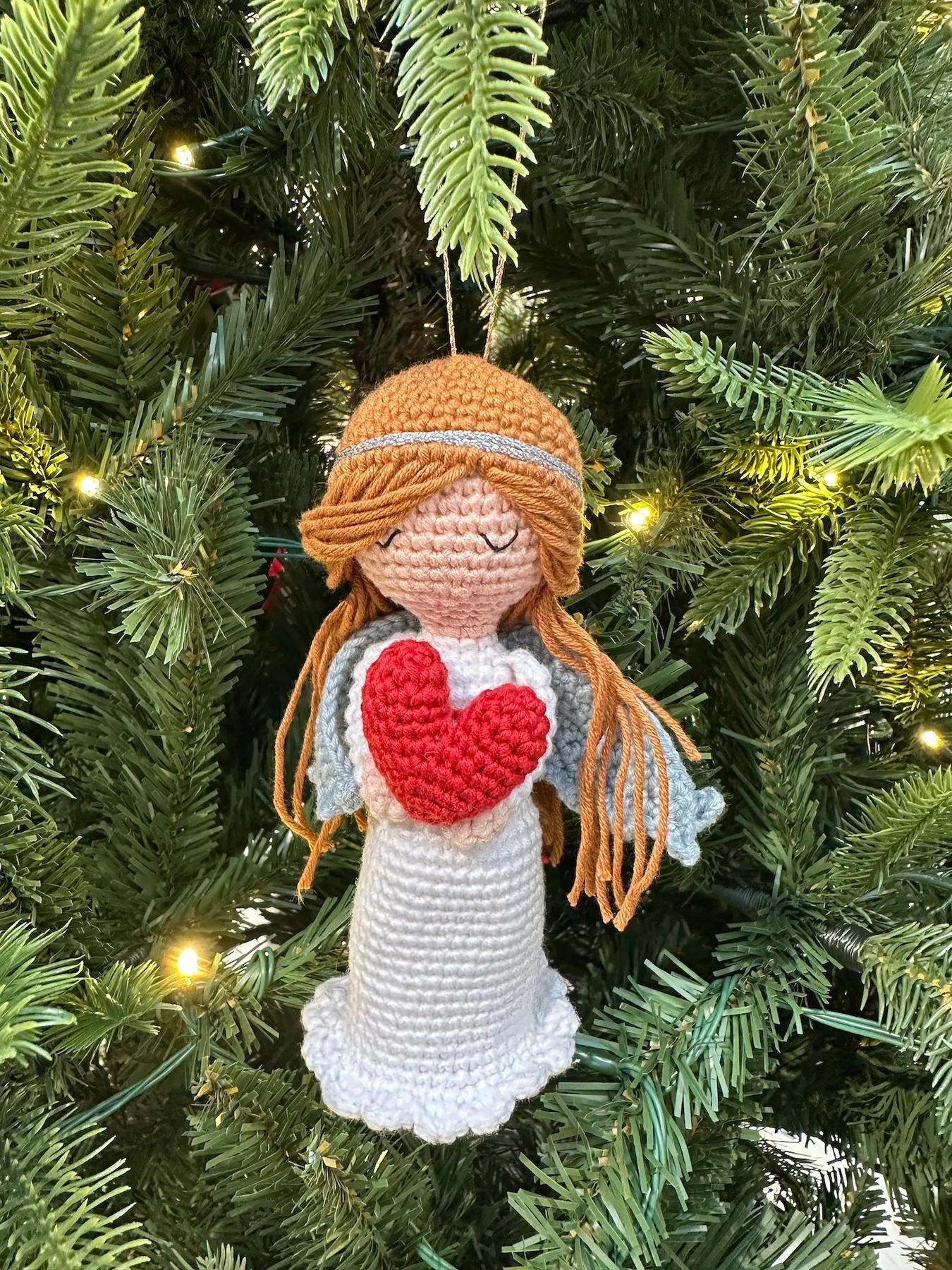
- Work a magic ring of 6 single crochet in white for the head.
- Increase to 12, work three rounds even, and stuff lightly.
- Switch to light blue for the wings: chain 6, double crochet back across, tie off two.
- Work the gown in white from the neck down, adding a scalloped hem of 5 double crochet in each stitch.
- Make the heart in red: two single crochet into a chain-2 ring, then join.
- Stitch on orange yarn hair and a silver yarn halo, then attach the heart to the hands.
Three colors, one focal point, no extras. The white gown and light blue wings share a value — both pale and cool — so the red heart is the only thing that truly pops, and it pops hard. That’s the whole design. The scalloped hem adds texture without adding a color, which keeps the figure readable from across the room. If you’re making a set, keep the heart red on every one. The repetition is what makes a group feel like a collection instead of six unrelated projects.
17. Wooden Angels in Red Dresses With Curly Wire Halos
Round wooden discs run about $1.50 for a four-pack at any craft store, and a bag of 50 wooden clothespins is under $5. Paint the discs with leftover wall paint rather than buying craft acrylic — it’s free, and it matches your room exactly. Cut the wings from a $1 sheet of basswood, or if you don’t have a scroll saw, from two layers of heavy chipboard with a wood-grain contact paper finish. Jute twine is $3 for 100 yards and will make the halos, the neck lace, and the hanging loops for the entire set. Total for eight angels: about $22.
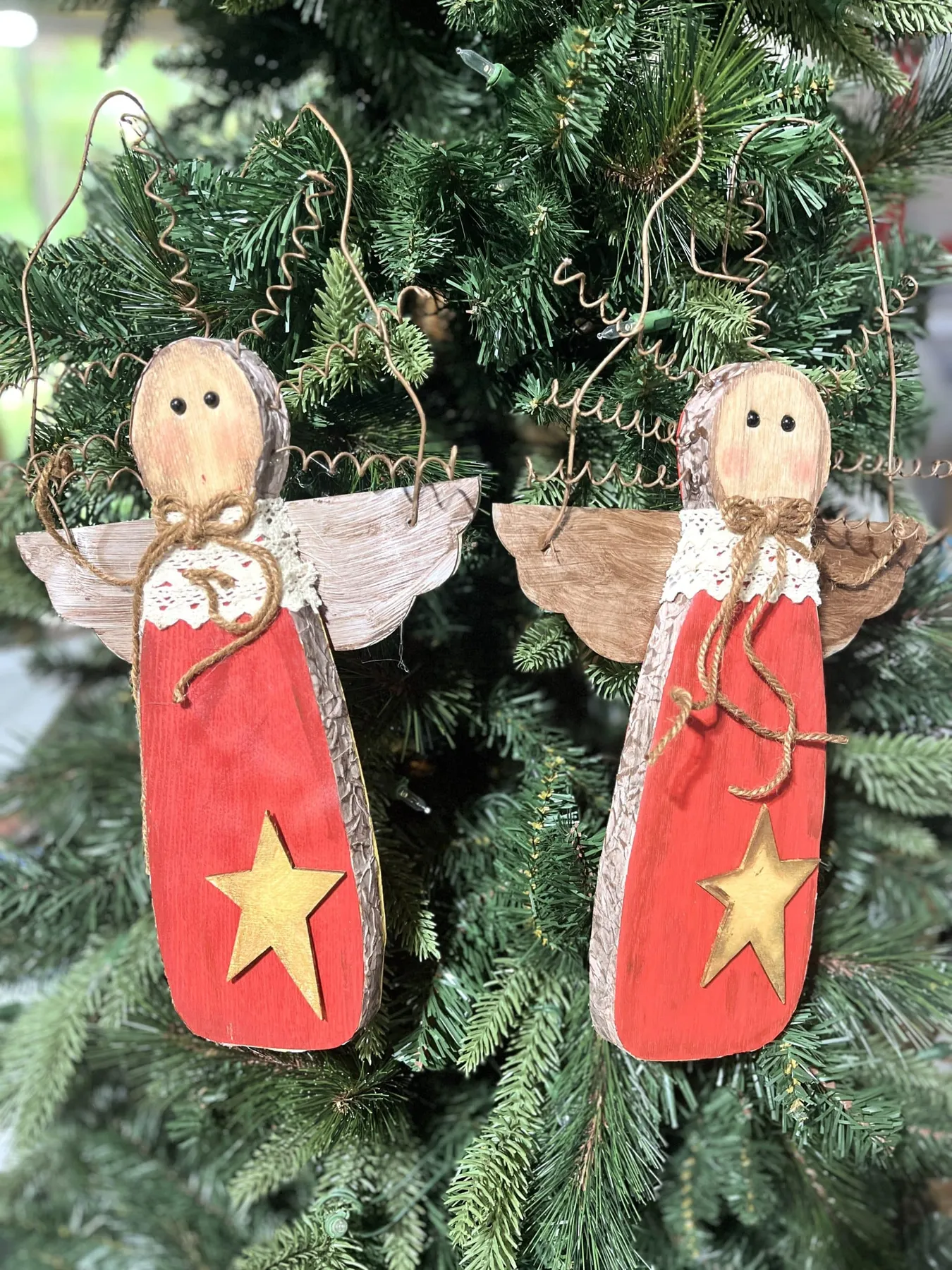
That curly wire halo is easier than it looks. Use 20-gauge copper or gold craft wire and wrap it around a pencil barrel 6 to 8 times to make a coil, then slide it off and stretch it gently to about twice its length. Bend the very ends into small loops so nothing scratches, then hot-glue the coil to the back of the head. Twenty-gauge holds a shape without fighting you. Anything thinner than 24-gauge flattens the moment a branch brushes it; anything thicker than 18-gauge is a wrestling match.
18. White Wooden Angels on Kraft Paper Gifts
- White wooden angel ornaments (set of 6): $14–$30
- Kraft wrapping paper roll: $6–$12
- Natural jute twine: $4–$8
- Red polka dot ribbon: $5–$9
- Fresh pine sprigs: free from a tree lot
- Candy canes and extra ornaments: $6–$12

Total: $35 to $71. Skipping the specialty ribbon and using twine everywhere brings the whole look in around $25, and the angels become gift toppers people actually keep.
Kraft paper with handmade toppers has quietly become the anti-plastic move of the decade — people are wrapping in paper they can compost and topping gifts with ornaments that get a second life on the tree. These white angels do double duty, which is why the trend has legs. It’s also cheaper than a bin of gift bags, and it photographs beautifully for anyone sharing their holiday on Pinterest. Wrapping a big batch? Standardize on one paper and one ribbon and let the toppers be the variety.
19. Peg Doll Angels With Feather Wings and Clothespins
Peg doll angels take about 45 minutes each, plus drying time, and run about $5 per figure.
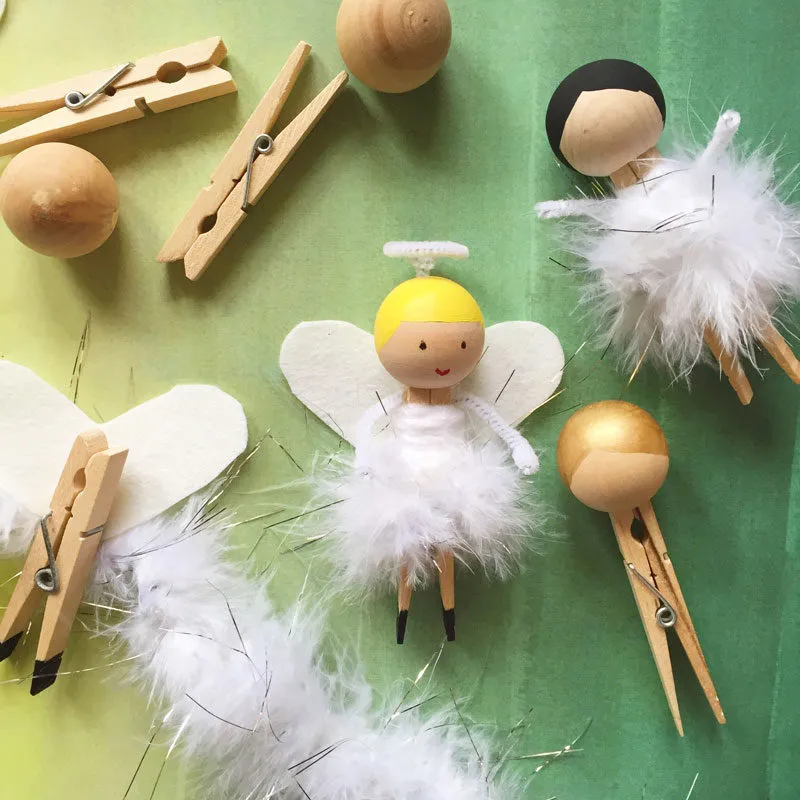
- Sand a wooden peg doll with 220-grit and wipe off the dust.
- Paint the head with two thin coats of acrylic, letting each dry fully.
- Draw the face with a fine-liner and seal with matte varnish.
- Cut felt wings from two layers of stiffened felt and hot-glue them at the back.
- Glue a ring of small white feathers around the wing base for softness.
- Wrap the body with a scrap of fabric and secure at the neck with twine.
- Confirm your peg dolls are unfinished wood, not varnished — paint won’t stick otherwise
- Let varnish cure 24 hours before handling, or fingerprints will show
- Sort feathers by size first; matching pairs save you from a lopsided angel
- Check that your hot glue gun is low-temp, since high-temp melts felt
20. Woven Angel and Beaded Star on Dark Marble
The polished dark marble is the whole reason this vignette feels expensive. Woven straw, gold wire, and deep red are all warm and matte, and they’d go soft and shapeless on a beige table. Against near-black stone, every gold thread reads like jewelry. If you don’t have a marble table, a matte black tray, a dark wood board, or even a charcoal linen runner gets you close. Buy the dark, low-sheen surface before you buy a single ornament. It costs less than one good decoration and changes how all of them look.
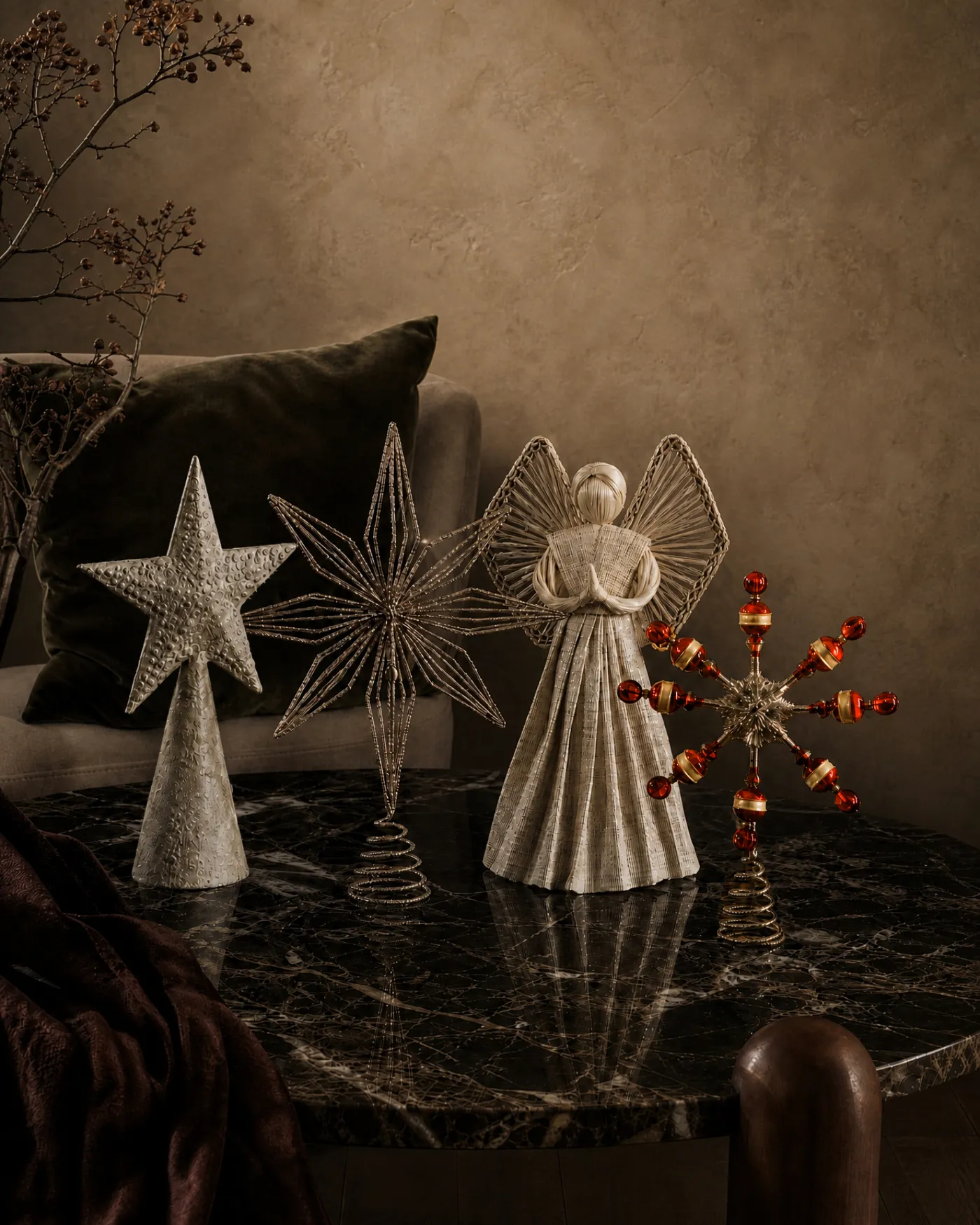
This arrangement is built for a console or entry table between 30 and 36 inches tall and at least 40 inches wide. Everything in it lives below 18 inches, so it works under a mirror, under a piece of art, or against a plain wall — no ceiling height requirements at all. Keep the angel, the star toppers, and the red-accented sphere within a 24-inch footprint so the grouping reads as one collection. For a dining table or bigger mantel setting, see Idea #7, which scales the same gold-and-cream language up to a full-size tree.
21. Folded Fabric Tree Ornament in Deep Red and Green
The formula is 40% deep red + 40% off-white + 20% forest green, with gold star fabric acting as a connective thread rather than a color. Notice that red and off-white get equal weight and green only shows up in bands — that’s what keeps a traditional palette from turning into a Christmas cliché. Move the same proportions to plum, oat, and olive and it stops being holiday-specific entirely. With fabric ornaments, the pattern in each layer should contain at least two of your three colors, so every fold relates to the next one.
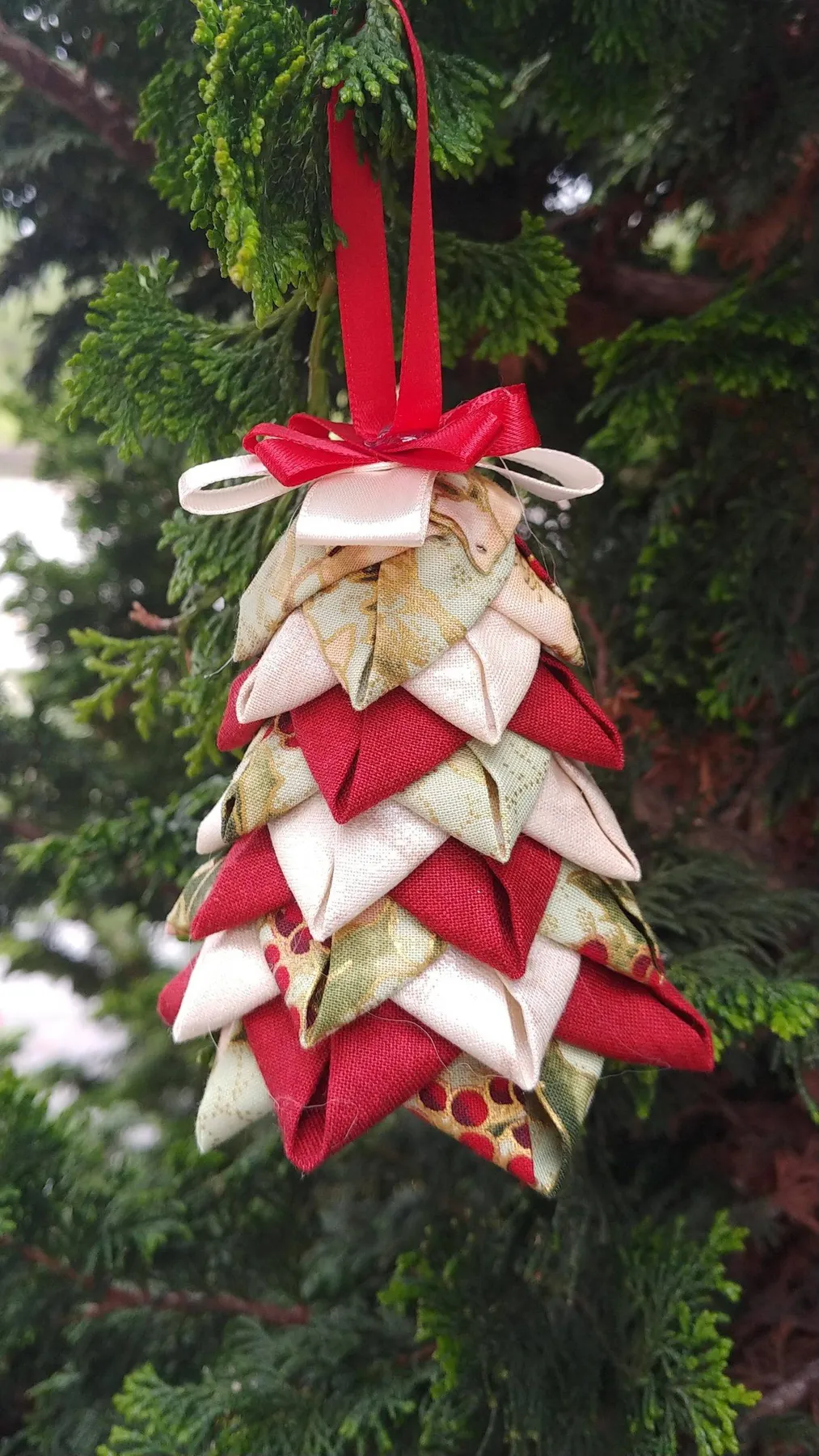
- Quilting cotton fat quarters (4): $8–$16
- 3-inch foam or styrofoam ball: $2–$4
- Straight pins: $3
- Deep red ribbon: $4–$7
- Small red and white bow: $2–$4
Total: $19 to $34 for a single ornament, or roughly $60 for a set of six once you own the pins. A pre-cut fat quarter bundle in coordinating prints is cheaper than four separate cuts and guarantees the colors actually talk to each other.
22. Three Wooden Angels With Hand-Painted White Flowers
Raw wood and dried botanicals are beautiful and temperamental. Unfinished wood expands and contracts with humidity and can crack along the grain if it lives near a heat vent, so seal the flat angels front and back before you display them. Dried grasses shed, so put a felt pad under those clear glass vases. And keep the whole arrangement out of direct sun, because dried stems fade to beige within a season. Want the look with none of the maintenance? Swap in preserved eucalyptus, which holds its color for years and doesn’t crumble.
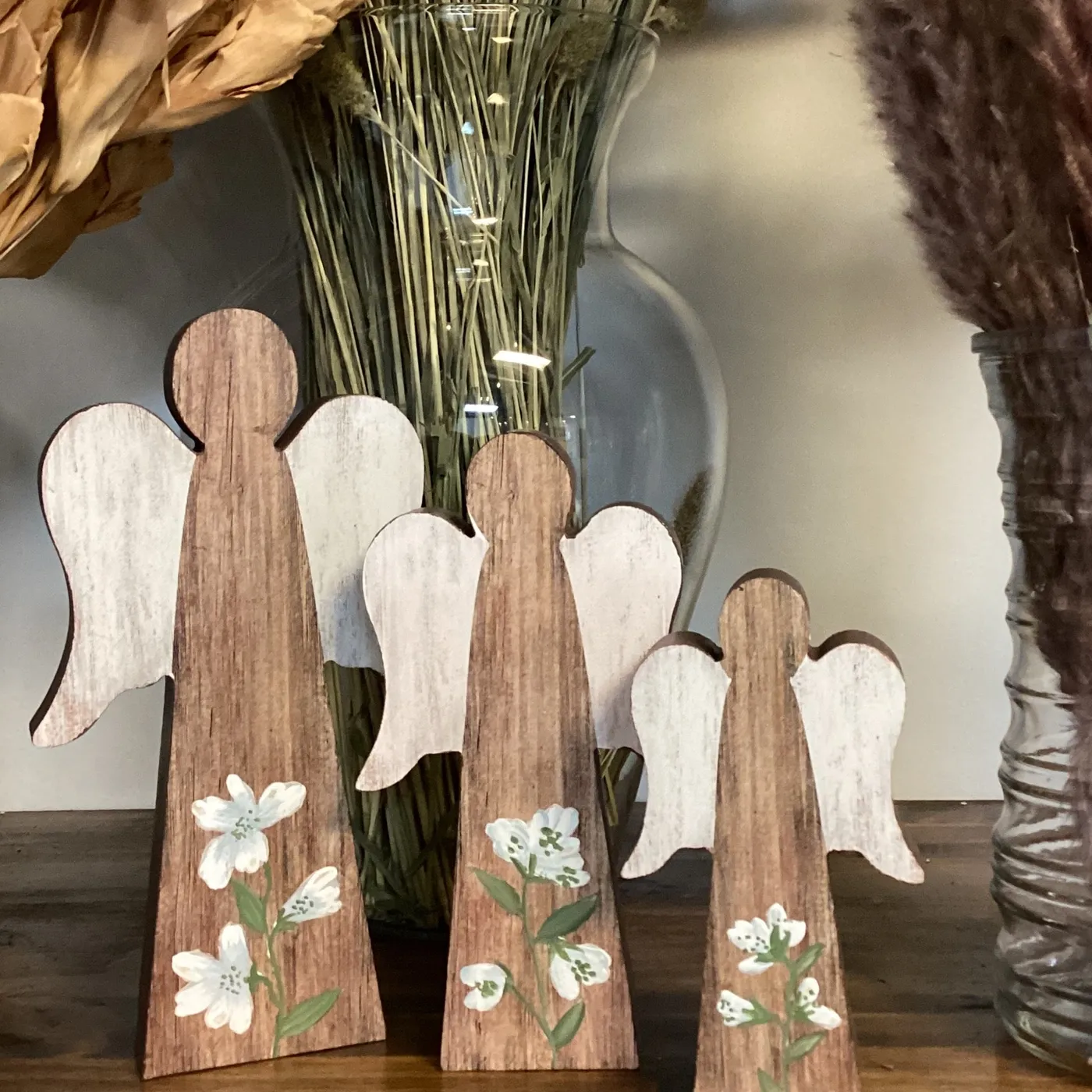
Three angels, three heights, one material. That’s the formula. The varied heights give the group a diagonal line, far more interesting than a row of equal figures. The hand-painted white flowers repeat across all three, tying them into a set, while the differing sizes tell you they were collected rather than bought as a kit. Odd numbers read better because the eye can’t pair them up and move on, so it lingers. Building your own group? Buy two now and hunt for the third at a craft fair later.
Roughly 70% natural wood + 20% white paint + 10% living green. That high wood percentage is what makes this feel calm instead of festive-overload, and it’s why the arrangement works in a dining room, a hallway, or really anywhere. To shift it warmer, leave the wood and swap the dried greenery for amber and rust stems. To shift it cooler, add a single matte white ceramic vessel and change nothing else. Whatever you do, don’t let the accent volume creep past a quarter.
23. White Felt Angel Playing a Horn on Sheet Music
Gold bead accents work best at roughly one-third the height of the piece, and in odd clusters. On a small felt angel, that means a cluster of three 4mm beads, not a scattered line of ten 2mm beads. Place them where light lands — the crown, the tip of the horn, the hem of the skirt — so they glint when someone walks past. Bigger is nearly always better here: 6mm beads read from three feet away, and 2mm beads just look like dust. Step back six feet and check whether you can see them before adding more.
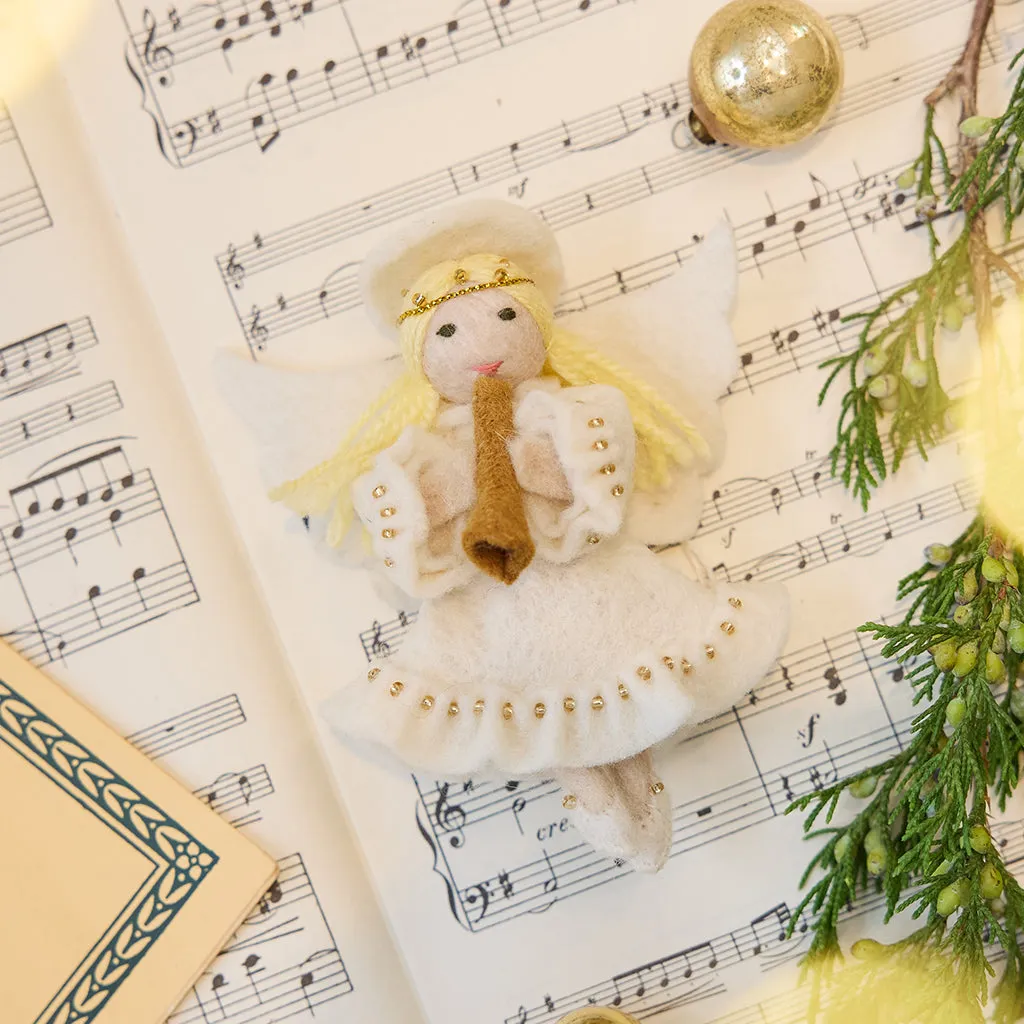
Felt sheets run about 35 cents each at craft stores, or $9 for a 40-piece rainbow bundle online, which is enough for roughly 25 ornaments. Wooden beads come in 100-count bags for $6. Sheet music as a styling prop is free if you raid a piano bench, or a few dollars at an antique shop for real vintage pages — and those photograph far better. Add a glossy gold bauble from a dollar store and one conifer sprig from the tree lot, and you’ve recreated this scene for under $20.
24. Golden Angel With a Star-Tipped Staff
- Gold gown angel figurine: $25–$65
- Distressed white wooden backdrop piece: $18–$45
- White wooden bead garland (6 ft): $10–$20
- Textured white runner or tray: $12–$28
- Small LED accent light: $8–$15
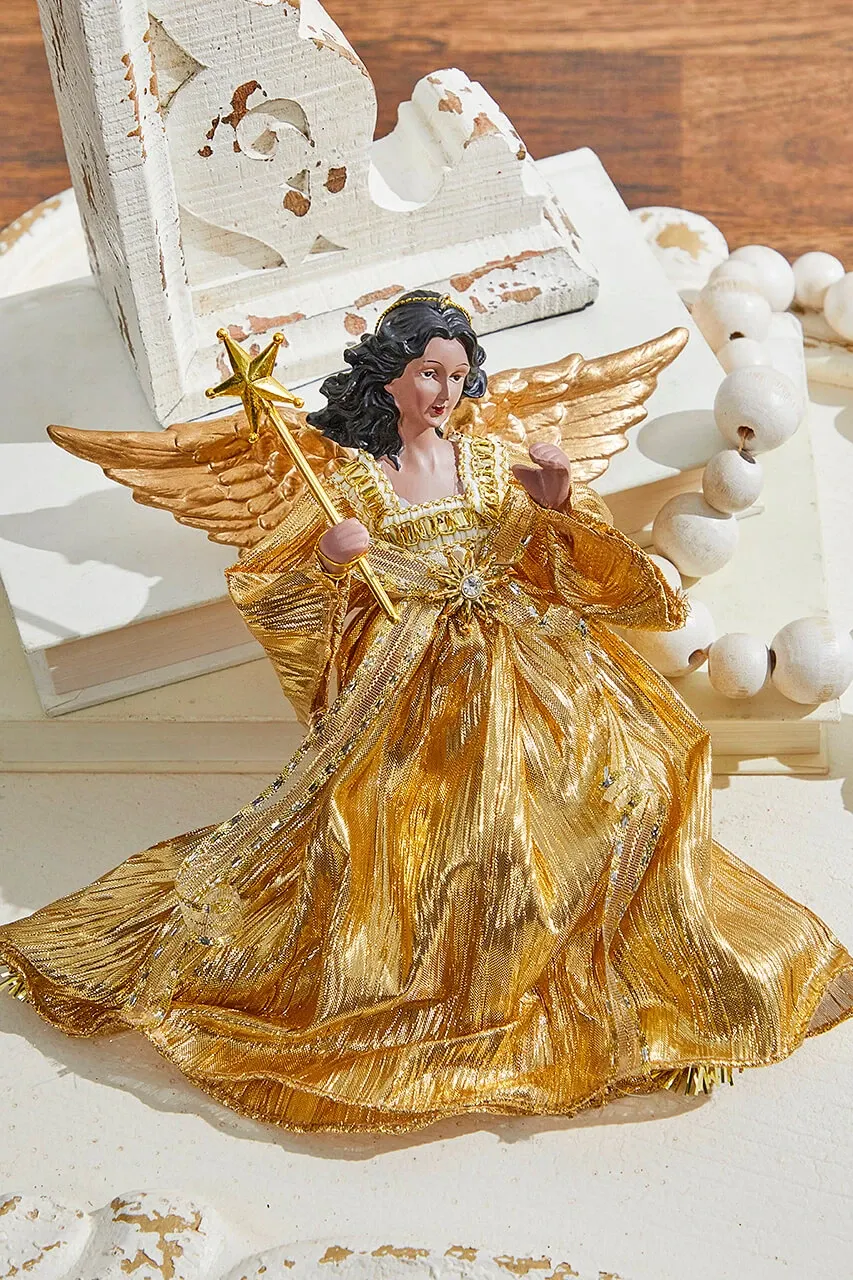
Total: $73 to $173. The figurine is the only piece that has to be right — everything else is texture. Thrift stores and estate sales turn up gold angels constantly in December for $5 to $15, and a coat of matte sealer on a scuffed one hides years of wear. Prefer a cooler metallic? Idea #29 runs the same logic entirely in silver.
The distressed white wooden piece behind the angel is doing quiet, essential work. Without it, the gold figure floats against a blank wall and looks like a lone figurine. With it, you get a frame — a rough, matte surface that makes the shimmer in the gown feel earned. That’s the rule with any high-shine object: give it something imperfect to sit against. Chipped paint, raw wood, burlap, or a stoneware plate all work. Skip this one element and the whole arrangement reads as bright and flat.
Gold finishes two ways: real metallic leaf, which tarnishes but can be gently polished, and sprayed metallic paint, which dulls permanently and flakes at the edges. Most affordable figurines are the second kind, so plan on a soft brush dusting rather than wiping, and never use water — moisture gets under the paint and lifts it. Keep the bead garland out of direct sun, since white-painted wood yellows in about two seasons by a bright window.
25. What Nobody Tells You About Displaying Fragile Handmade Angels
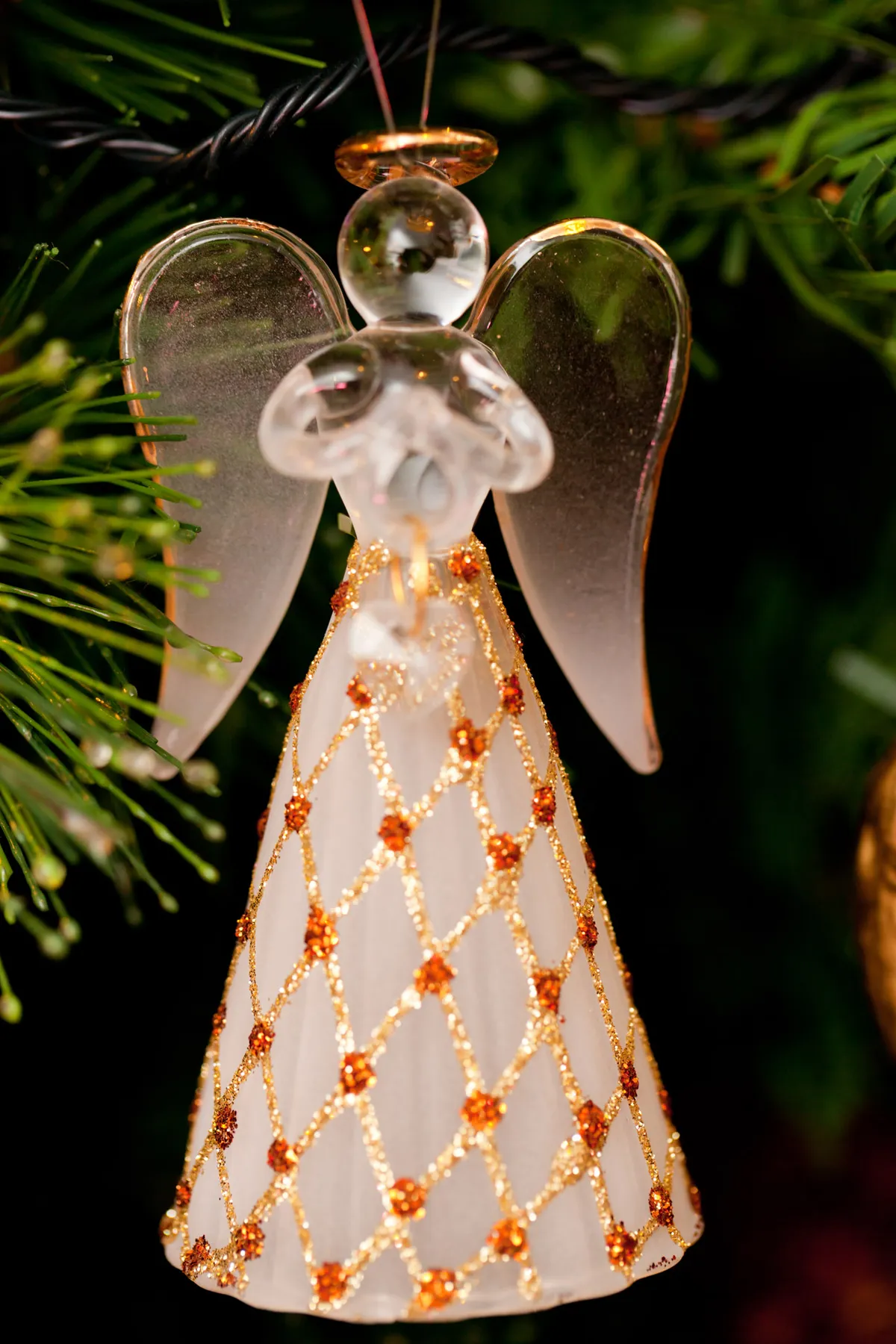
Here’s the thing nobody mentions: handmade angels are often heavier and more fragile than the store-bought ornaments you’re used to. Felted wool holds moisture, air-dry clay is brittle, and anything with glued-on beads fails at the glue line long before the beads themselves wear out. Test each one before it goes anywhere near the tree. Hang it and gently bounce the branch — if it swings hard or slides, it needs a wired hook instead of a wire loop. And keep the heaviest pieces on interior branches, closer to the trunk, where the wood can actually support them.
- Weigh your heaviest ornament — anything over 4 ounces belongs near the trunk
- Check whether your tree lights are LED; incandescent bulbs get hot enough to soften glue
- Confirm no ornament sits within reach of a toddler’s arm or a cat’s paw
- Test-hang everything before you commit to a layout
- Keep a spare pack of wired hooks within arm’s reach of the tree
26. Crocheted Grey Animal Angel With a Silver Star
A crocheted animal angel takes about 90 minutes and roughly $5 in yarn.
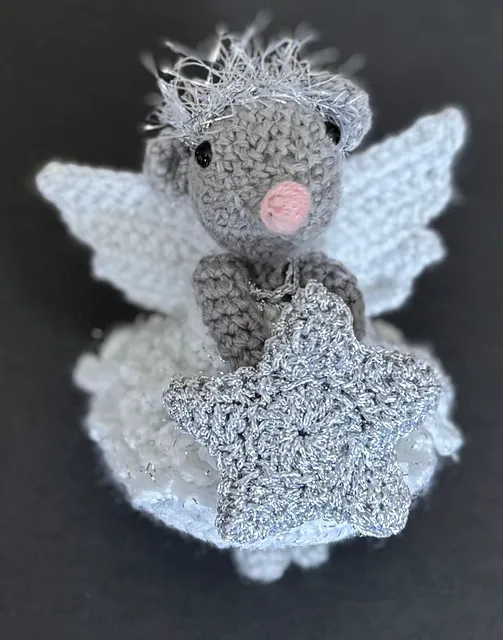
- Work a magic ring in grey and increase to 18 single crochet for the body.
- Work four rounds even, then decrease back down and stuff firmly.
- Add a small pink yarn nose with three satin stitches and two black bead eyes.
- Chain 8 in light grey for each wing, half-double crochet back across, and stitch them on.
- Work the fluffy white skirt in the round with a 2-chain picot edge.
- Crochet a flat five-point star in silver yarn and stitch it between the paws.
The silver tinsel halo is what turns a cute grey animal into an angel. Swap it out and you have a very nice stuffed creature — charming, but not the thing. That single metallic ring adds the vertical sparkle that says heavenly without a single extra piece of fabric. It costs almost nothing, too: a few inches of metallic yarn wrapped around a small wire loop. If you’re making a set, use the same silver element on every figure, whether it’s a halo, a star, or a belt.
27. Red Feathered Angel With a Tinsel-Sparkle Dress
Feather wings need a hidden armature. Trim the quills off six to eight small craft feathers, then overlap them in a fan on a felt base shaped like a wing, gluing only the bottom third of each feather so the tips stay loose. Pin the felt to a foam block and let it dry flat for an hour — otherwise the weight of the feathers curls the base. Two wings per angel, mirrored. Feathers this size come in packs of 50 for around $6, more than enough for a dozen ornaments, and that fan arrangement gives you depth a flat cutout can never match.
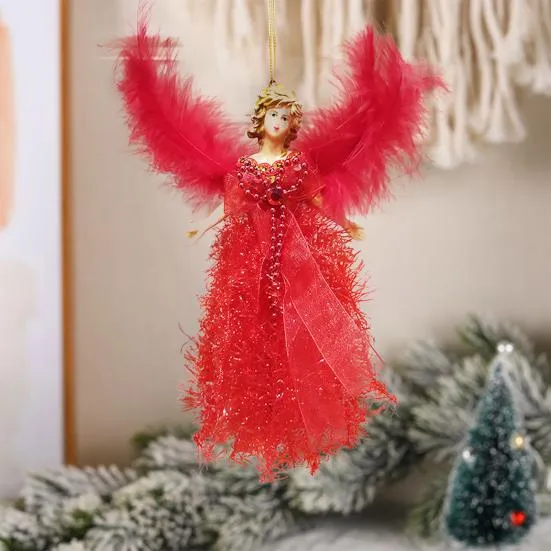
The palette sits at 60% bright red + 25% gold + 15% frosted green. Almost everything is saturated, which is why that tiny bit of frosted green in the background matters — it’s the only low-chroma note, and it gives your eye somewhere to rest. Rebuild the same formula in a different key: 60% deep burgundy, 25% antique brass, 15% sage. Same energy, more grown-up. With three saturated colors, one must be the true dominant, one supports it, and one appears only in small props. Even splits always look chaotic.
28. Handmade Angel With Pipe Cleaner Wings on a Beaded Tree
Small handmade figures like this one live between 3 and 4 inches, which is the sweet spot for a 6- to 7-foot tree. On a 9-footer, size up or cluster three together — a lone 3-inch ornament disappears at that height. Space handmade pieces roughly every 8 to 10 inches along a branch so each one gets its own air. Working with a tabletop tree instead? See Idea #30, where the same felt-and-sequin construction is scaled for a smaller display. And if you have a tall tree with only small ornaments, hang them in a band across the middle rather than spreading them thin.
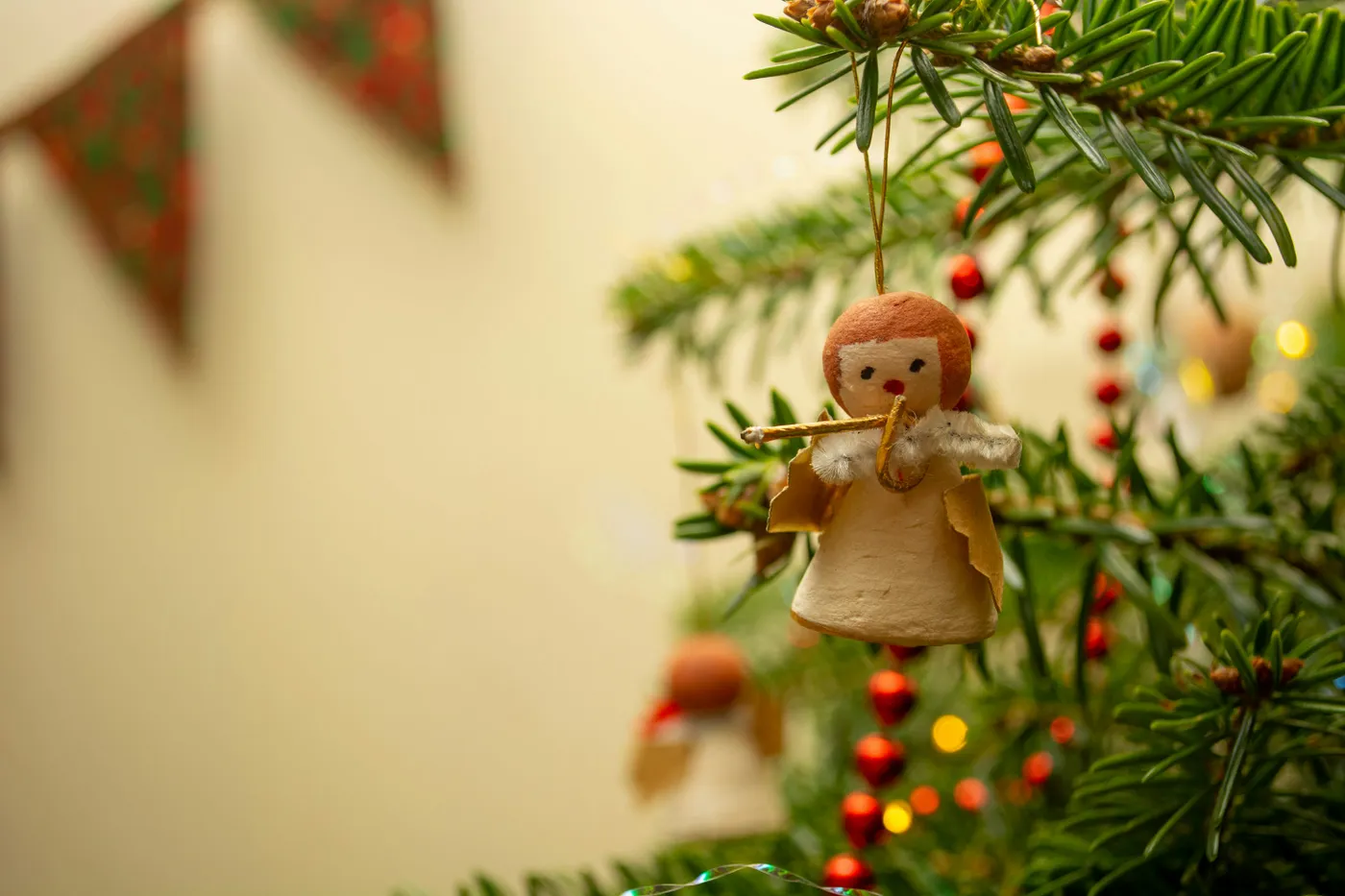
Multicolored string lights are back after a decade of nothing-but-warm-white, and they change what ornaments you can get away with. Colored bulbs flatten contrast and boost saturation, so small, brightly colored handmade pieces read as lively rather than busy. That’s why you’re seeing more red bead garlands and patterned fabric banners mixed in with craft-fair figures. It’s a nostalgia cycle, and it should hold for several seasons because it’s driven by people recreating childhood trees rather than by one retailer.
29. Silver Metallic Angels With Diamond Cutouts and Pinecones
Metallic cutwork against raw pinecones is a texture contrast you feel before you consciously notice it. Silver is smooth, cool, and reflective; pinecones are rough, warm, and matte. Put them next to each other and both get more interesting. The diamond and star cutouts in the angel bodies add a third layer — pattern — and the dark metal ring behind everything gives the group a boundary, so it reads as one composition instead of a pile. Styling a shelf? Pick one shiny object and surround it with three matte textures.
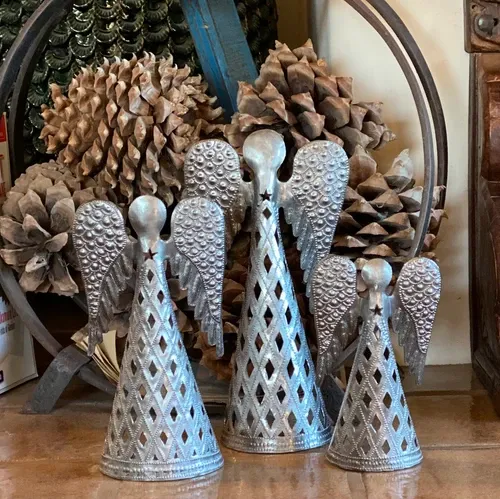
- Silver metallic angel figures (set of 3): $16–$38
- Natural pinecones, bag of 20: $8–$14
- Dark metal decorative ring: $12–$25
- Warm-toned wooden tray or board: $15–$30
- Dark green or blue velvet accent: $10–$20
Total: $61 to $127. Pinecones are free if you take a walk in November, and the ring often turns up at a thrift store for $3. That drops the realistic build to about $35, and the silver angels are the only thing you’d genuinely miss.
30. Sequin-Covered Felt Cone Angels
Everything in this set came from the dollar store except the yarn. Felt cones are $1.25 each, a mixed pack of sequins is $2, silver tinsel trim is $1.50 a yard, gold glitter cardstock for wings is $3, and a bag of small wooden beads for halos is $2. Total for six angels: about $18. For the painted faces, use craft acrylics and a fine brush — skip the plastic face forms entirely. Paint on felt holds up better anyway, and it looks less mass-produced, which is the whole point.
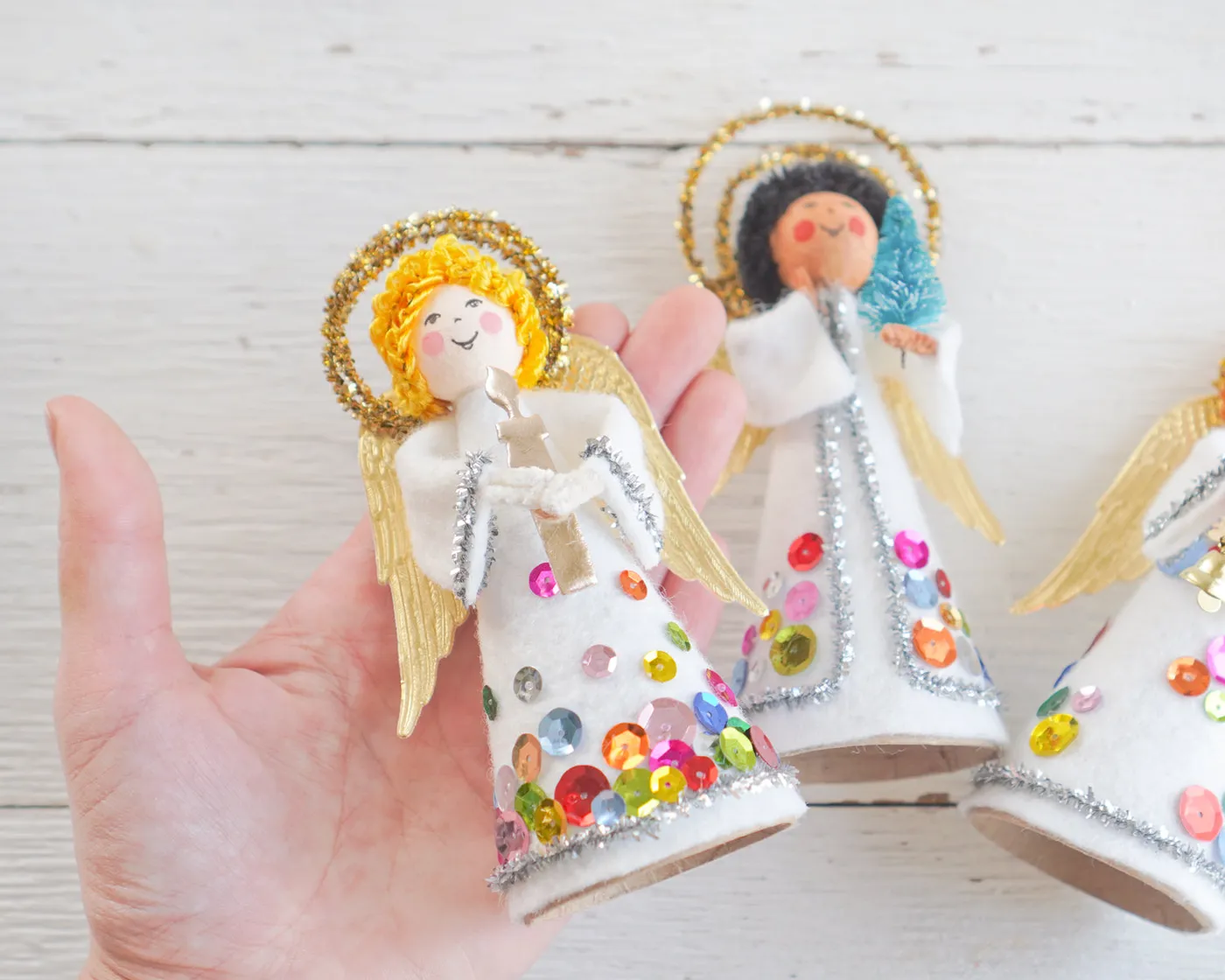
Sequins stay put if you work in rows from the bottom up and use tacky craft glue rather than hot glue. Hot glue sits on the surface and pops off within a season; tacky glue soaks slightly into the felt and forms a real bond. Place a dot, press the sequin, hold for three seconds, then move on — about one sequin every four seconds once you’re in rhythm. Overlap each row by half so no felt shows through, and alternate a few colors within each row rather than clustering them. Random mixing reads as confetti; alternating reads as design.
31. Glowing White Angel in a Knitted Hat and Sequined Scarf
Anything that glows from inside runs on batteries, and battery life in small figurines is usually 20 to 40 hours — which is most of one holiday season if you leave it on. Buy rechargeable AAAs and swap them weekly rather than letting a dim angel sit on your mantel embarrassing everyone. Check the heat, too: budget LED inserts run cool, but older incandescent inserts can warm fabric enough to soften glue. If you’re buying a lit figurine, ask whether the light source is replaceable. When it burns out, a sealed unit becomes an unlit figurine.
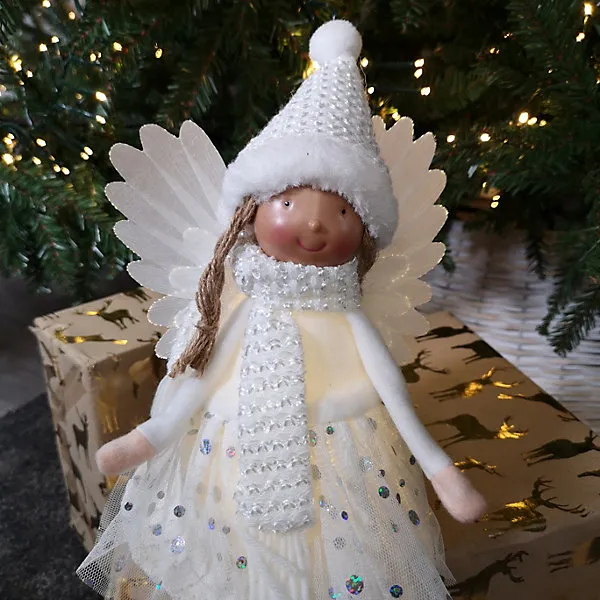
Sequined and feathered pieces need more care than anything else in your holiday box. Feathers flatten, sequins catch on each other, and iridescent finishes scratch if you look at them wrong. Store lit figurines with the batteries removed — leaking batteries ruin fabric faster than anything else that can happen. Once a season, fluff the scarf and wings with your fingers and check that no sequin has loosened enough to fall. Expect the sparkly scarf to shed for two seasons, then settle down.
32. Copper Wire Angel Strung With Paper Beads
Paper bead angels take about two hours, including bead-rolling time, and cost around $4.
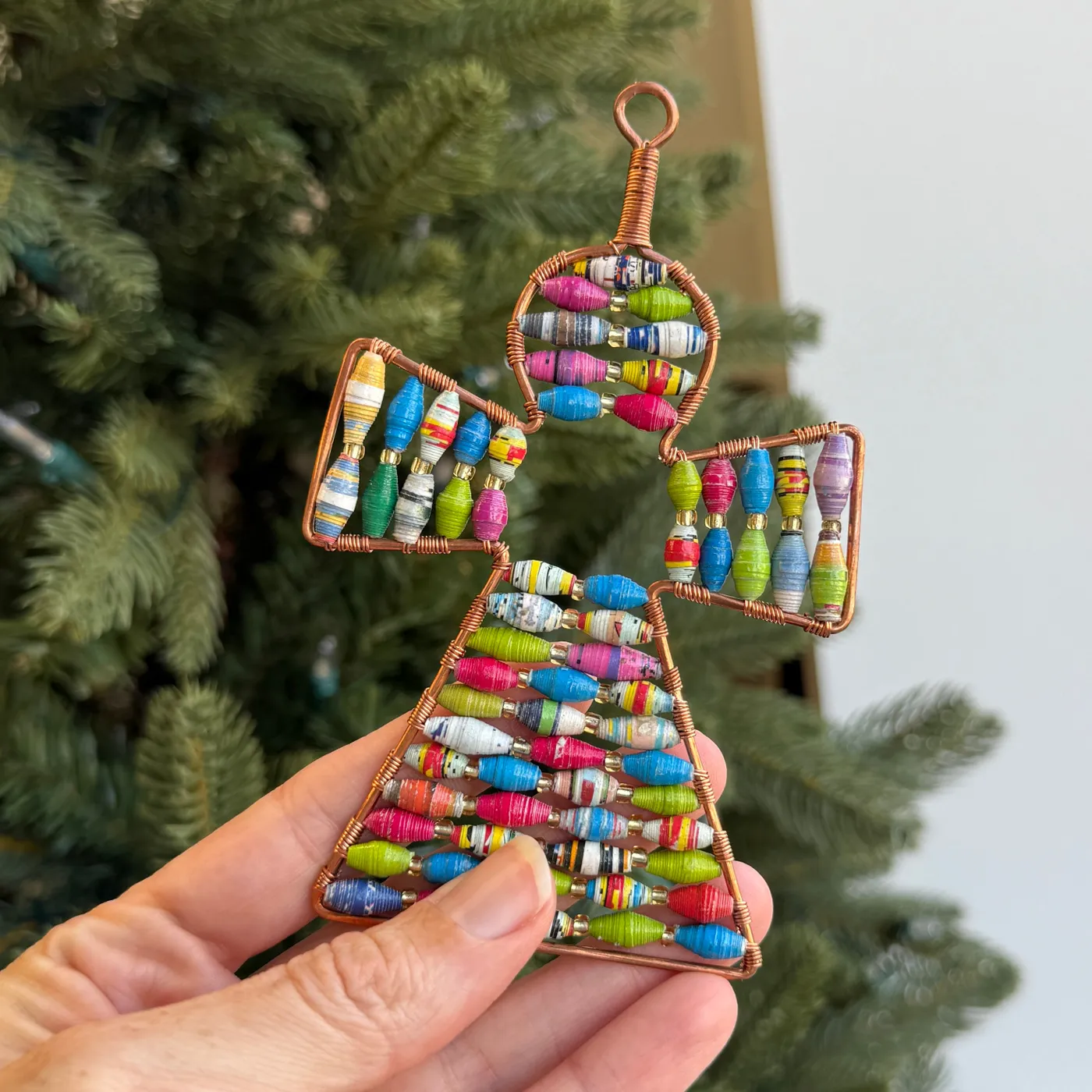
- Cut magazine pages into long triangles about 1 inch wide at the base.
- Roll each triangle tightly around a wooden skewer, gluing the last inch closed.
- Slide the beads off and seal with a thin coat of matte Mod Podge.
- Bend 20-gauge copper wire into a triangle for the body and a ring for the head.
- String the beads onto the wire frame in a random color sequence.
- Twist the wire ends together at the top and form a hanging loop.
At 3 to 4 inches tall, these are the smallest pieces in this collection and they need company. Hang them in groups of three or four within a 6-inch circle rather than spreading them across the tree — small ornaments gain visual weight through clustering. They’re ideal for a 6- to 7-foot tree, a tabletop display, or a wreath. Skip them on anything taller than 8 feet unless you’re grouping. For a similar scale that stands alone better, see Idea #26.
33. Angel in a Ruffled Purple and Gold Dress
The gold belt is the detail that pulls the whole figure together, and it’s about four inches of ribbon. Without it, the purple ruffled dress ends and the puffy gold sleeves begin with nothing in between — the eye slides from one to the other and the silhouette goes soft. A belt, a sash, or even a narrow band of contrasting fabric creates a waistline, and a waistline is what turns a stack of fabrics into a body. If you’re finishing a figure and something feels off, add the belt before you change anything else.
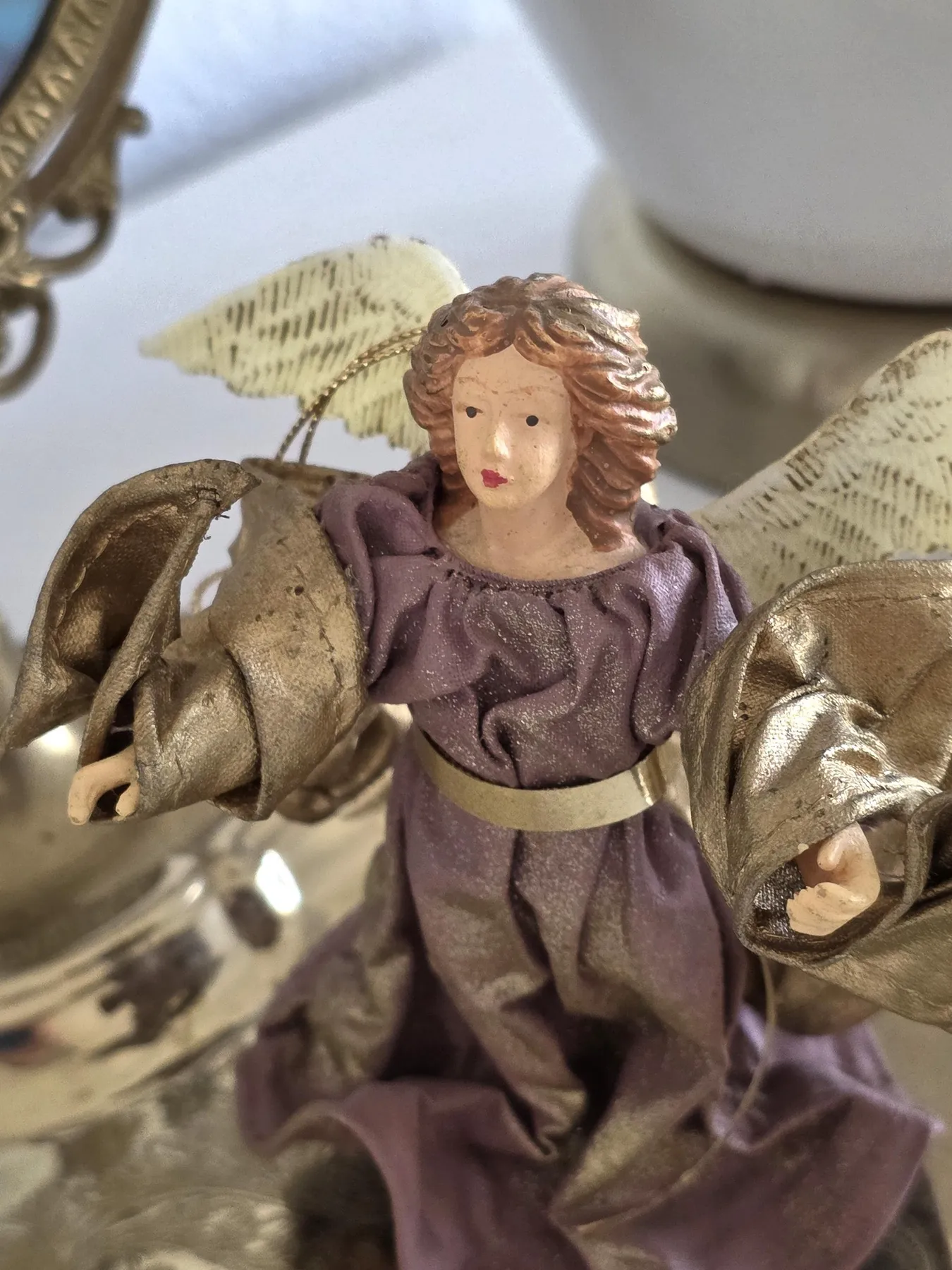
Ruffles that stand up rather than droop need interfacing. Cut your fabric strip three times as wide as the finished ruffle length, iron a lightweight fusible interfacing to the back, then run two rows of basting stitches and gather. Interfaced fabric holds the wave, so the dress reads as sculpture instead of collapsing into a puddle within a day. For puffy sleeves, use a small wad of polyester batting inside a fabric tube rather than stuffing them with scraps — you get an even shape with no lumps, and it weighs less if the figure hangs.
34. Glittered Angel With Iridescent Cellophane Wings
Iridescent cellophane is doing something no fabric can. As the wings shift, they catch different colors from different angles — so the same ornament looks pink from the sofa and green from the doorway. That changeability keeps your eye moving, which is why this figure feels alive in a way a flat felt angel doesn’t. Crinkling the cellophane before you attach it multiplies the effect, because every crease becomes another facet. The googly eyes and painted mouth add a note of humor that keeps the whole thing from getting precious.
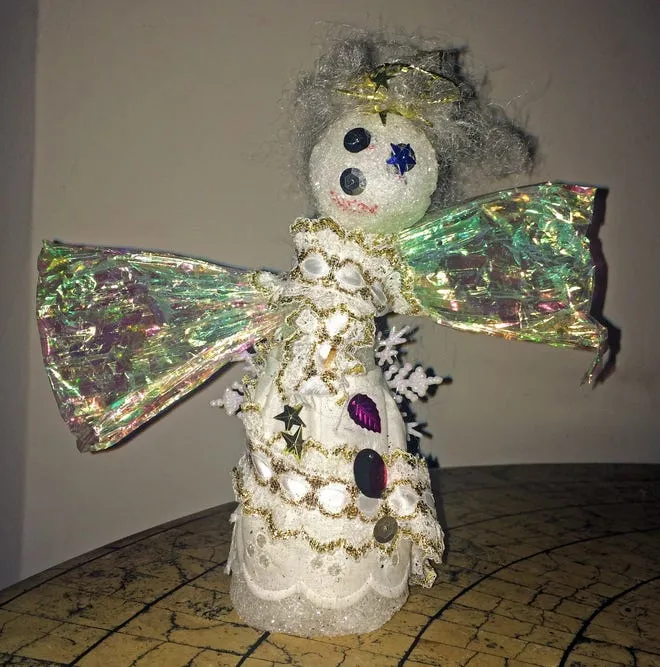
- Test-hang the figure for five minutes to check the wings don’t curl
- Confirm your cellophane isn’t stiff florist wrap, which cracks when folded
- Seal the glittered head before attaching hair, or the fluff will pick up glitter
- Plan storage now — cellophane creases permanently if it’s flattened
Upcycled materials have moved from craft-fair novelty to the center of handmade holiday decor. Cellophane wings, paper bead frames, and fabric scraps are all part of the same shift: people want decorations that don’t look like they came out of a mold, made from what’s already in the house. This figure — leftover lace, gold trim, and packaging material — is the purest version of that idea, and it isn’t a trend likely to burn out, since the appeal is the process as much as the object.
Your Handmade Angel Story Starts With One Figure
You don’t need 34 of these — you need one that makes you stop in the doorway. Start with a single felted or crocheted angel and let it teach you what your space actually wants before you order the other eleven. Then add the display base, the kraft box, the dark tray, or the matte white backdrop that makes it feel collected instead of purchased.
📌 Save this to Pinterest before you start shopping — and pin your favorite idea so you can find it again in November.