
You know the feeling — you’ve saved forty blue-and-white Christmas tree photos and you still can’t tell which one would actually work in your living room. We spent serious time browsing Etsy, HomeGoods, Target, and Anthropologie to narrow it down to 21 ideas that genuinely deliver, spanning everything from an $18 single ornament to a $640 statement display.
Inside you’ll find chinoiserie trees, flocked winter-wonderland scenes, navy-and-gold classics, and a few cheerfully eclectic wild cards — with budget and luxury versions of the same look compared side by side. In 2026, blue-and-white has moved well past the nautical thing and landed squarely in the chinoiserie lane, which is exactly why it’s one of the fastest-growing holiday palettes on Pinterest right now. And stay until the end — we break down the most common mistakes that can ruin these looks. 📌 Save this to Pinterest for later — you’ll want to revisit these ideas.
1. Three Blue and Gold Trees, One Grand Holiday Moment
Strip the ornaments off these three trees and the display still holds together. The element carrying it is the wide navy-and-gold patterned ribbon, woven horizontally through the branches instead of tied into tidy bows. It reads as one continuous band of color across all three heights, which is exactly what makes a cluster look like a single composition rather than three trees parked in the same corner. The navy gift boxes and dark blue skirt with gold trim keep that band going all the way to the floor.
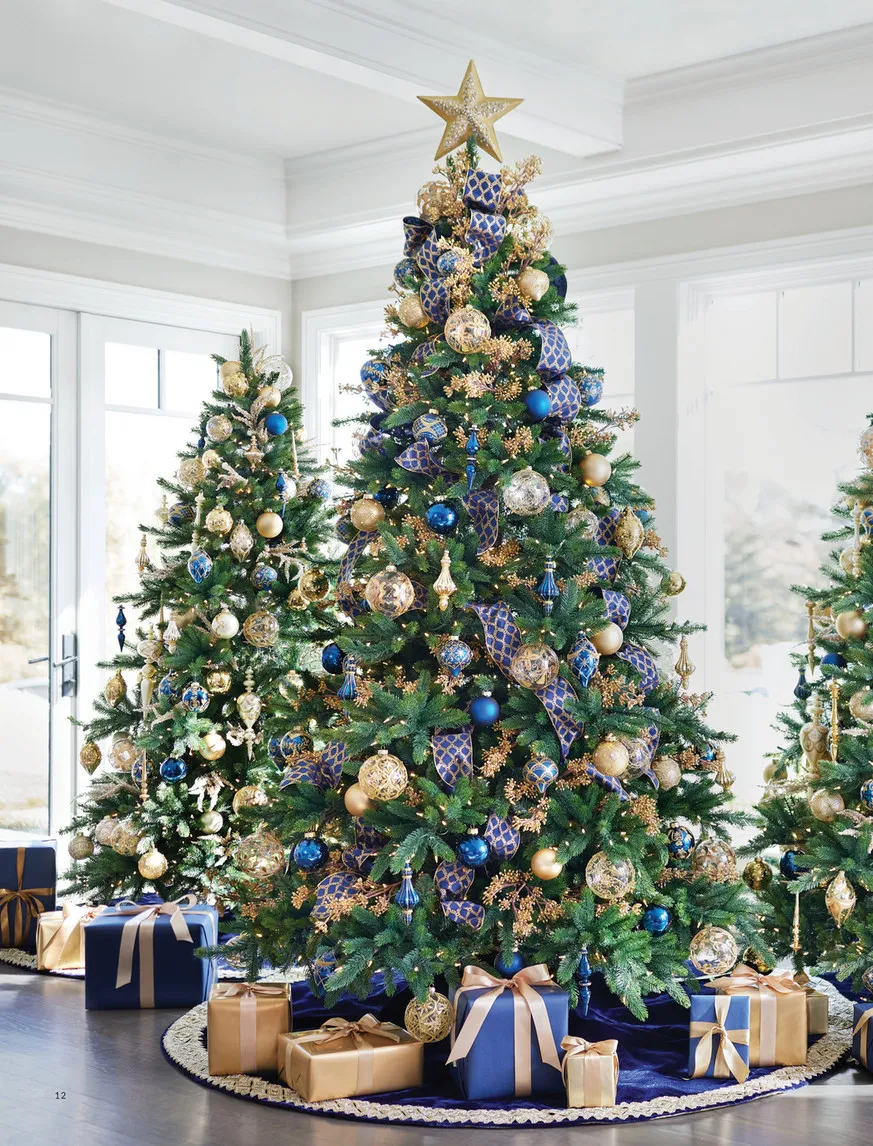
Clustered trees have been creeping back for a couple of seasons, and this is the year they went mainstream — searches for trios and “tree grove” setups keep climbing because they solve a real problem: one tall tree in a big room looks lonely. Jewel tones are riding along with it. After years of oatmeal-everything holiday decor, people want saturation again, and navy plus gold delivers it without going full candy cane.
2. Blue, Gold, and a Golden Reindeer Guarding the Gifts
The golden reindeer isn’t decoration, it’s a scale anchor. A tree this loaded with blue, gold, silver, and white ornaments needs one large, quiet silhouette nearby or the eye has nowhere to land. The fluffy white skirt does the same job at floor level — it lifts the arrangement off the ground and makes the silver and gold gifts look styled rather than dumped. Remove either one and the tree starts to feel like a store display. Compare with Idea #1 — same blue and gold palette, but arranged as a grove instead of a single tree.
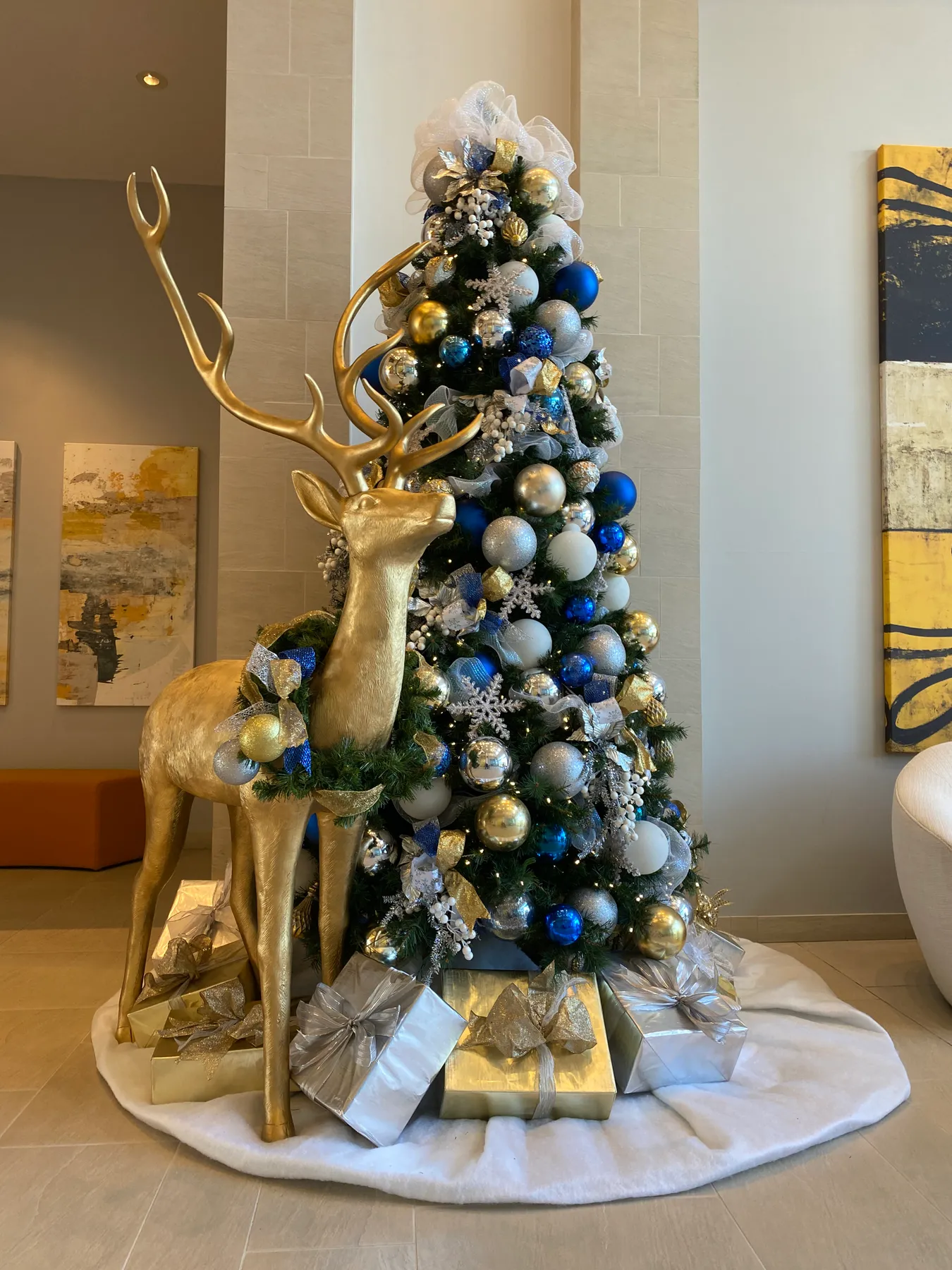
- Reindeer figure: $45–$180
- Tree and lights: $180–$450
- Blue, gold, silver, and white ornaments: $90–$220
- White faux fur tree skirt: $25–$70
- Ribbon, berries, and picks: $20–$45
Total: roughly $360 to $965. Budget alternative: shop the reindeer on January clearance or find a ceramic one at a thrift store, swap the fur skirt for a white flat sheet tucked and pinned, and buy ornaments in multi-packs of one color per year. That lands the same look near $190.
3. Frosted Blue and Silver with Sheer Ribbon Draped Just So
Sheer ribbon is the cheapest way to make a tree look expensive, but only if you weave it instead of draping it. Cut four-inch-wide sheer ribbon into three-foot lengths, then weave each piece over one branch and under the next, working down in a loose spiral. Space them every twelve to eighteen inches. Draping ribbon over the surface makes a tree look like it’s wearing a scarf; weaving it makes the ribbon look like it grew there, and it holds its shape around frosted sprigs and a glowing star topper.
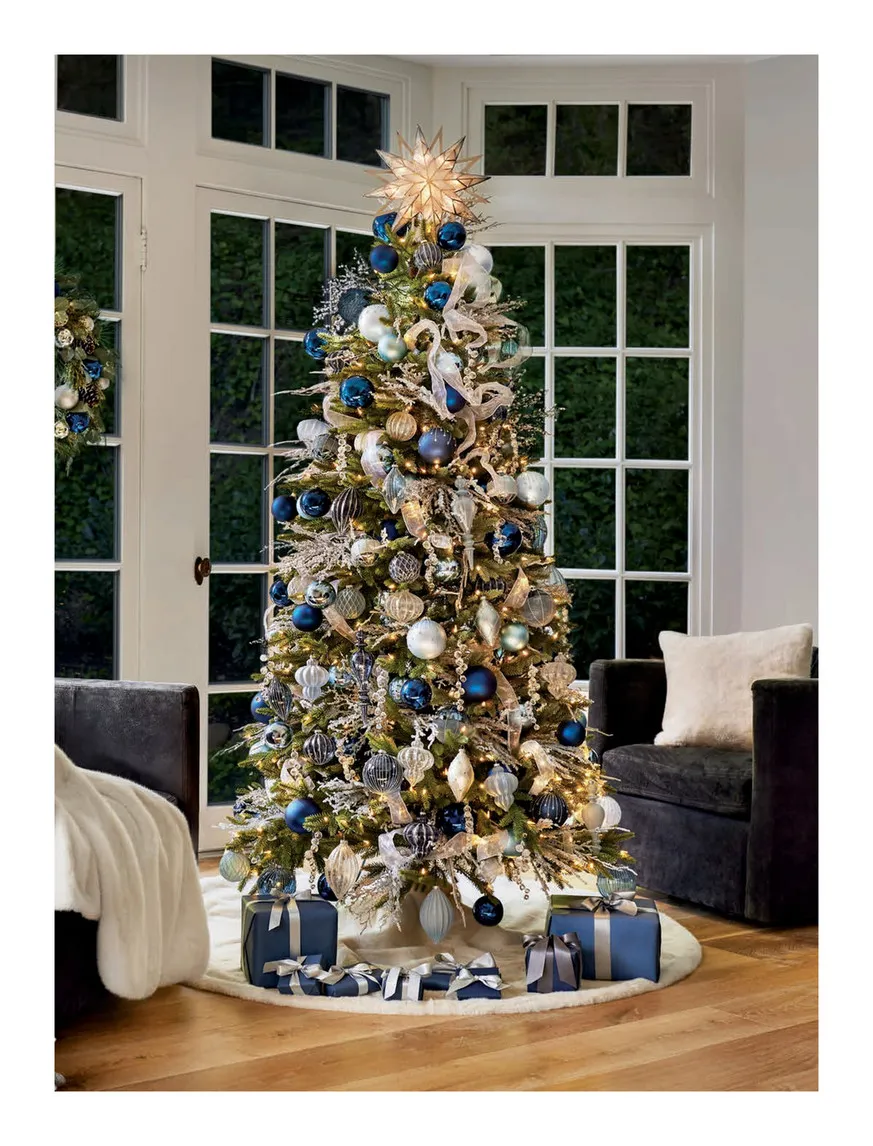
This density — frosted branches, sheer garland, a star that reads from across the room — needs vertical room. A nine-foot tree wants at least a ten-foot ceiling and ideally a twelve-by-fourteen-foot space so the fluff can breathe. In an eight-foot-ceiling room, drop to a seven-and-a-half-foot tree and skip the star for a cluster of frosted picks. See Idea #10 for a tighter-room version of the same cool palette.
4. Chinoiserie Ornaments Meet Red Roses and Ginger Jars
The formula here is 55% evergreen base + 25% blue-and-white chinoiserie + 10% red + 10% gold. That 10% is doing a lot of work: without the red roses and berry clusters, the chinoiserie ornaments go museum-quiet. Swap red for hot pink and the room turns playful; swap it for deep plum and it gets moody. Keep the chinoiserie at roughly a quarter of the total either way — past that, the tree and the mantel display start competing instead of agreeing.
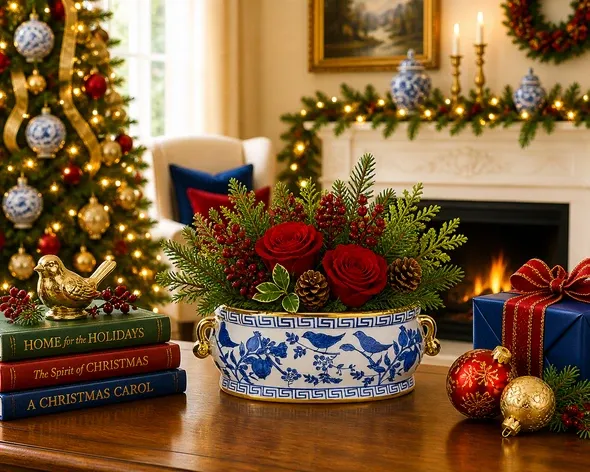
Fresh roses in December are a commitment, not a decoration. A centerpiece this size needs water every other day and a full rebuild in about five days, and the petals will drop onto a dark wood table where you’ll see every single one. If your house runs dry in winter, swap in faux magnolia, berries, and pine with a few silk peonies. Nobody at the table will know, and you’ll get three seasons out of it.
5. A Ginger Jar Planter Goes Purple-Plaid Maximalist
The look hinges on one object most people can find cheap: a blue-and-white planter. HomeGoods and T.J. Maxx run large ginger jar planters between $40 and $90, and Facebook Marketplace is full of them after every estate clean-out. Don’t buy new ceramic if you can avoid it — drop a plain black nursery pot inside a $25 oversized vase and it reads identical from across the room. Put the savings into a fuller artificial tree instead, because that’s the thing people actually notice.
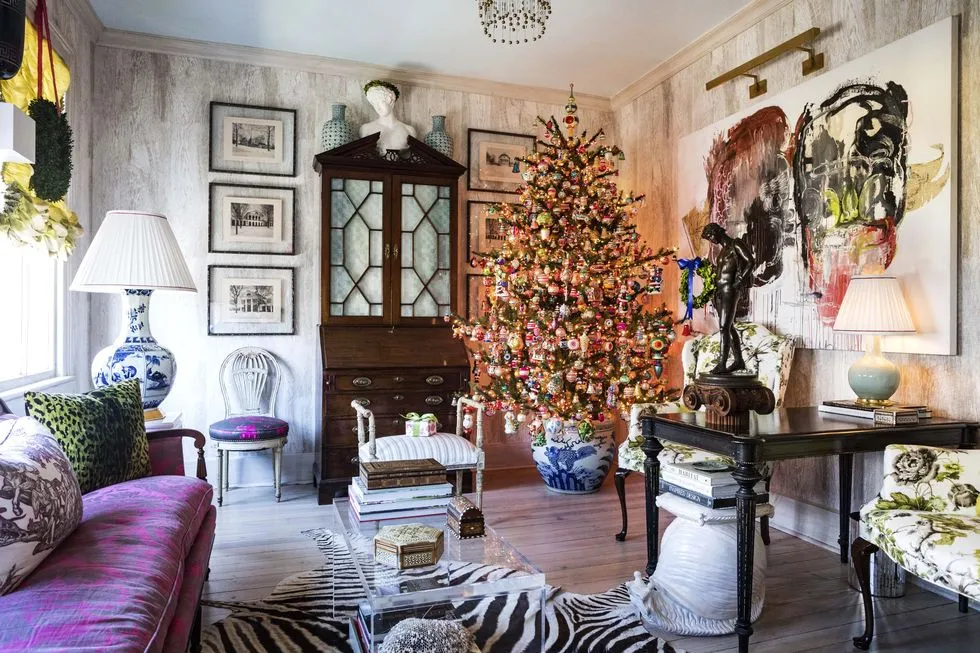
It’s the planter. A tree this heavily ornamented, sitting in a patterned blue-and-white pot in a room with a zebra rug and abstract art, gets a calm focal point below all that color. Take the pot away and you have a very decorated tree sitting on the floor. This is the same move as Idea #9, just at a much larger scale — and in a maximalist room, that base is the only thing keeping the whole corner from tipping over.
6. Flocked Branches, Magnolia Blooms, Navy Velvet Ribbon
- Cut navy and olive velvet ribbon into eighteen-inch lengths.
- Fold each into a simple loop bow — no wire, no fuss.
- Wire a white magnolia bloom to the back of every third bow.
- Tuck each cluster into the flocked branches, angled slightly downward.
- Step back three feet and pull anything that touches a bow.
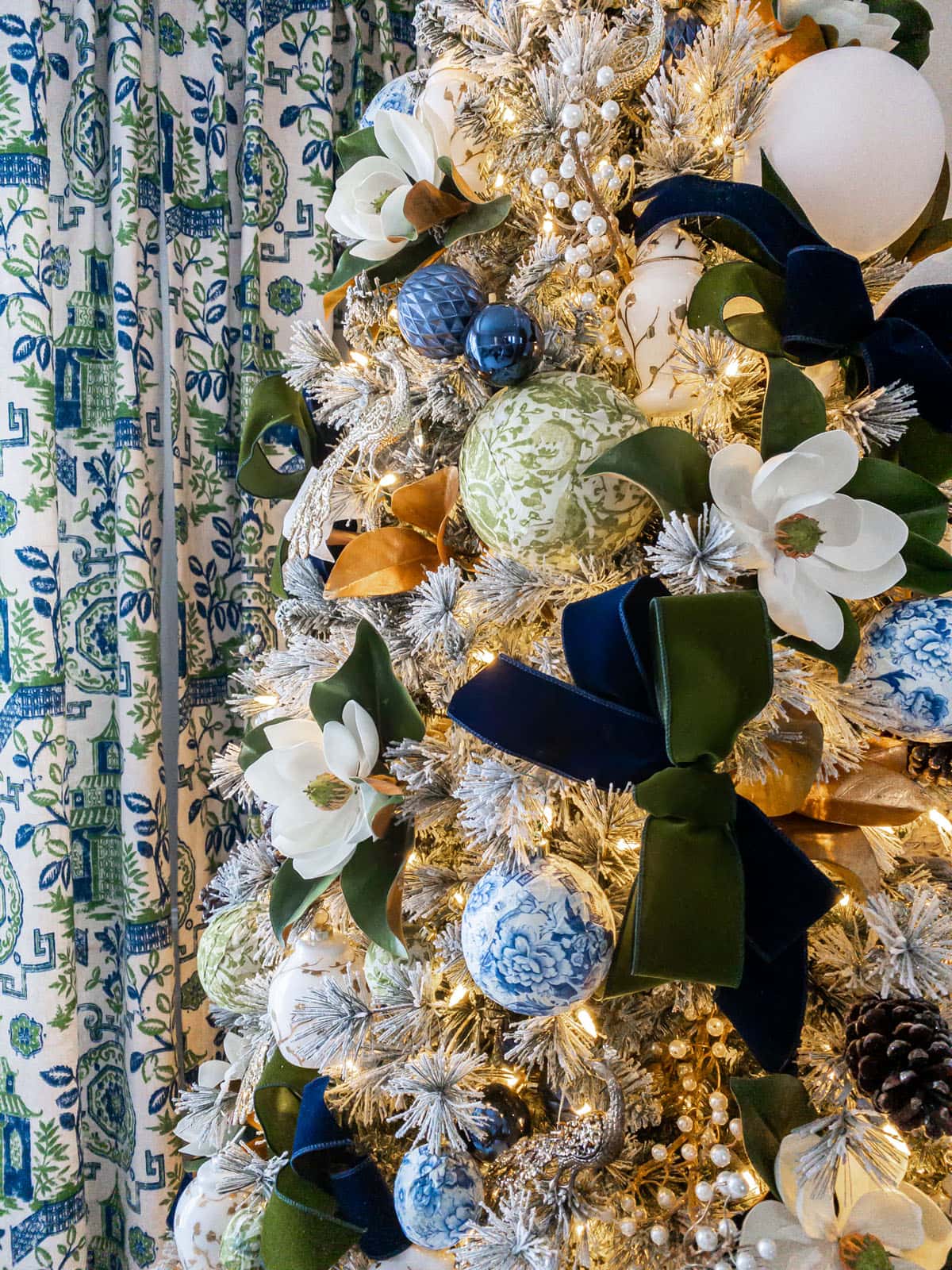
About 45 minutes for a seven-foot tree, and $40 to $70 in materials if you catch velvet ribbon on sale in November. The blue and green patterned drapes behind it are doing you a favor — they repeat both ribbon colors, so the tree feels built into the room.
Flocked trees need fewer ornaments than you think — roughly eight to ten per foot of height, not the twenty the packaging suggests. The trick with this palette is odd numbers of the loud pieces. Cluster three magnolia blooms in one spot rather than spreading six evenly around the tree; even distribution flattens a flocked tree because the white branches already supply the texture. Let some branches stay completely empty.
7. Real Evergreen Dressed in Chinoiserie and Red Berries
Chinoiserie has been the quiet powerhouse of American decorating for a few years, and it finally hit the holidays full force. The reason is simple: blue-and-white porcelain is one of the few patterns that works with a real evergreen instead of fighting it. This year’s version leans toward living trees with red berries rather than flocked white, which reads warmer and photographs better in the gray December light most of us actually live in.
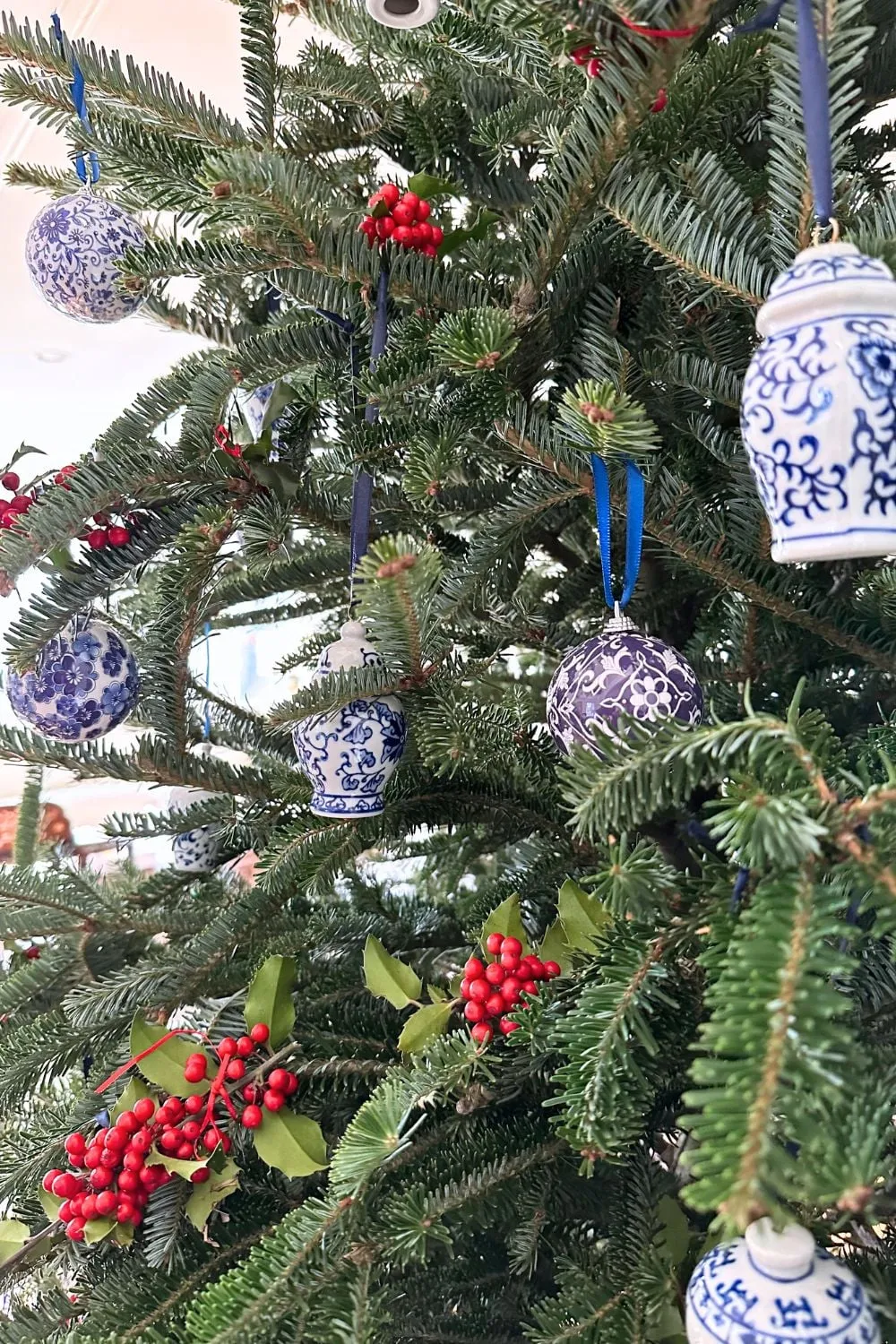
The red berries are punctuation, not decoration. They’re clustered here and there rather than spread evenly, so your eye travels around the tree instead of landing in one spot. The royal blue satin ribbons do the opposite job — they run vertically and pull the eye downward, which keeps a round tree from reading as one big ball. Warm red against cool cobalt, soft berries against sharp porcelain: classic contrast, no fuss.
8. Ceramic Ginger Jars Scaled Up to Floor Vase Proportions
- Ceramic ginger jar ornaments (six to eight): $60–$140
- Blue and white ball ornaments (twelve): $35–$80
- Large blue and white floor vase: $90–$320
- Ceramic garden stool: $80–$250
- Red berry picks: $15–$35
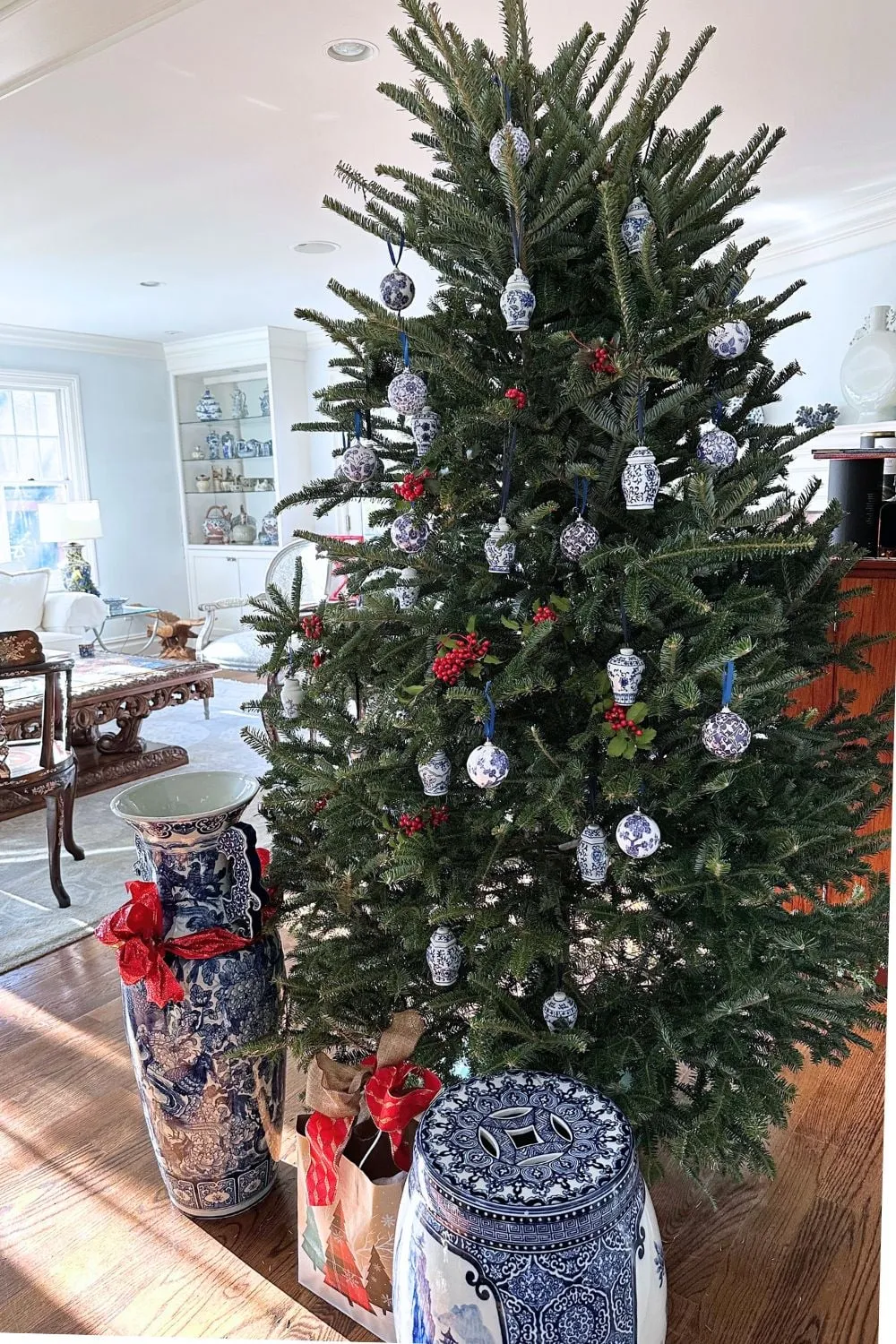
Total: $280 to $825. The budget version is genuinely good here — thrift stores turn up blue-and-white ginger jars for $8 to $20 each, and a garden stool in the wrong shade can be spray-primed and hand-painted in an afternoon for about $25.
- Measure the floor space for the vase and stool together — they need about three feet of width.
- Check whether your tree stand fits inside the vase, or plan on a five-gallon bucket liner.
- Photograph your wall color in daylight; pale blue walls make cobalt glow, green walls mute it.
- Set an ornament limit before you shop — eight jars is about the visual ceiling.
9. The Chinoiserie Planter That Replaces a Tree Skirt
Using a ceramic planter as a tree base only works if it’s sized right. The pot’s interior needs at least two inches of clearance around your stand on every side, and the pot itself should be roughly one-third the width of the tree’s widest point — so a four-and-a-half-foot-wide tree wants a fifteen-inch pot. Line it with a five-gallon bucket, sandbag the stand, and stuff the gap with burlap so nothing rattles when the cat investigates.
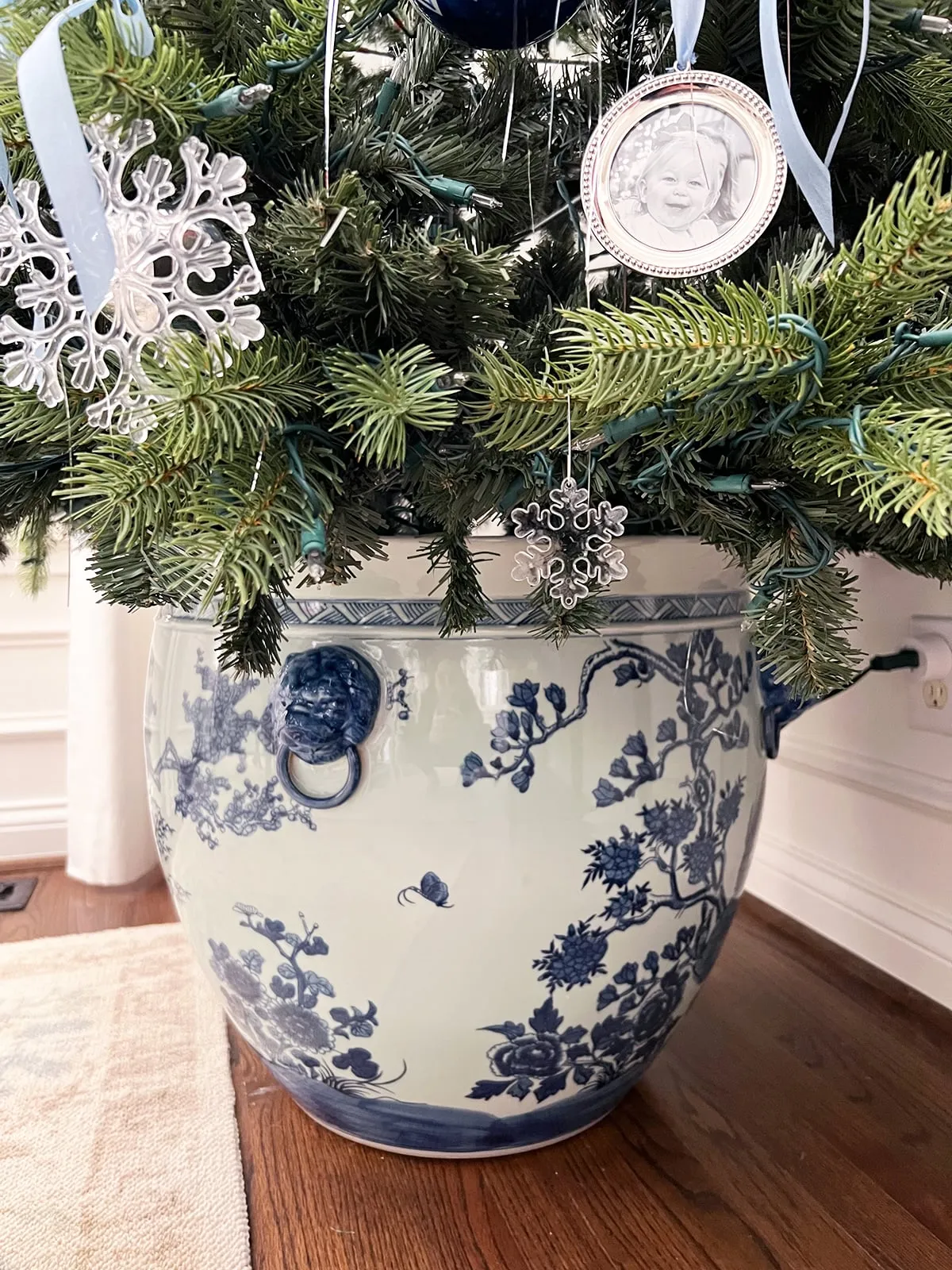
The planter is the whole idea. A tree skirt would have covered the stand just as well, but it would have vanished against the rug and left the floor feeling unfinished. This blue-and-white patterned pot carries the theme down to ground level and makes a fairly ordinary tree look collected rather than assembled. Everything above it — acrylic snowflakes, a framed photo ornament, small lights — is just support.
10. Blue and Silver Baubles with a Crate Tucked Underneath
This is the blue-and-white tree for shorter ceilings. A six-and-a-half to seven-foot tree with a two-foot footprint fits comfortably in an eight-by-ten room with eight-foot ceilings, and it still reads full as long as you vary the ornament sizes. Skip wide garland entirely and stick with fairy lights — they take up no visual space. If you’ve got a bay window or a narrow entry, a slim four-foot version with the same mix works just as well.
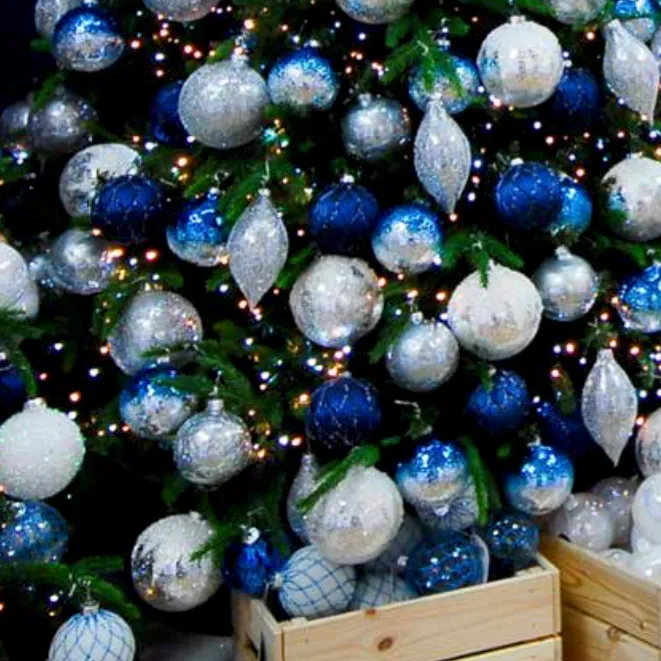
Blue and silver is the easiest palette to fake. Walmart and Target both sell sixty-piece shatterproof sets in blue and silver for under $30 each, and two sets fills a seven-foot tree — skip the specialty shops entirely. A wooden crate from a craft store runs about $12 and doubles as storage the other eleven months of the year. Want the same idea with more bite? Idea #11 takes this palette darker with navy, black, and silver.
11. Navy, Black, and Silver Against a Bold Red Wall
Matte navy and glossy black look incredible in person and slightly dead in photos — which matters if the tree is going on a holiday card. That solid red wall behind it is doing more heavy lifting than any ornament, because it’s the only reason the dark spheres read at all. Recreate the effect with warm white bulbs, not cool white, plus a lamp or candle within a few feet of the tree. Cool LEDs turn navy into flat gray and black into a shadow.
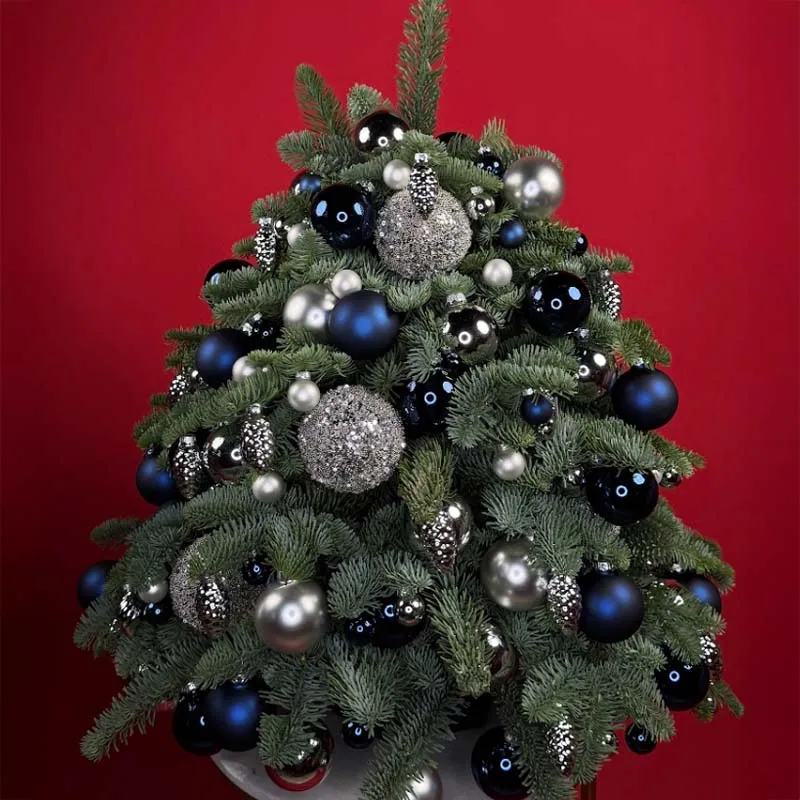
The ratio that keeps this from going goth: 55% deep green foliage + 30% silver + 15% black and navy combined. Silver is the bridge — it’s what stops black ornaments from reading as holes in the tree. Swap silver for champagne gold and everything warms up; swap it for matte white and you get a snow-and-charcoal look that suits a modern room. Keep black under 10% or the whole thing starts feeling grim.
12. A Single Deep Blue Ginger Jar Ornament, Up Close
- Hand-painted ceramic ornaments: dust with a dry microfiber cloth twice a season; never spray cleaner.
- Silver caps and chains: wipe with a jewelry cloth each January before tarnish sets in.
- Storage: acid-free tissue in a divided box, about $18 for a set that holds fifty pieces.
- Annual replacement: budget for one or two broken pieces per season with kids or cats around.
Call it $25 a year for storage and replacements. Not much — but don’t skip the acid-free tissue, or you’ll be replacing a $40 ornament instead of a $2 one.
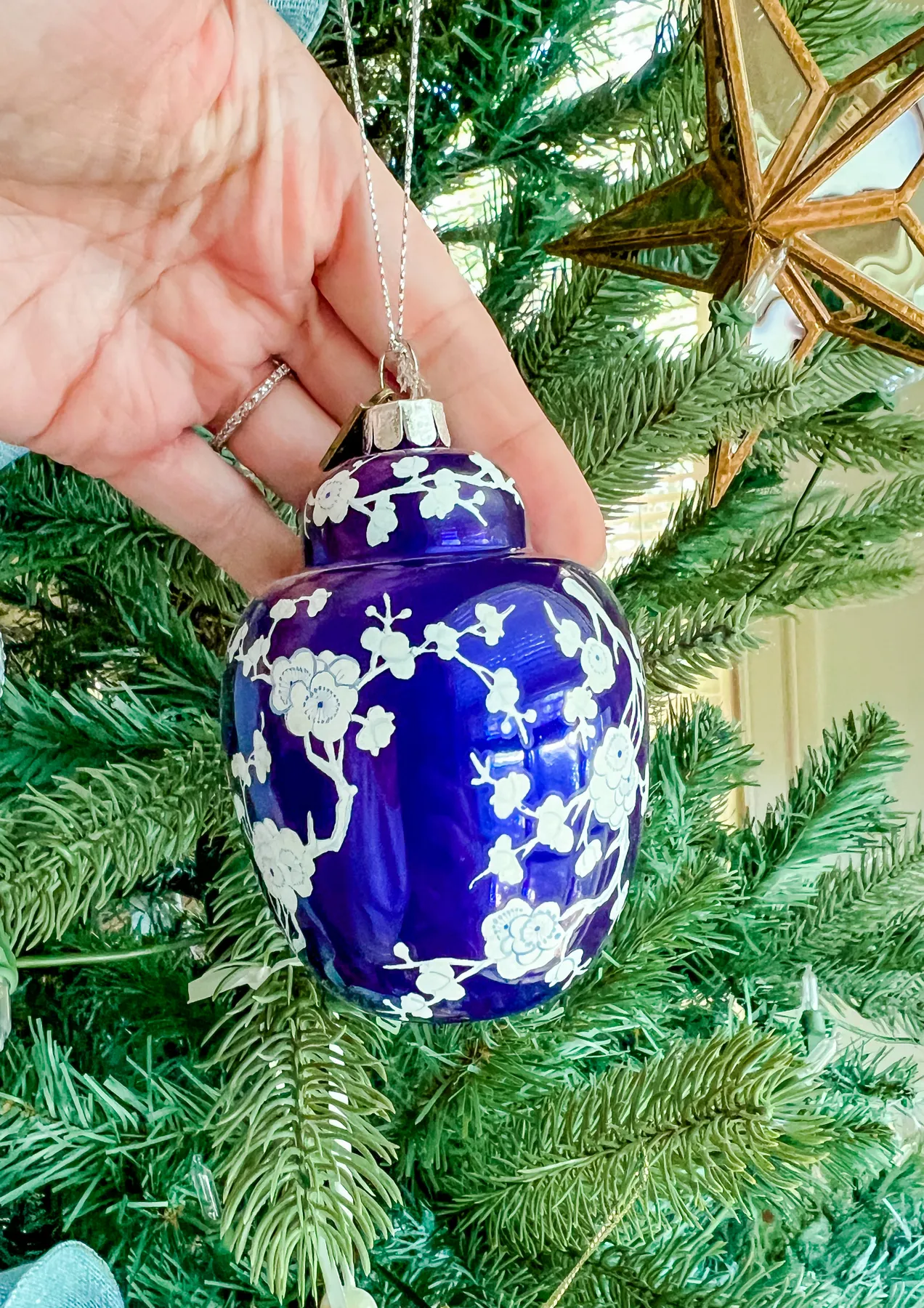
Scale is what separates a curated tree from a craft-fair tree. On a seven-foot tree, use ornaments between three and six inches, and make roughly a third of them noticeably larger than the rest. A four-inch ginger jar next to nine two-inch balls looks intentional; ten identical three-inch balls look like a set. Tuck a multi-faceted gold star among the larger pieces — small, bright accents are what fill the gaps where lights show through.
13. One Red Accent Against Navy and Black
Red next to deep blue and black shouldn’t work, and yet. The reason is temperature: this blue is cool and desaturated, the black is neutral, and the red is warm and fully saturated. That’s contrast in three dimensions at once — hue, value, and temperature — which is why the red reads as deliberate rather than clashing. Put that same red against a bright turquoise and it would look like an accident.
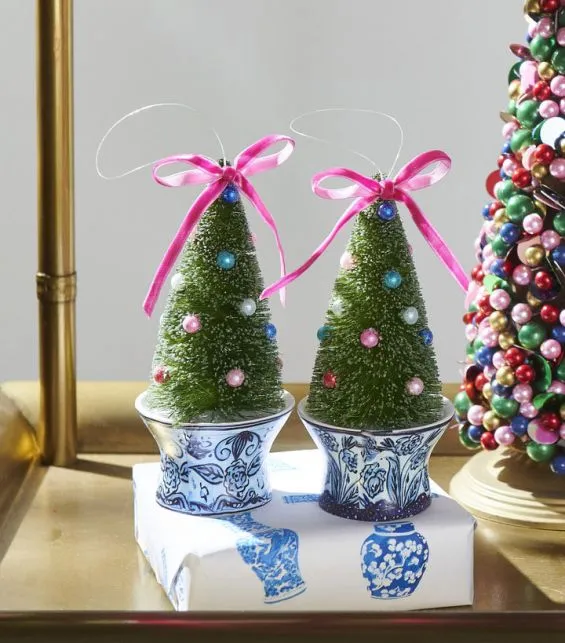
Formula: 70% deep base (navy, black, or very dark green) + 20% crisp white + 10% red, and no more. The 10% matters — figure one red element per square foot of tree, tops. Swap the red for oxblood and it gets more traditional; swap it for a saturated tomato and it turns graphic and modern. Whatever you choose, keep the white constant, because white is what stops a dark palette from closing in on itself.
14. Matte Meets Glossy: Two Navy Ornaments on a Flocked Branch
- Two-quart flocked pine picks: $12–$30
- Navy ornaments, matte and glossy: $15–$40
- Ornate silver caps or hangers: $8–$20
- Small battery fairy lights: $10–$25
- Vase or crock for the arrangement: $15–$45

Total: $60 to $160 for a mantel swag, console vignette, or entryway arrangement. Budget alternative: one $12 bag of mixed navy ornaments from Walmart plus dollar-store flocked picks gets you there for about $40.
Mix finishes at a two-to-one ratio. For every two matte ornaments, hang one glossy — that’s the pairing on this flocked branch, and it’s the difference between depth and a mirror ball. Under warm light, matte navy absorbs and reads as almost-black; glossy navy throws light back and reads royal. Three matte to one glossy is too quiet, all glossy is loud. Compare with Idea #11, where the same matte-and-shine rule plays out in black and silver.
15. A Flat Lay of Tinsel, Bottlebrush Trees, and Blue Baubles
- Start with a dark blue surface — a runner, a tray, or a tablecloth.
- Place two silver bottlebrush trees at opposite corners for height.
- Pile matte blue ornaments into one shallow bowl, not three.
- Drape blue tinsel once, loosely, in a single S-curve across the surface.
- Scatter white pom-poms last, and stop as soon as it looks uneven.

Twenty minutes of hands-on time and under $45 in materials if you already own the bowl and tray — less if you shop the post-holiday clearance.
Tinsel and sequins shed. Metallic tinsel drops fibers everywhere, and a sequined ornament will catch on knit blankets, sweater sleeves, and long hair without mercy. If you have pets, keep tinsel well above reach — it’s a well-documented hazard for cats. Bottlebrush trees shed bristles when handled, so place them once and leave them alone rather than restyling the tray every week.
16. A Winter Wonderland Tree with Owl Figurines on Navy Shelves
Flocked winter-wonderland trees used to be the thing your grandmother put up in the spare room. Now they anchor a whole scene — shelving, figurines, the works — because the Christmas-village instinct never really left, it just got edited. This year’s version skips ceramic snow babies for white owls and oversized paper snowflakes, which is cheaper, harder to break, and reads cleaner in a small room. Styling a tree as a scene has real staying power.
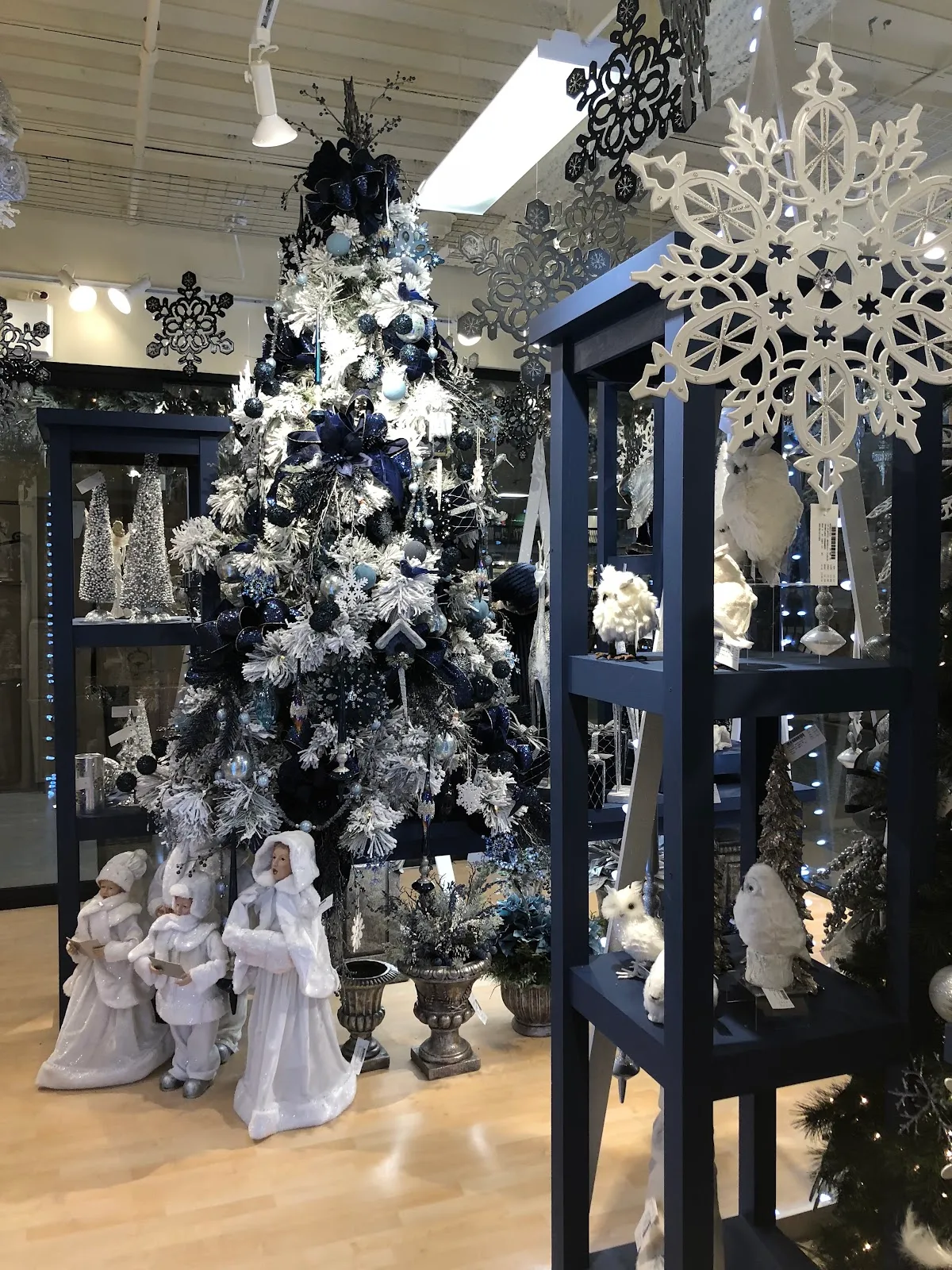
Skip the pre-flocked tree entirely. A $12 bag of flocking powder and a spray bottle of water turns a standard green tree into this look in about ninety minutes, though you’ll want to do it outside and let it cure a full day. White owl figurines run $6 to $18 at HomeGoods, and thrift stores are full of them. Paper snowflakes are a $10 set online. See Idea #17 for another way to keep the frost without buying a new tree.
17. Striped Teardrop Glass with Silver Glitter Lines
It’s the silver glitter lines. Vertical blue and white stripes alone would look like a beach towel; the thin glitter running between each stripe is what makes this ornament look hand-blown rather than printed, and it’s why it holds up next to real brown pinecones instead of competing with them. If you’re buying one statement ornament this year, buy one with texture you can see from three feet away.
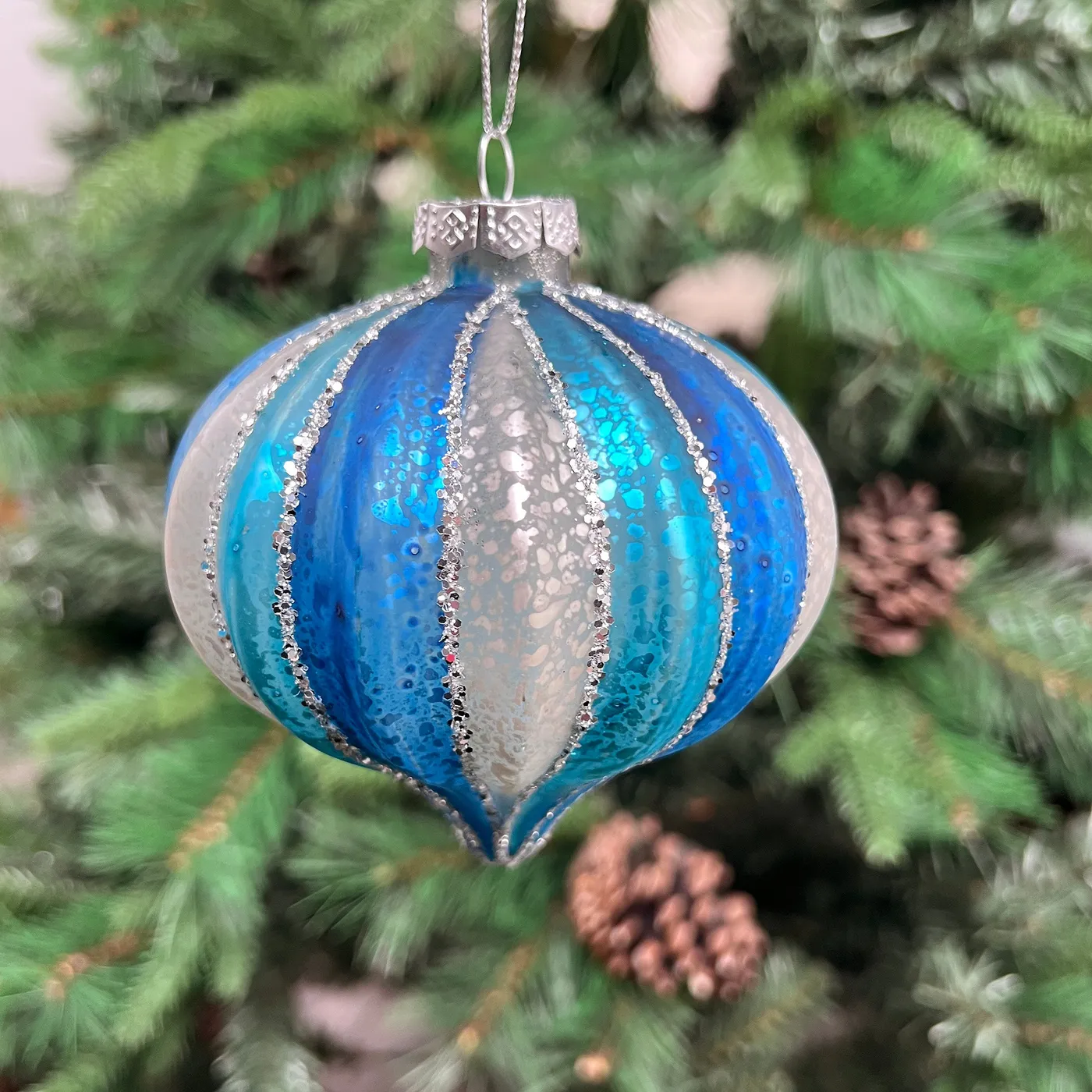
Ratio for this corner of the tree: 50% evergreen + 35% blue in at least two values + 15% silver. The two values matter — one deep royal and one light turquoise keep a cool palette from going flat, and the silver is the connective tissue. Swap the turquoise for pale aqua and it reads beachy; swap it for cobalt and you get a crisper, more classic tree. Hold silver at roughly one in seven ornaments.
18. A Warm-Lit Eclectic Tree and a Rattan Elephant Side Table
- Note which direction the sliding doors face — south and west glass will backlight the tree all afternoon.
- Measure the gap between tree and side table; you want at least eighteen inches of walkway.
- Check that the woven table can hold two loaded baskets without wobbling on smooth flooring.
- Decide whether the ornaments should compete with the rattan — if not, hold the tree to three colors.
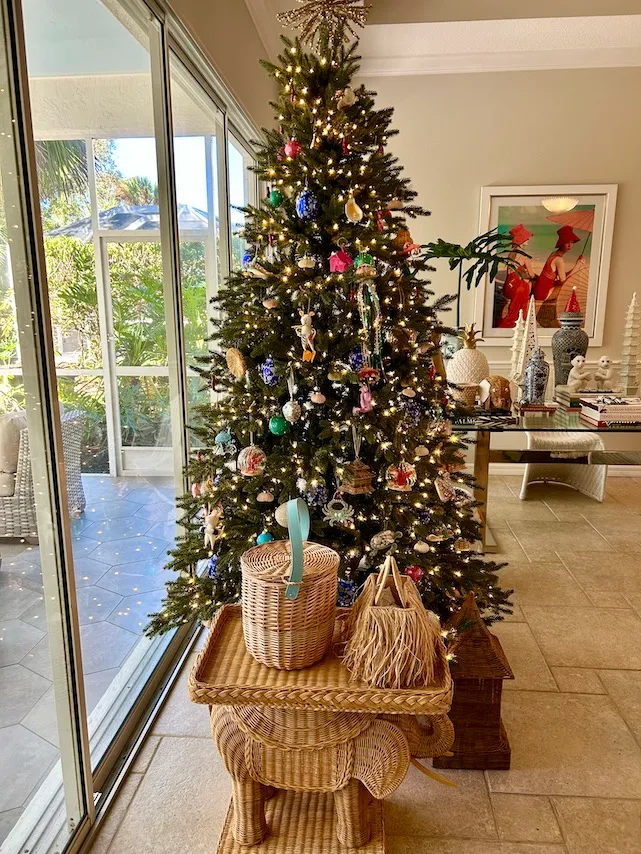
Rattan, warm white bulbs, and a few woven textures are what keep a busy, colorful tree from tipping into chaos. The warmth of the natural materials matches the warmth of the lights, so the ornaments get to be the loud part without anything fighting them. It’s also why the tree sits beside glass instead of a wall: daylight and greenery do a lot of the visual work for free, and the ginger jars on the console tie the blue back in.
19. The Hexagonal Deep Blue Ornament Styled on a Stack of Books
Aged brass tarnishes — that’s the point, but it tarnishes on its own schedule. Wipe the hanger with a dry cloth before you pack it away, and store the ornament in a small muslin bag rather than a plastic bin, which traps moisture and dulls the finish faster. Fresh pine foliage here will drop needles within two weeks; if you want this vignette up through January, use faux cedar and save yourself the vacuuming.
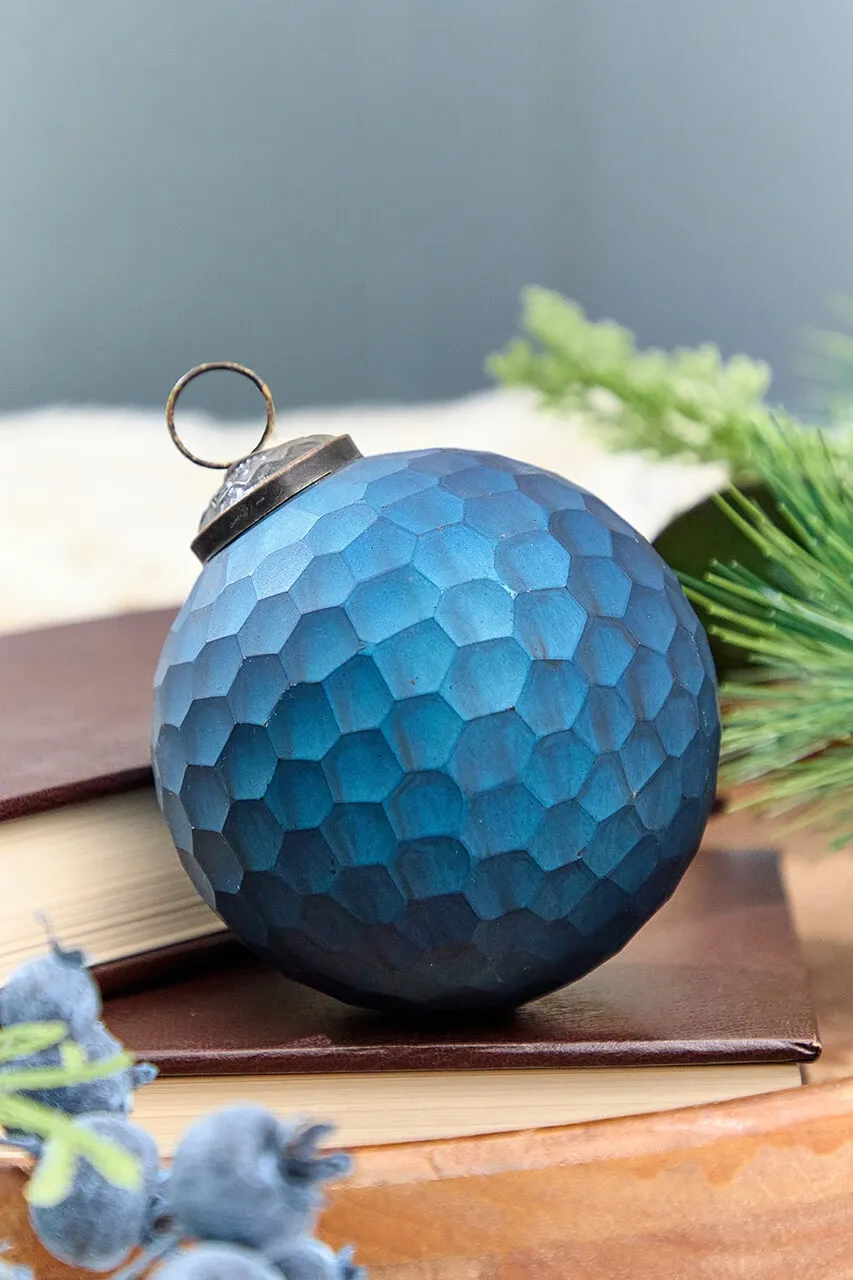
This is console scale, not floor scale. It works on a surface thirty-two to thirty-eight inches high, with the whole vignette staying under twenty inches wide so it doesn’t crowd a hallway. Anything narrower than a fourteen-inch console reads as clutter. For a bigger statement, triple the arrangement on a dining table — and if you’re dressing a full tree instead, the same deep blue goes much larger in Idea #8.
20. A Feather Tree in Deep Blue Surrounded by Jewel-Tone Glass
Feather trees are surprisingly easy to fake. Buy a small wire cone form for about $10, then layer $12 worth of dark blue feather boas around it with hot glue, working bottom to top. Vintage glass ornaments in jewel tones turn up at thrift stores for fifty cents to two dollars each — buy them by the handful and don’t worry about matching. Total outlay lands around $55 for the tree and a dozen ornaments.
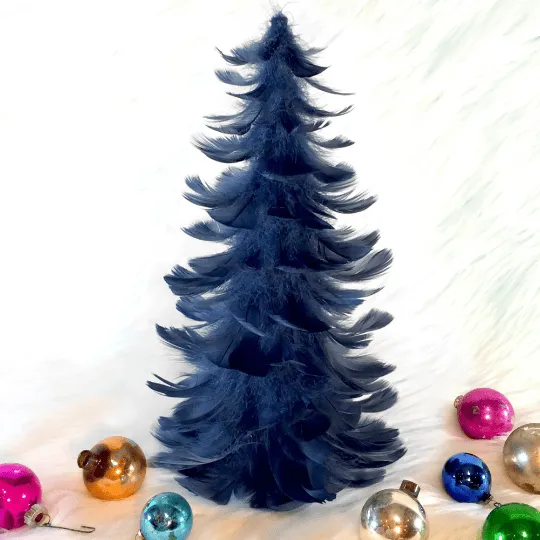
Feather trees shed, and they don’t love being touched. Keep this one on a shelf or side table where nobody brushes past it, especially with kids in the house — feathers and toddlers are a bad combination. The vintage glass is genuinely fragile, so skip any piece showing cracks around the cap. This is a display piece, not the family tree.
21. Blue Ornaments on a Black Branch Tree, Styled for Halloween
- Bare branch tree, painted black: $25–$70
- Blue ornaments (twelve to fifteen): $20–$60
- Black planter pot: $12–$35
- Faux pumpkins, white and pale orange: $15–$40
- Candle and black tablecloth: $15–$35
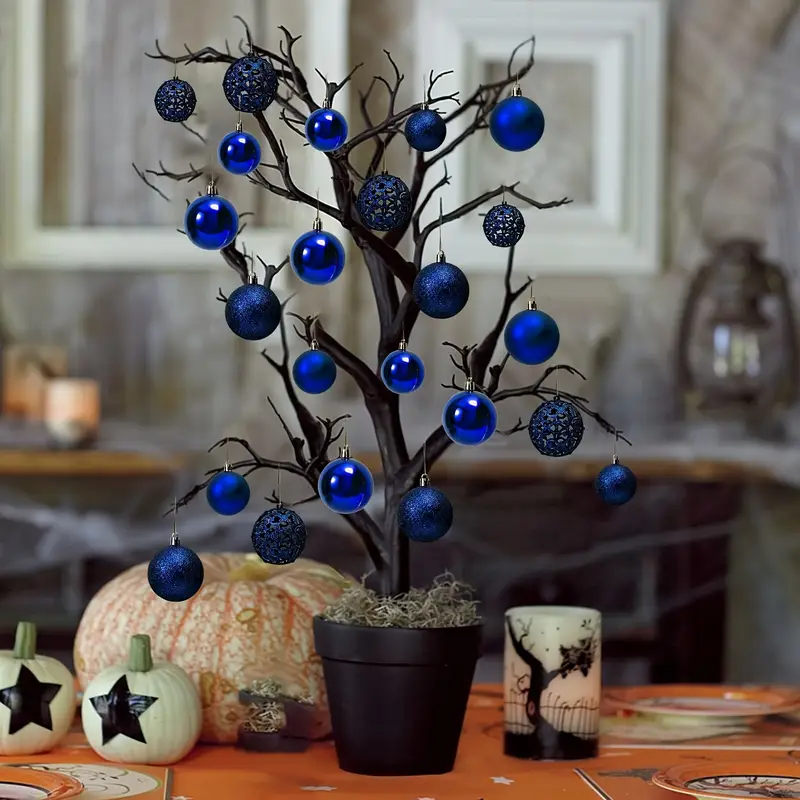
Total: $87 to $240. Budget alternative: spray-paint a branch bundle you collect on a walk, use a terracotta pot painted matte black, and buy pumpkins in the post-Halloween clearance aisle at 75% off. Under $50 if you shop in early November.
- Trim branches to a matching height and bundle them with floral wire.
- Spray two thin coats of matte black, drying between coats.
- Set the bundle in plaster of Paris inside the pot and let it cure overnight.
- Hang ornaments evenly, keeping the lowest one six inches off the pot rim.
- Style the table with pumpkins and a candle, then stop.
About two hours of hands-on time plus overnight curing — roughly $30 in materials if you forage the branches.
Your Blue and White Tree Starts With One Good Ribbon
Blue and white is one of those palettes that rewards restraint — pick your two blues, decide where the gold or red enters, and then let the tree breathe. Start with the ribbon or the planter, because those two decisions quietly set the tone for everything else you hang. 📌 Pin this guide before the holiday rush — you’ll want it back when the ornaments hit clearance in January.