
You know that feeling when you finally find a stocking setup that looks exactly right — and then you realize it needs a mantel you don’t actually have? Same.
We spent serious time browsing Etsy, Wayfair, Target, Anthropologie, and Amazon to bring you only what’s worth your attention this year, from $12 hardware to $210 heirloom holders. After filtering through hundreds of holders, stands, and hooks, we narrowed it to 32 that genuinely work in real rooms.
Inside you’ll find rustic wood stands, antique-gold figurines, modern minimalist displays, and a few gloriously whimsical character holders — with budget and luxury versions compared side by side.
2026’s biggest shift is the freestanding holder: Pinterest searches for “stocking stand without a mantel” keep climbing as renters stop drilling holes they’ll have to patch in January.
And stay with us to the end — we break down the most common mistakes that can ruin these looks. 📌 Save this to Pinterest for later — you’ll want to revisit these ideas. This post contains affiliate links; if you buy through them we may earn a small commission at no extra cost to you.
1. Antique Gold Snowflake, Deer & Snowman Stocking Holders
- Four antique-gold stocking holders: $30–$95 total, or $4–$12 each thrifted
- Chunky knit stockings in red, green, and cream: $25–$70 each
- Evergreen garland with red berries and pinecones: $35–$90
- Pinecone-and-cotton wreath: $25–$60
- Touch-up paint for the mantel: $0–$40
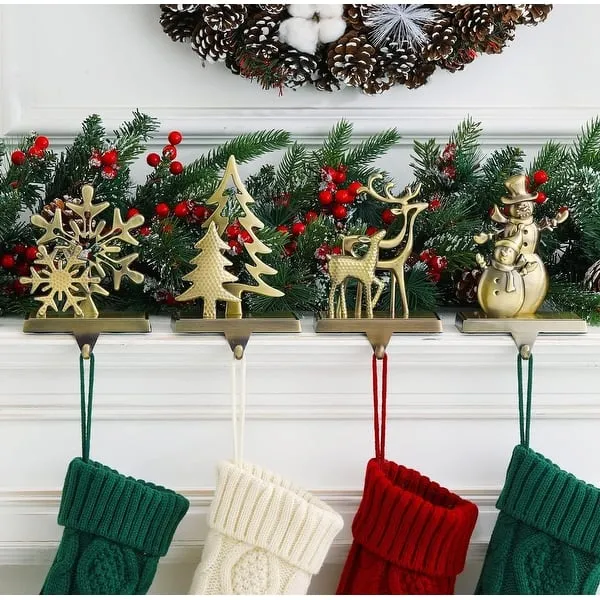
Budget alternative: hit the thrift stores in early January for the figures at $3–$5 each, buy one $18 garland and tuck in pinecones from the yard, then sew stockings from clearance knits at $8 apiece — about 55% less for the same look.
Four mismatched antique-gold figures — a snowflake, a tree, a deer, a snowman — stand on a white mantel above chunky knit stockings. It works because they’re a set without being a matching set. Remove any one and the lineup collapses into three random objects.
The magic is that each figure carries the same visual weight: same finish, same scale, same height. Collect them over years from after-Christmas sales, and the gold finish does all the unifying for you.
2. Hanging Stockings With Zero Nails and Zero Hangers
Do the math before you buy. A stuffed chunky knit stocking weighs 2–4 pounds; add a paperback, a phone charger, and a bag of candy and you’re at 6–8 pounds. A weighted holder needs at least a 4-inch-wide footprint and roughly a quarter of that load in its own mass. Anything lighter rolls off the moment someone tugs the toe.
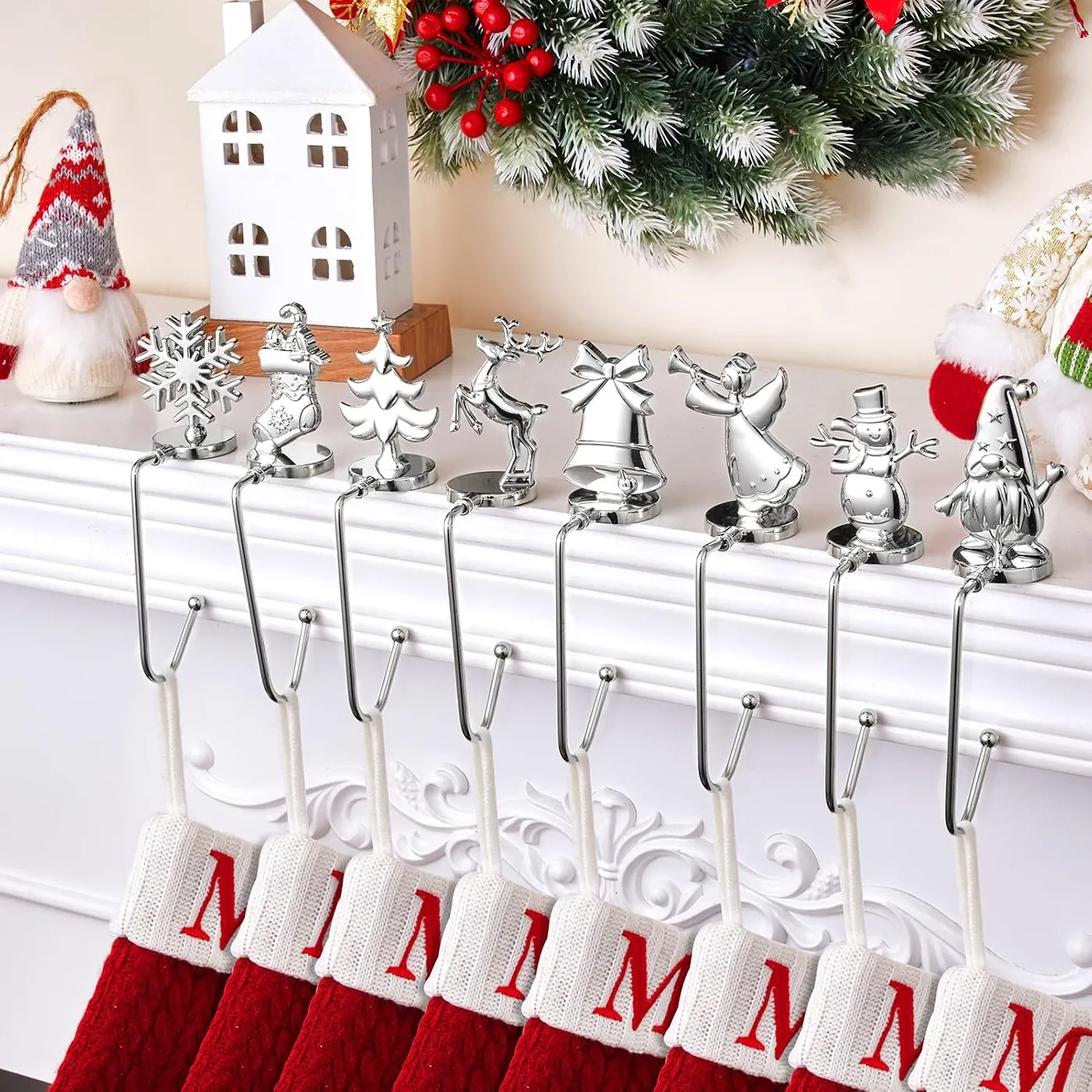
No-nail setups are brilliant in rentals, but nothing is anchored — a dog’s tail or a two-year-old can take the whole arrangement down in one happy lunge. Keep heavy items tucked in the cuff pocket rather than the toe, and set freestanding holders on a rug or felt pad so they don’t scratch hardwood.
If you have pets or toddlers, this is the year to hang stockings higher than you think you need to. Your shins will thank you in February.
3. Three Golden Nutcrackers, Three Plaid Stockings
The formula here is 45% white mantel + 25% deep green garland + 20% red-and-green plaid + 10% gold. That last 10% does all the heavy lifting — the three golden nutcracker figures, the matching golden hooks, and the warm light threaded through the greenery all live in that band.
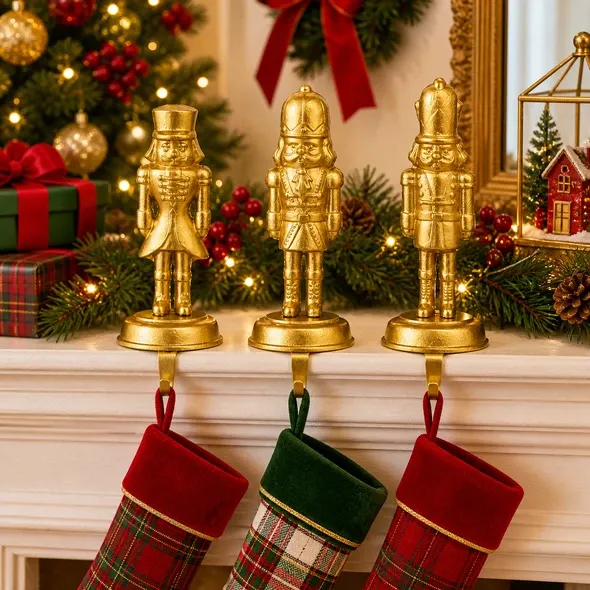
You can swap it without breaking it: keep the ratios, change the metal to matte black and the plaid to black-and-white buffalo check. Same structure, entirely different mood.
Three is the number that makes this work. Designers lean on odd numbers because the eye can’t pair them up and move on — it keeps circling. Here, three identical nutcracker silhouettes repeat at the same scale, which reads as deliberate rather than collected.
The second principle is contrast of finish: glossy plaid next to matte greenery next to metallic gold. And notice the garland never crosses in front of the figures — the holders sit forward of the greenery so nothing gets swallowed.
4. No-Mantel Solutions That Still Feel Like Christmas
Building a wall-mounted hook rail is a 45-minute project, and it’s the most flexible option in this whole list.
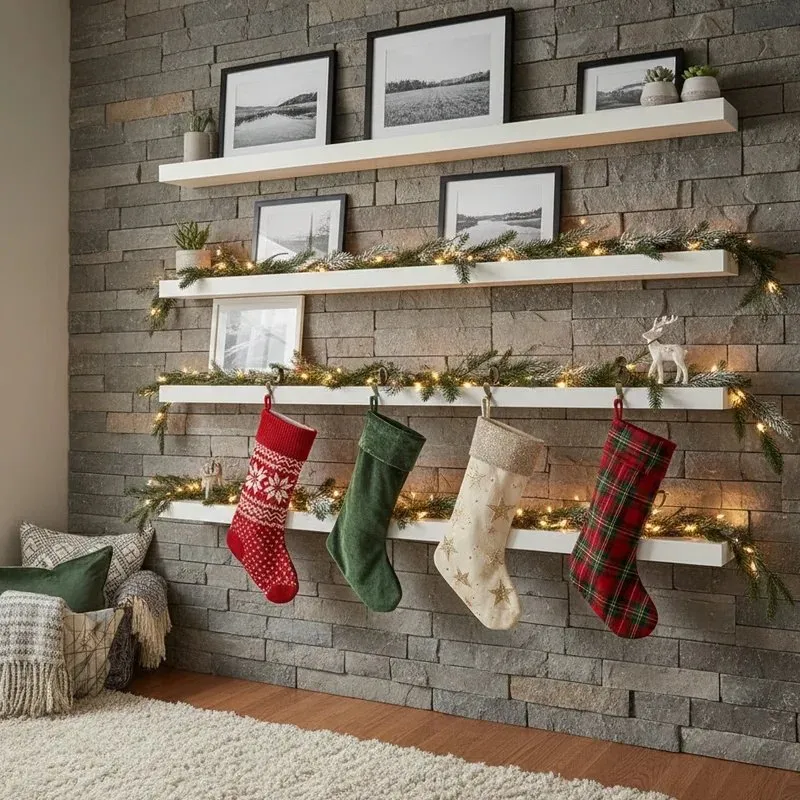
- Locate studs with a magnetic stud finder and mark two points 32 inches apart.
- Paint a 1×4 pine board to match your wall, then sand the edges slightly so it reads custom.
- Mark hook positions 8–10 inches apart and pre-drill pilot holes.
- Screw three brass or black hooks into the board with 1-inch screws.
- Secure the board into the studs with 2.5-inch screws, then caulk the seams with paintable caulk.
Total materials: $25–$42. Let the caulk cure before you hang anything heavier than a hand towel.
You need at least 30 inches of clear horizontal wall and one unobstructed section with no outlets or light switches. Standard 8-foot ceilings are fine; below that, keep the rail at 46–50 inches from the floor so full stockings don’t graze the baseboard.
Wide, low spaces do better with a freestanding stand; narrow hallway and entry walls are the sweet spot for a rail.
5. A Modern Mantel That Doesn’t Try Too Hard
The “quiet mantel” has been building for three seasons: asymmetric greenery, a handful of ornaments, one sculptural focal point, and light that’s warm rather than bright. It’s a reaction to a decade of maximalist Christmas content — people got tired of buying ninety ornaments and storing them eleven months.
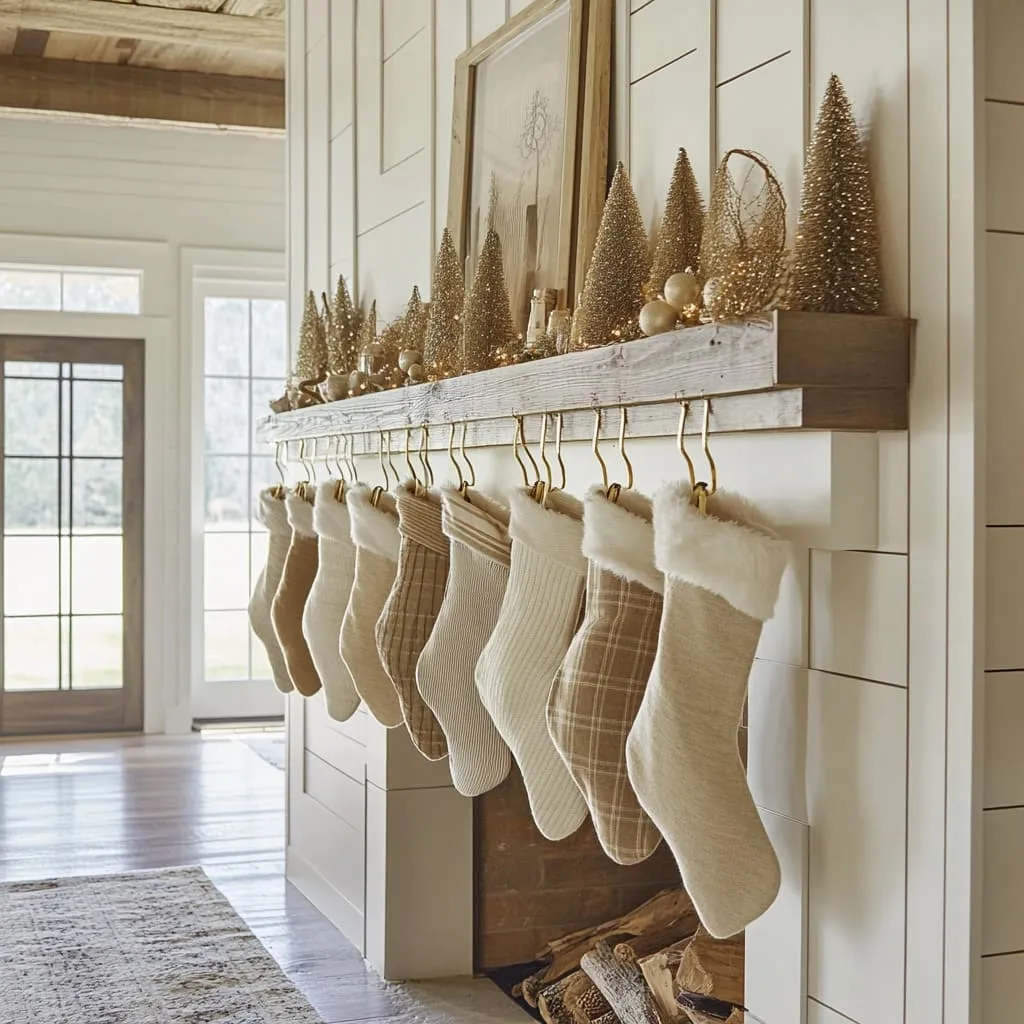
It has staying power because it’s cheap to maintain. You’re not chasing a new color every year; you’re editing down what you already own and adding one or two pieces that feel intentional.
- Measure your mantel’s depth — most holders need 8 inches of flat surface to sit stable.
- Note where your outlets are before you fall in love with a lit garland.
- Count how many stockings you’re actually hanging this year, not how many you own.
- Cap yourself at three colors. Four is how mantels get cluttered.
- Photograph the mantel empty so you can see what you’re working with.
6. A Freestanding Rustic Wood Stand That Goes Anywhere
You don’t need a $200 retailer stand. A leaning wooden ladder from Facebook Marketplace runs $15–$30, and two 2x4s plus a 1×6 board will cost about $18 at a home center if you own a saw. Hang three stockings from the rungs with S-hooks ($6 a pack), drop a $14 woven basket underneath, and pick up knit stockings from Walmart at $10 each.
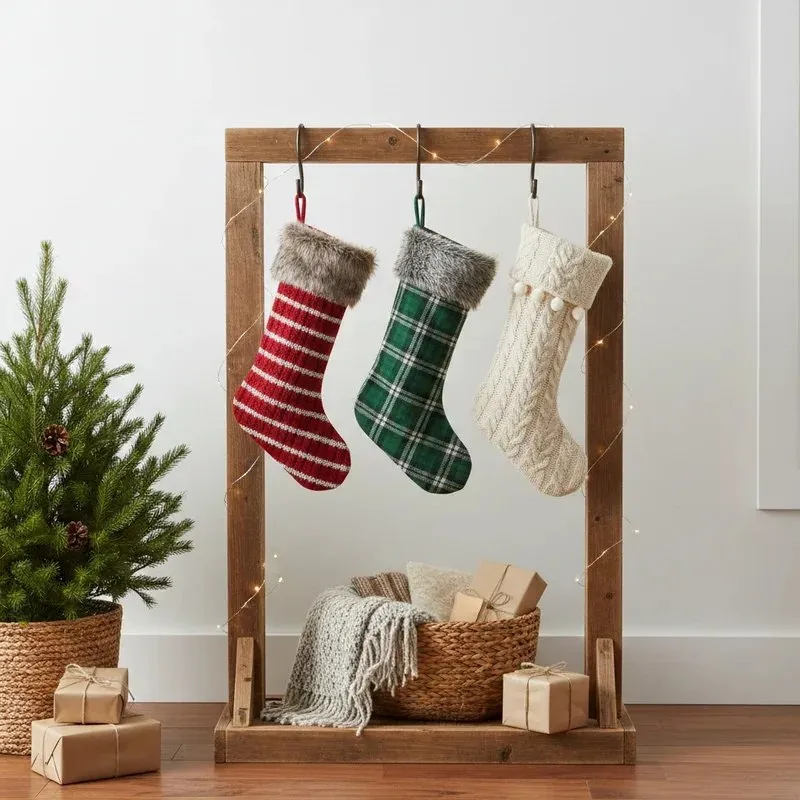
Whole setup: $55–$85, versus $200–$350 for the styled retail version. Nest a $12 string of fairy lights along the frame and nobody will know the difference.
Faux fur cuffs and knit stockings are magnets for pet hair — keep a lint roller in the hall closet and hit them once a week through December. String lights are the other maintenance item: cheap sets fail about every other season, so buy one spare strand and keep it in the box.
Raw wood stands need a wipe-down with a dry cloth, never a wet one, and don’t park one against a heat vent or radiator — the wood will cup and the stand will start to wobble.
7. Brass Hooks on Pale Wood, Bells Above
Space your hooks 8–10 inches apart and cap yourself at four per mantel. More than four and the stockings overlap, which reads as crowded even in a big room. Then check the drop: the top of each stocking should sit 2–3 inches below the mantel edge — not level with it, and not hanging so low it swings into the hearth.
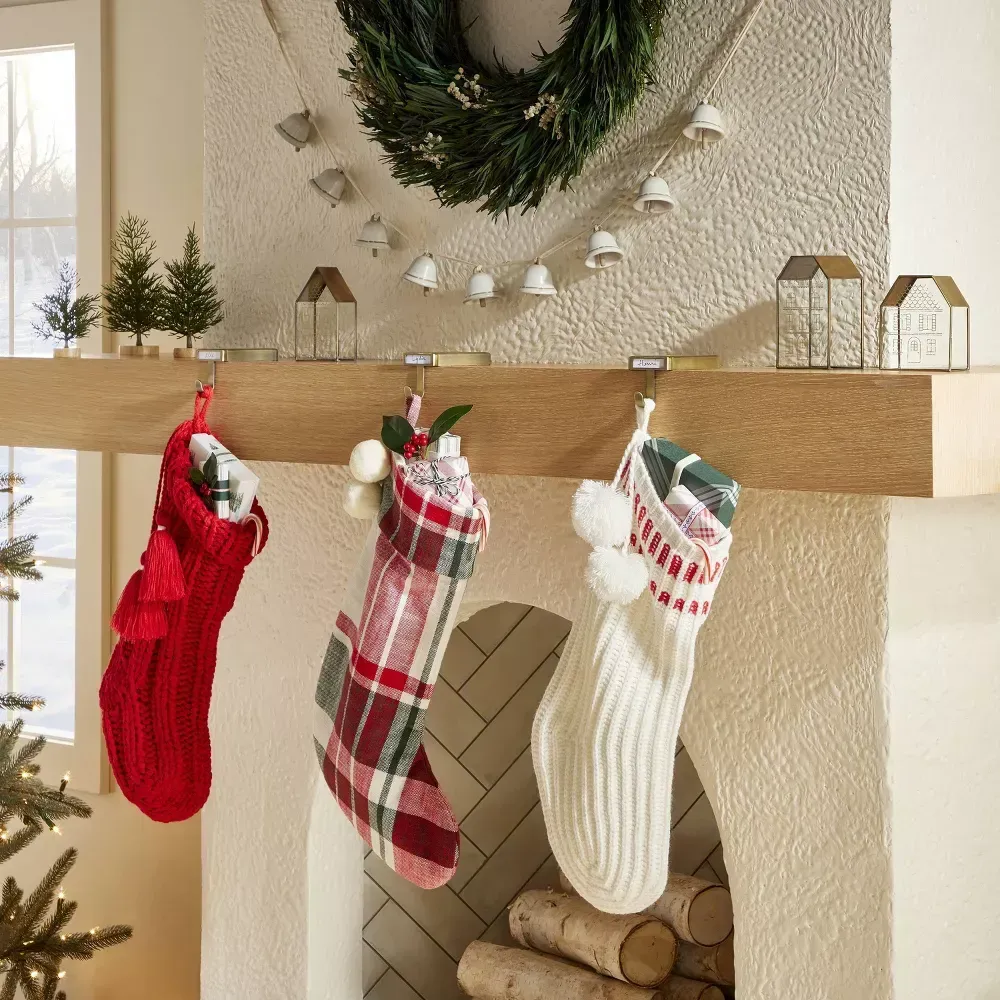
Mix three textures but only three colors. Here it’s a red knit with tassels, a red-and-white plaid, and a cream knit with pom-poms — three textiles, one tight palette.
- Brass-toned over-the-mantel hooks: $8–$18 each (three to four needed)
- Knitted and plaid stockings: $18–$45 each
- White bell garland: $15–$35
- Miniature evergreen trees and metal houses: $25–$70
- Greenery picks: $12–$30
Budget alternative: skip the bell garland and clip $6 jingle bells onto a $10 garland with floral wire, then hunt metal houses at a thrift store in January for a couple of dollars apiece.
8. Sleek Freestanding Stands for Minimalist Rooms
Modern freestanding stands photograph beautifully and wobble in real life. They need a genuinely level floor — an eighth of an inch of slope and the whole thing lists. On hardwood, a weighted metal base will also scratch unless you add felt pads, and matte black or brushed metal shows fingerprints faster than anything else in your house.
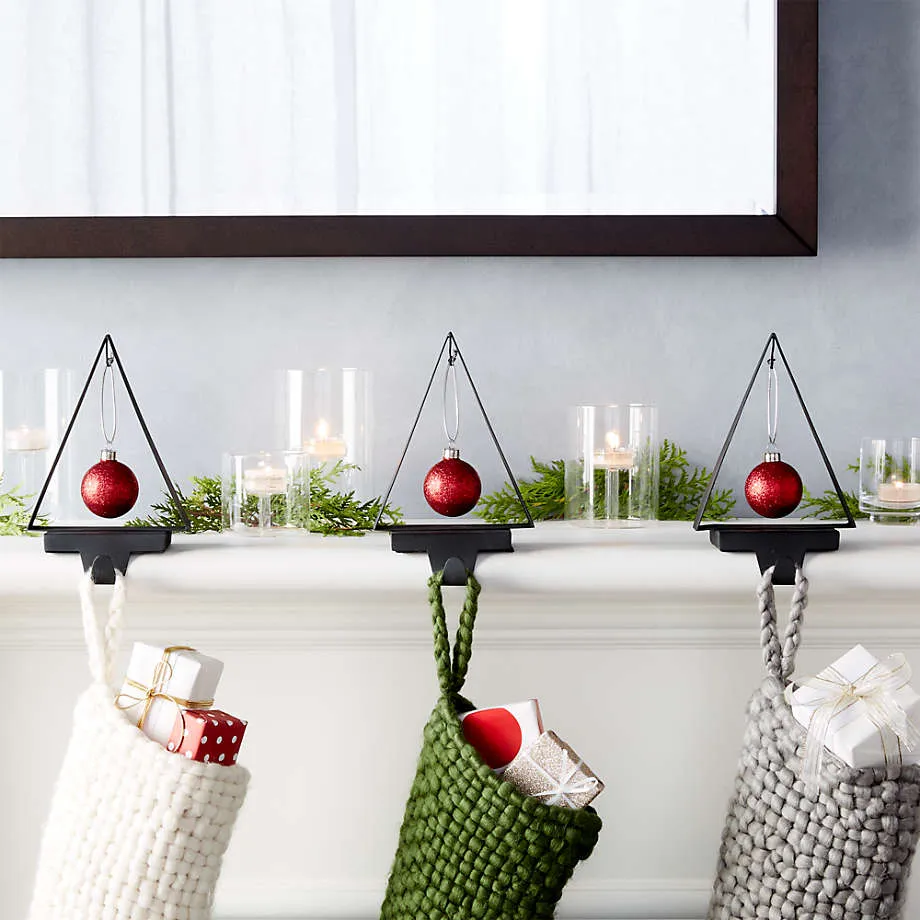
They’re also not kid-friendly. A slim post with a wide top is exactly the wrong physics for a five-year-old pulling on a stocking toe.
The base plate is the entire design. Everything above it is styling; the base is structure. A good freestanding holder has a base plate at least as wide as the top span, low to the floor, and heavy enough that you notice the weight when you lift it.
Look for a base that sits flat against the floor with no separate feet — feet concentrate weight on three or four points and dent softwood over a single season.
9. A Chunky Wooden Beam Draped in Foliage
Building the beam garland takes about two hours, and it’s the piece everyone asks about.
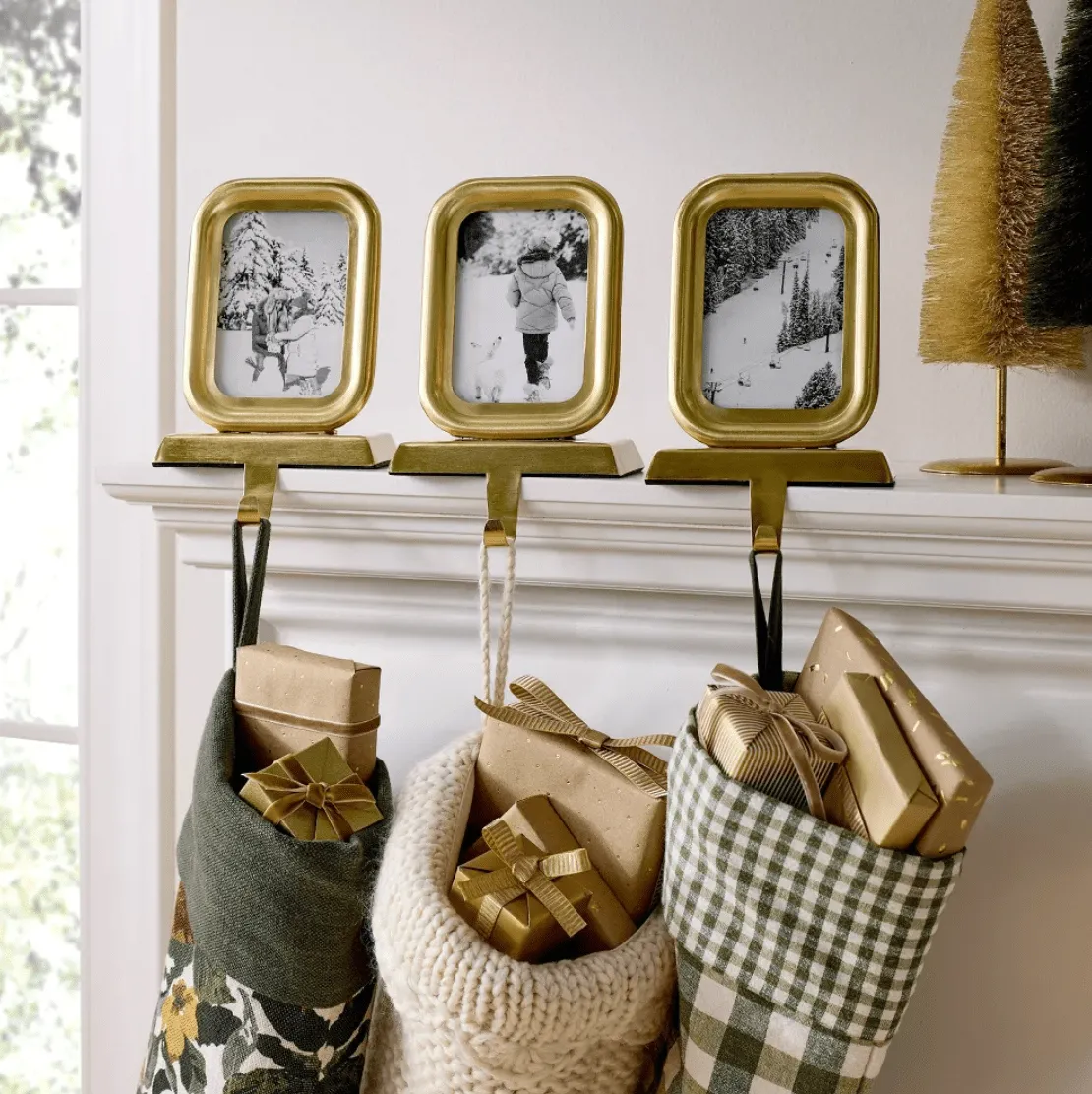
- Source a 4–6 foot reclaimed or cedar beam and sand the cut ends smooth.
- Attach 9–12 greenery picks along the front face with 22-gauge floral wire, working from both ends toward the center.
- Wrap 200 warm-white micro lights around the wire, tucking the battery pack behind the beam.
- Wire a large plaid bow slightly off-center — never dead center.
- Hang stockings from the beam itself, spacing them to match the greenery clusters.
Cost: $60–$120 if you buy picks on sale. Time: one evening, one holiday movie.
The ratio that makes this read as lush instead of messy is roughly 55% greenery, 20% natural wood, 15% red and cream textiles, and 10% warm light. The wood is the base note — everything else sits on top of it.
To shift the mood, keep the percentages and change the ingredients: swap the plaid bow for wide burlap ribbon and the red stockings for oatmeal linen, and the whole thing goes farmhouse-neutral without you touching a single proportion.
10. Leaping Gold Reindeer Holders on a White Shelf
There’s exactly one stocking here, and that’s the point. Two ornate gold holders topped with leaping reindeer, a lit garland, and a single red velvet stocking create a horizontal rhythm that’s mostly empty space. Negative space is a design choice, not an oversight.
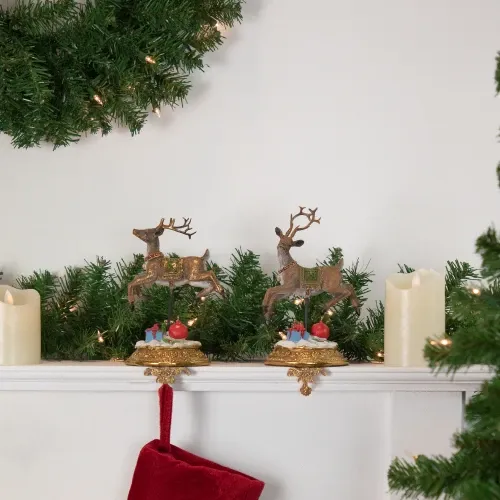
The vertical lift comes from the cream LED pillar candles — they pull the eye up and keep the composition from flattening into a shelf display. Each reindeer’s leap points inward toward the stocking, which quietly directs your attention to the one object that matters.
This composition needs a mantel or shelf at least 48 inches wide, and it looks best with 10–14 inches of open wall above so the reindeer silhouettes read cleanly against the background.
Below 48 inches, use one holder instead of two and drop to a single pillar candle. Wide stone mantels scale up better; narrow consoles want a completely different approach.
11. A Wooden Holder Board With Chunky White Knits
Ribbon loops beat metal clips every time. Clips crush knit fibers and leave permanent dents in anything chunky, while a 1-to-1.5-inch grosgrain or satin loop spreads the load and looks intentional. Thread it through the stocking’s hanging loop, then drape both ends over the hook.
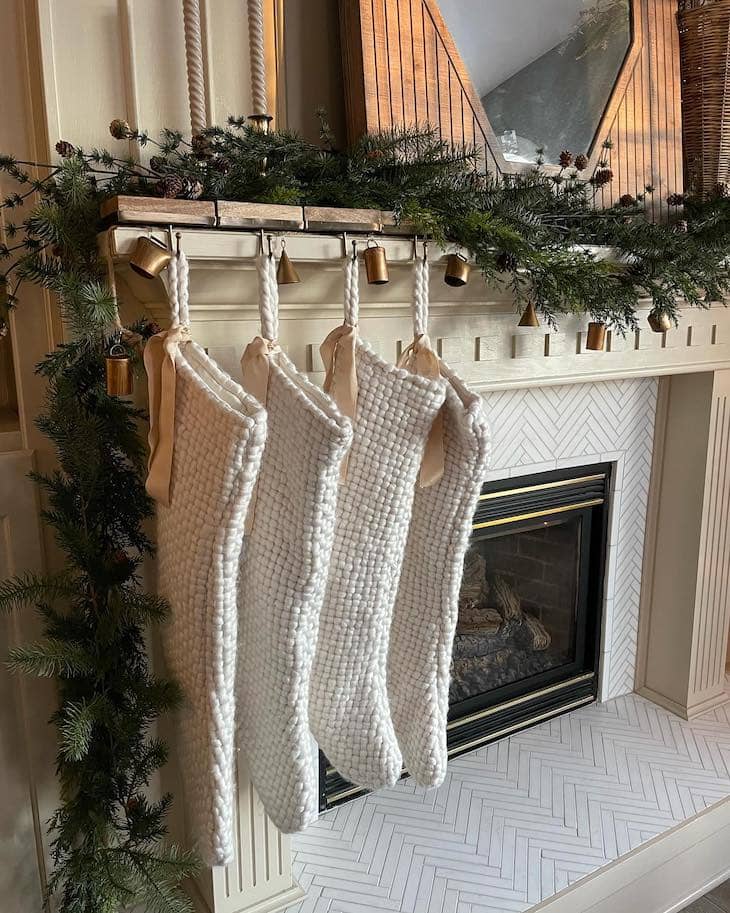
Better still: a plain 1×4 board painted to match your mantel lets you position hooks wherever you want without drilling into the mantel itself — and you can rebuild the layout next year for $6 of hardware.
Brass tarnishes. If your hooks have a living finish rather than a lacquer coat, they’ll dull to a warm patina in a season or two — polish with a cloth and brass cleaner twice a season if you want them bright, or leave them and call it character.
White knit stockings show everything: cocoa, dog fur, fireplace ash. They’re hand-wash, lay-flat-dry items, so plan one wash in January and store them in a cotton bag, not a plastic bin, to keep the fibers from yellowing.
12. Five Real Ways to Hang Stockings Without a Mantel
Command hooks rated for 5 pounds cost about $12 for a six-pack and will hold a light stocking on drywall without a single hole. A leaning ladder from Marketplace runs $20. A curtain rod with wooden rings — $18 at Target — turns a blank wall into a display in ten minutes. And plain S-hooks on a bookshelf edge cost $6 for eight.
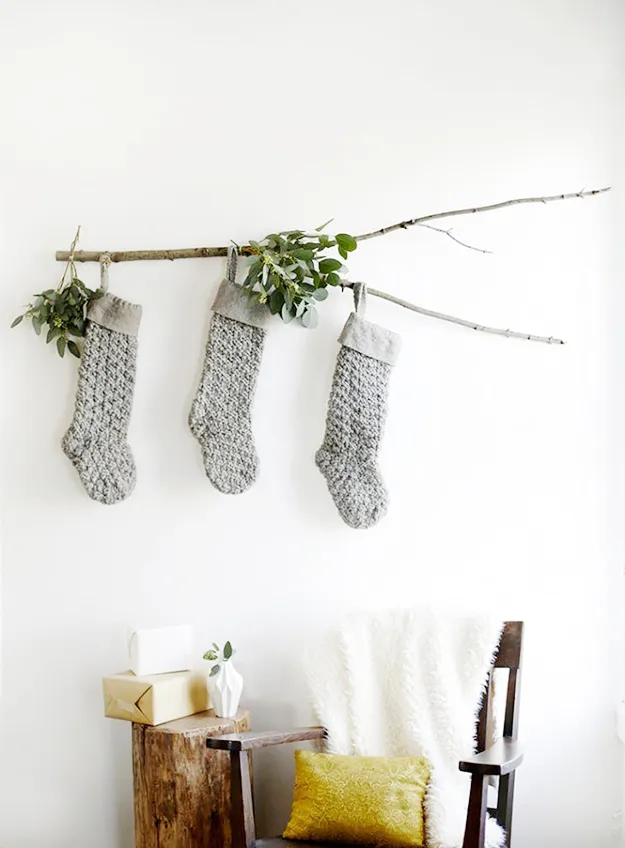
Any of these gets you the look for under $45, compared with $150+ for a decorative stand. Add a $10 garland along the rod and no one will ask where the mantel went. This is the renter’s version of Idea #4‘s wall rail — same idea, no drilling.
- Weigh a fully loaded stocking before you trust any adhesive hook.
- Check your wall type — Command strips behave differently on plaster and textured paint.
- Confirm the weight rating on the package, then cut it in half for safety.
- Decide whether kids need to reach the stockings, or whether high and out of reach is the goal.
13. White Stockings on a Black Console Beneath a Fragmented Mirror
The fragmented circular mirror is what turns this from a nice console into a composition. It’s built from mirrored segments in a black frame, and it throws the white village houses, the frosted bottle-brush trees, and the silver bells back at you from a dozen angles. Without it, the black console reads flat and the white stockings disappear.
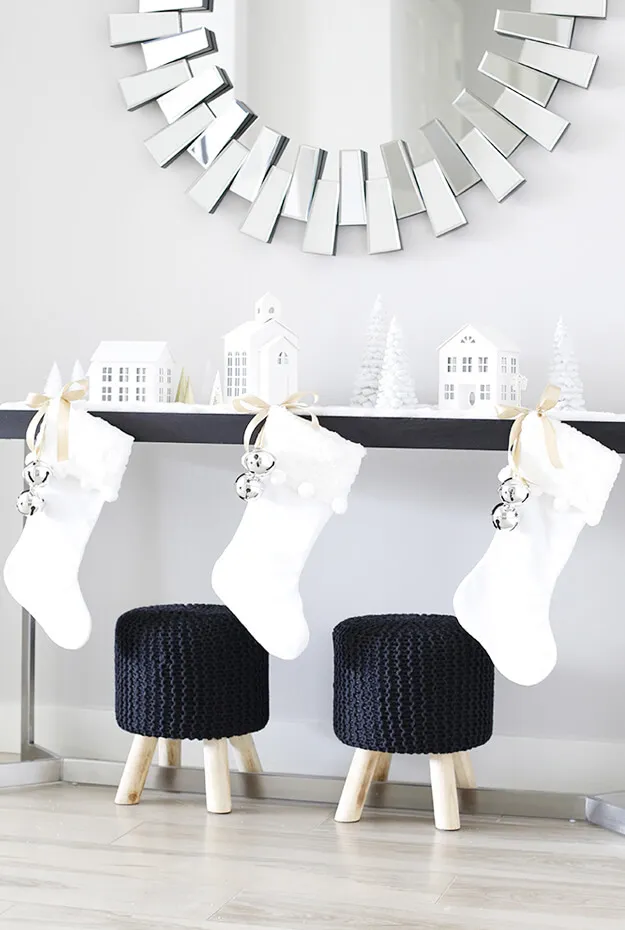
It also doubles the light in a room that doesn’t have much of it. If you only splurge on one thing here, splurge on the mirror.
The console-as-mantel move has been growing for a few years and it’s fully mainstream now — partly because more people live in apartments without fireplaces, and partly because a console is furniture you keep in January. Black furniture with white holiday styling is the specific combination trending: hard, graphic, and a stark backdrop for soft textiles.
It’ll hold up. Console tables don’t go out of style, and white-and-silver holiday decor has survived every decade since the 1960s.
14. A Sequin Stocking Hung on a Bedroom Headboard
Hang from the top rail of the headboard, never the slats or spindles — that’s where the structure lives. Use a removable adhesive hook rated above the load, or a slim over-the-door hook if your headboard has a solid top rail. Position it at the outer edge, not above the pillow you actually sleep on, and keep the drop short so the stocking doesn’t rest on the nightstand.
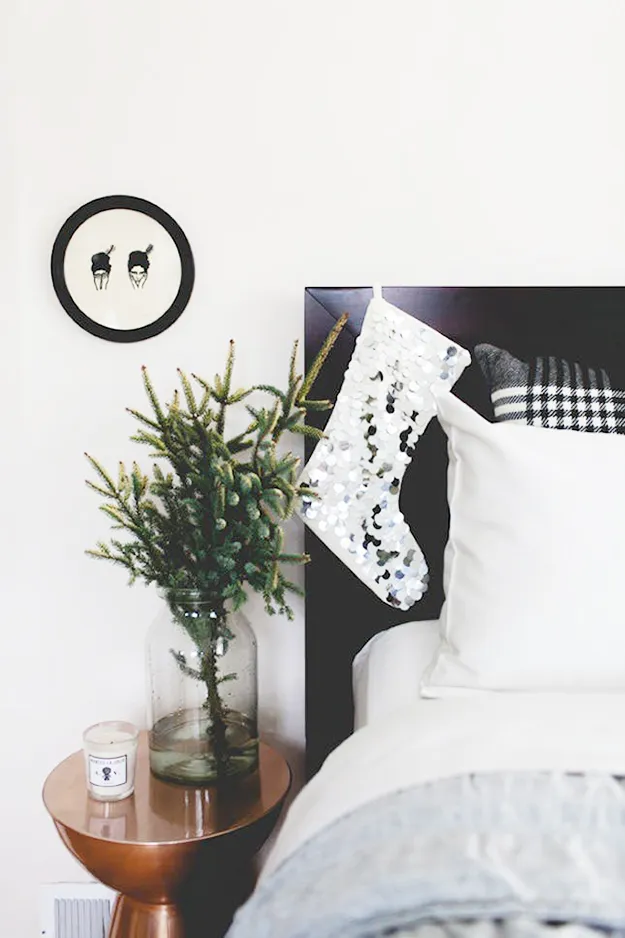
The copper side table, the pine branches in a glass jar, the small white candle — that trio costs under $50 and does more for the room than the stocking does.
Sequins shed. Give a sequined stocking a good shake outside before it comes in, and don’t hang one over white bedding you care about. And a lit candle next to fresh pine branches, right beside a bed, is a genuine fire risk — pine needles and dry branches go up fast. Swap it for a flameless candle with a timer; nobody will notice, and you’ll sleep better.
15. Distressed Metal Deer With a Crown and a Bow Tie
- Two distressed metal deer-bust holders: $45–$110
- Small metal crown and bow tie accents: $8–$20
- Ribbon or cord for hanging: $6–$12
- Stockings (one each): $20–$60
- Shelf styling — greenery, jars, small decor: $0–$60
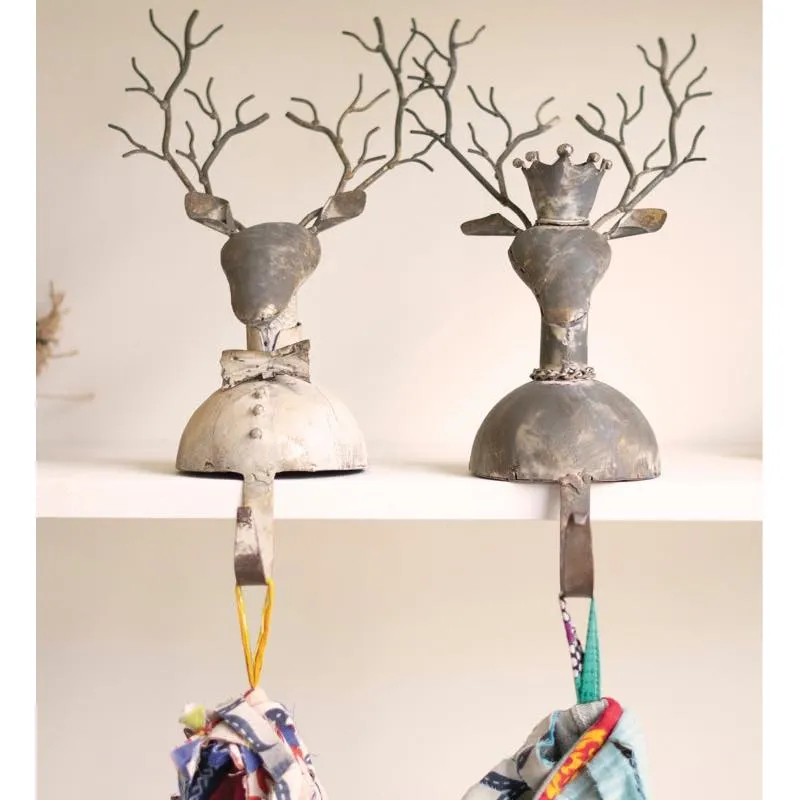
Budget alternative: buy two plain cast-metal deer from a craft store at $9–$14 each and distress them yourself with a $6 tube of chalk paint. Same silhouette, about 60% less.
Distressing plain metal takes about 90 minutes plus dry time.
- Scuff the whole surface with 220-grit sandpaper and wipe with a damp cloth.
- Brush on one thin coat of gray chalk paint; let it dry 30 minutes.
- Sand the high points — antler tips, muzzle, shoulders — back to bare metal.
- Seal with matte polyurethane so the finish doesn’t rub off on fabric.
- Attach the crown or bow tie with E6000 and let it cure overnight.
Materials: about $18. Skill level: absolutely beginner.
16. Mixed Knits Under a Wall-Mounted TV
Roughly 45% greenery, 25% mixed textiles, 20% white mantel, 10% red accents. The garland carries the visual load, which is exactly what you want when a television sits right above it — a heavy decor layer would fight the screen.
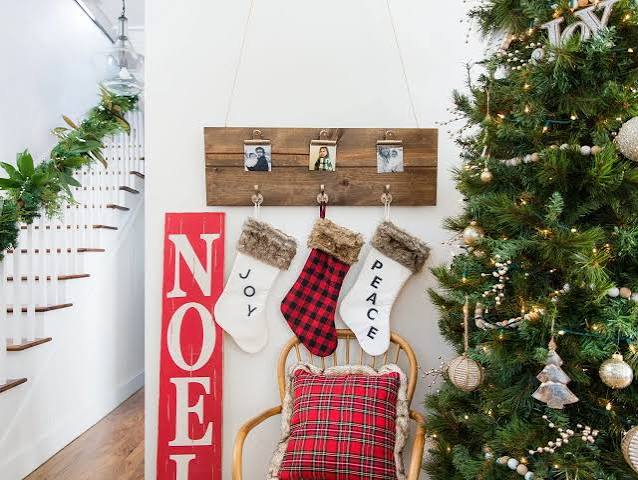
To adapt: keep the greenery percentage and swap red berries for silver ornaments in a cool-toned room, or go all-cream textiles for a softer, less traditional read.
When a TV hangs above the mantel, keep the garland under 6 inches deep and stop every stocking top at least 3 inches below the mantel edge. Anything taller and the mantel starts crowding the screen — and you’ll see it every single night from the couch.
Simple dark metal hooks disappear against all this greenery, which is why they work here. Skip anything sculptural or shiny; the television already owns the focal point.
17. Gnome Stockings on Brass Tree Holders
The faux fur cuffs. Two plain knitted stockings — one red, one olive — get their entire personality from a band of brown faux fur with a felt gnome appliqué on top. That cuff is the difference between a $12 stocking and a $60 stocking, and it takes about fifteen minutes to add.
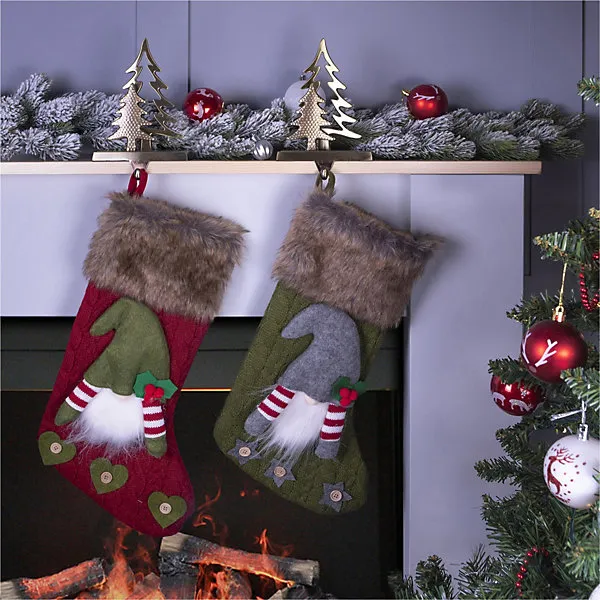
Remove it and you’ve got a nice, forgettable pair of knits. Keep it, and the flocked garland and the glowing faux fire below suddenly have something to talk to.
Buy plain knit stockings from Target or Walmart at $8–$15 each, then cut a 4-inch strip of faux fur from a $6 half-yard and stitch or fabric-glue it along the cuff. Felt gnome appliqués run $3–$5 for a pack on Etsy, and brass tree holders are $12–$20 each online.
Full pair for under $60, versus $180–$250 styled. If you’d rather lean traditional than whimsical, the golden nutcracker setup in Idea #3 uses the same three-color discipline without the fur.
18. Leather Straps Instead of Hooks — White Knit Stockings
Red appears exactly once in this room, and it’s the JOY sign. That’s it. Everything else is white, deep green, black, and the warm brown of the leather straps — which is why the red lands so hard. One accent color, used once, at the center of the composition.
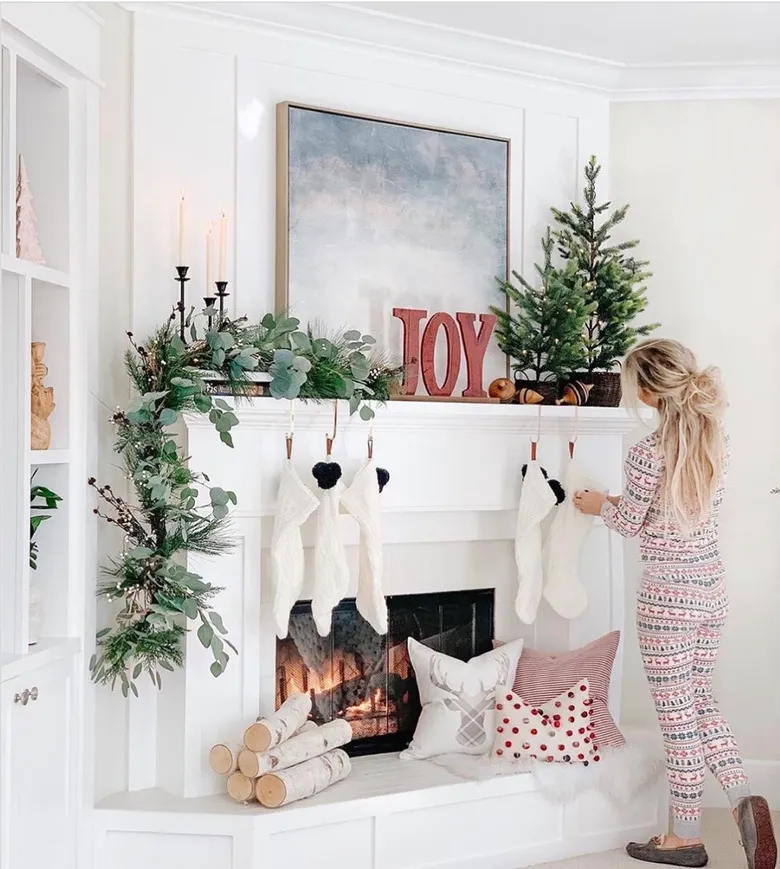
The leather straps are the quiet second move. Against a paneled white fireplace, metal hooks would have read cold. Leather brings a natural material into a space built entirely from paint, tile, and knit, and it warms the whole arrangement.
Four stockings need at least 60 inches of mantel run; 72 inches is where it starts feeling comfortable. Each full stocking occupies about 9 inches of visual width once it’s stuffed, so plan 12 inches of spacing and let the ends breathe.
Under 48 inches? Go with two stockings and a single accent, like the restrained setup in Idea #26.
19. Bird-Shaped Holders on a Marble Fireplace
The mix here runs about 50% marble white + 20% black firebox + 15% olive and cream textiles + 10% grey veining + 5% living green from the potted plant. The veining in the marble is doing quiet pattern work, which is why the patchwork striped stocking doesn’t feel loud — there’s already movement in the stone.
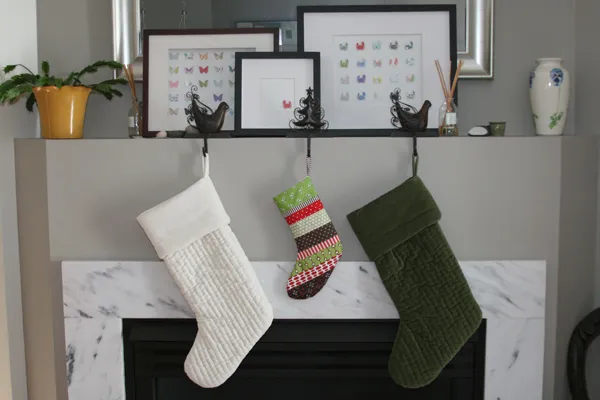
Swap the olive quilting for deep rust and the whole thing warms up instantly; swap it for charcoal and it goes sharply modern. The proportions never change.
Marble etches. Skip vinegar, citrus, and any all-purpose spray — use a pH-neutral stone cleaner and wipe spills the same day. Even a spilled glass of lemonade can leave a dull ring if you leave it overnight.
Also, don’t lean framed art directly against a marble shelf without felt backing. Stone scratches from the back of a picture frame faster than you’d expect.
20. Distressed Wood Mantel With Brass Holders and a Glowing Screen
- Three ornate brass over-the-mantel holders: $12–$28 each
- Knitted stockings in red, green, and white: $18–$50 each
- Evergreen garland with berries and lights: $30–$75
- Wooden tree figurine and small accents: $15–$45
- Garland lights (if not included): $12–$25
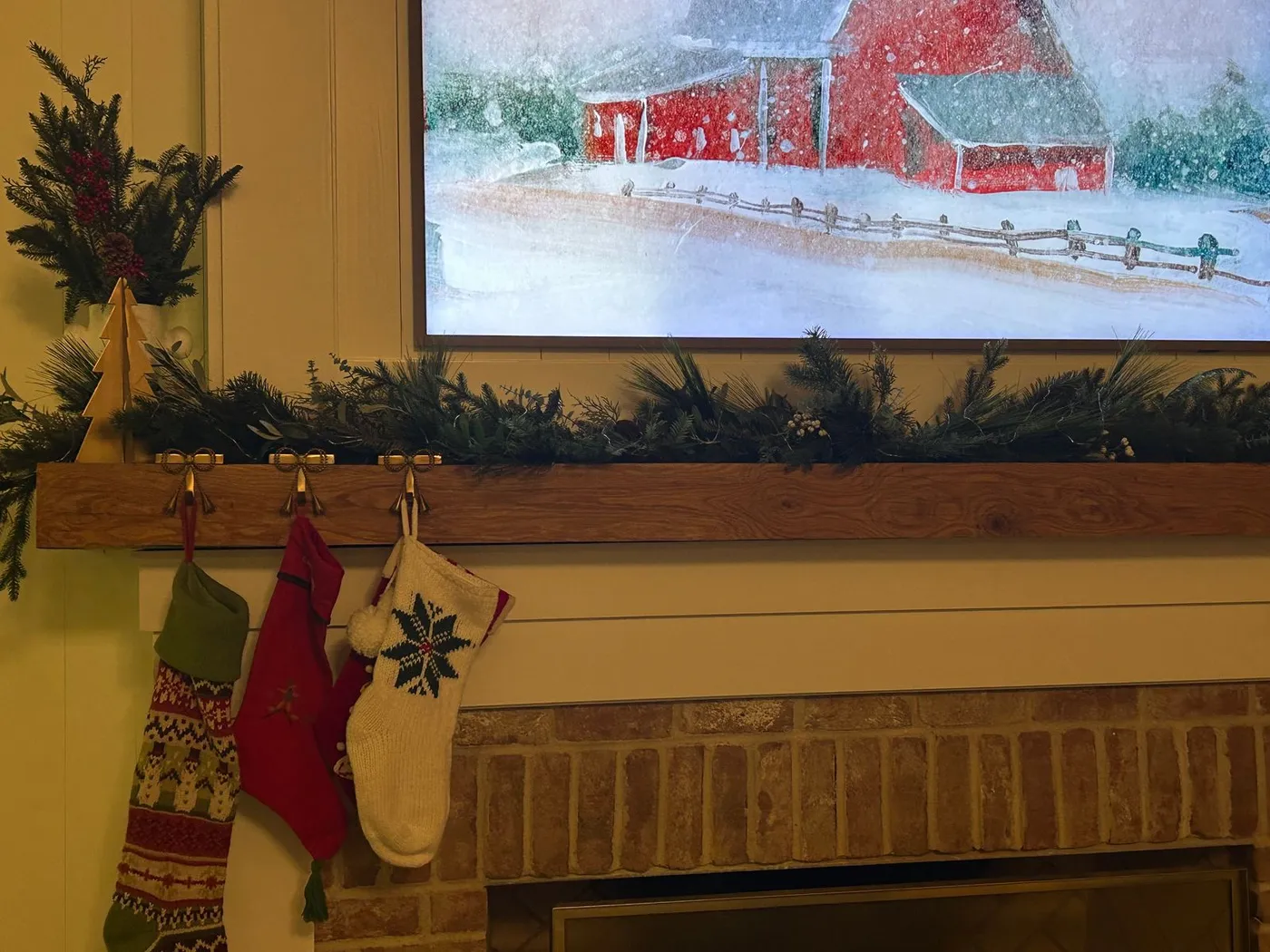
Budget alternative: the wooden tree figurine is the easiest thing to DIY — a $6 pine cone blank and an afternoon with acrylic paint gets you close, and thrifted brass holders show up constantly at $4–$8 each in December.
Measure your mantel edge thickness before you buy any over-the-mantel holder. Most are built for edges between 1 and 2 inches, and a chunky distressed beam can easily run 3 inches — at which point the holder won’t clamp and you’re returning it in a panic on December 20th.
Also, brick and garland are abrasive together. Put felt pads under holders on brick or rough stone so the metal doesn’t scratch the surface every time you adjust a stocking.
21. Gold Tree and Nutcracker Holders With Velvet Loops
The light pink velvet loop. That’s the entire reason this shelf looks styled instead of standard-issue. Gold plus white plus deep green is the default Christmas palette — beautiful, but everywhere. Sliding one blush-pink velvet ribbon onto the second hook is a five-second decision that changes the whole read.

Deep green velvet on one holder, blush on the other, and the two holders suddenly relate to each other instead of just sitting next to each other.
The formula: 60% white + 20% gold + 15% deep green + 5% blush pink. That last sliver is the surprise note, and it should stay small — 5% is a ribbon, not a sofa.
In a coastal room, swap the blush for dusty blue and keep everything else. In a moodier space, go plum. Same proportions, entirely different personality.
22. Carved Deer and Santa on a White Mantel
The blue is the risk that pays off. Among all the green, red, and white trees, two blue felt trees sit quietly and keep the whole vignette from looking like a catalog page you’ve seen a hundred times. It’s not a big gesture — it’s one color, used small.
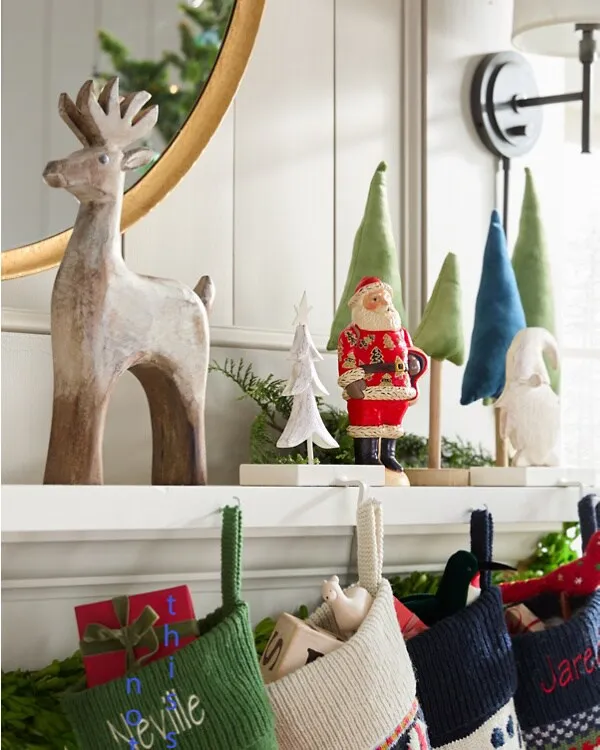
Scale is the second principle: the tallest piece sits at one end, and the arrangement descends in height from there. Your eye travels along the mantel instead of bouncing around it.
Thrift stores and estate sales are gold mines here. Plain figurines at $3–$8 each, sprayed matte white, look almost identical to $40 boutique pieces. Felt trees show up in Target’s dollar section most Novembers at $3–$5 apiece.
Facebook Marketplace is unbeatable for a carved wooden deer — $15–$35 is typical, and those pieces are heavy and beautifully made because they were sold as decor decades ago, when things were built to last.
23. Cream Holders With Carved Wood Figures on Rough-Hewn Wood
If you’re ordering personalized stockings, place the order by November 1. Embroidery shops run 2–3 weeks in November and 4–6 in December, and the good ones close their books early. Space personalized stockings 5–7 inches apart so the names stay readable from standing height — closer than 5 inches and the script starts to overlap visually.
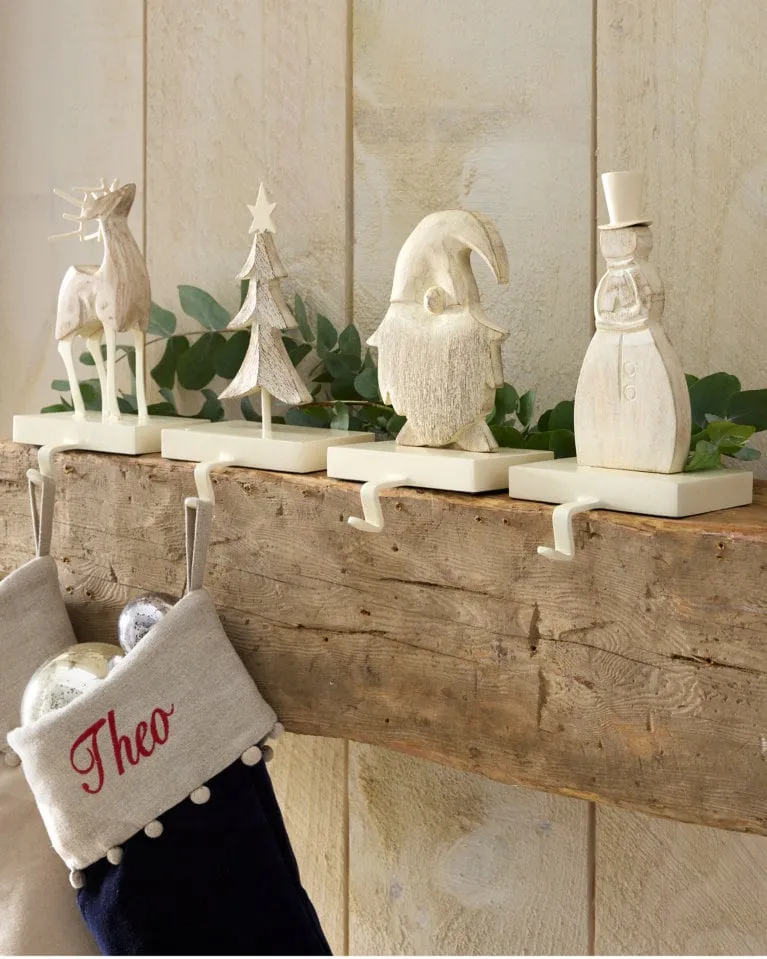
Cream-colored holders need contrast behind them, or they vanish. Here the rough-hewn wood does that job. On a painted white mantel, you’d want greenery — or the whole set disappears into the wall.
This is the quiet-luxury Christmas that’s been building for a while now: cream, raw wood, linen, seagrass, and almost nothing plastic. Shoppers are buying fewer pieces and better ones, and personalized textiles are the single biggest category in that shift.
It has real staying power because it isn’t a color story — it’s a material story. Materials don’t date the way trends do.
24. Personalized Knits With Photo Frames in the Garland
Personalized stockings usually run 18–20 inches long and about 7 inches wide when stuffed, so three of them need at least 30 inches of usable mantel run — and 40 inches is where the composition actually breathes. Measure the flat top surface, not the whole shelf, because ornaments eat into that number fast.
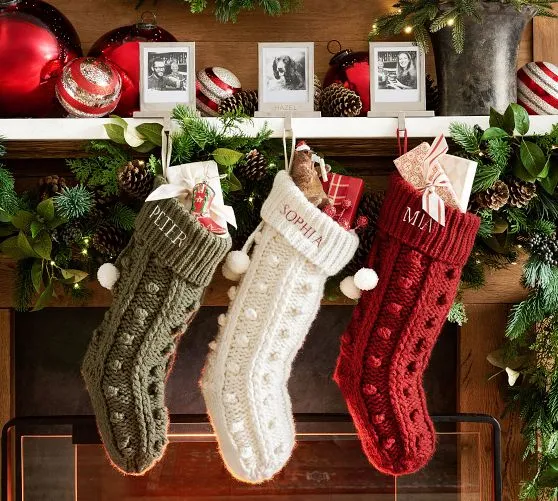
Below 30 inches? Hang two and add a garland swag to fill the visual gap. Long, wide mantels can comfortably hold four or even five.
Adding photo frames to a garland takes about 25 minutes.
- Buy three small frames — 2×3 or 3×4 inches works best.
- Remove the easel backs and any glass you don’t need.
- Print photos at 2×3 and seal them with matte spray so they don’t curl in a warm room.
- Wire a small alligator clip to each frame’s backing with 22-gauge floral wire.
- Clip the frames onto the garland at staggered heights, not in a straight line.
Cost: about $12 plus prints. Result: the most-commented-on part of your mantel.
25. Burlap Stockings on White Antler Holders
Burlap stockings run $8–$14 each at Walmart, and a yard of plaid fabric for the cuffs costs about $5 — enough for three stockings. White sculpted antler holders show up at Hobby Lobby for around $9 each when the after-Christmas markdowns hit, and even in season they’re typically $12–$18.
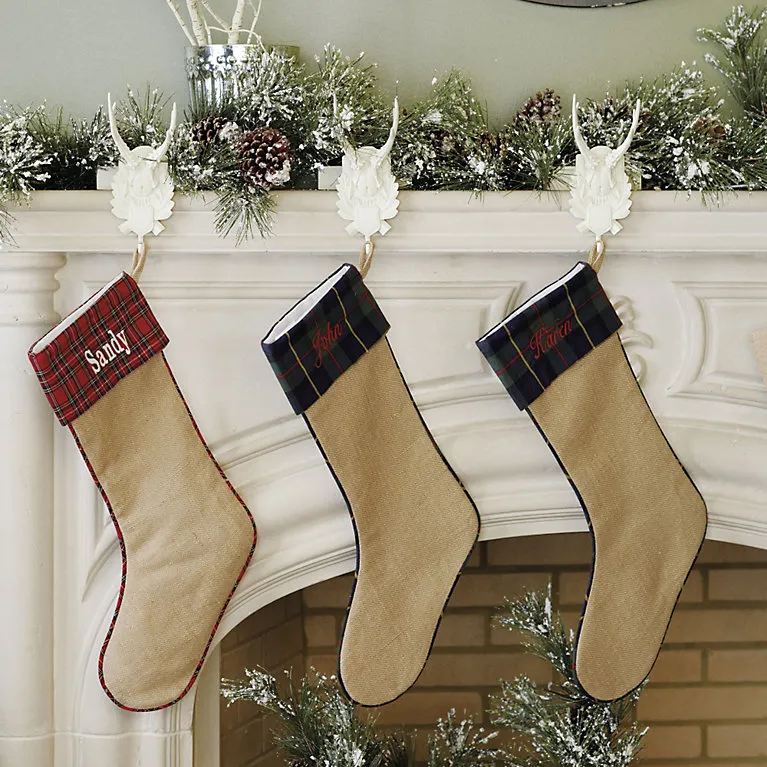
Total: about $50 for the whole lineup, versus $200–$250 for a styled designer version. The frosted garland is the one place I’d spend: $25–$45 gets you one that looks genuinely frost-dipped rather than glittery.
If you’re adding names yourself with iron-on vinyl, burlap is unforgiving. Press at 300°F for 15–20 seconds, use a pressing cloth, and test on a scrap first — burlap scorches before it looks like it’s scorching, and there’s no fixing a burn mark.
Fabric glue is the safer route for cuffs. It takes twelve hours to cure but it never melts a fiber.
26. A Single Gold Deer Head and Two Silver Ornaments
Deer-head holders are usually light — that’s the whole problem. If the stocking holds anything heavier than a small gift and a chocolate orange, the holder leans forward off the mantel. Test it with a full load before December 24th, not on December 24th.
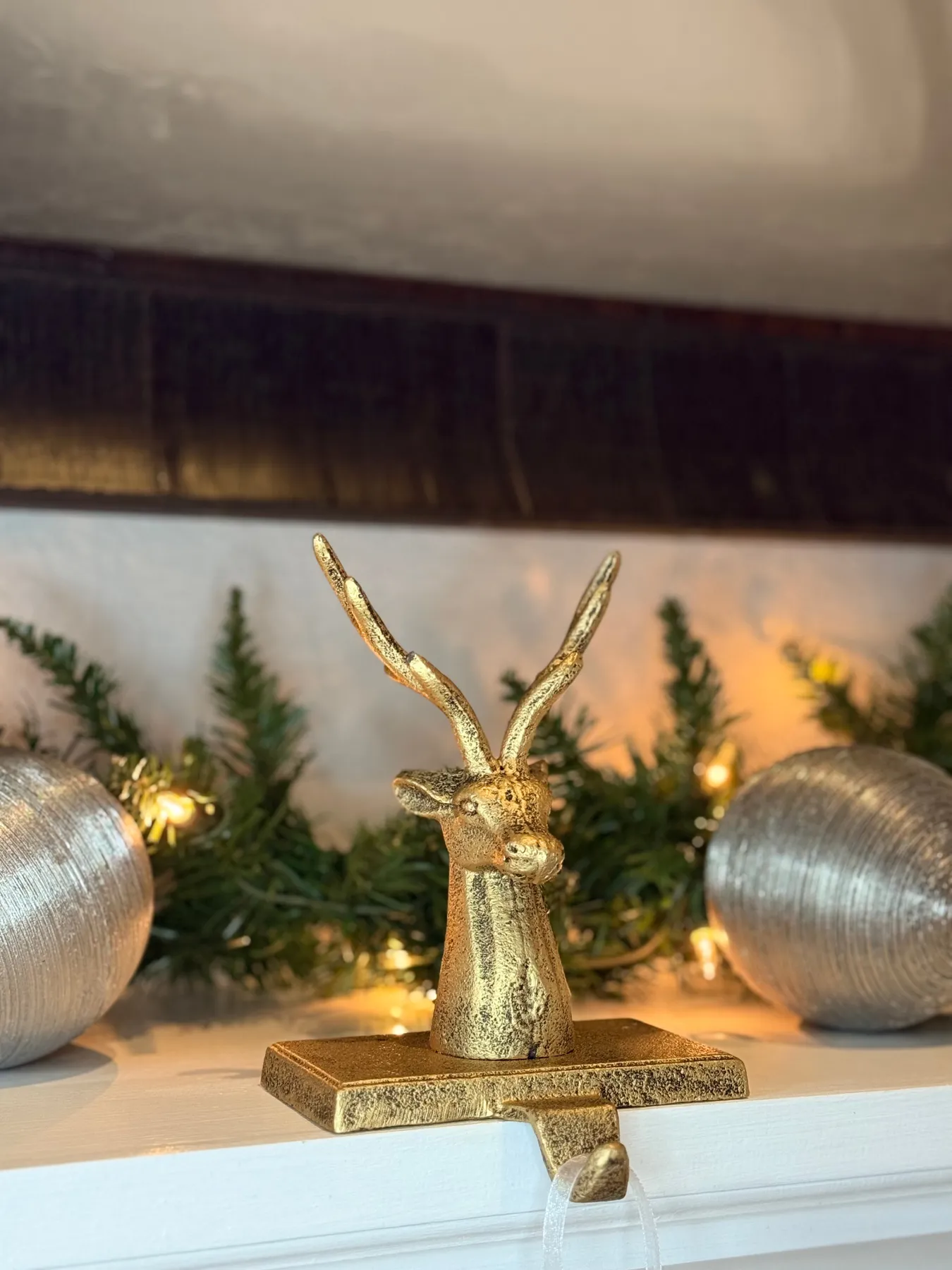
Also worth saying: the metallic deer-head silhouette cycles in and out of fashion. Buy it because you like looking at it, not because it’s trending this year.
Restraint is the one thing here. One textured gold deer head, one thin white ribbon, two ribbed silver ornaments, a lit garland. Add a third ornament and the composition gets top-heavy; remove one and the balance tips the other way. Two is the number.
Compare with Idea #10 — same gold metal, same restraint, but two leaping reindeer instead of one watchful deer. Very different energy from the same ingredients.
27. Dark Metal Holders Across a Light Stone Mantel
The formula: 50% light stone + 30% green pine garland + 12% white candles + 8% red berries, with the patterned stockings acting as the textile layer on top. The stone is the calm base — that’s why you can get away with five different stocking patterns and it still reads collected rather than chaotic.
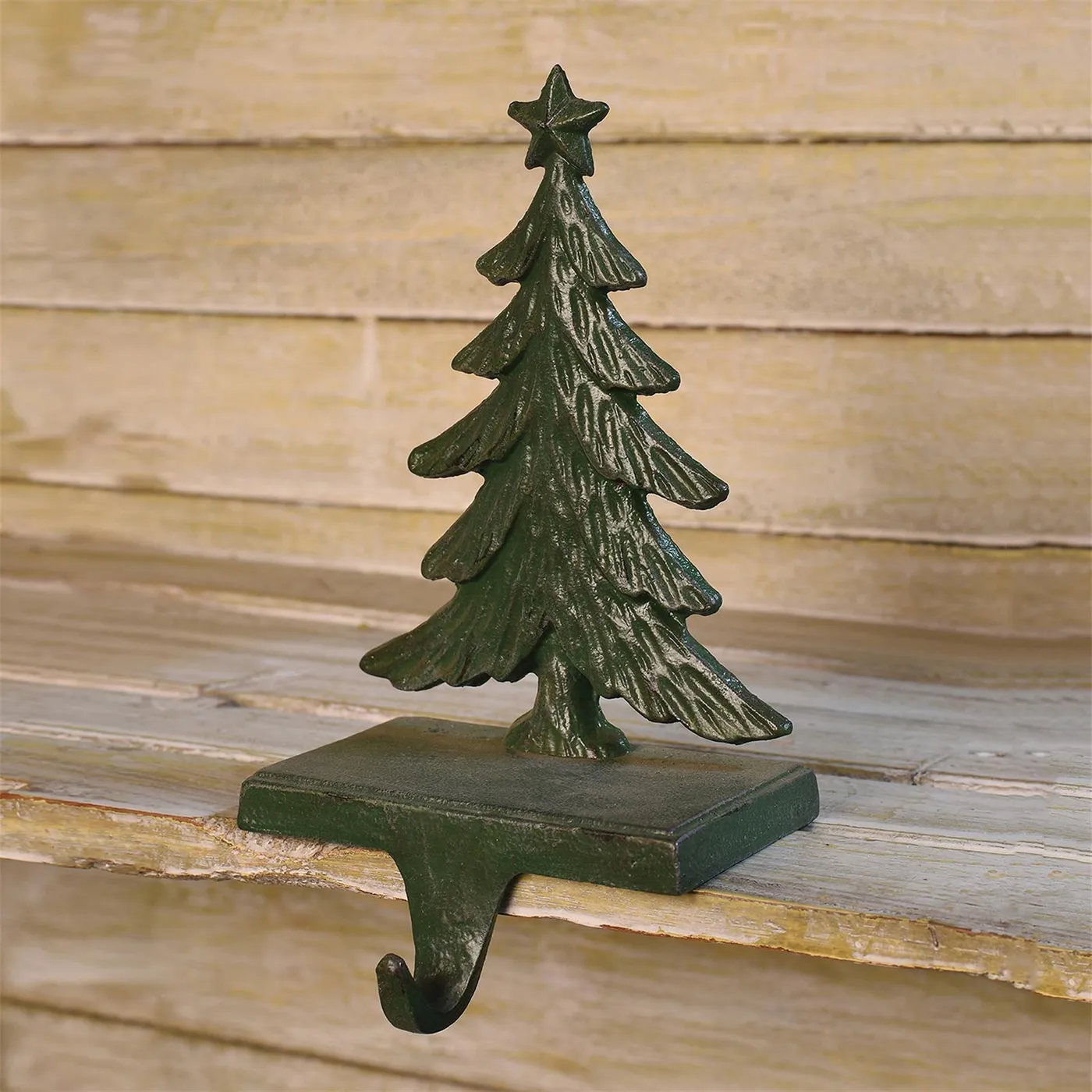
Swap the red berries for copper baubles and the whole thing goes warmer; swap them for eucalyptus and it turns Scandinavian. The stone percentage stays put in every version.
Candles leave soot, and stone is porous. Trim every wick to a quarter inch before lighting and keep pillar candles inside glass sleeves so the flame never touches the stone directly.
When soot does land, wipe with a dry microfiber cloth — never a wet one. Water pulls soot deeper into the pores and turns a smudge into a stain you’ll see every December.
28. Bronze Over-the-Mantel Hangers With Faux Fur Stockings
- Bronze over-the-mantel hangers: $12–$30 each (three to four needed)
- Red cable knit stocking with faux fur cuff: $20–$45
- Red and gray plaid faux-fur stockings: $15–$35 each
- Green wreath with red berries and pinecones: $25–$70
- Garland and small accents: $20–$50
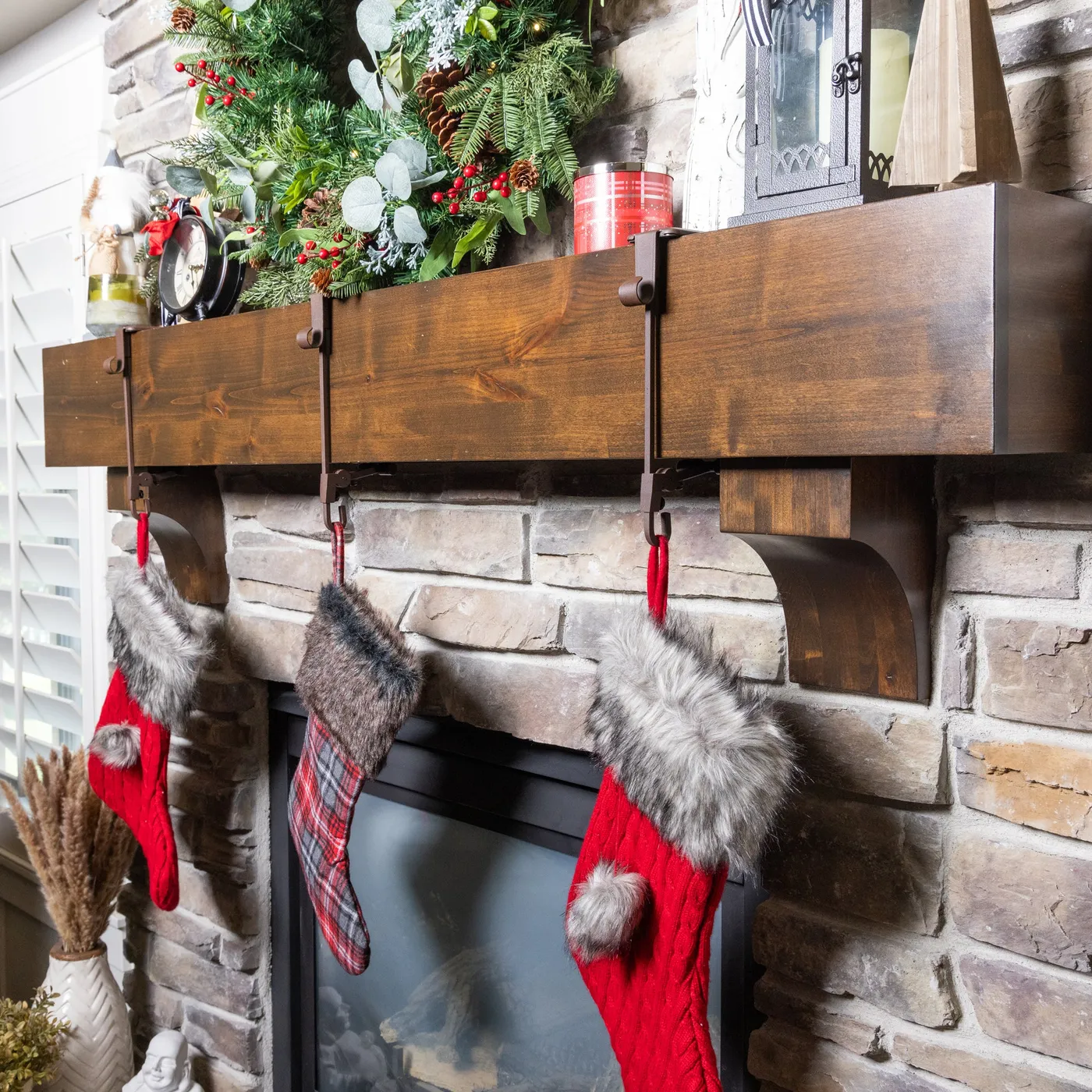
Budget alternative: buy plain plaid stockings at $8–$12 each and add your own fur cuffs from a $6 half-yard of faux fur. Same look, roughly half the price.
The corbels are what make this mantel feel substantial — they give a chunky dark beam the visual support it needs so it doesn’t look like it’s floating on stacked stone. Remove them and the whole thing reads like a shelf.
The fur cuffs are the second move. Stacked stone is hard and cold and full of texture; faux fur softens that edge and gives the eye somewhere to rest. And bronze is the mediator — it’s warm enough for the wood and cool enough for the stone, which is exactly why it works as the metal in this room.
29. Antique Brass S-Hooks With Deep Red Embroidery
S-hook holders are the easiest to get wrong. Check two measurements before ordering: the arm that rests on the mantel usually fits edges between 1 and 2 inches, and the front arm should be at least 3 inches long. Heavy embroidery and braided trim add bulk, and a short front arm pushes the stocking right up against the mantel face.
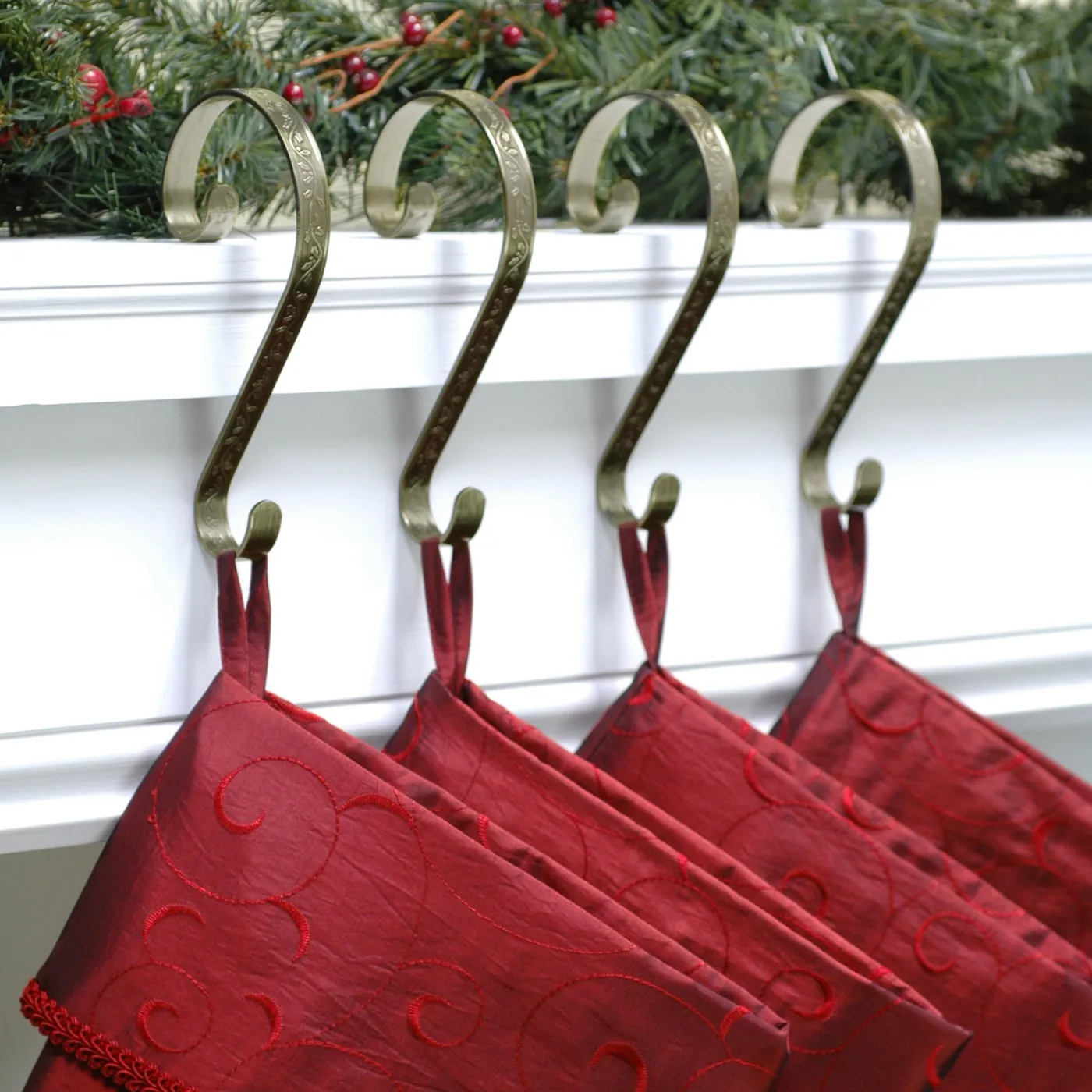
Also check the hook opening. Thick braided trim needs a wider throat than a thin cotton loop — under half an inch and you’ll be fighting the stocking every time you hang it.
Embroidered stockings hold their shape, which means they take up more room than you’d think. Budget 9 inches of mantel run per stocking, so four need a minimum of 36 inches and look genuinely comfortable at 48.
Compare with Idea #18 — four stockings there, four here, but leather straps and plain white knit take up noticeably less visual space than deep red embroidery and braid.
30. A Distressed Window Frame Turned Stocking Holder
Converting a thrifted window frame takes about two hours.
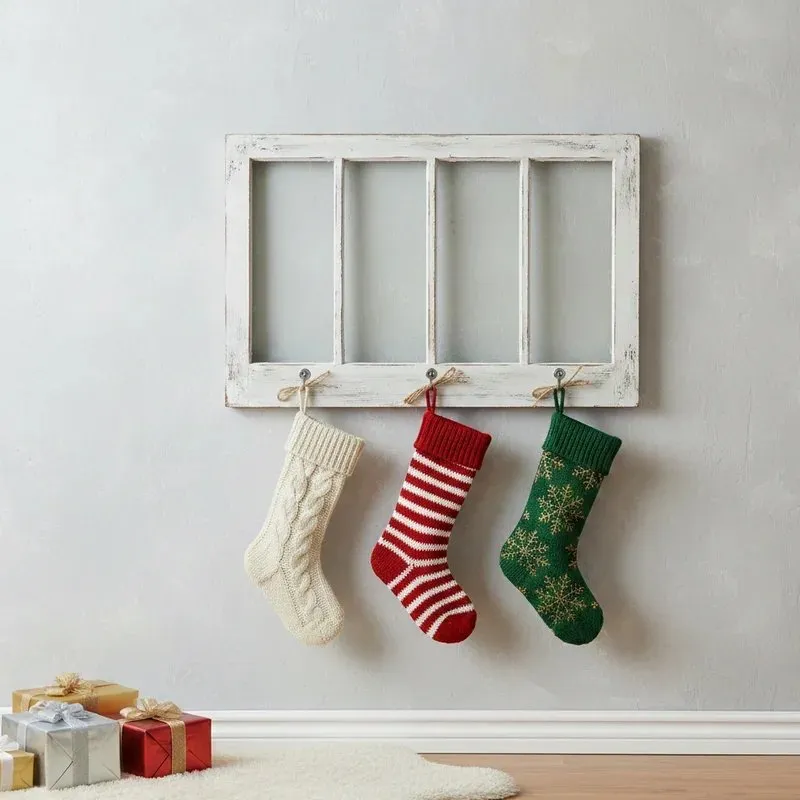
- Remove the glass, glazing, and any loose hardware; fill old screw holes with wood filler.
- Sand the whole frame, then paint it white with two thin coats.
- Once dry, distress the edges with 120-grit sandpaper where wear would naturally happen.
- Screw three hooks into the bottom rail with 5/8-inch screws — longer ones will split old pine.
- Add picture wire across the back and hang from two wall points, not one.
Materials: $20–$40 if you already own paint. The twine loop detail costs nothing and looks intentional.
Habitat ReStore and local salvage yards sell window frames for $10–$25, and the chippier the paint, the better. Hooks are about $1.50 each at any hardware store, and Walmart knit stockings run $10 apiece.
Whole project under $60 — this is the freestanding alternative to Idea #12‘s adhesive hooks, and it’s the one people ask about at parties.
31. DIY Stocking Hanger Kits Worth the Weekend
The kit price hides the real cost. You’ll still buy paint, stain, hardware, and sandpaper, and you’ll spend a Saturday on it. Add $25–$40 and four hours to whatever the kit costs before you decide it’s a bargain.
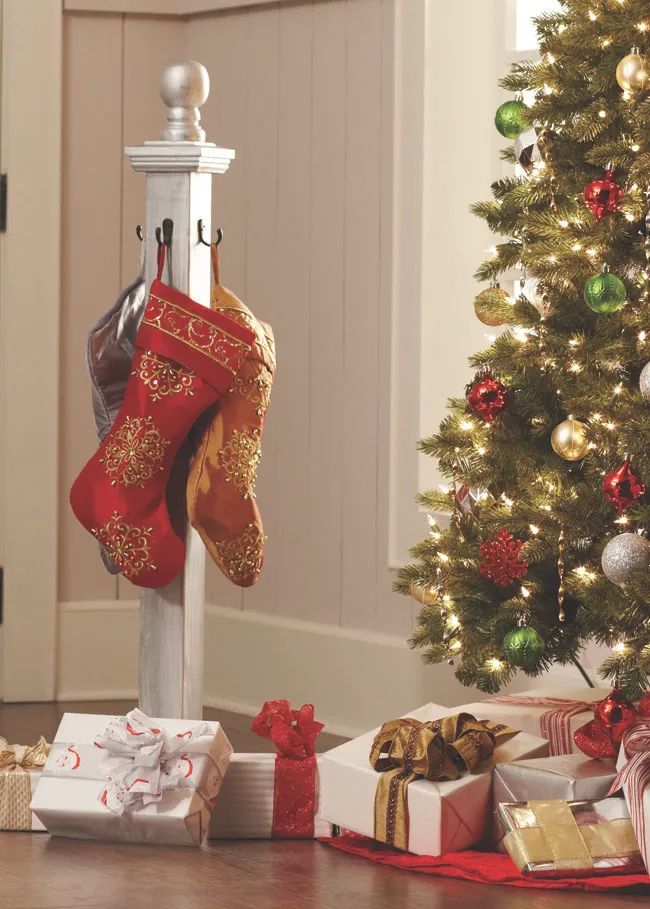
The bigger issue is material. MDF kits look fine painted but don’t hold screws well under load — a stuffed stocking can pull a hook right out of the edge. Look for solid pine or poplar, or check the listing for the words “hardwood” or “solid wood” before you buy.
DIY decor kits exploded as gifting items after 2023, and by now they’ve become the mainstream answer to a real frustration: people are tired of buying mass-produced Christmas decor that looks identical to their neighbor’s.
Making it yourself solves that problem, and it gives you something to hand down. The trend isn’t going anywhere — the desire to make is older than the desire to buy.
32. The Quiet Minimalist Pine Stocking Holder
The wood is the design. A simple pine holder with a rounded dowel and no paint, no pattern, no figure on top — the timber itself is the entire visual statement, and it works because the grain and the soft rounded edges carry the piece on their own.
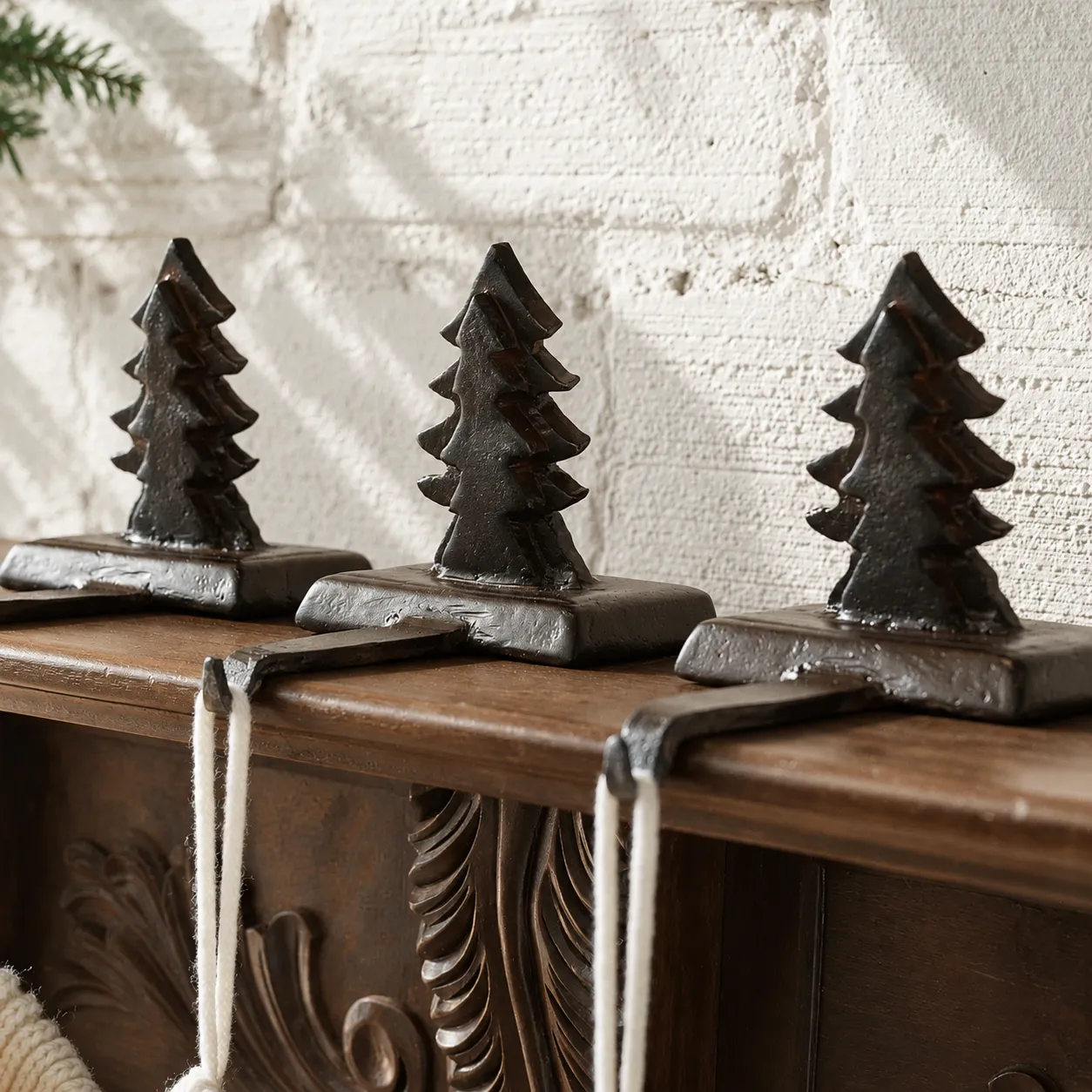
Paint it and you’ve lost everything. This is the one holder on this list where adding is subtracting.
- Check your mantel depth — a wooden base needs at least 6 inches of flat surface.
- Confirm the finish. Raw pine dents easily; a light oil or hard wax makes it far more forgiving.
- Count how many stockings the piece actually holds, not how many you own.
- Decide whether you want the wood to darken naturally or stay pale, because oiling changes that.
- Weigh your fullest stocking before committing to a slim base.
Pick the Holder, and December Takes Care of Itself
Whether you’re working with a wide stone mantel, a black console in a rental, or a headboard in a guest room, the holder is the one decision that sets the tone for everything above and below it. Start there, keep your colors to three, and let the rest of the decorating happen around it.
📌 Save this to Pinterest now so it’s waiting for you in November — and if you try one of these setups, we’d love to see how it turned out.