
You know that feeling when you finally find the Christmas pillow that looks exactly right — and then realize it doesn’t match a single thing already on your sofa? We’ve all been there, scrolling for twenty minutes and saving nine photos we’ll never revisit.
After filtering through hundreds of options across Target, Etsy, Amazon, and HomeGoods, we narrowed it down to 30 ideas that actually deliver, from roughly $12 covers to $260 embroidered statement pieces. Inside you’ll find traditional plaids and gingerbread whimsy, neutral winter woodland scenes, and jewel-tone velvet — with budget and luxury versions compared side by side, and every idea shoppable with direct product links.
In 2026 the mood has shifted away from glitter and toward texture: punch needle, tufting, beaded embroidery, and hand-stitched trim are what people are saving on Pinterest this year.
Bookmark this before you scroll away — it’s the kind of guide you’ll come back to in November.
1. Gingerbread House Embroidery on Crisp White Pillows
Embroidered pillows always look flatter in person than they do in photos, and the culprit is almost always the insert. For an 18-inch cover, buy a 20-inch down-alternative insert — the extra two inches fills the corners and gives the gingerbread house stitching enough puff to read as a real cottage instead of a flat patch. If your cover is already zipped up tight, unzip it halfway and re-fluff the fill by hand; you’ll recover most of the loft in about two minutes.
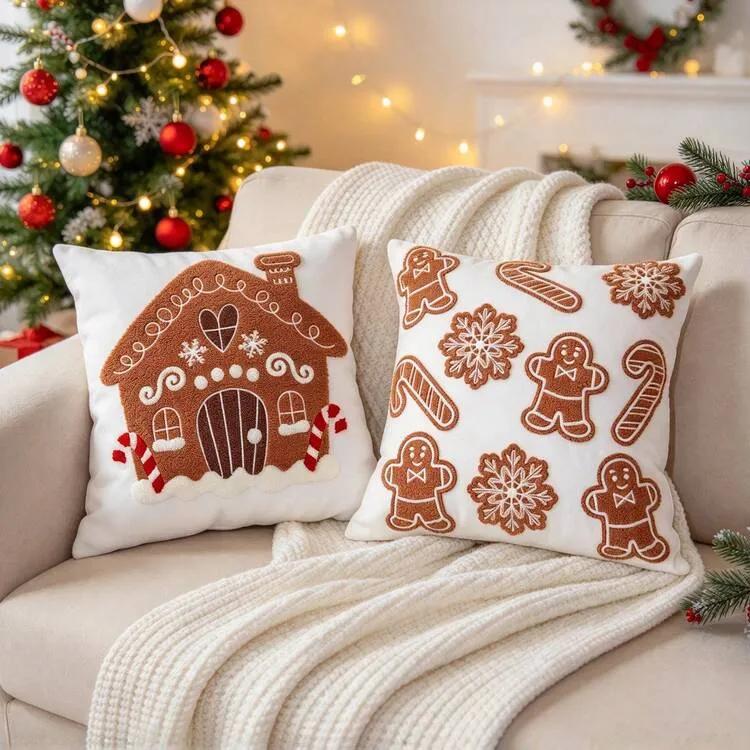
What keeps these two white pillows sweet instead of cluttered is restraint: same white ground, same brown-and-red thread, two different scales. The gingerbread house is the hero at roughly 10 inches wide, while the smaller gingerbread men, snowflakes, and candy canes act as supporting pattern around it — so your eye registers one story, not two competing ones. The cream knit throw underneath is doing quiet work too, softening the white-on-white edge where pillow meets sofa.
2. Plaid, Velvet, and Cable Knit Layered on a Beige Sofa
- Light beige fabric sofa (if you’re buying new): $700–$1,600
- Pillow trio — forest green velvet, red-and-green plaid, cream cable knit: $30–$65 each
- Chunky beige-and-red stripe knit throw: $45–$110
- Rustic wood side table: $80–$240
- Pine boughs, pinecones, pillar candle: $30–$70
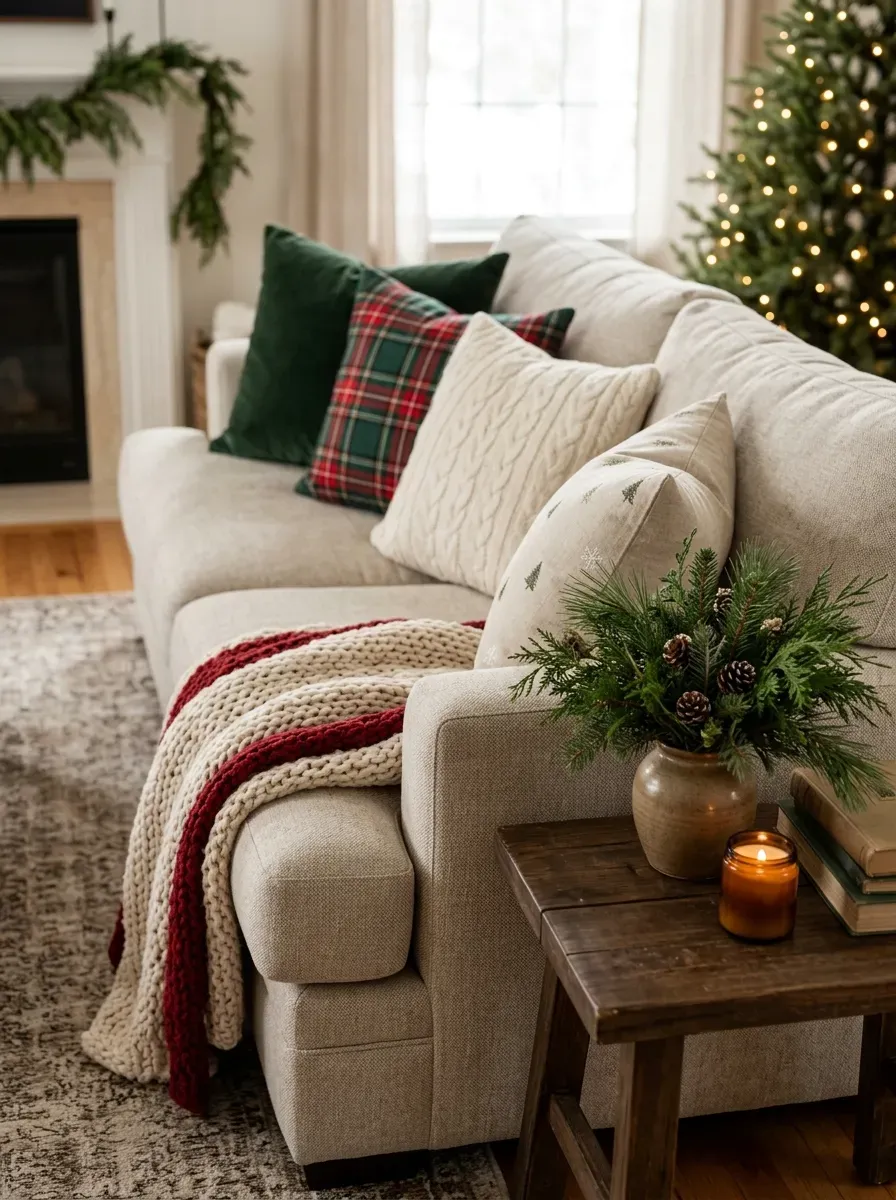
Total: $885–$2,215 if you start from scratch.
Budget alternative: keep the sofa you already own, hunt the side table on Facebook Marketplace for $25–$60, and buy three $12 Target covers to slip over pillows you already have. Same layering, roughly half the money.
Three pillows in three different textures is right at the edge — add a fourth and the sofa starts looking like a bedding aisle. That cable knit will snag on rings, zippers, and cat claws, so if you have any of the three, drape it over the sofa arm where hands land less often. And pinecones shed. Set the arrangement on a tray so you’re tipping debris into the bin once a week instead of picking needles out of the upholstery.
3. Candy Cane Wreath Pillow with Green Pom-Pom Trim
Pom-pom trim is the cheapest way to make a plain cover look custom, and it takes one evening.
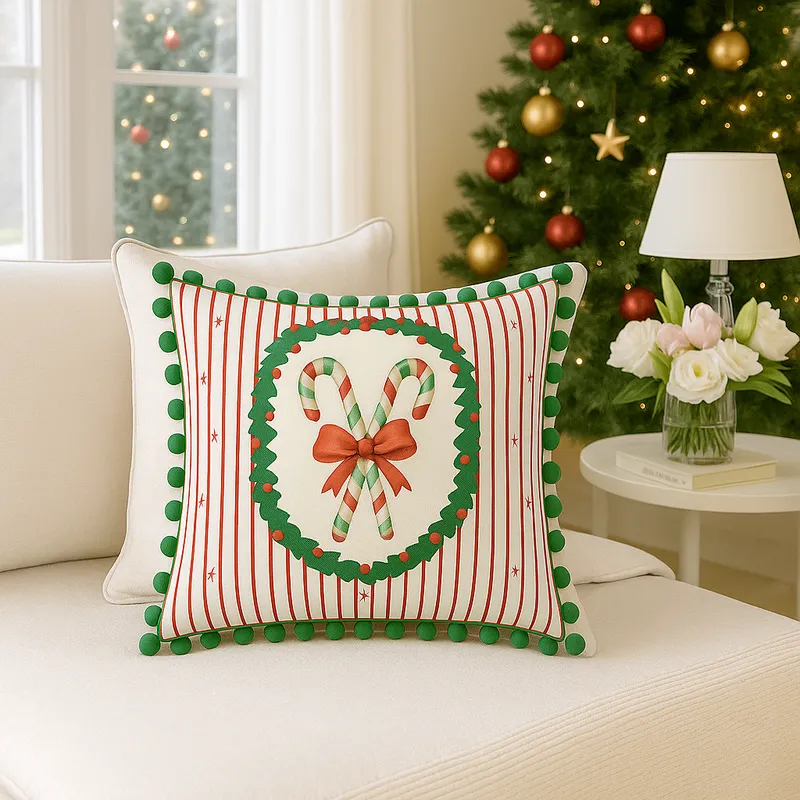
- Buy 2 yards of green pom-pom trim with ¾-inch poms — about $6 at a craft store.
- Pin it around the cover’s seam line with the poms facing outward.
- Hand-stitch with matching green thread, small stitches every inch, catching only the trim’s woven tape.
- Ease around the corners rather than folding — a fold leaves a bald patch.
- Zip onto the insert and steam so the poms stand upright.
Time: about 45 minutes. Cost: under $10 plus the cover.
Take away the pom-poms and you still have a charming red-striped pillow with a candy cane wreath — and you’d walk right past it. The green perimeter is what turns a nice pillow into one you notice from the doorway. It’s structural too: the poms break the hard square edge, so the pillow reads slightly rounder against a white sofa, and they repeat the wreath’s green so the design feels finished rather than printed on.
4. Trio of Gingerbread House Pillows with Snowflake Embroidery
The formula here is roughly 55% cream and white base, 30% red and green accents, 10% warm brown gingerbread, and 5% white icing highlights that glint almost metallic against the fabric. Swap the accents to navy and silver, keep the brown at 10%, and you have a frosty version of the exact same composition. The percentages matter more than the colors — the moment accents creep past a third of the surface, the grouping starts reading as pattern instead of scheme.
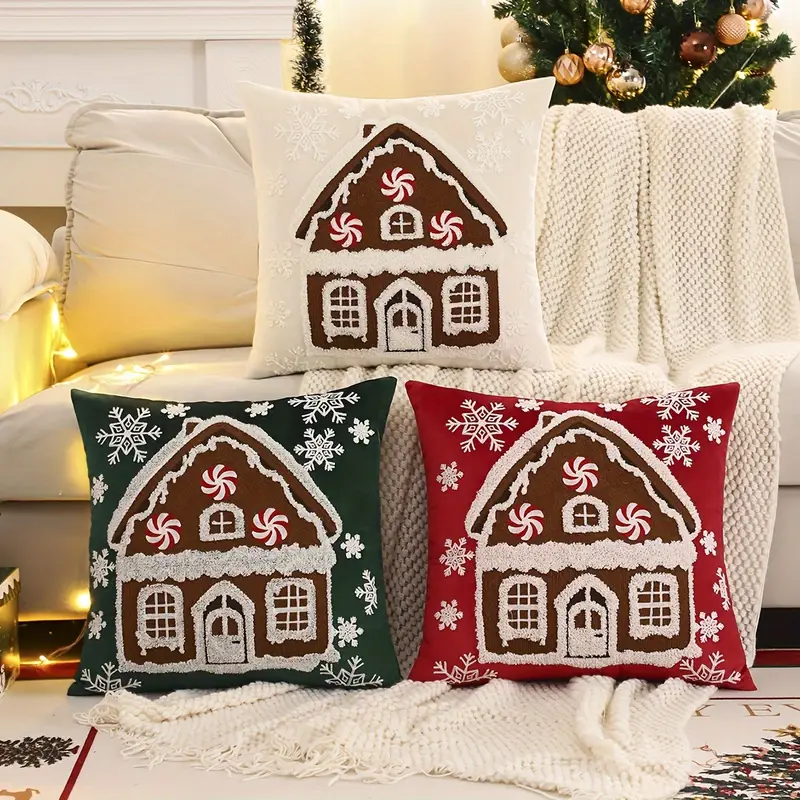
- Sofa seat width — three 18-inch pillows plus breathing room need at least 68 inches of clear seating.
- Odd numbers read better than even in a row, so plan for three or five, never four.
- Check whether your throw is warm cream or cool white; clashing undertones are the number one reason a pillow combo looks off.
- Set a floor of about $90 for three embroidered covers, or $40 if you’re covering inserts you own.
5. Oversized Gingerbread Man Pillow on a Light Armchair
You don’t need a boutique version of a shaped gingerbread pillow. Target and Walmart both stock plush gingerbread-man pillows for $15–$25 through December, and HomeGoods usually has them under $20. Handy with a sewing machine? Trace the shape onto a $6 fleece throw, sew two layers right sides together, clip the curves, turn, and stuff with a $9 bag of polyfill — done in an evening for under $20. The solid red rectangle behind it is just a $10 cover over a pillow you already own.

Here’s why the shaped pillow earns its spot: it sits in front of a solid red rectangle and a red-and-white plaid throw, so the eye needs a break in silhouette, not another square. The white icing piping and red buttons give it just enough detail to hold attention at armchair scale, and the plaid behind repeats the red without fighting the brown. Nothing competes — the shapes are doing the work color usually does.
6. Gingerbread House Pillow Styled as a Single Focal Point
Shaped pillows need negative space the way a framed print does. Leave at least 8 inches of bare upholstery on either side of a gingerbread house pillow, and prop it at a slight 15-degree tilt against the arm rather than flat against the back — the angle catches light on the icing detail and keeps it from looking like a cushion that slid out of place. If yours is around 18 inches, tuck a 12-inch square behind it and call it finished. Never pair two shaped pillows.
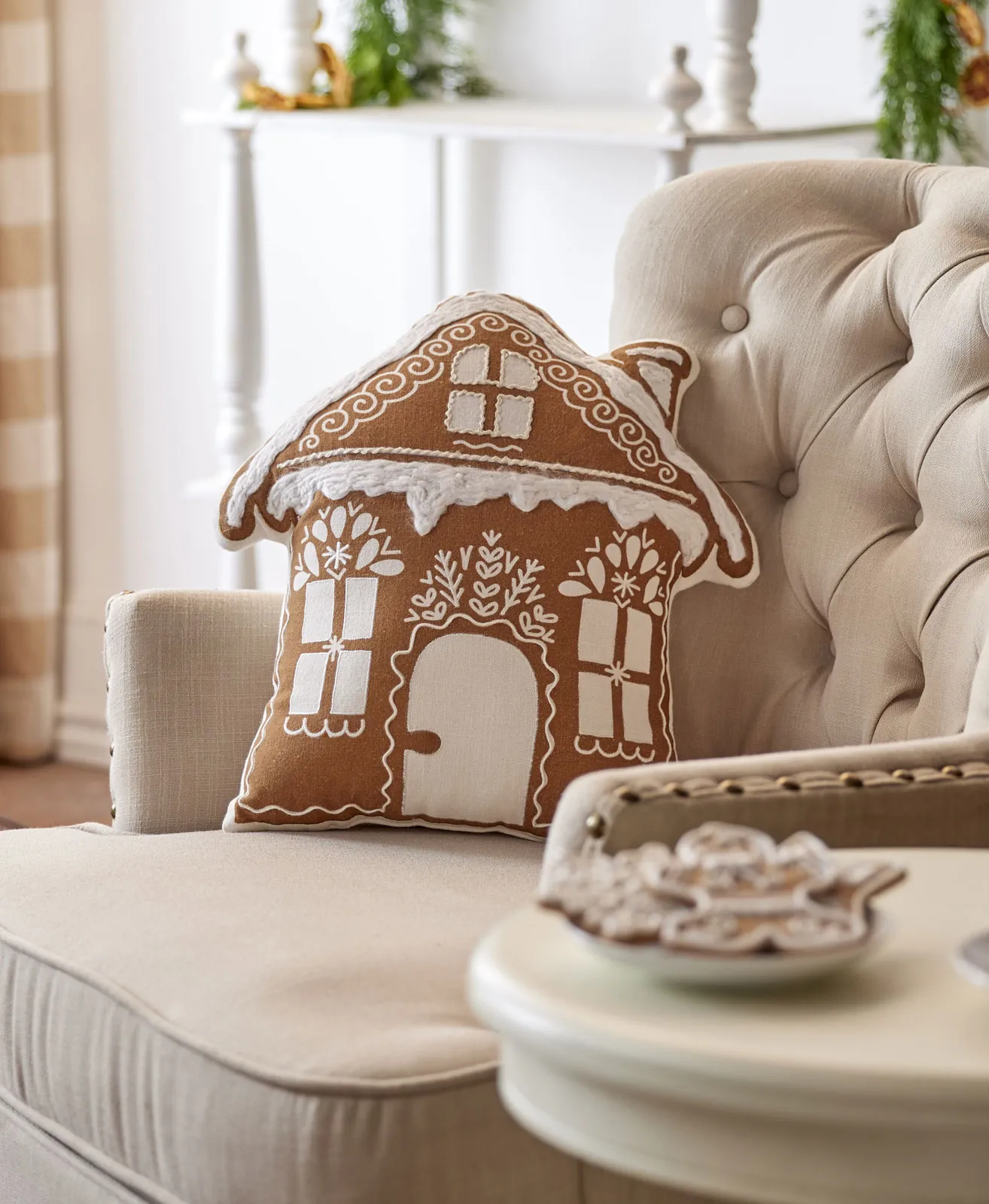
Gingerbread house pillows read best on chairs and small loveseats under 70 inches wide, in rooms from roughly 80 to 250 square feet where the pillow sits within a few feet of whoever’s sitting down. On anything wider than 90 inches, a single shaped pillow disappears — cluster two or three with squares behind them, or look at Idea #4, where three square embroidered pillows cover a long seat far better. Ceiling height isn’t a factor. Viewing distance is.
7. Nutcracker Embroidery with Tasseled Corners
It’s the tassels at all four corners. Take them off and you have a handsome deep red pillow with three well-stitched nutcrackers — good, but quiet. The tassels give the rectangle weight and a little sway, they push the red past the pillow’s own edge so it visually merges with whatever it’s leaning on, and they pick up the gold in the nutcracker uniforms. One small trim detail, and the whole thing goes from souvenir to heirloom.
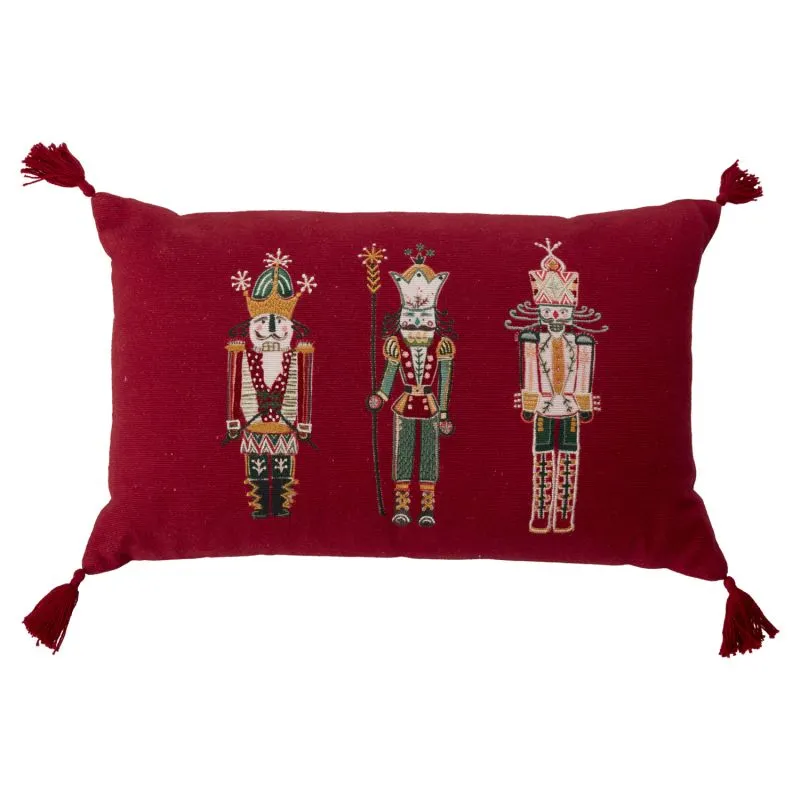
Nutcracker motifs are having their best season in years, and it isn’t only the ballet. The broader pull is toward traditional, hand-stitched Christmas imagery — nutcrackers, reindeer, embroidered trees — over graphic novelty prints, which fits the grandmillennial and maximalist holiday styling that’s been building on Pinterest since 2023. This one has staying power because it’s seasonal without being dated: a detailed nutcracker pillow in deep red will look just as correct in 2032.
8. Colorful Snowflake and Star Pillow Against Green Velvet
- Rectangular white snowflake print pillow: $25–$45
- Dark green velvet sofa (if buying): $900–$2,400
- Green velvet slipcover for one cushion: $30–$60
- Plain white or cream inserts: $12–$22 each
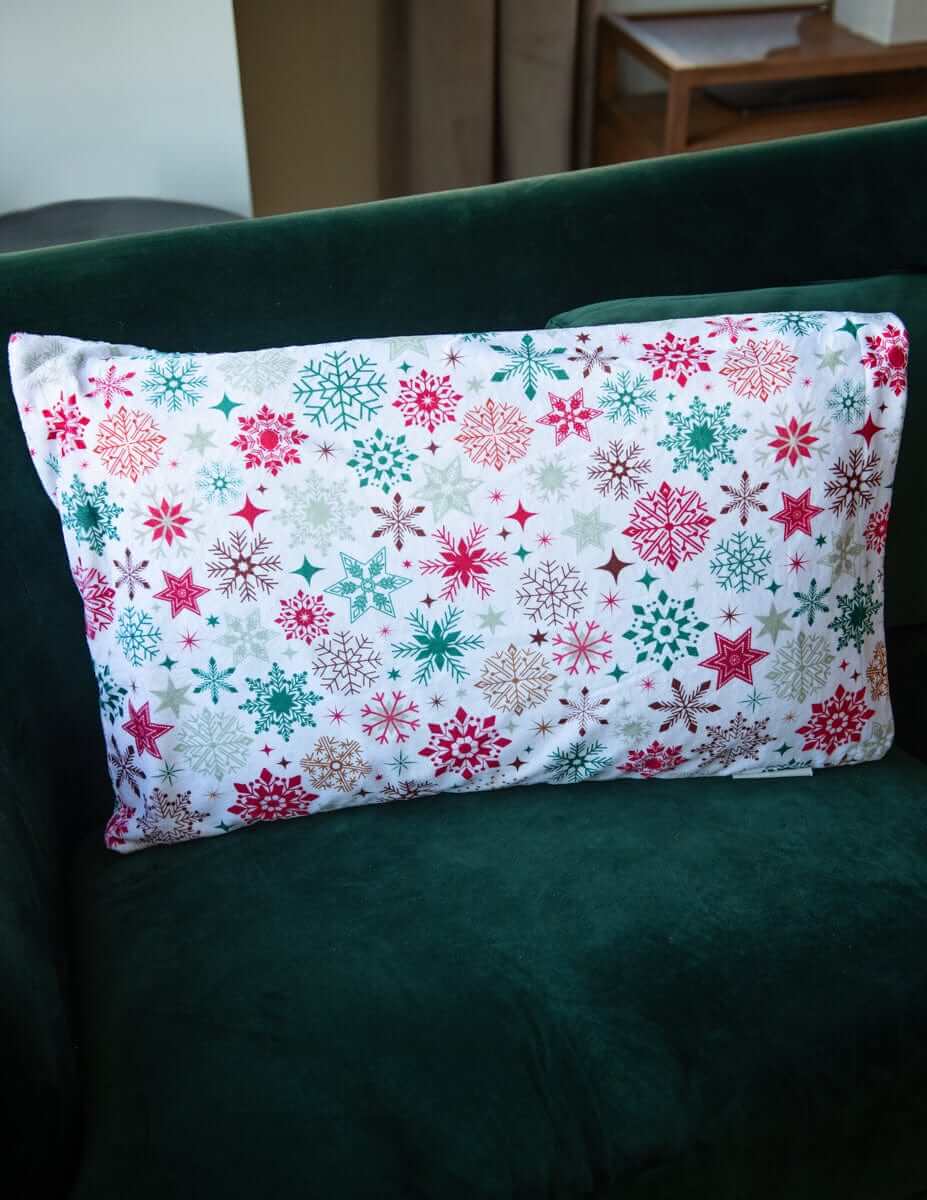
Total: $55–$140 without the sofa, or $950–$2,500 if the velvet is the whole point.
Budget alternative: put the printed cover on a green velvet lumbar you already own, or pick up a secondhand velvet armchair on Marketplace for $60–$150 and let that be your green moment.
A busy multicolor print needs a saturated solid behind it or it reads as noise. Dark green velvet works because it absorbs light instead of bouncing it, so the whites and teals in the snowflake and star pattern pop by contrast rather than brightness. If your sofa is beige or grey, a $30–$60 velvet slipcover on one cushion — or a plain green velvet lumbar layered behind the printed pillow — gets you about 80% of the effect for a fraction of the commitment.
9. Embroidered Winter Forest Pillow with Appliquéd Tree
The trick here is that everything is tonal — grey embroidery, white appliqué, white chair, red throw — so texture does all the talking. The appliquéd tree sits proud of the flat stitching and gathers light differently, creating depth you’d never get from an all-stitched design. Grey piping frames the pillow and keeps the white-on-white from going soft, and the red knit throw is the single jolt of color that makes all that restraint read as intentional instead of accidental.
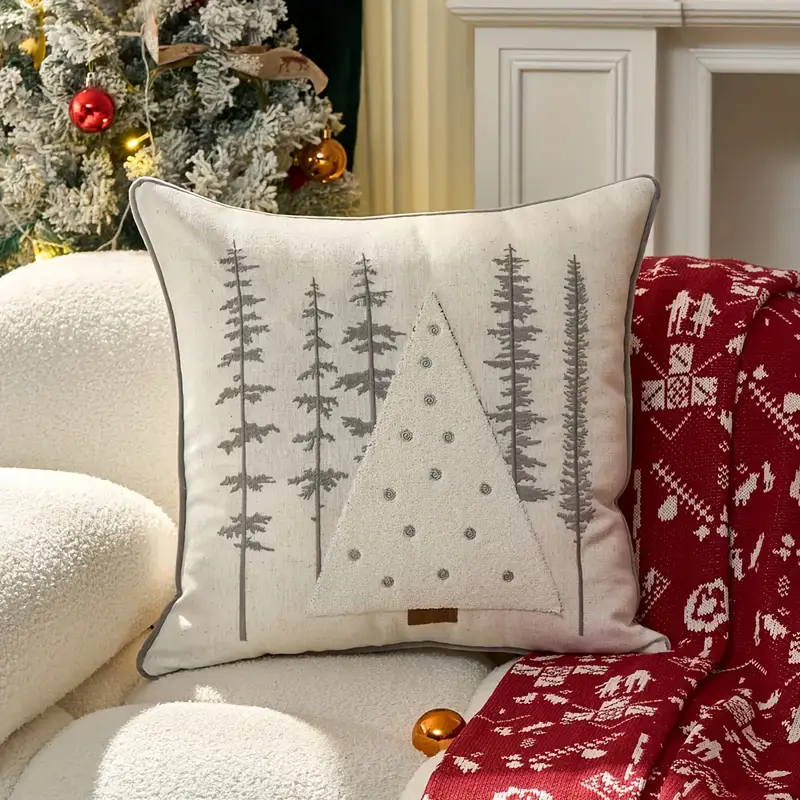
Embroidered whites show every fingerprint. Spot-clean with a damp cloth and a drop of mild detergent, machine-wash at most twice a season on cold, and always air-dry — a dryer will shrink the appliqué and dull the grey thread. That knit throw will shed loose fibers onto the white chair for the first several uses, so shake it out well before it ever touches the upholstery. Budget on replacing white covers every three or four seasons if they live on a daily-use chair.
10. Cream and Beige Pillows with Winter Wildlife Scenes
The recipe is about 60% cream, 25% beige and tan, 10% muted green from the tree motifs, and 5% gold from beaded snowflakes and metallic thread. It’s a low-contrast formula, which is exactly why it looks calm against a dark brown sofa. To shift it, keep the 60/25 split and move the accent to slate blue or silver for a colder, more modern read — the balance holds as long as the metallic stays at a whisper.
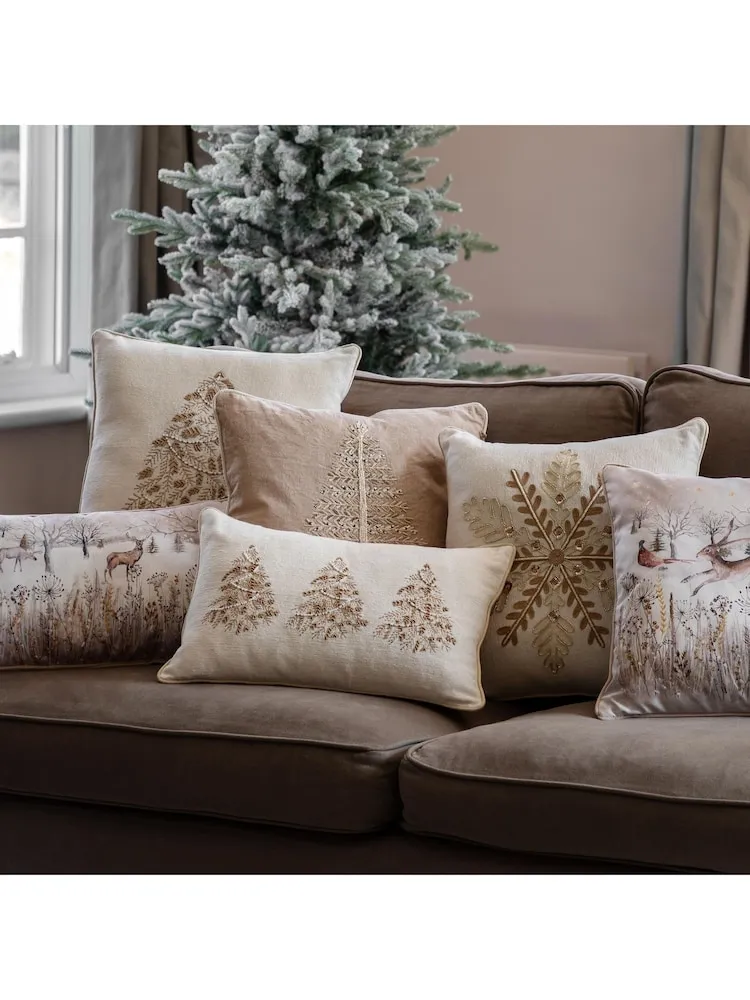
These pillows suit generous sofas: 20-inch squares plus a 14×22 lumbar, on a dark brown upholstered frame at least 84 inches wide. In a room under 150 square feet, four pillows will crowd the seat, so use three. Narrower than 72 inches? Drop to two squares and skip the lumbar entirely. Warm wood floors and cream walls give this palette the most room to breathe; cool grey walls will flatten the beige.
11. Embroidered Tree Lumbar with Scalloped Green Trim
Lumbars live or die by how you layer them.
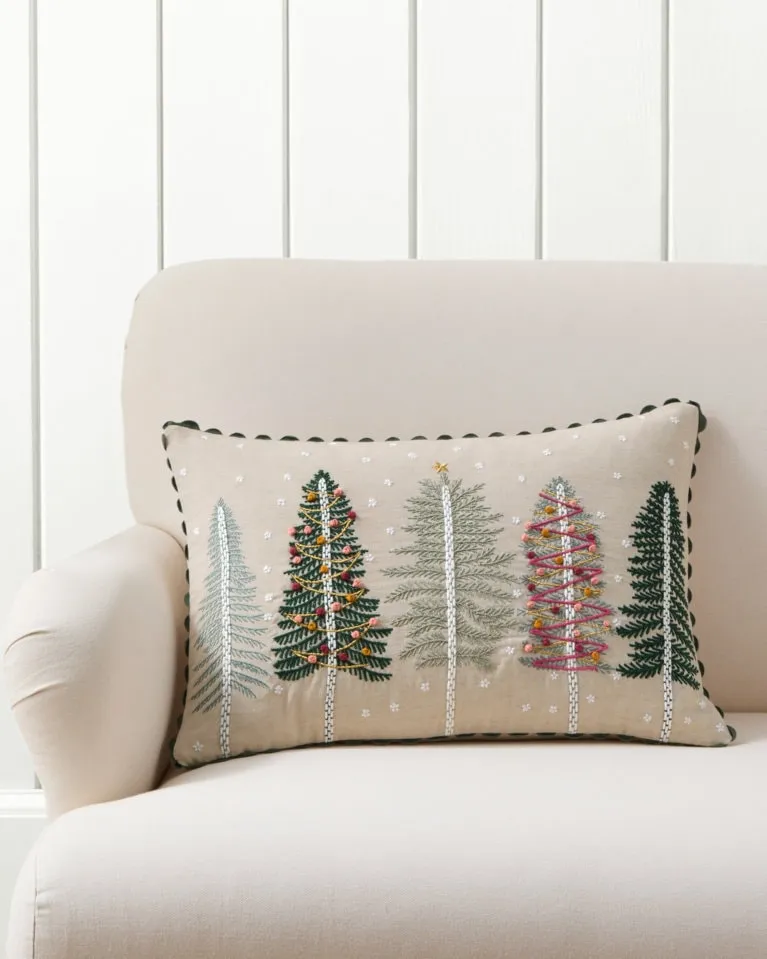
- Measure your clear seat width first. A 14×22 lumbar needs 40 inches of seating to look deliberate.
- Center the lumbar, then add one square to each side, angled slightly toward it.
- Give the lumbar a 20-inch insert rather than an 18 — rectangles go flat fast.
- Karate-chop the top edge of each square once. Once.
- Step back four feet. If the lumbar vanishes, it’s too small for that seat.
Time: about 20 minutes. Cost: nothing if you’re shopping your own stash, $30–$45 for a new embroidered one.
Scalloped trim is the detail that costs money. If you love the look but not the price, HomeGoods and T.J. Maxx regularly carry scalloped-edge Christmas lumbars for $18–$30, and Amazon has beige embroidered tree lumbars with contrast trim around $22. Or take a $10 plain beige cover and add a dark green blanket-stitch edge by hand in an hour — scalloped silhouette, a tenth of the price, and nobody will guess which is the designer version.
12. Tufted Golden Retriever Pillow Framed by a Wreath
Light blue is an underrated holiday neutral because it sits nearly opposite red on the color wheel without fighting it — it cools an arrangement instead of competing with it. If you’re already working in warm creams and reds, one light blue pillow is enough to freshen the whole group. Because this one is tufted, keep it out of high-traffic corners: punch-needle and tufted surfaces shed loose wool for the first few weeks. Vacuum with a brush attachment on low, and never rub it with a damp cloth or you’ll fuzz the pile.
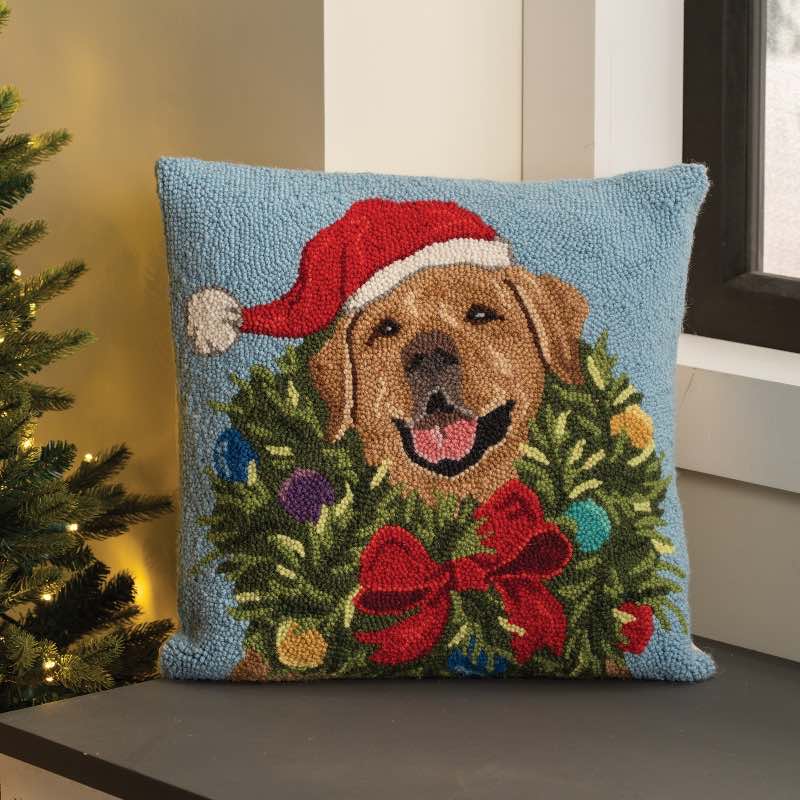
The red bow at the base of the wreath is the whole reason this composition works. It closes the circle, gives the dog’s face a frame and a base, and points your eye straight up to the portrait. Without it the wreath floats and the pillow becomes a nice novelty item you forget by January. With it, the tufted piece reads as a framed portrait — which is why the scattered ornaments in the greenery suddenly feel like they belong to the dog.
13. Vintage Red Truck and Polka Dot Reindeer on Grey
- Light grey fabric sofa (if buying): $650–$1,500
- White vintage truck print pillow: $22–$40
- Red polka dot reindeer appliqué pillow: $20–$38
- Cream chunky knit throw: $45–$110
- Two down-alternative inserts: $24–$44
Total: $761–$1,732 with the sofa; $111–$232 for the styling layer alone.
Budget alternative: Walmart and Five Below carry truck-print Christmas covers for $8–$14 in season, and a cream throw from IKEA runs about $25. Same red-and-white energy — and it’s the cheaper, more graphic cousin of the layered look in Idea #2.
Red on light grey is gorgeous in daylight and slightly washed out under warm bulbs, so check your lamp temperature before you commit — 2700K turns red rusty, 3000K keeps it clear. Appliqué edges on the reindeer can lift after a few washes, so hand-wash or use a mesh bag. And if a cream or white sofa shares the room, keep the damp polka dot cover away from it on cleaning day.
14. Emerald Velvet with Golden Botanical Embroidery
This is a jewel-tone formula: about 70% light beige and neutral, 25% deep emerald velvet, and 5% gold and lime from the embroidery. It works because the green and gold sit close in value, so the pillow reads as one rich field with fine detail rather than two competing colors. Want it cooler? Swap emerald for deep teal and gold for champagne, keeping the same 70/25/5 split. The formula survives any color swap as long as the accent stays under a third of the surface.
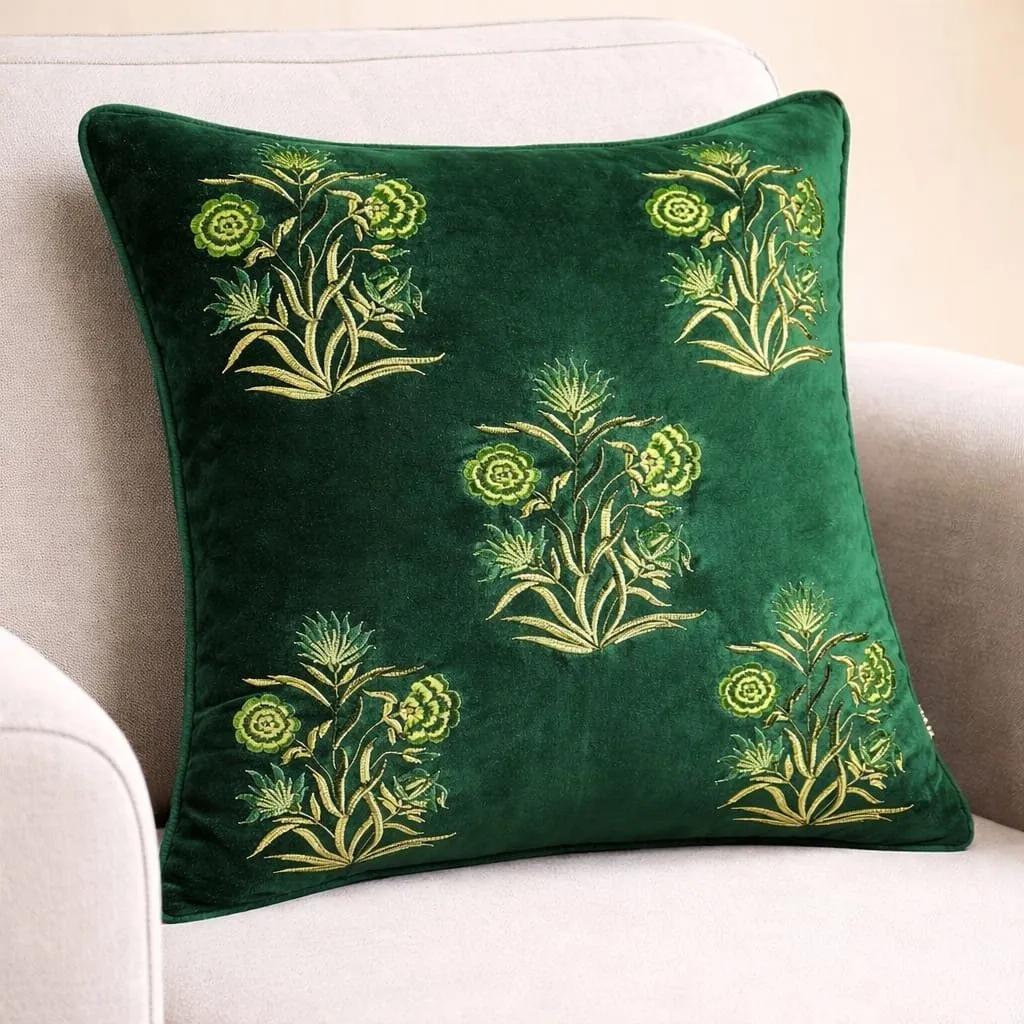
Jewel tones came back hard with the quiet-luxury wave, and velvet with botanical embroidery is the version that stuck for the holidays — it reads festive without a single Santa in sight. Pinterest saves for emerald-and-gold styling have climbed steadily since 2024, and the reason it endures is simple: it’s really an autumn-to-winter palette with a longer shelf life than anything covered in reindeer. Run it October through February and nobody blinks.
15. Watercolor Winter Forest Pillows on Cream
- Check print scale — a watercolor forest needs pillows at least 18 inches so the trees stay legible.
- Look at the blues in the print next to your sofa fabric; cool blues want a cream base, not a yellow-white one.
- Decide where the gnome lives before you buy anything. A small striped figure needs its own surface, not the sofa seat.
- Confirm the throw’s tassels sit in the same blue range as the print, or go fully neutral.
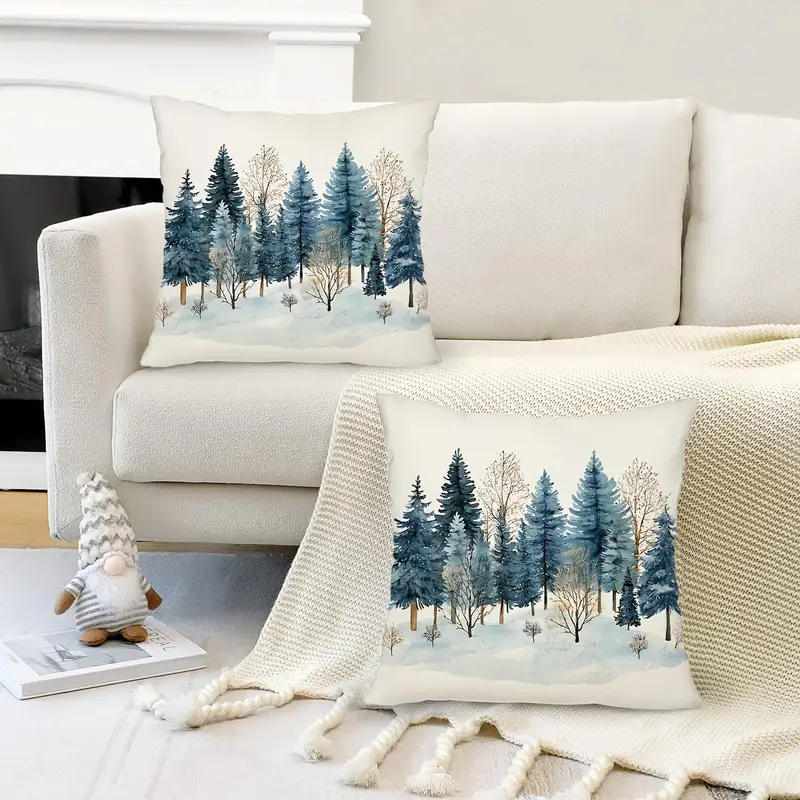
Watercolor reads soft from across the room and detailed up close, which is a rare combination in holiday decor. Because the trees are painted in blues and browns, your eye stays calm even though the print covers the whole face of the pillow — no harsh graphic edges to compete with the cream sofa. The knitted throw with tassels repeats the texture language, and the little grey and white gnome resting on a book is the accent that makes the corner feel styled rather than shopped.
16. Sage Green Deer Pillow with White Foliage Embroidery
An 18-inch sage green pillow is happiest on a single armchair in a reading nook — roughly 40 to 70 square feet of floor space, with the chair about 8 feet from the nearest doorway so the embroidery reads as you walk in. The white plank wall behind it gives sage a clean, cool backdrop; against a warm beige wall the green goes slightly muddy, so shift toward a grey-green if that’s your room. In a larger living room this works as part of a four-pillow group rather than a solo moment.
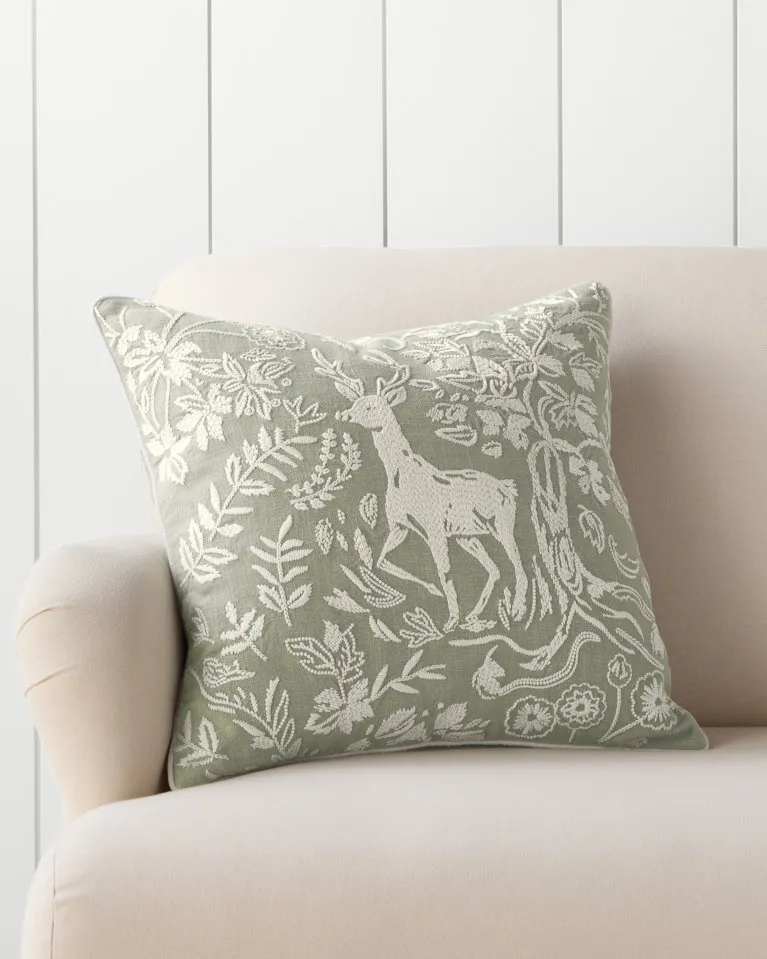
Sage green with white embroidery looks expensive and costs almost nothing to fake. A plain sage cover runs $8–$16 at IKEA and Amazon, and a small embroidery kit with a deer outline is about $12 at any craft store — figure two evenings for a beginner. Etsy sellers make this exact style for $35–$60, still cheaper than a boutique shop, and secondhand sage velvet covers show up on Poshmark for under $20 in January when everyone purges holiday decor.
17. Red Embroidered Tree Pillow with Falling Snow
Rectangles need two companions, no more.
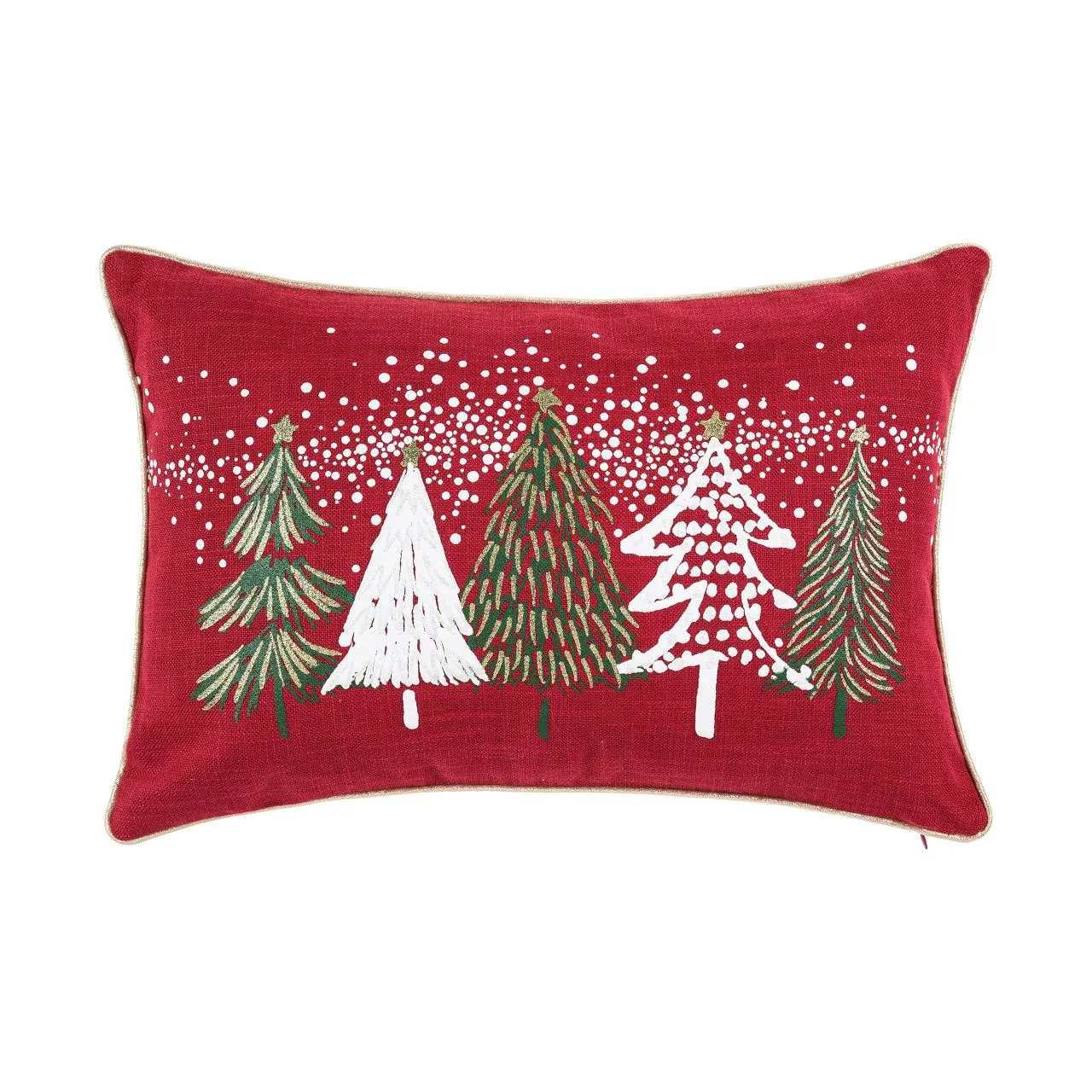
- Start with the rectangle. Center it and check that it sits below eye level when you’re standing.
- Add two squares — one solid pulled from the embroidery, one small pattern.
- Angle each square about 15 degrees off the back so the light piping catches light.
- Resist a fourth pillow. A red rectangle with two supports is a complete arrangement.
- Rotate weekly so the embroidery doesn’t crease along the same line.
Time: 10 minutes. Cost: $0, or $28–$50 for two supporting covers.
Deep red fabric and dense embroidery are both fade-prone in direct sun, so keep this pillow off a south-facing window seat unless you like a softer red by spring. Wash cold in a mesh bag, lay flat to dry, and never iron the embroidery directly — press from the back through a cloth. The light piping will collect lint from a cream sofa, so keep a roller in the drawer. Realistically, one hand-wash a season keeps it looking new for years.
18. Plush Gingerbread House Pillow with Fluffy Roof Trim
It’s the fluffy white trim running along the roofline. Everything else on this pillow is embroidery — flat, precise, controlled — and then the roof breaks out in a soft white pile you have to touch. That one texture shift is what makes a light brown plush pillow read as a gingerbread house instead of a brown square, and it’s why the white embroidered windows, door, and icing still register against the same-tone fabric. Remove it and the whole thing goes flat.
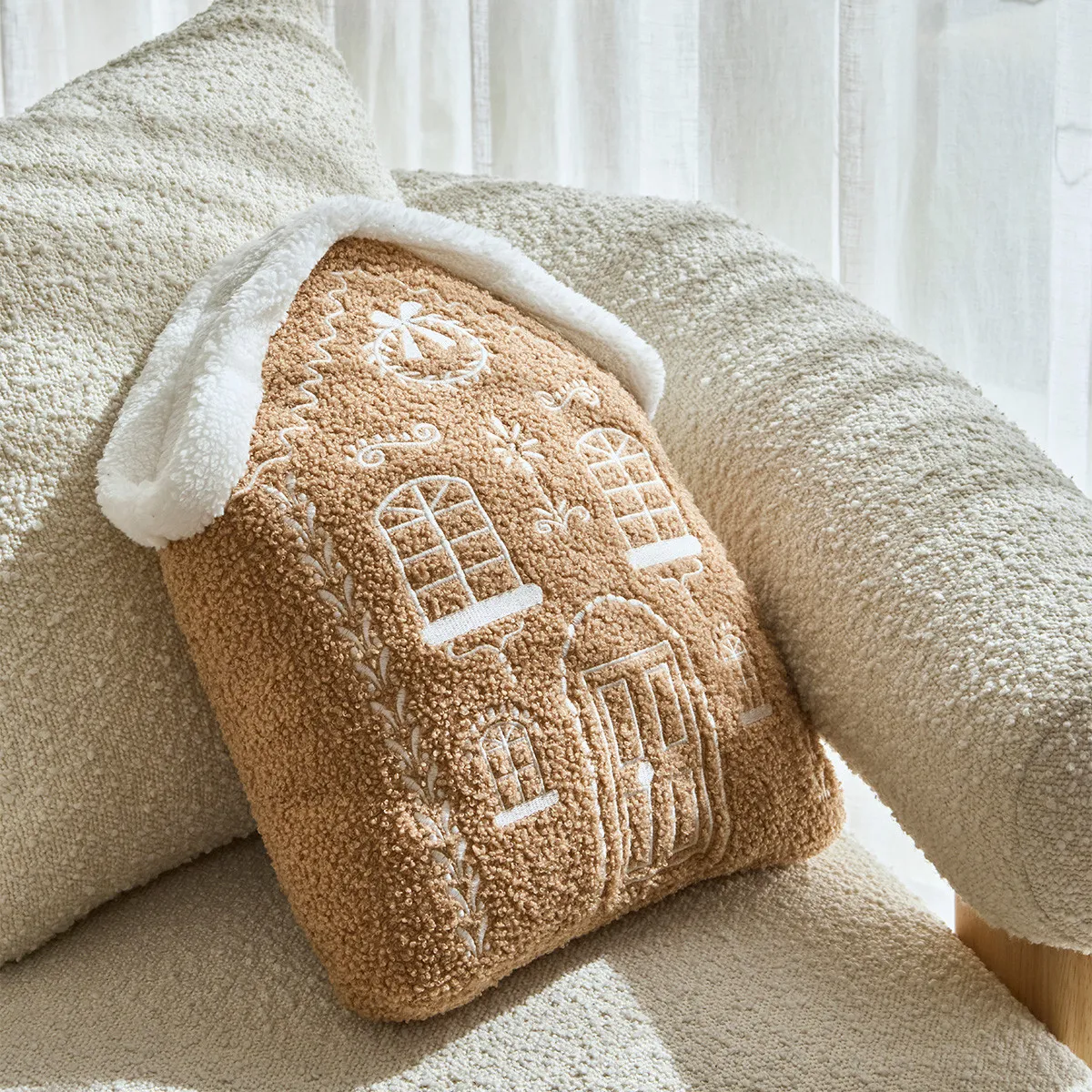
Plush shapes work because they give your eye a break from geometry. A room full of square pillows and rectangular sofas needs one soft, non-angular object, and a gingerbread house does that job while staying on theme. The white detailing reads at 10 feet even though the contrast is low, and the off-white textured upholstery underneath echoes the pillow’s pile so the two surfaces feel related. Same principle as Idea #1, just with a bigger silhouette and no fabric pattern to compete.
19. Golden Crushed Velvet Pillows on Deep Green
- Two gold crushed velvet Christmas pillows: $22–$45 each
- Dark green velvet sofa (if buying): $900–$2,200
- Pre-lit mantel wreath: $45–$120
- Two small decorative trees: $18–$40
- Wooden coffee table: $120–$350
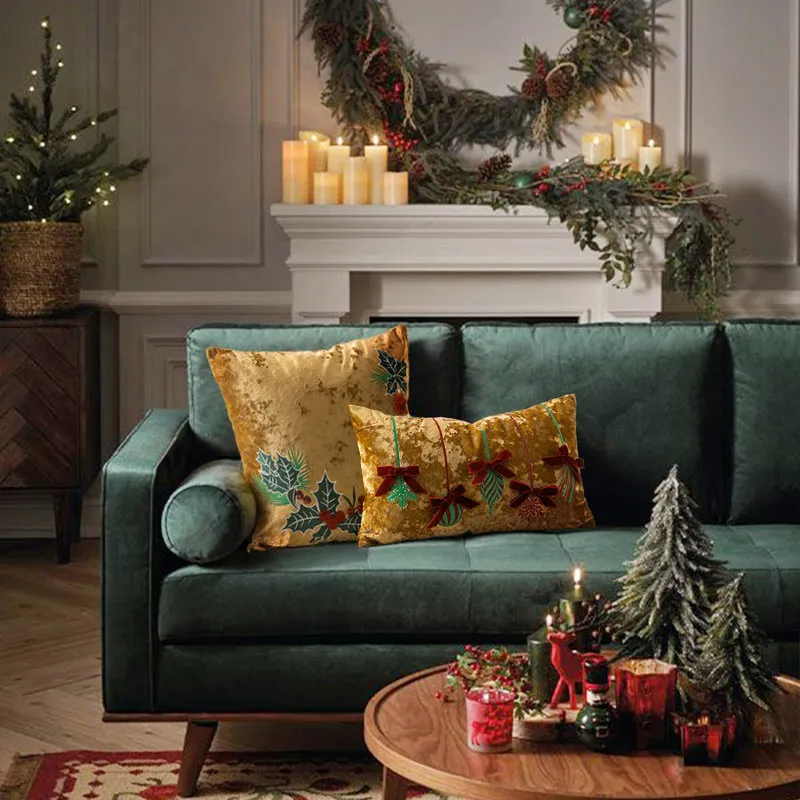
Total: $1,105–$2,755 from scratch; $85–$205 for the pillow-and-wreath layer alone.
Budget alternative: keep your sofa and add two $15 gold velvet covers plus a $25 unlit wreath with a $6 string of battery lights. The green velvet can come later.
Crushed velvet needs light to look like crushed velvet. Put these pillows on a sofa that faces away from every lamp and the gold reads as flat mustard — instead, keep them within about 6 feet of a warm bulb or a window, and the pile will shift from bright to deep as you walk past. Same trick applies to the little trees: light them from a lower angle and the green velvet behind them picks up a subtle halo.
20. Buffalo Plaid and Merry Red on a Grey Sectional
Buffalo plaid is bold, and on a sectional it’s a lot of square footage. A check around nine inches is about the largest that still reads as pattern rather than statement wall — go bigger and the red ‘Merry Christmas’ pillow gets swallowed whole. Also check that your light grey is actually grey. Greige undertones turn the black in buffalo plaid slightly brown, which looks muddy next to a true red. Lay the cover on the sofa in daylight before you cut the tags.
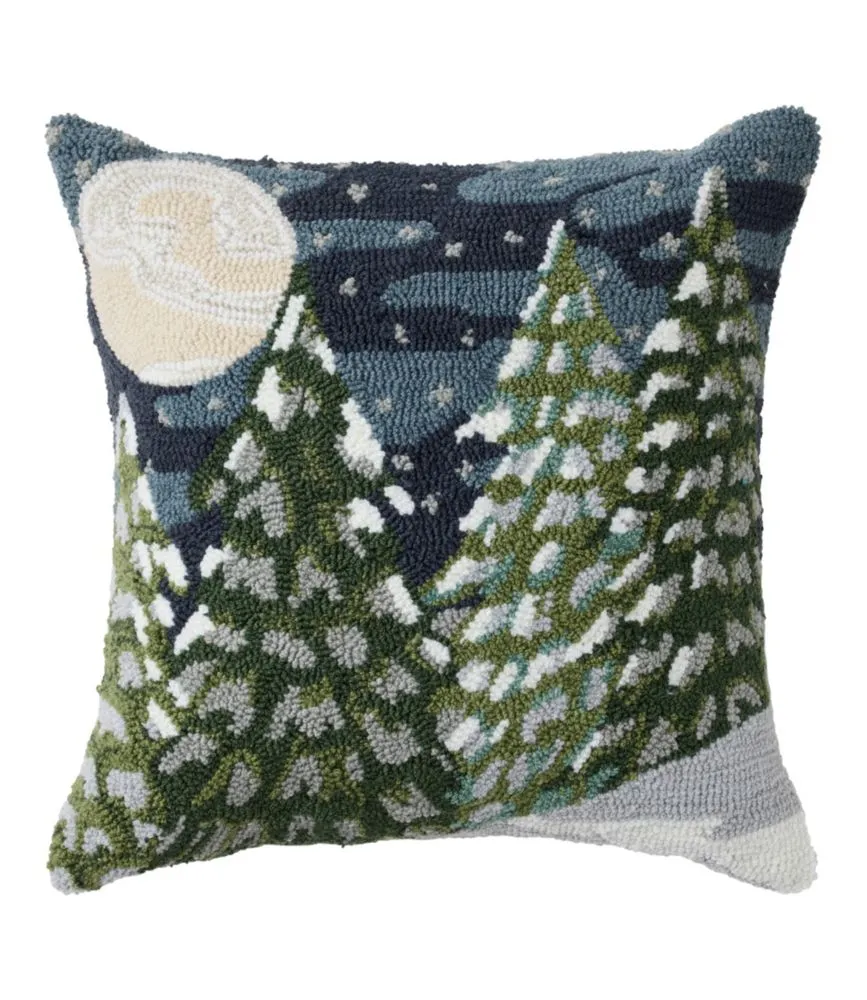
The formula is roughly 65% light grey, 25% red, and 10% black and cream combined. Grey does the heavy lifting as the neutral, which is why the red can be this bright without tipping into chaos. Want a warmer version? Swap the grey sofa for oatmeal, hold red at 25%, and change the black-and-white plaid to brown-and-cream — the structure holds. It’s a different mood than the layered textures in Idea #27, but the math is the same.
21. Washable Candy-Design Cushion for High-Traffic Rooms
Washable novelty cushions have quietly become one of the fastest-growing categories in holiday decor, and it makes sense — households with toddlers, dogs, and cats stopped buying dry-clean-only pillows years ago. The 50×30 cm format (about 20 by 12 inches) is the sweet spot: big enough to read as decor, small enough to fit a bench, a desk chair, or the corner of a sectional. The candy-stripe aesthetic ties straight back to the vintage Christmas revival that’s been building since 2023.
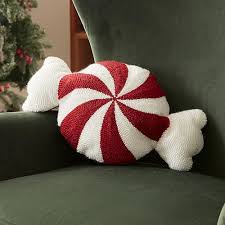
- Start with the seat. A 20×12 cushion needs about 36 inches of clear width to look deliberate.
- Center it on a bench, or offset it on a sofa — never dead center on a large couch.
- Pair it with one square behind and nothing else. Lumbars lose impact in a crowd.
- Use a slightly fuller insert so the corners stay crisp.
- Rotate the cover monthly so one side doesn’t fade ahead of the other.
Time: 10 minutes. Cost: $0 if you own it, $12–$20 if you don’t.
22. Tufted Hot Cocoa Pillow with Tree and Snowflake
Tufted novelty pillows look handmade, and often are — which is why they run $40–$70 from small makers on Etsy. Amazon and Target carry very similar punch-needle and tufted Christmas pillows for $16–$28, and the difference is mostly stitch density, not looks. If you’re patient, a punch needle kit is about $20 and a plain cream cover $8; a first-timer can finish a simple tree-and-mug design over a weekend. Thrift stores in January are another goldmine — holiday novelty pillows get donated barely used.
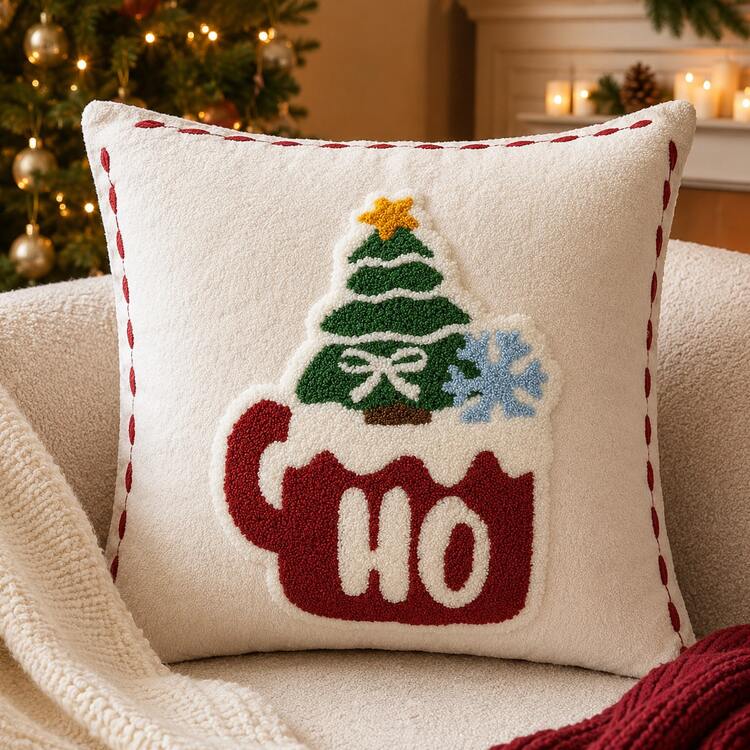
The red stitched border here isn’t decoration, it’s a frame — and it’s why the cream cover doesn’t look unfinished at the edges. If you’re making or altering one, run the border stitching half an inch inside the seam and keep the stitch length short so it reads as a line rather than a dash. When the tufted design is large like this mug, tree, star, and snowflake cluster, a heavier border balances it; a thin one looks like an afterthought next to all that pile.
23. Plaid and Needlepoint Florals on White Bedding
Plaid and needlepoint shouldn’t work together, and yet the pairing is one of the oldest tricks in traditional decorating. The reason: they share a scale. The navy plaid check is small, the floral motifs on the black needlepoint are small, and both sit on crisp white bedding that acts as a reset button between them. The plaid throw at the foot of the bed repeats the plaid pillow and closes the loop, so the black floral — the loudest piece — ends up reading as the accent instead of the outlier. Compare it with Idea #14, where the same dark-ground-plus-metallic idea plays out on a single pillow.
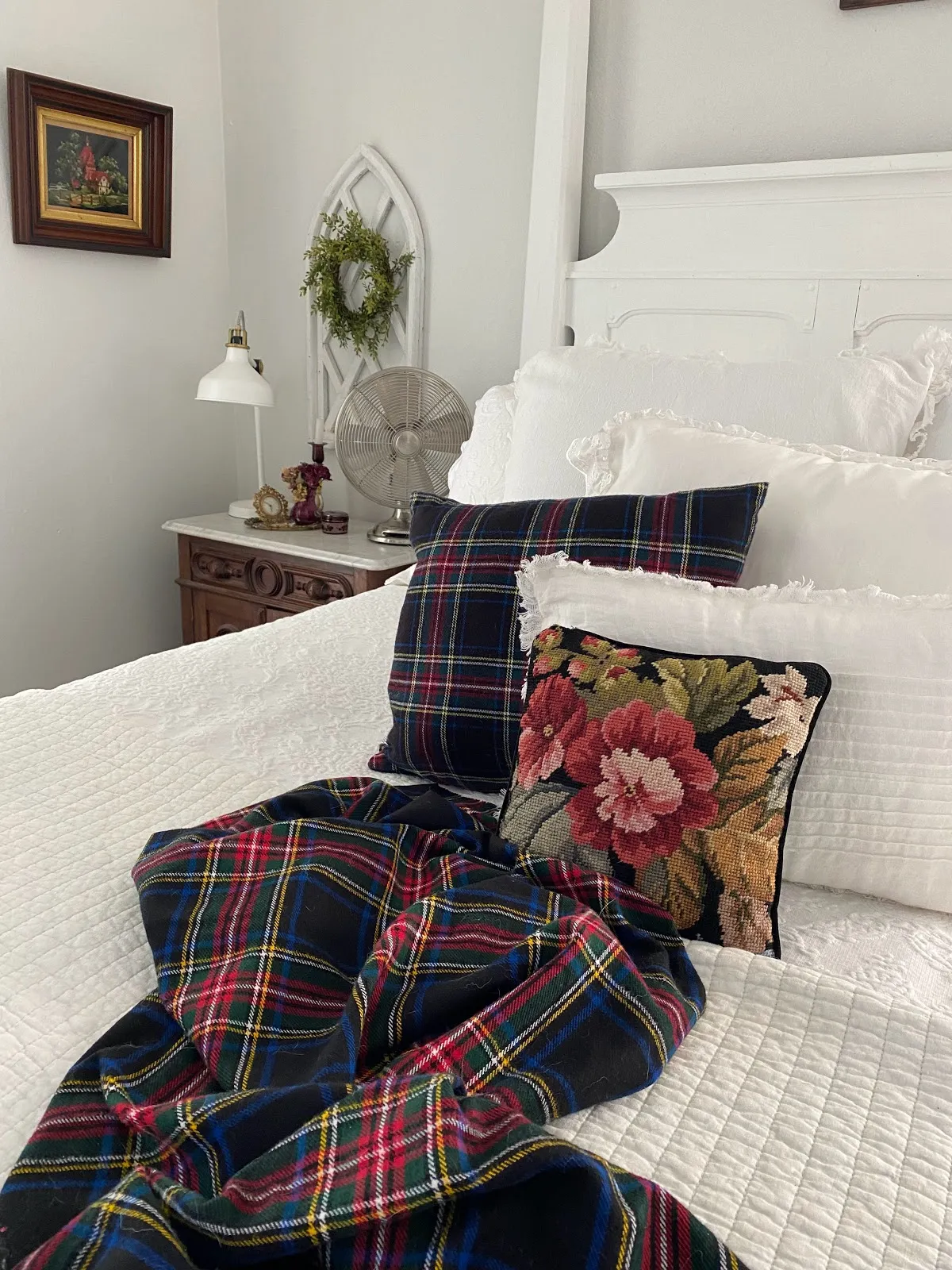
On a queen bed, four pillows is the practical ceiling before the bed starts looking like a display. A king can handle two euro shams, two standard, and one lumbar — five total. The navy plaid at 20 inches and the floral needlepoint at 18 work on both sizes, but keep the ruffled whites behind them; ruffles need depth to sit against, and a low headboard will flatten the whole stack. In a bedroom under 120 square feet, use three pillows and let the plaid throw carry the rest.
24. Beaded Tree Embroidery on Cream with Gold Piping
- Two beaded tree embroidered pillows: $40–$90 each
- Dark brown upholstered sofa (if buying): $800–$1,900
- Frosted artificial tree branch or small tree: $25–$70
- Gold-toned piping detail (if custom): $15–$30 per pillow
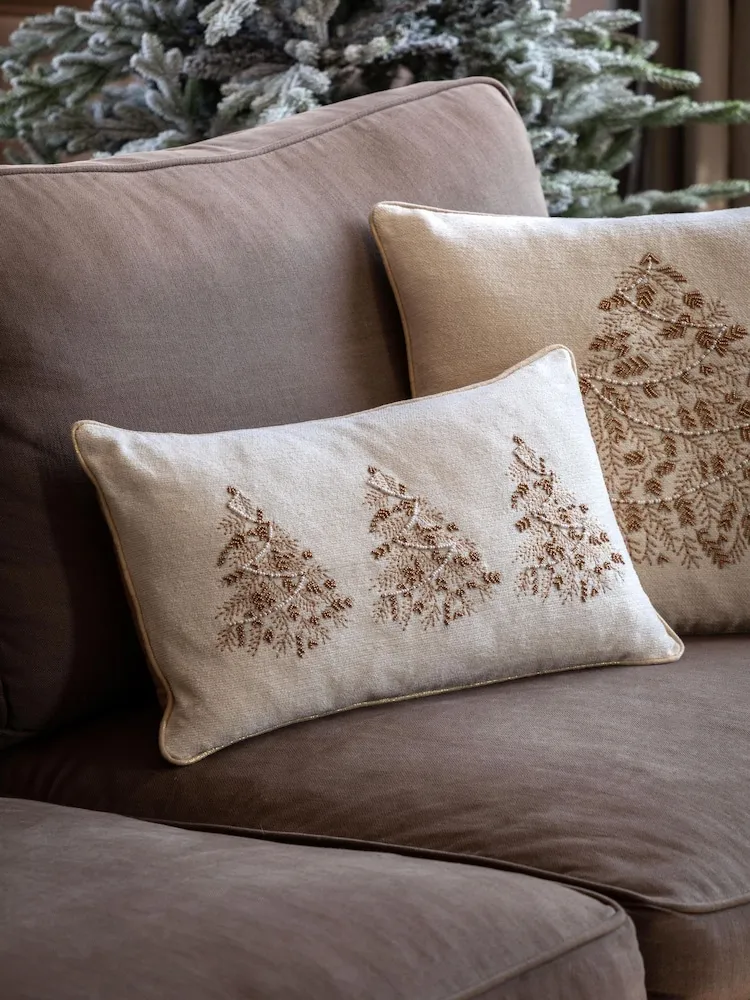
Total: $120–$250 for the pillow layer; $920–$2,150 with a new sofa.
Budget alternative: Amazon and Wayfair carry beaded Christmas tree pillows for $22–$38, and a single frosted branch from a craft store runs $6–$12. You’ll lose a bit of stitch density and the gold piping, but the beaded texture reads the same at three feet.
Beadwork is beautiful and demanding. Beads loosen with every wash, so hand-wash in cool water with a teaspoon of gentle detergent, press the water out between towels, and dry flat — never hang a beaded pillow or gravity will stretch the embroidery. Expect to lose a bead or two a season; keep a needle and matching thread handy and tack them back immediately. Gold-toned piping can tarnish in humid rooms, so keep these away from bathrooms and kitchens.
25. Forest Animal Pillow with Peek-a-Boo Pockets
The pockets. A squirrel and a fox emerging from stitched openings on the lower third of the pillow turns a pretty forest scene into something a kid will actually pick up and investigate. The horizontal stitching across each pocket gives them a real seam so they don’t read as appliqué, and the animals sitting half-inside gives the composition a foreground, middle ground, and background. Take the pockets away and it’s a lovely embroidered pillow — but nobody under ten would ever touch it.
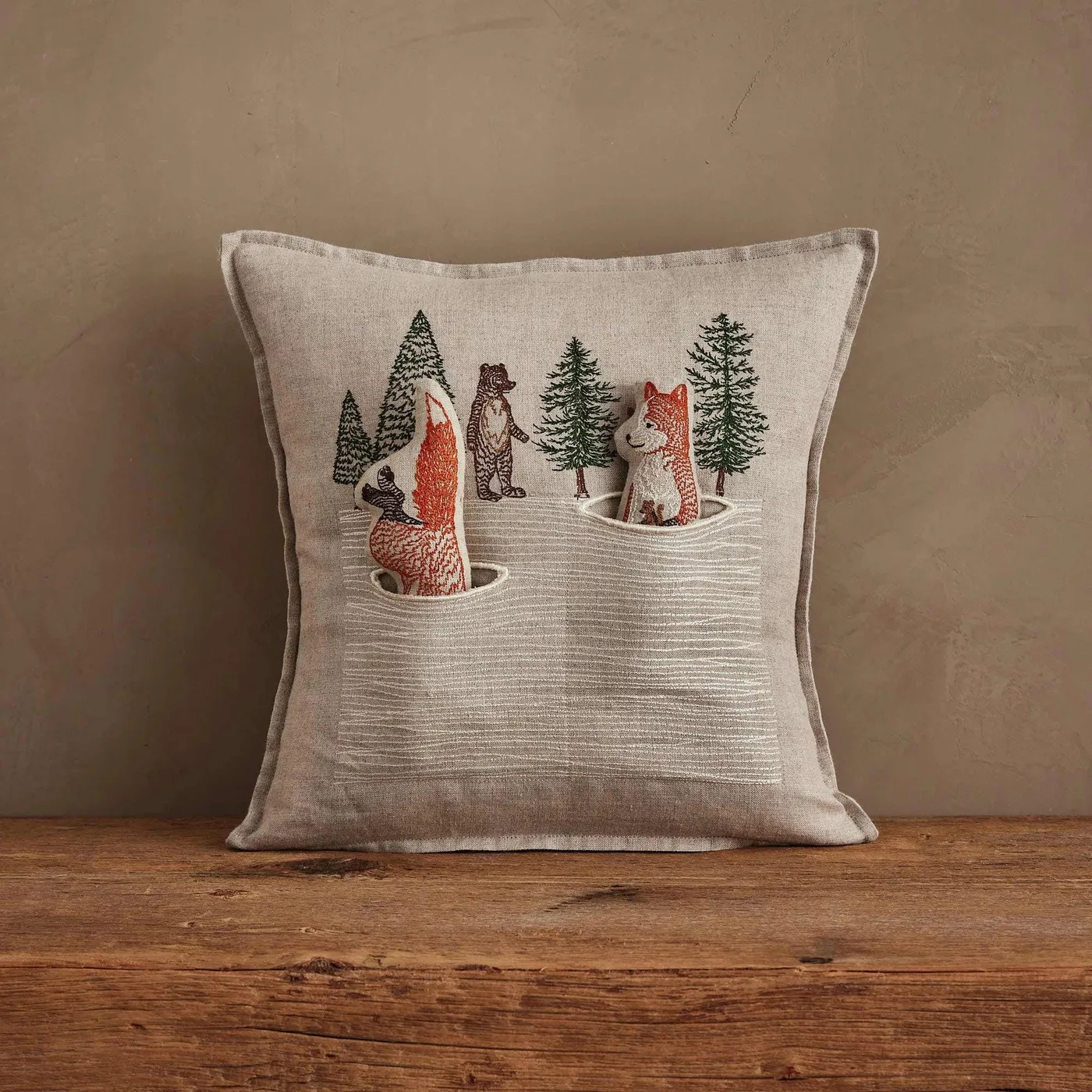
- Clear the surface first — this pillow wants a distressed wood shelf or bench, not a sofa corner.
- Stand it upright rather than leaning it. Pockets only read at eye level.
- Add one natural element nearby: a pinecone, a candle, a sprig of evergreen.
- Keep the wall behind it light so the dark green evergreen embroidery stays visible.
- Rotate a quarter turn monthly so the pockets don’t sag into one shape.
Time: 15 minutes. Cost: $0 to $20 if you need a candle or greenery.
26. Embroidered Christmas Mice in Stockings Lumbar
Embroidered novelty lumbars on Etsy run $28–$55, and that’s fair for hand-stitched work — but you don’t have to pay it. An $8 IKEA linen lumbar cover plus a $6 iron-on or hand-stitched patch gets you the idea for under $20. Seasonal aisles at HomeGoods and T.J. Maxx often have animal-embroidered lumbars for $16–$25 in November, and secondhand Christmas linens on eBay go for a few dollars in January. The dark red piping is the one detail worth paying for; it’s what makes the pillow look finished instead of homemade.
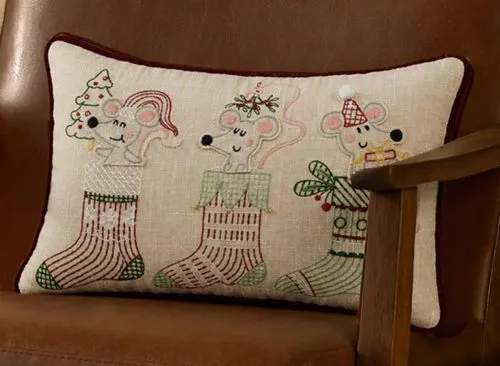
- Measure the chair seat depth — a 12×20 lumbar needs at least 20 inches of seat to sit properly.
- Check the chair’s leather tone against the off-white linen; brown leather warms the fabric, black cools it.
- Confirm the piping reads as red and not burgundy under your room’s lighting.
- Decide whether this is a kid-friendly moment or a formal one before you place it within reach.
27. Plaid and Teddy Bear Velvet Pillows on Cream
Roughly 50% cream from the sofa and throw, 30% plaid, and 20% velvet teddy bears. Plaid at nearly a third is bold — it works only because the plaid does double duty on the throw, so your eye accepts it as a theme rather than an accent. Want it calmer? Drop the plaid to 20%, raise the cream to 60%, and swap one plaid pillow for a solid deep green velvet. Same structure, half the visual volume, and it’ll still read as Christmas.
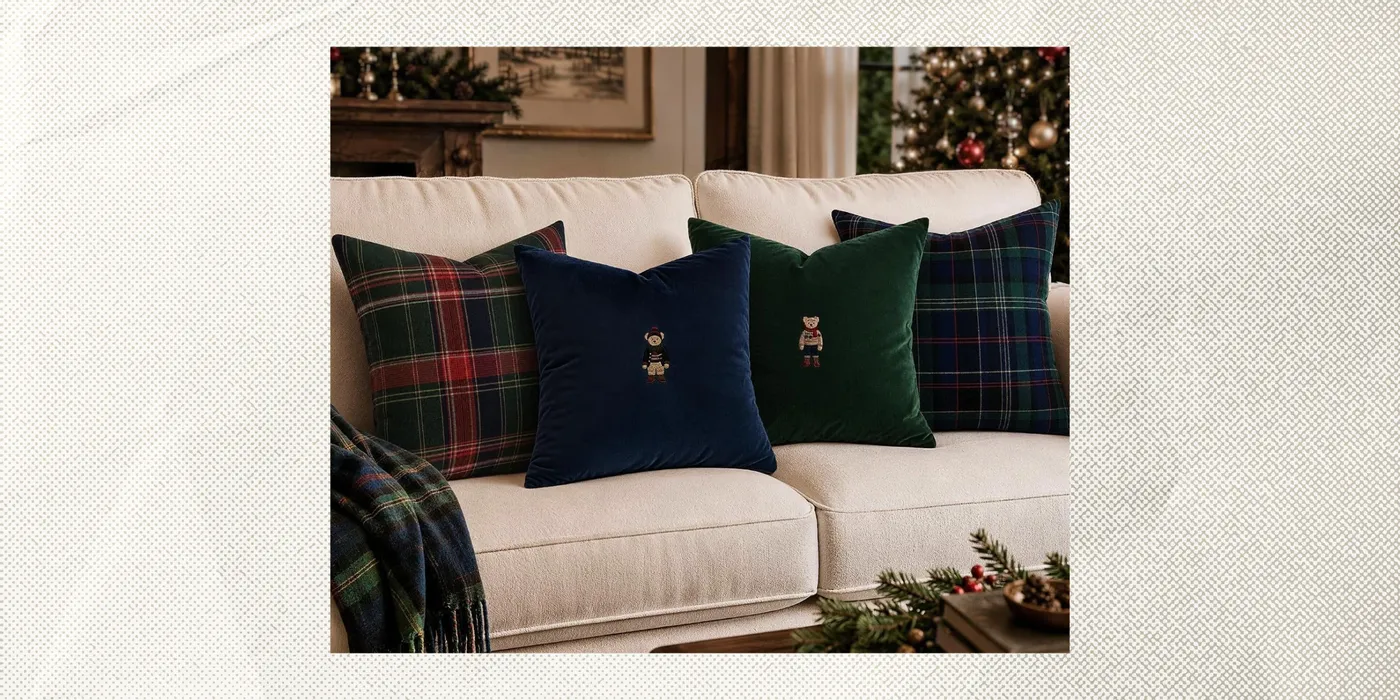
The plaid throw draped over the arm is what makes four pillows look composed instead of crowded. It repeats the plaid squares at a larger scale and lower height, so your eye moves from the throw up through the pillows and lands on the teddy bears — the only soft, non-geometric shapes in the stack. The cream sofa gives both patterns a neutral floor, and the garland on the mantel in the background echoes the same deep greens, tying the whole vignette together.
28. Red ‘Merry’ Pillow and Plaid Pair with Votive Styling
- Red ‘merry’ throw pillow: $18–$32
- Two red-and-white plaid pillows: $16–$28 each
- Wood coffee table: $120–$380
- Ornament centerpiece with platter: $30–$70
- Mercury glass votive holders and candles: $20–$45
- Faux hydrangea and red berry stems: $18–$40
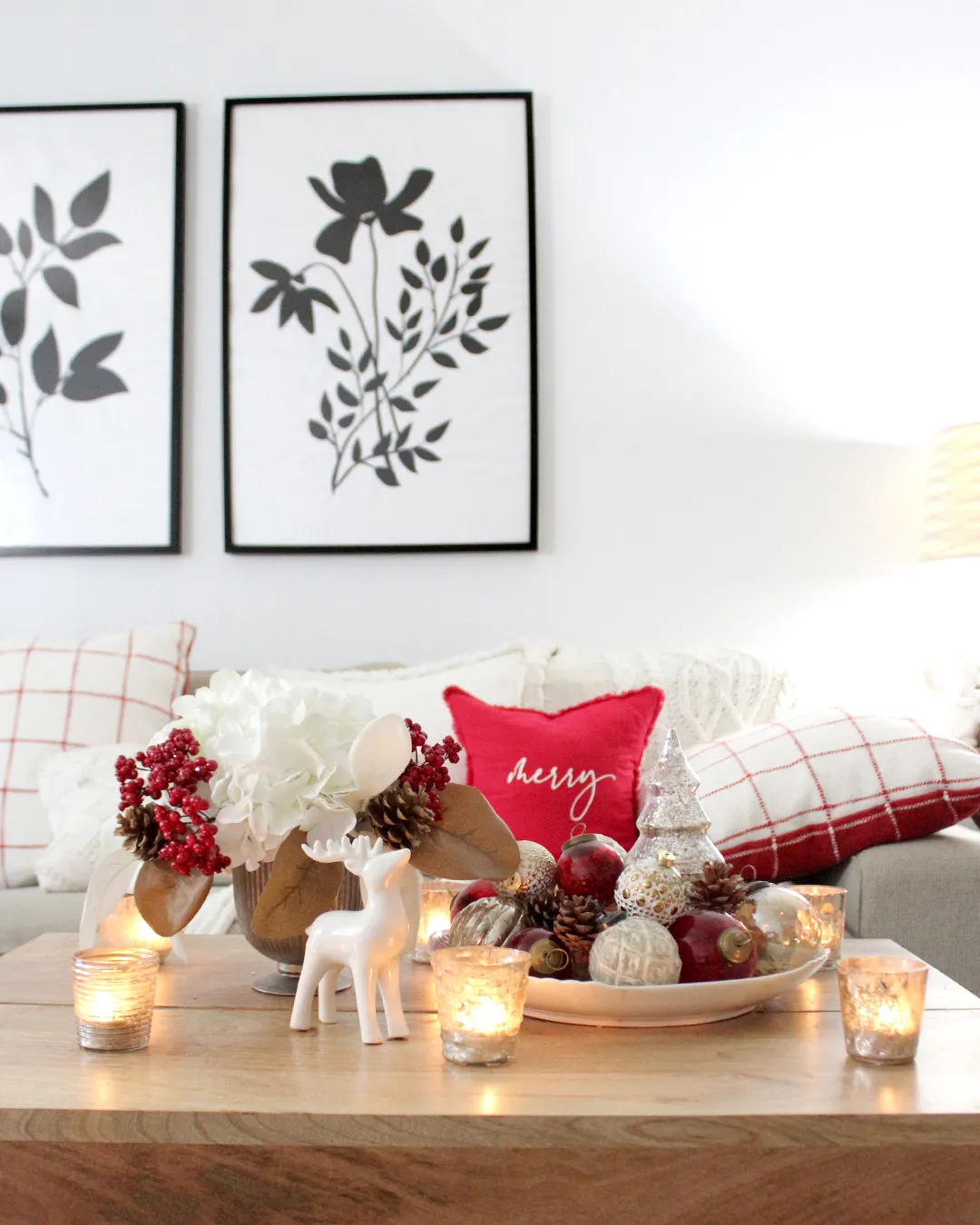
Total: $238–$623 for the full vignette, or $102–$215 if the table is already yours.
Budget alternative: Dollar Tree carries mercury-look votives for $1.25 each and red berry stems for about $2. A thrifted platter plus ornaments you already own gets the centerpiece under $25.
Real candles plus dried greenery plus fabric deserves a second thought. Never burn a votive under a shelf or within a foot of a pillow, and blow them out before you leave the room — this is the most common holiday decor mistake and it isn’t a small one. Battery-operated votives with a flicker have gotten convincing at $12–$20 for a set of six. Berry stems shed, so check them on the platter, not the upholstery. And if a whole sofa of red feels like a lot, the chair vignette in Idea #26 scales the same palette down to one seat.
- Measure your coffee table — the centerpiece should take no more than a third of the surface.
- Check that the pillow reds match; ‘merry’ red and plaid red are often different dyes.
- Confirm the sofa is at least 70 inches wide for two plaid pillows plus the merry one.
- Choose candle or battery before buying holders — the sizes differ.
29. Personalized 2026 Wreath Pillow in a Mixed Collection
Personalized year pillows — a wreath framing ‘2026,’ a monogram, a family name — have moved from novelty to a genuine category. The reason is generational: buyers in their late twenties and thirties treat holiday decor as a keepsake rather than a one-season purchase, and a dated pillow quietly becomes an heirloom with a story attached. It also solves the gifting problem. Expect the trend to hold; year-stamped pieces have appeared every season since 2019.
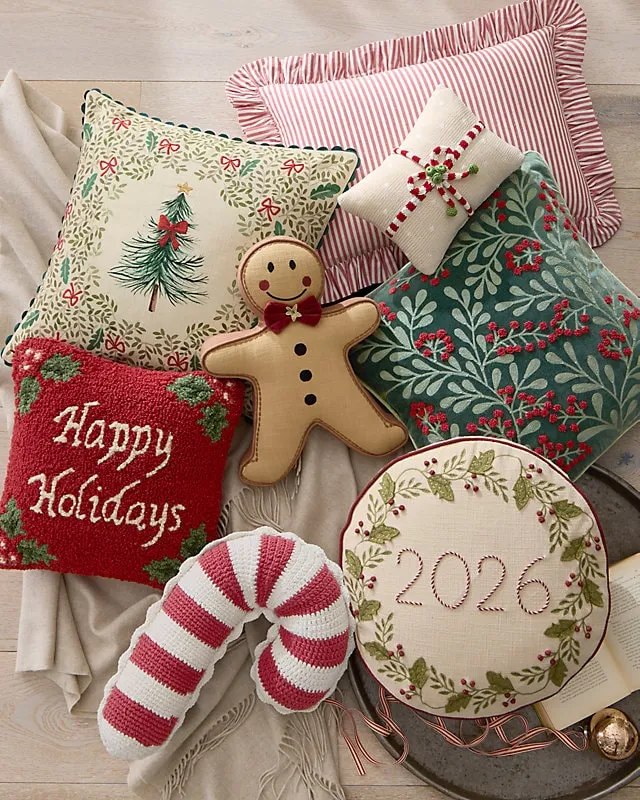
The trick to a mixed collection is limiting the shapes. Pick one shaped pillow, one with dimensional texture like appliqué or beads, and one flat printed or embroidered piece, then let color do the rest. Across this grouping — an evergreen tree square, a ruffled candy-stripe pillow, a green velvet holly pillow, a red hooked ‘Happy Holidays’ pillow, a shaped gingerbread man, and a crocheted candy cane — the cream and beige bases keep six different designs from looking like a flea market. Every new novelty pillow you add should repeat a color already in play, never introduce a seventh.
30. Red Star Pillows and a Snowflake Tabletop Tree
The miniature tree on the side table is the element that turns two star-patterned pillows into a composition. It echoes the pillow pattern in three dimensions — red spheres for the red stars, white snowflakes for the white ground — and the silver twig wreath around its base ties into the metal tones. Take the tree away and you have a pleasant red-and-white sofa. Leave it there and the corner reads as designed, with the red bag of baubles on the shaggy rug finishing the line of sight all the way down to the floor.

This setup wants a sofa at least 78 inches wide, so two 20-inch star pillows can sit at either end with room to breathe, and a side table roughly 18 to 24 inches square so the little tree doesn’t crowd the arm. A 5×8 white shaggy rug anchors the vignette without swallowing a smaller room; anything larger and the furniture starts to float. In a living room under 130 square feet, keep the pillows and skip the floor bag.
Start With One Pillow, End With a Whole December
You don’t have to redo the entire room to make it feel like December. One embroidered pillow, one knit throw, one small lit tree on the side table — that’s usually the difference between a house that looks decorated and a house that feels it. Pick the idea here that suits the sofa you already own, then build outward next year.
📌 Save this to Pinterest before you head to the store — you’ll want it in November when the good covers are already picked over.