
You know that feeling when you spot a silver tinsel tree in someone’s hallway photo and every modern tree you’ve ever owned suddenly feels a little boring? Same. We spent serious time digging through Etsy, Anthropologie, eBay, and West Elm — plus vintage catalogs and thrift-store finds — pulling together the 32 best 1950s Christmas tree ideas for 2026, with options running from $24 ornaments to a $1,450 antique-inspired showpiece.
Inside you’ll find vintage tinsel glam, mid-century traditional, nostalgic handmade, and cozy cottage styling — budget and luxury versions compared side by side, and every idea shoppable so you can click straight to what you need. Retro tinsel and Shiny Brite ornaments are surging on Pinterest again this year, partly because color is back, and partly because nothing beats a tree that looks like it survived three generations.
And stay until the end — we break down the most common mistakes that can ruin these looks. 📌 Save this to Pinterest for later — you’ll want to revisit these ideas. This post contains affiliate links, which means we may earn a small commission at no cost to you.
1. An Old-Fashioned Tree That Was Never Themed
Here’s what separates a great old-fashioned tree from a cluttered one: it should look collected, not ordered. On a 7-foot tree, aim for roughly 70 to 90 ornaments and vary the sizes hard — the biggest baubles in the lower third, the smallest tucked near the top so the silhouette tapers like a real fir. Mix finishes at about 40 percent glass, 30 percent matte, 30 percent metal, and repeat every color at least three times so the eye reads it as a choice rather than a leftover box.
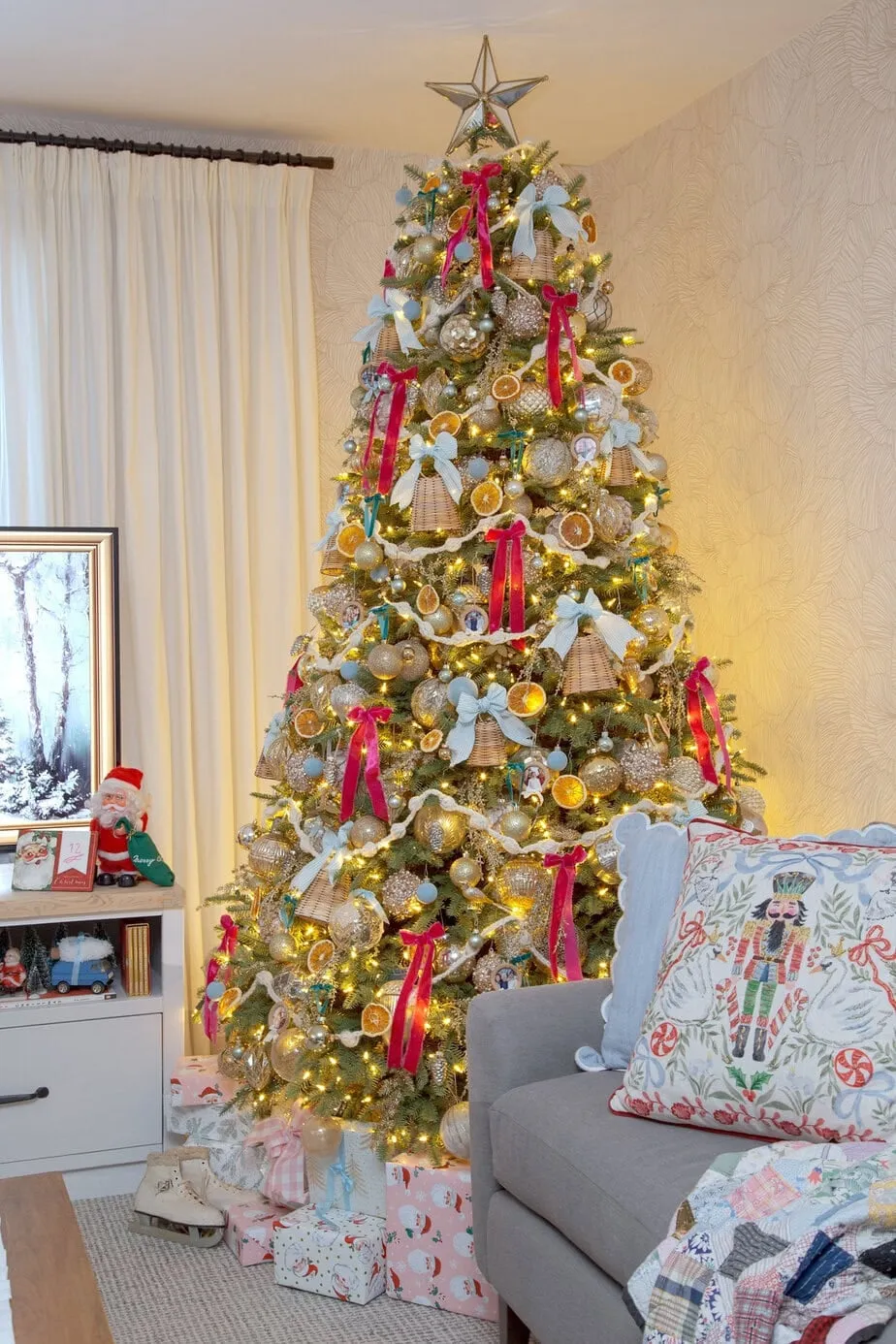
- Tree (7.5 ft mixed-tip faux fir): $180–$450
- Ornaments (70–90 pieces, mixed vintage and new): $150–$600
- Lights (1,000 warm white LEDs): $25–$60
- Tinsel or garland: $15–$40
- Tree skirt or collar: $30–$90
Total: $400–$1,240. Budget alternative: a Facebook Marketplace faux fir for $40 to $80, one $25 box of mixed-color glass balls from Walmart, and a $6 strand of tinsel get you most of the way there for under $150.
2. Gold Baubles, a Cane Rocking Chair, and One Amaryllis
Two honest notes before you copy this room. Silver and gold on the same tree can read muddy under cool bulbs, so keep everything at 2700K warm and skip daylight LEDs entirely — that one swap changes the whole scene. And if there’s an amaryllis on the fluted coffee table, know that every part of the plant is toxic to cats and dogs, so a high shelf or a glass cloche is the safe move.
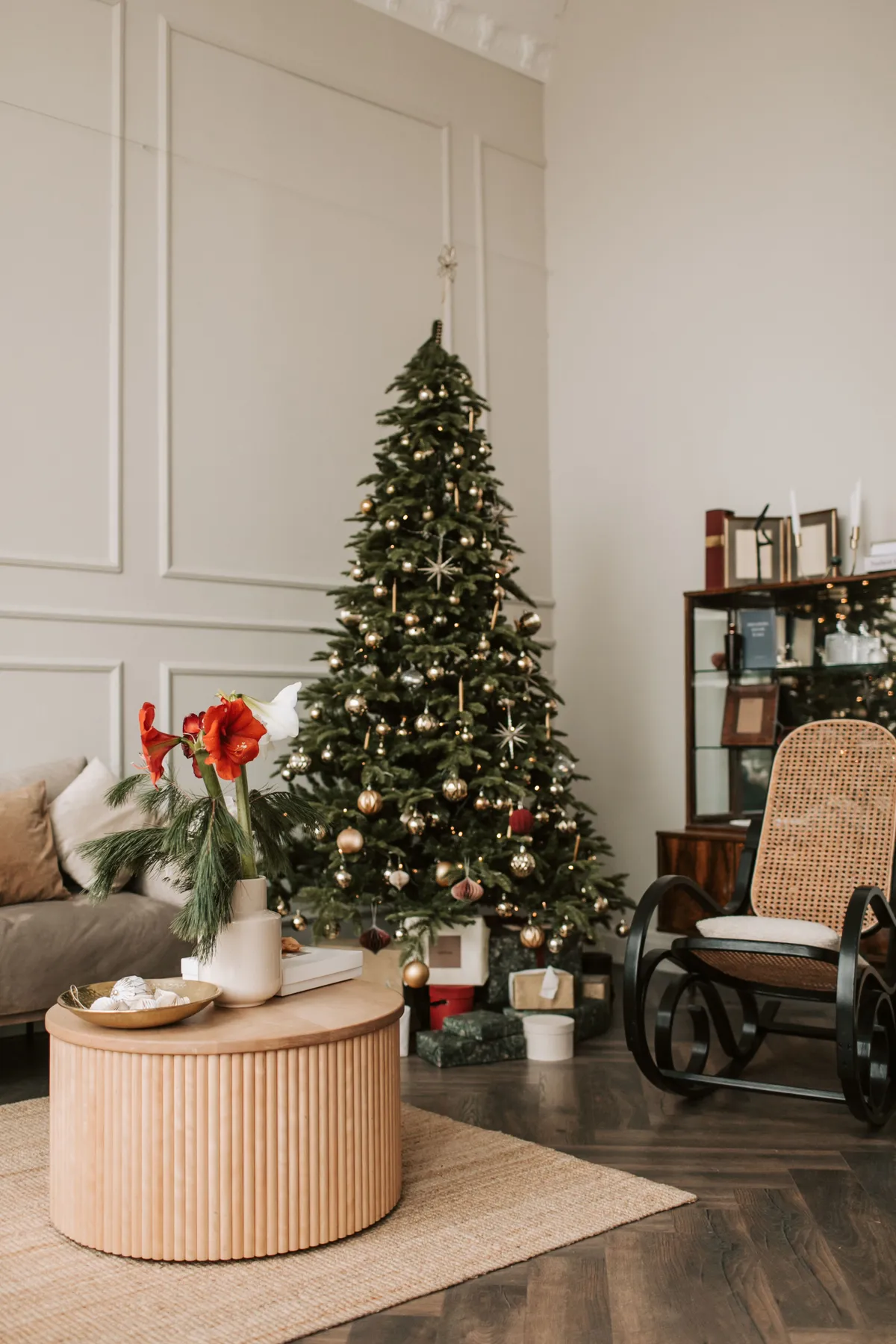
The formula is easy to steal: 70 percent deep green foliage, 20 percent mixed metallics — roughly two gold baubles for every silver one — and 10 percent warm red, which shows up only in the amaryllis and one or two ornaments. Swap gold for antique brass and red for cranberry and the math still holds. Just keep the metallics in one temperature family, or the tree starts to look like a jewelry box.
3. Candy Canes and Multicolor Bulbs by a Stone Hearth
How to make the mixed red-berry garland draped over that stone fireplace:
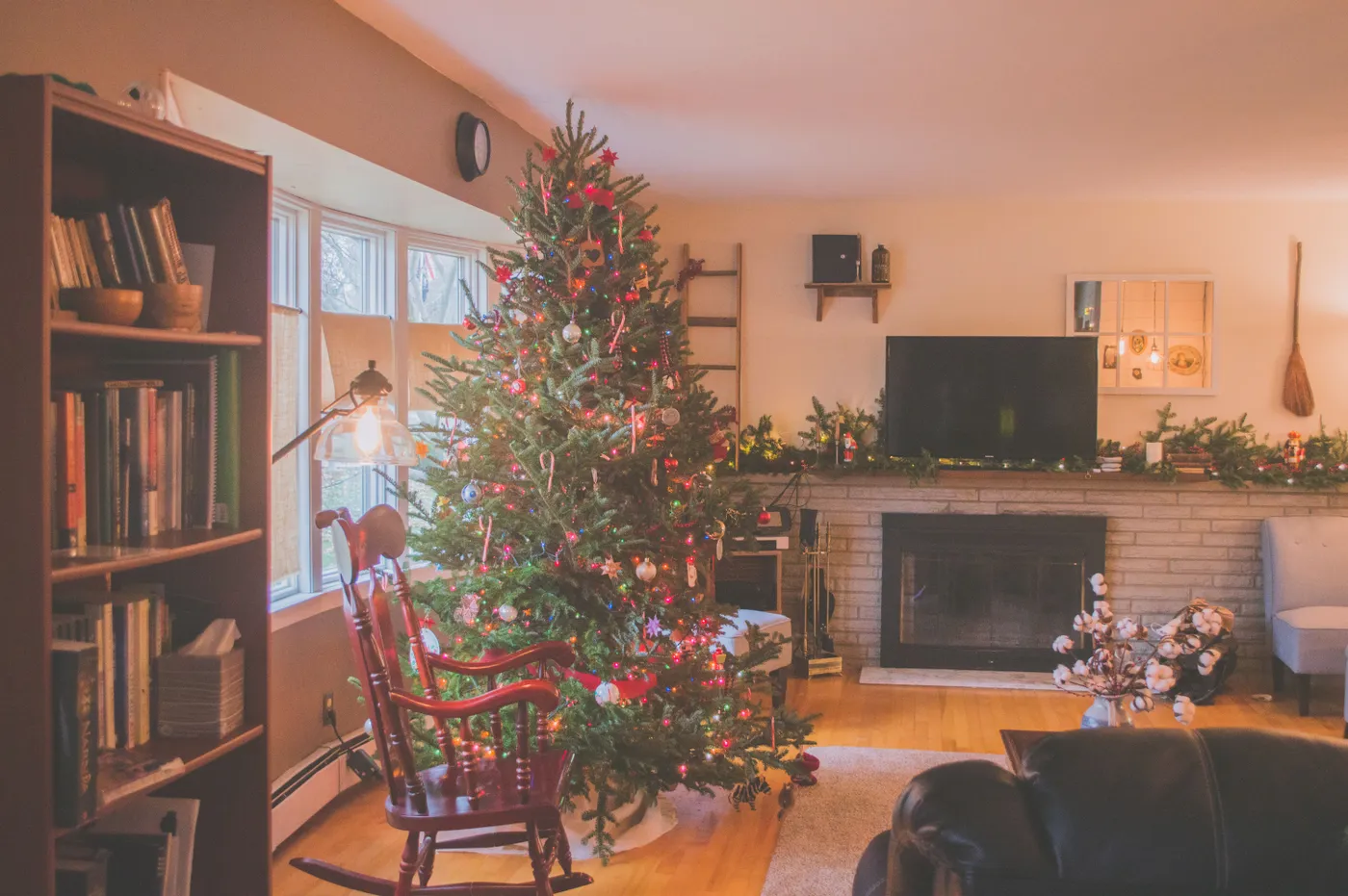
- Zip-tie a 9-foot faux pine garland to the mantel edge so it sits slightly forward of the shelf.
- Wind warm white fairy lights through it in a loose figure-eight so the wire disappears.
- Tuck in clusters of faux red berries every 10 to 12 inches — odd numbers read better than even.
- Add three dried orange slices and two pinecones at the corners for visual weight.
- Fluff the branches forward with your hands, then step back and fill any bald spots.
About 40 minutes and $35 in materials, and it’s reusable for years.
You don’t need vintage to get this look. Target and Walmart both carry multicolor LED strands for around $6, and a 25-count box of candy canes is $3 at any grocery store. For the tree itself, a $60 6-foot pencil fir from IKEA plus $40 of mixed ornaments gets you the same warm, slightly chaotic energy. The garland is where it pays to spend, since cheap faux pine looks flat next to real stone. Compare with Idea #7 for the tinsel version of this mood.
4. Glittered Glass Ornaments Draped on Red Velvet
that makes this vignette work is that the ornaments are arranged as a collection, not hung. Four pieces — a snowman, a bell with a bow, a snow-covered cabin — sit close together on draped red cloth so you can actually see the hand-painted detail and the applied glitter. Remove the tight grouping and you have four ornaments in a box. Remove the red fabric and the glitter stops sparkling. Everything else here is background.
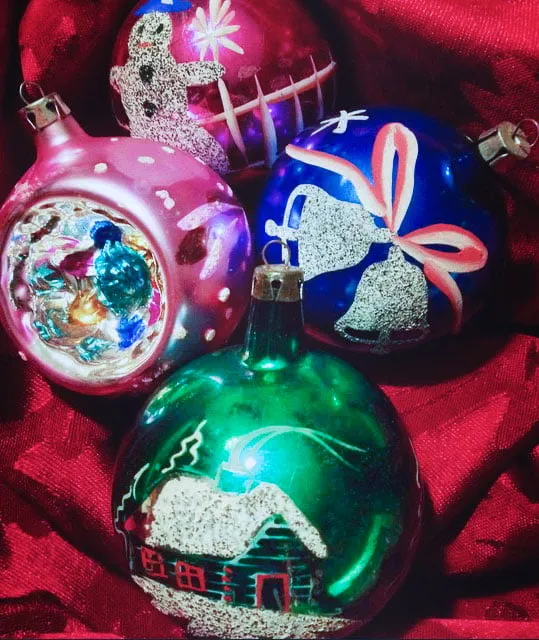
Three principles are doing the work. Repetition of motif: every ornament carries the same glitter treatment, so four different subjects still feel like one set. Contrast of texture: matte painted glass against coarse glitter against soft fabric. Scale: each piece is roughly the same size, which lets the red read as one field of color instead of a busy pattern. Steal the grouping trick for a coffee table or a shelf.
5. A Plain Fir with Tiny Red Ribbons at the Front Door
This look belongs to an entry, and entry scale is unforgiving. You need at least 36 inches of clear floor depth in front of the door to fit a tree beside it without bumping coats. A 4- to 5-foot slim fir is the sweet spot under an 8-foot ceiling — anything taller and the top branches crush against the header. In a hallway narrower than 42 inches, go with a 3-foot tabletop version on a side table instead. For bigger rooms, see the double-tree arrangement in Idea #13.
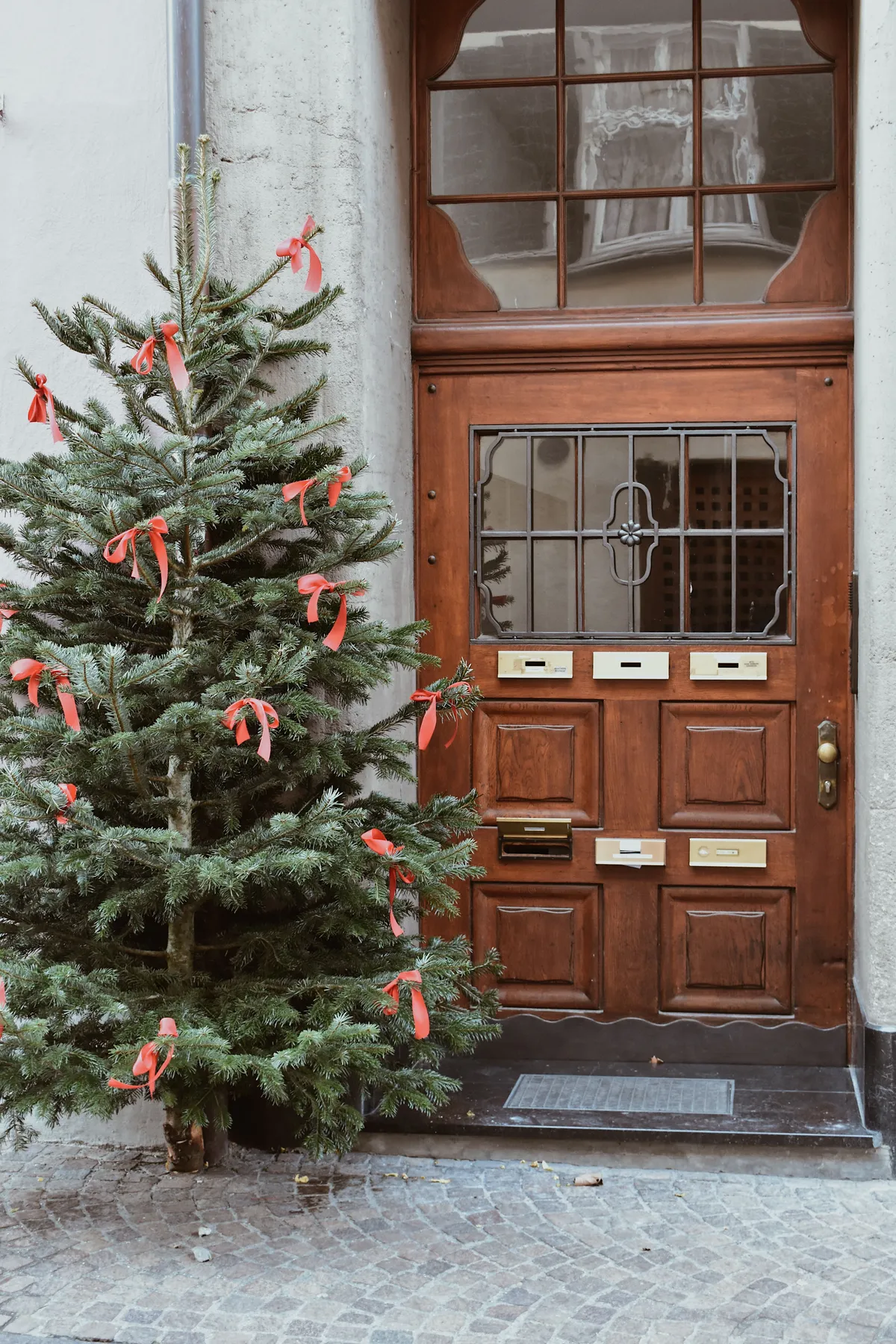
This is the quiet Christmas idea, and it’s everywhere in 2026 — partly a reaction to years of maximalist, color-drenched trees, partly because small red ribbon bows cost almost nothing and photograph beautifully. The old European hall feeling comes entirely from restraint: no lights, no glitter, no theme. It has real staying power because it never reads as a trend in the first place.
6. Emerald Velvet, Dried Oranges, and Tartan Everything
Velvet tufted sofas look incredible and collect everything — crumbs, pet hair, and flattened seat cushions. Vacuum with a brush attachment weekly and rotate the cushions monthly. Dried orange slices hold up for years if you store them in an airtight jar instead of a hot attic. And that tartan wool rug will shed for the first month, so plan on a few extra vacuum passes. None of this is high-maintenance, it’s just not zero-maintenance.
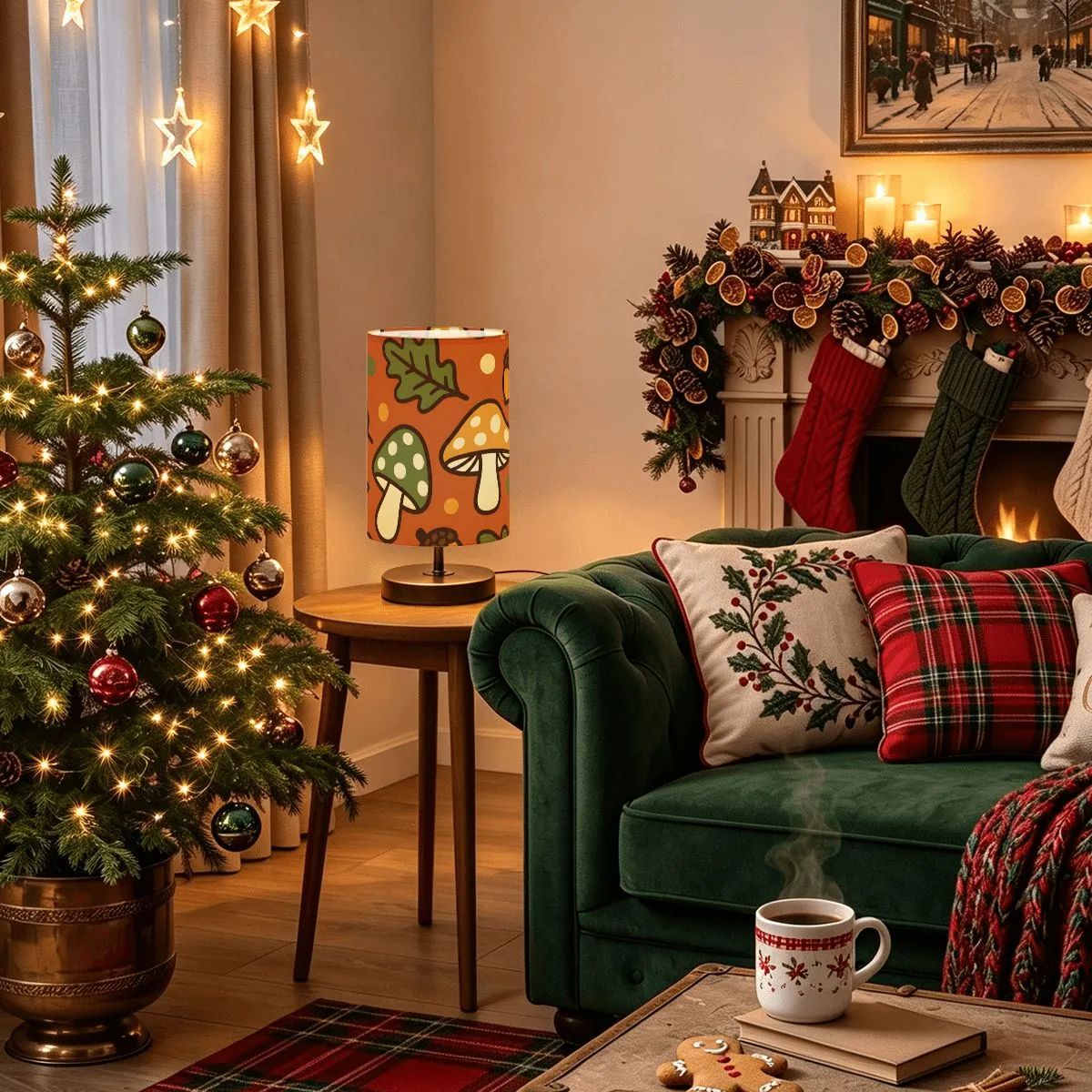
Before you commit to this room, check these off:
- Measure the wall behind the tree — a metallic planter adds 14 to 18 inches of width.
- Confirm you have a grounded outlet within 6 feet of where the tree will stand.
- Decide now whether the tartan rug goes over carpet or hardwood; it needs a pad either way.
- Budget for real garland or good faux, plus a wire base for the dried orange slices that won’t rust.
- Check that the emerald velvet reads green, not black, in your room’s evening light.
7. Red Balls and Silver Tinsel Above a Brick Hearth
- Tree (6.5–7.5 ft): $120–$400
- Red ball ornaments (60–80 count, mixed sizes): $40–$150
- Silver tinsel or icicles (6–8 packs): $18–$40
- Warm white string lights: $20–$45
- Red stockings, wreath, candles: $35–$120
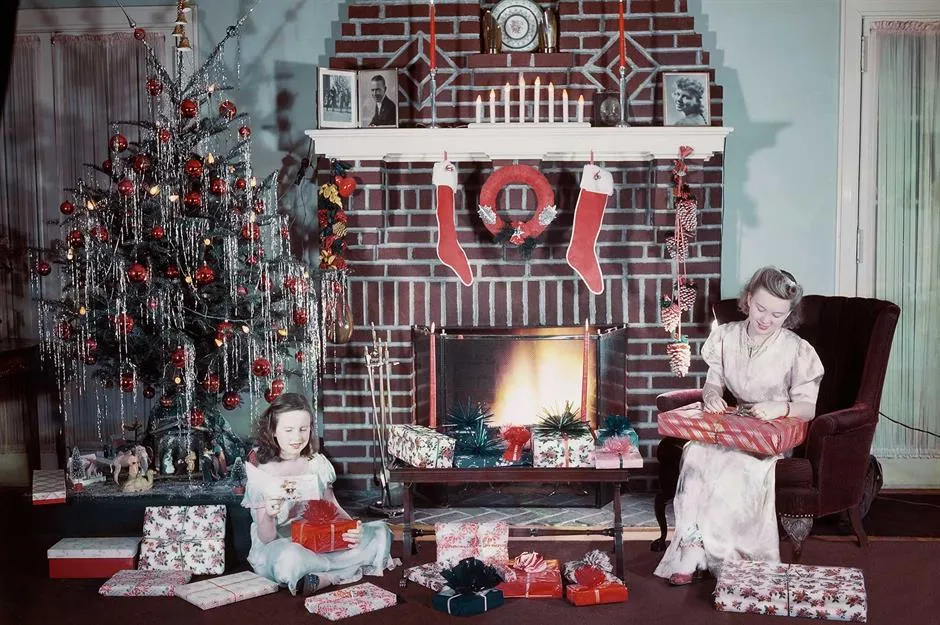
Total: $233–$755 before gifts. Budget alternative: a $35 6-foot tree, a $12 box of red shatterproof balls, and $10 of dollar-store tinsel gets you the exact same silhouette for well under $70.
Tinsel is where most people go wrong. It isn’t confetti — hang it in small clumps of two or three strands, one clump per branch tip, working from the inside out. Tossing handfuls at the tree is why some Christmas photos look like a car wash. For a 7-foot tree, six to eight packs of 1,000-strand icicles is right. And yes, it sheds: lay a sheet underneath, gather it up when you’re done, and shake it outside.
8. Tinsel, Candy Pink, and a Striped Velvet Stool
This tree is 60 percent green foliage, 30 percent silver tinsel and glass balls, and 10 percent candy pink — which shows up on the gown and in one or two ornaments. That last 10 percent is what makes it a photograph instead of a catalog page. Swap the pink for ice blue or butter yellow and the formula holds. Just keep the tinsel and the ornaments in the same metallic temperature; warm gold tinsel next to cool silver balls looks like a mistake rather than a mix.
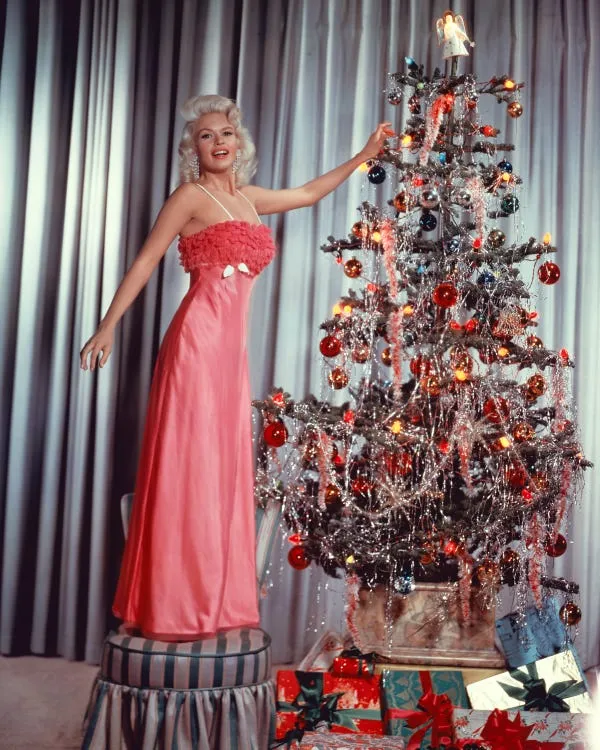
Two realities check in here. Vintage tinsel from the 1950s was often lead-based, so if you’re buying old stock online, wash your hands and keep it away from kids and pets — modern mylar icicles look nearly identical. Also, heavily tinseled trees are heavy, literally. A 7-footer with eight packs of icicles plus glass ornaments can push 80 pounds, so use a stand rated for it or you’ll be re-righting it weekly.
9. Icy Tinsel Against Textured Teal Walls
Everything in this scene can come from a thrift store. Glass ornaments are $1 to $3 each at Goodwill, red upholstered armchairs turn up on Facebook Marketplace for $60 to $120, and icicle tinsel is $2 a pack at dollar stores in November. The teal wall is the one place to spend — a gallon of good paint runs $45 to $70 and it’s the reason the silver actually reads as silver. Skip peel-and-stick wallpaper here; the wall texture is the point.
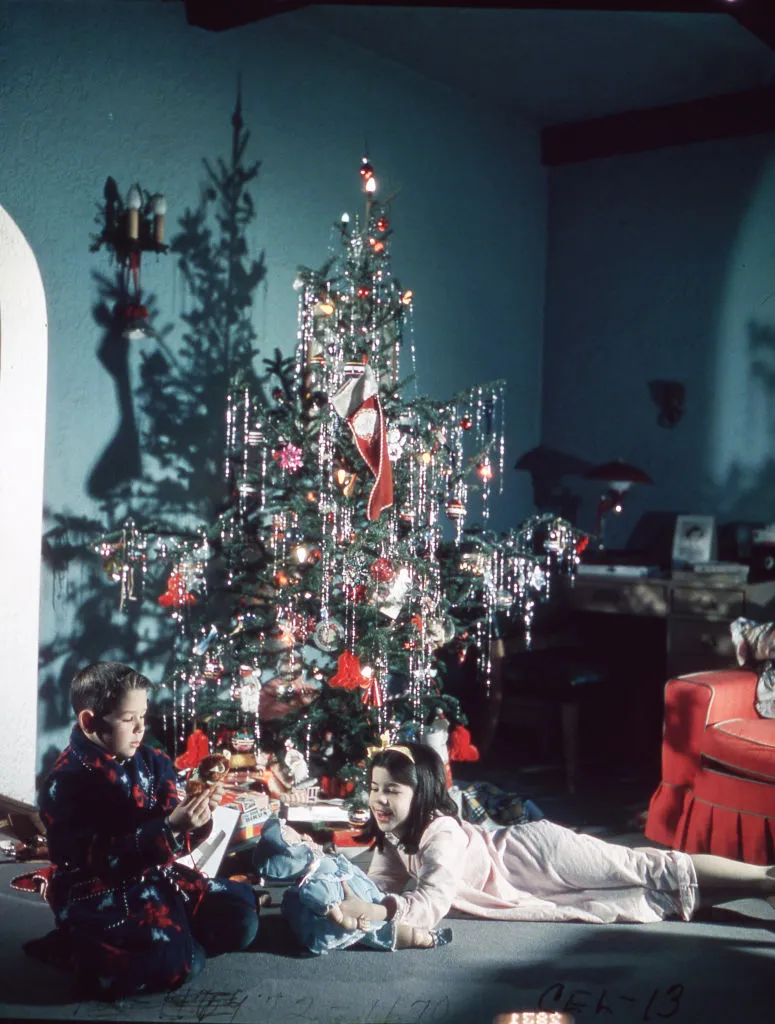
How to get that heavy icicle tinsel look without the mess:
- Start with lights first — tinsel over bare branches looks bald at night.
- Hang icicles in singles, not clumps, on the outermost branch tips for a dripping effect.
- Work top to bottom so the strands cascade naturally downward.
- Add small colored lights last, tucked behind the tinsel so the glow diffuses.
- Step back six feet and fill any flat spots.
About 90 minutes and $25 in tinsel. This is the same technique as Idea #7, just heavier on the ice.
10. Feather-Patterned Wallpaper Behind a Tinseled Fir
Three things keep this from turning into visual noise:
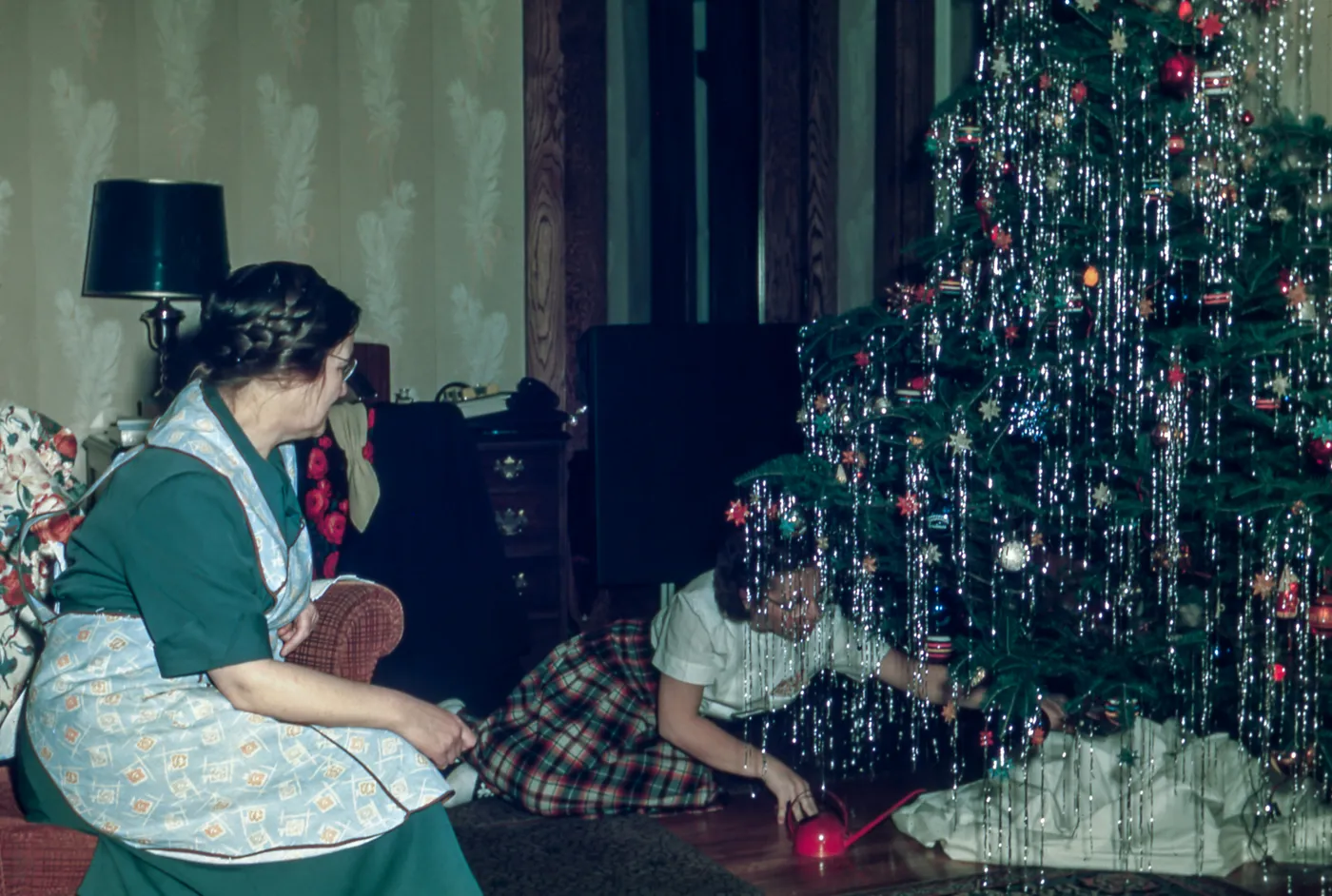
- Value contrast — the tree is dark green and silver, the wallpaper is light beige, so the tree reads as a silhouette.
- Scale difference — the feather motifs are tiny and the ornaments are large, so they never compete.
- One warm anchor — the dark green brass lamp and the wood furniture stop the room from going cold.
If your wallpaper has a bold pattern, keep the ornaments larger and fewer. If it’s subtle, you can go dense.
The patterned wallpaper is the one thing you can’t swap out. Without it, you have a nice tinseled tree in a room. With it, the tree looks layered into the architecture instead of parked in front of it — the light feather motifs echo the ornaments without matching them. If you rent, a large framed panel of patterned fabric behind the tree gets you 70 percent of the effect for about $40 in supplies.
11. A Silver Tinsel Tree Behind the Dinner Table
For a tinsel tree to work as a dining backdrop, you need real breathing room. Plan on a dining area of at least 10 by 12 feet, with the tree at least 30 inches behind the chairs — any closer and guests spend dinner ducking branches. A 4- to 6-foot tinsel tree fits beautifully under an 8-foot ceiling; in a smaller apartment dining nook, a tabletop version on a sideboard does the same job. Buffets and open-plan kitchens have the easiest time with this layout.
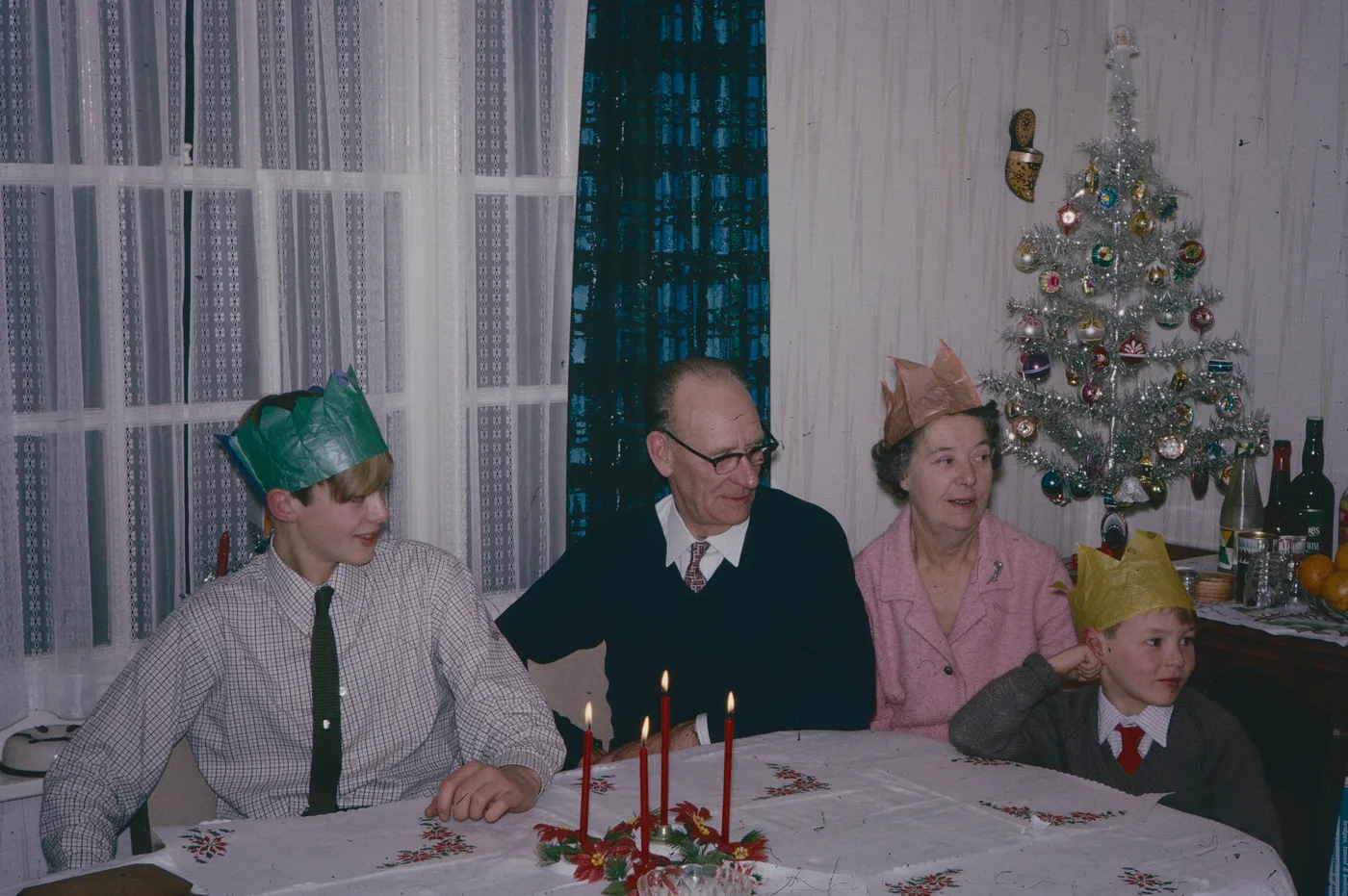
The upkeep here is mostly the table. An embroidered white cloth with poinsettia details needs a stain guard and a gentle wash after every big meal — spot-treat red wine and cranberry immediately, because both set permanently in hot water. Tinsel trees themselves are easy: dust with a hairdryer on cool from three feet away, and store in a bag rather than a box so the strands don’t kink. Keep candles dripless and never leave them lit unattended.
12. A Glass Santa and a Candle on Flocked Branches
The Shiny Brite revival is in full swing going into 2026, and it isn’t just nostalgia marketing. After a decade of neutral, beige-heavy holiday decor, people are craving saturated color and objects with visible history — the kind of ornaments that came in a box from a dime store. Flocked trees are part of the same pull: they mimic the snow most of us don’t get. Expect this one to stick around, since vintage glass holds value and never goes out of style.
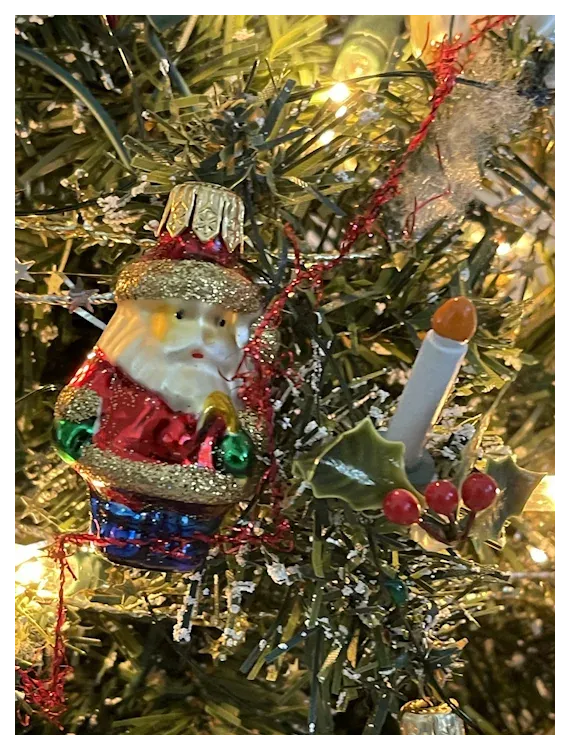
Before you commit to flocking and glass:
- Confirm the flocked tree is flame-retardant and rated for indoor use — some budget versions shed white powder all season.
- Check your ornament hooks; vintage glass needs wire, not plastic clips.
- Plan storage with divided trays, because glass breaks when it rattles.
- Hang anything painted or glittered higher up, out of grab range for kids and pets.
- Test your light strand’s warmth — 2700K reads gold against white flocking, 4000K reads cold and gray.
13. Twin Lit Trees Flanking a Carved Stone Fireplace
Symmetry is the whole illusion here, and it’s unforgiving. The two trees should be within 2 inches of the same height, set the same distance from the fireplace corners — usually 18 to 24 inches — and lit with identical strands and identical bulb counts. Then break it slightly: mirror the ornament placement but not the colors, so the left tree carries more red and the right carries more gold. Perfect symmetry looks staged; near-symmetry looks expensive.
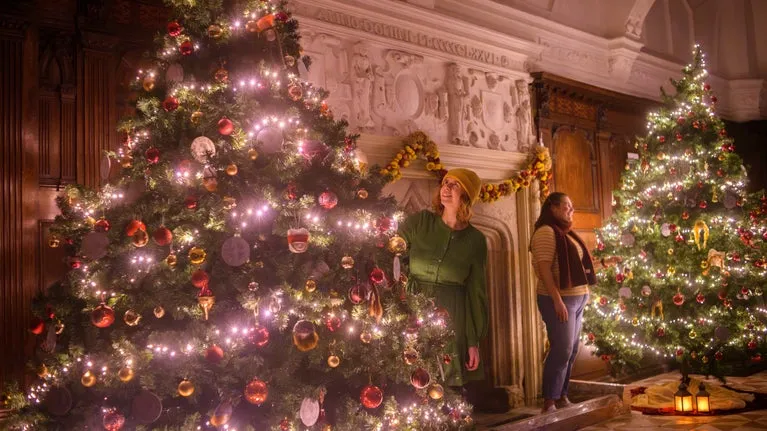
- Two faux firs (7–8 ft each): $400–$1,300
- Warm white string lights (2,000+ bulbs total): $60–$140
- Red, gold, and silver ornaments (150+ pieces): $180–$600
- Pre-lit upgrade option: add $300–$800 over unlit
- Floral garland for the mantel: $50–$180
Total: $690–$2,220 before gifts. Budget alternative: buy one 7-foot tree and one 6-foot tree, add a 6-inch riser box under the shorter one, and skirt both with matching fabric. Nobody notices, and you save $200 or more.
14. A White Teardrop Ornament with Pink Hash Marks
Indent ornaments — the ones with a deep circular recess in the glass — are gorgeous and fussy. That recess catches dust and fingerprints and can’t really be cleaned without risking the painted finish, so plan on a soft brush and a gentle puff of air rather than a cloth. The metal cap is the weak point: lift by the cap, never by the loop, and keep these away from the bottom third of the tree where kids and tails live.
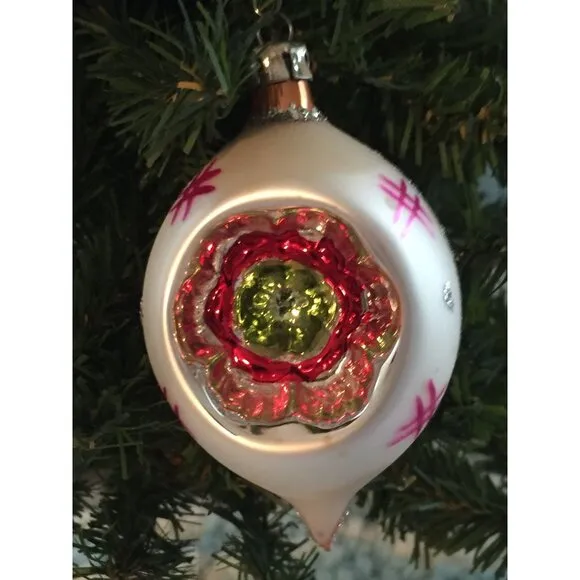
The formula for mixing novelty ornaments like this one: 50 percent classic round baubles in two or three colors, 30 percent shaped pieces like teardrops, bells, and finials, and 20 percent hand-painted or character ornaments. That ratio keeps a tree feeling collected without tipping into chaos. This white-and-pink piece is your 20 percent, so give it a strong color neighbor. Compare with Idea #28, where the ornament itself is the entire color story.
15. Three Tasseled Glass Ornaments, One Color Story
How to make coordinating tassels for vintage ornaments:
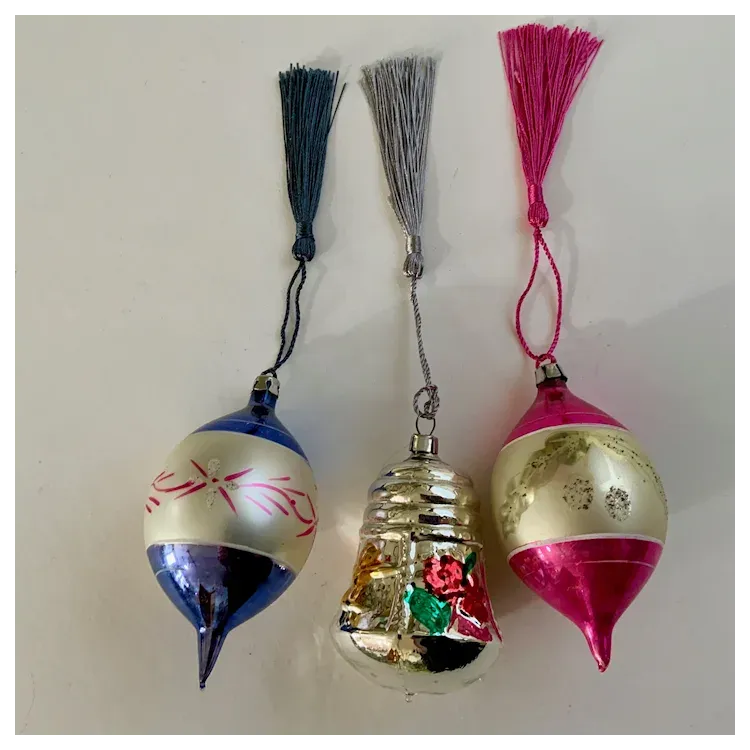
- Measure 8 inches of embroidery floss or silk cord in a shade that matches the ornament’s painted detail.
- Loop it through the metal cap’s wire and knot twice, leaving a 3-inch tail.
- Wrap the bundle tightly 1 inch below the cap with matching thread, then tie off.
- Trim the bottom ends evenly — angled cuts look better than straight ones.
- Lightly starch the tassel so it keeps its shape on the branch.
About 10 minutes per ornament, roughly $3 each in materials.
You can also just buy the look. Michaels and Joann both stock glass finial ornaments in the $5 to $9 range, and dollar stores carry tassel trim by the yard for $2. Estate sales are the real goldmine — a box of 20 vintage glass ornaments often goes for $15 to $40, and you can unify mismatched pieces with your own tassels in one accent color.
16. A Golden Gift Bag Hiding in the Branches
The single best move here is the golden gift-bag ornament. It’s unexpected — you don’t notice it at first, then you do, and it makes you look closer at the whole tree. A woven stick bundle sits nearby for texture, with red ribbons and berries picking up the same warmth. Take the gift bag away and the tree reverts to standard green-and-gold. That tiny joke is what makes people lean in.
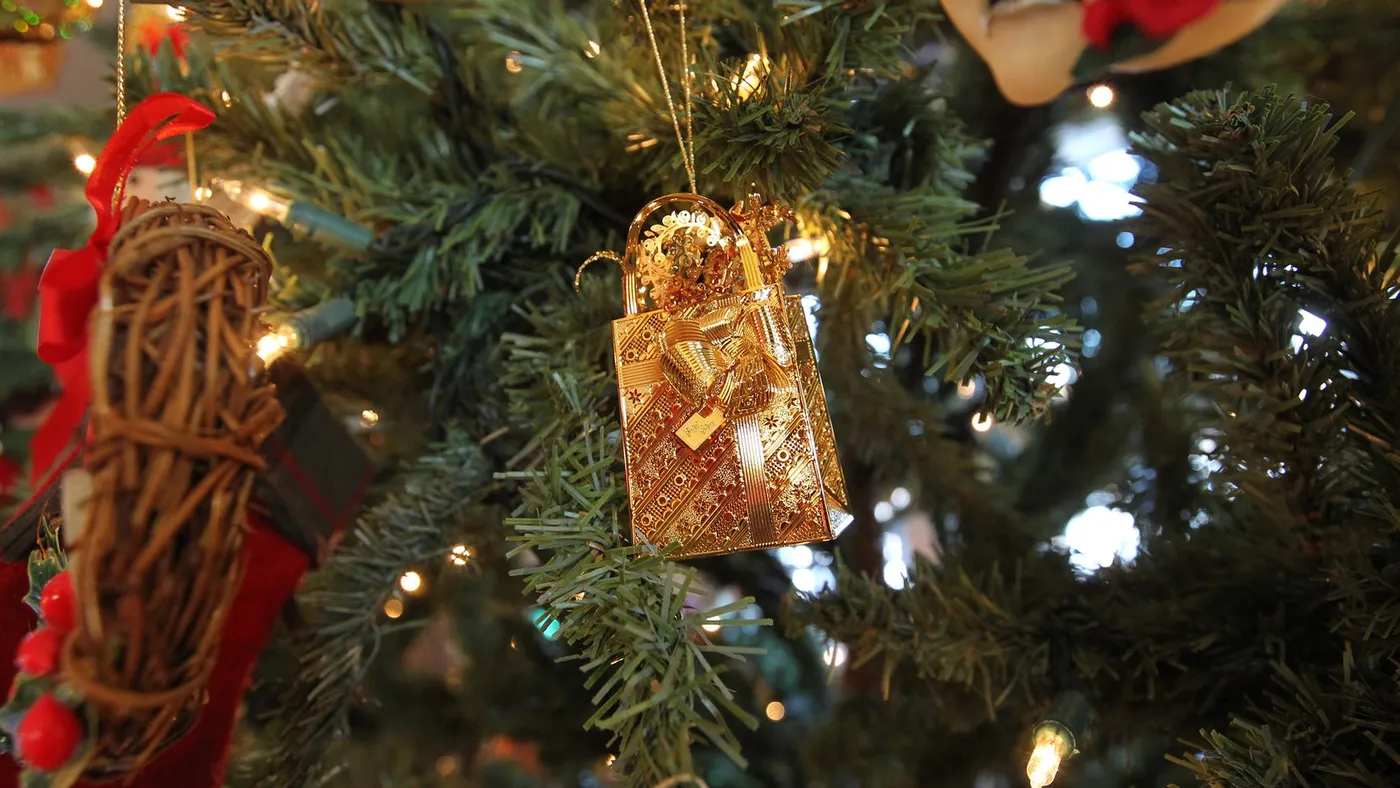
It works because of three small principles. Scale surprise: one ornament that’s larger and more detailed than everything around it becomes the focal point. Material contrast: smooth gold metal against rough woven twigs gives the eye two textures in one small area. Color repetition: the red berries and ribbon echo each other at different sizes, so the accent reads as intentional rather than random. Repeat one or two of these on any tree and it improves.
17. A Glass Gingerbread House with Heart-Shingled Roof
Ornament scale is the thing nobody talks about. On a 4-foot tree, keep hanging pieces between 2 and 4 inches — anything bigger overwhelms the branches. A 6- to 7-foot tree handles 3 to 6 inches comfortably, and only an 8-foot-plus tree can carry 6- to 8-inch statement pieces like a detailed gingerbread house. If you’re working with a small tree and love big ornaments, use fewer of them and skip the filler baubles entirely.
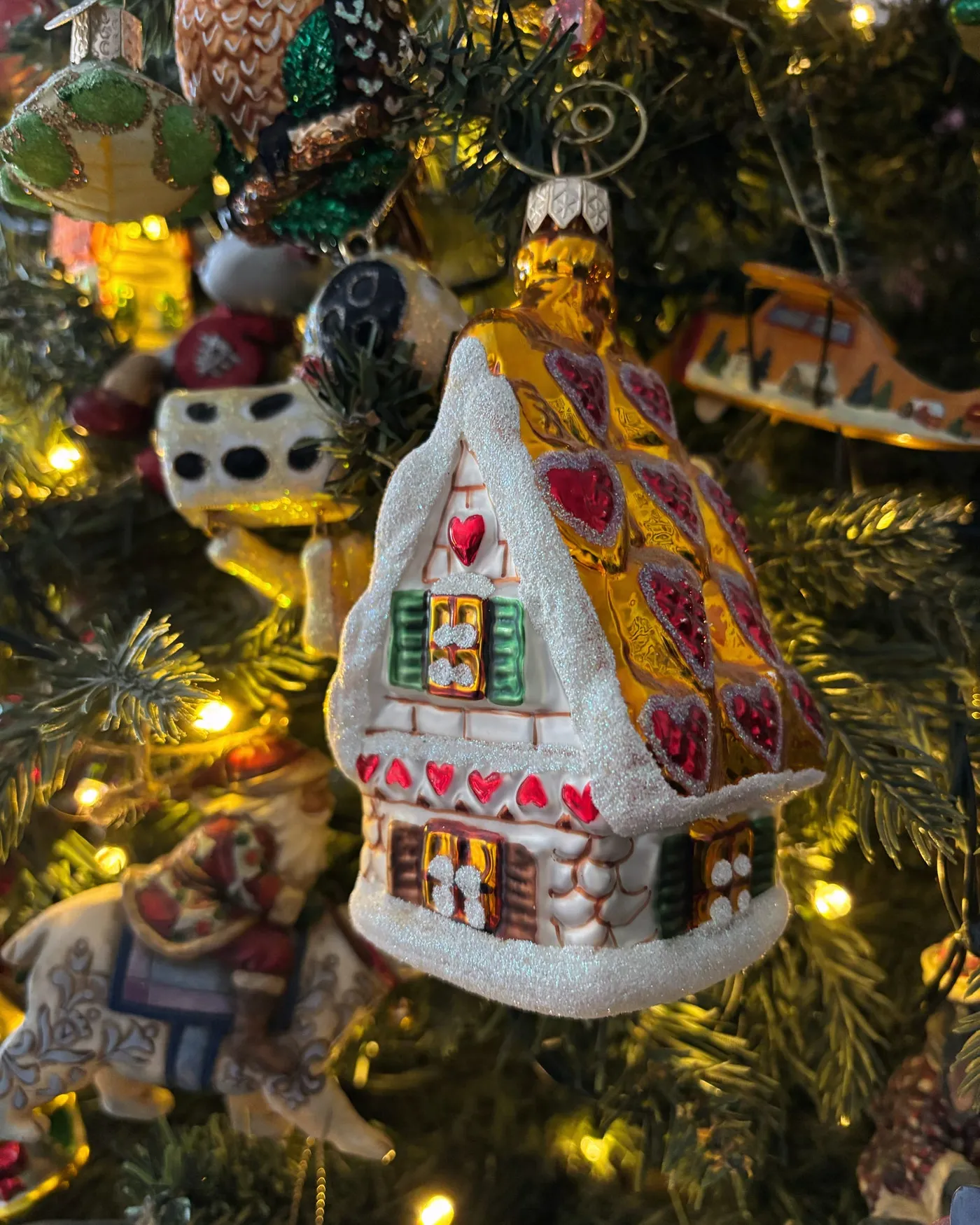
Food-shaped ornaments have quietly become one of the strongest holiday categories going into 2026 — gingerbread houses, cupcakes, hot cocoa mugs, tiny champagne bottles. Part of it is the general swing toward playful, nostalgic decor; part of it is that these read instantly in photos, which matters when half your audience sees the tree on a phone screen. Staying power is decent, but stick to glass or ceramic over plastic if you care about keeping them a decade.
18. A Feather-Haired Angel with a Gold Tinsel Halo
Vintage angel toppers are usually felt, feathers, tulle, and gold braid — all of which attract dust and none of which like water. Clean with a soft makeup brush and a can of compressed air held well back. Keep feathers out of direct sun or they yellow within a season. And if the gown is sheer, store it wrapped in acid-free tissue rather than a plastic bag; plastic traps moisture and can leave marks on metallic trim.
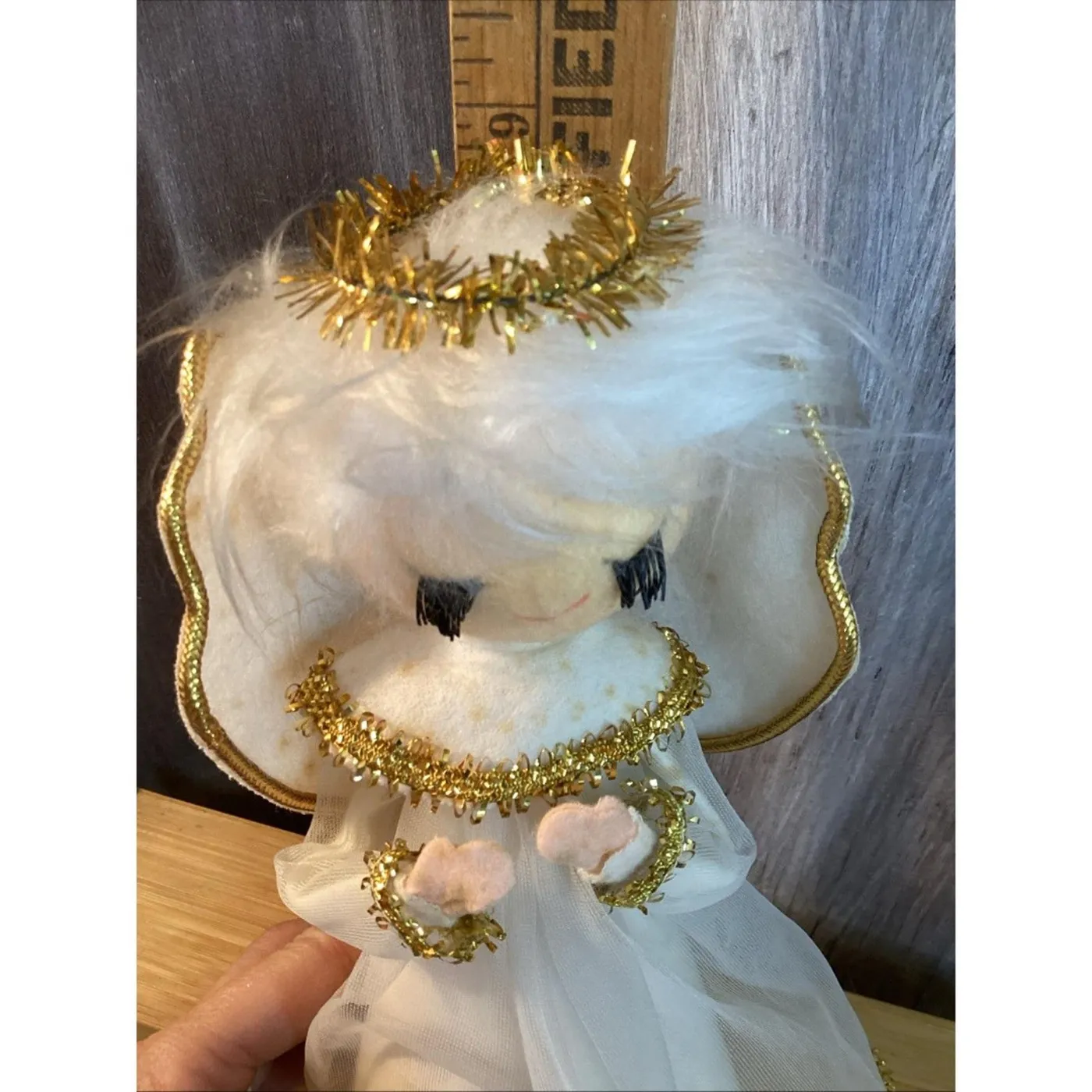
Check these before you commit to a vintage topper:
- Weigh it. Anything over 1 pound needs a reinforced top branch or a wire armature.
- Measure your tree’s top branch spread — a 6-inch-wide topper needs a sturdy, upright branch.
- Confirm the topper’s colors against your tree’s palette before buying online.
- Check for loose sequins or frayed tulle and repair with clear thread first.
- Decide on lighting: an unlit topper against warm bulbs reads as a silhouette, which can be lovely or flat.
19. Silver Branches, Stone Fireplace, City at Night
- Silver tinsel tree (6–7 ft, vintage style): $150–$500
- Red and white glass ornaments (40–60 count): $60–$180
- Chrome or glass side table: $90–$350
- Stacked stone fireplace treatment (if you’re building): $2,000+
- Warm floor lamp or accent lighting: $60–$200
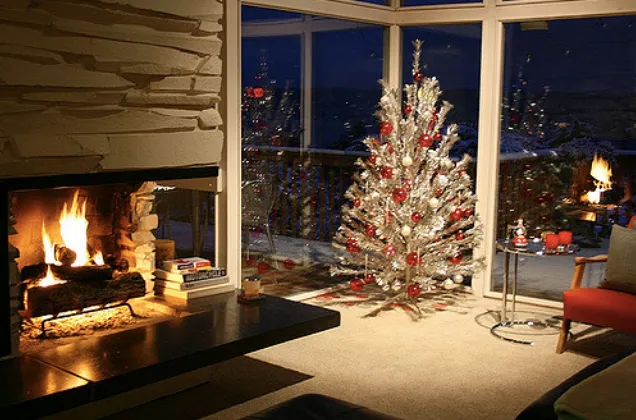
Total: $360–$1,230 excluding any fireplace work. Budget alternative: a $90 silver tinsel tree from Target or Walmart plus a $20 set of red and white shatterproof balls gets you 90 percent of this scene — nobody can tell at night.
City-view rooms are the hardest to light well, because two sources fight each other: the room and the skyline. Keep the tree lights at 2700K, add one warm floor lamp at about 40 percent brightness on the opposite side of the room, and turn off every overhead. Quick checks:
- See window reflections in the TV or glass table? You’re overlit.
- Does the silver tree look gray instead of bright? Bump the lamp up one notch.
- Is the city view disappearing? Dim the interior, not the tree.
20. Teal Walls, White Trim, and a Lace-Draped Table
The palette math here is simple and very repeatable: 55 percent teal walls, 30 percent white — trim, mantel, tablecloth — and 15 percent red and gold in the tree and stockings. That 15 percent is doing all the festive work, so you can swap red for rust or gold for copper without losing the room. The trick is keeping the trim pure white. Cream trim against teal turns the whole wall muddy by comparison.
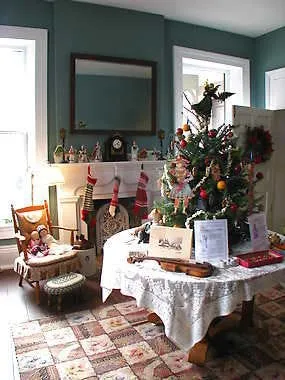
Teal is a beautiful, temperamental paint color. Because most teals carry a strong green or blue undertone, they shift depending on your light direction — a north-facing room can push it toward gray, and warm evening bulbs can push it toward turquoise. Buy a sample pot, paint it on all four walls if you can, and look at it in daylight, at dusk, and at night before you commit. It’s a $400 mistake you don’t have to make.
21. Felt Balls, Ceramic Luminaries, and Burlap Wrap
This is the most budget-friendly idea in the whole collection. Felt ball ornaments run about $8 for 30 on Amazon and Etsy, bottle brush trees are $3 to $6 each at Target, and ceramic house luminaries turn up at thrift stores for $4 to $10. A full miniature village plus felt ornaments and a burlap tree wrap can come in under $60 total — and if you make the felt balls yourself from craft-store wool, closer to $25 for the set.
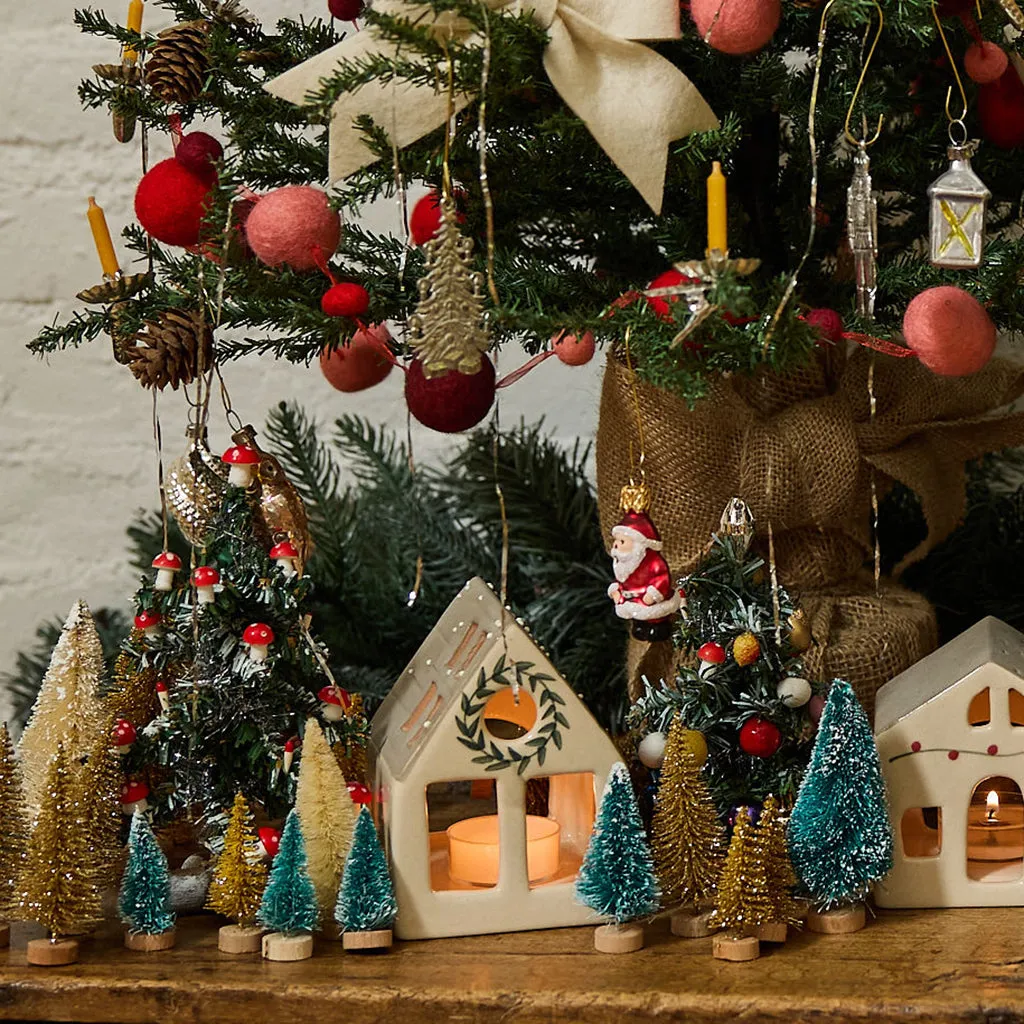
How to build the miniature village under the tree:
- Start with a rough board or a slice of reclaimed wood as the ground plane — 24 to 30 inches wide.
- Place the tallest luminary slightly off-center, then cluster two smaller houses beside it.
- Add bottle brush trees in odd numbers, varying heights, in gold and teal to tie into the ornaments.
- Hide battery tealights inside the houses and run the wiring behind the board.
- Finish with faux snow along the front edge only — leave the backs clean.
About an hour, $40 to $70 in materials.
22. A Silver Tinsel Tree with Its Own Color Wheel
The rotating color wheel is the entire reason this works. A silver tinsel tree is basically a mirror — it has no color of its own, so a wheel turning slowly through red, green, blue, and amber gives it four different moods in about 20 seconds. That’s also why the ornaments are gold, purple, and silver starbursts: they catch and bounce the changing light. Without the wheel, a tinsel tree is just shiny. With it, it’s an event.
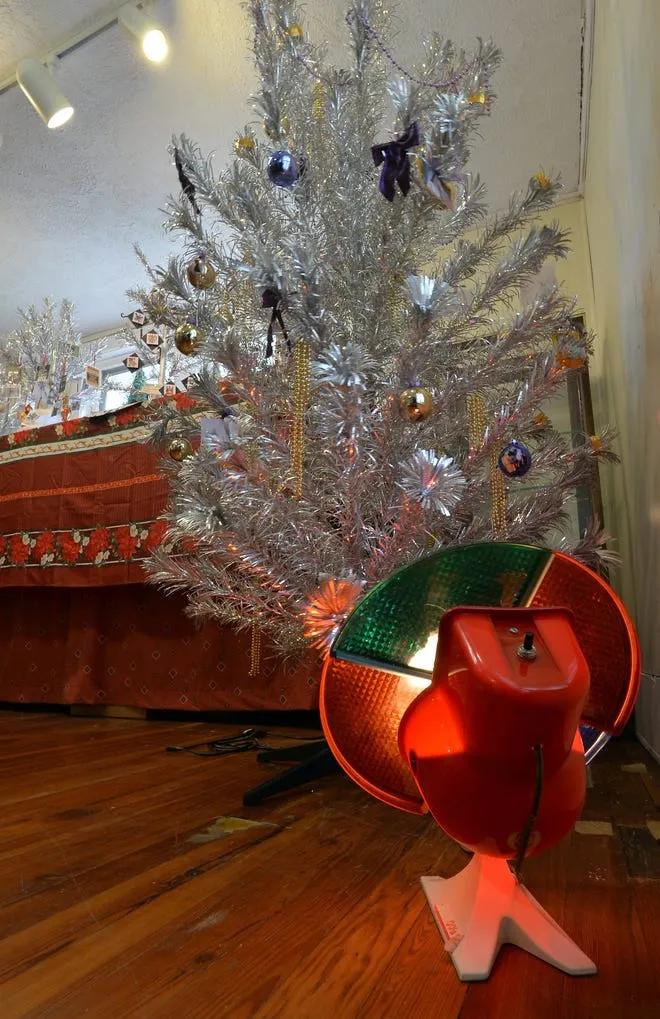
If you remove one thing, remove anything but the color wheel. It’s a projector, a light source, and a timer all in one — the reason the tree looks different every time you glance up. Modern reproductions run $30 to $60 online, and originals from the 1950s show up on eBay and Etsy for $80 to $200. Place it 12 to 18 inches from the base, angled up at the trunk, and let it do the decorating.
23. Primary Colors, Heavy Tinsel, One Bright Star
This tree needs vertical room. A dense, heavily tinseled 7-footer with a statement star wants at least a 9-foot ceiling to avoid looking crushed, and a 9-foot tree wants 10. Room-wise, plan on 10 by 10 feet minimum so you can stand back far enough to see the whole thing — you should be able to view it from roughly one and a half times its height. For tighter spaces, the slim tabletop version in Idea #31 holds the same energy.
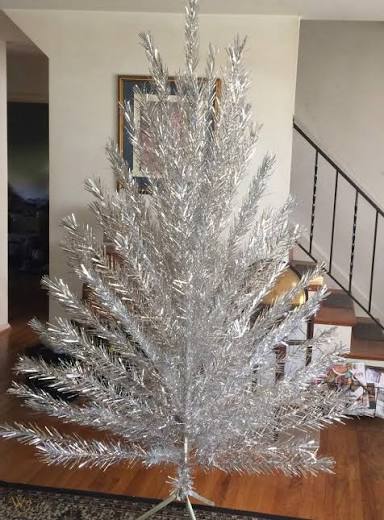
Tinsel is a commitment, mostly in January. Expect a fine silver dust on the floor for weeks after you take the tree down, and plan on vacuuming twice. Store tinsel strands loosely in a bag, not a box — kinked tinsel never hangs right again. Shiny glass ornaments in primary colors chip at the seam if they knock together, so use divided trays. Budget about $15 a year for replacement strands and two or three new balls.
24. The Classic 1950s Tree with an Angel on Top
Mid-century Christmas is having its biggest moment in decades. Auction prices for 1950s Shiny Brite ornaments have roughly doubled since 2020, and Pinterest saves for vintage Christmas tree decor keep climbing every November. The appeal is partly aesthetic — saturated color after years of beige — and partly emotional, since a lot of us are decorating with the boxes our grandparents saved. This one is more than a trend; it’s a hand-me-down.
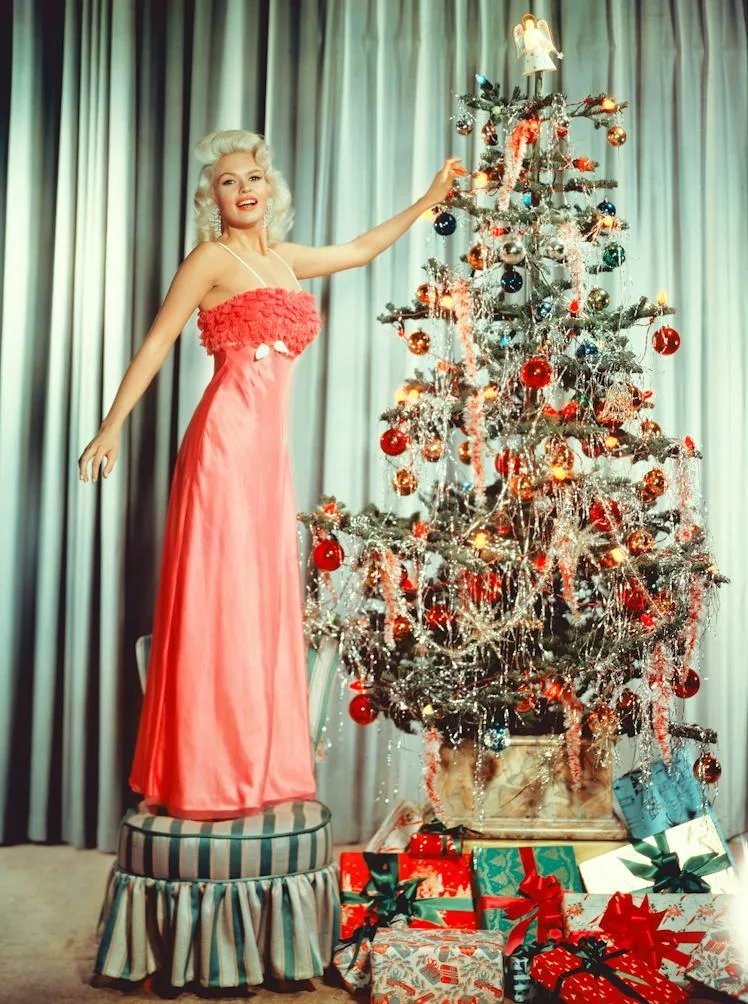
Run through this before you start:
- Check that your stand is rated for the weight — heavily tinseled glass trees run 70 to 90 pounds.
- Decide the tinsel budget now; you’ll want 6 to 8 packs for a 7-foot tree.
- Sort ornaments by color first so you distribute evenly instead of clumping reds on one side.
- Confirm you have a spare fuse and one backup strand of lights.
- Set up a photo spot — the pink gown and striped stool in Idea #8 aren’t accidental.
25. Flocked Branches Wearing Red-and-White Stripes
Red-and-white decorating fails when the pattern is random. Pick a rhythm and hold it: alternate one red ornament, one white ornament, one striped piece, then repeat. On a 7-foot tree that’s a cycle roughly every 8 to 10 inches, which reads as intentional from across the room. For the wooden bead garland, drape shallow scallops — each dip about 12 inches wide — and space the beads so there’s a red accent every 3 inches. Rhythm is what separates a styled tree from a decorated one.
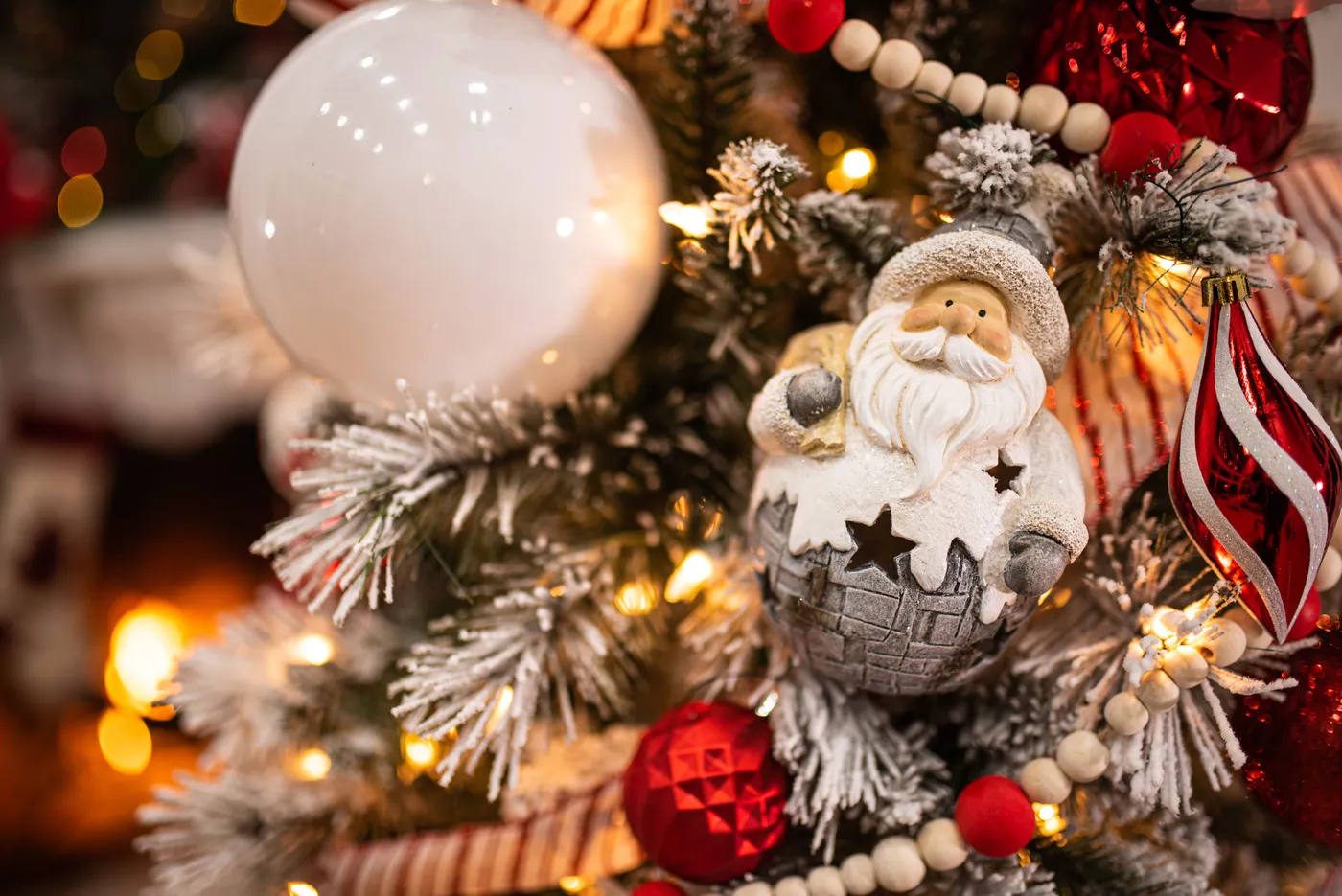
- Flocked tree (6.5–7.5 ft): $150–$450
- Red and white ornaments (60–80 pieces): $70–$220
- White Santa figurine or similar focal piece: $25–$90
- Wooden bead garland with red accents: $20–$55
- Warm white fairy lights: $20–$45
Total: $285–$860. Budget alternative: flock your existing tree with a $20 spray can and a drop cloth, then add a $25 set of red and white shatterproof balls. Messy for an afternoon, saves you hundreds.
26. Shiny Brite Boxes, Tiered Platters, and Pink
Hosting reality check: a tinsel tree and a buffet table are a messy combination. Tinsel sheds, and it sheds onto food. Keep the tree at least 4 feet from the table, or skip the tinsel entirely and use a bare silver tree with ornaments only. Also, tiered platters look generous but they dry food out fast — keep dips, cheese, and anything with mayo on ice until guests arrive. Quick list to stay sane:
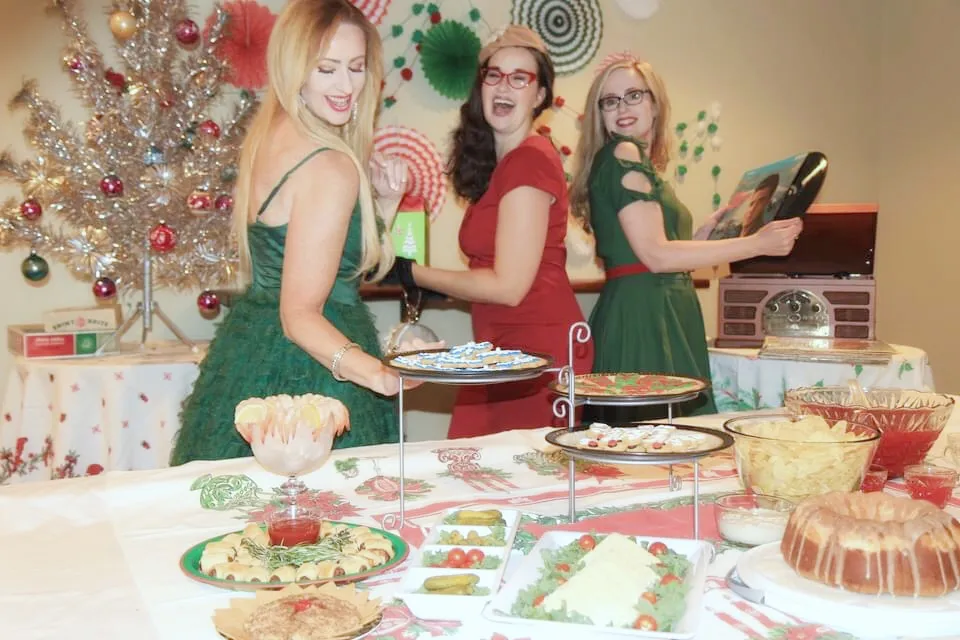
- Set the record player where nobody will bump it.
- Keep the tree skirt clear of the buffet traffic path.
- Put the vintage ornament box up high, out of reach.
for the table: 50 percent white cloth as your neutral field, 25 percent red-and-green pattern, 15 percent silver from the tree and platters, and 10 percent pink from the record player and the ornament box. That pink is the wildcard that makes the whole scene feel 1955 instead of generic.
27. Pinecones, Red Stars, and Warm White Bulbs
How to make the pinecone and star ornaments for this tree:

- Bake foraged pinecones at 200°F for 45 minutes to kill anything living in them.
- Attach a small screw eye to the top and thread it with twine.
- For stars, cut 3-inch shapes from balsa or buy wooden blanks at a craft store and paint them deep red.
- Hot-glue a tiny loop of ribbon to the back of each star for hanging.
- Cluster red berries nearby so the reds echo at two different scales.
Roughly 90 minutes, about $20 in materials for 20 ornaments.
Everything here is available cheap. Walmart sells pinecone ornament sets for $8 to $12, wooden star ornaments come in 24-packs on Amazon for around $10, and red berry picks are $3 each at dollar stores — you’ll need four or five for a 7-foot tree. A thrifted grapevine wreath can be pulled apart for natural filler. Total for the whole tree’s ornament supply: under $50 if you shop in early November.
28. Hot Pink Meets Lime Green on One Glass Piece
This ornament does something most don’t: it carries two loud colors that shouldn’t work together and makes them look deliberate. The pink sphere up top, the lime bell below, the white band with tiny red flowers in between — it’s basically a designer’s palette exercise hanging from a branch. Remove it and the tree loses its loudest, most joyful moment. One or two of these per tree is plenty; any more and it becomes a theme.
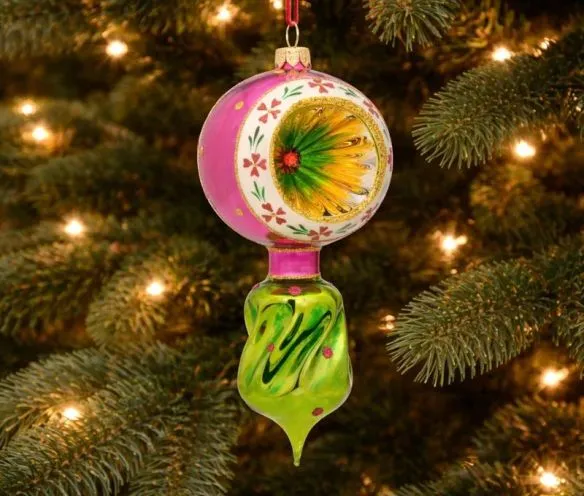
Three things make the color clash read as harmony. Proportion: pink gets the larger sphere, lime gets the smaller bell, so neither dominates. Separation: the white band with floral detail physically divides the two hues so the eye doesn’t have to reconcile them directly. Repetition: the tiny pink dots on the green section echo the pink above, tying both halves together. Use the same tricks with any two colors you love but would never normally pair.
29. Bronze Ornaments, Ceiling Garland, Patterned Rug
Ceiling garland is the detail most people can’t pull off, and it’s almost entirely about height. You need at least 8-foot ceilings, and 9 or 10 is better — below 8 feet, a garland across the room reads as a dropped beam. Run it parallel to the longest wall rather than diagonally, keep it at least 18 inches clear of any doorway, and use lightweight faux pine so it doesn’t sag. That patterned rug wants about 12 inches of bare floor around it in a room this full.
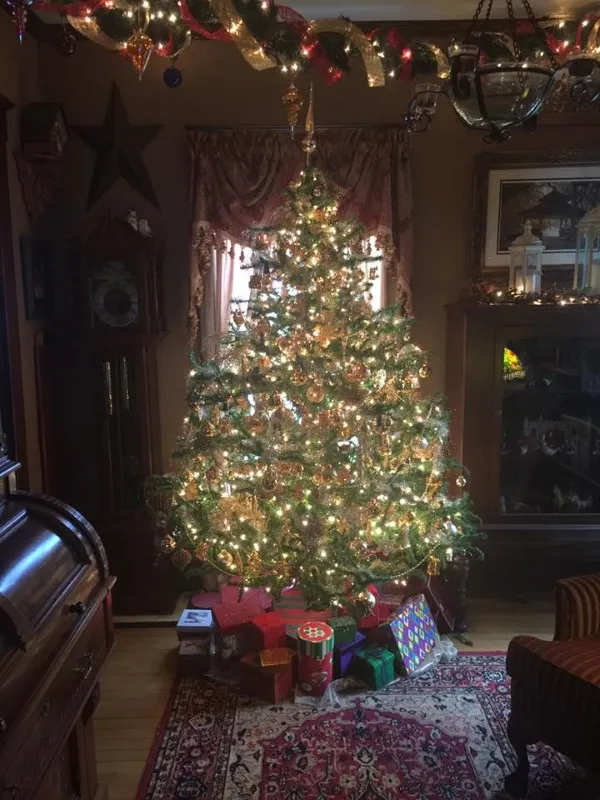
Maximalism has come back in a big way for 2026, and ceiling garland is its signature move — the holiday equivalent of a gallery wall. It’s also a reaction against minimalism fatigue and a nod to the layered, collected interiors people see in mid-century photography. The double-tree arrangement in Idea #13 runs on the same instinct. Staying power is decent if you keep the palette tight; layered rooms look dated when the colors wander.
30. Warm Bulbs, Snowflakes, and a Tiled Wall
Warm white LED strands are rated for roughly 20,000 hours, but they fail at the connector long before they fail at the bulb — inspect the plugs each year and replace any strand with a frayed wire. Gold and silver ornaments with a metallic finish will tarnish over time, especially in humid storage; keep them in a sealed bin with a silica packet. And that beige patterned tree skirt, if it’s fabric, needs spot cleaning rather than a machine wash to keep the print sharp.
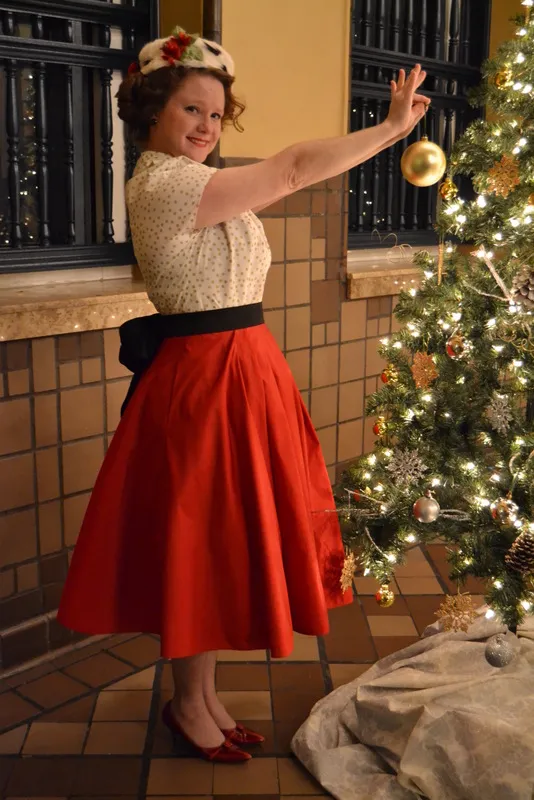
Verify these before you commit:
- Count your outlets — a lit 7-foot tree plus an extra strand usually needs two.
- Check ceiling height against tree height plus topper; allow 6 inches of clearance.
- Test one strand in the room before buying the tree, so you know the warmth is right.
- Confirm your ornament storage can hold glass without pieces touching.
- Measure the wall if the tree stands against tile — a scratched tile wall is permanent.
31. A Tabletop Tree in a Distressed Teal Cast Iron Stand
- Small live or faux evergreen (18–24 in): $25–$60
- Pastel glass ornaments (25–35 pieces, mixed shapes): $40–$120
- Vintage cast iron tree stand: $30–$150
- Metallic leaf and star ornaments: $15–$40
- Fringed table runner: $15–$45
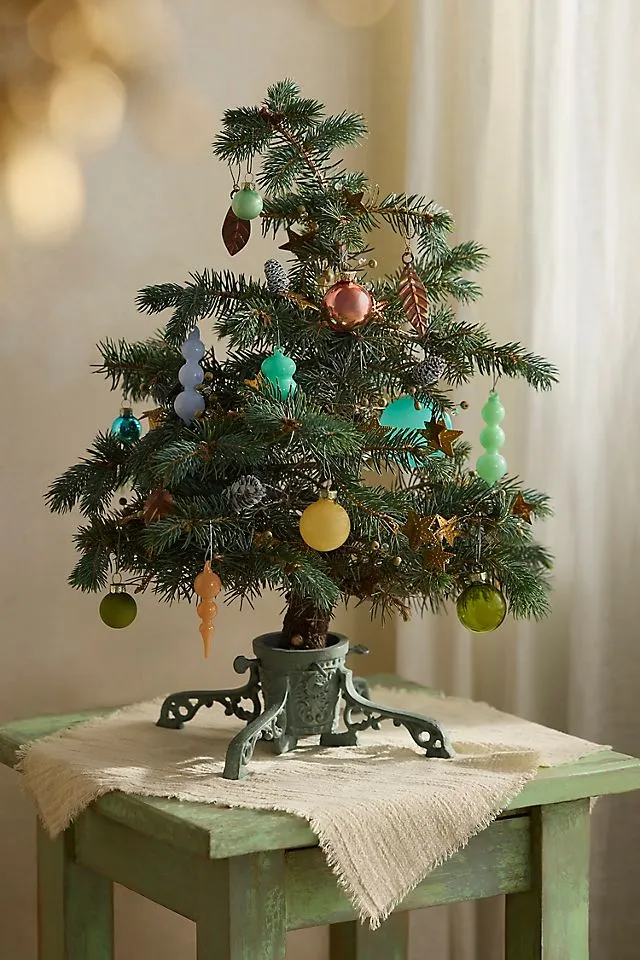
Total: $125–$415. Budget alternative: skip the ornament sets this year and buy one $12 mixed box from Target, then add thrift-store pieces over time. Thrifted glass balls at $1 to $2 each build a better collection than any boxed set.
Tabletop styling has one rule: height variation, not clutter. Put the tree slightly off-center on the table, let the stand stay visible as a feature rather than hiding it, and leave at least 8 inches of empty surface on the other side. If the ornaments are pastel and metallic, keep the runner plain — a cream fringe is perfect because it doesn’t compete. A patterned runner plus patterned ornaments plus a distressed table is three competing textures in a very small space.
32. Rudolph Ornaments and a Red Nose Express Train
The formula for a character tree: about 40 percent general ornaments — snowflake garland, standard baubles — 40 percent themed character pieces, and 20 percent lights and garland that carry the story. That ratio keeps the tree readable as a Christmas tree instead of a merchandise display. Underneath, dedicate the base entirely to the theme: train set, themed gift bags, plush toys. Spill it onto the floor a little and it stops looking like a display and starts looking like play.
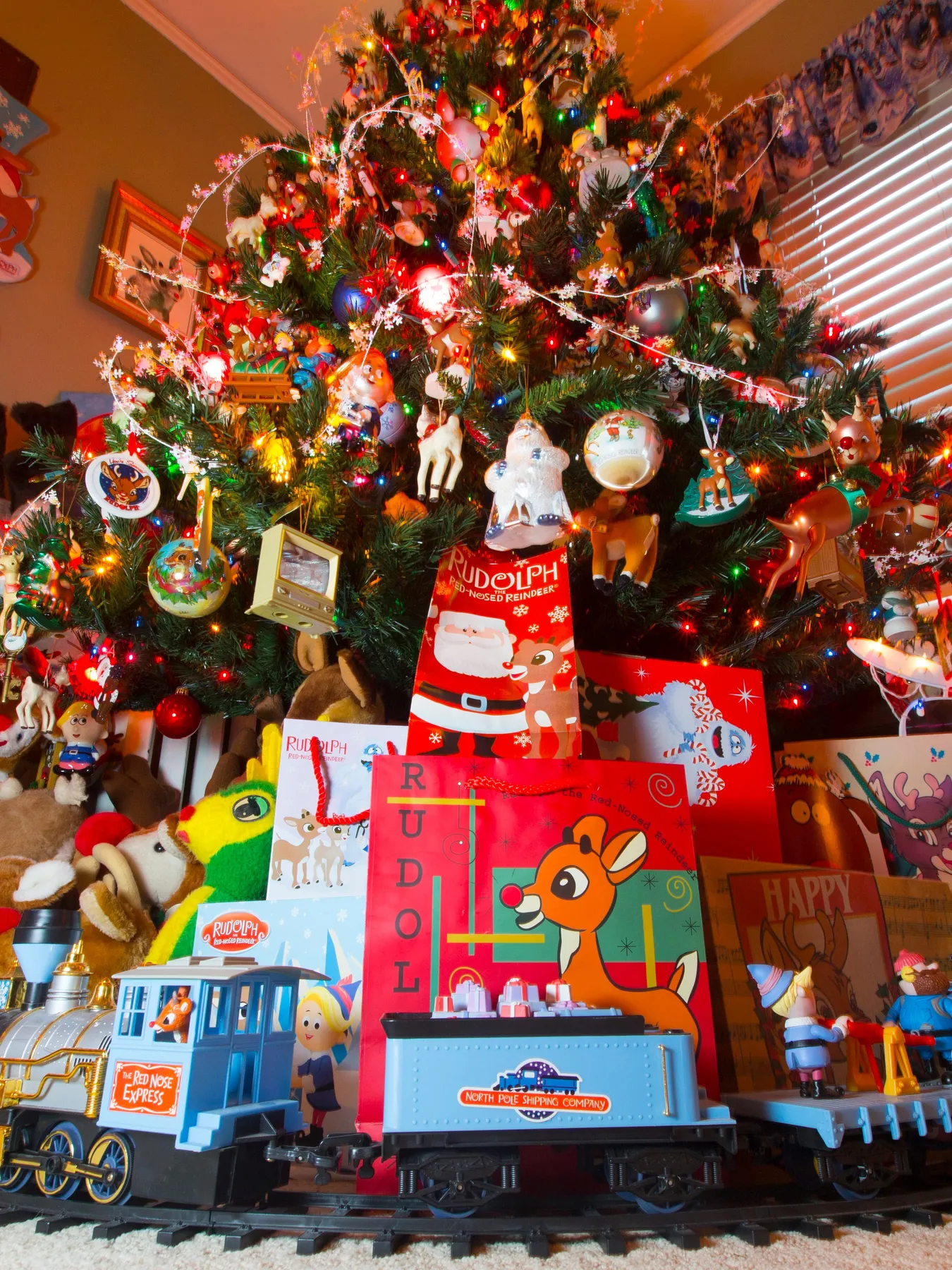
Be honest about the space and the noise. A train set under the tree needs a flat loop of at least 30 inches in diameter and a hard floor — it will not run on thick carpet. Multicolor lights plus a moving train plus a character theme is a lot of stimulation, so if the room is also your main living space, consider switching to warm white bulbs and letting the train carry the energy. Keep a small screwdriver nearby; the wheels loosen.
Go Hang Something Ridiculous on the Top Branch
The best 1950s trees were never perfectly styled — they were collected, added to, and a little bit odd, which is exactly why we’re all still saving photos of them seventy years later. Start with one idea above that fits the room you actually have, buy two things this week, and let the rest accumulate.
📌 Pin your favorites now so you can find them in November when the good ornaments are already gone.