
You know the feeling: it’s the first week of December, the fancy chocolate calendar costs more than the gifts you’ll actually buy, and someone has already shaken every box under the tree. That’s usually the moment people start searching for homemade advent calendars — and then close the tab, convinced it’s a craft-blog fantasy.
It isn’t. We spent a few late nights combing Etsy makers, Target, and three very good vintage markets to pull together the 30 countdown ideas worth your December — from a $12 paper-house village to a $180 illuminated wood heirloom, and everything in between.
Four moods run through the list: pale Scandinavian wood, traditional German woodcraft, hand-stitched felt and fabric, and one genuinely joyful painted-color camp. Budget and luxury versions sit side by side, so you can see exactly what the extra money buys.
2026 is the year the reusable December won. Saves for wooden and fabric calendars keep climbing because people are done buying plastic they’ll bin in January.
📌 Save this to Pinterest for later — you’ll want to revisit these ideas when the first of December sneaks up on you.
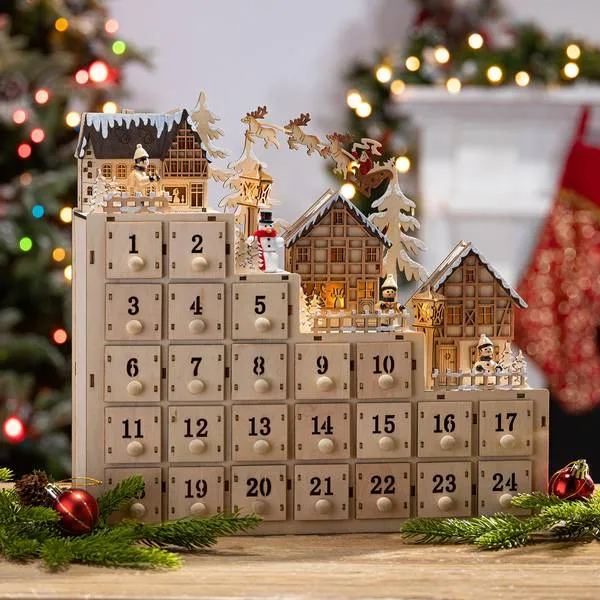
1. The Miniature Wooden Village With Numbered Drawers
Pull one thing away and this calendar stops being memorable: the laser-cut side panel where Santa’s sleigh and reindeer are cut clean through the wood. Without it you’d still have a handsome stack of drawers — you’d just lose the storytelling, and the part that makes a kid stop and look. Everything else here is supporting cast, right down to the little red-hatted figures on the roof line.
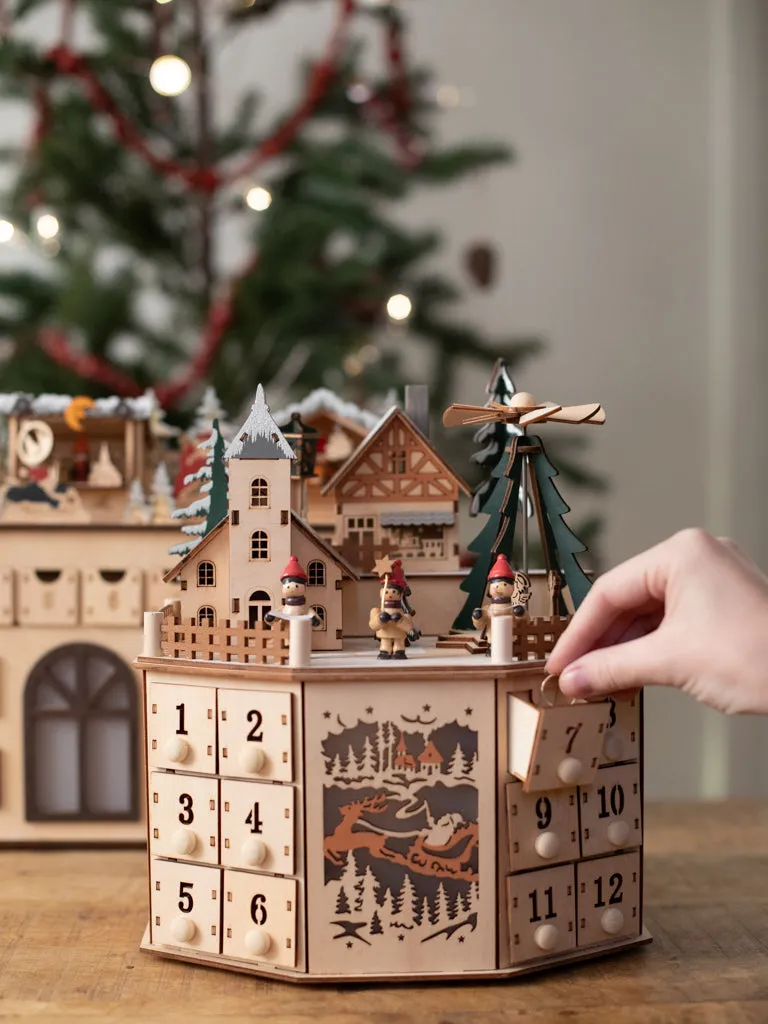
Two things are doing quiet work. First, repetition: twenty-four identical knobs, each about the size of a pea, read as texture rather than clutter — swap in mismatched pulls and the whole piece gets noisy. Second, restraint. Pale birch, forest green, one stripe of red. That’s the entire palette, and the dark tree glowing behind it supplies the mood.
2. A Nutcracker Theatre Built From 24 Red Drawers
Keep the numerals small — three-quarter-inch gold vinyl or a fine paint pen, centered, never touching the drawer edge. Oversized numbers on tiny drawers turn a theatre into a jewelry box. And if you’re adding curtains, buy cotton velour or wool felt rather than polyester: polyester catches light in a way that reads cheap from across the room, and it pills the moment small hands touch it.
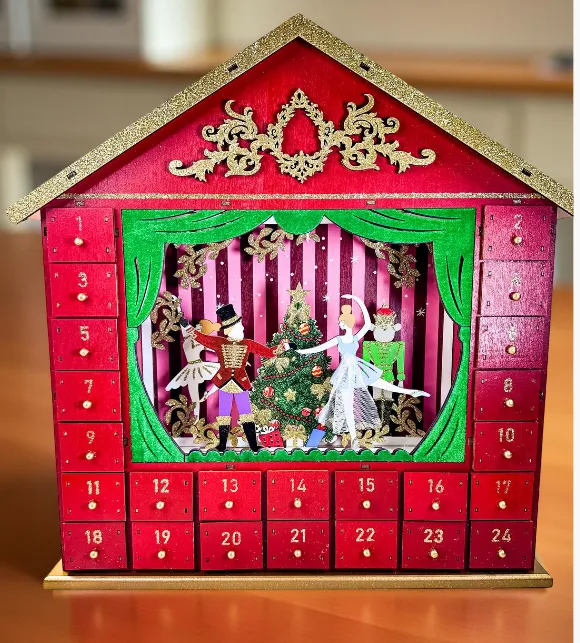
The formula here is roughly 55% pale wood, 25% red, 15% green velvet, 5% gold glitter. Swap the red drawers for deep navy and you get a night-sky version; swap green curtains for burgundy and it turns Victorian. The ratio is what matters — keep the smallest share for the metallic, or the glitter wins the room.
3. Felt Nativity Wall Hanging With Movable Figures
This is a weekend project, not a December-long one. Four hours, about $35 in materials, and a sewing machine you vaguely remember how to thread:
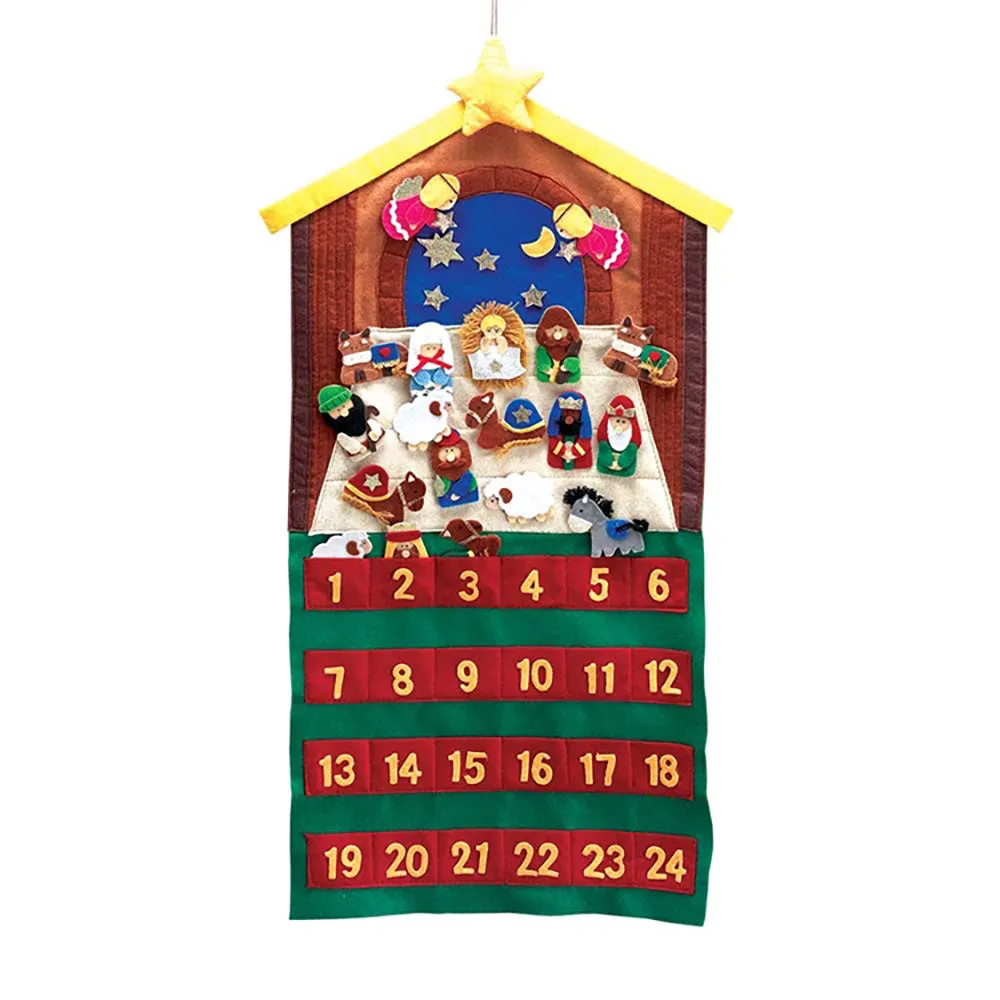
- Cut two 14×28-inch panels of wool-blend felt for the backing.
- Stitch 24 pockets in two rows of twelve, each roughly 3 inches square.
- Build the barn shape at the top with craft glue and a scrap of tan felt.
- Cut the figures — Mary, Joseph, the wise men, two sheep, a donkey, one yellow star.
- Sew a dowel sleeve along the top and hang it at kid height.
Here’s what nobody mentions: movable figures wander. By December 14 the donkey is behind the sofa and the star has been worn as a hat. Plan for it — stitch a small snap or an elastic loop into each pocket so pieces stay put overnight but still come free. Wool-blend felt holds its shape; cheap acrylic goes fuzzy in a week.
4. Painted Winter Scene Wooden Box That Holds Real Treats
- Unfinished 24-drawer wood box: $45–$80
- Acrylic craft paint and two brushes: $15–$25
- Number stencils or rubber stamps: $10–$15
- White ceramic candy bowls: $8–$20
- Cookies, brownie squares, wrapped candies: $20–$30
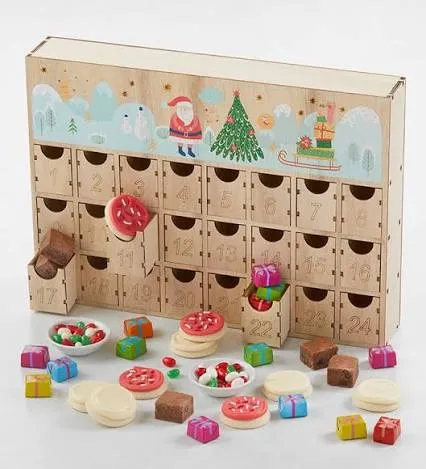
Total: about $98–$170. Budget alternative: a secondhand tea box or a small IKEA drawer unit runs $15–$25, and painting the top panel yourself gets you most of the way there for roughly a third of the price.
The painted top is the entire personality of this piece — Santa, a snow-dusted tree, mountains, a sleigh piled with gifts in bright red and pine green against bare wood. Seal it with two coats of matte polycrylic so December’s sticky fingers don’t take the scenery with them.
5. Illuminated Forest Diorama Under a Red Roof
Put the lights behind the trees, never in front. A six-foot strand of 2700K micro fairy lights taped to the back wall of the diorama gives you glow without a single visible bulb, and a battery pack with a six-hour timer hides neatly in one of the drawers. Warm only — anything above 3000K turns a cozy forest into a dentist’s waiting room.
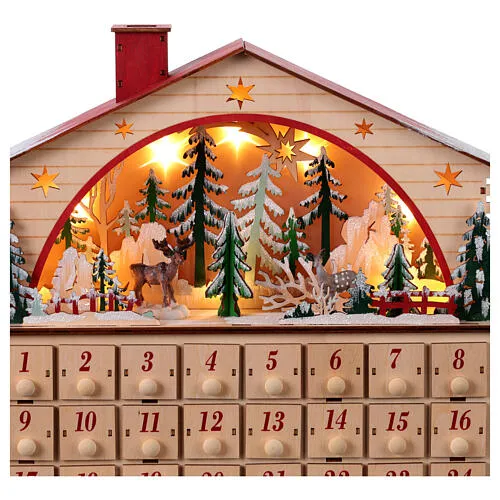
The return of the analog countdown is real, and it isn’t nostalgia for its own sake. Wooden and fabric calendars are being bought as heirlooms, the kind of thing you put a name on and hand down. In 2026 that reads as a quiet flex: fewer objects, kept longer, glowing at 2700K instead of syncing to an app.
6. The Twelve-Drawer Version for Smaller Countdowns
Twelve drawers is the underrated size. It suits a console 36 to 48 inches wide or a shelf run in an apartment under 600 square feet, where a 24-drawer build starts to feel like furniture you didn’t plan for. Surface width is the constraint here, not ceiling height. If you have a tall empty wall instead, see Idea #22, where 25 tiny houses climb a triangle.
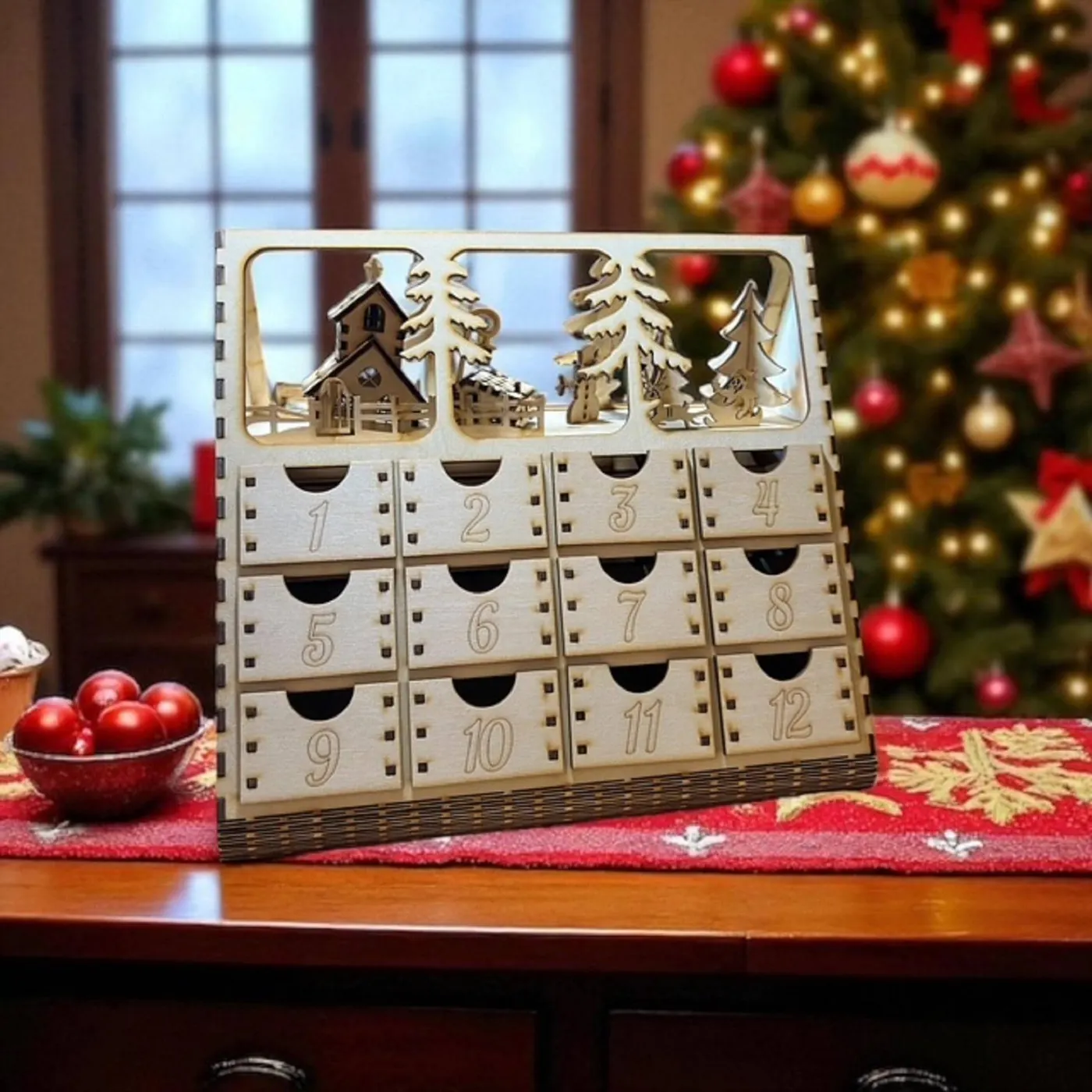
The look is a light wood box, laser-cut trees, engraved numbers, and a red embroidered runner underneath. Hit all four notes for $30–$45: a Target or Walmart wooden drawer box, a sheet of number stickers, and a red table runner from a thrift bin. Facebook Marketplace turns these boxes up constantly in January, when everyone is packing up.
7. Kraft-Tagged Presents Instead of a Calendar
No carpentry, no painting, no storage problem in January. About an hour of wrapping and $40 in small gifts:
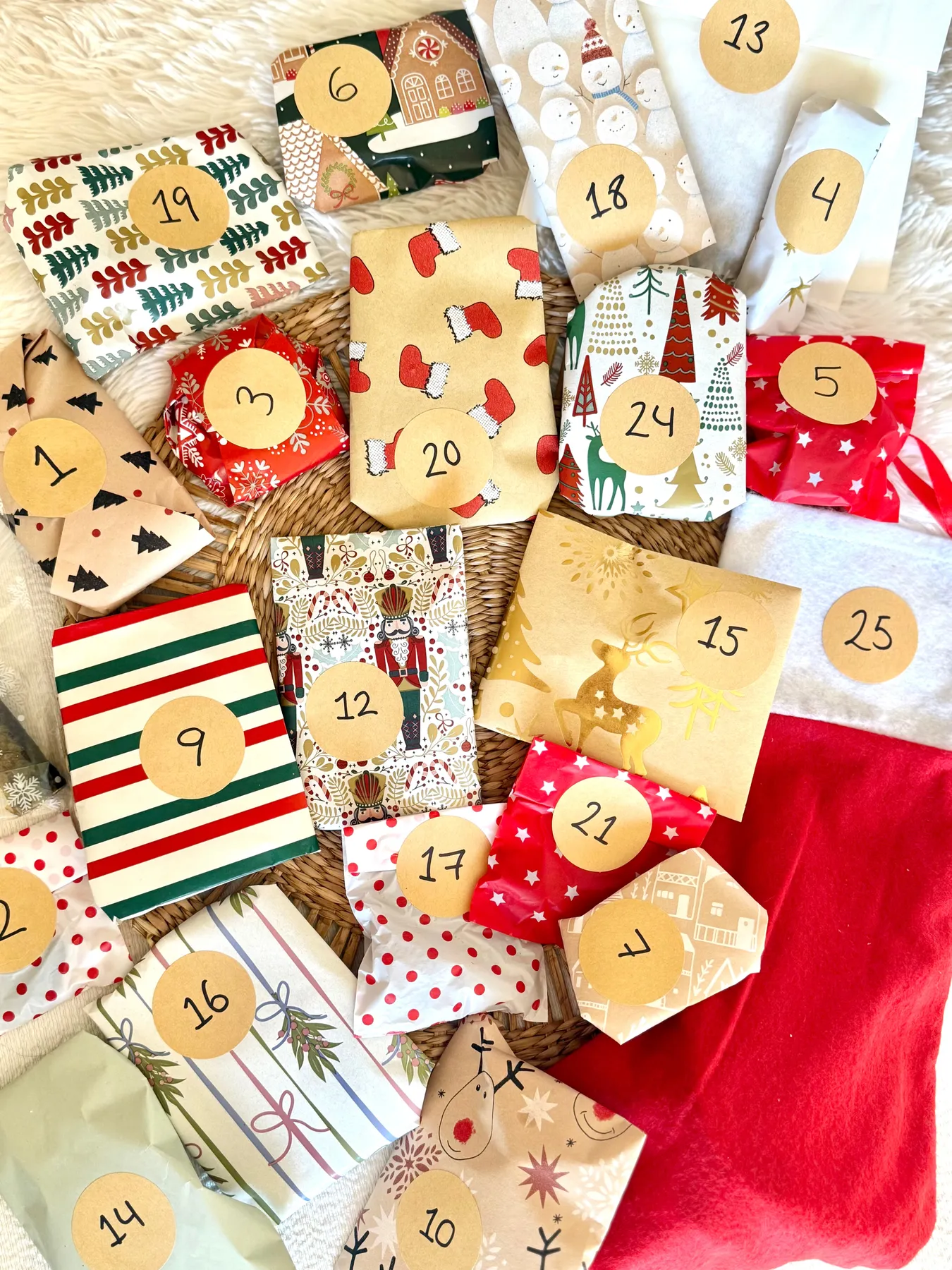
- Buy 24 small items — lip balms, card games, socks, candy canes.
- Pick five patterned papers and wrap everything in a mismatched mix.
- Add a kraft circle sticker to each, numbered 1 to 24 in marker.
- Pile them into a shallow woven basket lined with a white faux fur throw.
- Leave day one on top and unlabeled. Let them hunt for it.
Twenty-four mismatched papers should look like chaos, and the kraft stickers are the only reason it doesn’t. Same size, same brown, same marker — one repeated shape for the eye to land on. Skip them and it’s a heap of presents. Add them and it becomes a countdown.
8. White Frame, Red Drawers, Two Gnomes
Color anchoring, plain and simple. Twenty-four red drawers repeat the same note often enough that the white frame around them reads as a border rather than furniture. Inside, the paper-cut birch trunks and firs sit slightly darker and slightly smaller than the drawers, which pushes the scene back and makes the piece feel deeper than it actually is.
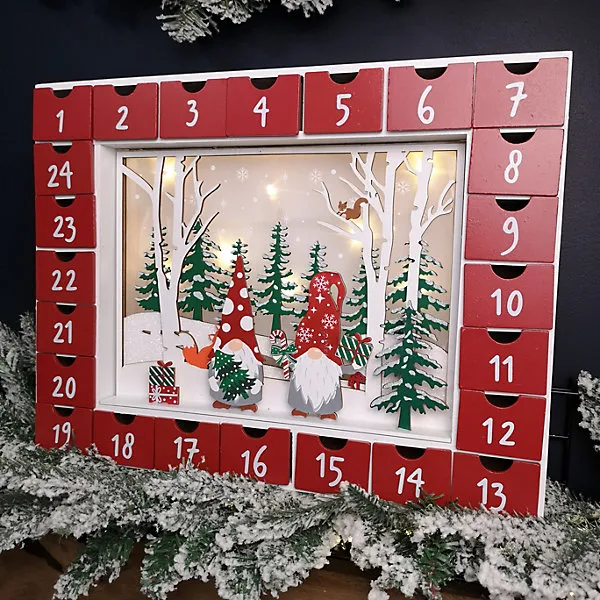
The ratio runs about 45% white frame, 30% red drawers, 20% forest green, 5% warm light. Change the drawers to sage and the frame to cream and you get a spring-adjacent version; keep the reds and swap gnomes for deer and it turns quietly Scandinavian. Hold the light share at 5% — more than that and the whole thing glows like a shop window.
9. Snow-Dusted Village With Pinecones on the Side
Faux snow is the maintenance story. Flocked trees and rooftops shed a fine white dust for the first two Decembers, so keep a soft brush nearby and dust the village monthly with the lights off. Skip the windowsill and any spot near a radiator — heat yellows fake snow and warps thin drawer fronts. Store it in a cotton bag, never plastic.
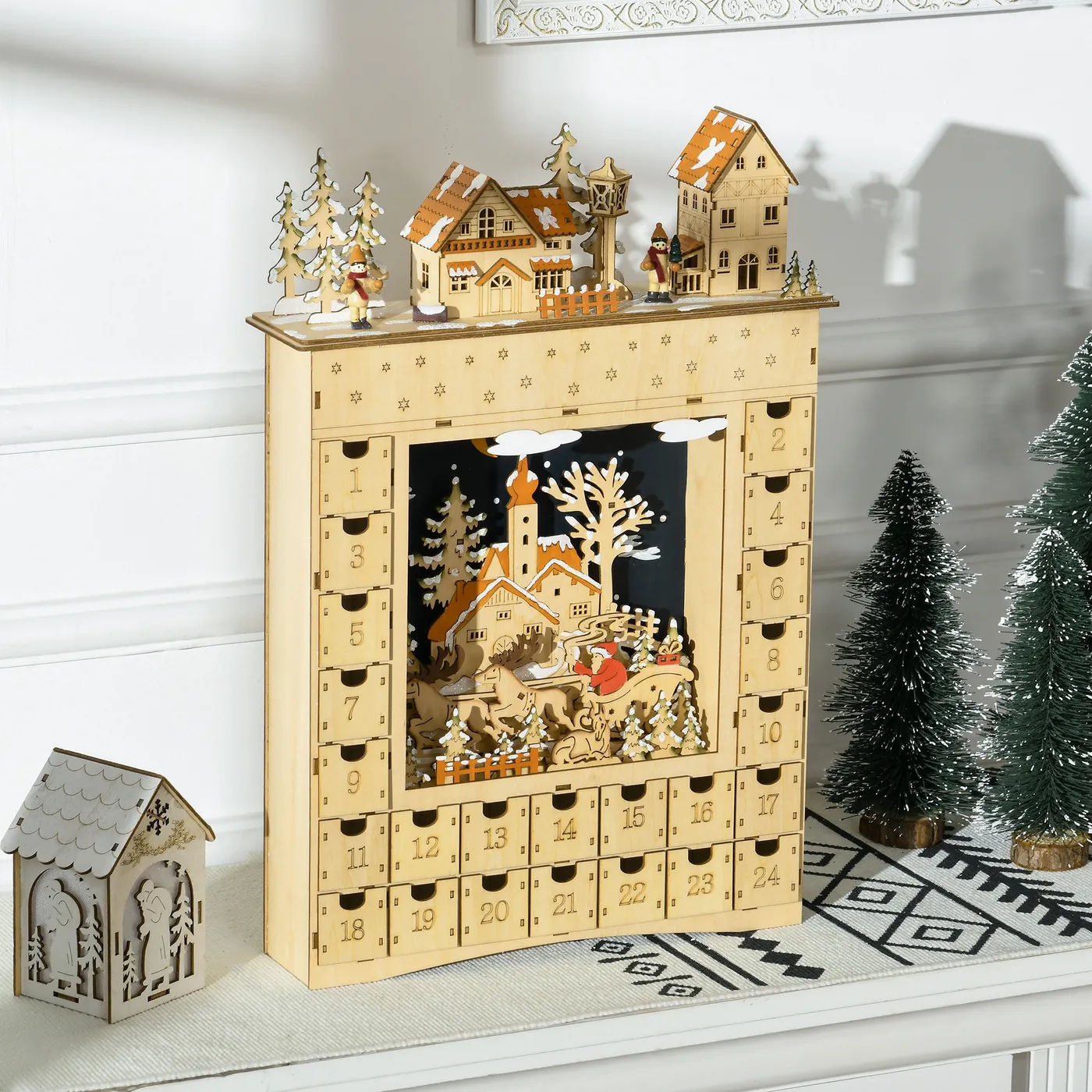
Those pinecones on the side aren’t filler — they break the straight line of the drawer bank. Group them in odd numbers, three to one side, never symmetrical. If yours came from the yard, bake them at 200°F for thirty minutes first; sap and small insects both surrender at that temperature, and your December stays bug-free.
10. The Layered Diorama With Bottle Brush Trees
This is the big one: 24 drawers plus a diorama usually lands around 20 inches tall and 24 wide, so give it a sideboard at least 48 inches long and leave 30 inches of air above for those fuzzy trees to breathe. Eye level or just below. In a tighter space, Idea #6 gets you the same wood-and-village language in half the footprint.
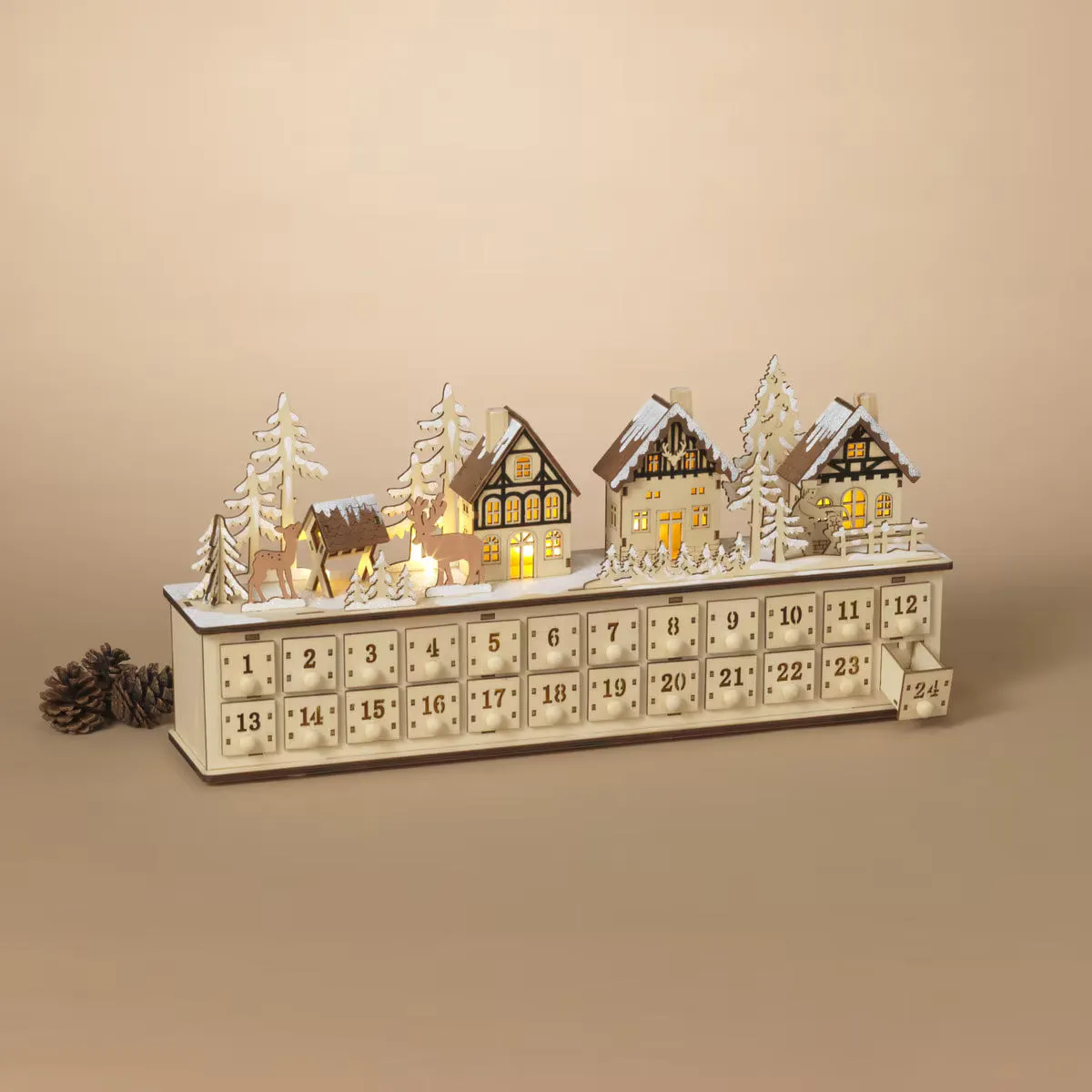
It’s the black-and-white geometric runner underneath — a strange hero for a Christmas calendar, and exactly why it works. Every other element is warm wood, white snow, and dark green; that one graphic stripe gives your eye a modern edge and stops the arrangement from blending into the tabletop. Remove it and the calendar floats.
11. The Red Cardboard Box Full of Cartoons
This is the $8–$15 end of the spectrum, and it’s genuinely charming: heavy red card stock, a sharp blade, and a downloadable house template. Print the illustrated panels at home or have a copy shop run them on 100 lb paper for a few dollars. Kids can color the inside flaps, which is half the fun and costs nothing at all.
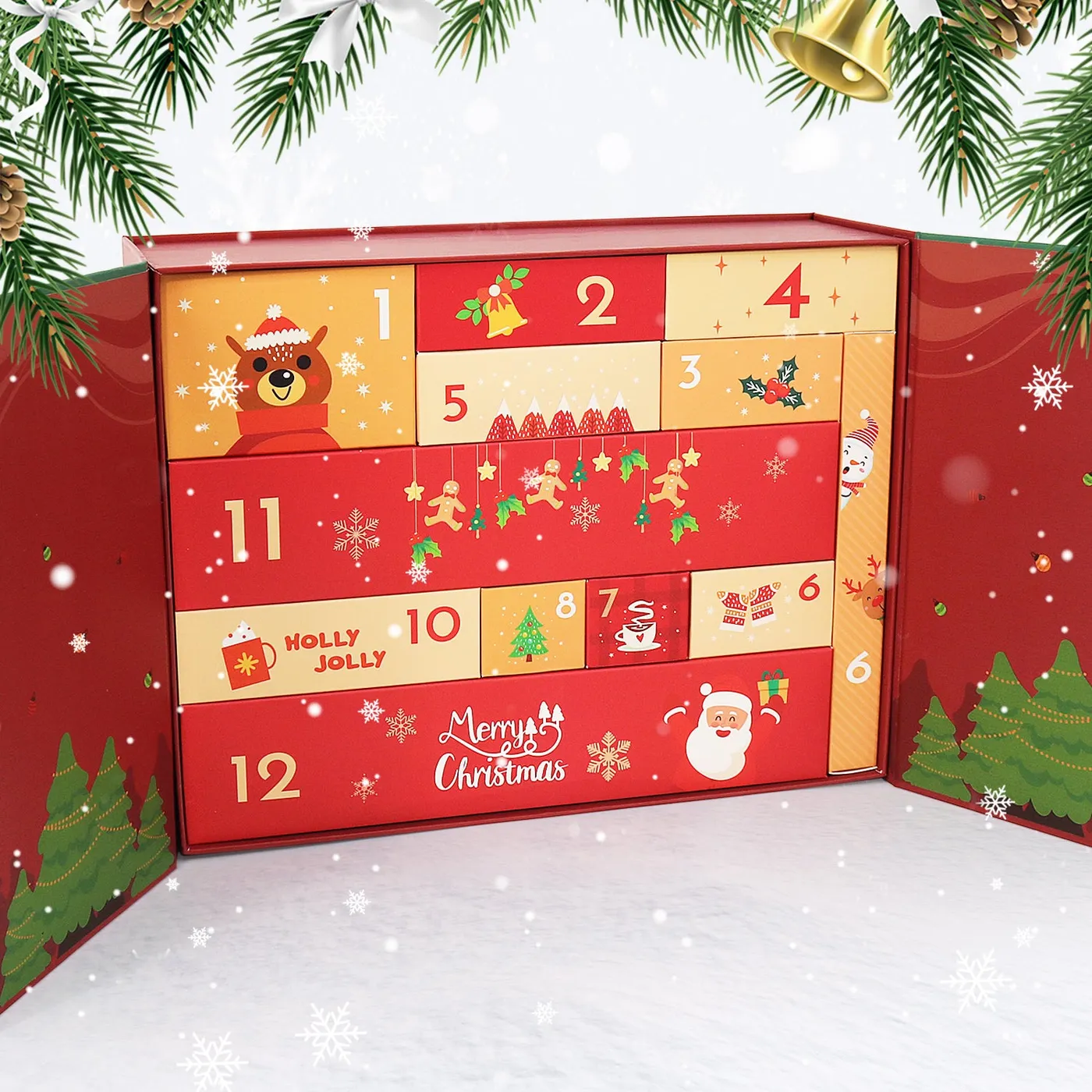
Cardboard has a one-December lifespan, sometimes less if the household includes a two-year-old. Fold lines go soft by week three and heavy treats pull compartments out of square, so keep fillers light — a sticker, a note, one chocolate. Want it to survive to next year? Cut the same shapes from book board and cover them in paper.
12. Off-White Canvas Pockets With Hand-Embroidered Motifs
Hang it so the bottom row sits 36 to 40 inches off the floor. Kids need to reach day one without a stool, and adults still need the top row to feel usable. Pockets should be 3.5 to 4 inches deep — enough for a matchbox car or a small ornament without bulging — and the dowel at least 3/4 inch thick so the canvas doesn’t bunch at the center.
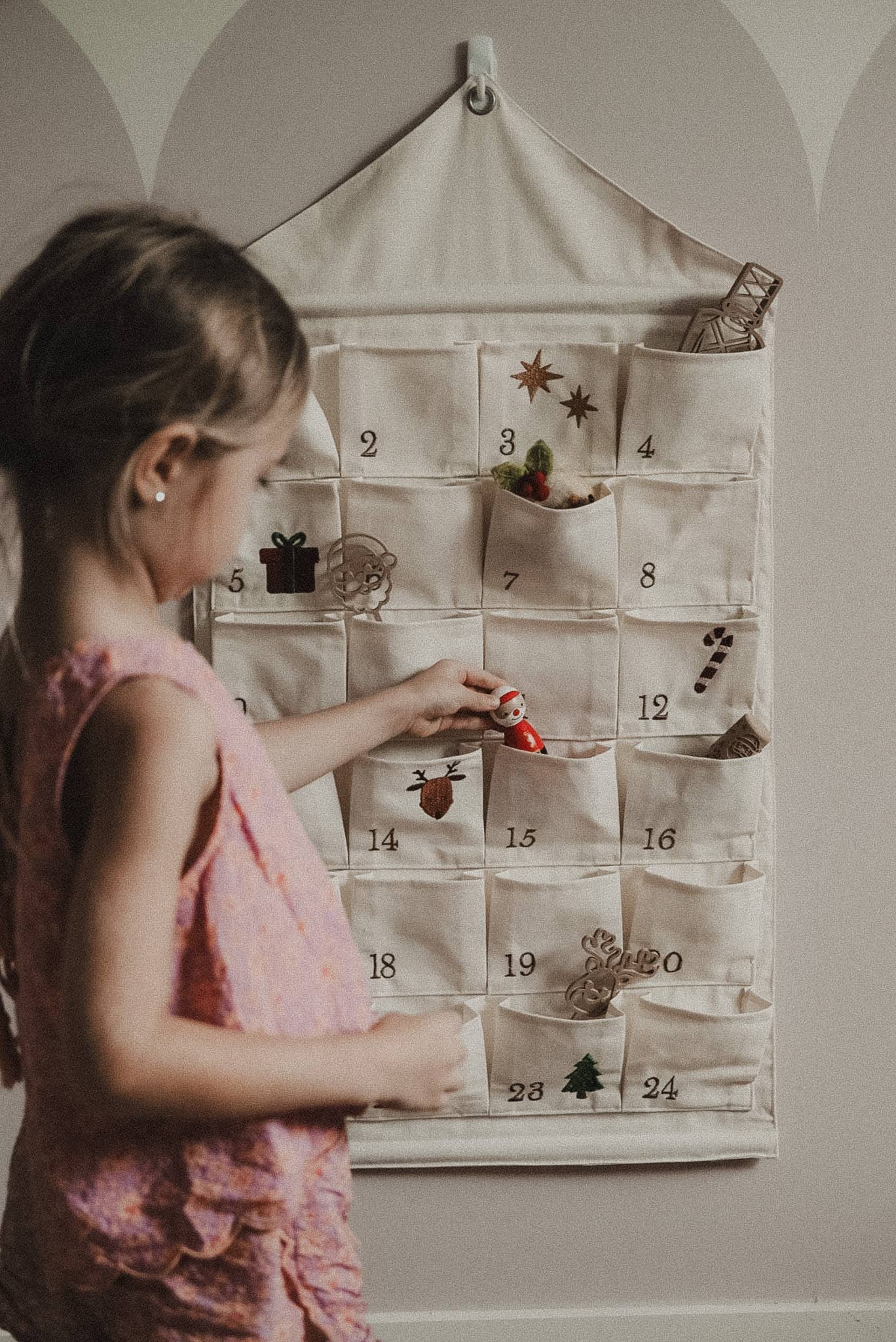
Fifteen minutes with an iron saves you a sagging calendar by December 8:
- Fuse lightweight interfacing to the back of the canvas before you sew anything.
- Press each pocket with a 1/4-inch seam allowance so edges stay crisp.
- Stitch two columns of twelve, leaving a one-inch gutter between them.
- Backstitch the top corners — that’s where the pull happens.
13. Tree-Shaped Flat Calendar Against a Red Paneled Wall
Read it as a color block first: about 50% vivid red wall, 30% deep green tree, 15% gold tinsel, 5% white and brown. The red does the thing most people are scared to do — it makes the green look deliberate instead of default. If a red wall feels like too much commitment, a deep navy panel gets you similar contrast with a cooler mood.
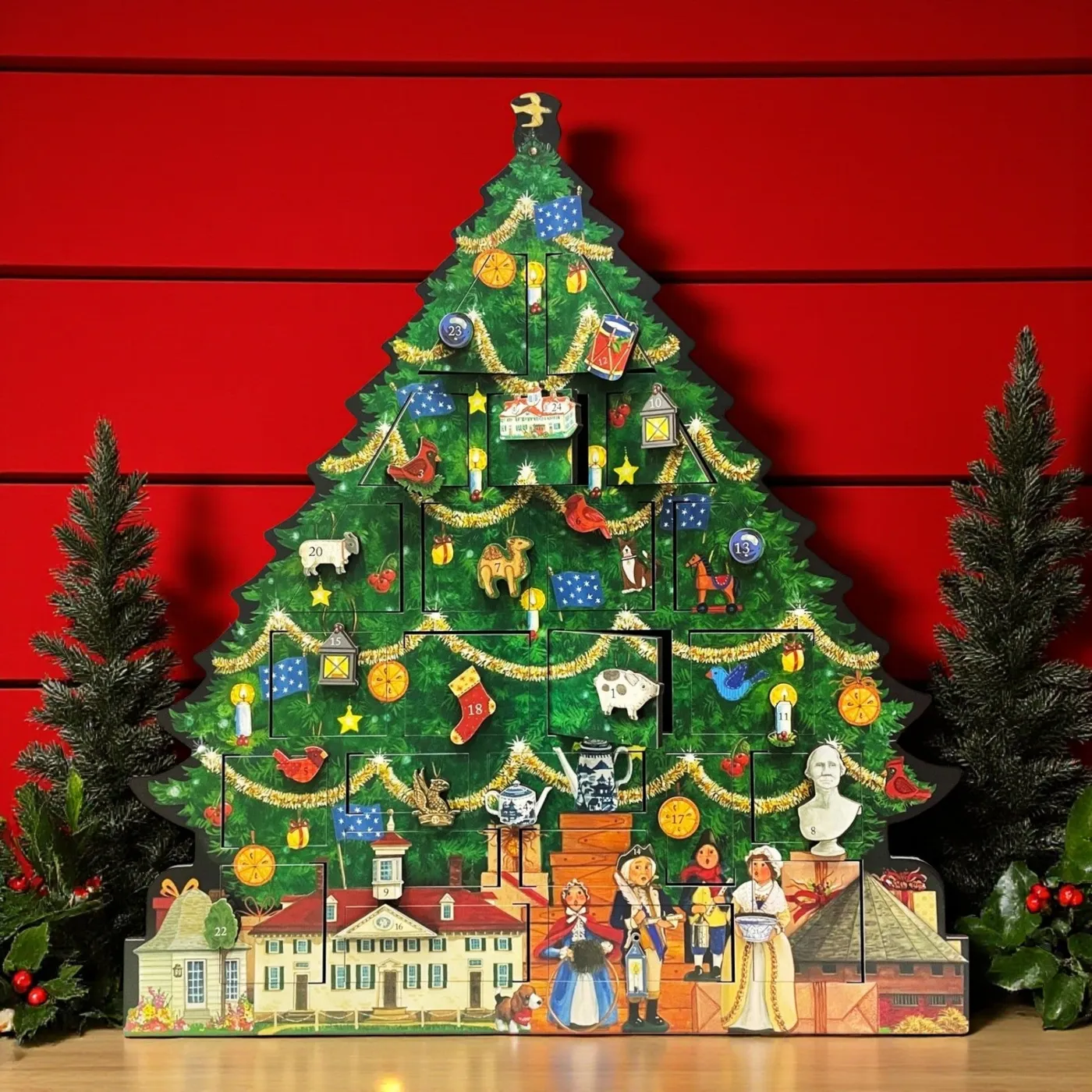
Three principles are stacked here. Complementary contrast: red and green at full strength, no muddying neutrals. Texture as interest: gold tinsel catches light and keeps a flat printed calendar from reading as poster board. And grounding: the colonial buildings and figures along the base give the tree a floor to stand on, so it doesn’t float against all that red.
14. Dark Green Tree Printed With Classical Angels
Printed paper advent calendars are older than most of us realize — German publishers were making them in the early 1900s — and they’re having a real revival in 2026 as people hunt the vintage-look version instead of the licensed-character one. The appeal is the artwork: classical angels and biblical scenes in muted gold and cream, on a mottled green that photographs beautifully.
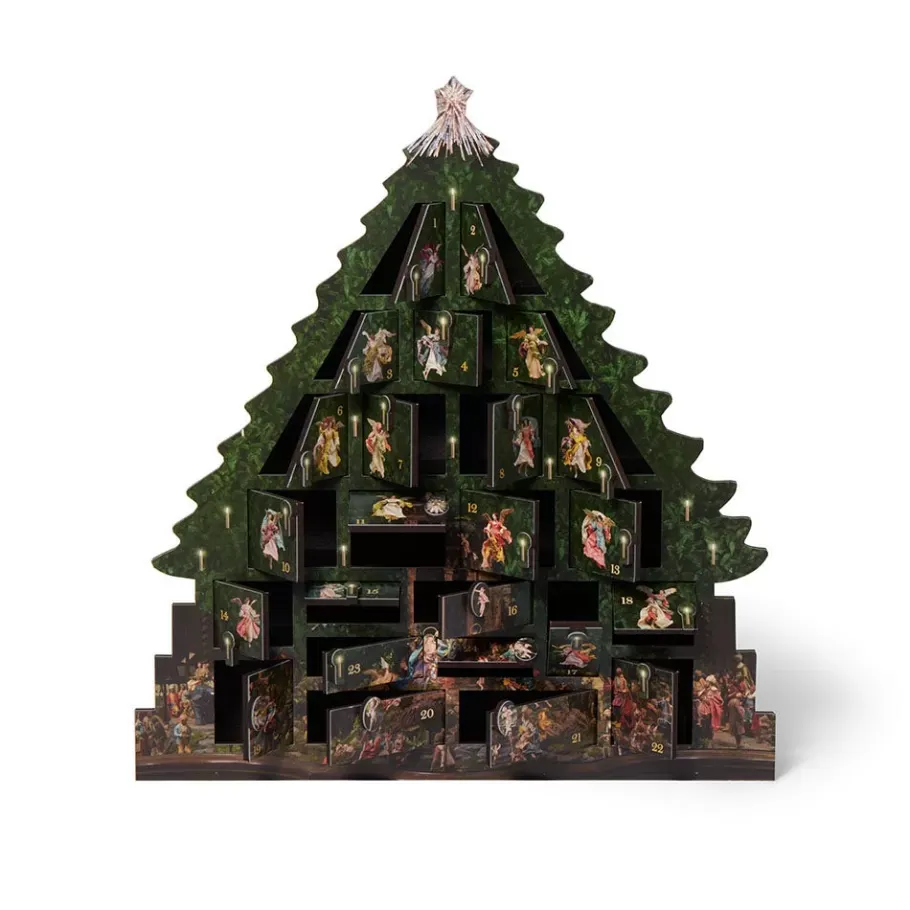
Paper fades, and it fades fastest near a window. Keep this one on an interior wall with no direct sun, and expect the little doors to loosen over the month — that’s normal. What you should avoid is tape, which lifts the printed surface when you peel it off in January. One pushpin at the top and a bit of blue tack at the base is plenty.
15. Wooden Grain and Drawer Reveals Up Close
Wood moves, and a drawer box has 24 chances to prove it. Keep the piece between 35% and 50% indoor humidity — forced-air heat dries a room out fast in December — and expect a sticky drawer or two by February. A rub of paraffin or a candle stub along the runners fixes it in seconds. Skip oil on unfinished or painted fronts; it darkens them unevenly.
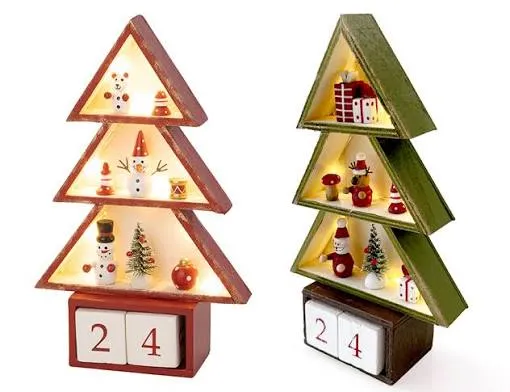
Check the drawer gaps before you buy anything. A well-made wooden calendar has roughly a 1/16-inch reveal around each drawer — enough to slide, tight enough that the numbers line up in a grid. Gaps of 1/8 inch or more will look sloppy from three feet away, no matter how pretty the scene on top is.
16. A Pink Wall Party With Felt Ball Garlands
Confidence is the whole design. That pink paneled wall would flatten a timid arrangement, but the house calendars are busy enough — stars, garlands, tiny figures — to hold their own against it. The felt ball garlands and paper stars repeat in three or four colors, so the eye finds rhythm instead of noise. Nothing here matches, and everything here belongs.
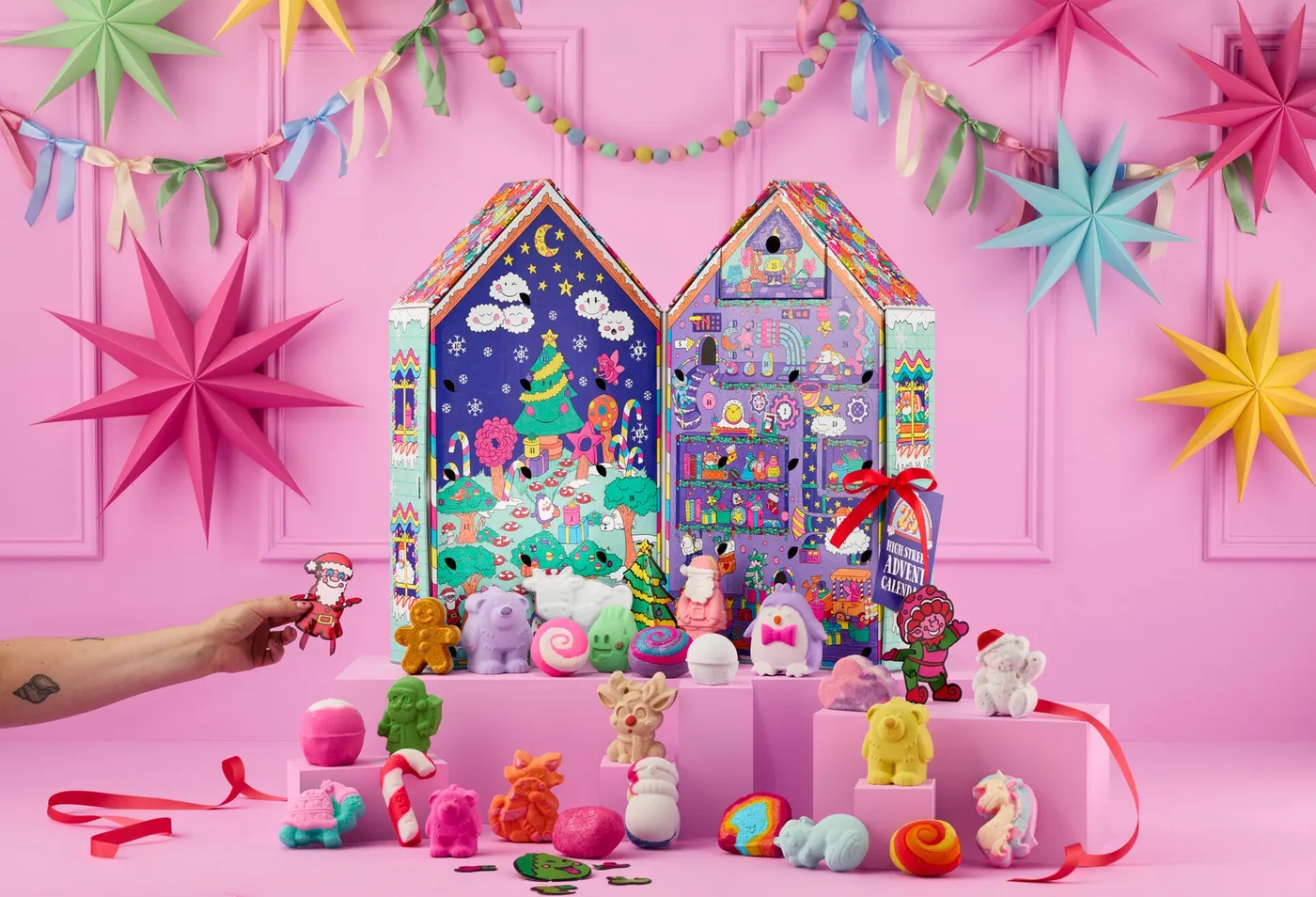
Paper stars run about $6 for a pack of twenty. Felt ball garlands are $12 for a hundred balls and a needle, strung by hand in an evening. Display blocks can be spray-painted foam or stacked books wrapped in pink paper. The figurines in front are the pricey part — skip them and use wrapped candy or tiny ornaments instead.
17. Tiered Village With LED Glow and Bauble Garland
Fluff the garland. A six-foot faux pine garland arrives compressed and looks thin until you separate every branch — ten minutes of work and it reads as nine feet of greenery. Then wire in six red baubles at staggered depths rather than in a row. Depth, not quantity, is what makes faux greenery look expensive.
Tiered calendars need height more than width: figure 22 to 26 inches tall and 20 inches of surface depth so the garland can spill forward. Entry consoles and sideboards handle them best. Bedside tables and narrow shelves don’t — the village ends up at eye level with nothing above it, and that LED glow just washes the wall.
18. Ornaments-in-Every-Pocket, Hung From a Dowel
Three hours, about $30, and it doubles as a decoration you’ll leave up past New Year:
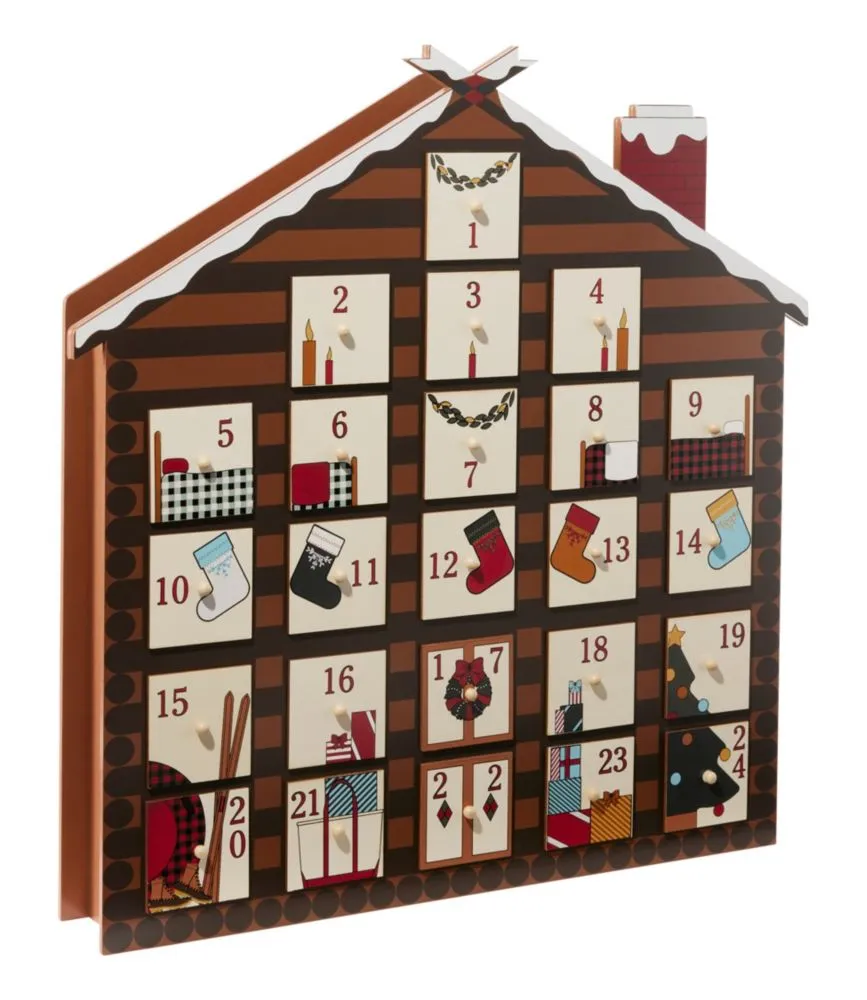
- Cut a 24-pocket panel from heavy cotton or canvas.
- Number the pockets 1 to 24 in red fabric marker.
- Thread a wooden dowel through the top sleeve and hang it level.
- Fill each pocket with one small ornament — snowman, star, reindeer.
- Let the day’s ornament go straight onto the tree.
Two cautions. Small ornaments are a choking hazard for anyone under three, so hang it above their reach or swap the contents for stickers. And fabric stretches: a pocket holding a glass bauble for 24 days will sag by Christmas. Line the pockets, or choose light wooden and felt ornaments instead.
19. Blue and Green Paper Houses Hung by String
- Card stock in three blues and two greens: $10–$18
- Craft knife and fresh blades: $8–$12
- Twine or fine ribbon: $5
- Number stamps or a fine pen: $8–$12
- Pine sprigs and a couple of old books for staging: $0–$8
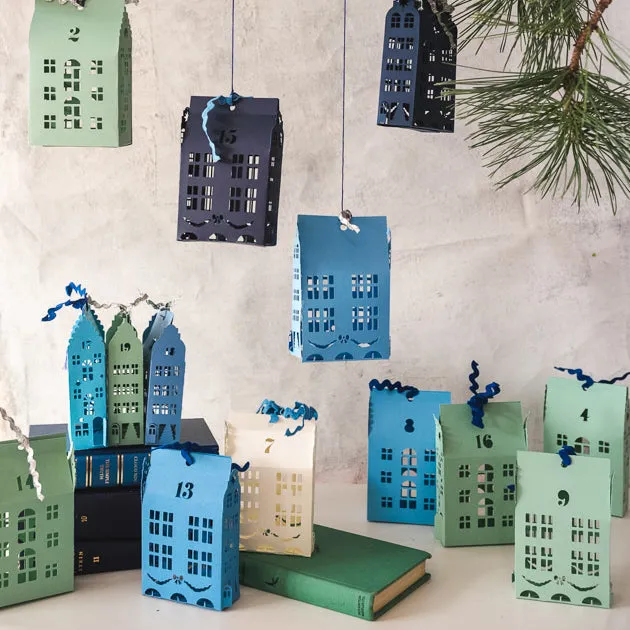
Total: about $31–$50. Budget alternative: printable house templates run $3–$5 and a copy shop will cut the stock for you — closer to $25 all in, with cleaner edges than most of us manage by hand.
Cut the windows from the back of the box, not the front. Score the outline on the reverse, cut through, and the front face stays crisp with no blade marks. Line the inside with a scrap of vellum and drop in a battery tealight — the whole village glows from within for about $2 a house.
20. Red Roof, Red Chimney, Warm Glow Inside
The red roof and chimney. Everything else on this calendar is pale wood and white snow, so that single painted roof does the job a whole color scheme usually handles — it makes the piece read as a house instead of a drawer bank. Without it the winter forest inside is still beautiful, but the object loses its silhouette. It’s the same trick that works in Idea #5, just with the forest brought indoors.
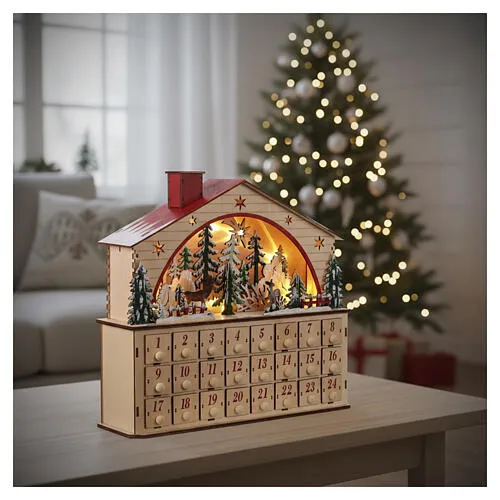
Internal lighting means wiring, and wiring means batteries or a cord you’ll trip over. Go battery, and check the compartment size before you fall in love with a model — some need three AA cells, which is a lot of hiding space. Keep anything with warm bulbs away from toddlers; the drawer fronts get warm enough to notice after an hour.
21. The Santa-Face Tree That Says Her Name
The personalization is the whole gift here, and it takes an evening:
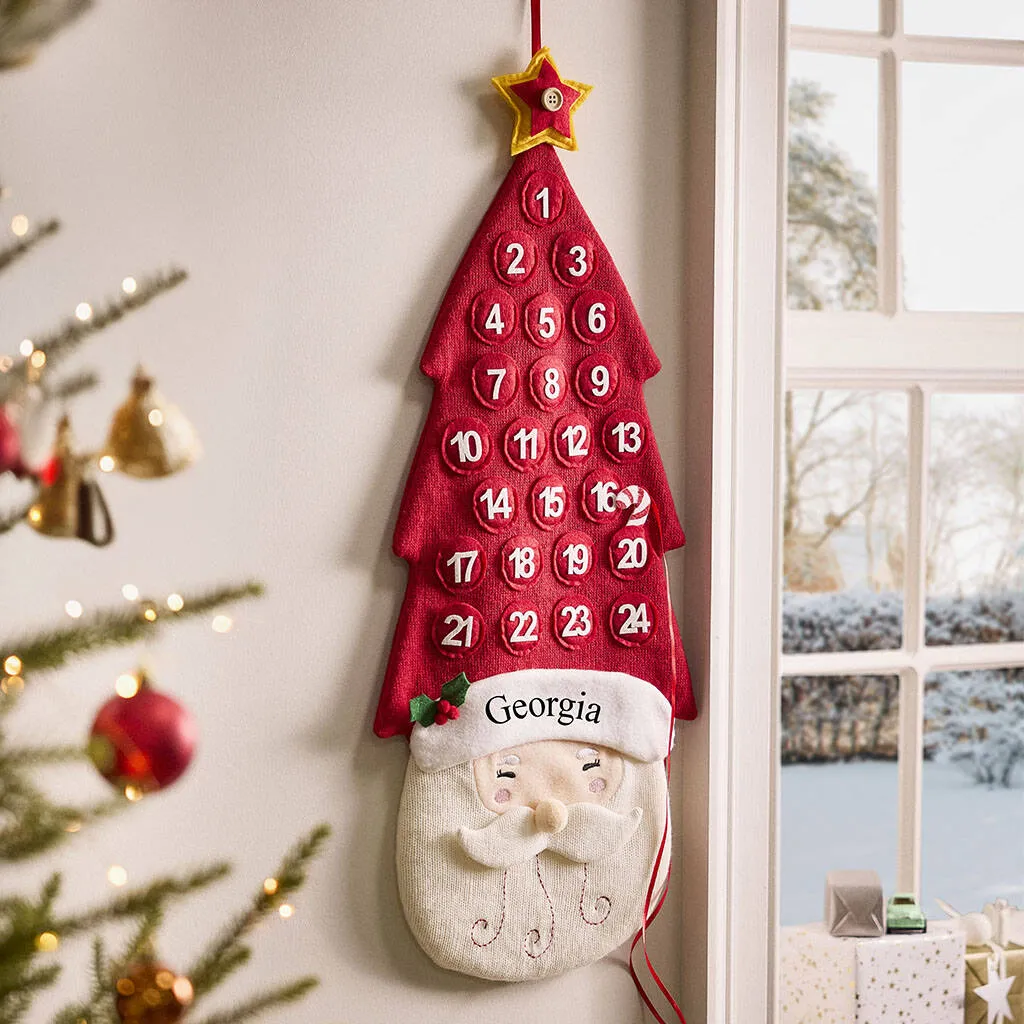
- Print the name in a chunky font, mirror-image, on freezer paper.
- Iron it onto the cream Santa hat fabric, shiny side down.
- Fill the letters with a satin stitch, or outline them in chain stitch.
- Peel the paper while warm — the stitches stay, the template goes.
The palette is roughly 70% red, 20% cream, 10% yellow-green accents, and that heavy red share is why it reads as a decoration rather than a craft project. On white or greige walls it’s the only saturated thing in the room. If your walls are already warm — terracotta, mustard — swap the red for deep forest green and keep the cream Santa.
22. Twenty-Five Tiny Houses in a Triangle
Figure on roughly 40 inches wide and 48 tall for a triangle of 25 houses, which means a wall run of at least five feet and 12 inches of table depth if you’re setting it on a surface. It likes a hallway end or a dining room corner. For a flat version that hugs the wall instead of projecting into the room, Idea #13 is the same idea in two dimensions.
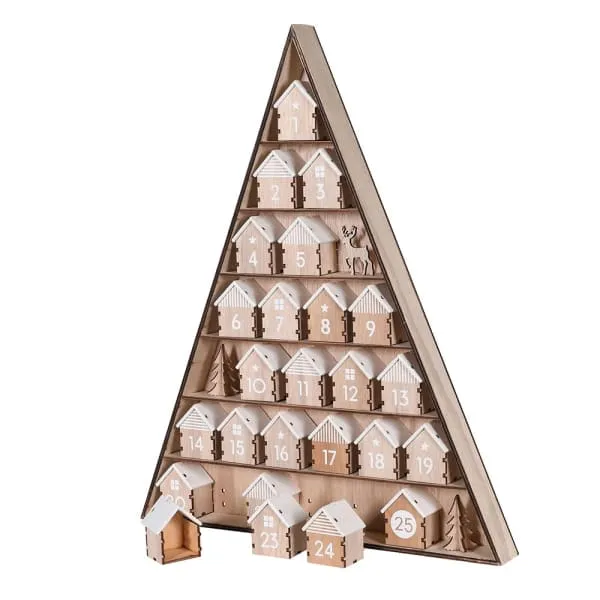
It’s the white roofs. Twenty-five light-wood boxes in a triangle would read as a very handsome set of blocks, but the moment each one gets a white-painted roof, the shape becomes a snowy village climbing a tree. That single repeated detail is the line between joinery and a Christmas decoration.
23. Cream Canvas Pockets Dressed With Vintage Stickers
Use removable label stickers and archival glue dots rather than glue. It means you can swap the vintage imagery every year — skating scenes one December, ballet the next — without destroying the canvas. Number in dark red, at least an inch tall, centered, and keep each sticker in the upper third of its pocket so it never gets grabbed by small hands.
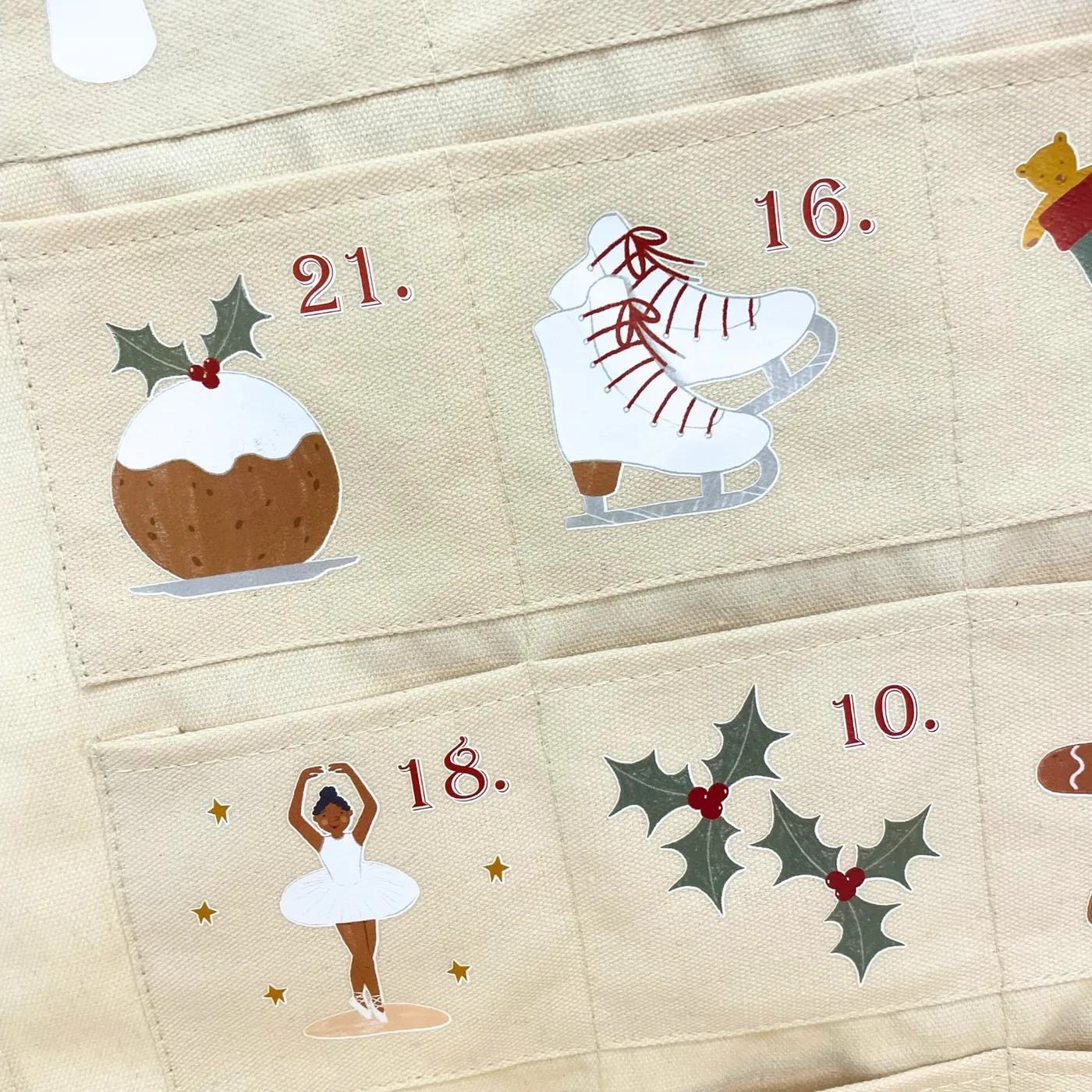
A ready-made fabric calendar runs $35–$60. The homemade version lands closer to $10: a yard of cream canvas from a remnants bin, twenty-four small stickers from a stationery shop or a printable sheet, and a fabric marker. The stitched pockets do the expensive-looking work; the stickers are the fun part and cost almost nothing.
24. A Wooden Train Pulling 24 Numbered Wagons
Sequencing does the heavy lifting. A train gives the eye somewhere to go — locomotive, wagon, wagon — so a long horizontal calendar never feels like a spreadsheet. Red and green drawers alternate in a loose, uneven pattern rather than strict turns, which keeps it playful. And the white fluffy surface beneath gives all that saturated color somewhere to land.
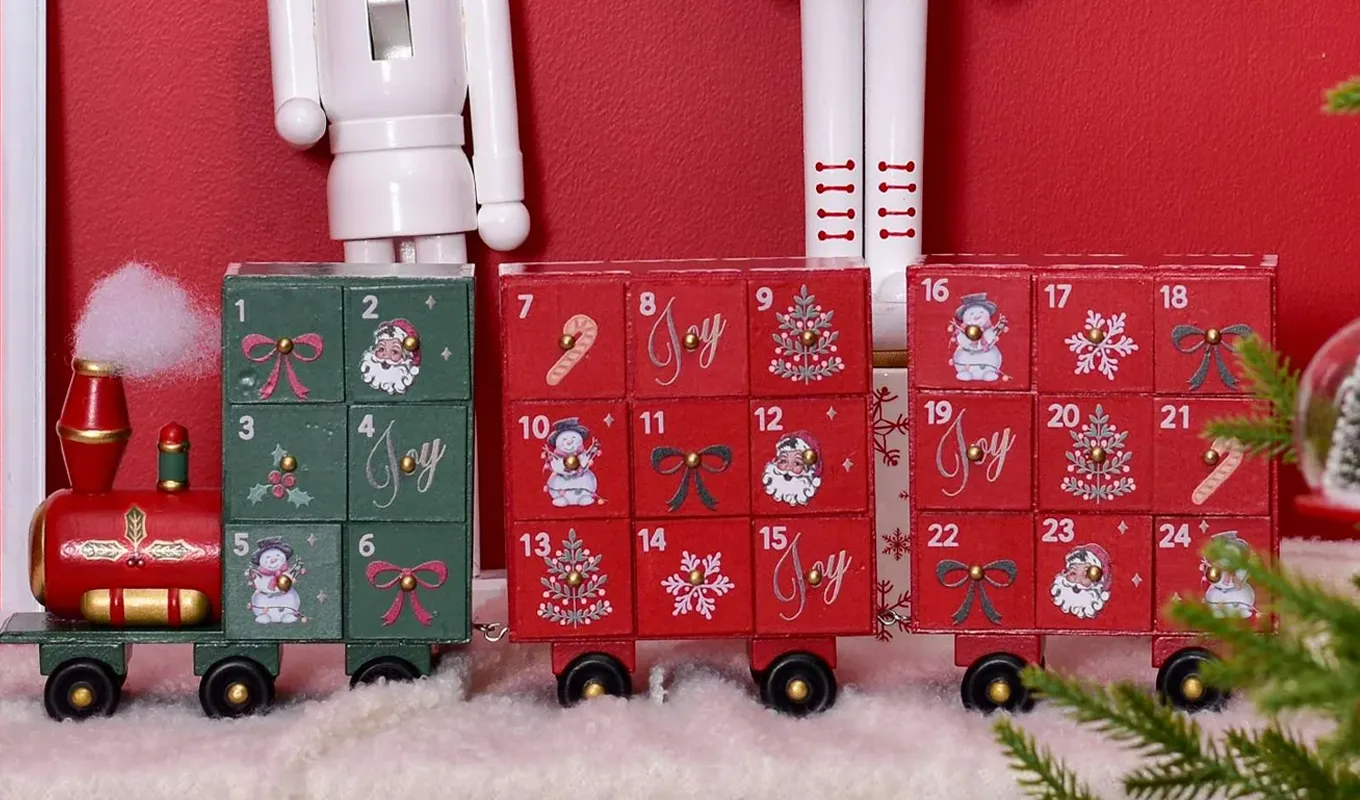
Novelty shapes come with a trade-off: small drawers. Expect each one to hold a single truffle, a lip balm, or a folded note — not a pair of socks. If this is going to be the main gift calendar, check interior dimensions before buying. And if it lives on the floor, it will be sat on. Put it on a low console instead.
25. Snowman and Reindeer Appliqué on a Paneled Door
Felt is forgiving but not invincible. It pills where hands rub, so vacuum the calendar on the lowest setting with a brush attachment once a month, and spot clean with a damp cloth and a drop of dish soap — never the washing machine. Keep it off doors that get slammed and away from the coat hook; the appliqué reindeer will lose an antler to a backpack.
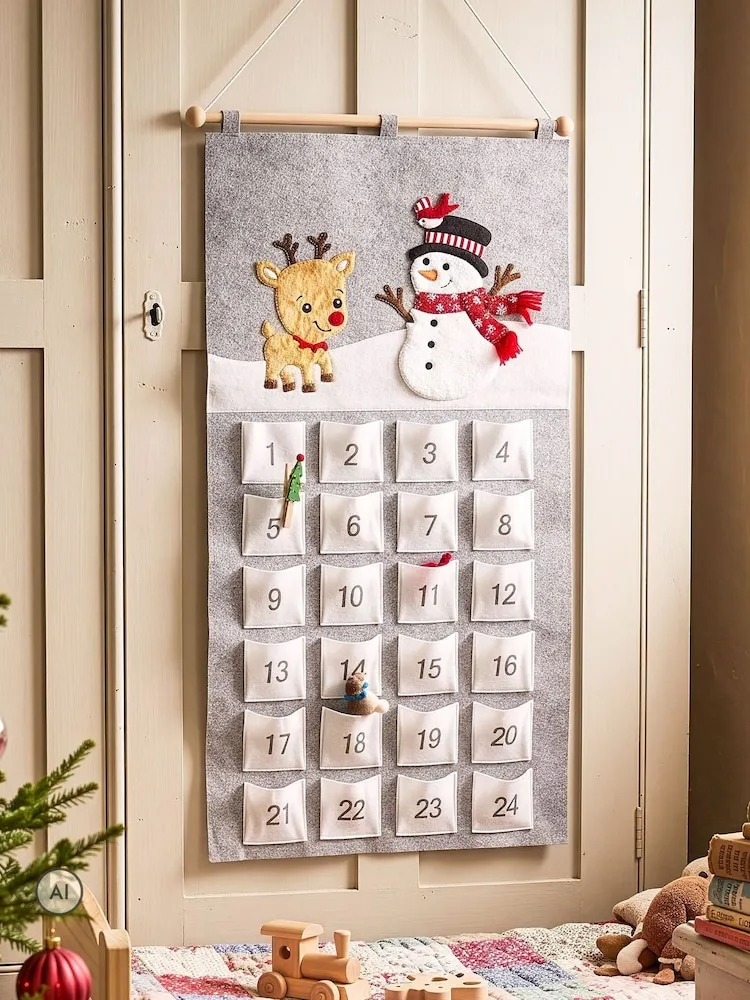
Hanging weight matters more than people think. A felt calendar with 24 filled pockets runs two to three pounds, which is well within a damage-free adhesive strip but well beyond a thumbtack. Use two strips, one at each end of the dowel, press for thirty seconds, and let it sit an hour before loading the pockets. That’s the step everyone skips.
26. The Tree-Shaped Calendar That Joins the Mantel
Floor-standing tree calendars want a living room with nine-foot ceilings and a clear three-foot circle around the base — this is furniture, not a wall hanging. It reads best beside a sofa rather than behind one, and it needs its own light source, since a floor piece in a dim corner just becomes an obstacle. Wall-hung options like Idea #22 solve the same space problem vertically.

The 2026 twist is the calendar as furniture: pieces substantial enough to sit next to the tree instead of competing with it. That’s why you keep seeing drawer towers photographed with wine glasses and a plate of cookies — it says stay a while, not look at my craft project. Same instinct as the double-tree trend, just quieter.
27. Backlit Nativity Silhouette on a Dark Table
The backlight. Without it, this is a well-made drawer box with a nice silhouette on top. With warm light behind the laser-cut nativity, the negative space becomes the subject — the figures read as shadow, the stable reads as architecture, and the whole thing looks like it cost three times what it did. Everything else here is supporting cast.
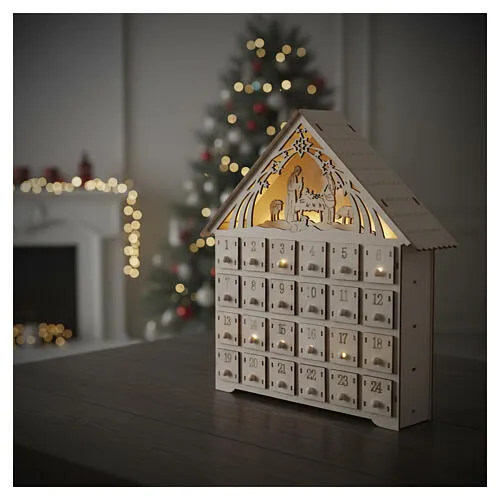
You don’t need the $150 version. A plain wooden drawer unit from IKEA plus a laser-cut paper or plywood nativity insert gets within a foot of this look for $35–$50, and a strand of battery fairy lights behind the insert supplies the glow. Keep it out of reach of anyone still putting small things in their mouth, and note that the dark table underneath matters more than the brand.
28. Wooden Blocks, Teddy Bears, and Star Lights
Check these before you commit to the shelf:
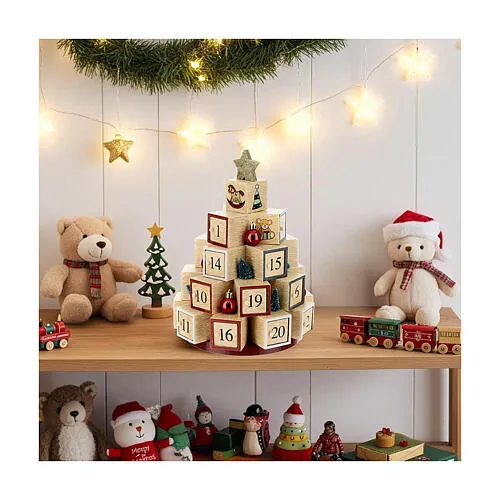
- Shelf depth of at least 10 inches — the blocks and trains spill forward.
- Anchored shelving; a loaded advent calendar is heavier than it looks.
- An outlet or timer for the star lights, within cord reach.
- Block numbers turned to face the smallest person in the house.
The contrast does the work: hard, geometric wooden blocks against soft teddy bears and a fluffy wreath. Star-shaped lights repeat a motif the blocks don’t have, so your eye keeps moving between shelf and wall. The white plank backdrop lets every warm wood tone read clearly — put these blocks on a dark wall and the whole thing goes flat.
29. Village Lights on a Rustic Cabinet
Roughly 50% warm wood, 25% forest green, 15% red, 10% golden light. It’s a classic ratio because the wood carries the moodiest weight and the red only has to appear in small hits — a bow, a bauble, a stripe on a blanket. Swap the green for slate blue and you get a cooler, more modern version without changing a single piece of furniture.
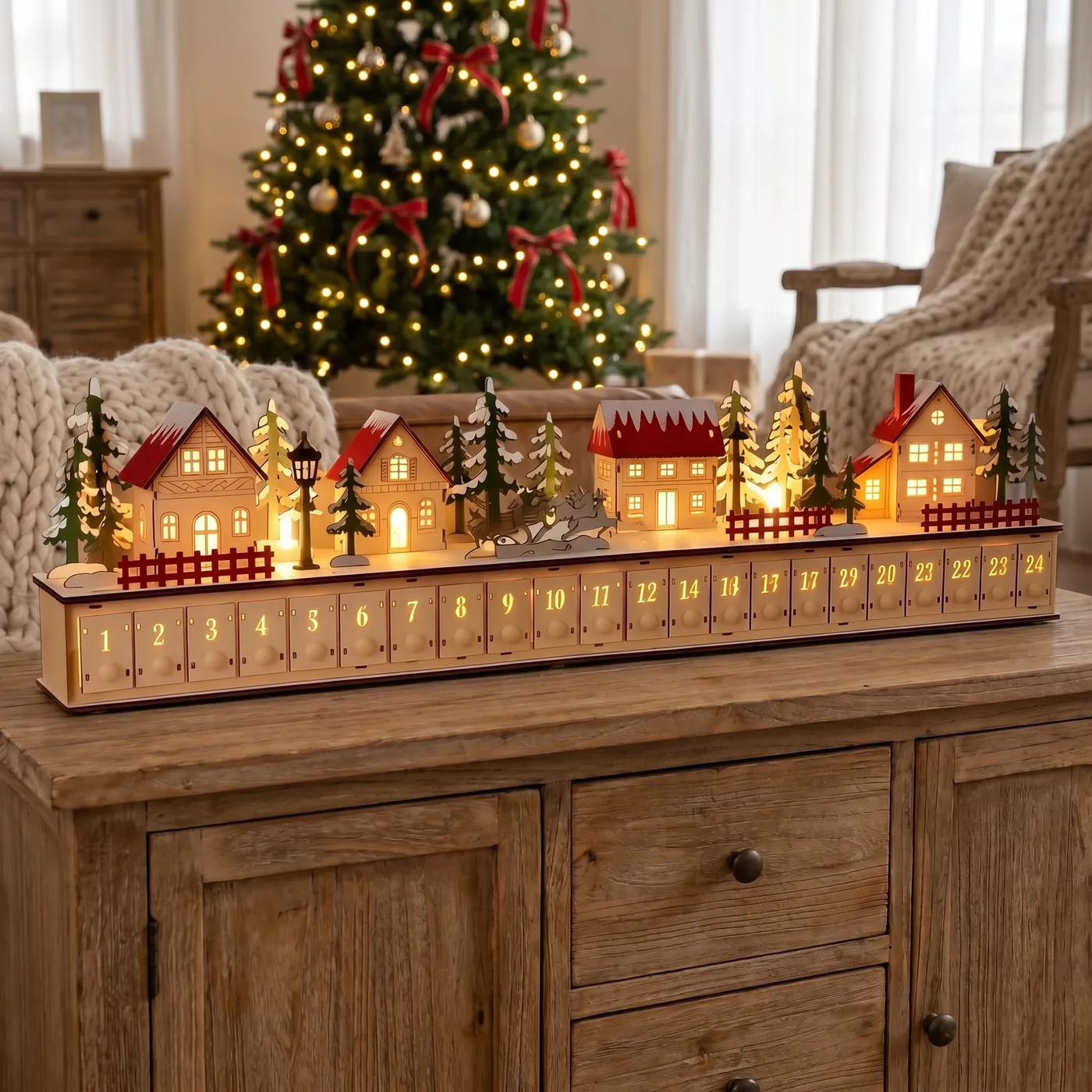
A rustic cabinet from Facebook Marketplace is $40 in a good week, and most lighted wooden villages run $30–$60 at big-box stores in early November. Add a chunky knit throw from Target at $30 and you’ve rebuilt the entire scene — cabinet, lights, blanket — for what the original calendar alone would cost. Idea #9 is the smaller, snow-dusted cousin of this same glow.
30. Alternating Red and Green Drawers With Crystal Pulls
Alternating drawers only work when the colors are equally saturated. Deep red and forest green, side by side, in the same matte finish — that’s why this one looks intentional. Pair a bright cherry red with a pale sage and the pattern turns accidental. And if you’re upgrading the pulls, replace all 24 at once; a mix of crystal and wood knobs reads as repairs, not style.
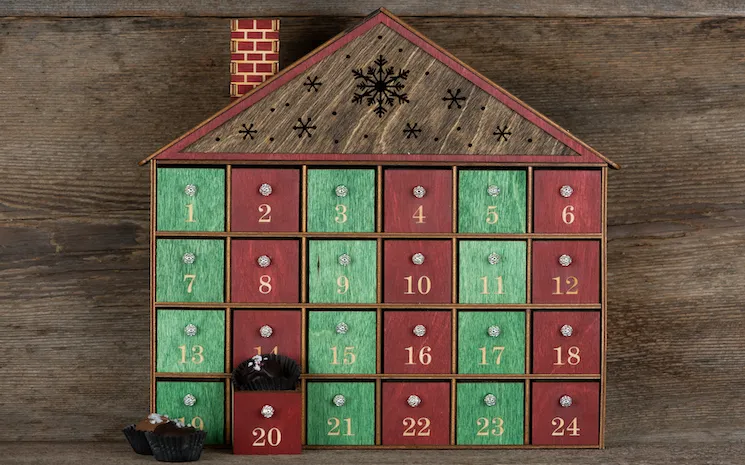
Chocolate and wood are not natural roommates. Keep the calendar below 70°F — a drawer above a radiator will bloom the chocolate into a gray, chalky mess — and wrap truffles in wax paper so cocoa butter doesn’t migrate into the drawer fronts. Wipe the interiors with a barely damp cloth in January before you store it, because crumbs attract pests.
December Is Built One Small Drawer at a Time
None of these countdowns require a workshop, a Cricut, or a personality that enjoys hot glue at 11 p.m. — most are one weekend, a thrifted box, and a decision about where the thing should live for the next 24 days. Pick the version that fits your wall and your patience, and let the rest go.
📌 If you found the right one, save it to Pinterest now — and tag us when your December 1st looks exactly like you hoped.