
Your neighbors are going to slow down when they drive past this year — and not because of a giant inflatable. After digging through hundreds of garages dressed as gifts, pampas-and-pinecone setups, and full roofline light shows, we narrowed it down to 22 garage door Christmas decorations that actually look good in person, not just in a phone photo at dusk. We spent serious time on Etsy, Walmart, Home Depot and Lowe’s to bring you only what’s worth your attention this year, across a range from about $15 to $1,200. Inside you’ll find traditional red-and-green classics, modern black-and-gold elegance, boho natural textures, and playful character designs — with budget and luxury versions compared side by side. In 2026, oversized matte ribbons and 2700K warm white light are what’s driving the saves on Pinterest. Save this post now — you’ll want it when you’re ready to shop.
Heads up: this post contains affiliate links. If you buy through them, we may earn a small commission at no extra cost to you.
1. Pampas Grass and String Lights Soften a Wood Garage Door
Pampas in a planter next to a driveway is a wind test, not a styling choice. Line the bottom of each container with 10 pounds of pea gravel, then push the plumes in at least 6 inches deep so they read as one mass instead of a bouquet. For the garland, anchor it every 18 inches with clear zip ties rather than hooks — pampas gets top-heavy after rain and will rotate on a single nail. Then lay the string lights on top of the greenery rather than weaving them underneath. Light bouncing off cream plumes looks soft; light trapped inside looks muddy.
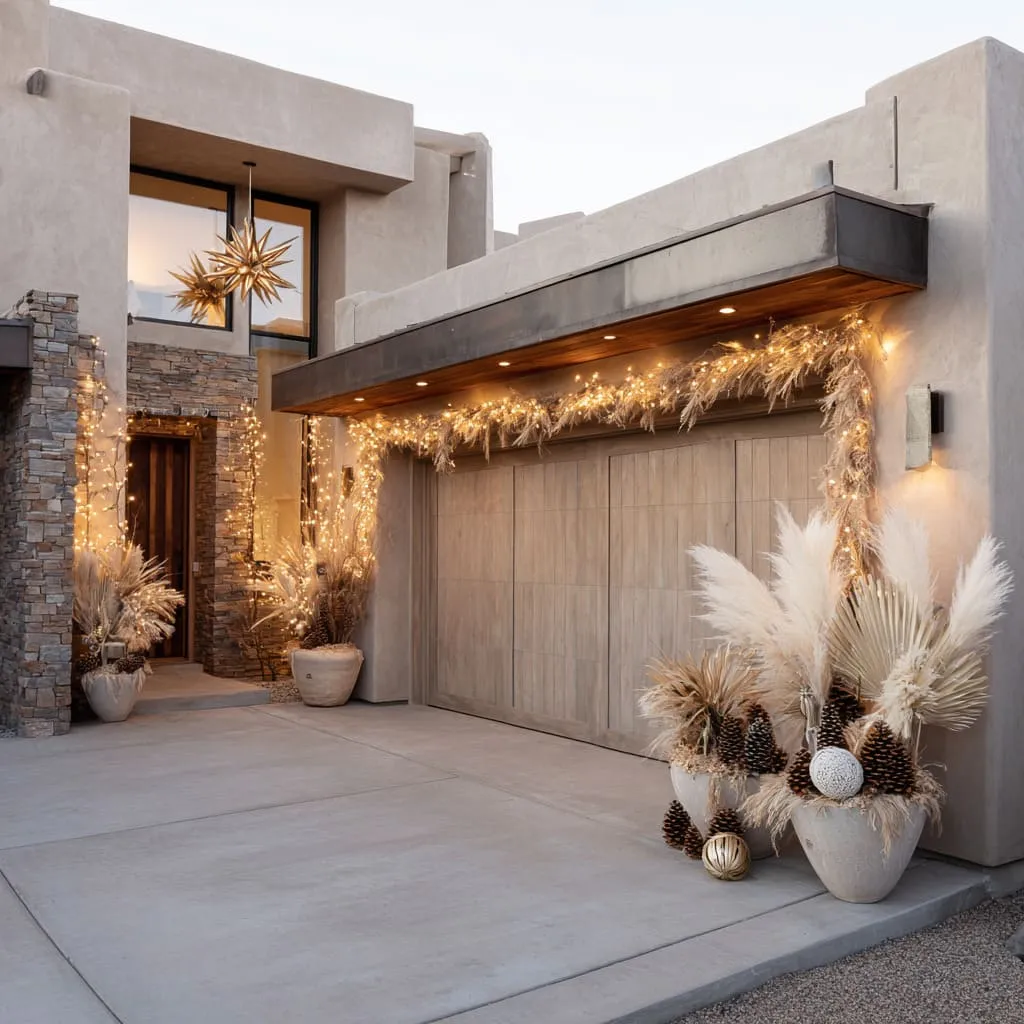
- Two large concrete-look planters: $80–$260
- Warm white LED string lights, two 50-ft runs: $30–$70
- Pampas plumes plus dried palm fronds: $40–$130
- Pinecones, gold and textured white ornaments: $35–$110
- Mounting clips, zip ties, outdoor timer: $20–$45
Total: $205–$615
Swap the concrete planters for 5-gallon buckets spray-painted matte greige and topped with gravel — that alone saves $150–$200, and nobody walking past will know.
2. Dark Gray Door Wrapped Like a Giant Christmas Present
Three things are doing the work here. First, contrast — a dark gray door is the only backdrop that makes a matte red ribbon look expensive instead of cartoonish. Second, proportion: the horizontal ribbon should sit at roughly the door’s vertical center, with the bow sized to about one-third of the door’s height. Third, repetition. The vertical stripes on the surrounding walls echo the door’s own window panels, so the whole facade reads as one wrapped object instead of a door with ribbon taped on.
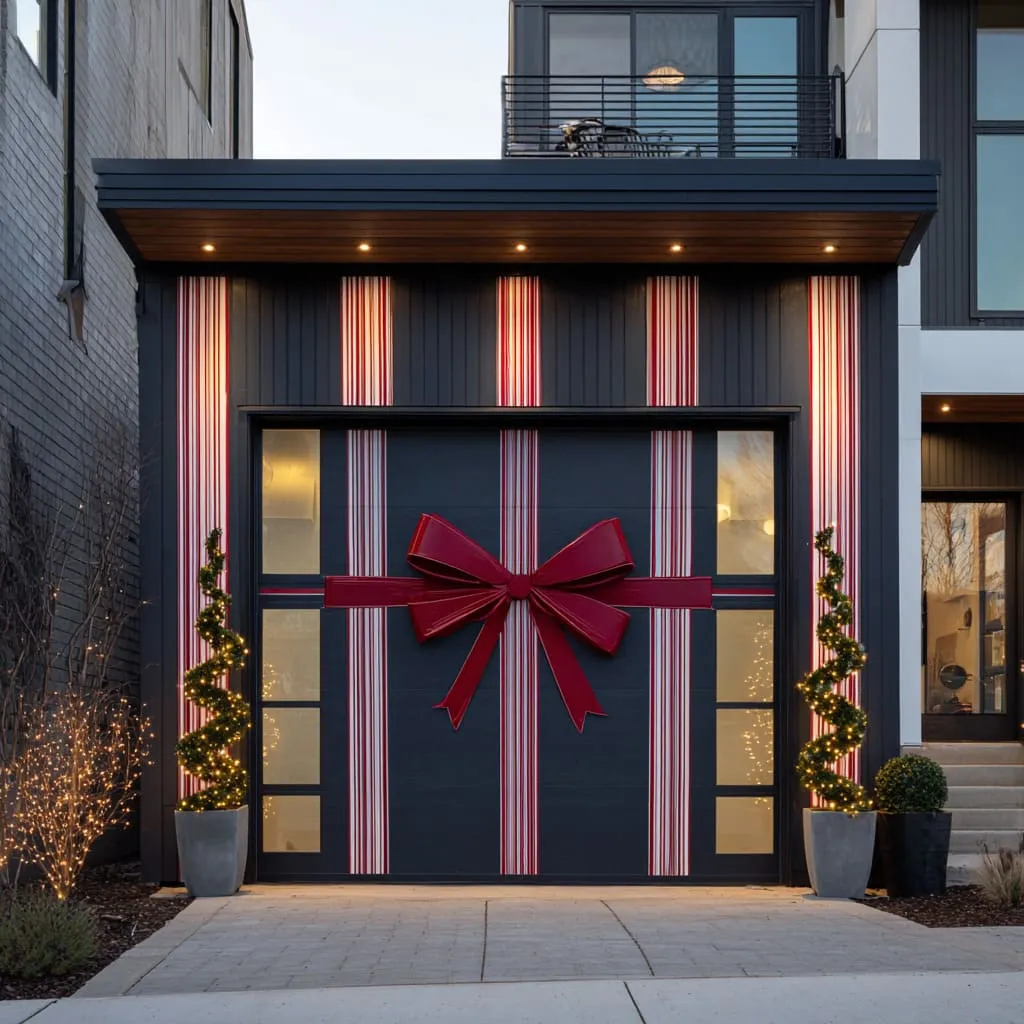
Here’s what nobody mentions in the inspiration photos: ribbon is basically a sail. On a 16-foot door you can catch 20-plus pounds of wind load in a gust, so use outdoor-rated hook-and-loop tape, not double-sided tape, and tether the bow to a thin plywood backing. Skip satin — sun and rain will spot it by January. Matte or grosgrain holds color far longer, and the illuminated topiaries flanking the door do double duty by visually framing all that red.
3. Black Garage Door with Glowing Snowflakes and Gold Garland
The formula is roughly 70% architectural black and white, 20% metallic ornament, 10% warm white light. Keep those percentages and you can swap the gold and bronze baubles for copper or brushed nickel without losing the mood, or trade the snowflakes for lit stars. What you can’t swap is the light temperature — everything here sits around 2700K to 3000K. Mix in a cool 5000K string and the gold instantly reads cheap next to it.
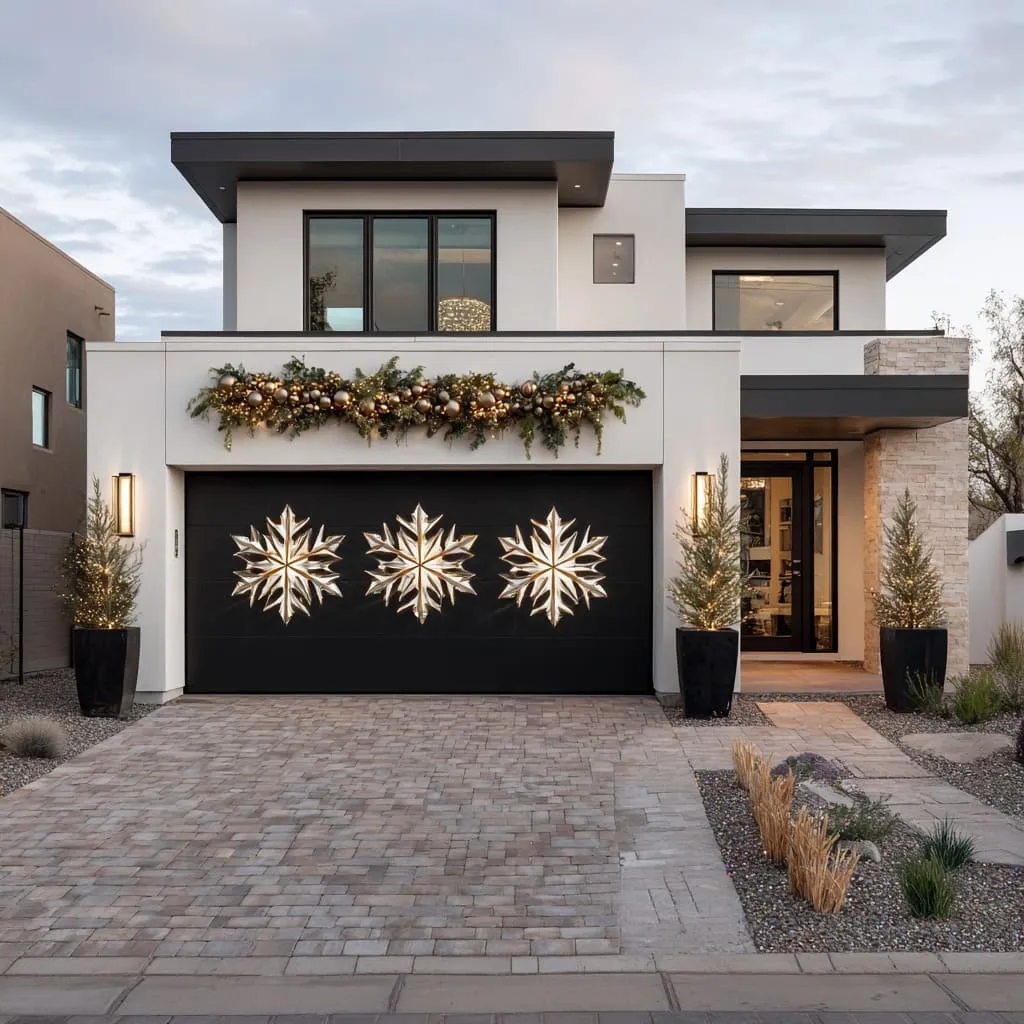
Size snowflakes in threes: 24-inch, 30-inch, and 36-inch, hung at door-center height with the largest in the middle, spaced 30 to 36 inches on center so the glow doesn’t merge into one blob. Use outdoor adhesive hooks rated for 5 pounds, then add a thin fishing-line safety tether to the door frame — snowflakes are the number one thing people find on their driveway after a windy night. For the evergreen garland above the door, plan on 100 warm white mini lights per 9 feet.
4. Beige Paneled Door with Black Hinge Straps and a Pergola
that makes this door look considered rather than builder-grade is the black hardware — the decorative hinge straps and the two pull handles. Take them off and you have a perfectly nice beige door that disappears. The black metal gives the eye somewhere to land, ties the dark wood pergola above to the door below, and picks up the deeper tones in the stone veneer to the left. If you’re painting existing hardware instead of replacing it, use a self-etching primer or the finish will chip by spring.
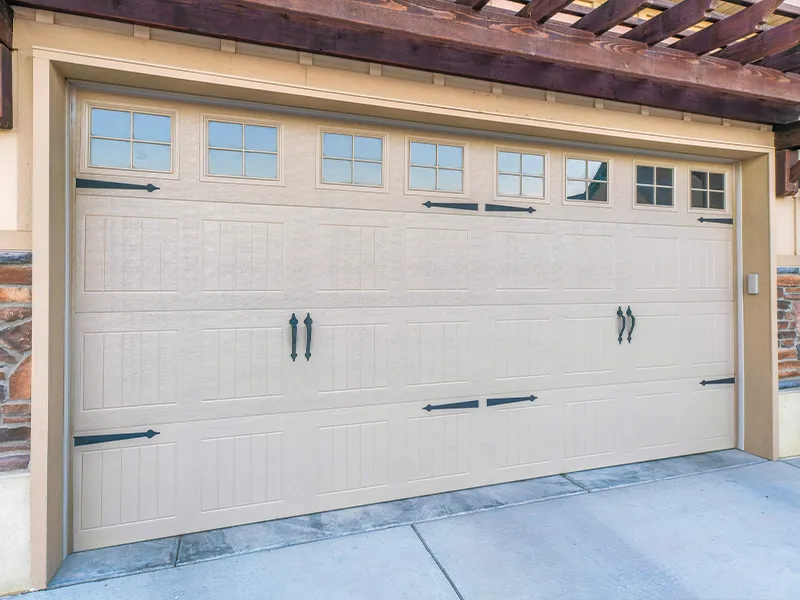
Painted steel doors want a fresh coat every five to seven years — sooner if the driveway gets direct afternoon sun, because heat cycling is what causes peeling, not rain. Black metal hardware shows hard-water spots from sprinklers, so wipe it down monthly. Keep hinges and the bottom seal lubricated with silicone spray each fall; a $6 can prevents the $400 hinge replacement nobody plans for. And those square grid windows up top mean nine panes of glass to clean per door.
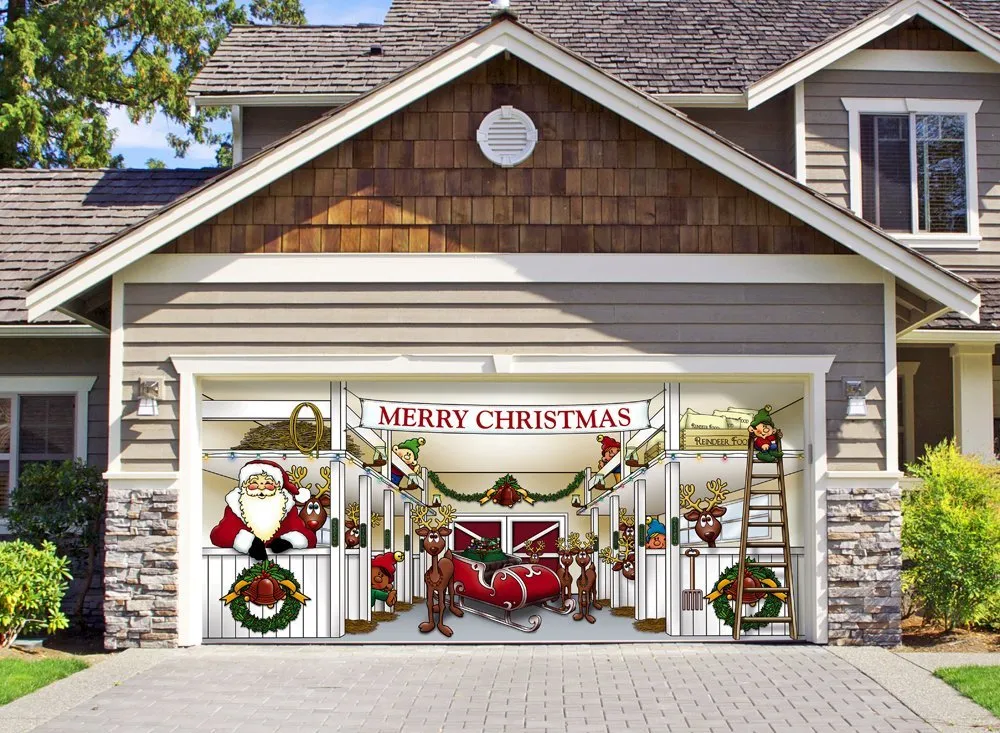
5. Personalized Elf Caricature Mural Across a Double Garage Door
Custom printed garage murals have moved from novelty to mainstream because printing costs collapsed — a full-color 16-by-7 banner that would have run $400 five years ago now lands closer to $100. The 2026 version of this is personalization: caricature versions of your own family, your dog, your last name in the corner under the “Happy Holidays” text. It’s a one-season wow rather than a permanent architectural choice, and that’s the honest tradeoff. If you redecorate every December anyway, it’s a great use of a hundred bucks.
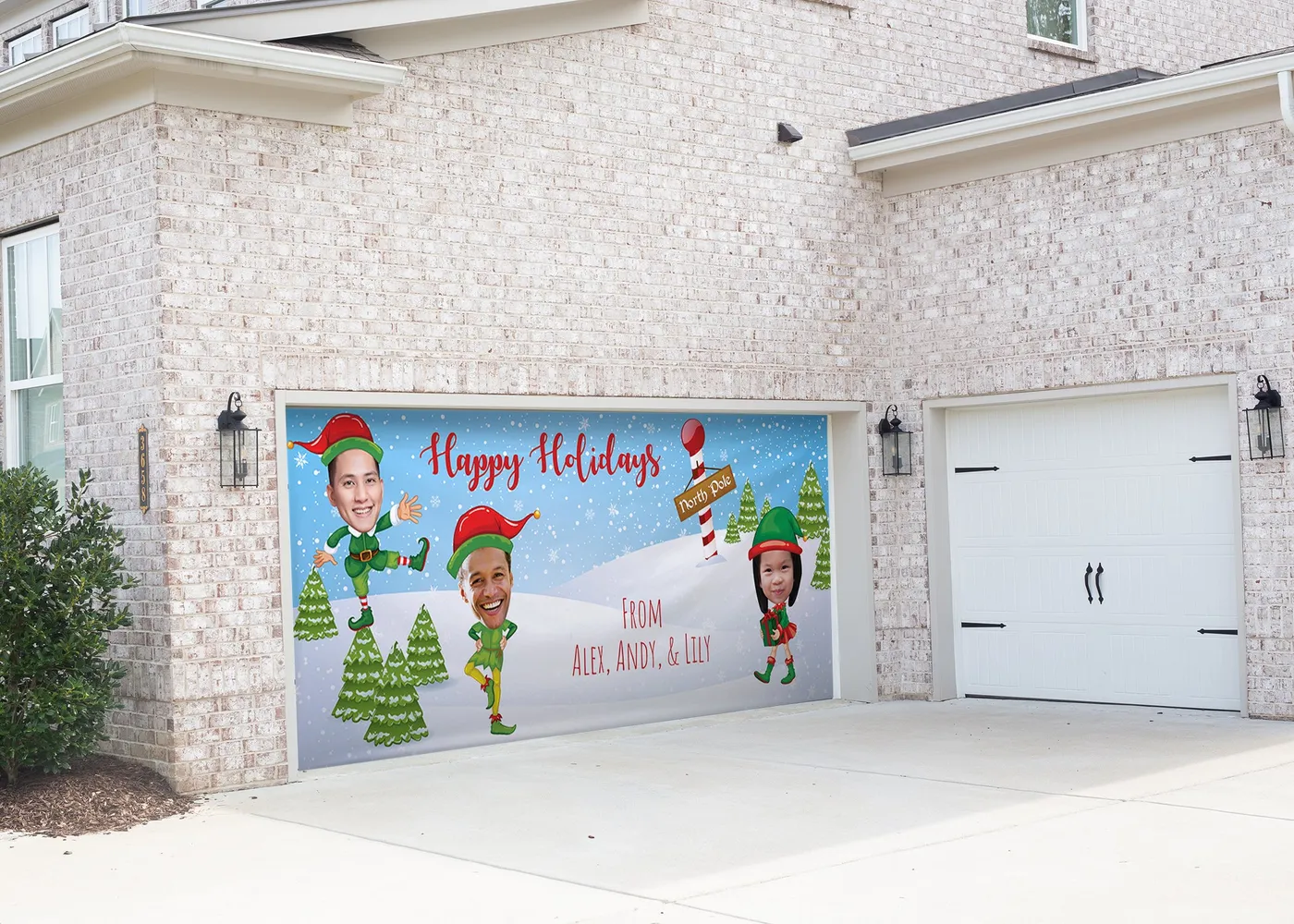
You don’t need a designer to get a mural like this. Here’s the cheap route:
- Commission a digital file on Etsy: $25–$60
- Print it as a grommeted vinyl banner at a local print shop: $60–$120 for 16 by 7 feet
- Choose mesh over solid vinyl if your door faces an open field — wind passes through instead of pulling
- Hang with bungee cords through the grommets, never tape
Total: roughly $85–$210 for a door-sized custom mural. Print shops also run holiday banner specials in early November, so ordering before Halloween usually saves 20%.
6. Cream and Sage Doors Framed by Conical Evergreens
The mix here is about 55% cream, 30% pale sage green, 10% black hardware, 5% evergreen. It’s a low-contrast palette on purpose — nothing shouts, everything agrees, which is why four doors in a row still look calm instead of busy. Want to shift it? Swap the green for a soft slate blue and keep the cream. Want more punch? Deepen the sage to olive and the same doors read distinctly traditional rather than coastal.
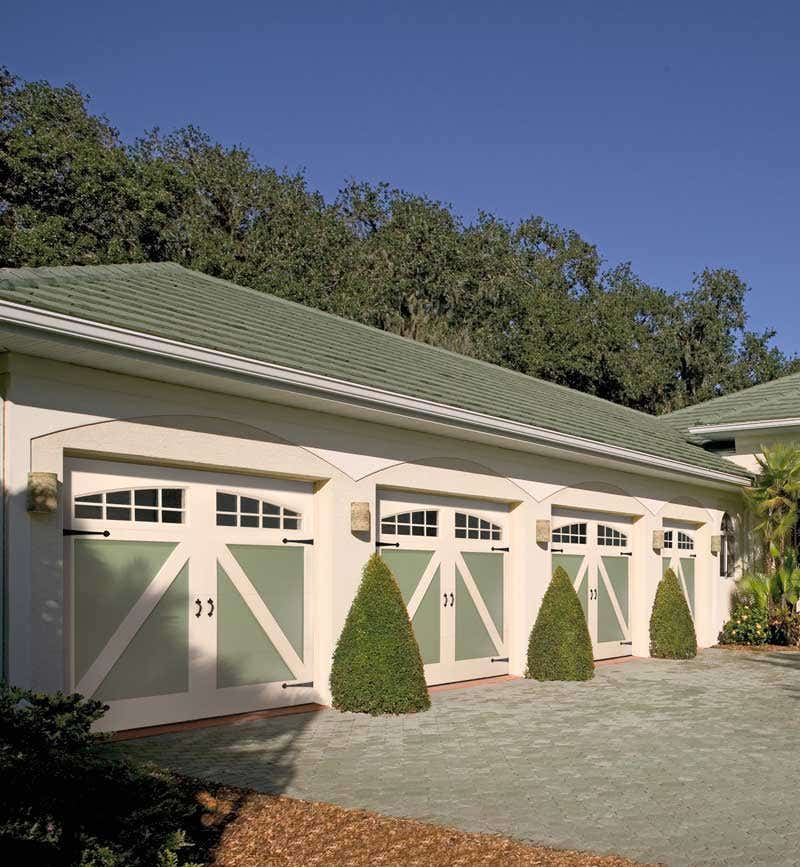
- Measure each door’s clear width and your driveway width — you need at least 30 inches of planting strip for conical shrubs
- Photograph the door color in daylight and again at dusk; green paint shifts dramatically under warm evening light
- Confirm your HOA allows a two-tone door before anyone opens a paint can
- Check whether the arched window grilles are real glass or vinyl inserts — it changes how the door gets masked and painted
7. Red Script Merry Christmas on a White Paneled Door
- Large “Merry Christmas” script decal: $18–$45
- Character decal set (Santa, snowman, tree, gingerbread): $12–$35
- Magnetic faux window panels, set of four: $40–$90
- Warm white spotlight aimed at the door: $35–$80
- Removal-safe adhesive and a felt-edge squeegee: $8–$20
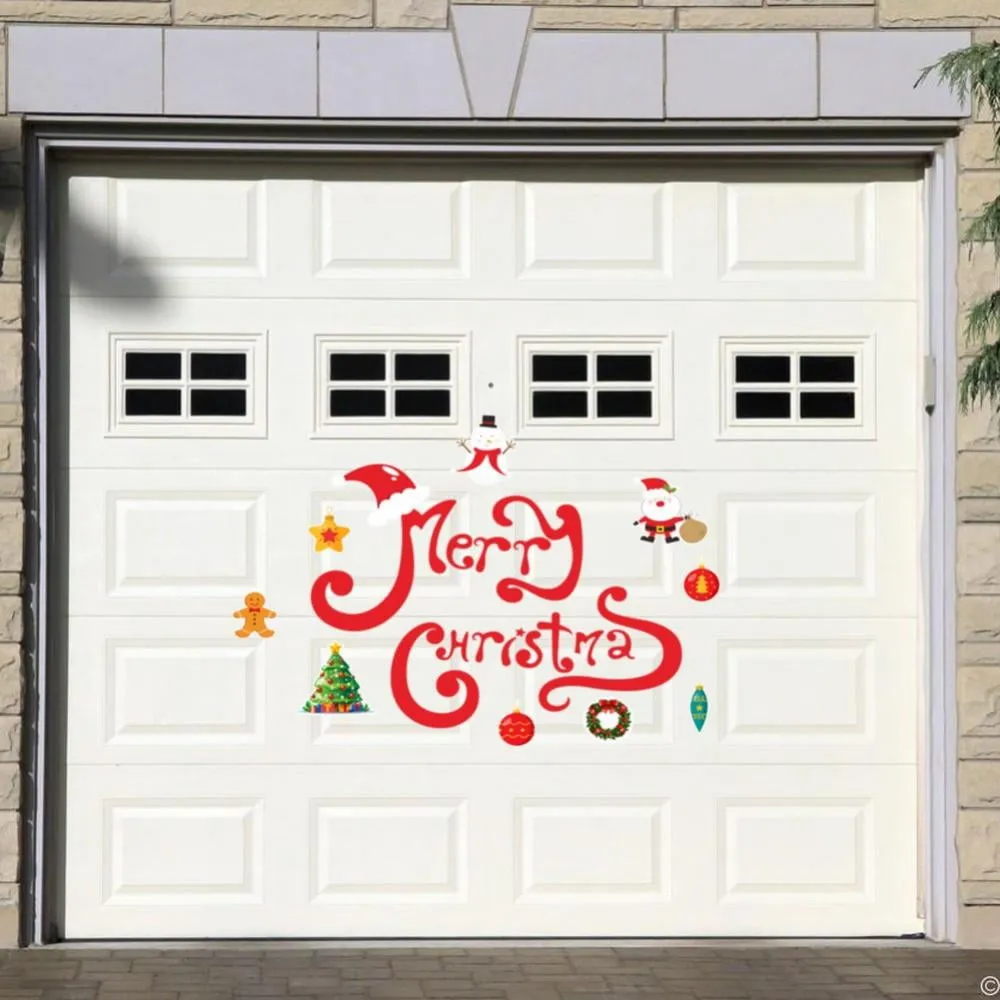
Total: $113–$270
That assumes a bare white door with nothing on it. Already own a spotlight and a ladder? Knock $50 off the top.
Here’s the honest store map. Walmart and Dollar Tree carry holiday cling multi-packs for $3–$8; the adhesive is mediocre, but a season is all you need. Etsy sellers cut a custom script in your exact door width for $20–$35, beating the $60 big-box version. Target’s magnetic faux window panels run about $25 for two versus $90 for architectural-grade. And if you own a Cricut, one $12 roll of outdoor vinyl covers the whole door and you’ll never buy decals again.
8. Olive Green Door with Cream Shingle Siding and Sconces
Olive green is doing something clever here: it’s dark enough to feel substantial, muted enough to sit beside cream shingle siding without fighting it, and warm enough that black sconces read as intentional rather than stark. The small rectangular windows along the top edge are the other quiet win — they break up a large flat panel and give the door a human scale. And the stone column bases anchor both sides, so the whole entry reads grounded instead of floating.
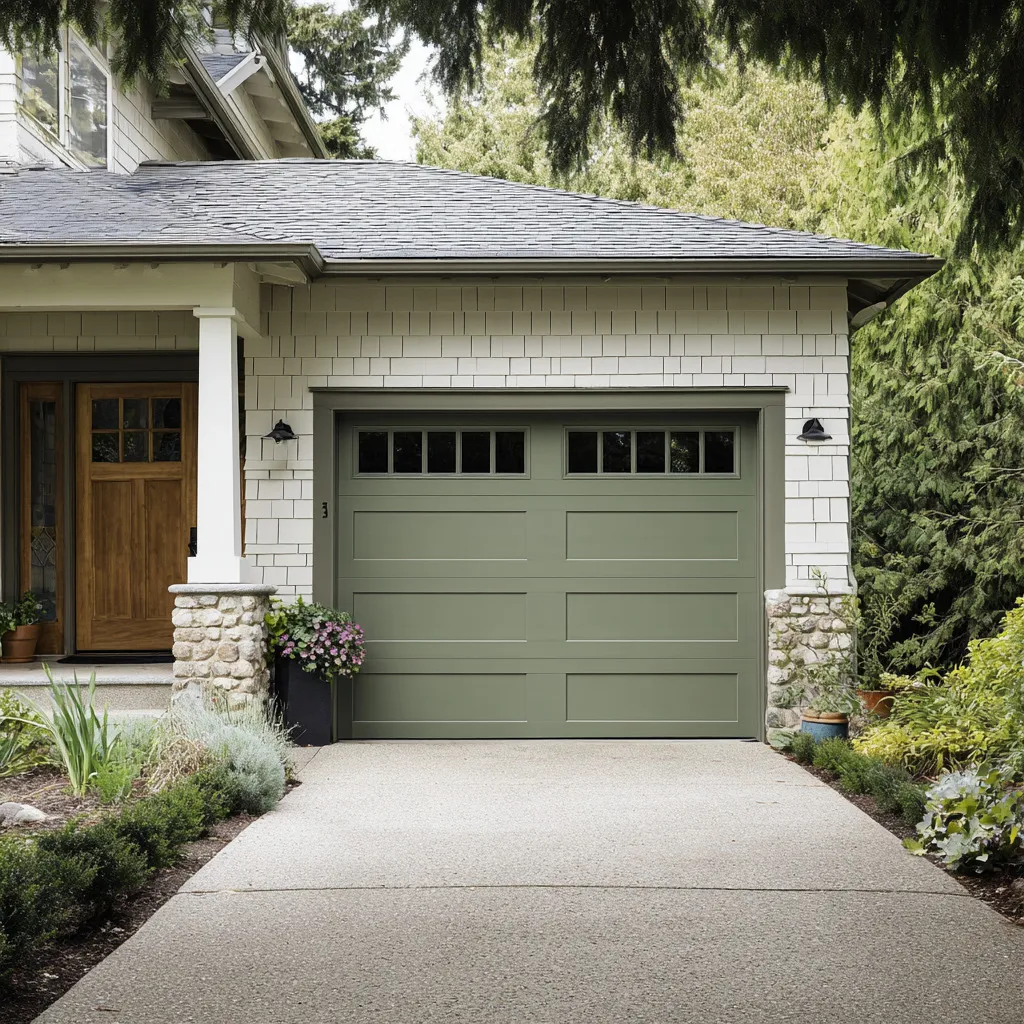
Match your wall sconces to the door’s proportions, not the house’s. Mount them roughly 66 inches to the center of the bulb, about 8 to 10 inches off each side of the door trim, and keep the fixture height between one-quarter and one-third of the door height. Then put 2700K bulbs in them. Sconces are the cheapest thing in this whole picture and the one most people get wrong, usually by going too small or too cool.
9. Warm White Rooflines and Gable Wreaths on a White Ranch
Hanging oversized wreaths on gables looks complicated; it’s a two-hour job.
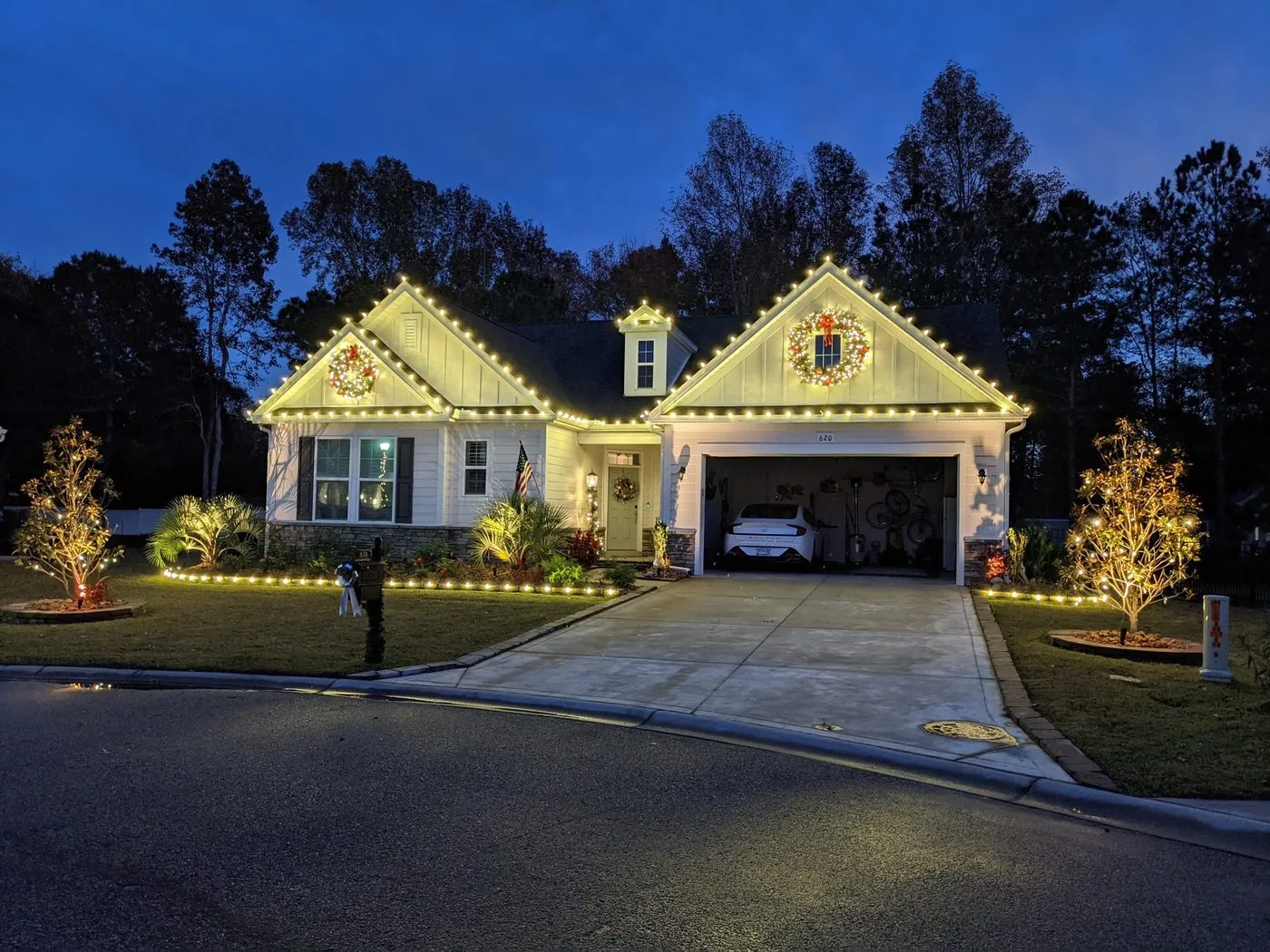
- Measure the gable width and pick a wreath one-quarter to one-third of it — usually 36 to 48 inches
- Screw a powder-coated cup hook into the fascia, not the siding
- Run monofilament from the wreath’s top wire up to the hook, leaving 4 to 6 inches of drop
- Add a second tie at the bottom rear so it can’t spin in the wind
- Zip-tie a battery pack to the back and set the timer for 6 p.m. to 11 p.m.
Materials: $25–$60. Time: about two hours for three wreaths with a helper.
This layout is happiest on a single-story home between roughly 1,200 and 2,200 square feet with a garage door up to 16 feet wide. Plan on about 1.2 feet of string light per linear foot of eave so you have slack for the dips. Facade longer than 40 feet? Split the run into two cords or you’ll get a visible voltage drop and the far end will look dim. Taller two-story homes do better with the layered approach in Idea #14.
10. Nativity Mural on a Dark Gray Board-and-Batten Garage
Faith-forward garage displays have grown quietly but steadily, and the reason is practical: a mural turns a blank 16-foot door into the focal point of the whole street for the price of a banner. Printers now offer religious artwork in the same template sizes as the novelty designs, so the barrier is gone. As for staying power — Nativity scenes are about as recession-proof as holiday decor gets. This isn’t a trend that will look dated in 2029.
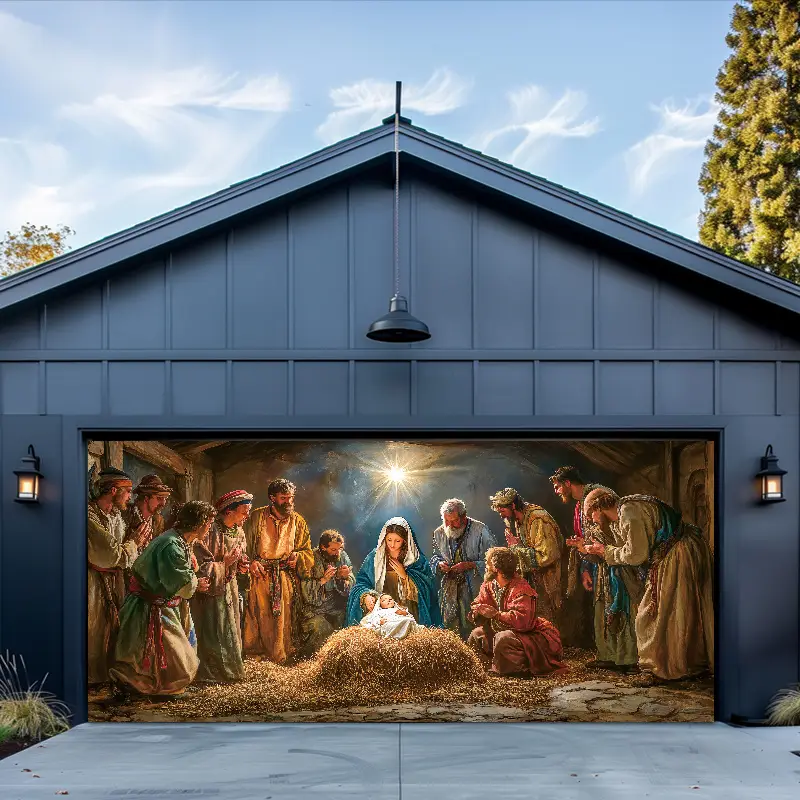
Two things to check before you order. First, HOA covenants: several associations have rules about religious displays on exterior structures, and it’s a miserable conversation to have in December. Second, sun exposure. Any printed banner facing south fades visibly in about two seasons. Mesh prints fade faster than solid vinyl but handle wind far better, which matters more on a large flat surface. Store it rolled, not folded, and you’ll get four or five years instead of two.
11. Icicle Lights, Lit Reindeer, and a Snowy Front Yard
- Count your gutter runs and buy icicle lights by the linear foot — 1.5 feet of strand per linear foot of gutter
- Clip the strand to the gutter’s front lip with plastic gutter clips every 18 inches
- Loop the excess at each corner rather than cutting, so you can reuse them next year
- Plug each run into a 15-amp outdoor timer, keeping connected watts under 1,400
- Set the reindeer 6 to 8 feet off the driveway edge and stake the antlers with two 12-inch ground stakes
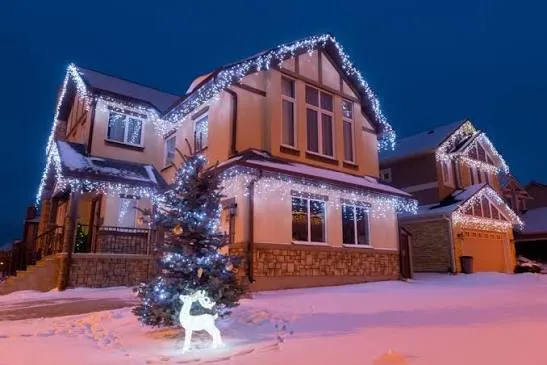
Total cost: $90–$220. Time: about three hours for a two-story roofline.
Icicle lights are the highest-maintenance decoration in this article, and it’s mostly a storage problem. Tangled strands fail at the wire, so coil each run around a piece of cut cardboard and label the length. Wipe the strands with a dry microfiber cloth before storing — road dust and spider webs love warm LEDs. Reindeer ornaments fade to a chalky white after two or three seasons outdoors, so store them inside, not in the garage rafters. Count on replacing roughly one string per year; that’s normal, not a defect.
12. HOHOHO Letter Decals Built from Holiday Shapes
The thing that makes this door work is that every letter of HOHOHO is a different holiday object — a gingerbread man, a donut, a wreath, a boot, a gift box. It’s a mismatch on purpose, and that’s the entire joke. Swap those for a matched set of uniform letters and you lose the charm; the door goes from playful to plain. So if you’re DIY-ing it, don’t hunt down a matching alphabet. Collect one letter at a time from different sets and lean into the chaos.
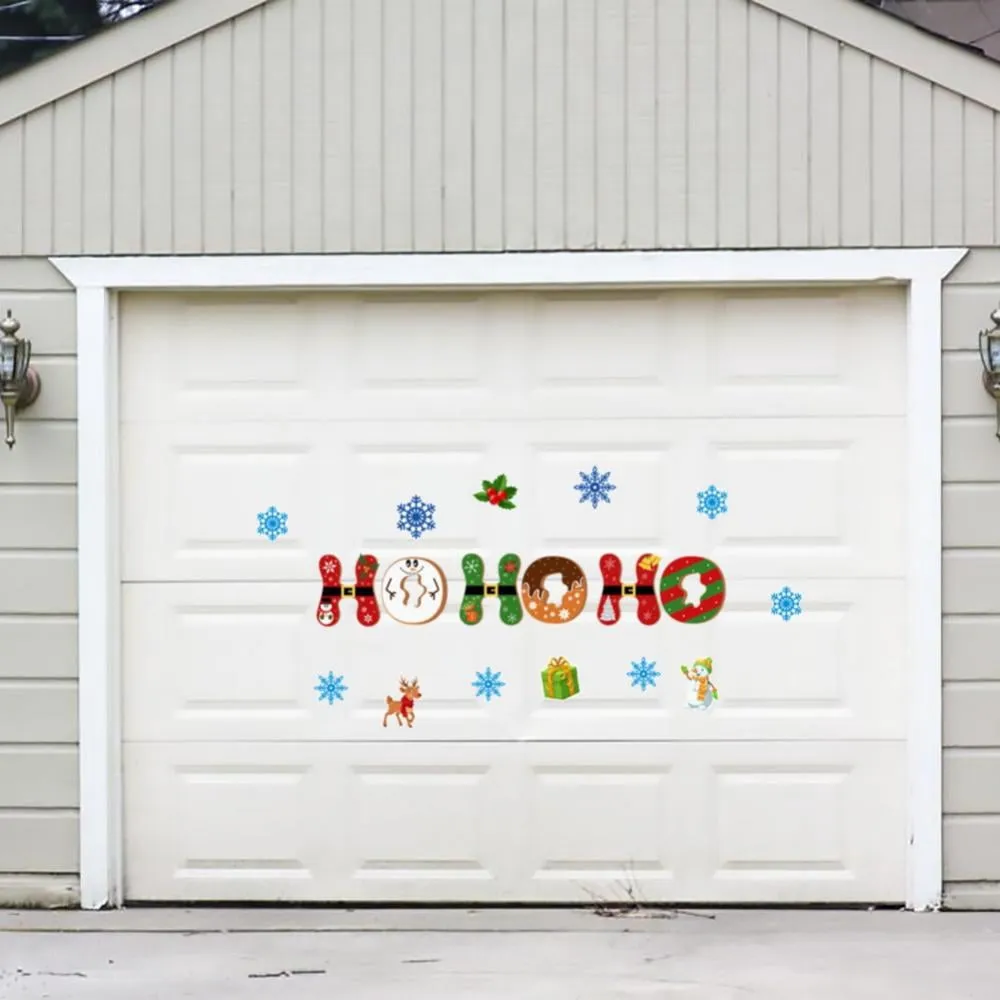
This is a $15 door, which is the whole point. Dollar Tree and Walmart multi-packs of holiday decals run $3–$8 and include letterforms, blue snowflakes, and small characters. The one upgrade worth making: peel-and-stick outdoor vinyl from Etsy for $12–$20, which holds color through rain while cheap clings go cloudy by mid-December. It’s a nice counterpoint to the printed mural in Idea #5 — same instinct, a tenth of the budget, and honestly more fun.
13. Gingerbread Letters Across a Ribbed Roll-Up Door
Ribbed roll-up doors are the diva of garage door decorating. The raised ribs mean a flat decal only touches about 60% of the surface, so the adhesive fails at the edges first. Use a removable low-tack formula and press it down with a felt-edge squeegee, working from the center out and bridging each rib rather than floating over it. Keep everything above the bottom two panels — the door needs those clear to seal against the weatherstripping. Nothing is sadder than a gingerbread house that got rolled up.
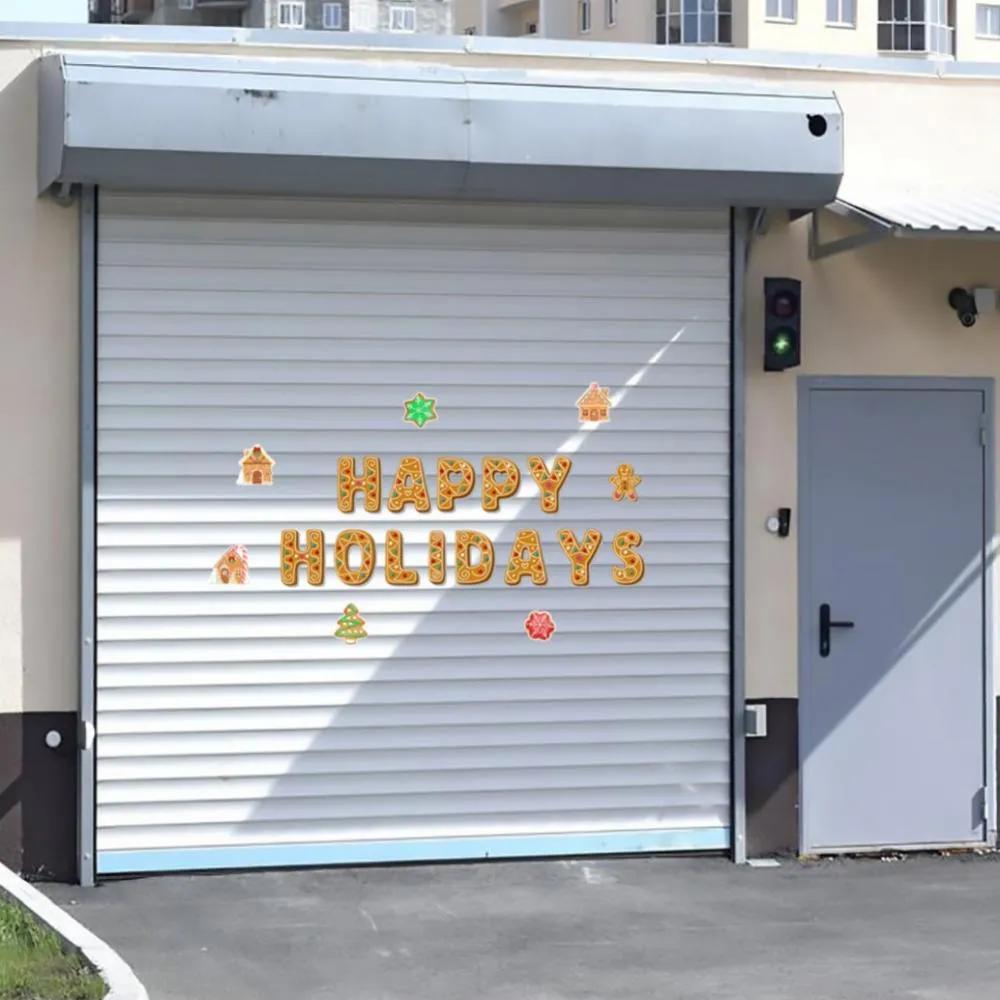
- Wash the door with warm water and a few drops of dish soap, then dry it completely
- Lay the lettering out on the driveway first and photograph it before anything touches the door
- Mark the centerline with painter’s tape so the message stays level
- Apply from the center outward, pressing each shape into the ribs
- Re-press every edge after 24 hours — that’s when lifting shows up
Cost: $20–$45 for a gingerbread letter set. Time: 60 to 90 minutes.
14. A Roofline-to-Lawn Light Display on a Snowy Suburban Home
A display this dense needs real square footage. As a rule, plan for one light-up element per 100 square feet of visible front yard, and keep at least 36 inches of walkway clear so delivery drivers aren’t navigating around a sleigh. If your roof edge is under 45 linear feet, this volume of decor crowds the house — a tighter roofline display like Idea #9 reads better. Working with 80 feet or more and a 25-foot setback? Go big. That’s the whole point.
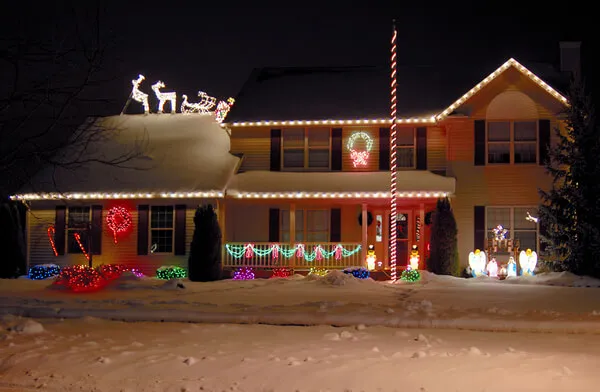
Split this into three dedicated circuits: roofline, yard figures, porch. A standard 15-amp outdoor circuit safely carries about 1,400 watts, so stay under 80% per run and use 14-gauge extension cords rather than the 16-gauge stuff that comes in the box. LED strings draw roughly 9.6 watts per 100 bulbs, which means you can run about 140 strings on one circuit — plenty of headroom. The real limit is always cords, never lights.
15. Red and White Roofline Lights Around a Wreath-Topped Garage
This is a strict two-color system: red and white, nothing else. The formula is 60% white string lights, 30% red, 10% greenery to keep it from feeling like a candy cane exploded. Because the palette is limited, the entire display reads as one composition from the street. Want to soften it? Swap the primary red for burgundy. Want more sparkle? Trade half the white minis for warm white and leave the rest crisp.
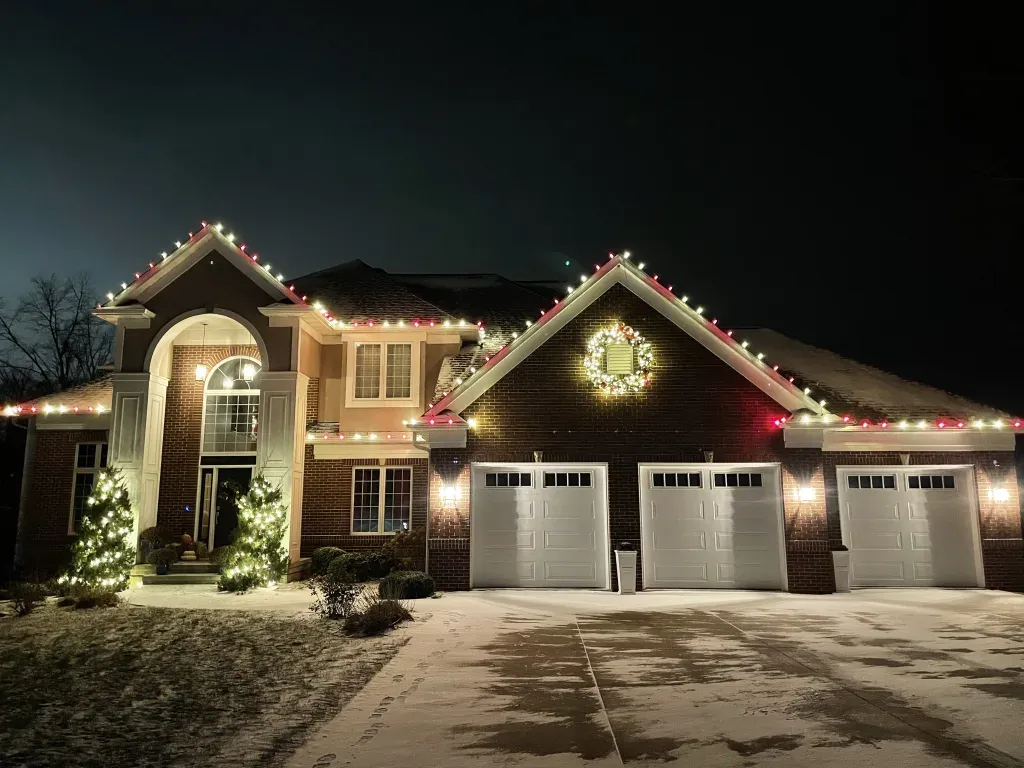
- Two-color roofline light sets, 150 ft total: $60–$140
- 36-inch pre-lit wreath: $70–$180
- Two lit conical trees, 4 ft: $80–$200
- Outdoor timer and 14-gauge extension cords: $35–$70
- Gutter clips and mounting hardware: $15–$35
Total: $260–$625
Late-November clearance on plain greens plus a $12 string of lights gets you most of the way there.
16. White Door Wrapped as a Gift Beneath a Lit Wreath
The illuminated wreath above the door carries this whole design. Without it, you’d have a nicely wrapped present and nothing else — the ribbon alone reads as a gift, not as a home. The wreath adds a second warm light source at eye level, pulls your gaze up from the door to the brick, and gives the composition a peak. Go bigger than feels reasonable: 36 inches minimum above a single door, 48 inches if you have the clearance.
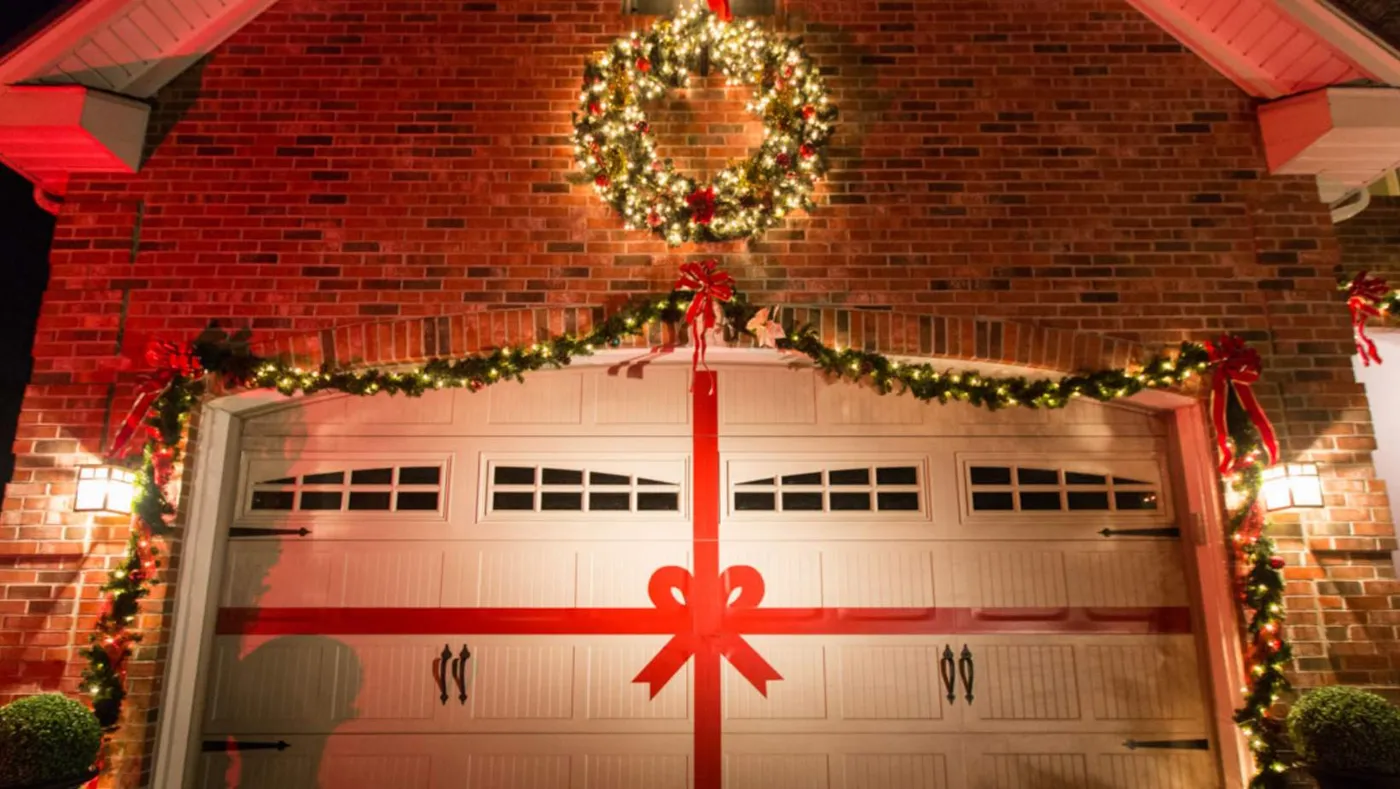
This works on standard eight-foot and nine-foot doors. On a 9-foot single door, a 10-inch-wide ribbon hits the sweet spot; on a 16-foot double door, go 14 to 18 inches wide or the ribbon looks like thread. Keep at least 18 inches of clearance above the door for the wreath, and hang it on brick with a masonry hook rated for 10 pounds — a wreath that size weighs 8 to 12 with lights. Compare with Idea #17 for a tighter, simpler version of the same trick.
17. Red Ribbon and Bow on a White Slatted Door
White is the best possible backdrop for a single saturated red, and this door uses that to maximum effect by keeping everything else out of the way. The horizontal slats do quiet work too — they echo the ribbon’s line, so the bow doesn’t look pasted on. And the warm string lights stop at the eaves instead of running down the walls, which keeps your eye moving across the facade rather than up and down. Restraint is the design here.
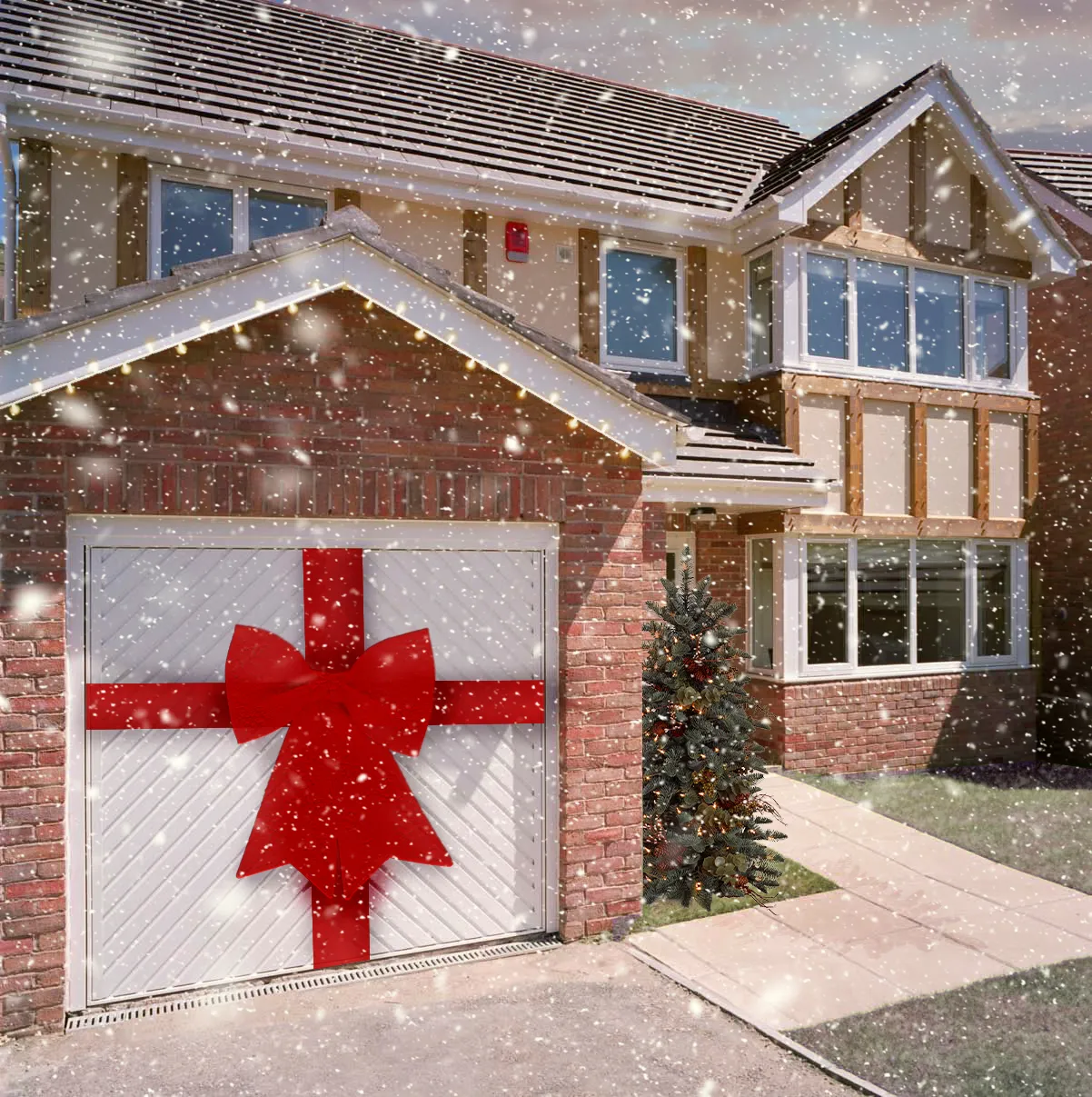
You can build this entire look for under $60. Wire-edge ribbon from a craft store runs $12–$25 for 25 feet, more than enough for one door. Make the bow yourself — 12 loops of 6-inch ribbon on a wire base, secured with floral wire — and it looks better than most store-bought versions. Warm white string lights are $15–$20 a strand in early November. A small pre-lit artificial tree from a thrift store, spray-painted matte white, fills the corner for about $10.
18. Rock-and-Roll Santa Banner with Two Reindeer
Humor-forward holiday decor has been the quiet breakout of the last three years — searches for funny Christmas decorations keep climbing, and garage banners are where it lands hardest, because a 16-foot door is the biggest canvas you own. A cartoon Santa in sunglasses throwing rock-and-roll hand gestures fits a broader shift: decorating as self-expression rather than obligation. Will it still be funny in 2030? Probably. But this is a two-to-three-season buy, not an heirloom.
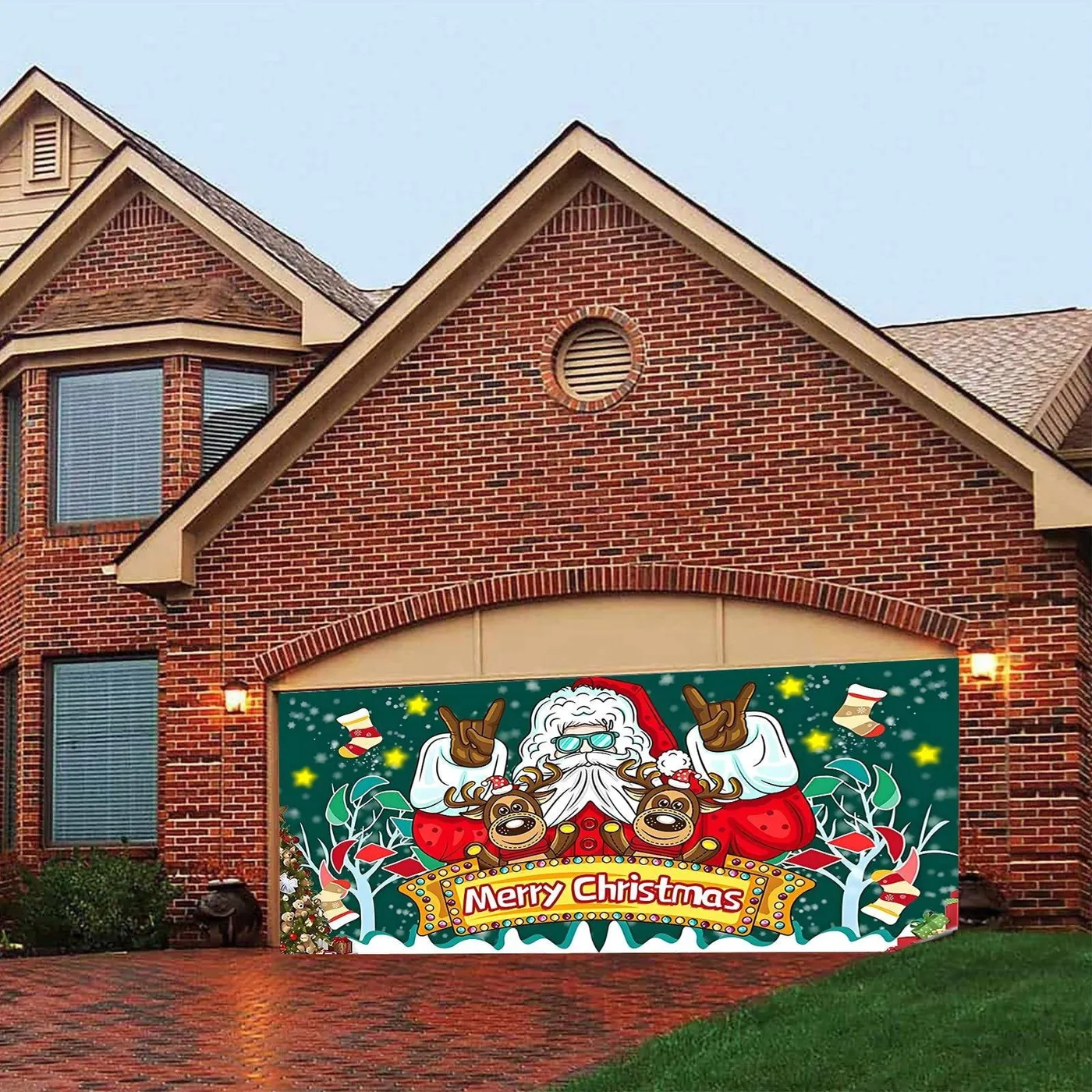
Three practical notes. Printed banners are wind sails, so order grommeted vinyl or mesh and hang it with bungee cords, never tape, or you’ll be chasing it down the street. Direct sun softens the ink within two seasons, so if your door faces south, budget for a replacement or store it indoors between Decembers. And check HOA rules on large printed signage — some associations treat a full-door banner differently than lights or wreaths. The mural in Idea #5 runs into the exact same three issues.
19. One Red Bow and Symmetrical Garland on a Beige Door
- Measure the door’s actual width and height — a bow should be about one-quarter of the door width
- Note whether your door surface is smooth steel or textured wood; garland hooks behave differently on each
- Confirm you have an outdoor-rated extension cord long enough to reach the nearest exterior outlet
- Decide up front whether this stays up through New Year’s — outdoor garland fades unevenly when half of it sits in shade
- Attach two adhesive hooks at the top corners of the door frame, not the door itself
- Drape the garland from the top-left hook, letting it sag about a third of the way down
- Secure the low point with a third hook so the swag holds shape in wind
- Wire the bow to the garland’s center with floral wire — never tape
- Thread red round ornaments through at roughly 10-inch intervals for even rhythm
Cost: $45–$120 for garland, bow, and ornaments. Time: about 45 minutes. Compare with the much louder inflatable version in Idea #22.
20. Warm White Outlines Across Three Wooden Lodge Doors
Warm white LED strings are the low-maintenance choice — roughly 90% less energy than incandescent and rated for 25,000 hours, about 15 seasons of December evenings. The fragile part is the connectors, so buy two extra strands as spares rather than replacing a whole run when one goes dark. The wooden doors underneath need resealing every two to three years; lights sitting wet against bare wood invite mildew along the bottom rail. Store the lit reindeer indoors — sun bleaches that white plastic into a sad grey in two seasons.
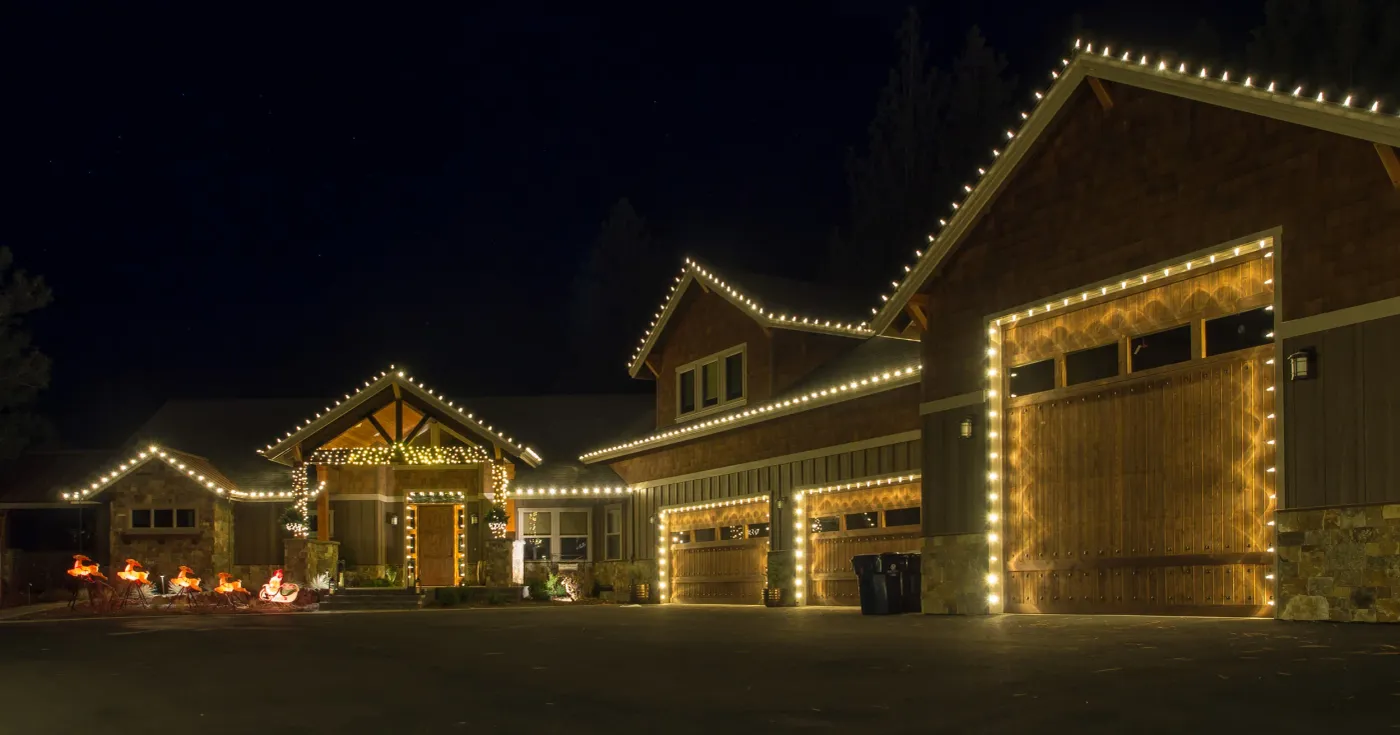
Lodge and craftsman facades usually run large — 3,000 square feet and up, with three garage bays and generous eave lines. That’s an advantage here, because warm white outlines need distance to read as a single glow. Measure your total roofline, gable edges, and door perimeters and add them together; that’s the footage you’re buying, often 200 feet or more. Under 120 feet total, a simpler outline like Idea #11 looks more intentional than a partial version of this.
21. Red and Green Lights Framing Two Dark Gray Doors
Red and green together can go Christmas-card fast, so the trick is proportion: roughly 45% red, 35% green, 20% unlit darkness. That last 20% is what makes it look designed rather than just glowing. The stacked stone accents and light gray siding provide the neutral that keeps both colors from vibrating. Want to update it? Trade the primary red for a deep berry and the green for a blue-green, and the same formula reads decidedly more current.
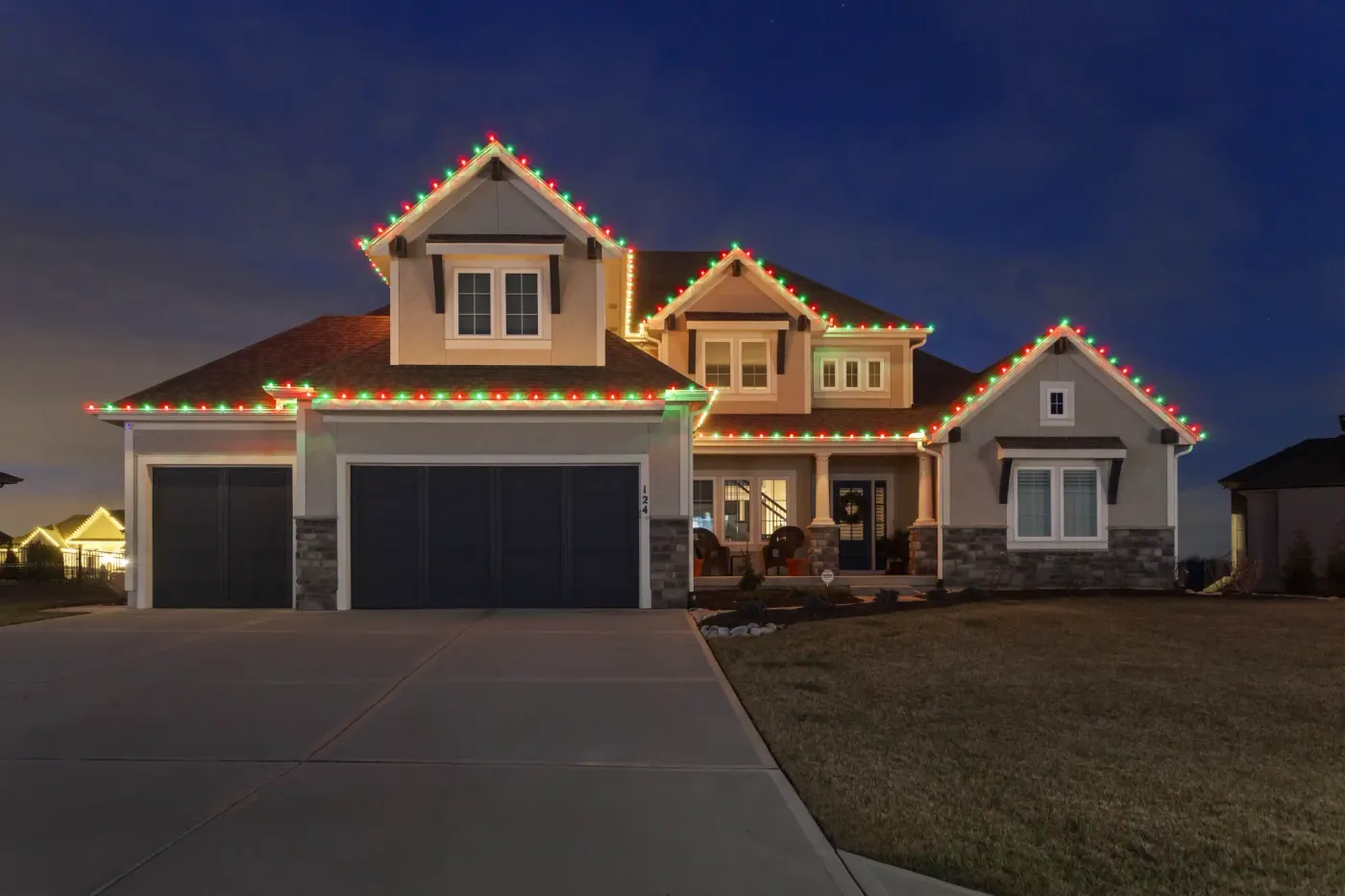
Two-color roofline lighting lives or dies on equal spacing. Skip the clips that come in the box and use gutter clips set every 16 to 18 inches — closer than that and the cord sags between them, wider and you get a scalloped look you didn’t plan. Alternate red and green in a repeating two-and-two pattern rather than one-for-one; a single alternation reads as flickering from 40 feet away. It’s the same discipline that makes the all-white version in Idea #9 look expensive.
22. Candy Cane Arch, Garland, and Inflatables on a Beige Door
- Green garland with red bows, 20 ft: $35–$80
- Candy cane inflatables, set of two: $50–$130
- Inflatable Santa, 6 to 8 ft: $60–$150
- Red and white striped arch kit: $45–$110
- Inflatable Christmas tree, 7 ft: $70–$160
- Ground stakes and a blower-rated outdoor timer: $20–$40
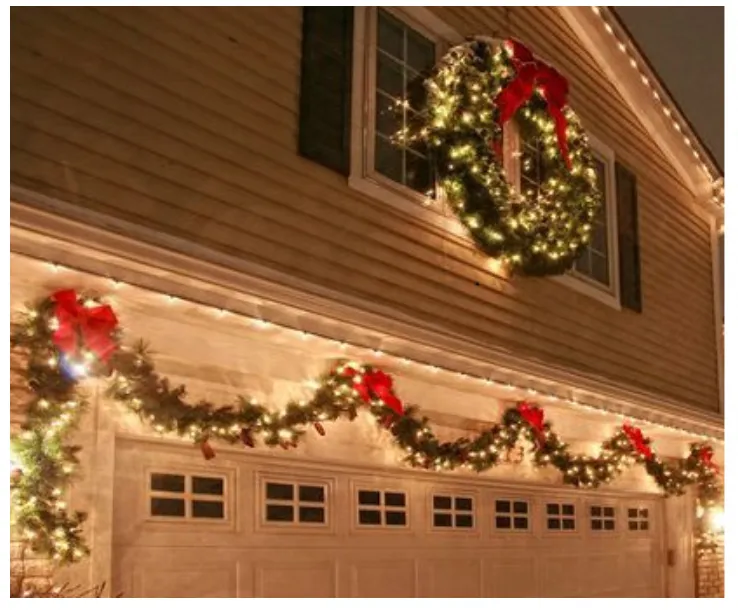
Total: $280–$670
The candy cane is what ties this together — it’s the only motif appearing three times: on the door panels, in the arch above, and echoed in the red bows strung along the garland. That repetition is what makes a pile of inflatables read as a set instead of a yard sale. Building this on a budget? Buy the arch first. It frames the door, and once the arch is up, everything you add afterward looks deliberate.
Make the Whole Street Slow Down
You don’t need the biggest display on the block — you need one decision you’re confident about, whether that’s a matte red ribbon that photographs like a magazine cover or a $15 set of decals your kids picked out. Start with the door, because it’s the largest, cheapest surface you own and the one everybody actually sees. 📌 Pin this guide to your Christmas board now — next November you’ll be glad you didn’t have to start from scratch.