
All-red Christmas trees are having a serious moment on Pinterest right now, and 2026 is the year the look finally grew up. Gone is the pile of identical crimson baubles — this year it’s velvet ribbon, felt pom-poms, flocked branches, red pipe-cleaner needles, and a whole lot of restraint.
We spent real time browsing Etsy, Target, Wayfair, Amazon, and Pottery Barn to bring you only what’s worth your attention this year — everything from $12 felt ornaments to $1,400 pre-lit showpieces. Below you’ll find 31 curated ideas, from timber-lodge rustic reds to marble-floor opulence, plus budget and luxury versions of the same look compared side by side. Every idea is shoppable, with direct product links.
Why now? Shoppers are moving away from multicolor and toward single-hue trees, and red is the one color that photographs well in a rental apartment, a century-old farmhouse, and a charcoal-walled loft alike. And stay until the end — we break down the most common mistakes that can ruin these looks.
📌 Save this to Pinterest for later — you’ll want to revisit these ideas.
1. A Red Pre-Lit Tree Anchors a Gray-and-White Living Room
What makes a red tree work in a neutral room is restraint everywhere else. The white painted fireplace with gray brick detail, the white sofa, the dark gray coffee tables — none of them compete. That leaves the tree, the red berry and pinecone wreath, and the red-and-gray patterned pillows doing all the talking. Even the gifts are wrapped in red and white only, so the color at floor level echoes the tree instead of introducing a new one.
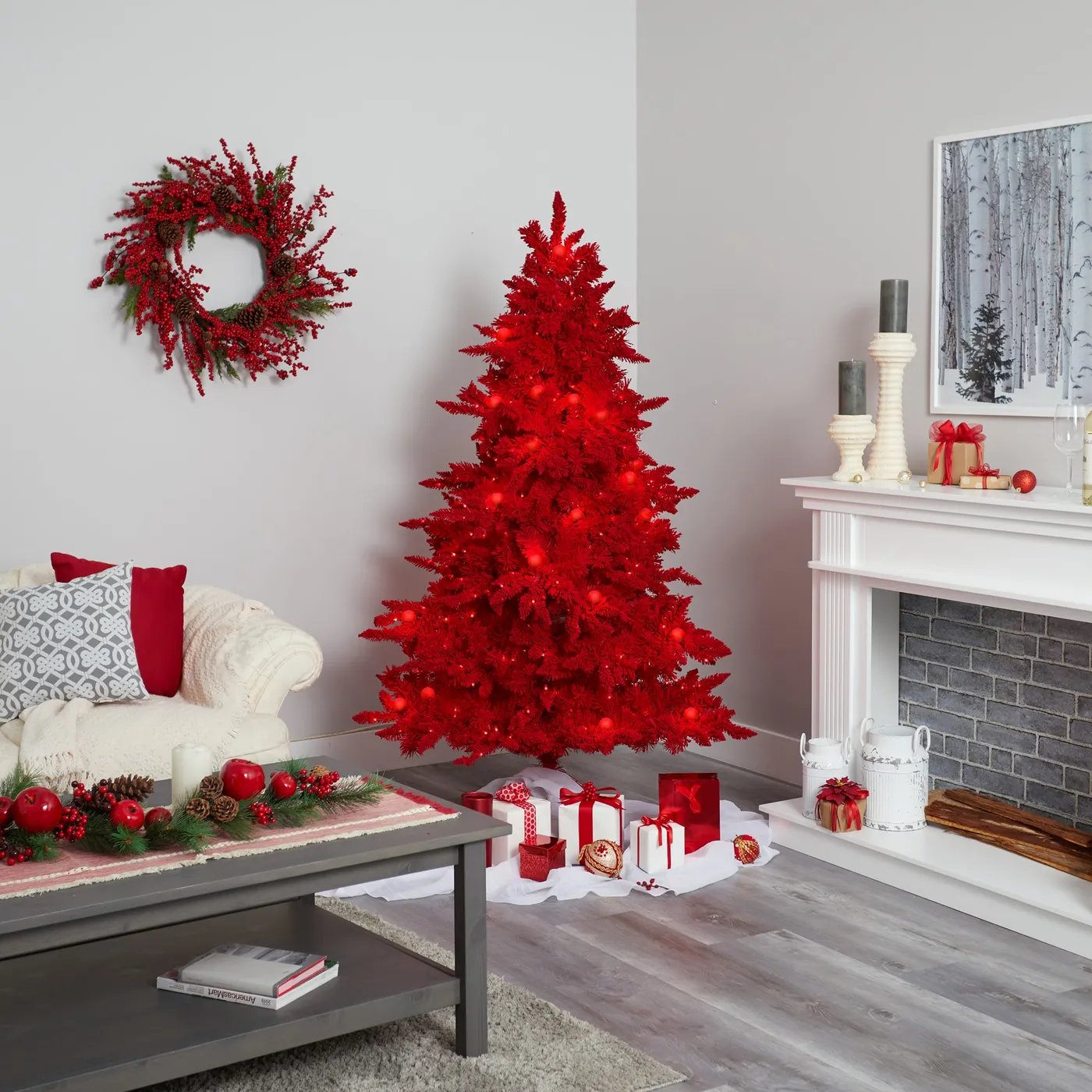
This arrangement wants roughly a 12-by-14-foot living room and ceilings at least 8 feet tall — the tree reads best with 6 to 10 inches of air above the topper. Keep 30 inches between the branches and the coffee table so nobody’s shin finds a branch in December. Smaller spaces should skip ahead to Idea #8, where a medium red tree hugs a dark corner wall without taking over the room.
2. DIY Felt Ball Cone Trees Topped With Soft Yellow Stars
These checkerboard cone trees are a weekend-afternoon project, not a month-long one. The short version:
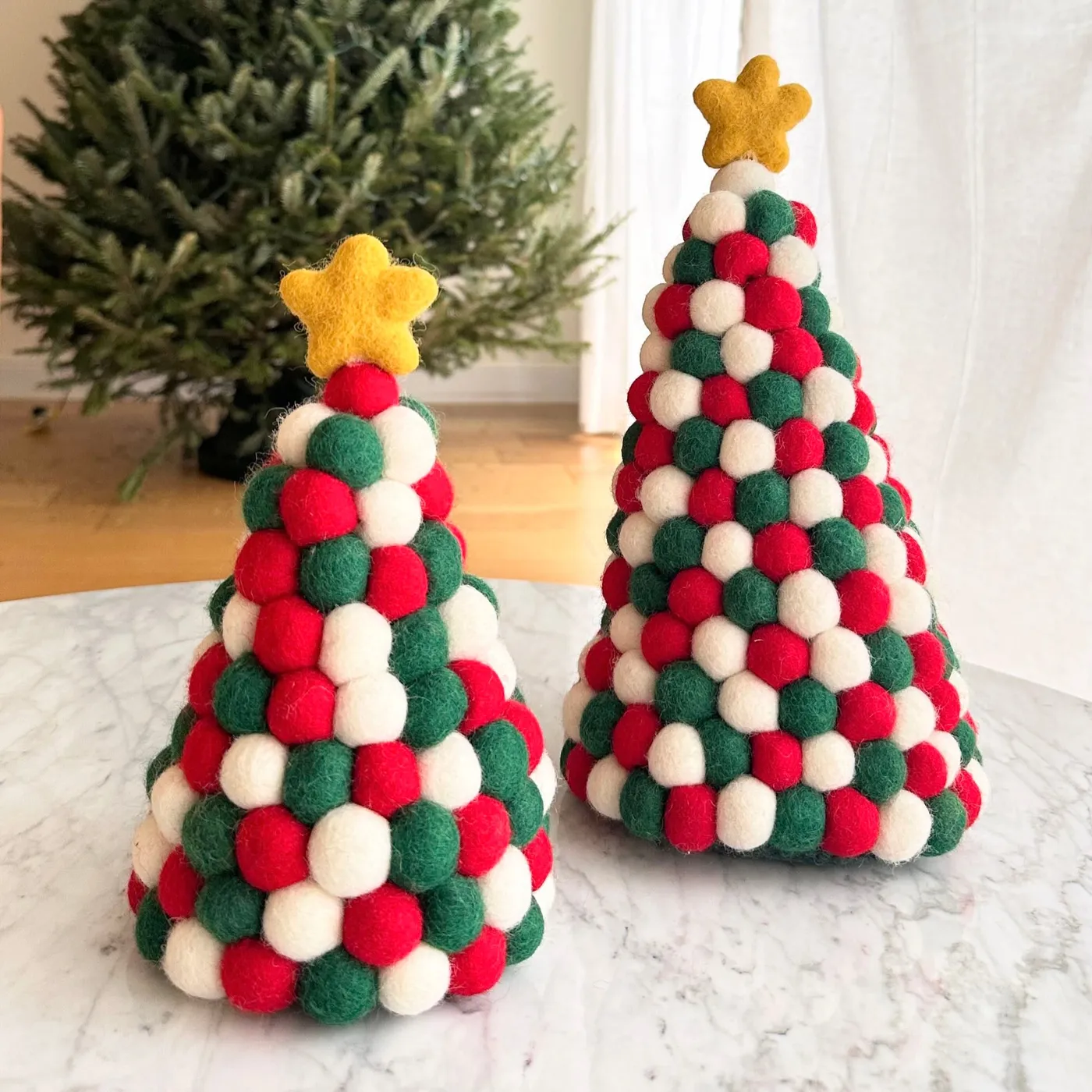
- Cut two cones — 10 and 14 inches. Two different heights read better than a matched pair.
- Sort felt balls by size: large at the base, medium through the middle, smallest near the tip.
- Hot-glue in a strict checkerboard of red, white, green. The pattern is what makes it look deliberate.
- Top each cone with a yellow felt star and press for 10 seconds.
Time: about 2 hours. Materials: $18–$28 for both trees if you buy felt balls in bulk.
Match the star to the ball size or you’ll get the lollipop problem — an oversized star perched on a slim cone looks like a hat. Keep the star no wider than a third of the cone’s base diameter. And if these are headed for marble or a polished console, glue a felt pad underneath; felt balls slide, and a scratched marble top costs more than the entire project.
3. Red Flocked Trees With Oversized Velvet Ornaments and Poinsettias
Rough numbers to recreate this red-flocked display:
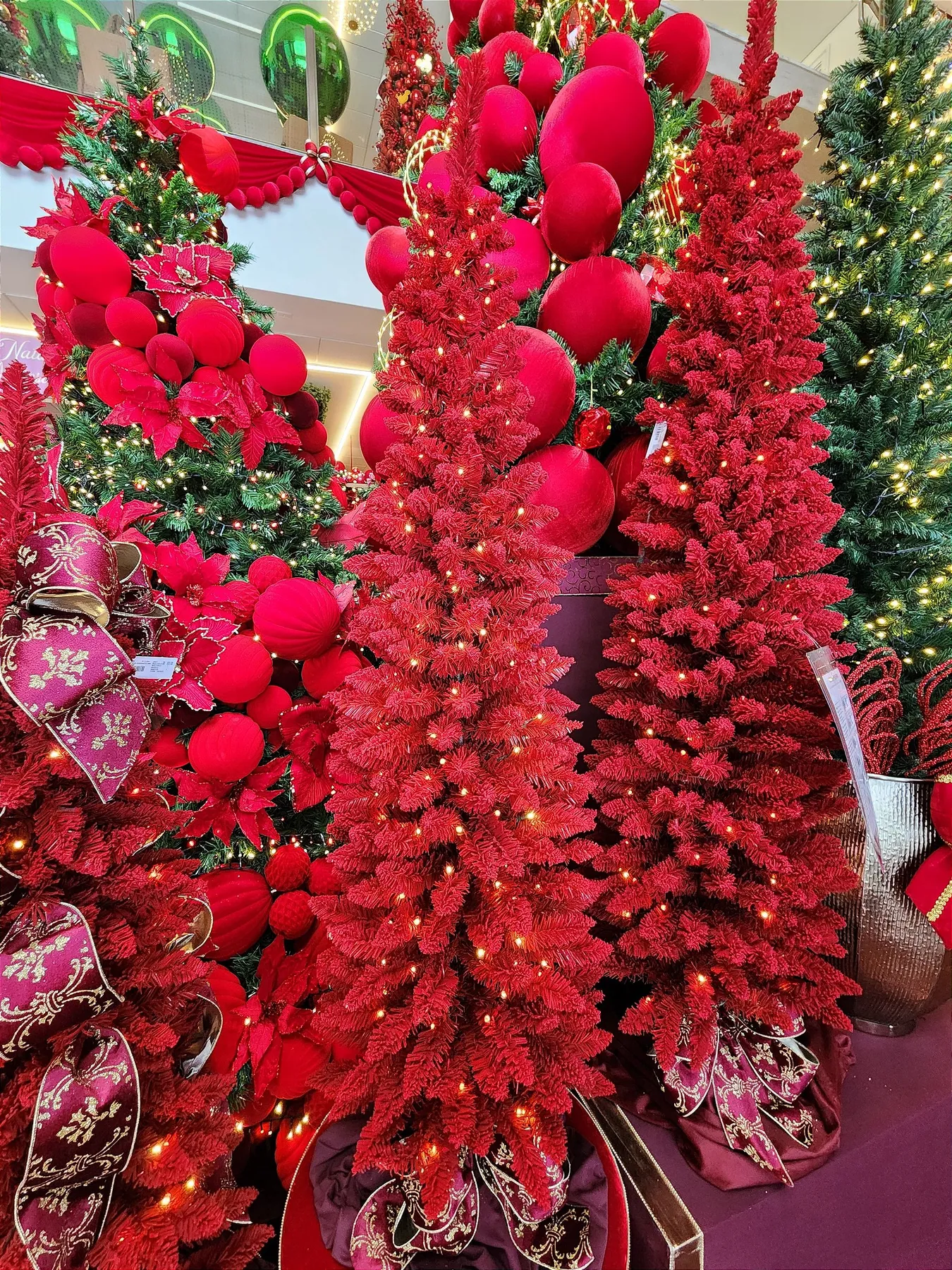
- Red flocked 7.5-ft tree: $300–$700
- Oversized red velvet ornaments (set of 12): $60–$140
- Red poinsettia picks (12): $30–$70
- Burgundy-and-gold patterned ribbon (2 rolls): $24–$48
- Warm white string lights (600 ct): $25–$45
Total: $439–$1,003
Budget alternative: keep a standard green tree, add a red light strand, and use the same velvet ornaments. You land within about 55% of the look for far less.
The oversized velvet ornament is the whole reason this reads as luxurious instead of craft-store. Big red velvet spheres — five to six inches across — hold their own against flocked branches in a way a hundred small baubles never will. Lose them and you’re left with a red-dusted tree. Keep them and everything else just supports the act.
4. Warm White Lights and Red Velvet Ornaments by a Black-Insert Fireplace
Cluster ornaments in odd numbers at three depths: one near the trunk, one mid-branch, one at the tip. Three deep and five wide, and you’ll never see a bare patch. Hang the biggest pieces in the bottom third — it visually weights the tree and keeps the top from looking top-heavy. And skip the ornament hooks on the small stuff; a loop of florist wire lets you angle each bauble instead of letting it dangle flat.
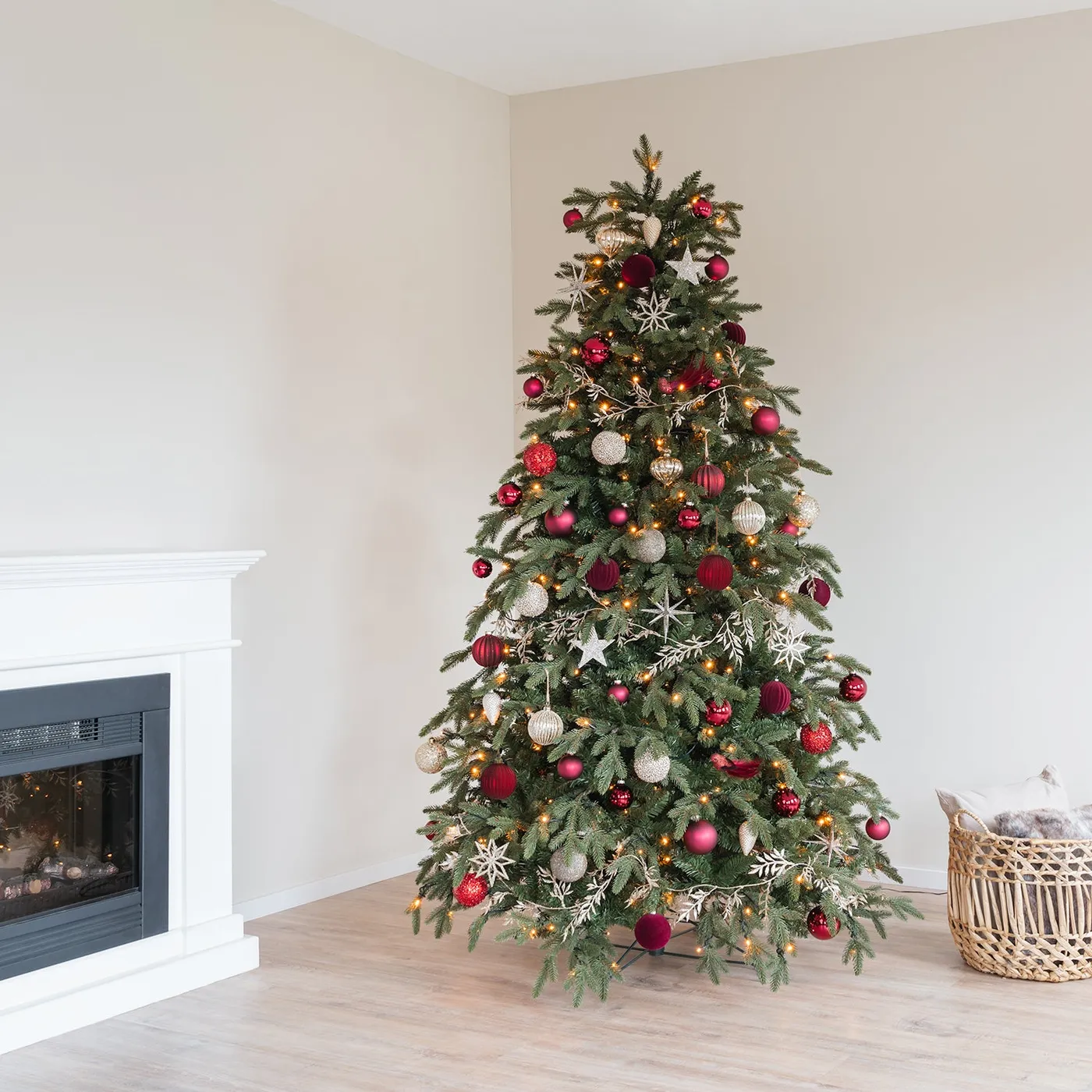
The mix here is roughly 60% green foliage, 25% deep red, and 15% metallic silver and gold. That ratio is exactly why it still reads as a green tree with red on it rather than a red tree. Swap the silver for copper and the whole thing warms up. Swap it for bright gold and it turns dressier. The 60% green base is non-negotiable — drop below half and the red starts to feel like a warning sign.
5. Flocked Branches and Red Bows Beside a Diamond-Paned Arched Window
What makes this corner work is the flocked white dusting set against genuinely dark architecture — an arched window with diamond panes, a dark wooden bookcase stacked with books. The red bows and baubles are the only saturated color in the frame, so they pop without shouting. The white-and-red snowflake throw on the chair ties the tree back into the room, which is why nothing here feels like a store display.
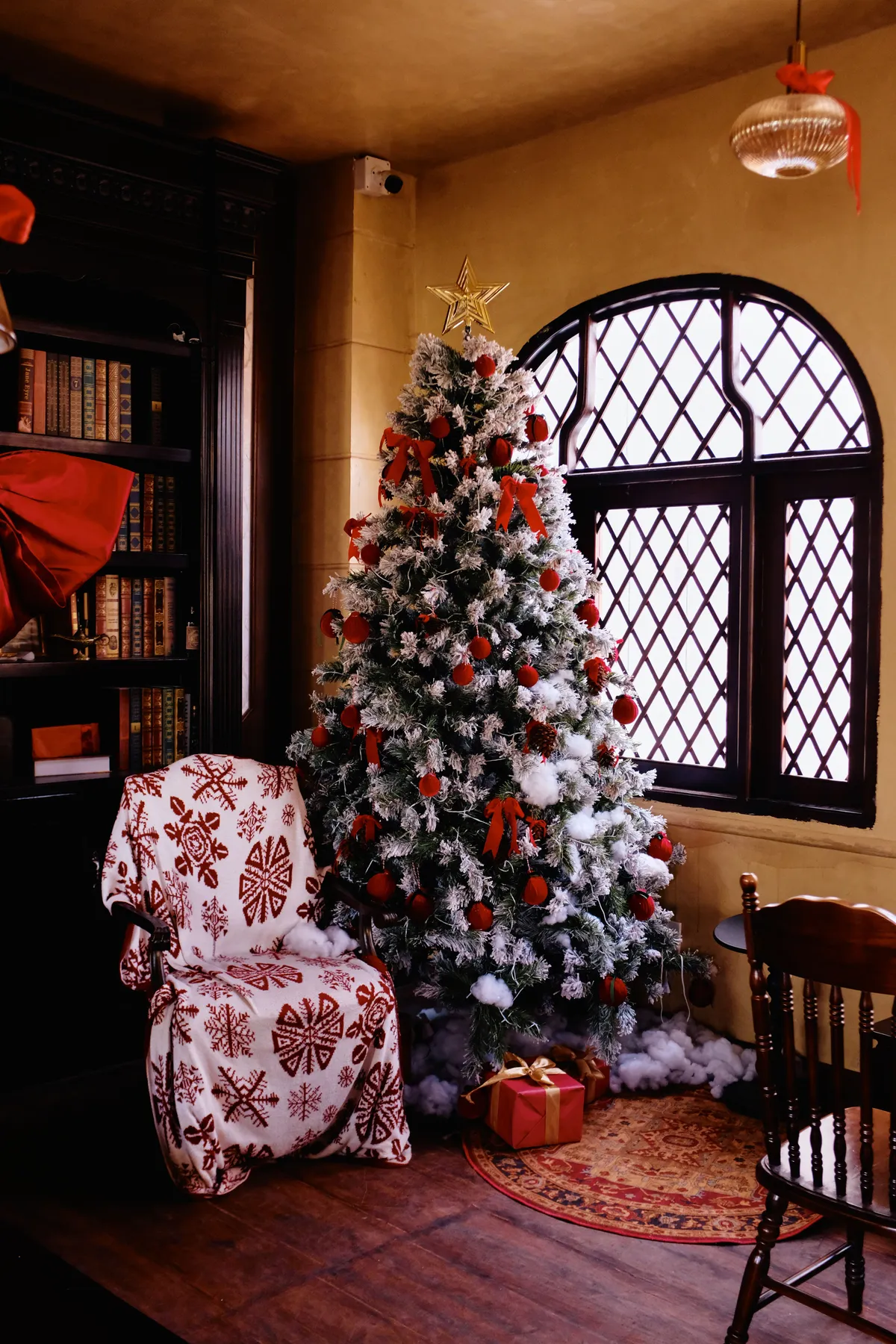
Flocked trees with an arch behind them usually need a 9-foot ceiling and about 5 feet of width to look intentional. If your window is shorter than the tree, center the tree on the arch, not on the room — the eye follows the curve. Working with a 7-foot ceiling? The felt ball tabletop trees in Idea #2 give you the same vintage warmth minus the height problem.
Flocked trees with visible white tips and warm gold light have been the most-saved holiday look two winters running, and the reason is camera-friendly: flocking catches light better than anything else in the room. It also hides thin patches in an older artificial tree. That workaround quality is why this one will outlive its trend cycle.
6. A Pink Felt Pom-Pom Tabletop Tree You Can Build for Under $40
You don’t need a $150 boutique piece for this. Two hundred felt balls in mixed pink shades from a craft supplier runs about $20, a styrofoam cone is $6, and a hot glue gun is $12 if you don’t already own one. Total: under $40. Skip the specialty pom-pom maker entirely — hand-rolled balls in slightly uneven sizes look more homemade, not less, and a yellow felt star cut from a single sheet costs about fifty cents.
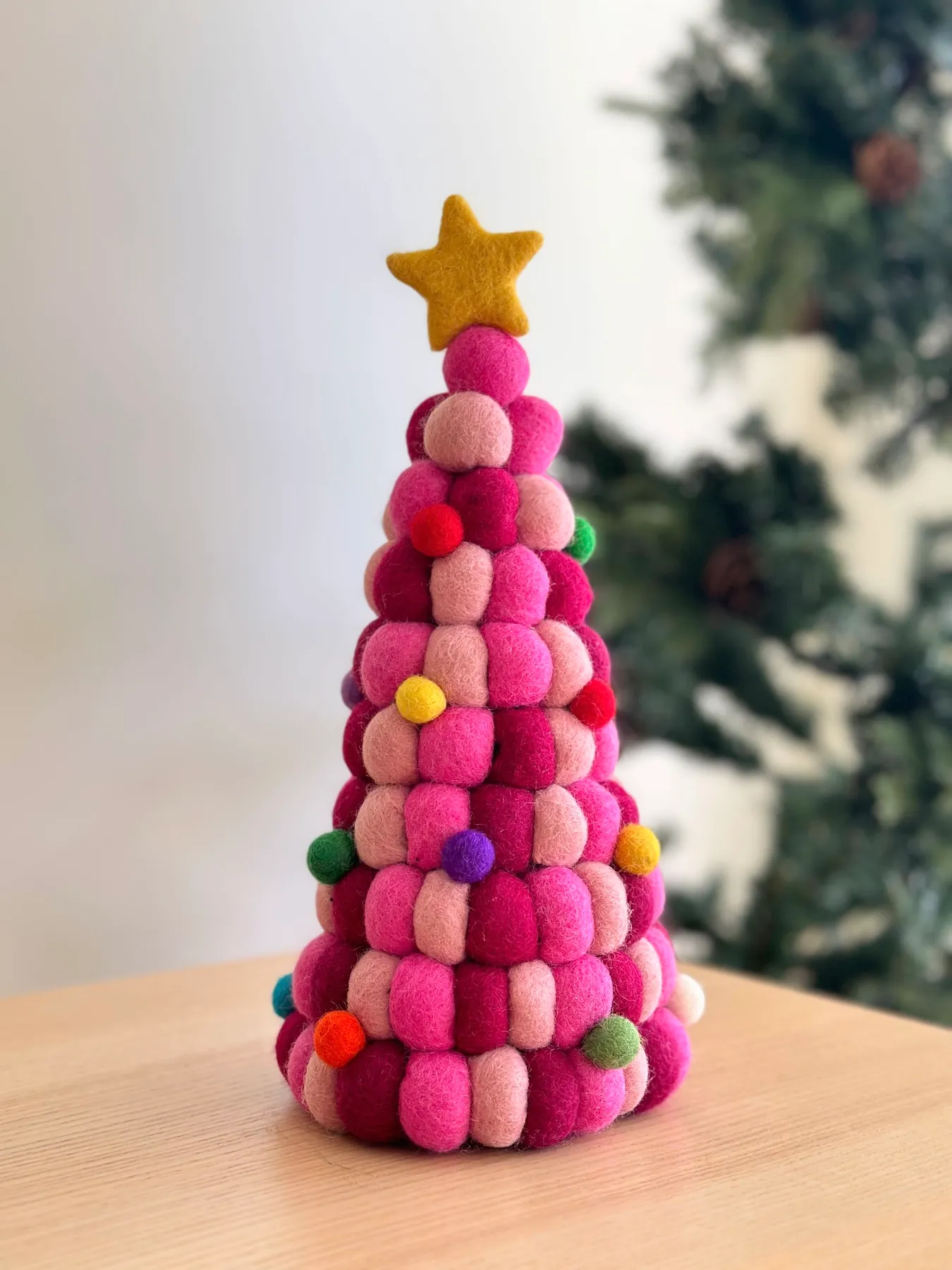
Ratio is everything with a pom-pom tree. Smallest balls at the tip, medium through the middle, largest at the base — then let two or three odd colors break the pattern. A tree of perfectly uniform pink pom-poms in perfectly even rows looks machine-made and a little sad. Tiny disruptions are what sell it as handmade, so resist the urge to fix the one ball that doesn’t match.
7. Red Poinsettias, Cardinal Figures, and Gold Pinecones on a Classic Fir
Call it 55% deep green foliage, 35% red, 10% gold shimmer. The trick is that within that red 35%, nothing matches — glossy red baubles, matte red, red fabric poinsettias, red feathered cardinals, dark red berries. Same color, five textures. Swap the cardinals for silver snowflakes and you keep the formula, but the tree goes cool and formal instead of warm and lived-in.
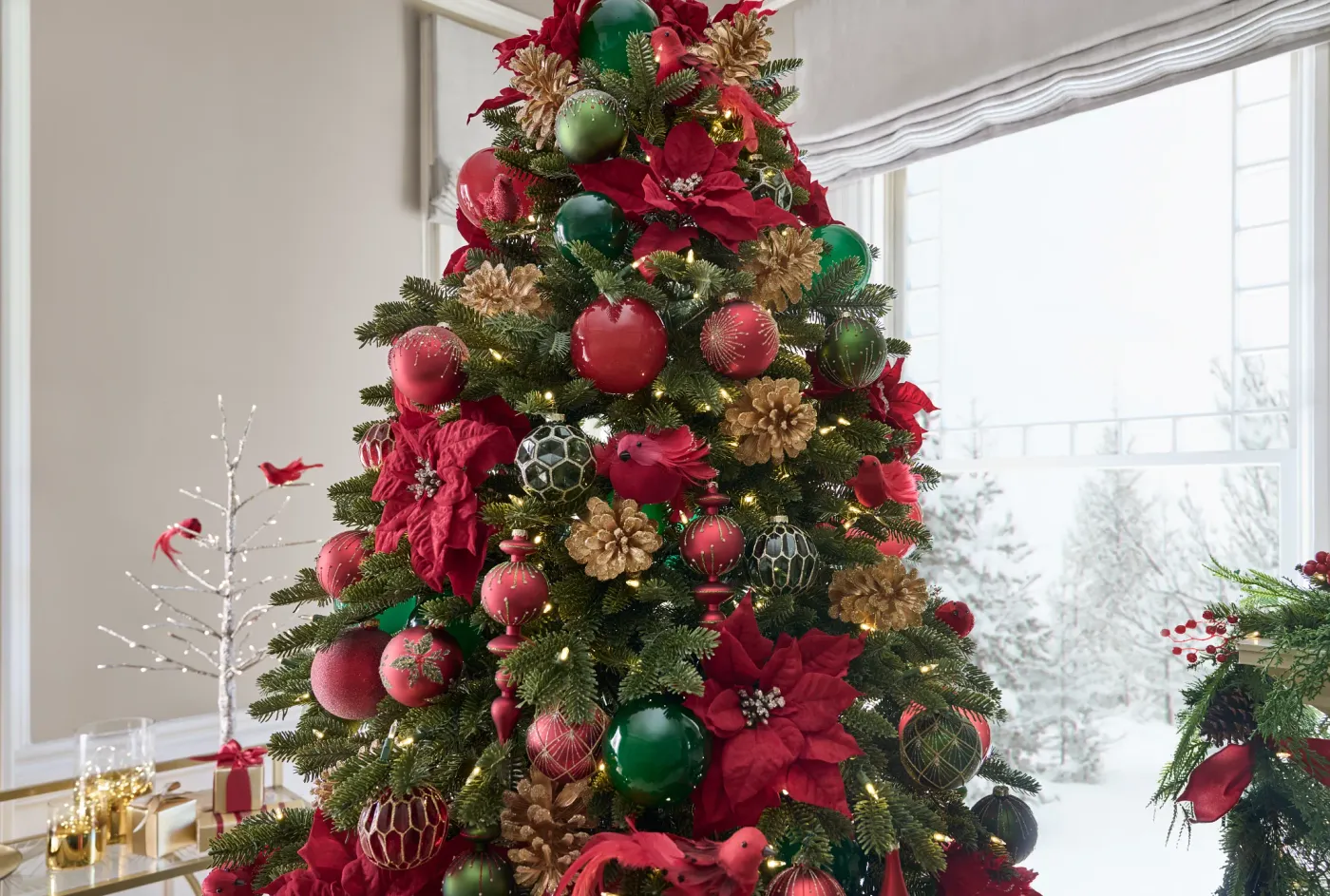
Red flocking and heavy ornament loads weigh more than they look. A fully dressed 7.5-foot tree with fabric poinsettias and lights can hit 70 pounds before you’ve added a thing, and the stand that came in the box may not be rated for it. Check the rating, or upgrade to a 28-inch base with a wider footprint. Flocking also sheds — vacuum weekly and put a skirt down if the tree sits on carpet you care about.
8. One Red Tree, One Matte Charcoal Wall, Zero Competition
A red tree on a white wall is cheerful. A red tree on matte charcoal is a decision. The dark wall swallows light, so the tree’s warm white bulbs become the only bright thing in the frame — and that’s why one black-and-white photo in a white frame reads as intentional rather than leftover. The dark wood floor keeps the scene grounded, and the light structural column beside the tree stops the whole thing from floating.
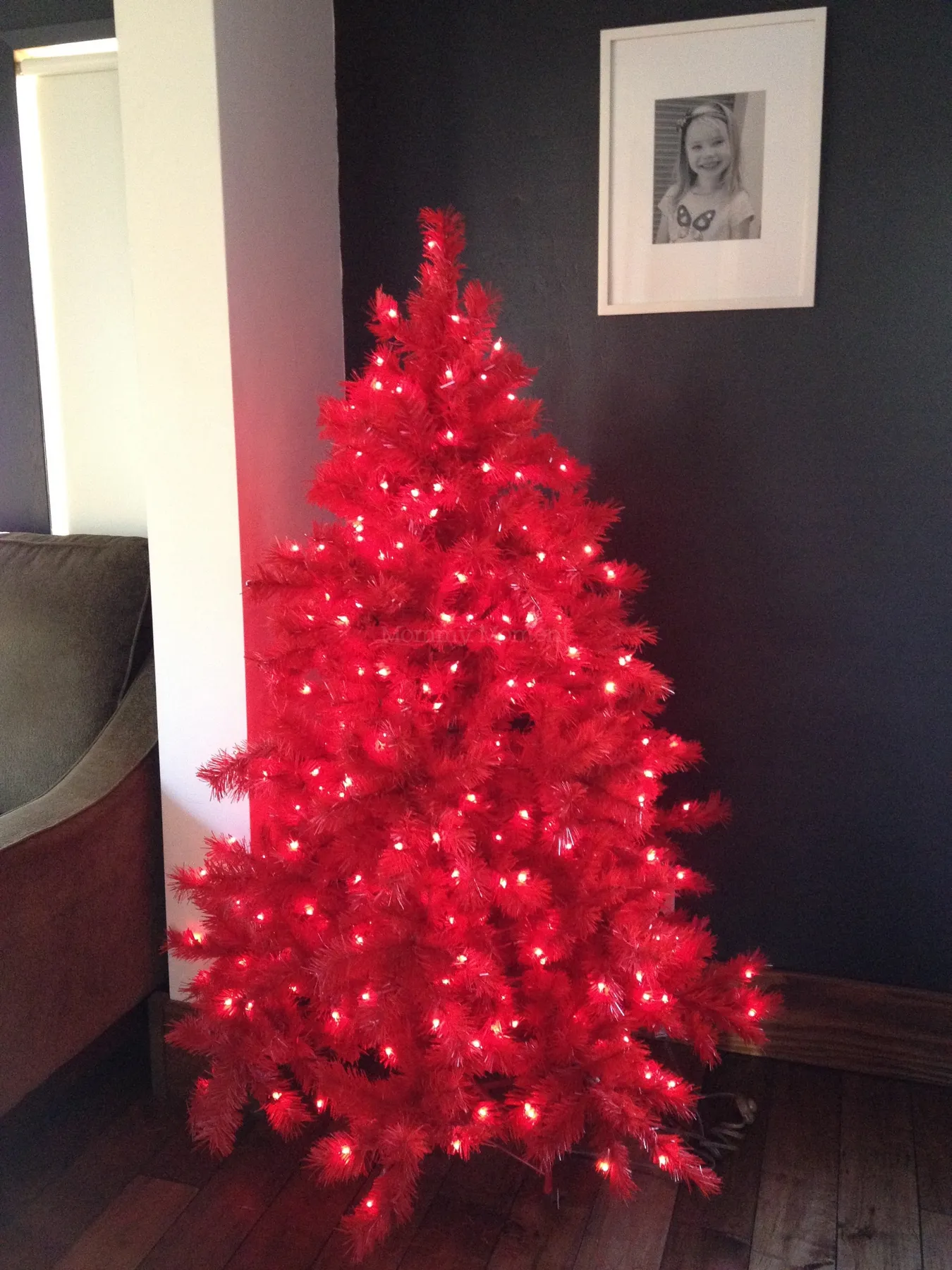
This is the small-space answer. A 6- to 7-foot tree fits a 10-by-10 corner with a pale column beside it, and the dark wall means you don’t need a mantel, a wreath, or a second vignette to make the room feel finished. Just leave a foot of breathing room between branches and column. Got more square footage? See Idea #1 for the fuller, gift-heavy version of the same red.
9. A Red-Only Ornament Set in Glitter, Matte, and Gold Swirl
It’s one color and it still isn’t boring, because every piece in the set is a different finish. Glitter. Matte. Red-and-white stripes. Gold swirl patterns. White starbursts on a red ground. That mix is the entire trick — a tree of identical glossy red baubles looks like a clearance bin, while the same volume in five finishes looks gathered over twenty years.
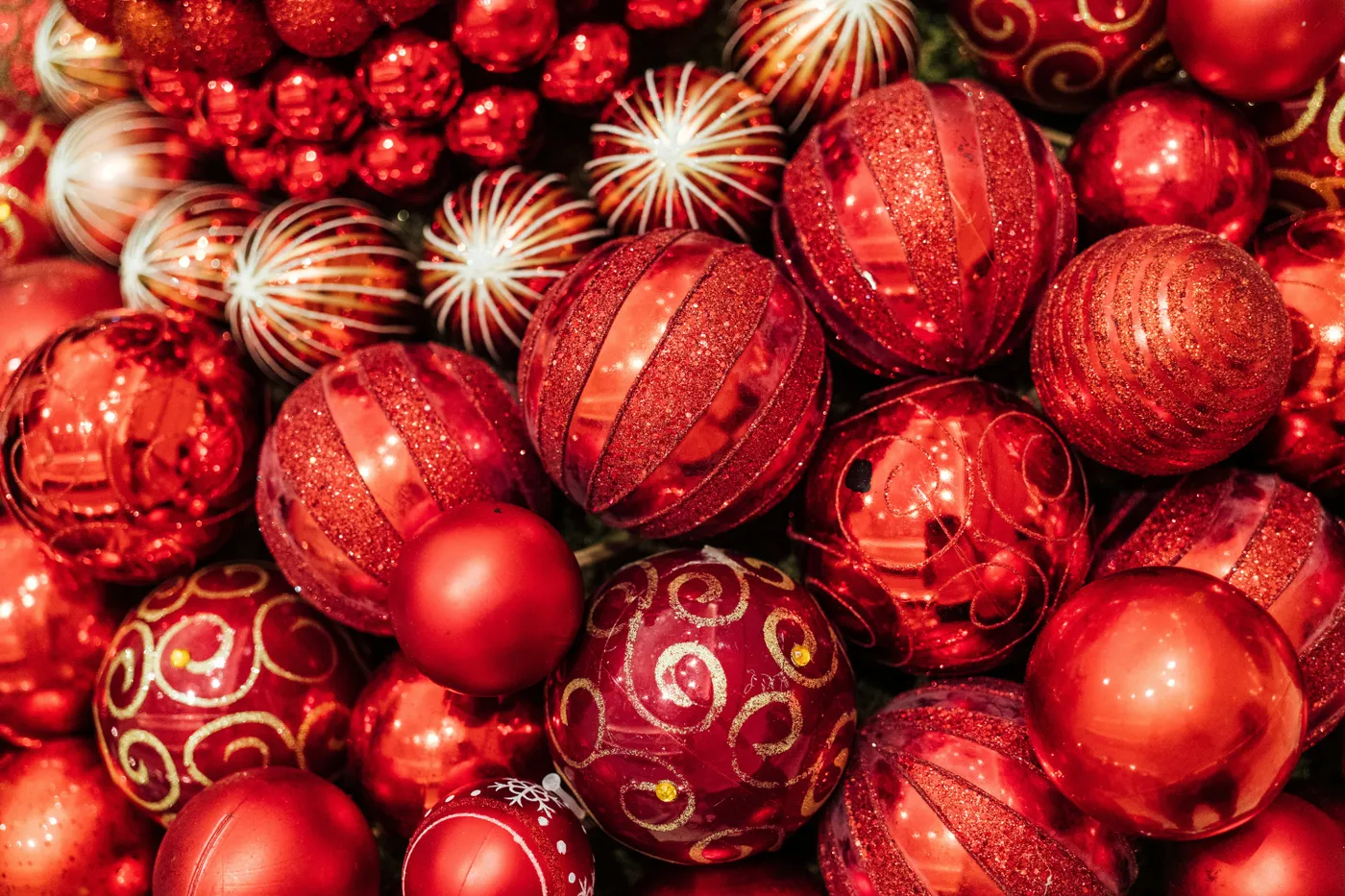
Building a red-only collection from scratch gets pricey fast at $8–$15 a box. Thrift stores and estate sales are goldmines precisely because red is the most commonly donated ornament color. Look for matte and patterned pieces to fill the gaps in a store-bought set. Ten to fifteen vintage red ornaments at $1–$3 each will do more for the mix than another $60 box from a big-box store.
10. A Red Berry Tree With a Gold Candelabra in a Charcoal-Dark Room
Wiring berry sprays takes less time than you think:
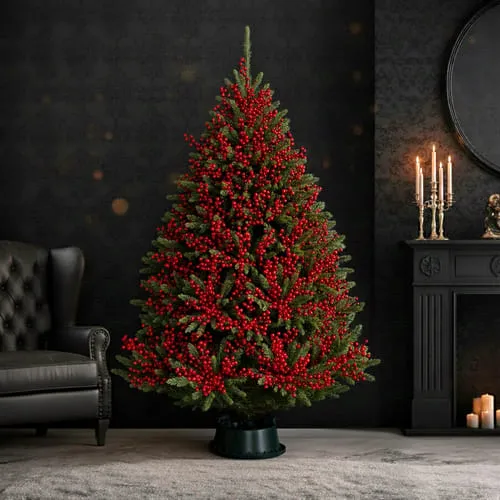
- Untwist each spray so the stems fan out — straight sprays look like sticks.
- Push the stem into the branch, not on top of it, and wrap the wire twice around the branch arm.
- Work in a spiral from bottom to top, keeping about 6 inches between clusters.
- Step back every 10 minutes. Berry sprays read completely differently at 3 feet than at 10.
Time: 45–60 minutes for a 7-footer. Cost: $25–$60 for 12 sprays.
A real flame on that candelabra needs at least 12 inches of clearance from every branch, ribbon, and berry spray, and never leave the room with it lit. A battery taper with a waxy finish gets you 90% of the look for none of the risk — nobody is inspecting the flame.
The warm-against-cool tension is the design. Charcoal walls, a black mantel, and tufted leather are all cool and dark. Red berries and gold are warm. That friction is why a $40 berry spray reads like it cost ten times that.
11. Wide Red Velvet Ribbon and Gold Branches on a Dense Fir
The formula: 50% green fir, 30% red, 20% gold. Red does two jobs here — the baubles run glossy and matte, and the wide velvet ribbon is the connective tissue that ties the whole tree together. Velvet ribbon is the most underrated element on any red tree because it adds a third texture at almost no visual cost. Swap the gold branches for champagne silver and it turns cool and elegant; keep them gold and it stays traditional.
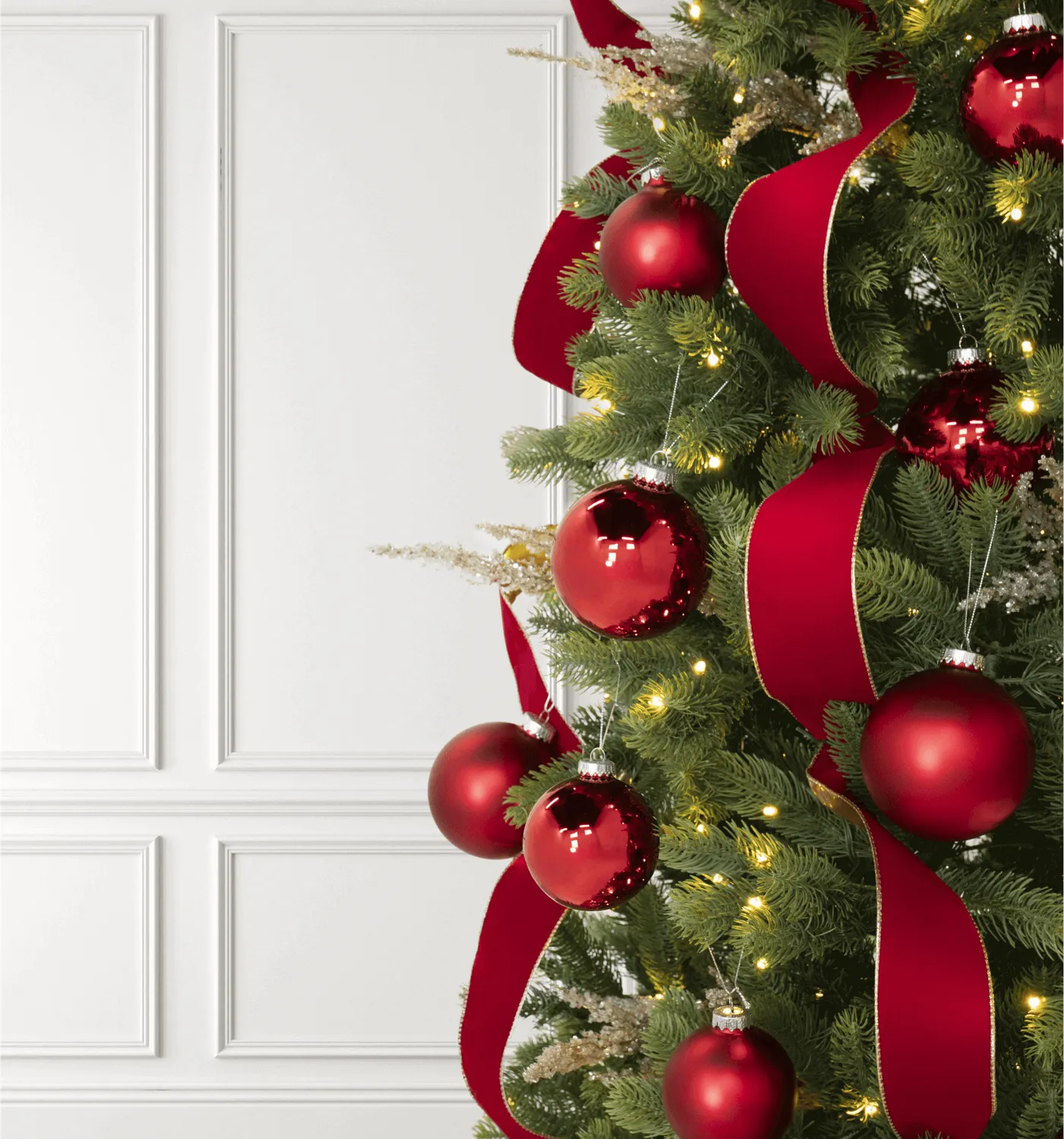
What to expect to spend:
- 7.5-ft unlit green tree: $120–$350
- Red ornament set, 60–80 pieces: $50–$120
- Wide red velvet ribbon with gold trim (2 rolls): $30–$60
- Gold accent branches or picks (12): $24–$55
- Warm white lights (700 ct): $25–$50
Total: $249–$635
Buy the tree pre-lit on late-December clearance for next year, and shop velvet ribbon by the yard at a fabric store — usually 40–50% less than pre-made holiday ribbon.
12. A Multicolor Tree in a White Gazebo, Grounded by a Red Skirt
Gazebo trees are gorgeous and high-maintenance. An open structure throws wind, temperature swings, and humidity at a tree in ways a living room never does — flocking sags, ribbon droops, and anything with real branches dries out twice as fast. Cap an outdoor display at four to five weeks, weight the base, and skip any fabric that can’t get rained on. The red-and-white tree skirt here is doing structural work as much as decorative: it hides the stand and catches fallen glitter.
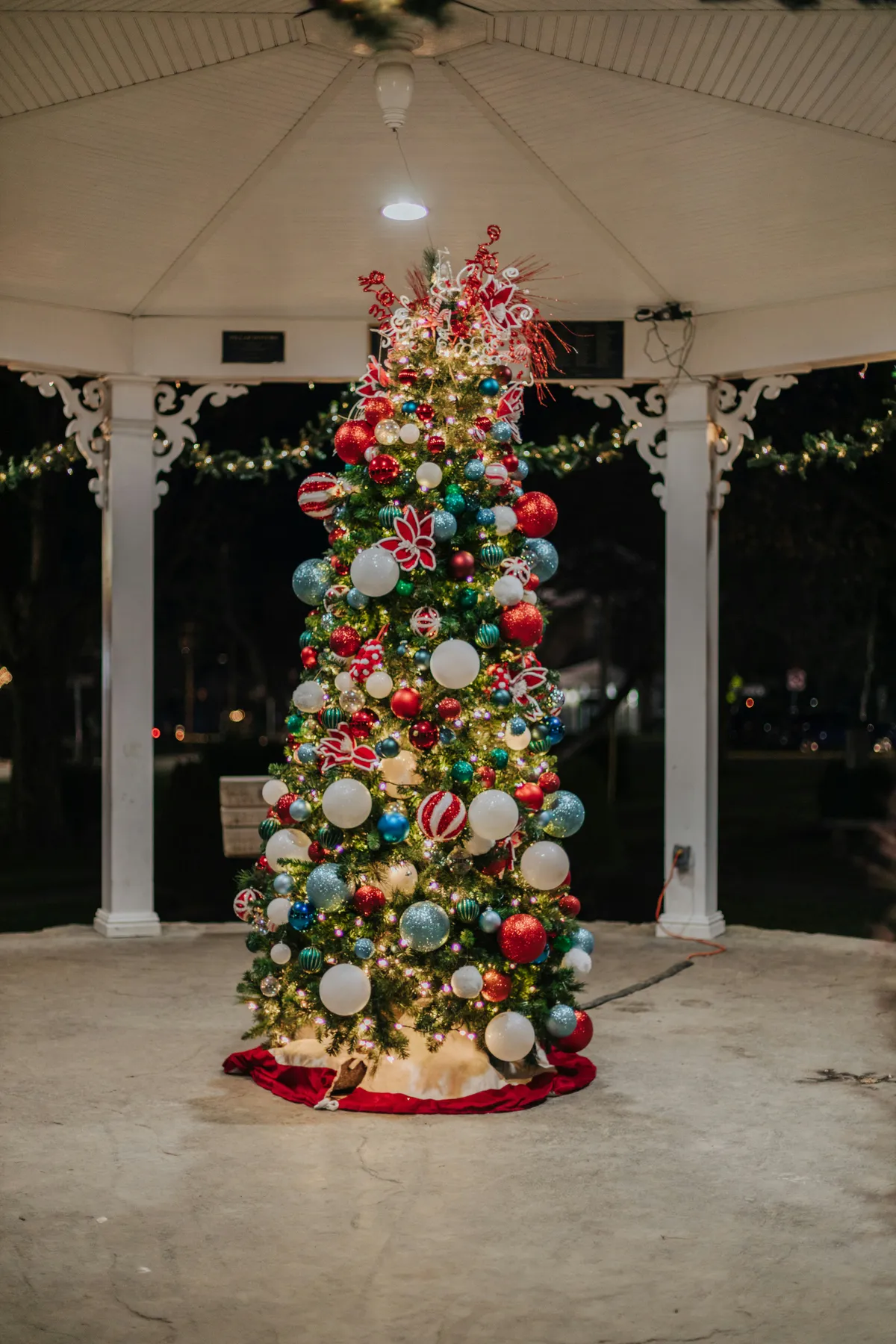
- Measure the gazebo opening — you want 8 inches of clearance on every side.
- Check whether the outlet is GFCI-protected and how far the cord has to reach.
- Confirm the skirt and topper are fade-resistant, or accept that they won’t be next year.
- Decide now how you’ll store everything, because taking it down wet is miserable.
13. Glitter Red Butterflies Light on a Green Tree With Matte Gold Spheres
Butterfly ornaments need to face outward and slightly upward — tilt each one 30 to 45 degrees so the wings catch light from the strand below. Flat-on butterflies disappear into the branches; angled ones look like they just landed. If yours have clips instead of loops, clip them to a branch tip rather than wiring them in, and keep them in the outer third of the tree so they read from across the room.
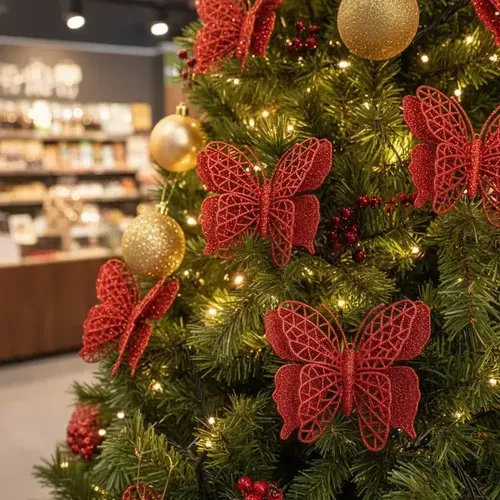
What works here is a red accent that isn’t a sphere. After the fortieth round bauble your eye stops registering them, but a glitter butterfly with cut-out wings breaks the rhythm and gives the tree a focal pulse. The matte and sparkling gold spheres underneath keep it grounded, and the dark red berry clusters add weight. Take the butterflies away and you’ve got a perfectly nice gold-and-red tree — pleasant, but forgettable.
14. A Ruchéd Red Fabric Tree With a Santa Belt and Gold Buckle
The build, start to finish:
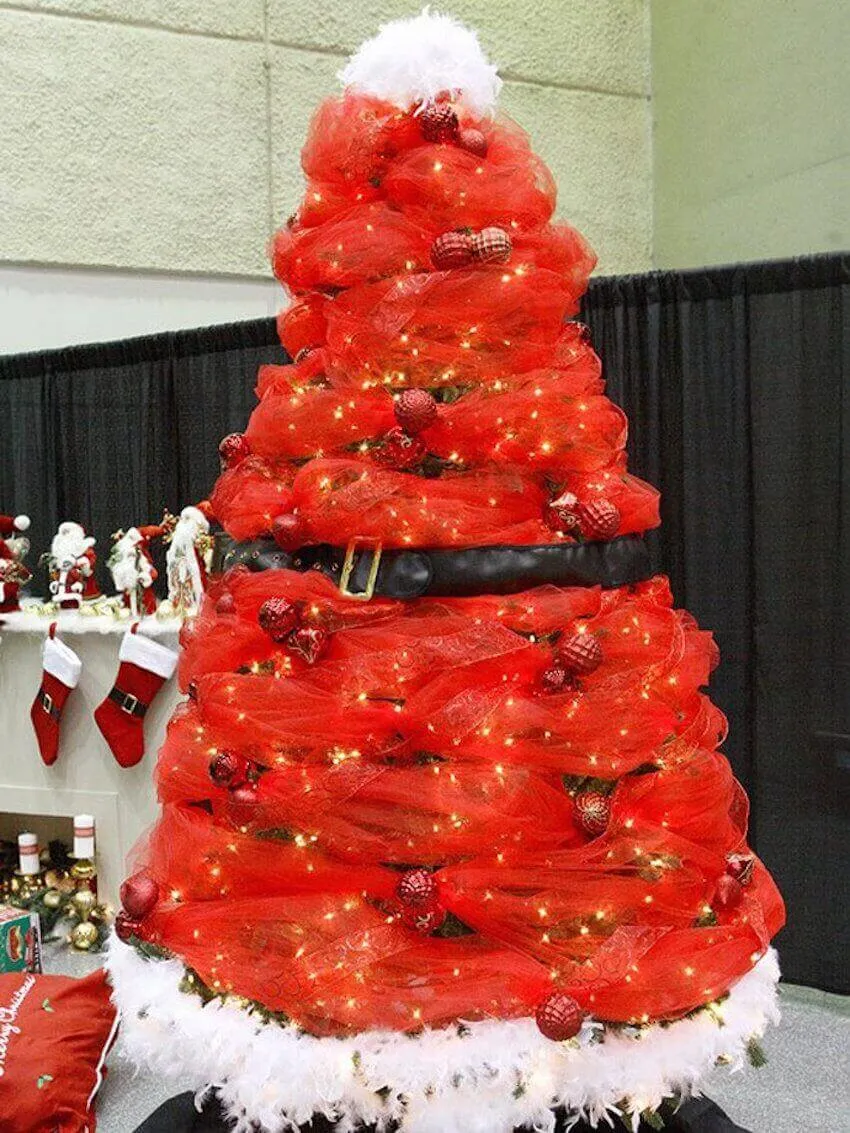
- Begin with a wire cone frame and wrap it in a neutral batting layer so red never shows through gaps.
- Cut sheer red fabric into 6-inch-wide strips — roughly 3 yards per foot of tree height.
- Pin each strip in a soft fold, working upward, overlapping by half so the ruching reads continuous.
- Thread warm white lights between layers as you go. Retrofitting later is a nightmare.
- Add the black belt and gold buckle at the midpoint, then white feather trim at the top and base.
Time: 4–6 hours. Fabric: $40–$90.
- Wire cone frame, 5 ft: $35–$80
- Sheer red fabric, 9–12 yards: $40–$95
- Warm white string lights (300 ct): $18–$35
- Black belt and gold buckle: $12–$30
- White feather trim, 3 yards: $15–$35
Total: $120–$275
The Santa belt is the whole idea. Without it, a ruched red cone is just a fabric sculpture. With it, your brain finishes the sentence instantly. One black band and a gold buckle tell more story than 200 ornaments ever could.
15. Flocked Greenery, a Giant Nutcracker, and a Miniature Snow Village
Miniature villages are the most space-hungry decor nobody budgets for. A lit scene with houses, rides, and snow needs roughly a 3-by-2-foot footprint, a power strip, and a spot where nobody will knock it over — plus dusting fourteen tiny roofs in January. If you love the look but not the upkeep, keep the village to three buildings and tuck them under a glass cloche so the dust never lands.
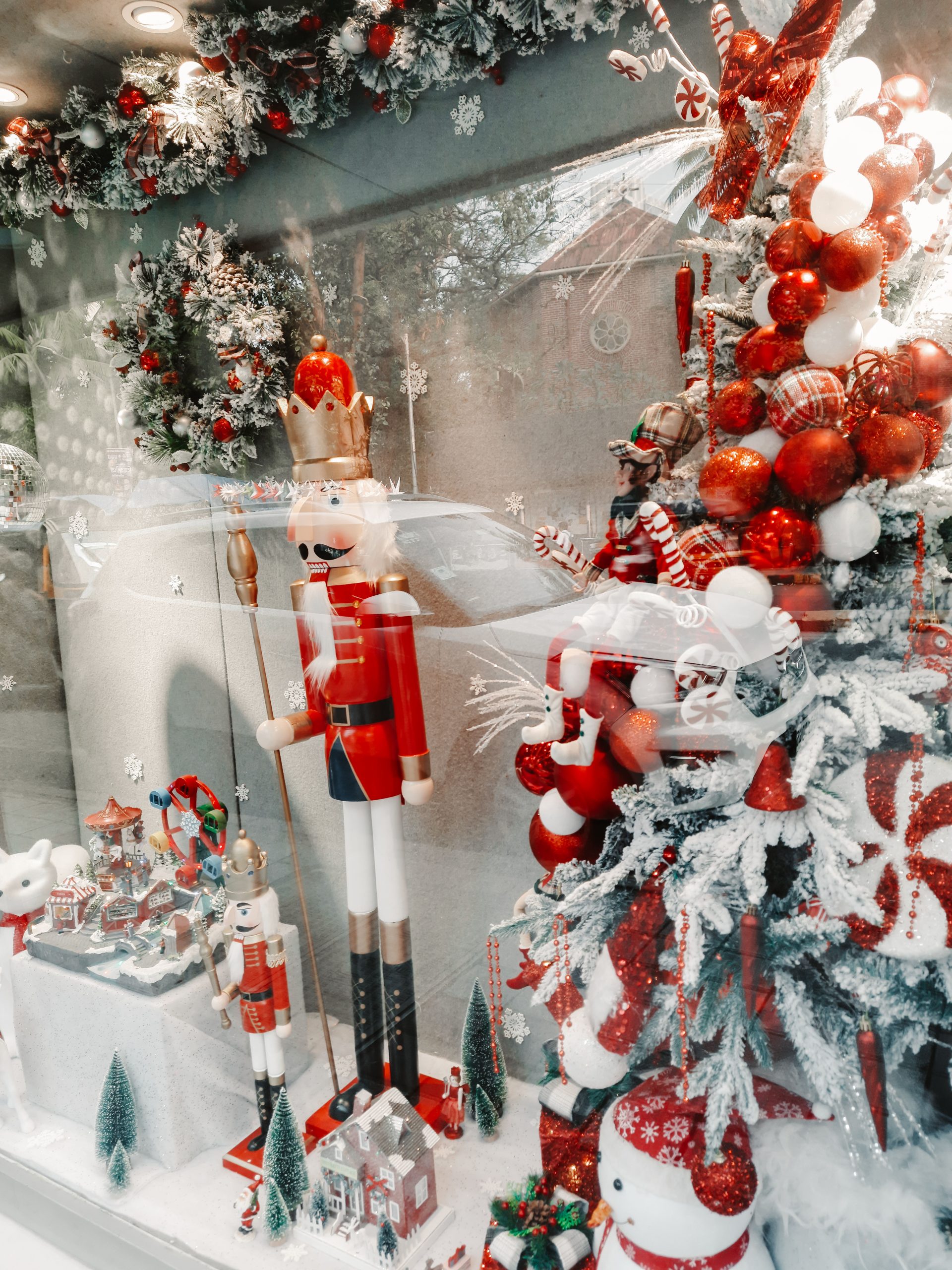
Flocked greenery with red and white follows an easy split: 50% frosted white-green, 40% red, 10% gold and silver for sparkle. The white does the heavy lifting — it’s what makes red feel like a candy cane instead of a stop sign. Trade the white for more green and the display turns darker and more traditional. The oversized nutcracker breaks the formula on purpose, which is exactly why he works.
16. Two Red Glass Tiered Trees Styled on a Red Surface
The styling choice, not the objects, is the point. Two red glass trees displayed on a red surface with green pine, pinecones, and a frosted silver tree behind. Red on red should look like a mistake — except the glass is reflective and the surface is matte, so the edges stay readable and the figures look like they were lit from inside. Move those same two pieces to a plain white shelf and they become ordinary tchotchkes.
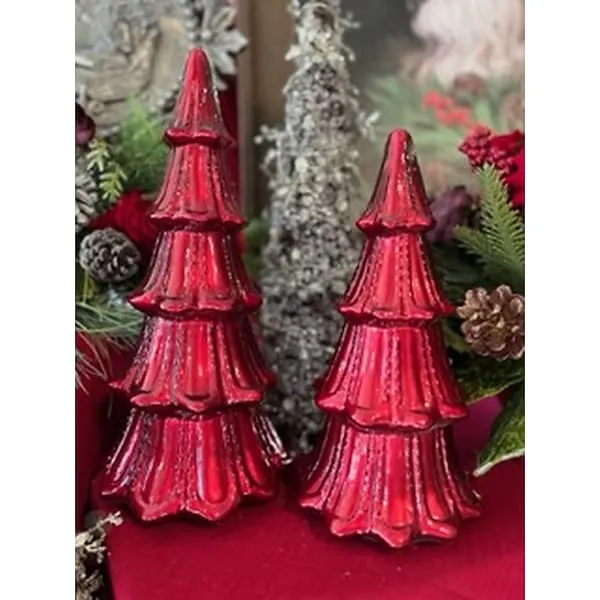
Vignettes like this live on sideboards, consoles, and entry tables — plan on 24 to 30 inches of width and at least 12 inches of depth so the greenery doesn’t overhang. Set the two glass trees at different heights and slightly off-center; a matched pair reads as a mass-produced set, an offset pair reads as a collection. Shorter surface? The tabletop berry tree in Idea #21 scales the same instinct way down.
17. Oversized Red and Pink Paper Flowers Take Over a Grand Fir
Oversized paper flowers went from craft-fair to mainstream in about two seasons, and 2026 is the year they’re genuinely everywhere. The appeal is scale — a 10-inch paper peony does the visual work of a dozen baubles, and it photographs beautifully because it has real dimension. Pink mixed with red is the newest iteration: it keeps the holiday red but pulls it out of candy-cane territory and into something closer to a florist’s window.
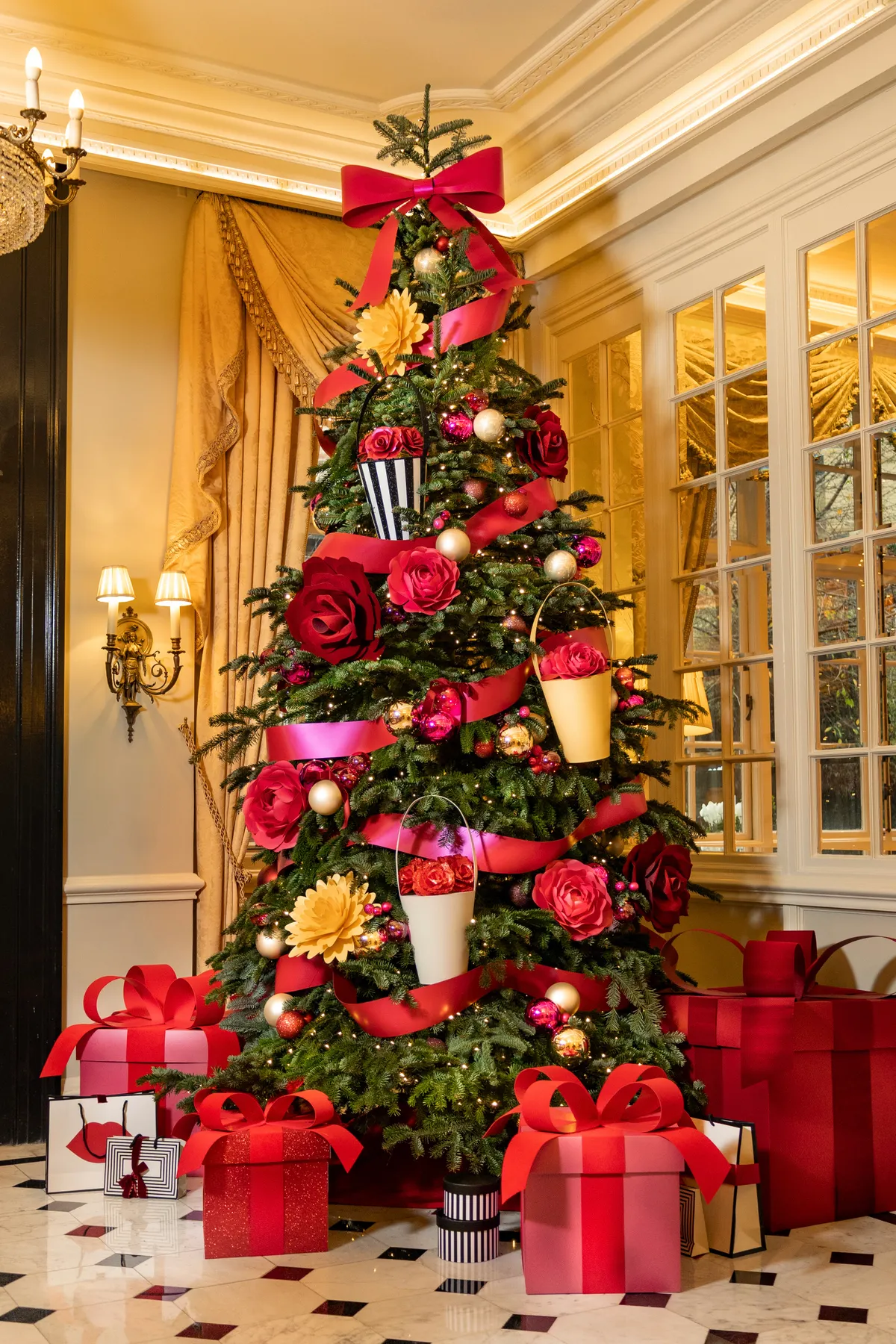
Two principles are doing the work. First, scale contrast — enormous flowers beside small metallic spheres make both feel bigger. Second, repetition with variation: the same flower shape appears in red, then pink, then cream, so the eye reads a pattern instead of a random assortment. Wide satin ribbon in red and pink welds the scheme together. Remove the size contrast and the tree flattens immediately.
Make them for a fraction of retail. Two sheets of heavy cardstock, a petal template, and hot glue gets you a 10-inch flower for about $3 once you own the template. Twenty flowers at $3 beats $12 each at a boutique. Use matte cardstock rather than glitter for a more expensive finish, and wire them in with floral tape so you can reposition next year.
18. One Deep Red Ornament With Gold Scallops and Jewel Beads
Statement ornaments belong on the outer third of the tree, and no more than three in any 12-inch square. Anything pushed deeper gets swallowed by needles. When a single ornament is the star — like this matte deep red sphere with the gold scalloped overlay — hang it at roughly 60 inches off the floor, eye level for a standing adult, where guests actually look. The bottom third of the tree is a dead zone and always has been.
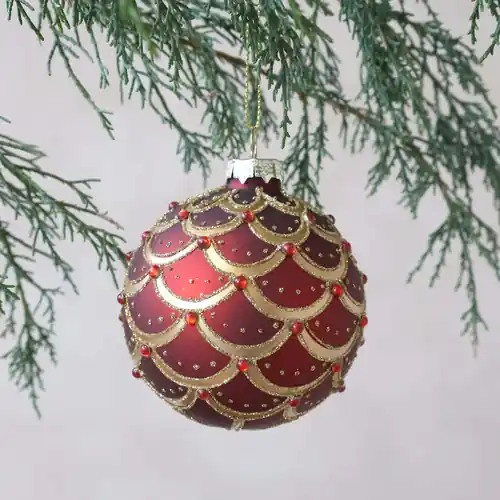
Glitter, jewel beads, and metallic overlays shed. Expect to vacuum under the tree weekly through December, and store these individually wrapped — a shoebox of loose glitter ornaments will sand the finish off each other by February. Matte finishes outlast gloss by years; gloss shows every fingerprint and hairline scratch. If you want the same richness with less fuss, look for fabric or wooden ornaments in the same deep red.
19. A Red Dress, Reindeer Antlers, and a Multicolor Tree in the Corner
Here’s the palette math on this scene:

- 45% green tree foliage and multicolor string lights
- 30% red — the dress, the antlers, the ornaments, the cherry on the cupcake
- 15% gold and silver ornament accents
- 10% warm wood tones from the table and floor
is temperature. The red in her outfit and the red on the tree are the same warmth — pull one ornament out and hold it next to your party outfit before you commit to a look, because a cool crimson against a warm tomato red will fight in every photo.
Small repeats of your main color are what make a scene feel finished. The cherry on the cupcake isn’t a detail — it’s the payoff, echoing the palette one more time at the tiniest possible scale.
20. Flocked Branches, Red Bows, and White Poinsettias in One Full Arrangement
Realistic numbers for this level of abundance:
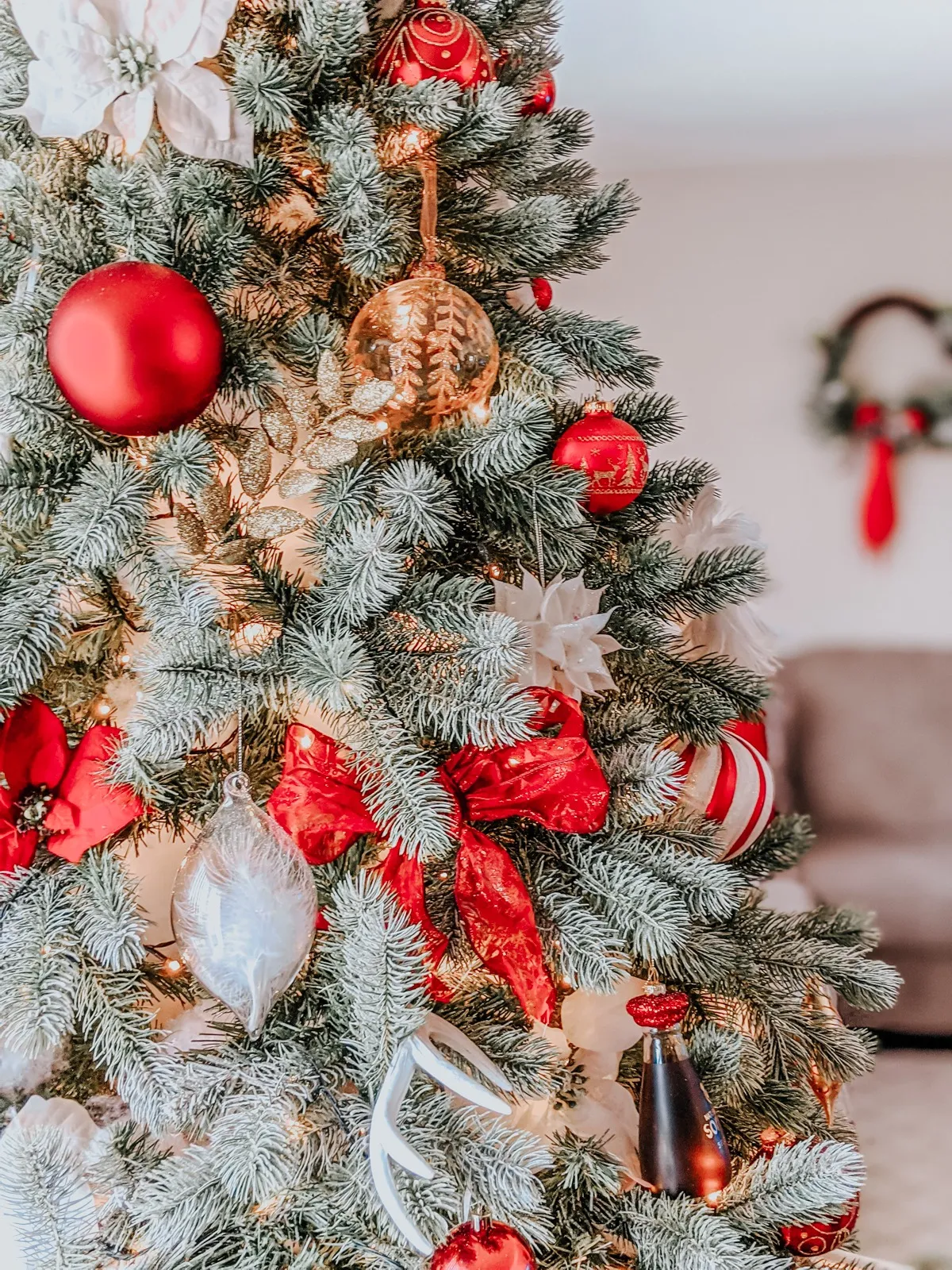
- Flocked pre-lit 7.5-ft tree: $350–$800
- Red fabric bows (12): $20–$50
- White and red poinsettia stems (12): $30–$65
- Gold patterned baubles (set of 24): $35–$75
- Red ball ornaments (set of 40): $25–$55
Total: $460–$1,045
Ribbon bows on a flocked tree should be 8 to 10 inches across — anything smaller vanishes into the white. Tie them with wired ribbon so the loops hold shape, and place them in a loose descending spiral rather than at random. About 12 bows on a 7.5-footer is right; 20 turns it into a ribbon tree with some branches attached.
- Wire the poinsettia stems together in threes before they go in — single stems droop.
- Push each cluster into the branch base, not the tip, then bend the bloom forward.
- Space clusters about 9 inches apart.
- Add a bow above each cluster so the fabric echoes the flower.
Time: 60–75 minutes. Cost: $50–$115 for the flowers and bows.
21. A Small Tabletop Fir Loaded With Red Berries and Brown Pinecones
Berries and pinecones are the most convincing red you can put on a tree, because they arrive with brown and dark green attached. That natural company is what keeps red from reading as artificial. The clusters here are dense — berries in tight groups of five to seven, pinecones pressed flat against the branches — and the elongated berry sprays add vertical movement so the little tree looks taller than it actually is.
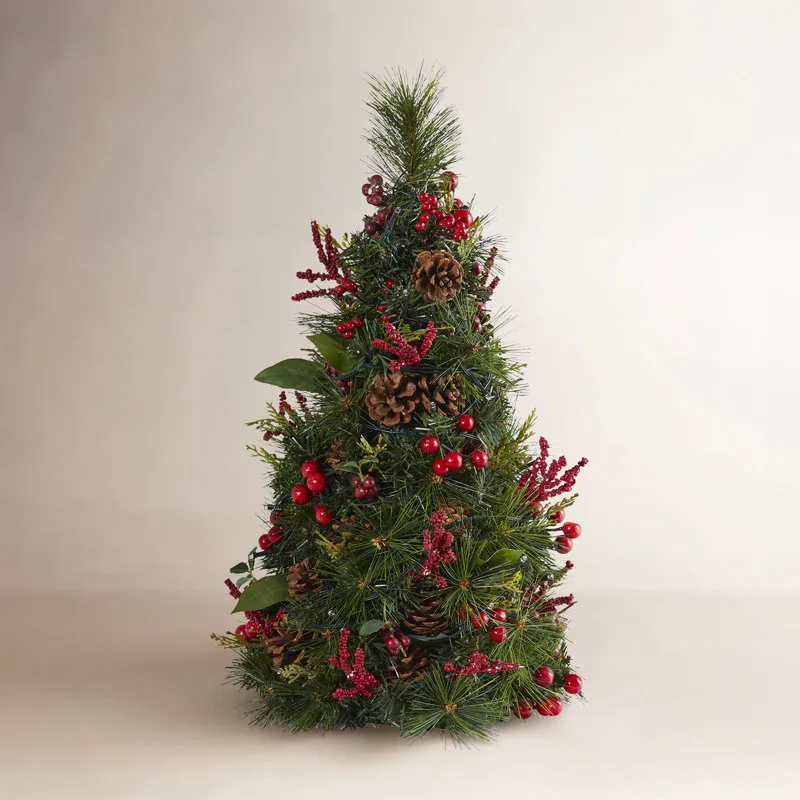
A tabletop tree like this wants to be 18 to 24 inches tall and sits best on a console or mantel with at least 8 inches of clear wall behind it. Counter height is your target; anything below 30 inches off the floor gets lost in the room. Bedside tables and entry consoles are the sweet spot. Want the same natural red at full scale? The berry tree in Idea #10 does it floor to ceiling in a dark room.
22. A Red-Lit Tree With Knitted Mittens and Gnomes in a Timber Room
The rustic-lodge look — natural wood paneling, a green planked ceiling, and a tree lit entirely in red with knitted mittens and tiny gnomes — is the holiday aesthetic most people are actually shopping for in 2026. It’s warm, it photographs well, and it forgives an imperfect tree. The mitten-and-gnome trend has real staying power because those ornaments are cheap, unbreakable, and toddler-proof. That combination never goes out of style.
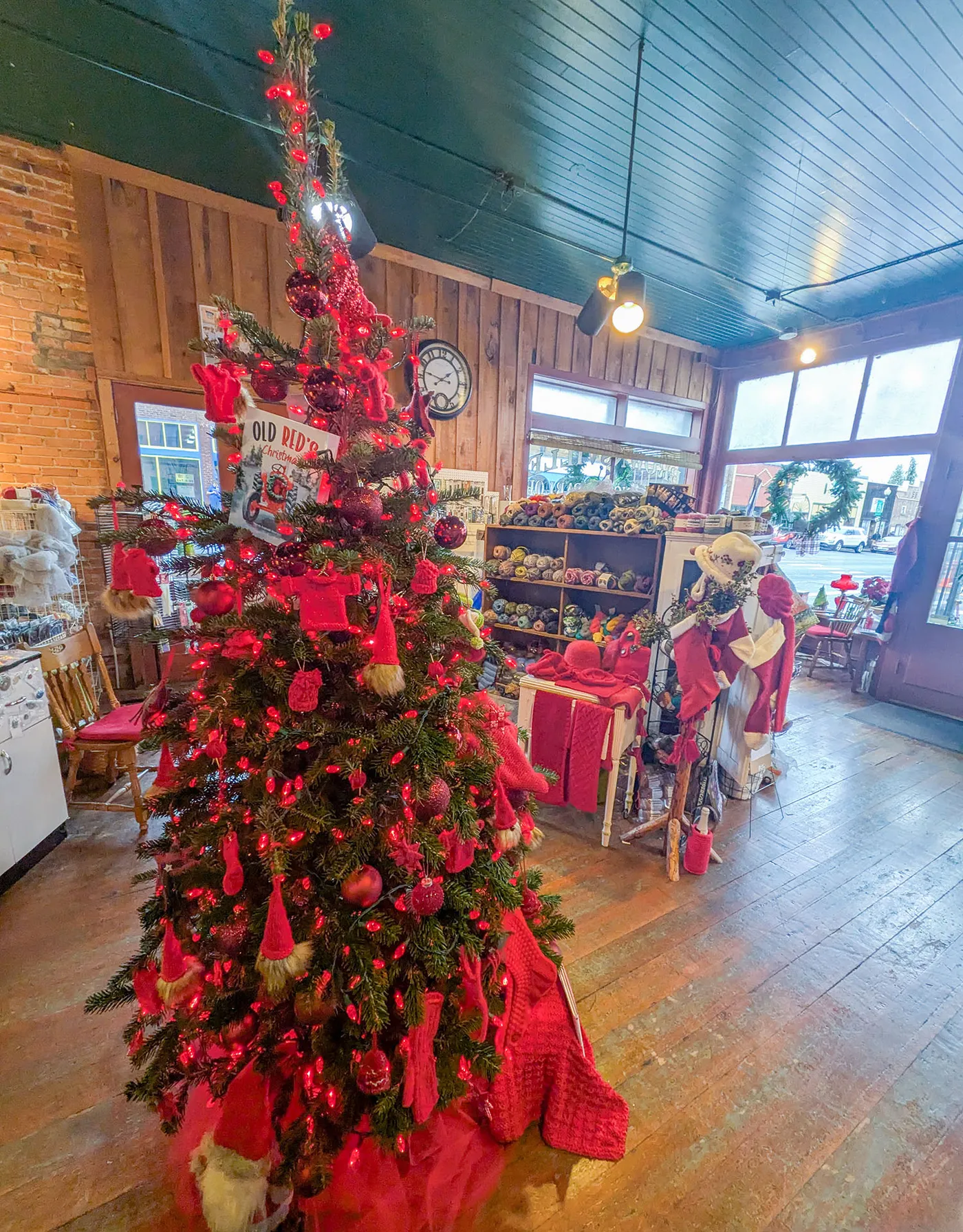
Red string lights are the budget hero. A 100-foot strand runs $12–$25 and completely changes a tree’s personality for the price of lunch. Mix in $5 knitted mittens from a discount store, a couple of dollar-store gnomes, and a red fabric skirt, and you’ve got 80% of this look for under $80. Facebook Marketplace is full of red lights every November from people who went another direction.
- 7-ft green tree: $90–$250
- Red string lights (300 ct): $25–$50
- Red baubles (set of 40): $20–$45
- Knitted mitten and gnome ornaments (12): $30–$70
- Red fabric tree skirt: $18–$40
Total: $183–$455
23. Bronze and Brown Ornaments in a Room With Columns and Gilded Consoles
Layering two warm metallics — bronze and gold — only works if you separate them by finish. Put the glossier pieces higher up where the string lights can hit them, and matte bronze lower where it can hold shadow. If everything is equally shiny at the same height, the tree turns into one flat bronze blob. Aim for about 30% of the ornaments to be matte, and keep the patterned ribbon to a single scheme.
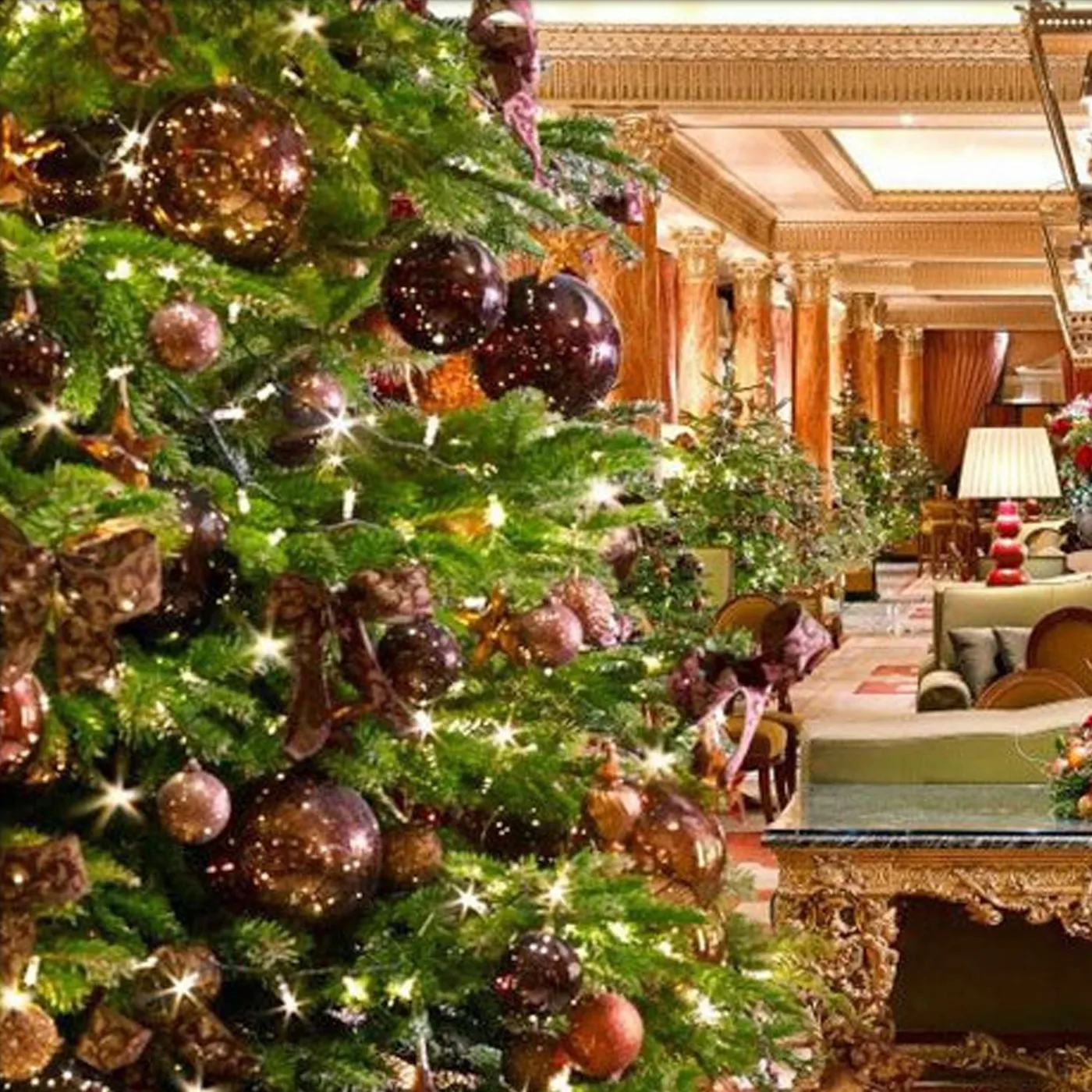
The formula for this room:
- 50% dark green foliage
- 30% brown and bronze
- 20% gilded gold and warm white light
That last 20% is what keeps it from looking muddy — bronze on green with no gold reads as brown. Swap the gold for champagne and the tree goes softer and more modern. Swap it for copper and it swings rustic. Do not add a third metallic; two is the ceiling.
24. Honeycomb Paper Trees in Deep Red and Natural Beige
The setup takes minutes:
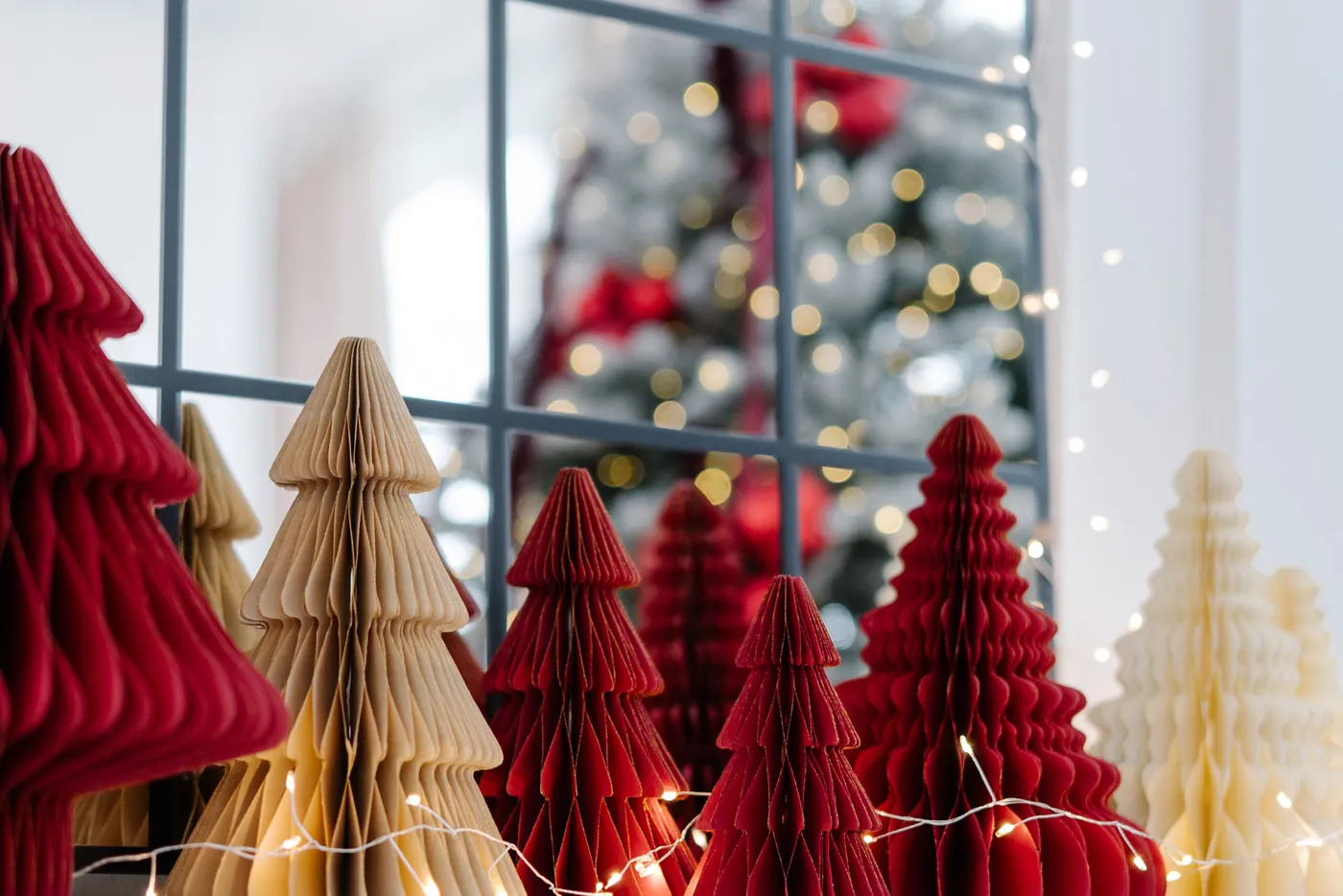
- Buy the honeycomb trees flat — they ship as panels that pop open.
- Open slowly from the bottom up. Rushing tears the paper honeycomb.
- Group in odd numbers and stagger heights by 2 to 3 inches.
- Thread a warm white strand behind and through the group, never in front.
- Set them slightly back from the window so the dark frame silhouettes the shapes.
Time: 5 minutes. Cost: $14–$40 for a set of six.
- Measure your windowsill or shelf — honeycomb needs 4 inches of depth.
- Check that your outlet has room for one more low-wattage strand.
- Confirm the paper is flame-resistant if you’re using anything warmer than LED.
- Decide now whether these live indoors only; paper doesn’t survive a wet sill.
The pairing is the thing. Red honeycomb alone is a solid-color display. Red next to natural beige makes both colors read richer, because beige gives the red something to be red against — the same reason a red ornament looks better beside a cream ribbon than beside another red one.
25. Matte Red Baubles, Faceted Gold Glass, and Warm String Lights
Glitter picks and faceted glass are the two highest-maintenance items on any tree. Glitter migrates — you’ll find it in the carpet in March. Glass chips and scratches if it’s stored loose. Keep a lint roller in the storage bin, wrap glass in tissue, and bag the glitter picks. If you’d rather skip the fuss entirely, matte red baubles and velvet ribbon deliver nearly the same richness for almost no upkeep.
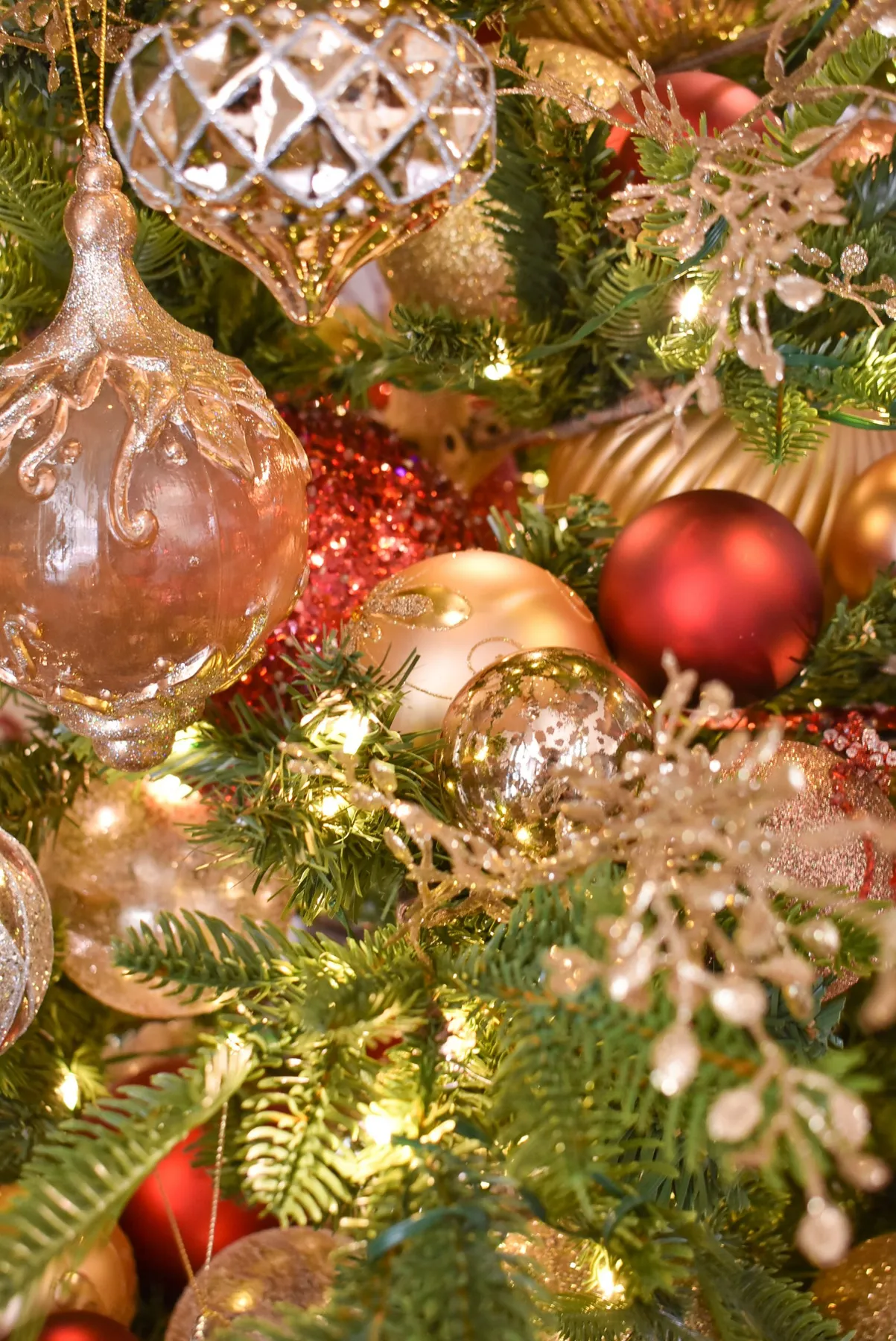
Roughly 45% dark green needles and lights, 30% matte red, 25% warm gold — split between matte gold spheres, glittery gold floral picks, and one large faceted glass ornament that serves as the focal point. That faceted piece is doing the most work per square inch; it scatters light and makes a modest ornament count look generous. Swap the gold picks for red glitter and you lose that bounce entirely.
26. Buffalo Plaid, Polka Dots, and Candle Lights on One Green Tree
Buffalo plaid plus polka dot plus stripe is three patterns on one tree, and it only survives because they share a tight palette — red, black, cream. Add a fourth ribbon in green and it tips straight into chaos. Pick three patterns, hold them to a two-color-plus-neutral rule, and don’t add a fourth no matter how cute it is in the store. One more thing: plaid ribbon is stiff. It holds a bow beautifully but it will not drape, so plan for structured loops rather than loose tails.
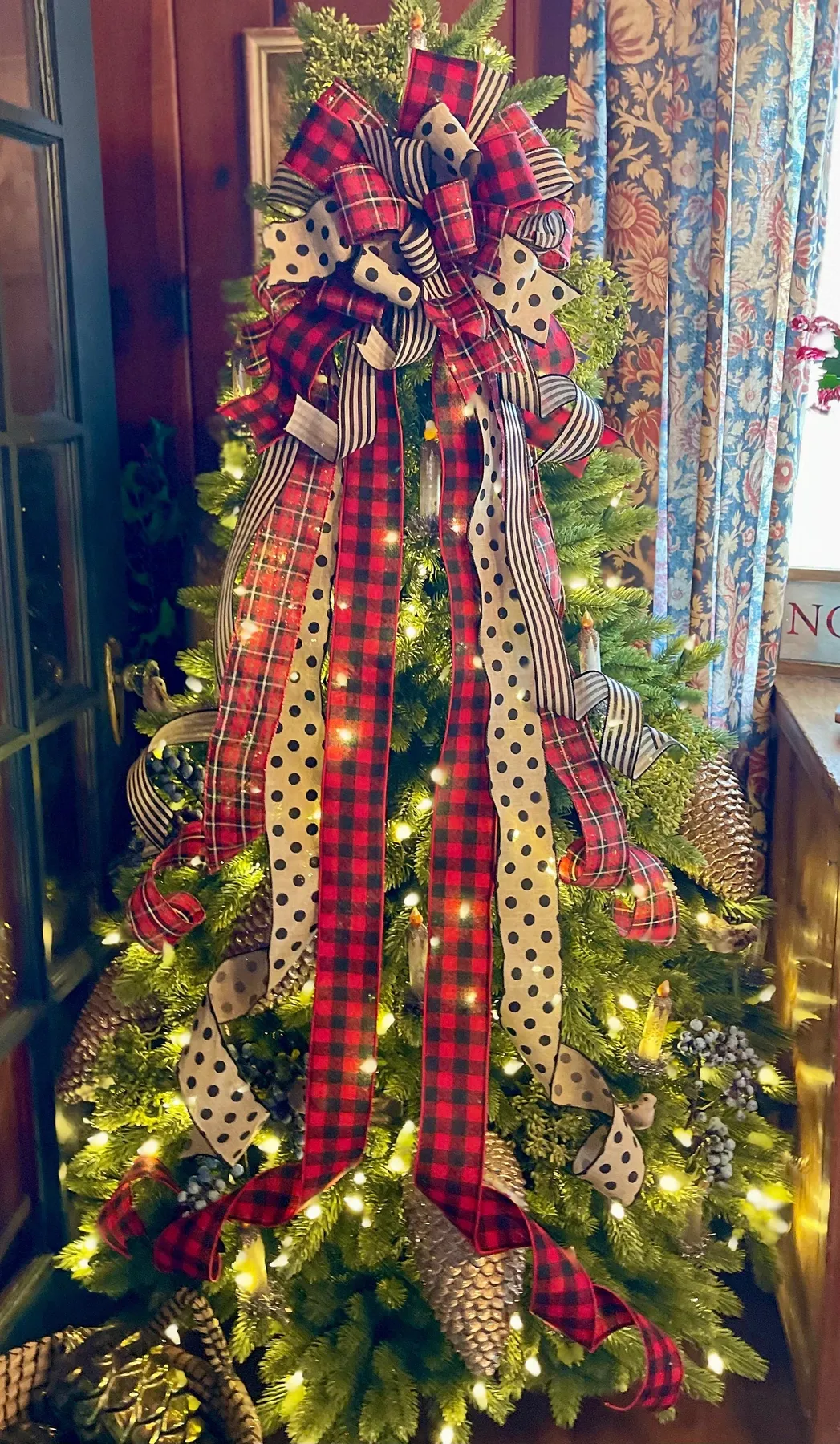
Buffalo plaid ribbon is cheap by the roll at craft stores in November, often 50–60% off the holiday aisle price. Three rolls at $6–$10 each beats pre-tied bows at $5 apiece. Pinecones are free if you have trees nearby — bake them at 200°F for 30 minutes to kill anything living inside, then add a wire loop. The whole ribbon-and-pinecone layer lands under $45.
27. A Gold Tiered Tree Stand Loaded With Velvet Bows and Ornaments
A tiered stand like this needs about 20 inches of table width and a wall behind it — it’s a front-facing display, so don’t float it mid-room. Side tables, entry consoles, and dining buffets all work. Scale the ornaments to the tier: 4-inch baubles on the bottom, 2-inch near the top. Pair it with a full tree and the proportions in Idea #31 keep the room from reading as two competing displays.
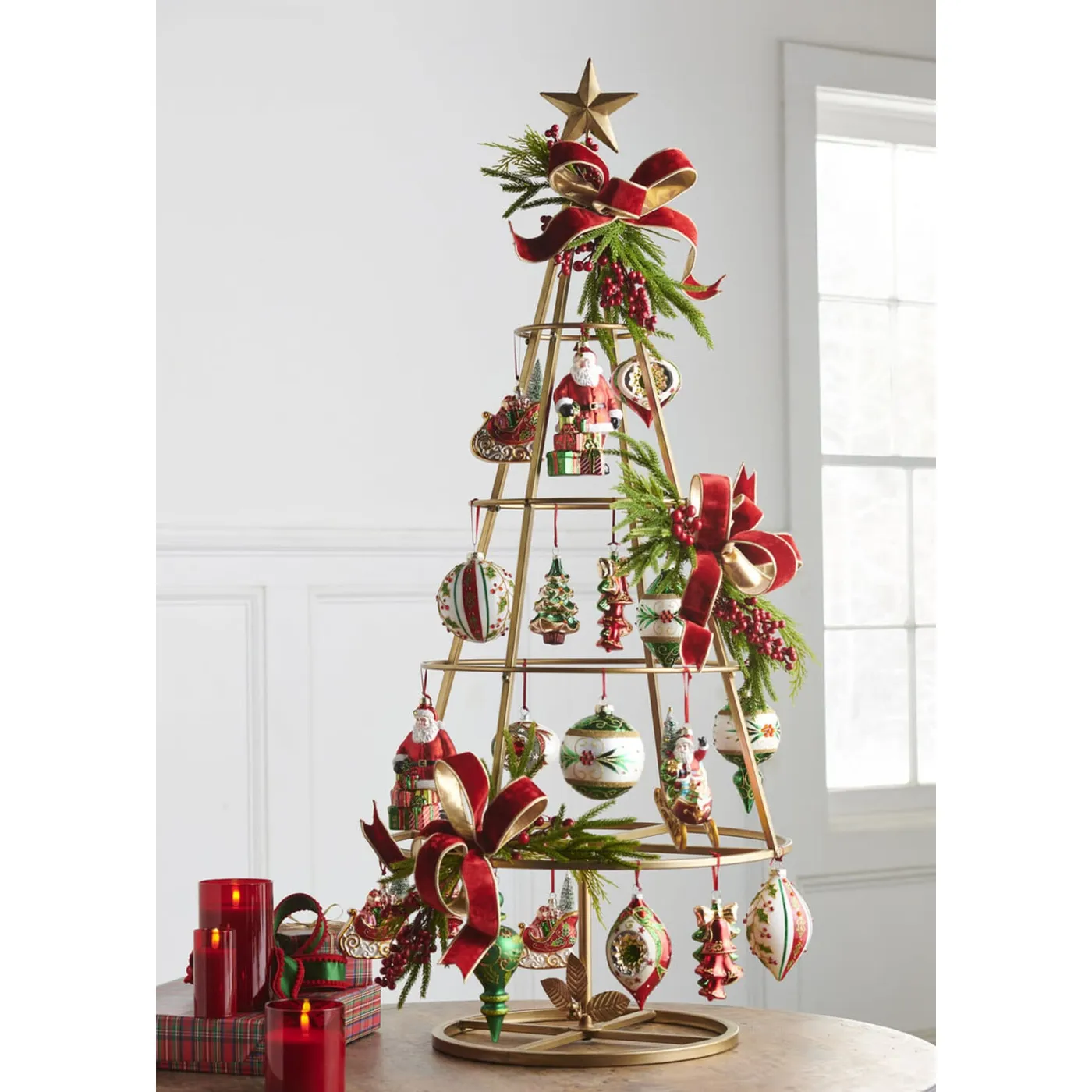
- Fill the bottom tier first — weight matters for stability.
- Hang the largest ornaments on the widest tiers and work smaller going up.
- Tuck evergreen sprigs and red berry picks behind the ornaments on each tier.
- Add velvet bows between tiers, never on top of ornaments.
- Finish with the gold star, then step back 6 feet before adjusting anything.
Time: 45 minutes. Cost: $30–$70 plus ornaments you already own.
Ornament display trees are the fastest-growing category in holiday decor, and it’s easy to see why — you actually get to see the ornaments you paid for instead of burying them in branches. They’re also the answer for apartments, dorms, and anyone with a toddler who treats the big tree as a climbing wall.
28. Glossy Red Cherry Ornaments With Glittery Green Stems
Cherry ornaments are charming and wrong in large numbers. One or two food-shaped ornaments on a tree is a wink; twelve is a theme; and a tree full of novelty shapes loses every bit of its rhythm. Cap it at three novelty pieces on a 7-foot tree, and place them at different heights so they read as finds rather than a collection. Grouped together, they look like a set you bought; spread apart, they look like things you found over time.
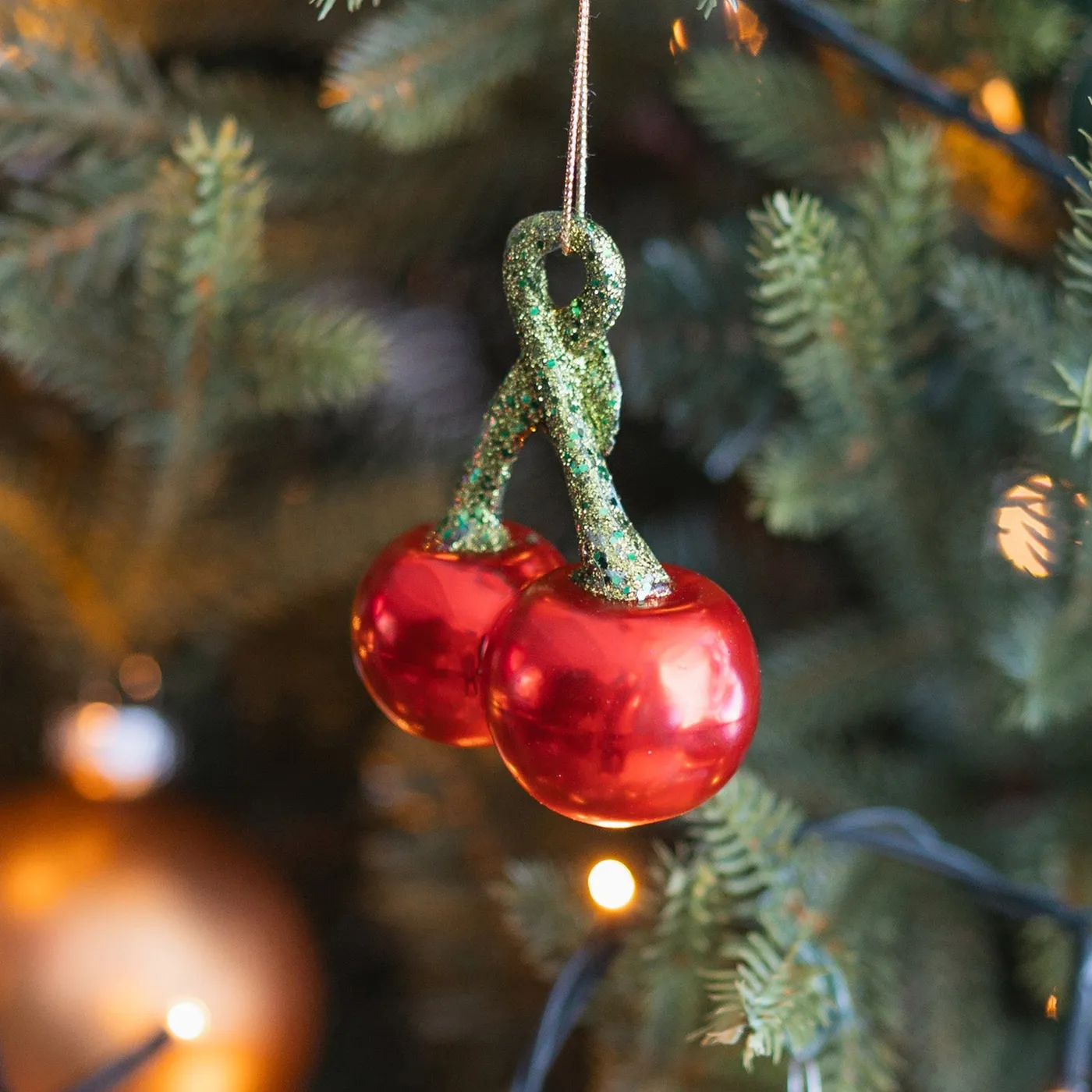
Glossy red finishes are the hardest to keep looking new. They show dust, fingerprints, and micro-scratches, and they can craze in a hot attic. Wrap each one in tissue and keep them out of direct sun while stored. If a glossy ornament has gone dull, a microfiber cloth and a breath of warm air brings most of the shine back — skip the polish sprays, which leave a film that attracts more dust.
29. A “Cherry Jam” Jar Ornament That Fools Everyone
- Check the loop rating — food-shaped ornaments are often heavier than they look.
- Confirm the fabric top isn’t glued on; hand-sewn versions last for decades.
- Hang at eye level where guests will actually spot the label.
- Photograph it before you pack it away so you can find a match next year.
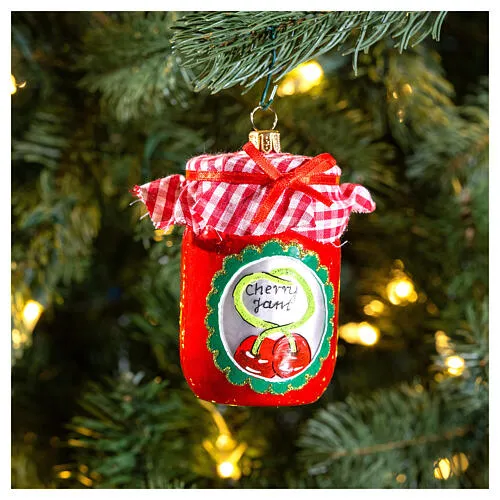
The red-and-white checkered fabric top is the entire joke, and it lands in about a quarter of a second. A plain red sphere with a cherry painted on it is just a red sphere. The checkered lid plus the handwritten-looking label makes your brain complete the word “jam” before you’ve read a thing. That’s a well-designed ornament — shape and fabric do the work, and the label is only confirmation.
30. A Fuzzy Red Tree Styled With Blue Glitter, Black Matte, and a Lollipop
What this eclectic candy-shop look actually costs:
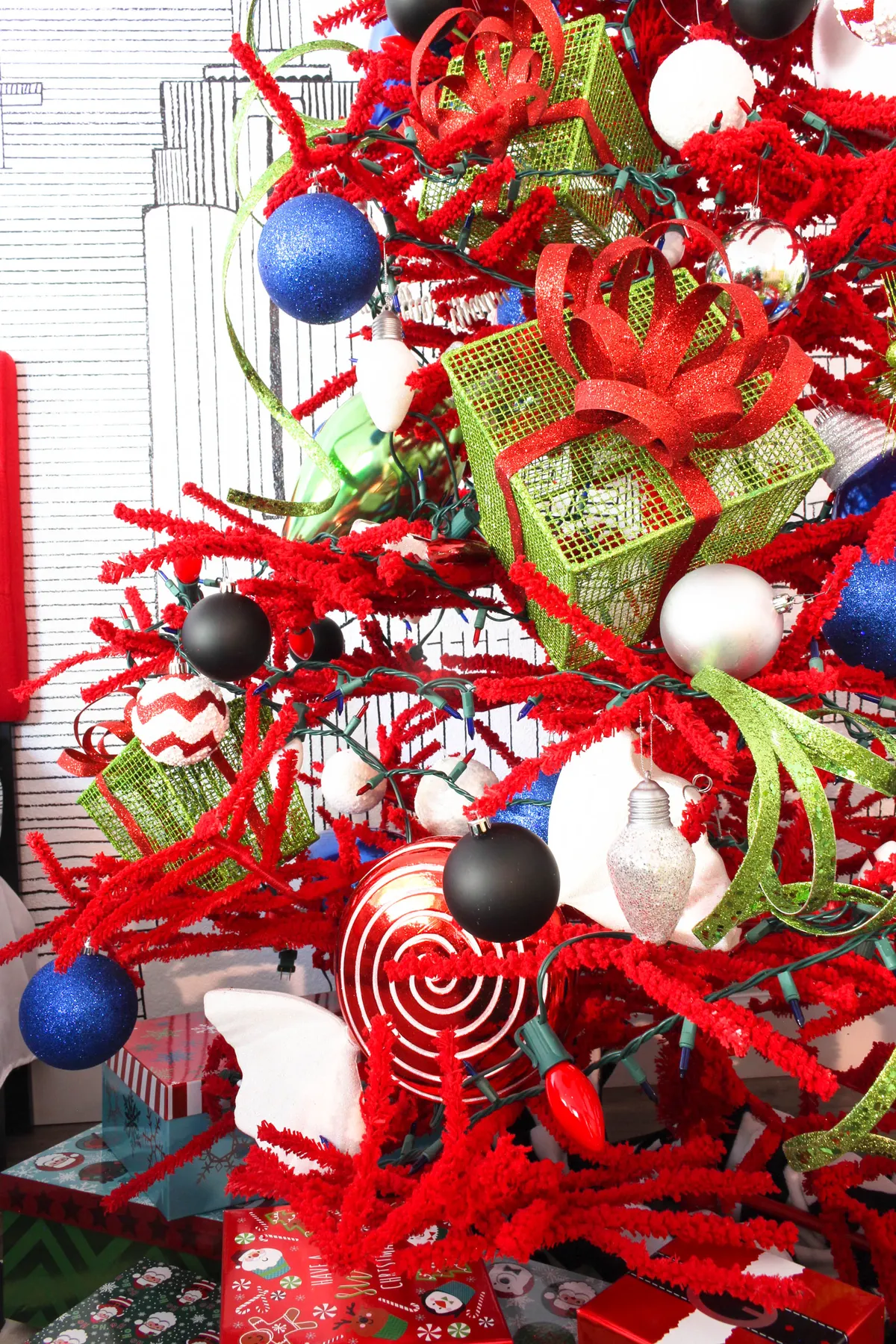
- Red fuzzy 6.5-ft tree: $150–$400
- Glitter blue ornaments (set of 12): $18–$40
- Matte black ornaments (set of 12): $16–$35
- Green mesh gift box ornaments (6): $20–$45
- Spiral lollipop ornament: $8–$15
- Green glitter ribbon and mixed string lights: $20–$40
Total: $232–$575
Budget version: start with a standard green tree, add a red light strand and a red-and-green ribbon garland, and you keep the candy-shop energy for roughly 45% less.
Fuzzy pipe-cleaner branches are the hardest tree surface to keep clean. They trap dust, pet hair, and stray glitter, and they hate a vacuum brush. A soft brush attachment on low, or a lint roller, is your best tool. Fuzzy branches also flatten where you clip ornaments, so rotate their positions each season and you’ll get several more years out of it.
31. A Densely Packed Fir With Red Berries and Gold Tinsel Sprays
Nobody warns you about the take-down. A tree this densely packed takes two to three hours to decorate and about the same to strip, and if every ornament goes into one bin, you’ll spend another hour untangling in January. Sort as you remove — breakables in one box, soft ornaments in another — and photograph the finished tree before you dismantle it. Next November you will absolutely thank yourself.
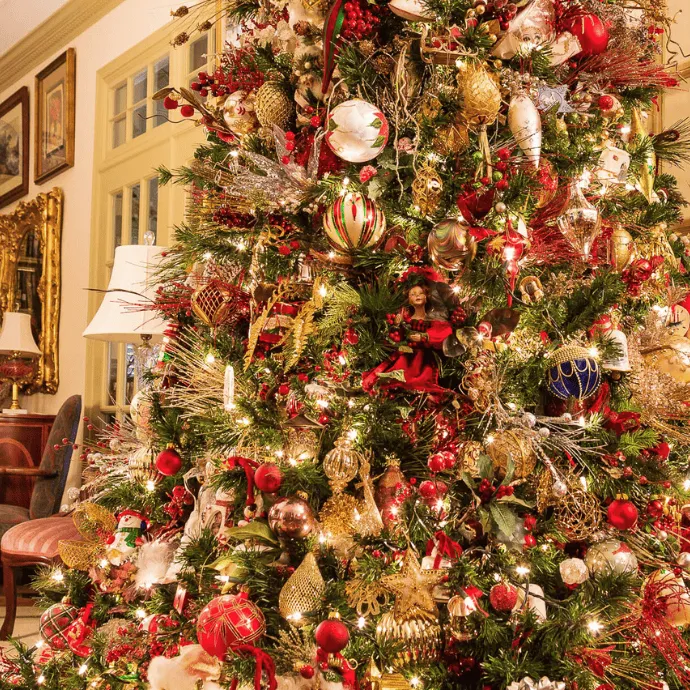
- Count your light strands first — a 7-footer wants around 700 bulbs.
- Weigh your heaviest ornaments and check what a single branch tip will hold; 8 ounces is the practical limit.
- Measure ceiling height minus the topper before you buy anything over 7.5 feet.
- Set a firm budget before you shop, or the “one more box” habit wins by a landslide.
One Red Tree, Thirty-One Ways to Make It Yours
Red is the rare holiday color that holds up in a charcoal-walled loft, a timber lodge, and a rental apartment with beige carpet — you just have to pick your version and commit to it. Start with one idea you can actually pull off this weekend, whether that’s a $40 felt pom-pom tree or a strand of red lights on the tree already sitting in your garage. 📌 Pin your favorite look now so it’s waiting for you when November rolls back around.