
You know the feeling — you’ve saved forty holiday tree photos to a Pinterest board labeled “someday” and you still can’t tell which one is actually yours. Here’s the thing: the look everyone keeps pinning for 2026 isn’t a theme you buy in one trip. It’s a set of habits you repeat.
We spent serious time combing Walmart, Target, Etsy, eBay, and HomeGoods to bring you only what’s worth your attention this year — every idea here lands somewhere between $2 and $4,600, so there’s a version of this for every budget.
Inside, 32 curated ideas spanning traditional red-and-gold, heritage equestrian, rustic-natural, and full opulence — with budget and luxury versions compared side by side so you can see exactly where the money goes. And stay until the end: we break down the most common mistakes that can ruin these looks.
Plaid, velvet, and brass are everywhere in 2026 because we’re decorating for memory rather than for a trend cycle — and the pieces that carry it are the ones you’ll unwrap again next December.
📌 Save this to Pinterest for later — you’ll want to revisit these ideas.
1. Grand Fir With Red Baubles and a Rose Gold Base
Strip everything away — the star topper, the glossy red spheres, the dense warm-yellow string lights — and this tree is still a landmark. What holds it together is the polygonal rose gold base that glows from inside, so the whole thing appears to float instead of sitting on pavement. Without it, the mass of red and gold reads bottom-heavy and slightly cheap. The base does structural work and decorative work at the same time, which almost nothing else in holiday decor manages. If you’re building a tree like this at home, spend your money here first and decorate later.

A tree loaded with red and gold fails when every ornament is the same size. Work in three scales instead: six-inch spheres as the anchor, four-inch as the middle layer, and two-inch picks tucked at the branch tips. Space the big ones about a hand-width apart so the branches can actually breathe between them. Oversized ornaments placed too densely stop reading as decoration and start reading as one solid mass. The same math applies whether you’re dressing a nine-foot fir in a front yard or a six-footer in a corner.
2. Gold and Deep Blue Against Ornate Ironwork
Think of this arrangement as 60% forest green, 25% deep blue, 15% gold. The blue lives in the velvet ribbon woven through the garland and in the ornaments; the gold lives in the leaf picks and in the light itself. Swap the navy for burgundy and the whole entry turns warmer and more traditional. Swap it for black and it goes moody and modern in an instant. Only the proportion really matters — keep your accent color under 30% of what the eye sees and it stays elegant no matter which hue you choose.
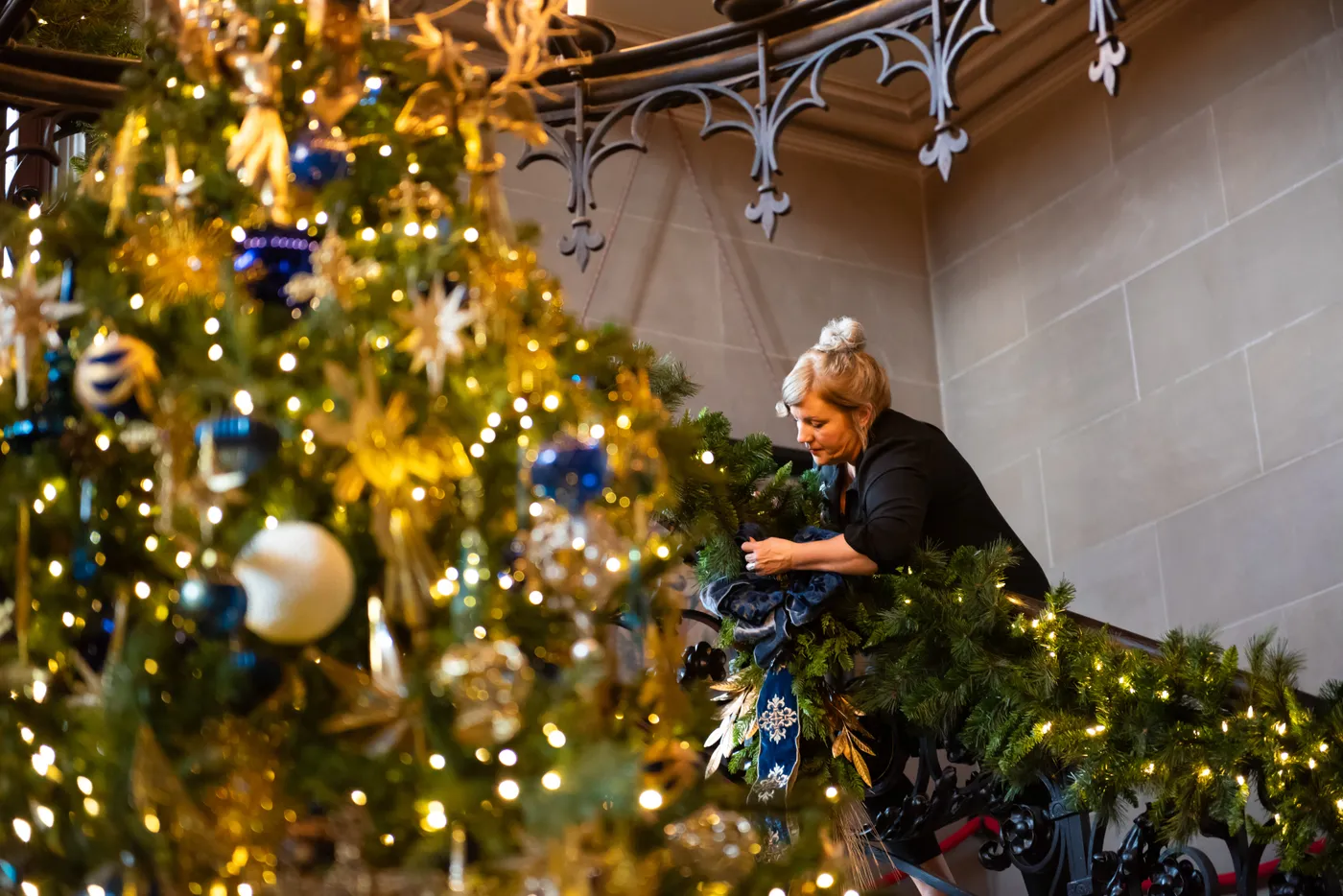
is that the garland doesn’t repeat the tree, it answers it. The tree carries blue ornaments; the garland carries blue velvet ribbon. Same color, different material — that’s how a large space feels considered instead of merely decorated. The black iron railing and beige stone block wall do the rest by giving all that green and gold a slightly weathered, neutral backdrop. Against clean white walls, the identical garland would read fussy rather than grand.
3. Foyer Tree, Knit Ottomans, and a Garlanded Staircase
This look needs height and a wide landing. A foyer with a twelve-foot ceiling and at least ten feet of floor width handles the tree, the round pedestal table, and three chunky knit ottomans without anyone feeling crowded. Under nine feet of ceiling, drop to a 7.5-foot tree and swap the three ottomans for two. If your entry is really a narrow hallway, borrow the garland-and-ribbon treatment from Idea #8 and skip the tree entirely — the staircase does the heavy lifting anyway.
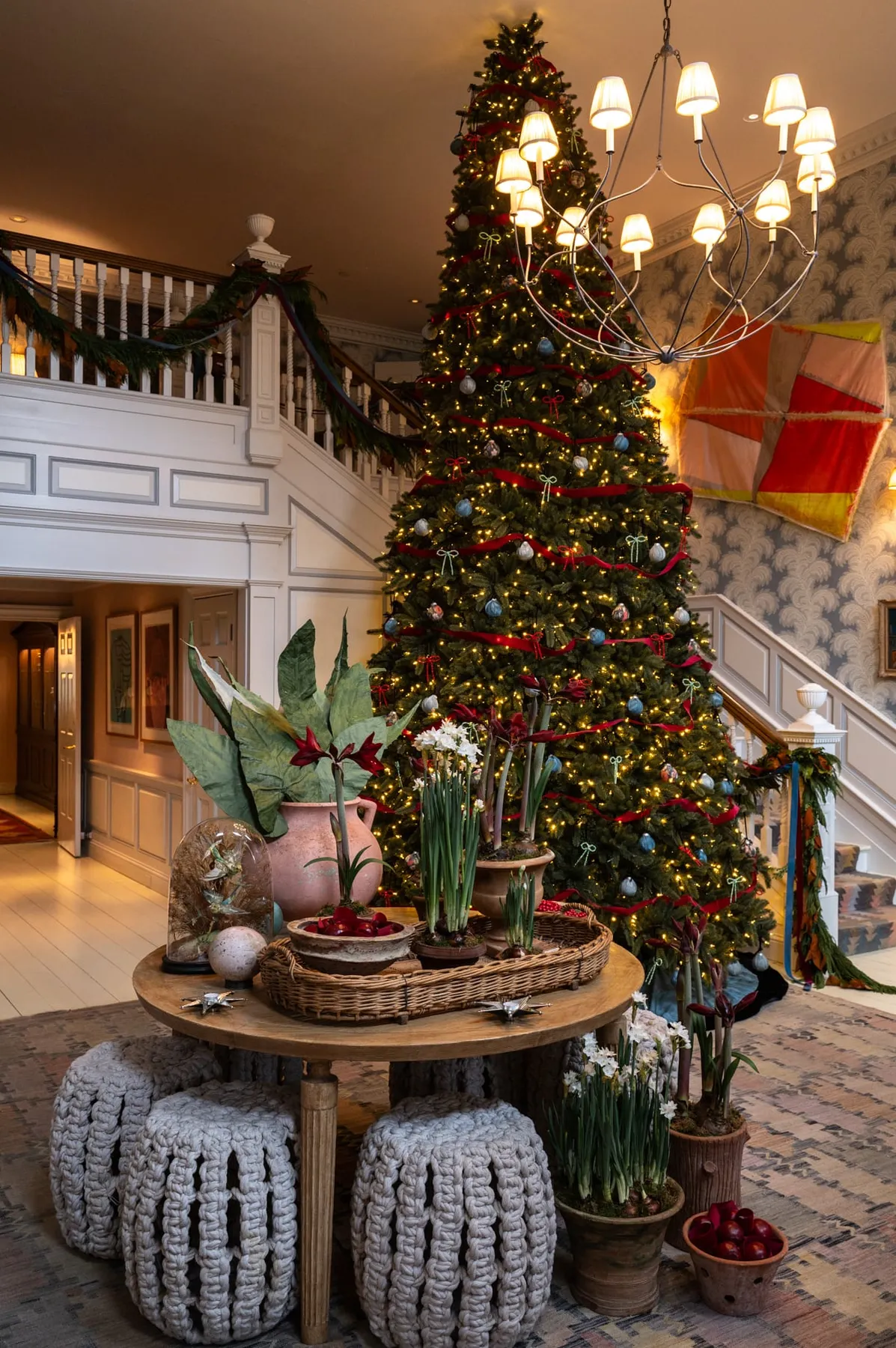
A round pedestal table is the most forgiving shape you can put in a foyer. No corners to bump, no back that has to face a wall, and it reads as a deliberate centerpiece from every doorway in the house. Keep the diameter between 30 and 40 inches, and keep the potted blooms under 18 inches tall so they don’t block the sightline to the staircase behind them.
- Start at the bottom newel and work up, never the other way around.
- Zip-tie the garland to the handrail every 18 inches — invisible, and it never sags.
- Weave ribbon through the greens instead of looping bows on top.
- Add lights last, pushing them in so you see glow, not wire.
- Finish with a single drop at the newel post.
Cost: $60-$140 for a twelve-foot run. Time: about 45 minutes.
4. Embroidered Teddy Bears in Tuxedos and Trench Coats
here is the outfits. Four bears, four completely distinct wardrobes — a black tuxedo, a navy coat, a red coat, a light trench. They are not a matching set and that is exactly the point. Collectible ornaments gain value when they can be lined up and compared; a tree of four identical bears would be charming for one season and forgettable by the next. The stitching is what sells it — stitched lapels, stitched buttons, visible brown fur peeking out under each collar.
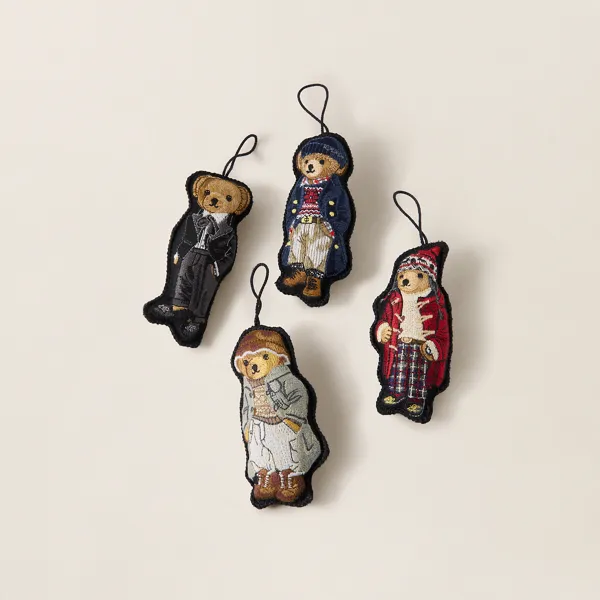
Get the look for less: hand-stitched character ornaments run $18-$45 each at boutiques, but vintage and secondhand versions turn up constantly on eBay and Etsy for $6-$15, and the older ones often have better detailing. Pair each themed bear with two plain brown felt bears from a craft store at about $2 apiece. From three feet away, the eye reads a full collection rather than a budget compromise.
5. A Flocked Tree With Giant Red Spheres
- Flocked nine-foot tree: $450-$1,200
- Giant red spherical ornaments, set of six: $90-$260
- White string lights, 600 count: $40-$90
- Red fabric runner: $30-$80
- Crystal-style chandelier, if not already in the room: $600-$3,000
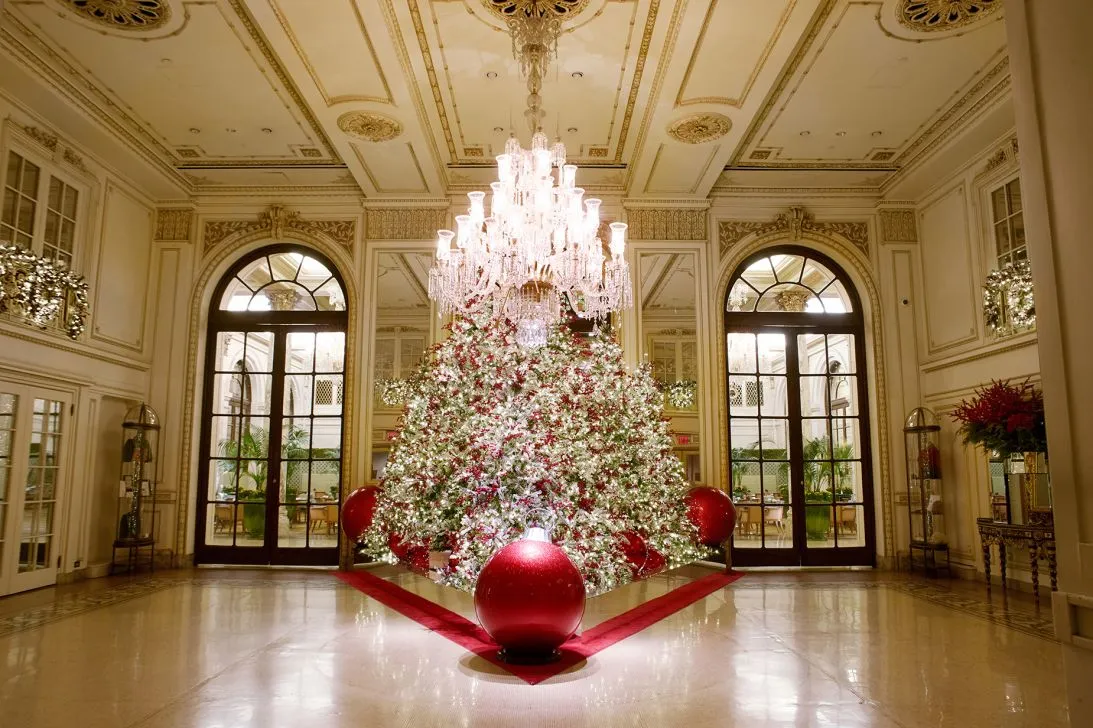
Total: $1,210-$4,630
Budget alternative: skip the chandelier, use a 7.5-foot flocked tree and six 8-inch spheres instead — roughly $380 all in, and it still fills the room.
flocking sheds. Every time you move the tree, set it up, or drag a gift box past it, you’ll find white dust settling on the floor, and a light polished surface shows every speck. Put a solid skirt or a vacuum-friendly rug underneath before you decorate, not after. Flocked trees also can’t be stored in a hot attic without yellowing, so a cool dry basement or closet is the only place they’ll survive to next year.
6. Gold Mesh Ribbon and Glittered Bows, Layered Deep
Gold mesh ribbon should be cut, not looped. Cut 18-inch lengths, fold each one in half lengthwise, and tuck the fold into the branches so the two tails fan outward. Looped bows sit flat against the tree and read cheap from across the room. Cutting gives you real volume, and it lets you place thirty or forty of them for the cost of a single roll of mesh.
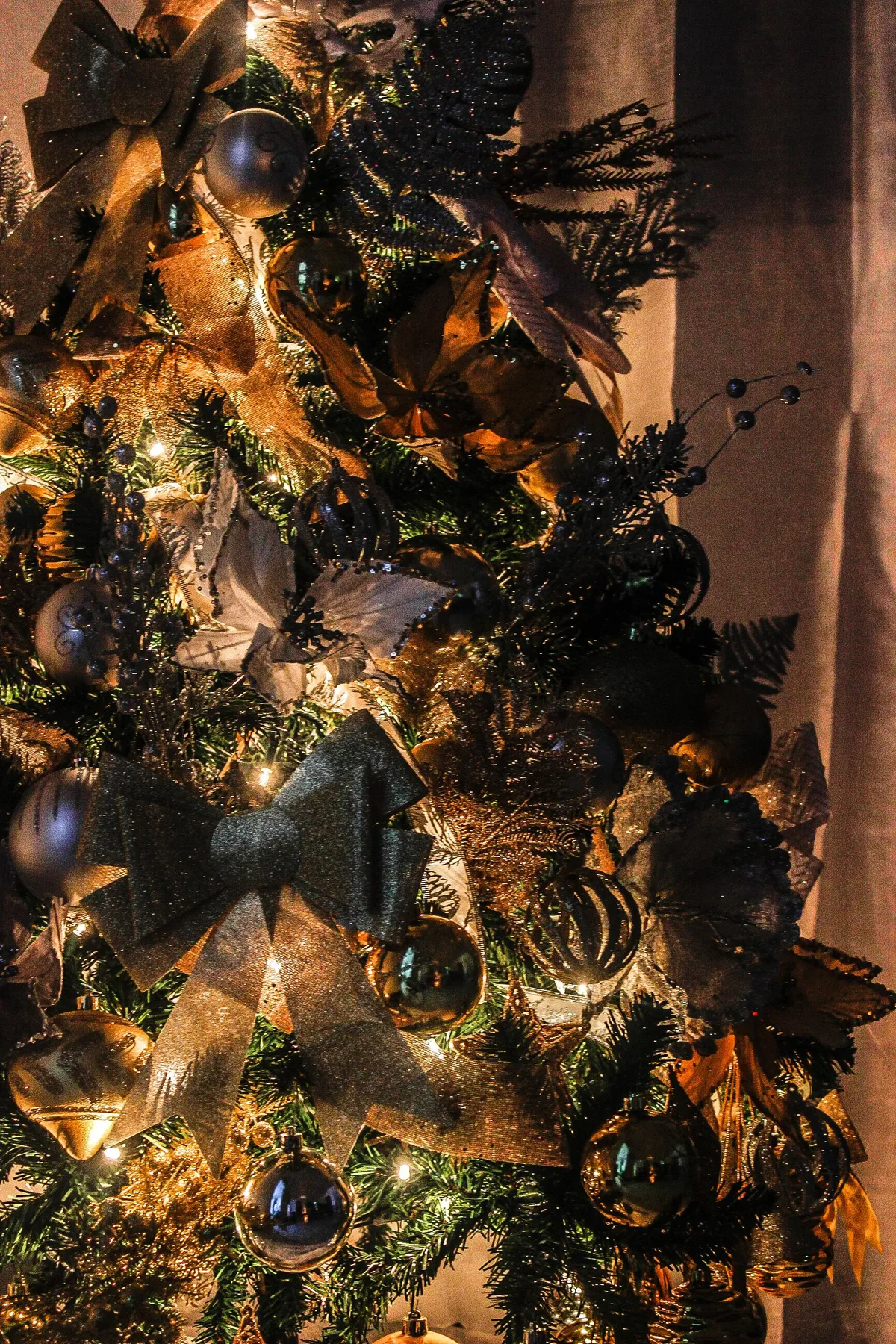
is that the palette is deliberately two-toned, not three. Gold and dark charcoal sit close enough in value that the tree reads as one shimmering mass from the sofa, then rewards you with detail when you walk up close. Warm white lights do the heavy lifting — swap them for cool white and all that gold turns faintly green. That single bulb choice is the difference between opulent and clinical.
- Count your lights: a tree this dense needs about 100 bulbs per foot of height.
- Test your ornament hooks — gold finishes chip against bare metal wire.
- Confirm your ribbon is wired; unwired mesh collapses by week two.
- Photograph the tree lit at night before you finalize ornament placement.
7. The Clock Post, the Marquee RL, and a Lit Evergreen
here reads as 50% evergreen, 20% warm white light, 20% red, 10% gold. The clock post and the illuminated marquee letters are really lighting fixtures, so count them in your illumination budget rather than your decor budget — that’s what keeps the scene from turning into a pile of competing objects. Swap the red for silver and the whole street corner goes frosty and cool. Swap the gold for brass and it gets older, quieter, and much more equestrian.
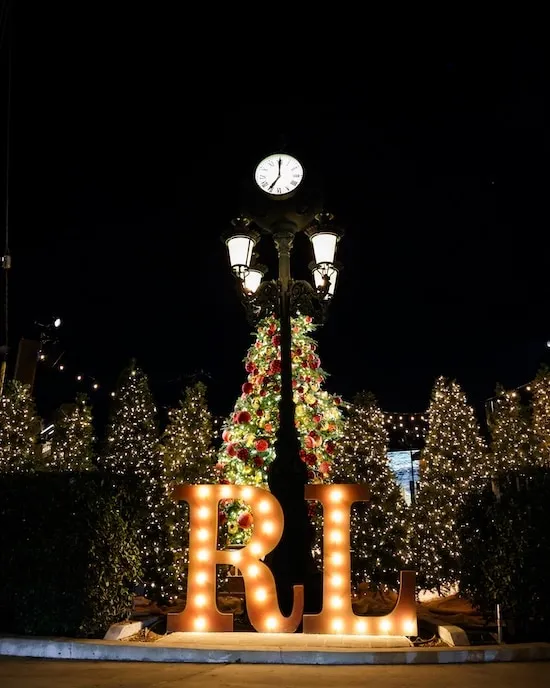
is the clock. A street lamp with a working clock face does something no ornament can: it gives the tree a sense of place. It says street corner, not showroom. Everything else in the frame is decorative; the clock is functional and therefore believable. If you’re recreating this at home, hunt down a vintage post lamp with a clock or a reproduction, and let it stand slightly in front of the tree so it reads as part of the composition rather than an afterthought.
8. Tartan Garland Draped Over a Carpeted Staircase
This garland suits a staircase with at least a 36-inch-wide run and a handrail you can comfortably reach. On a tight switchback stair, a lush garland eats the walkway — stay under 8 inches in diameter there. Wide, straight, open staircases can handle the full treatment with tartan and checkered ribbons. For a smaller entry, look at Idea #3, where the same garland logic plays out on a curving staircase instead of a straight run.
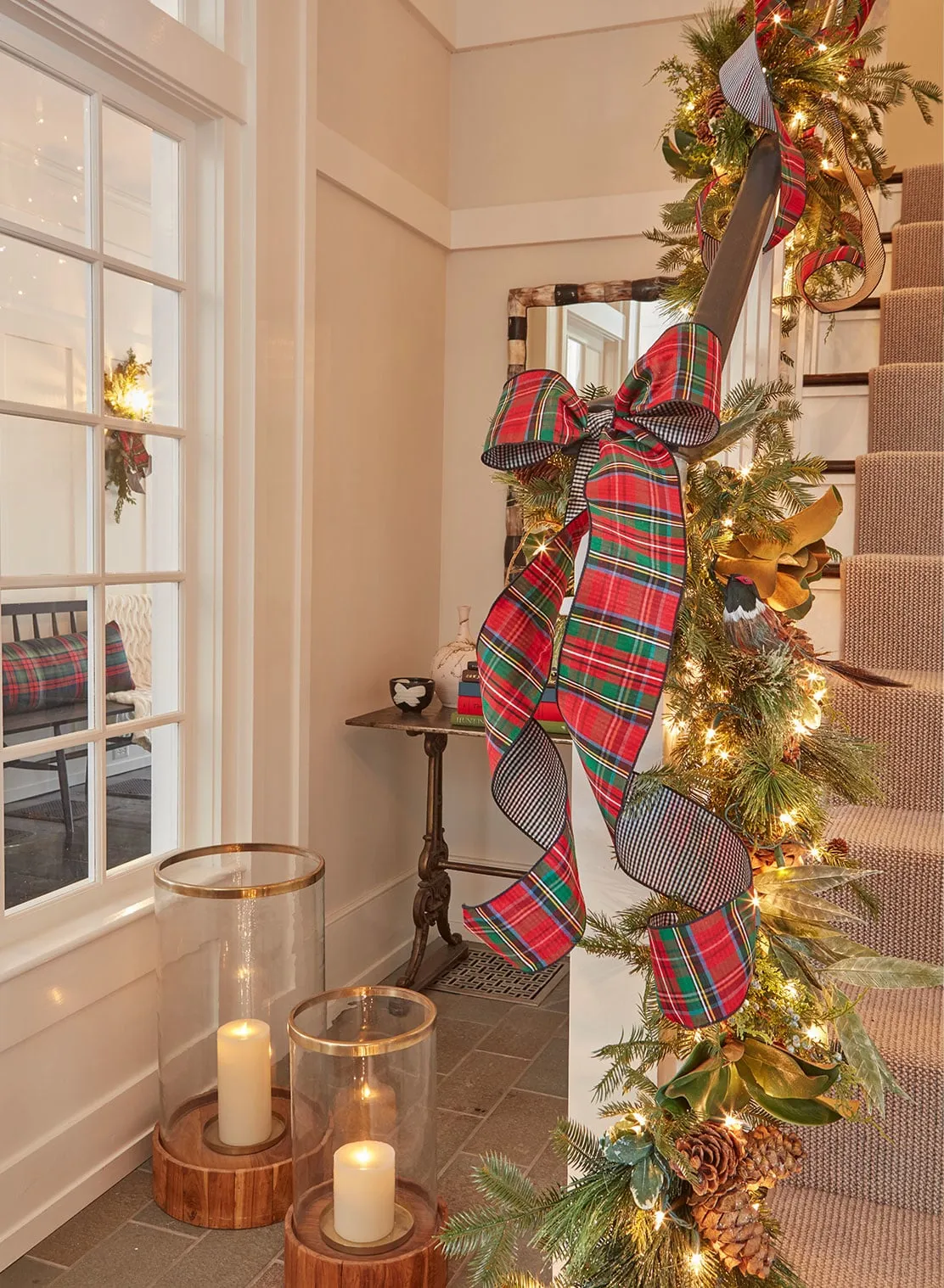
- Measure your tread depth before you buy lanterns — you don’t want them overhanging.
- Choose clear glass so the candle flame reads from across the room.
- Use battery pillar candles with a five-hour timer so you’re not relighting nightly.
- Place lanterns on the floor or on a console, never on a step anyone uses.
- Group them in odd numbers — two on the floor, one on the table.
Cost: $35-$90 per lantern, plus $30-$60 for ribbon. Time: about 20 minutes to style the whole landing once the garland is hung.
9. Fluted Green Bells Tied With Plaid Ribbon
Any hanging ornament should clear at least 12 inches off the floor and sit above knee height on a door. Green fluted bells with pine, berries, and pinecones are heavier than they look — use a 20-pound-rated hook if you’re hanging them on a door, or a wide velvet ribbon so the weight distributes across the trim. Clip the pine needles back from the bow so they don’t crush the ribbon flat over the season.
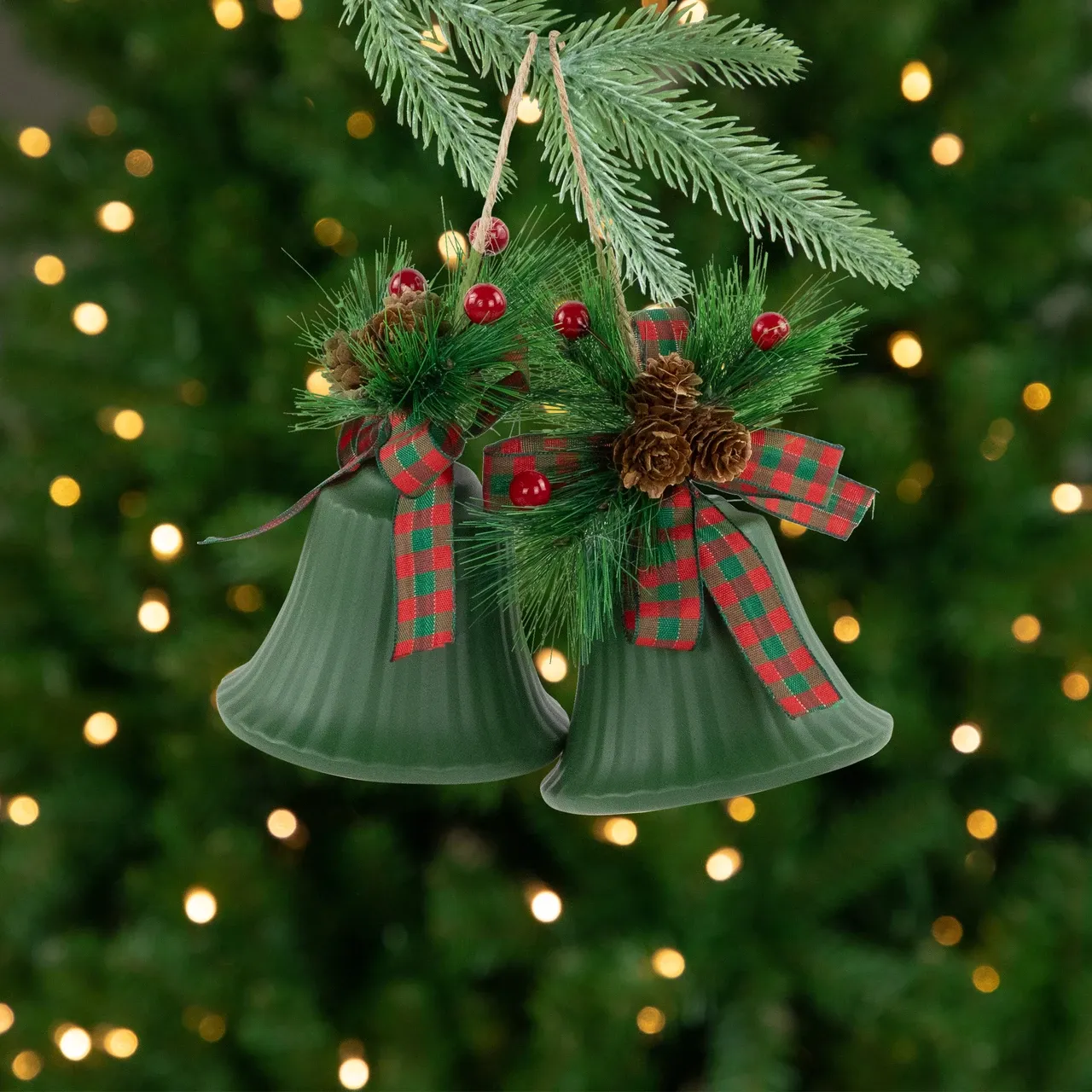
is three textures in one palette. Matte green metal, glossy berries, and matte plaid ribbon all sit in the same red-and-green family, so the eye relaxes instead of hunting. And the soft bokeh behind them is doing as much work as the bells themselves — warm light at low levels makes a $12 ornament look expensive. That’s a photography trick, but it’s a decorating one too: hang ornaments where light pools, not where it’s flat.
Get the look for less: dollar-store bells run $1.25 for two, and a can of dark green spray paint plus a matte sealer gets you the fluted look for about $8 total. Plaid ribbon is $3 a roll at Walmart versus $12 at a fabric store. Real pinecones cost nothing if you gather them in autumn — bake at 200°F for an hour first.
10. Red and Gold Tree Over Terracotta Tile
- 7.5-foot green tree: $180-$650
- Red, silver, green, and gold ornament set: $70-$200
- Warm white lights: $30-$70
- Red and gold patterned ribbon: $20-$45
- Poinsettia picks: $15-$40
- Santa throw pillow: $25-$70
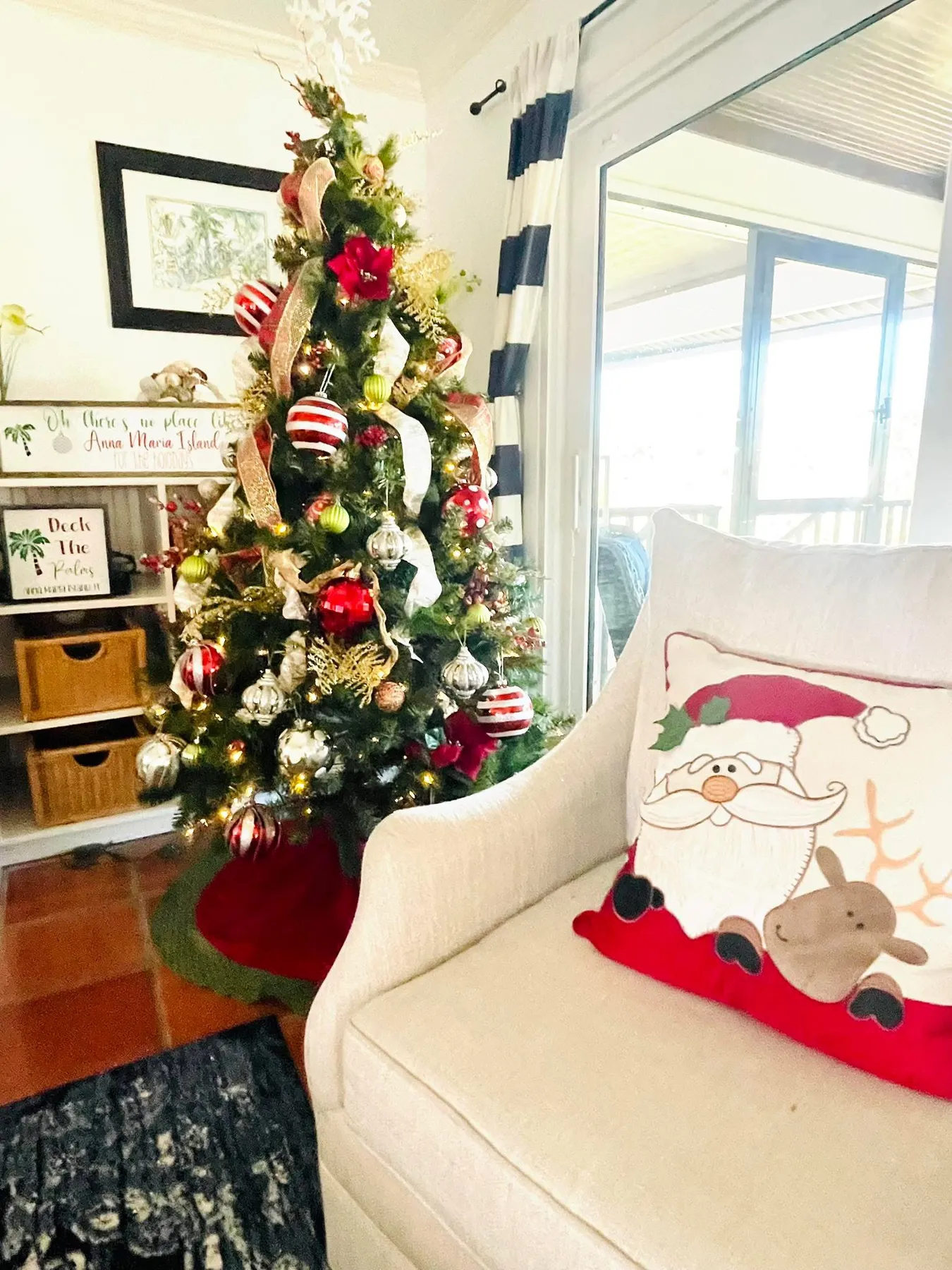
Total: $340-$1,075
Budget alternative: thrift the ornaments and the pillow, then buy the tree used on Facebook Marketplace in mid-November — about $120 all in, and nobody walking past will know the difference.
terracotta tile plus a tree stand equals scratched floors. Terracotta is softer than porcelain and scuffs easily, so put a felt pad or a rubber mat under the stand before the tree goes up. A tree parked beside a sliding glass door also sits in constant temperature swings, which dries out real greenery fast — if you’re going live, plan on watering every other day, no exceptions.
11. All-Gold Ornaments Against a Planked Gallery Wall
is the absence of red. A green tree with nothing but gold on it is a quiet, confident choice. It reads less like Christmas and more like a very good winter party. Remove the gold and you have a plain tree; add even one red bauble and you lose the entire effect. Keep the lights warm, and mix spheres with leaf shapes and geometric picks so the gold never flattens into a single shiny texture.
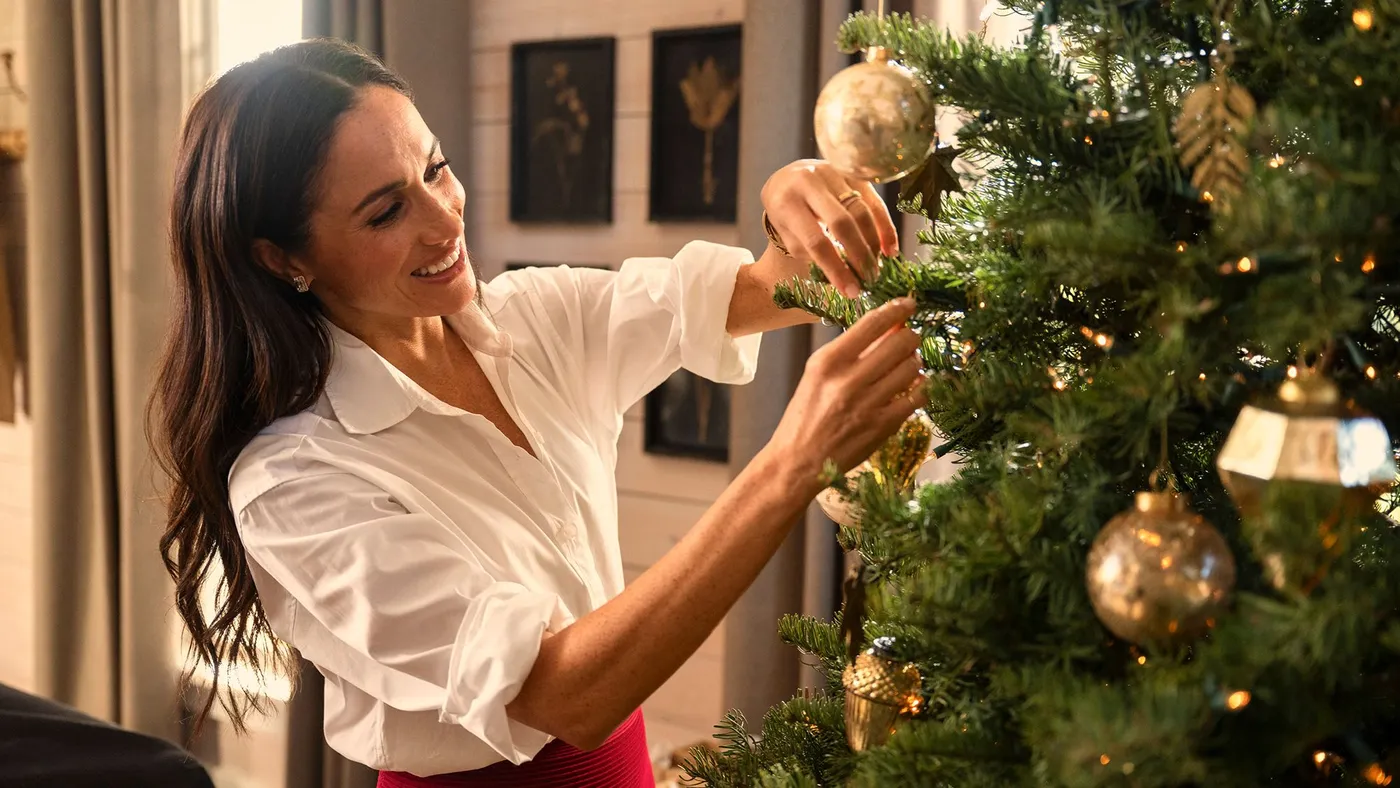
65% green, 30% gold, 5% warm white light. There’s no third color, which is exactly why it holds up against the planked wall and the dark botanical frames. Swap gold for copper and the tree turns warmer and more rustic. Swap in silver and it goes cool and modern. The wall behind matters more than people expect — horizontal planks and dark frames give all that metallic shine something matte to sit against.
12. Gilded Reindeer and Polar Bears at the Holiday Table
A dining table centerpiece should never exceed 14 inches in height if people are sitting across from each other, or you spend the whole meal leaning sideways to talk. Gilded reindeer and a full tree display belong on a buffet or a side table, where they can be tall and theatrical without blocking anybody. If you want the fantasy on the table itself, keep the tallest element under 12 inches and build the arrangement outward instead of up.
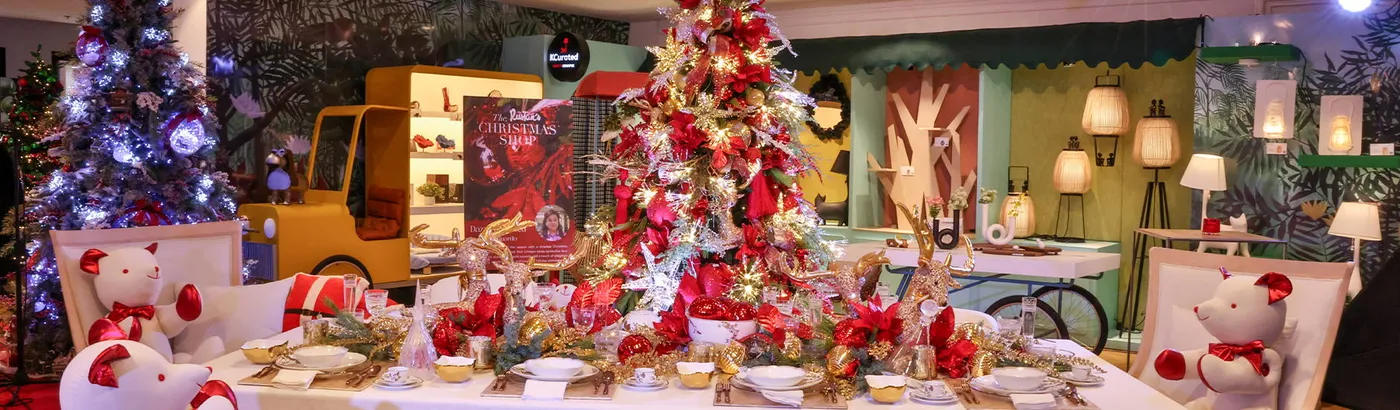
This display needs a formal dining room of at least 14 by 16 feet, with clearance on both sides of the table for the flanking trees and a clear sightline to the backdrop. In a standard 10-by-12 dining room, keep one tree and move everything else to the mantel. For a tighter footprint with the same opulent energy, the styling in Idea #17 is the better fit.
13. A Blue Stable Door, a Wreath, and Red Berries
is the door color. A light blue stable door against white siding and evergreen is a palette most people would never pick for Christmas, and it’s the reason this entry feels fresh instead of predictable. The red berries, bows, and stacked gift boxes deliver the festive hit; the blue delivers the calm. Swap the blue for a classic red door and the whole entry gets louder and considerably more ordinary.
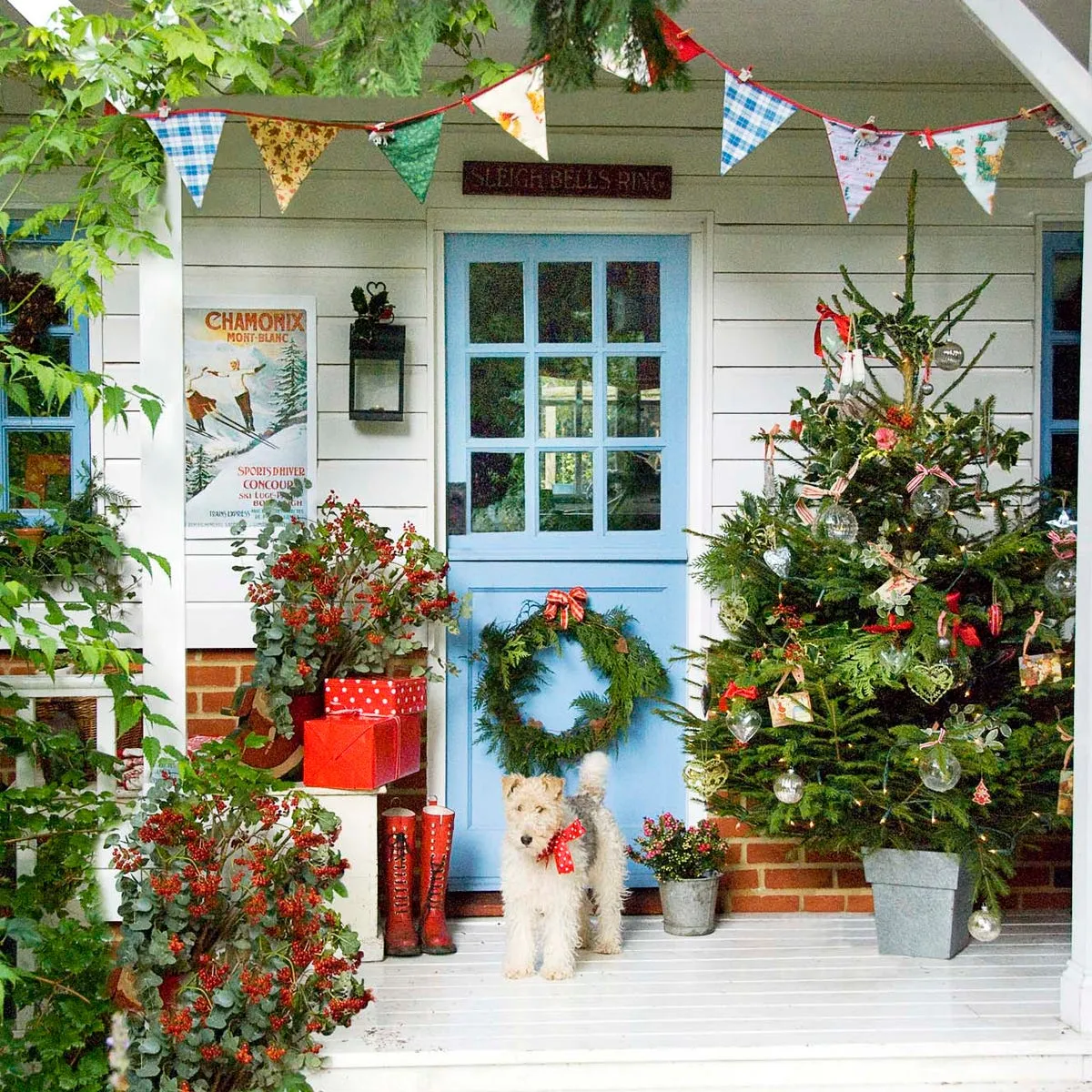
Get the look for less: a $25 artificial wreath plus a $4 spool of red satin ribbon and you’re essentially done. A potted evergreen in a gray planter runs $40-$80 at a garden center in late November and will live for years, unlike a cut tree. Fill out the rest of the porch with thrifted baskets and dollar-store berry picks. Total spend: about $110 for something that reads like a catalog cover.
Mix the proportions this way:
- One tall element — the tree or the potted evergreen.
- Two mid-height berries or planters flanking the door.
- Three small gift boxes stacked unevenly on the step.
- One wreath, centered, with a ribbon that reaches the middle of the door.
14. Green Velvet Sofa Under a Wall of Lit Garland
- String the garland along the wall 30-36 inches above the sofa back so nobody’s head grazes it.
- Use adhesive clips rated for the garland’s weight if you’re hanging fresh greenery.
- Run the string lights through the garland first, then hang the whole thing as one piece.
- Keep a live garland an inch off the wall so the sap doesn’t mark the paint.
- Plug everything into a smart plug and put it on a schedule.
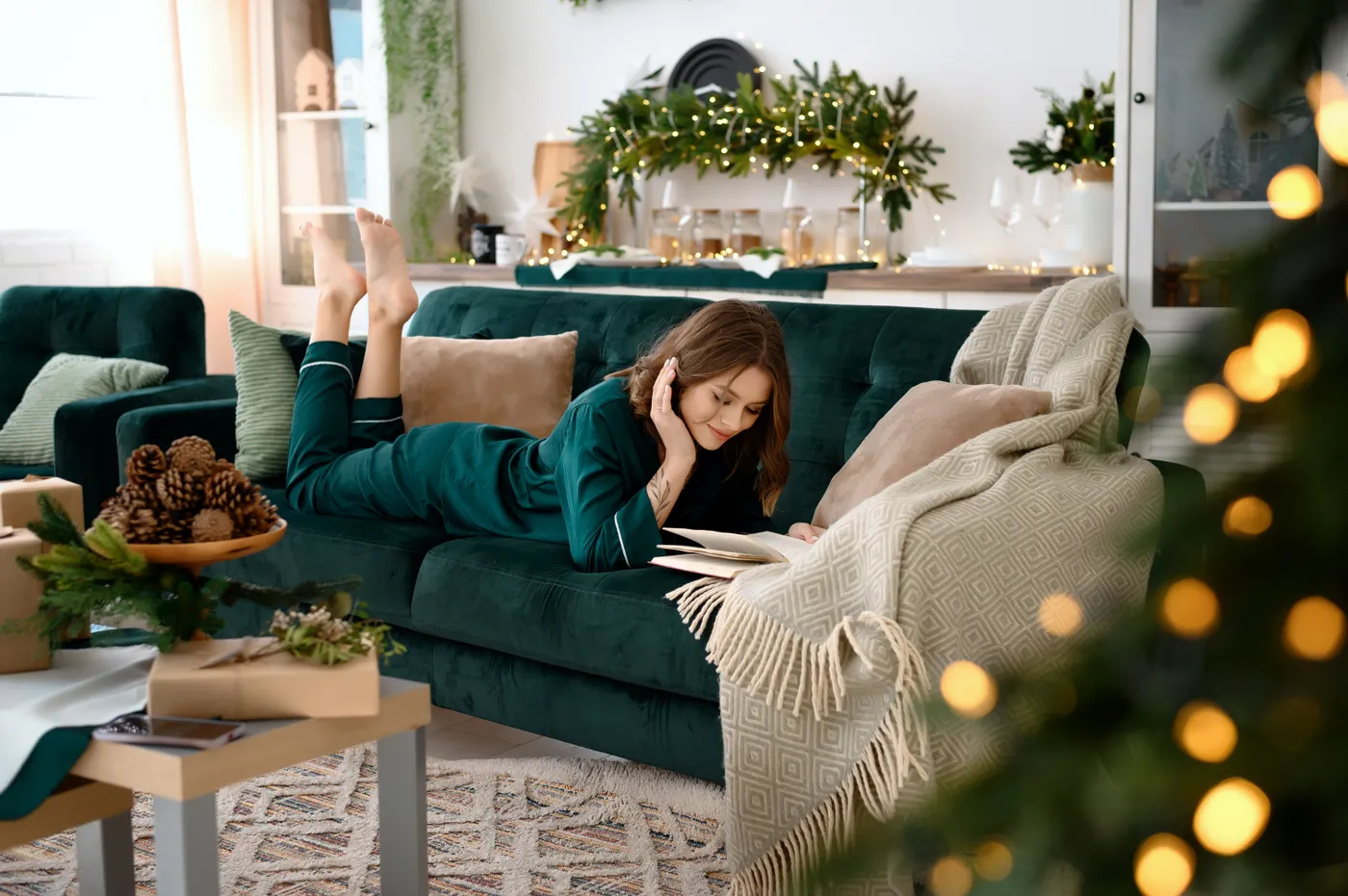
Cost: $45-$120. Time: about 40 minutes, most of it spent untangling lights.
a deep green velvet sofa is gorgeous and it shows everything. Crushed pile, pet hair, and cracker crumbs all announce themselves immediately. Brush velvet weekly with a soft brush in one direction and vacuum with an upholstery attachment only — never a beater bar. If you have dogs, a green cotton-blend slipcover gets you the same look with a fraction of the anxiety.
15. A Kitchen Window Garland in Red, Gold, and White
Garland over a kitchen window should sit on the frame, not above it. Center it on the window trim so it reads as part of the architecture rather than something you taped up in a hurry. Keep the bottom edge at least four inches above the faucet so you can still fill a stockpot, and always run the garland about six inches past the trim on both sides — otherwise the window looks like it’s wearing a hat that’s too small.
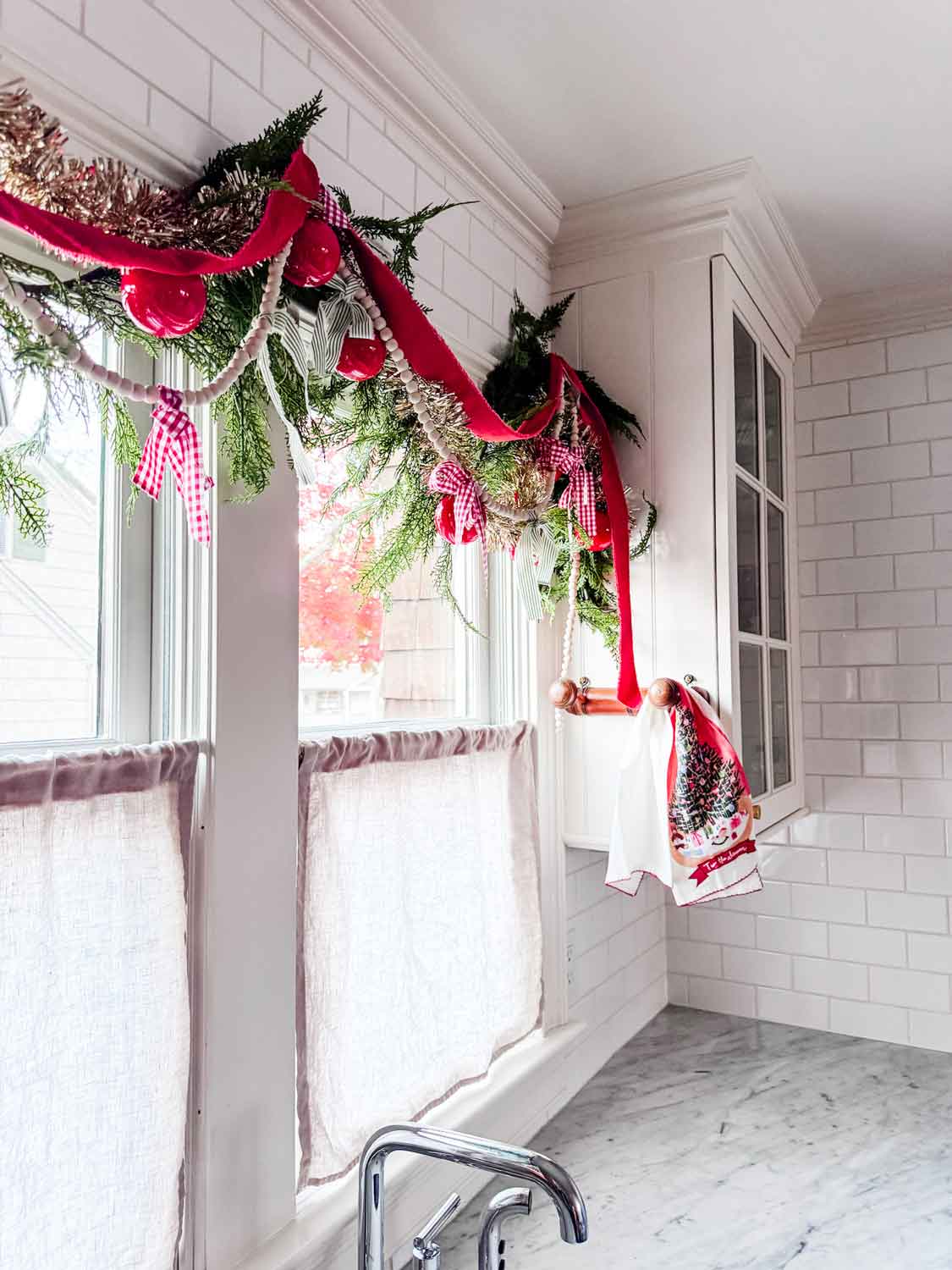
- Twelve-foot garland: $35-$90
- Red satin ribbon: $8-$20
- Glossy red ball ornaments, set of twelve: $15-$35
- Gold tinsel strand: $6-$14
- Beaded white string: $10-$25
- Adhesive clips and floral wire: $10-$20
Total: $84-$204
Budget alternative: dollar-store garland plus ribbon and a bead strand from a craft store — under $30, and the sheers hide the cheap stems.
70% evergreen, 20% white from the subway tile, curtains, and marble, 10% red. That red is doing a lot of work with very little material — a few ribbons and a dozen balls. If your kitchen already has warm wood or cream cabinets, hold the red at 10% and let green and white carry it.
16. A Gilded Crescent and Star on Flocked Branches
is the crescent. A single gilded crescent-and-star ornament gives this flocked tree its entire identity. Blue and gold is a classic pairing, but it’s usually executed with a full set of matched baubles. Here, one unusual shape in aged gold does the work of a dozen. If you’re collecting slowly, this is the kind of piece to buy first and build the rest of the tree around.
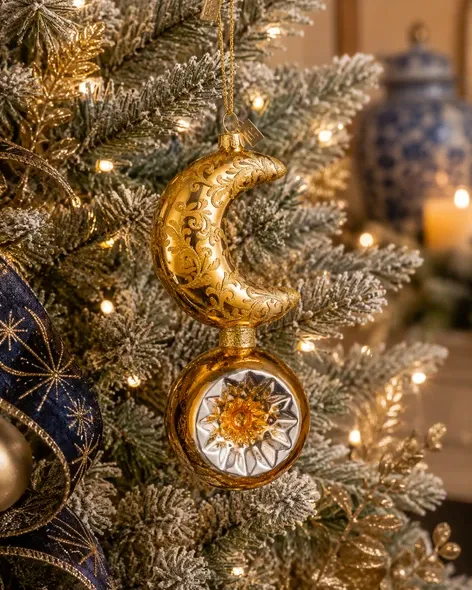
is the scale of the ornament against the scale of the branches. Flocked branches are visually heavier than plain green ones, so anything hanging there needs real size to register at all. The dark blue ribbon embroidered with gold stars ties the navy into the composition without introducing a second competing motif. Warm lights finish it — this palette turns cold and vaguely maritime under bright white bulbs, which is not the mood you’re after.
17. Red Plaid Ribbon and a Berry-Dressed Mantel
This is a mantel look for a room with a nine-foot ceiling or higher, because a flocked tree this full plus a mirror-topped mantel needs vertical room to breathe. On an eight-foot ceiling, drop to a 6.5-foot tree and lean the mirror instead of hanging it. If your mantel runs under five feet wide, skip the berry garland entirely and use a single asymmetrical spray on one end. Readers short on space should also check Idea #27 for a compact version of the same red-and-green language.
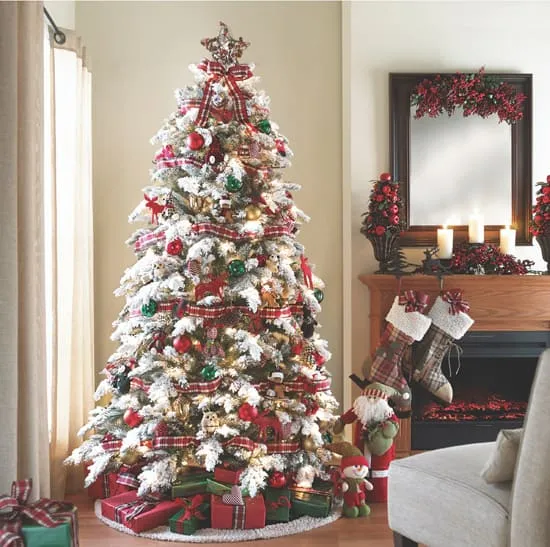
When a flocked tree and a decorated mantel share a wall, give them different ornament sizes. If the tree uses four-inch balls, the mantel should use berries, small sprays, and two-inch picks. Matching sizes on both surfaces flattens the entire wall into one undifferentiated texture, and you lose the sense that a person arranged any of it. Variety in scale is what makes two displays read as one designed room.
18. Buffalo Check, Bandana, and a Bear in Gold
Get the look for less: buffalo check ornaments are everywhere at discount stores in November — $8-$14 for a set of six. Bandana-patterned red balls are a $5 craft-store find. The real trick is the gold sphere with the dressed bear inside; if you can’t locate the branded version, a plain gold ball plus a tiny plastic bear glued to the front gets you ninety percent of the effect for about $3. Nobody is examining your tree from eight inches away.
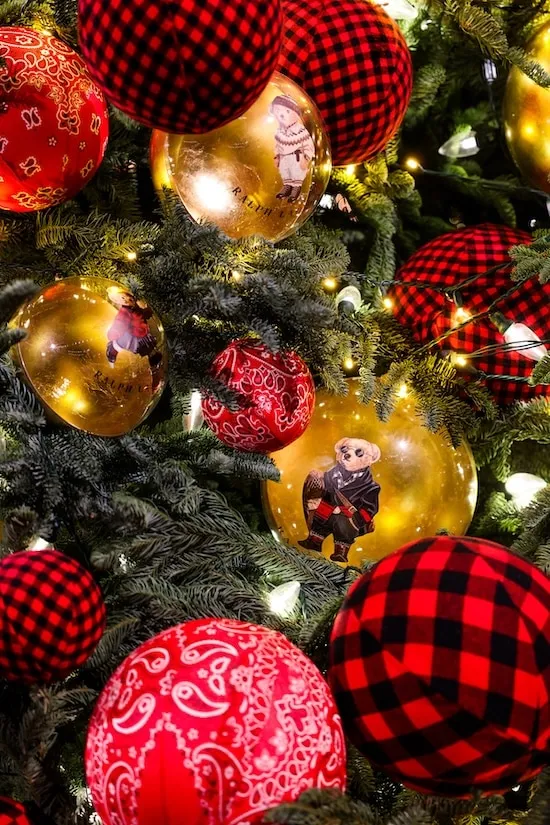
novelty ornaments multiply. Once you start collecting character and pattern pieces, you’ll be at two hundred ornaments before you know it, and a tree that’s too full reads as cluttered rather than generous. Rule of thumb: ten ornaments per foot of tree height, maximum, with the rest rotated out each year. Store them in labeled bins by theme so you can swap a whole collection without unpacking every single one.
19. The Three-Color Rule That Keeps a Tree Collected
is the number three. Every tree that photographs well and still looks good in week five has a three-color limit: one dominant, one secondary, one accent. The moment you add a fourth, the eye stops knowing where to land and the tree reads as a pile of ornaments instead of a composition. Pick your three, write them down, and buy toward them for the rest of the season — including the ribbon and the picks.
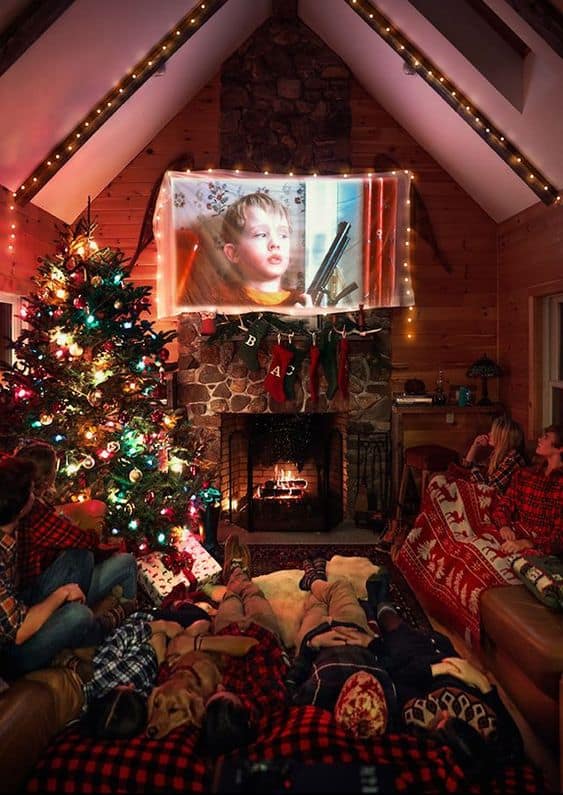
- Choose your three colors and actually write them down.
- Divide your ornaments into those three piles, plus a “doesn’t fit” pile.
- Store the rejects for next year instead of forcing them on the tree.
- Hang the largest ornaments first, spaced evenly around the whole tree.
- Fill gaps with ribbon and picks rather than more balls.
- Step back to the doorway and evaluate from fifteen feet away.
20. Matte Red, Shiny Gold, and a Filigree Showpiece
A dense 7.5-foot tree with red and gold works in almost any room — figure on about 30 inches of clearance on every side. The real constraint isn’t floor space, it’s the ceiling: with a topper, you want at least 12 inches of headroom above the top branch. In a room under 200 square feet, use a six-foot tree and scale your ornaments down one size. Larger rooms can carry an eight-footer, covered in Idea #5.
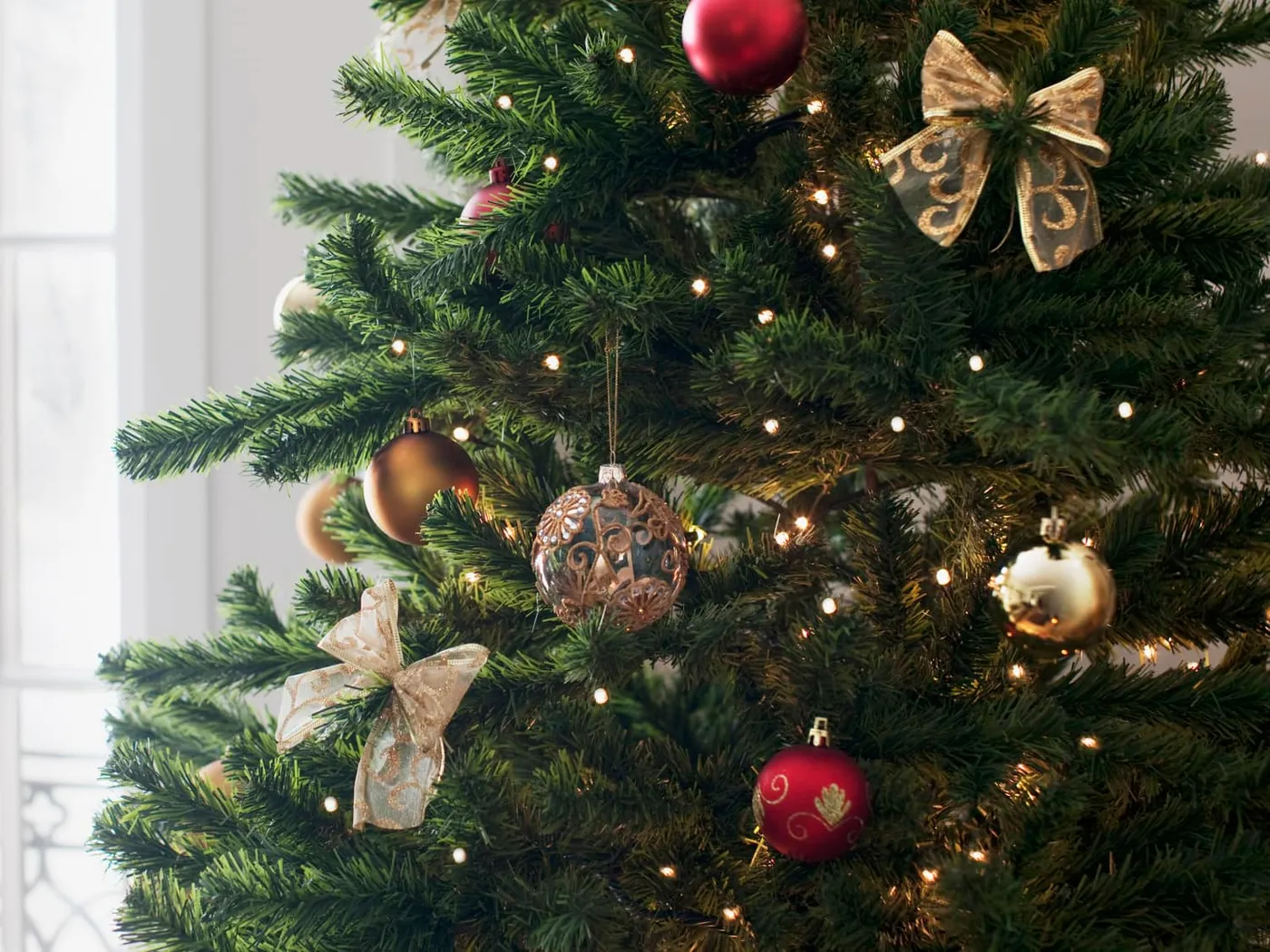
- 7.5-foot dense green tree: $200-$700
- Warm white lights: $30-$70
- Red ornament set, matte and shiny mixed: $45-$120
- Gold filigree statement ornaments: $18-$60
- Gold ribbon bows: $12-$35
Total: $305-$985
Budget alternative: buy the tree used in early December and shop the after-Christmas sales for next year at 70% off.
- Measure ceiling height minus topper clearance before you buy anything.
- Decide where the plug goes — a wall outlet, not an extension cord across a walkway.
- Check your tree’s light temperature against the lamps already in the room.
- Set a hard ornament count so you stop buying in week three.
21. Navy Tartan and Red Stripes by a Big Window
if you have kids, small ornaments and low branches are a genuine hazard. Anything under two inches is a choking risk, and glass balls hit the floor eventually — it’s a matter of when. Put shatterproof ornaments on the bottom third, glass on the top two-thirds, and anchor the tree to the wall with a strap. You still get the whole look; you just don’t spend December vacuuming up glass. A few other things worth knowing:
- Match your gift wrap to the ornaments, not the other way around.
- Keep white gift boxes low and light so they don’t compete with the tree.
- Skip tinsel entirely if there are pets in the house.
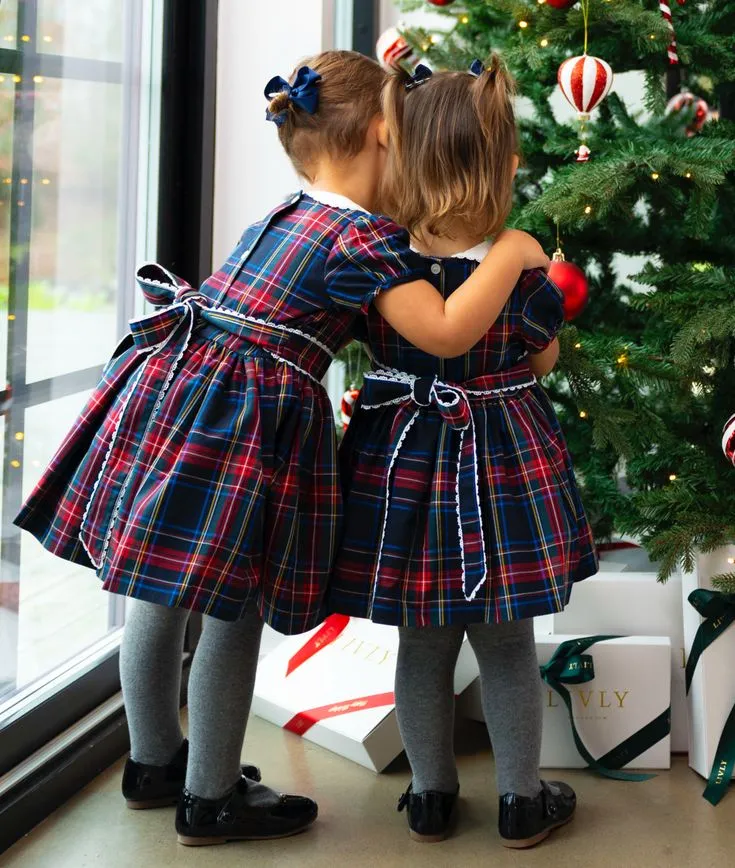
is proportion. Two children in matching tartan against a large dark-framed window and a floor-to-ceiling tree creates a vertical composition the eye genuinely enjoys. The red-and-white striped ornaments echo the navy-and-white dresses without literally matching them, which is exactly why the scene feels styled rather than themed. Repeating a motif in two materials is the oldest trick in the book, and it still works every single time.
22. Warm Lit Evergreens Around a Snowy Pool Deck
Get the look for less: wrapping outdoor trunks in string lights costs roughly $12 per tree for 200 warm white LEDs. You don’t need commercial-grade anything — ordinary outdoor-rated plug-in strands from a hardware store last for years if you store them dry. Cluster three trees at different heights rather than lighting every single one, and you’ll get the same magic for under $60 instead of a few thousand.
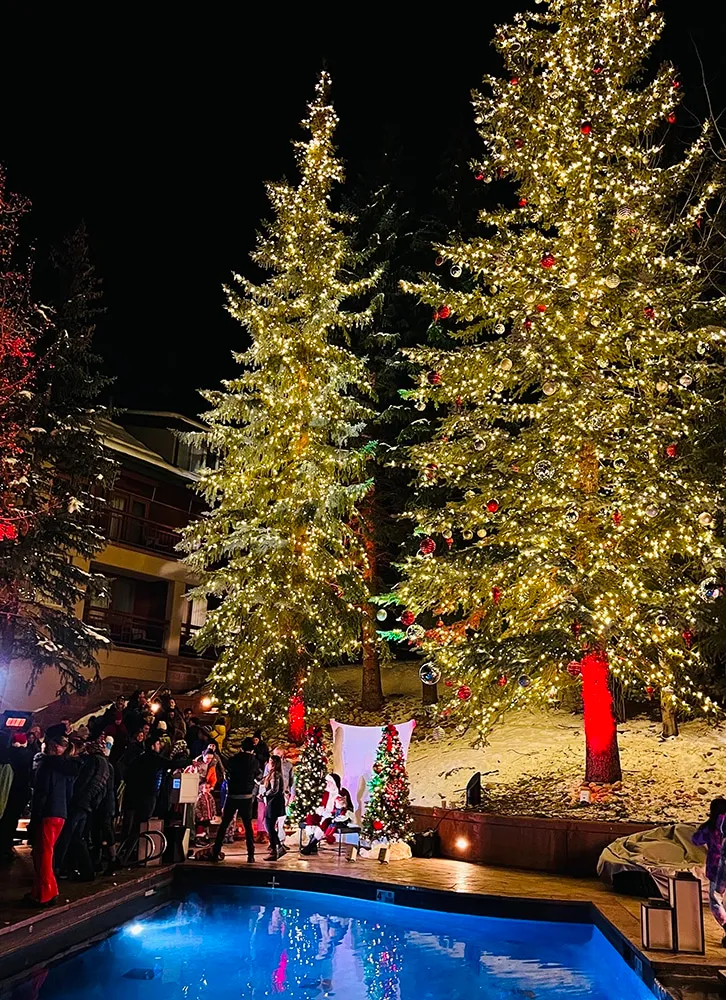
- Start wrapping at the trunk and work upward in a slow spiral.
- Keep the spacing even — about six inches between passes.
- Zip-tie the plug end near an outlet and use a covered outdoor box.
- Run everything off one timer so you’re not out in the snow at ten p.m.
- Test every strand before hanging — one dead bulb can kill an entire run.
23. A Celestial Sun-and-Moon Ornament in Gold and Silver
Novelty glass ornaments break more often than anything else on a tree. Hang them on interior branches rather than at the tips, where they’re protected from sleeves, vacuum handles, and curious pets, and use hooks with a closed loop instead of open wire. Store them in their original box with tissue between each one. A $30 ornament deserves thirty seconds of care in January, and it’ll last a decade instead of a season.
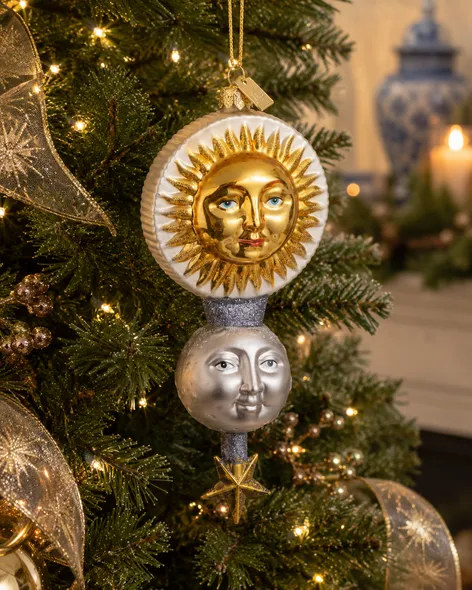
60% green, 25% gold, 10% silver, 5% pale blue. The gold ribbon with the star pattern and the blue-and-white ginger jar in the background both carry the same pale blue note, which keeps the composition from feeling random. Swap silver for pewter and it gets older and more rustic. Swap it for chrome and the whole thing turns sharp and contemporary.
is the pairing itself — a sun and a moon, stacked, in two different metals. Alone, either would be a perfectly nice ornament. Together, they tell a story, and that’s the difference between a decorated tree and a collected one. If you’re buying statement pieces this year, buy them in pairs or trios.
24. A Teddy Bear in Plaid Pajamas With Wooden Buttons
is restraint in the details. Red-and-white plaid pajamas, a red collar, two light wooden buttons, textured brown feet. Every element is doing exactly one job. The gold hanging ribbon is the only shine on the entire ornament, so the eye goes straight to it against the dark green branch. If the bear’s outfit had glitter, or a printed graphic, or a jingle bell, the whole thing would tip straight into souvenir-shop territory.
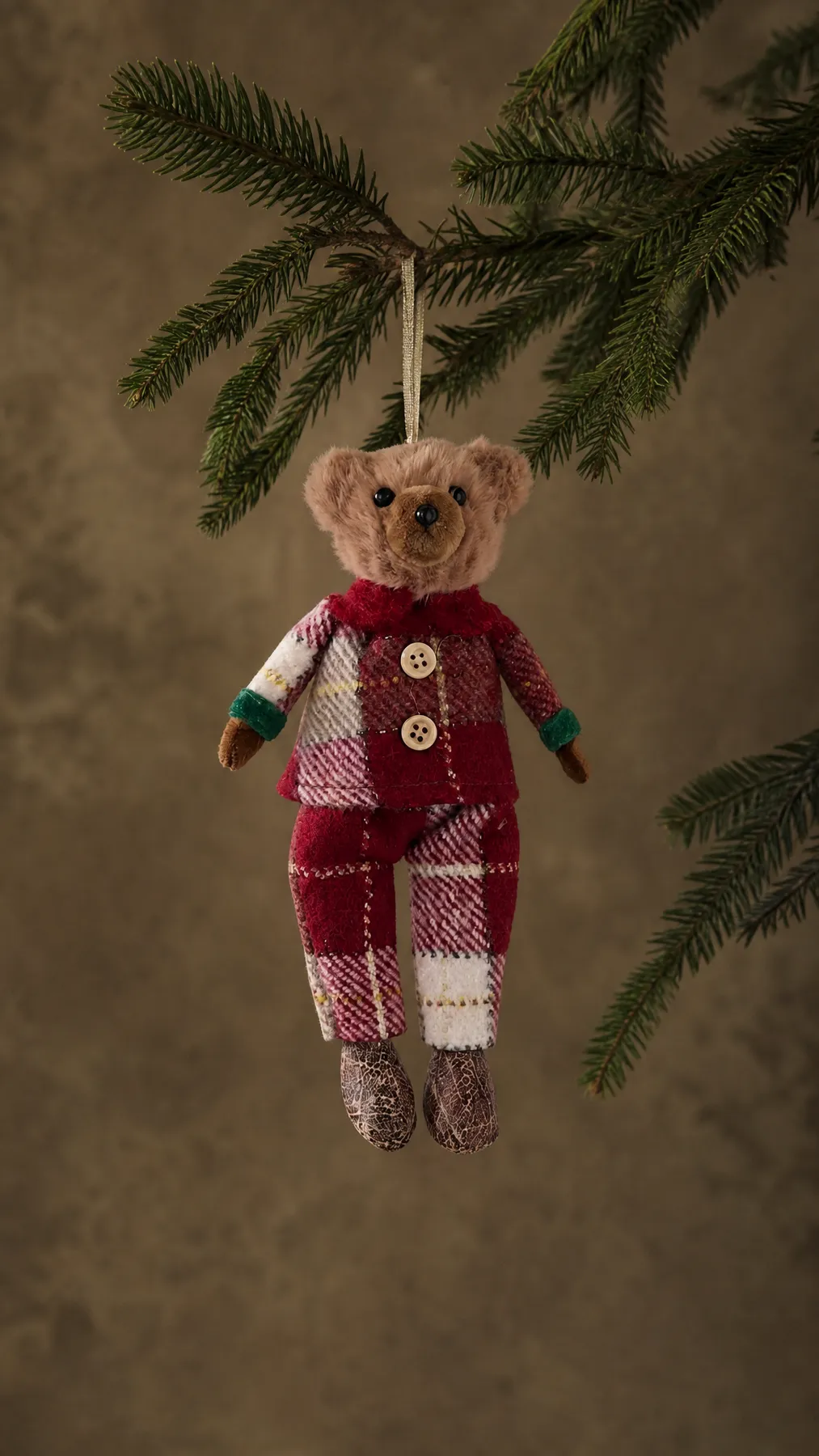
Get the look for less: plush character ornaments show up at discount chains for $4-$9 in November, and they’re often better proportioned than the expensive ones. If you want the handmade look, a plain brown felt bear plus a scrap of plaid fabric and two buttons is a twenty-minute project that costs about $3. Group three or four together on one branch for real impact — a single tiny ornament gets lost in the greenery.
25. Light-Up Ceramic Trees With Gold Star Toppers
light-up ceramic ornaments usually run on button cells, and those die fast if you leave them switched on. Look for ones with a genuine on-off switch rather than a squeeze activator, and buy a spare pack of LR44 batteries — you’ll go through four or five sets in a season. Don’t hang them near a heat vent either. Ceramic and thin wiring both dislike temperature swings, and a cracked ornament is not something you can fix.
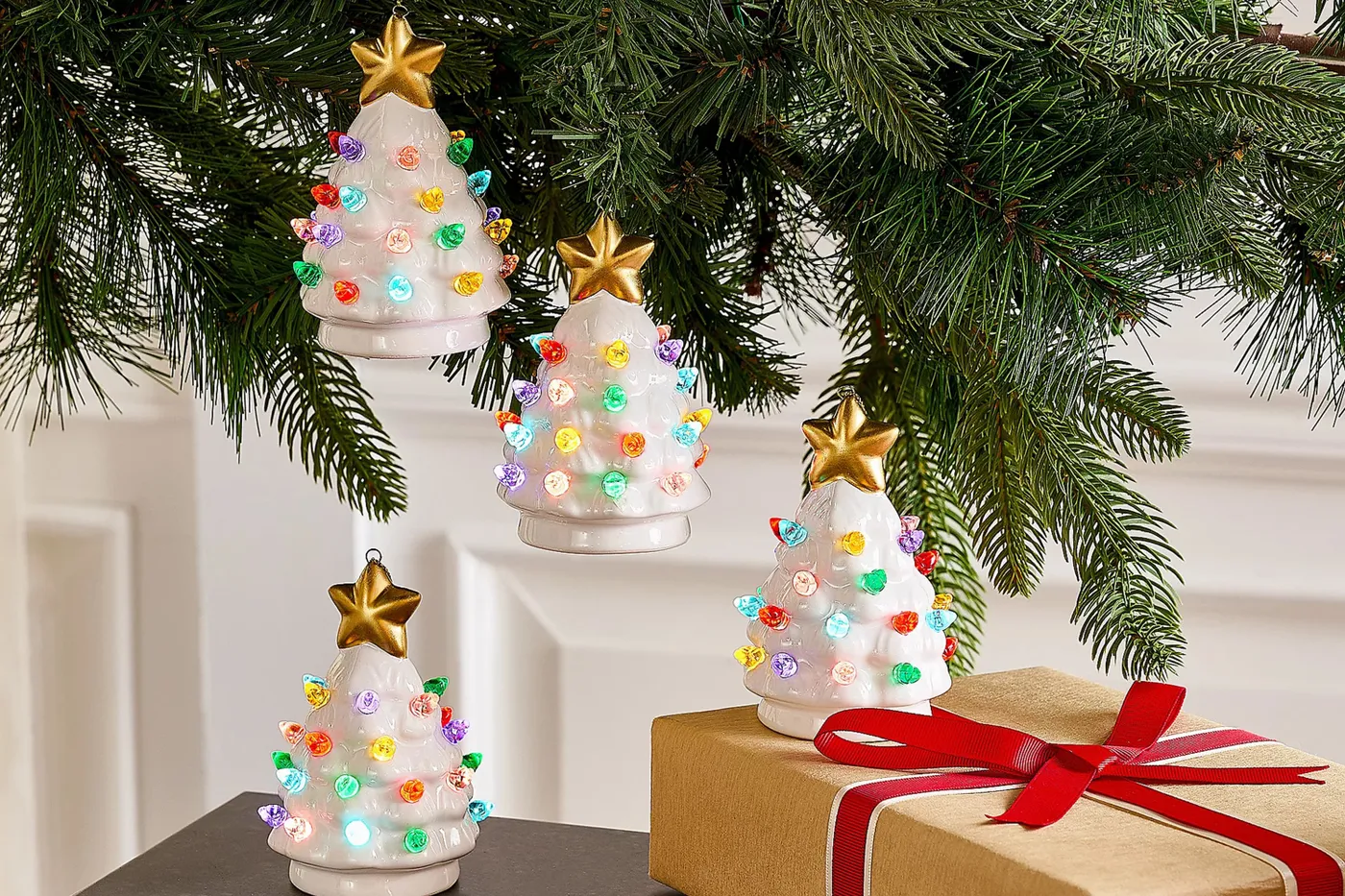
Light-up ornaments read best on a tree six feet or taller, where they can sit at eye level and in the middle third of the branches. On a tabletop tree, keep it to two or three or the whole arrangement starts looking like a retail display shelf. In a small apartment, they’re a genuinely nice alternative to string lights altogether — see the compact styling in Idea #31 for how that plays out on a shelf.
26. A Santa-Hatted Teddy Bear Cookie Jar Centerpiece
- Set the cookie jar at the back of the surface on a stack of two books for height.
- Layer a tree branch or a small wreath behind it to create depth.
- Add one matte red ornament in front for a color echo.
- Place a wrapped gift box to one side to break the symmetry.
- Keep the entire vignette under 18 inches wide.

Cost: $0-$40 depending on what you already own. Time: about 15 minutes.
A character cookie jar is a focal point, not a background object. Give it its own empty wall or a plain surface behind it, and keep competing decor at least a foot away on either side. The fastest way to make a $60 ceramic piece look like a $10 one is to crowd it with three other holiday items on the same twelve inches of counter.
27. Dried Orange Slices and Matte Gold Bells in Evergreen
a dried-orange-and-pinecone wreath looks wonderful for about three weeks, then the citrus darkens, the berries drop, and the pinecones start shedding. Plan to refresh it in early January, or accept the fade as part of the charm. If you want it to survive multiple seasons, use dehydrated oranges rather than oven-dried ones, skip fresh berries entirely, and store the wreath in a sealed bin with a couple of silica packets.
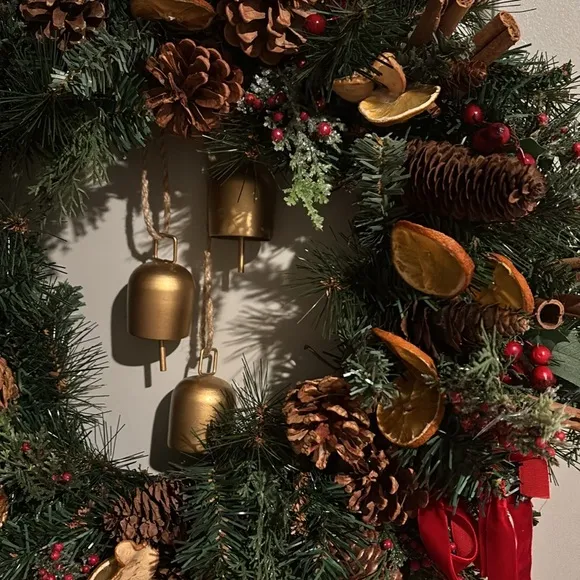
60% evergreen, 20% brown from pinecones, cinnamon sticks, and twine, 12% orange, 8% gold. Only the gold is metallic, which is precisely why the wreath feels natural rather than glitzy. Swap the orange for dried cranberries and it gets tarter and redder. Swap the matte gold bells for black and it turns moody and modern — same structure underneath, a completely different read on the door.
28. Tuxedo Jacket, Jeans, and Cowboy Boots by the Tree
The “unfinished formal” look — a tuxedo jacket with jeans and cowboy boots — has been building for several years, and in 2026 it’s fully mainstream. It’s the same instinct driving the return of heritage American labels and the popularity of mixed-formality holiday photos on Pinterest. Does it last? The silhouette is classic; only the styling is current, which means the pieces you buy will still work in 2031.
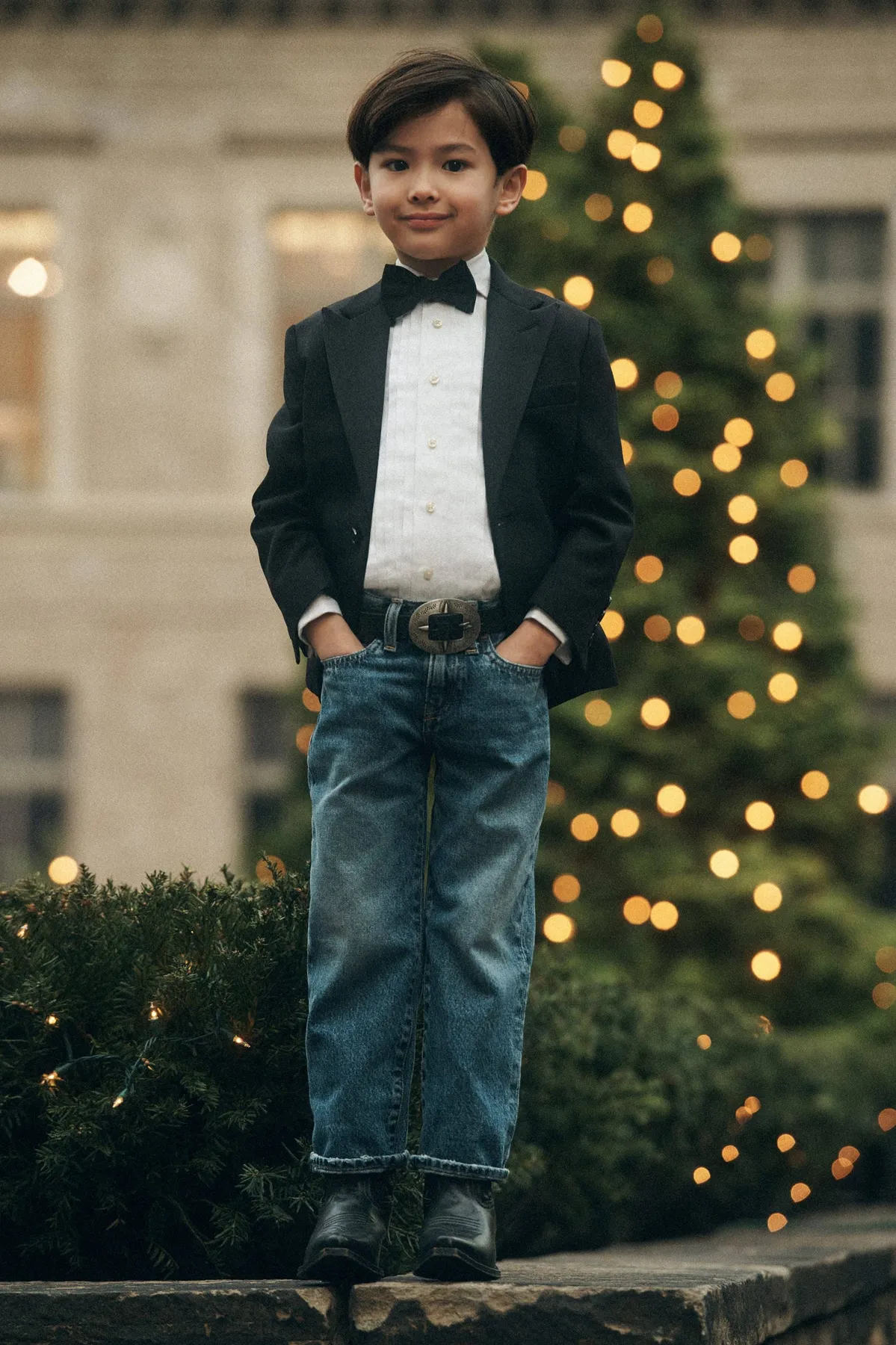
- Tuxedo jacket: $90-$450
- Pleated dress shirt: $35-$120
- Jeans: $40-$150
- Cowboy boots: $120-$400
- Statement belt buckle: $35-$200
Total: $320-$1,320
Budget alternative: thrift the jacket and borrow the boots from a friend — about $120 for the identical effect in photographs.
29. A Gold Stirrup Ornament on Deep Red Velvet Ribbon
Velvet ribbon should be hung with a folded knot, not a bow. Fold a 24-inch length in half, pass the loop behind the branch, pull both tails through, then knot once. It holds better than a bow, uses half the ribbon, and looks considerably more expensive. Wired velvet in a deep wine red is the one ribbon genuinely worth spending $8 a roll on — the cheap stuff goes limp by the second week.
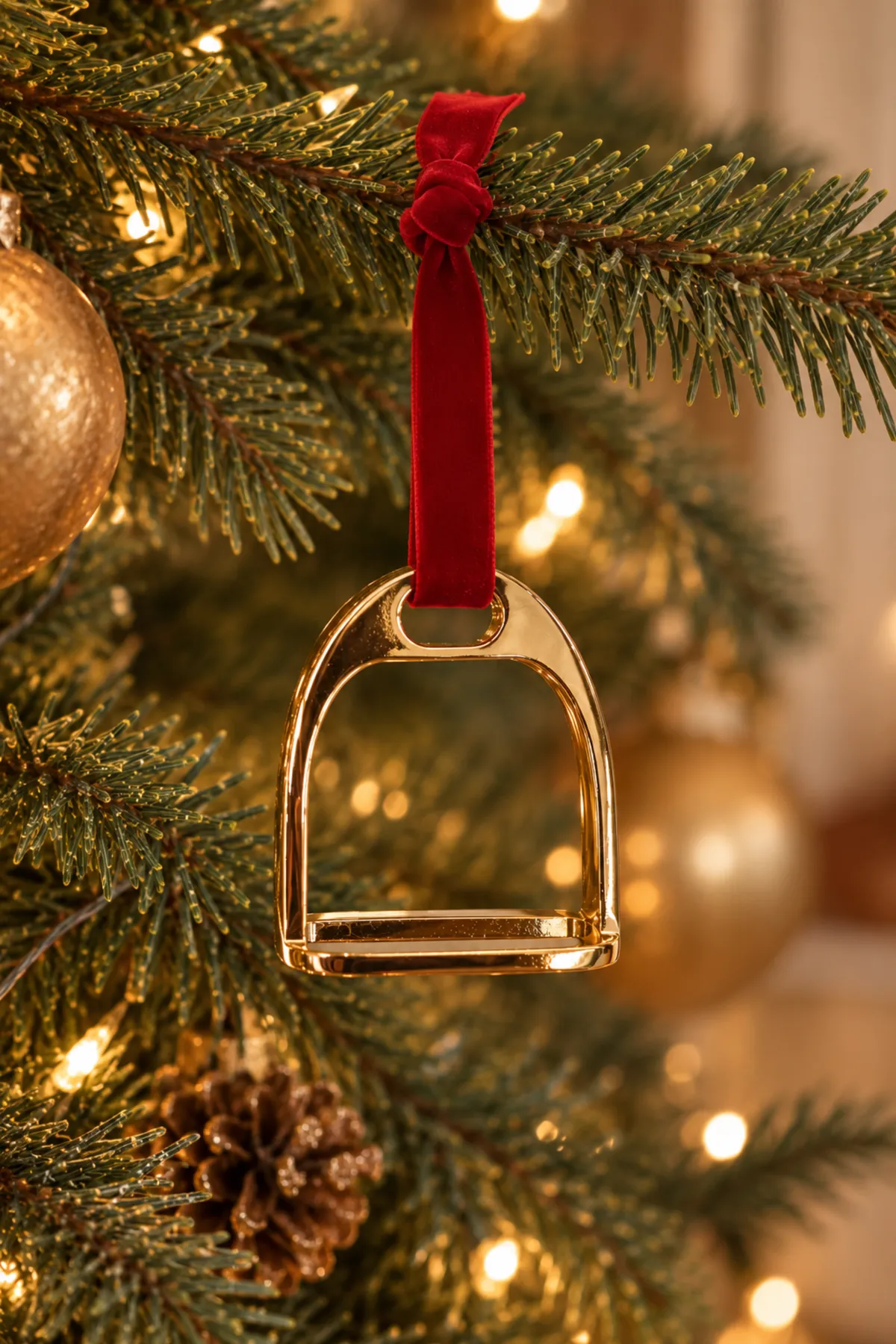
is that the ornament is a piece of tack. An equestrian stirrup in gold hanging on a tree is a small, specific joke that only lands if you commit to it fully. The deep red velvet ribbon and the glittered pinecone around it make the reference feel intentional rather than accidental. Specificity is the entire point — a generic gold sphere in the same spot communicates nothing at all.
30. A Tiered Velvet and Plaid Tree Skirt
A tiered skirt is one of the easiest ways to make a small tree look substantial. On a six-foot tree, a 48-inch skirt pools beautifully; on a 7.5-foot tree, move up to 60 inches. You want the outer ring to extend roughly 10-12 inches past the lowest branches, so the skirt reads as a deliberate ring rather than a puddle. On hardwood, add a nonslip pad underneath — velvet on wood slides the moment anyone bumps the tree.
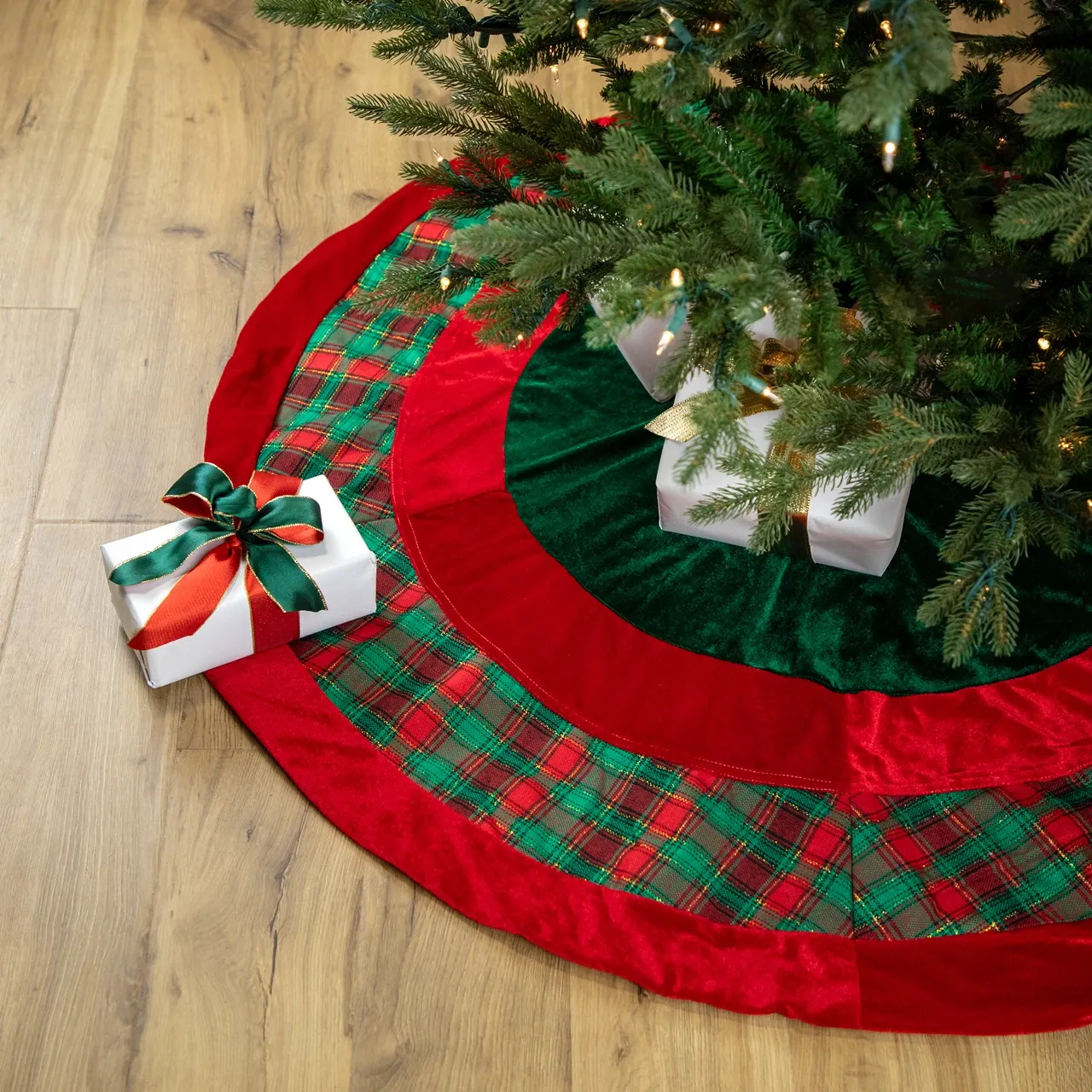
Get the look for less: three yards of plaid flannel, one yard of red velvet, and one yard of green velvet run about $35 total at a fabric store in December — or $15 if you catch the clearance sale in January and save it for next year. Cut three concentric rings and stitch them together. No-sew versions using fusible hem tape hold up perfectly well and take about an hour.
31. A Leather-Handled Tray With Mercury Glass and Antlers
mercury glass and glittered finishes shed. Every time you move one, it leaves a fine dust of silver on your tray and your table. Keep them in a single lined box, never stack them, and dust with a dry microfiber cloth rather than a damp one. Candle soot is the other enemy here — trim wicks to a quarter inch and the cream pillars will stay clean instead of turning gray by New Year’s.
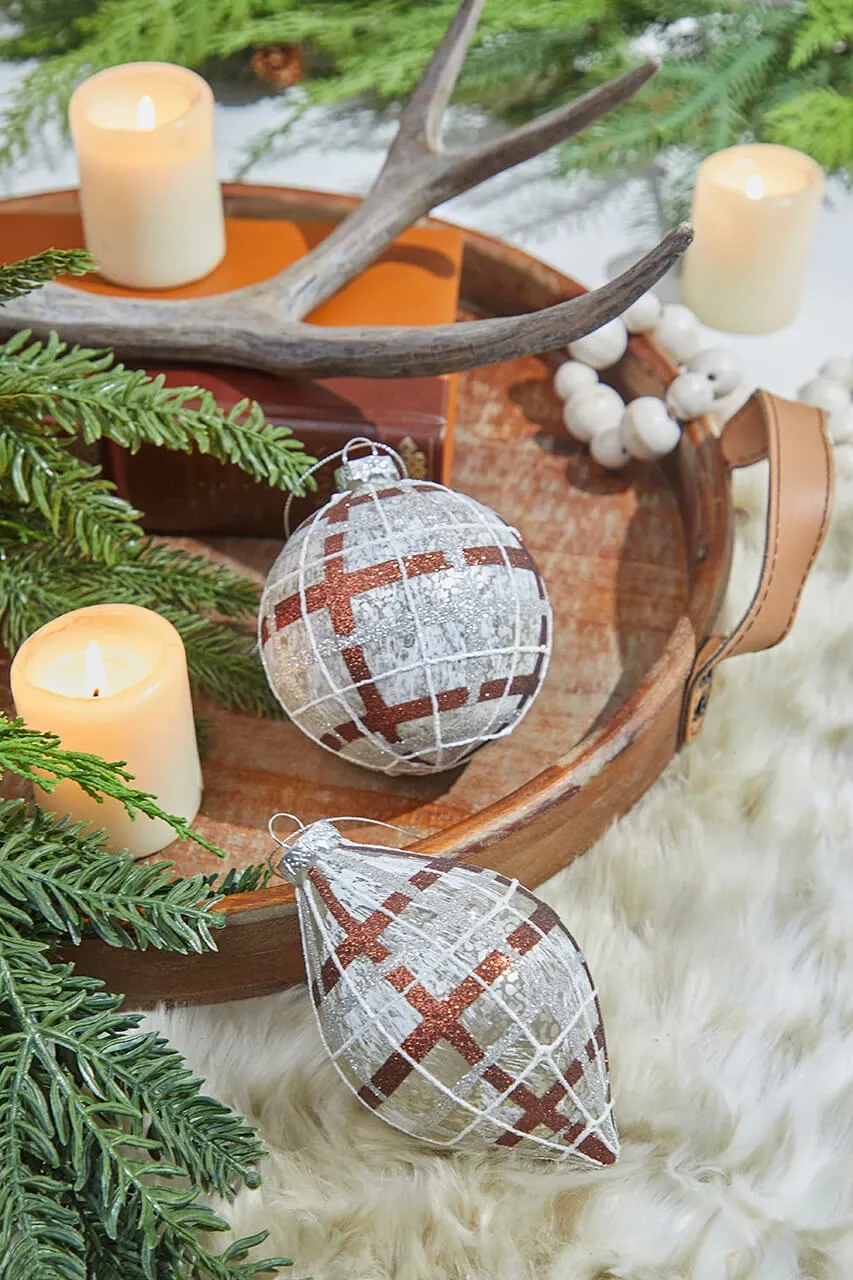
this is a tray you’ll want to move. Antlers, lit candles, and antique books on a fluffy textile is a wonderful photograph and a genuinely bad idea if anyone in the house is under four feet tall. Put it on a console or a shelf above waist height, or swap the candles for battery pillars. The look should never require supervision.
32. A Lit Tree Beside a Candy Shop Window
Shop-window styling is having a real moment because people are decorating for the street again, not just for the living room. In 2026 we’re seeing more exterior vignettes, storefront-inspired porch displays, and windows styled specifically to be seen from the sidewalk. It’s nostalgic, it photographs beautifully after dark, and it’s the one holiday trend that costs almost nothing to try with things you already own.
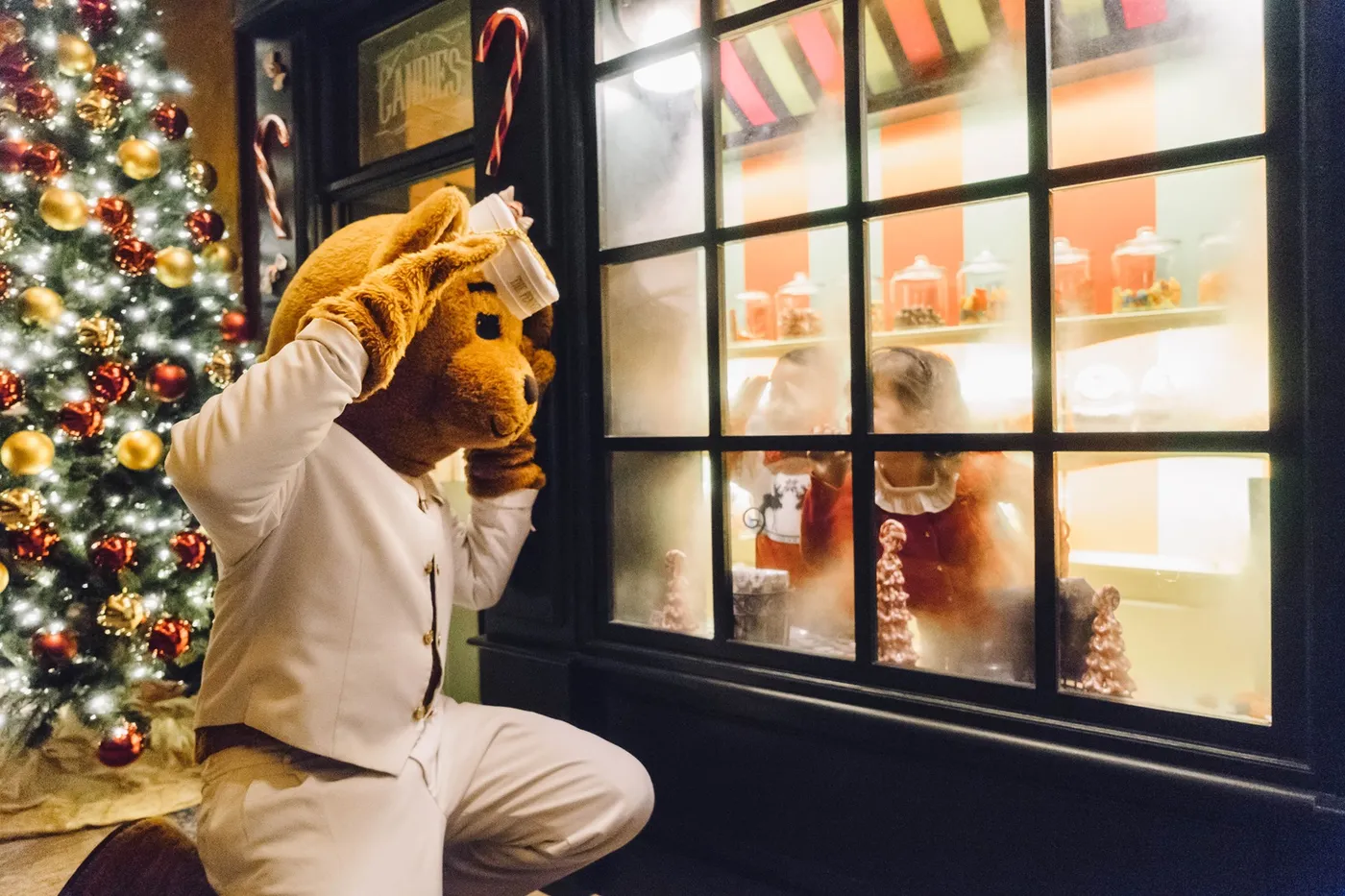
- Start with the tree, not the window — it sets the height for everything else.
- Fill glass jars with candy in one color family only.
- Back the shelf with striped paper or paint for depth.
- Hang two candy canes on the outer frame, never on the glass.
- Light from inside so the window is brightest at dusk.
Cost: $40-$120. Time: about 90 minutes.
is the jars. Twenty identical glass jars, filled to slightly different heights with candy in three colors. That repetition is what makes a window read as a shop rather than a shelf — remove the jars and you just have a nice tree next to a window. Identical containers with different contents is a merchandising principle worth stealing for any shelf in your house.
Your Tree Has a Point of View — Now Go Use It
The best holiday rooms aren’t the ones with the most ornaments — they’re the ones where somebody made a decision and stuck with it. Pick your three colors, pick your one hero piece, and let the rest of the house follow.
📌 Pin this guide before you start shopping — next December you’ll be glad you saved it. And if you try one of these looks, come back and tell us which idea you stole.