
You know the feeling: you open Pinterest for one quick red-and-green idea and forty minutes later you’re deep in a stranger’s mantel décor, convinced your own house is failing at Christmas. It isn’t. It’s usually one focal point, one palette rule, and a roll of ribbon away from the photos you keep saving.
We dug through IKEA, Target, and Walmart — plus a whole lot of thrift-store finds — to pull 32 red-and-green ideas that hold up in a real house, spanning roughly $3 ornaments to a $455 dining table. Budget and luxury versions sit side by side, so you can see exactly what the extra money buys.
Inside: traditional mantels and velvet ribbon, rustic cabin rooms, plaid tablescapes, jewel-toned maximalism, and a few ideas that keep working long after the tree comes down. Red-and-green is back in 2026 with deeper, quieter color than the glitter-heavy version most of us grew up with. And stay until the end — we break down the most common mistakes that can ruin these looks.
📌 Save this to Pinterest for later — you’ll want to revisit these ideas.
1. Deep Red Velvet and Forest Green in a Classic Living Room
Strip this room down and the thing you’d miss first isn’t the tree — it’s the white fireplace dressed in green garland with red velvet bows. That’s the anchor. The deep red knit throws and velvet pillows on the off-white sofa read as a deliberate echo, and the gold candlesticks pick up the ornaments. Take the mantel away and the botanical gallery wall and the rustic coffee table turn into pleasant wallpaper. Compare with Idea #9, where the same move plays out on an ornate carved mantel at twice the scale.
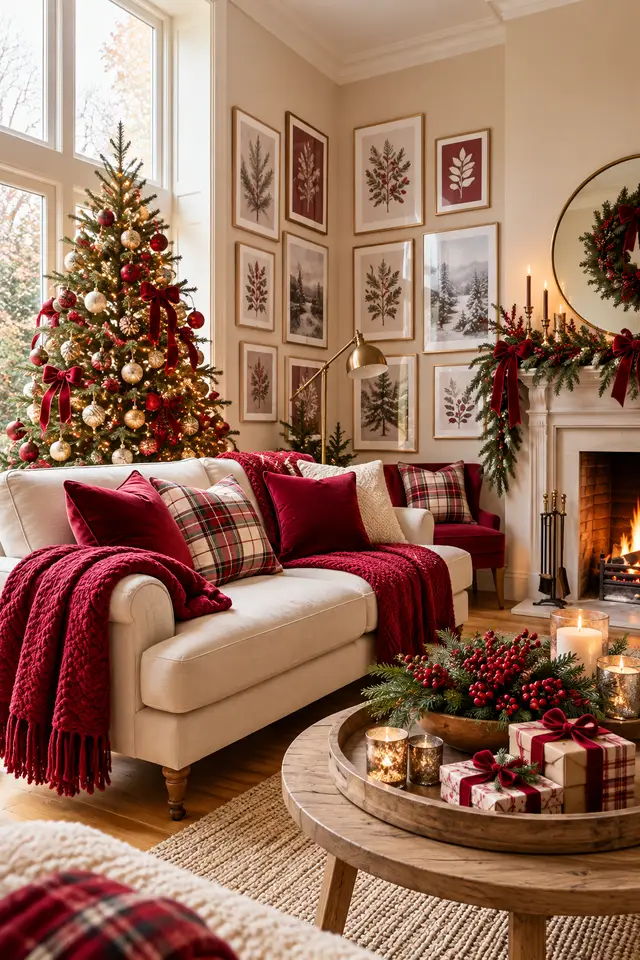
Red and green never actually left, but 2026 is the year it came back with weight — deep reds instead of cherry, forest green over lime, real velvet over glitter. Call it grandmillennial with better editing. The look borrows the layered warmth of a 1990s family Christmas and strips out the clutter, which is exactly why it photographs like a magazine spread while still feeling like a house people live in.
2. Stone Fireplace, Plaid Stockings, and Fresh Garland
Two honest warnings about this setup. Fresh garland and open flame don’t mix at close range — keep greenery at least 12 inches above the firebox, and never let real branches dry out within three feet of a live fire. Red pillar candles above a working fireplace will slump in the rising heat, so switch to battery pillars with a flicker if you actually burn wood. The stone will outlast everything; the greenery won’t.
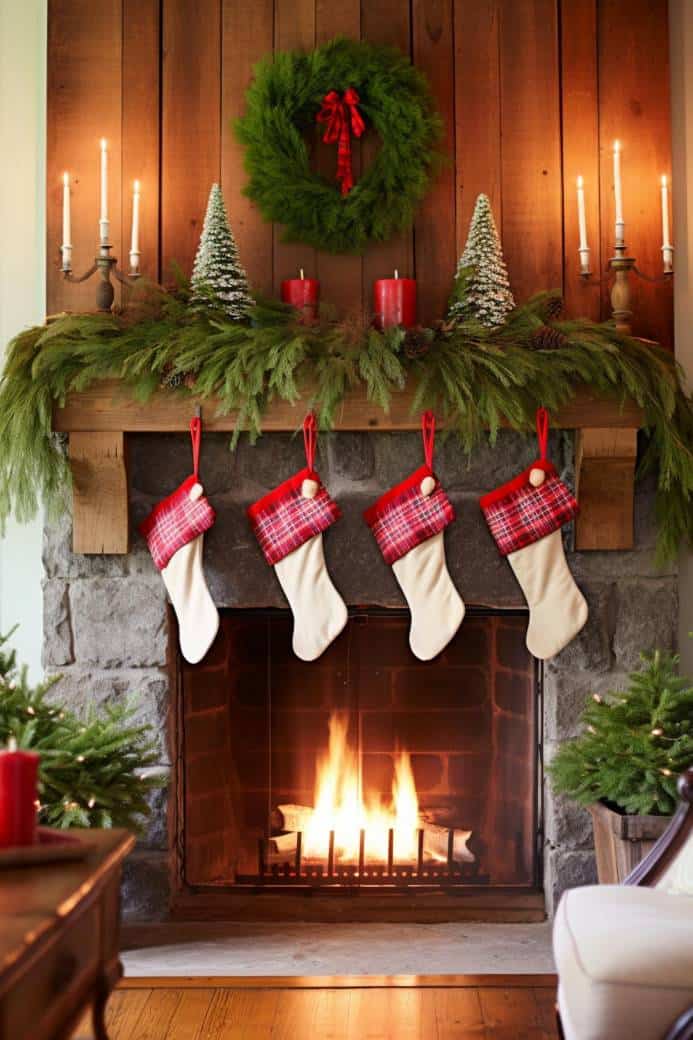
Hanging a heavy wreath on vertical wood paneling without wrecking the wall:
- Mark the center 12 to 14 inches above the mantel shelf.
- Drive a small brass cup hook into a panel seam rather than the panel face — the seam hides the hole later.
- Loop thin florist wire around the wreath’s inner ring and knot it twice.
- Hang it, then slide the red bow onto the top loop so the knot disappears.
About 15 minutes and under $20 for hook and wire. The wreath is the real expense.
3. Red Felt Stockings on a Garland-Draped White Mantel
Order garland at 1.5 times the length of your mantel. A six-foot mantel wants nine feet of greenery so it can pool at both ends instead of stopping in midair. Then hang stockings so the heel sits at least 8 inches above the firebox opening. A red felt stocking looks charming right up until it’s warm to the touch and smells like scorched wool.
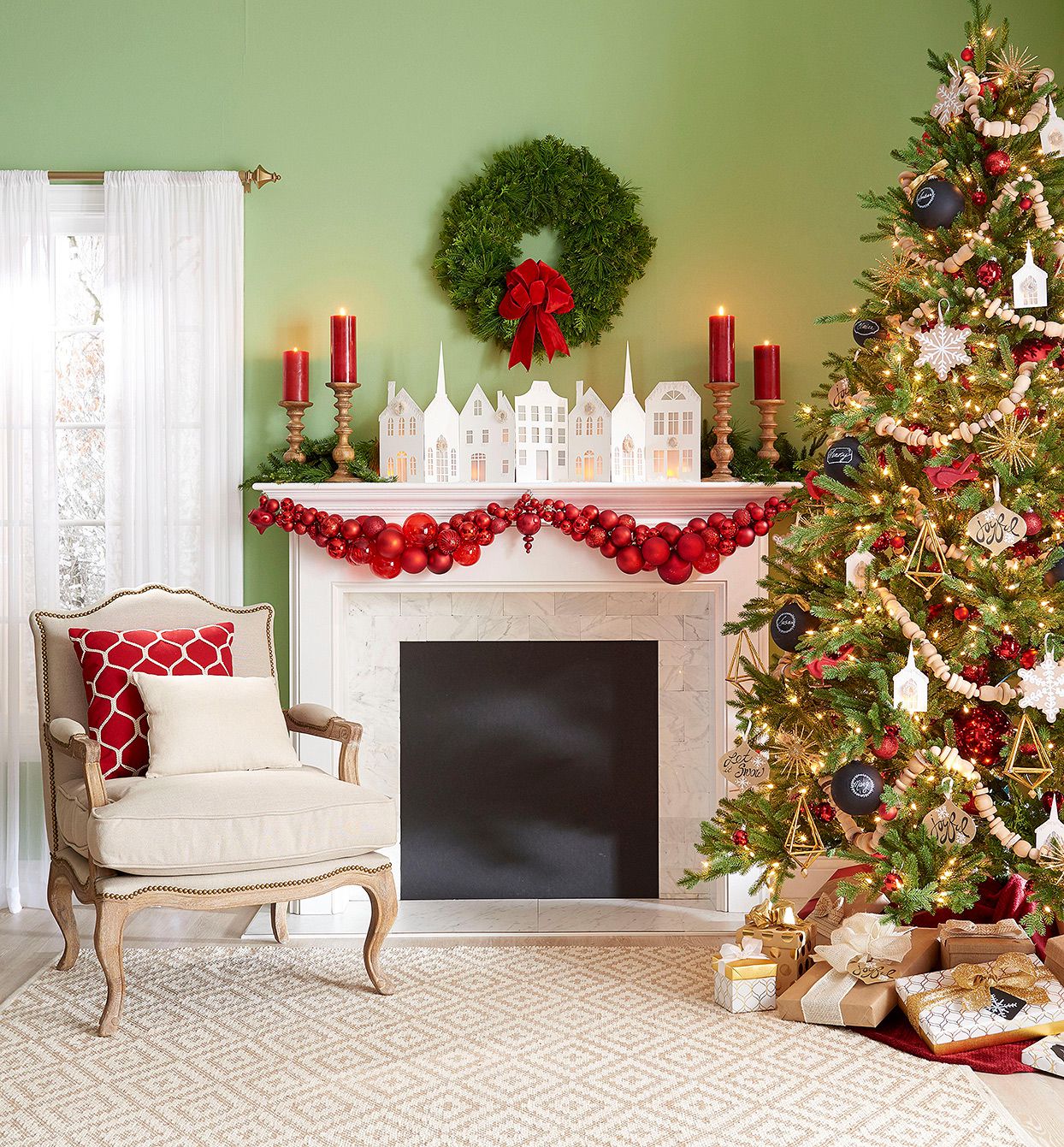
The ratio here is roughly 60 percent white — mantel, candle bodies, bright cuffs — 30 percent forest green garland, and 10 percent bright red plus gold hardware. Hold that formula and you can swap ingredients freely: eucalyptus for pine, burgundy for cherry, brass for gold. Change two of the three and it stops reading traditional, which is fine. Just know you’re designing a different room.
4. Fair Isle Knits on a Light Wood Bench Wall
Hanging a row of knit stockings so it actually looks even:
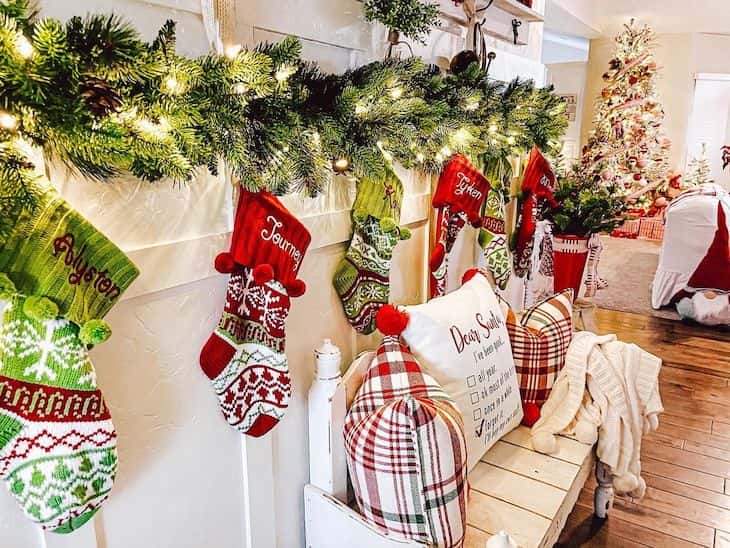
- Space the hooks 8 to 10 inches apart; wider than that and the row reads sparse.
- Measure down from the center of the garland’s swag so every stocking top lines up.
- Use removable hooks rated for 3 pounds — knit stockings are heavier than they look.
- Vary height by an inch for kids’ stockings, and no more. Bigger jumps look accidental.
Roughly 20 minutes and about $15 in hooks.
The fair isle knit stockings are the expensive part and the easiest to fake. Target and Walmart both run red-and-green knits under $15 each in November, and thrift stores are full of handmade ones for $3 to $5 — mismatched hand-knits genuinely look better than a matched set. The light wood bench is a $60 IKEA piece, plaid pillows come from Walmart’s holiday aisle, and the cream throw runs about $25. Whole wall: under $120.
5. Lime Green Feathers and Red Glitter on a Rustic Table
Count the ingredients: about 70 percent bright lime green feathers, 20 percent red glitter baubles, 10 percent white ceramic. The vase is doing quiet work — it’s the only glossy, neutral surface in an otherwise matte, textured arrangement. Swap lime for sage and glitter for matte and you get a calmer, more formal version of the same math without changing a single proportion.

If you had to remove one element it’s the glossy white vase, hands down. Matte green stems in a burlap-wrapped container turn this into a fall craft fair centerpiece. The glossy white ceramic is the only cool, reflective note in a warm arrangement, and that friction is exactly what makes lime green read as a decision instead of an accident. Swap the vase for glass and the whole thing goes threadbare.
6. Red Plaid Tablecloth Meets Clear Acrylic Chairs
- Red plaid tablecloth, round 70 inch: $30–$60
- Gold Christmas tree figurines, set of three: $25–$70
- White polka-dot mugs with gold rims, set of four: $24–$48
- Greenery and red berry centerpiece: $35–$90
- White faux fur wreath: $20–$45
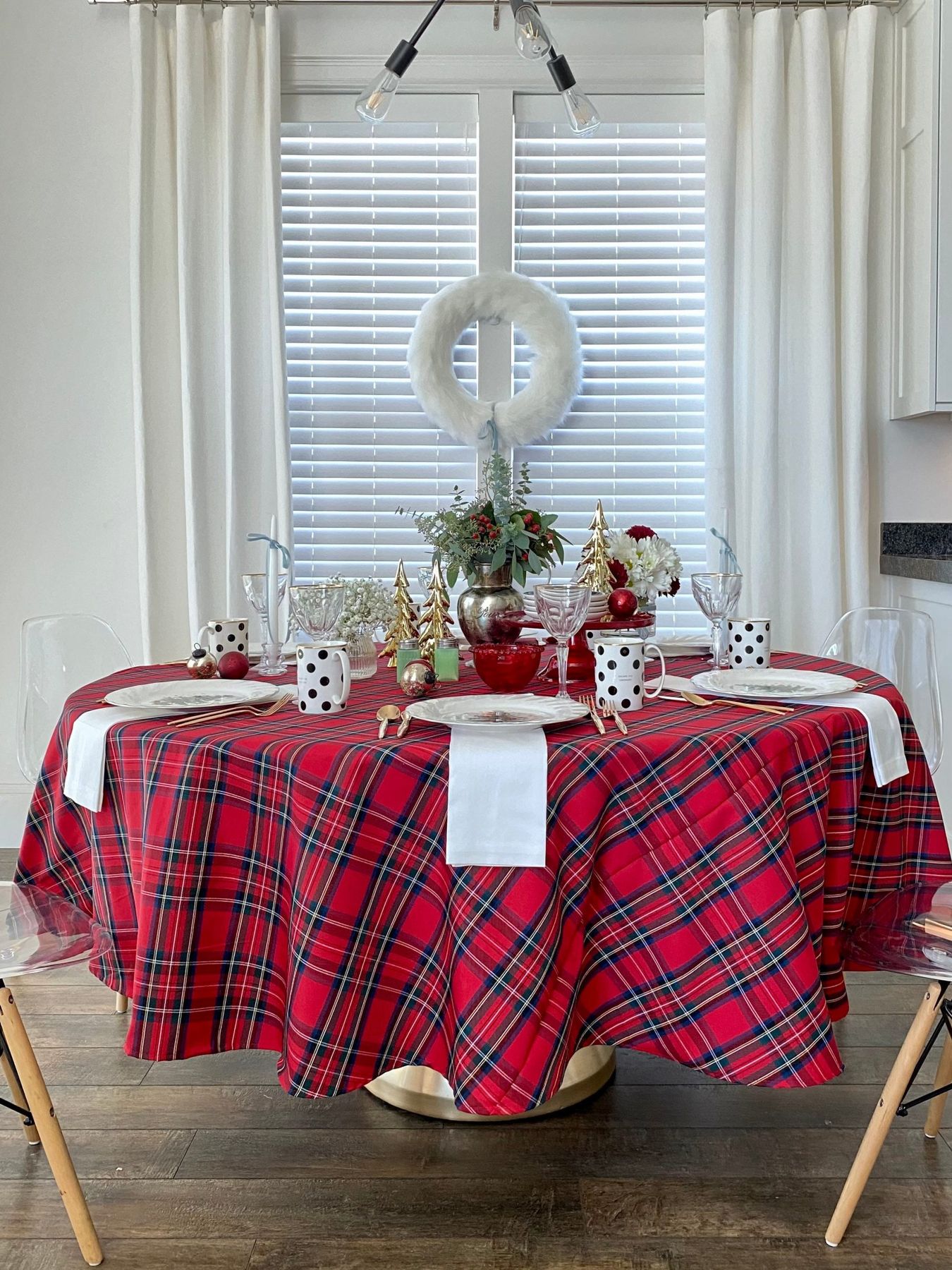
Three things are happening here. Contrast — the busy plaid gets grounded by clear acrylic chairs that basically vanish. Repetition — white shows up in the mugs, the wreath, and the polka dots, which keeps your eye moving instead of snagging. And scale: the round cloth is the biggest surface at the table, so everything else gets to stay small and bright.
Plaid used to mean flannel and firewood. What’s changed is the pairing — traditional red plaid set against modern acrylic and metallic gold, which is why it photographs so well for Pinterest. The contrast reads as 2026 rather than 1996. It also happens to be one of the most forgiving setups to shop for, since plaid is everywhere from Dollar Tree to Williams Sonoma.
7. A Red Ribbon Tree Beside a White Fireplace
A tree this full needs room to work. Plan on 12 inches between the treetop and the ceiling so a topper doesn’t scrape, and 18 inches of clearance on the widest side for branches to breathe. In a room under 150 square feet, a 7-footer beside a fireplace starts to feel like a wall — go to 6 feet and keep the ribbon wide. Compare with Idea #20, where the same palette moves to the table instead.
Wide red velvet ribbon is the entire personality of this tree and also the cheapest part. A 50-yard roll runs $10 to $15 at Michaels in November, versus $8 per pre-tied bow at a decor store. Walmart’s 7.5-foot pre-lit tree drops under $150 after Thanksgiving, and a 100-count bag of shatterproof red and green ornaments is about $25. You can build this whole look for under $250.
8. Lighted Village Houses Nestled in Credenza Garland
A garland-loaded credenza is a dust trap. Faux greenery collects it fast, so plan on a two-minute pass with a hairdryer on the cool setting every couple of weeks — far better than trying to wipe individual sprigs. Ceramic village houses need a dusting before they go back in the box, because a year in the attic bakes it on. Brass hardware wants a wipe twice a season or it goes dull.
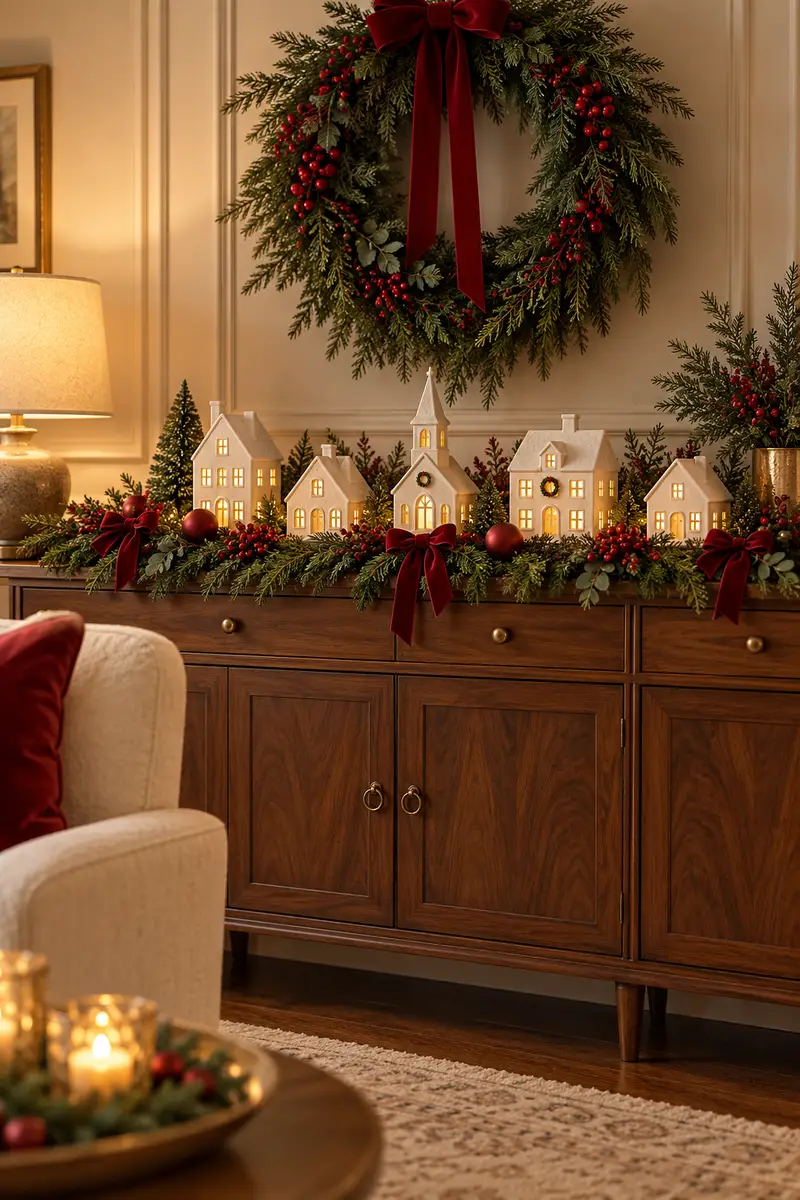
Set the lighted village houses on stacks of hardback books you already own, then drape the garland over them. You get varied heights for free, and the garland hides the cords inside its own volume instead of letting them snake across the wood. Add a plug-in outlet timer and the whole credenza comes on at dusk without anyone touching it. Fifteen minutes of setup, and the vignette runs itself all season.
9. Carved Dark Wood, Velvet Bows, and Flanking Garlands
Three things keep the ornate carved mantel from disappearing under all that decoration. Symmetry — the flanking garlands mirror each other, so your eye travels straight to the center. Repetition at three scales: large velvet bows, small red ornaments, tiny warm lights. And temperature contrast — warm bulbs against dark carved wood read as glow rather than glare. Remove the symmetry and the carving turns into noise.
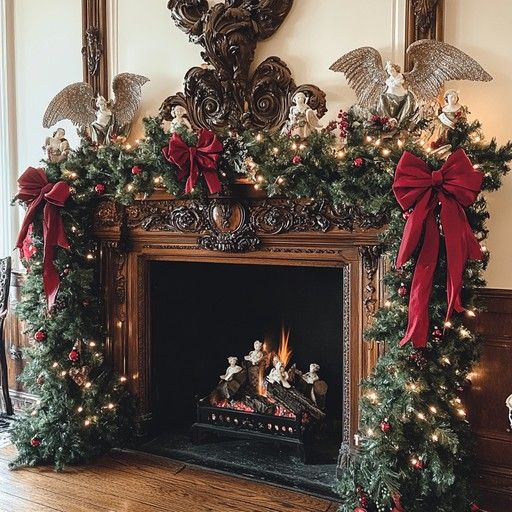
- Measure the mantel’s full length before buying garland — carved shelves are wider than they photograph.
- Confirm there’s an outlet nearby; an extension cord stretched across the hearth is a tripping hazard.
- Decide whether the garland stops below the first molding line or buries it. Burying it is a choice, not an accident.
- Check the mantel’s load tolerance before stacking figurines on top of heavy greenery.
10. Elf-Toe Stockings and Plaid Ribbon Over Stacked Logs
That neat stack of logs inside the firebox is a styling move, not a fire setup — if you plan to burn anything, logs can’t live there. The red candles on the mantel need to move too, because heat rises straight up the face of a fireplace and wax follows. Keep real wood in a basket off to the side and leave the firebox empty. Charm doesn’t require a hazard.
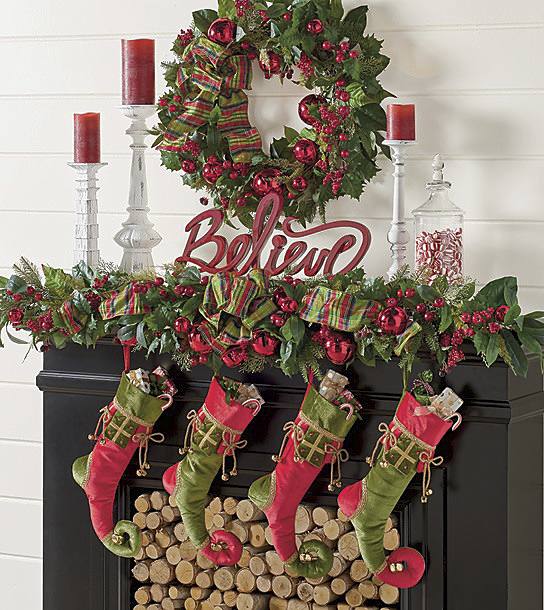
- Garland, 9 feet, fresh or faux: $25–$80
- Plaid ribbon, two rolls: $12–$24
- Velvet elf-toe stockings: $15–$30 each
- White spindle candlesticks, pair: $18–$45
- Red script sign: $10–$28
11. Dark Green Plaid Walls and a Tufted Leather Sofa
This room is about 80 percent green — plaid paper above, flat wainscoting below, shaggy rug underfoot — with 15 percent cognac leather and 5 percent brass and black hardware. That sounds like too much of one color until you notice the texture changes at every level: matte paper, satin paint, tufted hide, shag pile. Swap the cognac sofa for gray and the formula holds. Swap the wainscoting for white and it goes preppy.
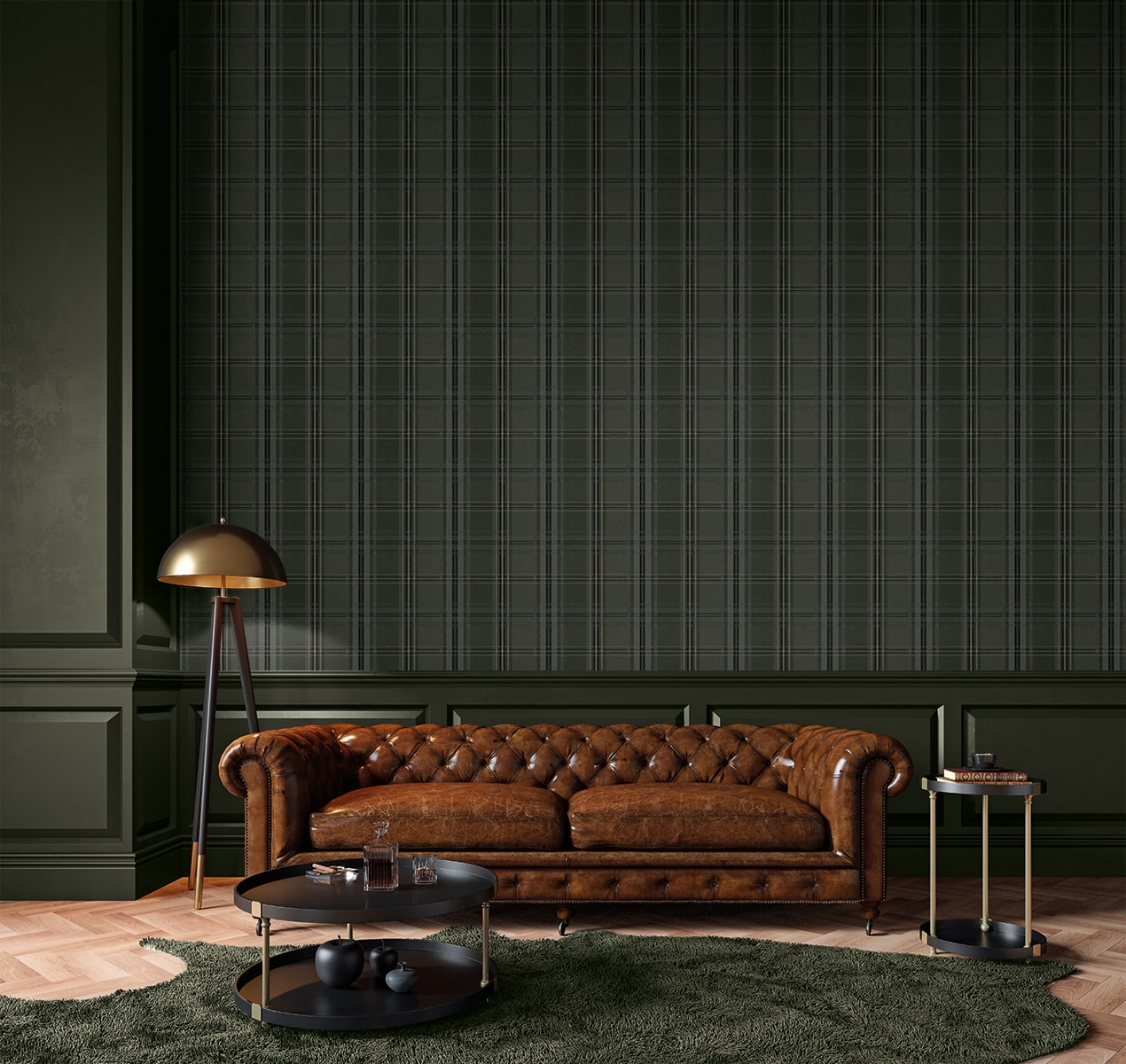
- Tape up a wallpaper sample for 48 hours — plaid shifts completely under warm versus cool bulbs.
- Decide the wainscoting height now: 36 inches in standard rooms, up to 42 under tall ceilings.
- Check the pattern repeat before ordering; matching plaid can add 15 to 20 percent to your roll count.
- Confirm you can live with a busy upper wall in a room you use every day.
Plaid at this scale eats space. Keep it to rooms at least 10 by 12 feet, and expect the pattern to pull the walls in visually by a foot or two. With 9-foot ceilings you can take the wainscoting to 42 inches and regain some balance. Smaller room? Run plaid on one accent wall and paint everything else that same dark green — see Idea #29 for the color-drenched version of that instinct.
12. A Red Persian Rug in a Vaulted Cabin Living Room
In a room this size, the red does all its work on the floor. A red, navy, and cream patterned rug carries the entire holiday palette without a single ornament hanging anywhere, which is why the design survives past January. It also anchors the seating zone under a vaulted ceiling that would otherwise feel unmoored. Wood walls at this scale need one high-contrast element, and the rug is it.
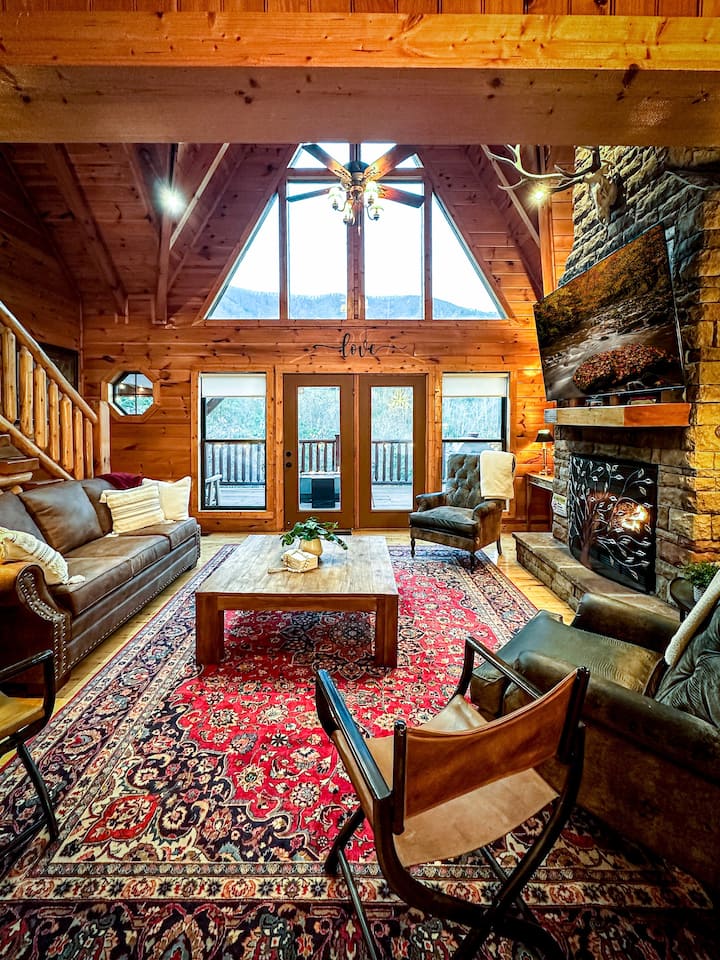
Machine-made Persian-style rugs in red and navy start around $200 for an 8×10 at Rugs USA or Wayfair, against $2,000 and up for hand-knotted. Wool-blend leather sofas turn up on Facebook Marketplace for $300 to $600 whenever someone downsizes. The stone fireplace look can be faked with stone veneer panels around an existing firebox for $400 to $800. Rustic grandeur is mostly square footage and one good rug.
13. The Mantel Mirror That Doubles Every Light
The dark-framed mirror is the sleeper hit. It reflects the lit garland and the wreath, so the mantel reads twice as bright without a second string of lights, and its dark frame gives the white mantel a hard edge to push against. Swap it for a light wood or white mirror and the arrangement goes soft and slightly washed out. One accessory doing the work of two.
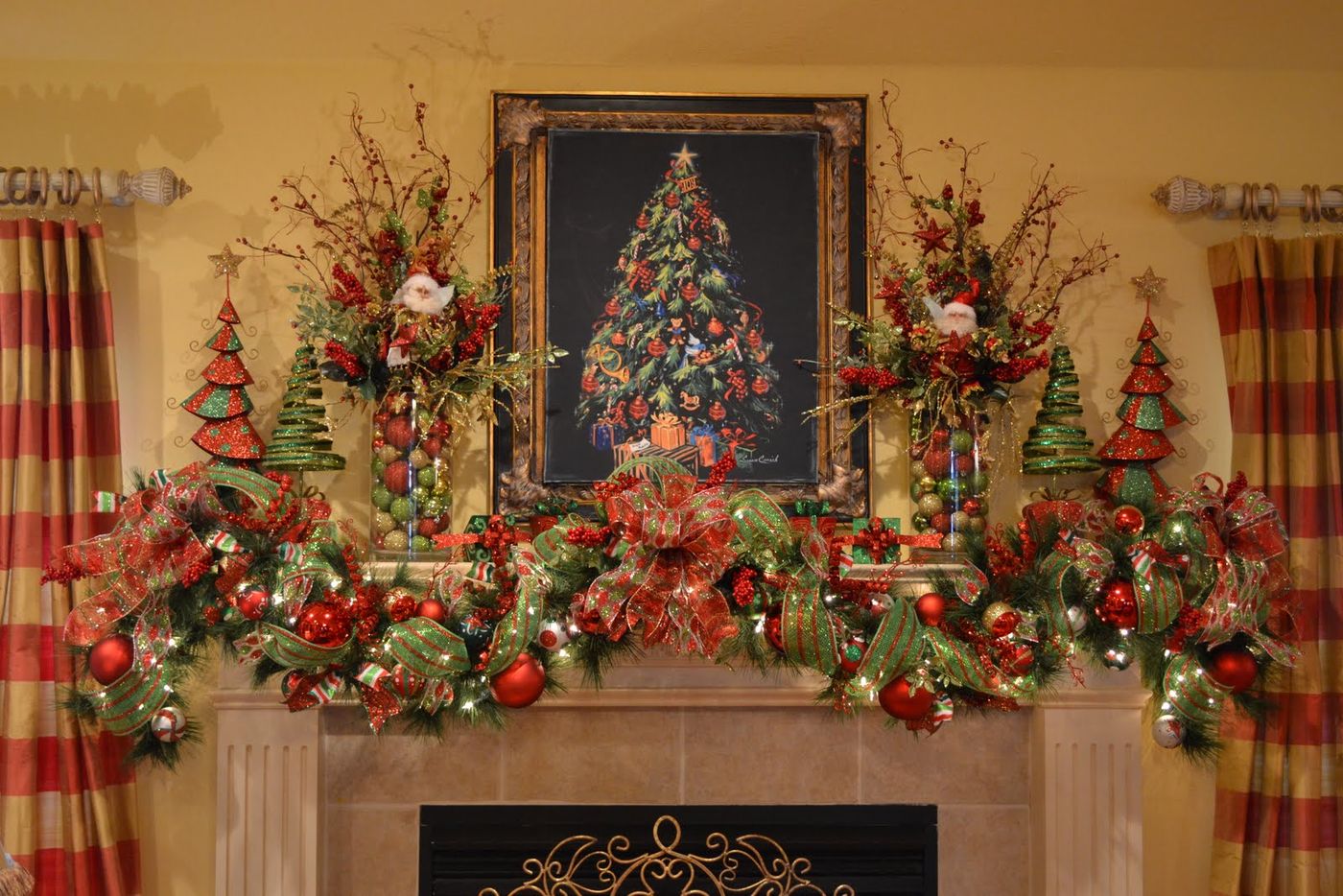
Layering lights into garland so the strands disappear:
- Lay the garland flat and run the cord along its spine, not across its surface.
- Weave in and out every 6 to 8 inches so the bulbs sit inside the needles.
- Add red baubles on wire picks every 10 inches, clustered in threes — never evenly spaced.
- Zip-tie the finished garland to a slim board, then set the board on the mantel. Next year it’s a 30-second install.
About 25 minutes and $15 in lights and zip ties.
14. Plaid Runner, Flocked Tree, Gold Cutlery
A runner like this needs to run long: buy 12 to 18 inches past each end of the table so it can pool slightly. On a 72-inch table, that means an 8-foot runner. Leave 36 inches between the table edge and the wall so chairs can pull out, and give a flocked tree at least 3 feet of clearance from the table. In tight dining rooms, a tabletop tree beats a floor tree every time.
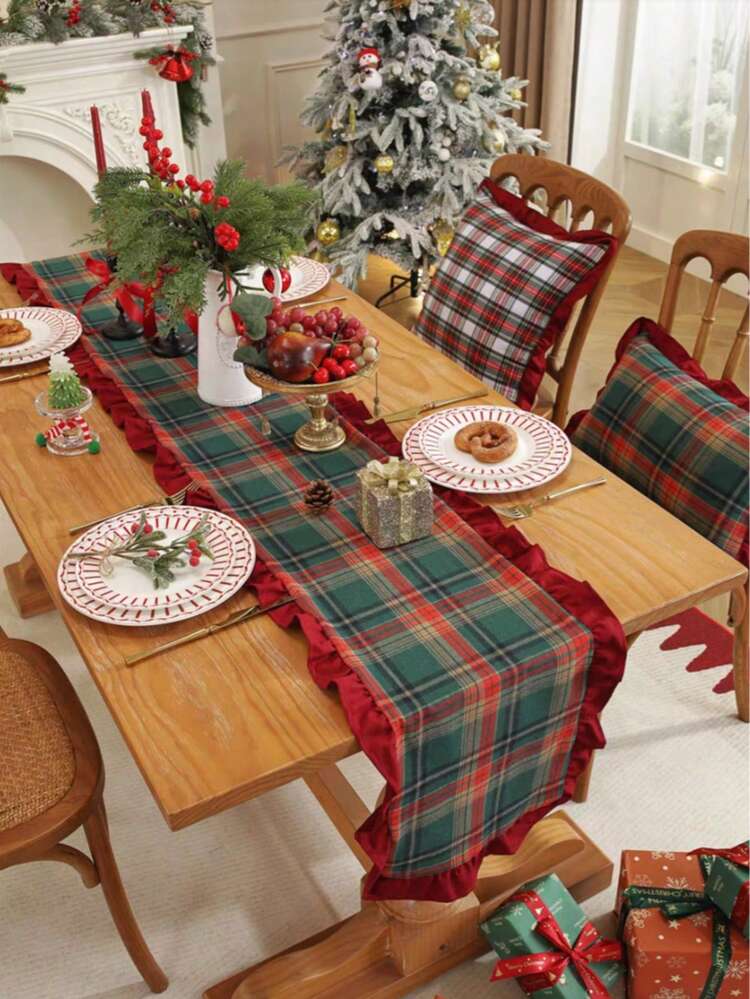
Two numbers worth saving to your phone. A table runner should overhang 6 to 8 inches per end; more than that and it looks like a tablecloth that gave up. And your dining rug should extend 24 inches past the table edge on every side, so chairs stay on the rug when they’re pulled out. Miss the rug number and every guest spends dinner half off the pile.
15. Dried Oranges and Sage Green in a Christmas Home Office
Making a dried orange and cinnamon garland:
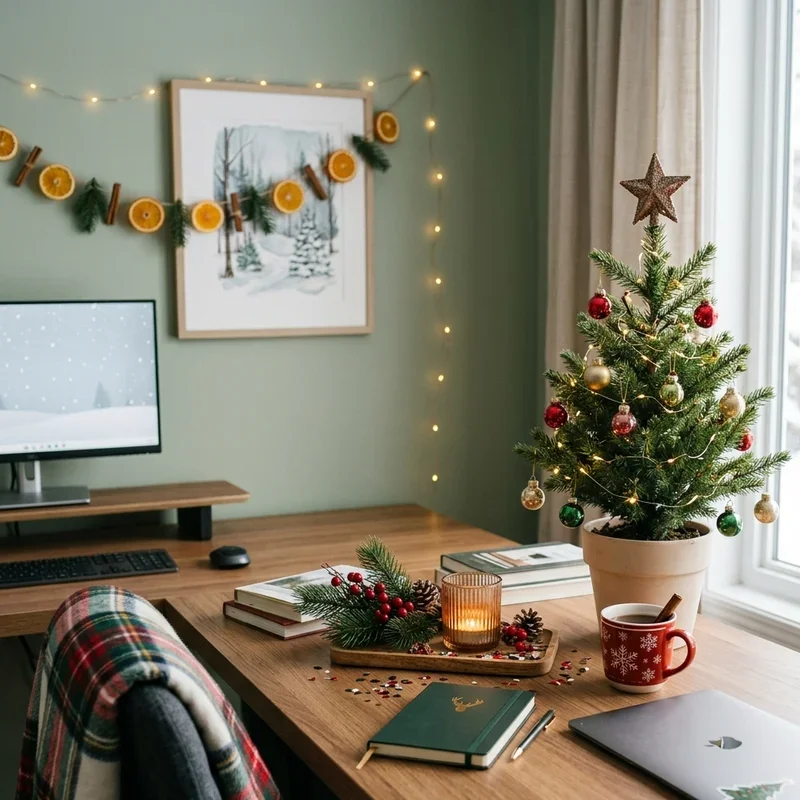
- Slice oranges a quarter inch thick and blot them dry — thicker slices mold before they dry out.
- Bake at 200°F for three to four hours, flipping once, until the centers are leathery rather than brittle.
- Thread twine through the rind with a needle, adding a cinnamon stick every three oranges.
- Hang it and let it finish drying for a day before adding lights.
About $8 in oranges and cinnamon, and four hours of mostly oven time.
String lights behind a monitor are gorgeous and terrible for your eyes. Warm strands bounce off a pale sage wall and glare across a matte screen, so run them beside or above the desk rather than directly behind it. Also worth knowing: dried orange garland smells wonderful for about three weeks and then just looks dusty. Plan to retire it in early January.
16. Three Nutcrackers Staged on a Lace Tablecloth
Nutcrackers are having a genuinely strange renaissance. They’re the one Christmas object that swings between kitsch and collectible depending on scale, and the 2026 version is oversized, mismatched, and staged as a vignette rather than lined up on a shelf. Thrift stores and estate sales still move them for $5 to $15, because most shoppers can’t tell a heavy German-made figure from a dollar-store one. Buy the heavy ones.
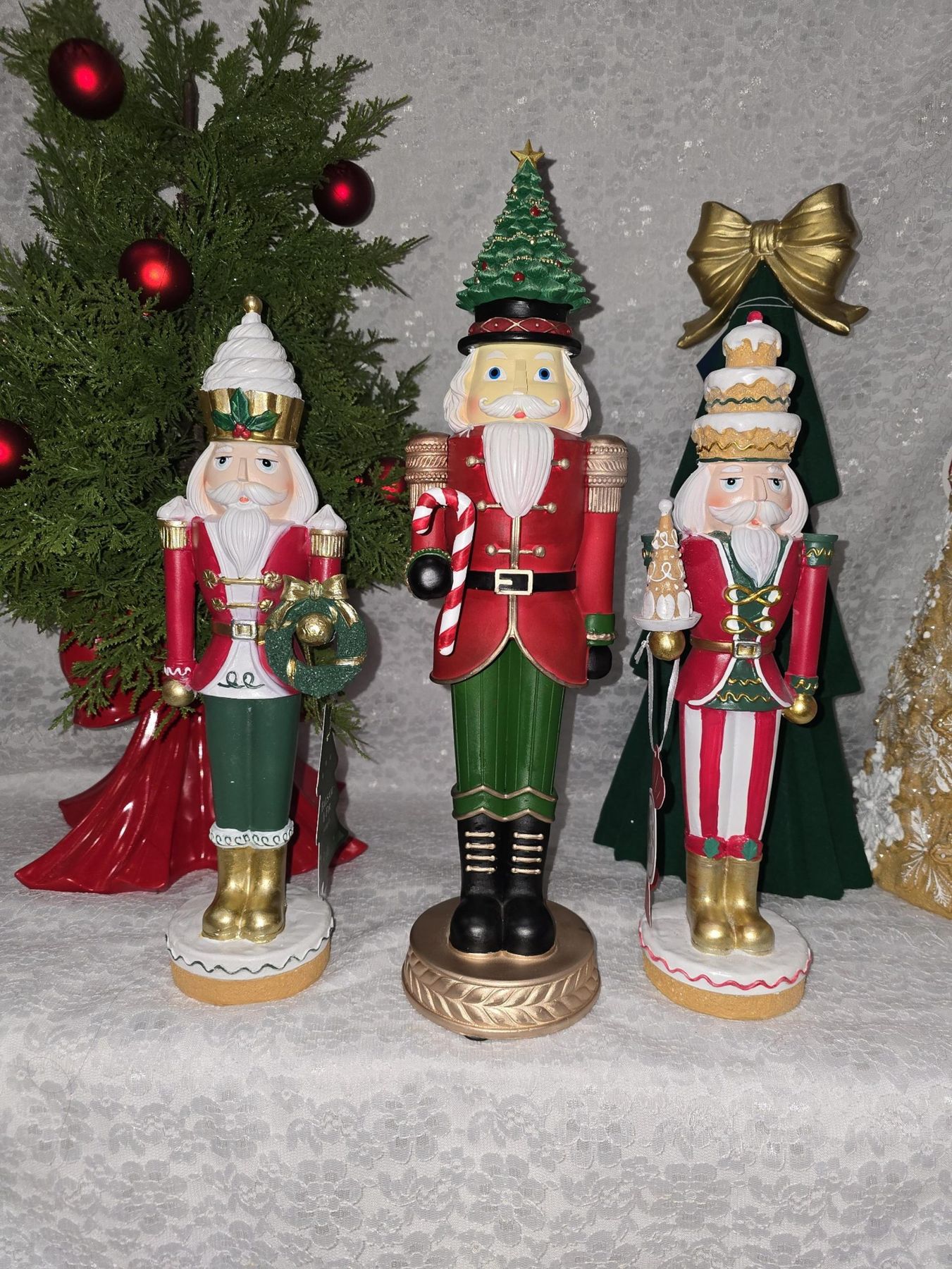
- Three decorative nutcrackers, 12 to 18 inches: $45–$180
- Faux pine trees, two sizes: $30–$70
- Red ball ornaments, box of 50: $15–$25
- Gold bows and a lace cloth: $15–$40
17. Three Papers, Two Ribbons, One Pile of Gifts
Wrap with three papers and two ribbons. Not four, not six — three patterns at clearly different scales (a small dot, a wide plaid, a solid) and two ribbon widths, one narrow at 1 inch and one wide at 2.5 inches. Then vary the heights under the tree by stacking two gifts to make a third. Evenly sized boxes in a neat row is what makes a tree look like a store display.

The wrapping math is 50 percent neutral, 30 percent green, 20 percent red. Here the greens are the dotted paper and the plaid ribbon; the reds are the satin ribbon and one red-wrapped box that pulls your eye across the pile. Neutral and green carry the volume so red can stay rare. Double the red and the whole arrangement reads discount. Same formula works in navy and copper if you’re tired of the classics.
18. Plaid Pillows and Gold Sconces in the Bedroom
- Sleep on it first — pillows with piping and buttons are decor, not pillowcases. Decide where they live at night.
- Measure the headboard width before buying plaid shams; standard shams won’t cover a king-width gap.
- Check the sconce power source. Hardwired needs an electrician; plug-in needs an outlet you can live with.
- Weigh the bedding: a quilted blanket over a duvet is too warm for most sleepers.
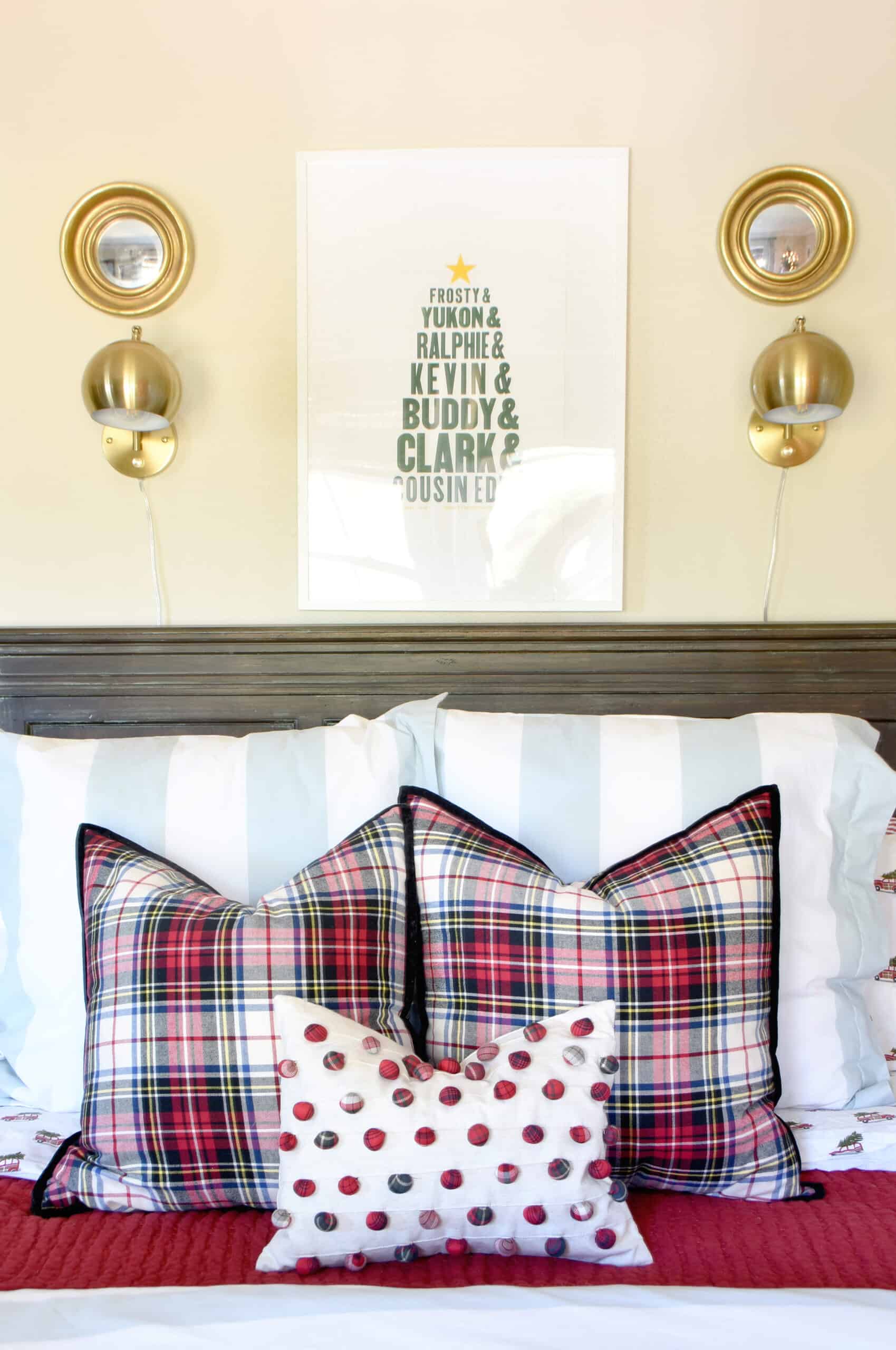
This bedroom is almost entirely soft goods, which is excellent news for your budget. Red quilted quilts run $40 to $70 at Target in December, plaid throw pillows are $12 to $20 each at Walmart or HomeGoods, and the gold round mirror pair is the classic IKEA look at $25 to $40. Plug-in spherical sconces start around $30. Print the Christmas tree typography art at home for about $3.
19. A Quilted Elf with Tiny Round Sunglasses
Elf decor is a love-it-or-hide-it category, and the risk is landing on the wrong side of cute. Styling is the difference: a single well-dressed elf tucked into garland reads as a wink, while five arranged on a shelf reads as a collection. Also, frosted faux garland sheds white flakes everywhere — put a tray or a runner underneath before you drape it over anything you care about.

It’s the tiny round sunglasses. That one detail flips the whole vignette from Christmas decoration to character — take them off and you’re left with a doll in a quilted jumpsuit sitting in pine branches. Small, slightly absurd accessories are what make holiday decor photographable instead of forgettable. Give your elf one personality detail and let everything else stay traditional red and green.
20. Red Roses and Layered Plaid on a Long Dining Table
- Layered red and plaid tablecloths: $40–$120
- Red and white roses, four grocery-store dozen: $60–$120
- Gold-rimmed chargers, set of eight: $50–$120
- Glass vases, assorted heights: $20–$45
- Plaid wrap and ribbon for favors: $25–$50
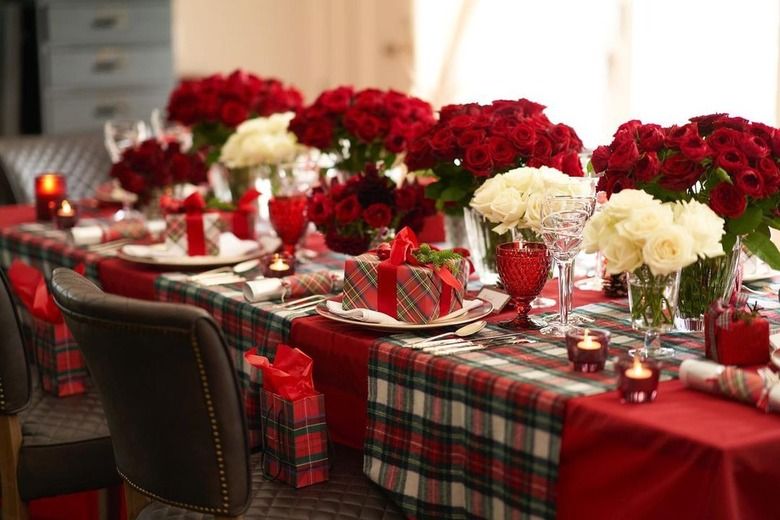
This setting needs a table at least 72 inches long. Any shorter and the gifts at each plate start elbowing the rose arrangements. Keep vases under 10 inches tall so guests can see across the table, and budget 15 inches of edge per person for a comfortable place setting. If your room can’t take a long table, steal the idea rather than the layout — see Idea #25 for the pared-down version.
21. A Distressed Santa Boot Planter Vignette
Build the vignette on three heights: the lantern tallest at 12 to 14 inches, the Santa boot mid at 8 to 10, pinecones and berries low and spilling off the edge. Cluster in odd numbers — three sprigs, five pinecones — and let one element overhang the surface so the arrangement doesn’t look placed. That single overlap is the difference between styled and staged.

Distressed finishes shed. The flaking red paint on a boot planter will keep flaking a little every year, so set it on a plaid runner or felt pad rather than directly on wood you care about. If there’s a real candle in the lantern, the metal will soot inside within a season; battery pillars avoid that entirely. And fringed plaid runners should be hand-washed cold or the ends fray into a mess.
22. Cascading Red Glitter Ribbon in a Silver Pot
Building a cascading ribbon tree:
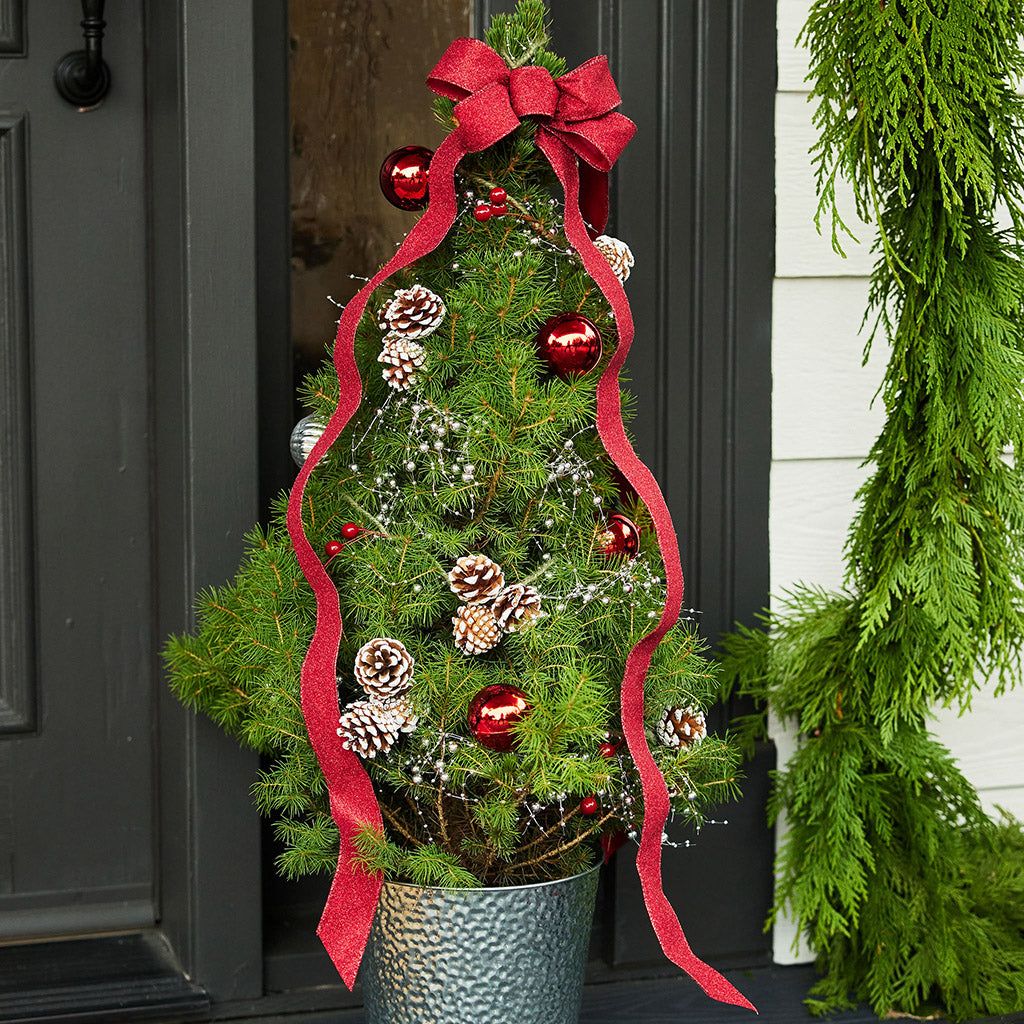
- Anchor the ribbon at the top with the bow, tails hanging down the front.
- Wind it in loose spirals, pinning every 8 to 10 inches so it doesn’t sag.
- Space red and silver ornaments 5 to 6 inches apart, tucking a few deeper into the branches.
- Add white-tipped pinecones last, at the outer tips where the white actually reads.
- Drape the beaded garland in two loose loops rather than a full spiral.
About 45 minutes on a tree this size.
Two things keep this small tree from looking like an afterthought. First, the hammered silver pot — the dimpled texture catches light and gives the glossy red bow something matte to sit against. Second, the white-tipped pinecones, which repeat that silver at a smaller scale. Glitter, matte metal, and organic texture: three finishes, one palette. That’s the whole trick.
23. Alternating Red and Warm White on Cone Trees
Three realities about lighting trees outside. Wrapping a living conifer tightly traps moisture and can kill the lower branches, so keep strands loose and pull them by February. Don’t chain more than three standard 100-light strands on one outlet — LED makes this easier. And alternating red and warm white looks fantastic but slightly chaotic unless you commit: red on the trees, warm white on everything low.
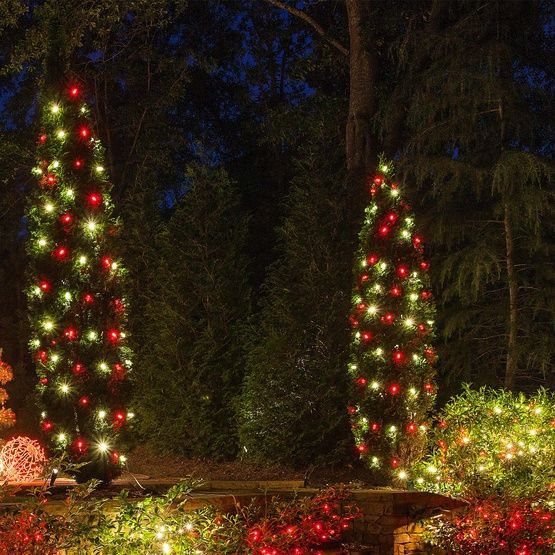
Wrap from the trunk outward, not the outside in. Start at the base and wind upward with 6 to 8 inch spacing between passes, and use the 2:1 rule — two strands of warm white for every one of red. An all-red tree goes from festive to alarming fast, and it’s the warm white that makes the red look intentional instead of urgent. Put the whole display on an astronomical timer and it runs itself.
24. Elf Mantel Sitters with Dangling Legs
The dangling legs. These two elves sit on the mantel edge with their legs hanging over the front, and that single styling choice is what makes you smile. Stand them upright like figurines and they become shelf clutter. Gravity is the joke. If you try this, weight the base with a small bag of rice or a dot of museum putty so nobody takes a header into the fire.

One red elf, one green elf, one white mantel: a 50/25/25 split that only works because the two colors are matched in intensity. A bright kelly green beside a deep burgundy would read as a mistake, so if you’re mixing your own, keep both in the same brightness range. The candy canes act as the neutral, repeating the white and giving each elf something to hold. Compare with Idea #16, where figurines get the opposite treatment — fully staged instead of casually perched.
25. White Cloth, Green Napkins, Red and Green Florals
This is the most replicable table in the whole article. White tablecloth: $20 at Target, or free if you already own one. Green cloth napkins: $12 for six at IKEA. Gold-rimmed plates turn up at HomeGoods and thrift stores for $3 to $6 each, and mismatched gold edges look intentional. The centerpiece is $25 from a grocery florist if you ask for red and green stems with no filler. Two brass candlesticks from Goodwill: $8.
Keep your taper candles between 10 and 14 inches tall. Any taller and the flames sit above the seated eyeline, turning dinner into a staring contest through a forest of wax. The test: if you can’t see the person across the table without leaning, the candles are too tall. Flanking them in brass keeps the floral centerpiece lower than the flames, which is exactly why it reads calm.
26. Rug-Pattern Stockings and Antique Brass Bells
A statement wall like this is read from the doorway, so scale up. The garland should span the paneling’s full width plus 12 inches of spill on each side, and stockings want 10 to 12 inches between them — closer and the textile patterns start fighting. Wooden tree cutouts work best in a cluster of five to nine; an even number reads like an accident from across the room. Give the whole vignette at least 6 feet of wall.
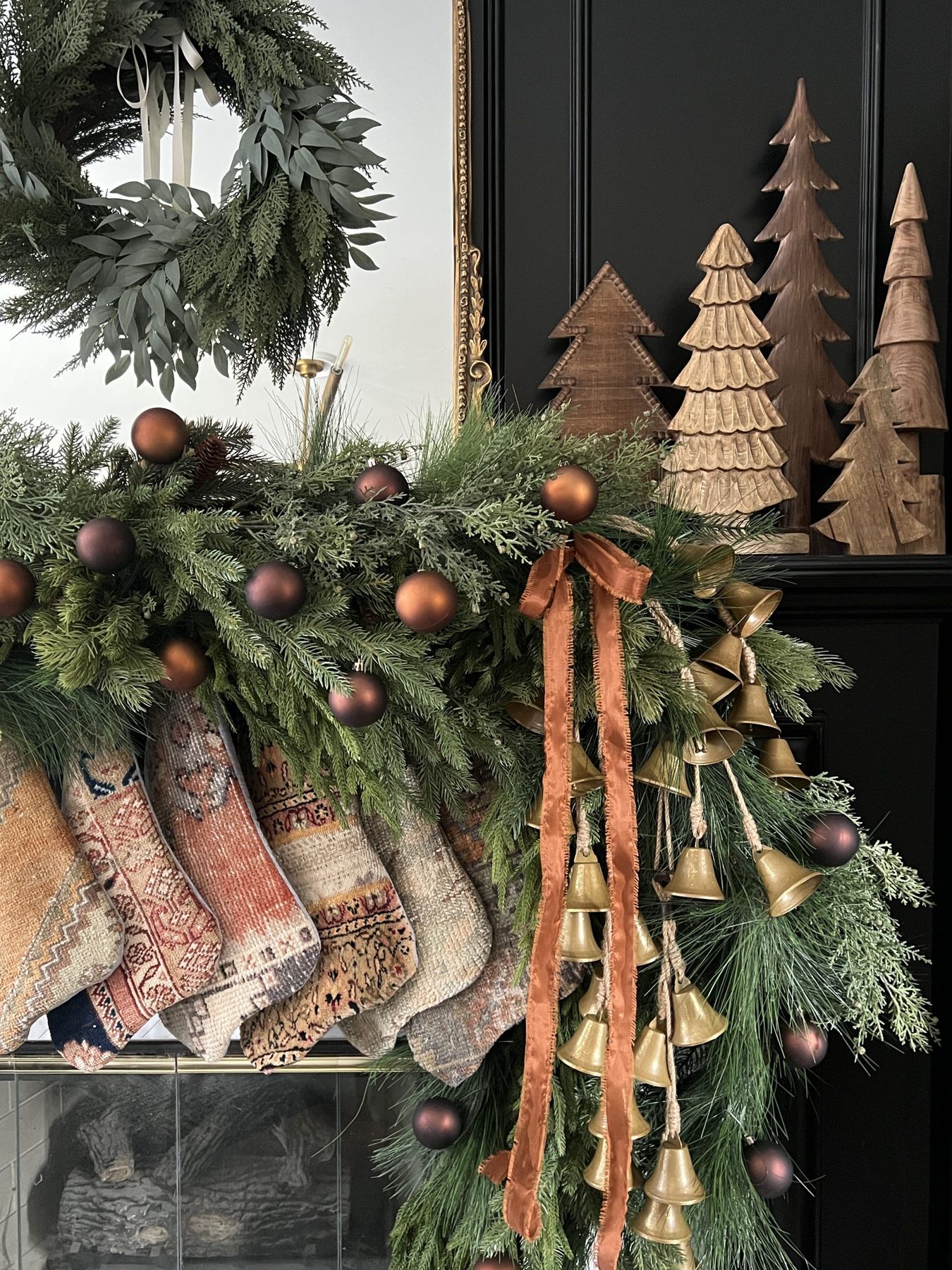
The stockings made from vintage rug remnants are what lift this from rustic mantel to something you’d screenshot. Everything else — the brass bells, the coppery ornaments, the wooden tree cutouts — is beautiful and completely expected. The textile stockings add pattern, a second craft tradition, and a rust tone that quietly ties the garland ribbon together. Take them away and there’s no story left.
27. Gray Shiplap, Arched Mirror, Wicker Deer Wreath
Dark gray shiplap shows dust more than you’d expect — every horizontal groove is a shelf. A microfiber pass once a month does it, and a vacuum brush attachment handles the grooves in about two minutes. Knit stockings pill and stretch when stuffed, so empty them before storage and hand-wash cold once a year. If the wreath hangs on a mirror, use a suction cup rated well above its weight.
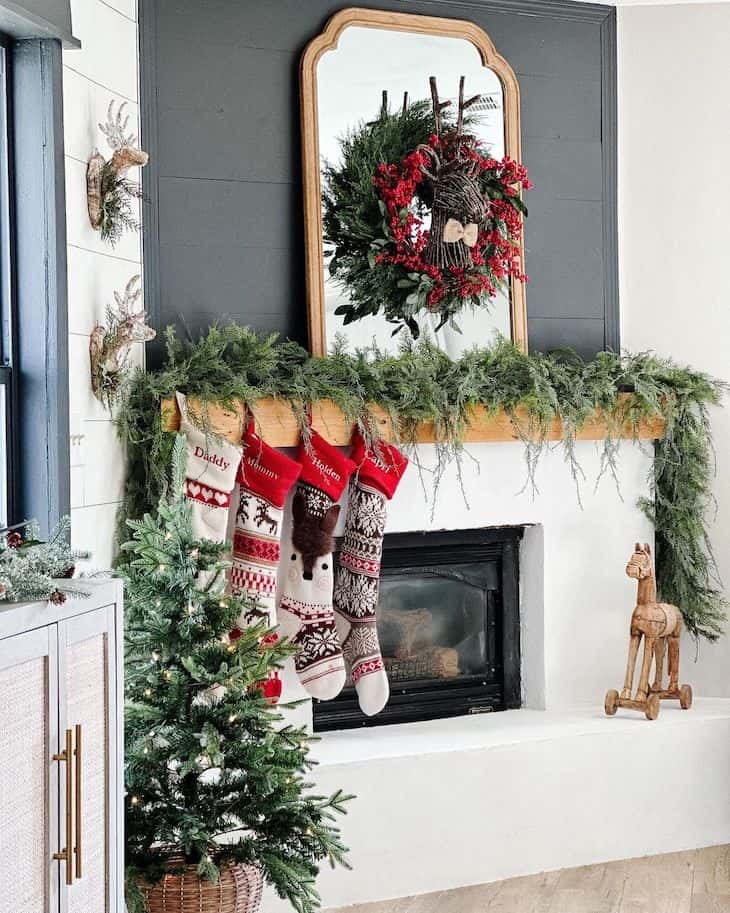
Three greens in three textures: pine garland, a berry-and-pine wreath with a wicker deer head, and a small artificial tree in a wicker basket. Repeating one color at different scales and materials is the oldest trick in holiday styling, and it’s why this mantel reads as designed rather than simply decorated. The dark shiplap and white firebox supply the contrast that keeps all that green from going muddy.
28. Plaid Chair Slipcovers That Change the Whole Room
- Measure each chair’s back height and width before ordering slipcovers — “one size” fits very few chairs.
- Test one cover on one chair through a full dinner before buying a set of eight.
- Check the fabric care label; anything at a dinner table will need washing in January.
- Confirm slipcovers clear the table apron when chairs are pushed in. Two extra inches of fabric can block seating depth.
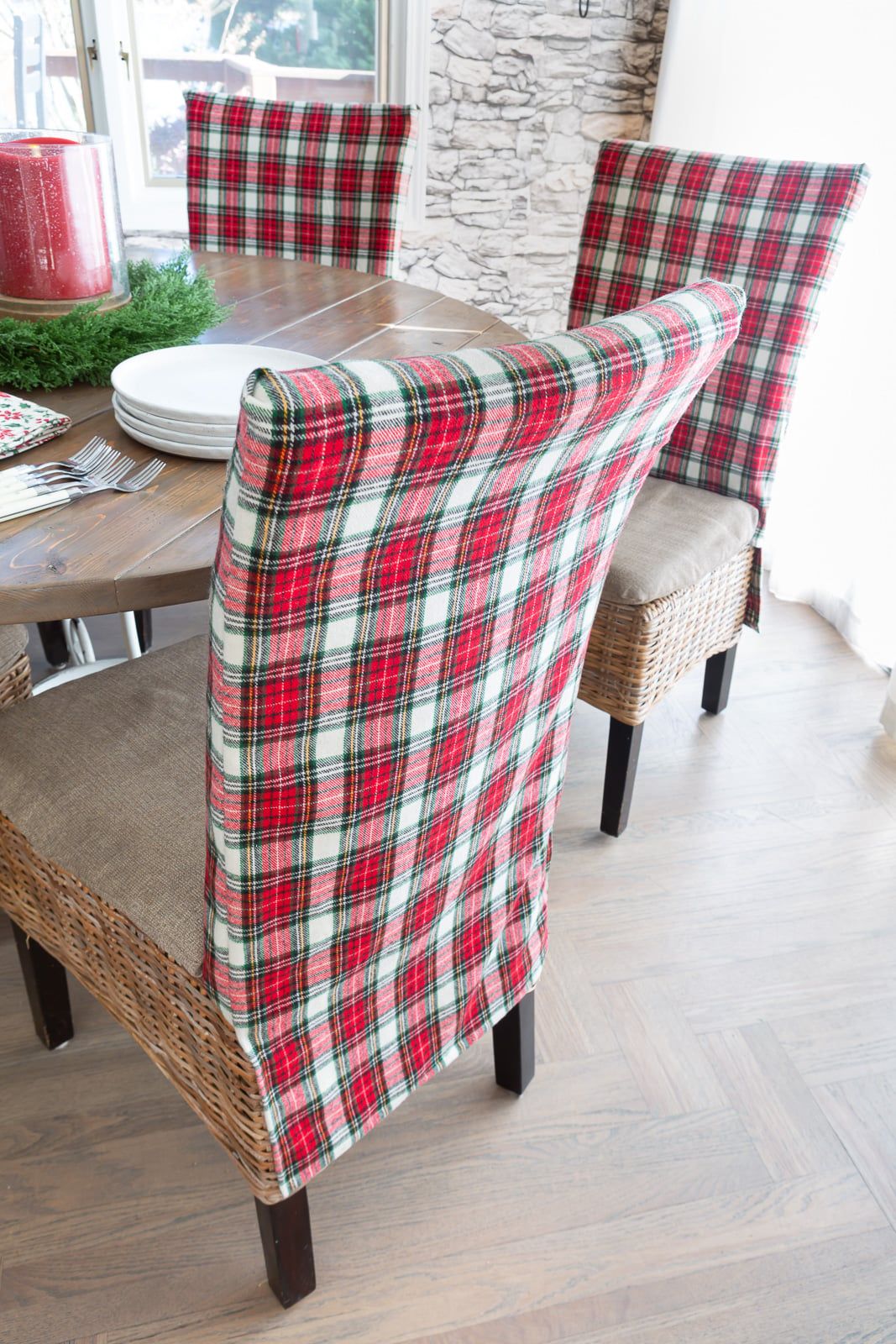
- Plaid chair slipcovers, set of six: $60–$150
- Glass hurricane and red pillar candle: $18–$40
- Green faux foliage wreath for the table: $20–$45
- Napkins and white plates you likely already own: $0–$40
29. Teal Walls, Red Velvet Sofa, Green Botanical Chairs
This room breaks the usual rule and wins anyway: about 40 percent deep teal walls, 30 percent green botanical upholstery, 20 percent crimson velvet, 10 percent brass and marble. There’s essentially no neutral. What keeps it from chaos is that every color sits at the same saturation — nothing pastel, nothing acid-bright. Copy the formula and hold your colors inside one intensity range, or add cream so the room can breathe.
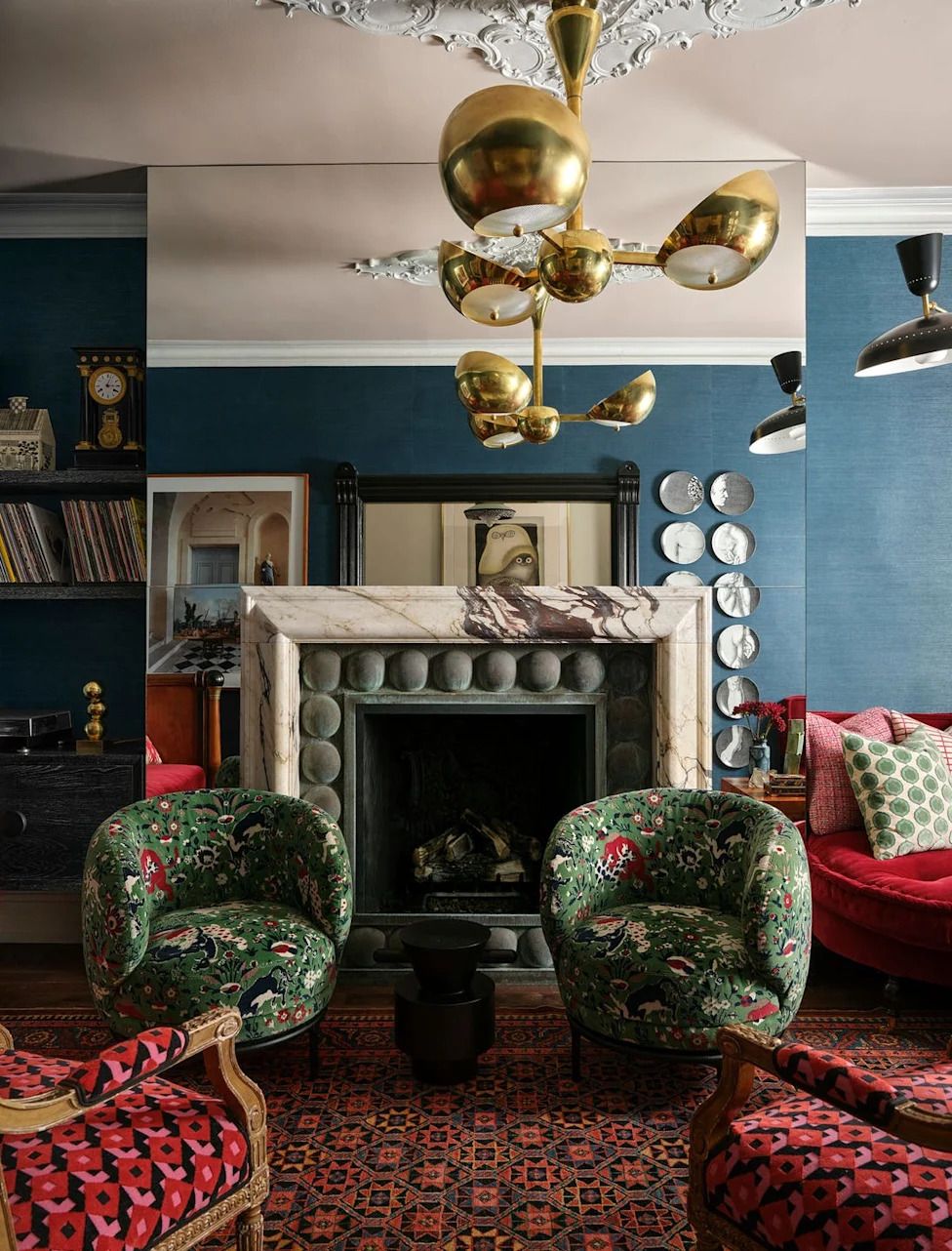
Jewel tones are 2026’s answer to a decade of beige. Call it maximalism’s third wave: color-drenched walls, velvet everything, patterned upholstery, and a ceiling that isn’t white. Searches for deep teal and oxblood rooms climbed hard through 2025, and the red-and-green holiday palette nestles right inside it — which is why a room like this can keep its Christmas styling up through February without looking seasonal.
30. Plaid Ribbon and Berries in a Tabletop Tree
Tabletop trees are where you can go cheap and nobody notices. A 24-inch artificial tree is $20 to $35 at Walmart, the plaid ribbon is $8 a roll, and berry clusters run $6 a bunch. The real trick is the bucket: a plain metal pail spray-painted or wrapped in plaid ribbon costs under $10 and looks custom. Total for the whole vignette, about $50.
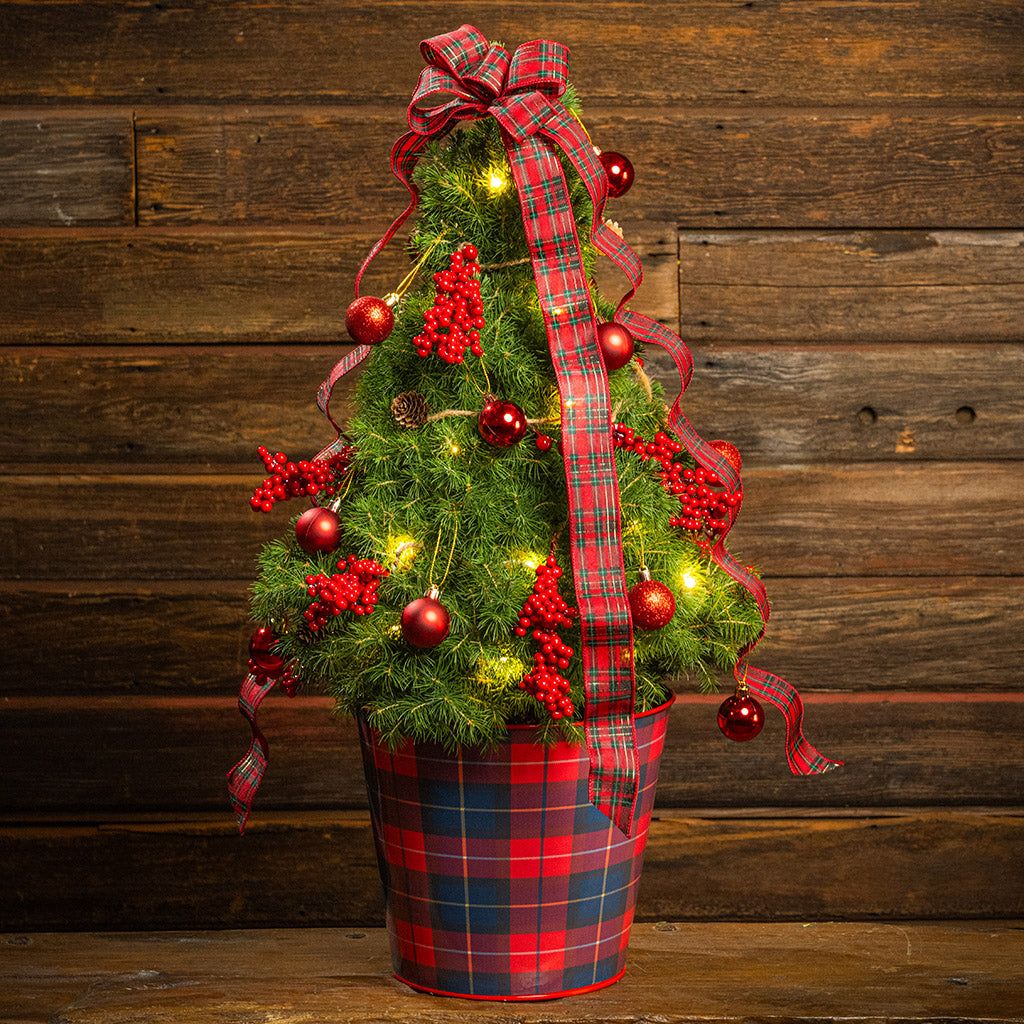
Tabletop trees come in three useful sizes: 18 inches for a shelf or mantel end, 24 inches for a console or entry table, and 30 to 36 inches for a side table beside a sofa. This one sits in the middle. Leave at least 6 inches of clear surface around the base so the plaid bucket reads as a container rather than a buried object, and keep the table at least 30 inches tall — a small tree on a coffee table just looks like it’s tipping over.
31. One Cream Cable Knit Stocking Against the Green
The cream stocking works because it’s the only pale, chunky, undyed thing in a scene full of saturated color and warm light. Against the green tree and the string lights, it reads as rest for your eye — a place to land. Cable knit adds shadow and depth that flat fabric can’t, which is why one cream knit stocking beside a bright tree beats three matching patterned ones.
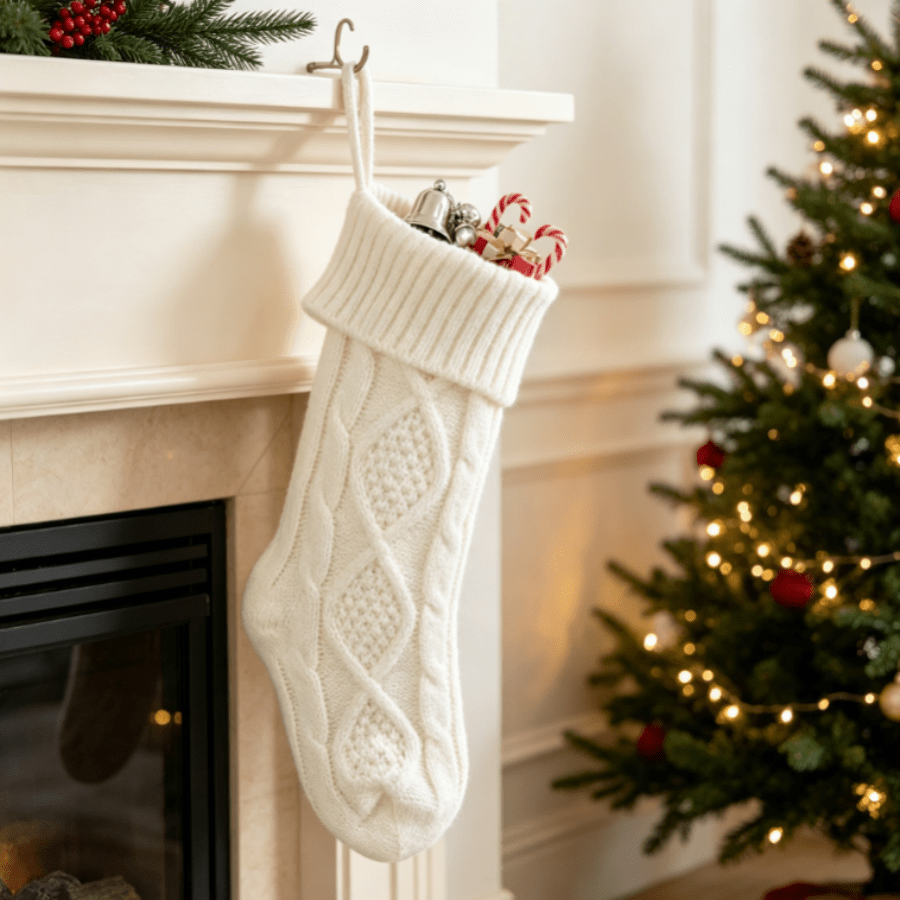
Two small cautions. Knit stockings stretch permanently once stuffed, so if you’re staging them, put crumpled tissue in the toe as a form and don’t hang anything heavier than a paperback. Second, candy canes in an open stocking will weep in a warm room — keep the wrappers on or swap to wrapped chocolates. And a white mantel shows fireplace soot, so plan a wipe-down before guests arrive.
32. Wide Red Ribbon on a Compact Silver-Planted Tree
On a small tree, go bigger rather than more. Ornaments should be at least 2.5 to 3 inches, roughly three per foot of tree height, and the ribbon should be wide — 2.5 to 4 inches — so it reads from across the room. Mini ornaments on a mini tree disappear into a blur. Skip the small baubles entirely and let one oversized red glitter bow do the work of ten.
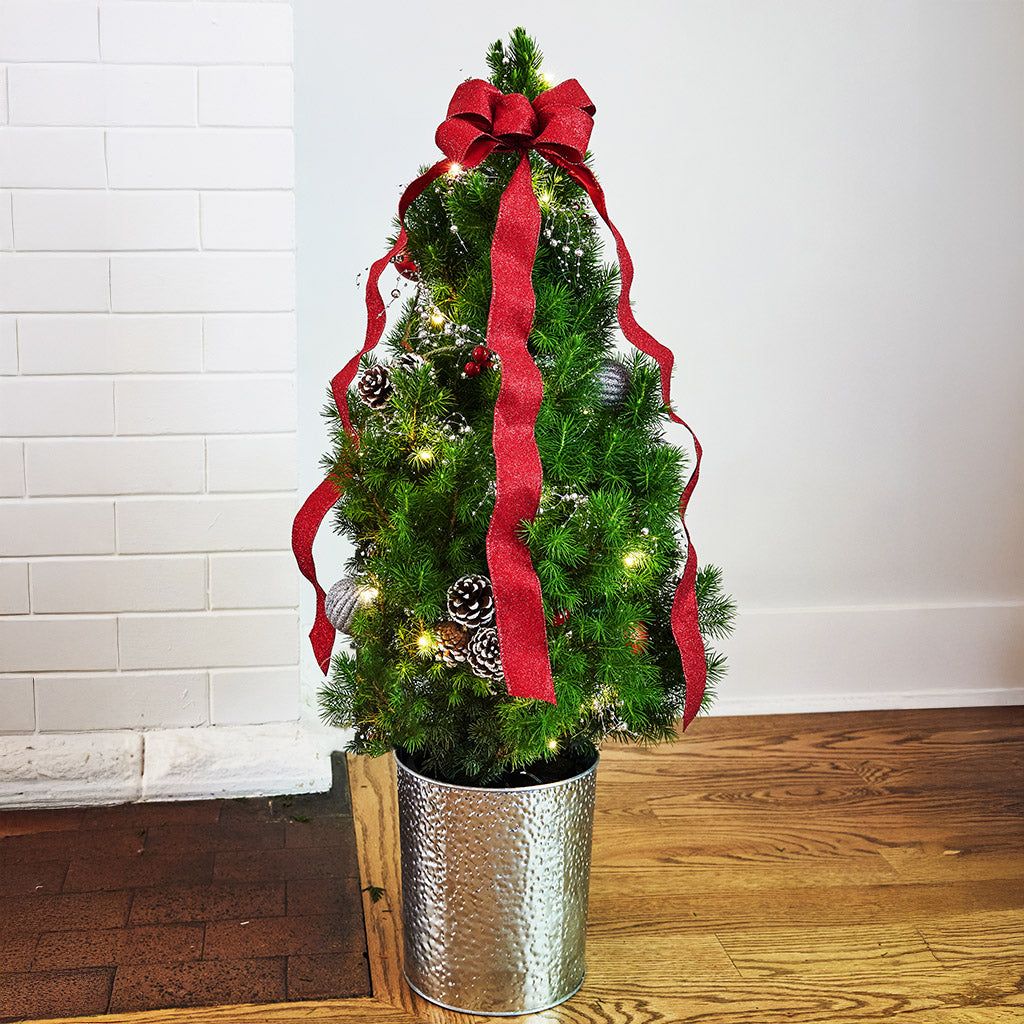
Glitter ribbon sheds forever. Expect a red dusting under this tree all season, and don’t park it next to a light-colored rug you love. Textured silver ornaments tarnish in humid rooms, so store them in a zip bag with a tarnish strip rather than loose in a box. And a hammered silver planter dents easily; lift it by the rim, never the sides. Compare with Idea #22 — same silver pot, softer palette.
Red, Green, and a Room That Still Feels Like Yours
Red and green works best when it’s edited, not accumulated — one focal point, one palette rule, and a finish that ties it together. Start with a single mantel, table, or tree, get that right, then let the rest of the house borrow from it.
📌 Save your favorite ideas to Pinterest now, and pin the mistakes section too — future-you will be very glad you did.