
Farmhouse Christmas porch ideas 2026 is having a major moment on Pinterest right now — and one look at your saved board explains exactly why. Nothing announces the season like a porch that glows before guests even reach the door. We spent serious time browsing Etsy, Target, and Wayfair (plus a small Amazon rabbit hole) to bring you only what’s worth your attention this year. After filtering through hundreds of options, we narrowed it down to 28 ideas that actually deliver — from a $12 wreath hanger up to a $640 full-porch setup. You’ll find traditional white-siding farmhouse looks, rustic wood-and-garland styling, buffalo check everything, flocked-and-frosted winter scenes, and a few vintage sled moments. Budget and luxury versions are compared side by side, so you can see exactly where to splurge and where to save. The big 2026 shift is toward warm-white lighting and layered texture instead of cool-blue LED strings — it flatters siding, it photographs beautifully, and it makes even a small porch feel intentional. And stay until the end — we break down the most common mistakes that can ruin these looks. Pin this guide for later — your future self will thank you when it’s time to actually do this.
1. A White Farmhouse Porch That Glows Before You Reach the Steps
The galvanized tubs are the thing. Two of them, planted with pre-lit miniature trees and parked on either side of the steps, do more work than any wreath here. They’re weatherproof, they cost a fraction of what a pair of ceramic urn planters would run, and they echo the metal tones a farmhouse already has. Take them away and this porch still looks decorated. Leave them in and it looks collected. That’s the difference between decorating and styling.
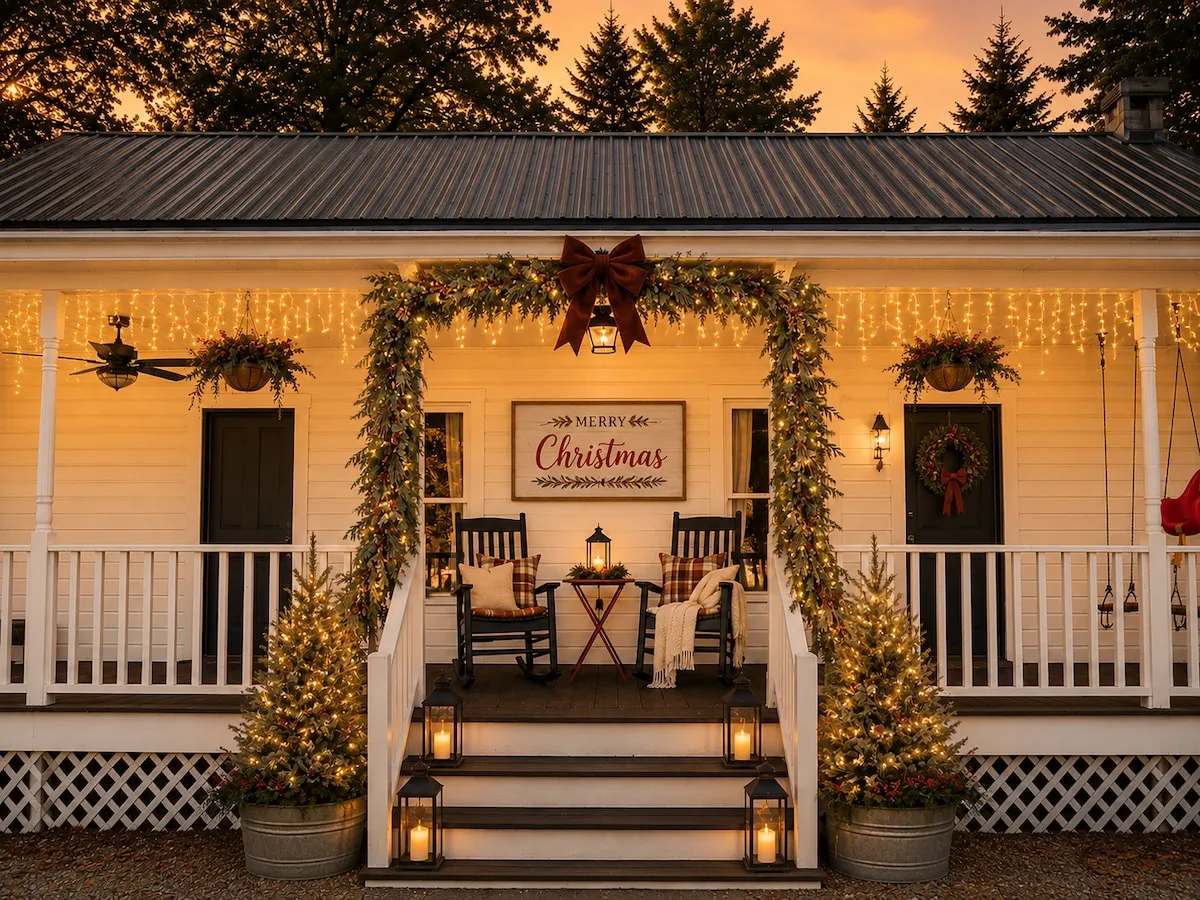
Here’s what pulling this together from scratch actually costs.
- Two 9-foot pre-lit garlands with berries and bows: $45–$120
- Pre-lit miniature trees and galvanized tubs (pair): $60–$180
- Two dark rocking chairs with plaid throws and pillows: $220–$600
- Round side table, black lanterns, LED candles: $60–$150
- Warm-white icicle lights for the roofline: $25–$60
- MERRY Christmas wall sign: $25–$70
- Total: $435–$1,180
Budget alternative: secondhand rockers run $40–$80 each on Marketplace, plain garland plus a $12 strand of lights looks nearly identical after dark, and feed-store buckets replace the tubs for about $8 apiece. Closer to $200 — and if you’d rather go black-and-white, the buffalo check version in Idea #14 runs on the exact same bones.
2. Natural Wood Double Doors Framed in Copper and Evergreen
Two things carry this entry, and neither of them is the garland. The first is symmetry — matched wreaths, matched planters, matched sconces — which is what makes a porch read as intentional from the sidewalk, where people actually see it. The second is the natural wood plank ceiling. It caps the space and turns a covered walkway into something closer to a room, so the greenery feels like it belongs here instead of like it got stapled on.
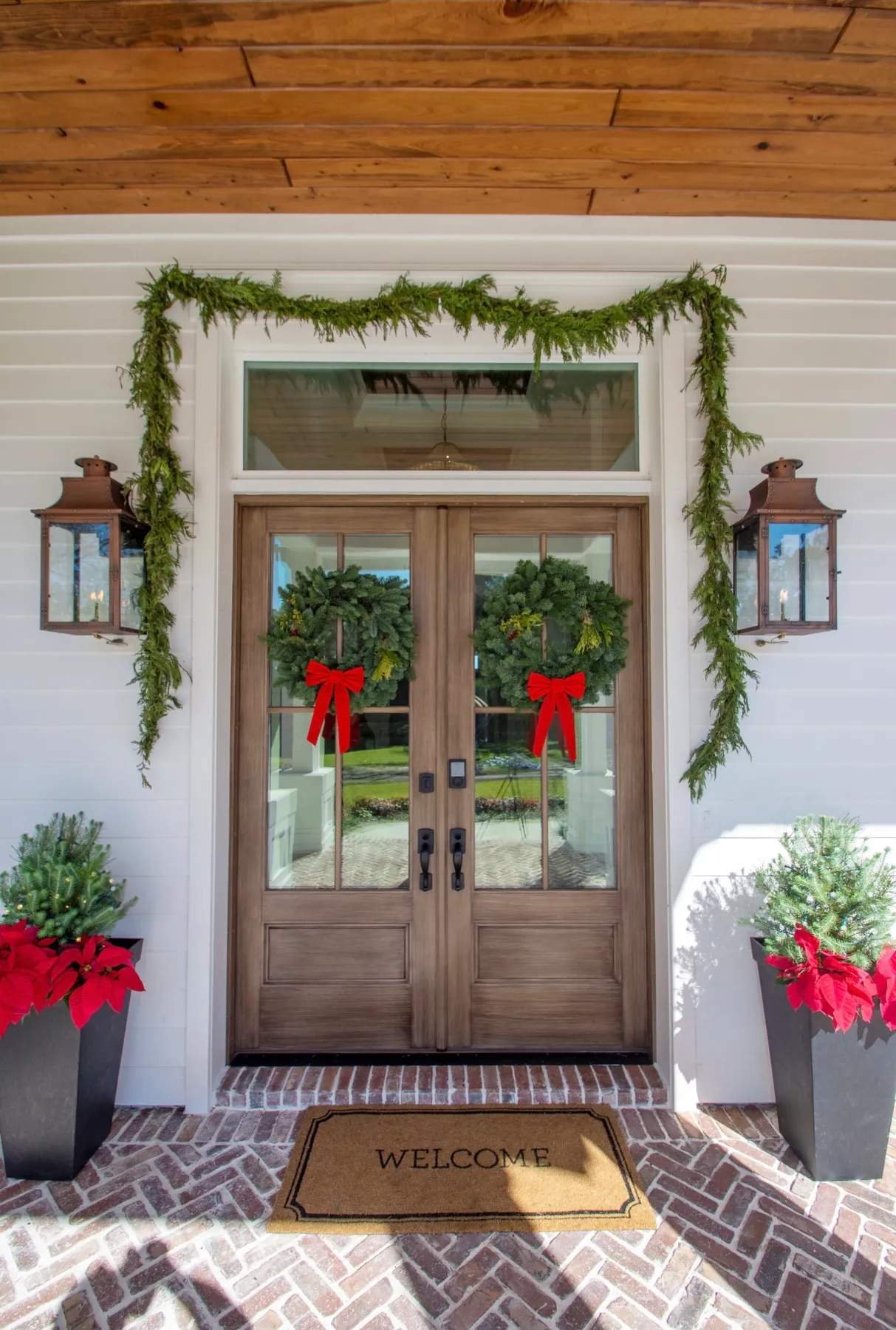
Wreath size is the most common miss. Measure your door’s width and hang a wreath that’s roughly one-third of it — a 36-inch door wants a 12- to 16-inch wreath, not the 24-inch one that looked great in the store. Center it in the upper third of the door with the bottom sitting above the mid-rail, and hang it from a wide ribbon rather than a wire hook so the hardware disappears behind the bow.
3. Black Door, White Clapboard, and Two Bushel Baskets of Red
The formula here is 70 percent white, 20 percent black, 10 percent holiday color. White clapboard, trim, and porch floor hold the base. The black door, sidelights, and lantern sconces supply the graphic punch. Then two wooden bushel baskets of poinsettias carry every bit of red on the entire facade. Trade the black for oil-rubbed bronze and it goes warmer and older. Swap the poinsettias for white amaryllis and red twig dogwood and it goes quieter.
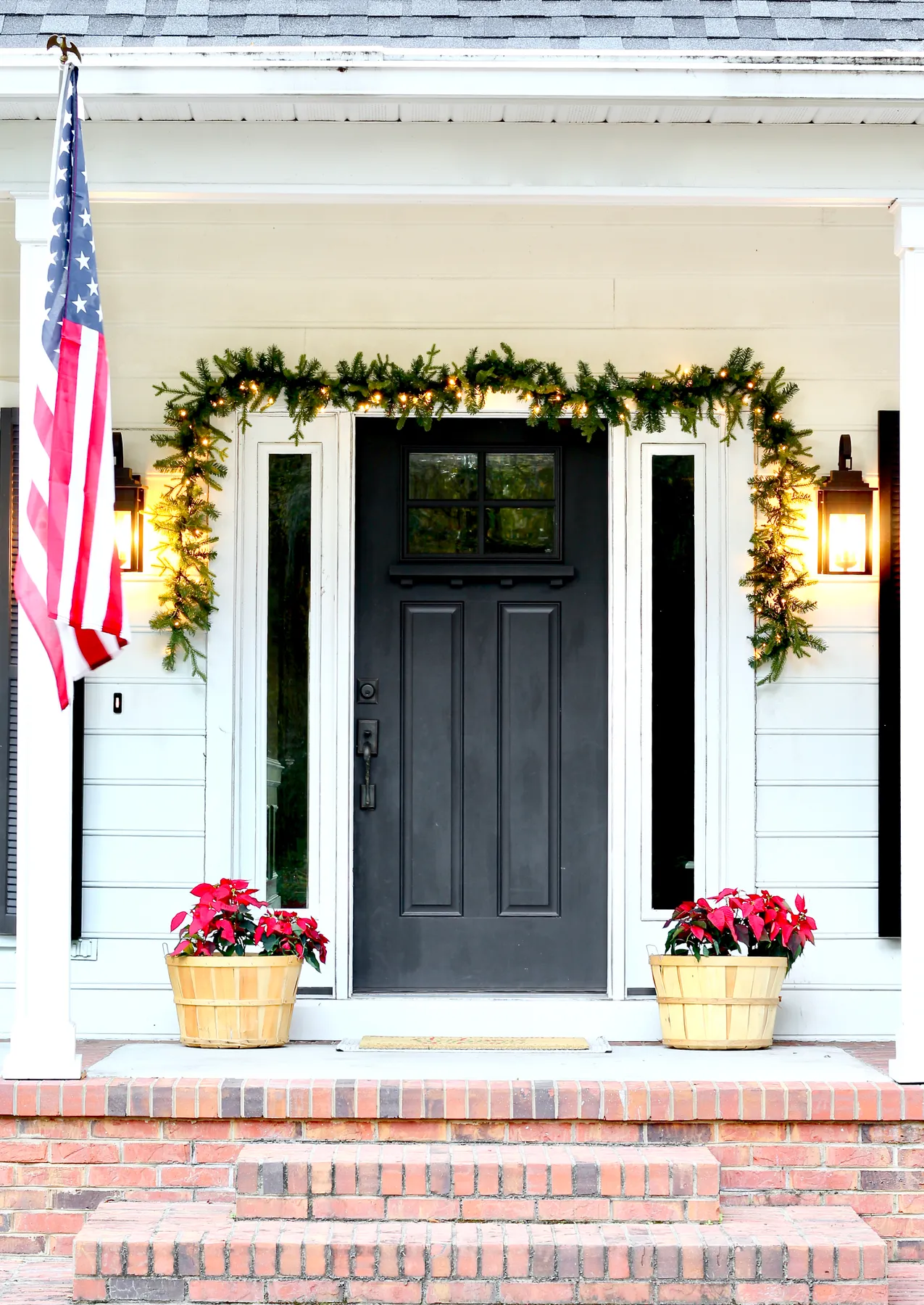
Poinsettias are tropical plants, and they will not forgive you for a hard freeze. Below about 50°F they sulk; at 32°F the leaves blacken overnight and there’s no coming back. If your porch faces north or you’re in zone 6 or colder, either bring the baskets in at night, buy faux poinsettias that read convincingly from ten feet away, or switch to winterberry holly and red twig dogwood, which shrug off cold without complaint.
4. One White Rocking Chair, One Plaid Set, One Perfectly Placed Lantern
Here’s the full recipe for a single-chair vignette.
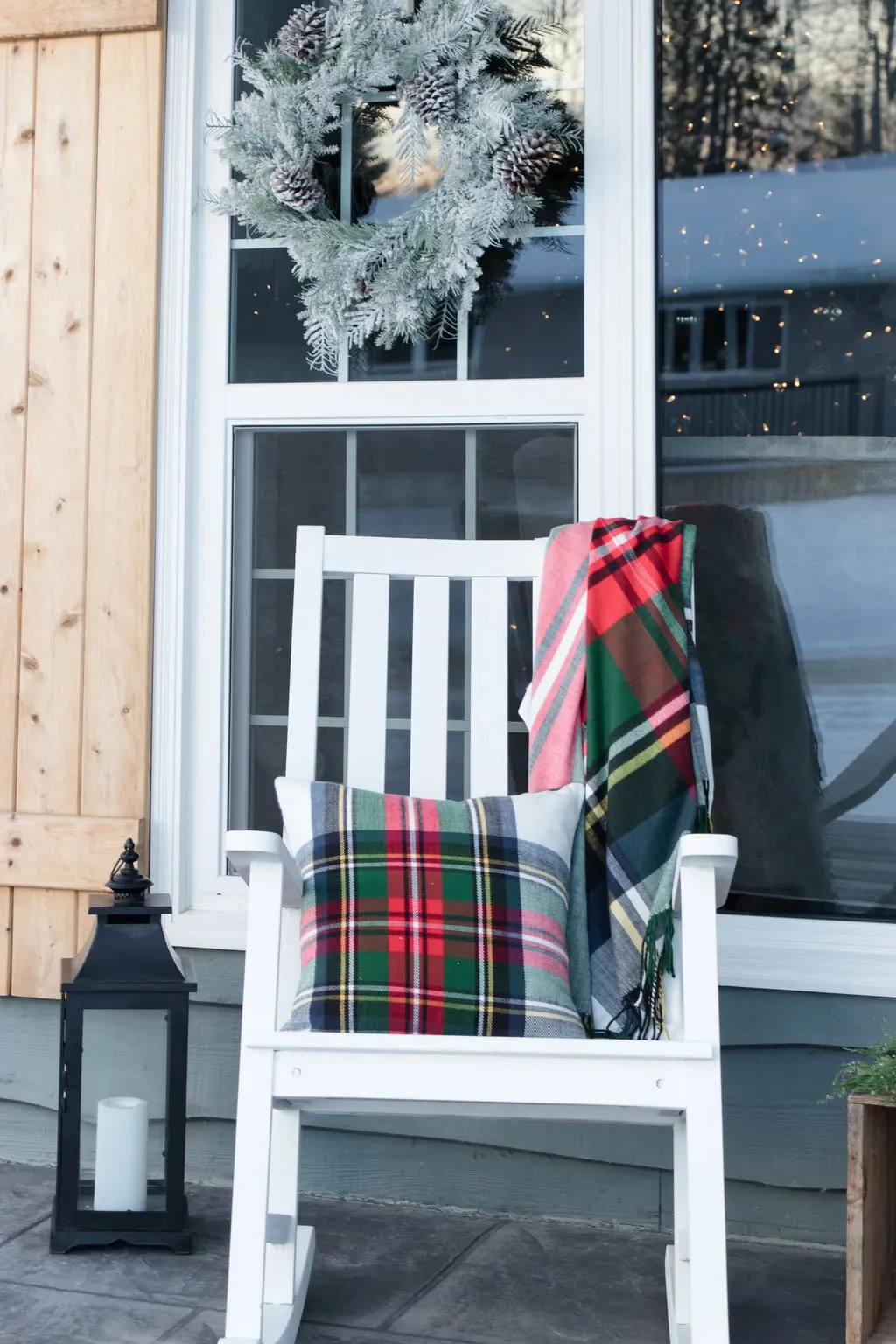
- Angle the chair 15 to 20 degrees toward the walkway so it greets people instead of facing the wall.
- Fold the throw in thirds lengthwise, then drape it over one arm with about 10 inches hanging down the outside.
- Stand the plaid pillow upright against the back — a slumped pillow kills the whole thing.
- Center the frosted wreath in the top third of the window behind the chair, hung from a ribbon or a suction cup rated for a pound.
- Set the lantern 12 to 18 inches from the chair’s outer arm, on the same visual line as the pillow.
- Use a battery candle with a six-hour timer so the porch lights itself at dusk.
Twenty minutes, and the only thing you might need to actually buy is the wreath hanger.
You probably already own a chair. A used white rocker runs $35–$70 on Facebook Marketplace, and if you can only find brown, a $9 can of exterior spray paint solves it in an afternoon. Plaid throws and pillows hit 60 to 75 percent off right after the holidays. The lantern is the one piece worth buying new — a good metal one with a glass hurricane is $20–$40 at Target or IKEA and will outlast the throw, the pillow, and possibly the chair.
5. Brown Double Doors, White Board-and-Batten, and a Sled by the Firewood
Rough numbers for a rustic porch like this one.
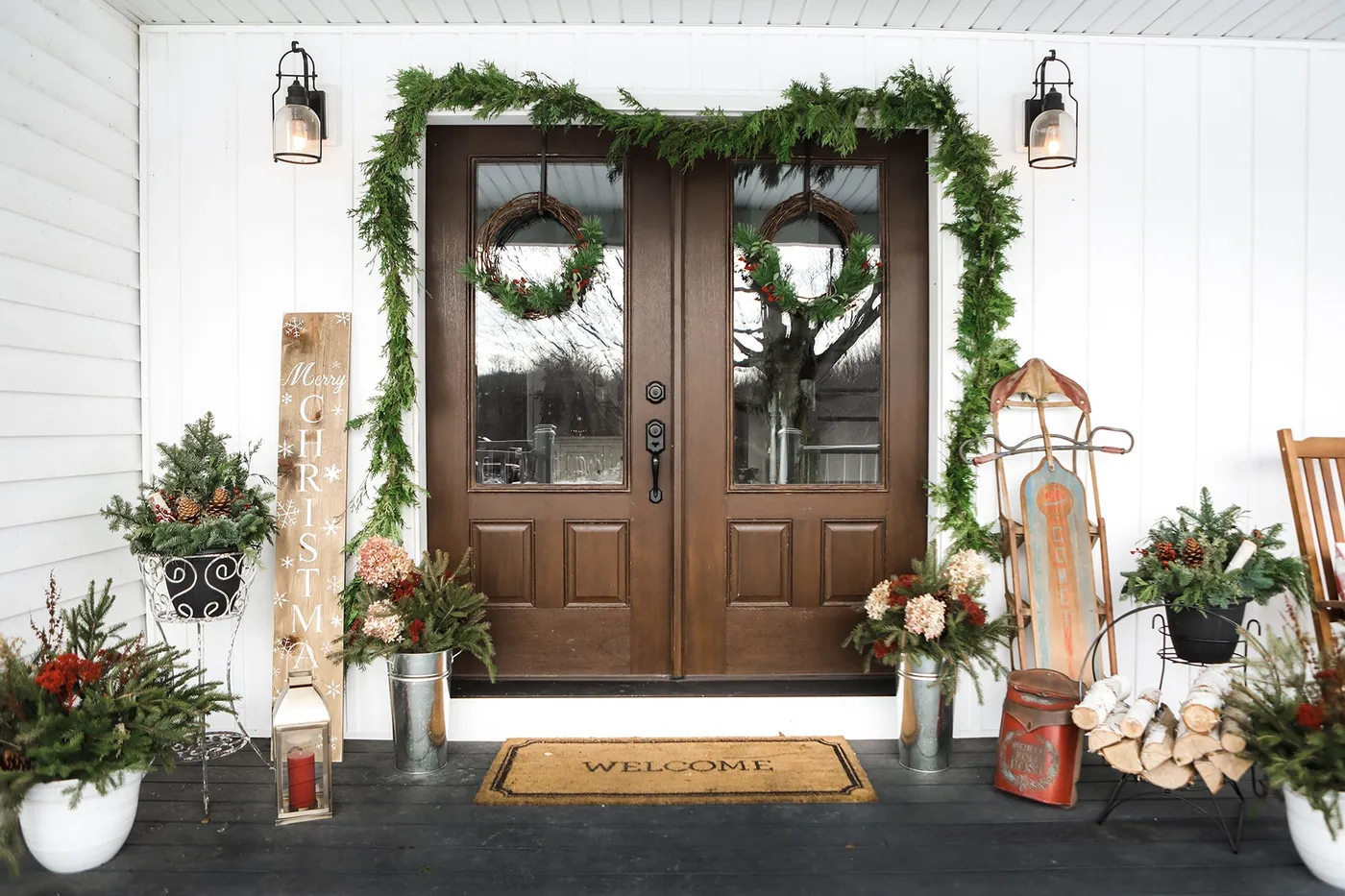
- Two 9-foot garlands plus a matching wreath: $50–$130
- Pair of black industrial wall sconces: $60–$160
- Wooden Merry Christmas sign: $30–$85
- Vintage sled, thrifted or Marketplace: $25–$120
- Two potted evergreens: $40–$100
- Firewood, stacked and dry: free to $60
- Total: $205–$655
If those evergreens are real, they’re on a clock. Cut garland dries in three to five weeks, drops needles every time someone walks past, and browns faster on a south-facing porch. Mist it every other day and keep it out of direct sun and you’ll stretch it to six weeks. The stacked firewood is its own project: keep it at least three feet from the door, off the floor on a rack, and only bring in what you’ll burn that week. Firewood is a five-star hotel for spiders.
6. The Quiet Farmhouse Porch: Warm Light, Natural Greens, No Overload
The 2026 version of the farmhouse porch has quietly dropped red-and-green maximalism. What’s climbing on Pinterest is warm white lighting, undyed natural greenery, and one or two saturated accents instead of six. Call it quiet farmhouse. It photographs better in low light, it works from November through February instead of December only, and it doesn’t require replacing everything you bought last year.
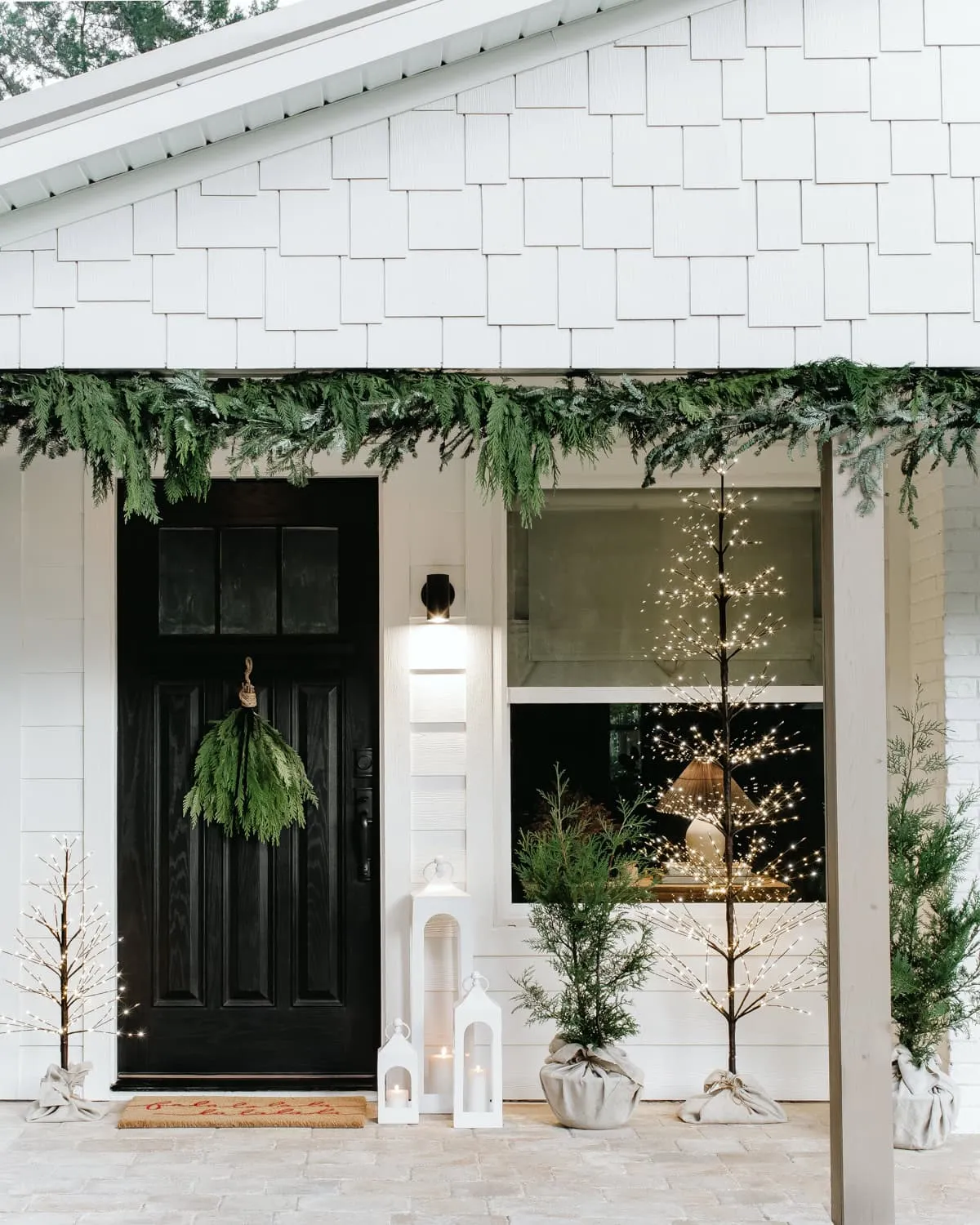
Layer light at three heights and the porch will read as designed even if nothing else is. Most porches have exactly one light source, and that’s what flattens them.
- Eye level: wall lanterns or sconces with 2700K bulbs, 40 to 60 watt equivalent
- Table height: lit garland, candle lanterns, or lit planters, $25–$60 each
- Ground level: path lights or a warm uplight aimed at the siding, $30–$80 for a two-pack
Keep every bulb in the same color temperature, or the mismatch becomes the only thing anyone notices.
7. A Dark Gray Door Dressed in Flocked Garland and White Bows
Roughly 60 percent cool neutral, 30 percent flocked green, 10 percent white with warm texture underneath. The dark gray paneled door, the gray patterned porch floor, and the white trim set an almost wintry base. The flocked garland and wreath carry the green. White bows, white pillar candles, and burlap bases bring the last ten percent — and the burlap is what keeps the whole thing from going sterile. Trade the flocked green for plain evergreen and the same formula reads as a fall porch instead.
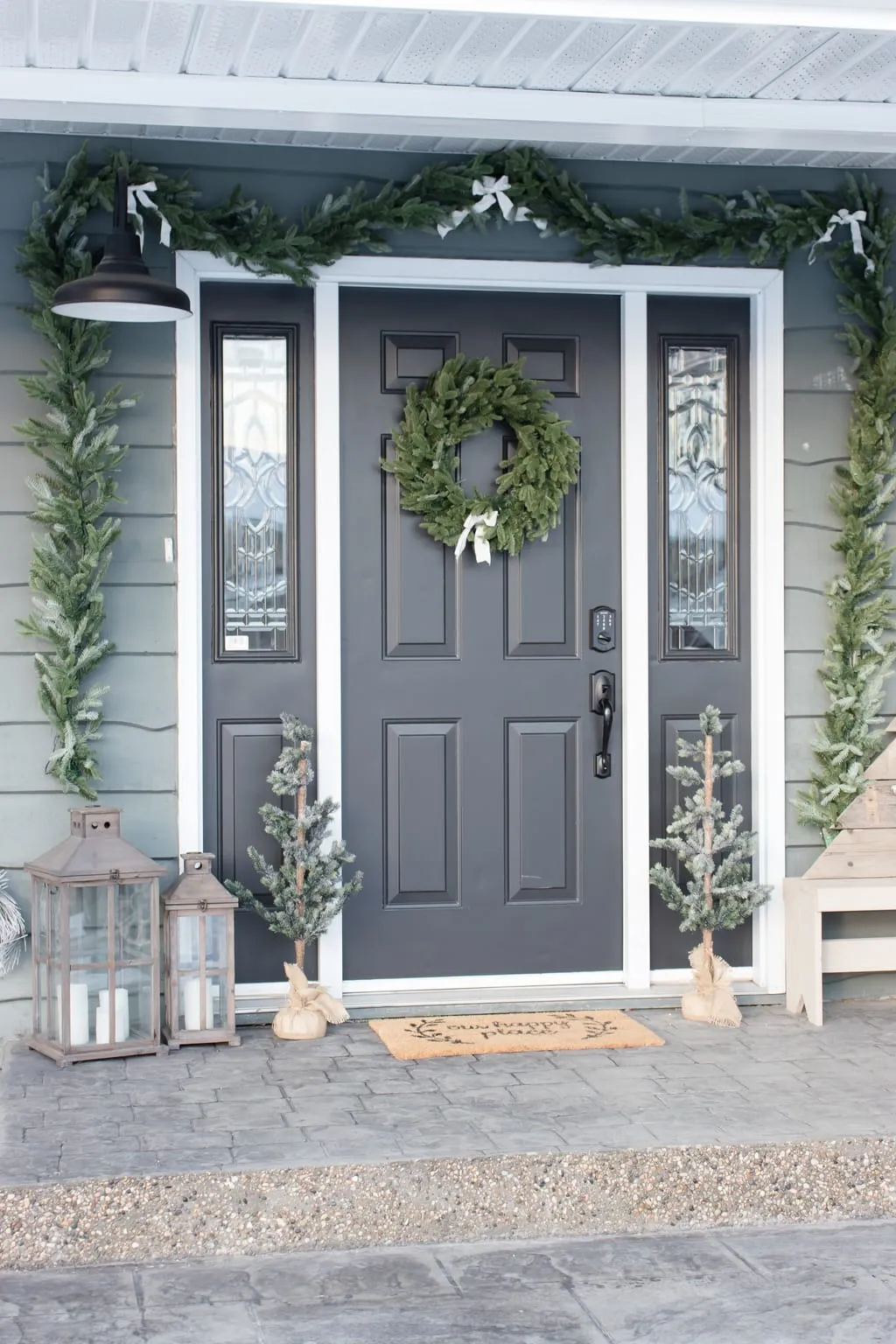
Flocked garland is the biggest markup in holiday decor, and the easiest thing to fake. Buy a plain 9-foot garland for $15–$25 and one can of spray flocking for $7. Lay it on cardboard outside and dust it in light passes from about 12 inches away. Two wooden lanterns run $20–$35 each at Target or IKEA, though thrift stores sell candle holders for $3. Burlap is about $5 a yard at any craft store — cut a band and wrap the base of a pot you already own.
8. A Fire Pit, a Chunky Knit Blanket, and a Porch You Won’t Want to Leave
A fire pit on a covered porch has rules. Keep it at least three feet from railings and six feet from any ceiling or overhang, and skip wood-burning units under a roof — embers travel and smoke stains white siding. A propane or gel insert gives you the flames without the risk. With kids or a dog in the house, a 30-inch tabletop model with a screen is the safer call, and never leave it lit and unattended. If you’d rather skip the open flame entirely, the garland-and-lantern setup in Idea #5 delivers a similar evening glow without the worry.
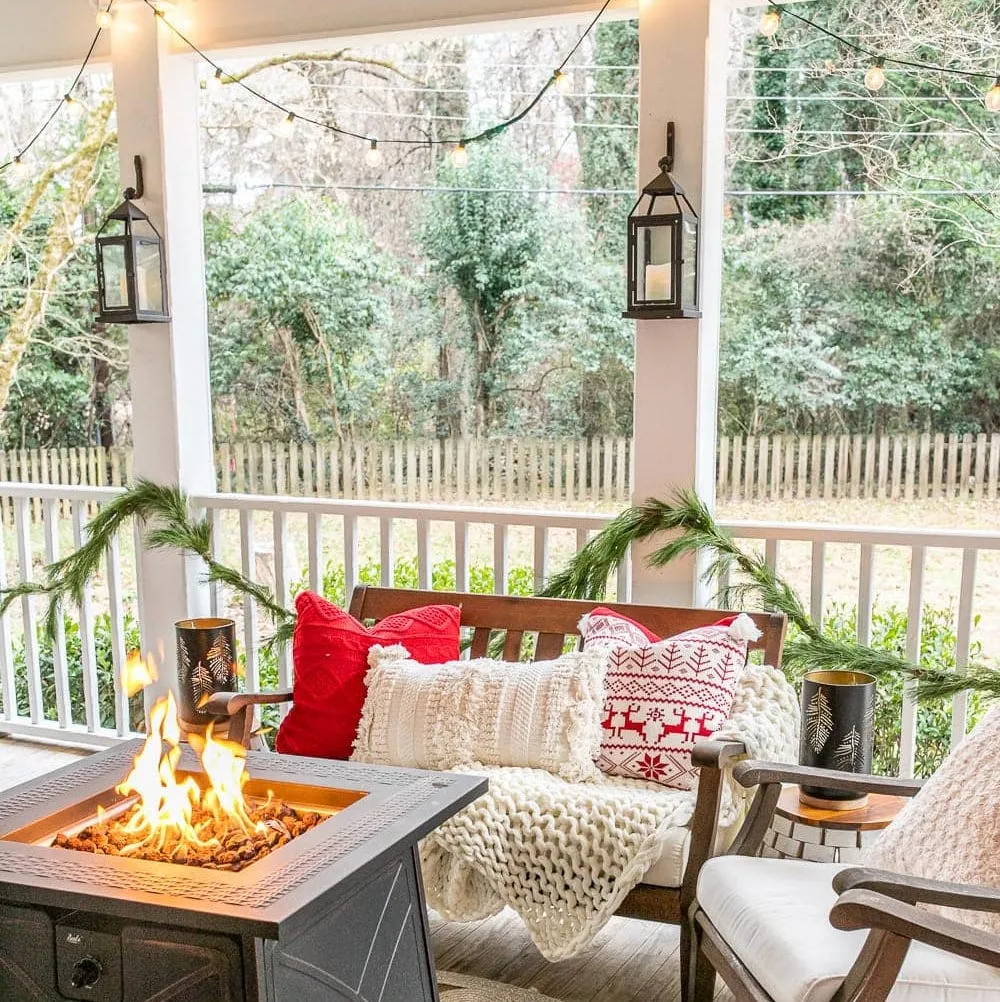
The fire pit anchors the composition at ground level and gives the eye something warm to land on. Everything else is layered on purpose: garland along the railing at mid height, string lights and hanging lanterns overhead, pillows and the knit blanket at human scale. Three heights, one focal point. That low flickering light also flatters the white railing instead of washing it out the way a single porch bulb does.
9. A Nighttime Porch Built Around a Navy Cushion Sofa
Rug size makes or breaks an outdoor seating area. A rug should extend at least 24 inches past the front edge of the sofa on both sides — for a six-foot sofa, that means 5×8 at absolute minimum, and 8×10 is better. If the front legs sit on the rug and the back legs are off, fine. If nothing sits on the rug, you bought a floor decal. One more thing: flat-weave polypropylene outdoor rugs handle a damp porch far better than anything tufted or backed in rubber.
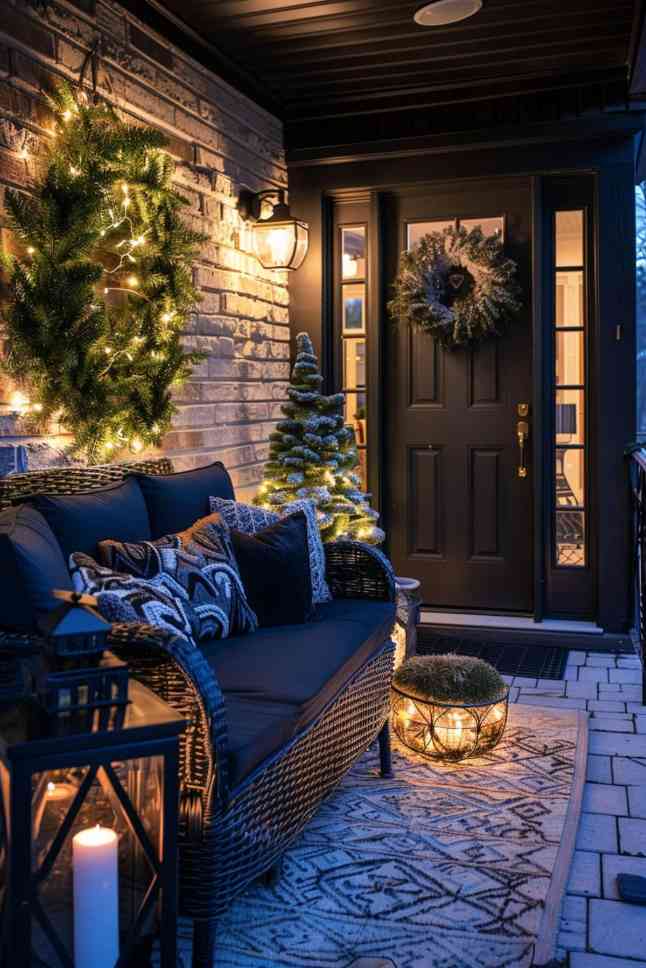
This layered setup needs room to breathe — 8×12 feet of usable porch (96 square feet) at minimum, with a nine-foot ceiling or higher if you’re hanging lanterns overhead. Below that, the sofa, the frosted tree, and the rug start competing for the same visual space. Measure the clear width from your door swing to the outer railing and treat that as your real number before you shop.
10. Sage Green Shiplap and a Checkerboard Floor, All Dressed for Christmas
Sage shiplap walls and a green-and-off-white checkerboard floor would be a lot in a living room. On an enclosed porch it works, because a transition space can afford more personality than a room you live in. The distressed white console table is the pressure valve — it gives the eye somewhere to rest between all that color. And the PEACE ON EARTH banner pulls a horizontal line across those vertical shiplap boards, which keeps the wall from reading like a fence.
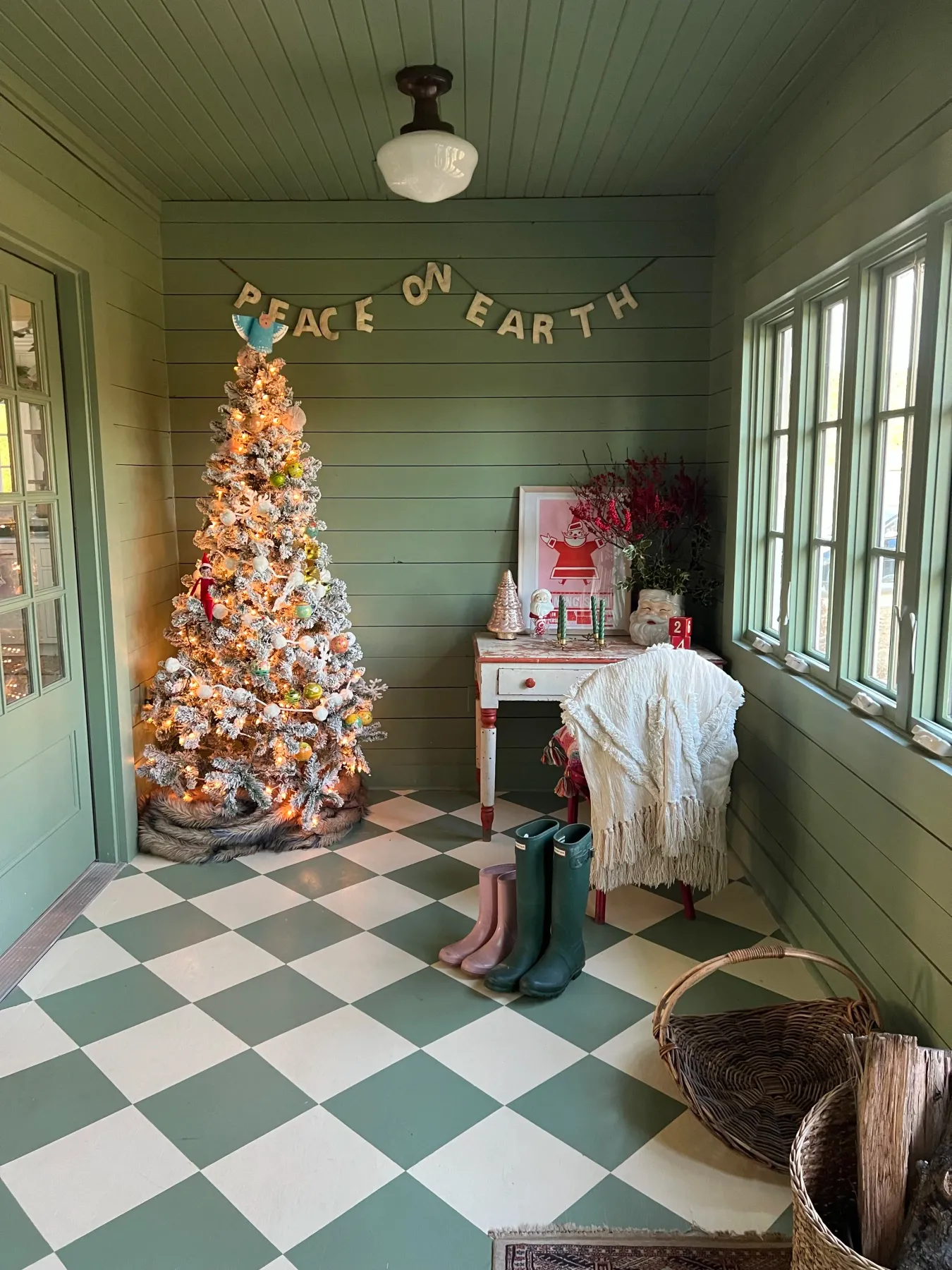
Vintage Santa figurines and letter banners were a flea market find five years ago. Now they’re the backbone of the nostalgic Christmas look that’s been building since grandmillennial styling went mainstream, and 2026 is the year it fully displaced all-white minimalism on Pinterest. The upside for you: this stuff is cheap at estate sales and thrift stores precisely because it spent a decade being unfashionable.
11. One Snow-Dusted Evergreen in a Dark Woven Basket
It’s the loose evergreen sprigs lying in the snow on the step. Nothing in this scene is expensive — one small tree in a woven basket, a weathered lantern, a candle — and the sprigs are what sell it. They make the arrangement look like it grew there rather than like somebody set it out at 3 p.m. on a Saturday. You can’t buy that look. You can only borrow a handful of trimmings from a tree lot and drop them where they fall.
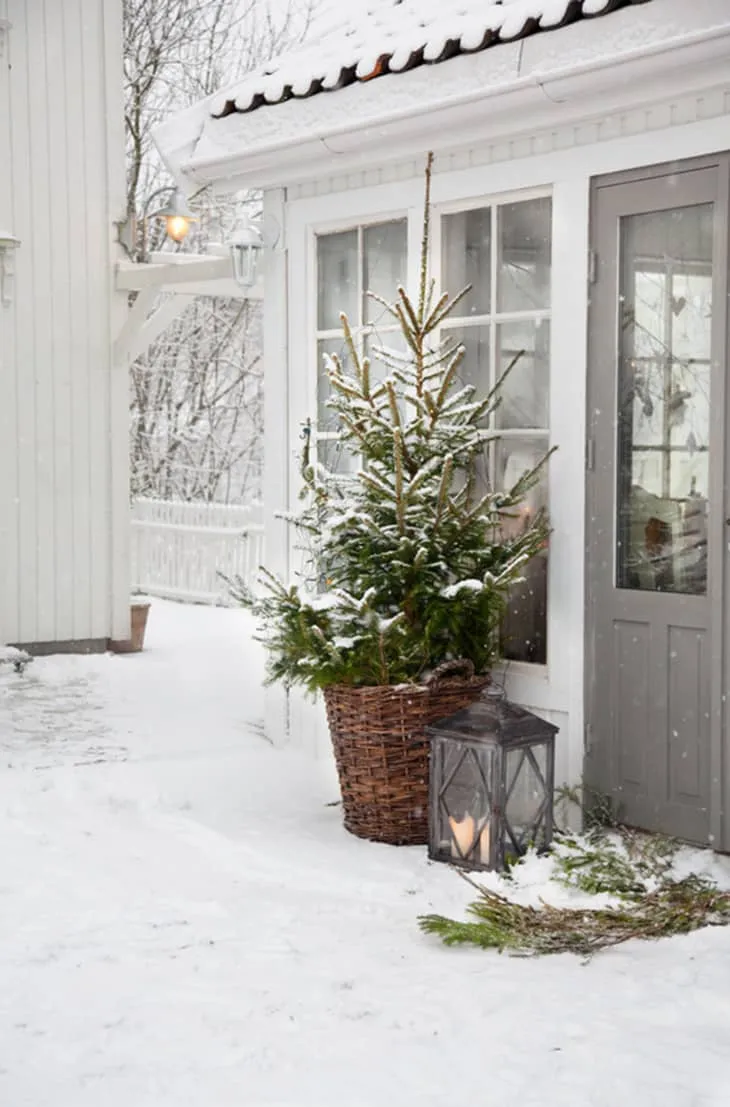
A living evergreen in a container is more maintenance than it looks. The root ball needs water even in winter — yes, even when it’s snowing, because wind dries it out fast — and a pot that holds standing water will crack in a hard freeze. Below 20°F, move the tree into an unheated garage. The other thing nobody mentions: snow on porch boards means ice, and rock salt pits concrete and kills the grass at the edge of your walk. Sand or a pet-safe melt is the better trade.
12. Wood Door, Copper Lanterns, and Planters That Change With the Season
This is the porch setup that pays for itself, because the pots stay and only the contents change. Mums and mini pumpkins in October, evergreen sprigs and red berries in December, daffodils in March. Mums run $6–$12 at a grocery store in late September, and the evergreen sprigs are often free — most tree lots will hand over their trimmings if you just ask. Dollar-store faux stems are $1.25 each and hold up outdoors for a season. Four seasons of styling for under $60 a year.
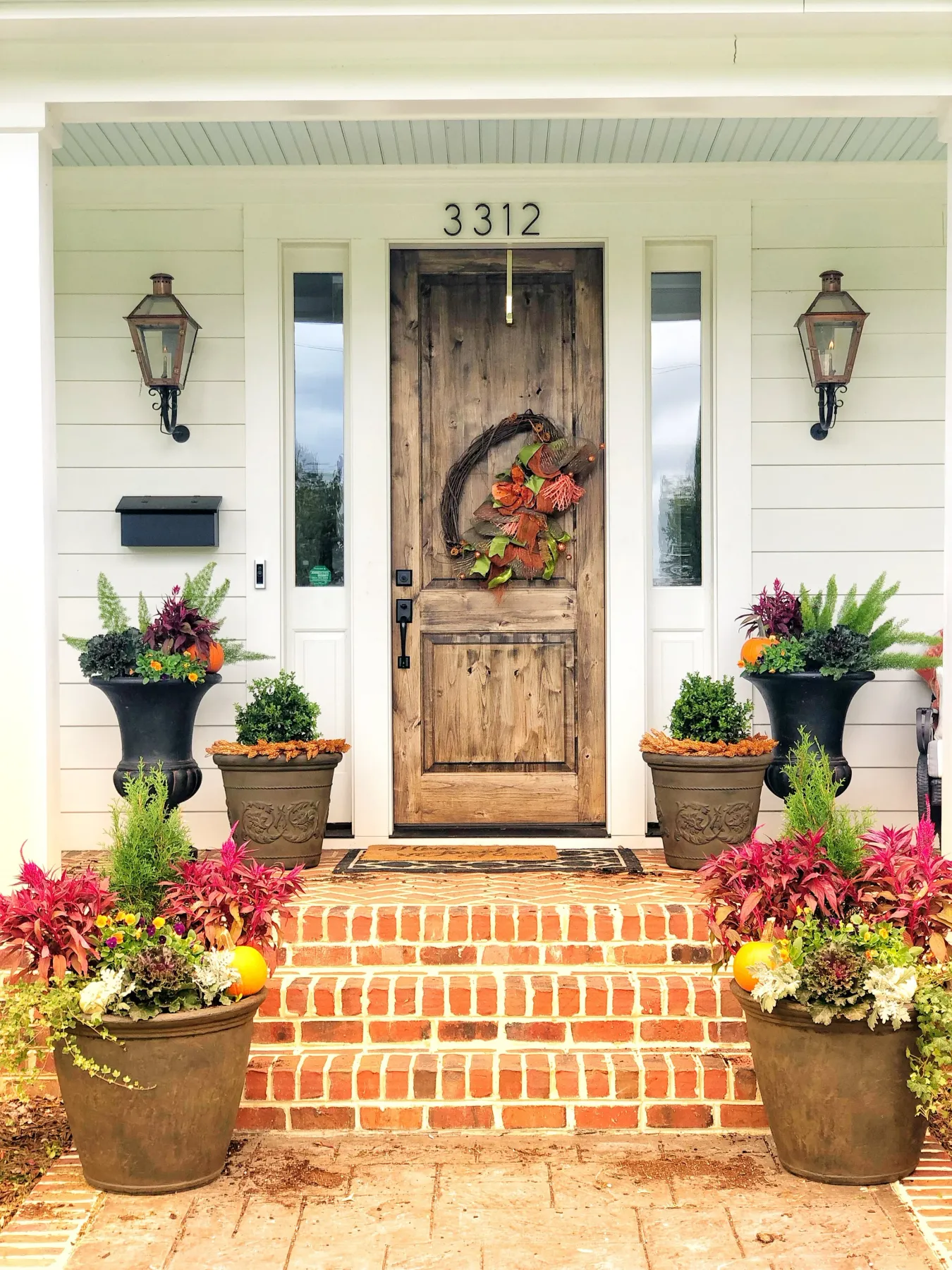
Wide brick steps are what make planters work here; you need at least 12 inches of tread depth to set a pot down without narrowing the path. This arrangement suits a porch six to eight feet deep and 10 feet wide or more. On a narrower entry, the paired-sconce-and-wreath approach in Idea #7 covers similar ground in half the footprint.
13. Paint Your Own Merry and Bright Porch Sign
Here’s the whole build, start to finish.
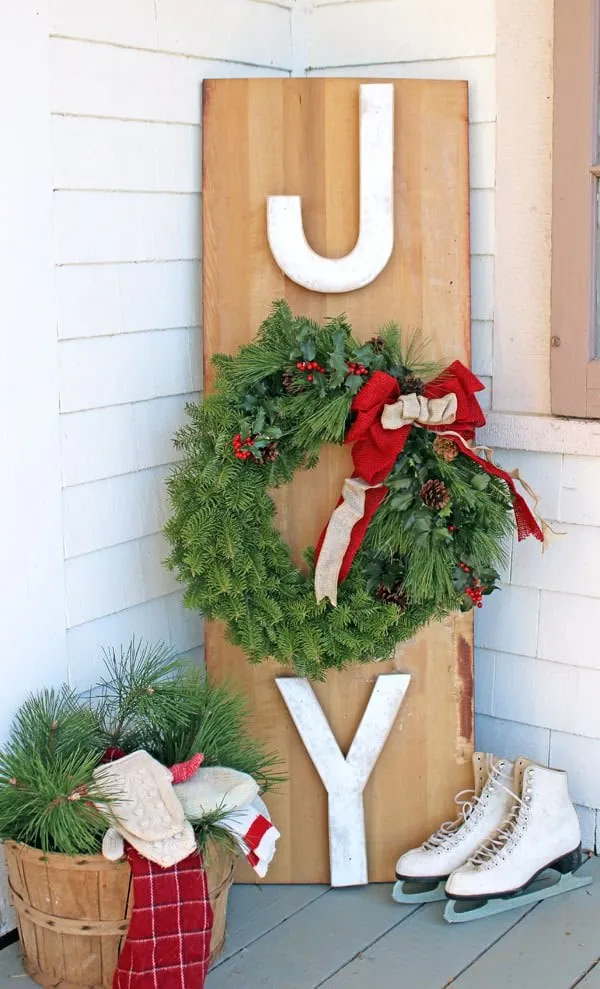
- Pick up a 1×10 board and have it cut to 48 inches — or 72 inches if you want the tall double-height sign.
- Sand the face and edges with 120-grit, then wipe it down.
- Brush on two thin coats of exterior latex in black, cream, or deep green. Thin coats. Let it cure 24 hours.
- Print your lettering at 350 to 400 point, tape it to the board, and trace the outlines — or rub graphite on the back for a transfer.
- Fill in with acrylic craft paint and a flat brush, edges first, two coats.
- Seal with two coats of exterior polyurethane, then add screw eyes and hang from cup hooks.
One weekend, mostly spent waiting on paint. About $25–$45 in materials.
If a weekend of lettering isn’t happening, don’t force it. Thrift stores and Marketplace are full of wooden holiday signs for $15–$30, especially in January when everyone’s clearing out. Etsy sellers make custom versions for $45–$90 if you want your family name on it. A plain board with a single word in a contrasting color — JOY, NOEL, WELCOME — costs about $12 and reads just as well from the sidewalk.
14. Buffalo Check, a Red Metal Truck, and a Stacked Stone Wall
Layered doormats are easy to get wrong. The base mat should be 6 to 10 inches wider than the mat sitting on top of it.
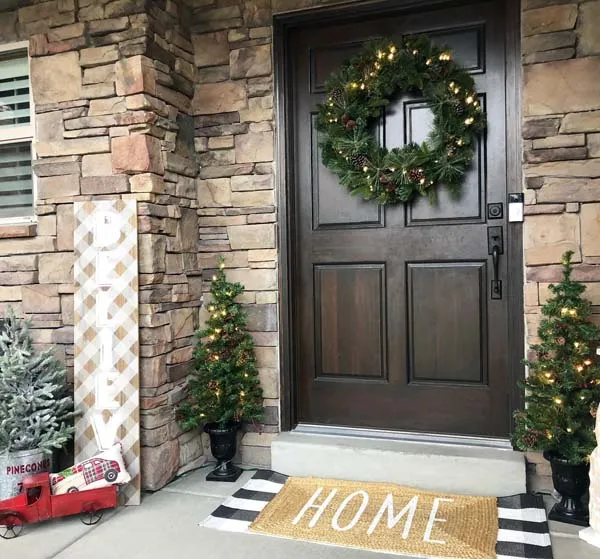
- Base: a 30×18 buffalo check mat, flat and non-shedding
- Top: a 24×16 coir mat for scraping, beveled edge
- Clearance: check your door’s bottom gap before you stack anything
Keep the whole stack under an inch thick so the door doesn’t drag across it. And anchor the truck — a 10- to 15-pound metal truck will absolutely walk off in a strong gust.
The red metal truck is the one thing. It’s what takes this from a nice buffalo check porch to a specific porch, one with a point of view. Everything around it is a pattern or a plant. The truck tells a story, it gives you somewhere to park a small frosted tree, and it’s the piece guests will photograph. If you only buy one decorative object this season, buy the one that looks like it has a history.
15. Gold on Black: A Snowy Porch That Reads From the Street
Two gold-accented pieces — the wreath and the ornaments in the garland — are doing the work of a much bigger display, because warm metal reflects light and stays legible from 30 feet away. Gold against snow and gray stone is high contrast, which is why this still looks alive in flat winter light. The pair of tall trees is the other move: repeating the same shape on either side of the door frames the entry and quietly makes the house look wider than it is.
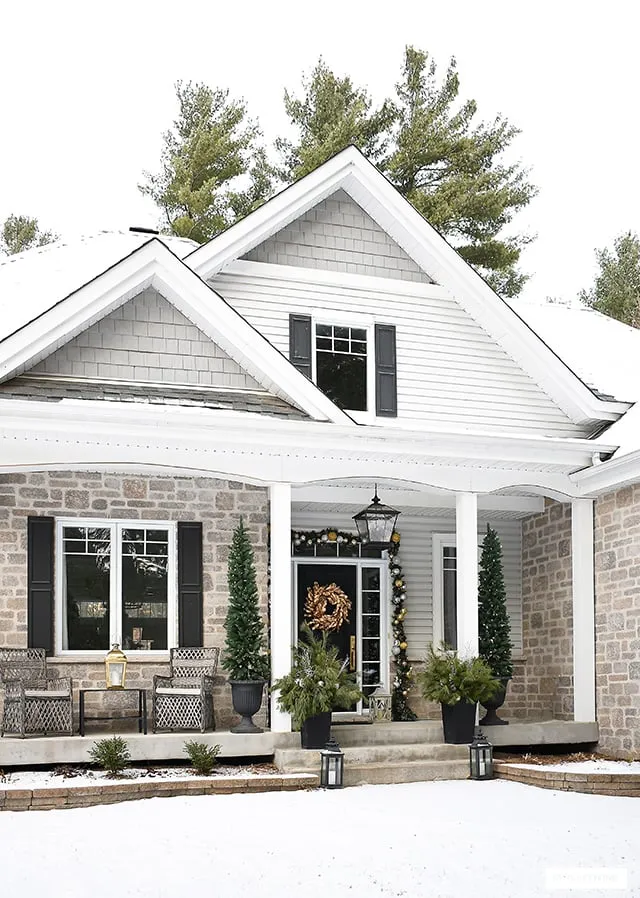
- Two 7- to 8-foot artificial trees: $180–$420
- Gold-toned wreath: $35–$90
- 9-foot garland with gold and silver ornaments: $40–$110
- Two dark planters: $60–$180
- Two potted evergreens with pinecones: $50–$120
- Black metal lanterns and LED candles: $40–$90
- Total: $405–$1,010
Budget alternative: skip the tall trees and set two 4-foot trees on upturned buckets behind your existing planters. Same silhouette from the sidewalk, about $70 instead of $300. Gold ornaments in big-box stores drop to half price by mid-December.
16. Cylindrical Planters and a Garland That Frames the Whole Door
55 percent white, 30 percent deep green, 10 percent black, 5 percent natural wood. That’s the whole recipe. The garland and wreath carry the green. The siding and trim carry the white. The lanterns and cylindrical planters carry the black. The wooden floor lanterns supply the last five percent, and without them the palette would feel cold and slightly corporate. Trade the black planters for aged bronze and it shifts warmer and older. Switch to square planters if your facade is all right angles.
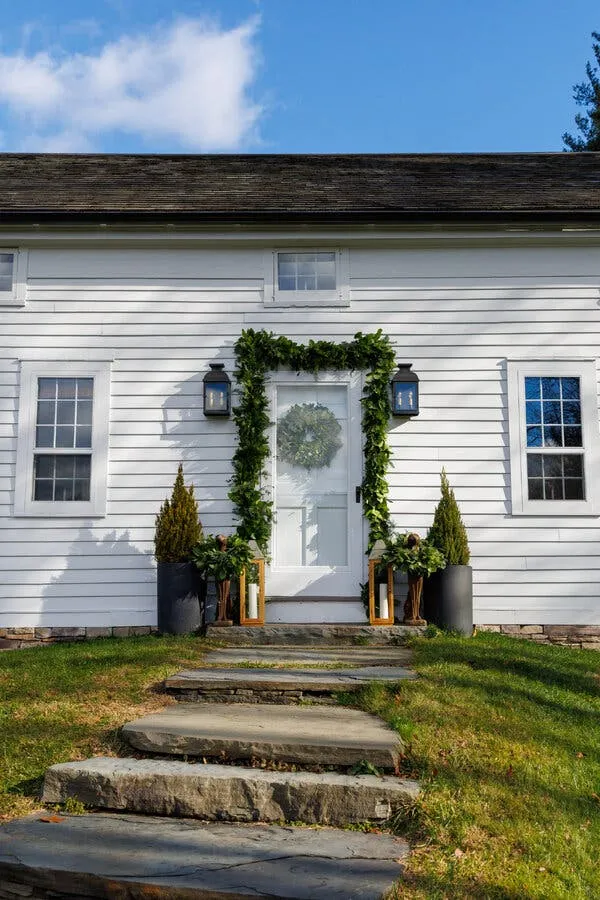
Run through this before you buy anything.
- Measure your door frame’s width, then multiply by 1.5 — that’s your minimum garland length
- Confirm at least two GFCI-protected outdoor outlets, ideally one on each side of the door
- Check which way the door faces — north-facing porches stay damp and faux greenery can mildew
- Weigh your planters empty; a 24-inch planter with a live tree and wet soil can top 100 pounds
- Walk your steps and count clear tread — leave at least 12 inches of walking room
17. Brick Steps, Green Shutters, and a Galvanized Bucket
That weathered wooden porch floor is the honest part of this picture. Snow, salt, and freeze-thaw cycles will gray it out, and no amount of sweeping fixes it — the boards need sealing or oiling every year or two. Galvanized buckets look great but they rust from the inside out once water sits in them, so drill a drainage hole before you plant anything. And if you’re hanging on brick, use masonry-safe hooks: brick is porous and a nail hole never disappears.
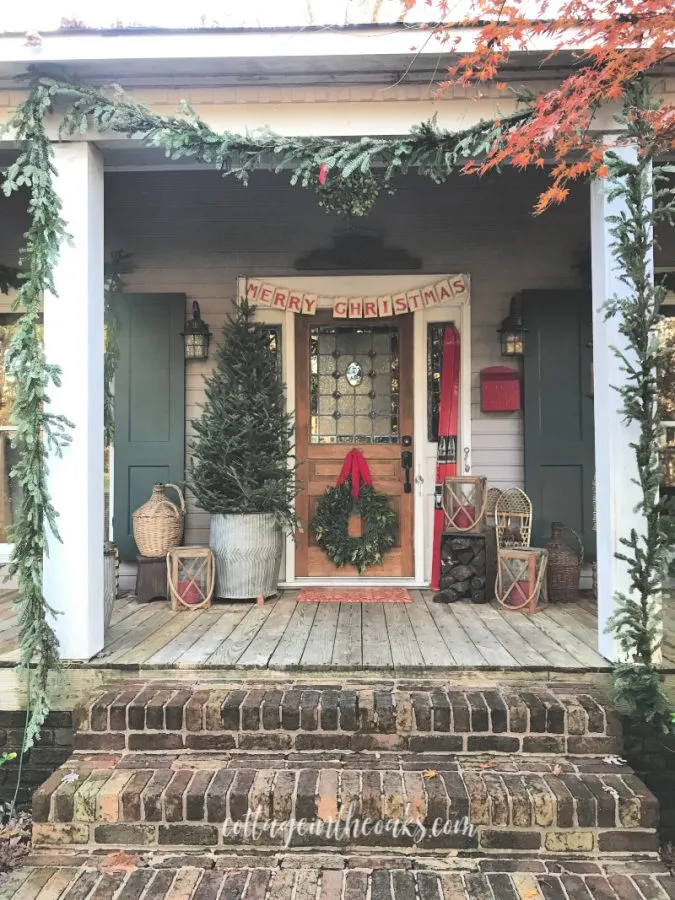
Do not attach garland to shutters. Adhesive hooks fail in cold, and screws into louvered shutters crack them — that’s a $200 mistake you’ll stare at for years. Run the garland on the wall above the door frame instead, using 1/8-inch masonry hooks rated for 10 pounds each, spaced every 18 to 24 inches. On a door with leaded glass, keep the wreath’s total weight under five pounds so hanging pressure never touches the glass.
18. How to Build a Winter Planter That Looks Like a Florist Did It
The method, in order.
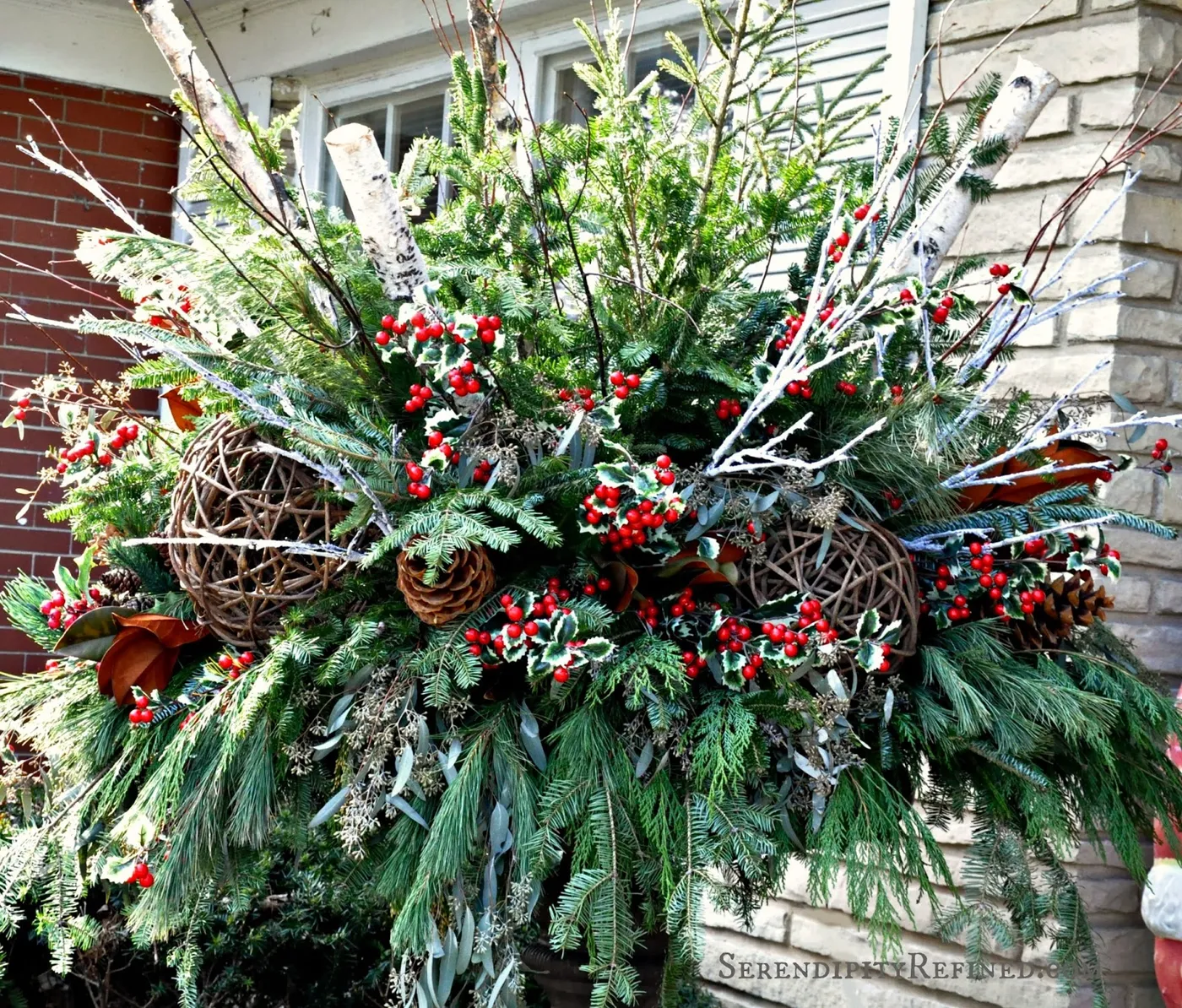
- Start with a 14-inch planter. Fill it with sand or a foam block — never loose potting soil, which freezes and heaves.
- Push two or three birch logs into the back, cut 18 to 24 inches tall, for vertical structure.
- Add evergreen branches in three layers, starting at the outer rim and angling them about 30 degrees outward so they drape over the edge.
- Fill the middle with red berry stems and a few frosted white branches for contrast.
- Tuck pinecones and woven rattan spheres into the gaps until no mechanics show.
- Skip watering entirely if everything is faux; if it’s real greens, soak the foam weekly.
Forty-five minutes and $35–$70 per planter.
The birch logs are the one thing. Without them, this is a pretty pile of evergreen sitting in a pot. With them, it has a vertical line, a warm wood tone that breaks up all that green, and a silhouette you can read from across the yard. Birch is also the cheapest element here — a three-pack runs $12–$18 and you’ll reuse them for years. If you can only add one thing to a planter you already own, add height.
19. A Vintage Sled, Two Jingle Bells, and Light Blue Siding
The whole vignette is a scavenger hunt, and that’s exactly the appeal. Sleds run $20–$60 on Marketplace or $5–$15 at an estate sale; repaint the runners if they’re too far gone. A pair of large jingle bells is $6–$12 at a craft store. Natural rope is $5 a spool. And the greenery on top? Tree lots throw away more trimmings than you could ever use — ask nicely and they’re free. Under $50 total, and not one piece of it looks like it came from the same aisle.
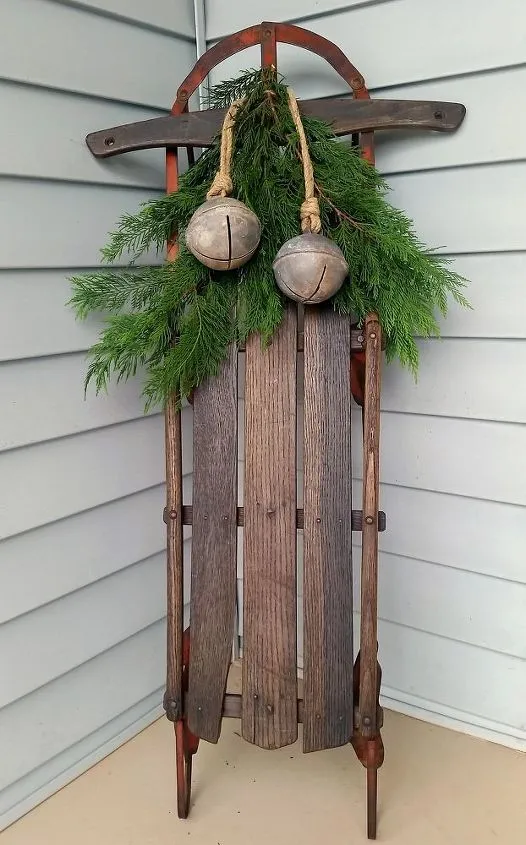
This is Christmas decor that doesn’t shout Christmas. No Santas, no snowmen, no red-and-green overdose. Sleds, ice skates, and weathered bells have taken over because they work from Thanksgiving through February, they photograph beautifully against cool siding colors, and they let people who don’t want a themed house still participate. Cottage-core styling has been feeding this for a couple of years and there’s no sign of it slowing down.
20. White Railings, Gingerbread Trim, and Lanterns on the Steps
Porches with gingerbread trim like this one are usually six to eight feet deep and 12 feet wide or more, which is why the arrangement can breathe. The rule of thumb: you need five feet of clear width for a pair of seating pieces, and at least 18 inches between the door frame and anything you place beside it. If your steps are narrower than 48 inches, use one large lantern instead of two. For a deeper porch where you’re layering seating, a rug, and greenery at three heights, the setup in Idea #9 shows what that extra square footage actually buys you.
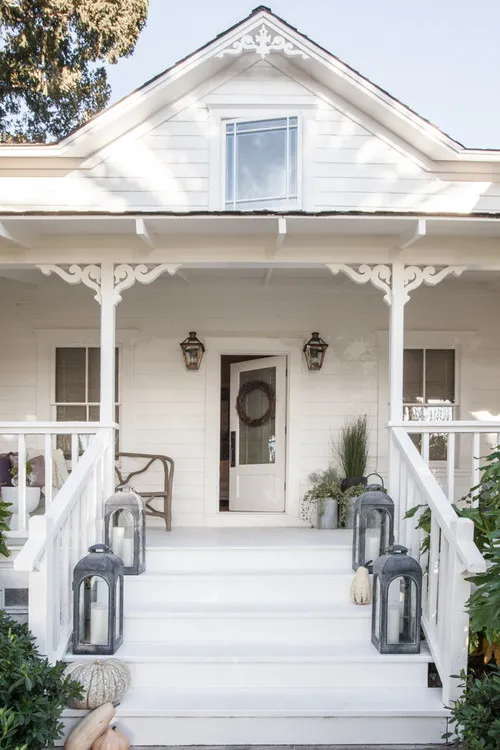
Those pumpkins will not last until Christmas, and that’s fine. Uncarved pumpkins hold three to six weeks outdoors, faster once freeze-thaw cycles start, and squirrels will start on them the moment they soften. Wipe them with one part bleach to ten parts water to slow the rot, keep them off concrete steps directly since they stain, and let them go gracefully. A slightly slumped pumpkin on a farmhouse porch has never bothered anyone.
21. A New Entry Door Changes Everything — Start Here
If you’re replacing the door before you decorate it, get these sorted first.
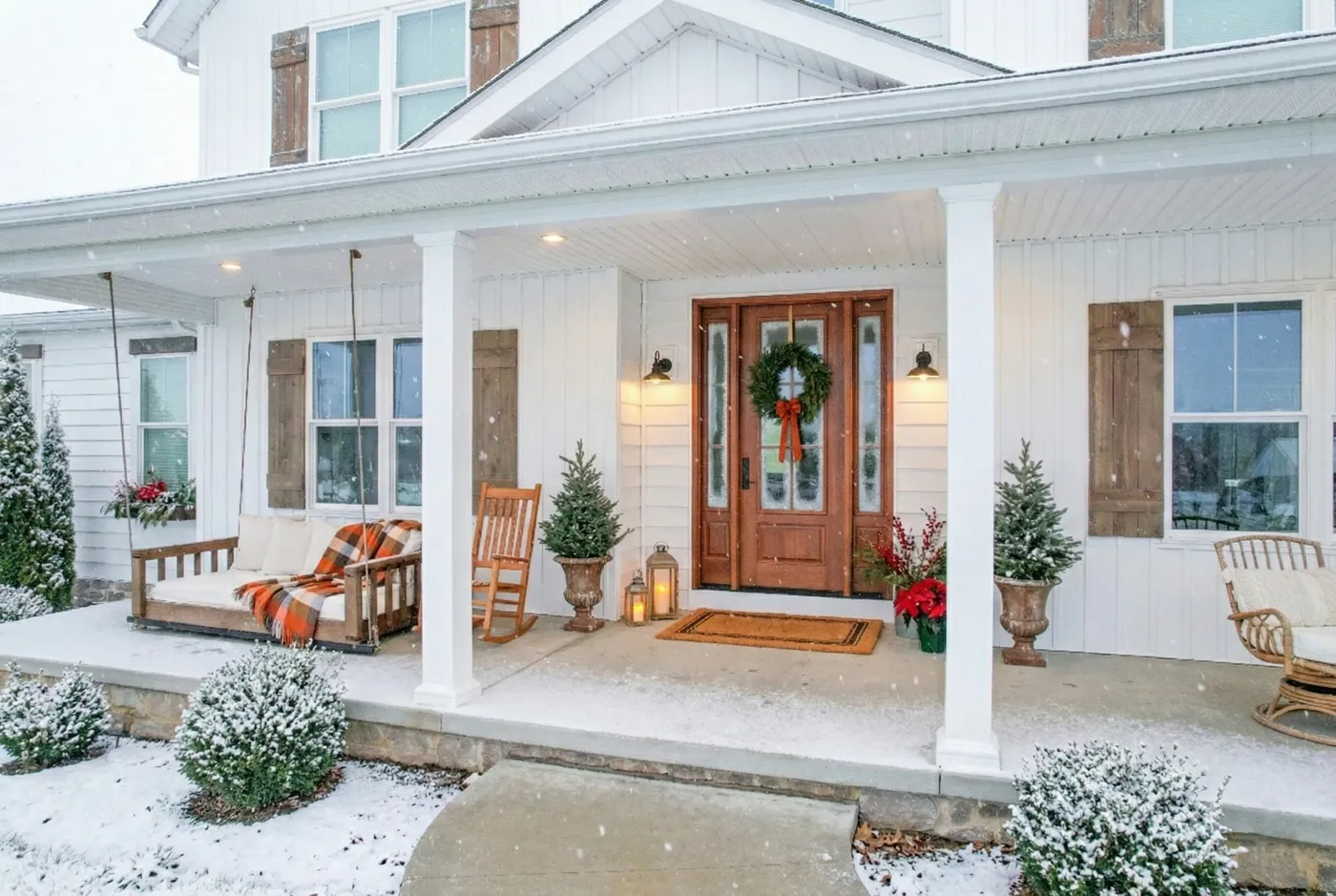
- Measure the rough opening in three places — top, middle, and bottom — and use the smallest number
- Decide primed versus prefinished; primed doors need paint within 30 days or the warranty is void
- Check your existing trim width against the new frame so you don’t end up buying trim too
- Confirm the new door’s swing direction (left or right inswing) matches your hinges
- Budget hardware separately: a decent handle set runs $80–$250 on its own
Once the door is in, don’t put screws in it. Fiberglass and steel show every hole forever, and a wreath hanger screwed into a brand-new door is the fastest way to lose a finish warranty. Use an over-the-door hanger with a felt backing, or hang from a wide ribbon secured inside the top of the door with removable adhesive. Keep the total weight under 10 pounds, and keep the first year simple — you’ll be surprised how much you like the door on its own.
22. Pink and Silver on a Big Green Tree, and a Light Blue House
70 percent dark green base, 20 percent silver, 10 percent magenta. That ratio is why this reads as sophisticated instead of like a birthday party — the tree itself does most of the work and the metallics handle the shine. The cascading brown-mauve garland is the wildcard, and it matters more than it looks: that muddy, textured note keeps the pink from turning sugary. Swap magenta for copper and silver for champagne and you get a completely different tree with the exact same 70/20/10 formula.
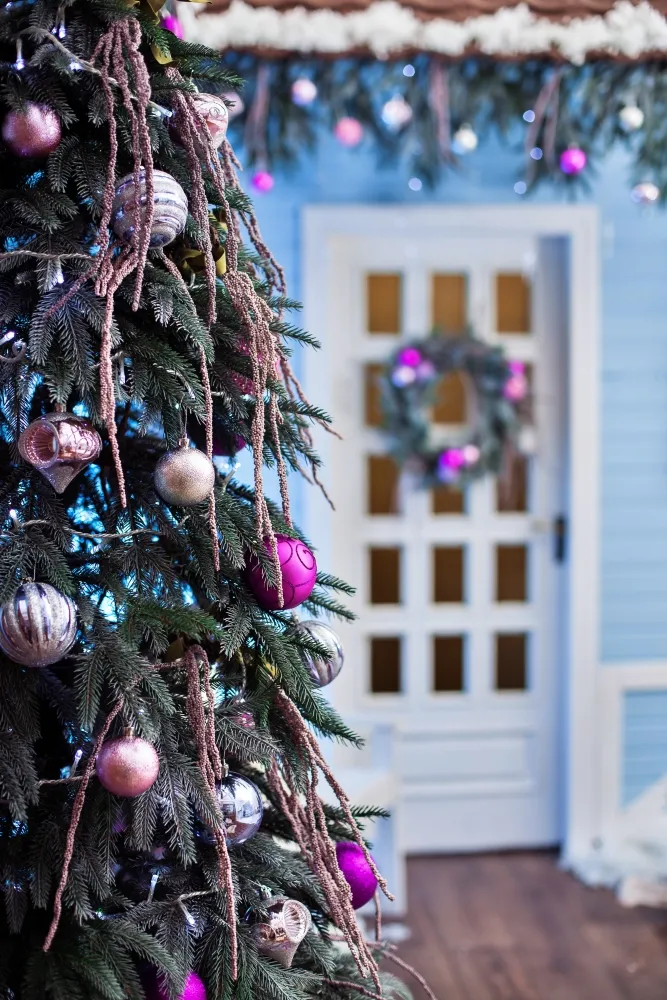
- 7.5-foot artificial tree: $120–$350
- Pink and silver ornament set, 100–150 pieces: $45–$120
- Two cascading textured garlands: $40–$90
- Warm white lights, 500–700 count: $25–$60
- Matching wreath and door garland: $50–$120
- Total: $280–$740
Budget alternative: buy ornaments in two sizes instead of five, and fill the back half of the tree with nothing but lights. Target and Walmart clearance pink and silver down to 70 percent off in early January, which is the moment to buy for next year.
23. A Faux Brick Fireplace, Dried Foliage, and a Porch Chandelier
The dried brown foliage climbing those white pillars is the smartest thing on this porch. It gives you height and volume for almost nothing, and the muted brown makes the deep green garlands look richer by comparison — warm against cool, rough against smooth. Then the white chandelier does something quietly clever: it treats an outdoor porch like an indoor room, which is why the space reads as cozy instead of merely seasonal. The white faux brick fireplace anchors everything.
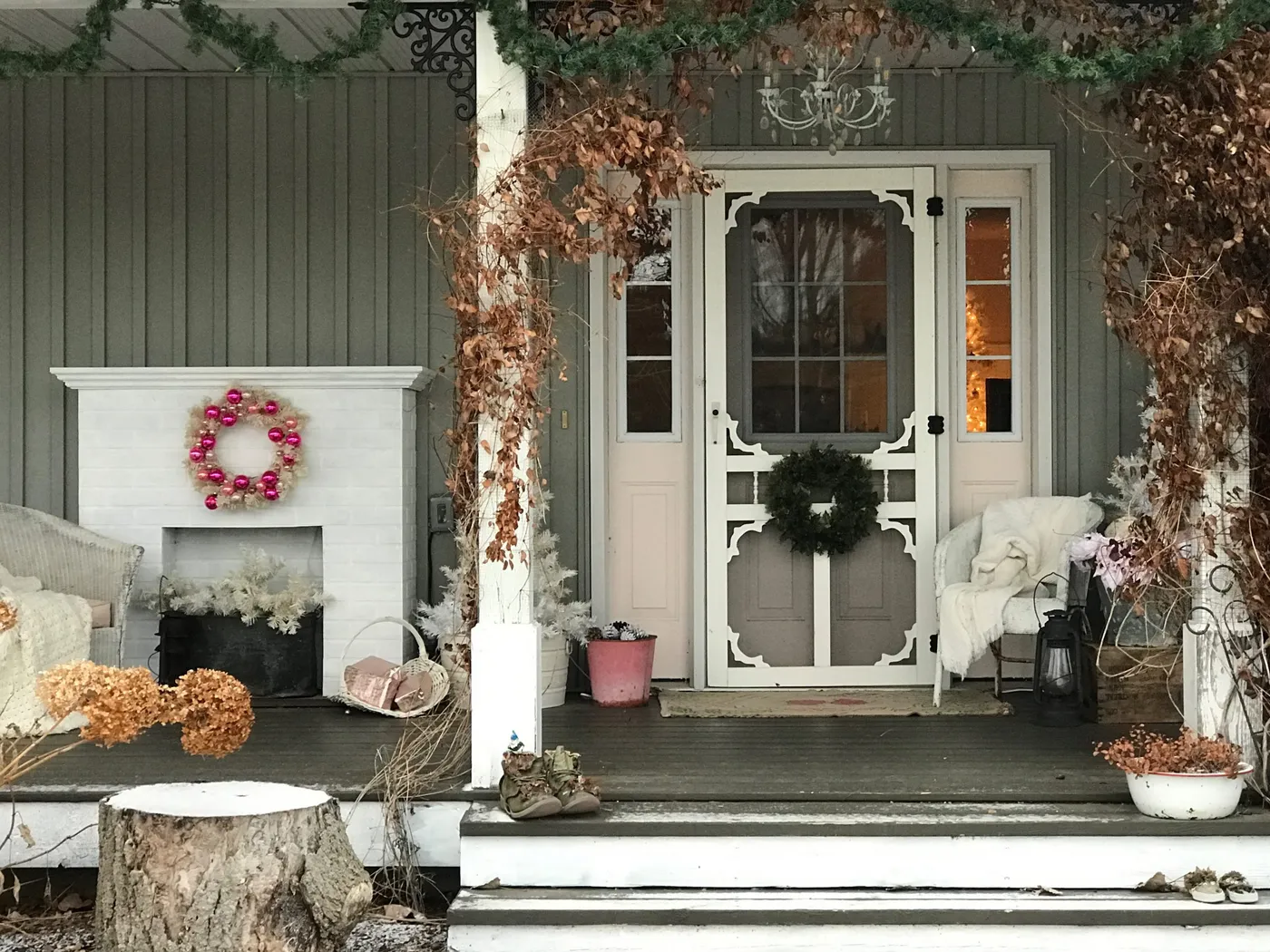
Dried foliage sheds. Constantly. Plan on sweeping weekly, and expect a light dusting just inside the door for the first two weeks. It’s brittle, too — a gust will snap stems off, so secure them with floral wire, not tape. If you have pets, check what you’re using, since some dried materials are irritants. And a faux fireplace with an MDF core will swell and peel if rain reaches it directly, so keep it under a roof and pulled back six inches from the edge.
24. A Black Rocker, a Plaid Pillow, and a Picnic Basket Full of Story
The wicker picnic basket, with the plaid thermos and that black ice skate leaning against it. The chair alone is furniture. The chair plus the basket is a scene — you can picture someone sitting there with cocoa, and that bit of imagination is what makes people stop at a porch. The skate is the detail that keeps it from turning too sweet. Style a chair like someone just got up from it, not like a store set it up.
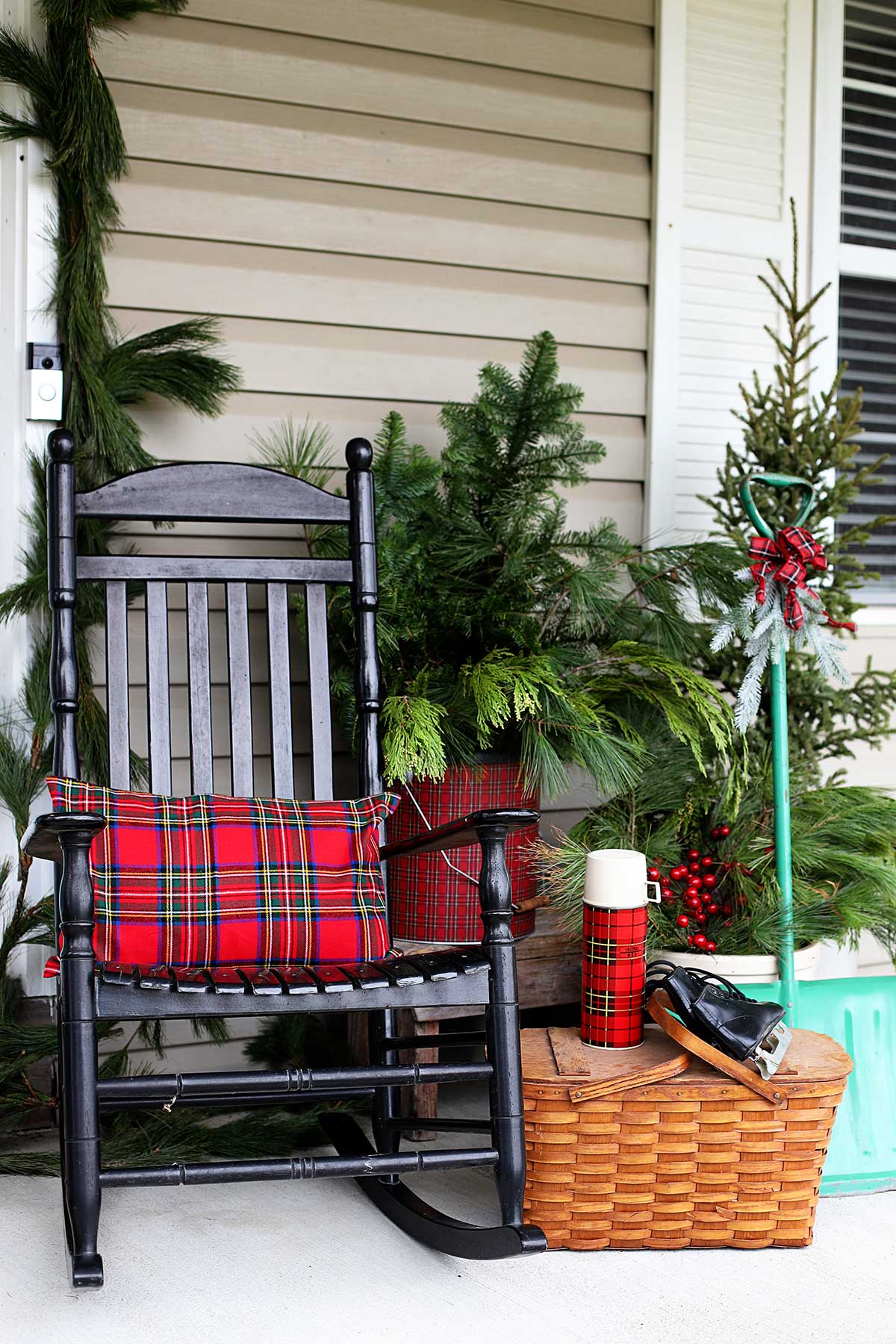
- Black wooden rocker: $60–$150 used on Marketplace
- Two metal or galvanized buckets: $5–$12 each
- Red plaid throw pillow: $12–$25
- Evergreen trimmings from a tree lot: usually free
- Wicker basket: $8–$20 at a thrift store
- Vintage thermos and ice skate: $15–$35 combined
Under $150 if you’re patient. This is the budget cousin of Idea #1 — same plaid, same rocker silhouette, about a quarter of the spend.
25. Three Rules That Make a Rustic Porch Look Composed
Rustic porches go wrong when everything is the same size. Three rules fix it: group things in odd numbers (three or five pieces per side, never four), stagger your heights by at least 12 inches between the tallest and shortest item, and always leave one surface bare — a stool, a step, an empty bucket. That emptiness is what makes the rest look curated. Keep 12 inches of clear walking space past your widest arrangement or the whole thing starts to feel like a yard sale.
A rustic entry display works at almost any size, but the recipe changes with the square footage. Under 30 square feet: one tall element and one low one, nothing else. Thirty to 60 square feet: add a bench or a chair. Over 80 square feet with a covered roof: you can layer in a rug, seating, and an overhead element without it feeling cluttered. Measure the clear width from door swing to railing before you buy anything.
26. Black Shutters, a Black Porch Swing, and Garland With Some Weight
A porch swing needs framing that can take 400 to 500 pounds with a person on it, plus anything you hang from it. Keep garland on a swing under five pounds or it’ll slap the house every time you move. Check the swing’s clearance against your door swing before hanging anything — a wreath that gets knocked off every time someone walks out becomes a decoration you resent by week two. And if those poinsettias are real, the cold-weather caveat from Idea #3 applies here too.
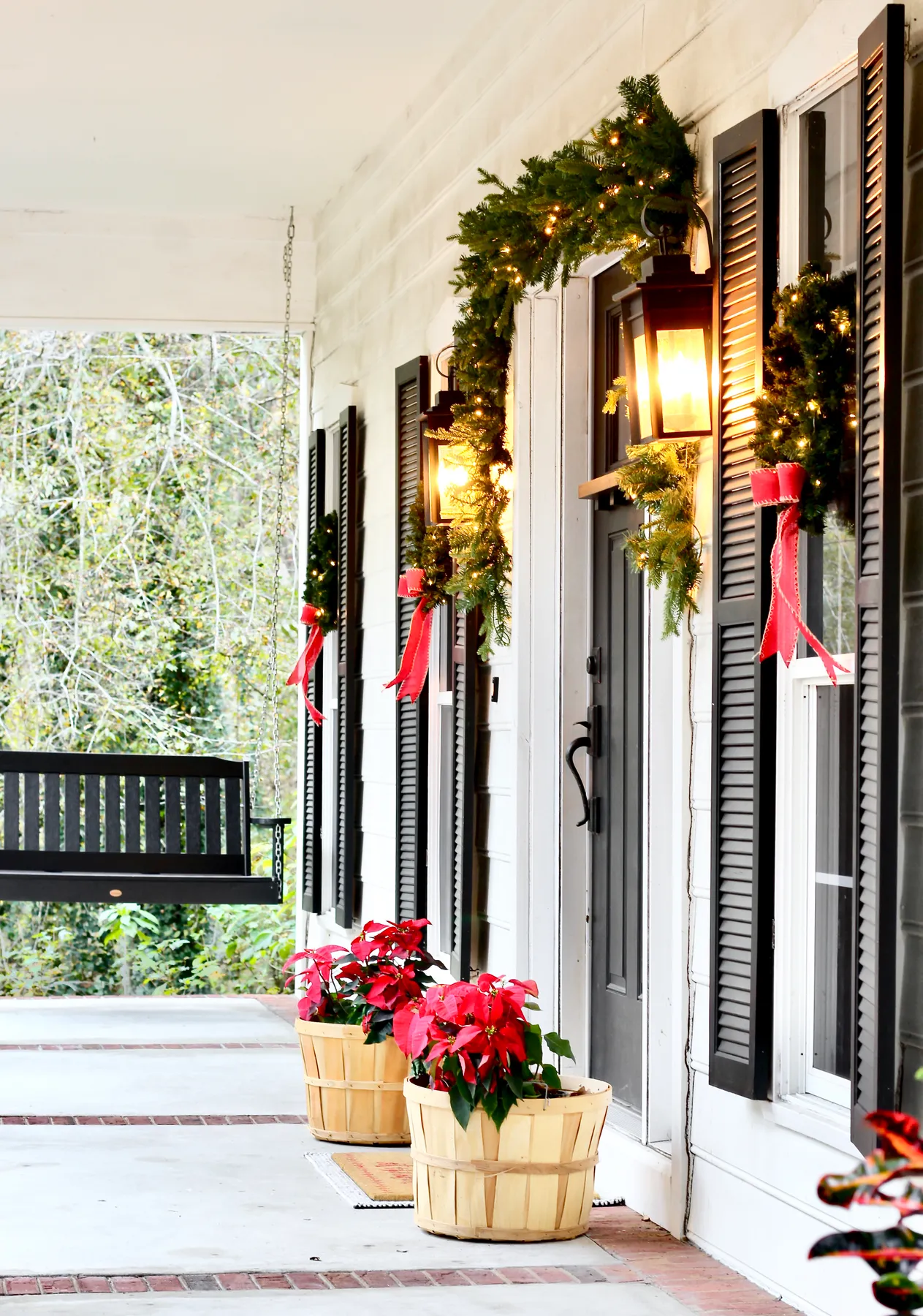
Hanging garland so it survives wind and doesn’t wreck your door frame.
- Measure from the top of the door frame down each side 18 inches, and mark both points with painter’s tape.
- Install 1/8-inch cup hooks rated for 10 pounds at those marks, plus one every 18 to 24 inches along the top run.
- Loop the garland through the hooks with green florist wire or clear zip ties — never nails.
- Fluff each branch outward so the garland reads as thick as it is wide.
- Add ribbon last, tying it over the hook points so the hardware disappears.
About an hour for a standard single door, $10–$15 in materials if you already own the garland.
27. Red Rockers, Plaid Ribbon, and Gifts Piled on the Porch
What a full-on plaid porch runs, roughly.
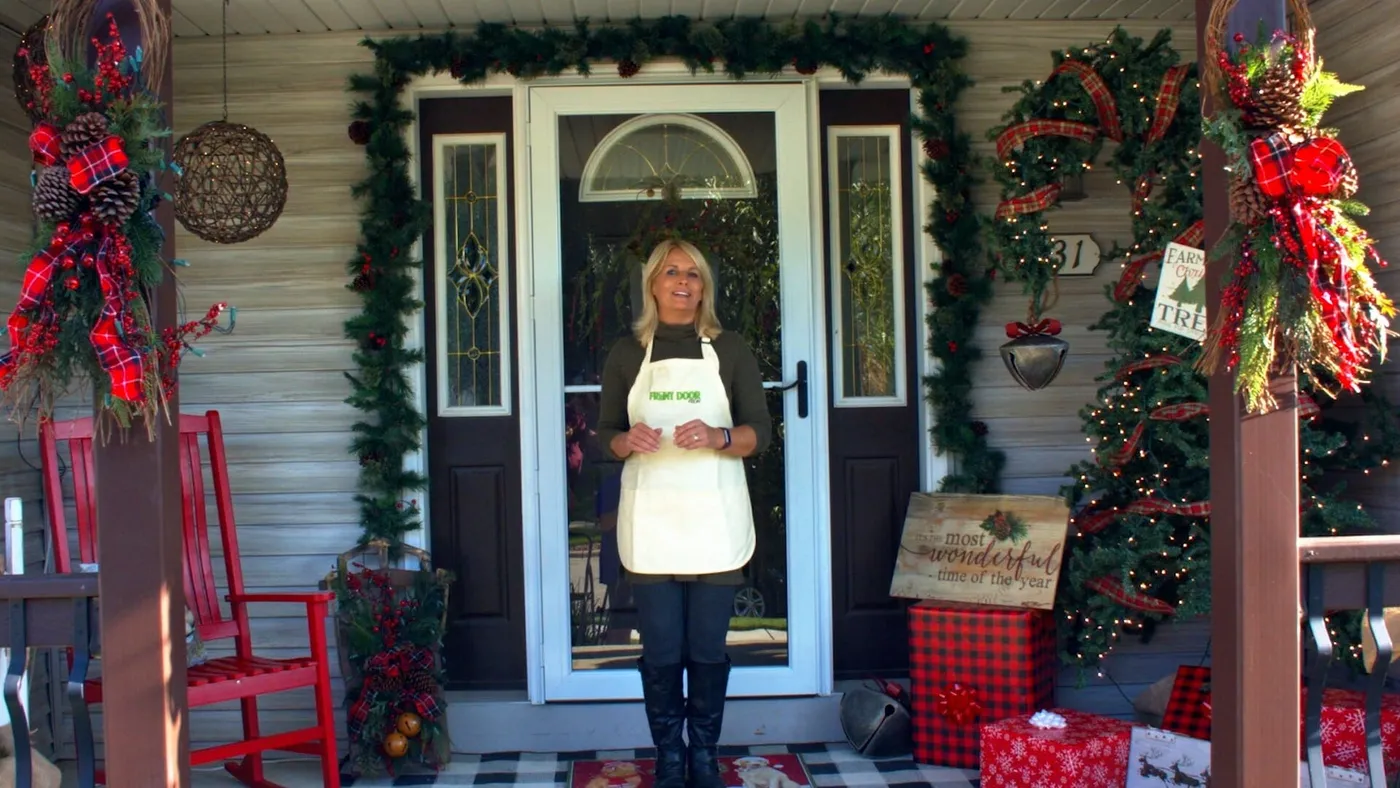
- Three to four 9-foot pine garlands: $90–$240
- Two rolls of 2.5-inch red plaid ribbon: $20–$45
- Wrapped gift boxes, paper, and bows: $30–$70
- 5×8 buffalo plaid outdoor rug: $45–$120
- Two red wooden rocking chairs: $180–$400
- Wooden holiday signs: $25–$70
- Total: $390–$945
Budget alternative: thrifted or hand-me-down rockers painted red cost about $60 all-in, and that’s the single biggest savings on the list. Dollar-store wrap and empty boxes you already own handle the gift pile — just don’t leave actual presents outside.
The buffalo plaid rug is the one thing. It’s the connective tissue: red ribbon, red chairs, red berries, black-and-white plaid. Without a shared element that’s a lot of loud pieces arguing with each other. The rug echoes the ribbon, calms the red, and gives the arrangement a floor so the chairs and gifts look placed rather than scattered. Compare with Idea #2 — same love of repetition, completely different palette.
28. Prepping a Big Porch Tree Without the Bald Spots
Getting a large artificial tree to look full is all technique.
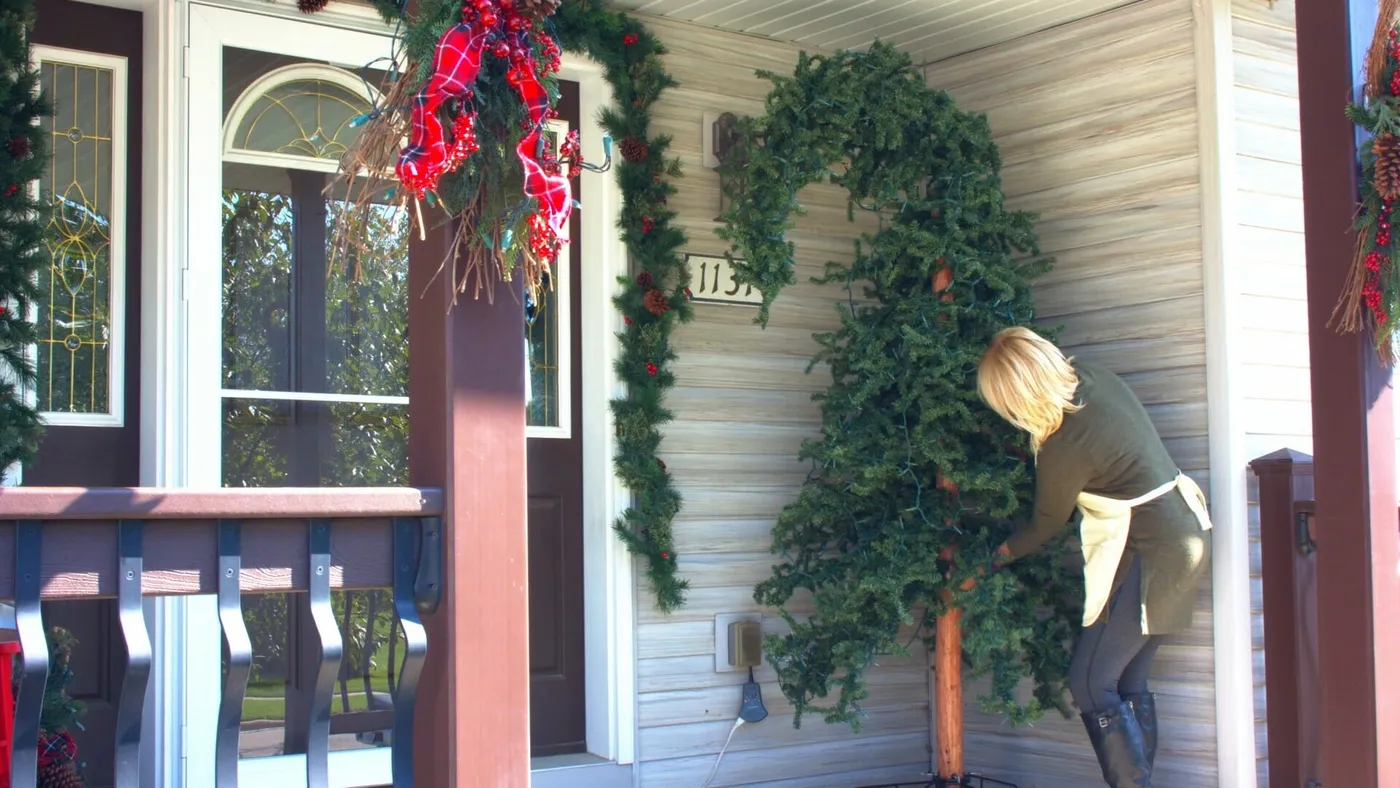
- Unbox the tree and let it sit at room temperature for 24 hours so the branches relax before you shape them.
- Fluff from the inside out, bending each branch tip up and outward in a fan. This is 80 percent of how full it looks, and it takes longer than you think.
- Run lights from the trunk outward, wrapping the main stem first, then each major branch.
- Use about 100 lights per foot of tree height — a 7-footer wants 700, minimum.
- Secure the plug end with a green zip tie at the base so nothing pulls loose in wind.
- Add the garland last, working top down so you can see how it falls.
The garland does the framing and the tree does the volume — that’s the entire trick. A dense garland around the door creates a flat, graphic outline that reads clearly in photos taken from the street, while the big tree adds depth so the entry doesn’t look like a two-dimensional cutout. The dark railing with black spindles underneath gives the scene a settled base line. One shape frames, one shape fills.
Your Porch Is the First Room Anyone Ever Sees
Guests form their whole impression of your home before they touch the doorknob, which is exactly why a porch is worth ten minutes of styling and one string of warm-white lights. Pick two ideas from this list, not ten — the paired garland from Idea #2 and the galvanized tubs from Idea #1 will do more than a cart full of ornaments ever could. 📌 Save this to Pinterest for later — you’ll want to revisit these ideas when it’s actually time to haul the bins down from the attic.