
Dried orange slices are quietly taking over Christmas — and unlike most Pinterest trends, this one smells like cinnamon and costs less than takeout. We combed through Etsy, Amazon, Terrain, World Market, and Target to pull the 35 dried orange Christmas decorations actually worth copying this year, from a $4 bag of navel oranges to a $180 mantel setup.
Inside you’ll find rustic raffia bundles, translucent ornaments that glow like stained glass, clove-studded centerpieces on gold platters, pinecone wreaths dusted with frost, and a few moodier citrus-and-dried-rose looks that lean Mediterranean rather than candy cane. Budget versions sit right beside the splurge versions, and every idea breaks down what it really costs to recreate at home.
The 2026 shift is toward handmade, low-waste decorating you can compost or pack away for next year — and dried citrus fits that perfectly. And stay until the end — we break down the most common mistakes that can ruin these looks.
📌 Save this to Pinterest for later — you’ll want to revisit these ideas.
1. Dried Orange, Cinnamon, and Frosted Berry Bundle
Strip this little bundle down to just the orange slice and the twine and it would still be pretty — but it wouldn’t stop you. The frosted white berries are doing the heavy lifting. They give the eye one cool, chalky note to land on between all that amber and cinnamon brown, and that small temperature shift is the difference between a nice craft and something you’d find stacked in a boutique hotel lobby. Lose the berries and the whole thing goes flat and monochrome.
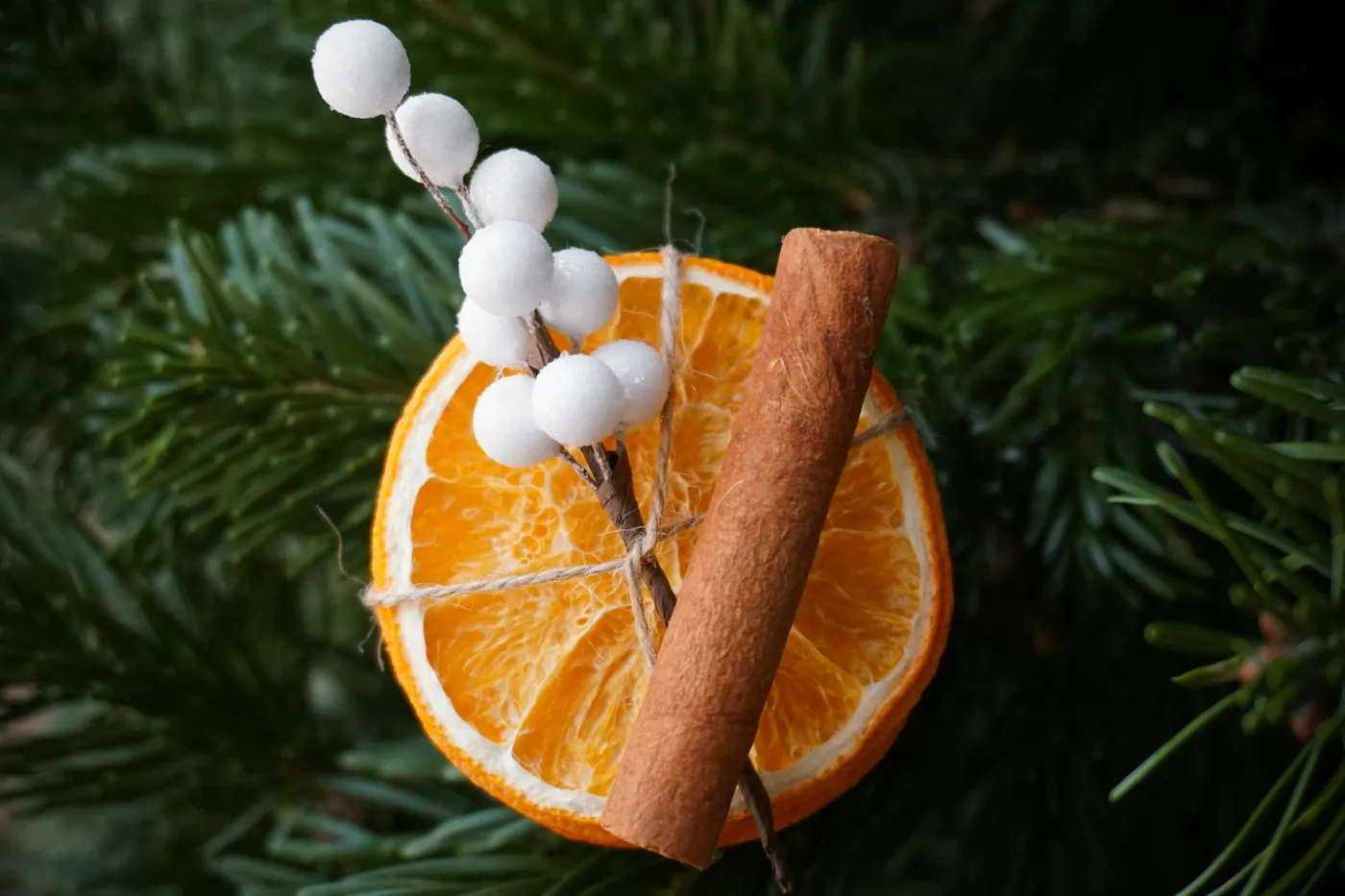
Cut your slices a scant 1/8 inch thick, not 1/4. Thick slices trap moisture in the middle, turn tacky, and sag on twine within a week. Thin slices dry in 3 to 4 hours at 200°F, stay translucent, and weigh almost nothing, so you can hang six or seven per branch without a single droop. Flip them every hour and they’ll finish flat instead of curled like potato chips.
2. A Backlit Orange Slice Glowing on the Tree
Backlighting is the entire trick here. A dried orange slice is basically a stained-glass window — hold it a couple of inches in front of a warm bulb and the segments light up as individual amber panels while the rind glows a deeper gold at the edges. It only reads that way because the slice is thin, genuinely translucent, and floating in front of the light source rather than pressed against the needles. The red-and-white striped string adds a quiet second job: a candy-cane wink that never competes with the glow.
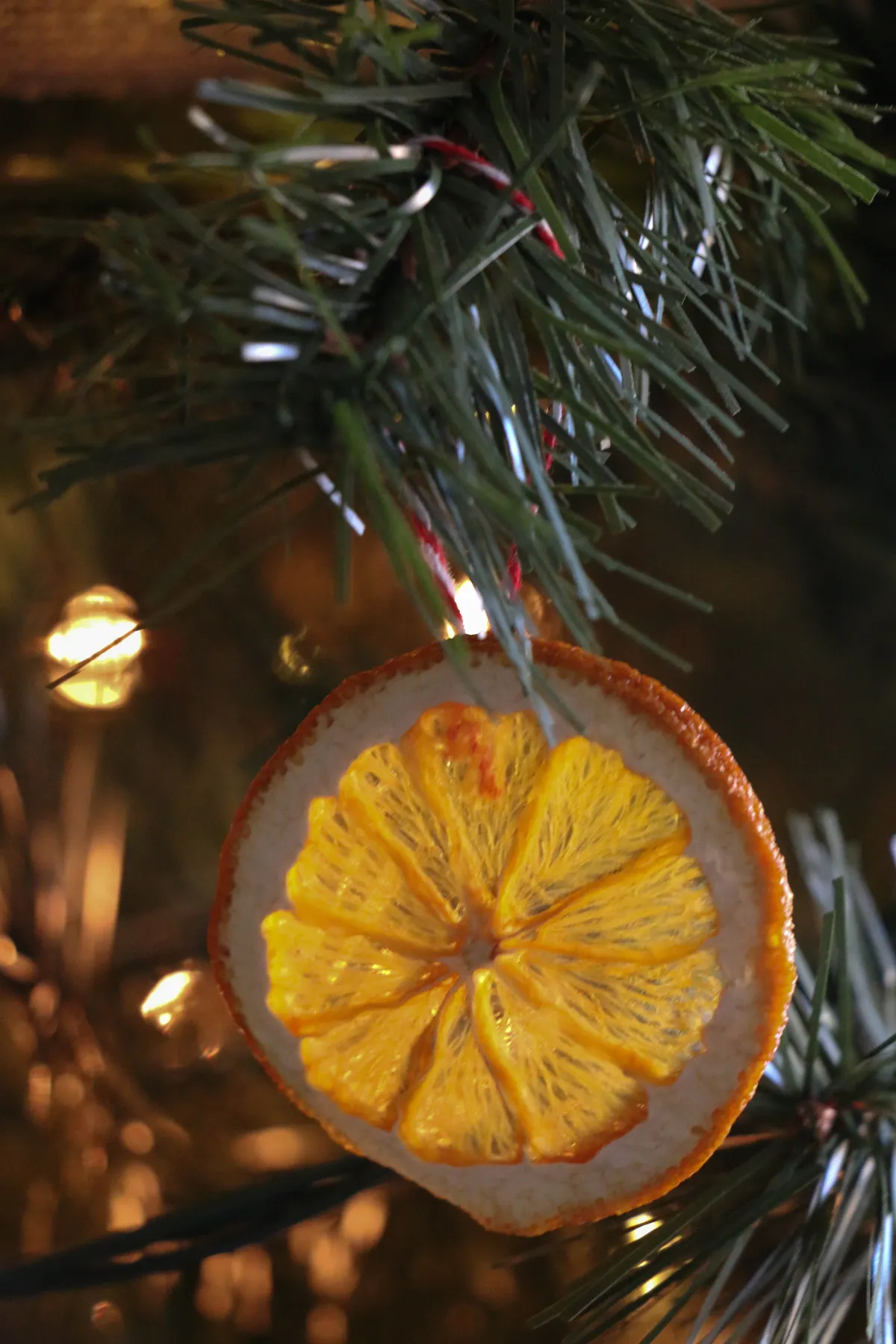
Here’s the part nobody warns you about. Some older light strands run hot enough to scorch fruit, and a slice touching a bulb starts smelling like burnt marmalade. Keep at least an inch of air between fruit and light. On a fresh tree, daily watering pushes humidity up around the branches, so dried slices can soften by New Year’s — artificial trees are honestly the safer host for this one.
3. Raffia-Tied Orange and Cinnamon Clusters
- Dry 8 to 10 orange slices at 200°F for 3 to 4 hours, flipping hourly until leathery, not brittle.
- Gather three slices and two cinnamon sticks into a fan shape in your hand.
- Wrap natural raffia around the center three times, pull snug, and knot at the back.
- Leave two long raffia tails, tie them into a loop, and trim the ends on an angle.
- Fluff the slices so they stagger instead of stacking perfectly flat.
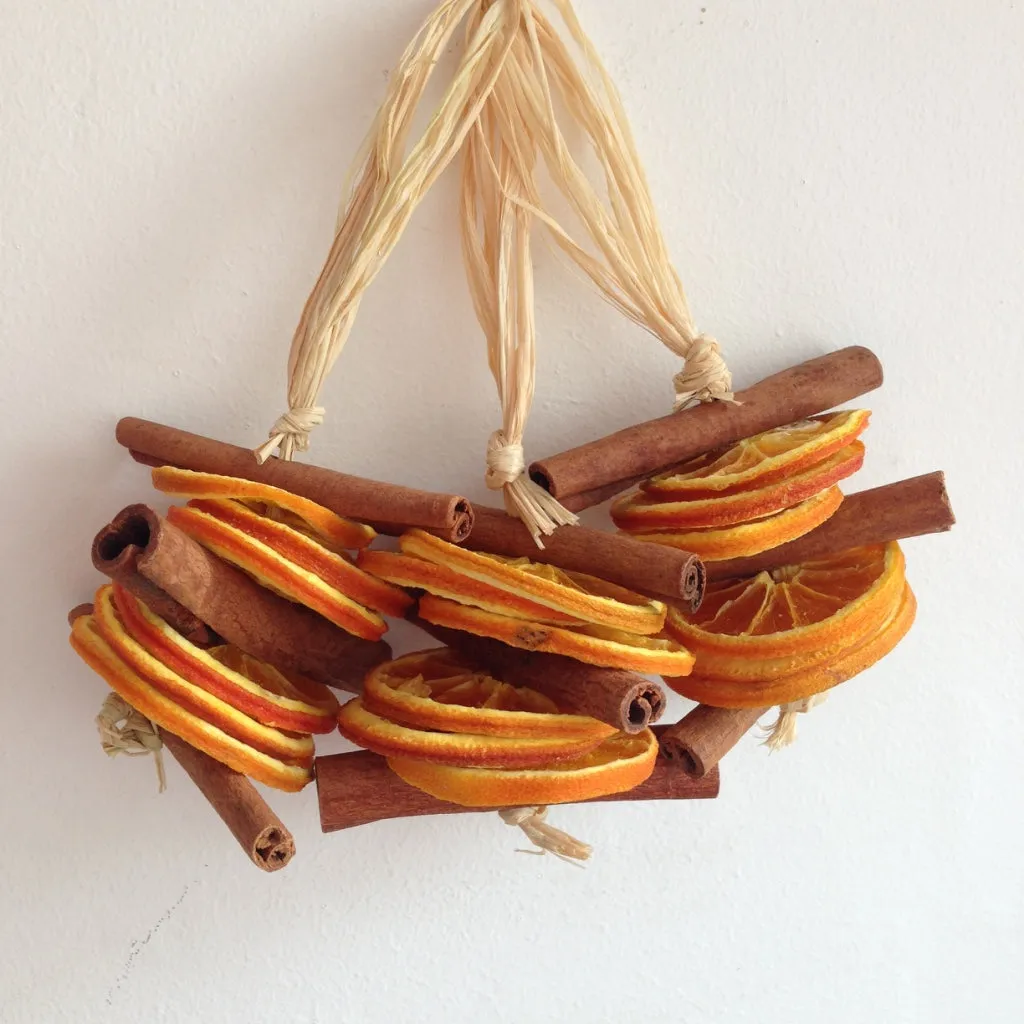
Twenty minutes, about $6 of materials, and you’ve got a set of five.
Think of it as a ratio you can remix: roughly 60 percent bright orange slices, 25 percent dark brown cinnamon, 15 percent pale raffia and white background. Swap the cinnamon for star anise and you get a lighter, more aromatic version. Swap in blood orange slices and the whole palette drops two shades warmer and moodier without changing a single proportion.
4. Mantel Garland with Wooden Houses and Orange Slices
- Real pine or fir garland, 9 to 12 feet: $35 to $90
- Six oranges, dried into roughly 50 slices: $5 to $9
- Light wood miniature houses, set of 4: $18 to $60
- Cotton twine and a tapestry needle: $4 to $7
- Warm-white string lights, 20 feet: $12 to $25
- Total: $74 to $191
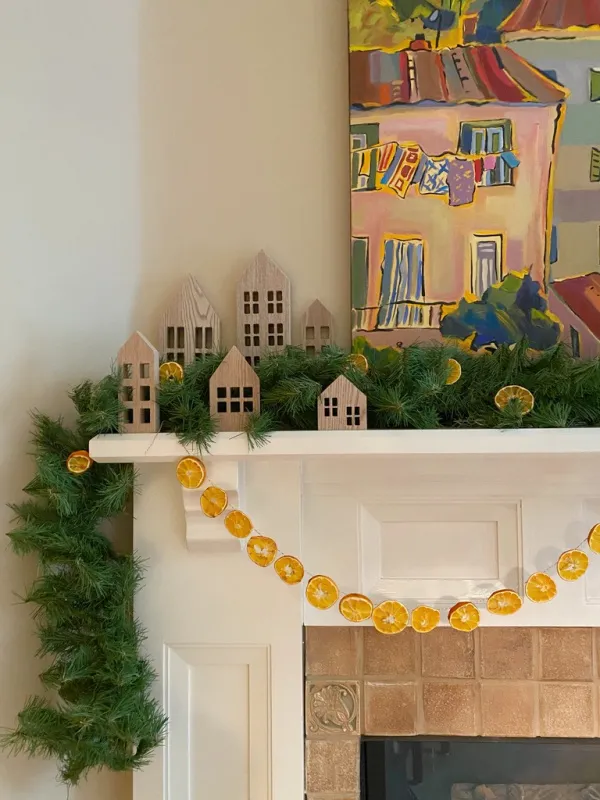
Budget alternative: faux garland from a craft store at 50 percent off plus thrifted wooden birdhouses painted a pale birch tone gets you 50 to 60 percent cheaper and nobody will spot the difference from across the room.
This is the look driving a lot of 2026 holiday decorating: little wooden villages tucked into greenery, echoing the nostalgia for handmade, kid-adjacent decor that’s been climbing on Pinterest for three seasons. It photographs beautifully and, more importantly, it invites people to rearrange the houses, which is exactly the kind of low-stakes participation a mantel wants.
5. Four Citrus Bundles on a Distressed Teal Rack
Read the color story and it’s almost architectural: about 50 percent warm orange from the slices and whole dried fruits, 20 percent muted green citrus, 15 percent cinnamon brown, and 10 percent that distressed teal metal. Teal and orange are near opposites on the wheel, which is precisely why the rack makes the fruit look expensive. Move the same bundles onto a plain black hook and the whole thing flattens into generic rustic.
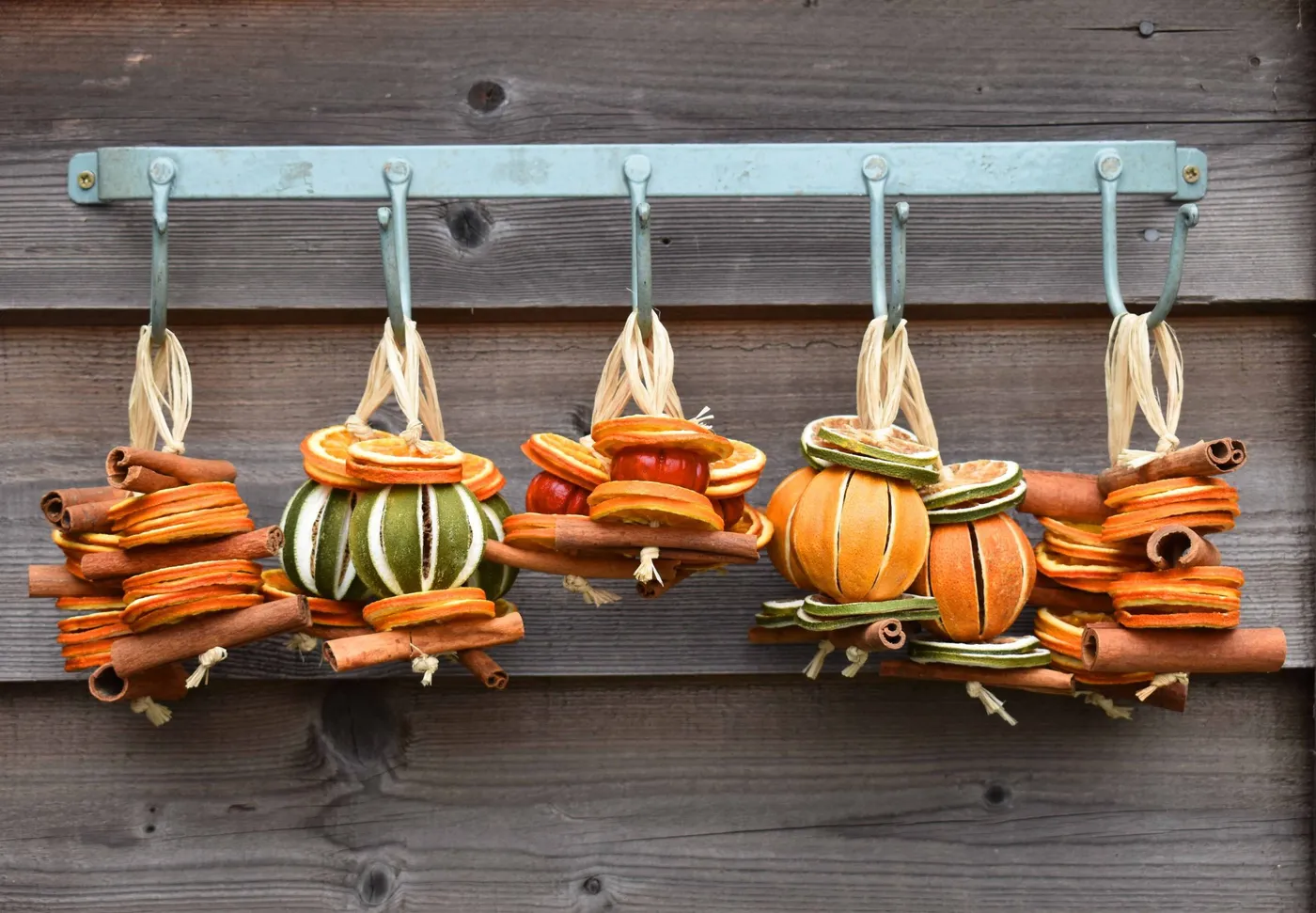
This is the dressed-up cousin of Idea #4 — same instinct for layering natural material over greenery, but the colder wall color does the work a mantel does there. Weathered dark wood behind it seals the deal.
If you changed one thing, change the teal. That single distressed metal bar is what turns four hanging bundles into a composition. It gives the eye a hard, cool, industrial edge to push against all that softness, and it explains why the arrangement reads as intentional rather than collected.
6. Holding a Translucent Slice to the Window Light
Single-object styling is having a real moment — one beautiful thing held up to natural light, nothing else competing. The dried orange slice fits that trend perfectly because it changes character with the light: backlit it glows like a paper lantern, front-lit it looks like a leather coaster. Pairing it with feathery beige pampas and a green succulent also nods at the citrus-and-terracotta palette that’s replaced strict minimalism in a lot of homes this year.
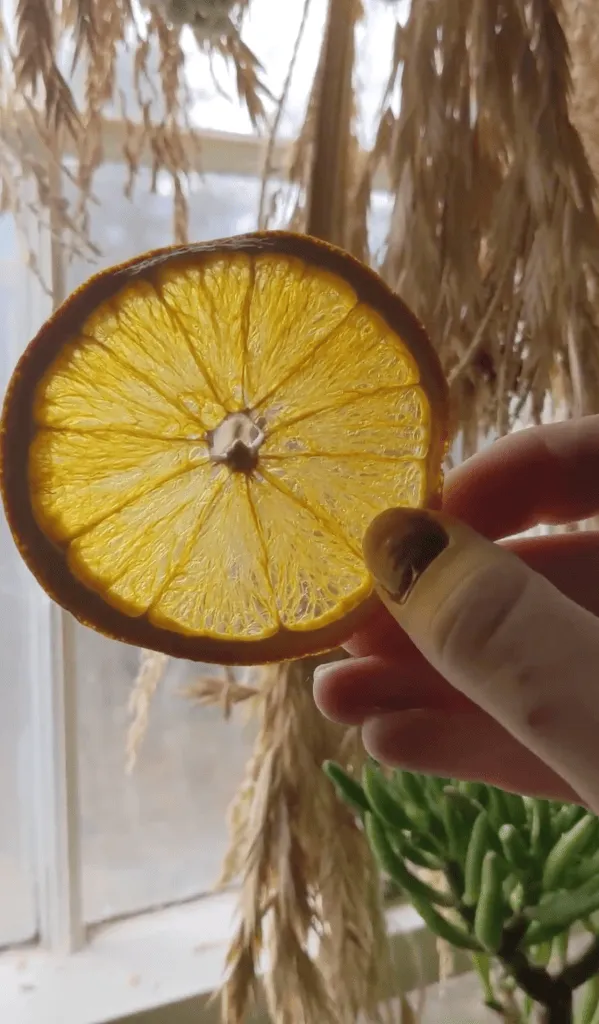
Want that glassy, backlit look in your own slices? Use a north-facing window for even, shadowless light when you photograph or display them, and dry at 200°F with the oven door propped open an inch for the last hour. That final hour is what drives out the last of the moisture so the pith goes clear instead of cloudy. If your finished slices look opaque and chalky, they needed another 45 minutes.
7. A Dried Citrus Wreath with Star Anise and Berries
Two principles carry this wreath. First, scale hierarchy: big whole dried orange spheres, medium citrus slices, tiny star anise and red berries. Your eye sorts them into layers instantly, which is why the wreath never looks like a jumble. Second, repetition — the same three or four elements, repeated evenly around the ring, keeps it calm against the busy white shiplap behind it. Remove the star anise and the wreath loses all its fine detail; remove the whole spheres and it loses its weight.
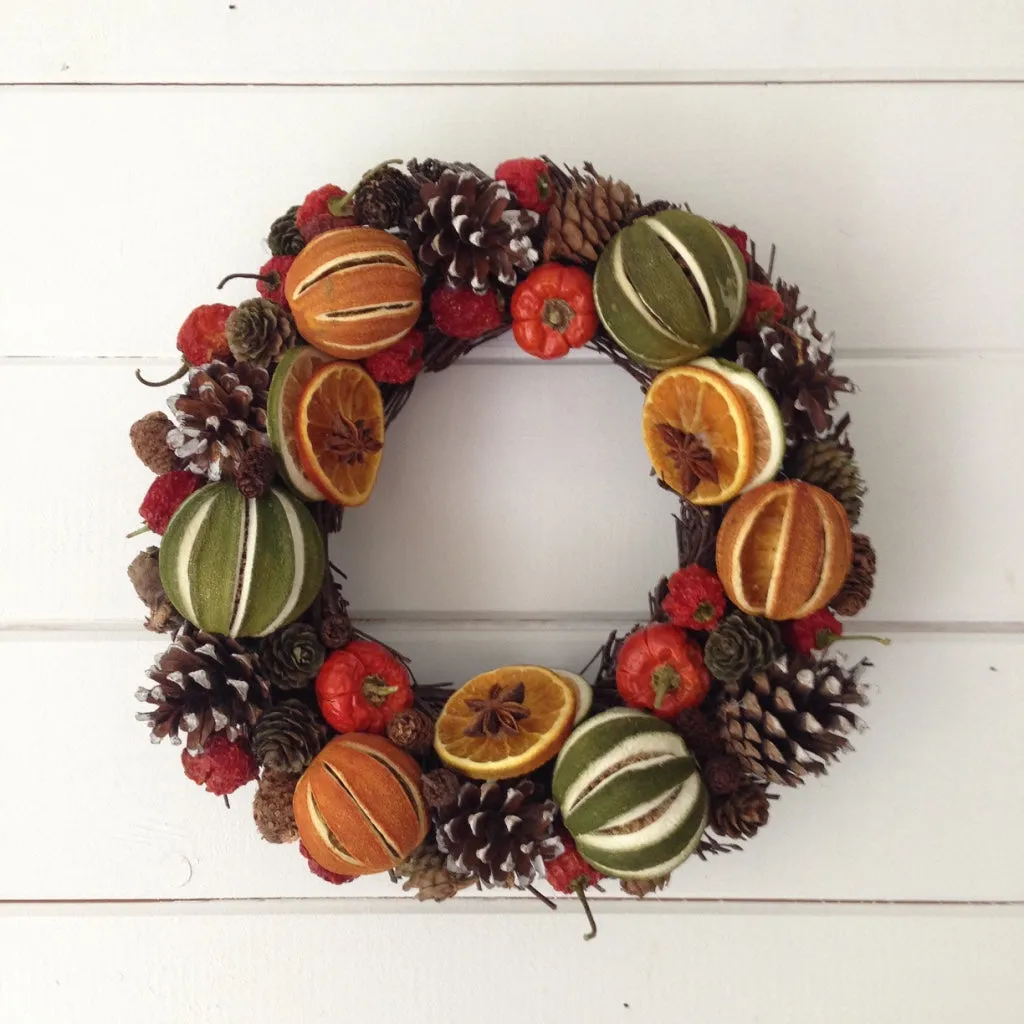
Keep it out of weather. Dried citrus beads up in humidity and goes tacky, and berries fade within a season of direct sun on a porch. Hang it in a covered spot, dust it monthly with a soft dry brush, and plan on replacing the star anise every year or two since the oils slowly evaporate. Pinecones and spheres will happily last five seasons or more in a climate-controlled room.
8. An Archway Garland Warm with Orange and String Lights
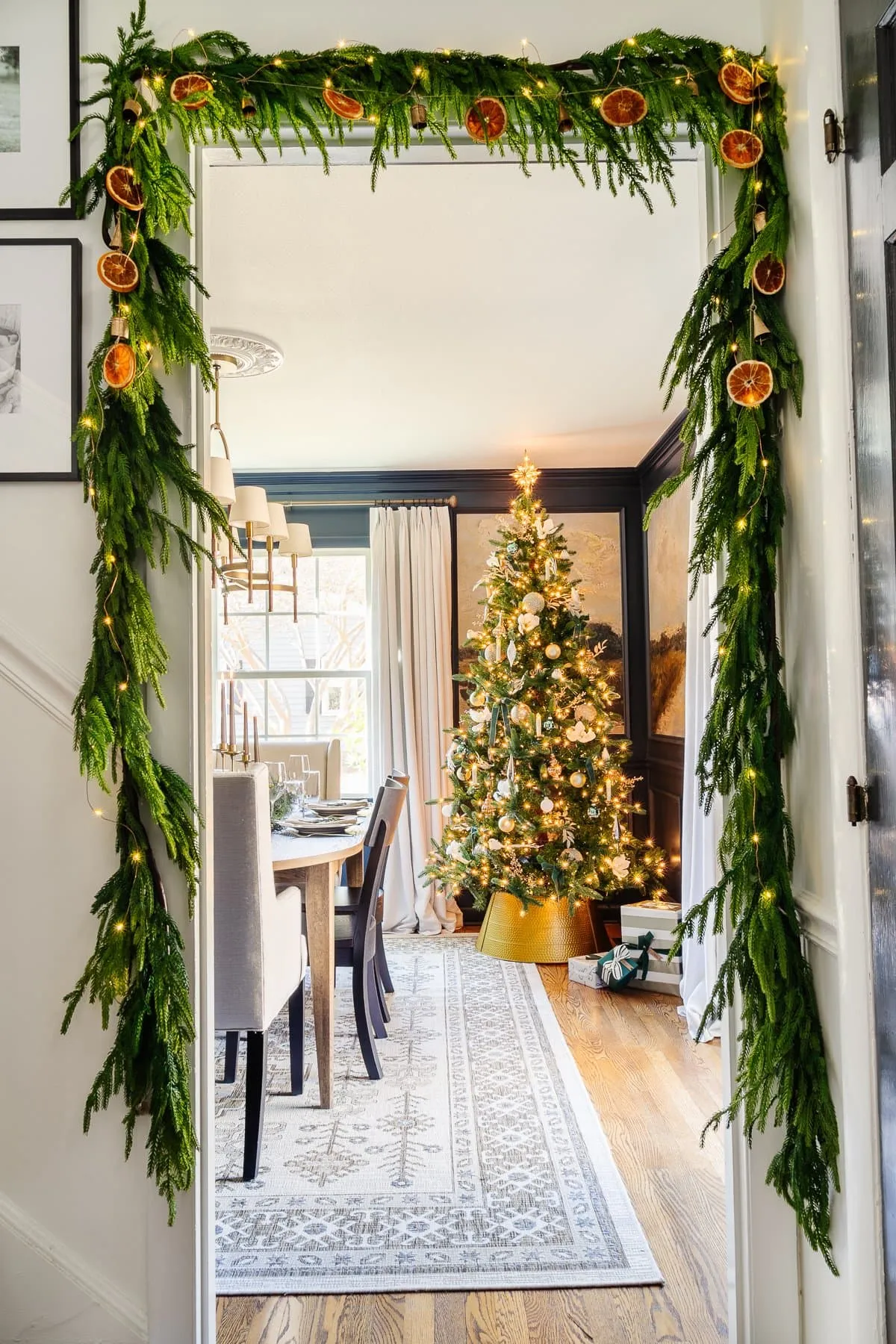
For a standard 32-to-36-inch doorway with an 80-inch opening, you want 9 to 12 feet of garland so it can swag 6 to 8 inches at the center and still reach the floor of the trim. Ceilings under 8 feet do better with a tight, straight run across the top rather than a deep swag — the deep drape eats visual height. Wide cased openings over 48 inches need two garlands zip-tied end to end or it will look thin and stingy.
The formula is roughly 70 percent evergreen, 20 percent dried orange, 10 percent warm light — and the light is doing more than you’d think. Those tiny bulbs catch the oil in the orange rind and make it look lit from inside. Shift the ratio to 60/25/15 and it gets noticeably more citrus-forward, which suits a dining room where you want the scent to carry.
9. Evergreen Wreath Dense with Fruit and Spice
Wire everything on with 24-gauge floral wire instead of hot glue. Glue fails in cold entryways and leaves shiny scars on the pine. Poke the wire through the fruit’s natural center hole, twist it around a branch, and clip. Notice this wreath keeps its middle open — that empty center is not an oversight, it’s what keeps the density on the outer ring from turning into a solid green donut.
One honest caution: dark purple berries, deep red fruit, and burnt orange slices is three strong hues in one small space. It works here because the fruit sizes are matched and the evergreen holds them apart. Size them unevenly and it tips into cluttered. Also, if you’re tempted to use real fresh fruit for that glossy finish, don’t — on a wreath with no airflow behind it, fresh fruit rots in about ten days and drips.
10. Frosted Pinecones with One Glowing Orange Slice
Frost sheds — accept that now. The white flocking on pinecones drops a fine dust for the first week, so give the wreath a gentle shake outside before hanging it indoors, and don’t hang it directly over a light-colored sofa arm. Cork pieces dry out and crumble after a couple of seasons, and a wreath stored in a hot attic will lose its frost entirely. A breathable box with tissue between layers keeps it intact for years. Under a covered porch, expect two to three seasons before you want to re-flock.
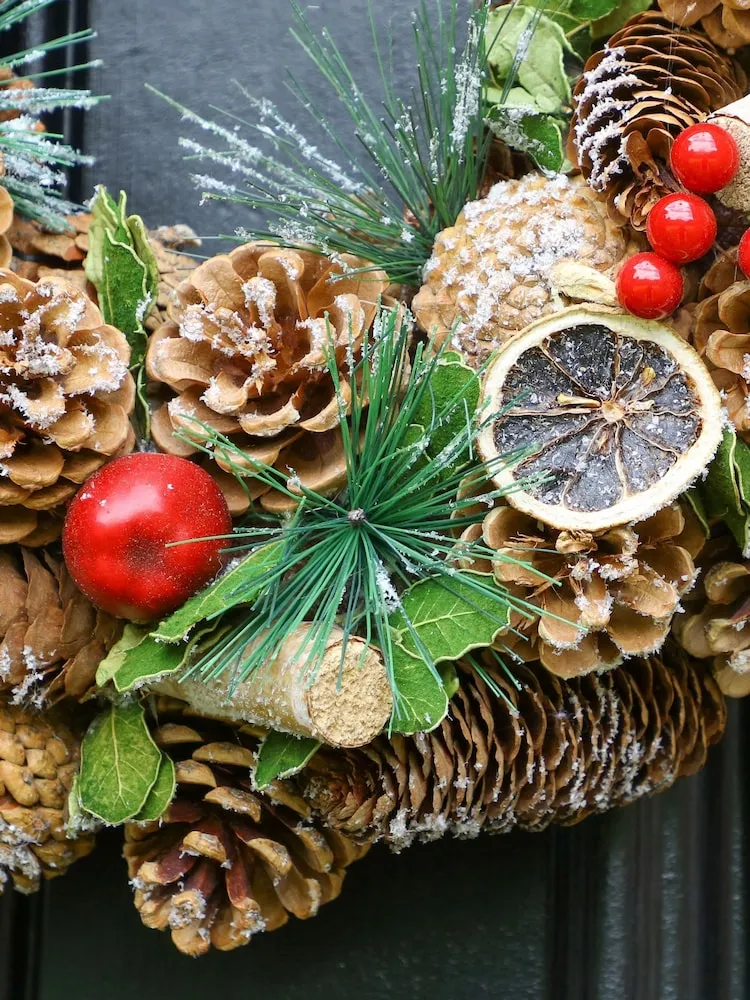
Dollar store pinecones, a can of spray snow at $4, and dried orange slices you made yourself. Total: under $20 for a wreath that looks like it came from a garden center. Save the budget for the berries, which is the one element where cheap versions always read cheap — glossy plastic red next to real dried orange is a giveaway from ten feet away.
11. Clove-Studded Oranges on a Gold Platter
- Choose firm oranges with tight skin and wipe them dry.
- Poke guide holes with a skewer or toothpick in a pattern — stripes, a spiral, or a simple cross.
- Press whole cloves into the holes; going straight in without a guide splits the peel.
- Nestle the oranges into mixed evergreen branches on a round platter, tucking small pinecones and berries underneath.
- Finish with a loop of gold decorative wire across the top for shine.
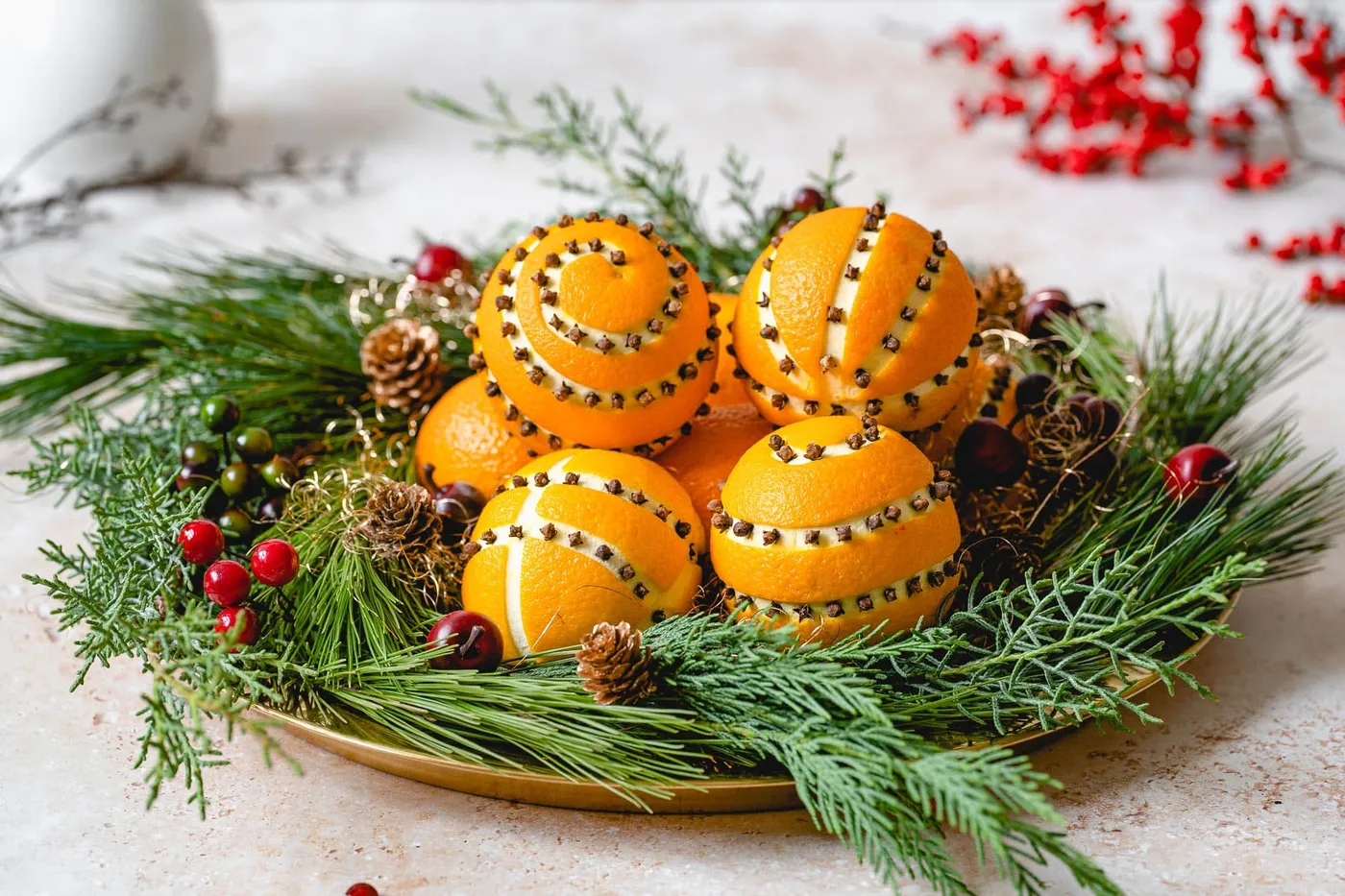
Fifteen minutes of studding per orange, about $8 in materials.
The reason this arrangement sings is circles on circles — round oranges on a round platter on a round table, repeated, with the gold as the only metallic note in an otherwise matte, natural scene. Metallic has a habit of looking cheap when it’s everywhere, and rich when it appears once.
12. Garlands of Orange Slices and Pinecones on the Tree
Space your slices every 8 to 10 inches along the thread and alternate a pinecone between every second or third slice. That rhythm reads as deliberate from across the room — even, but not mechanical. Tighten to 4 inches and it becomes a solid orange stripe that fights the ornaments. Everything here is roughly 50 percent pine needle, 30 percent dried orange, 20 percent dark brown pinecone, and the string lights just amplify what’s already there.
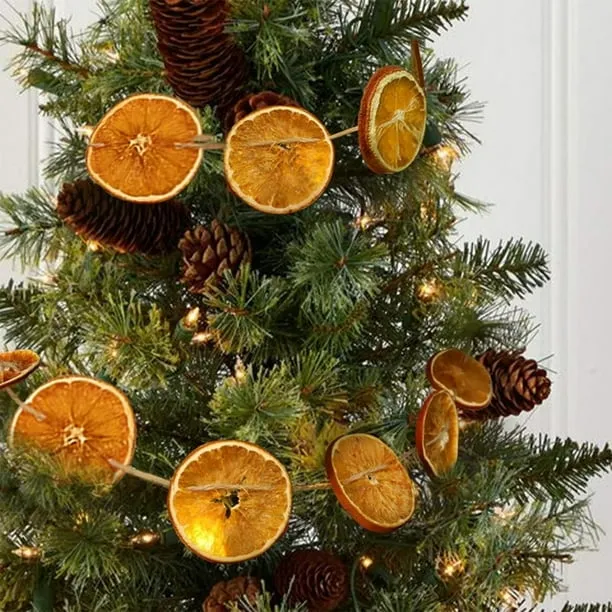
Weight is the real issue. A six-foot strand of slices and pinecones weighs almost nothing, but pinecones soak up moisture in a humid room and get heavier than you expect. String onto cotton twine rather than cheap craft wire, which rusts at the twist points and leaves brown marks on the needles. And hang the strand by draping it over branches, not wrapping — wrapping crushes the slices flat against the tree.
13. One Orange Slice Against Cinnamon and Pine
What makes this shot work isn’t the ornament in front — it’s the soft blur behind it. Those out-of-focus bundles of cinnamon sticks tied with string suggest a whole collection without showing it, and they add a second, warmer layer of brown that keeps the green needles from feeling cold. Focus and blur together create depth in a way a single well-lit slice on a bare branch simply never will.
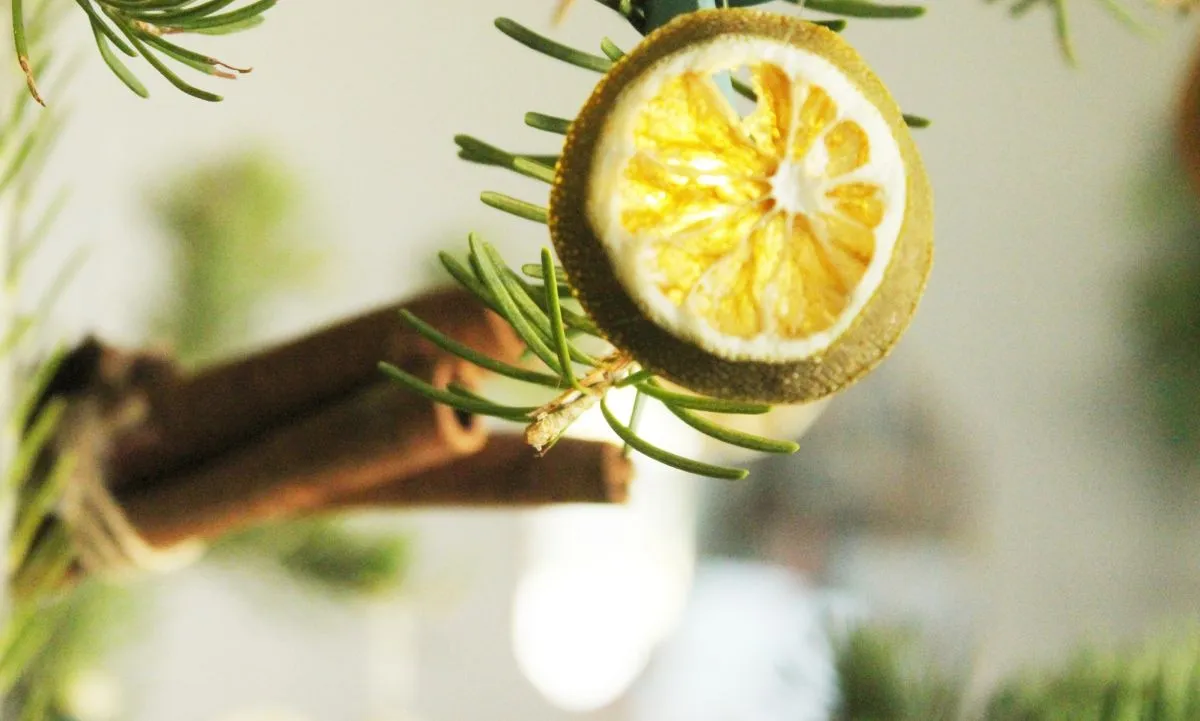
Thread your loop through the pith, not the flesh. The white center of a dried slice is dense and holds, while the translucent segments tear under any weight. Use cotton string, tie a 3-to-4-inch loop, and hang the slice perpendicular to the branch so its face catches light instead of catching needles.
14. Orange Halves, Lime Slices, and Cinnamon in Threes
Dried limes are the tricky one. They go from pale green to olive to brown far faster than oranges, and a half-dried lime slice will mold inside of two weeks in a warm room. Slice them no thicker than 1/8 inch and dry until they’re crisp enough to snap, not bendy. Orange halves need six to eight hours — twice as long as slices — so plan a whole afternoon for this one rather than an hour before guests arrive.
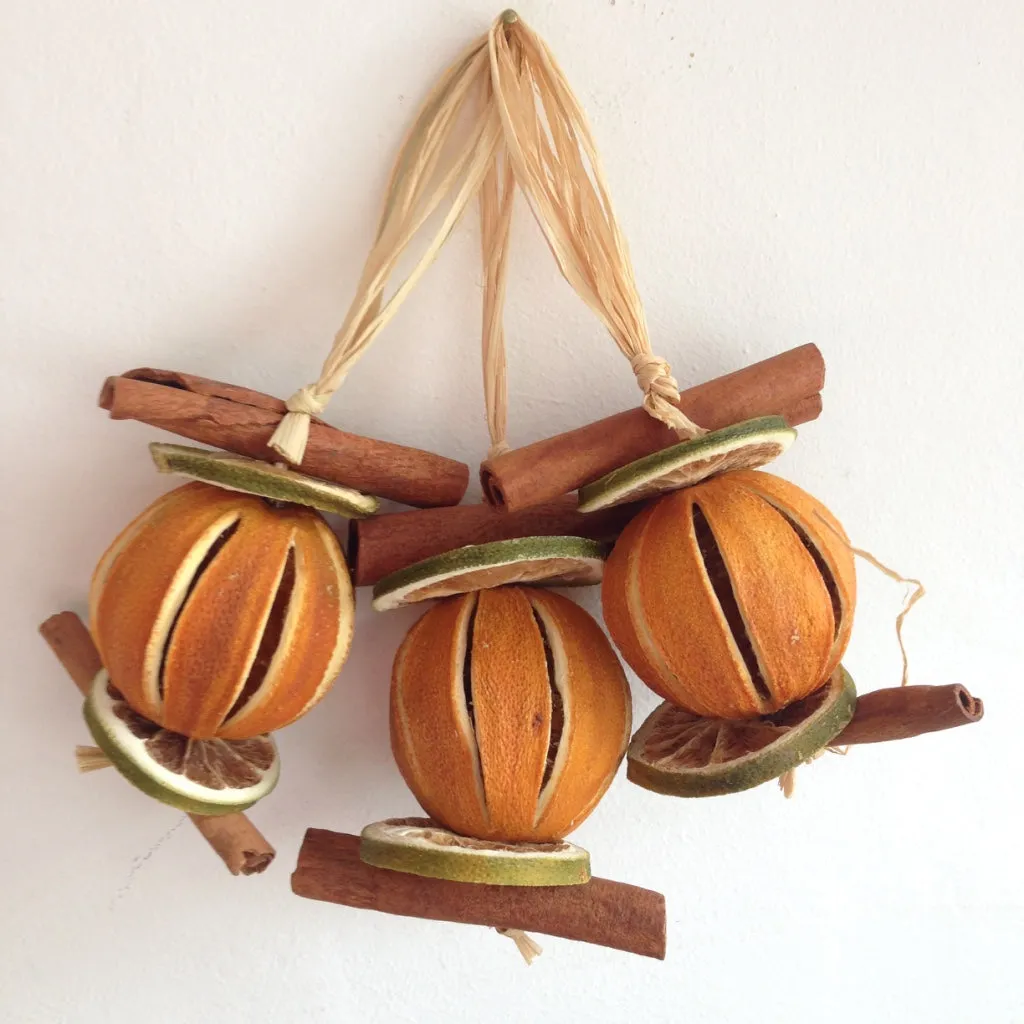
- Cut orange halves and lime slices to 1/8 inch.
- Blot both sides with a paper towel; citrus juice is what causes browning.
- Dry at 200°F, orange halves 6 to 8 hours, lime slices 3 to 4, flipping hourly.
- Group three pieces per cluster with two cinnamon sticks.
- Tie each cluster with raffia and hang at staggered heights.
15. Eucalyptus, Baby’s Breath, and Orange Slices for Crafting
Fresh eucalyptus at a florist runs $8 to $14 a bunch — dried stems from a craft store run about $5 and last indefinitely. Baby’s breath is the cheapest filler in the game, under $4 a bundle, and a little goes a long way. If you’re making a batch of twenty gift tags, buy one bunch of each, one bag of oranges, and a spool of cream ribbon, and you’ll spend about $25 total. Thrift stores are also reliably full of loose ribbon spools for a dollar or two.
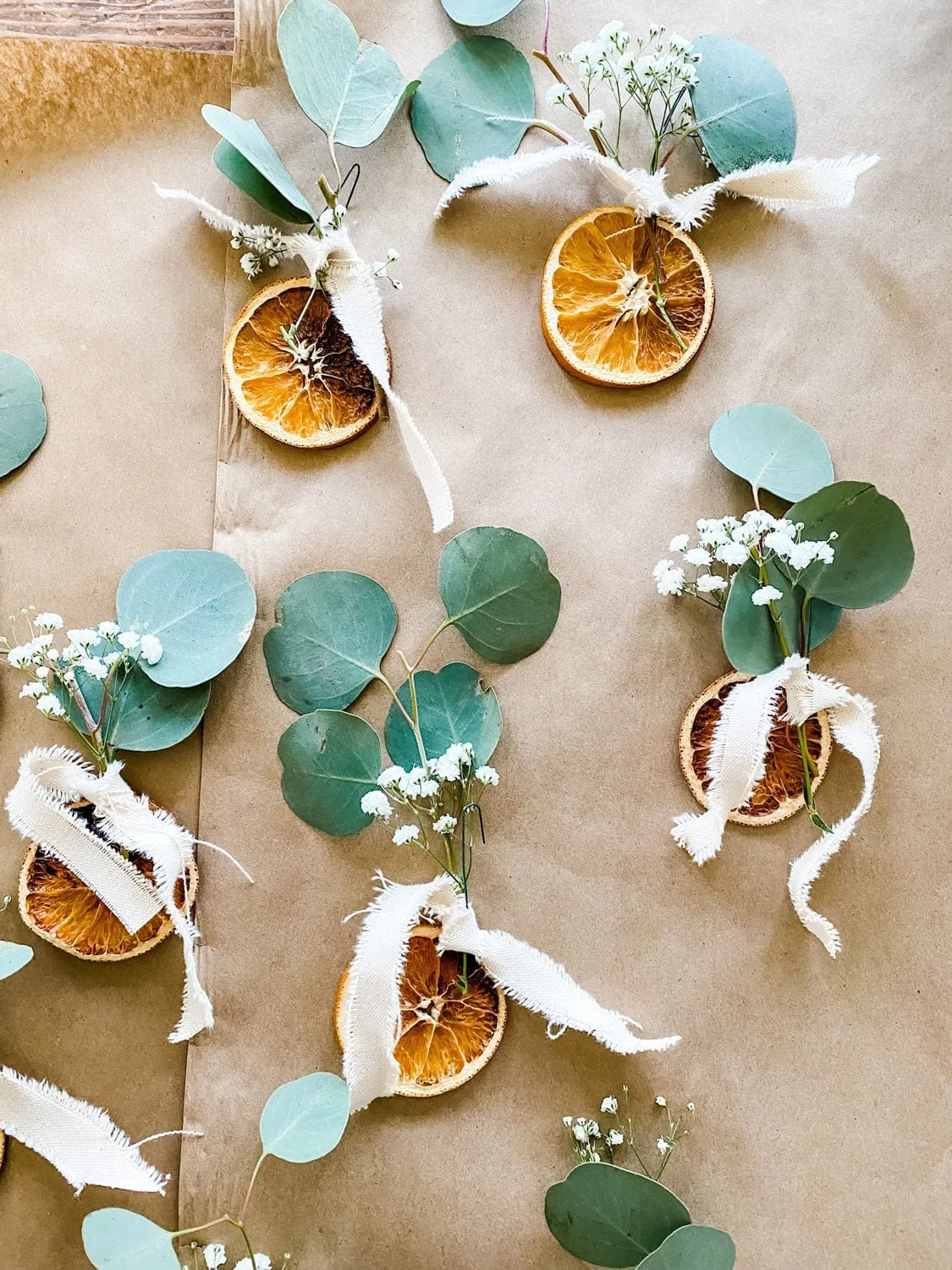
To get that soft frayed ribbon edge, cut on the bias rather than straight across, then pull one horizontal thread from the cut end. The weave unravels into a clean fringe instead of fraying into fuzz. It takes fifteen seconds per ribbon and it’s the detail that makes handmade tags look purchased.
16. A Single Orange Ornament on the Tree
- Count your tree’s free branch tips — roughly 30 to 40 slices covers a six-foot tree without crowding.
- Measure the gap between branches; slices need 3 inches of clearance to hang without tilting.
- Check your string lights for exposed bulbs before you hang anything flammable nearby.
- Decide on one string color — cotton twine or ribbon, never both.
- Set a drying day at least 48 hours before decorating.
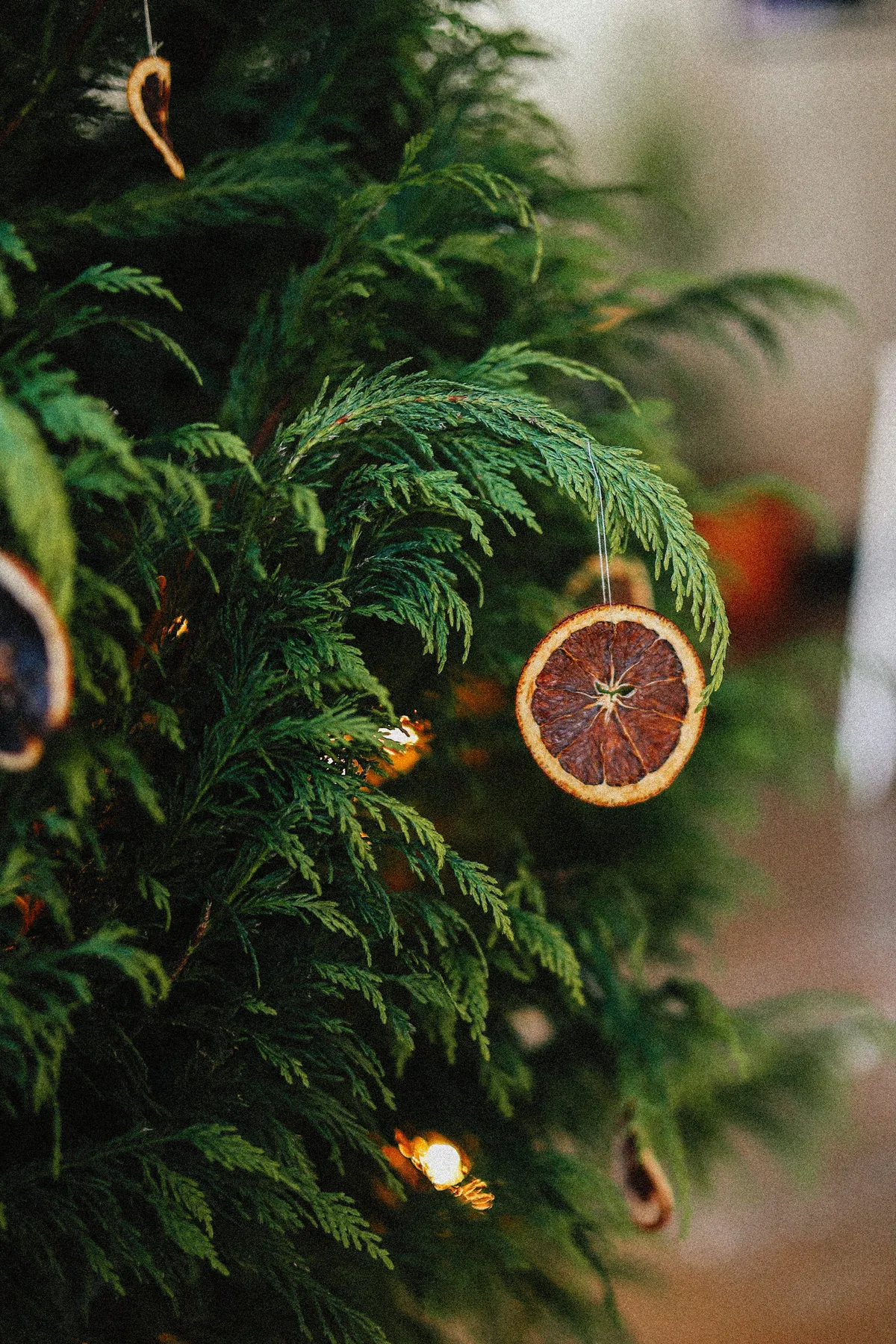
This works on trees from about four feet to nine feet. Below four feet, use smaller slices and fewer of them or the tree disappears behind fruit. If you’re working with a nine-foot tree or a double-height room, see Idea #2 for the backlit approach — at that scale, glow matters more than color.
17. A Cozy Tabletop of Citrus, Cranberries, and Fairy Lights
This works because everything lives on one surface with a defined edge. A wooden board or tray gives the eye a border, and inside that border the rules change: things can be dense, layered, and slightly messy without becoming clutter. The cranberries are the secret weapon — small, cheap, glossy, and their cool red balances the warm amber slices so the whole vignette doesn’t turn muddy.
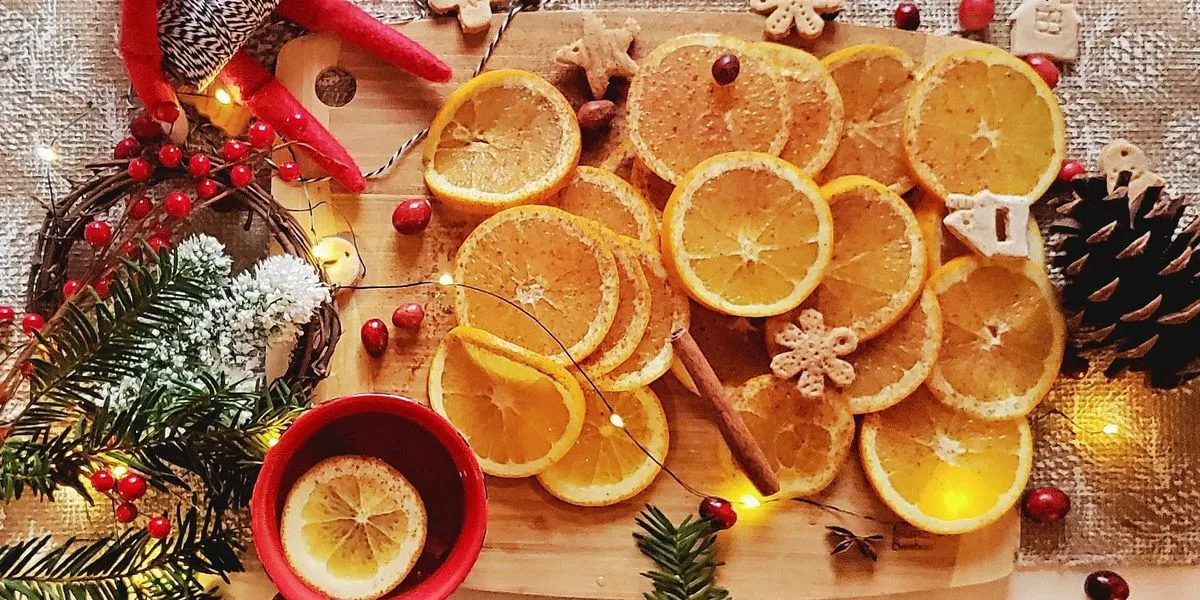
Use a cutting board you already own instead of buying a tray, and hit the dollar store for two bags of cranberries and a strand of fairy lights. A thrifted red bowl runs $2 to $4 and does exactly what that small red bowl is doing here — anchoring the corner of the composition with a solid block of color. Total spend: under $15.
18. Blood Orange Slices on Parchment with Twine and Scissors
- Slice blood oranges 1/8 inch thick and lay them on parchment, not directly on the rack.
- Blot both faces dry — blood oranges carry more juice than navels.
- Dry at 200°F for 5 to 6 hours, flipping every hour.
- Cool completely on the parchment; warm slices tear when you lift them.
- Stack flat in a paper bag with a piece of twine until you’re ready to use them.
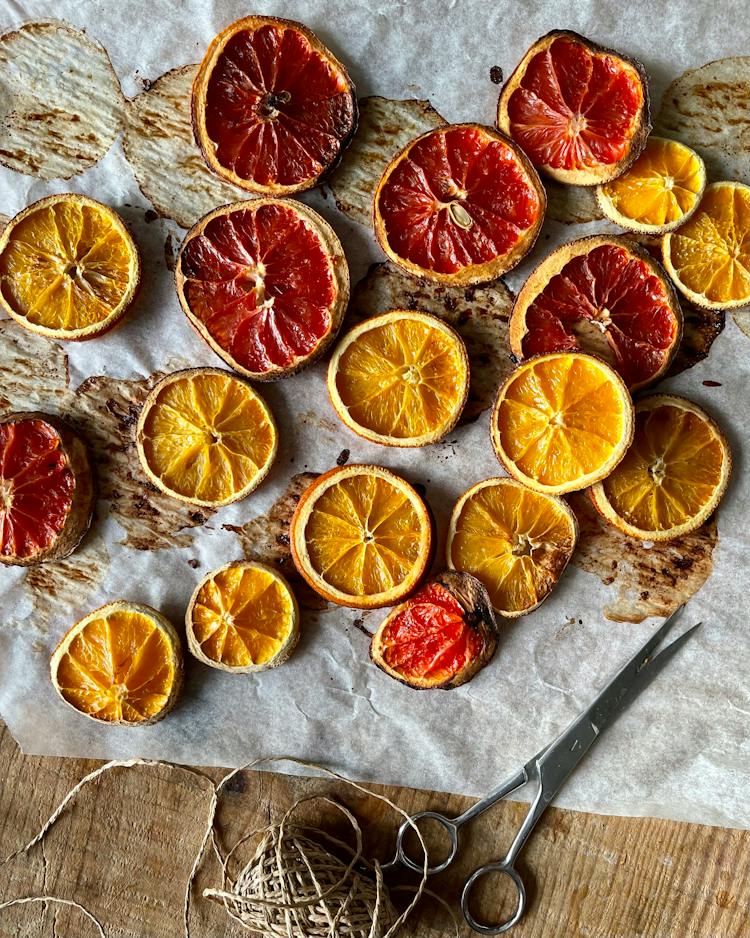
Deep reddish-orange is having a genuine moment in holiday palettes — it reads as more grown-up than bright clementine, and it sits beautifully against dark greens and warm woods instead of fighting them.
19. Dried Roses and Orange Slices on a Warm-Lit Tree
Try this mix: about 45 percent deep green needles, 25 percent dried rose tones in pink, purple, and muted brown, 20 percent burnt orange slices, 10 percent warm light. The roses pull the palette somewhere romantic and slightly faded, which is a very different feeling from the classic red-and-green tree. Want it more traditional? Swap the roses for dried red berries and keep every proportion identical — the structure holds.
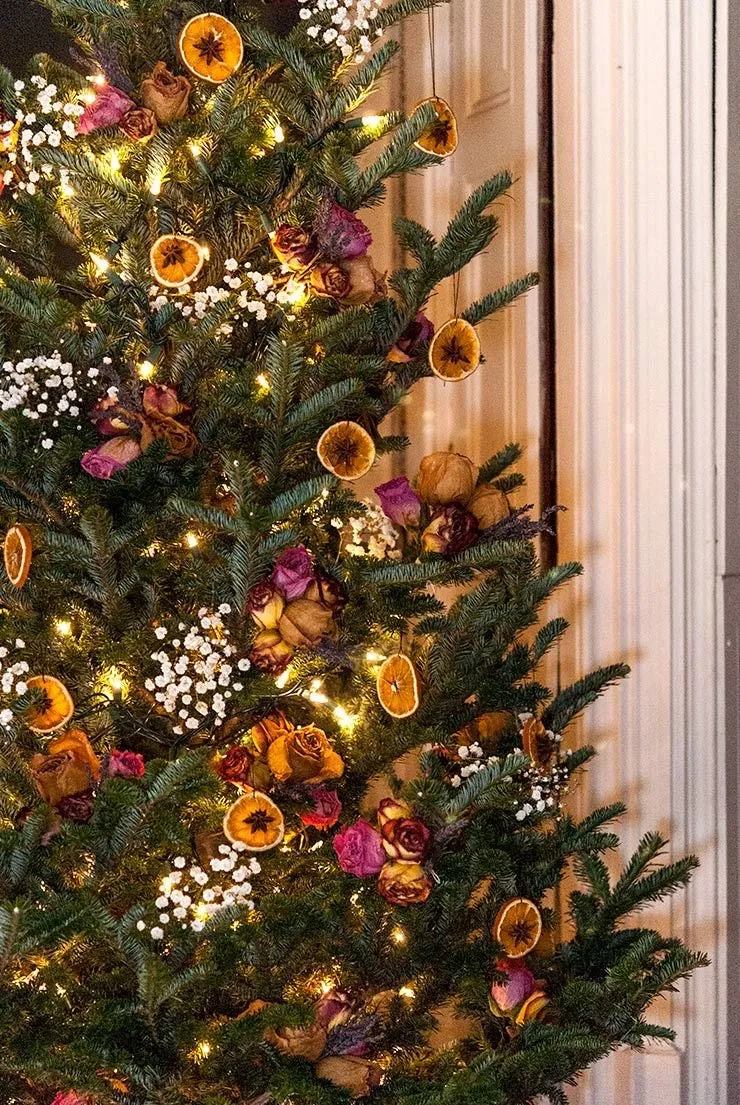
The dried roses are the one thing. Take them out and you’re left with a perfectly nice natural tree that looks like a hundred others. The roses add volume, a matte texture that contrasts with the glossy rind, and a color no one expects on a Christmas tree — that small surprise is what makes people stop and ask where you got the idea.
20. Crafting the Classic Orange Slice Ornament
The most common failure isn’t burning — it’s uneven drying. Slices that sit on a solid baking sheet steam from underneath, go brown in the center, and stay sticky. Use a wire rack over a sheet pan so air moves underneath. If your slices curl at the edges after two hours, they’re drying too hot; drop to 175°F. And if they smell bitter rather than sweet, you left too much pith on the slice — trim it to about 1/8 inch before drying and the flavor turns warm and orangey instead of sharp.
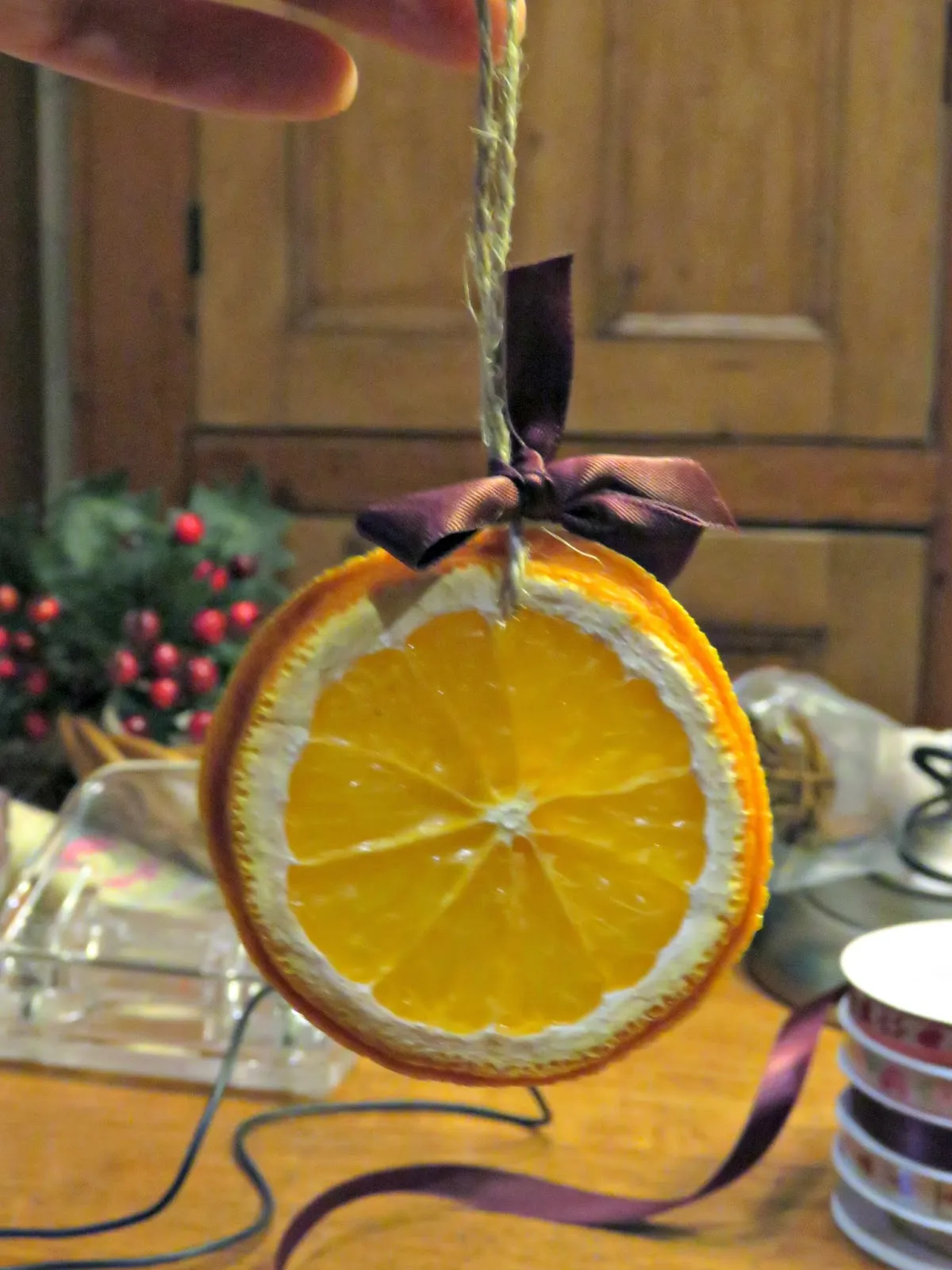
For a needle that slides through without cracking the slice, thread through the rind rather than the center. The outer ring is the toughest part of a dried slice and it acts like a built-in buttonhole. Poke from the pith side out through the rind, knot, and hang — no glue, no wire, no tearing.
21. Natural Orange Accents for a Whole-Home Glow
Dried citrus scales up better than most decor because the material is cheap. For an entry, one bundle or a small garland is enough. For a staircase banister, plan on one cluster every 18 to 24 inches. A whole-home treatment across a 1,600-square-foot house typically runs 60 to 90 dried slices, which is about 12 to 15 oranges — under $15 of fruit if you buy bags in December, and closer to $8 in January when grocery stores discount citrus.
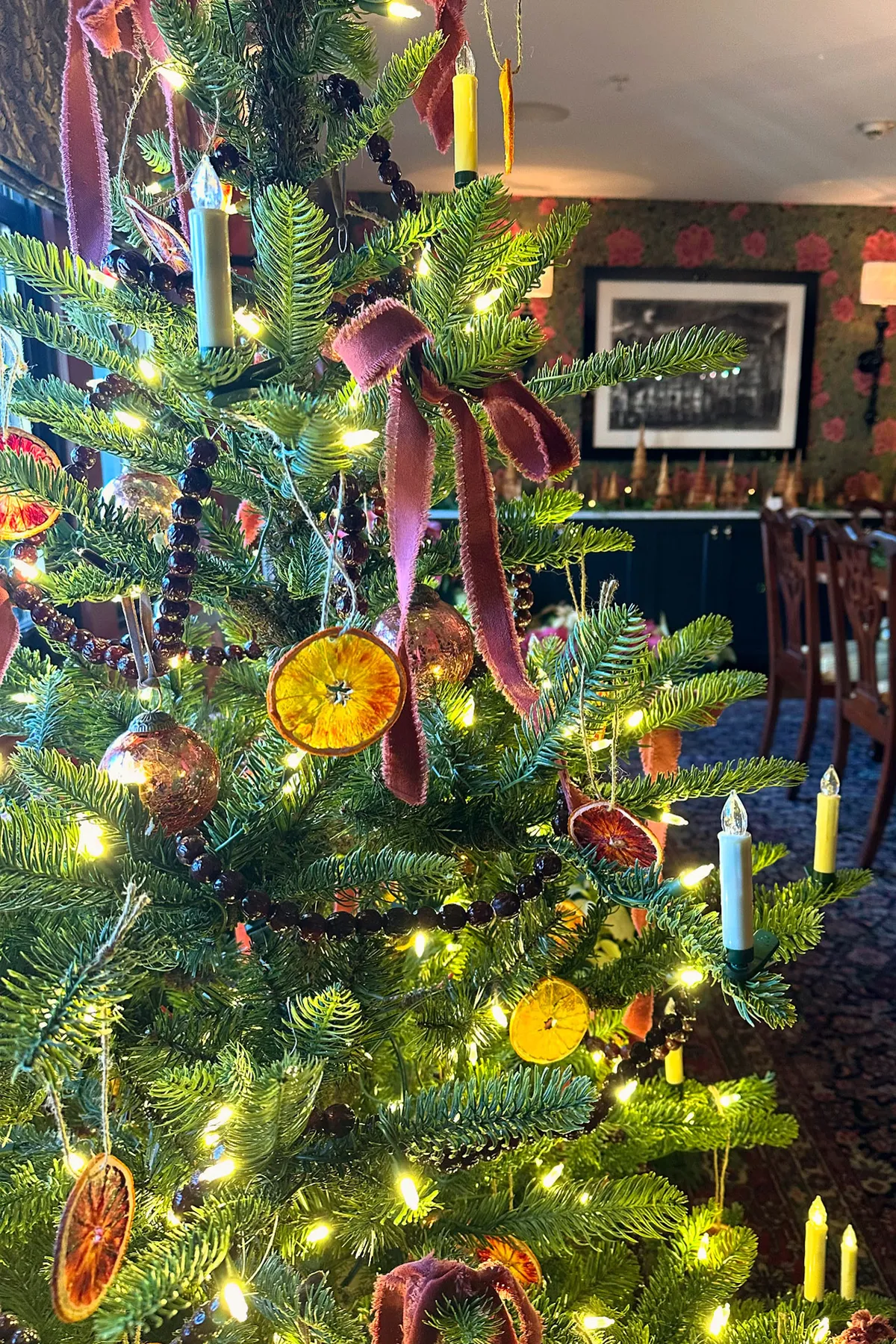
Set a calendar reminder for the day after New Year’s. Take everything down, brush off any dust with a dry pastry brush, and store slices flat in a paper bag in a closet rather than a plastic bin. Plastic traps residual moisture and turns a good batch soft and moldy by the following November. Kept dry, slices hold their color for three to five years — a full decade if they never see direct sun.
22. Dried Orange Slices and a Golden Pinecone
The golden pinecone is the whole reason this tree corner looks curated instead of homemade. Everything else is matte and natural — the translucent slice, the dried orange peel sphere, the white bead. The pinecone brings a metallic sheen that reflects the string lights and gives the eye a tiny, unexpected sparkle. Without it, you have a pleasant collection of brown things. With it, you have a scheme.
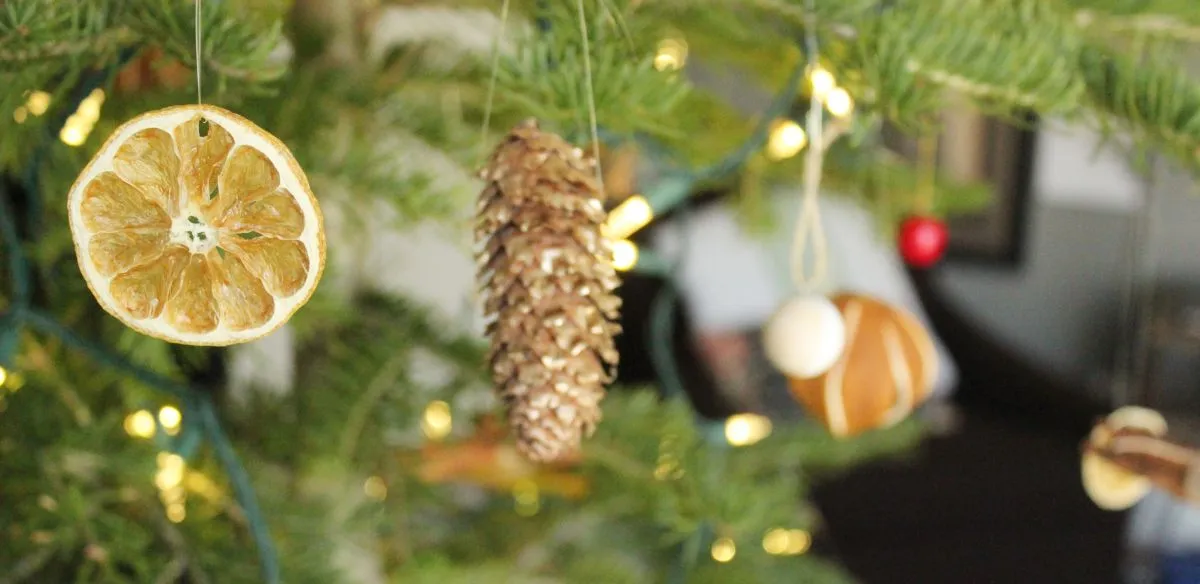
Paint your own. Plain pinecones from the yard or a dollar store cost nothing, and a $5 bottle of gold craft paint covers a dozen of them. Dip just the tips rather than spraying the whole cone so the natural brown shows through — full coverage looks plastic. The spherical dried orange peel ornaments are also free if you’re already drying slices, since they use up the rinds you’d otherwise throw away.
23. California Natural Accents in Citrus and Pine
The California approach to holiday decorating has been spreading east for a few years now — less snow globe, more olive branch and citrus grove. It borrows from Mediterranean Christmas traditions where dried fruit, nuts, and greenery carry the whole scheme, and it suits anyone who’d rather skip the tinsel entirely. In 2026 it’s showing up in neutral, sun-bleached palettes that transition easily into January decor, which is part of the appeal.
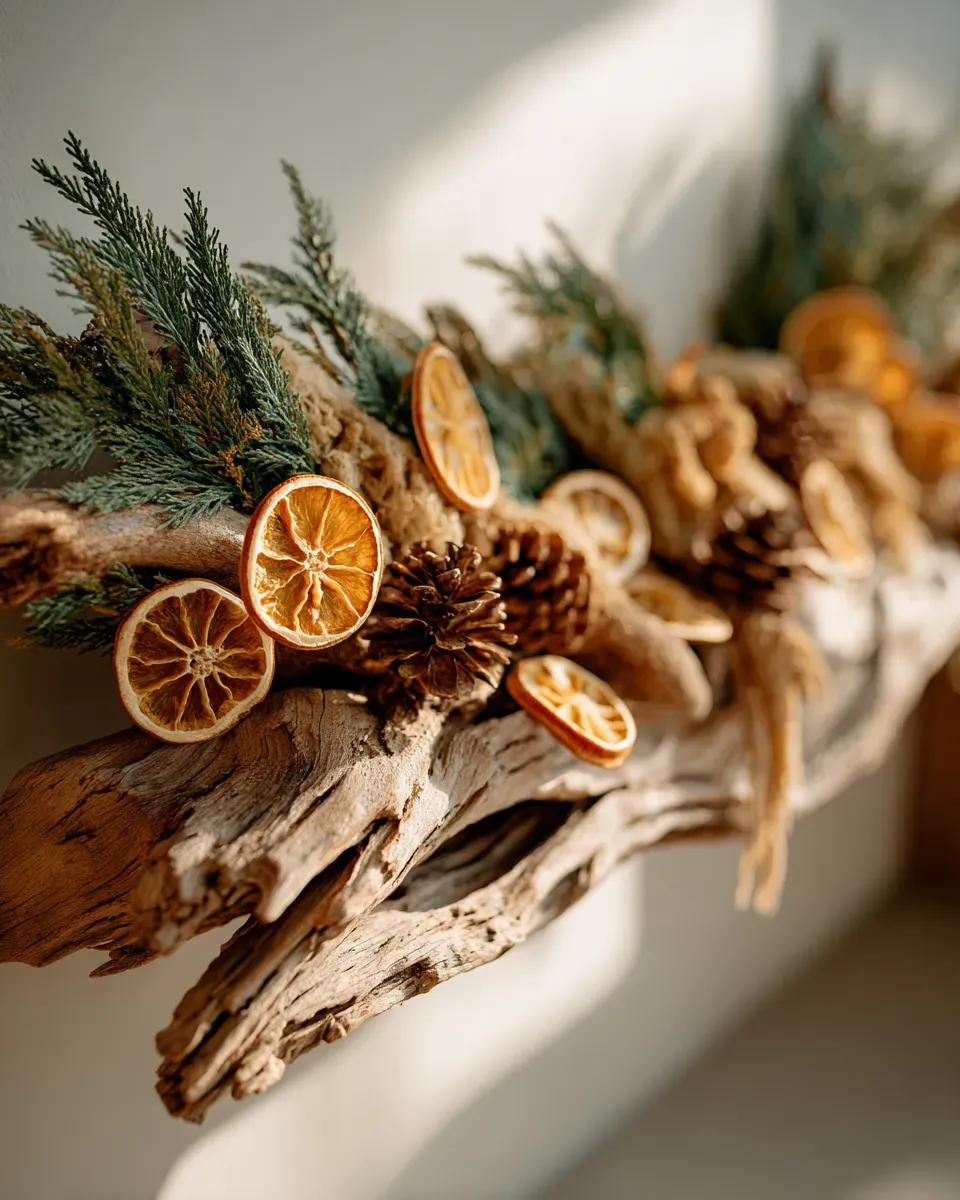
One warning if you’re already deep in traditional reds and greens: this style doesn’t blend well with them in the same room. Pick a zone — the dining room goes Mediterranean, the living room stays classic. Mixing both across an open floor plan tends to read as two half-finished rooms rather than one deliberate house.
24. Fruit and Seed Pods Dangling from a Wooden Beam
Asymmetry is doing the work here. Nothing hangs at the same height, no two elements match, and the rough brick behind it stays mostly empty — which matters more than people realize. Without that negative space, the hanging pieces would read as clutter against a busy wall. The dried citrus slices bring the color, the seed pods bring structure, and the small red berries repeat just often enough to tie the whole run together.
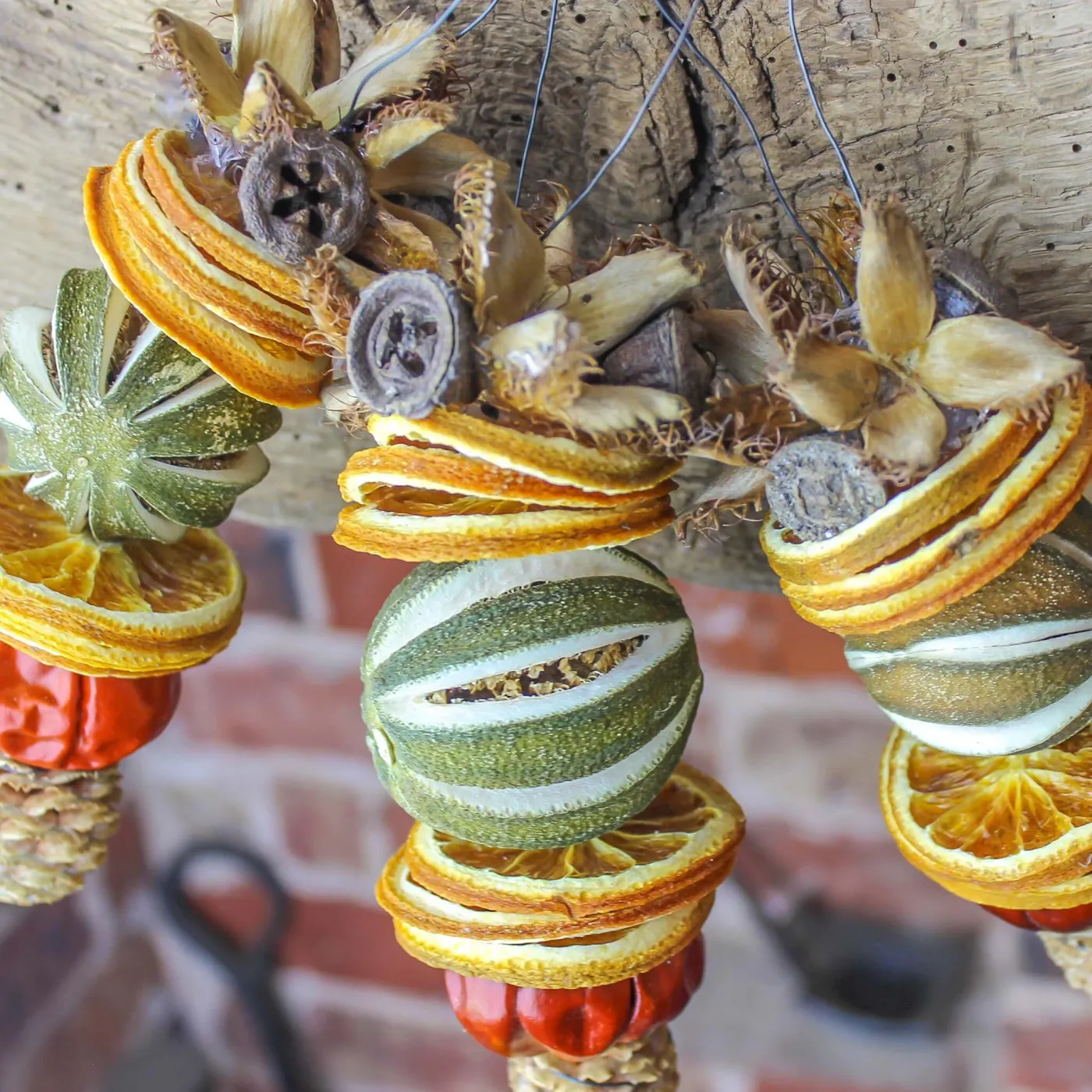
Hang in 2-inch increments. Pick a top reference point, then drop your pieces at 0, 2, 4, 6, 8, and 10 inches below it — not randomly, and not evenly at 6 inches apart, which reads as a regimented row. The irregular-but-measured rhythm looks organic and stays easy to adjust when one piece is too long.
25. Homemade Orange Peel Ornaments
- Score an orange peel into a continuous 1/2-inch-wide spiral with a vegetable peeler.
- Wrap the strip around a wooden spoon handle and secure both ends with twine.
- Let it dry three to five days in a warm, dry room until it holds its curl.
- Slide it off the handle and thread ribbon through the coil.
- Hang where it can catch a little air movement so it finishes drying.
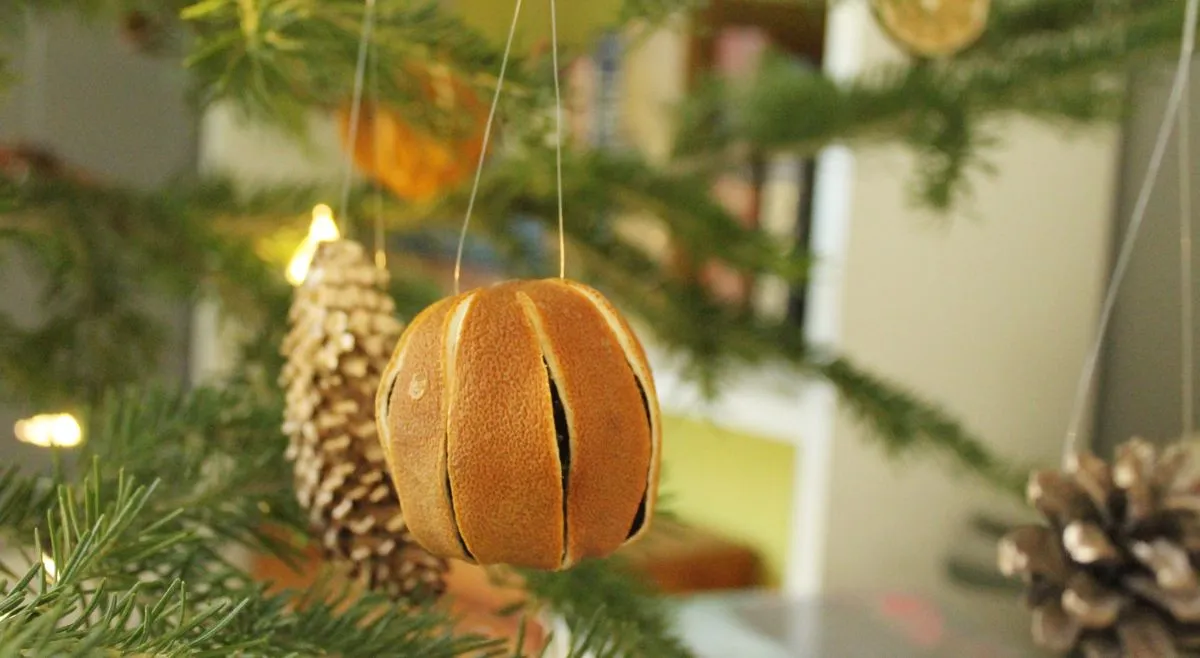
Roughly ten minutes of hands-on time and five days of patience per batch.
The continuous spiral is everything. If you cut the peel into separate strips instead, you get a handful of anonymous curls. One unbroken strip coiled from a single orange reads as a deliberate object — and it uses the part of the fruit you’d otherwise compost.
26. An Evergreen Garland with Cranberry and Citrus Strings
- Faux evergreen garland, 9 feet: $25 to $70
- Eight oranges, dried into 65 slices: $6 to $12
- Three bags of fresh cranberries: $6 to $9
- Upholstery needle and cotton twine: $5 to $8
- Warm-white string lights, 20 feet: $12 to $25
- Total: $54 to $124
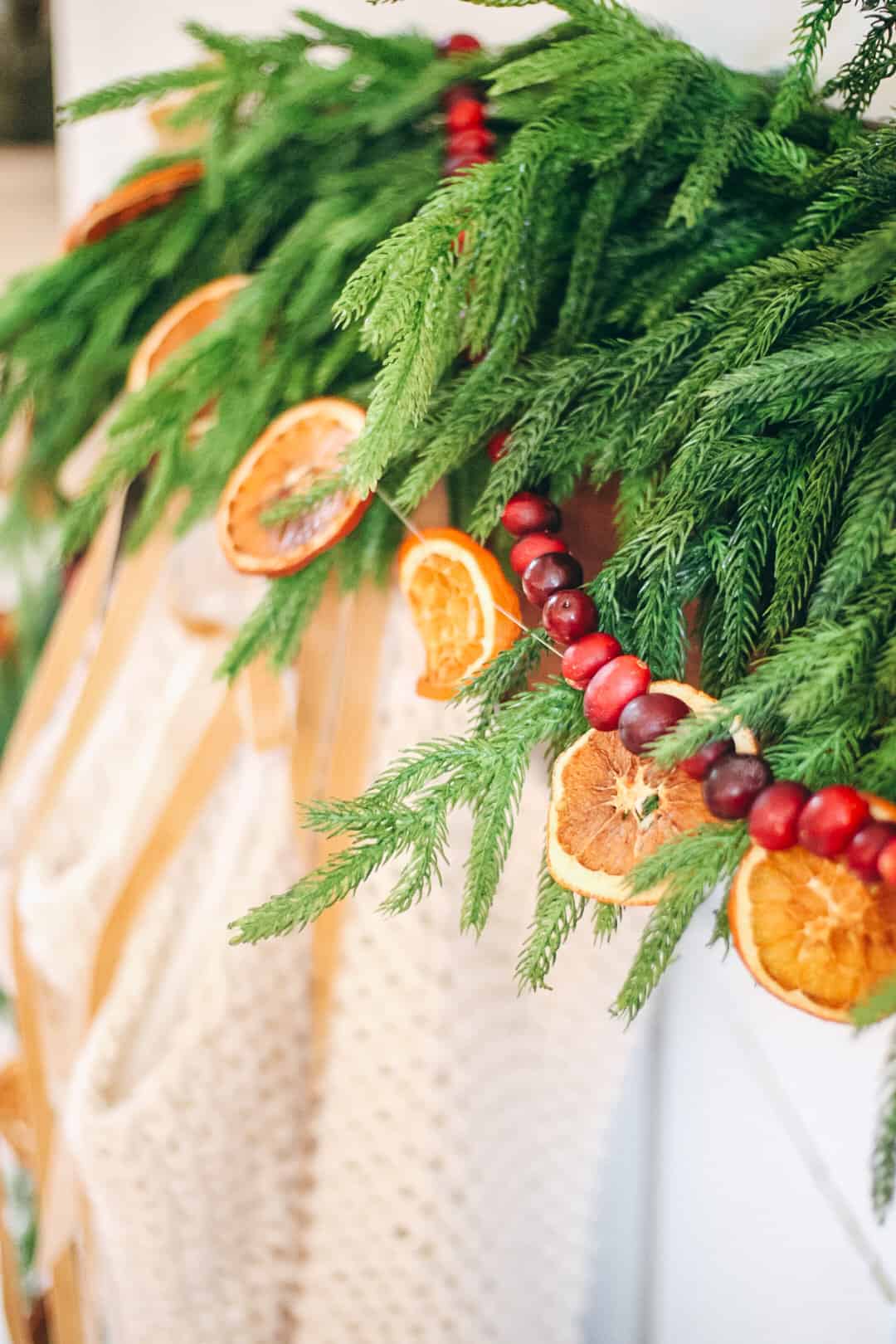
Budget alternative: skip the lights and use garland you already own. Cranberries threaded on plain twine cost about $2 a foot and look best for ten to fourteen days before they start to wrinkle — so plan them for the two weeks you actually host.
Balance it like this: 55 percent evergreen, 20 percent cranberry red, 15 percent dried orange, 10 percent that soft cream textile. The cream is what keeps this from feeling like a strictly traditional red-and-green display.
27. Building DIY Fruit Ornaments from Scratch
Seal the slices and they’ll hold color for years instead of fading to beige. One coat of matte Mod Podge or a light spray of clear shellac on each side does it. Matte finishes look natural and hide fingerprints; gloss makes the slices look like candy and shows every smudge. Two thin coats beat one thick coat every time — thick sealer stays tacky in humid rooms and collects dust in a way you can’t wipe off.
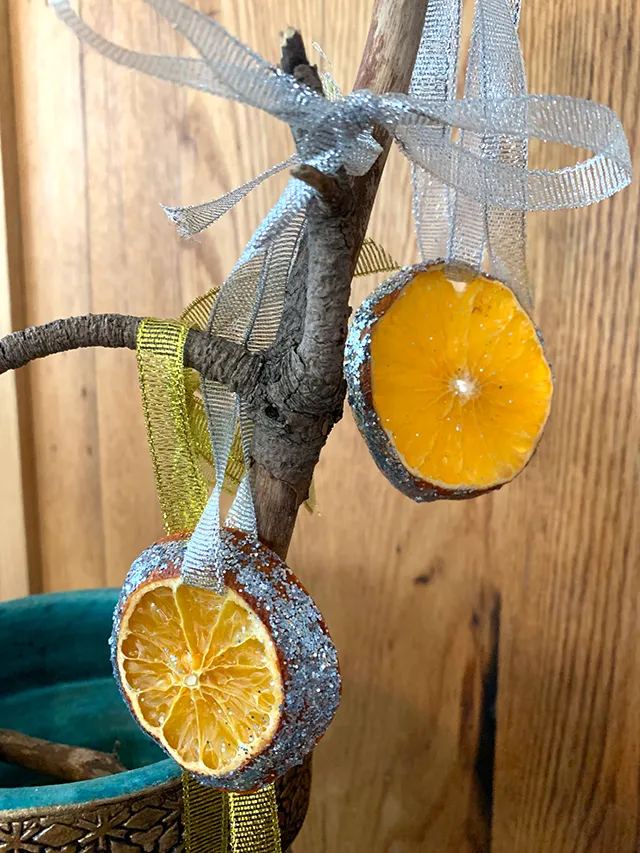
Before you seal anything, check for pets. Dried citrus rind isn’t a chew toy, and both cats and dogs will go after ornaments that smell like food. Citrus oils are irritating to them in larger amounts, so hang fruit ornaments on the upper half of the tree in households with animals, and skip the ones with loose berries that can be batted to the floor.
28. A Spice Wreath with Pinecones and Faux Dried Fruit
Faux dried fruit has one advantage: it never attracts pantry moths or fruit flies the way real dried citrus sometimes can. It also never fades. The trade-off is that it looks flat and slightly waxy up close, and it collects dust in the crevices. Blast it with a hairdryer on the cool setting for thirty seconds every month or two and it’ll look new. Never wash it — water lifts the flocking and leaves water spots on the faux fruit finish.
A 40-centimeter wreath, which is about 16 inches across, is the sweet spot for a standard 36-inch front door. On a door narrower than 32 inches it will crowd the frame; on a double door you’d want two of them or one at 24 inches. Interior doors in hallways do well with the smaller 12-to-14-inch size, since you’re viewing them from just a few feet away.
29. Drying Fruit and Preserving Leaves for Winter
- Mix one part glycerin to two parts warm water in a shallow pan.
- Submerge clean leaves and weigh them down so they stay under.
- Leave them three to five days, until the leaf surface feels slightly oily.
- Blot dry and press flat between newspaper for a week.
- Store in a paper envelope away from light.
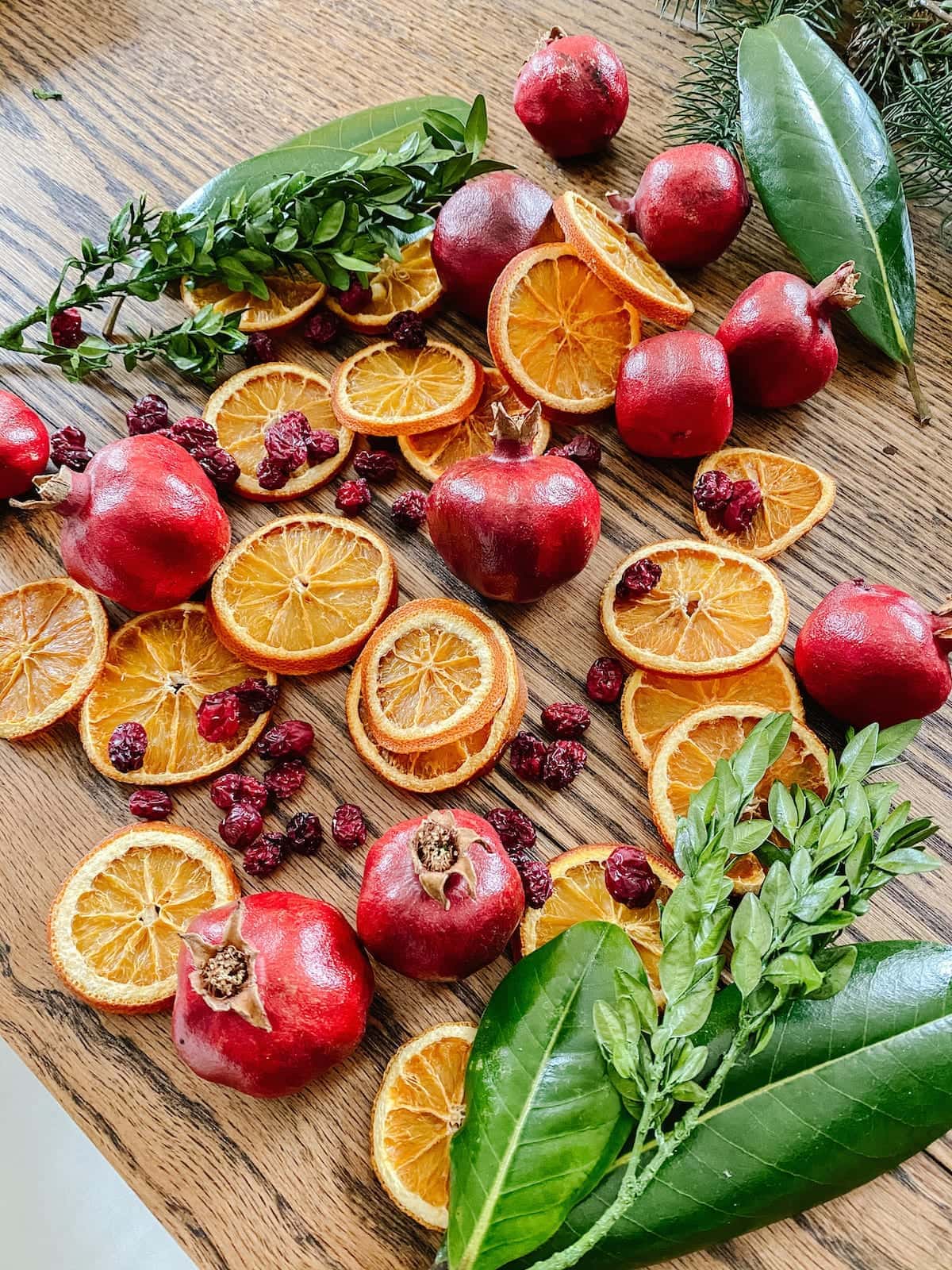
About a week of passive time, roughly $8 of glycerin for a large batch.
Preserved leaves and dried citrus are a genuinely good pairing because they contrast in the right way: leaves stay soft, matte, and flexible, while dried slices go crisp and translucent. One absorbs light, one throws it. Putting both in the same garland gives you a texture conversation you don’t get from greenery alone.
30. Orange Slice Napkin Rings for the Table
The tie is what separates a nice napkin ring from a piece of fruit with string on it. A single knot reads unfinished. Two wraps of fine twine, a small knot, and one clean tail trimmed on a steep angle reads as a product. Add a sprig of rosemary or a cinnamon stick tucked behind the slice and it looks like it came from a shop, which is exactly the point of a two-minute project.
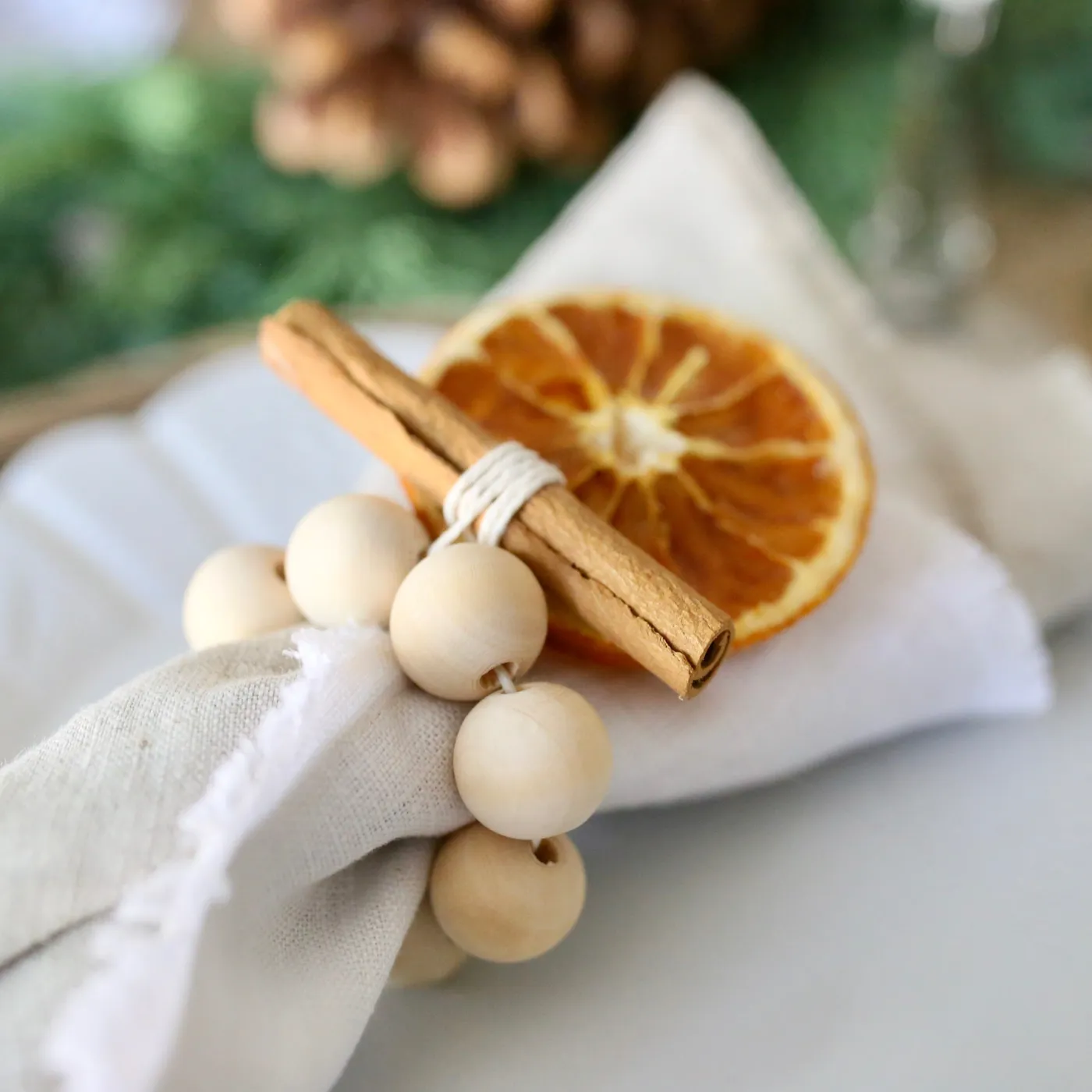
Under a dollar per ring if you buy the oranges at a grocery store in December. Skip the $4 wooden beads and use a small cinnamon stick instead — same warm brown, plus it actually smells like something. If you’d rather not dry your own, a bag of pre-dried slices online runs $12 for about fifty, which is enough for a full table setting plus a garland.
31. A Yuletide Candle Arrangement with Dried Fruit
Build the height in layers: 60 percent of your candles at one tall height, 25 percent at a middle height, 15 percent at a low stub. That’s roughly a 1-inch difference between tiers for small arrangements and 2 to 3 inches for a mantel-scale one. The dried fruit should sit in the lowest band, resting on the surface, and the greens should spill just over the edge to connect the arrangement to the table.

Keep dried citrus at least 3 inches from any flame. Fruit that close will char and smoke before it ever catches, and the smell is genuinely unpleasant. If you want the glow without the worry, use battery-operated pillars for the tall tier and save real candles for the center, where they’re surrounded by moisture-rich evergreen rather than dry fruit.
32. A Simple DIY Citrus Slice Ornament
- Dry slices completely — they should snap, not bend, before you hang them.
- Thread a 6-inch length of thin cotton twine through the rind.
- Tie a double knot on the back side and trim the tail short.
- Loop the ends and knot to form a hanging ring.
- Hang on upper branches only, out of reach of curious pets.
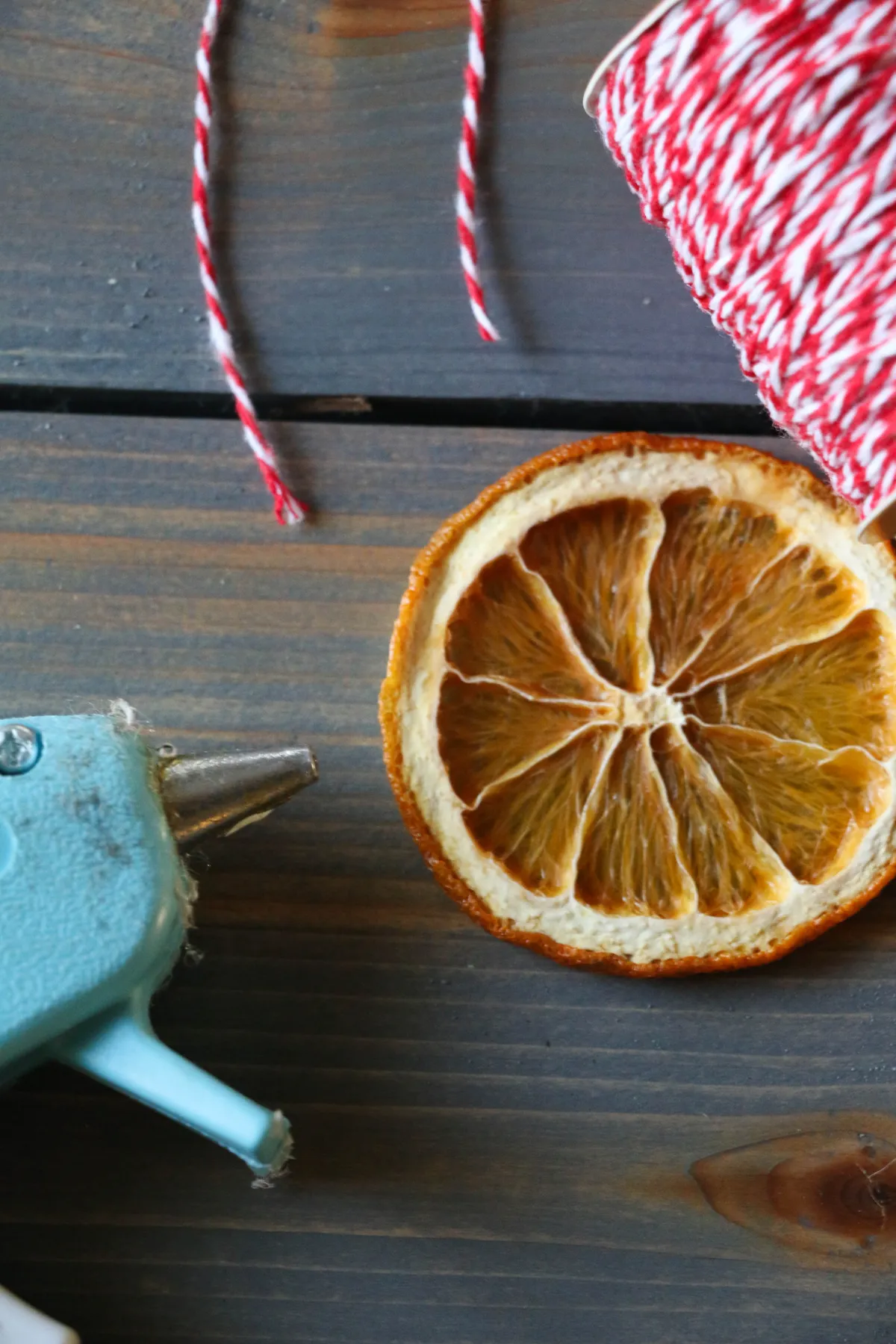
Three minutes per ornament once your slices are dry.
Honest note: these are decorative, not edible, and that distinction matters in a house with pets or toddlers. Dried rind is tough and stringy, and while a nibble is unlikely to cause real harm, citrus oils can upset a small animal’s stomach. Hang them high, and choose twine over wire so nothing rusts if your home runs humid in winter.
33. Stringing a Citrus Garland End to End
Slow decorating is the through-line for holiday style right now — fewer purchased things, more made-by-hand things, and length of process as part of the pleasure. A citrus garland is the perfect ambassador for that idea because it’s cheap, it takes an evening of threading, and it looks better the longer it hangs. It’s also the rare trend that costs almost nothing to try, which is why it keeps resurfacing every December instead of burning out.
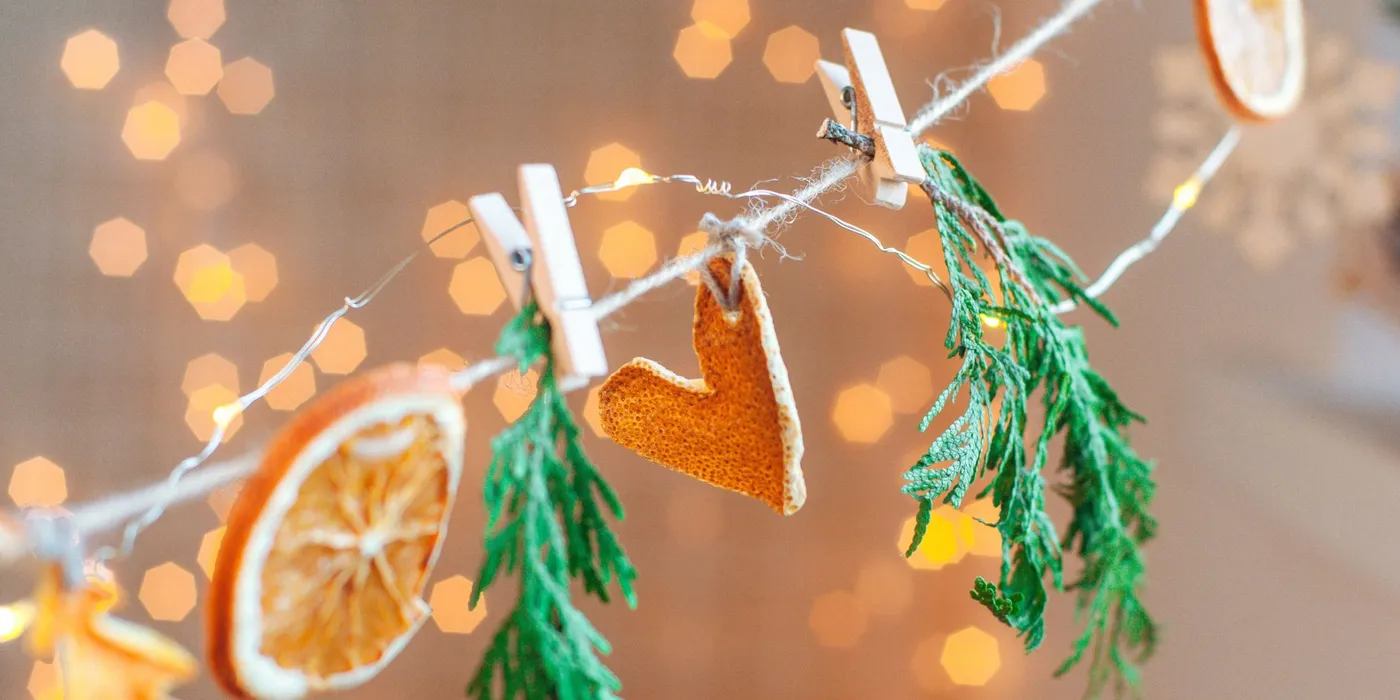
Plan on one dried slice per 2 inches of garland, with a pinecone every 8 to 10 inches. A single orange yields 8 to 10 usable slices, which gives you close to 20 inches of garland per fruit. So ten oranges gets you roughly 16 feet — enough for a mantel, a banister, or a doorway with some to spare. Thin slices need tighter spacing; thicker ones look sparse at 2 inches apart.
34. Keeping a Dried Orange Garland Fresh for Years
What makes a long garland readable from across a room is variation, not repetition. Mix slice sizes — small clementine slices next to big navel rounds — and the eye keeps moving instead of scanning a uniform orange line. Alternate a few darker blood orange slices for depth, and let the pinecones break the color every foot or so. Same material, three different scales, completely different result.
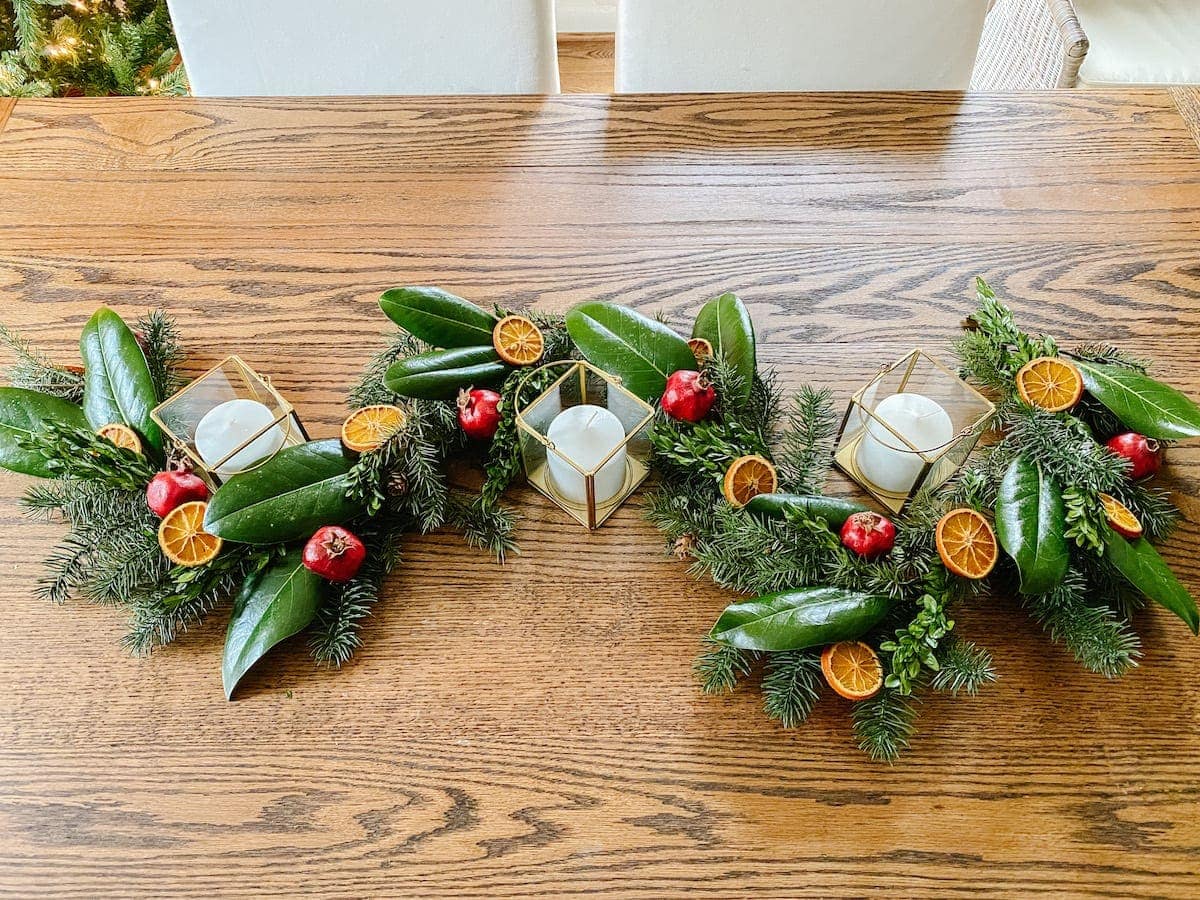
Store your garland wound around a cardboard tube, not folded in a box, so slices don’t crack at the thread holes. Keep it out of damp basements and away from cedar chests, where aromatic oils can leave a film. Stored dry, a well-sealed garland looks good for five years. Unsealed ones fade to a soft tan after about three — which, honestly, still looks nice against evergreen.
35. Drying Orange Slices So They Actually Last
- Wash and dry the oranges, then trim the navel end flat.
- Slice 1/8 inch thick with a sharp knife or a mandoline.
- Blot both sides with a towel to remove surface juice.
- Arrange in a single layer on a wire rack over a sheet pan.
- Bake at 200°F for 3 to 4 hours, flipping every hour.
- Cool completely, then store flat in a paper bag.
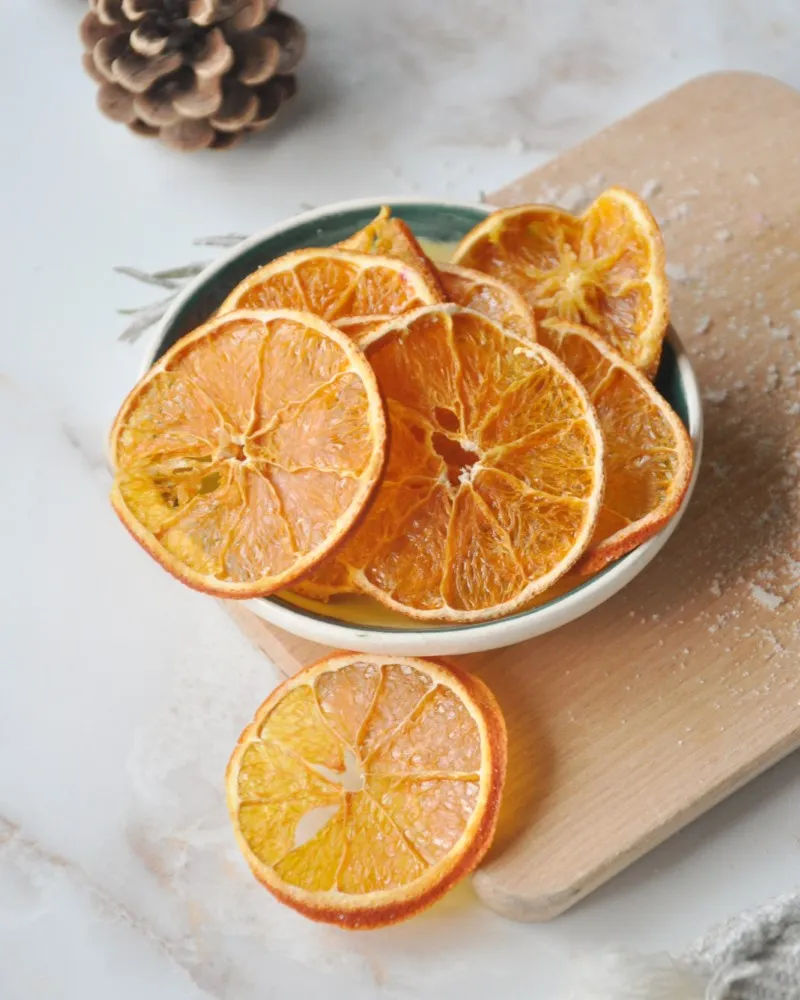
One afternoon, about $5 of fruit for two dozen slices.
Buy a mandoline. Hand-slicing always produces a few 3/16-inch slices hiding in the pile, and those are the ones that stay soft and eventually mold. A $20 mandoline gives you uniform 1/8-inch slices in a quarter of the time, which sounds fussy until you’ve thrown away an entire batch because three thick slices ruined the bag.
Your Windowsill Is About to Smell Like Christmas
Start with one orange, one sharp knife, and a wire rack — that’s genuinely all it takes to get going, and everything else in this guide builds on that first batch. Whether you string a simple garland or go full mantel village, dried citrus rewards the small amount of effort with something that looks collected, smells incredible, and costs almost nothing.
📌 Pin your favorite idea now so it’s waiting for you when December gets busy — and tag us when your windowsill starts smelling like Christmas.